My Son Raised My Rent to $1,200—Then He Opened My Empty Bedroom Door.k
PART2:
Barbara was sixty-two, healthy, energetic, and perfectly capable of living independently.
She had recently sold a house outside San Antonio after owning it for nearly twenty years, and according to Jessica, she’d made “an absolute killing.”
I never asked how much.
Jessica told me anyway.
“Over four hundred thousand after everything.”
She said it over coffee one morning as though announcing a lottery win.
“That’s wonderful for her.”
“She deserves it.”
“I’m sure she does.”
At that point, I had no reason to think Barbara moving in had anything to do with me.
Jessica presented it as temporary.
“My mom wants to take her time deciding where to buy next.”
“How long will she stay?”
“A few months.”
I nodded.
It wasn’t my house.
The first indication that there were very different definitions of “guest” came on moving day.
When I moved in, Tyler had put me in the smallest upstairs guest room.
It was pleasant enough.
One window.
Small closet.
Room for a queen bed, narrow dresser, and armchair if you turned everything carefully.
I had never complained.
Barbara arrived and was immediately given the downstairs mother-in-law suite.
It was nearly twice the size of my room.
Private bathroom.
Walk-in closet.
Separate sitting area.
French doors leading directly to the pool.
Jessica spent the entire morning arranging flowers on Barbara’s dresser.
Tyler carried in boxes.
I carried in boxes too.
By sunset, Barbara was sitting on the patio with a glass of white wine saying:
“I think I can make this work.”
I nearly laughed.
The next morning, Jessica moved her car out of the garage.
I assumed contractors were coming.
Then Barbara pulled her Lexus into the empty space.
Jessica saw me looking.
“Mom hates getting into a hot car.”
I waited.
“She gets lightheaded.”
Barbara had played pickleball for two hours the previous afternoon in ninety-six-degree heat.
I said nothing.
My Buick remained on the street.
Then the pantry changed.
Barbara cleared two shelves for organic crackers, imported olive oil, supplements, protein powders, expensive tea, and jars of things I couldn’t identify.
Two shelves became four.
Then half the pantry.
She moved the cereal because she disliked “visual clutter.”
She replaced Tyler’s coffee.
Rearranged the living room furniture.
Moved a lamp William had bought me because she thought it made the room “too heavy.”
Then she removed three framed family photographs from a console table and replaced them with her watercolor paintings.
Not terrible paintings.
Not good either.
One afternoon I found the family photographs stacked face-down in a drawer.
I put them back.
The next morning, they were gone again.
I found Jessica in the kitchen.
“Where are the pictures?”
“What pictures?”
“The photographs from the console.”
“Oh. Mom needed wall space.”
“One was Tyler with his father.”
Jessica glanced toward the family room.
“We have plenty of pictures.”
I stared at her.
She kept slicing strawberries.
I should have understood then.
Instead, I told myself not to be territorial.
It wasn’t my house.
That phrase became my excuse for almost everything.
Barbara complained the mattress was too firm.
Two days later, a delivery truck brought a memory-foam mattress.
Barbara said the pool was chilly.
Tyler raised the water temperature.
Barbara wanted a television in her sitting area.
One appeared.
She wanted blackout curtains.
Installed.
She disliked the inexpensive showerhead.
Replaced.
Then one evening, Jessica came into the kitchen while I was making chicken.
“Mom wants salmon.”
“I’m making chicken.”
“She’s been craving salmon.”
“There’s chicken.”
“Could you run to Central Market?”
I looked at the pan.
“Now?”
“Wild-caught, please.”
Jessica smiled as if asking me to pick up bread.
I should have said no.
Instead, I turned off the burner.
Drove twelve minutes.
Paid thirty-eight dollars for salmon.
Came home.
Cooked two dinners.
Nobody offered to reimburse me.
That happened more than once.
I had gradually become the unpaid household manager.
Groceries.
Dinner.
Dog walking.
Packages.
Contractors.
Dry cleaning pickups.
Waiting for the plumber.
Letting the pool technician through the gate.
Running to the pharmacy when Jessica didn’t want to go.
I didn’t mind helping at first.
I had time.
I loved Tyler.
And after William died, being needed felt dangerously close to being loved.
That’s one of the things nobody warns widows about.
When your life has revolved around another person for forty-three years, usefulness can become addictive.
A request feels like purpose.
Until you realize the requests never stop.
The rent conversation happened about a month after Barbara moved in.
Tyler came home early one afternoon.
I was putting away groceries.
He stood on the opposite side of the kitchen island.
“Mom, can we talk about something?”
“Of course.”
Jessica joined him.
That should have warned me.
Tyler slid a sheet of paper across the counter.
A handwritten agreement.
Nothing formal.
Nothing complicated.
Rent.
$900 a month.
I read it.
Then looked at him.
“What is this?”
He rubbed his neck.
“Jess and I have been talking.”
Jessica folded her arms.
“Everyone needs to contribute.”
I looked around the kitchen.
There were three grocery bags I’d just purchased.
“Everyone?”
Tyler said:
“You know what I mean.”
“No. I don’t.”
He sighed.
“Utilities are up.”
“Because the pool is heated.”
Jessica frowned.
“That’s not the point.”
“Food costs are up.”
“I buy most of the food.”
“We appreciate that.”
“I cook.”
“We appreciate that too.”
“I take care of Baxter.”
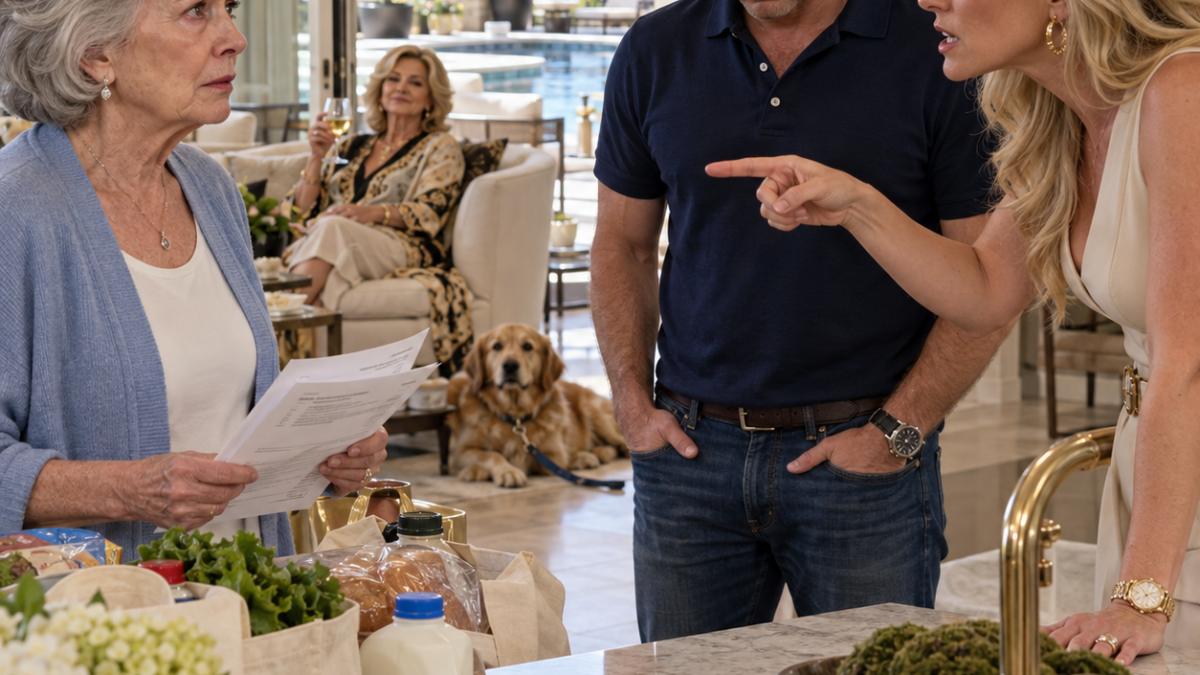
Their old golden retriever lifted his head from beside the pantry when he heard his name.
“I stay here when contractors come.”
Jessica said:
“Those things aren’t rent.”
I looked through the glass doors.
Barbara was stretched across a chaise lounge beside the pool wearing sunglasses and reading a magazine.
“How much does Barbara pay?”
Jessica’s entire face changed.
“My mother’s situation is different.”
“How?”
“Her capital is tied up.”
“In what?”
“Investments.”
“She just sold a house.”
“That money is for her future.”
The irony was so perfect I almost admired it.
“And mine isn’t?”
Jessica looked at Tyler.
He took over.
“Mom, nobody is attacking you.”
“I didn’t say anyone was.”
“It’s nine hundred dollars.”
“I can read.”
“You can afford it.”
That sentence bothered me.
Not because it was wrong.
Because of how easily he said it.
“How do you know what I can afford?”
He hesitated.
“I mean… you’re okay.”
“Yes.”
“So it’s not a hardship.”
I looked at my son.
A man I’d once driven to emergency rooms at two in the morning.
A man William and I had helped through college.
A man I had handed twenty thousand dollars to only months earlier.
I could have said all of that.
I didn’t.
Instead:
“When does this start?”
“Next month.”
I signed.
That was my mistake.
Not because $900 harmed me.
It didn’t.
I signed because I still believed peace was worth buying.
For several months, I paid.
Nine hundred dollars on the first.
Groceries throughout the month.
Dog food.
Household supplies.
Laundry detergent.
Paper towels.
Cleaning products.
Occasional meals out when Jessica “forgot her card.”
I never calculated the total until later.
When I finally did, my contribution averaged somewhere around seventeen hundred dollars each month.
And that was before assigning any value to my time.
Meanwhile, Barbara paid nothing.
Not utilities.
Not groceries.
Not household help.
Nothing.
She did occasionally buy wine.
For herself.
And once she bought hand soap for the downstairs bathroom.
Jessica praised her for three days.
“Mom picked that scent herself.”
I began wondering whether grief had actually made me stupid.
The house changed too.
Not physically.
Emotionally.
When I first arrived, Tyler would sit with me after dinner.
We talked about William.
Sports.
His business.
Anything.
By the seventh month, he mostly disappeared into his office.
Jessica started calling the family room “our private sanctuary.”
The first time, I thought she was joking.
I walked in one evening carrying tea.
She and Tyler were watching television.
Jessica paused the show.
“We’re having couple time.”
“Oh.”
“No offense.”
“None taken.”
I went upstairs.
A week later, I invited my friend Ruth over for coffee.
Ruth had lived two floors below William and me at the condo.
She arrived at eleven.
Left at twelve-thirty.
That evening Tyler knocked on my bedroom door.
“Mom, can you give us a heads-up before having people over?”
I stared.
“I did. I told Jessica this morning.”
“She meant more notice.”
“How much?”
“Maybe a few days.”
“For coffee?”
“It’s just respectful.”
I looked toward the hallway.
Barbara had three friends by the pool that afternoon.
I could hear them laughing.
“How much notice did Barbara give?”
Tyler shut his eyes.
“Mom.”
“What?”
“Why do you keep making everything about Barbara?”
“Because your rules seem to change depending on which mother they apply to.”
He looked genuinely offended.
“That’s not fair.”
I almost apologized.
Old habits are hard to kill.
Instead I said:
“Maybe.”
And closed my door.
That was the first time I didn’t apologize simply because my son looked uncomfortable.
The cardboard boxes arrived on a Tuesday.
I had been at the library.
When I came upstairs, six large boxes were stacked beside my dresser.
Another two sat beneath the window.
I couldn’t fully open the curtains.
I walked downstairs.
Jessica was at the kitchen island.
“What’s in my room?”
She didn’t look up.
“My mom needed storage.”
“Why is it in my bedroom?”
“Her closet’s full.”
“There are three other bedrooms.”
“One is Tyler’s office.”
“I know.”
“One is the workout room.”
“I know.”
“And we need the other one available for guests.”
I stared at her.
“I live here.”
“Yes.”
“So my bedroom is less important than a guest room?”
She sighed.
“Eleanor, they’re boxes.”
“They block half my window.”
“Move them to the other side.”
“There isn’t another side.”
“Then maybe consolidate your things.”
That sentence did it.
Not loudly.
Not dramatically.
Something inside me simply stopped cooperating.
I went upstairs.
Closed the door.
Sat on my bed.
Looked at the boxes.
Then called Diane Foster.
Diane had been our financial advisor for twenty-six years.
William distrusted nearly everyone who wore a suit, but he trusted Diane.
She had talked us out of selling during two market crashes.
Stopped William from buying a ridiculous timeshare in Cabo.
Once spent an entire afternoon explaining Medicare to us without visibly losing patience.
She answered on the third ring.
“Eleanor.”
“Are you busy?”
“For you? No.”
“I want to ask something.”
“Go ahead.”
“Can I afford to live alone?”
Silence.
Then:
“Eleanor.”
“Yes?”
“Are you asking whether your portfolio can support independent housing?”
“Yes.”
Another pause.
“Where are you?”
“In my bedroom.”
“Alone?”
“Yes.”
“Good.”
Her voice changed.
“Why are you asking this now?”
I looked at Barbara’s boxes.
“Because I think I’ve stayed somewhere too long.”
Diane didn’t immediately give me numbers.
That’s why she was good.
She asked questions first.
Did I want to rent or own?
Austin proper or surrounding area?
Condo?
Townhome?
Senior community?
Did I want stairs?
How much monthly spending made me comfortable?
Did I want travel money preserved?
Long-term-care reserves?
Estate goals?
Then she said:
“Eleanor, you could have afforded to remain in your old condo indefinitely.”
“I know.”
“You can afford another home.”
“I know.”
“You can buy one without touching the assets we earmarked for long-term care.”
I swallowed.
“All cash?”
“If you choose something reasonable.”
“What qualifies as reasonable?”
She named a number much higher than I intended to spend.
I laughed.
“What?”
“You sound surprised.”
“I don’t know why.”
“I do.”
“Why?”
“You’ve spent the last year behaving like a woman who needs permission.”
That stung.
Diane knew it.
She didn’t apologize.
I looked around the small room.
“Can you recommend a realtor?”
“Yes.”
“Someone discreet?”
“Very.”
“Diane?”
“Hmm?”
“Don’t tell Tyler.”
“I would never discuss your finances with your son without permission.”
That sentence should have been obvious.
Instead, it made my eyes fill.
“Thank you.”
“What happened?”
“Nothing yet.”
“But something will?”
“Yes.”
She sighed.
“Then call me before you do anything generous.”
I smiled.
“You know me too well.”
“I know exactly how much money you’ve given people while calling it temporary.”
“Twenty thousand.”
“That’s the one I know about.”
“Just twenty.”
“Good.”
Then she added:
“And Eleanor?”
“Yes?”
“Do not loan Tyler anything else until we talk.”
I didn’t promise.
But I heard her.
The realtor’s name was Nina Patel.
We met two days later at a coffee shop in North Austin.
I told Tyler I was seeing Ruth.
That was the only lie I told.
I didn’t like it.
But by then, privacy inside that house felt impossible without secrecy.
Nina showed me six properties over ten days.
The first was too dark.
The second had a kitchen that looked like an operating room.
The third smelled like somebody’s twenty-year collection of scented candles.
The fourth was beautiful and absurdly expensive.
The fifth made me pause.
Two-bedroom single-story townhome in a quiet community about twenty minutes from Tyler.
Small courtyard.
Oak tree.
Attached garage.
Actual garage.
No stairs.
The living room had tall windows.
The kitchen wasn’t new, but it was bright.
The second bedroom could be a guest room or office.
There was a covered patio in back.
The owner had planted rosemary along the fence.
I stood in the kitchen.
Nina watched me.
“What are you thinking?”
“That William would hate these countertops.”
She smiled.
“Is that good or bad?”
“Good.”
I ran my hand along the edge.
“He’d spend six months complaining and then refuse to replace them because they still worked.”
“Sounds practical.”
“He was cheap.”
“Also practical.”
I walked into the bedroom.
Morning light.
Quiet.
No boxes.
No one else’s belongings.
I opened the closet.
Empty.
For the first time since William died, the thought of living alone didn’t feel like abandonment.
It felt like room.
“How much?”
Nina told me.
I nodded.
“Make the offer.”
She blinked.
“Do you want to sleep on it?”
“I’ve spent eight months sleeping on things.”
She smiled.
“Fair enough.”
My cash offer was accepted two days later.
Closing in three weeks.
I told no one in Tyler’s house.
I kept paying rent.
Kept buying groceries.
Kept cooking.
But something had changed.
Once you know where the exit is, a locked room feels different.
I started packing slowly.
Not visibly.
One drawer at a time.
Important papers went to a safe-deposit box.
Jewelry went with Ruth.
Winter clothes into suitcases stored in Nina’s office storage room for a few days.
William’s photographs came down last.
Jessica barely noticed.
Then Tyler announced the rent increase.
Sunday evening.
Dinner.
I had made meatloaf.
Barbara complained it needed more salt.
Tyler cleared his throat.
“Mom, we need to adjust your rent.”
I looked at him.
“Adjust.”
“Utilities and property taxes have gone up.”
“How much?”
“Twelve hundred.”
I set down my fork.
“From nine hundred.”
“Yes.”
“When?”
“Next month.”
Barbara kept eating.
Jessica drank wine.
I looked at Tyler.
“Does Barbara’s rent increase too?”
Silence.
Jessica put down her glass.
“My mother doesn’t pay rent.”
“I know.”
“So why are you asking?”
“Because I’d like to understand.”
Jessica leaned back.
“My mother’s financial arrangements are none of your business.”
“Fair.”
I nodded.
“Then neither are mine.”
Tyler exhaled.
“Mom, don’t make this difficult.”
“I asked a question.”
“You always compare yourself to Barbara.”
“Because we are both mothers living in the same house.”
Jessica’s face hardened.
“My mother is family.”
Nobody moved.
Not even Barbara.
I looked at Jessica.
Then at Tyler.
“What exactly am I?”
Jessica’s eyes flicked away.
Tyler gave a little shrug.
I will remember that shrug longer than the words.
“If you don’t like my rules,” he said, “find somewhere else to live.”
There it was.
The permission I no longer needed.
I nodded.
“All right.”
Tyler frowned.
“What?”
“I said all right.”
Jessica looked suspicious.
“Meaning?”
“Meaning I heard you.”
Barbara took another bite of meatloaf.
“Could somebody pass the salt?”
I handed it to her.
Dinner continued.
That was Sunday.
My closing was Wednesday.
I became the legal owner of my new home at 10:42 in the morning.
I drove there afterward alone.
Unlocked the door.
Walked inside.
Nothing.
No furniture.
No voices.
No dog nails on tile.
No television.
No Jessica calling from another room.
I stood in the empty living room and cried.
Not because I was sad.
Because I had forgotten silence could belong to me.
I sat on the floor with my back against the wall.
Then laughed.
William would have hated the countertops.
I could hear him already.
“Eleanor, somebody charged money for this?”
I laughed harder.
The movers came the following Thursday.
I chose the date carefully.
Jessica and Barbara had a spa appointment.
Tyler had a commercial landscaping job across town.
I had already given written notice that I would be ending my room rental at the end of the current paid period.
Tyler had glanced at the envelope without reading it properly.
“What is this?”
“Written confirmation.”
“Of what?”
“Our conversation.”
He opened it.
I had written:
Tyler, as you suggested, I have found somewhere else to live. I will vacate by the final day covered by my current rent payment. I will not owe further rent after that date. Love, Mom.
He read it.
Then laughed.
“Where are you going?”
“I’ll tell you when I’m settled.”
“You’re serious?”
“Yes.”
Jessica came through the room.
“What?”
“Mom says she’s moving.”
She looked at me.
“To where?”
“Somewhere else.”
She actually smiled.
“I think independence would be good for you.”
“So do I.”
Neither of them asked whether I needed help.
That mattered.
Neither offered to carry a box.
Neither asked if I was afraid.
Tyler did ask one thing.
“You’re still covering Costco this month, right?”
I looked at him.
“No.”
He blinked.
“What?”
“I’ll buy the food I eat until I leave.”
“But you always do the Costco run.”
“I won’t be living here.”
He looked confused.
As though the groceries had been generated by the house itself.
I went upstairs.
Closed the door.
And smiled.
Moving day took four hours.
Ruth supervised like a general.
Nina brought coffee.
The movers carried out my bed, dresser, chair, books, photographs, sewing cabinet, and the few pieces I’d kept from the condo.
I left Barbara’s boxes stacked neatly in the center of the empty room.
On top, I placed the handwritten rent agreement.
The key to the front door.
And a note.
Tyler, you told me to find somewhere else to live if I did not like your rules. I took your advice. I hope the room is useful to Barbara for storage. Love, Mom.
Then I walked downstairs.
Baxter followed me.
The old golden retriever pressed against my leg.
I knelt slowly.
“I’m sorry, sweetheart.”
He licked my wrist.
For some reason, leaving that dog nearly broke me.
Ruth looked away so I could have the moment privately.
I stood.
Closed the front door.
And left.
My new home felt enormous that night even though it was half the size of Tyler’s house.
I ate takeout Thai food sitting on a folding chair because my dining table hadn’t arrived.
Then I took a shower in my own bathroom.
Set the thermostat exactly where I wanted it.
Parked my car inside my garage.
I stood there staring at the Buick for a full minute.
Inside.
No Texas sun baking the seats.
No Barbara’s Lexus occupying the space because she disliked hot leather.
I laughed out loud.
Then I slept nine hours.
The longest uninterrupted sleep I’d had since William died.
The next morning, I turned my phone off.
Not silent.
Off.
I unpacked.
Ruth came over.
We hung photographs.
William on our wedding day.
Tyler at six holding a fish smaller than his hand.
William asleep in a lawn chair with a newspaper over his face.
I placed none of Barbara’s watercolors anywhere.
At five-thirty, I turned the phone back on.
Twenty-seven missed calls.
Sixteen from Tyler.
Seven from Jessica.
Three from Barbara.
One from an unfamiliar number that turned out to be Tyler’s office manager.
I stared.
Then listened to the first voicemail.
“Mom, call me.”
Second.
“Mom, where are you?”
Third.
“This isn’t funny.”
Fourth.
“Did you actually move everything?”
Fifth.
“You can’t just disappear.”
I almost deleted the rest.
Then one from Jessica.
“Eleanor, we need to discuss the financial arrangement because your notice doesn’t address several household obligations.”
Household obligations.
I played Barbara’s message.
“Eleanor, where did you put the salmon pan?”
I laughed so hard I had to sit down.
Then Tyler called again.
I answered.
“Hello?”
“Where are you?”
“Home.”
“What do you mean home?”
“My home.”
“Where?”
“I’m not giving you the address while you’re shouting.”
“I am not shouting.”
He was shouting.
“Then lower your voice.”
Silence.
“Mom.”
“Yes?”
“What the hell is going on?”
“You told me to find somewhere else to live.”
“I didn’t mean literally.”
That was the moment.
Not the empty room.
Not the boxes.
That sentence.
I sat very still.
“What did you mean?”
“You know what I meant.”
“No, Tyler. Explain it.”
He breathed hard.
“I was frustrated.”
“You said if I didn’t like your rules, I could leave.”
“People say things.”
“Adults are responsible for the things they say.”
“Mom, this is insane.”
“Why?”
“Because you just moved.”
“Yes.”
“You didn’t discuss it with us.”
“I don’t need permission.”
“That’s not what I’m saying.”
“What are you saying?”
He went quiet.
Then:
“We made plans.”
“With my bedroom?”
“With the budget.”
There it was.
“What budget?”
He didn’t answer.
“Tyler.”
“We counted your rent.”
“For what?”
“House expenses.”
“Twelve hundred dollars.”
“Yes.”
“And Barbara?”
“Why do you keep bringing her into this?”
“Because she still lives there for free.”
“That’s Jessica’s mother.”
“And I am yours.”
He exhaled sharply.
“This isn’t helping.”
“No. It isn’t.”
“Mom, I need you to come back so we can talk.”
“No.”
“Just for a month.”
“No.”
“Until we figure this out.”
“No.”
“What happened to you?”
That hurt.
But not enough.
“I stopped confusing being useful with being loved.”
Silence.
Then he said:
“That’s not fair.”
“Maybe not.”
“You know the business has been struggling.”
“I gave you twenty thousand dollars.”
“That was almost a year ago.”
“And?”
“It went to payroll and debt.”
“You told me.”
“We’ve lost another account.”
“I’m sorry.”
“We’re short.”
“How short?”
He didn’t answer.
“Tyler.”
“About thirty-five hundred a month right now.”
My stomach tightened.
“How long?”
“Three months.”
“And you increased my rent because of that.”
“No.”
“Tyler.”
He cursed softly.
“We needed everyone to help.”
“Everyone except Barbara.”
“Jessica won’t ask her.”
“Then that’s a marital issue.”
“Mom.”
“No.”
“What?”
“I am not solving this.”
“You can afford twelve hundred.”
Again.
Not I miss you.
Not I’m sorry.
Not I shouldn’t have treated you differently.
You can afford it.
I stared at William’s photograph across the room.
“Yes,” I said. “I can.”
The line went quiet.
That wasn’t the answer Tyler expected.
“What?”
“I can afford twelve hundred.”
“Then why—”
“I can also afford not to live there.”
Silence.
“Where did you move?”
“A place I bought.”
Another silence.
Longer.
“You bought?”
“Yes.”
“A house?”
“A townhome.”
“When?”
“This week.”
“With what?”
I almost laughed.
“My money.”
“Mom, how much money do you have?”
There it was.
Again.
The question that had begun before William’s funeral flowers died.
I closed my eyes.
“Enough.”
“How much?”
“That’s private.”
“I’m your son.”
“Yes.”
“So?”
“So my bank balance is still private.”
He sounded stunned.
“I thought you were living on Social Security and Dad’s pension.”
“I receive both.”
“But you bought a place in cash?”
“I did.”
“You told us you needed somewhere to live.”
“No.”
I corrected him.
“You told me I shouldn’t be alone.”
“That was because Dad died.”
“I know.”
“You made it sound like moving in with us helped you financially.”
“I never said that.”
He stopped.
Because he knew I was right.
I had never said it.
They had assumed.
Or perhaps they had found the assumption convenient.
“Mom.”
“Yes?”
“Are you rich?”
I laughed despite myself.
“No.”
“That depends on what you call rich.”
“How much did Dad leave you?”
“Your father and I built a retirement.”
“How much?”
“I’m not answering.”
He became angry again.
“So you’ve been sitting on all this money while watching my business struggle?”
My hand tightened around the phone.
“I gave you twenty thousand dollars.”
“Which you clearly didn’t need.”
That sentence removed the last tenderness from the conversation.
Not forever.
But for that night.
“A gift is not less generous because the giver survives it.”
“That’s not what I meant.”
“It is exactly what you meant.”
“Mom—”
“You thought my money was waiting to become yours.”
“No.”
“Yes.”
“I never said that.”
“You didn’t have to.”
I looked around my new living room.
Boxes.
Photographs.
My furniture.
My quiet.
“You charged me rent while I bought your groceries and cared for your household.”
“That was fair.”
“Perhaps.”
“And now you’re punishing us.”
“No.”
“You know we need the money.”
“I’m simply no longer renting your smallest bedroom.”
“Because of Jessica?”
“Because of all of you.”
He went silent.
That finally reached him.
“All of us?”
“Yes.”
“What did I do?”
The question made me sad.
“You watched.”
He didn’t speak.
“You watched Barbara receive twice my space for free.”
“Mom—”
“You watched Jessica fill my bedroom with her mother’s storage.”
“You agreed to charge me rent.”
“You raised it.”
“You limited who I could invite over.”
“You allowed me to become the cook, shopper, dog walker, package receiver, and unpaid housekeeper.”
“I never asked you to do all that.”
“No.”
I felt tears.
“That was part of my mistake.”
He softened slightly.
“Come home.”
“I am home.”
“Mom.”
“I love you.”
“Then help me.”
The sentence came so quickly I nearly missed what it revealed.
Love meant help.
Help meant money.
Money meant staying.
William once told me Tyler had inherited my generous heart and his terrible habit of waiting too long to learn a lesson.
Maybe.
But that night, I decided the lesson could finally arrive.
“I have helped you.”
“You can help more.”
“I can.”
He stopped breathing for a second.
I continued.
“And I’m choosing not to.”
He hung up.
I sat on my folding chair and cried.
Boundaries are satisfying in stories.
In real life, they often feel terrible.
Especially when the person on the other side is your child.
Ruth came over the next morning with bagels.
I told her everything.
She listened.
Then said:
“Good.”
“I feel awful.”
“You can feel awful and still be right.”
“He’s struggling.”
“He’s forty-one.”
“He’s my son.”
“Yes.”
“His business might fail.”
“Yes.”
I glared.
“You’re not very comforting.”
“That’s because you don’t need comfort.”
“What do I need?”
“A spine.”
I threw a napkin at her.
She laughed.
Then became serious.
“Eleanor, if you go back now, you’re teaching him that insulting you is another way to get paid.”
That sentence stayed with me.
Diane called later.
Tyler had emailed her.
I nearly dropped my phone.
“He did what?”
“He sent me a message asking to discuss your finances.”
“What did you say?”
“That I’m unable to discuss a client’s finances with anyone without written authorization.”
“And?”
“He replied that he’s your son.”
I closed my eyes.
“Of course he did.”
“He also asked whether William established any trust for him.”
My heart sank.
“There isn’t one.”
“I know.”
“What did you tell him?”
“Nothing.”
“Thank you.”
“Eleanor.”
“Yes?”
“This is why I wanted you to keep your numbers private.”
“I know.”
“No, listen.”
Her voice softened.
“There is nothing shameful about leaving your child an inheritance someday.”
“I know.”
“There is also nothing shameful about spending your own money while you’re alive.”
I stared through the patio door.
My little courtyard needed plants.
Rosemary.
Maybe tomatoes.
William would approve.
“He thinks Dad’s money should help him.”
“It is your money.”
“William earned part of it.”
“And you earned part.”
“I stayed home twelve years.”
“You raised a child.”
“Then worked twenty-four.”
“I know.”
“Managed the investments.”
“Yes.”
“Helped William build everything.”
“Yes.”
Diane paused.
“You don’t need to argue this case with me.”
I smiled.
“Sorry.”
“Don’t argue it with Tyler either.”
“What?”
“You don’t need to prove why you’re entitled to what you already own.”
That may have been the most expensive advice Diane ever gave me.
And it cost nothing.
The first week in my new home felt strange.
I kept waking before sunrise expecting footsteps above me.
There weren’t any.
I kept buying too much food.
Then realized I was shopping for one person.
I walked into the garage each morning just because I could.
My car sat cool beneath the roof.
It delighted me far more than it should have.
I bought tomatoes.
Put pots on the patio.
One plant died within a week.
I told William he could stop laughing.
On Saturday, Ruth brought two women from her book club.
I didn’t ask anyone for seventy-two hours’ notice.
We drank coffee for three hours.
Nobody complained.
When they left, I noticed I had laughed more that afternoon than in the previous six months.
Then Tyler showed up.
I hadn’t given him my address.
Nina had accidentally mailed a closing document to his house because it remained on one old form.
That was enough.
At four-thirty, somebody pounded on my door.
I looked through the peephole.
Tyler.
I almost didn’t open.
Then I did.
He stood on my porch.
Face flushed.
“What are you doing here?”
“You wouldn’t tell me where you lived.”
“That wasn’t an invitation to investigate.”
“I didn’t investigate.”
He held up the envelope.
“This came to the house.”
I took it.
“Thank you.”
He looked past me.
“Can I come in?”
I hesitated.
Then stepped aside.
Tyler entered.
Looked around.
My furniture had arrived.
William’s chair sat by the window.
The wedding photograph was on the bookshelf.
A blue ceramic bowl I had owned for thirty years sat on the dining table.
Tyler looked toward the kitchen.
“This is nice.”
“Thank you.”
“How much?”
“No.”
“Mom.”
“No.”
He laughed once.
Disbelieving.
“You’re really doing this.”
“Yes.”
He walked to the patio doors.
“You have two bedrooms?”
“Yes.”
“Garage?”
“Yes.”
“What are the monthly dues?”
“Tyler.”
He turned.
“Why won’t you tell me anything?”
“Because every financial fact becomes a calculation.”
His expression hardened.
“What does that mean?”
“It means when you learn I can afford something, you start deciding what else I should afford.”
He stared.
“I came here because we’re in trouble.”
“I know.”
“Jessica’s furious.”
“About what?”
“You leaving.”
“Why?”
“Because now everything falls on us.”
I nearly laughed.
“Your house?”
“Our expenses.”
“Exactly.”
“Barbara’s still there.”
“Yes.”
“Ask her for rent.”
He looked away.
“Jessica won’t.”
“Then reduce expenses.”
“We already are.”
“Sell something.”
“Mom.”
“That’s what William and I did whenever money became tight.”
“You don’t understand business.”
“I understand subtraction.”
He turned.
“You think I’m some kind of failure.”
“No.”
“You’ve always thought I was irresponsible.”
“No.”
“Dad did.”
“Your father thought you were optimistic.”
“He used that word when he meant stupid.”
I smiled despite myself.
“He sometimes did.”
Tyler looked toward the floor.
“The twenty thousand is gone.”
“I assumed.”
“I can’t give it back.”
“It was a gift.”
He looked surprised.
“You’re not asking?”
“No.”
“Then why does it feel like you’re holding it over me?”
“Because you are ashamed of needing it.”
He looked up.
That landed.
I continued.
“I gave you money because I wanted to help.”
“I didn’t buy ownership in your life.”
“You, however, started treating my help like a recurring revenue stream.”
He winced.
“That’s not fair.”
“Then tell me I’m wrong.”
He couldn’t.
I sat.
After a moment, he sat across from me.
For the first time since I moved out, he didn’t sound angry.
He sounded tired.
“The business is bad.”
“How bad?”
“We may lose the yard.”
“The equipment yard?”
“Yes.”
“Lease?”
“Three months behind.”
My stomach tightened.
“Why?”
“Two clients still owe us.”
“How much?”
“About forty-eight thousand.”
“Have you pursued it?”
“Yes.”
“Attorney?”
“Too expensive.”
“That may be more expensive.”
He rubbed his eyes.
“I know.”
I almost offered money.
The words rose automatically.
How much do you need?
I swallowed them.
Instead:
“What does your accountant say?”
“Cut payroll.”
“Have you?”
“Two people.”
“Equipment?”
“We can sell one trailer.”
“Personal spending?”
He became quiet.
“Jessica doesn’t want to change everything because of a temporary business problem.”
I stared at him.
“Temporary problems become permanent when pride finances them.”
He gave me a look.
“That’s very Dad.”
“Yes.”
“I hated when he talked like that.”
“I know.”
“What do you think I should do?”
That was different from asking what I would pay for.
So I answered.
“Call a business attorney about the unpaid invoices.”
“Meet your accountant.”
“Freeze nonessential spending.”
“Make a list of every personal expense.”
“Sell what you don’t need.”
“And talk to your wife about Barbara contributing.”
His jaw tightened.
“She’ll lose it.”
“Then you have two problems.”
He stood.
“I knew you’d say that.”
“Then why ask?”
“I thought maybe you’d care.”
The words hit hard.
I stood too.
“I care enough not to help you hide the problem.”
He reached the door.
“Dad would’ve helped me.”
I felt anger flash.
“Your father would’ve made you bring every business statement to the dining table and explain them line by line.”
Tyler stopped.
“He would’ve helped after you did that.”
Silence.
“You want the part where he writes the check.”
“You’ve forgotten the part where he makes you face why you need it.”
Tyler left without saying goodbye.
I cried again.
Then I made tea.
Growth is terribly repetitive.
You have to choose it more than once.
Back at Tyler’s house, my absence apparently became impossible to ignore.
Barbara did not walk Baxter.
Jessica tried for three mornings, then hired a dog walker.
Barbara did not cook.
They started ordering takeout.
Barbara did not buy shared groceries.
She bought her organic food and labeled two shelves.
Jessica had to stay home for contractors.
Tyler started missing calls while waiting for deliveries.
Laundry piled up.
No one died.
But the invisible work I’d done became visible the moment it stopped happening.
Then Barbara complained.
Not about me.
About the household.
One evening she apparently told Jessica:
“This house has become chaotic.”
Jessica answered:
“Mom used to handle a lot.”
Barbara said:
“Well, ask her to come back.”
Tyler later told me that was the moment he first heard how absurd the arrangement sounded.
Ask her to come back.
As if I had been an employee who quit without notice.
Two weeks after moving, I received a text from Jessica.
We need to discuss what you owe for the month.
I read it twice.
Then replied:
My rent was paid through my final occupancy date according to the agreement and written notice. If you believe otherwise, please send the calculation in writing.
No response.
An hour later:
This is unbelievably cold after everything we’ve done for you.
I almost answered.
Then didn’t.
The old Eleanor would have written five paragraphs.
Explained grief.
Groceries.
Laundry.
Twenty thousand dollars.
Fairness.
Barbara.
Love.
The new Eleanor put the phone down.
The next morning, Jessica called.
I let voicemail take it.
“Eleanor, I don’t know what story you’ve told yourself, but we took you in when you were alone. We gave you a place to live. We included you in our family. You don’t get to suddenly act like we exploited you because we asked for a reasonable contribution.”
I listened once.
Then deleted it.
Not because nothing she said was true.
They did take me in.
They did give me space.
For several months, they did help me survive the worst grief of my life.
That was real.
So was what came later.
Two truths can occupy the same house.
I didn’t need to turn Tyler and Jessica into monsters to justify leaving.
I only needed to admit the arrangement had become unhealthy.
That distinction helped me sleep.
About a month later, something changed.
Barbara was asked to pay.
Tyler did it.
Not Jessica.
He called me afterward.
“Guess how that went.”
“I assume you’re calling because it went beautifully.”
He laughed despite himself.
“She said no.”
“How much did you ask?”
“Six hundred.”
I nearly dropped the phone.
“You charged me nine hundred.”
“I know.”
“Then twelve.”
“I know.”
“And asked her for six.”
“I was trying to ease into it.”
I laughed.
“Did she appreciate your gentleness?”
“She said we were humiliating her.”
“Of course.”
“She reminded Jessica that she paid for their wedding flowers.”
“When did you get married?”
“Fourteen years ago.”
I laughed harder.
“She also said she’s saving her money because she doesn’t know what medical expenses she’ll have later.”
I stopped laughing.
Tyler did too.
After a moment, he said:
“I heard it.”
“What?”
“What I’d done.”
I waited.
He continued.
“She said her money was for her future.”
“Yes.”
“And all I could think was… so was yours.”
My eyes filled.
“Tyler.”
“I’m sorry.”
I didn’t answer immediately.
“I mean it.”
“I know.”
“No, Mom.”
His voice cracked.
“I charged you rent after you gave me twenty thousand dollars.”
“You didn’t steal it.”
“That’s not the point.”
“You were struggling.”
“I let Jessica convince me it was fair because you could afford it.”
I sat down.
“And then I kept telling myself you liked helping.”
“I did.”
“I know.”
“That made it easier.”
“For both of us.”
He was quiet.
“Why didn’t you say something earlier?”
I smiled sadly.
“Because I was afraid if I became difficult, I would lose you.”
That stunned him.
“What?”
“After your father died, I was terrified of being unnecessary.”
“Mom.”
“So every errand felt good.”
“Every dinner.”
“Every request.”
“Until they didn’t.”
He breathed out slowly.
“I didn’t know.”
“I didn’t tell you.”
“No.”
Then:
“But I should’ve noticed.”
“Yes.”
That was important.
Not you should have told me.
I should have noticed.
We talked for almost an hour.
No money.
No business rescue.
No rent.
Just truth.
It was the first conversation that felt like my son speaking to me instead of a man negotiating with an asset.
Three days later, Barbara moved out.
Jessica asked again for rent.
Barbara refused.
Then Jessica suggested $400.
Barbara refused.
Then utilities only.
Barbara said:
“I am not paying to live with my own daughter.”
That phrase should be framed.
Two days later, she rented a furnished apartment near the Domain.
At $2,300 a month.
When Tyler told me, I had to put the phone down because I was laughing too hard.
“She wouldn’t pay six hundred?”
“No.”
“But she’ll pay twenty-three hundred?”
“Yes.”
“Why?”
“She said privacy is worth it.”
I wiped my eyes.
“Apparently.”
Jessica did not find it funny.
Her relationship with Tyler began unraveling around the same time.
Not because of me.
Not really.
Money exposes cracks it doesn’t create.
Tyler wanted to cut expenses.
Jessica wanted to maintain appearances.
She insisted the kitchen renovation had increased property value and therefore shouldn’t be considered irresponsible.
Tyler asked what imported pendant lights had to do with business debt.
Jessica asked why he couldn’t run a successful company.
He slept in the guest room for a week.
Then they started counseling.
I stayed out of it.
Mostly.
Tyler occasionally tried to tell me too much.
I stopped him.
“She’s your wife.”
“I know.”
“Talk to your therapist.”
“We don’t have one.”
“Then get one.”
“You’ve become ruthless.”
“Diane says I’m developing.”
He laughed.
Diane loved that.
My own life expanded.
That was the part nobody expected.
Including me.
I joined Ruth’s book club officially.
We read maybe half the books.
The rest of the time we ate cheese.
I started swimming three mornings a week at the community pool.
Not gracefully.
I was never graceful in water.
William used to say I swam like somebody arguing with the lake.
I volunteered twice a month at the public library.
I took a beginner watercolor class.
I was terrible.
Barbara would have felt superior.
I didn’t care.
I painted a rosemary plant that looked like a green explosion.
I hung it in my kitchen.
Because I could.
Six months after I moved, Tyler’s landscaping business survived.
Barely.
He hired an attorney to pursue the unpaid commercial invoices.
One client settled.
The other entered mediation.
He sold a truck he didn’t need.
Canceled a storage unit.
Renegotiated the equipment-yard lease.
He and Jessica sold a luxury SUV and bought something used.
Nobody died.
Nobody became homeless.
The world did not end because I refused to write a check.
One evening, Tyler came over carrying a grocery bag.
I opened the door.
“What is that?”
“Dinner.”
“Did you cook?”
“No.”
“Thank God.”
He laughed.
We ate barbecue on my patio.
Halfway through dinner, he handed me an envelope.
I stared.
“What?”
“Open it.”
Inside was a check.
$900.
I frowned.
“What’s this?”
“One month.”
“Of what?”
“Rent.”
“I don’t live with you.”
“I know.”
“Then why?”
He looked uncomfortable.
“I calculated what you spent.”
“Oh no.”
“Mom.”
“No.”
“I went through the old grocery charges you put on the shared app.”
“I didn’t put all of them there.”
“I know.”
“Dog food.”
“Cleaning supplies.”
“Other stuff.”
He rubbed his neck.
“I can’t repay everything.”
“I’m not asking.”
“I know.”
“Then what is this?”
He looked at me.
“The first time I charged you rent, you had already given me twenty thousand dollars and were doing half the work in the house.”
“Tyler.”
“I need to do this.”
I looked at the check.
“Is the business stable enough?”
“Yes.”
“Are you lying?”
“No.”
“Does Jessica know?”
His pause answered.
I raised an eyebrow.
“She knows I’m making things right with you.”
“That sounds diplomatic.”
“We’re working on it.”
I slid the check back.
He pushed it toward me again.
“No.”
“Tyler.”
“Take it.”
“Why?”
“Because if you refuse, you’re rescuing me again.”
That stopped me.
I looked at my son.
He smiled faintly.
“Therapy.”
“You got one.”
“We got two.”
“Two therapists?”
“One for me.”
“One for us.”
“Expensive.”
“Cheaper than divorce.”
I laughed.
Then I took the check.
Not because I needed $900.
Because he needed to return it.
The following month, another arrived.
Then another.
I finally called.
“How long are you planning this?”
“Twelve months.”
“No.”
“Yes.”
“I don’t want ten thousand eight hundred dollars.”
“I do.”
“That makes no sense.”
“It does to me.”
“Tyler.”
“Mom.”
We argued.
He won.
William would have enjoyed that.
I deposited the checks into a separate savings account.
A year later, when Tyler finished paying them, I didn’t give the money back.
That would have defeated the point.
Instead, I used part of it to take a trip.
Santa Fe.
Ruth came.
We ate too much.
Bought pottery we didn’t need.
I sent Tyler a photograph of myself holding a margarita.
He replied:
Is that my rent money?
I wrote:
Yes. Delicious.
He sent back six laughing emojis.
That was healing.
Not pretending nothing happened.
Being able to acknowledge what did without becoming trapped inside it.
Jessica took longer.
For months, our conversations were polite and shallow.
Birthdays.
Weather.
Holidays.
She never apologized.
Not really.
Once she said:
“I think things got blown out of proportion.”
I answered:
“I don’t.”
That ended the conversation.
Another time:
“We were under tremendous financial stress.”
“I know.”
“I wasn’t myself.”
“I understand.”
She looked relieved.
Then I added:
“Understanding isn’t the same as saying it was acceptable.”
The relief vanished.
We didn’t fight.
There was no point.
I no longer needed Jessica to agree with my version of events.
That’s another benefit of having your own front door.
You stop negotiating reality with people who don’t live behind it.
About eighteen months after I moved out, Jessica came to see me alone.
That was unusual.
She stood on my patio holding coffee.
“Can we talk?”
“Yes.”
She sat.
For several seconds, neither of us spoke.
Then:
“My mother is exhausting.”
I laughed before I could stop myself.
Jessica did too.
That surprised both of us.
“She wants to move back in.”
“Why?”
“Her apartment raised the rent.”
“How much?”
“Three hundred dollars.”
I covered my mouth.
Jessica shook her head.
“I know.”
“I’m sorry.”
“No, you’re not.”
“No.”
She laughed again.
Then grew serious.
“Tyler said no.”
“Good.”
“He told her if she moves in, she pays rent.”
“Better.”
“She said family doesn’t charge family.”
I stared.
Jessica looked embarrassed.
“Yes.”
For a moment, the universe felt almost too obvious.
She continued.
“I heard myself.”
“What?”
“The day I said it to you.”
My throat tightened.
“My mother is family.”
I nodded.
“I don’t know why I said that.”
“I do.”
She looked at me.
“You were defending someone you loved.”
“By excluding someone else.”
“Yes.”
Her eyes filled.
“I treated you terribly.”
I didn’t rush to rescue her.
“I let myself think you had more than enough.”
“I did.”
“That made it feel okay.”
“It wasn’t.”
“No.”
She wiped one eye.
“And I was jealous.”
That surprised me.
“Of what?”
“You.”
I almost laughed.
“Jessica.”
“You were calm after William died.”
“I was not.”
“You looked calm.”
“That’s different.”
“You had savings.”
“You had a paid-off home.”
“You gave us twenty thousand like it was nothing.”
“It wasn’t nothing.”
“I know now.”
She looked down.
“I was terrified.”
“Of money?”
“Of everything.”
“Tyler’s business.”
“The renovation.”
“My mother telling me I’d married a man who couldn’t provide.”
That sounded like Barbara.
“I wanted somebody to be the person who was okay.”
“And that became me.”
“Yes.”
“So I told myself you didn’t mind.”
I breathed slowly.
“I did mind.”
“I know.”
“Eventually.”
“I know.”
She looked around my patio.
“You seem happy.”
“I am.”
“Were you unhappy with us the whole time?”
“No.”
That mattered.
“The first months helped me.”
Her eyes lifted.
“I needed people around me.”
“I loved being with Tyler.”
“I even loved cooking.”
“Then somewhere along the way, help became expectation.”
Jessica nodded.
“And expectation became entitlement.”
“Yes.”
She stared at the coffee cup.
“I’m sorry.”
It was the first clean apology she’d given me.
No but.
No stress.
No if you felt hurt.
Just sorry.
“Thank you.”
She looked up.
“Do you forgive me?”
I considered.
“I think so.”
Her shoulders dropped.
“But.”
She almost smiled.
“There’s always a but.”
“I don’t want to live together again.”
She laughed.
“Neither do I.”
Good.
We hugged before she left.
Not long.
Not movie-perfect.
Enough.
Barbara never apologized.
That’s fine.
Not every character in your life completes the lesson you wish they would.
She remained convinced her situation had been different.
Whenever the subject came up, which was rarely, she said she had been a “temporary guest.”
She lived with them eleven months.
I paid rent for eight of those.
But by then, I didn’t need to win the argument.
Barbara and I could occupy the same Thanksgiving table without discussing fairness.
That counted as maturity.
Or exhaustion.
Probably both.
My relationship with Tyler became better than it had been before William died.
That surprised me most.
Once money was removed from our relationship, we had to figure out what remained.
At first, awkwardness.
Then conversation.
He began calling without asking about finances.
Sometimes simply:
“Mom, you watching the game?”
Sometimes:
“Baxter did something disgusting.”
Sometimes nothing important at all.
I realized how much I had missed unimportant calls.
Before William died, Tyler called because he wanted to talk.
Afterward, almost every call had become a question.
A need.
A request.
A problem.
Now ordinary returned.
One Sunday, he came over to help replace my garbage disposal.
He spent two hours beneath the sink.
Finally crawled out.
“I hate plumbing.”
“Your father hated plumbing.”
“He always said plumbing was proof civilization went too far.”
“He also clogged every drain he touched.”
Tyler laughed.
Then he looked toward William’s chair.
“Do you think Dad would be disappointed in me?”
The question came from nowhere.
I sat.
“About what?”
“You know.”
I did.
“The money.”
“The rent.”
“You.”
I thought carefully.
“Your father was disappointed in you many times.”
Tyler looked wounded.
I smiled.
“He was disappointed in me too.”
“That’s marriage.”
“That’s parenting.”
“That’s loving people who remain human after you love them.”
Tyler stared.
“So yes?”
“Yes.”
“He would’ve been disappointed.”
He nodded.
Then:
“Would he forgive me?”
“Immediately.”
I paused.
“Then lecture you for four hours.”
Tyler laughed.
“That’s worse.”
“Much.”
I looked at him.
“You don’t need your father’s permission to become better.”
His eyes filled.
“Mom.”
“No crying near the new disposal.”
“Why?”
“I don’t know if you installed it correctly.”
That made him laugh again.
The disposal worked.
Mostly.
Two years after I moved, I received a letter from my old condominium building.
A unit had come up for sale.
Same floor.
Two doors down from the home William and I shared.
For a moment, my heart jumped.
I drove over.
Parked.
Walked into the lobby.
Same smell.
Same elevator.
Same hallway carpet.
I stood outside our old door.
Different wreath.
Different welcome mat.
A child’s shoes near the threshold.
I expected pain.
Instead, I smiled.
That condo had held one life.
My new place held another.
Going backward wouldn’t bring William forward.
I left without seeing the available unit.
Diane asked later:
“No temptation?”
“Some.”
“And?”
“I already found home.”
She smiled.
“Good.”
Then she pulled out my financial plan.
“Now can we discuss spending more?”
I groaned.
Diane had spent twenty-eight years telling us to save.
Now she had reinvented herself as a professional nuisance telling me to spend.
“You’re going to die with too much money.”
“That sounds like Tyler’s problem.”
“No.”
She pointed a pen at me.
“That’s exactly the attitude I don’t want.”
I laughed.
So I traveled.
Not extravagantly.
But more.
Santa Fe.
Charleston.
A river cruise with Ruth that William would’ve mocked until the moment he discovered the buffet.
I renovated the kitchen.
Yes.
I replaced the countertops.
William lost the argument posthumously.
I bought a good mattress.
Not because Barbara had one.
Because I wanted one.
I paid for weekly housecleaning.
At first, spending money on cleaning felt indulgent.
Then I remembered how many hours I’d cleaned other people’s house for free.
I got over it.
I also updated my estate documents.
Not because Tyler had demanded anything.
Because the whole experience reminded me that ambiguity invites assumptions.
Diane recommended an estate attorney named Melanie Cho.
I told her everything.
She listened.
Then asked:
“What do you want your money to do?”
Not:
Who deserves it?
Not:
Who expects it?
What do you want it to do?
That question helped.
I wanted Tyler to inherit.
He was my son.
I loved him.
I also wanted protections around certain assets.
I established funds for future grandchildren if there ever were any.
I designated charitable gifts to the library and a hospice organization that had helped William.
I gave Ruth a ridiculous ceramic lamp she had admired for years.
She complained when I told her.
“You’re assigning me furniture before you’re dead?”
“Yes.”
“Rude.”
“It’s ugly.”
“I love it.”
“Exactly.”
Tyler’s inheritance remained substantial.
But not all of it outright.
When I told him, he didn’t ask how much.
That alone nearly made me cry.
He said:
“Whatever you want, Mom.”
“Really?”
“Yes.”
“You don’t want numbers?”
He smiled.
“I’ve learned numbers are dangerous around you.”
I laughed.
Then he became serious.
“Dad wanted you taken care of.”
“Yes.”
“So take care of yourself.”
That was the sentence I had waited years to hear.
Not help me.
Not what do I get?
Take care of yourself.
I reached across the table.
Held his hand.
“I am.”
The biggest test came three years after I left.
Tyler’s landscaping company hit another rough patch.
A major commercial client went bankrupt owing him almost sixty thousand dollars.
He called.
I could hear it in his voice immediately.
“Bad day?”
“Bad month.”
He explained.
I listened.
Then waited for the request.
It didn’t come.
“What are you going to do?”
“Cut one crew temporarily.”
“Sell the newer skid steer.”
“Use the line of credit.”
“Attorney filed the claim.”
I nodded though he couldn’t see me.
“Sounds reasonable.”
“Yeah.”
Pause.
“Mom?”
“Hmm?”
“I almost asked you.”
I smiled.
“For money?”
“Yeah.”
“What stopped you?”
“I imagined Dad asking me whether I’d exhausted every other option.”
I laughed.
“Terrifying, isn’t he?”
“Still.”
“Do you need help?”
There was a long silence.
“No.”
“You sure?”
“Yeah.”
“Okay.”
Another silence.
Then he said:
“Thank you for asking.”
That was when I knew something fundamental had changed.
I could offer help without fearing it would become expectation.
He could refuse it without fear.
Love had stopped being a financial negotiation.
Eventually, the business recovered.
Not dramatically.
No sudden fortune.
Tyler became more conservative.
Kept more cash.
Took fewer vanity jobs.
Stopped buying equipment simply because a dealer offered attractive financing.
Jessica returned to part-time work in marketing.
Their marriage survived.
Not untouched.
But surviving isn’t the same as unchanged.
Sometimes unchanged is the problem.
They sold the enormous Austin house two years later.
The pool.
The five bedrooms.
The mother-in-law suite.
The garage that once belonged to Barbara.
They bought a smaller house fifteen minutes away.
Three bedrooms.
No pool.
Smaller mortgage.
When they invited me over for dinner the first time, Jessica opened the door.
“Welcome.”
I stepped inside.
“Where’s my room?”
Tyler froze.
Jessica stared.
Then I laughed.
They both realized I was joking.
Tyler pointed toward the hallway.
“Guest room.”
“How much?”
He groaned.
“Mom.”
“Nine hundred?”
“Stop.”
“Twelve?”
Jessica laughed.
“Dinner’s ready.”
I walked into the kitchen.
Nothing fancy.
Old cabinets.
Normal countertops.
Tyler had grilled chicken.
Jessica made salad.
Barbara was there too.
She had brought wine.
Free of charge.
We sat around the table.
At one point Barbara complained the dining chair was uncomfortable.
Tyler looked at me.
I looked at him.
We both started laughing.
Barbara frowned.
“What?”
“Nothing,” we said together.
It became one of my favorite evenings.
Not because everything had been erased.
Because it hadn’t.
History sat at the table with us.
But it no longer controlled the seating arrangement.
Years after I moved out, I still sometimes think about the exact moment Tyler opened my old bedroom door.
He told me about it much later.
He had come home exhausted.
Walked upstairs because he wanted to talk to me.
He said the door was partly open.
He pushed it.
The room was empty.
Bed gone.
Dresser gone.
Pictures gone.
Only Barbara’s boxes remained in the middle of the floor.
My note sat on top.
He said his first emotion wasn’t anger.
It was fear.
Not about money.
Not immediately.
He thought I’d disappeared because something had happened to me.
Then he read the note.
Relief came.
Then anger.
Then he went downstairs.
Opened the refrigerator.
And saw something else.
Nearly empty shelves.
Not literally empty.
But all the things I always kept stocked were gone.
Milk.
Eggs.
Fruit.
Baxter’s food bin nearly empty.
Cleaning supplies low.
He looked at the calendar.
Contractor coming Tuesday.
Veterinary appointment I’d always reminded him about on Wednesday.
A package requiring a signature Thursday.
Dinner wasn’t prepared.
Laundry room full.
Then he opened his bank app.
Mortgage.
Utilities.
Business shortfall.
Renovation balance.
Credit cards.
My $900 payment from the previous month.
And nothing scheduled for the next.
That was when he panicked.
Not because twelve hundred dollars would save him.
Because for the first time, he saw how many parts of his life had quietly rested on me.
Money was only the easiest one to measure.
He called sixteen times because he wanted everything back before he had to understand what losing it meant.
When he finally told me that, we were sitting on my patio.
I asked:
“Were you angry at me?”
“Yes.”
“Why?”
“Because leaving made me feel abandoned.”
I nodded.
Then:
“Did charging me rent make me feel like family?”
He looked down.
“No.”
“Did filling my room with Barbara’s things?”
“No.”
“Did telling me to leave?”
“No.”
He rubbed his hands together.
“I think I thought mothers don’t leave.”
That sentence nearly broke my heart.
“Mothers leave houses, Tyler.”
“I know.”
“They leave jobs.”
“Cities.”
“Bad situations.”
“Sometimes marriages.”
“Being your mother doesn’t mean I stop being a person who gets to leave somewhere she’s unhappy.”
He nodded.
“I know that now.”
I smiled.
“Expensive lesson.”
“For me or you?”
“Mostly you.”
He laughed.
My new townhome has been mine for almost six years now.
The rosemary grew out of control.
I finally replaced it.
The oak tree drops leaves directly into the courtyard no matter how often I complain.
The kitchen countertops are new.
Diane retired.
We still have lunch.
Ruth claims the ceramic lamp in my estate plan has appreciated emotionally if not financially.
Baxter died at fourteen.
Tyler called me before the veterinarian appointment.
I went with him.
We both cried like children.
Barbara moved to Arizona for two years, hated the heat despite having complained constantly about cold pool water, then returned to Texas.
She lives in a condo now.
Pays her own HOA dues.
Irony is patient.
Jessica and I are not best friends.
We don’t need to be.
We respect each other.
That’s enough.
Tyler still occasionally asks advice.
Not money.
Advice.
Sometimes I give it.
Sometimes I tell him to figure things out himself.
He no longer hears that as rejection.
I no longer hear being needed as proof that I’m loved.
That may be the most important thing I’ve learned.
After William died, I thought loneliness was an empty room.
It isn’t.
Some of the loneliest nights of my life happened under my son’s roof with four other adults in the house.
Loneliness is being present and still feeling like your value depends on what you provide.
It is eating food you bought at a table where you’re treated like a tenant when convenient and family when labor is needed.
It is watching someone else’s mother receive comfort simply because she is loved while you calculate whether your own presence has earned enough credit for the month.
My new house taught me something else.
Being alone is different.
Being alone is drinking coffee at six in the morning with no one telling you where you may sit.
It’s parking in your own garage.
Inviting a friend over without permission.
Buying exactly one piece of salmon because that’s all you intend to cook.
Leaving dishes until morning because nobody is grading your usefulness.
Turning the thermostat down.
Or up.
Hanging a terrible watercolor in your own kitchen.
Silence can be lonely.
But silence can also be freedom.
I wish William had seen this version of me.
Sometimes I think he did, before I did.
Near the end of his life, when we were discussing practical things nobody wants to discuss, he said something I dismissed.
“Don’t turn Tyler into your retirement plan.”
I was offended.
“He’s our son.”
“I know.”
“He’ll take care of me.”
“Maybe.”
“William.”
He reached for my hand.
“I hope he visits you because he loves you.”
“I don’t want him visiting because either of you built a life where you need the other one to survive.”
I thought he was being cynical.
He wasn’t.
William had spent his whole adult life making sure we would have choices.
Savings weren’t just numbers.
They were choices.
Insurance wasn’t just money.
It was choices.
Paying off a mortgage early.
Living below our means.
Investing instead of showing off.
All of it had been designed so that one day, when life changed, neither of us would be trapped.
Then William died.
And I almost gave away the freedom we’d spent forty years building because grief convinced me dependence was safer.
It wasn’t.
Tyler did not rescue me from widowhood.
He gave me somewhere to hide from it for a while.
I am grateful for that.
Then the hiding place became too small.
So I left.
That doesn’t make him a villain.
It doesn’t make me a victim forever.
It makes us people who got something wrong and had to learn differently.
Sometimes people ask whether I regret the $20,000.
No.
I gave it freely.
At the time, I wanted to help my son.
The gift became a problem only when I started using it silently as evidence that he owed me gratitude.
He didn’t owe me a lifetime.
He owed me respect.
Those are different things.
And I owed myself enough respect not to stay where I felt diminished simply because I had once chosen to move in.
That’s why I never asked for the $20,000 back.
That’s also why I never moved back.
The last argument Tyler and I ever had about money happened on my seventy-fourth birthday.
He and Jessica took me to dinner.
Not expensive.
A little Italian place I like.
Afterward, Tyler handed me an envelope.
“What’s this?”
“Open it.”
Inside was a brochure for a seven-day Alaska cruise.
I stared.
“No.”
He smiled.
“Yes.”
“How much did you spend?”
“Mom.”
“How much?”
Jessica laughed.
“Now you know what it’s like.”
I glared at both of them.
“This is ridiculous.”
Tyler leaned back.
“You can afford it.”
I narrowed my eyes.
He started laughing.
“That was deliberate.”
“You little—”
Jessica laughed harder.
Then Tyler reached across the table.
“Happy birthday, Mom.”
I looked at him.
The joke could only be funny because the wound had closed enough.
Not disappeared.
Closed.
I took his hand.
“Thank you.”
“You’re welcome.”
“I’m bringing Ruth.”
“Obviously.”
“Not you.”
“I know.”
“You’d complain.”
“I learned from Dad.”
That almost made me cry.
Instead I smiled.
I went to Alaska.
Ruth got seasick.
I didn’t.
I stood on the ship balcony one morning looking at mountains rising out of gray water and thought of the day I sat in Tyler’s guest room surrounded by Barbara’s boxes.
At the time, my world felt incredibly small.
One window half blocked.
One dresser.
One bed.
One door I was afraid to close too firmly because it was somebody else’s house.
I wish I could go back and sit beside that version of myself.
I wouldn’t tell her to become angry.
Anger wasn’t what she needed.
I would tell her:
You still have choices.
Your son’s discomfort is not an emergency.
His bills are not proof that you have failed as a mother.
Someone else’s entitlement doesn’t become your obligation because you can afford it.
And family is not the person who gets to live for free while another person pays.
Family is supposed to be the place where dignity costs nothing.
The day Tyler told me to find somewhere else to live, he thought he was ending an argument.
He did something much more valuable.
He reminded me I could.
So I did.
And the first night in my new home, surrounded by boxes and eating takeout from a folding chair, I realized something I should have understood much sooner.
William had not spent forty years helping me build financial security so I could use it to make everyone around me comfortable.
We built it so that when life eventually asked me a difficult question, I would be free to answer honestly.
Did I want to keep paying for the privilege of feeling unwelcome in my own son’s house?
No.
Did I need to stay because I was a widow?
No.
Was I obligated to fund an adult child simply because I had more than he did?
No.
Could I love him and still leave?
Yes.
Could he be angry and still survive?
Yes.
Could our relationship become better after I stopped rescuing it with money?
That answer surprised both of us.
Yes.
A few weeks ago, Tyler came over on Sunday morning.
He brought coffee.
Good coffee.
William would’ve disapproved on principle because it cost six dollars.
We sat on the patio beneath the oak tree.
Tyler looked toward my garage.
“Remember when you were excited about parking inside?”
“I am still excited.”
“That was such a low bar.”
“You’d be surprised what becomes luxurious after somebody tells you you’re taking up too much space.”
He winced.
“Sorry.”
“I know.”
He smiled.
Then said:
“Barbara wants to stay with us for two weeks at Christmas.”
I burst out laughing.
“What did you say?”
“Yes.”
“Free?”
He stared at me.
“Mom.”
I waited.
He shook his head.
“Free.”
I grinned.
“Growth has limits.”
He laughed.
Then:
“But it’s two weeks.”
“That’s reasonable.”
“And Jessica and I agreed before she asked.”
“Even better.”
He leaned back.
“I think that’s the difference.”
“What?”
“Before, we didn’t decide things together.”
“We reacted.”
“Mom wanted something, Jess said yes.”
“Jess wanted something, I panicked.”
“You needed something, we figured you’d handle it.”
He looked ashamed.
“Everybody was using everybody.”
I thought about it.
“Maybe.”
“And now?”
“Now we ask.”
He nodded.
We sat quietly.
No crisis.
No rent.
No loan request.
No accusation.
Just coffee.
After a while Tyler said:
“You know the thing I regret most?”
“The rent?”
“No.”
“The twelve-hundred-dollar increase?”
“No.”
“The boxes?”
“No.”
I looked at him.
“What?”
“That shrug.”
I knew immediately.
When I asked what I was after Jessica said her mother was family.
Tyler had shrugged.
“If you don’t like my rules, find somewhere else to live.”
He looked toward the patio floor.
“I remember your face.”
I didn’t answer.
“I made you feel like you weren’t my mother.”
His voice cracked.
“I made you feel like a tenant I could replace.”
I touched his arm.
“You were selfish.”
He nodded.
“I was hurt.”
Another nod.
“But you were still my son.”
He wiped his eye.
“You really need to stop making me cry every time I come here.”
“Then stop arriving emotional.”
He laughed.
So did I.
The oak leaves moved overhead.
My garage door was closed.
My terrible rosemary replacement was growing beside the fence.
William’s chair sat empty through the glass doors inside.
Not painfully empty anymore.
Just empty.
There is a difference.
For a long time after he died, I believed starting a new life meant betraying the old one.
I know better now.
William and I spent forty-three years building a life together.
The best thing that life gave me after he was gone was the ability to build another one.
My son once told me that if I didn’t like his rules, I should find somewhere else to live.
He meant it as a warning.
I eventually learned to hear it as permission.
And I have never been more grateful that, for once in my life, I took him at his word.