HOA Karen Cut the Lock Off My Jeep to Steal It—Then She Opened the Door and Saw the POLICE K-9 Waiting Inside
PART2
I paid every HOA fee on time.
My property was maintained.
My lawn stayed within regulation height.
My trash cans disappeared from the curb before the deadline.
I didn’t play loud music.
I didn’t argue with neighbors.
I didn’t attend HOA meetings unless something directly required my presence.
To most people in Willowbrook, I was simply the quiet guy with the black Jeep.
That was intentional.
My actual work depended heavily on discretion.
When neighbors asked what I did for a living, I usually said security consulting.
It wasn’t exactly a lie.
It was simply incomplete.
My black Jeep Commander was equally understated.
At a distance, it looked like a dark SUV with tinted windows and a roof antenna.
Most civilians wouldn’t notice anything beyond that.
Anyone with professional experience around tactical vehicles would have noticed immediately that it was different.
Specialized window film.
Thermal shielding.
Acoustic insulation.
Independent rear climate control.
Secondary power.
Integrated cameras.
Secure equipment mounts.
A dedicated K-9 compartment.
The Jeep was technically part of the city fleet, configured for law-enforcement transport and occasionally assigned to me depending on operations and training schedules.
That mattered.
Sandra Mitchell would eventually discover exactly how much.
My first real interaction with her happened near the community mailbox station three weeks after I moved into Willowbrook.
I had just opened my mailbox when I heard heels clicking quickly across the pavement.
“Mr. Cole.”
I turned.
Sandra was approaching in that same red blazer she would later wear while ordering someone to cut my lock.
Gold buttons.
Structured shoulders.
Clipboard pressed against her ribs.
HOA badge swinging from a lanyard.
She stopped in front of me and held out a yellow sheet of paper.
“I’m issuing a notice of violation.”
I looked at it.
“Violation of what?”
“Article Four, Section Seven-B.”
She said the section number like she expected it to frighten me.
I read the notice.
Vehicle improperly positioned within designated allocation.
I looked across the lot.
My Jeep was sitting perfectly inside the painted lines of space 2847B.
Then I looked back at Sandra.
“That’s my assigned parking space.”
Her lips tightened.
“The association’s records indicate that your vehicle is positioned in a manner inconsistent with the visual requirements of the parking area.”
“That isn’t what this notice says.”
Her eyes narrowed.
I tapped the paper.
“It says improperly positioned within designated allocation. My lease addendum identifies 2847B as my assigned space.”
Sandra tilted her head.
“I am very familiar with the association documents.”
“So am I.”
That answer bothered her.
I could see it immediately.
People like Sandra weren’t accustomed to residents responding with calm specificity.
They were used to one of two reactions.
Compliance.
Or anger.
Both were easy to manage.
Calm questions were harder.
I continued.
“Lease Addendum, Section Three. Contract 2847B.”
For half a second, Sandra just stared at me.
Then she recovered.
“The HOA retains supplemental authority over all exterior common areas.”
“That may be true.”
“It is true.”
“I didn’t say it wasn’t.”
Her expression changed.
It was subtle, but I saw it.
Annoyance.
Not because I had yelled.
I hadn’t.
Not because I had insulted her.
I hadn’t.
She was annoyed because I wasn’t impressed.
“I’ll review your notice,” I said, “and respond within the forty-eight-hour period required by your own enforcement policy.”
Sandra pulled the paper slightly closer to herself before letting go.
“You should understand, Mr. Cole, that failure to comply could result in additional penalties.”
“I understand what the document says.”
“I’m not sure you understand how seriously we take these matters.”
“I understand exactly how seriously you take them.”
She stared at me.
I stared back.
Finally, Sandra turned and walked away.
But before she reached the sidewalk, I noticed something.
She looked back.
Not at me.
At the Jeep.
She studied it for several seconds.
The roof antenna.
The tint.
The shape of the rear compartment.
She wasn’t looking at it like someone concerned about parking alignment.
She looked at it like someone trying to determine how much resistance she might face if she decided to make it a problem.
After Sandra left, I walked over to the Jeep.
I tapped twice on the rear side window.
Two measured taps.
Half-second spacing.
There was a quiet movement inside.
Then a controlled exhale.
I checked the external climate display.
Twenty-two degrees Celsius.
Ventilation active.
Secondary battery normal.
Everything stable.
Rex was comfortable.
Rex was a Belgian Malinois.
Thirty-two kilograms of muscle, nerves, intelligence, and discipline.
Amber eyes.
Dark face.
Athletic frame.
He had been trained for protection, controlled apprehension, area security, and specialized vehicle protocols.
People who didn’t understand working dogs usually imagined aggression.
Rex wasn’t aggressive.
He was controlled.
That difference was everything.
An uncontrolled animal reacted emotionally.
Rex followed commands.
A screaming person did not automatically trigger him.
A stranger approaching did not automatically trigger him.
A door opening did not automatically trigger him.
His training was built around discrimination.
Assessment.
Position.
Command.
Restraint.
During certain paperwork periods, training intervals, or operational logistics, he remained inside the rear compartment with the climate system running.
It was designed specifically for that purpose.
I had never felt any reason to explain this arrangement to the HOA.
They had never asked.
Until Sandra.
That evening, at 7:14 p.m., my phone chimed.
HOA email.
Subject line:
FINAL NOTICE — VEHICLE REMOVAL REQUIRED WITHIN 48 HOURS.
I opened it at my kitchen counter.
The original complaint about parking position had suddenly multiplied.
Now Sandra claimed the roof antenna violated neighborhood aesthetic guidelines.
She claimed my window tint created “reduced transparency inconsistent with community safety values.”
That line actually made me stop reading for a second.
Reduced transparency.
Community safety values.
It sounded official.
It meant almost nothing.
Then came the third allegation.
According to Sandra, I had failed to register the Jeep under a “supplemental community vehicle policy.”
I opened every document I had received when I bought the house.
Purchase agreement.
HOA disclosure.
Parking addendum.
Vehicle registration forms.
Community handbook.
Board amendments.
No supplemental policy.
I searched the HOA resident portal.
Nothing.
Then I searched the archived meeting minutes.
There it was.
A proposed vehicle registration amendment discussed eight months earlier.
Proposed.
Never formally adopted.
Sandra was citing a policy that did not legally exist.
That was when I stopped treating the situation like a clerical misunderstanding.
I opened a new evidence folder.
Date.
Time.
Document.
Source.
Email header.
Screenshot.
Relevant clause.
Contradiction.
I saved everything.
People sometimes misunderstand documentation.
They think documenting a conflict means you are preparing to fight.
It usually means the opposite.
Good documentation prevents emotion from controlling the outcome.
Facts don’t shout.
They don’t exaggerate.
They sit quietly until somebody needs them.
Sandra was giving me plenty.
I responded politely.
I disputed the violations.
I cited the lease language.
I requested the official adoption record for the supposed supplemental vehicle policy.
I requested the exact aesthetic provision prohibiting the antenna.
I also reminded the HOA that its own rules provided forty-eight hours for a resident response before further enforcement action.
Then I waited.
Sandra lasted until the next morning.
At 8:06 a.m., she sent an email to the entire neighborhood.
All 340 households.
The subject line was:
COMMUNITY SECURITY AND COMPLIANCE NOTICE.
She didn’t mention me by name.
She didn’t have to.
The email described “an ongoing vehicle compliance matter involving a resident who has declined to engage constructively with community safety standards.”
I read the sentence twice.
Declined to engage constructively.
I had replied to her with citations, documentation, and questions.
Apparently, “constructive engagement” meant obedience.
Sandra continued.
The vehicle, she wrote, displayed “characteristics inconsistent with ordinary residential use.”
She described the tint as a “visibility concern.”
She described the antenna as “commercial or tactical in appearance.”
And then she wrote:
“Residents should be assured that the board will take all available enforcement measures to protect the visual integrity and safety expectations of Willowbrook Estates.”
That was the first time she publicly used the word tactical.
By 10:00 a.m., three neighbors had sent me screenshots.
At 11:20, someone knocked on my door.
It was Jim Weatherbee.
Jim was a retired civil engineer in his seventies.
Thin.
Polite.
Cardigan even when the weather didn’t require one.
He looked uncomfortable.
“Marcus?”
“Morning, Jim.”
He glanced over his shoulder before lowering his voice.
“I thought you should know Sandra’s calling an emergency meeting tonight.”
“I figured she might.”
“She’s telling people your Jeep is a security concern.”
I leaned against the doorframe.
“Did she explain how?”
Jim shook his head.
“Not really. Mostly the windows. The antenna. She keeps saying it’s an unauthorized tactical vehicle.”
I almost smiled.
Almost.
“Interesting.”
“She has signatures.”
“How many?”
“Enough.”
That mattered.
Under Willowbrook’s bylaws, the board president could call an emergency compliance session with fifteen resident signatures.
Sandra knew the rules.
She also knew how to create pressure.
Jim rubbed one hand over the other.
“I don’t know what’s going on between you two. But I’ve seen her do this before.”
That got my attention.
“What do you mean?”
He looked toward the parking area again.
“Once she decides somebody is a problem, she keeps pushing until they stop fighting.”
“Has she done that to you?”
Jim hesitated.
“Different situation.”
I didn’t push.
Not then.
“I appreciate the warning.”
He nodded.
“Just be careful.”
“I will.”
That evening, Sandra held the emergency meeting.
I deliberately did not attend.
Sandra expected a confrontation.
I wasn’t giving her one.
A neighbor who had become tired of Sandra’s behavior had legal access to a security feed covering the community room and had provided written permission for me to view it.
So instead of sitting in front of Sandra while she performed for a crowd, I watched from home.
Sandra stood beside a projector screen.
Red blazer.
Clipboard.
Deborah Hicks, HOA vice president, sat beside her.
Sandra clicked to the first slide.
UNREGISTERED TACTICAL VEHICLE — SPACE 2847B.
She spoke for twenty-seven minutes.
I transcribed nearly every word.
“Pattern of noncompliance.”
“Resistance to board authority.”
“Potential hazard.”
“Unverified vehicle purpose.”
“Threat to community transparency.”
At one point, a resident raised his hand.
“What exactly has the owner done besides park in his assigned space?”
Sandra’s mouth tightened.
“The issue is larger than parking.”
“How?”
“The vehicle’s characteristics raise legitimate concerns.”
“What characteristics?”
“I’m not going to debate security details in an open session.”
I leaned closer to my screen.
That was good.
Very good.
She was now implying secret evidence.
Another resident spoke.
“Has the owner actually violated a law?”
Sandra immediately answered.
“This is not a municipal proceeding. The HOA has independent enforcement authority.”
That phrase again.
Independent enforcement authority.
She loved it.
After more discussion, the board voted.
Fourteen to nine.
Removal proceedings approved.
The vote itself was questionable.
What happened afterward was much worse.
Sandra left the meeting around 9:00.
Instead of going home, she drove approximately two miles to a strip mall.
There, she met a tow operator named Gary Pruitt.
The meeting happened in a parking lot.
Sandra apparently forgot that the city traffic network covered the intersection and portions of the commercial area.
Later, investigators would retrieve the footage.
It showed Sandra speaking with Gary.
Then handing him an envelope.
A thick envelope.
He opened it.
Looked inside.
Closed it.
Put it into his jacket.
The next morning, I found a handwritten note under my front door.
Sandra’s handwriting was precise and almost decorative.
Mr. Cole,
Pursuant to HOA enforcement action, your vehicle will be removed today at 3:00 p.m. due to continued noncompliance.
Sandra Mitchell
HOA President
I read it once.
Then again.
Specific vehicle.
Specific action.
Specific time.
Written authorization.
I folded the note along its original crease and placed it into an evidence sleeve.
Then I looked out my front window.
The Jeep sat quietly in 2847B.
“You just gave me everything I needed,” I said.
At 10:00 a.m., I went outside.
I opened the rear compartment through the secured secondary access panel.
Rex immediately looked at me.
Alert.
Calm.
Waiting.
I checked his water.
Replaced it.
Checked the sealed protein pack.
Checked the climate system.
Checked the temperature monitor.
Checked the secondary battery.
Everything normal.
Rex watched each movement.
I crouched beside him.
“We’re probably going to have visitors.”
His ears shifted slightly.
“That wasn’t a command.”
No reaction.
I scratched the side of his neck once.
“Good.”
Then I activated the Jeep’s full protection-recording protocol.
Four camera arrays.
Continuous high-resolution recording.
External audio.
Timestamp synchronization.
GPS tagging.
Secure server uplink.
Redundant storage.
From that point forward, anyone touching the vehicle would be recorded from multiple angles.
I closed the compartment.
Rex remained inside.
Then I walked to the HOA office.
Sandra was there.
Of course she was.
Deborah Hicks stood beside a filing cabinet.
Sandra looked up from behind her desk.
She smiled.
It was the smile of someone who thought the person in front of her had finally arrived to surrender.
“Mr. Cole.”
“Sandra.”
“I assume you’re here regarding the removal notice.”
“I am.”
She leaned back.
“Then I hope you’re finally prepared to resolve this responsibly.”
“I just want to confirm a few things.”
Her smile widened.
“Go ahead.”
I sat down.
I placed both hands flat on the table.
My phone was already recording.
State law permitted single-party consent.
“Are you confirming that the HOA intends to remove my Jeep today?”
“Yes.”
“At approximately three o’clock?”
“Yes.”
“Without my consent?”
Sandra’s smile disappeared.
“We do not require the consent of a noncompliant resident to perform authorized enforcement.”
“Without my consent,” I repeated, “and without a court order?”
She glanced at Deborah.
Then back at me.
“Under the association’s enforcement authority, yes.”
“And that authority comes from your HOA charter?”
“Our governing documents and adopted enforcement provisions.”
“The vehicle is parked in my assigned space?”
“That does not exempt you from community standards.”
“That wasn’t my question.”
Sandra’s eyes hardened.
I repeated it.
“The Jeep is currently parked in space 2847B, which is assigned to my property. Correct?”
She exhaled sharply.
“Yes.”
“Thank you.”
Her posture shifted.
She was beginning to sense that this conversation was not going the way she expected.
I continued.
“You also confirm that you personally authorized the removal?”
“As board president, yes.”
“And you personally selected the towing contractor?”
“That is administrative information.”
“So that’s a yes?”
Deborah interrupted.
“Marcus, I think Sandra has answered your questions.”
I looked at her.
“I’m almost finished.”
Sandra folded her arms.
“What exactly are you trying to accomplish?”
“Clarity.”
“You’ve had plenty of clarity. Your vehicle violates the rules.”
“Then you should have no problem confirming your actions.”
She leaned forward.
“Let me make something very clear to you, Mr. Cole. You moved into a governed community. You do not get to decide which rules apply to you simply because you don’t like them.”
I held her gaze.
“And you don’t get to create rules simply because you want them to exist.”
Her face reddened.
“You’re becoming argumentative.”
“No. I’m documenting.”
Silence.
Just one second.
But I saw it hit her.
“Documenting what?”
“The process.”
Sandra gave a cold laugh.
“You can document whatever you like. At three o’clock, that vehicle will be removed.”
“Understood.”
I stood.
“Anything else?” she asked.
“Yes.”
She looked almost triumphant.
I said, “I strongly recommend that nobody force entry into the vehicle.”
Her expression changed.
Not fear.
Challenge.
“Is that a threat?”
“No.”
“Because threatening an HOA officer—”
“It’s not a threat.”
I opened the door.
“It’s advice.”
Then I left.
At 12:40, I called Sergeant Diana Chen.
Chen and I had worked together long enough that neither of us wasted words.
“What’s up?” she asked.
“I may have a property issue this afternoon.”
“What kind?”
“HOA.”
She laughed once.
“That bad?”
“They’ve scheduled a tow on the Commander.”
The laughter stopped.
“The city vehicle?”
“Yes.”
“With Rex?”
“Yes.”
A pause.
“Do they know?”
“They’ve been given enough information to know they should stop.”
“What do you need?”
“Nothing proactive.”
“Marcus.”
“I mean it. I’m not asking you to intervene.”
“Then why are you calling?”
“If a routine patrol happened to pass Willowbrook between 2:30 and 4:00, I’d consider it a professional courtesy.”
Another pause.
Then Chen said, “Copy that.”
At 2:20 p.m., I left my house.
I positioned myself far enough away that Sandra wouldn’t see me immediately but close enough to respond quickly.
My phone displayed all four camera feeds.
2:31.
Movement.
Camera Three captured Sandra entering the parking area.
Red blazer.
Clipboard.
Deborah beside her.
Gary Pruitt followed carrying a heavy canvas equipment bag.
A tow truck rolled in behind them.
Inside the Jeep, Rex stood.
His ears moved forward.
Body centered.
Eyes fixed on the approaching group.
No barking.
No growling.
Just attention.
Sandra stopped beside the Jeep.
Gary put down the bag.
“You said the owner isn’t here?”
Sandra looked around.
“He was notified.”
“That’s not what I asked.”
“He was notified.”
Gary looked at Deborah.
Deborah held a small voice recorder.
“For administrative documentation,” she explained.
Gary frowned.
“Why do you need that?”
Sandra answered.
“Because this resident has been confrontational.”
I almost laughed.
I had never once raised my voice at her.
Gary walked around the Jeep.
He studied the tint.
The antenna.
The reinforced rear windows.
His discomfort was obvious.
“This isn’t a normal SUV.”
Sandra’s answer came instantly.
“It’s a Jeep.”
“No, I know it’s a Jeep.”
“Then what’s the problem?”
Gary crouched near the driver’s side.
“What does this guy do?”
Sandra looked irritated.
“That is irrelevant.”
“I tow vehicles for you, Sandra. I’m not breaking into something that belongs to somebody I shouldn’t be messing with.”
She stepped closer.
“You have written authorization from the association.”
Gary looked at her.
“The association isn’t the police.”
“You’ve towed for us before.”
“Cars parked in fire lanes.”
“This vehicle is being removed under the same authority.”
“No, it isn’t.”
Sandra lowered her voice.
“You were paid to do a job.”
There it was.
Captured clearly by the external microphone.
Gary looked at Deborah.
Then at Sandra.
“Your paperwork says I’m authorized.”
“You are.”
“If this comes back on me—”
“It won’t.”
Gary hesitated.
Sandra’s voice sharpened.
“Can you remove the vehicle or not?”
His pride made the decision for him.
He opened the equipment bag.
Pulled out the hydraulic cutter.
My pulse remained steady.
The situation wasn’t out of control.
Not yet.
On camera, Sandra folded her arms.
Gary positioned the cutter around the hardened lock.
He paused one final time.
“Last chance.”
Sandra rolled her eyes.
“Oh, for God’s sake. Cut it.”
The hydraulic actuator engaged.
The blades tightened.
Metal groaned.
Then the lock snapped.
It fell onto the pavement with a heavy clang.
Sandra looked down at it.
She smiled.
“See?” she said. “That wasn’t difficult.”
Gary didn’t answer.
“Now hook it up.”
He examined the Jeep.
“I need access to disengage—”
“Then get access.”
Gary stepped toward the driver’s window.
He cupped one hand around his eyes and shined a flashlight through the tint.
The beam moved across the front seat.
Console.
Rear partition.
Then farther back.
It stopped.
Two amber eyes stared directly into the light.
Gary jerked backward so violently he nearly tripped.
“Jesus!”
Sandra jumped.
“What?”
“There’s something in there.”
“What do you mean something?”
“A dog.”
Sandra stepped toward the glass.
She squinted.
Rex did not move.
He stared directly back at her.
Sandra’s fear lasted less than two seconds.
Then arrogance replaced it.
“It’s a dog.”
Gary turned toward her.
“Yeah, Sandra. I can see that.”
“Then open the vehicle.”
“No.”
The word came out immediately.
Sandra blinked.
“What?”
“I’m not opening a locked vehicle with a dog like that inside.”
“It’s contained.”
“You don’t know that.”
“It’s inside the vehicle.”
“That doesn’t mean it’s contained once I open the door.”
Sandra stared at him as if he were deliberately wasting her time.
“We are not abandoning an authorized removal because the resident left an animal inside.”
Gary looked back through the window.
Rex stared at him.
“That is not a Labrador.”
Sandra’s voice became cutting.
“For heaven’s sake, Gary. You’re a grown man.”
I started walking.
Slowly.
I wanted the recording to continue.
Sandra moved closer to the Jeep.
“This resident has been using intimidation from the beginning. The windows. The equipment. Now this.”
Gary shook his head.
“I don’t like it.”
“You accepted payment.”
Silence.
“Do the job.”
Gary rubbed his jaw.
Then he reached back into his bag.
He pulled out a Slim Jim.
The moment I saw it, I increased my pace.
Not running.
Not yet.
Gary slid the tool between the glass and seal of the rear passenger door.
Inside, Rex changed position.
One step.
That was all.
One silent step forward.
His weight settled.
His shoulders squared.
His head lowered slightly.
Someone trained around working dogs would have understood that posture immediately.
Stop.
Back away.
Do not advance.
Gary didn’t have that experience.
Deborah watched over his shoulder.
Sandra stood with her clipboard pressed against her body.
Click.
The lock released.
Gary froze.
“I got it.”
Sandra pointed.
“Open it.”
Gary looked at her.
“You open it.”
Her face twisted.
“I am not the contractor.”
Deborah sighed.
“I’ll do it.”
Gary stepped back.
“Deborah—”
But she already had her fingers around the handle.
She pulled.
The rear passenger door opened.
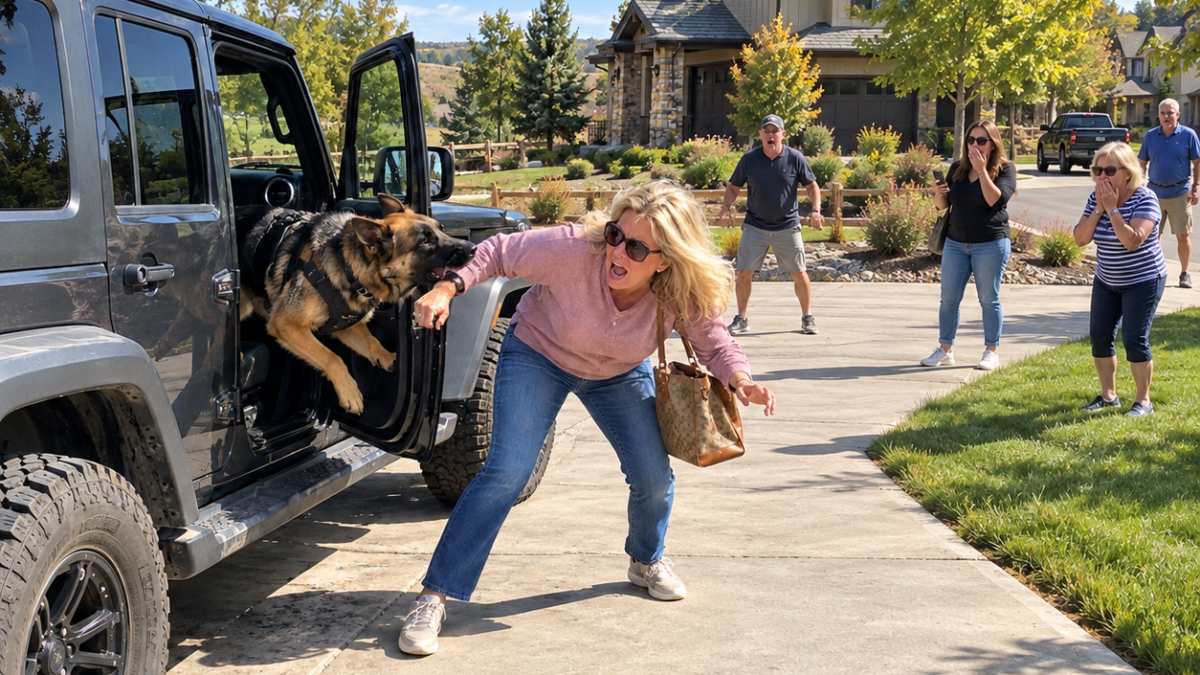
Cold air flowed out from the climate-controlled interior.
For half a second, nobody spoke.
Then Rex made a sound.
Not a bark.
Not a snarl.
A deep, steady vibration from the chest.
Low.
Controlled.
Terrifying.
Deborah’s face changed first.
All color disappeared.
Rex stood framed in the doorway.
Four paws planted.
Muscles tight.
Amber eyes fixed forward.
And now the tactical vest on his body was fully visible.
White reflective letters ran across the side.
POLICE K-9.
Deborah read it.
Her mouth opened.
“Oh my God.”
Sandra leaned forward.
Then she saw it too.
Her clipboard lowered slowly.
Gary whispered something I couldn’t hear.
Deborah took one backward step.
Her heel caught the pavement edge.
She dropped hard onto the ground.
Gary raised both hands instinctively.
Sandra remained standing.
Barely.
Rex stayed exactly where he had been trained to stay.
Inside.
That was the part none of them understood.
Rex did not need to charge.
He did not need to bark.
He did not need to bite.
He simply stood there.
Waiting.
His training protocol was absolute.
Do not dismount the vehicle without handler command unless specific emergency conditions apply.
The door could be open.
Someone could yell.
Someone could panic.
Rex would hold.
Sandra didn’t know that.
And judging by her face, she was suddenly reconsidering every decision she had made that afternoon.
I reached them thirty seconds later.
My phone was still recording.
“I need everyone to remain exactly where they are.”
Sandra snapped toward me.
Fear immediately converted into anger.
That was predictable.
People who build their identity around authority often become most aggressive when they feel it slipping.
“You!”
I ignored the accusation in her voice.
I looked at Rex.
“Hold.”
He stayed.
I looked at Gary.
“Step away from the vehicle.”
He immediately moved.
Sandra found her voice.
“What is this?”
I looked at her.
“You tell me.”
“You left a dangerous animal inside a vehicle!”
“No.”
Her eyes widened.
“No?”
“I left a trained K-9 inside a climate-controlled law-enforcement transport vehicle parked in my assigned space.”
Sandra raised her chin.
“This is a residential community. You cannot conceal a dangerous animal in a vehicle and create a safety hazard.”
“You forced the vehicle open.”
“We were executing a lawful HOA removal.”
“No, you weren’t.”
She pointed at me.
“Do not speak to me that way.”
Gary actually looked at her.
Even he seemed stunned.
I remained calm.
“Sandra, move away from the door.”
“You don’t have the authority to give me orders.”
That was when I reached into my back pocket.
I pulled out my badge.
I held it where she could see it.
Sandra stopped talking.
I gave her time.
One second.
Two.
Three.
Her eyes moved across the city seal.
The designation.
The identification.
Then back to my face.
I spoke clearly.
“My name is Marcus Cole.”
Nobody interrupted.
“Lieutenant Commander, City SWAT Division.”
Sandra’s lips parted.
“K-9 Unit Supervisor.”
Gary whispered, “Oh, hell.”
I continued.
“The vehicle you ordered forcibly entered is designated law-enforcement transport currently assigned to an active police K-9.”
Sandra looked at the Jeep.
Then at the broken lock.
Then at Rex.
Then back at me.
I watched the realization arrive.
Not all at once.
In pieces.
The antenna.
The tint.
The equipment.
The plate.
The dog.
The vest.
The cameras.
The warning I had given her.
I held my phone slightly higher.
“What you have done is being documented as destruction of protected government property, unlawful interference with a law-enforcement vehicle, and forced entry into an occupied K-9 transport.”
Sandra’s mouth opened.
Closed.
Opened again.
“This vehicle is parked on HOA-controlled property.”
“It’s parked in an assigned resident space.”
“The association has enforcement rights.”
“Not the rights you just exercised.”
“You never disclosed that this was a police vehicle.”
That sentence was important.
Very important.
I looked directly at her.
“You were told not to force entry.”
“That is not disclosure.”
“You had the registration information.”
Her face changed.
Just slightly.
Enough.
I saw it.
So did my camera.
Before Sandra could answer, two patrol vehicles entered the lot.
No sirens.
No drama.
They rolled in slowly and stopped behind the tow truck.
Sergeant Diana Chen stepped out of the first unit.
She looked at the scene once.
Broken lock.
Tow truck.
Open Jeep.
Police K-9.
Sandra.
Gary.
Deborah still sitting on the pavement.
Me.
Chen sighed.
“Sandra Mitchell?”
Sandra immediately stepped toward her.
“Officer, thank God. This man has been concealing—”
Chen raised one hand.
“Ma’am, stop.”
Sandra stopped.
Chen looked at me.
“Everyone safe?”
“Yes.”
“K-9?”
“Contained. No contact.”
Chen nodded.
Then she looked at Gary.
“Who cut the lock?”
Gary pointed at the broken pieces.
“I did.”
“Who instructed you?”
He looked at Sandra.
Sandra looked at him.
Chen noticed that too.
“Sir?”
Gary swallowed.
“Ms. Mitchell.”
Chen looked at Sandra.
“Is that accurate?”
Sandra straightened her blazer.
“I authorized a lawful HOA enforcement action.”
Chen’s expression didn’t change.
“Do you have a court order?”
“The HOA charter grants—”
“That isn’t what I asked.”
Sandra went silent.
Chen repeated the question.
“Do you have a court order authorizing seizure of this vehicle?”
“No court order was necessary.”
Chen turned toward another officer.
“Photograph everything before anybody moves.”
Sandra’s face flushed.
“This is absurd.”
The officer began photographing the cut lock.
The door.
The lock mechanism.
The tow equipment.
The Jeep.
Gary looked physically sick.
“I was given paperwork.”
Chen turned.
“What paperwork?”
Gary reached into the tow truck cab.
He pulled out a folder.
“Authorization from the HOA.”
“Hand it to me.”
He did.
Chen read the first page.
Then the second.
Her eyebrows lifted.
She looked at Sandra.
“This document does not grant legal authority to seize a vehicle.”
Sandra scoffed.
“It is an internal enforcement authorization.”
“That’s exactly what it is.”
“Then you agree.”
“No.”
Chen held up the paper.
“I’m saying this document authorizes HOA administrative action. It is not a seizure warrant. It is not a court order. It is not a repossession order. It does not supersede registered ownership.”
Sandra’s voice grew louder.
“You clearly don’t understand our charter.”
Chen looked at her.
“I understand it isn’t the criminal code.”
Sandra froze.
Deborah finally stood up.
She brushed dirt from her pants.
“I didn’t know.”
Nobody answered her.
She repeated it.
“I didn’t know this was a police vehicle.”
Gary immediately spoke.
“Neither did I.”
Both of them looked at Sandra.
Sandra looked away.
That was the first crack.
The second came when Chen inspected the vehicle plate.
She entered the number into her system.
The result appeared almost immediately.
Chen looked up.
“City fleet.”
Gary closed his eyes.
Deborah stared at Sandra.
Sandra said nothing.
I watched her jaw tighten.
Chen looked at me.
“You said they had access to the registration?”
“The HOA requested resident vehicle information when I moved in.”
Sandra interrupted.
“That does not mean—”
Chen turned toward her.
“Stop talking over me.”
For possibly the first time in eleven years, somebody gave Sandra Mitchell a direct instruction in her own neighborhood and she obeyed.
Chen continued processing the scene.
K-9 welfare personnel were requested.
The rear compartment temperature was checked.
Water available.
Ventilation active.
No distress.
No injuries.
Rex remained exactly where I had ordered him.
A few residents had started gathering at a distance.
Phones appeared.
Whispers spread.
Sandra noticed.
Her embarrassment seemed to anger her more than the legal situation.
She pointed at the small crowd.
“This is association business. Everyone needs to return to their homes.”
Nobody moved.
Jim Weatherbee stood near the edge of the sidewalk.
He looked at the cut lock.
Then at Sandra.
For once, he didn’t look intimidated.
Sandra tried again.
“I said this is association business.”
Chen turned.
“Ma’am, this is now a police scene.”
Sandra looked like she had been slapped.
“This is private property.”
Chen’s voice stayed even.
“And we are investigating potential criminal conduct.”
Sandra stepped backward.
The clipboard in her hand seemed suddenly ridiculous.
All those documents.
All those rules.
All those years of telling people what they could plant, where they could park, which color they could paint their trim.
None of it mattered now.
Gary pointed toward Sandra.
“I need to say something.”
Chen looked at him.
“Go ahead.”
“I was paid separately for this tow.”
Sandra’s head snapped toward him.
“Gary.”
He ignored her.
“She gave me cash last night.”
“Gary, do not—”
Chen stepped between them.
“Ms. Mitchell, stop.”
Gary continued.
“She said the resident was refusing compliance and that she needed it handled without delay.”
Chen asked, “How much?”
Gary hesitated.
“Eight hundred.”
Sandra’s face went white.
“It was an expedited contractor fee.”
Gary laughed nervously.
“You told me not to invoice the HOA.”
Silence.
That sentence changed the atmosphere.
Even I hadn’t expected him to say it that quickly.
Sandra stared at him.
“You are lying.”
“No.”
“You are trying to protect yourself.”
“I am protecting myself.”
“That payment was authorized.”
“Then where’s the receipt?”
Sandra said nothing.
Chen wrote something down.
“Mr. Pruitt, you’ll have an opportunity to provide a full statement.”
“I will.”
Sandra’s voice sharpened.
“He is the one who cut the lock.”
Gary turned on her.
“Because you told me you had authority!”
“I gave you written documentation.”
“You gave me HOA paperwork!”
“You accepted it.”
“You paid me cash in a parking lot!”
“Stop.”
Chen’s voice cut through both of them.
Everyone went quiet.
Then she looked at Sandra.
“You have the right to remain silent.”
Sandra stared at her.
“What?”
Chen continued.
“Anything you say can and will be used against you in a court of law.”
Sandra laughed.
It was not a normal laugh.
It was short and disbelieving.
“You cannot possibly be serious.”
Chen kept going.
“You have the right to an attorney.”
“This is insane.”
“If you cannot afford an attorney—”
“I know Miranda.”
“Then listen.”
The residents watching from the sidewalk became completely silent.
Sandra Mitchell had spent eleven years acting as though the HOA charter made her the highest authority inside Willowbrook Estates.
Now she was standing beside my damaged Jeep while an actual police sergeant read her constitutional rights.
Rex watched from inside.
Still calm.
Still waiting.
Eighteen minutes later, the K-9 welfare check was complete.
No injury.
No heat stress.
No dehydration.
No abnormal behavior.
I stepped to the open rear door.
“Rex.”
His ears moved.
“Out.”
He stepped down in one clean motion.
Deborah moved away immediately.
Gary took another step backward.
Sandra stared.
Rex walked directly to my left side.
“Sit.”
He sat.
The veterinarian checked his eyes.
Paws.
Respiration.
Temperature.
Everything normal.
When the exam finished, Rex returned to heel position.
The entire afternoon had been chaos for everyone else.
To him, it had been another training problem.
Wait.
Observe.
Hold.
Follow the handler.
That should have been the end.
It wasn’t.
At approximately 6:00 that evening, investigators obtained traffic-camera footage from the strip mall.
Sandra meeting Gary.
Sandra handing him the envelope.
Gary checking the contents.
No invoice.
No service receipt.
No official HOA paperwork exchanged on camera.
That created questions.
Investigators started asking them.
The next morning, a search warrant was authorized for the HOA office.
By noon, officers were carrying file boxes out of the same room where Sandra had sat behind her desk and told me she could remove my Jeep whether I consented or not.
I watched from across the lot.
Jim stood beside me.
“I never thought I’d see that,” he said.
“See what?”
“Somebody finally tell her no.”
I looked at him.
His expression was complicated.
Relief.
Fear.
Maybe embarrassment.
“Jim.”
He glanced at me.
“You said she’d done this before.”
He looked toward the HOA office.
“Yes.”
“What happened?”
For several seconds, he said nothing.
Then he exhaled.
“A tree.”
“A tree?”
“A Japanese maple.”
He gave a humorless smile.
“My wife planted it.”
I waited.
Jim continued.
“Sandra said the species wasn’t approved.”
“Was it?”
“It was on the landscaping list when we planted it.”
“What changed?”
“Apparently the board revised the list.”
“After you planted it?”
“Two years after.”
“And she fined you?”
“First two hundred. Then four hundred. Then she threatened to place a lien.”
My eyes narrowed.
“What did you do?”
“I paid.”
“How much?”
“Twelve hundred dollars.”
“Through the HOA portal?”
He shook his head.
That was when I understood.
“How?”
“Cashier’s check.”
“Made out to the association?”
Another pause.
“No.”
“To whom?”
Jim looked ashamed.
“Sandra told me the fastest way to resolve it was through an administrative settlement.”
“To her?”
He nodded.
“Personally?”
“Yes.”
“Did you get a receipt?”
“She gave me a handwritten note saying the matter was closed.”
I stared at him.
“Do you still have it?”
“I think so.”
“Find it.”
His eyebrows lifted.
“Why?”
“Because investigators are going to want it.”
By the second day, the investigation had expanded far beyond my Jeep.
Willowbrook collected approximately eighty-nine thousand dollars a year in association dues.
That number wasn’t unusual.
The expenses were.
Only about forty-one thousand dollars in annual expenses could be supported with normal documentation.
Landscaping.
Common-area utilities.
Insurance.
Repairs.
Maintenance.
Administrative services.
The remaining money disappeared into vague categories.
Discretionary administrative reserve.
Special compliance expenditure.
Vendor settlement.
Emergency enforcement.
No invoices.
No meaningful vendor records.
No third-party verification.
No clear paper trail.
Sandra had spent years telling residents to document every fence board, mailbox color, parking permit, landscaping change, and patio modification.
Apparently, she had been much less interested in documenting tens of thousands of dollars.
Then investigators found the emails.
One thread involved my Jeep.
It had been exchanged between Sandra and Deborah before the removal attempt.
Investigators later showed the relevant section to my attorney.
Deborah had written:
“Vehicle still appears tactical. Should we verify registration before enforcement?”
Sandra replied:
“Already checked.”
Deborah:
“And?”
Sandra’s answer was short.
“Plate comes back to city fleet.”
That alone should have ended the situation.
But Sandra wrote another message.
“We will treat it as civilian until we have reason not to.”
That sentence changed everything.
Up to that point, Sandra might have argued incompetence.
Confusion.
Administrative misunderstanding.
A badly written HOA policy.
A legitimate mistake made by someone who believed she had authority.
After that email?
No.
She knew the vehicle was registered to the city.
She knew it looked like a law-enforcement platform.
She knew the plate was not privately registered to me.
And she intentionally proceeded anyway.
Because stopping would have required admitting she was wrong.
For Sandra Mitchell, apparently, that was harder than committing a crime.
Deborah hired an attorney almost immediately.
Then she began cooperating.
Meeting notes.
Board emails.
Private correspondence.
Enforcement records.
Vendor lists.
Settlement agreements.
Once one drawer opened, others followed.
Jim found his handwritten note.
Investigators collected it.
Then another resident came forward.
And another.
A family two streets over had paid $900 to resolve a fence violation that never appeared in the official HOA accounting.
An elderly widow had paid $650 for an “expedited architectural variance.”
A young couple had paid $1,500 after Sandra threatened escalating penalties over a backyard shed.
Several payments had been directed through unusual channels.
Some were cashier’s checks.
Some were money orders.
Some were cash.
Residents had been told these were settlement payments.
The HOA’s formal accounting records didn’t reflect them properly.
Within a week, investigators had identified roughly $67,000 in undocumented or irregular funds connected to Sandra’s administration.
The neighborhood changed almost overnight.
People who had spent years whispering started talking openly.
Stories came out.
Fines.
Threats.
Private settlement offers.
Selective enforcement.
Residents who challenged Sandra received violation notices for unrelated issues days later.
People who supported her seemed to receive warnings instead of penalties.
For years, each resident had thought his or her experience was isolated.
Now they compared documents.
Dates.
Amounts.
Patterns.
Sandra’s system depended on everyone believing they were alone.
Once they spoke to each other, the system collapsed.
Gary cooperated early.
Very early.
His attorney clearly understood the situation.
He turned over the cash envelope.
Phone records.
Messages from Sandra.
Previous towing requests.
He admitted he had known some HOA jobs were aggressive.
He admitted the cash payment should have raised concerns.
He admitted he cut the lock.
But he also showed investigators the documents Sandra had provided and the messages in which she repeatedly claimed legal authorization.
Gary still faced consequences.
He deserved them.
But cooperation mattered.
Deborah cooperated too.
Sandra did not.
Her attorney took a different approach.
The argument was essentially that Willowbrook’s HOA charter created a private enforcement zone over association-managed property.
According to the defense, the association’s rights over parking spaces gave Sandra broad authority to remove noncompliant vehicles.
It sounded impressive.
Until actual law entered the conversation.
The question wasn’t whether an HOA could regulate parking.
Of course it could, within legal limits.
The question was whether an HOA president could knowingly order forced entry into and attempted seizure of a city-owned law-enforcement vehicle without lawful seizure authority.
That was a very different issue.
Her attorney tried to blur the two.
The judge didn’t seem interested in helping.
I attended one hearing.
Sandra looked different.
No red blazer.
No HOA lanyard.
No clipboard.
Dark suit.
Hair tied back.
Two attorneys beside her.
The prosecutor displayed photographs of my Jeep.
The broken lock.
The forced entry.
Rex’s compartment.
Then the email appeared on the courtroom screen.
Plate comes back to city fleet.
We will treat it as civilian until we have reason not to.
The prosecutor let the sentence sit there.
No dramatic speech.
No yelling.
He didn’t need one.
The defense attorney stood.
“Your Honor, the association exercised authority it reasonably believed existed under governing charter provisions—”
The judge looked over his glasses.
“Counsel.”
The attorney stopped.
“You are asking this court to accept the proposition that a private homeowners association may knowingly disregard municipal vehicle registration because its internal rules create superior authority?”
“No, Your Honor. We are saying—”
“Because that sounds remarkably close to what you are saying.”
The attorney tried again.
“The vehicle was located within an association-controlled parking area.”
“And?”
“The HOA had established removal procedures for noncompliant vehicles.”
“Did those procedures authorize destruction of city property?”
“No, but—”
“Did they authorize forced entry into a law-enforcement transport?”
“No.”
“Did they authorize seizure of a city-owned vehicle after the association president learned it was city-owned?”
The attorney paused.
“No, Your Honor.”
The judge leaned back.
“Then I’m struggling to understand the relevance of your enforcement-zone argument.”
The attorney spoke for several more minutes.
The judge denied the theory shortly afterward.
Sandra stared straight ahead.
For the first time since I had known her, she looked small.
Not physically.
Structurally.
Everything she had built herself around had disappeared.
No neighborhood meeting where she controlled the microphone.
No residents afraid of fines.
No board members backing her up.
No clipboard.
No red blazer.
No authority performance.
Just evidence.
Gary’s testimony.
Deborah’s emails.
Financial records.
Traffic footage.
My recording.
The Jeep cameras.
The broken lock.
And Sandra’s own words.
The charges accumulated.
Destruction of protected property.
Interference involving a law-enforcement animal.
Theft-related offenses connected to the attempted vehicle seizure.
Then financial charges.
Fraud-related counts.
Embezzlement allegations.
Extortion-related conduct.
Seven counts in total.
She was ultimately convicted on five.
The HOA itself was placed under temporary state oversight.
Its accounts were frozen while auditors reconstructed years of transactions.
The forty-seven-page rulebook was reviewed.
A large number of provisions were removed, rewritten, or limited.
Enforcement procedures were changed.
No more private cash settlements.
No more undocumented “administrative resolution” payments.
No more towing based solely on a president’s handwritten note.
No more emergency penalties without proper board records.
Residents received restitution from recovered funds where investigators could document the payments.
Jim received his twelve hundred dollars back.
He came to my door the week the payment cleared.
For once, he wasn’t wearing the cardigan.
He held an envelope.
“Got it.”
“The money?”
He nodded.
“Twelve hundred.”
“Good.”
He looked down at the envelope.
“My wife died two years ago.”
I hadn’t known.
“I’m sorry.”
“She loved that tree.”
He looked toward his property.
From my doorway, I could see the Japanese maple rising above the edge of his front yard.
“I almost cut it down because of Sandra.”
“But you didn’t.”
“No.”
He smiled faintly.
“I suppose that makes the refund feel better.”
A few months later, Jim agreed to serve on the interim HOA board.
When he told me, I raised an eyebrow.
“You sure you want that?”
“Somebody has to do it.”
“That’s usually how bad ideas start.”
He laughed.
“Maybe. But I think we’ve had enough presidents who enjoy the power.”
“What kind do you want?”
“The kind who hates meetings.”
“That might work.”
Gary received lesser charges.
He paid a substantial fine.
He kept his towing license.
From what I heard later, the experience permanently changed how he handled private tow requests.
If the registered owner didn’t request the tow and there wasn’t obvious statutory authority, police authorization, or court-grade documentation, he refused the job.
Apparently, whenever an HOA called him after Willowbrook, his first question became:
“Do you have actual legal authority, or do you have HOA paperwork?”
That distinction probably saved him from repeating the worst mistake of his career.
Deborah resigned from the board.
She moved out of Willowbrook less than a year later.
I never spoke to her again.
Sandra remained the center of the criminal case until sentencing.
I was present for part of that too.
The prosecution described a pattern.
Not simply one bad afternoon.
Not simply one Jeep.
Not simply one K-9.
A pattern of treating internal HOA authority as a weapon.
A pattern of escalating against residents who resisted.
A pattern of using legal-sounding threats to pressure payments.
A pattern of exploiting the fact that most ordinary people don’t have the time, money, or energy to challenge every official-looking demand placed in front of them.
Sandra’s attorney argued that she had dedicated more than a decade to the community.
That was true.
He argued that many residents had supported her.
Also true.
He argued that her initial motive had been maintaining order.
Maybe.
But motive didn’t erase conduct.
And good intentions, if they had ever existed, had long since become indistinguishable from entitlement.
When Sandra was given an opportunity to speak, she stood slowly.
For several seconds, she looked toward the gallery.
I wondered whether she would apologize.
She didn’t.
She said she had spent eleven years protecting property values.
She said modern homeowners associations were often criticized simply for enforcing standards residents had voluntarily agreed to.
She said she believed she had become a “symbolic target” for people angry about community governance.
Then she said something that told me she still didn’t fully understand.
“If Mr. Cole had simply disclosed his position from the beginning, none of this would have happened.”
I almost laughed.
The prosecutor didn’t.
The judge didn’t.
The judge leaned forward.
“Ms. Mitchell, the victim’s occupation did not create your legal obligations.”
Sandra looked at him.
“You did not require knowledge of his employment to refrain from unlawfully damaging and entering property.”
Her face tightened.
The judge continued.
“You were informed that the vehicle was registered to the city.”
Sandra said nothing.
“You proceeded.”
Still nothing.
“You directed a contractor to cut the lock.”
Silence.
“You directed the vehicle to be entered.”
Silence.
“You did so after obtaining registration information that should have caused any reasonable person to stop and seek legal clarification.”
Sandra’s attorney touched her arm.
She looked down.
The judge’s voice stayed calm.
“This court is not sentencing you because you enforced landscaping standards.”
A few people in the gallery shifted.
“You are being sentenced because you repeatedly confused private administrative authority with legal entitlement, and when confronted with information contradicting that belief, you chose escalation.”
That was it.
That was the entire case in one sentence.
She chose escalation.
Every time.
When I cited the parking assignment, she escalated.
When I challenged the nonexistent policy, she escalated.
When her own records showed city registration, she escalated.
When Gary questioned the tow, she escalated.
When he discovered Rex, she escalated.
When Deborah opened the door and saw POLICE K-9 across his vest, Sandra’s first instinct was still to argue about HOA authority.
At every exit ramp, she accelerated instead.
Eventually, there was nowhere left to go.
After the case ended, life inside Willowbrook became almost boring.
Which was exactly what a neighborhood was supposed to be.
People repainted mailboxes without emergency hearings.
One family installed patio furniture without receiving a three-page compliance letter.
The revised HOA handbook became shorter.
Much shorter.
Meetings lasted forty minutes instead of three hours.
Residents disagreed.
Then they voted.
Then they went home.
Nobody treated landscaping disputes like national security matters.
My Jeep stayed in space 2847B whenever I brought it home.
No one complained about the antenna.
No one complained about the tint.
Nobody ever again used the phrase “threat to community transparency” around me.
As for Rex, the department reviewed every second of the incident.
His performance was almost perfect.
He stayed inside the vehicle despite unauthorized entry.
He maintained protective posture.
He did not pursue.
He did not dismount.
He did not make physical contact.
He did not escalate beyond what was necessary to deter approach.
At the next unit briefing, he received a formal commendation for vehicle-protection protocol compliance.
The citation described him in the language departments use for working animals.
Controlled response.
Command retention.
Environmental stability.
Zero unnecessary escalation.
Zero injuries.
I printed a copy.
Pinned it to the recognition board.
Rex looked at it once.
Then he looked at me.
Then at the treat pouch on the counter.
“You don’t care?”
His ears moved.
“Your commendation.”
Nothing.
“You almost helped expose sixty-seven thousand dollars in questionable HOA funds.”
He yawned.
“You terrified three adults without leaving a vehicle.”
His eyes shifted toward the treats again.
“Right.”
I gave him one.
That earned a response.
Months later, I drove into Willowbrook after a training shift.
The sun was low.
Kids were riding bicycles near the sidewalk.
Jim was watering the Japanese maple.
Rex was lying in the rear compartment, exhausted from work.
I parked in 2847B.
Exactly inside the lines.
I shut off the engine but left auxiliary systems running while I finished a log entry.
For a moment, I looked at the parking space.
Nothing about it seemed important.
Just painted lines on pavement.
But that ordinary piece of asphalt had become the point where two completely different ideas of authority collided.
Sandra had spent eleven years mastering the appearance of power.
She knew how to write official-looking notices.
How to quote sections.
How to call emergency meetings.
How to make neighbors feel as though resisting her meant resisting the law itself.
She had titles.
Policies.
Letterhead.
A clipboard.
A board.
A red blazer.
And confidence.
Especially confidence.
That was what made her effective.
Most people don’t challenge someone who looks certain.
They assume certainty must come from knowledge.
They assume the person quoting a rule has checked whether the rule exists.
They assume the person threatening a lien has authority to place one.
They assume the person ordering a tow has legal grounds.
They assume someone else has verified everything.
Sandra lived inside those assumptions.
For years, they protected her.
Until she met something assumptions couldn’t change.
Records.
Cameras.
Registration.
Emails.
Law.
Rex.
The part people later found most dramatic was the moment Deborah opened the Jeep door.
I understood why.
Visually, it was perfect.
Sandra standing there in her red blazer.
Gary beside the cut lock.
Deborah pulling the handle.
Cold air spilling out.
Then Rex appearing in the doorway wearing a vest marked POLICE K-9.
That was the moment the story changed in their minds.
But it wasn’t the moment that mattered most.
The most important moment had happened earlier.
It happened when Sandra discovered the Jeep was registered to the city.
She had information that contradicted what she wanted to believe.
She could have stopped.
She could have called an attorney.
Called the city.
Called me.
Asked one question.
Verified one fact.
Canceled the tow.
Instead, she wrote:
We will treat it as civilian until we have reason not to.
She had the reason.
She ignored it.
Everything afterward came from that decision.
People like Sandra often imagine accountability arrives suddenly.
It doesn’t.
It accumulates.
One email.
One threat.
One payment.
One undocumented transaction.
One abuse of authority.
One person pressured into silence.
Then another.
Then another.
Eventually, somebody starts keeping records.
Sandra thought I was doing nothing because I wasn’t yelling.
She mistook calm for surrender.
She mistook patience for weakness.
She mistook documentation for hesitation.
That was her final mistake.
I never needed to threaten her.
I never needed to insult her.
I never needed to stand in an HOA meeting and scream.
I asked questions.
I saved emails.
I preserved notices.
I recorded lawful conversations.
I knew what authority she had.
More importantly, I knew what authority she did not have.
Then I let her make her own choices.
She made every one of them.
The cutter.
The lock.
The Slim Jim.
The door.
The cash envelope.
The emails.
The false policy.
The undocumented payments.
None of those decisions belonged to me.
That mattered.
Because revenge usually requires you to become part of the chaos.
Accountability doesn’t.
Accountability works best when you make the boundary clear, preserve the facts, and let the person crossing that boundary create the evidence themselves.
Sandra Mitchell had controlled Willowbrook Estates for eleven years.
She believed a forty-seven-page rulebook gave her the right to decide what belonged in every driveway, every yard, every parking space, and eventually every resident’s life.
Then one Wednesday afternoon, she stood beside my Jeep and ordered a man to cut through a hardened-steel lock.
The lock broke.
She smiled.
She thought the sound meant she had won.
What she didn’t understand was that the lock hitting the pavement wasn’t the sound of my resistance ending.
It was the sound of her evidence chain beginning.
She ordered the door opened.
Deborah pulled the handle.
And standing silently inside was Rex.
Not barking.
Not charging.
Not moving.
Just waiting.
POLICE K-9 written across his vest.
Sandra froze.
For the first time since I had known her, she had nothing to say.
And by the time she found her voice again, the cameras had already recorded everything she would later wish she could deny.
The broken lock.
The forced entry.
The tow operator.
The instructions.
The open door.
The K-9.
Her words.
Her choices.
All of it.
She had spent years using paperwork to frighten other people.
In the end, paperwork destroyed her.
She had spent years telling residents that rules had consequences.
She was right about that too.
Just not in the way she expected.
And every time I park that Jeep in space 2847B, I remember the last thing Sandra said before I left her office that morning.
“At three o’clock, that vehicle will be removed.”
She had sounded completely certain.
Three o’clock came.
The Jeep never moved.
Rex never left the vehicle until I gave the command.
Sandra lost her office.
Her authority.
Her control of the HOA.
And eventually, her case in court.
All because she could not tolerate hearing one simple word.
No.
That afternoon taught Willowbrook something it should never have needed to learn.
An HOA can regulate a neighborhood.
It can enforce valid covenants.
It can send notices.
It can levy lawful fines.
It can establish legitimate community standards.
What it cannot do is transform a clipboard into a badge.
Sandra discovered that distinction standing three feet from a Belgian Malinois.
She discovered it with a severed lock at her feet.
She discovered it while two patrol cars rolled into the parking lot.
And she discovered it permanently when a judge explained that private authority ends where actual law begins.
Rex received a commendation.
Jim got his twelve hundred dollars back.
Residents recovered money.
The HOA was rebuilt under oversight.
Gary learned to demand real paperwork.
The rulebook shrank.
Willowbrook became quieter.
And Sandra Mitchell became the example nobody in that neighborhood ever forgot.
Not because she challenged the wrong resident.
Not because she picked the wrong Jeep.
And not even because there happened to be a police K-9 waiting behind the door she ordered opened.
She became the example because she had been given warning after warning, fact after fact, opportunity after opportunity to stop.
And every single time, arrogance told her to keep going.
Until she finally cut through the wrong lock.
And found out exactly what was waiting on the other side.