HOA Karen Kept Blocking My Private Gate With Her Tesla—Then a 40-Ton Logging Truck Rolled In
PART2
For months, I had been angry.
Every time her car appeared in front of that gate, anger came first.
Hot.
Immediate.
I imagined arguments.
Tow trucks.
Lawsuits.
Confrontations.
I imagined standing in front of an HOA board and making them admit the road did not belong to them.
But watching Brianna dismiss my mother with a shrug killed the anger.
What replaced it was colder.
Cleaner.
Resolve.
I leaned toward her open window.
“Move the car.”
She sighed.
“Evan, I am not going to rearrange an entire community meeting because you suddenly have company.”
“She’s my mother.”
“That doesn’t change access policy.”
“There is no access policy.”
“You keep saying that.”
“Because it’s true.”
“No. It’s your interpretation.”
I looked at the property marker ten feet away.
Then the county sign.
Then the gate.
Then back at her.
“Brianna, you’re parked on private property.”
“I am vice president of Maple Ridge Estates.”
“That title does not own my road.”
“You’re being hostile.”
“I’m being clear.”
She smiled again.
“You should try being neighborly.”
Neighborly.
That word had become one of the ugliest words I knew because Brianna used it whenever she wanted something that did not belong to her.
Let us use your road.
Be neighborly.
Let us park by your gate.
Be neighborly.
Stop complaining when residents block commercial access.
Be neighborly.
Accept fake notices.
Be neighborly.
Pretend your deed changes because our HOA wishes it did.
Be neighborly.
I stepped back.
Mom opened her door.
I immediately walked toward her.
“Stay in the car.”
“I can walk.”
“No.”
“Evan.”
“You shouldn’t have to.”
Mom was eighty.
Still sharp.
Still stubborn.
But her hands shook when she stood too long, and the walk from the gate to my house was uphill over gravel.
She looked past me at Brianna’s car.
“That woman again?”
“Yes.”
Mom sighed.
“Some people are determined to be remembered badly.”
I almost smiled.
“Give me a minute.”
I went back to Brianna.
She was now standing outside the Tesla talking to two HOA board members.
I heard her say, “…and this is exactly what I’ve been telling you about. He creates unnecessary conflict.”
I stopped.
One of the men looked embarrassed when he saw me.
The other pretended to study something on his phone.
Brianna crossed her arms.
“See?”
“See what?”
“This.”
She gestured at me.
“You come storming over every time Maple Ridge residents use this access.”
“You’re blocking my mother.”
“She’s perfectly safe.”
“That isn’t your decision.”
“We have an HOA meeting starting in six minutes.”
“Move the car.”
Her smile disappeared.
“No.”
Just that.
No.
I stood there and listened to the word.
Months earlier, it might have made me explode.
That day, it made something settle into place.
“All right.”
Brianna blinked.
Apparently she had expected another argument.
“That’s it?”
“For today.”
Her confidence returned.
“I knew you could be reasonable.”
I nodded.
“Enjoy your meeting.”
I turned around.
“Evan?”
I kept walking.
“See? That wasn’t difficult.”
I didn’t answer.
Mom watched me approach.
“You get her to move?”
“No.”
“What now?”
“We’ll take you through the lower service entrance.”
“That’s twenty minutes around.”
“I know.”
She studied my face.
“What are you thinking?”
“Nothing illegal.”
Mom smiled faintly.
“That wasn’t my question.”
I opened her door.
“I’m done asking.”
And I was.
That was the last day I ever asked Brianna Hale to move her car.
Everything after that was notice.
Documentation.
Witnesses.
And eventually, forty tons of consequence rolling down my private road on a cold Monday morning.
But to understand how we got there, you have to understand what Maple Ridge Estates was and why Brianna believed my gate belonged to her.
I had lived outside Maple Ridge for twelve years.
My property wasn’t part of the subdivision.
Never had been.
My house sat on acreage that had once belonged to a larger timber tract.
A narrow private gravel road ran from the county road through a metal gate and into my property.
The deed was clean.
The survey was clean.
The title was clean.
The road was mine.
I paid to grade it.
I paid to gravel it.
I paid to maintain drainage ditches.
I paid when storms washed out sections.
Maple Ridge came later.
Luxury houses.
Stone entrances.
Decorative street lamps.
Identical mailboxes.
The neighborhood backed against one side of my access road.
For years, nobody cared.
Residents waved.
Kids rode bikes nearby.
People occasionally bought firewood from me.
One neighbor borrowed a log splitter and returned it with homemade bread.
That was normal.
Then Brianna moved in.
She had the kind of confidence that seemed rehearsed.
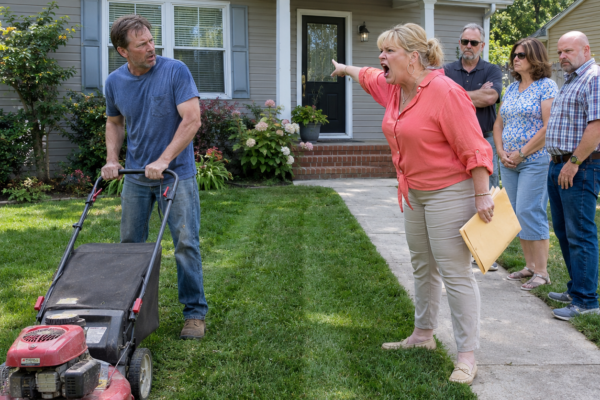
Blonde ponytail.
Expensive sunglasses.
Perfect athletic clothes.
A smile that appeared before every sentence and vanished the second she heard the word no.
She became vice president of the Maple Ridge HOA within a year.
I later learned she had campaigned on “modernizing community access.”
At the time, I had no idea that phrase included my gate.
The first time she blocked it, I assumed it was an accident.
Her white Tesla was sitting across the entrance one afternoon.
I pulled up behind it.
Waited.
Nothing.
Honked.
Nothing.
Got out.
“Hey!”
Brianna was standing with several women near the HOA clubhouse lawn.
She turned.
“That your car?”
“Oh!”
She waved.
“Yeah. I’ll only be a minute.”
“You’re blocking my gate.”
“I know.”
That answer surprised me.
“You know?”
“Yes. We’re setting up for a meeting.”
I pointed to the sign.
“Private road. No parking.”
She tilted her head.
“This road is community access.”
“No, it isn’t.”
“It absolutely is.”
“No.”
She laughed.
“Evan, right?”
“Yes.”
“I’m Brianna Hale. HOA vice president.”
She offered the title like credentials.
I nodded.
“Move your car.”
Her hand dropped.
“I said I’ll only be a minute.”
“I need access.”
“You can wait.”
I stared at her.
“I live there.”
She smiled.
“I know.”
That should have warned me.
People who are confused usually ask questions.
Brianna wasn’t confused.
She knew exactly where I lived.
Exactly what the gate served.
And exactly what she was blocking.
She simply thought her reason mattered more.
“Move it.”
Her eyes narrowed.
“You don’t need to be rude.”
“I’m not.”
“This meeting is important.”
“So is getting to my house.”
“Everyone in Maple Ridge shares responsibility for maintaining good relationships.”
“What does that have to do with your car?”
“Your road borders our common area.”
“That still doesn’t make it yours.”
She smiled again.
“You’re new to how these things work.”
I had lived there longer than she had.
I decided not to explain irony.
She eventually moved the car.
Not immediately.
Seven minutes later.
That should have been the end.
Instead, “just one minute” became her routine.
Sometimes it was the Tesla.
Sometimes visitors.
Sometimes an HOA contractor.
The road was apparently the most convenient place to stop while unloading signs, flowers, meeting supplies, or catering.
Every time I objected, Brianna treated the obstruction like a minor personal flaw in my personality.
“Relax.”
“Don’t be dramatic.”
“It’s only temporary.”
“You can wait.”
“We’re all neighbors.”
One afternoon, I came home with a trailer full of split oak.
Her Tesla sat across the gate.
I called her.
Voicemail.
Called again.
Nothing.
Finally walked to the clubhouse.
She was inside setting out bottled water.
“Your car.”
She didn’t look up.
“What about it?”
“It’s blocking my gate.”
“Oh.”
She opened another case of water.
“I’ll move it when we finish.”
“No.”
She looked at me.
“Excuse me?”
“Now.”
“Evan, there are fifteen people here.”
“I have a loaded trailer sitting in the road.”
“Then park it.”
“I’m trying to.”
She gave me the smile.
“I don’t understand why you insist on making everything adversarial.”
“You parked across my gate.”
“Because there’s nowhere else convenient.”
“That’s not my problem.”
“It becomes your problem when you refuse to cooperate with the surrounding community.”
I remember staring at her and thinking: this woman genuinely hears herself differently than everyone else does.
She moved the car.
Slowly.
With exaggerated annoyance.
Then came the first HOA letter.
Not addressed as a violation yet.
A “community access clarification.”
It claimed my private road had been “historically utilized for neighborhood servicing and common-area access.”
False.
It suggested continued obstruction by gates, signs, or confrontational conduct might create “safety and easement concerns.”
I read it twice.
Then called the HOA office.
A polite administrator named Claire answered.
“I received a letter about my road.”
“Yes, Mr. Coleman.”
“I’m not a member.”
“I understand.”
“The HOA has no easement.”
“I’ll have to refer that to the board.”
“Who authorized the letter?”
Pause.
“Vice President Hale.”
Of course.
I emailed the board.
Attached my deed.
Attached the survey.
Asked them to identify any recorded easement.
Their response took nine days.
It said they were “reviewing historical use.”
Historical use.
One of those phrases people use when they can’t find actual paperwork.
Meanwhile, Brianna kept parking there.
I started taking pictures.
Date.
Time.
License plate.
Position.
Duration.
At first I felt ridiculous.
I was a forty-eight-year-old man photographing a white Tesla sitting across a gate.
But a friend of mine named Mark Alvarez changed my attitude.
Mark was an attorney.
Not the theatrical kind.
He didn’t speak in Latin.
He didn’t enjoy court.
He liked paper.
I showed him the letters.
He studied the survey.
“Road’s yours.”
“I know.”
“No recorded easement.”
“I know.”
“HOA knows?”
“I sent them everything.”
“And she’s still blocking it?”
“Yes.”
“Then stop arguing.”
I looked at him.
“What?”
“Stop arguing.”
“That’s your legal advice?”
“My legal advice is that people ruin good cases by talking too much.”
He tapped the photos.
“Document.”
“I am.”
“Better.”
“What does better mean?”
“Dates. Times. Every notice. Every obstruction. Every communication. Certified mail. Keep your signs visible. No threats. No touching her vehicle. No stupid social-media posts. No yelling.”
“That sounds boring.”
“Boring wins.”
That became the plan.
Boring.
Clean.
Undeniable.
I pulled another certified copy of the deed.
Another survey.
County tax map.
Road-maintenance records.
Old title documents.
Everything showed the same thing.
Private property.
Mine.
I sent Brianna a certified notice.
Not emotional.
No insults.
It said unauthorized vehicles blocking the private access road interfered with residential and commercial access.
It documented prior warnings.
It stated future obstruction after notice would be treated as trespass and handled through appropriate lawful channels.
Brianna signed the receipt.
Spiky signature.
Clear date.
I kept it.
Then I installed better signs.
Heavy metal.
Reflective.
PRIVATE PROPERTY.
NO PARKING.
GATE ACCESS REQUIRED 24 HOURS.
AUTHORIZED VEHICLES ONLY.
Signs so obvious a blindfolded person could feel the guilt walking past them.
Brianna parked in front of one two days later.
I photographed it.
She came out of the clubhouse and saw me.
“Taking pictures of women now?”
“I’m documenting the car.”
“That’s creepy.”
“It’s parked on my road.”
“You are obsessed.”
“You signed the notice.”
She smiled.
“I sign a lot of things.”
“Good.”
“What’s that supposed to mean?”
“Nothing.”
She stepped closer.
“You keep trying to intimidate me with paperwork.”
“I’m not intimidating you.”
“You absolutely are.”
“You can end it whenever you want.”
“How?”
“Stop parking here.”
She laughed.
“No.”
There it was again.
Then she leaned closer.
“Because this road serves Maple Ridge whether you like it or not.”
“No easement.”
“That’s your interpretation.”
“County records are not an interpretation.”
“You’re not a lawyer.”
“My lawyer agrees.”
That made her pause.
Just for a second.
Then the smile came back.
“Lawyers say whatever clients pay them to say.”
“Then find one who can locate your easement.”
Her cheeks reddened.
She walked away.
The next escalation was vandalism.
Someone spray-painted over part of my NO PARKING sign.
Not enough to destroy it.
Enough to obscure two words.
I replaced it.
Two days later, an official-looking notice appeared taped to my gate.
MAPLE RIDGE ESTATES
ACCESS OBSTRUCTION NOTICE
It accused me of interfering with “established communal ingress.”
Communal ingress.
To my house.
I called Mark.
He read it.
“Who signed it?”
“Brianna.”
He laughed.
“What?”
“She’s helping you.”
“How?”
“Every fake authority claim she signs strengthens the pattern.”
“That’s optimistic.”
“It’s litigation.”
Fair.
Then neighbors started treating me differently.
That bothered me more than the letters.
People I had known for years stopped waving.
One man I used to help with fallen branches avoided eye contact in the grocery store.
Someone told me Brianna had been describing me at meetings as “the hostile property owner.”
Apparently I was threatening emergency access.
I was destabilizing relations.
I was trying to “isolate” myself from the community.
That word again.
As if property ownership was a personality disorder.
I attended one HOA board meeting voluntarily.
Not because they governed me.
Because I wanted the record.
Brianna sat near the front.
She looked delighted when I entered.
“Mr. Coleman.”
“Brianna.”
The HOA president, a man named Howard, looked tired before the meeting started.
I explained the problem.
Private road.
Blocked access.
Commercial deliveries.
Safety.
Survey.
No easement.
Brianna smiled through the whole thing.
Then she spoke.
“May I?”
Howard nodded.
She folded her hands.
“Evan has unfortunately turned a minor neighborly accommodation into an unnecessary conflict.”
I almost interrupted.
Mark’s voice appeared in my head.
Boring wins.
So I stayed quiet.
Brianna continued.
“The road in question has served the Maple Ridge common area informally for years.”
“No,” I said.
Howard raised a hand.
“Let her finish.”
Fine.
“We are not claiming ownership of his property.”
That was new.
“We are simply requesting reasonable flexibility.”
“What does that mean?” I asked.
She smiled.
“Not treating every temporary stop as a crisis.”
“My gate gets blocked.”
“For minutes.”
“Sometimes hours.”
“That is an exaggeration.”
I pulled out photographs.
Time stamps.
One hour twenty-three minutes.
Fifty-two minutes.
One hour seven.
Brianna’s smile tightened.
Howard looked at them.
Then at her.
“These accurate?”
She waved one hand.
“There are contextual circumstances.”
“Is that your car?”
“Yes.”
“Is it in front of his gate?”
“It is adjacent to—”
“Across.”
I placed the survey on the table.
“This is my only primary entrance.”
Brianna’s voice sharpened.
“You have another service track.”
“It’s not all-weather access.”
“You can improve it.”
There was a silence.
Howard looked at her.
I looked at her.
Even another board member looked uncomfortable.
“So your solution,” I said slowly, “is that I build a second road because you don’t want to park thirty yards farther away?”
“That is not what I said.”
“That is exactly what you said.”
She leaned back.
“You are impossible.”
“No. I’m the property owner.”
The board promised to review the issue.
Nothing changed.
Three mornings later, her Tesla was back.
Then came Mom’s visit.
That was the day patience ended.
Not discipline.
Patience.
There’s a difference.
I did not touch Brianna’s car.
Did not tow it.
Did not damage it.
Did not shout.
I drove Mom through the lower service track.
Twenty extra minutes.
She made it into the house exhausted.
She sat at my kitchen table with tea.
“You’re angry.”
“I’m fine.”
“You’ve been my son for forty-eight years.”
I sat across from her.
“She looked at you and told you to wait.”
Mom shrugged.
“I’ve survived worse women.”
“That’s not the point.”
“No.”
“She thinks she can decide whether we enter my property.”
“Yes.”
“She’s doing it because nobody stops her.”
Mom stirred her tea.
“Then stop her.”
I looked at her.
She smiled.
“But don’t become stupid just because she is.”
That night I called Mark.
“I’m done.”
“With what?”
“Asking.”
“Good.”
“What can I do?”
He paused.
“That depends on what you mean by do.”
“I have logging contracts next month.”
I sold firewood and did small-scale timber work.
Nothing massive.
But two sections of my acreage were under planned selective harvest.
A commercial logging company would need access through my gate.
Large trucks.
Heavy trailers.
Scheduled windows.
Mark understood immediately.
“Real delivery?”
“Real.”
“Contracted?”
“Yes.”
“Scheduled?”
“Yes.”
“Required access?”
“Yes.”
“Then notify everyone.”
“Everyone?”
“HOA. County if relevant. Sheriff’s office if you anticipate a dispute. Put the carrier on notice. Document the route. Give her specific warning.”
“What if she parks there?”
Mark was quiet.
“Evan.”
“What?”
“Do not turn this into revenge.”
“I’m not.”
“Your goal is access.”
“Yes.”
“Not her car.”
“Yes.”
“You understand the difference?”
“Yes.”
“Good. Then build a record so clean nobody gets to rewrite what happened.”
That’s what I did.
The logging operation was legitimate.
Contracts signed.
Dates fixed.
Hauling schedule documented.
Insurance current.
Commercial vehicles expected before sunrise.
My gate was the designated access.
No alternate route could safely accommodate the truck.
I sent formal notice to Maple Ridge.
Commercial heavy-vehicle access required Monday from 5:30 a.m. onward.
Gate must remain unobstructed.
I sent Brianna a separate certified letter.
Same notice.
Clear date.
Clear time.
Clear consequences of obstruction.
She signed.
Again.
I emailed.
She received it.
I texted once.
Delivered.
I called.
She answered.
“Why are you telling me about your business?”
“Because your car cannot be at my gate Monday.”
“I don’t schedule my life around your trucks.”
“This isn’t a request.”
“See? That tone.”
“Brianna.”
“What?”
“Move anything you own away from my gate before Monday morning.”
“You don’t intimidate me.”
“I’m notifying you.”
“Same thing.”
“No.”
“You think bringing some giant truck in here proves something?”
“It’s work.”
“Then use another entrance.”
“No.”
“You’re deliberately creating conflict.”
“The truck is contracted.”
“Cancel it.”
I actually laughed.
“You want me to cancel a commercial logging haul so you can park your Tesla in front of my gate?”
“You’re twisting my words.”
“I repeated them.”
Her voice went colder.
“You don’t control Maple Ridge.”
“I don’t want to.”
“You act like a king behind that gate.”
“It’s my gate.”
“You think owning a strip of gravel lets you ignore community needs.”
“It lets me use my road.”
She scoffed.
“Nothing is going to happen Monday.”
“I hope you’re right.”
“You won’t do anything.”
I said nothing.
“Guys like you complain. That’s all.”
That was her mistake.
Not because it insulted me.
Because it proved she had heard the warning and decided it wasn’t real.
The county had notice.
The HOA had notice.
The logging company had documentation.
I also contacted the sheriff’s department.
Not demanding action.
Informational.
Ongoing access dispute.
Prior warnings.
Potential obstruction during commercial operation.
A deputy called me.
“You expecting trouble?”
“I’m hoping not.”
“Any threats?”
“No.”
“Any court order?”
“No.”
“Private road?”
“Yes.”
“Send the survey and notices.”
I did.
Sunday night, I barely slept.
Not because I planned to destroy anything.
Because I knew Brianna.
At 3:45 a.m., I checked the camera.
Gate clear.
4:12.
Clear.
4:38.
Clear.
At 4:51, headlights appeared.
White Tesla.
It pulled up slowly.
Stopped.
Then turned.
For one second, I thought she might leave.
Instead, Brianna backed the car directly across my gate.
Centered it.
Turned off the lights.
Got out.
Looked straight at the PRIVATE ROAD sign.
Then toward one of the cameras.
Not directly enough to see it.
She walked toward Maple Ridge.
I sat in my kitchen holding a coffee cup.
No anger.
Just disbelief.
She had received everything.
Certified notice.
Email.
Call.
Specific commercial schedule.
And she parked there anyway.
I saved the clip.
At 5:03, I called her.
Voicemail.
“Brianna. Your vehicle is blocking my gate. Commercial trucks are scheduled. Move it immediately.”
At 5:15, I called again.
Nothing.
5:26.
Another voicemail.
Then I texted.
MOVE VEHICLE FROM PRIVATE GATE IMMEDIATELY. COMMERCIAL ACCESS ACTIVE.
Delivered.
No answer.
The deputy arrived shortly after.
Same neutral patience as someone who had read all the paperwork and did not want a neighborhood circus before breakfast.
He parked clear of the entrance.
Walked over.
“That it?”
“Yes.”
He looked at the Tesla.
Then at the signs.
“She notified?”
“Multiple times.”
He reviewed copies.
The logging company called.
“Five minutes out.”
I looked at the deputy.
“Truck’s coming.”
He nodded.
“Owner reachable?”
“No response.”
He tried dispatch.
They attempted contact.
Nothing.
The eastern sky began lightening.
Maple Ridge windows started glowing.
People noticed the cruiser.
Then the logging truck appeared.
Diesel first.
Low mechanical growl coming down the county road.
Then headlights.
Then the rig itself.
Big.
Heavy.
Built for work.
The driver slowed.
Stopped short.
Got out.
His name was Ray.
He had been hauling timber for thirty years.
He looked at the Tesla.
Then at me.
“That yours?”
“No.”
“Figures.”
He walked the access.
Looked at the turn radius.
Looked at the gate.
“No alternate?”
“Not for your rig.”
He nodded.
The deputy spoke with him.
No shouting.
No theatrical planning.
Just practical discussion.
The truck had a scheduled access requirement.
The car was unlawfully blocking private commercial ingress according to the documents already provided.
More neighbors came outside.
Phones appeared.
I hated that.
The whole thing was becoming spectacle.
At 5:42, I called Brianna again.
Nothing.
I honked my truck horn.
Long.
Then again.
The logging truck sounded its air horn once.
The blast rolled through Maple Ridge.
Lights came on everywhere.
Still no Brianna.
Ray looked at me.
“You sure?”
I looked at the Tesla.
Then the deputy.
Then the camera.
Then my notices.
Everything I had done for months led to one basic fact:
She had been warned.
Over and over.
I nodded.
“Proceed with the job.”
The truck moved.
Slowly.
Very slowly.
Not racing.
Not charging.
There was something almost unreal about watching that much mass move at walking speed.
The diesel engine barely seemed to care.
The Tesla looked tiny in comparison.
At first, nothing happened.
Ray eased forward.
The front of the logging rig approached the rear quarter of the car.
People stood on lawns.
Nobody spoke.
The deputy watched.
I watched.
Cameras watched.
The truck stopped inches away.
One final pause.
I looked toward the clubhouse path.
No Brianna.
Ray sounded the horn again.
Nothing.
Then the rig moved.
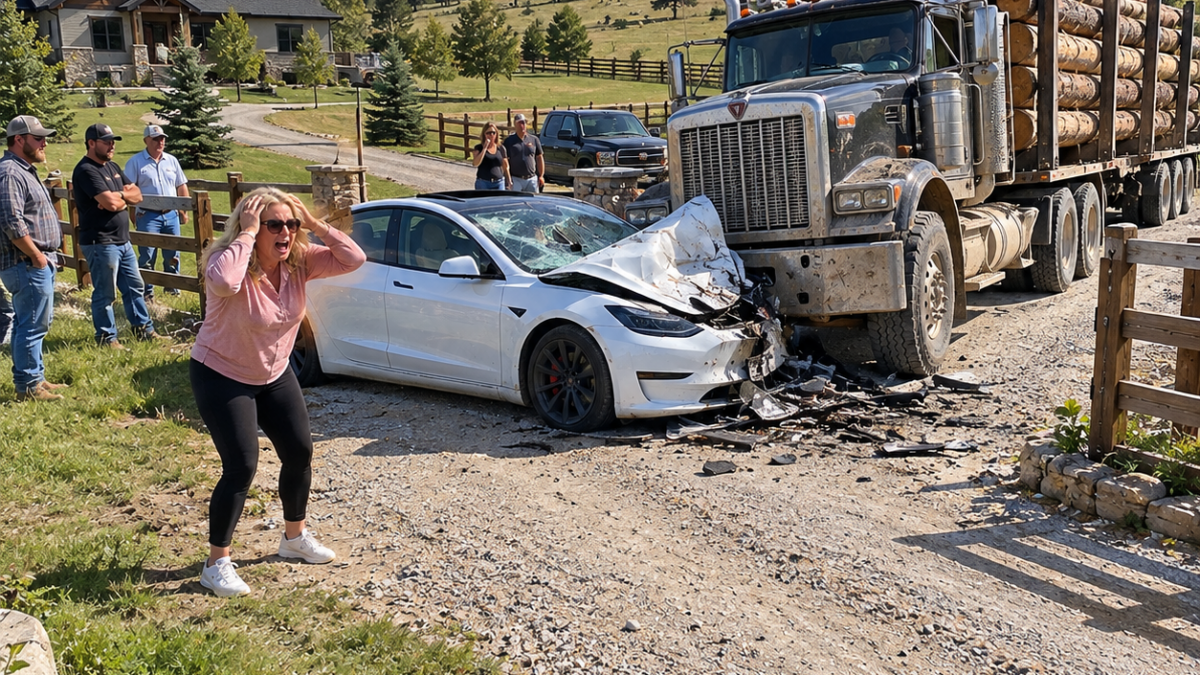
Contact.
A soft bump.
For half a second, the Tesla shifted slightly.
Then resistance.
The truck continued its controlled forward movement.
Plastic cracked.
A rear light shattered.
Someone gasped.
The back corner of the Tesla began folding.
Metal does not care about entitlement.
It does not care about HOA titles.
It does not care how expensive a vehicle is.
It responds to force.
The rear panel crumpled inward.
Glass trembled.
The trunk distorted.
The Tesla was pushed and compressed against the obstruction geometry created by its own position.
The sound was terrible.
Not an explosion.
More like a sequence of failures.
Crunch.
Pop.
Crack.
Steel yielding.
Plastic breaking.
A side window crazing.
People on the lawns stood frozen.
Then a scream came from behind them.
“STOP!”
Brianna.
She was running.
Hair loose.
Sweatshirt thrown over pajamas.
Barely tied shoes.
No sunglasses.
No polished HOA smile.
Just panic.
“STOP THAT TRUCK!”
Ray stopped.
Immediately.
The Tesla was already mangled at the rear.
Brianna ran toward it.
“What are you doing?”
She looked at me.
Then the deputy.
Then Ray.
Then back at her car.
“My car!”
I said nothing.
She ran to the driver side.
Tried the handle.
The body deformation had shifted the door.
It didn’t open normally.
She screamed again.
“You destroyed it!”
The deputy stepped forward.
“Ma’am.”
She spun.
“Arrest him!”
“Ma’am, calm down.”
“He crushed my Tesla!”
“You were notified to remove it.”
“What?”
The deputy pointed toward the gate.
“This is private access.”
Brianna stared at him.
“He did this intentionally!”
I finally spoke.
“You were warned.”
Her eyes locked on me.
“You psychopath.”
“Certified letter.”
“You crushed my car!”
“Email.”
“I will destroy you.”
“Phone call.”
“You think paperwork makes this okay?”
“Voicemail at five-oh-three.”
“Shut up!”
“Second voicemail.”
She lunged one step toward me.
The deputy moved between us.
“Ma’am.”
She pointed around him.
“He has been harassing me for months!”
I almost laughed.
Neighbors were now recording openly.
Howard, the HOA president, came hurrying down the sidewalk wearing sweatpants and a jacket over a T-shirt.
“What happened?”
Brianna turned on him.
“Do something!”
Howard stared at the Tesla.
“What the hell?”
“He destroyed my car.”
The deputy looked at Howard.
“You with the HOA?”
“Yes.”
“Were you notified about commercial gate access this morning?”
Howard went still.
Then looked at me.
Then Brianna.
“Yes.”
Brianna’s face changed.
“Howard.”
He ignored her.
“We received the notice.”
“Did you notify board members?”
“Yes.”
“Howard!”
He finally looked at her.
“You got the same email.”
“This is not about the email!”
“It is absolutely about the email.”
She stared at him.
“You’re siding with him?”
“I’m siding with the fact that we were told not to block this gate today.”
“I am vice president.”
“Brianna, your car was parked across the gate.”
“For community business!”
“At five in the morning?”
That landed.
A murmur went through the watching neighbors.
Brianna looked around.
Her husband appeared next.
Slippers.
Sweatpants.
Face pale.
“What happened?”
She pointed at me.
“He crushed the car.”
Her husband stared.
Then at the truck.
Then at the deputy.
Then at the signs.
“Why was it here?”
Brianna didn’t answer.
He looked at her.
“Bri.”
“I parked it.”
“Why?”
“Because this road is part of the access dispute.”
Her husband closed his eyes.
That reaction told me something.
He knew.
Maybe not every detail.
But enough.
“You parked it here on purpose?”
She snapped.
“Do not interrogate me in front of these people.”
“Did you?”
“I was making a point.”
The entire morning seemed to stop around that sentence.
She was making a point.
There it was.
Not an accident.
Not temporary parking.
Not misunderstanding.
A point.
Howard rubbed one hand over his face.
The deputy looked at her.
“You intentionally placed the vehicle across the gate after receiving notice that heavy commercial access was scheduled?”
Brianna realized the problem immediately.
“I did not say intentionally.”
Her husband looked at her.
“You literally just said—”
“Stop talking.”
The deputy remained calm.
“Ma’am, when did you park here?”
She hesitated.
“I don’t remember.”
Camera did.
“Were you aware of the posted signs?”
She looked at them.
“How could I not be? He put them everywhere.”
Another bad answer.
“Were you aware the road is privately owned?”
“It’s disputed.”
“No,” I said.
She turned.
“Shut your mouth.”
The deputy looked toward me.
I stopped.
He asked Brianna, “Do you have a recorded easement?”
She folded her arms.
“The HOA has historical community rights.”
Howard said quietly, “We don’t have a recorded easement.”
Brianna spun.
“What are you doing?”
“I’m not lying to a deputy.”
Her face went scarlet.
“This board has completely abandoned me.”
Howard stared at her.
“We told you to stop parking here.”
“No, you said avoid escalation.”
“Yes.”
“This is his escalation!”
Howard pointed at the crushed Tesla.
“That is your car.”
She looked like she might hit him.
Instead, she turned back to me.
“You’re paying for every dollar.”
I nodded.
“Call your insurance.”
“I will.”
“Good.”
“And then I’m suing you.”
“Call your lawyer.”
“I have one.”
“Great.”
Her husband whispered, “Brianna, stop.”
“No!”
She pointed at the truck.
“This is criminal damage.”
The deputy shook his head slightly.
“This is going to be documented.”
“Then document him.”
“We’re documenting everything.”
“I want him arrested.”
“That’s not happening right now.”
Her face went blank.
“What?”
“I said nobody is being arrested right now.”
“He intentionally crushed my vehicle.”
“After documented notice, multiple attempts to contact you, commercial access requirements, and your vehicle obstructing a private road. The exact civil liability can be handled by the appropriate parties.”
Brianna looked like she had been slapped.
“You’re useless.”
The deputy’s expression changed slightly.
Not angry.
Just done.
“Ma’am, I suggest you stop making this worse.”
She laughed sharply.
“Worse?”
She pointed at the Tesla.
“How could this possibly get worse?”
It did.
Not immediately.
But steadily.
First came insurance.
Brianna filed a claim.
Her version, according to documents I later saw through counsel, described the Tesla as “lawfully parked adjacent to a community easement when maliciously struck by a commercial vehicle operating under the direction of the neighboring landowner.”
Maliciously.
Community easement.
Adjacent.
Three lies in one sentence.
Then my footage appeared.
Camera one showed the Tesla arriving at 4:51 a.m.
Camera two showed Brianna getting out.
The signs were visible.
The gate was visible.
Her deliberate parking position was visible.
My calls were logged.
Certified receipt existed.
Emails existed.
HOA notice existed.
Sheriff notification existed.
Commercial contract existed.
Ray’s delivery schedule existed.
The deputy’s body camera existed.
Her statement about “making a point” existed.
Suddenly the story became harder to sell.
Her insurer disputed coverage for the way she had created the obstruction.
Her lawyer called Mark.
Mark called me.
“She wants to sue.”
“I assumed.”
“She has a problem.”
“Several.”
“Don’t get cute.”
“Sorry.”
“The problem is evidence.”
“My favorite kind.”
Mark sighed.
“She also wants the HOA involved.”
“Why?”
“She claims she was acting in her official capacity.”
I laughed.
“You think that’s funny?”
“Yes.”
“It is a little funny.”
The HOA did not laugh.
Their insurer got involved.
Their attorney got involved.
Emergency board meeting.
Brianna apparently walked in expecting support.
She walked out without her title.
Howard called me the next day.
“I want to make something clear.”
“Okay.”
“The board never authorized Brianna to park across your road.”
“I know.”
“We also never authorized those fake notices.”
“You sent some of them on HOA letterhead.”
Silence.
“Yes.”
“Then somebody authorized something.”
Another silence.
“We handled this badly.”
“Yes.”
He sounded exhausted.
“She made it sound like the easement was real.”
“You could have checked.”
“We should have.”
“Yes.”
“I’m sorry.”
That was the first apology from Maple Ridge.
It mattered.
Not because it erased the previous months.
Because it admitted reality.
Howard continued.
“We’re sending a formal letter confirming Maple Ridge claims no ownership or parking right over your road.”
“Good.”
“We’re also removing Brianna from vice president pending a vote.”
I looked out the window toward the gate.
“What changed?”
Howard gave a humorless laugh.
“She parked her Tesla in front of a logging truck.”
Fair.
The neighborhood changed quickly after that.
People who had avoided me started waving again.
Then stopping.
Then apologizing.
Some admitted Brianna had told them I was trying to block emergency services.
Others had heard I was suing the HOA.
I wasn’t.
Some thought I had installed the gate after Maple Ridge existed.
The gate had been there before half their houses.
Brianna had been very good at telling stories.
That was her real talent.
She rarely told a complete lie when a distorted truth would work better.
Yes, my road bordered Maple Ridge.
Therefore community access.
Yes, residents had occasionally stopped near it.
Therefore historical use.
Yes, I objected.
Therefore hostility.
Yes, heavy trucks used my property.
Therefore neighborhood danger.
Narrative by accumulation.
Once the Tesla incident happened, the accumulation reversed.
Residents saw the signs.
Saw the deputy.
Saw the logging contract.
Saw the notices.
Saw Brianna screaming.
Saw Howard admit the board had been notified.
Saw her husband ask why she parked there.
Saw her answer.
The story became simpler.
Brianna had been warned.
She did it anyway.
Her attempt to sue died fast.
Mark called me after talking with her attorney.
“He is not enthusiastic.”
“About the case?”
“About his client.”
“That bad?”
“He asked whether you would agree not to seek fees if she dropped everything.”
“What do you think?”
“I think peace has value.”
“So yes?”
“Yes, if we also get written acknowledgment that she has no access right and no authority to obstruct.”
“Do it.”
I didn’t need money.
I needed the gate clear.
Brianna hated that settlement condition.
I heard later she called it humiliating.
Maybe.
But I had spent months asking for exactly one thing:
Stop blocking my road.
She signed.
The HOA then held a formal board vote.
Brianna lost her office.
Not because everyone suddenly loved me.
Because the board realized her behavior created liability.
That’s the funny thing about organizations.
They can tolerate arrogance for years.
Liability changes their religion overnight.
The new HOA letter came certified.
Maple Ridge Estates acknowledged my road as private property.
No community easement.
No parking rights.
No HOA authority.
Any future resident use required my express permission.
I framed that letter.
Not dramatically.
Just a cheap black frame in my office.
Mark saw it.
“You’re petty.”
“I prefer organized.”
“You framed surrender.”
“I framed clarification.”
He laughed.
Mom came back in spring.
That visit mattered more than all the legal paperwork.
I watched her car approach the gate.
Nothing blocking it.
No Tesla.
No fake notices.
No HOA banners.
Just gravel.
She drove through.
Parked beside the house.
I helped her out.
She looked back down the hill toward the entrance.
“Clear.”
“Yes.”
“Looks nice.”
“It looks like a road.”
“Exactly.”
We went inside.
After lunch she asked what happened to Brianna.
“Lost the HOA position.”
“Good.”
“She moved later.”
“Also good.”
“Mom.”
“What?”
“You’re ruthless.”
“I’m eighty.”
She adjusted her walker.
“I don’t have time for difficult people.”
Brianna’s house went up for sale a few months after the incident.
Her husband apparently moved first.
I don’t know whether the Tesla contributed to marital problems.
None of my business.
I heard she relocated.
Different town.
Maybe a different HOA.
I hope they had wide parking lots.
The Tesla itself was declared a major loss.
I never saw it again after it was removed.
People assume that image is the part I remember most.
White luxury car folded under the mass of a logging truck.
It isn’t.
The moment I remember most is Brianna telling Mom to wait.
Because that was when the conflict stopped being irritating and became clear.
Before then, I had treated Brianna’s behavior as something temporary.
A personality problem.
A neighbor problem.
Something I could tolerate until she got bored.
But entitlement doesn’t usually get bored when tolerated.
It expands.
The first time she blocked my gate, she said one minute.
Then forty minutes became acceptable.
Then an hour.
Then HOA notices.
Then spray paint.
Then fake easement claims.
Then outright refusal.
Every time nothing serious happened, she learned the wrong lesson.
She learned the boundary was negotiable.
I had accidentally trained her too.
Every time I waited.
Every time I moved my schedule.
Every time I found another way around.
Every time I told myself it wasn’t worth a bigger fight.
She interpreted restraint as inability.
That was why she laughed when I warned her about the logging operation.
“You won’t do anything.”
She believed that.
Because for months, consequence had always stopped one step before reaching her.
Warning.
No consequence.
Photo.
No consequence.
Letter.
No consequence.
Board meeting.
No consequence.
She had become convinced the pattern was permanent.
Then Monday came.
I sometimes wonder what she expected when she parked the Tesla at 4:51 that morning.
Maybe she expected me to cancel the truck.
Maybe she expected another argument.
Maybe she wanted video of an angry confrontation.
Maybe she believed the deputy would side with the HOA.
Maybe she simply wanted to prove that all my paperwork meant nothing.
That was always the real fight.
Not Tesla versus logging truck.
Not resident versus HOA.
Not even gate versus parking.
Paper versus attitude.
Boundary versus entitlement.
Evidence versus narrative.
Brianna was excellent at narrative.
I became better at evidence.
That difference decided everything.
People later called what happened “revenge.”
I never liked that word.
Revenge would have meant hunting down her car somewhere else.
Revenge would have meant damaging it after the fact.
Revenge would have meant doing something because I wanted her to suffer.
That wasn’t the sequence.
A real commercial job needed access.
She knew.
She blocked it anyway.
Multiple warnings followed.
She still refused.
The job proceeded.
That doesn’t make the result pretty.
It was expensive.
Dramatic.
Messy.
But the conflict existed before the truck ever arrived.
The truck simply made denial impossible.
There is a strange power in physical reality.
Brianna could argue with me.
Argue with deeds.
Argue with surveys.
Argue with letters.
Argue with board members.
Argue with signs.
But when a forty-ton working vehicle arrived at the gate her Tesla was blocking, suddenly the geometry mattered.
The road had a width.
The gate had a location.
The truck had a route.
The Tesla occupied that route.
All her language disappeared.
No “community harmony” could move steel.
No “historical understanding” changed the turn radius.
No vice-presidential title widened the gate.
For once, the world did not care how she described it.
That morning taught Maple Ridge something too.
After Brianna left, the HOA rewrote its access policies.
Mostly to clarify that private adjacent property was private.
Which should not have required a policy.
But sometimes organizations need to write down obvious things after someone powerful pretends they are complicated.
Howard remained president another year.
He became surprisingly decent once Brianna was gone.
One afternoon he stopped by.
Parked on the county shoulder.
Walked to the gate.
Did not cross until I waved him in.
That alone made me smile.
“I brought something.”
He held a folder.
“What?”
“Revised HOA policy.”
“I’m still not a member.”
“I know.”
“Then why do I care?”
“Because page three mentions your road.”
I stared at him.
“That sounds dangerous.”
“Read it.”
The language said no HOA member, officer, contractor, or guest could use, obstruct, park upon, or represent any private adjacent access as HOA-controlled without recorded legal authority or owner permission.
I looked at Howard.
“You wrote a Brianna rule.”
He sighed.
“We wrote several.”
I laughed.
He did too.
Then he became serious.
“I should have stopped her earlier.”
“Yes.”
“I believed her.”
“I know.”
“She was persuasive.”
“I know.”
“She made everything sound urgent.”
“That was her trick.”
Howard nodded.
“She always acted like if we didn’t support her immediately, something terrible would happen.”
“And eventually something did.”
He looked toward the gate.
“Yeah.”
Before leaving, he said something I didn’t expect.
“People think this was about the car.”
“It wasn’t.”
“I know.”
He nodded toward the gravel.
“It was about this.”
“The road?”
“The word no.”
That was exactly it.
Brianna could not stand no.
No, this road is private.
No, you can’t park here.
No, the HOA does not have an easement.
No, your title doesn’t apply.
No, convenience does not create a right.
No.
A simple word.
People like Brianna hear it as aggression because they have spent too long surrounded by people saying yes to avoid conflict.
Months passed.
Then years.
The incident became one of those local stories people exaggerated.
Someone told a new resident I had deliberately hired a logging truck just to destroy a Tesla.
False.
Someone else claimed there were three trucks.
There was one.
Another person said Brianna had been arrested.
She hadn’t.
Another said the sheriff ordered the truck forward.
He didn’t.
Stories get bigger.
Reality was simpler.
That’s why I kept the documents.
Not because I expected another lawsuit.
Because facts deserve somewhere to live after gossip takes over.
The logging contract.
The notices.
The certified receipts.
The gate photographs.
Camera timestamps.
The HOA acknowledgment.
The settlement.
All in one folder.
Mark once looked at it and said, “You know nobody is coming for this anymore.”
“I know.”
“Then why keep it?”
“Why do lawyers keep files?”
“For malpractice protection.”
“Exactly.”
He laughed.
“You’re impossible.”
“Apparently.”
The gate is still there.
Same metal frame.
Same sign.
I replaced the smaller sign once after weather faded it.
The new one says:
PRIVATE ACCESS
KEEP CLEAR AT ALL TIMES
No threat.
No argument.
Just instruction.
Nobody parks there anymore.
Delivery drivers stop clear.
Neighbors stop clear.
Even visitors who don’t know the history understand.
Sometimes respect only needs a sign.
Sometimes it needs a history behind the sign.
Mom visits less now.
Travel is harder.
But every time she comes, she notices the gate.
One autumn afternoon, she looked at the road and said, “Funny.”
“What?”
“All that trouble.”
I knew what she meant.
“You think?”
“That woman could have just parked twenty yards away.”
“Thirty.”
Mom nodded.
“Thirty yards.”
We both looked down the hill.
“Imagine rearranging your entire life because you refused to walk thirty yards.”
That was Brianna’s story in one sentence.
She lost a car.
Lost an HOA title.
Lost credibility.
Eventually moved.
All because parking somewhere legal would have required a short walk.
Of course, it was never really about walking.
If it had been, she would have moved the first time.
It was about being told she couldn’t do something.
The car was only the symbol.
My gate said she did not control everything near Maple Ridge.
That offended her.
Once I understood that, all her behavior made sense.
Not rational sense.
Emotional sense.
Every fake notice was an attempt to erase the boundary.
Every HOA letter tried to turn convenience into policy.
Every accusation tried to turn resistance into hostility.
Every time she parked there, she was saying the same thing:
You cannot stop me.
The final morning answered:
You were stopped long before today.
You just refused to notice.
The funny thing is I never felt triumphant afterward.
People asked.
“Did you enjoy watching the Tesla fold?”
No.
The sound was awful.
I knew somebody had just lost an expensive vehicle.
Even if she caused the situation, destruction isn’t beautiful in person.
Movies make it clean.
Real crushed metal looks ugly.
Broken glass.
Bent panels.
Loose trim.
Warning chimes beeping pointlessly.
Brianna crying.
Her husband pale.
Neighbors filming.
Nothing about it felt heroic.
What felt good came later.
The first morning I drove through the gate without checking whether her car was there.
The first commercial delivery that arrived without drama.
The first time Mom drove straight to the house.
The first letter from Maple Ridge admitting there was no easement.
That was the victory.
Normal life.
Peace is boring.
That is what makes it valuable.
When you’ve dealt with a person like Brianna long enough, you forget how much mental space conflict consumes.
Every engine near the gate made me wonder.
Every HOA envelope tightened my stomach.
Every time I saw that white Tesla, my day changed.
Afterward, that stopped.
Pine trees.
Gravel.
Work.
Coffee.
Logs.
Rain.
Mom’s visits.
Neighbors waving again.
Nothing cinematic.
Perfect.
There is one moment from the morning of the logging truck I still replay sometimes.
Not the crush.
Not the screaming.
A few minutes after Brianna arrived, while she was arguing with the deputy, somebody behind me said quietly:
“Guess the rules go both ways.”
I never turned to see who.
I didn’t need to.
That sentence mattered because Brianna had spent years presenting herself as the guardian of rules.
Parking restrictions.
Landscaping standards.
Community procedures.
Meeting policies.
She loved rules when they moved other people.
The moment a boundary restricted her, she treated it as illegitimate.
That is not respect for rules.
That is respect for power.
And those are very different things.
Actual rules apply when they are inconvenient.
Actual ownership still exists when somebody powerful dislikes it.
Actual boundaries remain boundaries after someone laughs at them.
My deed didn’t become more valid the morning the Tesla was damaged.
It had always been valid.
The survey didn’t become correct because a deputy saw it.
It had always been correct.
The road didn’t become private because Brianna lost the HOA vote.
It had always been private.
The only thing that changed was her ability to pretend otherwise.
Sometimes that is what consequences do.
They don’t create truth.
They remove the space where somebody has been hiding from it.
If I could go back to the first day Brianna parked across the gate, I would do one thing differently.
I would document sooner.
Not argue.
Not explain more.
Not try harder to make her understand.
Document.
Because people like Brianna often understand perfectly.
They just assume you lack the patience to prove it.
That was her biggest miscalculation with me.
She thought patience meant weakness.
My mother once described me as the kind of child who would spend three hours untangling fishing line rather than cut it.
Brianna interpreted that same personality as hesitation.
She was wrong.
Patience can be passive.
But it can also be preparation.
I waited.
Collected.
Filed.
Notified.
Verified.
By the time the logging truck arrived, there was almost nothing left to argue about.
That was deliberate.
Not the damage.
The clarity.
I wanted anybody reviewing what happened to see the same sequence.
Private road.
Repeated obstruction.
Repeated warning.
Documented notice.
Legitimate commercial access.
Final calls.
No response.
Work proceeded.
No mystery.
Brianna hated that because ambiguity had always been her strongest weapon.
She lived in phrases like:
We’ve always done this.
Everyone knows.
Community access.
Reasonable use.
Neighborly cooperation.
Those phrases work when nobody asks for a map.
I asked for the map.
There was no easement.
End of argument.
She kept arguing anyway.
The new Maple Ridge board learned that lesson.
So did I.
Years later, I occasionally meet residents who moved in after Brianna left.
Most don’t know the story.
I prefer that.
Once, a new neighbor named Dylan stopped while I was working near the road.
He pointed at a faint scrape on one of the old gate posts.
“What happened there?”
“Long story.”
“Truck?”
“Yes.”
He nodded.
“Looks rough.”
“It was.”
Then he pointed toward the Maple Ridge clubhouse.
“Somebody told me an HOA lady parked a Tesla here and got it crushed.”
“That’s the short version.”
“True?”
“Mostly.”
He laughed.
“What’d she do?”
“Refused to move.”
“For a logging truck?”
“Yes.”
“Why?”
I shrugged.
That was still the hardest question.
Why?
Because she believed I would always move first.
That was probably the answer.
“She thought everyone else would adjust.”
Dylan looked at the road.
“That’s expensive confidence.”
“Very.”
He walked away.
I thought about that phrase.
Expensive confidence.
Brianna had plenty.
What she lacked was humility.
Humility would have saved her car.
Humility would have saved her title.
Humility would have saved months of conflict.
A simple sentence:
Sorry. I’ll move.
That’s all.
Instead she chose:
You won’t do anything.
She was right in one sense.
I didn’t scream.
Didn’t punch.
Didn’t chase.
Didn’t vandalize.
Didn’t play tricks.
I did almost nothing dramatic.
I let documents accumulate.
I let warnings stand.
I let schedules proceed.
And when the moment arrived, I stopped rearranging my life around her refusal.
That was enough.
People sometimes think standing up for yourself requires aggression.
It doesn’t.
Sometimes the strongest thing you can do is stop absorbing consequences that belong to someone else.
For months, Brianna parked illegally.
I absorbed the delay.
She caused conflict.
I absorbed the reputation damage.
She invented an easement.
I spent time disproving it.
She blocked Mom.
Mom took the longer route.
Every time, her choice created a cost and somebody else paid it.
The logging morning was the first time the cost stayed on her side of the line.
That is why it felt so shocking.
Not because consequences were unusually cruel.
Because she had gone so long without carrying them.
I still have the framed HOA letter.
Right below it is the original certified receipt with Brianna’s signature.
Sometimes when Mark visits, he points at the wall.
“Your little museum.”
“It’s history.”
“It’s petty.”
“You’ve said that.”
“You’re still petty.”
Then we have coffee.
I’m fine with petty if petty means remembering the exact moment bureaucracy finally told a bully no.
The rest of the file stays in the cabinet.
I don’t need to look at it.
The road itself is evidence enough.
Clear.
Open.
Mine.
The last time Mom visited, spring rain had washed some gravel toward the ditch.
I was outside raking when her car came up.
She rolled down the window.
“Need help?”
“You’re eighty-two.”
“So?”
“So no.”
She laughed.
I opened the gate.
She drove through.
No waiting.
No argument.
No HOA vice president standing there explaining community responsibility.
Just my mother coming to my home.
After she parked, she stood with the walker and looked back.
“You know what the best part is?”
“What?”
“That car isn’t here.”
I smiled.
“Yeah.”
She patted my arm.
“You got your peace back.”
That was when I realized she was right.
Peace wasn’t something Brianna had taken permanently.
I had simply allowed her to occupy too much of it for too long.
Once the conflict ended, the property became mine again in more than the legal sense.
It felt mine.
That matters.
Home is partly ownership on paper.
But it is also the expectation that you can arrive without negotiation.
That your mother can visit without waiting behind someone else’s ego.
That work trucks can enter.
That deliveries can arrive.
That a gate means access for the owner, not leverage for a neighbor.
Brianna never understood that.
To her, every boundary was a social negotiation.
If enough people wanted access, ownership should yield.
If the HOA preferred something, private rights should bend.
If she had a title, other people should accommodate.
That worldview works until it meets a person who knows exactly what the paperwork says.
Then the language changes.
She called me selfish.
Hostile.
Dramatic.
Unneighborly.
Obsessive.
The words changed.
The survey did not.
That’s probably the cleanest lesson I took from the whole thing.
When somebody is trying to drag you into an emotional fight over something objectively documented, go back to the document.
Where is the line?
Who owns it?
What rights exist?
What notice was given?
What happened?
Not what someone felt happened.
Not what an HOA newsletter said.
Not what a vice president declared.
What actually happened.
The morning the logging truck arrived, reality had receipts.
Brianna had attitude.
Attitude lost.
I never bought another security camera after that.
Didn’t need one.
The existing system still runs.
Mostly records deer.
Delivery drivers.
Wind moving branches.
Once, a black bear wandered near the gate around midnight.
It sniffed the NO PARKING sign.
Then left.
Better behaved than Brianna.
I saved that clip.
Not for evidence.
Because it made Mom laugh.
Maple Ridge is quieter now.
Howard eventually stepped down.
The new board seems boring.
That is a compliment.
No crusades.
No fake easements.
No president’s letters about hostile neighboring landowners.
People pay dues.
Maintain landscaping.
Argue about pool hours.
Normal HOA nonsense.
Exactly where their authority belongs.
Inside Maple Ridge.
My authority stays on my property.
Theirs stays on theirs.
A line.
Simple.
The kind of thing Brianna turned into a war because she could not tolerate a limit.
I occasionally hear different versions of where she went.
Another county.
Maybe another state.
Someone said she joined another neighborhood board.
I hope that part isn’t true.
Not because I want to punish her forever.
Because some lessons deserve time to settle.
Maybe she changed.
People can.
Maybe somewhere she now parks twenty yards away and walks.
Maybe she sees a private gate and thinks twice.
Maybe not.
It doesn’t affect me anymore.
That is the best ending any conflict can have.
Not watching your enemy suffer.
Becoming irrelevant to each other.
The road stays open.
The gate stays clear.
My work continues.
Mom visits.
Neighbors wave.
And nobody asks whether the HOA vice president can borrow my property because the answer is already understood.
No.
One ordinary word.
The word Brianna fought for months.
The word she treated like an insult.
The word written into every boundary whether people like her acknowledge it or not.
No.
No, you may not park here.
No, your HOA does not own this.
No, convenience does not equal access.
No, a title does not erase a deed.
No, other people do not have to reorganize their lives to make your choices easier.
Brianna kept hearing that word and answering with her Tesla.
Until one Monday morning, she put the car in the one place I had warned her repeatedly it could not remain.
Then the logging truck appeared over the rise.
Forty tons.
Diesel rumbling.
Work order signed.
Route documented.
Deputy present.
Cameras recording.
And suddenly the argument she had stretched across months became physically simple.
There was a gate.
There was a truck that had to pass through it.
And there was Brianna’s Tesla sitting exactly where she had been told not to leave it.
She believed everyone would stop for her.
For once, they didn’t.
The truck rolled forward.
Her car folded.
Her authority folded shortly after.
The fake easement disappeared.
The HOA backed away.
The lawsuit went nowhere.
The neighborhood finally learned the truth.
Then Brianna left.
And my gate became what it had always been before she decided to turn it into a battlefield.
A gate.
Nothing more.
Nothing less.
Mine.
And clear.