HOA Karen Invited 500 People to Camp on My Private Ranch—Then She Saw 24 Bulls Coming Through the Gate
PART2
Before Stonebridge, there had been open grass, a few scattered trees, and one old service lane.
Then the developer arrived.
Roads went in.
Utilities.
Sidewalks.
Rows of almost identical houses.
A clubhouse.
A pool.
Landscaped entrances.
Walking paths.
Decorative stone signs that announced STONEBRIDGE MEADOWS in lettering large enough to be visible from orbit.
I didn’t care.
Their land was their business.
My land was mine.
That arrangement worked perfectly until Karen became HOA president.
She moved into Stonebridge about four years earlier.
Within six months, she had taken over the board.
Nobody else seemed especially eager to spend evenings arguing about mailbox shades and hedge heights.
Karen was.
She loved procedure.
Loved rules.
Loved meetings.
Mostly, she loved having a title.
HOA PRESIDENT.
She said it the way some people say GOVERNOR.
Our first conflict was ridiculous.
A letter appeared in my mailbox.
NOTICE OF EXTERIOR COMPLIANCE CONCERN.
I laughed before reading the second paragraph.
My pasture vegetation, according to Karen, was not being maintained in a manner consistent with Stonebridge visual standards.
I called the number at the bottom.
Karen answered.
“Stonebridge Meadows Homeowners Association.”
“This is your neighbor on the west side.”
She paused.
“The ranch?”
“Yes.”
“How can I help?”
“You sent me a compliance notice about my grass.”
“It’s not technically a violation notice.”
“That’s good, because I don’t belong to your HOA.”
“We’re aware.”
“Then what is it?”
“A courtesy request.”
“It says corrective action requested within fourteen days.”
“That is our standard language.”
“Then your standard language is wrong.”
She sighed.
“The grass along your eastern fence line has become visually inconsistent with our maintained common spaces.”
“It’s pasture.”
“Yes.”
“That’s what pasture grass looks like.”
“Residents have complained.”
“They can stop looking.”
She did not enjoy that answer.
“The appearance affects community values.”
“Your houses affect my view.”
“What?”
“I used to see open fields. Now I see thirty roofs.”
“That’s completely different.”
“Why?”
She had no answer.
The second letter involved my cattle.
LIVESTOCK NUISANCE CONCERN.
Apparently, cattle noise had been reported during “quiet enjoyment hours.”
I called again.
“Karen.”
“Yes?”
“You sent me a noise complaint about cows.”
“Several residents reported disruptive livestock sounds.”
“What exactly would you like me to tell the cows?”
“This doesn’t need to be sarcastic.”
“They’re cattle.”
“We’re asking you to consider relocation farther from the subdivision.”
“They were here first.”
“That isn’t the issue.”
“It is from the cow’s perspective.”
She hung up.
Then came the fence complaint.
My barbed-wire fence did not fit Stonebridge aesthetic standards.
Then the old gate.
Then one of my stock tanks.
Then manure odor.
Then farm-equipment visibility.
Karen somehow convinced herself that because her subdivision had been built beside my ranch, my ranch had acquired a duty to look less like a ranch.
I ignored most of it.
Then she called the county.
She described my bulls as dangerous animals threatening Stonebridge residents.
The county livestock officer came out.
He spent ten minutes looking at my fencing.
Another ten looking at the herd.
Then he said, “What exactly was the complaint?”
I handed him Karen’s letter.
He read it.
Looked at the bulls.
One was chewing grass with half its face covered in hay.
The officer shook his head.
“Wild animals?”
“That’s what she called them.”
“These are cattle.”
“I’m aware.”
He drove over to Stonebridge afterward.
I never heard the full conversation.
But Karen stopped using the phrase “wild animals.”
For about two weeks.
Then the HOA extended a walking trail along my eastern property line.
That was when things became more serious.
The trail itself was on Stonebridge land.
Fine.
But their contractor placed several stakes almost twenty yards into my property.
I checked against my survey.
Moved nothing.
Photographed everything.
Then called the county surveyor.
The stakes were wrong.
Stonebridge’s contractor corrected them.
Karen was furious.
She came to my gate holding one of her maps.
“Our master plan shows the green belt extending beyond your existing fence.”
“There is no green belt on my property.”
She tapped the map.
“It’s right here.”
“That is a marketing map.”
“It’s the community planning map.”
“It isn’t a land survey.”
“The original developer identified this entire area as protected open space.”
“He could have identified the moon.”
She glared at me.
“That doesn’t make it his.”
“Our residents were sold homes based on access to green-space views.”
“They have views.”
“Not access?”
“No.”
“Why?”
“Because looking at my pasture from your trail doesn’t create a right to enter it.”
“That’s unnecessarily hostile.”
“No. It’s a property line.”
Karen’s favorite tactic was to turn the word no into a moral defect.
If I refused, I was selfish.
If I asked her to respect a boundary, I was hostile.
If I pointed to a deed, I was antisocial.
If I refused to let an HOA redefine my land, I was “against community.”
She started telling people she was “negotiating” with me.
I discovered this when a neighbor named Carl mentioned it at the feed store.
“You opening your pasture?”
I looked at him.
“What?”
“Stonebridge events.”
“No.”
He frowned.
“The HOA lady told people she was working out an agreement.”
“There is no agreement.”
A week later, I heard two walkers along the trail talking about future yoga sessions “inside the green belt.”
I walked over.
“Just so you know, that pasture is private.”
One woman looked confused.
“We were told the HOA was opening it.”
“They aren’t.”
“Karen said—”
“I know what Karen says.”
That evening, I installed additional NO TRESPASSING signs every fifty feet along the eastern boundary.
Karen complained that the signs were “visually aggressive.”
I added two more.
Then came the flyer.
It appeared in my mailbox on a Tuesday.
Bright colors.
Stars.
Campfires.
Happy cartoon tents.
STONEBRIDGE FREEDOM CAMPOUT.
LIVE MUSIC.
FOOD TRUCKS.
BONFIRES.
CAMPING UNDER THE STARS.
ALL WEEKEND.
LOCATION:
COMMUNITY GREEN BELT.
I knew exactly what that meant.
I went directly to the clubhouse.
Karen sat behind a folding desk reviewing sign-up sheets.
I placed the flyer in front of her.
“What is this?”
She barely looked up.
“The Freedom Campout.”
“Where?”
“The green belt.”
“Whose green belt?”
She sighed.
“We’ve discussed this.”
“No. You’ve discussed it. I’ve told you no.”
She set down her pen.
“The planning maps clearly recognize that area as part of the broader recreational green zone.”
“My deed clearly recognizes that area as mine.”
“We are not debating the deed again.”
“Good.”
I put my survey on the table.
“Here is the boundary.”
She didn’t look.
“Karen.”
“I know what your survey claims.”
“It doesn’t claim anything. It shows the property line.”
“Our counsel has advised that long-term community use expectations may create broader rights.”
“What community use?”
“The trail system.”
“The trail is on your side.”
“Visual access.”
I stared at her.
“You think seeing my grass creates legal access?”
She leaned back.
“This is bigger than you.”
There it was.
“The community deserves outdoor space.”
“You have parks.”
“This is different.”
“You have common lawns.”
“This is natural open land.”
“It’s a cattle pasture.”
“We’ll clean up afterward.”
I laughed.
Loud enough that two people at another table looked over.
“You’ll clean up after five hundred people camp on working pasture?”
“Yes.”
“You can’t get your board to empty the dog-park trash cans on schedule.”
Her lips tightened.
“Do not insult our volunteers.”
“I’m not discussing volunteers.”
I pointed to the survey.
“This is my deed.”
Then toward the flyer.
“This is your event.”
Then back to her.
“They do not overlap.”
“They do according to our interpretation.”
“No.”
“Then perhaps this is something the court will eventually clarify.”
“If one person crosses that fence without permission, they are trespassing.”
Karen gave me that smile.
The thin, administrative smile she used when she thought someone beneath her had become emotional.
“You really intend to stand against five hundred neighbors?”
“I intend to stand on my own land.”
“You’re selfish.”
“I’ve heard.”
“People like you are why communities can’t progress.”
“People like me?”
“People who think ownership means absolute control.”
I stared at her.
“On my pasture?”
“Yes.”
“That is almost exactly what ownership means.”
She lifted her clipboard.
“We’ll see.”
I walked out.
By Friday afternoon, I did.
The county road backed up with SUVs.
Campers.
RVs.
Travel trailers.
Food trucks.
Cars carrying kayaks even though there was nowhere to kayak.
Families poured through the eastern side of my pasture.
I watched people move temporary fence sections.
Then somebody cut wire near one of the old access points.
My security cameras recorded all of it.
When I tried to drive toward my barn, two men in reflective vests stepped into the road.
One held up his palm.
“Sorry, sir. Campground is at capacity.”
I stopped my truck.
“What?”
“You’ll need to park somewhere else.”
“Son.”
He smiled patiently.
“Yes?”
“You’re standing in my driveway.”
The smile faded.
“I was told this is event access.”
“By who?”
“The HOA.”
“This road leads to my barn.”
He looked past me.
Then toward hundreds of tents behind him.
“Well, President Karen said—”
“I don’t care what President Karen said.”
The second volunteer walked closer.
“No need to get hostile.”
“I am not hostile.”
I pointed at the gravel beneath their shoes.
“You are blocking the owner of this property from driving across his own land.”
The first man glanced at his radio.
“I’ll get Karen.”
“Please do.”
Five minutes later, Karen appeared.
Megaphone in one hand.
Clipboard in the other.
She walked toward my truck like she had been waiting for the moment.
Then she raised the megaphone.
“Oh, everyone, don’t worry!”
Hundreds of people turned.
“It’s just our neighbor.”
Laughter.
Karen continued.
“He’s been resistant to the green-belt project.”
More laughter.
I stepped out of the truck.
“Karen.”
She lowered the megaphone.
“What?”
“You have five hundred people trespassing on my property.”
“They are invited guests.”
“Not mine.”
“The HOA has authorized the event.”
“The HOA doesn’t own the pasture.”
“Your interpretation.”
“My deed.”
“Again, you’re being dramatic.”
Behind her, somebody pulled one of my NO TRESPASSING signs loose.
I pointed.
“Tell them to stop.”
Karen didn’t look.
“This event is already underway.”
“Tell them to leave.”
“No.”
That single word did something.
Not to my temper.
To my certainty.
Until then, I had still been willing to imagine she might recognize the scale of her mistake.
She didn’t.
Karen lifted the megaphone.
“Ladies and gentlemen, please continue enjoying yourselves!”
The crowd cheered.
Then she looked at me.
“The community has spoken.”
I took out my phone.
Hit record.
“Say that again.”
Her eyes narrowed.
“What?”
“The part about the community.”
She smiled.
“The community has spoken.”
“And you are refusing my demand that these people leave my property.”
“You do not have unilateral authority over a contested green space.”
“Good.”
“Good?”
“I wanted that recorded.”
Her smile vanished.
I walked to the nearest fence post.
Recorded the broken wire.
The torn sign.
The fire pits already dug into dry grass.
RVs parked beyond the boundary.
People siphoning water from a stock tank.
I narrated each point calmly.
Then I called the sheriff.
The deputy took almost an hour.
I couldn’t blame him completely.
The road was so clogged with cars that his cruiser crawled through the event.
When he reached me, he stepped out and looked around.
“Sir.”
“Deputy.”
“We’ve received noise complaints.”
“That’s not why I called.”
“What’s the issue?”
I turned slowly.
“This.”
He looked across the camp.
“Okay.”
“Approximately five hundred people on private property.”
Karen hurried over.
“This is a civil boundary disagreement.”
The deputy raised a hand.
“Ma’am, let me talk to him.”
She crossed her arms.
I handed him my survey copy.
“My property line.”
He studied it.
“Fence roughly follows it?”
“Yes. Within surveyed tolerance.”
Karen interrupted.
“We have a planning map showing community green-space rights.”
The deputy took it.
Looked at both.
His expression became uncomfortable.
“I’m not a surveyor.”
“That’s fine,” I said.
“I can’t adjudicate a boundary dispute roadside.”
“I’m asking you to address trespass.”
Karen spoke immediately.
“They were invited under HOA authority.”
The deputy sighed.
“Here’s the problem.”
I already knew I wasn’t going to like the sentence.
“If she’s claiming a property or access right and has documentation, even if you dispute it, this may need to be resolved civilly unless I have a clear court order or an obvious criminal act.”
“So they stay?”
“I’m not saying they have the right to stay.”
Karen smiled.
“But I’m not clearing five hundred people from land when the parties are presenting conflicting boundary claims without direction.”
The difference between those sentences was legally meaningful.
Practically useless.
Karen lifted her chin.
“I told you.”
I ignored her.
I asked the deputy:
“Are the fire pits permitted?”
He looked toward the smoke.
“That I can check.”
“The food trucks?”
“I can check.”
“The road obstruction?”
“Yes.”
“The cut fence?”
“If you can document who did it.”
“I can.”
That wiped some of the satisfaction off Karen’s face.
Still, the deputy did not evacuate the camp.
Karen interpreted that as victory.
When his cruiser finally left, she raised her megaphone.
“The authorities have confirmed our right to remain!”
I turned.
“That isn’t what he said.”
She ignored me.
The crowd cheered.
I went home.
Not because I surrendered.
Because arguing with five hundred people accomplishes nothing.
My father used to say:
“Never get into a shouting match with a fool. People watching from a distance might not know who’s who.”
So I stopped shouting before I ever started.
I made coffee.
Opened the old property binder.
And began working.
The survey was clean.
The deed was clean.
The grazing use was documented.
The ranch predated Stonebridge by decades.
County rules recognized livestock operations.
I also reviewed the route we normally used to move bulls between the north and south pasture sections.
That route crossed the area Karen had converted into a campground.
Not because I designed it that way.
Because cattle had been moved through that corridor long before Stonebridge existed.
Normally, if people were present, I delayed.
Or routed differently.
Five hundred trespassers changed the situation.
I called an attorney I knew named Dale.
I explained everything.
There was a long silence.
Then:
“She put how many people there?”
“About five hundred.”
“On your deeded land?”
“Yes.”
“She cut fencing?”
“Recorded.”
“Fire pits?”
“Yes.”
“Did the sheriff respond?”
“Yes.”
“What did he say?”
“Boundary dispute. Civil.”
Dale sighed.
“That sounds about right for the immediate situation.”
“I need to move livestock tomorrow.”
Another pause.
“Need to?”
“Normal pasture rotation.”
“How many?”
“Twenty-four bulls.”
This time the pause was longer.
“Travis.”
“Yes.”
“Tell me you are not planning to chase five hundred people with bulls.”
“I’m not.”
“Good.”
“I’m planning a normal controlled transfer with two additional handlers, marked corridors, advance notice, and written filings.”
Dale became interested.
“Where does the established livestock route run?”
“Across my pasture.”
“Through the campground?”
“Through the land they occupied.”
“Alternative?”
“Yes, but worse for animals and equipment.”
“Any law requiring you to abandon ordinary ranch operations because unauthorized people are present?”
“Not that I can find.”
“I want to see the documents.”
I drove into town.
Dale reviewed the deed.
Survey.
County livestock rules.
Photos.
Sheriff response.
Then he leaned back.
“You’re in a strong position on the property issue.”
“And the livestock movement?”
“Potentially lawful.”
“Potentially?”
“Because lawful does not mean reckless.”
“I agree.”
“If you deliberately create an unreasonable risk to frighten people, that becomes a different case.”
“I agree.”
“So if you do this, you do it like a professional ranch operation.”
“That was the plan.”
“Written notice.”
“Yes.”
“Law enforcement notified.”
“Yes.”
“Animal control.”
“Yes.”
“Handlers.”
“Two.”
“Defined movement route.”
“Yes.”
“Safe retreat areas clearly identified.”
“Yes.”
“No rushing animals.”
“Never.”
“No provocation.”
“Obviously.”
“No one between the bulls and an exit.”
“Yes.”
Dale looked at me.
“And if conditions aren’t safe, you stop.”
“Yes.”
He nodded.
“Then document all of it.”
That evening, I prepared a formal livestock movement notice.
Saturday.
High noon.
North pasture to south pasture.
Twenty-four head.
Established internal livestock corridor.
Professional handlers assisting.
Unauthorized persons on the ranch advised to vacate or remain outside marked livestock movement zones.
Copies went to the sheriff’s office.
County clerk.
Animal control.
The HOA.
I taped another copy beside Karen’s event sign.
Then one to the information board near the campground entrance.
One of Karen’s volunteers tore it down.
My camera recorded him doing it.
So I posted another.
At the ranch, I hired Jake and Tom, two brothers from down the road.
Both had handled my cattle before.
We walked the route.
Marked safe areas.
Placed cones.
Bright ribbons.
Made sure gates opened cleanly.
Checked animals.
The bulls were calm.
They knew Jake.
Knew Tom.
Knew my whistle.
Knew feed buckets.
These weren’t fighting bulls.
They were breeding cattle.
Powerful, yes.
Unpredictable if mistreated, like any large animal.
But under normal handling, steady.
That distinction mattered.
Across the field, Karen’s festival kept getting worse.
Music.
Generators.
Fire.
Trash.
At one point, I saw a teenager carrying one of my signs toward a campfire.
I walked over.
“Put that down.”
He froze.
“It was on the ground.”
“It was attached to my fence yesterday.”
He set it down.
A woman nearby rolled her eyes.
“Seriously?”
“Yes.”
“It’s just a sign.”
“It says no trespassing.”
“We were invited.”
“Not by the property owner.”
She pointed toward Karen’s stage.
“The HOA owns the green belt.”
“No.”
“Karen said—”
“I know.”
By midnight, parts of the pasture smelled like a parking lot.
Gray water from one RV ran into a shallow ditch.
Trash piled beside the fence.
Someone had connected a hose to a livestock tank.
I shut it off.
The man using it complained.
“We were told water was included.”
“Not mine.”
He looked annoyed.
“What are we supposed to use?”
“Ask the person who sold you camping on someone else’s ranch.”
Every incident went into the evidence file.
Around eleven, I called the sheriff again.
Left notice that the livestock transfer was scheduled.
The dispatcher confirmed receipt.
Then animal control.
They already knew my herd.
The officer on duty said:
“Keep it controlled.”
“That’s the plan.”
“And if the crowd interferes?”
“We stop.”
“Good.”
I slept.
The next morning, Karen’s event was louder.
Around ten, rumors spread about the bulls.
I heard campers talking.
“He won’t do it.”
“Twenty-four?”
“That’s illegal.”
“Karen said he’s bluffing.”
Karen walked around reinforcing that idea.
At one point, one of my cameras caught her saying:
“He wants to frighten you. Don’t give him the satisfaction.”
At eleven-thirty, I walked toward the north gate.
Jake was already there.
Tom checked the south lane.
The bulls clustered behind us.
Dark bodies.
Heavy shoulders.
Dust around their hooves.
I could hear music from the camp.
Then Karen spotted me.
She marched over.
Megaphone.
Of course.
“What do you think you’re doing?”
“Moving cattle.”
“You are not.”
“Yes.”
“You cannot bring those animals into an occupied campground.”
“This is not a campground.”
“There are families here.”
“They were told to leave.”
“This is an authorized HOA event.”
“Not on my property.”
“You’re going to hurt somebody.”
“Everyone has been notified.”
“I didn’t approve anything.”
I almost smiled.
“You don’t approve my ranch operations.”
She lifted the megaphone.
“If you open that gate, I will have you arrested.”
I looked at my watch.
11:58.
“You already called the sheriff once.”
“I’ll call again.”
“Please do.”
She raised her voice.
“You are threatening innocent families with dangerous animals!”
“No.”
I pointed toward the posted livestock notice.
“I’m moving livestock through private grazing land. Everyone here has been told.”
“You planned this to intimidate us.”
“I planned this because the animals need to rotate.”
“Liar.”
That was the first time I felt my temper move.
I looked at her.
“Karen.”
“What?”
“You put five hundred people on a working ranch after the owner said no.”
Silence.
“You removed warning signs.”
She said nothing.
“You blocked my driveway.”
Nothing.
“You dug fire pits.”
Nothing.
“You cut fencing.”
Nothing.
“Now you are standing in the path of a lawful livestock operation and calling me the problem.”
She lifted the megaphone.
“The community will not be bullied!”
The crowd cheered weakly.
Not like yesterday.
People were looking at the bulls now.
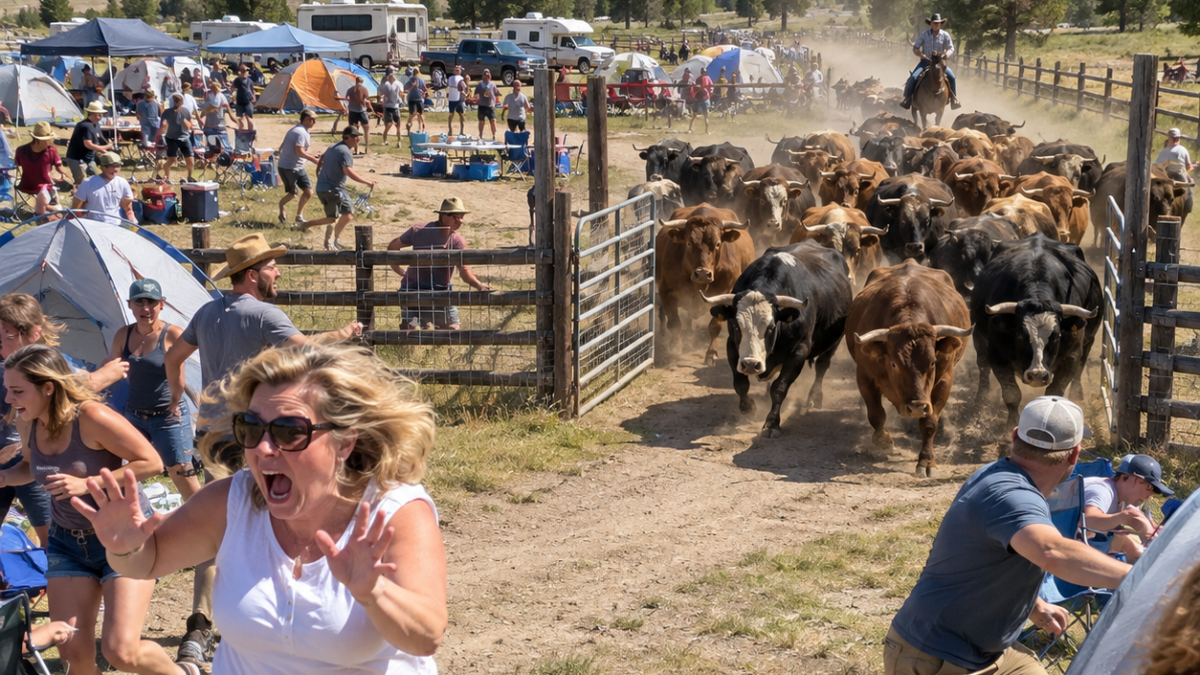
At 12:00, I opened the gate.
No dramatic charge.
No explosion.
Just a metal latch lifting.
A chain dropping.
The gate swinging inward.
My lead bull took two slow steps.
Stopped.
Snorted.
Then continued.
The rest followed.
Twenty-four animals.
Dark backs moving like a slow wall.
Dust rising.
Jake whistled.
Tom signaled from the side.
I shook the feed bucket once.
The herd moved.
Calm.
Controlled.
Predictable to us.
Absolutely terrifying to people who had never stood fifty yards from a mature bull.
Someone screamed.
Another camper laughed nervously.
Then a younger bull kicked at the dust.
That was enough.
People started backing away.
Karen raised the megaphone.
“DO NOT PANIC!”
Which is one of the most reliable ways to make people panic.
“Stay where you are!”
That was worse.
I shouted:
“Move behind the ribbon lines! Give the herd space!”
Jake repeated it.
Tom waved people toward the safe side.
Most listened to us.
A few listened to Karen.
Bad choice.
One man climbed onto a cooler.
A woman grabbed two children.
Dogs started barking.
A drone lifted overhead.
One bull glanced up at it.
Kept walking.
Then somebody knocked over a stack of chairs.
That sound triggered a wave of movement.
People rushed.
Tents collapsed.
Coolers rolled.
A food vendor started his truck and tried to back out.
I shouted:
“STOP THE VEHICLE!”
Jake moved toward the driver.
“Don’t drive through the herd!”
The truck stopped.
Good.
The bulls continued.
They weren’t charging campers.
They weren’t chasing anyone.
They were walking an established route.
But fear doesn’t care about technical distinctions.
Five hundred people saw twenty-four massive animals moving toward the space they had been told was a recreational lawn.
The campground emptied itself.
Fast.
Karen stood on her folding table.
“This is harassment!”
One bull passed twenty feet away.
She jumped down.
“This is dangerous!”
I almost laughed.
The sheriff arrived during the movement.
I had told him.
His cruiser stopped near the road.
He stepped out.
Looked at the herd.
Looked at the crowd.
Looked at me.
Then at Karen.
She ran toward him.
“Arrest him!”
The deputy raised an eyebrow.
“He deliberately released wild animals into a family event!”
The deputy unfolded the livestock notice.
“These are cattle.”
“They’re bulls!”
“Yes.”
“He released them!”
“He notified us.”
“He knew people were here!”
The deputy looked around.
“So did you.”
Karen stopped.
He continued.
“The notice advises unauthorized persons to remain outside the livestock corridor.”
“This is community land.”
“That is not established.”
“You told him yesterday it was civil!”
“I told both parties the boundary dispute was civil.”
Karen pointed at me.
“Then he can’t act like he owns it.”
The deputy stared at her.
“He has a deed.”
I didn’t say anything.
The bulls kept moving.
A golf cart had been parked too close to the route.
One bull brushed its side.
The cart rocked.
A plastic side panel cracked.
Alarm started screaming.
The bull barely reacted.
The crowd did.
“OH MY GOD!”
People scattered again.
Karen screamed:
“SEE?!”
The deputy watched the animal continue walking.
“That vehicle should not have been parked in the livestock lane.”
Karen looked ready to explode.
“You’re taking his side!”
“No, ma’am.”
The deputy pointed toward the fire pits.
“I’m looking at an unpermitted mass gathering, open fires, blocked access, a known property dispute, and livestock movement that was reported in advance.”
Karen’s mouth opened.
He continued.
“If you want my professional opinion, you should start getting people off this property before somebody gets hurt.”
That was the first time she looked scared.
Not of the bulls.
Of losing control.
By 1:00, half the campers were packing.
By 2:00, most RVs were leaving.
The remaining people moved to the far eastern area near Stonebridge’s actual property line.
The bulls reached the south gate without incident.
Not one person injured.
Not one bull injured.
No charge.
No contact.
No bite.
No trampling.
Nothing.
I closed the gate.
Karen stood in the aftermath.
Hat crooked.
Clipboard bent.
Megaphone hanging from one hand.
“This isn’t over.”
“I know.”
“I’ll have your ranch condemned.”
“Good luck.”
“You endangered children.”
“No.”
“You destroyed property.”
“Your guests parked in a livestock corridor.”
“You planned this.”
“Yes.”
That surprised her.
I continued.
“I planned a controlled cattle movement.”
“You planned it because we were here.”
“I planned it because livestock have to move.”
“Liar.”
The deputy stepped between us.
“That’s enough.”
Karen pointed at me.
“I’m suing him.”
Dale later told me that statement was the most predictable thing she had done all weekend.
The paperwork arrived the next morning.
Emergency injunction.
Dangerous livestock.
Reckless intimidation.
Psychological distress.
Property destruction.
Animal cruelty.
Karen wanted a judge to prohibit me from moving cattle across what she called “community recreational property.”
I called Dale.
He came to my kitchen.
Read the filing.
Then smiled.
“What?”
“She has a problem.”
“Which one?”
“All of them.”
He flipped through the injunction request.
“They describe the bulls as being intentionally driven into the crowd.”
“They weren’t.”
“We have footage?”
“Four cameras.”
“Handlers visible?”
“Yes.”
“Cones?”
“Yes.”
“Ribbon?”
“Yes.”
“Sheriff?”
“Yes.”
“Advance notice?”
“Filed.”
“Animal-control acknowledgment?”
“Yes.”
Dale closed Karen’s complaint.
“She has videos of screaming people.”
“I know.”
“You have videos of why they were screaming.”
“Yes.”
“That difference matters.”
Then county officials started arriving.
Fire marshal.
Environmental officer.
Public-health inspector.
Karen had apparently filed complaints against my ranch immediately after the cattle movement.
Unsafe livestock.
Environmental contamination.
Fire risks.
Unlicensed food operations.
The irony became almost artistic.
The fire marshal found my ranch operations compliant.
Then he walked through the former campground.
His notebook came out.
Unapproved bonfires.
Improper fuel storage.
Blocked emergency access.
Open flame near dry vegetation.
Citations went to the event organizer.
The HOA.
The environmental officer inspected gray-water discharge.
More problems.
The health official looked at food service and temporary sanitation.
More violations.
Karen had summoned inspectors to attack me.
They ended up writing against her event.
Local sponsors began distancing themselves.
A restaurant that had provided discount vouchers issued a statement that it had not been told the event was on disputed private property.
A sporting-goods store removed its logo from future HOA materials.
Then Stonebridge’s insurance carrier sent questions.
Was the event permitted?
No.
Was the HOA confirmed owner of the property?
No.
Had the event been approved under policy requirements?
Unclear.
Did the HOA knowingly enter disputed property?
The insurer wanted documents.
Coverage became uncertain.
That mattered because cleanup was already expensive.
Trash.
Fence repair.
Grass damage.
Ruts.
Water contamination testing.
Legal bills.
Karen’s injunction.
My response.
Then Karen decided she needed public sympathy.
She held a press conference.
On a cul-de-sac.
Behind her stood perhaps twenty HOA residents.
Most looked like they wished they were somewhere else.
Karen wore a red blazer.
No sun hat this time.
Clipboard.
Naturally.
A local reporter asked:
“Ms. Vance, did the HOA have written permission from the ranch owner to hold the campout?”
Karen answered:
“The ownership issue is legally complex.”
“No written permission?”
“We had authority under community green-space provisions.”
“Can you show those provisions?”
“Our counsel is reviewing them.”
Another reporter asked:
“Did county officials issue citations related to the event?”
“Those citations are based on misleading information supplied by the rancher.”
The reporter looked surprised.
“Are you saying the fire marshal fabricated violations?”
“That is not what I said.”
“You said the violations were based on false information.”
Karen’s face reddened.
“There is an organized effort to discredit this board.”
A resident standing behind her looked at the ground.
The reporter asked:
“Did the rancher provide advance notice of the livestock movement?”
Karen snapped:
“He weaponized animals against families.”
“That wasn’t my question.”
“He knew children were present.”
“Did he give notice?”
She refused to answer.
That clip spread around Stonebridge.
Not because I shared it.
Residents did.
Meanwhile, I said nothing publicly.
Every time a reporter called, I referred them to Dale.
No rant.
No insult.
No victory speech.
Dale and I prepared my own claim.
Trespass.
Fence damage.
Pasture damage.
Illegal dumping.
Interference with ranch access.
Nuisance.
Cleanup costs.
Legal fees.
We also sought declaratory relief confirming the exact boundary.
Karen had spent months saying the land was ambiguous.
I wanted a court order making it impossible for any future HOA president to repeat the lie.
The first injunction hearing went badly for her.
Her attorney argued that moving twenty-four bulls while campers were present created an unacceptable hazard.
Dale agreed that bulls were large animals.
Then he played the footage.
Slow.
Controlled.
Three handlers.
Marked path.
People directed to safe areas.
The judge watched.
Then Dale presented the livestock notice.
Sheriff receipt.
Animal-control acknowledgment.
County grazing records.
Then the property survey.
The judge looked at Karen’s attorney.
“Your client’s position is that this land is HOA property?”
“Shared recreational land, Your Honor.”
“Recorded where?”
The attorney hesitated.
“We rely on community-development maps and historical use.”
Dale stood.
“Your Honor, there is no recorded HOA interest in this pasture.”
The judge reviewed the deed.
The injunction was denied.
Karen was furious.
But denial did not end the broader case.
If anything, it made her more desperate.
She started telling residents that I was forcing the HOA to spend money.
That sentence angered people.
Not because they suddenly loved me.
Because people were seeing increased legal costs.
Potential insurance problems.
County fines.
Cleanup.
Karen proposed special assessments.
A father at one board meeting stood up and said:
“Why should I pay because you held a music festival on property we didn’t own?”
Karen responded:
“We acted for community benefit.”
He stared at her.
“My benefit would be not getting sued.”
Another resident said:
“You told us the green belt belonged to Stonebridge.”
“It does.”
“Then show us the deed.”
Karen changed the subject.
That stopped working.
Then, unbelievably, she organized another event.
Smaller.
She called it FAMILY GREEN-BELT DAY.
Maybe a hundred people came.
Bounce houses.
Food stalls.
A karaoke stage.
Most stayed closer to Stonebridge’s side.
But several activities again spilled onto my pasture.
Dale told me not to confront anyone directly.
We documented.
The sheriff had already been notified.
County orders were already in place.
Then somebody flew a drone low over the south fence.
One bull stood nearby.
The drone buzzed close.
The animal tossed its head.
Campers screamed.
Nobody was touched.
The bull never crossed a fence.
Yet panic moved through the group.
One SUV was parked partly inside my property.
People rushed toward it.
Someone left a door open.
The bull walked near the vehicle.
Its shoulder brushed the metal.
The panel dented.
Alarm sounded.
Within minutes, social media captions appeared.
RANCHER’S BULLS ATTACK FAMILY EVENT.
The sheriff arrived.
This time, his attitude was different.
He walked directly to Karen.
“Ma’am.”
She pointed at me.
“Arrest him.”
“No.”
“He did it again!”
The deputy looked at the bull.
It was chewing.
“He’s on the ranch.”
“He came toward us!”
“He is livestock on livestock property.”
Karen sputtered.
“You cannot possibly defend this.”
The deputy held up a county order.
“What I can tell you is that you are operating another gathering after being cited.”
“This is HOA property.”
“We have had that argument.”
Karen lifted her clipboard.
“The board authorized—”
“This ends today.”
She froze.
“What?”
“Evacuate the unauthorized portion of the event.”
“You don’t have authority—”
“I absolutely do.”
Deputies began moving people out.
Karen grabbed her megaphone.
“Everybody stay calm! We have rights!”
Nobody listened.
Families packed.
Food vendors closed.
The bounce house collapsed.
By sunset, the pasture was quiet again.
Trash remained.
Ruts remained.
Karen remained.
She stood behind the fence pointing at me.
“I’ll bury you in court.”
I tipped my hat.
“I’ll see you there.”
Two weeks later, we did.
Karen arrived with three attorneys.
Red blazer.
Perfect hair.
A thick stack of binders.
She looked confident.
I had Dale.
One binder.
Very thick.
Her side went first.
They described me as a hostile rancher.
A man unwilling to accommodate a growing community.
A man who had allegedly transformed agricultural activity into intimidation.
They showed shaky phone footage.
Bulls.
Screaming.
People running.
One clip stopped just as an animal approached the campground.
No context.
No full route.
No preparation.
No warning signs.
Dale watched without reacting.
Then he stood.
“Your Honor, we would like to begin with ownership.”
He handed over the deed.
Survey.
Tax map.
Historical parcel records.
The judge reviewed them.
“Counsel for the HOA.”
Karen’s attorney stood.
“Yes, Your Honor.”
“Where is your recorded interest?”
“Our argument is based on equitable community use and planning representations.”
“Recorded interest.”
“No formal easement.”
“Ownership?”
“No.”
“License from the property owner?”
“No.”
“Written consent?”
“No.”
The judge looked up.
“So the HOA invited hundreds of people onto land in which it held no recorded property interest.”
The attorney tried:
“The boundary was contested.”
Dale handed over the county survey confirmation.
“The county disagrees.”
Then photographs.
NO TRESPASSING signs.
Then trail-camera footage.
Campers pulling signs down.
People cutting fencing.
RVs crossing into pasture.
Water being taken from livestock tanks.
Fire pits.
Gray water.
Trash.
Dale presented the sheriff reports.
Then the livestock notice.
Then the animal-control documentation.
The judge watched a full video of the bull movement.
Not Karen’s edited clips.
The full sequence.
Handlers.
Slow herd.
Marked safe zones.
People running long before the cattle reached them.
The judge looked at Karen’s attorneys.
“Were any people injured?”
“No, Your Honor.”
“Any livestock injuries?”
“No.”
“Did any bull pursue an individual?”
“No.”
“Any evidence the animals were deliberately driven into people?”
They hesitated.
“No direct evidence.”
Dale continued.
County citations.
Fire marshal.
Environmental violations.
Public-health issues.
Karen’s event had produced a remarkable paper trail.
Then he presented the second event.
The sheriff order.
The trespass warnings.
The HOA emails.
Then came something Karen had not expected.
Months earlier, several Stonebridge common parcels had accumulated delinquent tax liens during a messy management transition.
They were not houses.
They were small HOA-controlled strips and common-area interests.
I had legally acquired some of those lien positions as part of a broader property-protection strategy Dale had discussed with me.
I did not own those parcels.
The liens did not magically transfer land to me.
But they gave me a recognized financial interest if Stonebridge defaulted.
More importantly, they demonstrated how poorly Karen’s board had managed basic property obligations while pretending to control mine.
Dale did not dramatize it.
He simply placed the documents into evidence.
The judge looked at Karen.
Then at her attorneys.
“I want to understand something.”
Silence.
“The association failed to maintain taxes on portions of its actual common property?”
Karen’s counsel replied:
“There were administrative issues.”
“Yet it was simultaneously asserting control over land outside those parcels?”
No good answer.
The court rejected the HOA’s ownership theory.
Confirmed my property boundary.
Confirmed that Stonebridge had no right to use my pasture without permission.
The HOA’s damage claims related to the controlled livestock movement failed.
My documented property claims succeeded.
Fence repair.
Soil remediation.
Trash removal.
Water testing.
Pasture restoration.
Legal fees to the extent permitted.
County violations remained with the event organizer.
Stonebridge.
The judge made the most important part of the ruling clear.
Whatever Karen believed a “community green belt” meant in marketing language, it did not override recorded private ownership.
The gavel came down.
Karen’s face went blank.
But even then, the story wasn’t over.
The HOA still had to live with what she had done.
Insurance coverage remained disputed for some event-related costs.
The board’s budget was a mess.
Residents were angry.
The clubhouse meeting after the ruling was packed.
Karen sat at the front.
No megaphone.
Just the clipboard.
A woman stood.
“You told us this was HOA land.”
Karen replied:
“Our legal position was reasonable at the time.”
“No.”
The woman held up a copy of the ruling.
“It wasn’t.”
A retired veteran stood next.
“You turned this HOA into a circus.”
Karen’s jaw tightened.
“We were protecting community access.”
“To somebody else’s land.”
Another resident shouted:
“My dues are going up because of your legal bills!”
Karen raised her hand.
“Everyone, please follow meeting procedure.”
Nobody cared.
A tired-looking father with two children beside him said:
“I would rather live next to those bulls than sit through another year of this.”
That got laughter.
Karen slammed the gavel.
“This meeting will come to order.”
A board member stood.
“I move that Karen be removed as president.”
Silence.
Karen stared at him.
“You cannot be serious.”
“Very.”
“On what grounds?”
“Unauthorized event planning.”
She looked stunned.
“Legal exposure.”
“You participated!”
“Based on information you provided.”
“Insurance violations.”
“Those are being contested.”
“Misrepresentation of property rights.”
“I relied on counsel.”
“Failure to disclose risk.”
“This is ridiculous.”
Another board member said:
“Second.”
Karen stood.
“You do this, and you destroy this community.”
The veteran replied:
“No. We’re trying to save it.”
The vote happened.
Karen lost.
Not by one vote.
Not close.
Overwhelmingly.
The clipboard shook in her hands.
“This is invalid.”
Nobody answered.
“You’ll regret this.”
Still nothing.
She looked toward me.
I was standing near the back.
“This is what you wanted.”
I shook my head.
“No.”
She laughed bitterly.
“Don’t lie.”
“I wanted you off my land.”
“And now I’m off the board.”
“That was your neighbors’ decision.”
“You caused all of this.”
“No.”
I looked at her.
“You invited five hundred people onto property after the owner told you no.”
Her face reddened.
“You deliberately humiliated me.”
“I documented you.”
“You sent bulls into families.”
“I moved livestock across a ranch.”
“You bought liens against us.”
“After your board failed to manage actual HOA property.”
She stepped toward me.
“You think you won?”
I glanced around the room.
“No.”
That answer surprised her.
“Then what do you call this?”
“A boundary finally being respected.”
Karen left the meeting.
She resigned formally within days.
A new board president was chosen.
His name was Harris.
Older man.
Retired engineer.
The first time he came to my ranch, he stopped at the gate.
Didn’t cross.
That alone impressed me.
I walked over.
“Mr. Harris.”
“Just Harris.”
“What can I do for you?”
He held out his hand.
“On behalf of Stonebridge Meadows, I’m done fighting you.”
I shook it.
“Good.”
“We want to repair the fence.”
“That’s part of the settlement.”
“I know.”
“We want to do more than send a contractor.”
“What do you mean?”
“Residents volunteered.”
I looked toward the subdivision.
“For what?”
“Cleanup. Reseeding. Fence work.”
“They don’t have to.”
“I told them that.”
“And?”
“They still volunteered.”
I thought about it.
“Fine.”
The next month felt almost impossible compared to everything before it.
Stonebridge residents showed up with work gloves.
Trash bags.
Wheelbarrows.
Some looked embarrassed.
Some apologized.
Most simply worked.
Crews hauled away garbage.
Ruts were graded.
Damaged pasture was reseeded.
Fence posts replaced.
Wire restrung.
Water near the gray-water dump area was tested.
The damaged stock tank plumbing was repaired.
A teenage boy approached me holding one of the old NO TRESPASSING signs.
“This yours?”
“It was.”
“I found it behind the trail.”
The sign was bent.
Dirty.
One corner burned.
“I’m sorry.”
“You didn’t do it.”
“My friends did.”
“You?”
“No.”
“Then don’t carry guilt that isn’t yours.”
He nodded.
“Can we put it back?”
“Yes.”
He helped me straighten the post.
Then screwed the sign on.
That felt better than any courtroom moment.
The settlement included a community restitution component.
Part of the HOA’s required spending went toward repairing damage and supporting local agricultural education.
Harris proposed a small scholarship fund for students interested in livestock management and agricultural trades.
I liked the irony.
The same HOA that had complained my bulls were an eyesore was now funding kids who wanted to learn ranch work.
Karen disappeared from Stonebridge not long after.
I heard she sold her house.
Whether at a loss, I never confirmed.
I didn’t care.
The tax-lien positions I held over several common parcels remained until Stonebridge resolved them.
I never wanted the land.
That was never the point.
Once the HOA corrected the delinquencies and formalized new protections, the liens were handled through normal legal channels.
But while they existed, nobody on that board forgot how important accurate property records were.
The new HOA adopted several rules.
No community event on property without verified ownership or written permission.
No expansion of trails beyond surveyed boundaries.
No board officer could publicly describe adjacent private land as HOA green space.
No event of significant size without permits and insurance confirmation.
No livestock complaints against neighboring agricultural property unless supported by actual county violations.
That last one made me laugh.
Life became quiet again.
The bulls continued moving between pastures.
Nobody screamed.
Nobody livestreamed.
Nobody called 911.
They walked.
Ate.
Slept.
Did what cattle do.
One evening, Jake came by.
He leaned against the north gate.
“Remember the campout?”
“Unfortunately.”
“The internet still has those videos.”
“I know.”
“People think those bulls stampeded five hundred people.”
“They walked.”
“I know.”
“One even stopped to scratch himself.”
Jake laughed.
“The video with dramatic music is better.”
“I hate the internet.”
“No you don’t.”
“I strongly dislike selective editing.”
He looked toward the herd.
“Still twenty-four?”
“Twenty-three.”
“What happened?”
“Sold one.”
“Karen?”
I stared at him.
He laughed.
“Sorry.”
The rebuilt fence line eventually looked almost normal.
Fresh cedar posts weathered.
New grass grew through the damaged areas.
The places where RVs had torn deep ruts softened.
Rain helped.
Time helped more.
The pasture didn’t forget immediately.
Land rarely does.
But it recovered.
One evening, I walked the eastern fence alone.
The sun was low.
Stonebridge roofs glowed orange.
On their side, kids rode bikes.
A couple walked the trail.
When they reached the section near my property, they stayed on their side.
No problem.
No confrontation.
The woman waved.
I waved back.
That was all I had wanted from the beginning.
Not isolation.
Not hostility.
Respect.
People sometimes confuse boundaries with rejection.
They aren’t the same.
A fence can separate property without separating people.
I can help a neighbor without giving him my land.
I can allow emergency access without creating permanent recreational rights.
I can be friendly without surrendering control.
Karen had never understood that.
To her, cooperation meant agreement with her.
Community meant surrendering individual rights whenever the HOA wanted something.
And resistance meant selfishness.
That mindset was what put five hundred people in my pasture.
The bulls were only the moment everyone finally noticed how absurd it had become.
I still think about the first Friday.
Karen standing on that plastic table.
Megaphone.
“Welcome to the Freedom Campout!”
Freedom.
Interesting word.
She used it while people tore down my private-property signs.
Blocked my driveway.
Cut my fence.
Took water.
Dug fires into my grass.
Then called me selfish for objecting.
Her idea of freedom seemed to mean freedom from hearing the word no.
That is not freedom.
That is entitlement.
And entitlement becomes dangerous when it wears an official badge.
Especially a small one.
HOA PRESIDENT.
Titles can distort people.
Not everyone.
Harris never acted like that.
Most board members never did.
But Karen began treating authority over landscaping rules as if it were authority over every piece of ground within sight of the clubhouse.
She convinced herself that my pasture was an inconvenience standing between her and her vision.
So she renamed it.
Green belt.
Then she talked about it publicly.
Then promised future access.
Then printed flyers.
Then invited hundreds of people.
Each step made the next one easier.
By the time she stood in my field with a megaphone, she had repeated the lie so many times that she seemed genuinely offended when reality contradicted it.
That is why documentation mattered.
If I had screamed at her six months earlier, the story might have become:
Angry rancher hates new neighbors.
If I had blocked the walking trail, she could have said:
Rancher interferes with community property.
If I had threatened campers, she could have portrayed them as victims.
Instead, I kept the deed.
The survey.
The letters.
The videos.
The photographs.
The notices.
The sheriff’s records.
The county citations.
The animal-control confirmation.
By the time we entered court, I didn’t need to describe Karen as dishonest.
The documents did that better than I could.
Dale said something after the ruling that stayed with me.
“You know why her case collapsed?”
“Because she was wrong?”
“That helps.”
“What else?”
“You never needed the judge to believe you were a good guy.”
I looked at him.
“You only needed the judge to understand what happened.”
That was true.
Court is not supposed to be a popularity contest.
Karen wanted the story to be emotional.
Families versus bulls.
Community versus one stubborn rancher.
Progress versus an old fence.
But strip away the emotional packaging and the facts were simple.
Who owned the land?
I did.
Did the HOA have permission?
No.
Were they warned?
Repeatedly.
Did they enter anyway?
Yes.
Did people damage property?
Yes.
Was the livestock transfer documented?
Yes.
Was anyone injured?
No.
Did the HOA create code violations?
Yes.
That was it.
Everything else was Karen standing on a table shouting through a megaphone.
Harris eventually invited me to one Stonebridge meeting.
Not because there was a dispute.
Because the board wanted to explain the new property-boundary policy.
I almost refused.
Then went.
Harris introduced me.
People looked uncomfortable.
I stood near the front.
“I’m not giving a speech.”
A few people laughed.
“I just want to say one thing.”
The room quieted.
“Most of you were never my enemy.”
I saw several faces change.
“I was angry about what happened.”
No reason to lie.
“I was angry about the damage.”
I looked around.
“But I understand many of you came because your HOA president told you the land was available.”
A woman nodded.
“That doesn’t erase responsibility for people who cut fences or ignored signs.”
Nobody moved.
“But it matters.”
Then I said:
“If Stonebridge wants to work with the ranch in the future, ask.”
Simple.
“If you need emergency access, ask.”
“If the county wants wildfire coordination, ask.”
“If kids want an agricultural field day, ask.”
“If a utility crew needs space, ask.”
I looked around.
“You might be surprised how often the answer is yes.”
Then:
“But if the answer is no, it stays no.”
Silence.
Harris nodded.
“That seems fair.”
“It is.”
Afterward, a woman approached me.
She had attended the Freedom Campout.
“I wanted to apologize.”
“For what?”
“I brought my kids.”
“You believed the flyer.”
“Yes.”
“Did you tear signs down?”
“No.”
“Cut fence?”
“No.”
“Dump trash?”
“No.”
“No apology necessary.”
She looked relieved.
Then she smiled.
“My son talks about the bulls constantly.”
“I’m sure he does.”
“He thinks they rescued the ranch.”
I laughed.
“They wanted grass.”
“He thinks differently.”
“Kids usually do.”
She hesitated.
“Were you scared?”
“Of the bulls?”
“No. Of what might happen.”
That was a better question.
“Yes.”
Her eyebrows rose.
“Really?”
“Of course.”
“Even though you planned it?”
“Especially because I planned it.”
I explained.
Large animals deserve respect.
Crowds behave unpredictably.
Dogs could get loose.
Vehicles could move unexpectedly.
One frightened camper could run the wrong direction.
One bull could react.
That was why Jake and Tom were there.
Why the path was marked.
Why notice mattered.
Why I would have stopped the movement if the conditions became uncontrollable.
She listened.
“So it wasn’t just revenge.”
“No.”
“Did you enjoy Karen panicking?”
I smiled.
“That is a different question.”
She laughed.
I did enjoy that part.
I won’t pretend otherwise.
When someone spends months telling you your rights do not matter, there is satisfaction in watching reality interrupt the speech.
But satisfaction and recklessness are different things.
I never wanted anyone hurt.
Not Karen.
Not campers.
Not children.
Not animals.
The point was to continue using my ranch like a ranch.
Her event had made normal ranch activity feel dramatic.
That was on her.
Years later, the story still got retold around the county.
Usually badly.
“Remember when you released bulls on five hundred HOA people?”
“No.”
“What do you mean no?”
“I moved bulls.”
“Same thing.”
“It is not.”
“You knew they’d run.”
“I suspected.”
People liked the dramatic version.
Twenty-four furious bulls charging through tents.
Karen diving behind an RV.
People fleeing for their lives.
That wasn’t what happened.
The truth was stranger because it was calmer.
The bulls walked.
The people panicked.
That was enough.
Karen had spent months calling those animals dangerous.
Then she invited hundreds of inexperienced people directly into their working pasture.
That contradiction was hers.
Not mine.
Some videos showed bulls closer to tents than I would have liked.
Several campers had ignored the marked movement corridor until the last minute.
One golf cart was damaged.
Later, a vehicle got dented at the second event.
No one was physically injured.
That remains the most important part.
The entire confrontation could have gone much worse.
That is why I never described the outcome as perfect.
Necessary?
I still believe so.
Legal?
The record supported it.
Satisfying?
Absolutely.
Risk-free?
No.
Nothing involving livestock and five hundred trespassers is risk-free.
If I could change one thing, I would have sought an emergency court order before the weekend.
Maybe police would have had clearer authority to evacuate the property.
Maybe the camp never would have reached that size.
But at the time, events moved quickly.
The sheriff treated it as a civil boundary dispute.
Karen exploited that delay.
So I worked with the tools available.
Documentation.
Notice.
Lawful ranch operations.
Professional handling.
Then court.
That sequence mattered.
Months after Karen left, Harris called me.
“We found something in the HOA archive.”
“What?”
“One of the original developer maps.”
“And?”
“The one Karen kept calling proof of the green belt.”
I sighed.
“What about it?”
“There’s a disclaimer at the bottom.”
I already knew where this was going.
He read it.
“Conceptual open-space views shown for marketing purposes only. Property boundaries subject to recorded plats and surveys.”
I laughed.
“Of course.”
“She had the map.”
“I know.”
“She must have seen the disclaimer.”
“Probably.”
Harris was quiet.
“Why do people do that?”
“What?”
“Read the part they want and ignore the rest.”
“Because sometimes a sentence is inconvenient.”
“That cost us a lot of money.”
“Yes.”
He sighed.
“We framed it.”
“What?”
“The disclaimer.”
“You framed the map?”
“No. Just enlarged the disclaimer.”
I laughed again.
“Where is it?”
“Board conference room.”
“What does it say underneath?”
“Recorded boundaries control.”
“Good.”
A few weeks later, I visited the clubhouse for another reason.
There it was.
On the wall.
A blown-up image of the disclaimer.
Not dramatic.
No mention of Karen.
No mention of bulls.
Just a quiet institutional reminder.
Recorded boundaries control.
That was probably the healthiest thing the HOA learned.
My father would have appreciated it.
He hated unnecessary conflict.
But he hated people abusing kindness even more.
The old binder he left me still sits in my house.
Survey.
Deed.
Water agreements.
Grazing records.
County correspondence.
I added a new section.
STONEBRIDGE.
It became thick.
Flyer.
Photos.
Notices.
Reports.
Ruling.
Settlement.
Final fence invoices.
One day I may give the binder to my nephew.
Maybe the ranch too.
If I do, I will explain why those papers matter.
Not because you should expect enemies.
Most people aren’t enemies.
Not because you need to live suspiciously.
You don’t.
But land lasts longer than arguments.
Property lines last longer than personalities.
Memories fade.
Board members change.
Developers disappear.
But records remain.
Karen tried to replace recorded facts with repetition.
She called the pasture a green belt enough times that people believed her.
Then belief turned into expectation.
Expectation turned into entitlement.
Entitlement turned into action.
That is how five hundred people woke me up on my own land.
Not because five hundred people individually decided to steal a pasture.
Most followed an invitation.
They trusted the person who claimed authority.
The responsibility concentrated at the top.
Karen knew I objected.
Karen had seen my survey.
Karen had been warned.
Karen printed the flyer.
Karen advertised the location.
Karen told residents the community had rights.
Karen refused to leave when I confronted her.
Karen repeated the claim after the sheriff arrived.
Karen organized the second event after citations.
That was why she ultimately lost the board.
Not because one event went wrong.
Because each time reality contradicted her, she escalated.
I sometimes wonder what would have happened if she had simply walked to my gate before printing the flyer.
“Can we rent part of the pasture for one weekend?”
I probably would have said no.
Five hundred people and open fires on grazing land?
Almost certainly no.
But maybe we would have found another option.
A smaller agricultural open house.
A designated field.
No RVs.
No fires.
Liability coverage.
Limited attendance.
Maybe.
That is what negotiation means.
You ask.
The other person answers.
You respect the answer.
Karen believed negotiation meant continuing until the answer changed.
That isn’t negotiation.
That is pressure.
And once she realized pressure was not working, she simply acted as though the agreement existed.
That is when things collapsed.
One summer evening, long after the lawsuits, citations, repairs, and board drama ended, I stood beside the north gate.
Same gate I had opened at noon.
The bulls were in the south pasture.
Crickets.
Warm air.
Stonebridge lights in the distance.
No music.
No megaphone.
No generators.
The grass had regrown over most of the campsite scars.
I could still identify a few circles where fire pits had burned deeper.
The largest RV rut remained faintly visible.
Everything else was healing.
Harris walked down the trail.
He stopped on his side of the fence.
“Evening.”
“Evening.”
He looked over the pasture.
“Hard to believe there were five hundred people out there.”
“I try not to.”
He laughed.
Then he became serious.
“Can I ask something?”
“Sure.”
“Did you know what would happen when you opened that gate?”
“What do you mean?”
“Did you know everyone would run?”
“No.”
He looked surprised.
“I expected them to move.”
“But not panic.”
“I hoped they wouldn’t.”
“They did.”
“Yes.”
He looked toward the south pasture.
“Those bulls look calmer than our board meetings used to be.”
“They are.”
He laughed.
Then said:
“I used to think Karen’s biggest problem was that she was too aggressive.”
I waited.
“I was wrong.”
“What was it?”
“She confused authority with ownership.”
That was good.
I nodded.
“Yes.”
“She thought because she had authority inside Stonebridge, everything affecting Stonebridge belonged under her control.”
“Exactly.”
Harris rubbed his chin.
“That’s a dangerous confusion.”
“Very.”
We talked for another few minutes.
Then he continued walking.
He never stepped across the fence.
He didn’t need to.
Good neighbors do not need shared ownership of everything to have a relationship.
Sometimes the best relationship begins with knowing exactly where each person’s ground ends.
Karen’s final legacy at Stonebridge was not the campout.
Not the bulls.
Not even the lawsuit.
It was the procedures people created afterward.
Before any event, somebody checked the parcel map.
Before any contractor crossed a boundary, written permission.
Before describing any land as common property, deed verification.
Before large events, permits.
Before open flame, fire review.
Before involving neighboring agricultural property, actual conversation with the neighbor.
Boring.
Excellent.
Good governance usually is.
Karen preferred spectacle.
Megaphones.
Declarations.
Big flyers.
Crowds.
“THE COMMUNITY HAS SPOKEN.”
Harris preferred emails that said:
“Please confirm the attached survey.”
Much safer.
The repaired north fence became stronger than the original.
Stonebridge paid for quality materials.
Cedar posts.
Proper braces.
Tensioned wire.
My old sign went back up.
PRIVATE PROPERTY
NO TRESPASSING
ACTIVE LIVESTOCK AREA
Harris asked once if the sign really needed all three lines.
“Yes.”
He nodded.
“Fair.”
Nobody complained about the aesthetics.
Months later, a Stonebridge kid knocked at my gate with his father.
Probably eleven.
Maybe twelve.
“Are those the bulls?”
His father looked embarrassed.
“Sorry. He’s been asking.”
I looked at the boy.
“Which bulls?”
“The ones that chased Karen.”
His father closed his eyes.
I laughed.
“They never chased Karen.”
The boy looked disappointed.
“But the video—”
“The internet lies.”
“All of it?”
“Enough.”
He looked through the fence.
“Can I see them?”
“From here.”
He watched.
One bull lifted its head.
The kid stepped back.
I smiled.
“They’re big.”
“Yes.”
“Are they mean?”
“No.”
“Can they hurt somebody?”
“Absolutely.”
He stared at me.
“How can both be true?”
“That’s how animals work.”
His father smiled.
I continued.
“They deserve respect.”
The boy nodded seriously.
“That’s why we keep fences.”
I looked at the repaired boundary.
“Yes.”
“That’s exactly why.”
There it was again.
A fence does not mean hatred.
It means clarity.
Inside this line, livestock.
Outside that line, walking trail.
Both can exist.
Both can be useful.
Both can be enjoyed.
Problems start when somebody decides the line is unfair because they want what is on the other side.
That was Karen.
The irony was almost perfect.
She called fences outdated barriers.
Then learned those barriers protected her residents too.
If the Freedom Campout had remained on Stonebridge property, none of this happens.
No bulls through the tents.
No county citations on my pasture.
No trespass lawsuit.
No insurance crisis.
No board recall.
No public humiliation.
No damaged golf cart.
No environmental cleanup.
No legal fees.
No ruined presidency.
All she had to do was respect one fence.
Instead, she treated the fence as an obstacle to her authority.
Years later, when someone asks me whether releasing the bulls was worth it, I correct them.
“I didn’t release bulls on people.”
I moved cattle.
That distinction is important to me.
Because the story is not about using animals as weapons.
It is about what happens when somebody forces ordinary land use into a confrontation.
My cattle didn’t know Karen.
They didn’t know the HOA.
They didn’t care about surveys.
They didn’t care about social media.
They moved from one pasture to another.
Slow.
Steady.
Following handlers.
Human arrogance created the drama around them.
Karen wanted to prove five hundred people could turn my pasture into community property.
The bulls proved five hundred people could not turn a working ranch into something it wasn’t.
Then the paperwork proved the rest.
Karen had theatrics.
I had title.
Karen had a megaphone.
I had a survey.
Karen had flyers.
I had photographs.
Karen had edited phone videos.
I had full recordings.
Karen had claims.
I had county reports.
Karen had a board title.
I had ownership.
That is why the ending was never really about the bulls.
The bulls made the scene memorable.
The documents made the outcome permanent.
I still have the flyer.
FREEDOM CAMPOUT.
Community green belt.
I keep it in the Stonebridge section of the binder.
Beside it is the final property order.
Two pieces of paper.
One claimed something.
The other proved something.
I know which one matters.
Karen eventually moved away.
I never saw her again.
No dramatic final confrontation.
No apology.
No tearful confession.
No revenge.
She left.
Stonebridge changed leadership.
The ranch recovered.
The pasture became quiet.
That is the only ending I needed.
One morning the following spring, I drove along the eastern boundary checking fence.
The grass was thick again.
Sunlight hit the wire.
A few Stonebridge residents walked their dogs on the trail.
One man waved.
I waved back.
Near the north gate stood the same place Karen had once balanced on a folding table and announced that the community had “won.”
Nothing marked it now.
No plaque.
No sign.
No evidence that five hundred people had cheered there.
Just grass.
I stopped the truck.
Got out.
Walked over to the fence.
One of the bulls stood a hundred yards behind me.
Quiet.
Huge.
Unbothered.
I thought about Karen’s megaphone.
“The community has spoken.”
No.
The community had been misled.
Eventually it spoke for itself.
It removed her.
Repaired the land.
Changed the rules.
Then moved on.
That distinction mattered too.
I never wanted Stonebridge destroyed.
I wanted it to stop crossing the line.
Once it did, there was no reason for war.
That is something Karen never understood.
A boundary is not an invitation to conflict.
It is often the thing that prevents conflict.
Clear line.
Clear ownership.
Clear responsibilities.
Respect both sides.
Simple.
The trouble starts when someone says:
“This line is inconvenient, therefore it should not exist.”
Karen said that in a hundred different ways.
The community deserves the land.
The green belt belongs to everyone.
The ranch should accommodate progress.
The fence is outdated.
The owner is selfish.
The map is disputed.
The HOA has broader interests.
All different sentences.
Same meaning.
Your no does not matter because I want a yes.
That was the real fight.
And when I think back to the moment she stood in the dust screaming that she would have my ranch condemned, I don’t remember feeling victorious.
I remember feeling tired.
Because none of it had been necessary.
She could have stopped at the first letter.
At the first survey.
At the first warning.
At the first no.
At the sheriff’s arrival.
At the county citations.
At the injunction denial.
At the second event.
At any point.
She kept choosing one more escalation.
Until her own board finally did what I had been asking her to do all along.
Stop.
That was the word that ended everything.
The repaired gate still swings smoothly.
The cattle still rotate between pastures.
I still keep coffee in the truck.
The HOA still exists next door.
And occasionally, when a Stonebridge event produces music loud enough to reach the ranch, I hear it across the grass.
It does not bother me.
Because the music stays on their property.
Their kids play on their lawns.
Their grills stay beside their clubhouse.
Their guests use their parking.
My bulls stay behind my fences.
That is what peace looks like.
Not everybody becoming the same.
Not everybody sharing everything.
Just people respecting what belongs to whom.
Karen invited five hundred people onto my private ranch because she believed a crowd could turn trespassing into community consensus.
She believed if enough tents appeared, I would surrender.
If enough neighbors cheered, the deed would stop mattering.
If the sheriff called it civil, she had won.
If she embarrassed me publicly, I would back down.
Instead, I documented.
I gave notice.
I kept the livestock movement controlled.
I let county officials inspect.
I let the court read the records.
And I let Stonebridge residents discover for themselves what their president had done.
The bulls never had to charge.
I never had to threaten anyone.
The land never changed ownership.
Karen simply ran out of ways to pretend otherwise.
And every now and then, when I open the old binder, I see her flyer again.
FREEDOM CAMPOUT.
I always notice that word.
Freedom.
Then I look through the window at two hundred acres my family protected for generations.
And I think the same thing.
Freedom does not mean you get to take somebody else’s ground.
Sometimes freedom is the right to stand behind your own fence, look at five hundred people who were told your land belonged to them, and say one quiet, permanent word.
No.