HOA Karen Had My Emergency Truck Towed for a “Community Project”—Then It Sank in the Mud and Left Her Stranded in the Dark
PART2
Nothing escaped her.
Not grass.
Not trash cans.
Not wreaths.
Not driveway stains.
Not porch lights.
And especially not Big Red.
She looked at the truck again.
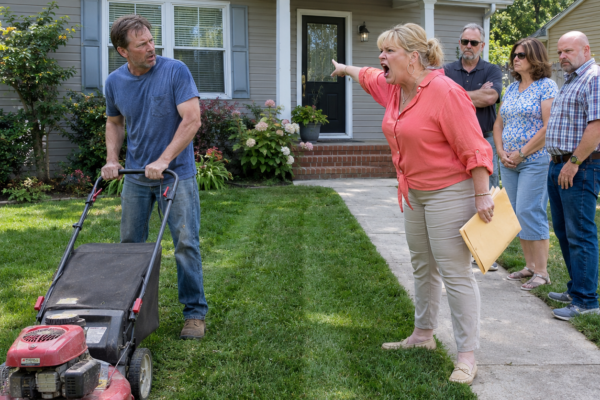
“Your personal attachment to that vehicle does not outweigh community standards.”
I smiled slightly.
“My personal attachment has nothing to do with it.”
“Then move it.”
“No.”
“Owen, don’t make this difficult.”
“I’m not.”
“You are refusing a reasonable request.”
“You came to my house and demanded I remove a legal vehicle from my own driveway because you think it looks ugly.”
“I did not say ugly.”
“You’ve called it an eyesore six times.”
“That was before.”
“Before what?”
She lifted her chin.
“Before I attempted to resolve this diplomatically.”
I stared at her.
One board member cleared his throat.
Marcy continued.
“The showcase matters. We have investors coming. Realtors. Families. We cannot have one property undermining the work everyone else has done.”
“Then don’t bring them down my street.”
“That is not an option.”
“Neither is moving my truck.”
Her mouth became a thin line.
“You leave us no choice.”
There it was.
Every conversation with Marcy ended like that.
You leave us no choice.
Not I chose to escalate.
Not I chose to punish you.
Not I chose to turn a disagreement into enforcement.
You did this.
You forced my hand.
You left us no choice.
I could almost hear my father laughing.
Dad had owned Big Red before me.
Ray Briggs.
Utility mechanic.
Furnace repairman.
Shade-tree electrician when the job was simple enough.
Roof patcher.
Storm cleanup volunteer.
The kind of man who had every tool you needed and three tools you didn’t know existed.
He had driven that truck through ice storms, tornado cleanup, summer floods, and more middle-of-the-night emergency calls than I could count.
He had also taught me one of the most useful sentences I ever learned.
“Never waste expensive anger on cheap people.”
So I didn’t get angry.
Not yet.
I nodded toward the sidewalk.
“Have a nice morning, Marcy.”
She stared at me.
“We’re not finished.”
“I am.”
“Owen.”
I stepped backward.
“Goodbye.”
Then I closed the door.
Three days later, weather reports started getting ugly.
Not ordinary rain.
A hard storm line was coming east out of middle Tennessee.
High winds.
Flash flooding.
Tornado potential.
Possible widespread outages.
I paid attention because bad weather was when people remembered I existed.
That was the thing about being a utility mechanic in a neighborhood full of accountants, consultants, medical administrators, and remote tech workers.
On sunny days, I was the man with dirty boots.
When transformers started exploding, suddenly I was “Owen, do you know anything about generators?”
Yes.
I knew something about generators.
I knew pumps.
Engines.
Electrical panels.
Transfer switches.
Chainsaws.
Fuel systems.
I had spent more than twenty years making broken machines useful again.
My hands were permanently nicked.
My fingernails were never completely clean.
I smelled faintly of oil half the time no matter how much soap I used.
And Big Red functioned as my rolling toolbox.
Friday afternoon, with the weather worsening, I started loading.
Portable generator.
Flood pump.
Heavy extension cords.
Tow straps.
Jumper cables.
Chainsaw.
Fuel.
Battery packs.
Work lights.
First-aid kit.
Tarps.
Crowbar.
Axes.
Toolboxes.
Drinking water.
A small portable oxygen-compatible power inverter I kept because Mrs. Elkins three houses down used supplemental oxygen.
By sunset, Big Red was less a pickup than an emergency response vehicle disguised as scrap metal.
Nate Collins, my next-door neighbor, stopped while I was checking the generator.
“Planning for the apocalypse?”
“Planning for Willow Pines.”
“Same thing?”
“Depends who’s running the HOA.”
He laughed.
Then looked toward the sky.
Clouds were stacking dark in the west.
“You think it’s going to be bad?”
“Yes.”
“How bad?”
“Bad enough that you should charge everything tonight.”
He nodded.
“You need help?”
“Check on the older folks.”
“Mrs. Elkins?”
“Already called her.”
“Donnelly?”
“He has batteries.”
Nate looked at Big Red.
“Marcy still wants that thing gone?”
“Apparently civilization depends on it.”
He shook his head.
“She complained about my recycling bin last week.”
“What was wrong with it?”
“It was visible from the side angle.”
“What angle?”
“Apparently the wrong one.”
I laughed.
That was Willow Pines.
The subdivision sat outside Knoxville, neat and comfortable and obsessed with looking neat and comfortable.
I had moved there because my mother needed help after hip surgery.
I never intended to stay.
Then Mom died.
Afterward, selling her house felt like erasing the last physical place where she had been alive.
So I stayed.
The neighbors weren’t bad people.
Most were decent.
Kind even.
They simply had gotten used to an HOA culture that treated visual order like morality.
Marcy was that culture with a pulse.
She had written me up for my grass being half an inch too high.
For leaving trash cans visible nineteen minutes beyond the approved time.
For having a porch light she considered “too industrial in tone.”
And once, memorably, for Big Red exhibiting what the notice called “visible evidence of deterioration inconsistent with neighborhood emotional presentation standards.”
Visible emotional distress.
That was the phrase.
I framed that one.
Hung it in the garage.
Even Nate thought I was joking until I showed him.
Now a storm was coming.
And for once, nobody cared whether my extension cords matched the landscaping.
The storm hit at 9:40 Friday night.
Wind first.
It slammed the west side of the house so hard I heard framing creak.
The power flickered.
Returned.
Flickered again.
Then somewhere down the street a transformer exploded.
Green-white light flashed through my windows.
Everything went black.
The wind kept screaming.
Rain followed sideways.
Hail hit the roof.
I was already pulling on my boots when my phone rang.
Mrs. Elkins.
I answered immediately.
“Mrs. Elkins?”
“Owen.”
Her voice shook.
“Power’s gone.”
“I know.”
“My oxygen battery says thirty minutes.”
“I’m coming.”
“I don’t want you out in this.”
“I’m already dressed.”
“Owen—”
“Stay sitting down. Don’t walk around. I’ll be there.”
I grabbed my coat.
Truck keys.
Flashlight.
Ran through the kitchen.
Opened the garage door manually.
Rain blew under it.
I stepped outside.
And stopped.
My driveway was empty.
For several seconds, my brain didn’t understand.
Big Red had been there.
I had loaded it myself.
I had locked it.
Now there were only two wet tire tracks leading toward the street.
“What the hell?”
I walked into the rain.
Maybe I had parked somewhere else.
That ridiculous thought passed through my head because reality was too stupid to accept.
Then my flashlight caught a white rectangle taped to the garage door.
I ripped it down.
WILLOW PINES HOA ENFORCEMENT ACTION
Vehicle removed pursuant to community safety and aesthetic compliance authority.
Storage location available upon board review.
My hands went cold.
Not anger.
Shock.
Surely not.
Surely nobody had looked at a severe-weather warning, looked at my loaded emergency truck, and decided tonight was the appropriate moment to enforce curb appeal.
Then somebody screamed down the street.
Not pain.
Panic.
I shoved the notice into my pocket and ran.
The community storm shelter sat near the clubhouse.
Old concrete structure.
Partially below grade.
Built when the development was new.
Most residents never thought about it unless the HOA used it in brochures.
When I reached it, flashlights bounced everywhere.
Twenty, maybe thirty people crowded near the entrance.
A large tree branch had fallen across part of the doorway.
People were trying to move it with their hands.
Inside, it was completely dark.
Someone shouted.
“Where are the emergency lights?”
Another voice:
“The cabinet’s locked!”
Then Marcy.
“Everybody calm down! I need you to remain calm!”
Of course.
She stood in the doorway with rain plastering her hair against her face.
Pearls still around her neck.
Tablet tucked under one arm inside a plastic cover.
She looked like a cruise director running a shipwreck.
Mr. Donnelly saw me.
“Owen!”
He grabbed my sleeve.
“Thank God.”
“Where’s Mrs. Elkins?”
“Inside.”
“Battery?”
“Almost gone.”
I pushed past.
Mrs. Elkins sat against the concrete wall.
Her oxygen concentrator was dead.
She had a portable battery unit.
Yellow indicator blinking.
Her daughter hadn’t been able to reach the neighborhood because a tree was blocking the road.
Mrs. Elkins looked at me.
“I’m okay.”
“No, you’re scared.”
She gave me a weak smile.
“Little bit.”
“What’s the battery say?”
“Eighteen minutes.”
I stood.
Turned toward Marcy.
“Where is my truck?”
She blinked.
“What?”
“My truck.”
Her expression changed.
Just slightly.
“That is not the priority right now.”
“My generator is in that truck.”
Nobody spoke.
“The portable power system is in that truck.”
More silence.
“My flood pump is in that truck.”
Marcy swallowed.
“Owen—”
“Where is it?”
She drew herself up.
“Your vehicle was relocated under HOA authority.”
“Where?”
“This is not the time to become confrontational.”
“An elderly woman has eighteen minutes of oxygen battery left.”
A few neighbors turned toward her.
I stepped closer.
“Where is my truck?”
Marcy’s jaw worked.
“The maintenance lot.”
I knew immediately.
“The back lot?”
She did not answer.
“Marcy.”
“Yes.”
The clubhouse maintenance lot sat behind the retention pond.
Low ground.
Soft soil.
Everyone who had lived in Willow Pines more than one rainy season knew it turned into mud during storms.
My chest tightened.
“You had a tow company put a loaded pickup in the retention lot?”
“It is designated HOA storage.”
“In dry weather.”
“Do not lecture me.”
“Did they leave it there?”
“Yes.”
“Keys?”
“We obviously do not have your keys.”
I laughed once.
I couldn’t help it.
Not because anything was funny.
Because rage was pushing against the inside of my ribs and laughter was safer.
“You had the only useful emergency equipment on this street towed into a mud field.”
Marcy’s face hardened.
“How was I supposed to know what you kept in that vehicle?”
That sentence silenced me.
How was she supposed to know?
Three years.
Three years of notices.
Photographs.
Complaints.
Inspections.
Letters.
And never once had she asked what the truck was for.
She only cared that it looked old.
Something clicked inside me.
Calm.
Hard.
Final.
I turned toward the group.
“Nobody leaves the shelter.”
Marcy snapped.
“Excuse me?”
I ignored her.
“Nate.”
“Yeah?”
“Get every phone light around Mrs. Elkins. Keep her sitting upright.”
“Got it.”
“Mr. Donnelly, blankets.”
“Yes.”
“Someone call county dispatch. Tell them we have a medical power emergency and no fixed backup.”
Marcy stepped closer.
“I am coordinating the emergency response.”
I looked at her.
Really looked.
Wet.
Pale.
Still clutching the tablet.
“No.”
The word came out quiet.
She stared.
“What did you say?”
“You are done coordinating.”
A few heads turned.
Her face flushed.
“You do not have authority to—”
“Neither did you when you stole my truck.”
“I did not steal anything!”
“You removed it from my property without permission.”
“Under HOA enforcement authority.”
“During a tornado warning.”
“It was scheduled enforcement.”
“You signed the tow?”
Her hesitation answered before her mouth did.
I nodded.
“That’s what I thought.”
“Owen, you need to control your tone.”
“Mrs. Elkins has less than twenty minutes.”
“I understand that.”
“No.”
I pointed toward her.
“You understand the phrase. You do not understand the consequence.”
Then I left.
Back at my garage, I still had an ATV.
Old four-wheeler.
A come-along.
Portable jump pack.
Some rope.
Not enough.
But something.
I threw gear into a crate and headed toward the clubhouse lot.
Driving through that storm was like moving through a car wash filled with tree branches.
Water crossed the street in sheets.
Leaves slapped my face.
The ATV tires hydroplaned twice.
Lightning flashed.
I rounded the clubhouse.
My headlights found Big Red.
I stopped.
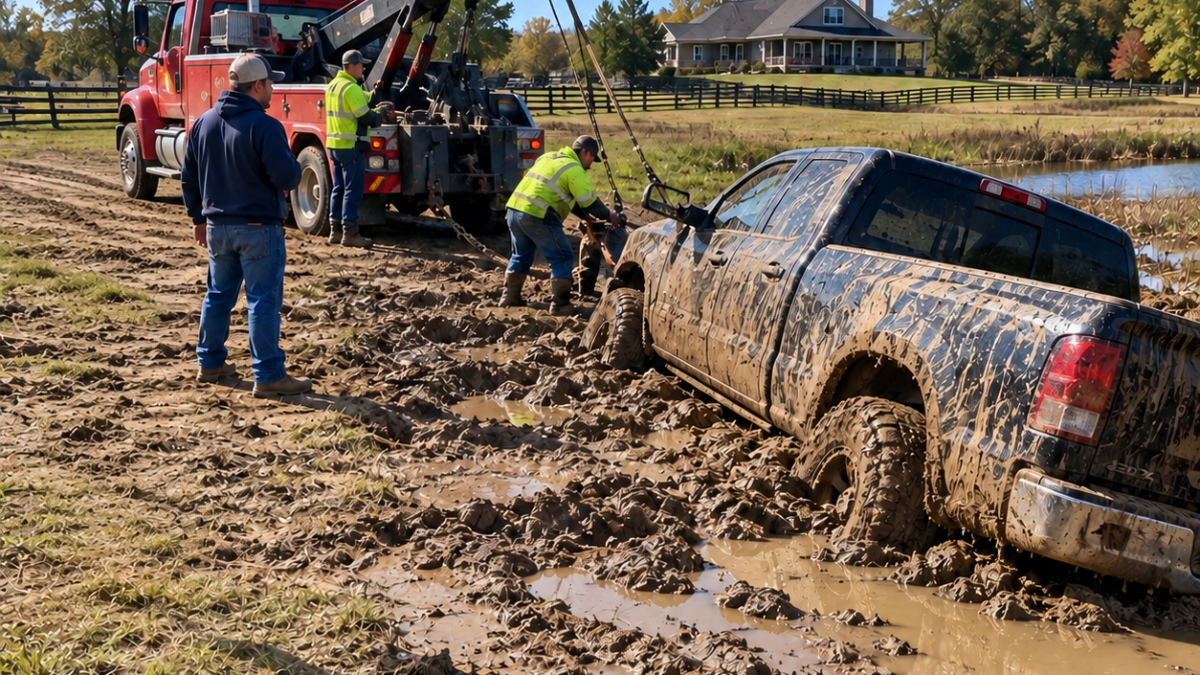
There it sat.
My father’s truck.
Buried to the axles.
Rear tires sunk deep into mud.
Bed full of everything half the neighborhood needed.
The tow truck was gone.
Of course.
I shut off the ATV.
For one second I stood in the rain staring.
Then I said out loud:
“You deserved a better Friday, Dad.”
Big Red said nothing.
I started working.
Winch line around a heavy fence post.
Come-along attached.
Tow strap to the truck frame.
Mud already above my boots.
I cranked.
The cable tightened.
The post creaked.
Big Red moved maybe an inch.
Then stopped.
I reset.
Cranked again.
Mud sucked at the tires.
Another inch.
I kept going.
My right shoulder burned.
Hands slipped.
Once I went down on one knee and buried it in cold mud.
I got up.
Cranked.
Pulled.
Swore.
Reset.
Lightning hit somewhere close enough that the sound came instantly.
Then blue lights appeared.
A county cruiser came slowly around the clubhouse.
Deputy Harris stepped out.
Rain poured off his hat.
He shined a light at me.
Then the truck.
“Owen?”
“Evening.”
“What the hell are you doing?”
“Recovering stolen property.”
He walked closer.
Saw the tow notice stuck beneath the windshield wiper.
“HOA tow?”
“Yes.”
“From your driveway?”
“Yes.”
“Tonight?”
“Yes.”
He stared at me.
“During the warning?”
“Yes.”
Harris closed his eyes for half a second.
“Please tell me there’s a reason that makes sense.”
“There isn’t.”
He shined his light into the bed.
Generator.
Pump.
Fuel.
Tools.
Then back at me.
“What’s happening?”
“Mrs. Elkins has oxygen battery for maybe ten more minutes.”
His face changed.
“Why didn’t you call?”
“Someone should have.”
He reached for his radio.
Then looked at the truck.
“You need a pull?”
I nearly hugged him.
“Very badly.”
He repositioned the cruiser onto firmer ground.
Attached a heavy recovery strap.
I ran the come-along.
He eased backward.
Big Red groaned.
Mud clung.
Rear tire spun once.
“Stop!”
He stopped.
I repositioned.
We tried again.
The truck moved.
Six inches.
A foot.
Then suddenly the suction released with a deep wet sound and the rear tires climbed out of the holes.
“Keep going!”
Harris pulled.
I guided.
Big Red crawled toward firm gravel.
Once clear, I opened the driver door.
Mud everywhere.
Steering wheel cold.
I turned the key.
Starter complained.
Once.
Twice.
Then that old engine roared.
I swear I almost cried.
Harris laughed.
“Ugliest beautiful sound I’ve heard all night.”
“Dad would’ve appreciated that.”
Five minutes later we were at the shelter.
People moved aside when Big Red arrived.
Nobody cared about paint.
Nobody cared about rust.
Nobody cared about curb appeal.
We unloaded the generator.
Ran it beneath the covered section with proper ventilation and protected cables.
Connected Mrs. Elkins’ oxygen equipment through the approved power system.
The machine came on.
A soft electronic hum.
She inhaled.
Her shoulders relaxed.
Someone started crying.
Another person clapped once.
Then stopped.
Too much emotion for applause.
I checked the equipment.
Stable.
Then started work lights.
Suddenly the shelter wasn’t dark.
Children stopped crying.
People could see.
Nate handed me a towel.
“You look like you crawled through a swamp.”
“Pretty accurate.”
Marcy stood against the concrete wall.
Her pearls were gone.
I didn’t know when she removed them.
Her blazer had mud along one sleeve.
Her hair was ruined.
For the first time since I had known her, she did not look like the person in control.
I walked past carrying an extension cord.
She spoke quietly.
“You could have told us.”
I stopped.
“What?”
“That you kept emergency equipment in the truck.”
I stared at her.
It took a moment to process the audacity.
“You could have told us,” she repeated.
I turned fully.
“For three years, you photographed that truck.”
Her eyes hardened.
“You wrote notices about it.”
“Owen—”
“You measured how far it sat from the sidewalk.”
“That is not relevant.”
“You fined me because the paint was faded.”
“I followed the rules.”
“You called it an embarrassment.”
“It was visually—”
“You never once asked what it carried.”
Her lips pressed together.
I stepped closer.
“You only cared how it looked from the street.”
“You will not speak to me like this.”
I let out a tired breath.
“I just did.”
Then I walked away.
The storm lasted most of the night.
We cut two fallen limbs.
Pumped water from one low garage.
Ran temporary charging stations.
Powered medical equipment.
Helped one family whose sump pump failed.
Big Red moved from house to house.
Generator.
Tools.
Tow straps.
Chainsaw.
By three in the morning, half the neighborhood had used something from that truck.
At five, I finally got home.
Mud on the floor.
Hands raw.
Shoulder aching.
I slept ninety minutes.
My phone woke me.
Six HOA violation notices.
I sat on the edge of my bed reading them.
Unauthorized emergency electrical distribution.
Unapproved use of portable generation equipment on common property.
Unapproved vehicle parking near storm shelter.
Soil transfer onto maintained pavement.
Interference with official HOA emergency procedures.
And my favorite:
Use of non-neutral-colored extension cables in visible common areas.
Orange cords.
During a blackout.
I stared at that one for a long time.
Then laughed.
Not happy laughter.
The kind you make when a person has exceeded the limits of your imagination.
I made coffee.
Went to the garage.
Big Red sat outside coated in mud.
Nate arrived ten minutes later.
He held up his phone.
“Tell me you saw the email.”
“I saw everything.”
Marcy had sent a neighborhood-wide message.
SUBJECT: UNAUTHORIZED EMERGENCY ACTIVITY
According to Marcy, independent residents had “disrupted coordinated HOA response efforts.”
She did not name me in the first paragraph.
She did in the second.
She described my generator use as unsafe.
My truck as improperly positioned.
My actions as “performative.”
Performative.
Mrs. Elkins had been breathing because of that performance.
Nate sat on a workbench.
“You fighting this?”
I looked at the notices.
Then Big Red.
Then the mud still packed around the tires.
“No.”
His eyebrows rose.
“No?”
“I’m documenting it.”
He smiled.
“There he is.”
By noon, I had started a file.
Driveway security footage.
I had cameras.
Nothing fancy.
One over the garage.
One facing the driveway.
They showed Big Red parked legally.
Tow truck arriving.
Marcy directing the driver.
Marcy holding her tablet.
Marcy pointing.
Truck being removed.
Time stamp.
Weather alert had already been active.
Next came Deputy Harris.
I called.
He emailed a preliminary incident note.
Truck found in HOA maintenance lot.
Vehicle contained emergency equipment.
Recovery required during severe weather.
Medical power need ongoing.
Mrs. Elkins’ daughter sent a statement.
Her mother required oxygen.
Backup power nearly exhausted.
Generator in my truck supplied power.
Nate sent video from the shelter.
Marcy in darkness.
People using phone flashlights.
Mrs. Elkins struggling.
Then Marcy arguing with me about the location of Big Red.
Another resident sent a clip of the generator starting.
The emotional shift in the room was visible.
Darkness.
Fear.
Then light.
I requested the towing authorization.
That was the piece that broke everything open.
The HOA administrator sent it reluctantly.
One signature.
Marcy Bledsoe.
No board vote.
No hearing.
No abandoned-vehicle verification.
No safety inspection.
She had categorized Big Red as:
ABANDONED / DERELICT EQUIPMENT SUBJECT TO IMMEDIATE COMMUNITY REMOVAL.
Abandoned.
In my driveway.
Registered.
Insured.
Used every day.
I called the towing company.
A man named Vince answered.
“I’m calling about a truck you removed Friday night.”
“Plate?”
I gave it.
Keyboard sounds.
Then silence.
“Yeah.”
“You towed it from my private driveway.”
“We had HOA authorization.”
“The authorization listed it as abandoned.”
Another silence.
“That’s what we were told.”
“It was loaded with active emergency-response equipment during a weather alert.”
“That wasn’t disclosed.”
“I’m aware.”
“Were the keys—”
“No.”
“Vehicle registered?”
“Yes.”
“Current?”
“Yes.”
Vince exhaled.
“Okay.”
“You dropped it in the retention lot.”
“That was the location they designated.”
“It flooded.”
“I heard.”
“You buried my truck.”
“Owen, I’m going to have my manager call you.”
“Good.”
The manager called.
Then their insurer called.
Suddenly everyone was interested in documentation.
By Thursday, the county mediator scheduled an emergency hearing because the dispute involved towing authority, property damage, and potential safety negligence.
Marcy arrived in navy blue.
Pearls restored.
Hair perfect.
Folder thick enough to stop small-caliber ammunition.
I arrived in work boots.
Nate came.
Deputy Harris came.
Mrs. Elkins’ daughter came.
I brought a thumb drive.
The mediator’s name was Ms. Calder.
Gray hair.
Reading glasses.
The sort of face that made people reconsider nonsense before speaking.
She opened the hearing.
“Mrs. Bledsoe, since the HOA initiated enforcement, you may begin.”
Marcy stood.
Of course she stood.
She liked standing when other people were seated.
“Thank you.”
She opened her folder.
“This situation has unfortunately been distorted by emotion.”
I almost smiled.
“This association has clear standards regarding vehicle maintenance and neighborhood presentation.”
Ms. Calder interrupted.
“Did the association tow Mr. Briggs’ truck?”
“Yes.”
“From his driveway?”
“Yes.”
“Continue.”
Marcy hesitated.
Then launched back into presentation mode.
She discussed curb appeal.
Safety.
Liability.
The fall showcase.
The “longstanding visual degradation” represented by Big Red.
She described me as repeatedly noncompliant.
She said enforcement had been planned before the storm reached emergency severity.
She said the truck had appeared “stationary and neglected.”
She said nobody could have anticipated it contained emergency equipment.
Then came the sentence I had been waiting for.
“One resident cannot simply exempt himself from standards because he has a sentimental attachment to outdated machinery.”
Ms. Calder looked at me.
“Mr. Briggs?”
I stood.
Walked to the monitor.
Inserted the thumb drive.
First video.
My driveway.
Big Red.
Time stamp.
Tow truck.
Marcy.
No dramatic narration.
Just footage.
Ms. Calder watched.
Marcy shifted.
Second video.
Storm shelter.
Mrs. Elkins in the dark.
Phone lights.
Marcy asking for equipment cabinet keys.
Someone telling her the keys had been in Big Red.
My voice asking where the truck was.
Marcy saying the maintenance lot.
Ms. Calder paused the video.
She looked over her glasses.
“Mrs. Bledsoe, you were aware the truck had been removed?”
“Obviously.”
“You directed the removal?”
“Yes, pursuant to—”
“Thank you.”
Third video.
Deputy Harris’ body camera.
Rain.
Mud.
Big Red buried.
Harris’ flashlight moving across the equipment.
His own voice.
“Clear as church bells. This truck is loaded for emergency work.”
Then footage of us pulling it free.
Then the shelter.
Generator running.
Mrs. Elkins’ oxygen concentrator powered.
The room became very quiet.
Marcy lifted one hand.
“This is being framed emotionally.”
Ms. Calder looked at her.
“A woman dependent on oxygen losing electrical power is not emotional framing, Mrs. Bledsoe.”
Nate looked down because he was trying not to smile.
Ms. Calder continued.
“It is a material fact.”
Marcy sat back.
I displayed the tow authorization.
Ms. Calder read.
Then read again.
“You categorized this vehicle as abandoned.”
Marcy lifted her chin.
“It was visibly neglected.”
“That was not my question.”
“It was an outdated vehicle that remained parked in an exposed—”
“Registered?”
Silence.
“Mrs. Bledsoe?”
“I believe so.”
“Insured?”
“I do not know.”
I handed over copies.
Ms. Calder reviewed them.
“Operable?”
I clicked to a still frame from Deputy Harris’ camera.
Big Red running.
Headlights on.
Marcy said nothing.
Ms. Calder turned back to the form.
“Who authorized immediate towing?”
“I did.”
“Board vote?”
“Emergency enforcement does not require—”
“Was there an emergency involving the vehicle?”
“The showcase presented—”
“That is not an emergency.”
Marcy’s face tightened.
“There were community preservation concerns.”
“During a severe-weather warning?”
“The decision predated—”
“The tow occurred during the warning.”
“Yes, but—”
“Did you verify whether the vehicle was abandoned before classifying it as abandoned?”
“It had been parked there for years.”
“In its owner’s driveway.”
Marcy swallowed.
“Yes.”
Ms. Calder placed the form down.
Mrs. Elkins’ daughter asked to speak.
Her name was Diane.
Quiet woman.
I had seen her dozens of times but barely knew her.
She stood.
“My mother is seventy-eight.”
Marcy looked down at the table.
Diane continued.
“She has chronic pulmonary disease.”
Her voice shook.
“When the power failed, her backup battery had less than thirty minutes.”
Ms. Calder listened.
“Owen’s generator kept her oxygen running until county support arrived.”
She looked at Marcy.
“My mother could have died because somebody decided an old truck was ugly.”
Marcy’s face hardened.
Not guilt.
Defense.
People confuse those.
Being cornered is not the same as being sorry.
Marcy said, “No one knew—”
Diane interrupted.
“You didn’t care enough to know.”
Silence.
That was the line that ended the hearing emotionally.
The ruling ended it officially.
Every HOA fine voided.
Towing fee reimbursed.
Damage caused by placing Big Red in the mud lot reimbursed after inspection.
Formal written apology required.
Marcy’s unilateral emergency authority suspended pending board review.
The towing policy had to be revised.
Ms. Calder closed the file.
Marcy looked straight ahead.
I thought it was over.
I should have known better.
Marcy could handle being disliked.
She could handle being challenged.
What she could not handle was being proven wrong in public.
Two nights later, she called a special HOA meeting.
Nate texted me.
YOU NEED TO COME.
I almost didn’t.
Then he sent a photo.
Slide title:
PROTECTING WILLOW PINES FROM ROGUE RESIDENTS.
Slide two showed me at the neighborhood picnic eating a hot dog.
Not even a good picture.
I went.
The clubhouse was packed.
Power had returned.
Air conditioning hummed.
Folding chairs in rows.
Marcy stood at the front.
Pearls.
Tablet.
Confidence rebuilt like nothing had happened.
I sat in the back.
She began.
“This is not about one truck.”
I nearly laughed.
“This is about whether Willow Pines will continue to be governed by consistent standards or whether individual residents will use intimidation, theatrics, and crisis situations to undermine community authority.”
People shifted.
Marcy clicked.
Photo of Big Red.
Then a photo of the generator.
Then one of me carrying a chainsaw.
“Certain residents have embraced what I would describe as blue-collar intimidation.”
That phrase landed somewhere old.
Blue-collar intimidation.
I looked at my hands.
Scars across the knuckles.
Grease still in the lines.
My entire life, I had known people like Marcy.
People who loved the result of skilled labor but disliked seeing the person who produced it.
They wanted furnaces repaired but not the dirty boots in the foyer.
They wanted trees removed but complained about the truck.
They wanted generators when the power failed but didn’t want them visible afterward.
Useful in storms.
Embarrassing in sunshine.
Marcy kept talking.
“Performative heroics.”
“Unauthorized action.”
“Personal machinery.”
“Disruption of official emergency structure.”
I stood.
Not dramatically.
Just stood.
Nate noticed first.
Then others.
Marcy stopped.
“Owen, public comment will occur after—”
“Do you know my father’s name?”
She blinked.
“What?”
“The man who owned that truck before me.”
“This meeting is not about your family history.”
“Do you know his name?”
“No.”
“Ray Briggs.”
Someone in the front whispered, “Ray?”
A few older residents turned.
I walked down the aisle.
“My father fixed furnaces in this neighborhood before you lived here.”
Marcy frowned.
“That is irrelevant.”
“He patched roofs after the tornado in ninety-eight.”
A man near the wall nodded.
“He did mine.”
I continued.
“He pulled Mrs. Webb’s Buick out of the ditch in 2006 after her husband died.”
An older woman raised her hand slightly.
“That was Ray?”
“Yes, ma’am.”
She smiled faintly.
I stopped near the front.
“That truck carried ladders.”
I pointed toward the slide.
“Generators.”
Next image.
“Sandbags.”
Next.
“Tools.”
Marcy’s face hardened.
“Sentiment does not override bylaws.”
“No.”
I looked around the room.
“It doesn’t.”
The room went very quiet.
“But decency should.”
Someone clapped.
One person.
Then another.
Marcy raised her voice.
“This is exactly the kind of emotional manipulation—”
“My father drove that truck.”
“Owen—”
“It carried medicine.”
“This is not—”
“It carried groceries to Mrs. Carpenter during the ice storm.”
“Owen!”
“It carried a six-year-old boy with a broken arm when the ambulance missed the turn.”
Marcy slapped her palm against the table.
“Enough!”
The room went silent.
She breathed hard.
Then said the worst possible thing.
“This community cannot be governed by nostalgia for every rusted piece of machinery owned by people who refuse to maintain standards.”
Nobody moved.
I looked at her.
Then toward the front row.
Mrs. Elkins was there.
Portable oxygen beside her chair.
She lifted the cannula slightly with one hand.
“Marcy.”
Marcy turned.
Mrs. Elkins’ voice was weak.
But clear.
“That rusted piece of machinery kept me breathing.”
Marcy’s mouth opened.
No sound.
Nate stood.
“I move for a vote of no confidence.”
Marcy spun.
“You are out of order.”
Mrs. Elkins raised her hand.
“I second.”
A murmur moved across the room.
Marcy grabbed the tablet.
“There will be no unauthorized motions.”
One board member finally spoke.
“Actually, the bylaws allow a confidence motion at a special meeting if seconded.”
She stared at him.
“You’re supporting this?”
“I’m stating the bylaws.”
“After everything I’ve done for this neighborhood?”
He looked uncomfortable.
“Yes.”
Marcy looked around.
For allies.
She found carpet.
That was the moment her presidency ended.
The vote was not close.
People who had tolerated her fines because fighting seemed exhausting finally realized she could be challenged.
People who had privately complained started speaking publicly.
Trash cans.
Grass.
Holiday decorations.
Vehicles.
Garden furniture.
One man said she had threatened fines because his daughter’s wheelchair-access van remained visible too often.
Every story made the next easier to tell.
Marcy tried to interrupt.
Tried to correct.
Tried to explain context.
The room had stopped listening.
She resigned before they finished counting.
She walked out with her tablet held against her chest.
Nobody followed.
The HOA apology arrived the next week.
Three paragraphs.
Clearly written by an attorney.
It acknowledged unauthorized towing.
Confirmed reimbursement.
Withdrew all related violations.
Expressed regret for disruption during the storm.
Marcy’s name did not appear.
I kept the letter anyway.
Paper matters.
Big Red needed work.
Mud had gotten everywhere.
Wheel bearings checked.
Starter replaced.
Rear brake inspection.
Electrical connectors cleaned.
New tires.
The tow company’s insurer covered the mud-related damage after their own investigation concluded the vehicle should never have been dropped in the flooded retention lot.
Vince from the towing company called me personally.
“We changed our HOA authorization policy.”
“Good.”
“We verify private-property ownership now.”
“Better.”
“I’m sorry.”
I appreciated that.
He sounded like he meant it.
The neighborhood changed too.
Not overnight.
Willow Pines was still Willow Pines.
People still argued about mulch color.
Someone proposed regulating inflatable Christmas decorations.
Another resident complained about wind chimes again.
Normal suburban nonsense survives everything.
But the culture shifted.
The new board created an actual emergency committee.
People volunteered.
Retired nurses.
A firefighter.
Two people with medical training.
Nate.
Deputy Harris helped us coordinate with county emergency management.
Then the board asked me to chair it.
I laughed when they asked.
“You’re serious?”
The new president nodded.
“We need somebody who knows equipment.”
“I’m the guy with the distressed truck.”
He smiled.
“That notice is gone.”
“I framed it.”
“I heard.”
“I have one condition.”
“What?”
“Nobody ever calls Big Red an eyesore again.”
The vote was unanimous.
A month later, a small metal plaque appeared beside my driveway.
Approved by the HOA.
COMMUNITY EMERGENCY RESPONSE VEHICLE
I stared at it.
Then called Nate.
“This is ridiculous.”
“Beautiful, isn’t it?”
“I hate it.”
“You love it.”
“I’m taking it down.”
“You absolutely are not.”
I left it.
Three months later, Marcy sold her house.
I heard she moved closer to Knoxville into a stricter development.
Maybe that was true.
Maybe neighborhood gossip.
I didn’t investigate.
I didn’t need her defeat to continue after she left.
The first time I saw the moving truck outside her house, I felt surprisingly little.
No triumph.
No desire to stand at the curb and wave.
Just relief.
Marcy had spent three years shrinking my peace in tiny increments.
Notice by notice.
Comment by comment.
Every time I saw her walking toward my driveway, I wondered what ridiculous thing had become unacceptable now.
When she disappeared, the space came back.
I could work in the garage without expecting an inspection.
Park Big Red without photographing its position.
Put the trash cans out without looking at the clock.
The ordinary freedom of not being watched.
That was the real victory.
Not the hearing.
Not the vote.
Not the apology.
Quiet.
Spring came.
Mom’s old roses bloomed beside the porch.
Big Red sat in the driveway.
Still ugly.
Still red.
Still mine.
One afternoon, Mrs. Elkins walked slowly down the sidewalk with her daughter.
They stopped.
Mrs. Elkins pointed toward the truck.
“That thing still running?”
“Unfortunately.”
She smiled.
“Good.”
I walked over.
“How are you feeling?”
“Better than during the storm.”
“That’s a low standard.”
She laughed.
Then touched my arm.
“Owen.”
“Yes, ma’am?”
“Thank you.”
I looked away for a second.
“You already thanked me.”
“I know.”
“Then we’re square.”
“No.”
She squeezed my sleeve.
“My husband used to say some people are umbrellas.”
“What does that mean?”
“You don’t appreciate them until it rains.”
I smiled.
“Your husband sounds smarter than me.”
“He was.”
Then she walked home.
That night, I sat in the garage with the door open.
Storm clouds far away.
Big Red cooling in the driveway after a job.
I looked at the framed violation notice.
Visible emotional distress.
Then the HOA apology.
Then Dad’s old photograph over the workbench.
Ray Briggs in his twenties, standing beside a much newer version of the same truck.
He had one hand on the hood.
Grinning.
I thought about the night Marcy had it towed.
How close Mrs. Elkins’ battery had been to failure.
How nobody knew where the equipment was.
How the shelter was dark because the emergency cabinet keys had disappeared with the truck.
How Marcy stood there demanding authority while the actual solutions sat buried behind the clubhouse.
That was what stayed with me.
Not that Marcy hated an old truck.
Lots of people hate ugly trucks.
Fair enough.
What bothered me was what her judgment revealed.
She had decided value by appearance.
Rust meant neglect.
Dirty boots meant low status.
Old equipment meant embarrassment.
And because she saw no value, she felt entitled to remove it.
She never asked:
Does he use that truck?
What does it carry?
Why is it there?
Who might need it?
She asked only:
How does it look?
That almost had consequences far beyond paint and pride.
I wondered how often people do that.
Not just with trucks.
With people.
Mechanics.
Custodians.
Line workers.
Maintenance crews.
Farmers.
Delivery drivers.
The people whose clothes stay dirty because something gets cleaner, safer, or more functional behind them.
Invisible when systems work.
Suddenly essential when they don’t.
Marcy wanted Willow Pines to look perfect.
The storm did not care.
Wind doesn’t care about approved landscaping.
Floodwater doesn’t read covenants.
Electricity doesn’t come back because an HOA president writes a violation.
When things break, appearance loses authority fast.
Skill matters.
Preparation matters.
Tools matter.
People matter.
That storm taught Willow Pines something I think the neighborhood needed.
It taught me something too.
Before the towing incident, I tolerated Marcy partly because I didn’t want to become that guy.
The angry mechanic.
The difficult neighbor.
The man with the old truck complaining about the HOA.
So I laughed off notices.
Paid a couple small fines.
Moved things.
Explained.
Compromised.
Each time I thought I was buying peace.
I wasn’t.
I was teaching Marcy that pressure worked.
She pushed.
I moved.
She pushed again.
I moved a little more.
By the time she towed Big Red, she genuinely believed my property was an object she could manage.
That realization bothered me.
Boundaries don’t become stronger because they’re reasonable.
Sometimes they become weaker because reasonable people keep adjusting while unreasonable people keep advancing.
The county hearing changed that.
Documentation changed it.
Not yelling.
Not revenge.
Not slashing tires.
Not threatening anybody.
Proof.
Marcy had her folder.
I had video.
She had language.
I had timestamps.
She had authority claims.
I had her signature.
She had aesthetics.
I had an oxygen machine running because my generator made it possible.
Facts made the room choose.
That lesson changed how I handled everything afterward.
When something matters, document it.
When somebody with authority makes a demand, ask where the authority comes from.
When a rule is cited, read the rule.
When someone says “everyone knows,” ask for the record.
When someone says “you leave us no choice,” look closely.
Usually, they had several choices.
They simply prefer the one that gives them control.
Marcy always had choices.
She could have ignored Big Red.
Could have asked me to park it temporarily somewhere else for the showcase.
I probably would have said no, but she could have asked like a human being.
She could have waited until after the storm.
She could have verified the truck before calling a tow company.
She could have apologized that night.
That alone might have saved her presidency.
Imagine it.
“Owen, I made a terrible mistake. I’m sorry.”
Sixteen words.
Maybe fewer.
Instead she issued six fines.
One for orange extension cords.
That was Marcy’s downfall in miniature.
She would rather double down into absurdity than admit one mistake.
Eventually people stop following someone like that.
Not because they suddenly become brave.
Because defending the person becomes more embarrassing than opposing them.
That happened at the clubhouse.
I remember seeing faces change while Marcy talked about blue-collar intimidation.
People weren’t angry at first.
They were uncomfortable.
Then Mrs. Elkins spoke.
That tiny woman with oxygen tubing did what I never could have done by shouting.
She reduced the entire argument to reality.
“That rusted piece of machinery kept me breathing.”
Nothing Marcy said afterward mattered.
You cannot argue aesthetics against breathing.
At least not without revealing what you value.
The emergency committee became surprisingly successful.
We inventoried residents with medical power needs.
Registered generators.
Mapped shutoff valves.
Created contact trees.
Put emergency keys where multiple trusted people could reach them.
Held a storm-preparedness meeting every spring.
No pearls required.
I insisted on practical exercises.
One Saturday, I set a portable generator on the lawn and asked who knew how to start it.
Four hands.
After two hours, twenty-three residents could.
We practiced safe extension-cord loads.
Fuel storage.
Medical device backup.
How to shut off water after a pipe burst.
How to safely clear minor debris without turning homeowners into amateur lumberjacks.
Deputy Harris attended once.
He pointed at Big Red.
“Still traumatizing property values?”
“Community emergency vehicle now.”
He read the plaque.
Then laughed so hard he had to lean on the hood.
“I’m serious.”
“That makes it worse.”
“You helped create this.”
“I deeply regret that.”
Even Howard, one of the old board members who had stood behind Marcy during that first porch visit, eventually apologized.
He came by while I was changing brake pads.
“Got a minute?”
“Depends.”
“I owe you something.”
“Money?”
“No.”
“Then probably.”
He stood awkwardly.
“I should have stopped the tow.”
I kept working.
“Yes.”
“I knew she was planning enforcement.”
I looked up.
“You did?”
“She said after the showcase complaints, the board had to show consistency.”
“And you agreed?”
“I didn’t disagree.”
“Same thing.”
He nodded.
“I know.”
That was more honesty than I expected.
“Why are you telling me?”
“Because I watched that shelter video.”
I said nothing.
Howard continued.
“I kept thinking… if that battery had failed.”
“It didn’t.”
“But it could have.”
“Yes.”
“I signed off on a culture that made somebody think towing your truck mattered more than asking whether it was needed.”
I put the wrench down.
“That’s bigger than Marcy.”
“I know.”
He looked toward Big Red.
“I never liked that truck.”
“You still don’t have to.”
“But I understand it now.”
“That’s enough.”
We shook hands.
I never became best friends with Howard.
That wasn’t necessary.
Resolution is not the same as friendship.
Sometimes peace is simply two people understanding the line better than they did before.
A year after the storm, another line of severe weather came through.
Not as bad.
But strong.
The emergency committee activated.
This time, no chaos.
Mrs. Elkins’ daughter had upgraded her mother’s battery system.
Two neighbors had generators ready.
The shelter cabinet contained redundant keys.
Big Red sat near the clubhouse voluntarily.
Marcy’s old parking spot was empty.
Rain came.
Power went out for three hours.
We powered the shelter.
Checked older residents.
Moved one fallen limb.
Pumped water from a garage.
No panic.
Afterward, Nate handed me coffee.
“Boring.”
“Perfect.”
“No screaming HOA president.”
“Improvement.”
“No stuck truck.”
“Major improvement.”
He looked at Big Red.
“Think Marcy knows we made that plaque permanent?”
“I hope not.”
“Why?”
“She’d probably move back just to appeal it.”
We laughed.
That was probably the first time I could laugh about her without any bitterness.
Time does that when an ending is clean.
My father used to say machinery remembers how it is treated.
I don’t know if that is mechanically true.
Probably not.
But Big Red developed a personality in my head after that storm.
Every ugly startup felt defiant.
Every new rust spot felt earned.
I kept it longer than made financial sense.
People offered to buy it.
I refused.
Eventually Nate asked, “What happens when it finally dies?”
“It won’t.”
“All machines die.”
“Traitor.”
“I’m serious.”
I looked at the truck.
I knew he was right.
Everything mechanical wears.
Metal fatigues.
Rubber cracks.
Engines lose compression.
Nothing lasts because we love it enough.
But some things deserve to finish on their own terms.
Big Red had earned that.
A few years after Marcy moved, I replaced the engine.
Financially stupid.
Emotionally necessary.
When the rebuilt engine first started, I heard my father’s laugh in my head.
You idiot.
Probably what he would have said.
Then:
Good.
Definitely what he would have meant.
The neighborhood kids started recognizing Big Red as the emergency truck.
One little girl once asked why the emergency truck looked “broken.”
Her mother turned red.
I laughed.
“It’s camouflage.”
“For what?”
“So storms don’t see it coming.”
She accepted that immediately.
Kids understand important things.
Adults complicate them.
Every fall, the HOA still held the showcase.
Big Red remained in my driveway.
Nobody asked me to move it.
One year, the new board actually put a sign near my property during the tour:
COMMUNITY EMERGENCY PREPAREDNESS PARTNER
I took it down after ten minutes.
Nate put it back.
I took it down again.
We repeated that three times.
Eventually Sarah Donnelly from the board called.
“Owen, leave the sign.”
“It’s embarrassing.”
“Imagine that.”
“I hate all of you.”
“We know.”
The funny part?
Prospective residents liked it.
People asked about the storm.
They liked hearing the neighborhood had an emergency plan.
They liked knowing residents looked after one another.
The ugly truck Marcy believed lowered property values became evidence that Willow Pines was resilient.
Life has a cruel sense of humor.
I sometimes wonder what Marcy would think.
Not often.
She occupies less space in my mind every year.
That is another kind of victory.
Anger can become a second HOA if you let it.
A little authority living in your head, issuing notices long after the person is gone.
I refused that.
Marcy lost her position.
Paid consequences.
Moved.
Done.
I didn’t need to hate her forever.
I hope wherever she ended up, she learned to ask questions before judging.
Maybe not.
Not my responsibility.
The responsibility I kept was the neighborhood.
When storms came, I prepared.
When people needed help, I helped.
Not because the HOA finally approved of me.
Because that was who my father had been.
And because after Mom died, helping other people somehow made staying in her house feel less lonely.
That part of the story rarely gets mentioned.
I didn’t remain in Willow Pines because I loved suburban life.
I stayed because memory had weight.
Mom’s coffee mug in the cabinet.
Her handwriting on an old recipe card.
The place where her chair used to sit.
Her roses outside.
Selling the house would eventually be reasonable.
But grief is not always reasonable.
Big Red was the same.
Dad’s dent.
Dad’s modifications.
Dad’s faded sticker on the toolbox.
Marcy saw old things and assumed neglect.
Sometimes old things remain because they are carrying more than their visible function.
That doesn’t exempt them from safety standards.
It doesn’t make every old truck sacred.
But it should make us hesitate before deciding that appearance is the same thing as value.
The last official document related to the case came from the HOA’s attorney.
Policy revision.
No vehicles on private lots could be towed by HOA authority without verification, notice, board authorization where required, and legal confirmation.
Emergency conditions suspended non-safety aesthetic towing entirely.
I read it.
Then put it in the file.
A boring ending.
Good.
The file itself became thick.
Violation notices.
Tow form.
Photos.
Videos cataloged on a drive.
Mediator ruling.
Reimbursement records.
Apology.
Emergency policy.
Sometimes I thought about throwing it away.
Never did.
Paper matters.
My father was not a lawyer.
Neither am I.
But he understood records.
Receipts.
Service manuals.
Dates written in marker inside a furnace cover.
He always said, “Memory tells stories. Writing tells you what actually happened.”
That was exactly what defeated Marcy.
Her story after the storm was that I hijacked the emergency.
The video showed otherwise.
Her story was that Big Red was abandoned.
Registration showed otherwise.
Her story was that nobody knew it was useful.
Maybe true.
But that revealed her negligence instead of excusing it.
Her story was that I violated procedure.
The procedure had failed because the person controlling it removed the resources.
Every claim met a document.
That’s why I tell people now:
When you’re dealing with someone who is used to controlling the narrative, don’t try to outtalk them.
Build the record.
Let them talk.
Let them send emails.
Let them sign things.
Let them explain themselves in writing.
Eventually arrogance becomes evidence.
Marcy signed the tow authorization herself.
If she had gone through the board, someone might have asked:
Why tonight?
Is it abandoned?
Who owns it?
Should we notify Owen?
Do we have authority?
Is severe weather a good time to tow a working truck?
One question could have stopped the disaster.
Marcy avoided questions because questions slow power down.
She wanted action.
Immediate.
Clean.
Visible.
Truck gone before showcase.
Problem solved.
Except real systems do not disappear because they are aesthetically inconvenient.
A storm made that obvious.
The night Big Red disappeared, I felt violated.
That word sounds dramatic for a truck.
But standing in my empty driveway in the rain, knowing somebody had physically removed my property while I was inside my home, changed something.
For the first time, the HOA did not feel annoying.
It felt dangerous.
Not because Marcy was violent.
Because she believed procedure made consent unnecessary.
That is how a lot of abuse hides.
Forms.
Titles.
Official language.
Nobody says, “I’m taking something that isn’t mine because I feel like it.”
They say:
Enforcement action.
Compliance.
Community safety.
Standards.
Necessity.
Procedure.
Marcy taped a white notice to my garage and believed the notice transformed wrong into right.
It didn’t.
The hearing proved that.
The neighborhood vote proved something else.
Authority depends partly on people continuing to believe in it.
Marcy had a title.
But after residents saw what she had done, the title stopped carrying weight.
She tried to run the special meeting the same way she always had.
Same tablet.
Same posture.
Same commanding voice.
Nothing worked.
Why?
Because people had stopped granting her moral authority even before they removed her formal authority.
That is why Mrs. Elkins’ small voice mattered more than Marcy’s microphone.
Legitimacy cannot be demanded.
That storm cost me money.
Time.
Sleep.
A starter.
A set of tires.
A strained shoulder.
It scared Mrs. Elkins.
Created chaos.
Put people at risk.
I would never choose to repeat it.
But something good grew out of the damage.
Willow Pines became less polished and more connected.
Before, everyone cared about appearance because appearance was easy to measure.
Grass height.
Paint color.
Trash cans.
Afterward, people started paying attention to harder things.
Who lives alone?
Who needs medical electricity?
Who has a chainsaw?
Who has first-aid training?
Which houses have elderly residents?
Where are generators stored?
Who has keys?
How do we check on one another when phones fail?
That was community.
Not matching mailboxes.
Not neutral extension cords.
People.
Once a year, the emergency committee held a preparedness day.
Mrs. Elkins always attended.
Even when she was too tired to stay long.
At one event she sat beside Big Red with a handwritten sign.
THIS TRUCK SAVED MY BREATH.
I wanted to remove it.
She slapped my hand.
“Don’t you dare.”
“That sign is dramatic.”
“So am I.”
“You’re encouraging Nate.”
“Good.”
She died two years later.
Peacefully.
Her daughter asked if Big Red could be in the funeral procession.
I said yes.
No hesitation.
I drove behind the family car.
That old engine humming.
For once, the truck had nothing in the bed.
No generator.
No tools.
Just a small bouquet Diane tied near the toolbox.
Afterward, I parked in my driveway and sat behind the wheel for almost an hour.
That was when I understood something my father probably knew all along.
Useful things collect stories.
That is why people become attached.
Marcy saw rust.
I saw Dad.
Mrs. Elkins saw oxygen.
Nate saw storm cleanup.
Diane saw the night her mother got another chance to breathe.
All of us were looking at the same truck.
Different value.
That doesn’t mean appearance never matters.
It means appearance is incomplete information.
Years after the original fight, a new HOA president came by.
Young woman.
Rachel.
She knocked.
I opened the door.
“Owen?”
“Yes.”
“I’m Rachel. New board president.”
“I’m sorry.”
She laughed.
“I’ve heard.”
“What can I do for you?”
She pointed toward Big Red.
I prepared myself.
“We’re updating the emergency inventory.”
I relaxed.
“What do you need?”
“Generator capacity.”
“Seven thousand running watts.”
“Pump?”
“Two-inch trash pump.”
“Chainsaw?”
“Two.”
“Winch?”
“Yes.”
She wrote everything down.
Then looked at the truck.
“I heard the story.”
“I’m sure you heard a version.”
“Marcy really towed it during the storm?”
“Yes.”
Rachel shook her head.
“That’s insane.”
“It seemed like a good idea to her.”
“She listed it as abandoned?”
“Yes.”
“It was in your driveway.”
“Yes.”
Rachel stared at me.
“How did anyone let her do that?”
That was the right question.
Not how did Marcy become like that.
How did everyone let it continue?
I shrugged.
“Slowly.”
Rachel nodded.
That answer seemed to bother her.
Good.
Power should bother people who receive it.
Keeps them careful.
Before leaving she said, “If I ever start acting like that, tell me.”
“I will.”
“Politely?”
“No promises.”
She laughed.
The neighborhood remained imperfect.
Thank God.
Perfect neighborhoods make me nervous now.
A little untidiness means people are probably living.
Bikes left near garages.
Garden gloves on porches.
Kids’ chalk on driveways.
Pickup trucks with scratches.
Wind chimes.
Vegetable gardens.
The community became more forgiving after Marcy.
Not lawless.
Just human.
There is a difference.
Big Red still sits in my driveway.
The plaque remains beside it.
I complain about the plaque.
Nobody believes me.
I am older now.
The truck is older.
Every year maintaining it becomes less sensible.
Maybe someday the engine will fail in a way even I cannot justify repairing.
When that happens, I’ll decide.
Me.
Not an HOA president.
Not a showcase committee.
Not someone holding a tablet and worrying about curb appeal.
Me.
That was all I ever wanted.
Not exemption.
Not special treatment.
Ownership of my own choices.
The freedom to decide when something I own has reached the end of its useful life.
Marcy tried to make that decision for me because she thought a title gave her better judgment.
The storm corrected her.
Not me.
Not revenge.
Reality.
When the lights went out, rust didn’t matter.
When Mrs. Elkins couldn’t breathe, paint didn’t matter.
When trees fell, nobody asked whether my chainsaw was aesthetically approved.
When water started entering garages, nobody cared what color the pump was.
And when Big Red’s engine finally roared out of that mud, nobody complained that it disturbed neighborhood tranquility.
That was the lesson.
Not that old things are always better.
Not that HOAs are always evil.
Not that mechanics are heroes.
Something simpler.
Do not confuse polish with value.
Do not confuse authority with wisdom.
And never remove the one ugly thing holding everything together simply because you don’t understand what it does.
Marcy learned that lesson in the dark.
Standing inside a storm shelter she had no equipment to operate.
Listening to an elderly woman struggle for breath.
Waiting for the old truck she despised to come back out of the mud.
I learned something too.
You don’t always defend your dignity by shouting louder than the person attacking it.
Sometimes you defend it by staying useful.
By keeping records.
By knowing your rights.
By doing the work.
And when the moment comes, by laying the evidence on a table and letting the truth speak without raising its voice.
The night Marcy had Big Red towed, she left a notice on my garage door.
I still have it.
The paper dried wrinkled from the rain.
HOA ENFORCEMENT ACTION.
Every once in a while, I take it out of the file.
Not because I’m still angry.
I’m not.
I keep it because it marks the exact moment appearance stopped winning.
One side of that piece of paper said my truck was an embarrassment.
The other side of history says it kept a woman breathing.
I know which version matters.
And so does Willow Pines.
Big Red is outside as I write this.
Rusty.
Loud.
Ugly.
Useful.
Exactly the way my father left it.
Exactly the way Marcy could never understand.
And every time a storm starts rolling over the Tennessee hills, somebody in the neighborhood eventually sends me the same message.
Owen, you ready?
I usually look out the window at that old red truck.
Then I answer the same way.
Always.