HOA Karen Ordered Cops to Arrest My Ranch Crew—Then She Saw My U.S. Marshal Badge
PART2
So I stood where the deputy told me to stand.
Shannon mistook that for fear.
“You see?” she said. “Even he knows he’s been caught.”
I looked at Tyler.
“You okay?”
He nodded once.
Angry.
Humiliated.
But okay.
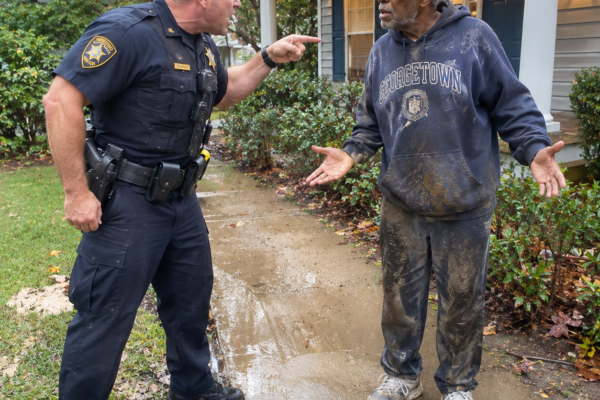
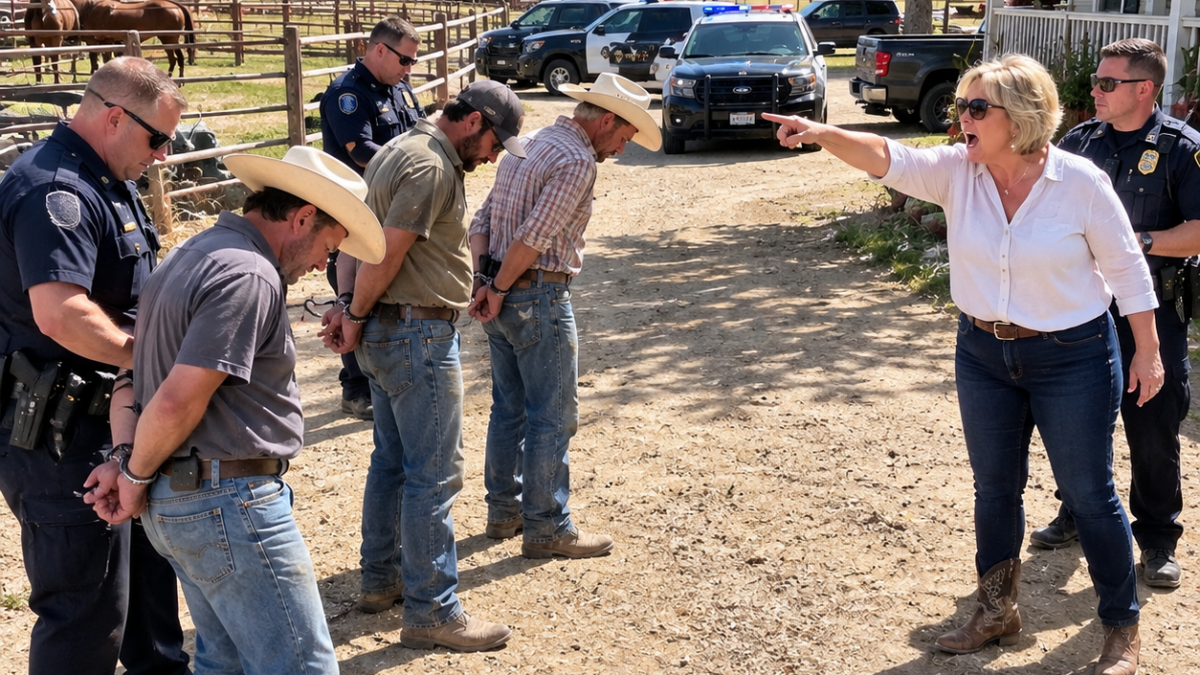
Shannon immediately snapped, “Don’t communicate with the suspects.”
The younger deputy turned toward her.
“Ma’am.”
“What?”
“Please stop directing the investigation.”
She looked personally insulted.
“I am the president of Desert Ridge HOA. This road is part of our protected emergency access corridor. These men cut an HOA lock and ignored repeated warnings.”
Miguel looked at me.
I could tell he wanted permission to unload four months of frustration.
I gave him the smallest shake of my head.
Not yet.
The older deputy approached me.
“Sir, are you Matthew Rourke?”
“Yes.”
“Owner of Rourke Creek Ranch?”
“Yes.”
Shannon cut in before he could ask another question.
“He claims to own the corridor. He doesn’t. Desert Ridge has permanent control.”
The deputy glanced toward her.
Then back at me.
“Did you authorize these men to remove the chain?”
“Yes.”
“Why?”
“Because it was attached to my internal ranch gate, and my attorney had already confirmed the HOA had no authority to put it there.”
Shannon laughed sharply.
“That’s his interpretation.”
“No,” Miguel said. “That’s what your own attorney told—”
“Stop talking!”
The older deputy turned again.
“Ms. Blake, I’m going to ask you one more time. Let us ask the questions.”
Her face reddened.
Then she pointed at me again.
“Ask him for identification.”
The deputy looked at me.
“Sir, may I see ID?”
“Absolutely.”
I had come directly from work.
That mattered.
Because the leather identification case in my inside jacket pocket was not my ordinary driver’s-license wallet.
I reached slowly toward it.
The younger deputy noticed the edge of the case.
His eyes narrowed.
Then I opened it.
His expression changed instantly.
He looked at the badge.
Then my photograph.
Then my face.
“Deputy U.S. Marshal?”
The entire scene went quiet.
Shannon blinked.
“What?”
I closed the case halfway.
“Yes.”
She stared at me.
“You’re a U.S. Marshal?”
“Deputy U.S. Marshal.”
For the first time that morning, Shannon Blake had no immediate response.
Tyler looked down, and I could tell he was fighting a smile.
Jordan suddenly became extremely interested in the ground.
Miguel simply exhaled.
Then Shannon found her voice again.
“You never told me.”
“You never asked.”
“You said you worked in federal law enforcement.”
“That was accurate.”
“You hid this from us.”
“No.”
I put the identification case away.
“My job has nothing to do with who owns this road.”
That sentence changed the mood.
Not because it impressed Shannon.
Because the deputies understood immediately what I was saying.
I was not pulling rank.
I was not asking for special treatment.
I was not telling county officers that a federal badge made my property claim stronger.
It didn’t.
A deed decided ownership.
An easement decided access.
A contract decided rights.
My badge had nothing to do with any of that.
Before anyone could say more, another sheriff’s vehicle turned onto South Creek Road.
Sergeant Calvin Price stepped out.
I knew Calvin from joint fugitive cases between the county and the U.S. Marshals Service.
More importantly, Calvin had also participated in county emergency planning after a wildfire eight years earlier.
He knew South Creek Road.
He knew my ranch.
And when he saw Tyler in handcuffs, his face changed.
“Why is one of Rourke’s ranch employees detained on Rourke Creek property?”
Shannon stepped forward instantly.
“Because he destroyed HOA property.”
Calvin looked at the cut chain lying beside the gate.
Then at Shannon.
“Start from the beginning.”
She did.
And for the next several minutes, she gave him the version she had apparently been repeating to everybody who would listen.
The road was an HOA emergency corridor.
My workers had interfered with it.
The HOA had secured the gate.
My employees cut the lock.
They had been warned.
They were trespassing.
My refusal to cooperate endangered hundreds of residents.
Calvin listened.
He did not argue.
Then he turned to Miguel.
“Your turn.”
Miguel explained that South Creek Road was a private ranch road.
That the HOA had placed a chain on an internal gate the night before.
That the chain prevented ranch crews from reaching fencing damaged by a storm.
That I had told him to photograph the lock, remove only the unauthorized chain, preserve it, and continue the repair work.
Calvin looked toward Shannon.
“What document gives Desert Ridge authority to put a lock on that gate?”
She pulled a folder from her SUV.
“Emergency preparedness agreement.”
Calvin read it.
Slowly.
Shannon stood beside him looking increasingly impatient.
Finally, he pointed to a paragraph.
“This says emergency vehicles and residents directed by public officials may use South Creek Road when the primary entrance becomes unsafe.”
“Correct.”
“Is the primary entrance unsafe today?”
“That’s not the point.”
“It’s a pretty important point.”
She folded her arms.
“The agreement creates permanent community access.”
Calvin read again.
“Where?”
“There.”
“That paragraph says both parties will maintain reasonable availability for emergency use.”
“Exactly.”
“That doesn’t say Desert Ridge owns the gate.”
“It protects our corridor.”
“Your corridor?”
“Our emergency corridor.”
“On whose land?”
She hesitated.
“Rourke Creek Ranch.”
Calvin looked up.
There it was.
The distinction Shannon had spent months refusing to make.
Then my attorney, Nathan Caldwell, arrived carrying a thick folder.
Nathan was one of those attorneys who could make another person feel increasingly uncomfortable without ever raising his voice.
He handed Calvin a survey.
My deed.
The emergency agreement.
Prior correspondence.
And, most importantly, letters from Desert Ridge’s own lawyer acknowledging that the emergency agreement did not clearly establish permanent everyday access.
Calvin asked Tyler several questions.
“Did you threaten Ms. Blake?”
“No.”
“Any security worker?”
“No.”
“Did you refuse an officer’s command?”
“No.”
“Did you touch anyone?”
“No.”
“Did you remove the chain?”
“Yes.”
“Under whose direction?”
“Matthew’s.”
“Why?”
“Because I needed through the gate to get equipment to the damaged fence.”
Calvin nodded toward the younger deputy.
The handcuffs came off.
Tyler rubbed his wrists.
He said nothing.
That silence was probably the smartest thing anybody did that morning.
Nobody was arrested.
Not Tyler.
Not Miguel.
Not Jordan.
Not Shannon.
Not me.
Calvin explained that the sheriff’s department was not going to settle a complicated property dispute beside a fence.
If Desert Ridge believed my workers had damaged HOA property, the HOA could pursue the proper legal process.
If I believed Desert Ridge had installed unauthorized equipment on my land, Nathan could do the same.
Then Calvin looked directly at Shannon.
“One more thing.”
She stiffened.
“When you call dispatch and say three men are breaking into restricted HOA property, damaging security equipment, and refusing to leave, that creates a very specific picture for responding deputies.”
“They were.”
“There is an active dispute over access rights.”
“They were trespassing.”
“Then say there is a disputed easement and ranch workers are removing a chain.”
Her eyes narrowed.
“Why does the wording matter?”
Calvin’s expression hardened.
“Because details matter when people with guns are being sent into a situation.”
Nobody said anything after that.
I had written enough reports in my career to understand exactly what he meant.
Words mattered.
“Armed suspect” was different from “licensed owner.”
“Breaking in” was different from “removing an unauthorized chain.”
“Restricted HOA property” was different from “a disputed road on privately owned ranch land.”
Shannon had used the most aggressive version of every fact.
And one of my employees had ended up in handcuffs because of it.
When the deputies finished, Shannon looked at me again.
Her eyes dropped briefly toward the pocket where I had put my marshal credentials.
“You really never thought mentioning your job was relevant?”
“No.”
“You let me argue with you for four months without telling me?”
“I told you I worked federal law enforcement.”
“You didn’t say U.S. Marshals Service.”
“Why would that matter?”
She stared at me.
“Because—”
She stopped.
Because what?
Because maybe she would have treated me differently?
Because maybe she would have stopped telling me I had no idea how government authority worked?
Because maybe she wouldn’t have told deputies to arrest my workers in front of me?
That was exactly why I had never emphasized the job.
If Shannon respected my property only after discovering I carried federal credentials, then she had learned the wrong lesson.
But to understand how three good ranch hands ended up facing deputies over a cut chain, you need to understand South Creek Road.
And you need to understand what happened four months earlier.
My name is Matthew Rourke.
I was fifty-two.
Rourke Creek Ranch covered a little more than 4,600 acres in northern Arizona.
It was not movie-set ranch country.
There were no perfect green fields stretching endlessly beneath snowcapped mountains.
Our land was dry.
Rocky.
Hard.
Beautiful if you understood what you were looking at.
Grass changed color with the season.
Mesquite and scattered trees broke up the hills.
A narrow creek ran stronger in spring and became modest during the hottest months.
The ranch had been in my family for decades.
My grandfather bought the original nine hundred acres.
My parents added neighboring parcels whenever opportunities appeared.
Eventually, those pieces became one large working ranch.
We ran cattle.
Maintained water systems.
Managed pasture.
Fixed fencing.
And spent an unreasonable percentage of our lives repairing gates that cattle seemed personally committed to destroying.
Miguel Alvarez had worked for my father before working for me.
He was forty-nine and had the kind of patience you develop after spending decades around animals that outweigh you.
If Miguel said cattle were behaving strangely, I listened.
If Miguel said weather was turning, I checked the forecast.
If Miguel said a man was trouble, I generally trusted him.
Tyler Brooks was thirty-six.
He handled heavy equipment.
He was smart, strong, quick with a joke, and occasionally faster with his temper than I would have preferred.
Jordan Ellis was thirty-one.
He dealt with fencing, water lines, pumps, and general pasture maintenance.
The three of them were not random laborers.
They were people I trusted with my land and livestock.
I did not ranch full time.
For seventeen years, I had served as a deputy United States Marshal.
My assignment kept me away from the ranch during much of the week.
The work involved fugitive investigations, court security support, prisoner operations, and assistance with federal cases.
I never talked much about it outside people who needed to know.
Around nearby towns, many people knew I “worked federal law enforcement.”
That was enough.
When I came home, I wanted to be Matthew.
Not Marshal Rourke.
I fixed fencing.
Checked cattle.
Argued with suppliers.
Helped Miguel move equipment.
Complained about diesel prices.
My federal job did not make my deed more valid.
It did not give me special access rights.
It did not make an HOA automatically wrong.
Years in law enforcement had actually taught me something more useful.
If you believe you are right, prove it.
Document it.
Slow down.
Facts first.
That became very important after Shannon Blake became president of Desert Ridge Estates.
Desert Ridge sat east of our southern pasture.
About three hundred fifty homes.
The development had been built fourteen years earlier on land that once belonged to an old horse ranch.
For years, we barely had problems with them.
Most residents were perfectly decent.
Some bought beef from us.
A retired nurse named Linda Foster volunteered at our yearly food drive.
Families sometimes came to a public viewing area we opened during calving season.
Kids would stand at the fence for an hour watching newborn calves and asking questions their parents could not answer.
I liked that.
Ranch land and neighborhoods can coexist.
They just need boundaries.
Then Shannon became HOA president.
She was fifty-five.
Organized.
Energetic.
Smart.
And very good at getting things done.
That last quality eventually became her biggest problem.
At first, Shannon accomplished useful things.
She improved playground maintenance.
Got an aging clubhouse roof repaired.
Expanded wildfire preparation.
Pushed residents to clear dangerous vegetation.
Worked on drainage.
People liked her because projects moved.
Then she started looking beyond HOA land.
One Saturday morning, Miguel called.
“You need to come to South Gate.”
“What happened?”
“New sign.”
“What kind of sign?”
“Funny kind.”
Miguel did not describe many things as funny.
I drove down.
A bright white metal sign had been bolted beside the gate.
DESERT RIDGE HOA
EMERGENCY AND COMMUNITY ACCESS
AUTHORIZED RESIDENTS ONLY
I stared at it.
Then looked at Miguel.
“Residents of what?”
He pointed east.
Desert Ridge.
Behind the gate ran South Creek Road.
Despite the name, it wasn’t a county road.
It was ours.
Old gravel.
It began near a county route, crossed onto Rourke Creek Ranch, followed the southern boundary for nearly a mile, then curved north toward working pasture.
Desert Ridge had another road nearby, but there was no normal public connection between the two properties.
I removed the sign carefully.
Didn’t damage it.
Stored it in the ranch office.
Then called Shannon.
“Did Desert Ridge attach a sign to South Gate?”
“Yes.”
“Why?”
“We’re reopening the emergency corridor.”
“What emergency corridor?”
“The south access route.”
“That’s a ranch road.”
“It has served Desert Ridge before.”
Technically, she was correct.
Eight years earlier, a wildfire threatened the primary highway serving Desert Ridge.
My father allowed fire vehicles, deputies, and evacuation traffic to cross our ranch.
Afterward, he signed an emergency preparedness agreement with the association.
I had a copy.
The agreement was clear enough to me.
If Desert Ridge’s normal entrance became unsafe during a real emergency, firefighters, ambulances, law enforcement, and residents acting under official evacuation direction could cross a defined ranch route.
That was it.
Not daily commuting.
Not school drop-off.
Not delivery traffic.
Not an HOA-controlled entrance.
Shannon disagreed.
She emailed me the agreement.
It was exactly the same document I had.
I called Nathan.
“This creates emergency access,” he said.
“I know.”
“During emergencies.”
“I know.”
“Under official direction.”
“I know.”
“So why is the HOA installing signs like it owns your gate?”
“That is apparently the question of the month.”
We soon learned the answer.
Desert Ridge wanted another entrance.
The community had grown.
Traffic had increased.
Wildfire risk remained serious.
I agreed that a second route made sense.
What I did not agree with was their preferred solution.
The HOA wanted to pave South Creek Road.
Connect it permanently to Desert Ridge.
And send hundreds of neighborhood vehicles every day through a road running directly beside one of our busiest cattle-handling areas.
Shannon invited me to an HOA meeting.
I attended.
They presented engineering drawings.
New pavement.
Drainage.
Fencing.
Lighting.
A landscaped connection.
They offered to pay for construction and maintenance.
In return, Desert Ridge would get permanent access across approximately 1.1 miles of my ranch road.
“No.”
Shannon looked surprised.
“You haven’t heard the financial details.”
“I understand the route.”
“We’re offering to improve your road at no cost.”
“It’s not a road I want turned into neighborhood traffic.”
“This benefits both properties.”
“It puts hundreds of vehicles beside cattle pens.”
“We can fence it.”
“Livestock move across that area.”
“We can build crossings.”
“Equipment uses it.”
“We can coordinate.”
“School traffic doesn’t coordinate with a cattle trailer because the HOA asks nicely.”
Her expression tightened.
“This is a major safety improvement for three hundred fifty families.”
“I agree you need a second route.”
“Then why are you blocking it?”
“I’m not.”
I showed them another possible line.
Farther east.
It crossed a narrow section of my property consisting mostly of rocky ground we barely grazed.
“That route could work.”
Their engineer studied it.
Shannon asked one question.
“How much more?”
The engineer hesitated.
“A lot.”
“How much?”
Nearly three times more.
Shannon looked at me.
“So your solution is that our community should spend millions more just because you don’t want cars near cattle?”
“My solution is that you don’t solve your cost problem by pushing the cost onto my ranch.”
The meeting ended badly.
After that, Shannon contacted me constantly.
Email.
Phone.
Letters.
She called Miguel.
She contacted my sister even though my sister owned exactly zero acres of Rourke Creek Ranch.
She mailed glossy engineering drawings showing what South Creek Road could look like after paving.
I gave the same answer.
Talk to me about the eastern route.
South Creek stays a ranch road except under the emergency agreement.
Then we discovered what was driving the urgency.
A developer named Sun Valley Communities had purchased 380 acres behind Desert Ridge.
Another 175 houses were planned.
Their easiest transportation design depended on the second Desert Ridge entrance.
That meant South Creek could eventually serve traffic from more than five hundred homes.
Sun Valley had offered Desert Ridge $2.6 million toward road construction, wildfire mitigation, drainage, and a new community recreation building if the HOA could provide the western transportation connection.
Nathan discovered that.
Not Shannon.
I called her.
“You forgot to mention 175 new houses.”
“It doesn’t change our discussion.”
“It absolutely changes the discussion.”
“The road would be designed for future traffic.”
“That’s exactly my point.”
“You’re blocking improvements that benefit hundreds of families.”
“I’m offering a different route.”
“At three times the cost.”
“Yes.”
“That’s unreasonable.”
“To you.”
She went quiet.
That was the heart of the problem.
The cheaper route for Desert Ridge was expensive for me.
Not in dollars.
In disruption.
Traffic.
Livestock risk.
Operational restrictions.
Dust.
Liability.
Equipment conflicts.
Shannon kept describing South Creek as the inexpensive solution because she wasn’t counting what the ranch would lose.
Then something constructive happened.
Sun Valley’s project manager, Patrick Sloan, contacted me directly.
Patrick was practical.
No ego.
He asked permission before bringing engineers onto the ranch.
We walked the eastern route.
It was rougher.
Rocky.
A wash would require a bridge.
But Patrick looked at the terrain and said:
“It’s harder. Not impossible.”
“More expensive.”
“Much.”
“Sorry.”
He laughed.
“It’s not your job to make our development cheap.”
That single sentence earned more trust from me than four months of HOA pressure.
For nearly two weeks, things calmed down.
Then Miguel found another white HOA sign.
This one had been installed inside the ranch gate.
PERMANENT EMERGENCY CORRIDOR
DO NOT BLOCK
I called Shannon.
“Did your HOA put another sign inside my gate?”
“Our maintenance contractor did.”
“On whose instruction?”
“The board authorized emergency access maintenance.”
“You cannot transform temporary emergency access into permanent daily access by printing a sign.”
“We have legal rights.”
“Then have your attorney explain them to mine.”
I removed the sign.
Documented it.
Stored it.
Two days later, another appeared.
Nathan sent a formal cease-and-desist letter.
Desert Ridge’s attorney, Gregory Hale, responded more cautiously than Shannon.
He admitted the emergency agreement did not clearly establish everyday residential access.
He suggested mediation.
I accepted.
Shannon postponed it twice.
Then she started targeting my workers.
Tyler was repairing drainage beside South Creek when two Desert Ridge security employees approached him.
They told him he was working inside an HOA emergency corridor.
Tyler laughed.
That was a mistake.
Not legally.
Socially.
They thought he was mocking them.
He called Miguel.
Miguel called me.
Nathan wrote another letter.
The private security company eventually apologized.
Their employees had been given an HOA planning map labeling South Creek Road as DESERT RIDGE SECONDARY EMERGENCY CORRIDOR.
Again, a map was being treated like ownership.
Then Shannon complained to the county that ranch machinery was blocking an evacuation route.
A county inspector came.
He looked at the road.
Our equipment.
The agreement.
Then asked:
“Is there an active emergency?”
“No.”
“Evacuation order?”
“No.”
He shrugged.
“No violation.”
Shannon was furious.
A week later, Miguel temporarily closed the road while crews replaced damaged fencing.
Shannon called the sheriff’s office.
Deputies came.
Miguel showed them the deed and Nathan’s letter.
They left.
No arrest.
No citation.
That should have taught her that police were not a shortcut around property law.
Instead, she escalated.
Then Nathan discovered the deadline.
Sun Valley’s $2.6 million package required Desert Ridge to show a workable second entrance within sixty days.
If not, Sun Valley could reduce the contribution and build another connection directly to the highway.
Shannon had promised HOA residents projects based on that money.
Clubhouse upgrades.
Drainage.
Wildfire work.
No major special assessment.
If South Creek failed, her political promises failed with it.
I understood the pressure.
Pressure still didn’t create property rights.
Then Patrick called.
“We’re leaning toward your eastern route.”
“That’s good.”
“Our engineers think we can make it work.”
“How expensive?”
“You don’t want to know.”
“Probably true.”
“We’re meeting Friday.”
Thursday night, Miguel called as I left my federal office.
“Shannon’s back at South Road.”
“What now?”
“New locks.”
I stopped walking.
“What?”
“HOA chain on the inner gate.”
An inner ranch gate.
Not the exterior boundary.
A gate we used to reach our own pasture.
“Photograph everything.”
“Want us to cut it?”
“Not tonight.”
The next morning, Miguel, Tyler, and Jordan needed that gate open to repair storm-damaged fence.
Nathan confirmed again that Desert Ridge had no authority to lock it.
I instructed Miguel very specifically.
Photograph the chain.
Remove only the HOA chain.
Save it.
Do not damage anything else.
Continue the repair.
Miguel did exactly that.
Twenty minutes later, Shannon arrived.
She saw the chain cut.
And called 911.
Not to report a disputed easement.
Not to say ranch employees removed an HOA chain from a contested gate.
She told dispatch that three men were breaking into restricted HOA property.
Destroying security equipment.
Refusing to leave.
The deputies arrived expecting something far more serious than what was actually happening.
Tyler got frustrated.
He stepped toward the gate while trying to point out that the ranch deed was in the truck.
The deputy told him to stop.
Tyler stopped.
But until identities and property rights could be checked, they temporarily handcuffed him.
Then Shannon stood there demanding everybody be arrested.
That was when I arrived.
And when she discovered who I worked for.
The day ended without an arrest.
But Tyler was angry.
I walked over after the deputies finished.
“You okay?”
“I’ve worked here nine years.”
“I know.”
“She stood there telling cops I was some criminal breaking into her property.”
“I know.”
“I told them the truth before you got here.”
“Yes.”
“And suddenly they look at your badge and everybody slows down.”
“That’s not the part I want you remembering.”
“It’s the part I’m remembering.”
I understood.
“You’re right to be angry.”
He looked at Shannon’s SUV.
“She just gets to leave?”
“For today.”
“That doesn’t seem fair.”
“No.”
I paused.
“But fair doesn’t mean we invent punishment because we’re mad.”
Tyler didn’t like that.
Neither did I.
Nathan collected everything.
Photographs.
The chain.
Signs.
Gate marks.
Tire tracks.
The exact place Tyler was detained.
Jordan labeled the chain with date and location and stored it in the ranch equipment office.
By sunset, South Creek looked ordinary again.
The next morning, Gregory Hale called Nathan.
Gregory was furious.
Not at us.
At Shannon.
He had specifically told the HOA not to make physical changes while mediation was pending.
He had not approved the lock.
Three days later, mediation finally happened.
Shannon attended.
Gregory.
Two board members.
Patrick.
A transportation engineer.
Nathan.
Me.
Patrick began.
“We no longer believe South Creek is the best route.”
Shannon whipped toward him.
“You told us it was.”
“I said it was the cheapest.”
“That’s the same thing in practical terms.”
“No. It isn’t.”
He placed the eastern-route drawings on the table.
A bridge over the wash.
Better highway angle.
Less interference with the ranch.
More direct control for Sun Valley.
Shannon stared at the map.
“And Desert Ridge?”
“The route can connect into HOA property from the east.”
“So we still get a second entrance?”
“Yes.”
That was what I had been saying for months.
Patrick proposed buying an easement across thirty-seven acres of rocky eastern ground.
Sun Valley would build the road.
Bridge.
Drainage.
Fencing.
Two livestock underpasses.
Maintain the improvements.
I was willing to negotiate.
Then Shannon asked about the $2.6 million.
Patrick became uncomfortable.
“That package was based on the original transportation plan.”
“So we lose it.”
“Not all of it.”
“How much?”
“Still under discussion.”
That was why Shannon was not happy.
The eastern route solved the safety problem.
It did not solve every financial promise she had made.
Outside the building, I found her beside her SUV.
“You nearly got three men arrested over a road that might not even be used.”
“I didn’t know Tyler would be handcuffed.”
“You told deputies to arrest all three.”
“I was angry.”
“So was he.”
She looked away.
Then said something surprisingly honest.
“I thought if I pushed hard enough, eventually you’d agree.”
“That’s exactly the problem.”
“I’m responsible for hundreds of residents.”
“And Miguel, Tyler, and Jordan are people too.”
She looked at me.
“Being responsible for one group does not make everybody outside that group less important.”
She didn’t apologize.
But she listened.
Then the situation changed again.
Sun Valley increased its proposed payment for the eastern easement to $1.9 million.
Nathan thought the amount justified serious negotiation.
But I cared just as much about limits.
No automatic future expansion.
No utilities except those explicitly allowed.
No access to internal ranch roads.
Sun Valley responsible for maintenance.
Separate legal rights for Desert Ridge.
Patrick agreed to most conditions.
It looked like the dispute might finally end.
Then Nathan received the sheriff’s incident report from the handcuffing.
He circled one phrase.
“Desert Ridge controlled property.”
“What?”
“Shannon keeps using that wording.”
“She thinks the emergency agreement gives them control.”
“No. The emergency agreement says emergency access.”
He began pulling old county planning records.
That search uncovered a map neither of us had ever seen.
Six years earlier, during a wildfire planning update, South Creek Road had been marked red.
Label:
DESERT RIDGE CONTROLLED EMERGENCY ACCESS PER CONVERSION AGREEMENT.
Nathan stared at me.
“Conversion agreement?”
“I’ve never heard of one.”
Neither had Gregory.
We requested the old file.
Two days later, the county sent a scanned document.
CONDITIONAL ROAD CONVERSION AGREEMENT.
Signed twelve years earlier.
By the original Desert Ridge developer.
And my father.
James Rourke.
I stared at his signature.
It was his.
The agreement said my father would allow South Creek Road to become permanent secondary residential access if certain conditions were completed within seven years.
A replacement ranch service road.
New fencing.
Two livestock crossings.
A payment of $180,000.
And a final recorded completion certificate.
My mouth went dry.
“Did they do those things?”
Nathan kept reading.
“There’s a certificate.”
Recorded six years earlier.
One year before the deadline.
Signed by Desert Ridge’s original developer.
And signed on behalf of Rourke Creek Ranch.
Not by my father.
William Prescott.
I knew William.
He had managed the ranch for almost twenty years.
My father trusted him completely.
Purchases.
Contractors.
Leases.
Deposits.
Paperwork.
Nathan asked:
“Could William sign property agreements?”
“I don’t know.”
That was the first moment in months when I had to seriously consider that Shannon might be wrong about everything she had done—
but not entirely wrong about the road.
Then Patrick called.
He had another problem.
The recorded certificate did not limit use to Desert Ridge.
It said South Creek Road could serve Desert Ridge and future residential property developed from the original seven-hundred-acre parent tract.
Sun Valley’s 380 acres had once belonged to that parent tract.
If the certificate was valid, more than five hundred homes might have permanent rights to South Creek Road.
No sale needed.
No new $1.9 million deal.
Nothing.
For the first time, I felt real fear about the road itself.
Nathan refused to panic.
“A recorded certificate matters.”
“So we lose?”
“I didn’t say that.”
“It looks valid.”
“Looking valid and being valid are not the same thing.”
We called William.
He was seventy-six and living near Prescott.
When Nathan explained the issue, William went silent.
Finally:
“I remember that agreement.”
“What do you remember?”
“James hated it.”
“Then why did you sign a completion certificate?”
Another long silence.
“Your dad was sick. I signed a lot of things when his heart got bad.”
My father had suffered serious heart problems in his final years.
William handled more ranch business during that period.
Nathan found a limited power of attorney.
William could sign checks.
Manage contractors.
Renew ordinary leases.
Execute documents necessary for daily operations.
Then came the limit.
He could not sell land.
Grant permanent easements.
Mortgage property.
Or alter recorded property rights without separate written authorization from my father.
Relief hit me.
Then Nathan ruined it.
“Maybe.”
“What do you mean maybe?”
“If the original agreement automatically converted the road once conditions were met, William might only have been certifying completion. The developer could argue he wasn’t granting a new easement.”
I hated legal sentences that began with “the developer could argue.”
We checked the conditions.
Replacement service road?
Built.
Fencing?
Built.
Two cattle crossings?
Built.
Payment?
Nothing in ranch bank records.
No $180,000.
I smiled.
“So conversion failed.”
Nathan raised a finger.
“Maybe.”
I glared at him.
He almost smiled.
The agreement allowed payment into escrow if my father refused to accept it.
Old developer records had been acquired by Horizon West Development.
They searched.
Found an escrow ledger.
There it was.
$180,000.
Deposited two weeks before William signed.
My heart sank.
Then Nathan noticed something.
Four months later, the money went back to the developer.
No payment to the ranch.
No closing.
No explanation.
“Something stopped the deal.”
Horizon West searched deeper.
Then they found a letter.
From my father.
Written eleven days after William signed the completion certificate.
Nathan read it aloud.
“I have reviewed the road completion certificate signed by William Prescott and do not approve conversion of South Creek Road at this time.”
I stared at him.
“He rejected it.”
The letter continued.
My father acknowledged the replacement road and fencing.
But one livestock crossing had drainage problems.
More importantly, he stated William had not been authorized to approve permanent residential access.
He demanded the certificate be withdrawn until the problems were corrected and he personally signed final approval.
That explained why the $180,000 was returned.
But nobody had withdrawn the recorded certificate.
For six years, it sat in public records.
A planner saw it.
Put it on a wildfire map.
Another planner copied that map.
Another copied it again.
Eventually, Shannon became HOA president and inherited a file saying:
DESERT RIDGE CONTROLLED EMERGENCY ACCESS.
She had not invented the phrase.
She had inherited a mistake.
When we showed her my father’s letter, she looked genuinely shaken.
“I didn’t know this existed.”
“I believe you.”
She looked surprised.
“You do?”
“Yes.”
Patrick laughed quietly.
“If she had it, she definitely would’ve waved it at you.”
Even Shannon smiled.
Nathan explained the real situation.
The ownership of the road was never in serious doubt.
The ranch owned the ground.
The question was whether a permanent easement existed.
My father’s rejection weakened the conversion.
The returned money weakened it.
William’s limited authority weakened it.
But the recorded certificate had to be formally corrected.
We filed a quiet-title action.
Desert Ridge agreed not to oppose the request unless new evidence surfaced.
Then William arrived with boxes of old ranch records.
We spent hours searching.
Finally, we found his copy of the completion certificate.
Across the top, in my father’s handwriting:
NOT FINAL. HOLD.
Then William found his own note from that day:
SIGNED TO CONFIRM WORK INSPECTION. JAMES TO APPROVE ACCESS AFTER DRAINAGE FIX.
That mattered.
Then another letter.
Mesa Vista’s attorney acknowledged my father’s objection and promised to repair the drainage issue and submit a new certificate for James Rourke’s personal approval.
No replacement certificate had ever been signed.
My father died the following year.
The conversion had been left unfinished.
A transaction that started but never closed.
A paperwork ghost.
At that point, something shifted in me.
Shannon had behaved badly.
She had crossed lines.
Called police unnecessarily.
Misrepresented the level of danger.
Treated my employees like criminals.
But I finally understood how she had convinced herself she was right.
That did not excuse her.
Understanding and excusing are not the same thing.
A bad decision can begin with an honest mistake.
It becomes something else when people warn you and you refuse to stop.
The quiet-title case moved forward.
For nearly two weeks, everything was peaceful.
Then Shannon did something I did not expect.
She came to the ranch office.
Miguel was there.
Jordan.
Tyler.
She asked if she could speak to them.
Nobody answered immediately.
Finally Miguel nodded.
Shannon looked at all three men.
“I owe you an apology.”
Tyler folded his arms.
She continued.
“I told the deputies a version of the situation that made you sound like criminals. I believed the road belonged under HOA control. But I should have told dispatch there was a disputed legal issue.”
Miguel nodded.
Jordan said, “Thank you.”
Tyler said nothing.
Shannon looked at him.
“I’m especially sorry you were detained.”
Tyler finally spoke.
“You told them to arrest me.”
“Yes.”
“I was telling the truth before Matthew showed up.”
“Yes.”
“You didn’t really start listening until you found out he was a marshal.”
Shannon’s face tightened.
I almost interrupted.
Tyler deserved the moment.
She looked down.
Then back up.
“You’re right.”
Tyler seemed surprised.
“So what does that mean?”
“It means his badge didn’t make you more truthful. I should have listened before I knew who he was.”
That was the first apology that mattered to him.
He gave a small nod.
Not forgiveness.
Not friendship.
But acknowledgement.
Then Patrick called again.
By then, I had developed a specific hatred for phone calls beginning with:
“Matthew, we found something.”
That was exactly how this one started.
“What now?”
Sun Valley’s surveyor had been tracing the original seven-hundred-acre parent tract.
A sixty-two-acre section had been separated years before Desert Ridge construction.
My father later bought it.
Mesa Field.
The same general area where I had proposed the eastern route.
Nathan reviewed the deed.
Then found something.
A reserved future transportation easement.
Not South Creek.
A completely different corridor.
The reservation could activate if a future residential project received county approval and the developer built the required bridge, road, drainage, and fencing at its own expense.
Patrick looked at the map.
“That’s almost exactly our eastern route.”
I couldn’t believe it.
Four months of fighting over the wrong road.
The eastern corridor—the expensive alternative—had potential access rights written directly into an old deed.
Worse, it could benefit both Sun Valley and Desert Ridge.
And because it was in the deed, it was much stronger than the broken South Creek conversion.
The $1.9 million purchase offer might disappear.
I’ll admit something.
For about five minutes, I was deeply disappointed.
Then Nathan looked at me.
“You bought this parcel subject to the reservation.”
“I know.”
“You want everybody else to respect recorded rights.”
“I know.”
“That includes rights you don’t like.”
“I said I know.”
He smiled.
The reserved easement was real.
But it was not unlimited.
The county still had to approve Sun Valley’s project.
The developer had to pay every construction cost.
The road had to stay inside a specific fifty-foot corridor.
And most importantly:
The transportation use could not materially interfere with continued agricultural operation of the remaining property.
Nathan tapped that sentence.
“This is where your ranch protection lives.”
Patrick agreed.
The original road design crossed directly over a new water line Miguel had planned.
They moved the route twenty-eight feet north.
Still inside the easement.
Cattle needed to move between pastures.
Sun Valley added a wide livestock underpass.
Drainage from the bridge threatened a grazing area.
Engineers redesigned it.
Sun Valley paid.
That was the difference between a legal access right and unlimited control.
They had rights.
So did I.
Both could exist.
Then the South Creek hearing arrived.
William testified.
He explained that he signed to confirm construction work.
He did not believe he was approving permanent residential traffic.
The judge reviewed:
My father’s rejection letter.
The returned $180,000.
William’s limited power of attorney.
The NOT FINAL notation.
William’s handwritten note.
The developer’s promise to submit a new certificate.
And the fact no final approval was ever signed.
The judge did not accuse anybody of fraud.
There was no dramatic criminal conspiracy.
The truth was more ordinary.
And, in some ways, more dangerous.
A deal had almost happened.
Work was performed.
A certificate was recorded too early.
My father rejected final conversion.
Money was returned.
The project moved on.
But the bad certificate remained.
Years passed.
Context disappeared.
Then people began trusting the surviving document more than the transaction that had actually happened.
The court declared the certificate ineffective as proof of permanent residential access.
County records were corrected.
South Creek Road remained a private ranch road subject only to the emergency agreement.
If wildfire blocked Desert Ridge’s entrance, official emergency traffic could cross.
If firefighters needed it, they could use it.
If county officials directed evacuation, residents could use it.
On an ordinary Tuesday?
Ranch road.
When the ruling came down, Shannon sat very still.
Afterward, she approached Tyler before approaching me.
“The judge confirmed it,” she said.
Tyler nodded.
“I owe you another apology.”
“You already apologized.”
“This part is different.”
She took a breath.
“I made an understandable mistake about the document. What wasn’t understandable was refusing to slow down after people warned me.”
Tyler watched her.
“That’s the part that bothered me.”
“I know.”
“More than the handcuffs.”
“I know.”
This time he held out his hand.
She shook it.
The sheriff’s office also reviewed the original call.
They found no wrongdoing by the responding deputies.
Given the initial report and conflicting ownership claims, Tyler’s short detention was considered part of stabilizing the scene until documents could be checked.
But the property database was updated.
South Creek Road:
PRIVATE RANCH PROPERTY.
LIMITED EMERGENCY ACCESS ONLY.
Calvin later told me:
“Your marshal credentials explained why I knew you. They didn’t prove your property case.”
“That’s exactly right.”
“If you’d been a mechanic, we still needed to read the deed.”
“I am a mechanic half the time anyway.”
He laughed.
But the point mattered.
I never wanted the story to become:
Federal marshal humiliates HOA president.
That would be satisfying for about ten seconds.
It would also miss the lesson.
Miguel’s rights did not become stronger because his employer was a marshal.
Tyler did not become more innocent when I opened my credential case.
Shannon’s documents did not become weaker because of my badge.
Facts decided the dispute.
Then we finalized the eastern-road arrangement.
Because Sun Valley already had conditional rights under the Mesa Field deed, they did not need to buy the entire easement for $1.9 million.
But they did want things beyond the reservation.
Temporary construction staging.
Wider bridge access.
Equipment areas.
Additional workspace.
Those were new rights.
They asked.
We negotiated.
$420,000.
In exchange, Sun Valley received limited construction access.
The ranch received new fencing.
Better drainage.
A larger livestock underpass.
A redesigned ranch entrance.
Repair guarantees.
Clear restrictions.
Nobody pretended they already owned what they wanted.
Nobody installed chains.
Nobody called deputies.
Nobody shouted “arrest them.”
Desert Ridge also received its second connection through the eastern route.
Sun Valley contributed $1.4 million toward wildfire clearing, drainage, and traffic improvements.
Less than the original $2.6 million package.
Enough for the essential safety work.
The recreation-building expansion was postponed.
Some residents complained.
At the HOA meeting, Linda Foster stood.
“A bigger recreation building would be nice. A safe legal road and wildfire improvements are necessary. Maybe we stop acting like every nice thing has to happen this year.”
People applauded.
Then came Shannon’s future.
She could have forced a removal vote.
She didn’t.
She announced she would complete the road transition and step down at the end of the quarter.
She stood in front of hundreds of residents.
No lawyer speaking for her.
No excuses.
“I allowed the Sun Valley deadline and promises I made about community improvements to affect my judgment.”
The room was silent.
“I started treating disagreement like disobedience.”
That sentence stayed with me.
“That is not how neighbors should treat each other.”
She stepped down.
The HOA adopted new rules.
Any claimed right over offsite private property had to be reviewed by counsel before signs, locks, barriers, or equipment were installed.
Emergency-access disputes had to involve county emergency officials rather than individual board members improvising authority.
Those rules were boring.
I loved them.
Good rules usually are.
Then something happened that surprised Tyler.
The new HOA leadership invited him to a maintenance meeting.
Linda Foster had become president.
She wanted Tyler to explain how ranch equipment moved through South Creek and Mesa Field so HOA maintenance crews would know where not to park during emergency preparation.
Tyler stared at me.
“They want me?”
“Apparently.”
“The trespasser?”
“Former alleged trespasser.”
“That sounds worse.”
He went.
Spent an hour explaining livestock trailers.
Gate clearances.
Seasonal cattle movement.
Equipment turning radius.
Water systems.
Residents asked questions.
Nobody ordered his arrest.
He came back to the ranch.
“Well?”
He shrugged.
“Not terrible people.”
“I told you.”
“You also almost ended up with two neighborhood roads.”
“Details.”
He laughed.
Construction on the eastern route started that fall.
Patrick kept every promise.
Crews contacted Miguel before entering temporary work zones.
One day, they uncovered an old ranch water line missing from every map.
They stopped.
Called.
Changed the design.
Lost two days.
Nobody died from waiting.
No sheriff arrived.
No emergency meeting.
Patrick started joking every time something unexpected happened.
“I have an exciting new opportunity to ask permission.”
The road opened the following summer.
At first traffic remained light because Sun Valley’s houses were not finished.
The cattle underpass worked.
The bridge handled a major storm.
Drainage stayed away from our grazing field.
Fencing kept cars separated from livestock.
South Creek remained gravel.
Quiet.
Private.
That October, county officials held a wildfire drill.
Under the original emergency agreement, South Creek was temporarily opened.
Desert Ridge residents practiced using both evacuation routes.
Shannon participated.
Not as president.
As a resident.
Bright safety vest.
Helping direct vehicles near the clubhouse.
She did not touch my gate.
I considered that progress.
Calvin drove onto the ranch near the end of the drill.
“Looks calmer than last time.”
“So far.”
“No HOA presidents ordering me to arrest ranch hands?”
Tyler called from behind us.
“Day’s still young.”
We laughed.
Calvin asked whether people at the Marshal Service had heard the story.
“Unfortunately.”
“What are they saying?”
“Someone left a plastic toy ranch gate on my desk.”
“What did the note say?”
“Federal jurisdiction ends here.”
Calvin laughed hard enough that he had to look away.
I kept the toy gate.
Still have it.
People love the dramatic version.
HOA Karen ordered cops to arrest my ranch workers.
She didn’t know I was a U.S. Marshal.
Every word of that is true.
But people imagine something that didn’t happen.
They picture me walking toward the deputies.
Flashing my badge.
Shannon going pale.
Me giving some perfect line.
Then handcuffs suddenly appearing on her wrists while my employees cheer.
That would make a satisfying sixty-second video.
It would also be false.
Nobody arrested Shannon.
My badge did not settle South Creek.
It did not invalidate the HOA documents.
It did not create ownership.
It did not prove Tyler right.
The deed mattered.
The emergency agreement mattered.
The conversion agreement mattered.
William’s authority mattered.
My father’s letter mattered.
The returned escrow money mattered.
The court mattered.
Then, after the court case, something else mattered.
People changed.
Not everybody.
Not instantly.
But enough.
Several months after the eastern road opened, Shannon called the ranch office.
Miguel answered.
She asked permission to come onto the property.
That alone made me smile.
When she arrived, she carried a box.
Inside was the first white metal sign.
DESERT RIDGE HOA
EMERGENCY AND COMMUNITY ACCESS
AUTHORIZED RESIDENTS ONLY
“The original one?” I asked.
“Found it in storage.”
“What am I supposed to do with it?”
She shrugged.
“Keep it.”
“As evidence?”
“As proof of how badly people can misunderstand one road.”
I laughed.
Then hung it inside the equipment barn.
Not as a trophy.
A reminder.
Shannon stood looking at it.
“When I called the sheriff that morning, I genuinely believed your employees were damaging something Desert Ridge controlled.”
“I know.”
“That doesn’t excuse the way I described it.”
“No.”
“I made it sound like there was no dispute.”
“Yes.”
“I should’ve told them everything.”
“Yes.”
She smiled slightly.
“You don’t make apologies easy.”
“I’m not sure they’re supposed to be.”
She looked at me.
“I also should have listened to Tyler before I saw your badge.”
“Yes.”
“That’s probably the part I’m most embarrassed about.”
“You should be a little.”
She actually laughed.
Then I said:
“But you learned.”
Her smile faded into something more serious.
“I’m trying.”
That was enough.
Rourke Creek Ranch stayed intact.
No five-hundred-house traffic stream ran through our cattle pens.
South Creek remained ours.
Desert Ridge received a safer second route.
Sun Valley received lawful access.
The eastern road worked better than the cheap solution everybody had fought over.
My employees received written apologies.
County records were corrected.
William stopped blaming himself once the court recognized his signature had never completed the conversion.
And I went back to my normal routine whenever I was home.
Fence repair.
Cattle.
Equipment.
Paperwork.
Trying unsuccessfully to convince Miguel to take more days off.
One evening, Tyler and I stood beside South Creek Road.
Cattle crossed toward water.
The sun was dropping behind the hills.
The road looked exactly the way it had before Shannon’s first sign appeared.
Tyler leaned against the gate.
“Funny thing.”
“What?”
“If she had listened to you in the beginning, they would’ve gotten a better road anyway.”
He was right.
The eastern route cost Sun Valley more.
But it handled drainage better.
Improved evacuation.
Protected ranch operations.
Connected naturally to future development.
Separated neighborhood traffic from livestock.
The cheap route had only looked cheap because it pushed the real cost onto somebody else.
That was the lesson I carried from the whole thing.
Shannon thought leadership meant pushing hard enough until resistance disappeared.
She thought responsibility for three hundred fifty families justified treating three ranch workers like obstacles.
She believed calling the police could turn a disputed road into an HOA road.
She believed saying “our corridor” enough times could make my gate part of her authority.
Then she discovered I was a deputy U.S. Marshal.
And for a brief moment, she made the opposite mistake.
She treated my title like it suddenly made my side more credible.
It didn’t.
Miguel deserved to be heard before anyone knew my job.
Tyler deserved to have his explanation taken seriously before anyone saw a federal credential.
Jordan deserved not to be treated like a criminal because an HOA president used aggressive language with dispatch.
Shannon deserved the chance to present documents she genuinely believed supported her.
Desert Ridge deserved a safe evacuation route.
Sun Valley deserved to understand the property rights attached to the land it purchased.
And Rourke Creek Ranch deserved to remain a working ranch without someone quietly transforming private roads into neighborhood streets.
Rights do not disappear simply because another person’s problem is urgent.
Urgency is not ownership.
Confidence is not authority.
A map is not a deed.
A recorded document is not always the entire transaction.
And a badge is not a substitute for evidence.
I knew that before Shannon Blake entered my life.
After four months of dealing with her, I understood it much better.
A year after the original incident, Tyler replaced the latch on South Gate.
I was helping.
Mostly by holding tools and giving him advice he had not requested.
He tightened a bolt.
“Remember when I got arrested here?”
“You were detained.”
“That sounds like something law enforcement says when they don’t want to admit handcuffs were involved.”
“You were temporarily detained.”
“See? Worse.”
I laughed.
He looked east.
In the distance, cars moved along the new road.
Far enough away that cattle barely noticed.
“Think Shannon ever drives that way?”
“Probably.”
“You think she remembers this gate?”
“Definitely.”
Tyler smiled.
“Good.”
Then he became serious.
“You know what bothered me most?”
“What?”
“Not the cuffs.”
I waited.
“It was the way she looked at me.”
I knew what he meant.
“Like you didn’t belong here.”
“Exactly.”
He stared down South Creek.
“I was standing on a ranch I’d worked for nine years, and she looked at me like I was some criminal who jumped a fence.”
“That’s why your apology mattered.”
“Yeah.”
He looked at me.
“And you really weren’t going to tell her you were a marshal?”
“No.”
“Ever?”
“If it came up naturally.”
He laughed.
“You are weirdly stubborn about that.”
“Maybe.”
“Why?”
I thought about it.
Then answered.
“Because someday you might work for somebody who isn’t a federal officer.”
“So?”
“You should still deserve the same treatment.”
He stopped smiling.
That was the whole point.
If I had pulled my credentials during the first HOA argument and said, “Do you know who I am?” maybe Shannon would have backed off.
Maybe.
But then what?
The next rancher might be a teacher.
A truck driver.
A retired couple.
A widowed farmer.
Someone with no badge.
No title.
No connection to law enforcement.
Would their property line matter less?
Would their employees deserve less respect?
It shouldn’t work that way.
Authority should not be what makes another person suddenly worthy of fairness.
That was why I kept returning to the same idea throughout the dispute.
Prove it.
Not because I distrusted everyone.
Because documentation treats powerful and ordinary people the same way.
Show the deed.
Show the easement.
Show the contract.
Show the final approval.
Show the payment.
Show the authority.
When Shannon said Desert Ridge controlled South Creek, we looked.
We found an emergency agreement.
Then an old conversion agreement.
Then a certificate.
Then my father’s objection.
Then returned escrow.
Then William’s limited authority.
Then his note.
Then the missing final approval.
That trail of documents gave Shannon something my anger never could.
An explanation.
She had inherited a bad record.
That explained her belief.
Her behavior was still hers.
That distinction mattered.
People often want stories divided cleanly.
Hero.
Villain.
Right.
Wrong.
Sometimes it happens.
Most real disputes are uglier.
A person can be wrong about one thing and right about another.
Shannon was right that Desert Ridge needed safer evacuation.
Wrong that urgency gave her authority over my gate.
She was right that historical documents existed.
Wrong about what those documents legally completed.
She was right that my men cut an HOA-owned chain.
Wrong that attaching the chain to my gate gave the HOA control of the gate.
She was right to call authorities if she genuinely believed property was being damaged.
Wrong to describe a known property dispute like an active break-in.
And when she learned those distinctions, she eventually admitted them.
That did not erase what happened.
Consequences matter.
She lost the presidency.
Her major promised project was delayed.
The HOA changed rules specifically because of how she behaved.
She had to apologize to men she had publicly treated like criminals.
But consequences do not require pretending people are incapable of changing.
That is another lesson law enforcement taught me.
Accountability and revenge are different things.
A lot of people confuse them.
Revenge wants humiliation.
Accountability wants correction.
I wanted South Creek corrected.
I wanted my workers treated fairly.
I wanted Desert Ridge to stop installing things on my land.
I wanted emergency access handled legally.
Once that happened, there was no prize in keeping Shannon as my permanent enemy.
A few months after the new road opened, Linda Foster invited Miguel and me to a Desert Ridge wildfire-preparation meeting.
Miguel said:
“You going?”
“Probably.”
“Why?”
“Because they asked.”
He nodded.
“Seems suspicious.”
“Free food.”
“That changes things.”
We went.
Residents asked practical questions.
How wide a gate did a cattle trailer need?
Where could emergency vehicles turn around?
Which ranch areas could not be blocked during calving?
How did the livestock underpass work?
Which fence sections were ranch-owned?
What happened if South Creek had to open during a real evacuation?
Nobody shouted.
Nobody threatened.
Nobody called deputies.
At one point, a resident raised her hand.
“Why didn’t we do this in the first place?”
Miguel answered before I could.
“Because talking is less exciting than fighting.”
People laughed.
He wasn’t wrong.
Afterward, Linda walked us outside.
She looked toward the eastern connection.
“I think the neighborhood is better off.”
“It is.”
“Even though we lost the recreation-building expansion?”
“You didn’t lose it forever.”
“No. Just delayed.”
She smiled.
“Turns out delayed isn’t fatal.”
Patrick Sloan would have appreciated that.
One of the biggest causes of the entire mess had been a deadline.
Sixty days.
Money attached.
Promises attached.
Shannon began treating time like legal authority.
It wasn’t.
If a deal becomes illegal unless completed quickly, the problem is usually the deal.
Good decisions can survive being checked.
That became my rule.
Whenever someone says:
We need this signed today.
We need access immediately.
We already promised people.
Construction is scheduled.
The money disappears Friday.
Ask more questions.
Deadlines are real.
They still do not change ownership.
A couple years later, South Creek was used during another wildfire warning.
Not a full evacuation.
But officials opened the route temporarily in case conditions changed.
This time there was no confusion.
County emergency management called the ranch.
Miguel opened the gate.
Deputies coordinated traffic.
Desert Ridge residents knew exactly why it was open.
When the threat passed, the gate closed.
Nobody claimed permanent control afterward.
That evening I drove South Creek alone.
Dust rose behind the truck.
The road curved past the cattle area.
Exactly the place Shannon once wanted hundreds of cars passing every day.
A cow stood beside the fence chewing as if every legal dispute in human history were beneath her concern.
Probably correct.
I stopped at South Gate.
The gate Tyler had once been handcuffed beside.
For a minute, I just sat there.
People often ask whether I was angry that day.
Of course.
I saw a man who worked for me in cuffs because someone had given police an exaggerated version of a property dispute.
Every instinct in me wanted to fix the situation immediately.
And I had something in my pocket that could change how people looked at me.
Federal credentials.
That is exactly when discipline matters most.
A badge can make people listen.
That doesn’t mean you should use it to win private arguments.
If I had stepped out yelling:
I’M A U.S. MARSHAL!
DO YOU KNOW WHO I AM?
maybe people would have moved faster.
Maybe Shannon would have shut up sooner.
But then the story would have become about rank.
Instead, the deputies checked.
Nathan brought documents.
Calvin reviewed the emergency agreement.
Tyler came out of the cuffs.
Nobody was arrested.
Then months of evidence did the real work.
That was slower.
Less satisfying.
And right.
I finally got out and shut the gate behind me.
The latch clicked.
My grandfather had built an earlier version of that gate decades before Desert Ridge existed.
The current steel gate was newer, but the ranch line was the same.
Beyond it, neighborhood lights began appearing as evening settled.
I did not dislike those people.
Most of them had never asked Shannon to arrest anyone.
Most simply wanted roads, safety, decent property values, and somewhere peaceful to live.
Same things I wanted.
Conflict had made us forget that for a while.
Then facts made cooperation possible again.
The next morning, I walked into the equipment barn and saw that first white HOA sign hanging on the wall.
EMERGENCY AND COMMUNITY ACCESS.
AUTHORIZED RESIDENTS ONLY.
Tyler had taped something beneath it.
A handwritten note.
ASK FIRST.
I laughed.
Miguel came inside.
“You see Tyler’s improvement?”
“Yeah.”
“Going to make him remove it?”
“No.”
“Good.”
He poured coffee.
I stared at the sign.
Four months of conflict had begun because someone attached that metal plate to a gate without asking.
Years of paperwork confusion.
One unfinished conversion.
One bad county map.
One ambitious HOA president.
One impatient deadline.
One chain.
One police call.
One pair of handcuffs.
And one federal badge Shannon never expected.
That was the dramatic part.
But the ending mattered more.
The HOA learned where its authority stopped.
The ranch kept South Creek private.
Desert Ridge got a safer second route.
Sun Valley got access it could legally use.
My workers got apologies.
County records were corrected.
The old mistake involving my father and William was finally resolved.
Shannon stepped down.
And when future planners wanted something from Rourke Creek Ranch, they stopped assuming.
They called.
They asked.
They brought surveys.
They brought lawyers when necessary.
They waited for answers.
It turns out asking permission is much cheaper than dispatching deputies.
I still work federal law enforcement.
I still ranch when I’m home.
Miguel still knows more about cattle than I ever will.
Jordan still fixes things I thought were already fixed.
Tyler still brings up the handcuffs whenever he thinks he can win an argument.
And South Creek Road is still gravel.
Sometimes county emergency vehicles use it.
Most days cattle dust settles across it and nobody notices.
Exactly the way I like it.
People still tell the story by saying:
“Remember when that HOA woman tried to get a U.S. Marshal’s ranch crew arrested?”
Yes.
I remember.
But when they laugh, I usually correct one part.
“She didn’t know I was a marshal.”
Then they ask:
“What did she do when she found out?”
I tell them the truth.
She was shocked.
Embarrassed.
For a moment, suddenly much more willing to listen.
But that was not when I won.
Because there was never supposed to be a winner standing over a loser.
The actual victory came later.
When the judge corrected South Creek’s record.
When the eastern route was redesigned around our cattle operation.
When Tyler walked into an HOA meeting and explained ranch access instead of being called a trespasser.
When Shannon apologized without blaming anyone else.
When county officials used South Creek exactly the way my father intended during a wildfire drill.
When the ranch and the neighborhood both got what they genuinely needed without one side taking what belonged to the other.
That is what winning looked like.
Not handcuffs.
Not humiliation.
Boundaries.
Respect.
Proof.
And one very simple rule Shannon should have remembered before she put a chain on my gate:
If you want something from somebody else’s land, you ask.
You do not declare it yours.
You do not put up a sign.
You do not lock their gate.
And you definitely do not call the cops and order them to arrest the people who actually belong there.