They Laughed at My Empty Uniform—Then My Commander Put My Name on the Flight He Refused to Cancel.k
part2:
Rourke noticed my missing wings the first week.
We were standing near the vending machines outside squadron operations.
He was forty-one.
Broad shoulders.
Expensive watch.
Perfect haircut.
The sort of man who somehow looked polished even after ten hours around aircraft.
His call sign was Blade.
He mentioned it frequently enough that I occasionally wondered whether he expected people to use it at the grocery store.
“You’re the new safety girl?”
he asked.
“Lieutenant Rowan, sir.”
His eyes dropped to my chest.
“No wings?”
“No, sir.”
“Wash out of flight school?”
“I completed my assigned qualifications.”
That was true.
He laughed.
Two younger aviators standing nearby smiled because their executive officer had smiled first.
“That sounds like something personnel teaches people to say when they don’t want to answer.”
I said nothing.
He leaned closer.
“Here’s a piece of advice.”
“Stay out of the way of the people doing the actual flying.”
“Yes, sir.”
That was all.
He walked away believing he had established the hierarchy.
I went back to my office.
My office had one narrow window, a dented filing cabinet, and a printer that jammed whenever urgency became involved.
I liked it.
Nobody asked me about missions.
Nobody asked why my personnel file contained restricted sections.
Nobody asked why Commander Valerie Sloane had been told through a special channel not to discuss my previous assignments.
At least, nobody asked at first.
Chief Petty Officer Henry Baird became suspicious after three weeks.
He had spent thirty-one years around naval aircraft.
Fifty-four.
Shaved head.
Oil-stained boots.
Hands that looked as though somebody had assembled them from spare parts.
I was standing near a Super Hornet while a young maintainer worked around an actuator.
Baird walked beside me.
“Something wrong with my airplane, ma’am?”
“Not yet.”
He followed my gaze.
The maintainer began a test.
I said:
“He’ll have to redo that.”
Baird looked at me.
“Why?”
“Wrong sequence.”
“He’ll get a misleading reading on that fitting.”
The chief studied me for half a second.
Then walked over.
He checked the procedure.
Spoke quietly to the maintainer.
Five minutes later, he returned.
“You were right.”
“Lucky guess.”
He folded his arms.
“I’ve fixed naval aircraft longer than most lieutenants around here have been alive.”
“Nobody guesses that well.”
I smiled.
“Then maybe don’t tell anyone.”
Something shifted in his expression.
Not suspicion.
Recognition of a boundary.
“Whatever you’re running from,” he said, “I hope it doesn’t catch you.”
I looked toward the runway.
“Me too, Chief.”
The first pilot who came to me voluntarily was Lieutenant Luke Bennett.
Twenty-six.
Bright.
Careful.
New enough to the squadron that he still checked things twice before pretending he had known them all along.
Rourke called him “the kindergarten pilot.”
Luke laughed when the others did.
Then one afternoon, I found him standing beside my gray Honda.
“Ma’am?”
“Yes?”
“Can I ask you something?”
“Sure.”
He looked around the parking lot before speaking.
That told me immediately he was embarrassed.
“Have you ever heard of somebody feeling like the airplane is turning even though the instruments say it’s level?”
I stopped unlocking the door.
“Spatial disorientation.”
He nodded.
“It happened to me last week.”
“Night?”
“Yes.”
“Any visible horizon?”
“Almost none.”
“What did you do?”
He stared at the pavement.
“I corrected toward what felt level.”
“What did the attitude indicator say?”
“That I was already level.”
My stomach tightened.
Daniel.
I pushed the memory down.
“Did you tell your instructor?”
“Not really.”
“Why?”
His jaw moved.
Then:
“Rourke says hesitation kills pilots.”
“He already thinks I’m too cautious.”
“I don’t want him thinking I’m weak.”
I leaned against the car.
“Luke, your inner ear is not a certified flight instrument.”
His eyes lifted.
“It can lie to you.”
“Especially when visual references disappear.”
“I know the textbook.”
“Then believe it when your body doesn’t.”
He exhaled.
“What if I panic?”
The exact honesty of the question hurt.
I remembered Daniel’s breathing over the radio.
“Then make your world smaller.”
Luke frowned.
“One instrument.”
“One correction.”
“One breath.”
“Don’t solve the entire flight in your head.”
“Read what you need.”
“Correct what you know.”
“Then breathe.”
He repeated:
“One instrument.”
“One correction.”
“One breath.”
“Exactly.”
“Eyes inside?”
“Yes.”
“Trust the airplane.”
He gave a nervous smile.
“How do you know this?”
“Aviation safety.”
Not false.
Not complete.
He nodded.
“Thanks, ma’am.”
I watched him walk away.
He reminded me of Daniel.
That scared me more than I admitted.
A week later, the squadron prepared for a major night-readiness exercise.
Rear Admiral Marcus Vale was scheduled to inspect the unit the following morning.
Rourke wanted perfection.
Everybody knew it.
He wanted a recommendation for promotion.
He wanted Vale to see a future commanding officer.
And Rourke believed caution looked like weakness.
Unfortunately, tule fog was beginning to spread through the Central Valley earlier than forecast.
By noon, I was reviewing weather observations.
At one, the trend worsened.
By three, visibility predictions had shifted again.
The original plan still technically fit within operating limits at launch time.
The problem was recovery.
The exercise profile would keep four Super Hornets airborne long enough that the fog could close around Lemoore before they returned.
Alternate fields existed.
Fuel margins existed.
But the planned decision point was too late for what the trend was doing.
I wrote a recommendation.
Delay departure ninety minutes.
Or keep the launch but establish an earlier mandatory divert point while fuel remained comfortable.
Not dramatic.
Not cowardly.
Not even unusual.
Risk management.
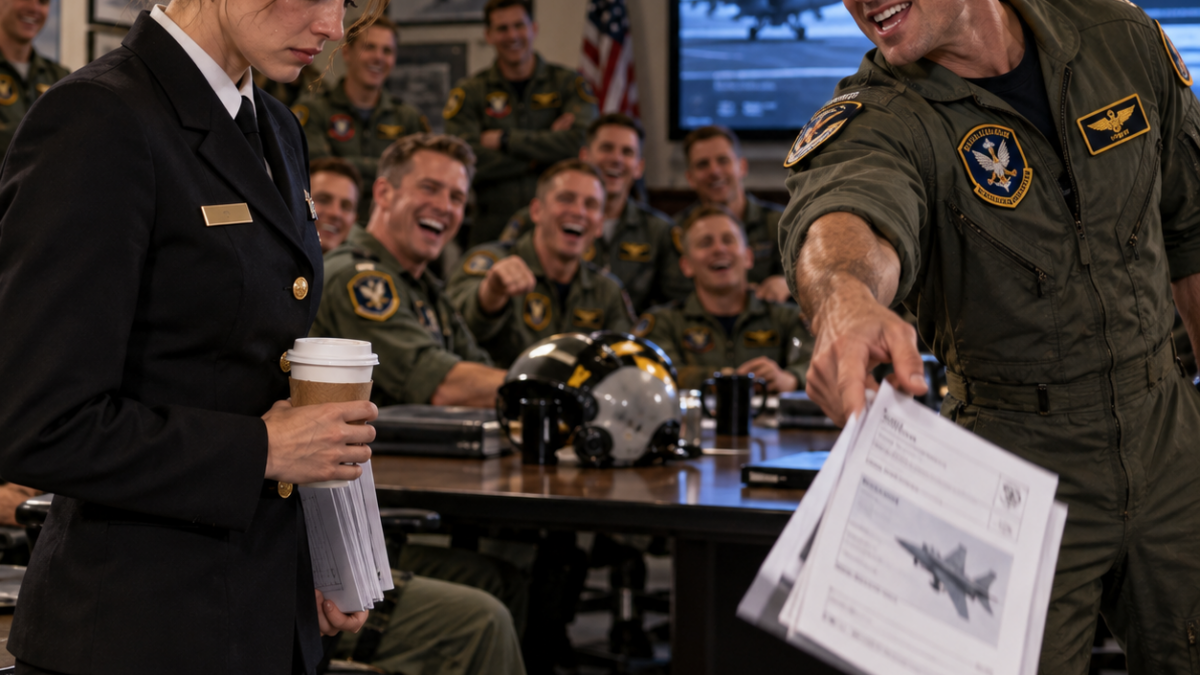
I brought the report to the briefing room.
Thirty aviators.
Rourke read the first page.
Then smiled.
“You really don’t know when to quit.”
“Sir, visibility is deteriorating faster than forecast.”
“I’m aware of weather.”
“Then you know the recovery window is narrowing.”
He leaned against the table.
“Let me explain something, Rowan.”
“Admirals don’t promote officers because a desk jockey got nervous about fog.”
A few pilots laughed.
Luke didn’t.
Neither did Baird, who was standing near the back.
I said:
“Sir, I want my objection entered into the flight-risk record.”
Rourke’s smile disappeared.
“Are you threatening me?”
“No, sir.”
“I’m documenting a safety concern.”
He stared.
Then shoved the report across the table.
“If you haven’t earned your wings, Lieutenant, maybe stop pretending you know how to fly.”
A few more smiles.
My coffee trembled in my hand.
I hated that.
Rourke noticed.
Mistook it for intimidation.
“Anything else?”
he asked.
I looked at the trash can.
Then him.
“Yes, sir.”
He leaned back, amused.
“Next time you lecture combat pilots, try spending a few hours in a cockpit first.”
I picked up my report.
Turned toward the door.
Then saw his laptop.
The electronic risk-assessment form was open.
The approval section highlighted.
He was changing something.
I couldn’t read the full text from where I stood.
But I saw the field.
Safety concurrence.
Then a dropdown.
Then my name.
I kept walking.
Back in my office, I submitted my warning through the official safety system.
Timestamp.
Attachments.
Updated weather.
Alternate-airfield analysis.
My recommendation.
Then I saved a copy outside the local squadron folder.
Not because I expected sabotage.
Because aviation investigations teach you one thing quickly.
Memory becomes very creative after something goes wrong.
At 6:38 p.m., my objection became part of the official record.
At 6:45, Commander Sloane called me.
“Elise.”
“Yes, ma’am?”
“I read it.”
“Good.”
“Rourke says conditions remain within limits.”
“At launch.”
“I’m concerned about recovery.”
“How confident?”
“High enough to move the divert decision earlier.”
Silence.
Then:
“I’ll talk to him.”
At 7:02, Rourke appeared in my doorway.
He closed it.
“You went around me.”
“I filed a safety report.”
“You contacted Sloane.”
“She contacted me.”
“Because you filed.”
“Yes.”
He stepped closer.
“You understand what tomorrow is.”
“An admiral inspection.”
“You understand what this exercise means.”
“Yes.”
“Then why are you trying to sabotage it?”
“I’m not.”
“You’re nervous.”
“I’m concerned.”
“Same thing.”
“No.”
Rourke smiled without humor.
“You know what your problem is?”
“I’m sure you’ll tell me.”
“You think caution equals competence.”
“And you think confidence equals immunity.”
His eyes hardened.
“Careful.”
I looked at him.
“That’s literally my assignment.”
He left.
At 7:14, the four Super Hornets taxied.
Luke flew in the second section.
Before he climbed into the jet, he saw me near operations.
Raised two fingers.
Our little signal.
Eyes inside.
I returned it.
Then watched his aircraft disappear into darkness.
Something cold settled beneath my ribs.
I went inside operations.
Lieutenant Simone Hayes was duty officer.
Thirty.
Sharp.
Practical.
She saw me take a chair near the back.
“Long night?”
“Probably.”
She gave me a spare headset.
Outside, fog thickened.
At 7:46, visibility dropped.
At 8:02, another observation came in.
Worse.
At 8:11, runway visual range fell again.
Simone read the report.
Then looked over at me.
“You called this.”
“I read the trend.”
“Same thing tonight.”
Rourke entered.
“Status?”
Simone answered.
“Vandal flight completing profile.”
“Recovery conditions deteriorating.”
“I recommend making the divert call now.”
Rourke looked toward me.
“Whose recommendation?”
“Mine.”
Simone answered.
Good.
Rourke walked toward the display.
“We’re still above minimums.”
“For now.”
“Then we continue.”
Simone said:
“They’ll have less fuel later.”
“They have reserves.”
“Reserves aren’t mission fuel.”
Rourke turned.
“Lieutenant Hayes, I understand aviation fuel planning.”
She stopped.
Not because she agreed.
Because the chain of command was still functioning.
For now.
At 8:24, Vandal flight completed the final training event.
One-One.
One-Two.
One-Three.
One-Four.
Luke was One-Three.
Simone transmitted:
“Vandal flight, be advised Lemoore weather continues deteriorating.”
Rourke added:
“Continue planned recovery.”
I looked at him.
“Sir.”
He didn’t turn.
“Divert now.”
“No.”
“Edwards remains clear.”
“That’s excessive.”
“They have comfortable fuel now.”
“They may not after multiple approaches.”
He finally looked at me.
“No wings.”
“Remember?”
I said nothing.
Simone did.
“Sir, if they miss twice, the alternate margin gets ugly.”
“They won’t.”
That sentence frightened me.
Not:
Probability is acceptable.
Not:
Weather supports approach.
They won’t.
Certainty without evidence.
The first aircraft began the approach.
Vandal One-One descended toward Lemoore.
Fog thickened below.
We heard the call.
“Unable visual.”
Then:
“Going missed.”
Simone marked the fuel board.
One-Two tried next.
Same result.
“Unable.”
“Going missed.”
The room changed.
Not panic.
Attention.
Fuel numbers suddenly mattered more.
Rourke stared at the weather display.
Simone said:
“Divert.”
He shook his head.
“One more.”
I stood.
“No.”
Every head turned.
Rourke looked at me.
“Sit down.”
“No.”
“Lieutenant—”
“You are about to spend fuel you cannot get back for an approach the last two jets could not complete.”
His face reddened.
“This is not your flight.”
“No.”
“But the numbers are.”
Before he could answer, Luke’s voice came over the radio.
“Approach, Vandal One-Three.”
His breathing sounded wrong.
I knew it immediately.
Too fast.
Too controlled.
Trying not to sound afraid.
Simone answered.
“One-Three, say issue.”
Pause.
“My body says I’m banking left.”
The room disappeared.
For half a second, I wasn’t at Lemoore.
I was back in the storm.
Daniel.
Falcon.
I can’t tell which way is up.
Luke continued.
“Instruments show level.”
Rourke reached for the microphone.
“Bennett, stop overthinking.”
“Fly the approach.”
I moved before thinking.
“No.”
He turned.
“Sit down.”
Luke’s breathing came through the headset.
Fast.
I looked at Simone.
“Tell him eyes inside.”
Rourke snapped:
“Do not interfere.”
Simone looked at me.
Then him.
Then keyed the radio.
“Vandal One-Three.”
“Eyes inside.”
“Trust your attitude indicator.”
“One instrument.”
“One correction.”
“One breath.”
Silence.
Then Luke:
“Copy.”
“One instrument.”
My hands were shaking now.
Not because of Rourke.
Because I had heard those same sounds once before and failed to bring someone home.
Simone continued:
“One-Three, discontinue approach.”
“Climb and maintain.”
“Prepare divert.”
Rourke stared at her.
“I did not authorize that.”
She looked at him.
“I’m duty officer.”
“I’m not sending a spatially disoriented pilot into a third attempt.”
Rourke’s face hardened.
Then One-Four reported a fuel imbalance indication.
Not catastrophic.
Manageable.
But now we had:
Two missed approaches.
One disoriented pilot.
One aircraft with a system issue.
Worsening fog.
Shrinking fuel.
The decision had made itself.
Except Rourke still would not accept it.
“One more attempt by lead.”
I stared at him.
“Why?”
He looked at me.
“Because I said so.”
“That isn’t an operational reason.”
Every person in the room went still.
He stepped closer.
“You do not get to question my authority.”
“I’m questioning the decision.”
“There is a difference.”
His hand moved toward the laptop.
That was when I saw it clearly.
The electronic risk form.
The safety approval block.
My name.
LT ELISE ROWAN
Below it:
SAFETY REVIEWED — OPERATION ACCEPTABLE
My blood went cold.
“What is that?”
Rourke snapped the laptop partially closed.
“Get away from my workstation.”
“That’s my name.”
“You reviewed the mission.”
“I objected.”
“You reviewed it.”
“That is not approval.”
Simone looked over.
“What is she talking about?”
I pointed.
“He changed the concurrence block.”
Rourke said:
“She’s confused.”
I pulled out my phone.
Opened the timestamped submission.
6:38.
Recommend delay or earlier mandatory diversion due accelerating deterioration in recovery conditions.
“That’s my record.”
Rourke’s face changed.
Then Luke’s voice came through again.
“Approach.”
“My vestibular symptoms are returning.”
Everything else stopped mattering.
I went to the alternate coordination console.
Simone had already opened the Edwards line.
I called.
“Edwards operations, NAS Lemoore safety.”
“Four Navy F/A-18s requesting immediate divert.”
“Deteriorating home-field weather.”
“One pilot spatially disoriented.”
“One aircraft reporting secondary system concern.”
Rourke grabbed my shoulder.
“Hang up.”
I turned slowly.
“Take your hand off me.”
He did.
Not because I frightened him.
Because everyone else was watching.
Edwards answered.
“Four accepted.”
“Runway available.”
“Weather clear.”
I looked at Simone.
She keyed:
“Vandal flight, divert Edwards.”
One-One responded immediately.
“Copy Edwards.”
No argument.
No hesitation.
Pilots in the aircraft understood the situation better than the man protecting tomorrow’s inspection.
Rourke said:
“I did not authorize—”
Simone looked at him.
“They’re already turning.”
Luke’s symptoms worsened during the turn.
“Lemoore, One-Three.”
“I’m getting the leans again.”
His lead moved closer.
Tried giving formation cues.
Luke’s breathing accelerated.
I took the spare microphone.
Stopped.
I wasn’t controlling agency.
I looked at Simone.
“May I?”
She nodded.
“Advisory.”
I keyed.
“Vandal One-Three.”
“This is Rowan.”
Silence.
Then:
“Ma’am?”
“Remember the parking lot.”
His breathing hitched.
“One instrument.”
“One correction.”
“One breath.”
“Tell me attitude.”
“Wings level.”
“Altitude?”
“Maintaining.”
“Vertical velocity?”
“Near zero.”
“What does your body say?”
“That I’m descending and turning.”
“Then your body is wrong.”
Pause.
“Trust the jet.”
“Copy.”
I heard him breathe.
Once.
Twice.
Slower.
“Trust the jet.”
“Yes.”
His lead stayed nearby.
Talked him through the next several minutes.
The farther east they went, the better the weather became.
The desert opened.
Stars returned.
Fuel remained sufficient.
One-One landed at Edwards.
Then One-Two.
One-Four.
We waited for Luke.
At 9:37, the radio transmitted:
“Vandal One-Three safe on deck.”
Nobody cheered.
The relief was too deep for noise.
Simone sat back.
Baird, who had arrived during the diversion, let out a breath.
I closed my eyes.
Daniel.
Not this time.
I opened them.
Rourke was at the laptop.
Closing windows.
Deleting?
Editing?
I moved.
“Don’t.”
He looked up.
“Excuse me?”
“Do not alter that file.”
“This is my workstation.”
“It contains my name.”
“I’m ordering you to step away.”
I looked at Simone.
“Preserve the console.”
Rourke laughed.
“You have no authority to order that.”
“No.”
“But Commander Sloane does.”
I called her.
She answered immediately.
“Elise?”
“The aircraft are safe.”
“I know.”
“Good.”
“Now I need you to preserve Lieutenant Commander Rourke’s workstation.”
Silence.
Then:
“Why?”
“He entered my name as safety concurrence after I filed a written objection.”
Rourke raised his voice.
“That is false.”
Sloane heard.
“Grant.”
He stopped.
“Ma’am—”
“Do not touch the computer.”
“This is being misunderstood.”
“Step away.”
His face went rigid.
But he did.
I sat down.
Only then did I notice my hands.
Shaking badly.
Baird brought coffee.
Fresh.
He set it beside me.
“Ma’am.”
“Chief.”
“You okay?”
“Yes.”
“Terrible liar.”
I almost smiled.
Then he looked toward Rourke.
“Is this where everybody learns you’ve been hiding something?”
“No.”
“Shame.”
At 10:18, Commander Sloane returned to the squadron.
With her came Lieutenant Commander Priya Shah from wing safety and a legal officer.
Sloane walked straight to operations.
Rourke started speaking.
“Commander—”
She held up one hand.
“No.”
Then to Simone:
“Duty log.”
Simone handed it over.
Sloane looked at Shah.
“Image the workstation.”
Rourke’s face hardened.
“This is unnecessary.”
Sloane looked at him.
“You entered Lieutenant Rowan’s name into a safety approval field after she submitted an official objection?”
“No.”
“So the audit will clear you.”
He said nothing.
Shah connected forensic equipment.
Rourke pointed toward me.
“She has been undermining this exercise from the beginning.”
Sloane looked at me.
“Elise?”
“I recommended delay or earlier diversion.”
“Documented?”
“At 1838.”
“Did you ever approve continued recovery into Lemoore?”
“No.”
“Did you authorize your name to be entered as approval?”
“No.”
Rourke laughed.
“This is absurd.”
“This woman has never even flown a Hornet.”
The room went silent.
Sloane looked at him.
Then at me.
I knew the question behind her eyes.
My record remained restricted.
My qualifications were not imaginary.
But my previous assignment details were still protected.
I said:
“Ma’am, my flight history is irrelevant to whether he falsified a document.”
Sloane nodded.
“Correct.”
That should have ended it.
Rourke could not stop.
“That is exactly the problem.”
“She walks around here acting like she knows more than pilots.”
Baird muttered:
“Sir.”
Rourke turned.
“What?”
“Maybe stop digging.”
Rourke stared.
Baird continued.
“I’ve watched Lieutenant Rowan catch maintenance-sequence errors most line pilots wouldn’t notice.”
“She talked Bennett through vestibular disorientation like she’d been there.”
“Maybe the issue isn’t what she knows.”
“Maybe it’s what you assumed.”
Rourke looked back at me.
“What are you hiding?”
“Nothing relevant to tonight.”
“Take off the mystery act.”
“This is a fighter squadron.”
“You don’t get to pretend you’ve done things you haven’t.”
Footsteps sounded in the corridor.
Then Rear Admiral Marcus Vale entered operations.
A day early.
Technically, eleven hours early.
His inspection team had advanced travel because weather threatened the next morning.
Nobody had expected him.
Rourke straightened.
“Admiral.”
Vale looked around.
“What happened?”
Sloane answered.
“Four-aircraft training flight diverted to Edwards after recovery weather deteriorated.”
“One pilot experienced spatial disorientation.”
“All aircraft safe.”
“Possible falsification of flight-risk documentation under investigation.”
Vale’s eyes sharpened.
“Whose documentation?”
Sloane looked toward Rourke’s computer.
“Lieutenant Commander Rourke’s.”
Rourke stepped forward.
“Sir, Lieutenant Rowan is creating confusion around a clerical change.”
Vale looked at me.
Then stopped.
“Elise?”
Rourke frowned.
I stood.
“Admiral.”
Vale looked at my uniform.
The empty space where my wings would normally sit.
Then back at me.
“I heard you requested a low-profile assignment.”
“Yes, sir.”
“I didn’t realize low-profile meant invisible.”
Nobody moved.
Rourke looked between us.
“Sir?”
Vale ignored him.
“How long since you flew?”
“Two years, eight months.”
“How long since Kerr?”
“Same.”
The name changed the room for the senior people.
Daniel Kerr had existed in restricted mishap records.
Vale had participated in part of the review.
Rourke said:
“I’m sorry, Admiral.”
“What exactly are we discussing?”
Vale turned.
“You told me Lieutenant Rowan has never flown?”
Rourke hesitated.
“I assumed.”
“You assumed.”
“Yes, sir.”
Vale looked at Sloane.
“Her record still compartmented?”
“Portions.”
“Then portions remain compartmented.”
He looked around the room.
“But there is nothing restricted about the fact that Lieutenant Rowan is a designated naval aviator.”
Rourke’s face went pale.
Vale continued.
“She flew Super Hornets.”
Silence.
Then:
“She also flew combat deployments.”
Rourke looked at my chest.
Then at my face.
“How many hours?”
he asked automatically.
Vale gave him a cold look.
“Enough that telling her to spend a few hours in a cockpit was an unfortunate choice.”
Nobody laughed.
That made the humiliation worse.
Vale looked toward the computer.
“Did you falsify her approval?”
“No, sir.”
“Excellent.”
“Then the forensic audit will establish that.”
Rourke stopped speaking.
That night, his flight-scheduling authority was suspended.
Not because I was secretly a combat aviator.
Because of the document.
That distinction mattered to me.
I went home after midnight.
My apartment was silent.
I opened the drawer in my bedroom.
The wings were still there.
Gold.
Small.
Harmless.
I stared at them.
Then closed the drawer again.
Not yet.
The next morning, Luke returned from Edwards.
I avoided him.
Cowardly.
Yes.
I didn’t want to hear his voice in person because I was afraid Daniel’s memory would collapse over it.
At 1:20, someone knocked on my office door.
Luke.
Flight suit.
Helmet bag.
He shut the door.
“You flew Hornets.”
“Yes.”
“A lot?”
“Yes.”
“Combat?”
“Yes.”
He stared.
“Why didn’t you tell me?”
I looked at him.
“Would it have changed the advice I gave you?”
He thought.
“No.”
“Then you didn’t need it.”
He sat.
“My body was screaming that I was banking.”
“I know.”
“I corrected toward the sensation once.”
“Then the warning came.”
“I almost did it again.”
I swallowed.
“But you didn’t.”
“Because I heard you.”
“One instrument.”
“One correction.”
“One breath.”
I nodded.
He looked at me carefully.
“Did that happen to you?”
Not exactly.
“My wingman.”
Luke’s face changed.
“He died?”
“Yes.”
“Spatial disorientation?”
“Contributing factor.”
He looked down.
“I’m sorry.”
“Thank you.”
Then:
“Rourke called me weak after the first incident.”
My anger returned.
Clean.
Focused.
“Write that down.”
Luke looked up.
“What?”
“Document it.”
“Why?”
“Because safety culture doesn’t fail when pilots become afraid.”
“It fails when pilots become afraid to admit they’re afraid.”
He nodded.
That afternoon, Luke submitted a statement.
So did Simone.
Baird.
Three pilots from the briefing room.
The forensic audit of Rourke’s workstation came back two days later.
It was worse than I expected.
At 6:31 p.m., the electronic risk form listed Rourke as approving officer.
At 6:38, my objection entered the official safety system.
At 6:52, Commander Sloane called Rourke.
At 7:05, he reopened the risk form.
At 7:09, he changed the safety-review name to mine.
At 7:11, he copied language from an earlier draft stating conditions remained acceptable.
At 7:13, he saved it.
One minute before the aircraft began taxiing.
Later, while the jets were returning, he added:
Safety liaison concurred with continued operations.
I hadn’t.
Not verbally.
Not electronically.
Not accidentally.
It wasn’t a clerical mistake.
He was building protection.
If the exercise ended successfully, nobody would care.
If something went wrong, there would be a record showing the safety officer had concurred.
My empty uniform made me convenient.
A quiet lieutenant.
No visible wings.
Someone easy to describe later as inexperienced.
Nervous.
Confused.
Overwhelmed.
The discovery hurt more than his insults.
Rourke hadn’t merely dismissed me.
He had planned to use me.
Then investigators uncovered another incident.
Two years earlier, he had modified wording in a maintenance-risk entry after a training abort.
No crash.
No casualty.
The matter went nowhere.
A year later, he had pressured a junior officer to soften a bird-strike report after ignoring repeated wildlife warnings.
Again, nothing catastrophic happened.
That was the problem.
Nothing happened.
So the behavior felt validated.
He learned that records could be cleaned after decisions.
That junior people could be pressured.
That outcome mattered more than process.
That if everyone landed safely, nobody wanted to fight about what almost happened.
Until our night.
Until four aircraft came home by turning away from his plan.
Until the system log preserved what he had changed.
Until I had a timestamp.
The investigation lasted months.
During that time, my hidden flight history became squadron gossip.
I hated it.
People who had ignored me suddenly wanted stories.
“How many combat sorties?”
“What did you fly overseas?”
“Were you really on that classified detachment?”
I answered almost nothing.
Credentials shouldn’t become a substitute for evidence.
That was the trap.
If the story became:
Rourke was wrong because Elise secretly had more flight experience than he did—
then everyone missed the point.
He would have been wrong even if I’d never touched a flight stick.
Weather data doesn’t become true because the person holding it is impressive.
Luke’s symptoms didn’t become real because I had experienced combat.
The fuel numbers did not care about my call sign.
So at the first safety stand-down after the incident, I walked to the podium wearing my wings for the first time at Lemoore.
The room went quiet.
One hundred twenty pilots, maintainers, and support personnel.
I waited until the whispers stopped.
Then said:
“If this piece of metal changes whether you believe the weather report I gave that night, we still have a problem.”
Nobody moved.
“Experience matters.”
“Credentials matter.”
“Training matters.”
“But evidence still has to survive without them.”
“If a twenty-year-old maintainer says a fitting looks wrong, inspect the fitting.”
“If a junior pilot says he is disoriented, listen.”
“If a weather observer tells you the trend is deteriorating, read the trend.”
“If a safety lieutenant tells you your fuel margin is shrinking, ask for the numbers.”
“Do not throw information away because you don’t respect the person carrying it.”
I looked toward Luke.
He sat in the third row.
Then I said:
“Fear is data.”
“Not a verdict.”
That line stayed with the squadron longer than I expected.
Baird had it printed on a coffee mug.
He put it on my desk.
FEAR IS DATA, NOT A VERDICT
I stared.
“This is terrible.”
“You’re welcome.”
“I hate motivational mugs.”
“I know.”
“That’s why I bought it.”
He walked away.
I kept it.
Rourke’s hearing occurred four months after the flight.
I testified.
He wore dress uniform.
Wings.
Ribbons.
Perfect posture.
None of it mattered.
The board reviewed my original report.
The system logs.
The altered risk assessment.
Weather records.
Fuel data.
Witness statements.
Luke’s statement about being mocked after reporting disorientation.
Rourke’s attorney tried to frame the issue as high-pressure command judgment.
Some of it was.
Commanders make hard calls.
Sometimes wrong calls.
Wrong isn’t automatically dishonest.
The signature changed everything.
One board member asked:
“Lieutenant Commander Rourke, did you believe Lieutenant Rowan’s safety recommendation was valid?”
“No.”
“Did you believe she approved continued operation?”
“I believed her participation in the planning process constituted review.”
“That was not the question.”
Rourke paused.
“No.”
“Then why did you enter her name into the concurrence field?”
Silence.
The board member waited.
Rourke finally said:
“I believed the form needed a safety-review name.”
“Why not yours?”
No answer.
That was the case.
Not fog.
Not my wings.
Not even his poor decision.
The attempt to rewrite accountability.
Rourke lost his executive-officer position.
His promotion recommendation disappeared.
Flight status was suspended during adjudication.
He was later reassigned and eventually separated from active service.
He wasn’t hauled off in handcuffs.
No dramatic prison sentence.
Real military accountability is usually less cinematic.
But losing command prospects for a man like Grant Rourke was not small.
I expected satisfaction.
Instead, I mostly felt tired.
A few weeks after the hearing, an email arrived.
From him.
Subject line blank.
I almost deleted it.
Then opened.
Rowan,
I believed you were trying to make me look weak in front of Vale.
You were not.
I kept reading.
I was more concerned with what a diverted exercise would look like than with why you were asking me to divert it.
Then:
Changing the authorization was indefensible. At the time, I told myself you had reviewed the plan and that I was correcting a technical omission. That was a lie I used because the real record frightened me.
I read that sentence twice.
Then:
I also understand now why Bennett did not report his first disorientation event through me. I created that.
I am sorry.
I waited three days before answering.
Then wrote:
Thank you for saying it plainly.
Wherever you work next, I hope the people beneath you can bring you bad news without fearing you more than the problem.
—Elise
He replied once.
Me too.
That was all.
Luke stayed in the Navy.
He became an excellent pilot.
Not fearless.
Better than fearless.
He learned not to confuse fear with incompetence.
Two years later, he became an instructor.
I once overheard him talking to a younger aviator after a simulator session.
The student had become disoriented.
Embarrassed.
Luke said:
“Your inner ear is not a certified flight instrument.”
I stopped in the hallway.
Then:
“When it happens, make your world smaller.”
“One instrument.”
“One correction.”
“One breath.”
I walked away before he saw me.
Not because I was sad.
Because hearing your words become someone else’s tool is a strange kind of grace.
Daniel never got to teach that lesson.
Luke did.
I had to be careful with that thought.
Daniel did not die so Luke could survive.
That is not how loss works.
One tragedy does not become meaningful simply because someone later learns from it.
Daniel died because weather, human physiology, mission pressure, and circumstance aligned badly enough to take him from us.
Luke survived because he had altitude, instruments, fuel, support, training, and enough time to trust what the aircraft was telling him.
Different men.
Different night.
Different outcome.
I eventually learned to let those truths remain separate.
Rear Admiral Vale called me to his office several weeks after the hearing.
He had my personnel file on the desk.
“Elise.”
“Sir.”
“Why aren’t you wearing your wings regularly?”
I looked at him.
“You know why.”
“I know why you stopped.”
“That isn’t what I asked.”
I looked toward the window.
Hornets taxied in the distance.
“I don’t need them for my assignment.”
“Not the answer.”
I stayed quiet.
Vale opened the file.
Flight hours.
Combat sorties.
Carrier qualifications.
Instructor evaluations.
A life I had tried to compress into a locked drawer.
He said:
“Daniel Kerr died.”
“I know.”
“You did not kill him.”
“I know.”
“Do you?”
I hated that question.
“Yes.”
Vale studied me.
“You can know something intellectually and still punish yourself as if it isn’t true.”
I looked at him.
“You become a therapist while I was away?”
“No.”
“Therapists have better hours.”
Then he slid the folder toward me.
“I’m not ordering you back into operational flying.”
“Good.”
“I am telling you to stop using grief as a reason to erase eleven years of your own life.”
I didn’t answer.
He continued.
“This squadron has young pilots afraid to report human-factors problems because somebody taught them fear equals weakness.”
“You understand both the cockpit and safety system.”
“Teach.”
“What?”
“Judgment.”
“That isn’t a syllabus.”
“It will be when you write one.”
I almost smiled.
“I’ll think about it.”
“You’ll do it.”
“That sounds less optional.”
“I’m an admiral.”
“Optionality decreases near stars.”
I laughed despite myself.
Six months later, I flew again.
Not combat.
Not deployment.
A proficiency flight in a two-seat Super Hornet.
Luke volunteered to fly front seat.
Baird inspected the aircraft personally.
Then came into my office.
“Jet’s good.”
“I didn’t ask.”
“Fuel’s good.”
“Chief.”
“Weather’s good.”
“I can have you removed.”
“Everyone likes me better.”
Unfortunately true.
I stood beside the aircraft that morning wearing a flight suit for the first time in nearly three years.
My body remembered everything.
Ladder.
Harness.
Helmet.
Checklist.
Smell.
Noise.
The cockpit closing around you.
I sat in the rear seat.
For several seconds, I couldn’t get a full breath.
Luke came over the intercom.
“You okay?”
I almost lied.
Then stopped.
“Afraid.”
Pause.
Then:
“Good.”
I laughed.
“Fear is data.”
“I hate you.”
“Not a verdict.”
“Start the aircraft.”
The engines came alive.
Vibration moved through me.
We taxied.
Then launched.
California dropped away.
Fields.
Canals.
Roads.
The Central Valley wide and flat beneath us.
We climbed above scattered cloud.
Luke gave me control.
“Your jet.”
Those words almost broke me.
I placed my hand on the stick.
“Mine.”
I banked left.
Gentle.
Then right.
Nothing dramatic.
No hero moment.
Just flight.
For the first time since Daniel died, the cockpit felt like something other than the place where I had failed to save him.
Then we entered a thin cloud layer.
White filled the canopy.
No horizon.
My inner ear whispered.
Turning.
More than you are.
My heart accelerated.
Daniel.
Then Luke.
Then my own voice.
Eyes inside.
Attitude indicator.
Wings nearly level.
Altitude stable.
One instrument.
One correction.
One breath.
The sensation faded.
We climbed into sunlight.
Luke said nothing.
Good pilot.
When we landed, Baird waited near the line shack.
“Well?”
I climbed down.
“My coffee is still better than yours.”
He grinned.
“Welcome back, ma’am.”
I never returned to full-time operational flying.
Didn’t want to.
That flight wasn’t a career reversal.
It was permission.
The cockpit no longer belonged exclusively to Daniel’s death.
It also belonged to eleven years of my life.
Bad coffee.
Carrier nights.
Long ferry flights.
Combat sorties.
Arguments.
Laughter.
Friends.
Training.
Mistakes.
Skill.
One terrible loss had occupied all of it for too long.
I stayed in aviation safety.
Eventually promoted.
Commander Sloane moved to another assignment.
Vale retired.
Baird retired too.
His ceremony was held in a hangar because he claimed chapels made him nervous.
At the reception, he raised a glass.
“I knew Rowan was a pilot before the rest of you.”
Luke shouted:
“No, you didn’t.”
Baird said:
“I spiritually knew.”
Everyone laughed.
Then he became serious.
“I’ve spent thirty-five years around airplanes.”
“The best people aren’t the ones who never make mistakes.”
“They’re the people who notice something is wrong early enough to say it.”
He looked at me.
“To people who notice.”
That was all.
Perfect.
Because noticing had always been the center of it.
I noticed the weather trend.
Luke noticed his body disagreed with his instruments.
Simone noticed the fuel margin collapsing.
Baird noticed I knew more than my uniform suggested.
Sloane noticed the paperwork no longer matched reality.
The forensic audit noticed the timestamps.
Systems survive because people notice.
They fail when hierarchy teaches people not to say what they noticed.
Years later, I was asked to speak at an aviation mishap-prevention conference.
Military.
Civilian.
Maintenance.
Airline.
I hate speeches.
Still accepted.
I opened with a photograph of a trash can.
Nothing else.
Then said:
“A safety report has no feelings.”
“If you throw it away, it will not become offended.”
“It also does not become wrong.”
People smiled.
Then I talked about schedule pressure.
Promotion pressure.
Authority gradients.
Confirmation bias.
Normalization of deviance.
How organizations slowly learn that a shortcut is safe because nothing bad happened last time.
Rourke had modified records before.
Nothing catastrophic followed.
So the shortcut became easier.
Again.
Again.
Until the night four pilots were airborne in deteriorating weather and one of them could no longer trust his own body.
The most dangerous part of a safety system is not always the first mistake.
Sometimes it is the moment after the mistake when someone edits the record so the mistake looks reasonable.
After the talk, a commercial airline captain approached me.
Older man.
Gray hair.
He said:
“I changed a maintenance note once.”
I looked at him.
“Why?”
“To avoid a delay.”
“What happened?”
“Nothing.”
He paused.
“That was the problem.”
Exactly.
Nothing happened.
So the shortcut felt validated.
Until someday something does.
I began teaching a simple rule.
If someone challenges a decision, separate the message from the messenger.
Ask:
What exactly are they seeing?
What evidence supports it?
What happens if they’re right?
What happens if they’re wrong?
Do not ask first:
Who are they to challenge me?
That question nearly cost us four aircraft.
Luke eventually learned Daniel’s name.
Not from me.
An article about an old mishap referenced him.
Luke came into my office.
“Lark?”
I looked up.
“What?”
“Lieutenant Daniel Kerr.”
My stomach tightened.
“Yes.”
“He was your wingman.”
“Yes.”
Luke sat.
“I think about Lemoore a lot.”
“So do I.”
“I would’ve rolled.”
“You don’t know that.”
“I corrected toward the feeling once.”
“Then the warning snapped me out.”
“If Simone had sent me down another approach…”
He stopped.
I said:
“But she didn’t.”
“You talked me through it.”
“You used your training.”
“Because you told me what to focus on.”
“Luke.”
He looked at me.
“Do not turn your survival into repayment for Daniel’s death.”
He went quiet.
“Those things are not connected like that.”
“You survived because you made the next right decision.”
“Let that belong to you.”
He nodded.
That was something I had finally learned well enough to give away.
Years after Lemoore, a letter arrived from Oregon.
Grant Rourke.
He wrote that he was teaching risk management at a small civilian flight school.
That made me laugh.
Then I read the next paragraph.
The first thing I teach is that if an instructor punishes a student for admitting disorientation, he is training that student to hide the next emergency.
Then:
I learned that from you too late to protect the pilots I was responsible for that night, but not too late to stop teaching the wrong lesson.
He asked one question.
Is Bennett still flying?
I wrote back:
Yes.
Nothing else.
Enough.
I retired from active service after twenty-three years.
My final ceremony was small.
My mother came.
Luke came.
Baird arrived in a suit that didn’t fit.
Vale came retired, cheerful, and fifteen minutes late.
My wings were on my uniform.
So were the ribbons I had once avoided looking at.
Afterward, my mother touched the insignia above my pocket.
“You finally put them back.”
“Yes.”
“Your father would’ve said it took you too long.”
“He would’ve complained about parking first.”
“That too.”
Luke gave me a framed photograph.
Four Super Hornets lined up at Edwards on the night of the fog incident.
I had never seen it.
Some ground crewman had taken the picture after they landed.
Clear desert sky.
Four aircraft.
All intact.
On the back, Luke had written:
ONE INSTRUMENT. ONE CORRECTION. ONE BREATH.
Then:
ALL FOUR CAME HOME.
I didn’t cry until I reached my car.
Retirement didn’t remove aviation from me.
I still teach.
Consult.
Review mishap reports.
Turn down most speaking invitations.
Accept some.
I live near Monterey now.
Fog is common.
Of course.
The first winter there, I woke one morning to a world entirely white outside my window.
For one second, my chest tightened.
Then I made coffee.
Sat by the glass.
Listened to the quiet.
Fog no longer belonged to Daniel.
Or Luke.
Or Rourke.
It was weather.
Just weather.
That felt like freedom.
I still have the original safety report from Lemoore.
The one Rourke threw in the trash.
Coffee stain on one corner.
Paper slightly creased.
I kept it even though the digital record mattered more.
Sometimes before teaching, I read it.
It’s boring.
That’s what always makes me smile.
No prophecy.
No dramatic language.
No:
IF YOU IGNORE ME, PEOPLE WILL DIE.
Just:
Visibility deteriorating faster than forecast.
Recommend delay or earlier divert decision.
Preserve fuel margin.
Confirm alternates.
Boring.
Good safety is often boring before the event and obvious afterward.
Had Rourke listened immediately, nothing dramatic would’ve happened.
Four aircraft would have diverted early.
Maybe Vale would have asked why.
Rourke would have been annoyed.
Everyone would have slept.
No hearing.
No investigation.
No story.
That’s the strange problem with prevention.
Success often looks like nothing happened.
No accident report.
No family notification.
No wreckage.
No names on a memorial.
Just another ordinary morning.
That is what safety is supposed to produce.
Nothing.
Beautiful, uneventful nothing.
People occasionally ask if I regret not telling Rourke who I was the first time he mocked my missing wings.
No.
Maybe the easier story says I should have pinned them on, revealed my combat history, and watched him shut up.
But that would teach the wrong lesson.
Suppose I had never flown.
Suppose I really was a ground-assigned safety officer with weather data, risk analysis, and no cockpit experience.
Would the visibility trend have changed?
Would Luke’s disorientation have become less real?
Would fuel burn slower?
No.
Rourke wasn’t wrong because he underestimated a secretly experienced pilot.
He was wrong because he decided the value of evidence depended on the status of the person delivering it.
The wings made the reveal satisfying.
The records made the case.
That is the difference.
I also eventually understood why he chose my name for the falsified approval.
At first, I thought it was convenience.
I had reviewed the mission.
My role fit the block.
Later, during testimony, it became clear it was more than that.
He chose me because he believed I was weak enough to carry the blame.
No visible wings.
No squadron history.
Restricted personnel file.
Quiet.
New.
If the operation went badly, he could say:
The safety officer reviewed it.
She approved.
She became nervous afterward.
She misunderstood weather.
She wasn’t a pilot.
He already had the story prepared.
The timestamp destroyed it.
6:38 p.m.
Written objection.
Before launch.
That’s why I tell every junior officer I teach:
Document serious disagreement professionally.
Not because you are building a case against your commander.
Because emergencies change memory.
People remember themselves as more cautious.
More specific.
More reasonable.
A timestamp does not care about pride.
Neither does weather.
Neither does fuel.
Neither does gravity.
Physics is wonderfully disrespectful of hierarchy.
Admiral.
Ensign.
Instructor.
Student.
Everyone gets the same gravity.
I like that.
It makes certain things cleaner.
The photograph Luke gave me hangs in my study.
Below it, the old safety report.
Beside them, my wings.
Not locked away anymore.
Sometimes visitors ask about the four jets.
I usually say:
“Long night.”
If they want more, I tell them.
But I never begin with the hidden combat pilot.
I begin with fog.
A report.
A commander who didn’t want bad news.
A young aviator afraid to admit his inner ear was lying.
Because that is the story.
Not revenge.
Not humiliation.
Not the moment an admiral recognized me.
Four pilots were in the air.
A decision needed to change.
And the people in that room finally chose reality over pride.
Everything else came afterward.
The investigation.
The wings.
Rourke’s career.
My return to flying.
All of it.
The part that still matters most happened over California when Luke said:
“My body says I’m banking.”
And someone answered:
“Trust the instruments.”
That was the decision.
One instrument.
One correction.
One breath.
Years later, Luke visited me in Monterey with his wife and daughter.
His daughter was six.
She saw my wings in the display.
“Were you a pilot?”
“Yes.”
“Like Daddy?”
“Unfortunately.”
Luke said:
“Do not listen to her.”
His daughter pointed to a photograph of Daniel and me beside a Super Hornet.
“Who’s that?”
I looked at the picture.
“My friend Daniel.”
“Was he a pilot?”
“Yes.”
“Where is he?”
Children ask clean questions.
“He died a long time ago.”
She thought about it.
“Do you miss him?”
“Yes.”
She nodded.
Then saw a dog outside and ran away.
Luke stood beside me.
“She has no filter.”
“I like her.”
He looked at Daniel’s photograph.
“You still think about him when you talk to me?”
“Sometimes.”
“Does that bother you?”
“It used to.”
“And now?”
I looked at him.
“Now you’re Luke.”
He nodded.
That mattered.
I could tell.
I had spent years making sure his survival never became a debt to a dead man.
We went outside.
Fog was moving in from the ocean.
Luke looked toward it.
“Want to divert?”
I laughed.
“Immediately.”
We went to dinner.
By car.
Safer.
The older I get, the less interested I am in heroic stories.
Heroism usually arrives after too many smaller things have already failed.
I prefer the stories where somebody notices early.
Where someone says:
Stop.
Check.
Look again.
Where leaders listen before reality has to shout.
Rourke wanted tomorrow’s inspection to look perfect.
The weather didn’t care.
Luke wanted not to look weak.
His inner ear didn’t care.
I wanted to disappear into a ground assignment.
The facts didn’t care about that either.
Reality is rude.
That is one of its virtues.
It keeps asking the same question.
What is true right now?
Not:
What do you want to be true?
Not:
What helps your promotion?
Not:
What protects your reputation?
What is true?
At 6:38 p.m., the truth was that the fog was deteriorating faster than planned.
Later, the truth was that two approaches had already failed.
Then the truth was that one pilot was disoriented.
Then that fuel was shrinking.
Then that my name had been placed on a decision I had opposed.
Every fact narrowed the choices.
Rourke resisted until the facts became impossible to outrank.
I try to remember that whenever somebody brings me information I don’t like.
Especially if they’re younger.
Especially if they irritate me.
Especially if my first thought is:
They don’t understand.
Maybe they don’t.
Ask anyway.
Show me.
That’s the leadership lesson I took from Lemoore.
Not that subordinates are always right.
They’re not.
Not that commanders should hesitate forever.
They can’t.
But if somebody says the ground feels wrong, at least look down before ordering everyone forward.
The last time I saw Rourke in person was years after we had both left active operational service.
We were at an aviation safety conference in Denver.
I saw him across the hotel lobby.
Older.
Gray at the temples.
He saw me too.
For a second, we simply stood there.
Then he walked over.
“Elise.”
“Grant.”
No rank.
No sir.
He looked at the wings pin on my civilian conference badge.
A joke from Baird.
Then smiled.
“You’re wearing them now.”
“Sometimes.”
He nodded.
“How’s Bennett?”
“Instructor.”
“That figures.”
Then:
“I owe him an apology too.”
“You probably do.”
He looked toward the conference room.
“I use that night when I teach.”
“I know.”
“You read the letter.”
“Yes.”
He hesitated.
“Do you hate me?”
I thought about it.
“No.”
He looked relieved.
Then I added:
“I was furious for a long time.”
“Fair.”
“You could have killed people.”
“I know.”
“And you tried to put my name on the decision.”
His face tightened.
“I know.”
Then:
“But you admitted it eventually.”
“That matters.”
He looked down.
“I wish I’d admitted it before the hearing.”
“So do I.”
We stood quietly.
Then he said:
“I thought command meant never letting people see uncertainty.”
“That was stupid.”
“Yes.”
He laughed once.
Then:
“I teach the opposite now.”
“Good.”
Someone called my name from inside the ballroom.
Rourke held out his hand.
I shook it.
No dramatic forgiveness.
No friendship.
Just two people with a shared failure they had both chosen to carry differently.
As I walked away, he said:
“Elise.”
I turned.
“All four came home.”
I nodded.
“Yes.”
That was enough.
Today, when I teach younger aviators, I start with one sentence.
“Your job is not merely to obey the plan.”
That always wakes the room.
Then I continue.
“Your job is to understand the plan well enough to notice when reality stops matching it.”
Most orders are lawful.
Most commanders are trying to bring people home.
Most safety systems work.
But no system is improved by punishing the person who says:
Something changed.
If you are wrong, be wrong professionally.
State what you see.
State your confidence.
State your recommendation.
Then let the decision-maker decide.
But never let fear of someone’s ego become the reason you stay silent.
I stayed silent about many things when I arrived at Lemoore.
My past.
My wings.
Daniel.
The combat hours.
That silence was mine to choose.
But the weather wasn’t.
Luke’s symptoms weren’t.
The flight-risk record wasn’t.
There comes a point when quiet stops being privacy and becomes consent.
That night, I reached that point.
Rourke told me:
“No wings, no opinion.”
He was wrong.
Not because I secretly had wings.
Because evidence does not require permission from rank.
I kept the report he threw away.
I kept the coffee stain.
I kept the photograph of four jets at Edwards.
And I kept flying, eventually.
Not because I forgot Daniel.
Because I finally understood that remembering him did not require me to abandon everything we had both loved.
Sometimes, when the Monterey fog rolls in, I still think about the night at Lemoore.
Four jets turning east.
Luke’s voice.
Simone’s hand on the radio.
Baird watching.
Rourke standing beside a computer with my name in the wrong place.
Then the first landing call from Edwards.
One safe.
Then two.
Three.
Four.
People love the moment Vale walked in and recognized me.
They love the reveal.
The secret combat pilot.
The commander suddenly pale.
I understand why.
But that’s not the part I replay.
I replay four aircraft landing.
Because nothing that came afterward mattered more than that.
Not Rourke’s humiliation.
Not my record.
Not my hidden wings.
Not even my career.
Four people went home.
Four families never received the worst knock that can come to a door.
And if you work in aviation long enough, you learn that sometimes the greatest victory is simply the accident report that never has to be written.
That night, the fog won the argument before any of us did.
The only question was whether we would listen in time.
Eventually, we did.
All four came home.