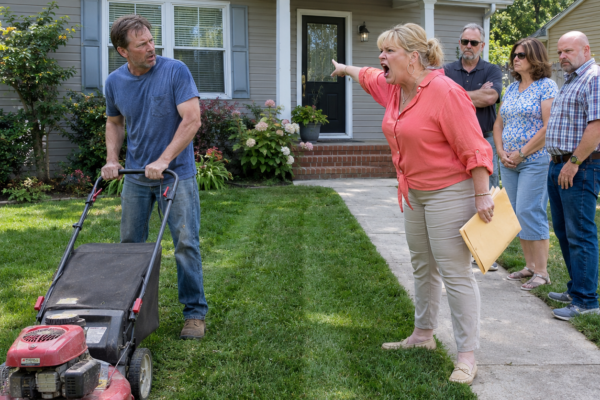
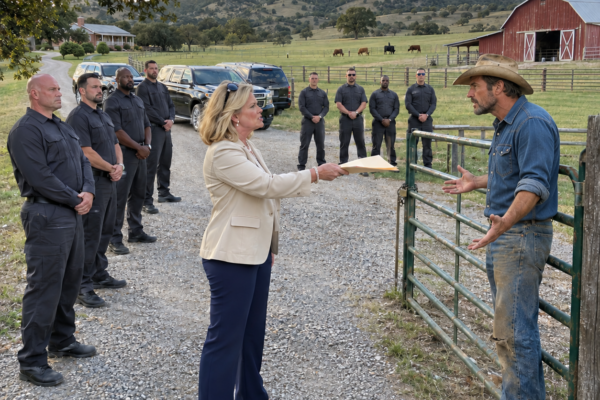
HOA Karen Called 911 on My Ranch Party—Then the Deputies Realized the “Armed Men” Were Police Officers
PART2
That was all.
Brenda looked toward Ryan.
“That man showed me his gun.”
Ryan stayed perfectly still.
The supervisor asked, “Did he point it at you?”
“I felt threatened.”
“That’s not what I asked.”
Brenda’s confidence faltered.
I looked upward.
Mounted above my ranch gate was a security camera.
It had recorded the entire confrontation.
Video.
Audio.
Everything.
I pointed toward it.
“That camera caught what happened.”
Brenda followed my finger.
Her eyes widened.
For the first time that afternoon, she looked genuinely afraid.
Not because anybody had threatened her.
Because reality had.
And that should have been the end of the strangest part of my ranch party.
It wasn’t even close.
Because while Brenda had every deputy at the front gate focused on her story about a dangerous armed gathering, one of my other ranch cameras sent an alert.
Someone had entered through a locked access point at the back of my property.
A dark pickup was moving toward my creek pasture.
Behind it was a utility trailer filled with orange survey stakes and metal signs.
And while Brenda stood at my front gate accusing police officers of being armed criminals, two men were quietly driving posts into my land.
One sign read:
MEADOW HILLS FUTURE EMERGENCY ACCESS.
That was the moment I realized Brenda’s 911 call might not be the biggest problem we had.
But to understand why an HOA president was standing outside my ranch telling sheriff’s deputies that a charity barbecue full of police officers was some kind of armed threat, you have to go back three weeks.
Back when the biggest problem in my life was whether I needed a new smoker.
My name is Jack Bennett.
I was fifty years old, and Bennett Creek Ranch covered about 640 acres outside a growing Oklahoma town.
My wife, Lisa, and I had lived there for twenty-seven years.
Our daughter Hannah was twenty-four and worked as a nurse in Tulsa.
Our son Tyler was twenty-two, studying agricultural business while helping me manage cattle.
The ranch had been in my family since the 1960s, when my grandfather bought the first hundred acres.
My father added more over the years.
So did I.
We raised cattle, cut hay, boarded several horses, and leased part of the western pasture during dry summers.
It wasn’t a glamorous ranch.
The house sat almost half a mile from the county road.
Behind it stood an old red barn.
Closer to the creek was a larger equipment barn.
The entrance sign had been painted by my father decades earlier.
BENNETT CREEK RANCH.
The letters had faded.
The wood had weathered.
I liked it that way.
Dad’s hand had painted those letters.
As far as I was concerned, faded paint was not damage.
It was history.
For most of my life, the ranch was quiet.
Then Meadow Hills Estates appeared along our southern boundary.
Nearly three hundred homes.
Clubhouse.
Pool.
Two parks.
Landscaped entrance.
Walking paths.
The usual HOA collection of rules about fencing, paint colors, parking, lawn care, decorations, and anything else people could argue about during a board meeting.
I had nothing against Meadow Hills.
Most residents were perfectly decent people.
Some bought beef from us.
A retired teacher named Helen Morris brought Lisa homemade bread every Christmas.
Kevin and Ashley Porter walked their dog along the public road and always waved.
We were neighbors.
That was fine.
Then Brenda Lawson became HOA president.
Brenda was fifty-five.
Confident.
Energetic.
Organized.
And capable of speaking to another adult as if she had already won an argument nobody else knew they were having.
She genuinely cared about Meadow Hills.
I’ll give her that.
The problem was that she eventually began caring about everything visible from Meadow Hills too.
Including my ranch.
Our first disagreement involved Dad’s sign.
I was repairing fence near the entrance one afternoon when Brenda stopped her white SUV.
She got out.
Looked at the sign.
Then at me.
“Jack, are you planning to replace that?”
I followed her gaze.
“The sign?”
“Yes.”
“No.”
She smiled.
“I mean eventually.”
“I mean no eventually.”
The smile weakened.
“It looks very weathered.”
“It is very weathered.”
“It’s right beside the Meadow Hills entrance corridor.”
“It’s beside my ranch gate.”
“That isn’t really the point.”
“From where I’m standing, it is exactly the point.”
She looked toward the faded letters again.
“It affects the visual character of the whole area.”
“My father painted that sign.”
“I understand sentimental attachment, but sometimes maintaining standards requires—”
“Brenda.”
She stopped.
“I’m not repainting it.”
She didn’t like the answer.
But she left.
I thought that was the end of the conversation.
Three weeks later, Meadow Hills’ management company mailed something called a COMMUNITY APPEARANCE COURTESY NOTICE.
It asked me to:
Repaint the ranch sign.
Trim two cedar trees.
Remove a horse trailer visible from the county road.
I called the management office.
A man named Paul Simmons answered.
“This is Jack Bennett.”
“Yes, Mr. Bennett?”
“I just got one of your HOA notices.”
He typed something.
Then paused.
“That’s strange.”
“Why?”
“You’re not listed as an HOA member.”
“That is exactly what I was hoping you’d discover.”
He apologized immediately.
Someone had added my mailing address during a compliance review.
He removed it.
Simple mistake.
No argument.
No anger.
Problem solved.
Three days later, Brenda drove thirty feet past my gate.
That was still thirty feet onto my land.
She climbed out holding another copy of the same notice.
“I heard you complained to management.”
“I corrected management.”
“You could make this easier.”
“For who?”
“The neighborhood.”
I looked south.
“You have almost three hundred houses. I have one ranch. I think the neighborhood survives my horse trailer.”
She sighed.
Then she noticed the camera mounted over my gate.
“Why do you have that?”
“Equipment disappears.”
“Does it record the road?”
“It records my entrance.”
She stared at the lens.
Something about her expression changed.
Only for a second.
Then she handed me the notice.
“I still think you should consider it.”
“I’ll put it somewhere safe.”
She left.
I put it in the trash.
The security camera was forgotten.
Until the day it saved us from a very serious lie.
The ranch party began as Daniel Brooks’ idea.
Daniel and I had been friends since high school.
He went into police work.
I stayed with cattle.
He eventually became a captain in a nearby city department.
I became the guy he called when he needed somebody to remind him he had once failed high-school algebra.
Every summer, Lisa and I held a barbecue.
Nothing huge.
Friends.
Family.
Neighbors.
People we had known forever.
That year, Daniel suggested turning it into a fundraiser.
One of his officers, Michael Torres, had been badly hurt in a highway crash while off duty.
Michael survived.
But his recovery was long.
His wife had two young children.
Travel to medical appointments was expensive.
He would be away from full duty for months.
Daniel wanted to help without making Michael feel like a charity project.
A private ranch fundraiser seemed perfect.
Food.
Music.
Raffle.
Donations.
No ticket price.
No speeches about how generous we were.
Just people showing up for somebody going through a hard year.
Lisa loved the idea.
Daniel invited officers from his department.
County deputies he knew.
State troopers.
Dispatchers.
Firefighters.
Retired officers.
Their families.
I invited ranch neighbors.
Lisa invited friends from church.
Tyler invited several classmates.
Hannah planned to drive down from Tulsa.
We expected around seventy people throughout the afternoon and evening.
Because parking could become a problem, I planned it carefully.
Everybody entered through the ranch gate.
Cars went into the hayfield west of the barn.
Nothing on the county road.
Nothing inside Meadow Hills.
Tyler would direct traffic.
Music would end around nine.
We moved speakers away from the neighborhood side.
I even called the sheriff’s department non-emergency number and told them we were hosting a fundraiser where several off-duty officers might be present and some could legally be carrying firearms.
Was I required to make that call?
No.
Did I feel better making it?
Yes.
Daniel laughed when I told him.
“You called the cops before inviting the cops?”
“I like paperwork.”
“No rancher has ever said that honestly.”
He had a point.
Then Brenda learned about the party.
Thursday afternoon, I was moving folding tables when her SUV appeared.
This time she stayed outside my gate.
Progress.
“What’s happening Saturday?”
“Barbecue.”
“How many people?”
“Not sure.”
“Is it private?”
“Yes.”
“Then why are there parking signs?”
“Because private guests still need to park.”
She frowned.
“Meadow Hills has its summer garden tour Saturday.”
“Okay.”
“Traffic could overlap.”
“Ours stays on the ranch.”
“Will there be music?”
“Yes.”
“How late?”
“Probably nine.”
Her expression tightened.
“Our quiet period begins at eight.”
“In Meadow Hills.”
“Sound travels.”
“So do birds.”
She ignored that.
Then she told me Meadow Hills rules prohibited large outdoor gatherings without event approval.
I reminded her again:
“My ranch is not inside Meadow Hills.”
“I know.”
Then she continued explaining HOA rules as if the previous sentence hadn’t happened.
That was Brenda’s specialty.
Acknowledge the fact.
Continue as though the fact didn’t matter.
I told her we would be respectful.
No fireworks.
No road parking.
Music controlled.
No reason for conflict.
Then she asked:
“Who’s coming?”
“Friends.”
“What kind of friends?”
I stared at her.
“The kind that eat brisket.”
She did not laugh.
Her attention shifted toward the barn.
Daniel and Officer Ryan Cooper were helping Tyler move chairs.
Both were off duty.
Jeans.
T-shirts.
Nothing about them screamed law enforcement.
Brenda watched.
“Those men work for you?”
“No.”
“Who are they?”
“Guests.”
She looked annoyed by the answer.
Then drove away.
Lisa came outside with lemonade.
“She is absolutely calling somebody Saturday.”
“Probably.”
“You worried?”
“No.”
“You should be.”
“Why?”
“You get sarcastic when you think you’re calm.”
“That makes no sense.”
“It makes perfect sense.”
Friday evening, a new letter arrived.
This one did not come from the management company.
Brenda had drafted it under the HOA board.
NOTICE OF EVENT CONCERN.
It claimed Meadow Hills had received reports that Bennett Creek Ranch intended to host:
A large unpermitted gathering.
Alcohol consumption.
Amplified sound.
Potentially dangerous activity.
I stopped at that phrase.
Potentially dangerous activity.
I called Paul Simmons.
“Did your company write this?”
“No.”
“Any complaints from residents?”
“Not that I know about.”
“Any reports of dangerous activity?”
“No.”
“Then where did this come from?”
“Brenda.”
Daniel came by that night.
I showed him.
“Should I cancel?”
He laughed.
“Because your HOA neighbor wrote a scary letter?”
“Not my HOA.”
“Exactly.”
Still, I tightened the plan.
Music farther from the south boundary.
Another parking volunteer.
No guests wandering toward Meadow Hills.
Anybody carrying a lawful personal firearm kept it properly holstered, concealed, or secured according to normal law and department policy.
Nobody needed weapons for the barbecue.
Some of the guests simply happened to be off-duty officers who routinely carried.
Saturday arrived warm and clear.
By noon, smoke from the smoker hung over the barn.
Brisket.
Ribs.
Lisa’s baked beans.
Children running through grass.
Older guests under shade tents.
Hannah and Tyler running the raffle.
Daniel arrived with his wife.
Ryan Cooper came with his brother.
Sergeant Anthony Reed brought what may have been the ugliest peach pie ever made.
It tasted excellent.
Retired Chief William Harper showed up wearing a cowboy hat so large that every officer who saw him immediately insulted it.
“You look like a sheriff from a children’s cartoon.”
William adjusted the hat.
“Respect your elders.”
“You retired specifically so we don’t have to.”
For several hours, the day was exactly what it was supposed to be.
Good food.
Old friends.
Children playing horseshoes.
People donating quietly.
By late afternoon we had raised nearly six thousand dollars.
Then Michael Torres arrived.
He was still using crutches.
His wife came with him.
Their children ran toward Daniel the second they saw him.
When Daniel handed Michael an envelope containing the first donations, Michael shook his head.
“No.”
“Yes.”
“I can’t take that.”
“Then consider it reimbursement.”
“For what?”
“All the terrible coffee you bought us.”
Michael laughed.
Then cried.
Daniel did too.
So did Michael’s wife.
Lisa walked away pretending she had something in her eye.
That moment was the reason everybody was there.
Not HOA drama.
Not property lines.
Not guns.
Not proving anybody wrong.
Helping one family breathe a little easier.
Around five, my ranch neighbor George Nolan found me.
“White SUV on the south shoulder.”
I already knew.
“Brenda?”
“Taking pictures.”
I walked toward the fence.
I stayed on my property.
She stayed on the public shoulder.
“You need something?”
She raised her phone.
“You have far more people than you told me.”
“I said I wasn’t sure.”
“There are armed men here.”
That got my attention.
“Who?”
“I saw guns.”
Then I understood.
Several off-duty officers carried legally.
Nothing strange.
Nothing aggressive.
“Brenda, nobody is threatening you.”
“I saw that man expose a handgun.”
She pointed.
Ryan.
He had adjusted his belt after helping move a cooler.
His shirt briefly lifted.
His holstered firearm became visible.
“You’re standing two hundred yards away photographing a private fundraiser.”
“There’s alcohol.”
“Some adults are drinking beer.”
“And guns.”
“Holstered firearms carried by people legally allowed to carry them.”
“I don’t feel safe.”
“Then go home.”
Her eyes narrowed.
“You don’t tell me what to do.”
“No. But I can ask you to stop bothering guests.”
She raised the phone toward me.
“Are you threatening me?”
“No.”
The camera above my gate recorded every word.
Thank God.
Brenda drove away.
Daniel approached.
“Problem?”
“Neighborhood president.”
“The sign woman?”
“That’s her.”
“She seems upset.”
“She noticed somebody carrying.”
Daniel frowned.
“Anyone draw?”
“No.”
“Touch their weapon?”
“No.”
“Approach her?”
“No.”
“Then she can be upset.”
We returned to the party.
Thirty peaceful minutes passed.
Then Tyler looked upward.
“Dad?”
“What?”
“Is that ours?”
A small drone hovered over the southern pasture.
“We don’t own a drone.”
It moved closer.
One state trooper looked up.
“That’s flying pretty low.”
Nobody touched it.
Nobody threw anything.
Nobody fired at it.
We watched.
Eventually it drifted back toward Meadow Hills.
Daniel said:
“Think that belongs to Brenda?”
“I think I’m planting taller trees.”
Ten minutes later, one of my guests received a text.
His wife lived in Meadow Hills.
Brenda had posted in the neighborhood group:
LARGE ARMED PARTY OCCURRING AT ADJACENT RANCH. PLEASE KEEP CHILDREN INSIDE WHILE HOA CONTACTS AUTHORITIES.
Daniel read it.
His expression hardened.
“That wording is bad.”
“Very.”
Before I called the management company, Tyler pointed toward the road.
Brenda was back.
She parked directly outside my entrance.
Got out.
Phone in hand.
I walked down.
Daniel came too.
“This event needs to end.”
“No.”
“I have residents frightened.”
“Then tell them nobody here is threatening anybody.”
“I saw armed men.”
Daniel spoke calmly.
“Ma’am, carrying a holstered firearm doesn’t automatically mean someone threatened you.”
She turned toward him.
“Who are you?”
“A guest.”
“Then stay out of this.”
Daniel nodded.
“Fair enough.”
Then stepped backward.
That somehow made her angrier.
She ordered me to shut off the music.
Clear the parking field.
End the party.
I refused.
Then Brenda stepped through my open gate.
“Stop.”
“I’m documenting violations.”
“You don’t have violations here.”
She kept walking.
“Leave my property.”
She stopped.
Then Ryan Cooper appeared from the parking field.
He was carrying two large bags of ice.
One in each arm.
As he adjusted them, his shirt lifted.
The grip of his holstered sidearm became visible.
Brenda froze.
Ryan kept walking.
He did not approach her.
Did not reach toward the weapon.
Did not even seem to realize she had seen it.
Then Brenda screamed.
“HE HAS A GUN!”
Everybody turned.
Ryan stopped instantly.
Hands still holding the ice.
Daniel said:
“Ma’am, nobody is threatening you.”
Brenda backed toward the road.
“I’m calling 911!”
I said:
“Go ahead.”
That might have been my biggest mistake of the afternoon.
Not because we had done anything illegal.
Because I underestimated what she was willing to tell dispatch.
She returned to her SUV.
Called.
The gate microphone picked up her side.
At first:
Large party.
Alcohol.
Armed men.
Then:
Aggressive guests.
Threats.
Daniel and I looked at each other.
None of that had happened.
Then she looked toward Ryan and said:
“One of them showed me his gun.”
Daniel’s expression changed.
“That didn’t happen.”
“No.”
Then Brenda listened.
Apparently dispatch asked a question.
She answered:
“Yes. He pointed it at me.”
Daniel immediately pulled out his phone.
The situation had just crossed a very serious line.
He called county dispatch directly.
“This is Captain Daniel Brooks. I’m off duty at Bennett Creek Ranch. You may have a weapons call coming in. There is no active threat. Multiple off-duty law enforcement officers are present.”
He listened.
“They already dispatched.”
“How many?”
He listened again.
“Several.”
Word moved through the party.
Nobody panicked.
The officers did exactly what trained officers should do when armed deputies are arriving at a scene with bad information.
Hands visible.
No touching weapons.
No sudden movement.
Nobody playing hero.
The music stopped.
Parents moved children closer to the barn.
Brenda stayed outside the gate.
Looking satisfied.
Then came sirens.
One.
Then another.
Then a third.
Lisa walked down.
“What did she tell them?”
Daniel answered quietly.
“She says Ryan pointed a gun.”
Lisa stared at the camera.
“But the footage—”
“I know.”
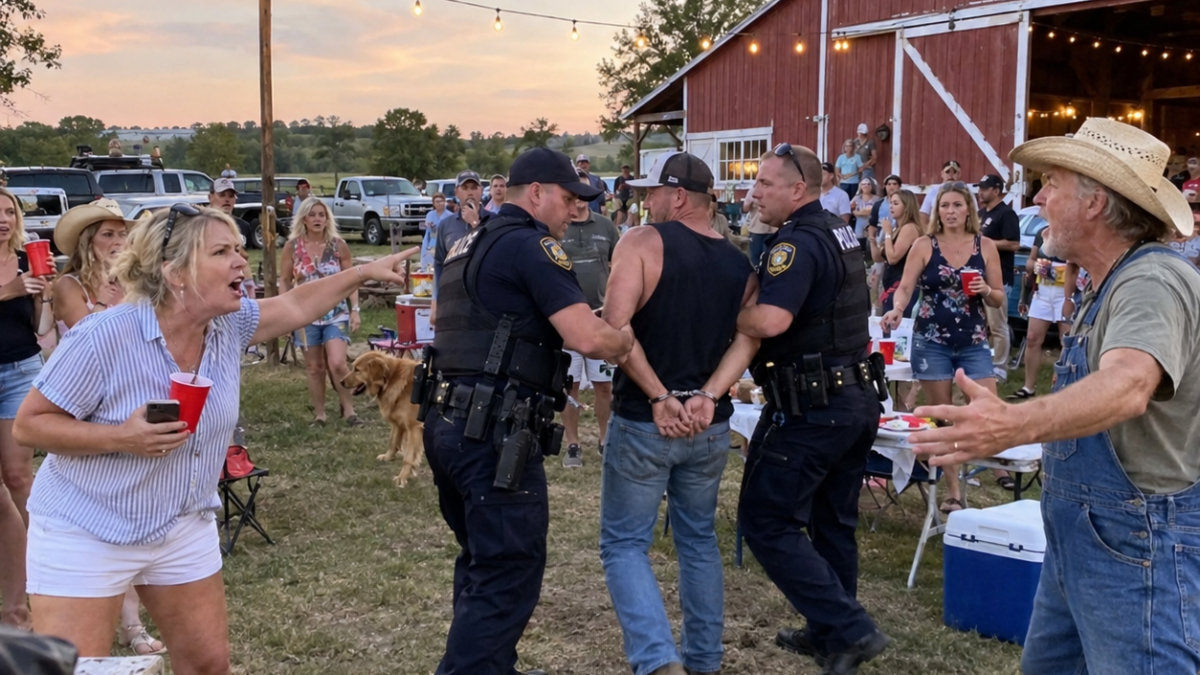
Cruisers arrived.
Brenda pointed.
“That’s them!”
And within minutes she discovered that the dangerous armed party she had reported consisted heavily of police officers, troopers, dispatchers, firefighters, retired officers, ranchers, nurses, children, wives, husbands, and one injured officer using crutches.
Captain Brooks identified himself.
Ryan identified himself.
Anthony Reed.
Two troopers.
William Harper.
The responding deputy stared.
“You guys are the armed party?”
William adjusted his cowboy hat.
“Mostly we’re the hungry party.”
Nobody laughed much.
Not yet.
The county supervisor spoke privately with Daniel.
Then approached Brenda.
“Dispatch says you reported a handgun was pointed at you.”
“Yes.”
“Which person?”
She pointed toward Ryan.
“That one.”
Ryan stood still.
I pointed at the camera.
“The whole encounter is recorded.”
Brenda’s eyes moved upward.
Her face changed.
“Does that record audio?” the supervisor asked.
“Yes.”
“I don’t consent to being recorded,” Brenda said immediately.
The supervisor ignored the argument.
“Mr. Bennett, preserve the footage.”
“Absolutely.”
Then Tyler came running from the barn.
“Dad.”
“Not now.”
“No, you need to see this.”
He held up his phone.
Security alert.
South equipment road.
A dark pickup had entered through a locked ranch access point.
Utility trailer behind it.
Meadow Hills HOA parking sticker in the windshield.
Another camera activated.
Truck stopped in my creek pasture.
Two men climbed out.
Opened the trailer.
Survey stakes.
Marking ribbon.
Metal signs.
One man hammered an orange stake into my ground.
Then another.
Then unfolded a sign:
MEADOW HILLS FUTURE EMERGENCY ACCESS.
Daniel looked over Tyler’s shoulder.
“What the hell?”
The county supervisor saw it too.
“If that’s live, we have an active trespass.”
Two deputies headed toward the south road.
Ryan and the other off-duty officers stayed exactly where they were.
The last thing anybody needed was armed party guests moving toward a police response.
I drove behind the deputies with Tyler.
Daniel joined only after being told he could come as my guest.
By the time we reached the creek pasture, six stakes were in the ground.
One man was attaching another sign.
The deputy stopped his cruiser.
Both workers froze.
The older one raised his hands.
“Problem?”
“This landowner says you’re on private property.”
The man looked genuinely confused.
“We were told access was approved.”
Those five words probably explain half the trespassing disputes in the country.
He introduced himself as Scott Palmer, survey technician for Red Oak Civil Engineering.
The younger worker was Jacob Ellis.
Neither acted aggressive.
Scott asked permission to retrieve his work packet.
The first page said:
MEADOW HILLS SECONDARY EMERGENCY CONNECTION — PRELIMINARY STAKING.
It directed them to mark a forty-foot corridor from Meadow Hills through my creek pasture toward County Route 6.
No permission from me.
No easement I knew of.
Scott looked sick.
“I swear the HOA told us access was authorized.”
“I believe you.”
That surprised him.
“But you still don’t have permission.”
The deputy documented everything.
Nobody arrested the survey workers.
There was no evidence they knowingly trespassed.
They were employees following a work order stating access had been arranged.
I asked:
“Who is the HOA contact?”
Scott pointed to the page.
BRENDA LAWSON.
Daniel looked at me.
Tyler said nothing.
The deputy photographed it.
That did not prove Brenda intentionally scheduled survey work as a distraction during the 911 call.
Timing is not proof.
Suspicion is not proof.
Scott said they were scheduled for five o’clock because the HOA expected the ranch entrance to be busy earlier.
“Who told you that?”
“A woman from the management office.”
“Brenda?”
“No. Linda.”
Interesting.
We returned to the front gate.
Brenda was still answering questions.
I showed her a photo of the survey work order.
“You know anything about this?”
She looked.
“Oh.”
Not denial.
Not surprise.
Oh.
“You knew?”
“I knew preliminary measurements were scheduled.”
“On my ranch?”
“The emergency route has been discussed for months.”
“Not with me.”
“It’s preliminary.”
“That doesn’t make trespassing preliminary.”
Then she said:
“We were told an old access easement existed.”
That was new.
“What easement?”
She did not answer clearly.
The county supervisor returned to the gun report.
Ryan explained.
Carrying ice.
Shirt lifted.
Weapon visible.
Never touched.
Never drawn.
Never pointed.
Other witnesses confirmed it.
Then Tyler brought the gate footage.
We watched.
Brenda entering.
Me telling her to leave.
Ryan crossing with two bags of ice.
Shirt lifting for maybe two seconds.
Holstered handgun visible.
Both hands still holding ice.
Brenda backing up.
Brenda calling 911.
Audio captured enough of her words.
The supervisor paused.
“You said he pointed this firearm at you.”
“I felt threatened.”
“That is different.”
“He had a gun.”
“That is different from pointing it.”
“I was scared.”
Nobody laughed.
Fear can be real.
A person can genuinely believe something terrible might happen.
But fear does not rewrite what already happened.
The supervisor told Brenda her report would be documented and reviewed.
No dramatic handcuffs.
No public arrest.
Tyler looked disappointed.
“I thought lying to 911 gets you arrested.”
Daniel said:
“Sometimes.”
“Why not now?”
“Because real life is less convenient than television.”
Tyler frowned.
Daniel continued.
“Full recording. Statements. Intent. Evidence. Then someone makes the legal decision.”
That mattered.
Having police officers at my party didn’t mean Brenda automatically became guilty of everything.
It meant her accusation had been made in front of people who understood how dangerous false weapons information could be.
After the deputies finished, the party continued.
Slowly.
Music stayed off almost an hour.
Some guests considered leaving.
Then Michael Torres walked toward the barbecue on his crutches.
“If anybody leaves before I get another plate, I’m making a citizen’s arrest for emotional damages.”
People laughed.
The tension finally cracked.
Music returned.
Low.
Lisa brought out more food.
The responding deputies were offered barbecue after finishing paperwork.
The supervisor took a container for later.
By sunset, we had raised almost eleven thousand dollars.
That was the part I refused to let Brenda destroy.
Daniel and I stood near the barn watching Michael’s children play horseshoes.
“Good party.”
“Besides the armed standoff involving potato salad.”
He smiled.
“You handled it right.”
“I wanted to yell.”
“Most people do.”
“What happens to Brenda?”
“Not your decision.”
Then Daniel looked south.
“I’d worry more about that road.”
So did I.
Sunday morning, I covered our dining room table with old property records.
Dad kept everything.
Surveys.
Fence receipts.
Pipeline notices.
Leases.
Road agreements.
Eventually I found it.
Temporary construction access.
Fifteen years earlier, while Meadow Hills was being built, the developer needed heavy equipment access for drainage work.
Dad allowed them to use part of our creek road.
Six months.
The agreement specifically said the ranch gate remained under Bennett family control.
No public right created.
No permanent access.
Six months.
I called our attorney, Rebecca Miles.
By Monday, she confirmed it.
Expired fourteen years earlier.
No replacement easement.
No permanent road right.
Nothing.
Then Rebecca discovered why Meadow Hills suddenly cared.
The HOA wanted to expand its clubhouse and recreation complex.
Larger pool area.
Pickleball courts.
Event lawn.
More parking.
County fire planning required adequate emergency vehicle access as expected event capacity increased.
Meadow Hills had one primary entrance.
Their proposed second route crossed my ranch.
Rebecca said:
“They need your road.”
“Then they should ask.”
“Yes.”
Helen Morris called Lisa that evening.
“Jack, Brenda told everybody you already agreed.”
“To what?”
“The emergency road.”
“I did not.”
“She said there is a historic easement.”
Helen forwarded HOA presentation slides.
There it was.
A red line across my property.
Label:
EXISTING BENNETT RANCH ACCESS EASEMENT.
Existing.
Not proposed.
Not disputed.
Existing.
Rebecca looked at the slide.
“Inaccurate.”
We requested Meadow Hills’ entire access file.
The management company responded.
Their manager, Linda Reeves, admitted she had scheduled the survey crew.
Why?
Brenda told her ranch access had already been approved through an existing easement.
“Did you verify it?” Rebecca asked.
“No.”
“Did you contact Jack?”
“No.”
“Why send surveyors during his private event?”
Linda hesitated.
“Brenda asked us to avoid interfering with normal ranch operations.”
I laughed.
Apparently entering the back pasture unannounced was their version of noninterference.
Linda sounded horrified when she saw the actual six-month agreement.
The management company paused every survey operation.
Then Brenda finally called me.
“This is getting out of control.”
“I agree.”
“You’re involving lawyers.”
“You sent surveyors onto my property.”
“We believed we had access.”
“You also believed Ryan pointed a gun.”
“That’s separate.”
“Same day.”
“I was frightened.”
“I understand.”
Silence.
Then her tone changed.
“Can we meet?”
“About?”
“The emergency route.”
Finally.
A request.
Not an order.
I agreed.
Tuesday, Brenda arrived with board members Susan Blake and Robert Hayes.
The management company’s lawyer came.
Rebecca sat beside me.
No yelling.
No deputies.
Just documents.
Brenda admitted she had relied on an old file calling our road “historic developer access.”
Rebecca put Dad’s original agreement on the table.
SIX MONTHS.
NO PUBLIC ACCESS RIGHT.
GATE CONTROL REMAINS WITH BENNETT FAMILY.
Susan read it.
Then looked at Brenda.
“So we don’t have an easement?”
Rebecca answered.
“No permanent easement has been located.”
For the first time, Brenda looked less angry than worried.
Without second emergency access, the clubhouse expansion might face restrictions.
They could redesign.
Build elsewhere.
Negotiate with another landowner.
Or ask me.
Brenda said:
“What would it take?”
“Trust.”
She frowned.
“What does that cost?”
“It isn’t a dollar amount.”
I told them I was not negotiating road rights until the 911 call and unauthorized survey issues were understood.
Not revenge.
Trust.
If a visible holstered weapon became “he pointed a gun at me,” then what happened later when we disagreed about gate width?
Or maintenance?
Or traffic?
Written contracts work only when people respect words.
Susan nodded.
“That’s fair.”
Brenda didn’t.
Several quiet days passed.
Then Meadow Hills held a special meeting.
Helen called afterward.
“They approved a temporary emergency access resolution.”
“What does that mean?”
“They declared your creek road necessary for community safety.”
I laughed without humor.
“Their vote does not create ownership.”
“I know.”
“But do they?”
The resolution told the HOA attorney to preserve historic emergency access through every necessary legal method.
Preserve.
Interesting word for something that had expired fourteen years earlier.
Then I read another claim.
Meadow Hills said it had used the creek road openly and continuously for more than a decade.
False.
Construction traffic used it for six months.
Then we locked it.
Rebecca started collecting old photos.
Camera footage.
Gate records.
Fence receipts.
Anything proving continuous private control.
Exactly one week after the party, I woke Saturday morning to the sound of heavy machinery near my southern boundary.
Tyler and I drove down.
A county fire inspector was there.
Small excavator.
Meadow Hills utility truck.
Brenda.
Susan.
“What is this?”
The fire inspector introduced himself.
“Mark Douglas. We’re here for emergency access evaluation.”
“Who authorized entry?”
Brenda held up paper.
“We obtained temporary authority.”
I looked.
Not a court order.
A county fire department administrative notice allowing evaluation of whether a proposed route could physically support emergency vehicles.
It did not grant rights over private property.
Mark saw the issue almost immediately.
“I was told access permission had been obtained.”
Brenda said:
“Our attorney says there are historic rights.”
Susan turned.
“What?”
Rebecca arrived.
“Your attorney told you Tuesday no permanent easement had been found.”
Brenda stiffened.
“He said it was disputed.”
“No. He said no permanent easement had been located.”
The excavator operator shut down.
Mark read everything.
“I’m not entering private land without confirmed access.”
Excellent answer.
Then something happened nobody expected.
A fire engine appeared inside Meadow Hills.
Then another.
No sirens.
Mark frowned.
“I requested one apparatus for weight testing.”
Then an ambulance appeared.
Then two police cruisers.
Mark’s radio crackled.
His face changed.
“Structure fire. Clubhouse area.”
Smoke rose over Meadow Hills.
The clubhouse renovation was burning.
Suddenly our road argument became irrelevant.
The fastest route from where the fire units were staged to the clubhouse crossed my creek road.
Mark looked at me.
“Mr. Bennett, I need permission to cross.”
No hesitation.
“Open it.”
Tyler unlocked the gate.
Fire engines crossed.
Ambulance.
Police cruisers.
Because emergencies are different.
Property rights do not require stupidity.
Someone needed help.
We followed.
Firefighters attacked flames near a renovation storage wing.
Nobody trapped.
No major injuries.
Then they found a cut gas-line area.
The site supervisor insisted that branch was supposed to have been isolated.
Security cameras near the clubhouse had also gone offline twenty minutes before the alarm.
Given everything that had happened the week before, everyone’s mind immediately went somewhere dark.
Then another camera showed a Meadow Hills maintenance pickup entering with a utility trailer.
Same general type of vehicle that had entered my pasture.
Susan whispered:
“That truck belongs to the maintenance committee.”
Three authorized drivers.
Brenda.
Gary Whitman.
Luis Romero.
Brenda immediately said:
“I did not drive it.”
Nobody had asked yet.
Daniel, standing beside me, murmured:
“Fast answer.”
I understood.
Still not proof.
Gary was located.
He said a plumbing contractor named Brian Keller had used the truck.
Brian confirmed it.
He had opened a valve believing the gas branch was dead.
It wasn’t.
Wrong valve had been tagged.
Gas entered a line.
Electrical spark likely ignited it.
The cameras?
Power had been shut down during work.
Same circuit.
No sabotage.
No conspiracy.
Just a dangerous construction mistake.
Mark Douglas looked at all of us.
“This is why we investigate before deciding what happened.”
Daniel glanced toward Tyler.
Tyler nodded.
Lesson understood.
The fire damaged one storage section and an unfinished wall.
Nobody hurt.
Thank God.
Ironically, the emergency response proved that my creek road saved time.
Brenda noticed.
So did everyone else.
By Monday, Meadow Hills filed an emergency court request seeking limited access.
Rebecca called.
“They’re using the fire.”
“The road was useful.”
“Yes.”
“Useful doesn’t mean theirs.”
“Correct.”
Their attorney was smarter now.
They no longer claimed ownership.
They argued public safety.
I surprised Rebecca.
“I’ll grant emergency-only access.”
Silence.
“Temporarily?”
“Maybe permanently if written correctly.”
“You understand that benefits Meadow Hills.”
“I don’t want an ambulance delayed because I’m angry at Brenda.”
Rebecca laughed softly.
“That makes this easier.”
My terms:
Locked gate.
County-controlled emergency access.
Fire.
Ambulance.
Law enforcement during real emergencies.
No HOA maintenance trucks.
No residents.
No event overflow.
No utilities.
No survey crews.
No future expansion rights.
No daily traffic.
Susan loved it.
Robert loved it.
The management company loved it.
Fire officials liked it.
Brenda didn’t.
At the next HOA meeting, she complained emergency-only access would not solve “community connectivity.”
Susan asked:
“What is community connectivity?”
“Future service needs.”
“Such as?”
“Maintenance access. Event overflow. Utilities. Long-term transportation options.”
There it was.
Not just emergencies.
I stood.
“No.”
Brenda turned.
“You haven’t heard the proposal.”
“I heard enough.”
I addressed the room.
“If you need emergency access, I’m willing to provide emergency access. If what you actually want is a second neighborhood entrance through my ranch, say that.”
Silence.
Then a Meadow Hills resident raised his hand.
“Do we need another regular entrance?”
Susan checked the traffic study.
“No.”
“Then why are we trying to get one?”
Brenda said:
“We should preserve future options.”
People groaned.
They were learning what “future options” usually meant.
Somebody else’s land.
The board voted four to three to pursue emergency-only access.
Brenda lost.
Then the sheriff’s department finished reviewing her 911 call.
The county attorney decided the false details were serious enough for a citation tied to inaccurate emergency reporting.
Not an immediate criminal arrest.
The dispatch recording was damaging.
The operator had apparently asked:
“Did he point the weapon at you?”
Brenda said:
“Yes.”
“Did you see the barrel directed toward you?”
“Yes.”
That was difficult to explain as vague fear.
She later admitted she never saw Ryan draw or point anything.
I did not celebrate.
Accountability mattered.
Humiliation didn’t.
Meadow Hills scheduled a membership meeting to decide whether Brenda should remain president.
I didn’t attend.
Their organization.
Their decision.
Lisa and I ate dinner on our porch.
Halfway through dessert, Susan called.
“Brenda resigned.”
“From president?”
“Board too.”
“What did she say?”
“That she can’t effectively lead with the neighborhood divided.”
Probably lawyer-approved language.
Still.
The next morning Susan called again.
“We accept your emergency-only terms.”
“Good.”
“HOA pays legal and installation expenses.”
“Good.”
“The ranch gate remains yours.”
“Very good.”
“Fire and ambulance use county-controlled access.”
“Perfect.”
Six-minute conversation.
No yelling.
No threats.
No cops.
Amazing what happens when people ask.
Normal life returned.
Michael Torres began physical therapy three days a week.
The fundraiser money covered travel and childcare.
Daniel sent me a photo of Michael standing without crutches.
That mattered more to me than Brenda’s resignation.
Then Rebecca called.
“Jack, we have another problem.”
Of course we did.
The creek road crossed Bennett Creek using a narrow concrete bridge my father built almost thirty years earlier.
Pickups crossed.
Tractors crossed.
Hay trailers crossed.
A fire engine had crossed during the clubhouse fire.
But an engineer evaluating permanent emergency use found missing structural records.
Nobody could certify the bridge for repeated modern fire-engine loads without testing.
Reasonable.
Then came the bigger issue.
Half the crossing wasn’t entirely on my land.
Bennett Creek followed a boundary.
Dad had built the bridge under an old agreement with the Henderson family.
That agreement allowed private agricultural crossing.
It prohibited conversion to subdivision or public access without approval from both landowners.
Meadow Hills did not own the Henderson side.
A narrow thirty-foot creek parcel remained with the family.
Current owner:
Margaret Henderson.
Seventy-three years old.
Forty miles away.
We called her.
She arrived at my ranch in an old blue Buick carrying a folder thick enough to qualify as structural reinforcement.
“My father trusted paper more than people.”
“I’m starting to understand him.”
Margaret remembered Dad.
Remembered the bridge.
Had no objection to legitimate emergency use if the structure was safe.
“I don’t want somebody dying because of thirty feet of fishing land.”
Then she opened her folder.
“But you need to see this.”
Twelve years earlier, Meadow Hills’ developer had asked the Henderson family to sell the creek strip.
They refused.
Then the developer requested an emergency road easement.
They refused that too.
Why?
Flooding.
During severe storms, water covered parts of the old road.
The developer’s own engineer agreed.
The Bennett Creek route had been rejected as Meadow Hills’ permanent emergency entrance.
Instead, the original subdivision plan reserved a different sixty-foot emergency corridor on the western side.
Susan leaned over the old plat.
“Where is this road?”
“There isn’t one.”
“What happened to the corridor?”
We checked.
Phase Four.
Six years earlier.
Six houses had been built across it.
Current owners innocent.
Legal homes.
Nobody tearing them down.
But the emergency corridor that Meadow Hills was supposed to preserve had vanished.
That explained why my ranch suddenly looked so useful.
Then Margaret said:
“There was another route.”
She pulled out another map.
Higher ground.
Farther north.
Crossing a narrow section of Henderson property.
Connecting to an undeveloped Meadow Hills maintenance area.
No floodplain problem.
No old bridge.
No houses.
Susan stared.
“That land is still empty.”
“Yes.”
Engineers studied it.
It worked.
Cost:
About seven hundred thousand dollars.
Not cheap.
But Meadow Hills would own and control it.
No dependence on my ranch.
Susan preferred it.
So did I.
Then engineers found another document.
The original emergency corridor hadn’t merely disappeared.
A formal amendment had removed it six years earlier.
Why?
Because the amendment said Meadow Hills had secured an alternate permanent emergency easement across Bennett Creek Ranch.
My ranch.
Rebecca called.
“Come to my office.”
The document lay on her table.
Forty-foot permanent emergency and service corridor.
Following my creek road.
Signature at bottom:
My father.
Charles Bennett.
Dad had been alive six years earlier.
The signature looked believable.
Too believable.
Margaret read the route.
“This can’t work.”
“Why?”
“Half that bridge crossing is my family’s property.”
Exactly.
Even if Dad had signed, he could not grant access across Margaret’s land.
Then I saw the date.
October 18.
Six years earlier.
Something about it bothered me.
That was the fall Dad had his stroke.
I called Lisa.
“Do you remember when Dad was hospitalized?”
“October.”
“Exact date?”
She kept old calendars.
A minute later:
“Admitted October twelfth.”
“When home?”
“November third.”
I stared at Rebecca.
The easement claimed Dad personally appeared at the Meadow Hills management office before a notary on October eighteenth.
On October eighteenth, my father was almost ninety miles away in a hospital.
Unable to walk.
Barely able to speak.
Then Margaret turned to the witness line.
One name.
Brenda Lawson.
Before she became HOA president, Brenda had supposedly witnessed my father signing a permanent road easement on a day when he was lying in a hospital bed.
Everything changed.
Rebecca ordered me not to call Brenda.
I wanted to.
Badly.
Instead, she sent the document to the county attorney.
Dad’s medical records confirmed hospitalization.
Lisa found photographs from October eighteenth.
Dad in the hospital room.
Hannah beside him with a milkshake.
No Meadow Hills office.
No signing.
A document examiner compared Dad’s genuine signatures.
The easement signature was extremely similar to one from the old temporary construction agreement.
Not just similar.
Several pen movements matched almost exactly.
Likely copied or traced.
Then the notary.
Patricia Cole.
The document claimed she notarized Dad’s signature.
She had moved to Arizona a year earlier.
Her state commission had expired.
She denied notarizing anything.
Her real seal did not match the one on the document.
Then investigators interviewed Brenda.
At first:
Six years was a long time.
She barely remembered.
Back then she served on the Meadow Hills infrastructure committee.
The project manager, Douglas Pierce, handled most paperwork.
Then the investigator asked:
“Did you personally watch Charles Bennett sign?”
Silence.
Finally:
“No.”
One word.
No.
The witness statement above her signature said:
I, Brenda Lawson, personally witnessed Charles Bennett execute this agreement.
No ambiguity.
She admitted she had signed because Douglas told her the owner signatures were already handled.
She thought the witness line merely confirmed HOA receipt.
She had not read it carefully.
I was furious.
But there was also a strange consistency.
That was Brenda’s entire pattern.
See Ryan’s holstered weapon.
Fill in the missing part.
“He pointed it.”
See temporary construction access.
Fill in the missing part.
“Permanent easement.”
See a witness line.
Sign it because somebody says the document is fine.
Assumption.
Confidence.
Action.
Douglas Pierce became the central focus.
He had managed development work.
Now retired in Arkansas.
He claimed Dad had verbally indicated interest in allowing an emergency route before the stroke.
Maybe Dad had.
That still didn’t authorize somebody to manufacture a permanent easement afterward.
Investigators found an old email:
CHARLES BENNETT IS HESITANT BUT EXPECTED TO APPROVE.
PREPARE PHASE FOUR ALTERNATE ACCESS USING RANCH ROUTE.
Then another, after Dad’s stroke:
BENNETT UNAVAILABLE.
WE CANNOT DELAY LOT RELEASES AGAIN.
PROCEED WITH ACCESS PACKAGE BASED ON PRIOR APPROVAL.
Prior approval.
Not signed approval.
Not recorded easement.
A belief.
That belief became paperwork.
Paperwork became county planning.
County planning let six houses replace the real emergency corridor.
Years later, maps told Brenda my road was Meadow Hills’ access route.
She believed the map.
Then sent surveyors.
Then called 911 and reported an armed threat that didn’t happen.
Every problem looked separate.
They weren’t.
They came from the same habit.
Replacing verified facts with convenient assumptions.
The county corrected the Phase Four records.
The questionable Bennett Ranch easement was removed from the subdivision access plan after Meadow Hills stopped defending it.
Margaret’s property made it unusable anyway.
Susan called a special board meeting.
This time residents received documents first.
Dad’s hospital records.
Temporary construction agreement.
Henderson deed.
Original emergency corridor map.
Phase Four amendment.
Questionable easement.
Brenda’s witness statement.
No rumors.
No social media.
Paper.
Brenda attended.
So did I.
Susan gave her the floor.
Brenda stood.
For once, she didn’t sound like someone trying to dominate a room.
“I signed a document I did not properly read.”
Nobody spoke.
“I trusted someone who said the owner signatures had already been handled.”
She looked toward me.
“I did not see Charles Bennett sign that easement.”
I said nothing.
“I should never have signed a statement saying I did.”
Then she continued.
“Years later, when Jack questioned the road, I treated him like he was interfering with something Meadow Hills already owned.”
Her voice shook slightly.
“I was wrong.”
That mattered.
Didn’t erase anything.
Still mattered.
Then she addressed Ryan.
He was sitting near the back with Daniel.
“When I saw your firearm, I was afraid.”
Ryan listened.
“You never pointed it at me.”
He nodded once.
No triumph.
No anger.
Brenda said:
“I told dispatch what I was afraid might be happening as if it had already happened.”
That was probably the clearest explanation of the entire mess.
Fear had converted possibility into fact.
Power had converted assumption into authority.
The membership then voted on whether Meadow Hills should continue any claim to my ranch road.
Almost unanimous.
No.
The Bennett Creek route was formally abandoned as permanent access.
Then they turned to the actual safety problem.
The northern route Margaret identified worked.
Margaret agreed to sell the needed strip at fair market value.
Not one dollar.
Not a coerced easement.
Not “community necessity.”
A real transaction.
Final project cost:
Around $780,000.
Bridge.
Drainage.
Road.
Emergency gate.
Residents didn’t love paying for it.
But the HOA would own it.
Control it.
Maintain it.
No dependence on private ranch property.
Insurance and the former developer contributed through settlement of the Phase Four records problem.
The rest came from reserves and a modest temporary dues increase.
Boring.
Practical.
Exactly how infrastructure should be handled.
Douglas Pierce faced the most serious consequences connected to the false easement.
Investigators concluded there was enough evidence that he knowingly submitted an access package without a valid executed agreement.
His case ended through a negotiated plea involving false property documentation, financial penalties, and restitution connected to correcting the records.
Brenda was not accused of forging Dad’s signature.
Evidence did not show she created the fake easement.
Her responsibility was different.
She admitted signing a witness statement that was not true.
And later she gave false details during the 911 call.
The emergency reporting case ended with a fine, community-service requirements, and instruction on proper emergency reporting.
Some people thought that was too soft.
Some thought it was too harsh.
I wasn’t interested in scoring it.
The truth was officially recorded.
That mattered more.
Ryan didn’t sue her.
He told me:
“I don’t need money from a frightened woman. I need her never to tell dispatch somebody pointed a weapon when they didn’t.”
I understood.
I also chose not to pursue Brenda personally for every dollar of legal cost.
Insurance covered much of the property dispute.
The HOA’s legal reserve covered the rest.
Could I have tried to hurt her more financially?
Probably.
I didn’t need to.
A boundary is strongest when you can protect it without becoming cruel.
Construction on Meadow Hills’ new northern route took about eight months.
During that time, I gave county fire officials temporary emergency-only permission to use Bennett Creek Road if the main neighborhood entrance became blocked.
Not residents.
Not HOA employees.
Not event traffic.
Real emergencies only.
Gate stayed locked otherwise.
County controlled the access method.
Susan joked:
“So you were never actually against helping Meadow Hills.”
“I was against Meadow Hills helping itself to my ranch.”
“Fair.”
Michael Torres continued recovering.
A year after the original fundraiser, he returned to light duty.
He insisted we hold another barbecue.
Lisa printed invitations.
At the bottom, in bold:
YES, MANY OF THE GUESTS ARE POLICE OFFICERS.
Daniel almost spilled his coffee laughing.
We invited Meadow Hills residents too.
Susan came.
Helen came.
George came.
Firefighters came.
Margaret Henderson brought a pie.
Then something happened I didn’t expect.
Brenda arrived.
She slowed outside the gate.
The old Bennett Creek Ranch sign was still there.
Still faded.
Still unrepainted.
I walked down.
“You lost?”
“No.”
She looked toward the barn.
Music.
People.
Children.
“Am I actually invited?”
“Your name is on the list.”
“I wasn’t sure you meant it.”
“I did.”
She entered.
No sheriff response.
No drone.
No survey crew.
No screaming.
No emergency vehicles.
She stayed around forty minutes.
Made a donation.
Ate barbecue.
Then crossed paths with Ryan near the drink table.
I couldn’t hear everything.
I saw her speak.
Ryan listen.
Then Brenda held out her hand.
Ryan shook it.
That was enough.
Forgiveness does not mean pretending something never happened.
Sometimes it means refusing to carry the same anger forever.
About a year after the original party, Meadow Hills opened its new emergency road.
Susan invited me to the ribbon cutting.
“I have cattle.”
“There’s cake.”
“That almost changes things.”
The road had a proper bridge.
Drainage.
Lighting.
Emergency gate.
And most importantly:
It belonged to Meadow Hills.
Exactly where their long-term emergency route should be.
My creek road went back to what Dad intended.
Ranch trucks.
Tractors.
Hay trailers.
And maybe an emergency vehicle if something truly went wrong.
Nothing more.
The strange part was that the whole disaster eventually improved my relationship with Meadow Hills residents.
Once the issue stopped being framed as:
RANCHER VERSUS NEIGHBORHOOD,
people started comparing facts.
Residents learned I wasn’t trying to block ambulances.
I learned they had been shown maps labeling my road as existing community access.
A lot of anger disappears when everybody finally receives the same information.
Dad’s records stayed in my office.
I digitized them.
Tyler said:
“After everything, you should put them in a bank vault.”
He was only half joking.
One evening, we repaired fence near the creek.
He asked:
“You think Grandpa would have allowed emergency access if they’d actually asked?”
I thought about it.
“Maybe.”
Tyler stopped working.
“So this entire disaster may have happened over something he might have said yes to?”
“Possibly.”
“That is insane.”
“Yes.”
Probably the biggest lesson of all.
People sometimes create enormous problems because they are afraid of hearing the word no.
Dad might have agreed.
I might have agreed.
Margaret did agree.
But people became so focused on guaranteeing the answer they wanted that they stopped asking honestly.
A temporary construction route became a fake permanent easement.
A visible holstered firearm became an armed threat.
A man carrying ice became someone “pointing a gun.”
A charity fundraiser became a dangerous illegal gathering.
A rancher asking people to leave private property became an obstacle to public safety.
Confidence filled every space where evidence was missing.
Until evidence finally showed up.
That first party became something people joked about for years.
“The day Brenda called 911 on twenty cops.”
Technically, not everybody there was law enforcement.
Some were troopers.
Daniel said that correction made the story worse.
He was probably right.
But I never wanted the story remembered only because Brenda embarrassed herself in front of police officers.
The dangerous part wasn’t embarrassment.
The dangerous part was giving emergency dispatch inaccurate information about a firearm.
When officers respond to a report that someone pointed a gun, they arrive prepared for a potentially deadly confrontation.
People can get hurt.
One false sentence can change how everybody behaves before a deputy even sees the property.
We were lucky.
Daniel realized what Brenda was saying.
He notified dispatch.
The officers at my party understood how to behave.
The responding deputies were professional.
Nobody made a sudden move.
Nobody reached toward a weapon.
The camera showed the truth.
If even one of those pieces had been different, a stupid neighborhood dispute could have turned tragic.
That is why I never treated Brenda’s 911 statement as merely funny.
It wasn’t.
People sometimes say:
“But she was scared.”
Yes.
She was.
Fear is real.
So is responsibility.
Being frightened does not give us permission to improve facts until they match our fear.
There is an enormous difference between:
“I saw a man with a firearm and I’m afraid.”
And:
“A man pointed a firearm at me.”
The first statement reports what happened and how you feel.
The second reports an act.
Those are not interchangeable.
Brenda learned that painfully.
So did Meadow Hills.
And, if I’m being fair, I learned something too.
I had underestimated how easily a misunderstanding becomes a crisis once people stop trusting each other.
By the time of the party, I already assumed almost anything Brenda did was hostile.
Often I was right.
Sometimes I wasn’t.
When the maintenance truck appeared near the clubhouse fire, my first thought was sabotage.
Wrong.
Construction mistake.
When the cameras shut down?
Looked suspicious.
Ordinary electrical shutdown.
When surveyors entered my land?
They genuinely thought permission had been granted.
Linda genuinely thought an easement existed.
Susan genuinely didn’t know the HOA attorney had rejected Brenda’s interpretation.
Different people knew different pieces.
That mattered.
Suspicion can protect you.
Certainty without evidence can destroy you.
That was Brenda’s mistake.
I refused to make it mine.
A few years later, Bennett Creek Ranch looked almost exactly the same.
Old barn.
Faded entrance sign.
Visible tractors.
Mismatched fence.
I eventually replaced the smoker.
Daniel still claims that was the only good decision to come from the entire incident.
Michael came to the barbecue every year.
Eventually without crutches.
His kids got older.
One year, his daughter won the horseshoe contest and refused to let any adult forget it.
Meadow Hills residents became regular guests.
So did firefighters.
County deputies.
Teachers.
Ranch neighbors.
The first year after the incident, people joked every time a cruiser passed the road.
“Jack, your party getting raided?”
“Only if someone sees Ryan carrying ice.”
Ryan would hold up both hands.
“Dangerous equipment.”
The joke worked because eventually the danger had passed.
But I never deleted the original camera video.
Not because I wanted revenge.
Because evidence has value.
The camera did not care whether I liked Brenda.
It did not care whether she liked me.
It did not care that Ryan was a police officer.
It recorded what happened.
Sometimes objectivity really is that boring.
Daniel called the camera “the best guest at the fundraiser.”
He wasn’t entirely wrong.
The gate camera protected Ryan.
The back cameras caught unauthorized survey work.
Dad’s old documents protected the ranch.
Margaret’s file exposed the flaw in the bridge route.
Hospital records protected Dad’s name.
Old emails exposed what happened in Phase Four.
Piece after piece, paper and recordings did what anger couldn’t.
They settled facts.
I sometimes wonder what would have happened if Brenda had simply come to my house months earlier and said:
“Jack, Meadow Hills needs a second emergency route. Your creek road would help. Can we negotiate?”
I might have said no.
I might have said yes with conditions.
Maybe Dad’s bridge would still have killed the idea.
Maybe Margaret would have rejected it.
Maybe the northern route would still have been better.
But we would have saved:
Police calls.
Survey trespass.
Court filings.
Legal fees.
Community division.
A false emergency report.
And one very strange afternoon involving twenty off-duty officers eating brisket while marked sheriff cruisers responded to investigate them.
All because asking honestly felt riskier than assuming permission.
One Saturday years later, I stood beside the ranch gate repainting a fence post.
Not Dad’s sign.
Never Dad’s sign.
Susan pulled over.
“Careful.”
“With what?”
“Someone might think you’re complying with Meadow Hills appearance standards.”
I looked at the paintbrush.
“You leave immediately.”
She laughed.
Then looked at the old sign.
“You’re really never repainting that, are you?”
“No.”
“Good.”
That answer surprised me.
“Good?”
“It looks like Bennett Creek now.”
I smiled.
That was probably the nicest thing any HOA president ever said about it.
The sign had survived Dad.
Weather.
Me.
Brenda.
And one ridiculous “community appearance” campaign.
It deserved retirement exactly where it stood.
Susan became a good HOA president because she understood something Brenda learned much later.
Leadership isn’t the ability to make everyone obey.
It’s the ability to solve problems while remembering other people have rights too.
When Meadow Hills needed land for the northern road, Susan asked Margaret.
Margaret named a fair price.
They negotiated.
Agreement.
Done.
Nobody invented an easement.
Nobody sent a survey crew first.
Nobody called 911.
It was almost disappointingly normal.
Exactly as it should have been.
Tyler eventually graduated and took a larger role in ranch management.
One day he was reviewing an equipment lease at the kitchen table when he said:
“Dad, I finally understand why you save every piece of paper.”
“Trauma.”
He laughed.
“No, seriously.”
“So am I.”
We still had boxes of Dad’s handwritten records.
Nothing sophisticated.
But one forgotten six-month access agreement had saved us from somebody’s claim of permanent rights.
One hospital calendar date helped expose a signature problem.
Property disputes often look like people yelling across fences.
Usually the real fight happens inside filing cabinets.
Hannah still tells friends that her father hosted “the most heavily armed charity barbecue in Oklahoma.”
I object every time.
“That isn’t accurate.”
“There were like twenty cops.”
“Not all carried.”
“State troopers too.”
“That doesn’t help your claim.”
“It helps mine.”
Lisa laughs.
And then, inevitably, somebody asks the question:
“What did Brenda do when she realized the guests were cops?”
The short answer?
She looked terrified.
But the longer answer matters.
She didn’t suddenly become wrong because the people she accused happened to be police officers.
She was already wrong because nobody threatened her.
Ryan being an officer made the moment more ironic.
It did not make his rights more important.
If Ryan had been a plumber carrying lawfully, the facts should have mattered the same way.
If Daniel had been a teacher, his witness statement should still matter.
If my party had contained no police at all, responding deputies should still have checked evidence.
That is the standard worth defending.
Not:
Treat people carefully because they might secretly be important.
Treat people carefully because facts matter.
Brenda’s mistake wasn’t that she called police officers dangerous.
Her mistake was calling anybody dangerous without checking whether the accusation was true.
One evening after the second annual fundraiser, Brenda remained near the gate after most guests left.
I walked over.
She looked toward the camera.
“Still recording?”
“Yes.”
She smiled awkwardly.
“I hate that thing.”
“It’s never lied about you.”
“That’s worse.”
For a moment, neither of us spoke.
Then she said:
“I really did think Ryan might pull that gun.”
“I know.”
“That doesn’t excuse what I told dispatch.”
“No.”
“I thought if I made them understand how afraid I was, they’d take it seriously.”
“So you made the facts more serious.”
She looked down.
“Yes.”
That might have been the most honest sentence she ever said to me.
I nodded toward Meadow Hills.
“How’s the new road?”
“Expensive.”
“Good?”
“Very.”
“Flood?”
“No.”
“Bridge?”
“Excellent.”
“Then maybe something worked.”
She smiled.
“I should have asked.”
“Yes.”
She looked toward Dad’s faded sign.
“You know, I still think that could use paint.”
I stared.
Then she laughed.
For the first time since I had known her, Brenda made the joke before I did.
That mattered too.
People can learn.
Not always.
Not quickly.
Not without consequences.
But sometimes.
And when they do, I think we should leave a little room for them to become better than the worst thing they did.
That doesn’t require forgetting.
The 911 citation still happened.
Her resignation still happened.
The false witness statement still mattered.
Douglas still faced consequences for the property filing.
The road claim disappeared.
Those were not erased.
Forgiveness without truth is denial.
Forgiveness after truth is different.
I kept the ranch.
Meadow Hills got its road.
Michael recovered.
Dad’s name was cleared.
Margaret got fair compensation.
Susan repaired trust.
Brenda learned that fear is not evidence.
And the old smoker finally died after one more summer.
We replaced it with a larger one.
Daniel stood beside the new smoker.
“This thing could feed a police department.”
“That apparently matters around here.”
He pointed at the gate camera.
“You keeping that?”
“Forever.”
“Smartest guest you ever invited.”
“It didn’t donate.”
“It saved Ryan a lot of trouble.”
True.
The following summer, we raised even more money for another local family.
No 911 calls.
No HOA notices.
No survey crews.
No drones.
At around five that afternoon, Ryan walked from the ice chest carrying two bags.
He stopped near me.
“Jack.”
“What?”
“Want me to cover my gun?”
I stared at him.
Then we both started laughing.
Daniel heard.
“What’s funny?”
“Nothing.”
Ryan raised the ice.
“I’m recreating the crime scene.”
Lisa shouted from across the barn:
“Do not encourage him!”
That was how the story finally became what it deserved to become.
Not a source of rage.
A lesson.
And eventually, a joke.
But I never forgot what could have happened.
That is why whenever somebody tells me Brenda’s 911 call was hilarious because she accidentally called cops on a party full of cops, I correct them.
The reveal was funny.
The call wasn’t.
Dispatchers need truthful information.
Police need accurate information.
People with firearms especially need accurate information attached to their actions.
A statement as simple as:
“He pointed it at me”
can change an entire police response.
So before you say it, you had better know it happened.
Brenda didn’t.
The camera did.
And when those cruisers rolled through my gate, Brenda thought she had finally forced the law to do what the HOA could not.
She thought police would shut down my ranch party.
Maybe arrest somebody.
Maybe scare me badly enough that I would finally stop resisting her demands.
Instead, Captain Daniel Brooks put down his barbecue.
Ryan Cooper stood there holding ice.
Sergeant Anthony Reed identified himself.
Two troopers did the same.
Retired Chief Harper stood beneath the barn in his ridiculous cowboy hat.
The responding deputy slowly realized the “armed gathering” he had been dispatched toward was full of law enforcement officers attending a fundraiser for another officer’s injured family.
That was embarrassing for Brenda.
Then the video showed Ryan never pointed anything.
That was serious.
Then the survey crew was found in my pasture.
That exposed the road fight.
Then old records showed no permanent easement.
Then Margaret showed us the original emergency plan.
Then the fake easement appeared.
Then Dad’s hospital records exposed it.
One lie did not create the entire disaster.
One assumption didn’t either.
It was a chain.
A dangerous one.
And every link came from somebody deciding certainty was easier than checking.
Brenda was certain I should repaint my sign.
Certain the ranch affected HOA standards.
Certain her neighborhood could regulate my party.
Certain armed men were dangerous.
Certain Ryan threatened her.
Certain an easement existed.
Certain surveyors could enter.
Years earlier, certain that Douglas knew what he was doing when she signed a witness statement she had not verified.
That is what unchecked certainty does.
It keeps moving.
Until reality stops it.
Reality stopped Brenda at my ranch gate.
With three sheriff cruisers.
A dozen badges.
One security camera.
And two bags of ice.
Years later, the faded Bennett Creek Ranch sign is still standing.
I could replace it tomorrow.
I won’t.
Every weathered board reminds me that not everything old needs improvement.
Every document in Dad’s files reminds me that paper matters.
Every Meadow Hills family that still visits reminds me that one bad leader is not an entire community.
Every annual fundraiser reminds me why the first party existed in the first place.
Michael.
His wife.
His kids.
People helping somebody when life got difficult.
That was the story before Brenda arrived.
It was the story after she left.
Everything in between was noise.
And if there is one moment I will probably remember until I’m gone, it is not even Brenda’s face when Daniel identified himself.
It was the county supervisor standing beside my gate, looking down at the 911 report.
He looked up at Brenda.
Then at Ryan.
Then at my camera.
“Mrs. Lawson, you told dispatch this man pointed a handgun at you.”
Brenda said:
“I felt threatened.”
And the supervisor answered with the simplest sentence in the entire mess.
“That’s not the same thing.”
No.
It wasn’t.
Feeling something does not automatically make the thing true.
Wanting land does not make it yours.
Needing a road does not create an easement.
Holding office does not create jurisdiction.
Seeing a gun does not mean somebody threatened you with it.
And having three hundred homes behind you does not give you more property rights than the rancher standing on the other side of the fence.
Meadow Hills eventually learned all of those lessons.
So did Brenda.
And Bennett Creek Ranch remained exactly where it had always been.
Private.
Working.
A little rough around the edges.
Full of cattle.
Home to a faded sign my father painted.
And still an excellent place for barbecue.
Especially when the guests happen to be police officers.