HOA Karen Climbed My Orchard Fence to Steal My Prize Peaches—And then she called 911, lying that I had broken her leg
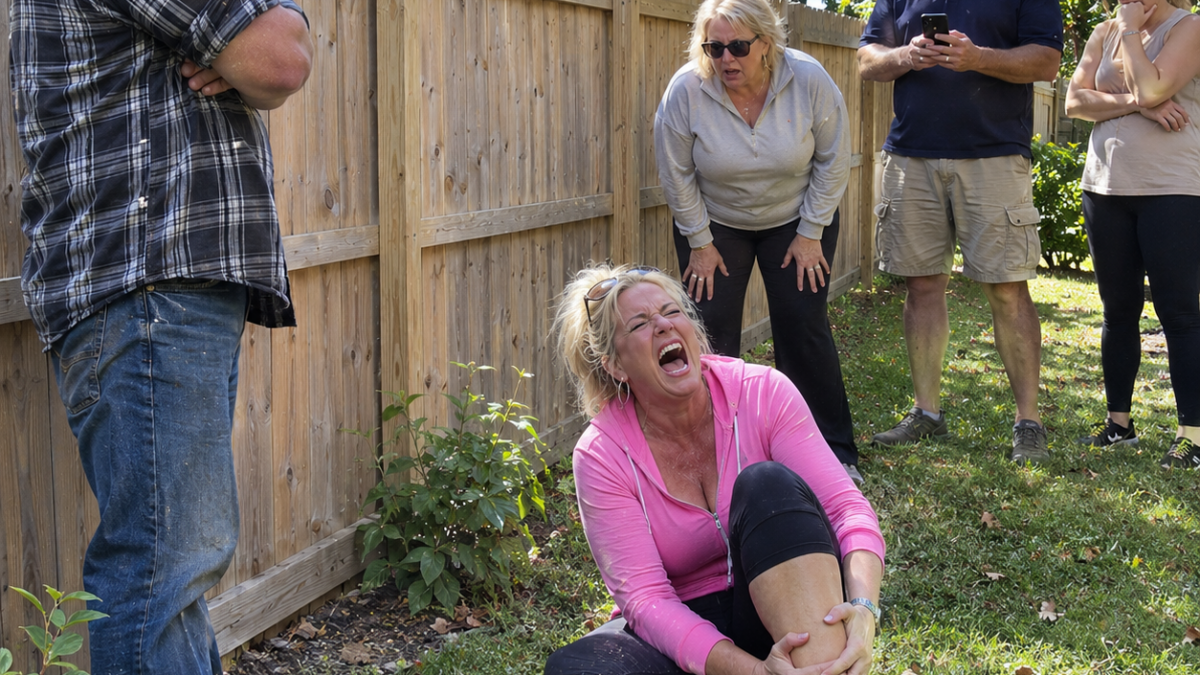
PART2
She looked away.
And that was when I noticed something else.
A small aluminum ladder was leaning against the outside of the fence.
It had WILLOW CREEK HOA PROPERTY stenciled across one side.
Cynthia hadn’t impulsively climbed over my fence.
She had brought HOA equipment to do it.
Then I saw a pair of pruning shears on the ground near the tote.
That bothered me more than the peaches.
“Why did you bring shears?”
She didn’t answer.
“Cynthia.”
“I don’t have to explain anything to you.”
“You came onto my land with a ladder, a bag, and pruning shears.”
“I was harvesting.”
“No.”
I looked at her.
“You were trespassing.”
The first sheriff’s cruiser arrived eleven minutes later.
And Cynthia smiled.
Not nervously.
Not gratefully.
Smugly.
Like the arrival of law enforcement meant the argument had already been decided.
A deputy stepped through the gate after I unlocked it.
Cynthia immediately raised her voice.
“Officer, thank God. I need this documented.”
The deputy looked at me.
Then at her.
Then at the peaches scattered everywhere.
“What happened?”
Cynthia pointed directly at me.
“He created a dangerous condition along a known community access point.”
The deputy looked at my six-foot fence.
Then at the locked gate.
Then at the PRIVATE PROPERTY sign.
He blinked.
“What community access point?”
And for the first time that afternoon, Cynthia stopped smiling.
My name is—
Actually, that’s exactly how I don’t want to tell this story.
Because none of this started with who I was.
It started with what I owned.
Seventeen acres.
That was the problem.
Seventeen acres of land my family had held since before Willow Creek existed.
The property sat outside a small town in western North Carolina, tucked between a county road and a development built during the housing boom.
My grandfather had bought thirty-four acres in the seventies.
My father inherited half.
His brother got the other half.
By the time the land came to me, mine consisted of a house, a barn, a workshop, a pond, and an orchard that covered almost six acres.
The orchard was the heart of it.
Apples.
Peaches.
Pears.
Plums.
A few old cherry trees that produced fruit only when they felt emotionally prepared to do so.
Most of the orchard wasn’t commercial in any serious sense.
I sold at a Saturday market.
A local restaurant bought pears.
A bakery bought peaches and apples.
Friends picked some.
I canned more than any reasonable human being should.
It paid its own expenses and gave me something I actually enjoyed doing.
The western edge of the property bordered Willow Creek.
Willow Creek had ninety-six houses, landscaped entrances, walking paths, decorative streetlights, a clubhouse, a pool, and a board that increasingly behaved as though the entire valley was an extension of its covenants.
My land was not part of Willow Creek.
That fact was simple.
Clear.
Recorded.
And apparently offensive to Cynthia.
When the development first went in, things had been fine.
The original developer installed a walking trail near my boundary.
My father actually allowed a few neighbors to buy fruit directly from the orchard.
He liked people.
If children asked whether they could pick an apple, he usually handed them a basket.
But he never opened the orchard as public property.
He never gave the HOA access rights.
He never signed an easement.
And he kept a fence along the western side because deer, dogs, teenagers, and fruit trees are a bad combination.
When I inherited the land, the fence was already old.
I replaced it with a six-foot cedar-and-wire design.
Nice looking.
Strong.
Locked gate.
Nothing hostile.
Then Cynthia became HOA president.
The first time she introduced herself, she didn’t say hello.
She said, “You need to trim those trees.”
I was standing near my mailbox.
I looked over.
She was wearing a white visor and carrying a clipboard.
“Which trees?”
“The fruit trees along our trail.”
“They’re not on your trail.”
“They overhang visually.”
I actually thought she was joking.
“Overhang visually?”
“They obstruct the sightline.”
“To what?”
“The mountain.”
I looked past the orchard.
The mountain was enormous.
My peach trees were twelve feet tall.
“Pretty sure the mountain is surviving.”
She didn’t smile.
“We have community standards.”
“I don’t.”
“You border us.”
“Yes.”
“That means what you do affects us.”
“That’s true.”
She seemed pleased.
Then I added, “But affecting you isn’t the same as being controlled by you.”
Her expression hardened.
That was our introduction.
Things declined from there.
The first real fight involved apples.
A group of Willow Creek residents walked into my orchard one Saturday morning in September.
Not accidentally.
They opened the gate.
The gate had been unlocked because I was moving equipment.
Seven adults and four children came in carrying reusable grocery bags.
I walked over.
“Can I help you?”
A woman smiled.
“We’re here for the neighborhood apple picking.”
I stared at her.
“The what?”
“Cynthia said residents could pick along this side.”
I looked toward the fence.
“Cynthia Bell?”
“Yes.”
“She doesn’t own this orchard.”
The woman’s smile disappeared.
“Oh.”
One of the men said, “We were told these trees were part of the community buffer.”
“They’re part of my property.”
Silence.
Everyone looked embarrassed.
That wasn’t their fault.
They had been lied to.
I explained that I sometimes sold fruit directly, and if they wanted apples, I’d happily make them a fair-price box.
But there was no free community picking.
They apologized and left.
That afternoon, I emailed Cynthia.
Her response arrived forty minutes later.
Daniel,
The HOA has historically considered fruit along the western boundary to be a shared neighborhood amenity due to its proximity to common property.
Please avoid confrontational interactions with residents who reasonably believe they may access naturally occurring resources along the boundary.
Naturally occurring resources.
I read that phrase three times.
Then I wrote:
Cynthia,
The orchard is privately owned agricultural property. The trees were planted, irrigated, pruned, sprayed, fertilized, and maintained by my family.
No HOA member has permission to enter or harvest fruit without my approval.
Please stop telling residents otherwise.
Daniel.
Her response:
We disagree with your interpretation.
That sentence became Cynthia’s favorite weapon.
Property deed?
We disagree.
Survey?
We disagree.
Locked gate?
We disagree.
Reality?
Apparently negotiable.
I called an attorney.
Her name was Melissa Grant.
She handled real estate and land-use disputes.
I gave her the emails.
She laughed once.
Not because it was funny.
Because Cynthia had put something ridiculous in writing.
Melissa sent the HOA a formal notice.
My property was private.
No recorded easement existed.
No recreational access existed.
No harvest rights existed.
No HOA authority extended onto my parcel.
Cynthia’s response came through the HOA attorney.
They did not claim ownership.
That would have been too absurd.
Instead, they claimed there had been a “historic permissive community practice.”
Melissa called me.
“That phrase means almost nothing by itself.”
“What are they trying to do?”
“Preserve ambiguity.”
“Why?”
“Because ambiguity is leverage.”
That was the first time I realized Cynthia wasn’t simply entitled.
She was strategic.
Not brilliant.
But strategic enough to make a small dispute expensive.
And expensive disputes are how bullies win.
I locked the gate permanently.
A week later, somebody cut the chain.
Not the lock.
The chain.
I found it lying in the grass.
Nothing obvious was missing.
I installed a heavier chain.
Then I installed a camera.
Two nights later, I caught three teenagers from Willow Creek climbing the fence.
They were after apples.
I recognized one.
I called his father.
The father was horrified.
“He said the HOA told kids it was okay.”
“Who told them?”
“I don’t know. I’ll find out.”
The next morning he called back.
His son had heard it from a neighbor who heard it from Cynthia during a pool committee meeting.
Again.
I emailed her.
No response.
Then peaches began disappearing.
Not a few.
Crates worth.
I would inspect a row in the evening and find entire lower branches stripped the next morning.
At first, the cameras showed nothing.
That bothered me.
Then I realized whoever was entering knew where the camera was.
I moved it.
Two days later, I caught an HOA maintenance worker.
He entered through a section of fence hidden behind honeysuckle.
Carried two five-gallon buckets.
Filled both with peaches.
Left.
The next morning, I drove to the HOA clubhouse.
Cynthia was there with two board members.
I placed still photographs on the table.
She looked down.
Then up.
“This is inappropriate.”
I almost laughed.
“He’s on my property.”
“He’s an association employee.”
“That makes it worse.”
“He was gathering fallen fruit.”
“He picked it off the trees.”
Cynthia looked at the photographs again.
“He may have misunderstood.”
“With two buckets?”
Board member Jim Warner shifted in his chair.
“Cynthia, did you tell maintenance they could collect fruit?”
She turned toward him.
“We’ve always maintained the boundary.”
“No,” I said. “You haven’t.”
She ignored me.
Jim said, “That wasn’t my question.”
Cynthia’s voice sharpened.
“We have used fruit from that area for community events before.”
That was new.
“What community events?”
She said nothing.
Then I remembered.
The Willow Creek Harvest Social.
Every October, the HOA held a big event.
Pies.
Cider.
Jam.
Baked goods.
Fruit baskets.
A promotional photo from the previous year had shown tables covered in peaches and apples.
I had never thought about where the fruit came from.
Now I knew.
“You’ve been taking fruit from my orchard for HOA events?”
Cynthia leaned back.
“You’re making this sound criminal.”
“It is stealing.”
“Oh, please.”
“Did you pay for it?”
“The fruit would otherwise fall and rot.”
“That is not your decision.”
Jim looked increasingly uncomfortable.
Another board member, Susan Keller, asked Cynthia, “How long has this been happening?”
Cynthia snapped, “Can we stop treating him like he owns every piece of fruit within sight of our boundary?”
I looked at her.
“I literally do own the fruit on my trees.”
She stood.
“This meeting is over.”
“No.”
She glared at me.
I gathered the photographs.
“You may be done talking.”
I looked at Jim and Susan.
“But I’m not done documenting.”
The next escalation came disguised as an HOA notice.
I received it by certified mail even though I wasn’t a member.
NOTICE OF NUISANCE CONDITION
It accused my orchard of:
attracting wildlife,
creating fallen-fruit hazards near the walking trail,
producing insect activity,
and failing to maintain vegetation to “community-adjacent standards.”
Melissa read it.
Then slowly removed her glasses.
“They know you aren’t in the HOA, right?”
“Very much.”
“They cannot fine you.”
“I know.”
“They cannot enforce covenants against you.”
“I know.”
“So what is this?”
“Cynthia.”
Melissa smiled.
“Fair.”
The letter demanded that I remove six peach trees within thirty days.
Those six trees included my best Elbertas.
The exact trees Cynthia later climbed the fence to reach.
I refused.
The HOA sent another letter.
Then another.
Then a demand that I allow their arborist to inspect the trees.
I refused that too.
Then Cynthia began telling residents the trees were diseased.
They weren’t.
She claimed falling fruit created a bee hazard.
The trees were forty feet from the walking trail.
She claimed wildlife attracted by my orchard endangered residents.
We had deer.
Apparently civilization was collapsing.
Then she made one mistake.
She attached a map.
The HOA map showed a fifteen-foot “landscape buffer” extending onto my property.
According to their version, the disputed trees sat partly inside that buffer.
I sent it to Melissa.
She called me within ten minutes.
“Where did they get this?”
“No idea.”
“This isn’t the recorded subdivision plat.”
“I assumed.”
“Get your surveyor.”
I called Aaron Dorsey, who had surveyed the property when I replaced the fence.
He came out the next day.
We walked the western line.
Pins matched.
Fence matched.
Trees were well inside my parcel.
The HOA map was wrong.
But not randomly wrong.
Somebody had shifted the boundary line.
By roughly twelve to eighteen feet.
Enough to include part of my orchard.
Aaron looked at the printout.
“This line follows the old temporary construction fence.”
“What construction fence?”
“When Willow Creek was built, developer fencing sat inside your father’s land for equipment separation. It was never a boundary.”
“You’re saying somebody used that as the property line?”
“Looks like it.”
“How could an HOA make that mistake?”
Aaron looked at me.
“Sometimes mistakes survive because nobody checks them.”
Then he added:
“Sometimes people prefer the map that gives them more land.”
That sentence stuck with me.
Melissa ordered certified copies of the recorded plats.
Then old aerial photography.
Then title records.
The actual boundary was not ambiguous.
Not even close.
My fence sat between three inches and fourteen inches inside my property depending on terrain.
The walking trail remained on HOA land.
There was no shared buffer.
No easement.
No community orchard.
Nothing.
Melissa sent everything to their attorney.
For nearly two weeks, silence.
Then the HOA attorney replied.
They withdrew the tree-removal demand.
I thought that might be the end.
I should have known better.
Cynthia hated losing more than she liked being right.
At the next Willow Creek board meeting, she told residents I had “weaponized technical surveying details against longstanding community expectations.”
Marcus Hale—who lived two streets from the clubhouse and had become one of the few HOA residents willing to forward me information—sent me the meeting notes.
I read that sentence twice.
Technical surveying details.
That meant the property line.
Cynthia had found a bureaucratic way to describe ownership as a loophole.
Then the Harvest Social approached.
That was when the theft increased.
My apples began disappearing.
Then pears.
I installed two more cameras.
One camera caught a woman entering with two children.
Another caught an HOA landscaping employee.
Another caught Cynthia herself standing outside the fence, pointing toward my peach rows while talking to a maintenance worker.
The audio was too distant.
But the gesture was obvious.
I sent everything to Melissa.
She sent a final cease-and-desist letter.
This one was stronger.
Any unauthorized entry would be treated as trespass.
Any fruit removal would be documented as theft.
The HOA and its agents had no permission to access the orchard.
Cynthia received the letter on a Monday.
On Wednesday, she came over personally.
I was pruning dead wood when she appeared outside the gate.
“You’ve crossed a line.”
I looked at her.
“You’re standing outside my fence complaining about boundaries. That’s impressive.”
“This intimidation campaign against residents is unacceptable.”
“Cameras on my property are intimidation?”
“You’re photographing children.”
“I’m recording trespassers.”
“They’re neighbors.”
“They’re inside a locked orchard.”
“You enjoy escalating this.”
I set down my pruning saw.
“Cynthia, stop telling people they can come here.”
“I have never told anyone to trespass.”
“You told residents the orchard was a shared amenity.”
“That’s not the same thing.”
“You sent maintenance workers to collect fruit.”
“They misunderstood.”
“Twice?”
She crossed her arms.
“The board is trying to preserve community harmony.”
“By taking my peaches?”
“You’re obsessed with ownership.”
I stared at her.
“Yes.”
That actually surprised her.
I continued.
“When it comes to people entering my land and taking things I grew, yes. Ownership matters.”
“You have more fruit than you can use.”
“That’s not relevant.”
“It is when children live next door.”
I almost laughed.
“Children living nearby does not create fruit socialism.”
Her face hardened.
“You think this is funny.”
“I think it’s ridiculous.”
“You’ll regret making enemies out of an entire neighborhood.”
There it was.
A threat.
Quiet.
Indirect.
Plausibly deniable.
I picked up my pruning saw.
“Anything else?”
She turned away.
Then stopped.
“The Harvest Social is next Saturday.”
“I know.”
“It would be a good opportunity for you to show goodwill.”
“How?”
“Donate fruit.”
I stared at her.
After everything.
After the thefts.
The letters.
The fake map.
The trespassing.
She still expected fruit.
“How much?”
Her expression softened slightly.
“Eight crates of peaches and four of apples.”
I laughed.
I couldn’t help it.
She looked offended.
“That’s your answer?”
“Yes.”
“You’re refusing?”
“Absolutely.”
She leaned closer to the fence.
“Then don’t complain when people judge you for it.”
“I’ll survive.”
She walked away.
I thought that conversation settled it.
Six days later, I found Cynthia lying in my orchard.
The morning of the fall had been perfect.
Cool.
Blue sky.
Dry enough that the grass no longer held dew by noon.
The Harvest Social was scheduled for four that afternoon.
My best late peaches were ready.
I had promised forty pounds to the bakery.
Another twenty were going to the Saturday market.
Around one thirty, I heard Boone barking.
Boone was my old Labrador.
Not aggressive.
But very committed to reporting suspicious squirrels, delivery drivers, and leaf blowers.
I stepped out of the barn.
He was facing the western fence.
Then I heard a metallic scrape.
I walked toward the sound.
At first I saw the ladder.
Then the white visor.
Cynthia was already over the fence.
She had dropped from the top rail and landed inside.
She didn’t see me.
I stayed back.
Not because I wanted her to fall.
Because I couldn’t quite believe what I was watching.
She picked up the tote.
Walked directly to the Elberta row.
Started harvesting.
No hesitation.
No uncertainty.
She knew exactly which trees she wanted.
She picked carefully.
Good fruit only.
Then she used the pruning shears to clip two small fruiting branches.
That made me angry.
Taking peaches was theft.
Cutting branches damaged the trees.
I stepped forward.
“Cynthia.”
She spun around.
The tote dropped.
“What are you doing?”
Her face went pale for half a second.
Then the arrogance returned.
“I could ask you the same thing.”
“You’re standing in my orchard.”
“These branches extend toward community property.”
“No, they don’t.”
“You’ve refused to maintain them.”
“You climbed my fence.”
She picked up the bag.
“We needed fruit for the Harvest Social.”
“You’re stealing it.”
She started walking toward the fence.
“Don’t be dramatic.”
“Put the bag down.”
“No.”
“Cynthia.”
“You have hundreds of pounds.”
“That doesn’t make them yours.”
“You’re going to let fruit rot because you’re angry at the HOA.”
“I sell it.”
She reached the fence.
The ladder was on the other side.
That was her problem.
She had climbed down easily enough because gravity helped.
Getting back over while carrying twenty pounds of peaches was harder.
She hooked the tote over one shoulder.
Grabbed the top rail.
I said, “Stop.”
She ignored me.
“Use the gate.”
“I’m not walking all the way around.”
“The gate is thirty yards away.”
“I have somewhere to be.”
She put one foot against the lower cross brace.
The fence wasn’t designed as a ladder.
“Cynthia, do not climb it.”
“Mind your own business.”
“It is literally my fence.”
She pulled herself upward.
One foot slipped.
She caught herself.
The tote swung.
Several peaches fell out.
“Put the bag down.”
“Stop distracting me.”
She reached the top.
Then tried to swing one leg over.
Her sneaker slipped off the narrow rail.
She fell backward.
Maybe four feet.
Not six.
She had almost cleared the top.
She landed awkwardly on her left side.
Her ankle twisted beneath her.
I heard her scream.
I ran over.
Boone barked.
I immediately called him back.
“Boone! House!”
He obeyed.
Cynthia rolled onto her back.
“You pushed me!”
I froze.
“What?”
“You distracted me.”
“That is not pushing.”
“You came at me.”
“I was ten feet away.”
“My ankle!”
“Don’t move.”
“I’m suing you.”
“Of course you are.”
Then she called 911.
And that was how we ended up with a deputy standing in my orchard asking what “community access point” she was talking about.
The deputy’s name was Luis Ramirez.
He looked like a man who had already heard three ridiculous explanations that day and was prepared for a fourth.
Cynthia spoke first.
“This property borders Willow Creek common land.”
Luis nodded.
“Okay.”
“The association has historically maintained access along this area.”
“No,” I said.
She snapped, “Stop interrupting.”
Luis raised one hand.
“I’ll speak to both of you separately.”
The ambulance arrived.
Paramedics examined Cynthia.
Likely sprain.
Possible small fracture.
They placed her ankle in a splint.
While they worked, Luis asked me what happened.
I explained.
Fence.
Ladder.
Peaches.
Shears.
Fall.
He looked at the tote.
“These are yours?”
“Yes.”
“You saw her picking them?”
“Yes.”
“Any video?”
“Yes.”
That changed everything.
“From where?”
I pointed.
Camera one.
Camera two.
A smaller camera mounted under the eave of my packing shed.
Luis looked almost relieved.
“Can you show me?”
“Absolutely.”
We watched the footage on my tablet.
There she was.
Arriving with the HOA ladder.
Looking both directions.
Climbing.
Dropping inside.
Walking to the peach trees.
Picking fruit.
Cutting branches.
Then me approaching.
The camera had no perfect audio, but enough.
Most importantly, the fall was visible.
I never touched her.
I wasn’t even close.
She slipped.
Luis watched twice.
Then exhaled.
“That clears up one part.”
“What part?”
“The pushing allegation.”
I looked toward Cynthia.
“She said I pushed her?”
“She said you caused her to fall.”
“That’s different.”
“She initially used the word pushed.”
I said nothing.
Because I was suddenly much angrier than before.
Stealing peaches was petty.
Lying to police about physical contact was different.
Luis walked over to Cynthia.
I stayed back.
Their conversation became heated.
I heard:
“…video…”
Then Cynthia:
“That doesn’t show the whole context.”
Then:
“He intentionally created a dangerous barrier.”
Luis said something quieter.
Cynthia responded:
“I had a right to access that area.”
Luis asked:
“Do you have documentation?”
She said:
“The HOA has maps.”
I almost smiled.
Maps.
That old fake boundary map again.
Melissa was going to love this.
Luis eventually returned.
“She wants to make a report regarding the fall.”
“That’s fine.”
“She also claims there’s a property dispute.”
“There was.”
“Was?”
“Survey settled it.”
“Do you have a copy?”
“In the house.”
I brought it.
Luis compared the survey to the fence.
Then to the orchard.
Then asked:
“Where’s the actual line?”
I pointed.
“Fence is just inside it.”
“So where she fell is your parcel.”
“Yes.”
“And the tree?”
“Mine.”
He nodded.
“What do you want to do regarding the fruit?”
That was harder than I expected.
I didn’t particularly want Cynthia arrested over peaches.
But I also knew that if nothing happened, she would tell everyone the police had validated her behavior.
“I want the trespass documented.”
“Understandable.”
“And the damaged branches.”
He looked at the shears.
“Also understandable.”
“I’ll let you determine everything else.”
He nodded.
The paramedics loaded Cynthia.
Before they closed the ambulance doors, she pointed at me.
“This is not over.”
Luis heard her.
He looked at me.
I said, “She says that a lot.”
By six that evening, Willow Creek’s Harvest Social was underway.
Marcus sent me a photograph.
On one table sat two nearly empty fruit bowls.
No peaches.
His message:
Guess the community resources didn’t arrive.
I didn’t respond.
I was too busy sending camera footage to Melissa.
She called twenty minutes later.
“This is incredible.”
“Good incredible?”
“For us.”
“I don’t want this becoming bigger.”
“That choice may no longer be yours.”
“What do you mean?”
“Cynthia told law enforcement you caused her injury.”
“I know.”
“She also entered after receiving written notice that access was prohibited.”
“Yes.”
“She used HOA equipment.”
“Yes.”
“She was taking fruit for an HOA event.”
“Apparently.”
Melissa paused.
“That raises an association liability issue.”
I sat down.
“How?”
“She was acting as HOA president, potentially for HOA purposes, using HOA property, after the HOA had been formally warned not to enter.”
“Oh.”
“Exactly.”
Then she asked:
“Do you still have the earlier footage?”
“Everything.”
“Maintenance employees too?”
“Yes.”
“Good.”
“What are you thinking?”
“I think Cynthia just connected months of trespassing to the association itself.”
That was the first moment I realized the fall might expose something much larger than one woman stealing peaches.
Monday morning, the HOA attorney contacted Melissa.
Not Cynthia.
The attorney.
They wanted “a cooperative resolution.”
That phrase usually means somebody has discovered risk.
Melissa asked what they proposed.
The HOA wanted me to agree that Cynthia had entered because of a good-faith misunderstanding regarding the boundary and historical access.
In return, they would acknowledge my current ownership and instruct residents not to enter going forward.
I laughed when Melissa read it.
“They want me to rewrite what happened.”
“Yes.”
“There was no good-faith boundary misunderstanding.”
“Correct.”
“She brought a ladder.”
“Yes.”
“And their attorney already had the survey.”
“Yes.”
“So no.”
“That was my recommendation.”
We declined.
Two days later, Cynthia sent a personal injury demand through her own attorney.
She claimed:
the fence presented an unreasonable climbing hazard,
I knew people regularly accessed the area,
I failed to provide a safe gate near the community trail,
I verbally startled her while she was climbing,
and I kept a dog whose barking contributed to her fall.
I read the letter.
Then I looked at Boone.
He was asleep upside down on the kitchen floor.
“Congratulations,” I told him. “You’re dangerous.”
Boone sneezed.
Melissa was less amused.
“They’re trying to create premises liability.”
“For a trespasser?”
“Law is more nuanced than ‘trespasser loses automatically.’ But her facts are terrible.”
“She climbed a locked fence.”
“Yes.”
“Past signs.”
“Yes.”
“After cease-and-desist letters.”
“Yes.”
“To steal peaches.”
“Yes.”
“And we have video.”
“Yes.”
I looked at her.
“So why am I nervous?”
“Because litigation is expensive even when the other side is wrong.”
There it was again.
The real weapon.
Expense.
Then Cynthia achieved her false victory.
At least she thought she did.
A week after the fall, the HOA sent a neighborhood-wide message.
Marcus forwarded it.
The subject:
SAFETY INCIDENT ALONG WESTERN BOUNDARY
The message said a board officer had been seriously injured while “inspecting disputed vegetation.”
Inspecting.
Not stealing.
Not harvesting peaches.
Inspecting disputed vegetation.
It accused me of maintaining “an unsafe barrier configuration adjacent to a commonly used pedestrian corridor.”
Then came this:
“Law enforcement responded and documented the incident.”
Technically true.
Implied meaning?
Completely different.
The message stated the HOA was reviewing legal options to protect residents and restore “safe community access.”
Residents began arguing online.
Some supported Cynthia.
Several said I had overreacted by fencing fruit trees.
One woman wrote:
If he has that much fruit, why not let kids enjoy it?
Another:
That orchard has always felt like part of our neighborhood.
Felt.
Apparently that was the new standard for title.
Then Cynthia attended a board meeting on crutches.
Marcus sent me the recording.
She received applause from some residents.
She stood at the front of the clubhouse and said:
“I will not be intimidated by someone who believes owning acreage makes him more important than an entire community.”
More applause.
She continued.
“This board will not surrender common access because one neighboring landowner has become hostile.”
I listened quietly.
Then she said the sentence that ultimately destroyed her.
“We have years of evidence demonstrating community use of that orchard.”
I paused the recording.
Years of evidence.
I called Melissa.
“Did you hear that?”
“Yes.”
“She says they have evidence.”
“Yes.”
“Can we get it?”
“If they sue, absolutely.”
The HOA filed suit eleven days later.
Not over peaches.
Over access.
They sought a declaration that residents had established rights to use a narrow strip near the orchard based on historic community practice.
It was an aggressive move.
And Cynthia celebrated.
The neighborhood newsletter described it as “formal action to defend Willow Creek’s longstanding rights.”
She told residents the board had finally forced me to answer.
For about three weeks, she acted like she had won.
Then discovery began.
And Cynthia’s “years of evidence” became our evidence.
The HOA produced hundreds of pages.
Emails.
Maintenance logs.
Meeting notes.
Old newsletters.
Photographs.
Maps.
Most were useless.
Some were devastating.
Not to me.
To them.
A 2018 maintenance email said:
“Mr. Mercer has allowed occasional apple pickup again this year. Please confirm before sending volunteers.”
Allowed.
Confirm.
A 2019 board note said:
“Orchard remains private property; do not advertise as HOA amenity.”
A 2020 event-planning email:
“Ask Daniel whether he can donate fruit.”
A 2021 email from Cynthia herself, before she became president:
“Do we have permission to pick pears from Mercer orchard?”
Permission.
Then came 2022.
Cynthia became president.
The language changed.
“Shared boundary fruit.”
“Community-access vegetation.”
“Historic amenity.”
“HOA-adjacent orchard.”
By 2023, she had instructed maintenance:
“Collect usable fallen and low-hanging fruit for Harvest Social.”
A worker replied:
“Do we have owner approval?”
Cynthia responded:
“Not necessary for boundary resources.”
Melissa stared at the email.
“Wow.”
“Is that good?”
“It’s terrible.”
“For her?”
“Extremely.”
Then came the most damaging document.
A board email from six months before the fall.
Susan Keller had asked:
“Has counsel confirmed we have rights to access Mercer orchard?”
Cynthia replied:
“Legal says the boundary situation is unclear. Until challenged formally, continue existing practice.”
Melissa read that aloud twice.
Then she looked at me.
“She knew.”
“Knew what?”
“That legal rights weren’t established.”
“And she kept sending people.”
“Yes.”
“Then after our cease-and-desist?”
Melissa turned another page.
Three days after receiving our letter, Cynthia emailed maintenance:
“Do not use main gate. Harvest only from west row where visibility from residence is limited.”
I stared at the screen.
“You’re kidding.”
“No.”
That was it.
Not misunderstanding.
Not tradition.
Not confusion.
Intentional avoidance.
She knew entry was forbidden.
She told workers how to avoid being seen.
Suddenly the personal injury claim looked very different.
So did the HOA lawsuit.
The next piece came from the HOA’s insurance carrier.
They had been notified of Cynthia’s injury and the access litigation.
Once discovery revealed the emails, the insurer reserved rights.
Translation:
They might not cover everything.
Intentional conduct is different from accidental conduct.
An HOA knowingly directing trespass after being warned can create problems with coverage.
The board panicked.
Jim Warner called me personally.
“I need to ask you something.”
“What?”
“Would you settle?”
“That depends.”
“Cynthia isn’t speaking for everyone anymore.”
“That’s new.”
He sighed.
“Believe me, I know.”
“What changed?”
“Insurance.”
Of course.
Nothing creates philosophical growth like an insurer asking uncomfortable questions.
Jim continued.
“We didn’t know about some of those emails.”
“You were on the board.”
“I wasn’t included.”
“Why?”
“You’d have to ask Cynthia.”
“I’d rather not.”
He hesitated.
“Can I tell you something off the record?”
“No.”
Silence.
I added, “Not because I’m trying to be difficult. This is litigation. I don’t want either of us pretending conversations are magically invisible.”
He sighed again.
“Fair.”
Then he said:
“Cynthia told the board legal had approved continued access.”
I already suspected that.
“Did they?”
“No.”
Their attorney had said the opposite.
The original legal memo was produced days later.
It warned the HOA that no recorded access right had been found and that continued entry without permission created trespass risk.
Cynthia had summarized that memo to the board as:
“Counsel believes historical use supports our position.”
That was not what counsel wrote.
Not even close.
The board meeting after that discovery was brutal.
I didn’t attend.
Marcus sent me an audio recording.
Residents demanded to know why the HOA had spent dues defending orchard access it had been warned it might not possess.
Susan read sections of the legal memo aloud.
Cynthia interrupted repeatedly.
“You’re taking that out of context.”
Susan responded:
“What context changes ‘no recorded or established right of access’?”
Cynthia said:
“It was preliminary.”
Jim asked:
“Did you tell maintenance to enter after Daniel’s attorney told us not to?”
Cynthia snapped:
“I instructed staff to maintain historic community practices.”
“Did you tell them to avoid his cameras?”
Silence.
Then:
“I was trying to prevent confrontation.”
Someone in the audience laughed.
Not happily.
Cynthia said:
“This is becoming a witch hunt.”
Marcus replied from the back:
“No, this is becoming expensive.”
That got applause.
Then Susan made a motion.
Remove Cynthia as HOA president.
Cynthia immediately objected.
“You cannot remove me because a hostile neighbor manipulated private correspondence.”
Jim said:
“The correspondence is yours.”
She turned toward the HOA attorney.
“Tell them this is improper.”
The attorney looked exhausted.
“The bylaws allow the board to remove officers by majority vote.”
“You represent me.”
“I represent Willow Creek.”
Same lesson.
Different HOA.
Board attorneys represent the association.
Not the president personally.
The vote was four to one.
Cynthia voted for herself.
She lost.
Her personal injury lawsuit didn’t disappear immediately.
That took another three months.
Her attorney argued that even if she lacked permission, the fence design contributed to the severity of her fall.
My insurer inspected it.
An engineer inspected it.
The fence was ordinary.
Code-compliant.
Not electrified.
Not barbed.
Not concealed.
No trap.
No broken boards.
No hidden wire.
No dangerous defect.
It simply was not designed to be climbed.
Which was exactly why I had installed a gate.
The security footage mattered most.
It showed Cynthia climbing in safely.
Walking around for several minutes.
Harvesting peaches.
Cutting branches.
Then attempting to climb out while carrying a loaded shoulder bag.
It showed me telling her:
“Use the gate.”
It showed her reply:
“I’m not walking all the way around.”
That sentence destroyed half her theory.
A safe exit existed.
She chose not to use it.
Her own lawyer eventually recommended settlement.
She withdrew her injury claim in exchange for each side bearing certain personal legal costs.
I agreed.
Not because I feared losing.
Because I was tired.
But the HOA lawsuit was different.
I wanted a recorded resolution.
I never wanted the next president claiming the orchard was a shared resource.
We reached mediation in February.
The room held:
me,
Melissa,
three HOA board members,
the HOA attorney,
an insurance representative,
Cynthia and her personal counsel,
and a mediator who looked like he had spent thirty years professionally listening to people explain why everyone else was unreasonable.
The HOA offered to dismiss its access claim.
I wanted more.
A recorded boundary acknowledgment.
No access rights.
No harvest rights.
No maintenance rights.
No implied easement.
No future claim based on historical recreational use.
The HOA would instruct contractors and residents not to enter my parcel without permission.
They would pay for replacement of the damaged peach branches.
And reimburse part of the survey and legal costs directly attributable to the false boundary claim.
The HOA attorney asked:
“Do we really need a recorded document?”
“Yes.”
“The plat already establishes the boundary.”
“You sued me anyway.”
Silence.
The mediator nodded.
Good point.
Cynthia spoke for the first time in twenty minutes.
“This is vindictive.”
I looked at her.
“What part?”
“All of it.”
“You climbed my fence.”
“You built the fence because you hated our neighborhood.”
“I rebuilt a fence my family already had.”
“You installed cameras.”
“After people stole fruit.”
“You called children trespassers.”
“They were trespassing.”
She leaned forward.
“You enjoy humiliating people.”
I shook my head.
“No, Cynthia.”
I pointed to the stack of documents.
“I’ve spent a year asking you to stay on your side of one surveyed line.”
She looked away.
Then the mediator produced the original recorded plat.
He placed it between us.
“This seems to be the central reality.”
Nobody spoke.
The line was obvious.
My orchard on one side.
Willow Creek on the other.
He continued.
“The association has no recorded interest west of this line.”
The HOA attorney said:
“Correct.”
Cynthia interrupted.
“Historic use matters.”
Melissa slid forward the old emails.
“Historic permissive use matters too.”
Then the 2019 board note.
“Orchard remains private property.”
Then Cynthia’s own 2021 email.
“Do we have permission?”
Then her 2023 instruction.
“Do not use main gate.”
Then the camera still.
Cynthia climbing over the fence.
Then another still.
The tote.
Then the pruning shears.
Then the final still.
Her on the ground.
The room was completely silent.
I didn’t enjoy it.
Not exactly.
But I did feel something I hadn’t felt in months.
Relief.
Because for the first time, Cynthia couldn’t control the story.
The documents did.
The survey did.
Her own words did.
The mediator looked toward her.
“Ms. Bell, the problem is not merely that you entered.”
He tapped the emails.
“The problem is that the evidence strongly suggests you knew permission had been revoked and continued directing access anyway.”
She said nothing.
Then the insurance representative spoke.
“Our coverage position is affected by intentional conduct.”
Cynthia turned.
“What does that mean?”
Her attorney quietly answered.
“It means you should listen carefully to the settlement proposal.”
That was the moment she finally understood.
The HOA wasn’t protecting her anymore.
The insurer wasn’t blindly paying.
The board had removed her.
Her personal injury claim was weak.
And the lawsuit she encouraged had produced the records proving she knew the orchard was private.
She sat back.
For once, Cynthia had nothing to say.
The settlement was signed three weeks later.
Willow Creek formally acknowledged the recorded property boundary.
No HOA member, employee, contractor, or board officer had access rights to my orchard.
No historical use created continuing harvest rights.
The HOA paid for the tree damage.
They reimbursed a negotiated portion of my survey and legal fees.
They also agreed to remove the inaccurate “landscape buffer” map from HOA records.
That part mattered more than people realized.
Bad maps become bad assumptions.
Bad assumptions become habits.
Habits become claims.
Claims become lawsuits.
The corrected plat was attached to Willow Creek’s property-management file.
Their walking trail remained exactly where it had always been.
Their residents lost nothing they legally owned.
That was important.
I didn’t seize land.
I didn’t close a public path.
I didn’t punish children.
I simply ended an imaginary right that Cynthia had spent years trying to turn into reality.
The board also adopted a new rule requiring legal review before any future claim against neighboring property.
Marcus called it the “Cynthia Rule.”
Officially, it had a much more boring name.
Cynthia resigned from the board two months later.
Not voluntarily at first.
Residents had started a recall petition.
She announced she was stepping down “to protect her family from continued hostility.”
Her house stayed in Willow Creek.
For a while.
Then a FOR SALE sign appeared the following spring.
I didn’t celebrate.
I didn’t photograph it.
I didn’t send it to anyone.
I did notice when the moving truck arrived.
Some things are difficult not to notice.
The orchard changed too.
Not much.
But enough.
I replaced the damaged branches.
One of the Elberta trees needed more aggressive pruning after Cynthia cut two fruiting limbs badly.
It recovered.
The next season it produced fewer peaches.
The season after that, it was nearly back to normal.
I installed a better gate closer to the western rows.
Not because Cynthia had been right about safe access.
Because I wanted easier access for my own equipment.
It had a keypad lock.
A camera above it.
And a sign.
Not threatening.
Just clear.
PRIVATE ORCHARD
ENTRY BY PERMISSION ONLY
Something unexpected happened after the lawsuit ended.
Willow Creek residents began buying fruit.
Legally.
A lot of it.
Marcus asked whether I would consider opening the orchard for one Saturday picking event.
My first instinct was absolutely not.
Then I thought about my father.
He had liked sharing the orchard.
The problem had never been neighbors.
It had never been children.
It had never even been the HOA itself.
The problem was one person deciding permission was beneath her.
So I agreed.
One Saturday.
Registration required.
Limited rows.
Small fee per basket.
The first year, forty-two families came.
Kids picked apples.
Parents bought peaches.
Nobody climbed a fence.
Nobody argued about community resources.
Nobody stole anything.
It was almost disappointingly normal.
Susan Keller, who had become HOA president, came with her granddaughter.
At checkout, she put two baskets on the scale.
“You know,” she said, “this is much easier.”
“What?”
“Paying.”
I laughed.
“Radical concept.”
She smiled.
Then she became serious.
“I’m sorry the board let it get that far.”
I appreciated that.
“You fixed it.”
“Eventually.”
“That counts.”
She looked toward the orchard.
“I think a lot of people genuinely believed this belonged partly to Willow Creek.”
“I know.”
“That’s the scary part.”
She was right.
Cynthia had repeated something often enough that people stopped asking whether it was true.
Community orchard.
Shared buffer.
Historic access.
Neighborhood resource.
Each phrase sounded harmless.
Together, they slowly erased the only phrase that actually mattered.
Private property.
The following October, I delivered twelve boxes of apples to the Willow Creek Harvest Social.
Sold them.
At a modest discount.
Susan paid with an HOA check.
A real transaction.
Clean.
Simple.
Nobody had to climb anything.
Marcus helped unload.
He looked at the boxes.
“You realize Cynthia wanted all this for free.”
“I remember.”
“She nearly broke her ankle over peaches worth what? Sixty bucks?”
“Closer to ninety.”
He shook his head.
“Ninety dollars.”
“It wasn’t about the peaches.”
“No.”
We both knew that.
Cynthia could have bought peaches.
She could have asked.
She could have accepted no.
The fruit was never the real issue.
Control was.
She couldn’t tolerate the idea that something beautiful sat beside her neighborhood and didn’t belong to it.
She saw trees from the walking trail and decided visibility created entitlement.
She saw my father’s generosity and decided courtesy was precedent.
She saw occasional permission and decided it was permanent access.
Then when I said no, she treated the boundary itself as an insult.
That mindset carried her farther and farther.
First an email.
Then residents entering.
Then maintenance workers.
Then false maps.
Then threats.
Then legal notices.
Then she brought an HOA ladder to my fence.
Climbed over.
Picked my best peaches.
Cut branches.
Fell while trying to climb back out with the evidence hanging from her shoulder.
And called the police.
That was the part I still couldn’t believe.
She called them.
Not me.
Cynthia was so certain she controlled the narrative that she summoned law enforcement to document her own trespass.
She expected the deputy to look at her injured ankle and see a victim.
Instead, he looked around.
Locked fence.
Private property signs.
Ladder.
Bag.
Shears.
Peaches.
Then camera footage.
Sometimes consequences don’t arrive dramatically.
Sometimes they’re already sitting in the grass around you.
Two years later, the orchard is still there.
So is the fence.
The Elbertas are healthy.
Boone is older and considerably less interested in protecting civilization from squirrels.
Willow Creek has a different board.
Relations are good.
Boring, even.
Which is exactly how property boundaries should be.
The corrected survey hangs in my workshop.
Not because I enjoy looking at paperwork.
Because that one sheet ended an argument Cynthia tried to stretch across an entire neighborhood.
There’s another thing hanging beside it.
One of the old PRIVATE PROPERTY signs.
The corner is bent.
Cynthia’s ladder damaged it when she climbed over.
I replaced the sign, but I kept the old one.
Not as a trophy.
More like a reminder.
People like Cynthia rarely begin by announcing that they intend to take something that belongs to you.
They use softer words.
Shared.
Historic.
Community.
Traditional.
Expected.
Fair.
They make ownership sound selfish.
They make boundaries sound hostile.
They make permission sound like obligation.
Then one day you look outside and someone is standing on your land holding a bag full of your property, explaining why you are unreasonable for wanting it back.
Cynthia spent months arguing that my orchard belonged, in some vague moral sense, to everyone around it.
In the end, she learned the difference between something being visible to the neighborhood and something belonging to the neighborhood.
Unfortunately for her, she learned it while sitting beneath one of my peach trees with a swollen ankle, a stolen bag of fruit beside her, and a sheriff’s deputy watching the security video of exactly how she got there.
REVIEW
HOA Karen Climbed My Orchard Fence to Steal My Prize Peaches—Then Her 911 Call Exposed Months of HOA Trespassing
“Don’t touch me! I’m injured because of your fence, and you’re going to pay for this!”
The woman screaming at me was lying on her back in the grass inside my orchard.
Not beside my fence.
Not on the sidewalk.
Not in some disputed strip of land.
Inside my orchard.
About twelve feet past a six-foot cedar fence with a locked gate, two PRIVATE PROPERTY signs, and a third sign that said:
ORCHARD CLOSED — DO NOT ENTER
Beside her lay a canvas tote filled with my peaches.
Not ordinary peaches, either.
She had gone straight for the eight trees I babied every year—the late-season Elbertas that my father had grafted decades earlier and that I sold to a local bakery before anyone else got a chance at them.
At least twenty pounds of fruit were scattered in the grass.
One peach had rolled beneath her expensive white sneaker.
The rest were in her bag.
Her name was Cynthia Bell.
President of the Willow Creek Homeowners Association.
And she had just climbed my fence to steal fruit because, according to her, my refusal to “share neighborhood resources” was selfish.
Now she was holding a phone to her ear.
“Yes,” she snapped into it. “I need police and an ambulance.”
I stared at her.
“You’re calling the police?”
She gave me a look of pure contempt.
“You should be worried.”
“I’m not the one sitting inside somebody else’s orchard with stolen peaches.”
Her mouth tightened.
“I fell because your fence is unsafe.”
“You climbed over it.”
“That’s irrelevant.”
“It feels pretty relevant.”
“I was trying to retrieve fruit that belongs to the community.”
I looked at the tote.
Then at her.
“Those peaches grew on my trees.”
“Those trees border HOA property.”
“They’re forty feet inside my property line.”
“You don’t get to monopolize resources that affect the neighborhood.”
For a second, I honestly wondered whether I had misheard her.
“Resources?”
She pointed weakly toward the trees.
“Half those branches are visible from the walking trail.”
I almost laughed.
“Visibility is not ownership.”
“You always do this.”
“Do what?”
“Act like property rights give you permission to ignore everyone else.”
That sentence told me more than anything else could have.
Cynthia didn’t believe she was stealing.
She believed my ownership was the problem.
She shifted and winced.
Her left ankle was already swelling.
I didn’t like her, but I wasn’t going to let somebody sit injured in my orchard because we were arguing over peaches.
“Don’t move,” I said. “The ambulance will handle the ankle.”
“Don’t tell me what to do.”
“Fine.”
I stepped back.
She looked toward the fence.
Then toward the road.
Then back to me.
“You’re responsible for this.”
“No.”
“You knew people were trying to access those trees.”
That stopped me.
People.
Not person.
“Who else has been coming in here?”
Her expression changed.
Just slightly.
“I said no such thing.”
“You just said people.”
“I’m in pain.”
“That doesn’t change the sentence.”
She looked away.
And that was when I noticed something else.
A small aluminum ladder was leaning against the outside of the fence.
It had WILLOW CREEK HOA PROPERTY stenciled across one side.
Cynthia hadn’t impulsively climbed over my fence.
She had brought HOA equipment to do it.
Then I saw a pair of pruning shears on the ground near the tote.
That bothered me more than the peaches.
“Why did you bring shears?”
She didn’t answer.
“Cynthia.”
“I don’t have to explain anything to you.”
“You came onto my land with a ladder, a bag, and pruning shears.”
“I was harvesting.”
“No.”
I looked at her.
“You were trespassing.”
The first sheriff’s cruiser arrived eleven minutes later.
And Cynthia smiled.
Not nervously.
Not gratefully.
Smugly.
Like the arrival of law enforcement meant the argument had already been decided.
A deputy stepped through the gate after I unlocked it.
Cynthia immediately raised her voice.
“Officer, thank God. I need this documented.”
The deputy looked at me.
Then at her.
Then at the peaches scattered everywhere.
“What happened?”
Cynthia pointed directly at me.
“He created a dangerous condition along a known community access point.”
The deputy looked at my six-foot fence.
Then at the locked gate.
Then at the PRIVATE PROPERTY sign.
He blinked.
“What community access point?”
And for the first time that afternoon, Cynthia stopped smiling.
My name is—
Actually, that’s exactly how I don’t want to tell this story.
Because none of this started with who I was.
It started with what I owned.
Seventeen acres.
That was the problem.
Seventeen acres of land my family had held since before Willow Creek existed.
The property sat outside a small town in western North Carolina, tucked between a county road and a development built during the housing boom.
My grandfather had bought thirty-four acres in the seventies.
My father inherited half.
His brother got the other half.
By the time the land came to me, mine consisted of a house, a barn, a workshop, a pond, and an orchard that covered almost six acres.
The orchard was the heart of it.
Apples.
Peaches.
Pears.
Plums.
A few old cherry trees that produced fruit only when they felt emotionally prepared to do so.
Most of the orchard wasn’t commercial in any serious sense.
I sold at a Saturday market.
A local restaurant bought pears.
A bakery bought peaches and apples.
Friends picked some.
I canned more than any reasonable human being should.
It paid its own expenses and gave me something I actually enjoyed doing.
The western edge of the property bordered Willow Creek.
Willow Creek had ninety-six houses, landscaped entrances, walking paths, decorative streetlights, a clubhouse, a pool, and a board that increasingly behaved as though the entire valley was an extension of its covenants.
My land was not part of Willow Creek.
That fact was simple.
Clear.
Recorded.
And apparently offensive to Cynthia.
When the development first went in, things had been fine.
The original developer installed a walking trail near my boundary.
My father actually allowed a few neighbors to buy fruit directly from the orchard.
He liked people.
If children asked whether they could pick an apple, he usually handed them a basket.
But he never opened the orchard as public property.
He never gave the HOA access rights.
He never signed an easement.
And he kept a fence along the western side because deer, dogs, teenagers, and fruit trees are a bad combination.
When I inherited the land, the fence was already old.
I replaced it with a six-foot cedar-and-wire design.
Nice looking.
Strong.
Locked gate.
Nothing hostile.
Then Cynthia became HOA president.
The first time she introduced herself, she didn’t say hello.
She said, “You need to trim those trees.”
I was standing near my mailbox.
I looked over.
She was wearing a white visor and carrying a clipboard.
“Which trees?”
“The fruit trees along our trail.”
“They’re not on your trail.”
“They overhang visually.”
I actually thought she was joking.
“Overhang visually?”
“They obstruct the sightline.”
“To what?”
“The mountain.”
I looked past the orchard.
The mountain was enormous.
My peach trees were twelve feet tall.
“Pretty sure the mountain is surviving.”
She didn’t smile.
“We have community standards.”
“I don’t.”
“You border us.”
“Yes.”
“That means what you do affects us.”
“That’s true.”
She seemed pleased.
Then I added, “But affecting you isn’t the same as being controlled by you.”
Her expression hardened.
That was our introduction.
Things declined from there.
The first real fight involved apples.
A group of Willow Creek residents walked into my orchard one Saturday morning in September.
Not accidentally.
They opened the gate.
The gate had been unlocked because I was moving equipment.
Seven adults and four children came in carrying reusable grocery bags.
I walked over.
“Can I help you?”
A woman smiled.
“We’re here for the neighborhood apple picking.”
I stared at her.
“The what?”
“Cynthia said residents could pick along this side.”
I looked toward the fence.
“Cynthia Bell?”
“Yes.”
“She doesn’t own this orchard.”
The woman’s smile disappeared.
“Oh.”
One of the men said, “We were told these trees were part of the community buffer.”
“They’re part of my property.”
Silence.
Everyone looked embarrassed.
That wasn’t their fault.
They had been lied to.
I explained that I sometimes sold fruit directly, and if they wanted apples, I’d happily make them a fair-price box.
But there was no free community picking.
They apologized and left.
That afternoon, I emailed Cynthia.
Her response arrived forty minutes later.
Daniel,
The HOA has historically considered fruit along the western boundary to be a shared neighborhood amenity due to its proximity to common property.
Please avoid confrontational interactions with residents who reasonably believe they may access naturally occurring resources along the boundary.
Naturally occurring resources.
I read that phrase three times.
Then I wrote:
Cynthia,
The orchard is privately owned agricultural property. The trees were planted, irrigated, pruned, sprayed, fertilized, and maintained by my family.
No HOA member has permission to enter or harvest fruit without my approval.
Please stop telling residents otherwise.
Daniel.
Her response:
We disagree with your interpretation.
That sentence became Cynthia’s favorite weapon.
Property deed?
We disagree.
Survey?
We disagree.
Locked gate?
We disagree.
Reality?
Apparently negotiable.
I called an attorney.
Her name was Melissa Grant.
She handled real estate and land-use disputes.
I gave her the emails.
She laughed once.
Not because it was funny.
Because Cynthia had put something ridiculous in writing.
Melissa sent the HOA a formal notice.
My property was private.
No recorded easement existed.
No recreational access existed.
No harvest rights existed.
No HOA authority extended onto my parcel.
Cynthia’s response came through the HOA attorney.
They did not claim ownership.
That would have been too absurd.
Instead, they claimed there had been a “historic permissive community practice.”
Melissa called me.
“That phrase means almost nothing by itself.”
“What are they trying to do?”
“Preserve ambiguity.”
“Why?”
“Because ambiguity is leverage.”
That was the first time I realized Cynthia wasn’t simply entitled.
She was strategic.
Not brilliant.
But strategic enough to make a small dispute expensive.
And expensive disputes are how bullies win.
I locked the gate permanently.
A week later, somebody cut the chain.
Not the lock.
The chain.
I found it lying in the grass.
Nothing obvious was missing.
I installed a heavier chain.
Then I installed a camera.
Two nights later, I caught three teenagers from Willow Creek climbing the fence.
They were after apples.
I recognized one.
I called his father.
The father was horrified.
“He said the HOA told kids it was okay.”
“Who told them?”
“I don’t know. I’ll find out.”
The next morning he called back.
His son had heard it from a neighbor who heard it from Cynthia during a pool committee meeting.
Again.
I emailed her.
No response.
Then peaches began disappearing.
Not a few.
Crates worth.
I would inspect a row in the evening and find entire lower branches stripped the next morning.
At first, the cameras showed nothing.
That bothered me.
Then I realized whoever was entering knew where the camera was.
I moved it.
Two days later, I caught an HOA maintenance worker.
He entered through a section of fence hidden behind honeysuckle.
Carried two five-gallon buckets.
Filled both with peaches.
Left.
The next morning, I drove to the HOA clubhouse.
Cynthia was there with two board members.
I placed still photographs on the table.
She looked down.
Then up.
“This is inappropriate.”
I almost laughed.
“He’s on my property.”
“He’s an association employee.”
“That makes it worse.”
“He was gathering fallen fruit.”
“He picked it off the trees.”
Cynthia looked at the photographs again.
“He may have misunderstood.”
“With two buckets?”
Board member Jim Warner shifted in his chair.
“Cynthia, did you tell maintenance they could collect fruit?”
She turned toward him.
“We’ve always maintained the boundary.”
“No,” I said. “You haven’t.”
She ignored me.
Jim said, “That wasn’t my question.”
Cynthia’s voice sharpened.
“We have used fruit from that area for community events before.”
That was new.
“What community events?”
She said nothing.
Then I remembered.
The Willow Creek Harvest Social.
Every October, the HOA held a big event.
Pies.
Cider.
Jam.
Baked goods.
Fruit baskets.
A promotional photo from the previous year had shown tables covered in peaches and apples.
I had never thought about where the fruit came from.
Now I knew.
“You’ve been taking fruit from my orchard for HOA events?”
Cynthia leaned back.
“You’re making this sound criminal.”
“It is stealing.”
“Oh, please.”
“Did you pay for it?”
“The fruit would otherwise fall and rot.”
“That is not your decision.”
Jim looked increasingly uncomfortable.
Another board member, Susan Keller, asked Cynthia, “How long has this been happening?”
Cynthia snapped, “Can we stop treating him like he owns every piece of fruit within sight of our boundary?”
I looked at her.
“I literally do own the fruit on my trees.”
She stood.
“This meeting is over.”
“No.”
She glared at me.
I gathered the photographs.
“You may be done talking.”
I looked at Jim and Susan.
“But I’m not done documenting.”
The next escalation came disguised as an HOA notice.
I received it by certified mail even though I wasn’t a member.
NOTICE OF NUISANCE CONDITION
It accused my orchard of:
attracting wildlife,
creating fallen-fruit hazards near the walking trail,
producing insect activity,
and failing to maintain vegetation to “community-adjacent standards.”
Melissa read it.
Then slowly removed her glasses.
“They know you aren’t in the HOA, right?”
“Very much.”
“They cannot fine you.”
“I know.”
“They cannot enforce covenants against you.”
“I know.”
“So what is this?”
“Cynthia.”
Melissa smiled.
“Fair.”
The letter demanded that I remove six peach trees within thirty days.
Those six trees included my best Elbertas.
The exact trees Cynthia later climbed the fence to reach.
I refused.
The HOA sent another letter.
Then another.
Then a demand that I allow their arborist to inspect the trees.
I refused that too.
Then Cynthia began telling residents the trees were diseased.
They weren’t.
She claimed falling fruit created a bee hazard.
The trees were forty feet from the walking trail.
She claimed wildlife attracted by my orchard endangered residents.
We had deer.
Apparently civilization was collapsing.
Then she made one mistake.
She attached a map.
The HOA map showed a fifteen-foot “landscape buffer” extending onto my property.
According to their version, the disputed trees sat partly inside that buffer.
I sent it to Melissa.
She called me within ten minutes.
“Where did they get this?”
“No idea.”
“This isn’t the recorded subdivision plat.”
“I assumed.”
“Get your surveyor.”
I called Aaron Dorsey, who had surveyed the property when I replaced the fence.
He came out the next day.
We walked the western line.
Pins matched.
Fence matched.
Trees were well inside my parcel.
The HOA map was wrong.
But not randomly wrong.
Somebody had shifted the boundary line.
By roughly twelve to eighteen feet.
Enough to include part of my orchard.
Aaron looked at the printout.
“This line follows the old temporary construction fence.”
“What construction fence?”
“When Willow Creek was built, developer fencing sat inside your father’s land for equipment separation. It was never a boundary.”
“You’re saying somebody used that as the property line?”
“Looks like it.”
“How could an HOA make that mistake?”
Aaron looked at me.
“Sometimes mistakes survive because nobody checks them.”
Then he added:
“Sometimes people prefer the map that gives them more land.”
That sentence stuck with me.
Melissa ordered certified copies of the recorded plats.
Then old aerial photography.
Then title records.
The actual boundary was not ambiguous.
Not even close.
My fence sat between three inches and fourteen inches inside my property depending on terrain.
The walking trail remained on HOA land.
There was no shared buffer.
No easement.
No community orchard.
Nothing.
Melissa sent everything to their attorney.
For nearly two weeks, silence.
Then the HOA attorney replied.
They withdrew the tree-removal demand.
I thought that might be the end.
I should have known better.
Cynthia hated losing more than she liked being right.
At the next Willow Creek board meeting, she told residents I had “weaponized technical surveying details against longstanding community expectations.”
Marcus Hale—who lived two streets from the clubhouse and had become one of the few HOA residents willing to forward me information—sent me the meeting notes.
I read that sentence twice.
Technical surveying details.
That meant the property line.
Cynthia had found a bureaucratic way to describe ownership as a loophole.
Then the Harvest Social approached.
That was when the theft increased.
My apples began disappearing.
Then pears.
I installed two more cameras.
One camera caught a woman entering with two children.
Another caught an HOA landscaping employee.
Another caught Cynthia herself standing outside the fence, pointing toward my peach rows while talking to a maintenance worker.
The audio was too distant.
But the gesture was obvious.
I sent everything to Melissa.
She sent a final cease-and-desist letter.
This one was stronger.
Any unauthorized entry would be treated as trespass.
Any fruit removal would be documented as theft.
The HOA and its agents had no permission to access the orchard.
Cynthia received the letter on a Monday.
On Wednesday, she came over personally.
I was pruning dead wood when she appeared outside the gate.
“You’ve crossed a line.”
I looked at her.
“You’re standing outside my fence complaining about boundaries. That’s impressive.”
“This intimidation campaign against residents is unacceptable.”
“Cameras on my property are intimidation?”
“You’re photographing children.”
“I’m recording trespassers.”
“They’re neighbors.”
“They’re inside a locked orchard.”
“You enjoy escalating this.”
I set down my pruning saw.
“Cynthia, stop telling people they can come here.”
“I have never told anyone to trespass.”
“You told residents the orchard was a shared amenity.”
“That’s not the same thing.”
“You sent maintenance workers to collect fruit.”
“They misunderstood.”
“Twice?”
She crossed her arms.
“The board is trying to preserve community harmony.”
“By taking my peaches?”
“You’re obsessed with ownership.”
I stared at her.
“Yes.”
That actually surprised her.
I continued.
“When it comes to people entering my land and taking things I grew, yes. Ownership matters.”
“You have more fruit than you can use.”
“That’s not relevant.”
“It is when children live next door.”
I almost laughed.
“Children living nearby does not create fruit socialism.”
Her face hardened.
“You think this is funny.”
“I think it’s ridiculous.”
“You’ll regret making enemies out of an entire neighborhood.”
There it was.
A threat.
Quiet.
Indirect.
Plausibly deniable.
I picked up my pruning saw.
“Anything else?”
She turned away.
Then stopped.
“The Harvest Social is next Saturday.”
“I know.”
“It would be a good opportunity for you to show goodwill.”
“How?”
“Donate fruit.”
I stared at her.
After everything.
After the thefts.
The letters.
The fake map.
The trespassing.
She still expected fruit.
“How much?”
Her expression softened slightly.
“Eight crates of peaches and four of apples.”
I laughed.
I couldn’t help it.
She looked offended.
“That’s your answer?”
“Yes.”
“You’re refusing?”
“Absolutely.”
She leaned closer to the fence.
“Then don’t complain when people judge you for it.”
“I’ll survive.”
She walked away.
I thought that conversation settled it.
Six days later, I found Cynthia lying in my orchard.
The morning of the fall had been perfect.
Cool.
Blue sky.
Dry enough that the grass no longer held dew by noon.
The Harvest Social was scheduled for four that afternoon.
My best late peaches were ready.
I had promised forty pounds to the bakery.
Another twenty were going to the Saturday market.
Around one thirty, I heard Boone barking.
Boone was my old Labrador.
Not aggressive.
But very committed to reporting suspicious squirrels, delivery drivers, and leaf blowers.
I stepped out of the barn.
He was facing the western fence.
Then I heard a metallic scrape.
I walked toward the sound.
At first I saw the ladder.
Then the white visor.
Cynthia was already over the fence.
She had dropped from the top rail and landed inside.
She didn’t see me.
I stayed back.
Not because I wanted her to fall.
Because I couldn’t quite believe what I was watching.
She picked up the tote.
Walked directly to the Elberta row.
Started harvesting.
No hesitation.
No uncertainty.
She knew exactly which trees she wanted.
She picked carefully.
Good fruit only.
Then she used the pruning shears to clip two small fruiting branches.
That made me angry.
Taking peaches was theft.
Cutting branches damaged the trees.
I stepped forward.
“Cynthia.”
She spun around.
The tote dropped.
“What are you doing?”
Her face went pale for half a second.
Then the arrogance returned.
“I could ask you the same thing.”
“You’re standing in my orchard.”
“These branches extend toward community property.”
“No, they don’t.”
“You’ve refused to maintain them.”
“You climbed my fence.”
She picked up the bag.
“We needed fruit for the Harvest Social.”
“You’re stealing it.”
She started walking toward the fence.
“Don’t be dramatic.”
“Put the bag down.”
“No.”
“Cynthia.”
“You have hundreds of pounds.”
“That doesn’t make them yours.”
“You’re going to let fruit rot because you’re angry at the HOA.”
“I sell it.”
She reached the fence.
The ladder was on the other side.
That was her problem.
She had climbed down easily enough because gravity helped.
Getting back over while carrying twenty pounds of peaches was harder.
She hooked the tote over one shoulder.
Grabbed the top rail.
I said, “Stop.”
She ignored me.
“Use the gate.”
“I’m not walking all the way around.”
“The gate is thirty yards away.”
“I have somewhere to be.”
She put one foot against the lower cross brace.
The fence wasn’t designed as a ladder.
“Cynthia, do not climb it.”
“Mind your own business.”
“It is literally my fence.”
She pulled herself upward.
One foot slipped.
She caught herself.
The tote swung.
Several peaches fell out.
“Put the bag down.”
“Stop distracting me.”
She reached the top.
Then tried to swing one leg over.
Her sneaker slipped off the narrow rail.
She fell backward.
Maybe four feet.
Not six.
She had almost cleared the top.
She landed awkwardly on her left side.
Her ankle twisted beneath her.
I heard her scream.
I ran over.
Boone barked.
I immediately called him back.
“Boone! House!”
He obeyed.
Cynthia rolled onto her back.
“You pushed me!”
I froze.
“What?”
“You distracted me.”
“That is not pushing.”
“You came at me.”
“I was ten feet away.”
“My ankle!”
“Don’t move.”
“I’m suing you.”
“Of course you are.”
Then she called 911.
And that was how we ended up with a deputy standing in my orchard asking what “community access point” she was talking about.
The deputy’s name was Luis Ramirez.
He looked like a man who had already heard three ridiculous explanations that day and was prepared for a fourth.
Cynthia spoke first.
“This property borders Willow Creek common land.”
Luis nodded.
“Okay.”
“The association has historically maintained access along this area.”
“No,” I said.
She snapped, “Stop interrupting.”
Luis raised one hand.
“I’ll speak to both of you separately.”
The ambulance arrived.
Paramedics examined Cynthia.
Likely sprain.
Possible small fracture.
They placed her ankle in a splint.
While they worked, Luis asked me what happened.
I explained.
Fence.
Ladder.
Peaches.
Shears.
Fall.
He looked at the tote.
“These are yours?”
“Yes.”
“You saw her picking them?”
“Yes.”
“Any video?”
“Yes.”
That changed everything.
“From where?”
I pointed.
Camera one.
Camera two.
A smaller camera mounted under the eave of my packing shed.
Luis looked almost relieved.
“Can you show me?”
“Absolutely.”
We watched the footage on my tablet.
There she was.
Arriving with the HOA ladder.
Looking both directions.
Climbing.
Dropping inside.
Walking to the peach trees.
Picking fruit.
Cutting branches.
Then me approaching.
The camera had no perfect audio, but enough.
Most importantly, the fall was visible.
I never touched her.
I wasn’t even close.
She slipped.
Luis watched twice.
Then exhaled.
“That clears up one part.”
“What part?”
“The pushing allegation.”
I looked toward Cynthia.
“She said I pushed her?”
“She said you caused her to fall.”
“That’s different.”
“She initially used the word pushed.”
I said nothing.
Because I was suddenly much angrier than before.
Stealing peaches was petty.
Lying to police about physical contact was different.
Luis walked over to Cynthia.
I stayed back.
Their conversation became heated.
I heard:
“…video…”
Then Cynthia:
“That doesn’t show the whole context.”
Then:
“He intentionally created a dangerous barrier.”
Luis said something quieter.
Cynthia responded:
“I had a right to access that area.”
Luis asked:
“Do you have documentation?”
She said:
“The HOA has maps.”
I almost smiled.
Maps.
That old fake boundary map again.
Melissa was going to love this.
Luis eventually returned.
“She wants to make a report regarding the fall.”
“That’s fine.”
“She also claims there’s a property dispute.”
“There was.”
“Was?”
“Survey settled it.”
“Do you have a copy?”
“In the house.”
I brought it.
Luis compared the survey to the fence.
Then to the orchard.
Then asked:
“Where’s the actual line?”
I pointed.
“Fence is just inside it.”
“So where she fell is your parcel.”
“Yes.”
“And the tree?”
“Mine.”
He nodded.
“What do you want to do regarding the fruit?”
That was harder than I expected.
I didn’t particularly want Cynthia arrested over peaches.
But I also knew that if nothing happened, she would tell everyone the police had validated her behavior.
“I want the trespass documented.”
“Understandable.”
“And the damaged branches.”
He looked at the shears.
“Also understandable.”
“I’ll let you determine everything else.”
He nodded.
The paramedics loaded Cynthia.
Before they closed the ambulance doors, she pointed at me.
“This is not over.”
Luis heard her.
He looked at me.
I said, “She says that a lot.”
By six that evening, Willow Creek’s Harvest Social was underway.
Marcus sent me a photograph.
On one table sat two nearly empty fruit bowls.
No peaches.
His message:
Guess the community resources didn’t arrive.
I didn’t respond.
I was too busy sending camera footage to Melissa.
She called twenty minutes later.
“This is incredible.”
“Good incredible?”
“For us.”
“I don’t want this becoming bigger.”
“That choice may no longer be yours.”
“What do you mean?”
“Cynthia told law enforcement you caused her injury.”
“I know.”
“She also entered after receiving written notice that access was prohibited.”
“Yes.”
“She used HOA equipment.”
“Yes.”
“She was taking fruit for an HOA event.”
“Apparently.”
Melissa paused.
“That raises an association liability issue.”
I sat down.
“How?”
“She was acting as HOA president, potentially for HOA purposes, using HOA property, after the HOA had been formally warned not to enter.”
“Oh.”
“Exactly.”
Then she asked:
“Do you still have the earlier footage?”
“Everything.”
“Maintenance employees too?”
“Yes.”
“Good.”
“What are you thinking?”
“I think Cynthia just connected months of trespassing to the association itself.”
That was the first moment I realized the fall might expose something much larger than one woman stealing peaches.
Monday morning, the HOA attorney contacted Melissa.
Not Cynthia.
The attorney.
They wanted “a cooperative resolution.”
That phrase usually means somebody has discovered risk.
Melissa asked what they proposed.
The HOA wanted me to agree that Cynthia had entered because of a good-faith misunderstanding regarding the boundary and historical access.
In return, they would acknowledge my current ownership and instruct residents not to enter going forward.
I laughed when Melissa read it.
“They want me to rewrite what happened.”
“Yes.”
“There was no good-faith boundary misunderstanding.”
“Correct.”
“She brought a ladder.”
“Yes.”
“And their attorney already had the survey.”
“Yes.”
“So no.”
“That was my recommendation.”
We declined.
Two days later, Cynthia sent a personal injury demand through her own attorney.
She claimed:
the fence presented an unreasonable climbing hazard,
I knew people regularly accessed the area,
I failed to provide a safe gate near the community trail,
I verbally startled her while she was climbing,
and I kept a dog whose barking contributed to her fall.
I read the letter.
Then I looked at Boone.
He was asleep upside down on the kitchen floor.
“Congratulations,” I told him. “You’re dangerous.”
Boone sneezed.
Melissa was less amused.
“They’re trying to create premises liability.”
“For a trespasser?”
“Law is more nuanced than ‘trespasser loses automatically.’ But her facts are terrible.”
“She climbed a locked fence.”
“Yes.”
“Past signs.”
“Yes.”
“After cease-and-desist letters.”
“Yes.”
“To steal peaches.”
“Yes.”
“And we have video.”
“Yes.”
I looked at her.
“So why am I nervous?”
“Because litigation is expensive even when the other side is wrong.”
There it was again.
The real weapon.
Expense.
Then Cynthia achieved her false victory.
At least she thought she did.
A week after the fall, the HOA sent a neighborhood-wide message.
Marcus forwarded it.
The subject:
SAFETY INCIDENT ALONG WESTERN BOUNDARY
The message said a board officer had been seriously injured while “inspecting disputed vegetation.”
Inspecting.
Not stealing.
Not harvesting peaches.
Inspecting disputed vegetation.
It accused me of maintaining “an unsafe barrier configuration adjacent to a commonly used pedestrian corridor.”
Then came this:
“Law enforcement responded and documented the incident.”
Technically true.
Implied meaning?
Completely different.
The message stated the HOA was reviewing legal options to protect residents and restore “safe community access.”
Residents began arguing online.
Some supported Cynthia.
Several said I had overreacted by fencing fruit trees.
One woman wrote:
If he has that much fruit, why not let kids enjoy it?
Another:
That orchard has always felt like part of our neighborhood.
Felt.
Apparently that was the new standard for title.
Then Cynthia attended a board meeting on crutches.
Marcus sent me the recording.
She received applause from some residents.
She stood at the front of the clubhouse and said:
“I will not be intimidated by someone who believes owning acreage makes him more important than an entire community.”
More applause.
She continued.
“This board will not surrender common access because one neighboring landowner has become hostile.”
I listened quietly.
Then she said the sentence that ultimately destroyed her.
“We have years of evidence demonstrating community use of that orchard.”
I paused the recording.
Years of evidence.
I called Melissa.
“Did you hear that?”
“Yes.”
“She says they have evidence.”
“Yes.”
“Can we get it?”
“If they sue, absolutely.”
The HOA filed suit eleven days later.
Not over peaches.
Over access.
They sought a declaration that residents had established rights to use a narrow strip near the orchard based on historic community practice.
It was an aggressive move.
And Cynthia celebrated.
The neighborhood newsletter described it as “formal action to defend Willow Creek’s longstanding rights.”
She told residents the board had finally forced me to answer.
For about three weeks, she acted like she had won.
Then discovery began.
And Cynthia’s “years of evidence” became our evidence.
The HOA produced hundreds of pages.
Emails.
Maintenance logs.
Meeting notes.
Old newsletters.
Photographs.
Maps.
Most were useless.
Some were devastating.
Not to me.
To them.
A 2018 maintenance email said:
“Mr. Mercer has allowed occasional apple pickup again this year. Please confirm before sending volunteers.”
Allowed.
Confirm.
A 2019 board note said:
“Orchard remains private property; do not advertise as HOA amenity.”
A 2020 event-planning email:
“Ask Daniel whether he can donate fruit.”
A 2021 email from Cynthia herself, before she became president:
“Do we have permission to pick pears from Mercer orchard?”
Permission.
Then came 2022.
Cynthia became president.
The language changed.
“Shared boundary fruit.”
“Community-access vegetation.”
“Historic amenity.”
“HOA-adjacent orchard.”
By 2023, she had instructed maintenance:
“Collect usable fallen and low-hanging fruit for Harvest Social.”
A worker replied:
“Do we have owner approval?”
Cynthia responded:
“Not necessary for boundary resources.”
Melissa stared at the email.
“Wow.”
“Is that good?”
“It’s terrible.”
“For her?”
“Extremely.”
Then came the most damaging document.
A board email from six months before the fall.
Susan Keller had asked:
“Has counsel confirmed we have rights to access Mercer orchard?”
Cynthia replied:
“Legal says the boundary situation is unclear. Until challenged formally, continue existing practice.”
Melissa read that aloud twice.
Then she looked at me.
“She knew.”
“Knew what?”
“That legal rights weren’t established.”
“And she kept sending people.”
“Yes.”
“Then after our cease-and-desist?”
Melissa turned another page.
Three days after receiving our letter, Cynthia emailed maintenance:
“Do not use main gate. Harvest only from west row where visibility from residence is limited.”
I stared at the screen.
“You’re kidding.”
“No.”
That was it.
Not misunderstanding.
Not tradition.
Not confusion.
Intentional avoidance.
She knew entry was forbidden.
She told workers how to avoid being seen.
Suddenly the personal injury claim looked very different.
So did the HOA lawsuit.
The next piece came from the HOA’s insurance carrier.
They had been notified of Cynthia’s injury and the access litigation.
Once discovery revealed the emails, the insurer reserved rights.
Translation:
They might not cover everything.
Intentional conduct is different from accidental conduct.
An HOA knowingly directing trespass after being warned can create problems with coverage.
The board panicked.
Jim Warner called me personally.
“I need to ask you something.”
“What?”
“Would you settle?”
“That depends.”
“Cynthia isn’t speaking for everyone anymore.”
“That’s new.”
He sighed.
“Believe me, I know.”
“What changed?”
“Insurance.”
Of course.
Nothing creates philosophical growth like an insurer asking uncomfortable questions.
Jim continued.
“We didn’t know about some of those emails.”
“You were on the board.”
“I wasn’t included.”
“Why?”
“You’d have to ask Cynthia.”
“I’d rather not.”
He hesitated.
“Can I tell you something off the record?”
“No.”
Silence.
I added, “Not because I’m trying to be difficult. This is litigation. I don’t want either of us pretending conversations are magically invisible.”
He sighed again.
“Fair.”
Then he said:
“Cynthia told the board legal had approved continued access.”
I already suspected that.
“Did they?”
“No.”
Their attorney had said the opposite.
The original legal memo was produced days later.
It warned the HOA that no recorded access right had been found and that continued entry without permission created trespass risk.
Cynthia had summarized that memo to the board as:
“Counsel believes historical use supports our position.”
That was not what counsel wrote.
Not even close.
The board meeting after that discovery was brutal.
I didn’t attend.
Marcus sent me an audio recording.
Residents demanded to know why the HOA had spent dues defending orchard access it had been warned it might not possess.
Susan read sections of the legal memo aloud.
Cynthia interrupted repeatedly.
“You’re taking that out of context.”
Susan responded:
“What context changes ‘no recorded or established right of access’?”
Cynthia said:
“It was preliminary.”
Jim asked:
“Did you tell maintenance to enter after Daniel’s attorney told us not to?”
Cynthia snapped:
“I instructed staff to maintain historic community practices.”
“Did you tell them to avoid his cameras?”
Silence.
Then:
“I was trying to prevent confrontation.”
Someone in the audience laughed.
Not happily.
Cynthia said:
“This is becoming a witch hunt.”
Marcus replied from the back:
“No, this is becoming expensive.”
That got applause.
Then Susan made a motion.
Remove Cynthia as HOA president.
Cynthia immediately objected.
“You cannot remove me because a hostile neighbor manipulated private correspondence.”
Jim said:
“The correspondence is yours.”
She turned toward the HOA attorney.
“Tell them this is improper.”
The attorney looked exhausted.
“The bylaws allow the board to remove officers by majority vote.”
“You represent me.”
“I represent Willow Creek.”
Same lesson.
Different HOA.
Board attorneys represent the association.
Not the president personally.
The vote was four to one.
Cynthia voted for herself.
She lost.
Her personal injury lawsuit didn’t disappear immediately.
That took another three months.
Her attorney argued that even if she lacked permission, the fence design contributed to the severity of her fall.
My insurer inspected it.
An engineer inspected it.
The fence was ordinary.
Code-compliant.
Not electrified.
Not barbed.
Not concealed.
No trap.
No broken boards.
No hidden wire.
No dangerous defect.
It simply was not designed to be climbed.
Which was exactly why I had installed a gate.
The security footage mattered most.
It showed Cynthia climbing in safely.
Walking around for several minutes.
Harvesting peaches.
Cutting branches.
Then attempting to climb out while carrying a loaded shoulder bag.
It showed me telling her:
“Use the gate.”
It showed her reply:
“I’m not walking all the way around.”
That sentence destroyed half her theory.
A safe exit existed.
She chose not to use it.
Her own lawyer eventually recommended settlement.
She withdrew her injury claim in exchange for each side bearing certain personal legal costs.
I agreed.
Not because I feared losing.
Because I was tired.
But the HOA lawsuit was different.
I wanted a recorded resolution.
I never wanted the next president claiming the orchard was a shared resource.
We reached mediation in February.
The room held:
me,
Melissa,
three HOA board members,
the HOA attorney,
an insurance representative,
Cynthia and her personal counsel,
and a mediator who looked like he had spent thirty years professionally listening to people explain why everyone else was unreasonable.
The HOA offered to dismiss its access claim.
I wanted more.
A recorded boundary acknowledgment.
No access rights.
No harvest rights.
No maintenance rights.
No implied easement.
No future claim based on historical recreational use.
The HOA would instruct contractors and residents not to enter my parcel without permission.
They would pay for replacement of the damaged peach branches.
And reimburse part of the survey and legal costs directly attributable to the false boundary claim.
The HOA attorney asked:
“Do we really need a recorded document?”
“Yes.”
“The plat already establishes the boundary.”
“You sued me anyway.”
Silence.
The mediator nodded.
Good point.
Cynthia spoke for the first time in twenty minutes.
“This is vindictive.”
I looked at her.
“What part?”
“All of it.”
“You climbed my fence.”
“You built the fence because you hated our neighborhood.”
“I rebuilt a fence my family already had.”
“You installed cameras.”
“After people stole fruit.”
“You called children trespassers.”
“They were trespassing.”
She leaned forward.
“You enjoy humiliating people.”
I shook my head.
“No, Cynthia.”
I pointed to the stack of documents.
“I’ve spent a year asking you to stay on your side of one surveyed line.”
She looked away.
Then the mediator produced the original recorded plat.
He placed it between us.
“This seems to be the central reality.”
Nobody spoke.
The line was obvious.
My orchard on one side.
Willow Creek on the other.
He continued.
“The association has no recorded interest west of this line.”
The HOA attorney said:
“Correct.”
Cynthia interrupted.
“Historic use matters.”
Melissa slid forward the old emails.
“Historic permissive use matters too.”
Then the 2019 board note.
“Orchard remains private property.”
Then Cynthia’s own 2021 email.
“Do we have permission?”
Then her 2023 instruction.
“Do not use main gate.”
Then the camera still.
Cynthia climbing over the fence.
Then another still.
The tote.
Then the pruning shears.
Then the final still.
Her on the ground.
The room was completely silent.
I didn’t enjoy it.
Not exactly.
But I did feel something I hadn’t felt in months.
Relief.
Because for the first time, Cynthia couldn’t control the story.
The documents did.
The survey did.
Her own words did.
The mediator looked toward her.
“Ms. Bell, the problem is not merely that you entered.”
He tapped the emails.
“The problem is that the evidence strongly suggests you knew permission had been revoked and continued directing access anyway.”
She said nothing.
Then the insurance representative spoke.
“Our coverage position is affected by intentional conduct.”
Cynthia turned.
“What does that mean?”
Her attorney quietly answered.
“It means you should listen carefully to the settlement proposal.”
That was the moment she finally understood.
The HOA wasn’t protecting her anymore.
The insurer wasn’t blindly paying.
The board had removed her.
Her personal injury claim was weak.
And the lawsuit she encouraged had produced the records proving she knew the orchard was private.
She sat back.
For once, Cynthia had nothing to say.
The settlement was signed three weeks later.
Willow Creek formally acknowledged the recorded property boundary.
No HOA member, employee, contractor, or board officer had access rights to my orchard.
No historical use created continuing harvest rights.
The HOA paid for the tree damage.
They reimbursed a negotiated portion of my survey and legal fees.
They also agreed to remove the inaccurate “landscape buffer” map from HOA records.
That part mattered more than people realized.
Bad maps become bad assumptions.
Bad assumptions become habits.
Habits become claims.
Claims become lawsuits.
The corrected plat was attached to Willow Creek’s property-management file.
Their walking trail remained exactly where it had always been.
Their residents lost nothing they legally owned.
That was important.
I didn’t seize land.
I didn’t close a public path.
I didn’t punish children.
I simply ended an imaginary right that Cynthia had spent years trying to turn into reality.
The board also adopted a new rule requiring legal review before any future claim against neighboring property.
Marcus called it the “Cynthia Rule.”
Officially, it had a much more boring name.
Cynthia resigned from the board two months later.
Not voluntarily at first.
Residents had started a recall petition.
She announced she was stepping down “to protect her family from continued hostility.”
Her house stayed in Willow Creek.
For a while.
Then a FOR SALE sign appeared the following spring.
I didn’t celebrate.
I didn’t photograph it.
I didn’t send it to anyone.
I did notice when the moving truck arrived.
Some things are difficult not to notice.
The orchard changed too.
Not much.
But enough.
I replaced the damaged branches.
One of the Elberta trees needed more aggressive pruning after Cynthia cut two fruiting limbs badly.
It recovered.
The next season it produced fewer peaches.
The season after that, it was nearly back to normal.
I installed a better gate closer to the western rows.
Not because Cynthia had been right about safe access.
Because I wanted easier access for my own equipment.
It had a keypad lock.
A camera above it.
And a sign.
Not threatening.
Just clear.
PRIVATE ORCHARD
ENTRY BY PERMISSION ONLY
Something unexpected happened after the lawsuit ended.
Willow Creek residents began buying fruit.
Legally.
A lot of it.
Marcus asked whether I would consider opening the orchard for one Saturday picking event.
My first instinct was absolutely not.
Then I thought about my father.
He had liked sharing the orchard.
The problem had never been neighbors.
It had never been children.
It had never even been the HOA itself.
The problem was one person deciding permission was beneath her.
So I agreed.
One Saturday.
Registration required.
Limited rows.
Small fee per basket.
The first year, forty-two families came.
Kids picked apples.
Parents bought peaches.
Nobody climbed a fence.
Nobody argued about community resources.
Nobody stole anything.
It was almost disappointingly normal.
Susan Keller, who had become HOA president, came with her granddaughter.
At checkout, she put two baskets on the scale.
“You know,” she said, “this is much easier.”
“What?”
“Paying.”
I laughed.
“Radical concept.”
She smiled.
Then she became serious.
“I’m sorry the board let it get that far.”
I appreciated that.
“You fixed it.”
“Eventually.”
“That counts.”
She looked toward the orchard.
“I think a lot of people genuinely believed this belonged partly to Willow Creek.”
“I know.”
“That’s the scary part.”
She was right.
Cynthia had repeated something often enough that people stopped asking whether it was true.
Community orchard.
Shared buffer.
Historic access.
Neighborhood resource.
Each phrase sounded harmless.
Together, they slowly erased the only phrase that actually mattered.
Private property.
The following October, I delivered twelve boxes of apples to the Willow Creek Harvest Social.
Sold them.
At a modest discount.
Susan paid with an HOA check.
A real transaction.
Clean.
Simple.
Nobody had to climb anything.
Marcus helped unload.
He looked at the boxes.
“You realize Cynthia wanted all this for free.”
“I remember.”
“She nearly broke her ankle over peaches worth what? Sixty bucks?”
“Closer to ninety.”
He shook his head.
“Ninety dollars.”
“It wasn’t about the peaches.”
“No.”
We both knew that.
Cynthia could have bought peaches.
She could have asked.
She could have accepted no.
The fruit was never the real issue.
Control was.
She couldn’t tolerate the idea that something beautiful sat beside her neighborhood and didn’t belong to it.
She saw trees from the walking trail and decided visibility created entitlement.
She saw my father’s generosity and decided courtesy was precedent.
She saw occasional permission and decided it was permanent access.
Then when I said no, she treated the boundary itself as an insult.
That mindset carried her farther and farther.
First an email.
Then residents entering.
Then maintenance workers.
Then false maps.
Then threats.
Then legal notices.
Then she brought an HOA ladder to my fence.
Climbed over.
Picked my best peaches.
Cut branches.
Fell while trying to climb back out with the evidence hanging from her shoulder.
And called the police.
That was the part I still couldn’t believe.
She called them.
Not me.
Cynthia was so certain she controlled the narrative that she summoned law enforcement to document her own trespass.
She expected the deputy to look at her injured ankle and see a victim.
Instead, he looked around.
Locked fence.
Private property signs.
Ladder.
Bag.
Shears.
Peaches.
Then camera footage.
Sometimes consequences don’t arrive dramatically.
Sometimes they’re already sitting in the grass around you.
Two years later, the orchard is still there.
So is the fence.
The Elbertas are healthy.
Boone is older and considerably less interested in protecting civilization from squirrels.
Willow Creek has a different board.
Relations are good.
Boring, even.
Which is exactly how property boundaries should be.
The corrected survey hangs in my workshop.
Not because I enjoy looking at paperwork.
Because that one sheet ended an argument Cynthia tried to stretch across an entire neighborhood.
There’s another thing hanging beside it.
One of the old PRIVATE PROPERTY signs.
The corner is bent.
Cynthia’s ladder damaged it when she climbed over.
I replaced the sign, but I kept the old one.
Not as a trophy.
More like a reminder.
People like Cynthia rarely begin by announcing that they intend to take something that belongs to you.
They use softer words.
Shared.
Historic.
Community.
Traditional.
Expected.
Fair.
They make ownership sound selfish.
They make boundaries sound hostile.
They make permission sound like obligation.
Then one day you look outside and someone is standing on your land holding a bag full of your property, explaining why you are unreasonable for wanting it back.
Cynthia spent months arguing that my orchard belonged, in some vague moral sense, to everyone around it.
In the end, she learned the difference between something being visible to the neighborhood and something belonging to the neighborhood.
Unfortunately for her, she learned it while sitting beneath one of my peach trees with a swollen ankle, a stolen bag of fruit beside her, and a sheriff’s deputy watching the security video of exactly how she got there.