HOA Karen’s Daughter Turned My Private Driveway Into Her Reserved Parking Spot—Then the Recorded Plat Exposed What Her Mom Had Been Claiming as HOA Land
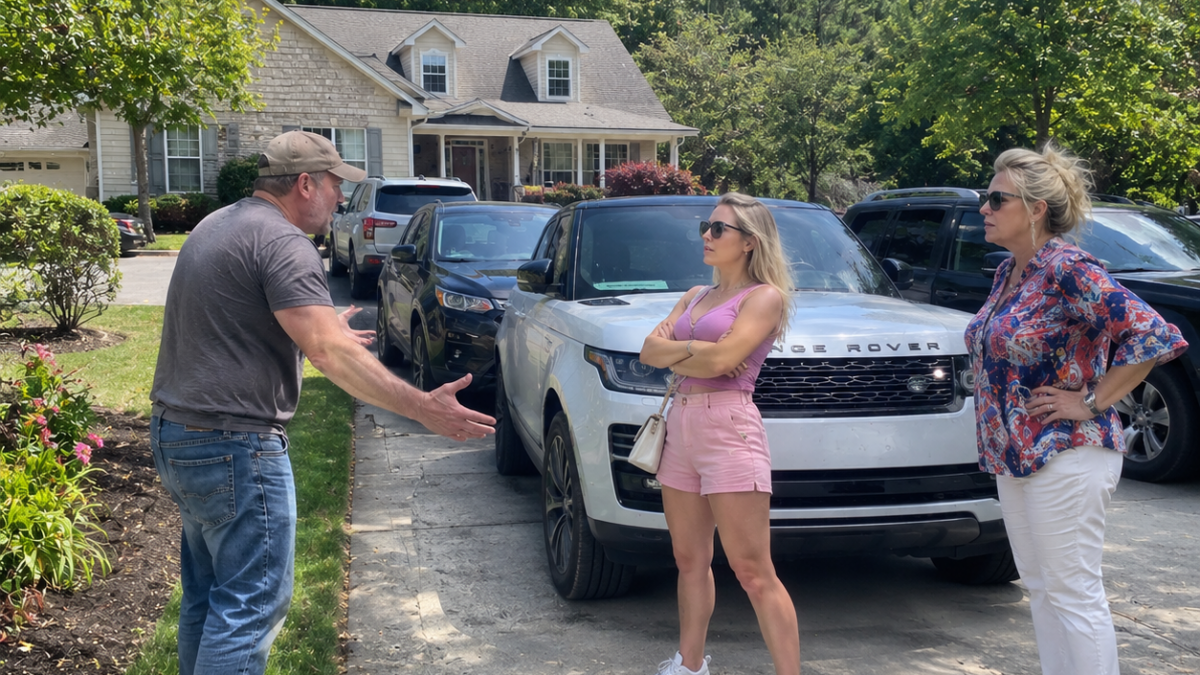
PART2
I looked at her.
She shrugged.
“Seriously. Try.”
Then she turned toward the narrow walking path that led through the hedge toward the Cedar Vale clubhouse.
She made it about fifteen feet before I called after her.
“What’s your name?”
She turned.
“You know who I am.”
“I know who your mother is.”
Her chin lifted.
“Madison Carlisle.”
“Good.”
“Why?”
“So the tow company knows who to ask for when you call.”
For the first time, she looked uncertain.
“You wouldn’t.”
I called Ray’s Recovery while she was still standing there.
She watched me.
I told dispatch I had an unauthorized vehicle blocking a posted private residential driveway.
They asked whether I was the property owner.
I said yes.
They asked whether the vehicle was occupied.
I looked at Madison.
“Not anymore.”
She stared at me.
The dispatcher said they could have a truck there soon.
I thanked her and hung up.
Madison walked back toward me.
“Cancel that.”
“No.”
“I was joking.”
“I wasn’t.”
“You can’t tow a resident’s vehicle from HOA parking.”
“It isn’t HOA parking.”
“My mom literally told me it is.”
“Then call your mom.”
Her face flushed.
“You’re seriously going to make me move because you want to prove some stupid point?”
“No. I asked you to move before I called anyone.”
“I’m not blocking you.”
I pointed at my pickup.
“You’re blocking a twenty-two-foot truck and a sixteen-foot trailer.”
“Use the grass.”
I stared at her.
She actually said it.
“Drive my truck across my lawn because you don’t want to move your Mercedes?”
“Oh my God. It’s grass.”
I nodded slowly.
“That explains a lot.”
“What does that mean?”
“It means call your mother.”
She did.
Immediately.
I could hear Brenda Carlisle’s voice through the phone even before Madison put it on speaker.
“Why is he bothering you?”
Madison looked directly at me.
“He says he’s towing my car.”
There was a pause.
Then Brenda said, “Put Jack on.”
Madison held the phone toward me.
I didn’t take it.
“You’re on speaker.”
Brenda’s voice became crisp.
“Jack, do not touch that vehicle.”
“I’m not touching it.”
“You know perfectly well that eastern access strip is available for community overflow parking.”
“No, Brenda. You’ve been saying that for months.”
“And the board confirmed it.”
“Boards don’t create property rights by voting.”
“Don’t start with the amateur-lawyer nonsense.”
I laughed once.
“Move the SUV.”
“That area appears on the Cedar Vale common-use map.”
“Not on the recorded plat.”
“You have been shown the association documentation.”
“You showed me a PDF.”
“A certified association map.”
“There’s no such thing as a magic HOA map.”
Madison smirked again.
Apparently hearing her mother take over had restored her confidence.
Brenda said, “I am giving you direct notice that Madison has permission to park there.”
“You can’t give permission to use my land.”
“Your land ends at the old hedgerow.”
“No.”
“Yes.”
“Then come show me the monument.”
Silence.
I knew exactly where the monument was.
Brenda apparently didn’t.
She recovered quickly.
“This childish confrontation is unnecessary.”
“Agreed.”
“So stop harassing my daughter.”
“Tell her to move.”
“I will not.”
“Then the tow truck can.”
Brenda’s tone sharpened.
“If you tow that vehicle, the association will hold you responsible for every dollar of damage, towing cost, storage fee, and legal expense.”
“Okay.”
“And we will pursue an enforcement action for interference with HOA property.”
“I’m not in your HOA.”
“You keep repeating that as though it answers every issue.”
“Usually it does.”
She hung up.
Madison smiled.
“You’re screwed.”
I looked at her.
“For towing a Mercedes?”
“For messing with my mom.”
Ten minutes later, a flatbed tow truck turned onto my driveway.
Madison stopped smiling.
The driver was a guy named Ray Mendoza.
I knew him from town.
He rolled down his window.
“Morning, Jack.”
“Ray.”
He looked at the Mercedes.
“This the one?”
Madison stepped in front of him.
“You can’t take my car.”
Ray killed the engine.
“You own it?”
“Yes.”
“You have permission from the property owner to park here?”
“My mother is president of Cedar Vale.”
Ray looked at me.
Then at her.
Then back at me.
“That a no?”
I said, “That’s a very long no.”
Madison pulled out her phone.
“I’m calling the sheriff.”
Ray shrugged.
“Do what you need to do.”
Apparently she expected that threat to stop everything.
It didn’t.
She called.
Ray photographed the vehicle and sign.
I signed the tow authorization.
Madison called Brenda again.
Brenda called Ray’s company.
Then Brenda called me.
I didn’t answer.
Then the first sheriff’s cruiser arrived.
Deputy Marcus Bell stepped out.
Madison rushed toward him.
“Thank God. This man is illegally towing my vehicle.”
Marcus looked at the Mercedes.
Then at me.
“Morning, Jack.”
“Morning.”
Madison’s eyes narrowed.
“You know him?”
Marcus said, “I know a lot of people.”
He looked at the sign.
Then the driveway.
Then Ray.
“What’s the issue?”
Madison launched into her version.
HOA overflow parking.
Community access strip.
Permission from association president.
Hostile homeowner.
Threatened towing.
Marcus listened.
Then looked at me.
“Your parcel?”
“Yes.”
“Any easement?”
“Road access for the utility company on the far edge. Nothing for parking.”
Madison interrupted.
“That’s not what my mom says.”
Marcus nodded.
“Does your mom have a deed or recorded easement?”
“She has HOA documents.”
He looked at me.
“You got your deed?”
“Inside.”
“Bring me a copy.”
I did.
The deed itself was old, but I also had a 2018 survey my father had commissioned when we replaced the drainage line.
The driveway was clearly inside Parcel 17-B.
My parcel.
The eastern boundary sat thirty-seven feet beyond the asphalt.
Marcus studied it.
Madison called Brenda again.
A black Lexus pulled into my driveway twelve minutes later.
Brenda Carlisle got out before the vehicle had fully settled.
She was in her late fifties, blond hair cut perfectly at the shoulders, white summer blazer, dark slacks, and the expression of a woman arriving to correct an employee.
She didn’t greet Marcus.
She pointed at the tow truck.
“Stop this immediately.”
Marcus said, “Morning, ma’am.”
Brenda marched toward Ray.
“I am Brenda Carlisle, president of the Cedar Vale Homeowners Association. You have no authorization to remove that vehicle.”
Ray held up the form.
“I’ve got authorization from the property owner.”
“He is not the owner of the parking strip.”
I raised the survey.
“Yes, I am.”
She didn’t look at it.
“Your outdated private survey conflicts with the association plan.”
Marcus said, “I’d like to see what you have.”
Brenda opened a leather folder.
Of course she had brought one.
She removed a glossy color map.
Yellow lots.
Green common areas.
Blue roads.
And along my driveway, a purple band labeled:
COMMUNITY ACCESS / TEMPORARY PARKING
I had seen it before.
The first time, it arrived attached to an email ordering me to stop placing garbage cans “within HOA-controlled access space.”
I had asked Brenda for the recorded instrument creating the purple band.
She never answered.
Now she handed the map to Marcus like she was presenting the Constitution.
“There.”
He looked at it.
“Recording number?”
Brenda blinked.
“What?”
“Where’s this recorded?”
“It’s maintained by the association.”
“That wasn’t my question.”
“It is based on the original development documents.”
“Which one creates the parking right?”
Her mouth tightened.
“This is a civil matter.”
That sentence told me she knew exactly what was happening.
Marcus nodded.
“Probably.”
Brenda relaxed.
Then he continued.
“But a civil dispute doesn’t automatically give your daughter the right to leave a vehicle blocking somebody’s driveway.”
“It is not his driveway.”
Marcus held the survey beside her map.
“County tax records identify the parcel as his.”
“We dispute the boundary.”
“You filed a boundary action?”
“No.”
“Survey?”
“The HOA has mapping.”
“Recorded survey?”
She stared at him.
“No.”
Marcus handed the glossy sheet back.
“I’m not stopping the tow.”
Madison’s mouth fell open.
“Seriously?”
Brenda’s face went red.
“You are taking sides in a property dispute.”
“No, ma’am. I’m declining to order a private towing company to ignore a property owner’s authorization based on an unrecorded HOA map.”
“This is unbelievable.”
Ray began positioning the flatbed.
Madison stepped toward her SUV.
Marcus said, “Ma’am, if you want to move it yourself before he hooks it, ask the property owner.”
Everyone looked at me.
Madison stared.
Brenda stared.
Ray waited.
I said, “She had that option twenty-five minutes ago.”
Madison’s face twisted.
“You’re such an asshole.”
Brenda snapped, “Do not speak to my daughter that way.”
I hadn’t said anything.
Marcus almost smiled.
Ray hooked the Mercedes.
Madison stood beside her mother and watched her SUV roll up the flatbed.
I expected embarrassment.
Maybe anger.
What I got was something else.
Brenda looked at me and smiled.
A cold little smile.
“You’ve made a mistake.”
I nodded toward the Mercedes.
“I think she did.”
“No.”
She stepped closer.
“You.”
Then she lowered her voice.
“You’ve just given me exactly what I needed.”
That sentence stayed with me.
Because the tow was supposed to end the problem.
Instead, it started the real one.
The following morning, I found a Cedar Vale violation notice taped to my mailbox.
UNAUTHORIZED INTERFERENCE WITH ASSOCIATION ACCESS
Fine: $500.
Daily continuing violation: $100.
I laughed.
Then I photographed it and mailed a copy back with:
NOT AN HOA MEMBER.
By Thursday, the fine had become $800.
Friday brought another notice.
OBSTRUCTION OF SHARED PARKING AREA
Monday:
HARASSMENT OF HOA RESIDENT / IMPROPER VEHICLE REMOVAL
Total claimed balance: $1,650.
I ignored all of them.
Then Brenda did something smarter.
She stopped sending fines to me.
She started sending letters to my mortgage company.
That got my attention.
The first letter asserted that Cedar Vale had a “continuing property interest” affecting part of my parcel.
The second alleged unresolved assessment obligations.
The third requested that my lender “preserve association lien priority.”
My bank called.
A woman from collateral services asked whether my property was subject to HOA covenants.
“No.”
“Cedar Vale says part of the tract is association-controlled.”
“They’re wrong.”
“Do you have title documentation?”
“Yes.”
“Can you send it?”
I did.
That was the day I called a property attorney.
Her name was Laura Bennett.
She specialized in land-use and title disputes and had the unnerving habit of becoming quieter when something interested her.
I showed her Brenda’s map.
She stared at the purple strip.
“Where did this come from?”
“HOA.”
“I know. Where did they say it came from?”
“Original development plan.”
“Recorded?”
“No idea.”
She looked at my survey.
Then my deed.
Then back at the HOA map.
“How old is Cedar Vale?”
“About nineteen years.”
“And your house?”
“My grandparents built it in 1974.”
“Driveway?”
“Older than that. It was farm access.”
Laura nodded.
“Let’s pull everything.”
We spent the next week doing exactly that.
County recorder.
Planning office.
Original subdivision plat.
Road dedication.
Utility easements.
Developer agreements.
Title chain.
Older aerial photographs.
The first thing we learned was that Brenda’s purple parking strip did not exist on any recorded Cedar Vale plat.
Not one.
The original development map showed my driveway as:
EXISTING PRIVATE ACCESS — NOT PART OF SUBDIVISION
That sentence alone should have ended the argument.
It didn’t.
Because the second thing we found was more interesting.
When Cedar Vale was approved, the county required a secondary emergency-access route.
The main subdivision entrance was on Oak Ridge Road.
But because the development had more than sixty homes, the fire marshal required a second route capable of supporting emergency vehicles.
The developer negotiated with my grandfather.
He granted a twenty-foot emergency-access easement across the far eastern edge of our property.
Not my driveway.
A gravel strip running parallel to it.
The easement ended behind the Cedar Vale clubhouse.
The language was extremely narrow.
Emergency vehicles.
Fire department drills.
Utility emergency repair.
No general resident traffic.
No parking.
No recreation.
No permanent structures.
And one more sentence:
Grantor retains full ownership and all uses not inconsistent with emergency access.
My grandfather had been careful.
Very careful.
The problem was that sometime around 2019, Cedar Vale had paved part of the emergency strip.
Then widened it.
Then connected it to the lower edge of my driveway.
Then started calling the entire area “community access.”
Nobody in my family had caught the extent of it because my father had been sick around that time.
He died in 2020.
I inherited the property.
And because the pavement blended together, I had assumed the little spur was still within the original easement.
It wasn’t.
Cedar Vale had expanded it by almost fourteen feet.
Onto my land.
Without permission.
Laura looked at the aerial photographs.
“That’s encroachment.”
“How bad?”
“Depends what they built.”
“Pavement.”
“Anything else?”
“Drainage box. Light pole.”
“Wonderful.”
“That doesn’t sound wonderful.”
“For them? No.”
Then we found the clubhouse site plan.
That was where Brenda’s motive became clear.
Cedar Vale had renovated its clubhouse two years earlier.
New pool deck.
Event room.
Kitchen.
Fitness wing.
The renovation eliminated fourteen parking spaces.
Residents complained constantly.
The HOA’s solution was to designate “temporary overflow parking” along the emergency-access strip.
Except the usable parking area they drew included my driveway shoulder.
Then my asphalt.
Then a gravel turnout beside my barn.
Brenda hadn’t invented the idea for Madison.
She had already been quietly treating my land as HOA parking.
The association had used it during three holiday events.
Two swim meets.
A board fundraiser.
And a graduation party.
I had been traveling during several of them.
The reason I hadn’t noticed earlier was simple.
People usually parked along the outer edge and left before I got home.
Madison was the first person entitled enough to block the actual driveway and then refuse to move.
Laura requested Cedar Vale board minutes.
They stalled.
She requested them again through formal channels.
That was when Brenda called me.
“You’ve hired an attorney.”
“Yes.”
“You could have avoided that expense.”
“So could you.”
She ignored it.
“We should resolve this neighbor-to-neighbor.”
“You sent letters to my mortgage company.”
“That was required notice.”
“No, it wasn’t.”
“You towed my daughter’s vehicle.”
“She blocked my driveway.”
“She had authorization.”
“From someone who didn’t own the land.”
Brenda’s voice cooled.
“You are taking an extremely aggressive position over an area this community has openly used for years.”
“There it is.”
“What?”
“Use.”
She paused.
I continued.
“This isn’t about Madison’s SUV anymore.”
“It never should have been.”
“No. It’s about the fact that you’ve been using my property as overflow parking.”
“We’ve maintained that area.”
“Paving somebody’s land doesn’t make it yours.”
“Our attorney disagrees with your interpretation.”
“Great. Have your attorney call mine.”
She didn’t.
Instead, three days later, Cedar Vale installed two new signs.
On my land.
CEDAR VALE GUEST PARKING
Six spaces.
Painted white lines.
Fresh.
I stood there at seven in the morning staring at them.
Someone had come overnight.
They had striped six parking spots along the edge of my driveway.
One stripe crossed the exact place Madison’s SUV had been towed from.
I called Laura.
She asked one question.
“Pictures?”
“About thirty.”
“Good.”
“What do I do with the signs?”
“Nothing yet.”
“I want them gone.”
“I know.”
“The paint?”
“Leave it.”
“Why?”
“Because Brenda just turned our argument into evidence.”
That afternoon, Cedar Vale sent an email to residents announcing new overflow spaces.
One resident forwarded it to me.
The email said:
The board has completed formal clarification of Cedar Vale’s long-established guest-parking rights adjacent to the eastern clubhouse corridor. Residents may use marked spaces without concern regarding improper towing.
Without concern regarding improper towing.
That was Brenda’s false victory.
She believed she had fixed the problem.
Madison’s tow embarrassed her.
So she did what she always did.
She made the HOA’s claim bigger.
More official.
More visible.
Instead of arguing that Madison had permission to use an ambiguous access area, Brenda had now painted parking spaces on my land and publicly announced that Cedar Vale controlled them.
Then she scheduled the annual summer meeting for Saturday.
At the clubhouse.
And invited residents to park in the new spaces.
Laura smiled when she heard.
“Go.”
“That’s your legal advice?”
“Absolutely.”
“Why?”
“Because I want her talking in front of witnesses.”
Saturday afternoon, cars filled the new spaces.
BMW.
Jeep.
Pickup.
Minivan.
A blue Tesla.
All lined up along my driveway.
I didn’t tow any of them.
That surprised Laura.
She asked why.
“Most of these people were told it’s legal.”
“Reasonable.”
I parked on my own grass instead.
Then walked into the Cedar Vale clubhouse.
The room held maybe seventy residents.
Brenda sat at the front table beneath a projector screen.
Madison sat in the second row.
When she saw me, she leaned toward a friend and whispered something.
They both laughed.
Brenda noticed me next.
Her smile appeared instantly.
“Jack. How nice.”
I took a seat near the back.
She opened the meeting with finances.
Pool repairs.
Landscaping.
Reserve fund.
Security cameras.
Then she reached “property clarification.”
A slide appeared.
It was her color map.
Purple strip and all.
Brenda stood.
“As many of you know, we recently experienced an unfortunate incident involving guest parking near the eastern clubhouse access.”
Madison turned around and looked at me.
Brenda continued.
“One neighboring property owner took it upon himself to tow an authorized vehicle despite long-established community use.”
People murmured.
I said nothing.
“The board has since completed its review and confirmed Cedar Vale’s right to maintain temporary parking within the highlighted corridor.”
A resident raised his hand.
“Is it ours?”
Brenda smiled.
“The corridor is subject to Cedar Vale control.”
That wasn’t an answer.
The man asked again.
“Do we own it?”
“It is part of the association’s access infrastructure.”
Laura, sitting two seats behind me, quietly wrote something on a legal pad.
Another resident asked, “Can he tow us?”
“No.”
Brenda looked directly at me.
“Not lawfully.”
Madison smirked.
There it was again.
The same expression from my driveway.
My mom said I can park here.
Brenda continued.
“The spaces have now been permanently marked to prevent further confusion.”
Permanently.
Laura wrote that down too.
Then a man near the front stood.
He introduced himself as Greg Palmer.
“Why wasn’t this parking available last year?”
Brenda said, “The board was still clarifying usage.”
“Clarifying with who?”
“The necessary parties.”
“Did Jack agree?”
The room got quieter.
Brenda’s jaw tightened.
“Mr. Mercer’s agreement is not required.”
Laura whispered behind me.
“Perfect.”
I almost laughed.
Greg looked toward me.
“Is that true?”
I stood.
Brenda immediately said, “This is not an open debate with nonmembers.”
I looked at Greg.
“No.”
Brenda slammed the gavel.
“You are out of order.”
I nodded.
“Then I’ll leave.”
That surprised her.
I walked out.
Laura followed.
In the parking lot, she said, “You handled that better than I expected.”
“Were you expecting me to steal the gavel?”
“Briefly.”
We stood beside the freshly painted spaces.
Six vehicles.
Six witnesses to Cedar Vale’s use.
Six examples of Brenda directing people onto my property after formal notice of a dispute.
Laura said, “Surveyor comes Monday.”
His name was Paul Warren.
He had been surveying property in the county for thirty-four years.
He arrived at seven-thirty with a two-man crew.
By nine, Cedar Vale security arrived.
Not real police.
Private security.
A man in khaki pants walked up.
“You can’t conduct work on HOA common property without authorization.”
Paul looked at me.
Then at him.
“Who are you?”
“Cedar Vale security.”
Paul pointed at his survey vest.
“I’m Paul Warren.”
The security guy waited.
Paul said, “That didn’t seem to help either of us.”
I turned away so he wouldn’t see me laughing.
The security officer called Brenda.
Brenda arrived twenty minutes later.
This time she brought the HOA attorney.
His name was Steven Pike.
Mid-fifties.
Gray suit.
Tired eyes.
He introduced himself to Laura.
They exchanged cards.
Then he looked at the survey crew.
“I understand there’s a boundary concern.”
Laura said, “There’s an encroachment concern.”
Brenda interrupted.
“We dispute that.”
Paul had already located the first original monument.
An iron pin buried beside the hedgerow.
He marked it with fluorescent flagging.
Then found the second.
And the third.
By eleven-thirty, the boundary was obvious.
The freshly painted Cedar Vale parking spaces were not close.
They were twelve to thirty-one feet inside my property.
Every single one.
The light pole was mine.
The drainage inlet was mine.
Part of the paved emergency lane was mine.
And the Cedar Vale map’s purple strip extended far beyond the actual easement.
Paul stretched a line between two pins.
Brenda stood beside it.
She looked toward the parking spaces.
Then back to Paul.
“That can’t be correct.”
He nodded.
“It is.”
“Your monument could have moved.”
“Three of them?”
“During construction.”
“These match the recorded plat and prior survey.”
Steven Pike asked to see the plat.
Paul handed it over.
Steven read.
Then looked at Brenda.
“Where did the purple map come from?”
She said, “Our property-management files.”
“Who prepared it?”
“The management company.”
“When?”
“I don’t know.”
Steven looked at Laura.
“Can we take a short break?”
Laura smiled.
“Of course.”
He and Brenda walked toward the clubhouse.
They argued for twelve minutes.
Not loudly enough to hear every word.
Loudly enough to catch pieces.
“…never told me…”
“…board relied on…”
“…not a recorded instrument…”
Then Brenda said something very clearly.
“Well, they’ve used it for years.”
Steven answered:
“That does not make it parking.”
When they returned, Brenda was furious.
Steven was pale.
He said, “The association will suspend parking in the disputed area pending review.”
Brenda snapped, “Temporary review.”
Laura said, “We’ll need the striping removed.”
Steven nodded.
“Reasonable.”
“The signs.”
“Yes.”
“Light pole.”
“We’ll discuss that.”
“Pavement.”
“That will require more discussion.”
Brenda stepped forward.
“We are not tearing up infrastructure based on one survey.”
Paul looked at her.
“You have a competing survey?”
“The HOA has mapping.”
Paul stared at her.
Then handed the glossy purple map back.
“That isn’t surveying.”
She hated him instantly.
By Tuesday, the parking signs were gone.
The paint remained.
That was when the county fire marshal entered the story.
Cedar Vale had recently applied for renewal of its clubhouse occupancy permit after renovation.
As part of that process, the HOA certified that it maintained an unobstructed secondary emergency corridor.
The corridor shown in the filing was not the actual twenty-foot easement.
It was Brenda’s widened purple strip.
The county planner saw Paul’s newly recorded survey and flagged the discrepancy.
Suddenly Cedar Vale had a problem much bigger than Madison’s tow bill.
The original emergency easement still existed.
But Cedar Vale had narrowed part of it with landscaping, a dumpster enclosure, and a decorative stone wall.
Then it had shifted the practical vehicle route onto my land.
For years, emergency vehicles had been using pavement outside the legal easement because the HOA itself had obstructed the original corridor.
The fire marshal, Dana Brooks, came out on Thursday.
She walked the entire route with Paul.
At the back of the clubhouse, she stopped beside the stone wall.
“This is inside the easement.”
Paul nodded.
“By four feet.”
She looked at Brenda.
“When was this built?”
“During renovation.”
“Permit?”
“The clubhouse renovation was permitted.”
“That wasn’t my question.”
Brenda looked at Steven.
He said nothing.
Dana measured.
Then looked at the dumpster enclosure.
Also inside the emergency easement.
Then the landscape island.
Also inside it.
She sighed.
“So you blocked the legal access and started using your neighbor’s land?”
Brenda’s face reddened.
“That is a gross oversimplification.”
Dana looked toward my driveway.
“It’s pretty accurate from here.”
Cedar Vale received a correction order.
Not a shutdown.
Not some theatrical evacuation.
A correction order.
Restore the legal emergency corridor.
Remove obstructions.
Provide updated plans.
Stop representing private property as part of the fire-access route.
And until the work was completed, no large clubhouse events exceeding a reduced occupancy threshold.
That last part made residents furious.
The pool stayed open.
The gym stayed open.
But the big wedding rentals, graduation parties, HOA events, and seasonal gatherings were restricted.
Brenda blamed me.
Naturally.
She sent another community email.
This one said:
Due to an aggressive boundary challenge initiated by an adjacent landowner, Cedar Vale is temporarily unable to use portions of its established emergency-access and overflow-parking corridor.
Laura read it.
Then looked at me.
“She really cannot help herself.”
I said, “Can we answer?”
“No.”
“Why not?”
“Because she keeps creating exhibits.”
The next exhibit arrived five days later.
A demand letter.
Cedar Vale accused me of interfering with an easement and demanded that I grant a permanent thirty-five-foot access-and-parking easement for one dollar.
One dollar.
I asked Laura whether that was a joke.
“No.”
“Why one dollar?”
“Because Brenda still thinks the HOA already owns the practical right. She wants you to sign something that cleans up the title.”
“So we’re back to ‘voluntary.’”
“Basically.”
“What if I say no?”
“You are going to say no.”
“I know. I just enjoy hearing it.”
Laura smiled.
“We counter.”
Cedar Vale needed my land.
That was now undeniable.
Not for the original emergency access.
They already had that.
They needed my land because they had spent money building their clubhouse in a way that made their own easement inconvenient.
Restoring the original route meant removing the stone wall.
Moving dumpsters.
Cutting out landscaping.
Regrading pavement.
Relocating drainage.
Their engineer estimated nearly $190,000.
Getting a wider easement from me would cost less.
Brenda assumed that gave her leverage.
It gave me leverage.
There was a special board meeting the following month.
This time, I was invited.
Officially.
My name appeared on the agenda:
EASTERN ACCESS RESOLUTION
I walked in with Laura and Paul.
The room was packed again.
Brenda sat at the center.
Madison wasn’t there.
Steven Pike was.
So was the HOA engineer.
Steven opened.
“The association has confirmed that certain historical improvements extend outside the recorded emergency easement.”
That was lawyer language for:
We built on Jack’s land.
He continued.
“The board has developed two potential remedies.”
Option one:
Restore the original twenty-foot emergency corridor entirely within the recorded easement.
Estimated cost: $187,000 to $230,000.
Option two:
Purchase an expanded easement from me.
Estimated construction cost after acquisition: approximately $48,000.
A resident asked, “How much does Jack want?”
Brenda answered before Steven could.
“An unreasonable amount.”
Laura looked at me.
I hadn’t given them an amount yet.
Steven said carefully, “Negotiations have not reached valuation.”
The resident frowned.
“Then how is it unreasonable?”
A few people laughed.
Brenda said, “Mr. Mercer has indicated he intends to leverage the situation.”
I stood.
“I indicated no such thing.”
She looked irritated.
“This is a board discussion.”
Steven said, “He is specifically invited to address the easement.”
Brenda stared at him.
He didn’t blink.
I walked to the front.
“I’m willing to sell Cedar Vale an expanded emergency-access easement.”
The room quieted.
“I’m not willing to give you parking.”
Someone asked why.
“Because I live there.”
A few residents nodded.
“My driveway is not a clubhouse parking lot. My barn isn’t overflow space. My lawn isn’t a shoulder. If Cedar Vale needs a wider emergency route, we can talk about a defined emergency route.”
Brenda said, “The association also needs occasional event flexibility.”
“No.”
“You’re being punitive.”
“No. I’m being clear.”
“You towed my daughter over two hours of parking.”
“She blocked my driveway after I asked her to move.”
Brenda’s face tightened.
I continued.
“And instead of admitting she was wrong, you painted six parking spaces on my property.”
Murmurs moved through the room.
Brenda said, “Based on maps available to the board.”
Paul stood from the side wall.
Steven visibly winced.
Paul carried a large plan tube.
He removed a mounted copy of the recorded subdivision plat.
Then placed it on an easel.
The title block was visible from across the room.
CEDAR VALE SUBDIVISION — FINAL RECORDED PLAT
He pointed to my boundary.
Then to the private-driveway notation.
Then to the emergency easement.
“The recorded documents are not ambiguous.”
Brenda interrupted.
“We’ve already heard your opinion.”
Paul looked at her.
“This isn’t an opinion.”
He pointed again.
“Here is Parcel 17-B.”
Then my driveway.
“Private.”
Then the easement.
“Twenty feet.”
Then Cedar Vale’s clubhouse improvements.
“Encroachments.”
He placed Brenda’s purple map beside the recorded plat.
“The HOA map moves this line.”
People leaned forward.
A resident said, “How far?”
“In places, more than thirty feet.”
Another asked, “Who made the HOA map?”
That question hung in the room.
Steven looked at Brenda.
Brenda looked at the board secretary.
The secretary looked down.
Finally Brenda said, “It was developed from management records.”
Paul asked, “By who?”
“This is not a deposition.”
“No.”
He stepped back.
“But somebody drew it.”
Laura stood.
“We know who.”
Brenda’s head snapped toward her.
Laura held up a document.
“Cedar Vale produced the source file last week.”
Steven closed his eyes.
That was when I knew something new had happened.
Laura had told me she found metadata.
She hadn’t told me the details.
She continued.
“The purple parking strip was added to the map in March of last year.”
Residents started whispering.
Brenda said, “That proves nothing.”
Laura looked at the board.
“The original file came from the management company. It showed the emergency-access easement correctly.”
She placed a printout beside Paul’s plat.
No purple strip.
No parking spaces.
Laura continued.
“A revised version was created eleven days later.”
Purple strip.
“Created on a Cedar Vale office computer assigned to the board president.”
The room became silent.
Brenda’s mouth opened.
Laura wasn’t finished.
“The file name was changed from ‘Emergency Access Reference’ to ‘Community Access Parking Map.’”
Steven looked down at his papers.
One of the board members, Carl Benton, stared at Brenda.
“You made that map?”
“No.”
“The computer was yours.”
“It’s an association computer.”
“Who had access?”
“Multiple people.”
The board secretary said quietly, “Not really.”
Brenda looked at her.
The secretary swallowed.
“You keep it locked in your office.”
Brenda’s voice sharpened.
“Linda.”
“I’m just saying.”
Carl asked, “Did we ever vote to create overflow parking there?”
Brenda hesitated.
“That usage was handled administratively.”
“Did we vote?”
“No formal vote was necessary.”
Another board member asked, “Did counsel approve it?”
Steven Pike spoke before she could answer.
“No.”
Everyone looked at him.
He continued.
“My firm was not asked whether Cedar Vale had parking rights over Mr. Mercer’s parcel before the towing incident.”
Brenda stared at him.
“You reviewed the access issue.”
“Emergency access.”
“You knew residents parked there.”
“I knew residents occasionally parked near the clubhouse. I did not know the association had painted spaces on private property.”
A resident shouted, “Then why did Brenda tell us Jack couldn’t tow us?”
No one answered.
The room went quiet again.
Then Carl Benton asked the question Brenda had been avoiding for months.
“Brenda, did you know that driveway was Jack’s when Madison parked there?”
Her face changed.
Not much.
Enough.
She said, “I believed the association had a longstanding use right.”
“That’s not what I asked.”
“Our practical use—”
“Did you know the recorded plat said it was private?”
Silence.
Carl leaned forward.
“You’ve been president three years. You chaired the clubhouse renovation. You signed the fire-access filing. Did you know?”
Brenda looked toward Steven.
He did not rescue her.
Finally she said, “I was aware the original plat contained historical language.”
Historical language.
I almost laughed.
Carl didn’t.
“The words ‘existing private access’ are historical language?”
Brenda raised her voice.
“You are simplifying a complex property issue.”
“No.”
Carl pointed toward the maps.
“I’m asking why you made a new map.”
“I did not personally—”
Linda, the secretary, spoke again.
“You emailed it to me.”
Brenda turned.
Linda had her phone out.
“You wrote, ‘I expanded the shaded corridor to reflect actual community use.’”
The room exploded.
People talked over one another.
“Actual use?”
“So she just drew it bigger?”
“Are you kidding?”
“That’s why we’re paying lawyers?”
Brenda stood.
“Everybody calm down.”
Nobody did.
She grabbed the microphone.
“This association has used that corridor openly for years. The revised map reflected facts on the ground.”
I finally understood her.
Completely.
She believed the use justified the claim.
Not eventually.
Already.
If residents parked somewhere long enough, it became parking.
If Cedar Vale paved something, it became access.
If she shaded a map purple, the deed was outdated.
Ownership, to Brenda, was something flexible.
Power wasn’t.
Carl said, “Did you direct Madison to park there?”
Brenda stared at him.
“That has nothing to do with the access problem.”
“It started the access problem.”
“No. Jack started this by towing an authorized resident.”
I spoke.
“She was authorized by you.”
“Yes.”
“Based on a map you expanded.”
“Based on established use.”
“On my property.”
“Disputed property.”
Paul said, “It isn’t disputed anymore.”
Brenda slammed the microphone down.
“I am not going to let one neighboring homeowner hold eighty-six families hostage over a driveway.”
That sentence was the mistake.
Because until then, some residents still saw me as part of the problem.
Then Greg Palmer stood.
“Who’s holding us hostage?”
Brenda looked at him.
“Excuse me?”
“Jack said he’ll grant an emergency easement.”
“Yes, but—”
“He said no parking.”
“That creates operational limitations.”
Greg laughed.
“You mean your daughter can’t park there.”
Someone else clapped.
Then another.
Brenda looked around the room and realized the audience had shifted.
Laura stepped forward.
“My client’s proposal is simple.”
She passed copies down the rows.
Twenty-eight-foot emergency-access easement.
Enough for fire apparatus.
Defined drainage rights.
Maintenance obligations.
No resident parking.
No storage.
No dumpsters.
No landscaping obstructions.
No clubhouse-event use.
Cedar Vale would pay appraised value.
It would remove all parking striping.
Restore the driveway shoulder.
Relocate the light pole.
Pay the survey and legal costs associated with correcting the encroachment.
In exchange, I would grant the expanded emergency access permanently.
A resident asked, “How much?”
Laura answered.
“Independent appraisal: $42,500 for the permanent easement and related construction impacts.”
The room was quiet.
Everyone had expected a ridiculous number.
Brenda had practically promised them one.
Carl said, “That’s less than a quarter of the reconstruction estimate.”
The engineer nodded.
“Yes.”
Brenda said, “It does not include parking.”
I looked at her.
“No.”
“We need event parking.”
“Build it on HOA land.”
“The clubhouse site is constrained.”
“That’s not my problem.”
She stared at me.
“You are doing this because Madison embarrassed you.”
“No.”
“You could allow six spaces.”
“I could.”
“Then why won’t you?”
“Because the first time I let you turn my driveway into a parking lot, the next board will point to that use and say it was always parking.”
She opened her mouth.
I continued.
“And because you spent months proving I was right not to trust an informal arrangement.”
That ended it.
The board voted.
Four to one.
Approve negotiations based on my proposed easement.
Brenda was the one.
The following morning, she emailed the board announcing that she was reconsidering whether the vote was valid.
By lunchtime, Carl had requested a special recall meeting.
By evening, enough residents had signed the petition.
Brenda lasted nineteen more days as president.
At the recall meeting, she gave a twenty-minute defense.
She blamed outdated plats.
Previous boards.
The developer.
The management company.
The county.
Me.
The tow company.
Even the fire marshal.
She said nothing about Madison until a resident asked directly.
“Would any of this have happened if your daughter had just moved her SUV?”
Brenda stared at him.
Then said:
“That is an unfairly simplistic characterization.”
The room laughed.
Not cruelly.
More like everybody finally understood how absurd the whole thing was.
The recall passed.
Seventy-one percent.
Brenda was removed as president.
She stayed on the board for another week.
Then resigned.
The new board signed the easement three months later.
Cedar Vale paid $42,500.
They paid Paul’s survey bill.
They paid part of my attorney fees under the settlement.
They moved the light pole.
Removed the parking paint.
Rebuilt the shoulder.
Cut back the decorative wall.
Moved the dumpster enclosure.
The original emergency corridor became usable again, and the expanded easement gave fire trucks a safer turning radius without swallowing my driveway.
The six “guest parking” spaces disappeared permanently.
The HOA also sent a letter to my bank withdrawing every suggestion that Cedar Vale had lien rights against my parcel.
That mattered more than the money.
Madison’s SUV stayed at Ray’s yard for three days after the original tow.
Apparently she refused to pay because Brenda kept insisting the HOA would force Ray to release it.
Ray did not.
Brenda eventually paid.
Tow plus storage.
I heard the bill was $638.
For months, that was the number people remembered.
They treated $638 like the punchline.
It wasn’t.
The real price was much higher.
Surveying.
Attorneys.
Engineering.
Corrective construction.
Fire-access work.
Settlement costs.
Brenda’s insistence that one Mercedes had a right to sit in my driveway ended up costing Cedar Vale more than $100,000 when everything was finished.
I didn’t enjoy that part.
Most residents hadn’t done anything wrong.
They were paying because their president refused to admit a boundary existed.
The new president was Greg Palmer.
His first official conversation with me happened at the end of my driveway.
He stood on the Cedar Vale side of the survey pin.
Actually checked where his boots were.
Then smiled.
“Is here okay?”
I laughed.
“You’re safe.”
He handed me a folder.
Inside was a copy of the newly recorded easement.
Highlighted properly.
No purple fantasy strip.
No overflow parking.
No language games.
Just the legal description.
He said, “We’re putting this in every future board orientation packet.”
“Good.”
“Along with the subdivision plat.”
“Better.”
“And a note that says your driveway is not guest parking.”
“That one feels unnecessary.”
Greg shrugged.
“History suggests otherwise.”
A month later, Cedar Vale installed a small sign at the clubhouse exit.
EVENT PARKING — HOA LOT ONLY
DO NOT PARK ON ADJACENT PRIVATE PROPERTY
I took a picture.
Sent it to Ray.
He replied:
Frame it.
I almost did.
Brenda didn’t move away immediately.
For a while, I still saw her Lexus driving past.
She never waved.
Neither did I.
Madison visited less often.
The first time I saw her after everything settled, she was driving the same white Mercedes.
She slowed near my driveway.
For half a second, I wondered whether she would do something stupid.
Instead she kept going.
That was good enough for me.
One evening the following summer, Cedar Vale held another barbecue.
Music drifted through the hedge.
Kids were in the pool.
Cars filled the clubhouse lot.
When the lot filled, people parked farther down Cedar Vale’s own streets and walked.
Nobody parked in my driveway.
Nobody blocked the barn.
Nobody painted lines.
Nobody sent me a notice.
Around sunset, Greg walked over carrying two paper plates.
“Peace offering.”
“Did I declare war?”
“According to the previous administration, several times.”
He handed me one.
Burger.
Potato salad.
Corn.
I looked toward the clubhouse.
“Am I violating HOA catering rules?”
“Probably.”
“Excellent.”
We sat on the low stone wall beside my garage.
After a minute, Greg said, “Can I ask you something?”
“Sure.”
“Why didn’t you tow everybody at that board meeting?”
I knew exactly what he meant.
The day Brenda had filled my freshly painted “guest spaces” with residents.
“I thought about it.”
“I would’ve.”
“No, you wouldn’t.”
“Probably not.”
I looked toward the hedge.
“Most of those people honestly believed Brenda.”
He nodded.
“They had a map.”
“A fake one.”
“Modified.”
“Fake enough.”
He laughed.
Then got serious.
“She really believed use mattered more than the deed.”
“I know.”
“Is there any situation where it could?”
“Ask Laura.”
“No thanks. She bills by the hour.”
That made me laugh.
The truth was more complicated than any one-liner.
Property disputes can be complicated.
Easements matter.
Historical use matters.
Recorded documents matter.
State law matters.
Facts matter.
But none of that gave Brenda the right to rewrite a boundary with purple shading because Cedar Vale needed more parking.
And none of it gave Madison the right to block my truck after being told to leave.
People sometimes ask whether I regret towing the Mercedes.
No.
I regret that it took a tow truck to expose how far the problem had already spread.
By the time Madison parked there, Cedar Vale had already paved beyond its easement.
Already obstructed the real emergency lane.
Already started using private land for events.
Already created a modified map.
Already begun talking about my driveway as though association use had somehow converted it into association property.
Madison didn’t create the entitlement.
She inherited it.
“My mom said I can park here.”
That sentence only sounded ridiculous because she said the quiet part out loud.
Brenda had been saying the same thing for years with nicer stationery.
The board says we can use this.
The association map says we control this.
Residents have always used this.
We maintain it.
We need it.
None of those sentences answered the only question that mattered.
Who owns it?
Today there’s a brass survey marker near the east edge of my driveway.
You wouldn’t notice it unless you were looking.
Paul set it flush with the ground after the final easement was recorded.
Sometimes when Cedar Vale has a big event, cars line the road all the way to the clubhouse.
They stop at that marker.
Every time.
Greg once joked that it was the most respected six-inch piece of metal in the county.
Maybe.
I still have the photograph from the morning this started.
Madison leaning against her Mercedes.
Sunglasses on.
Iced coffee in hand.
That private-parking sign behind her.
If you didn’t know what happened afterward, it would look like nothing.
Just a young woman parked somewhere she shouldn’t.
But that single SUV exposed an altered HOA map, years of unauthorized parking, pavement built outside an easement, a blocked emergency corridor, and a board president who genuinely believed her title gave her the power to turn somebody else’s driveway into community property.
Madison told me her mother said she could park there.
The tow truck proved her mother could say whatever she wanted.
The recorded plat was the thing that decided whether it was true.
REVIEW
HOA Karen’s Daughter Turned My Private Driveway Into Her Reserved Parking Spot—Then the Recorded Plat Exposed What Her Mom Had Been Claiming as HOA Land
“My mom said I can park here.”
The young woman leaning against the hood of the white Mercedes SUV said it with a smile that made it clear she wasn’t explaining anything.
She was informing me.
Her SUV was sitting dead center in my driveway.
Not near it.
Not partly across the apron.
Not with two tires touching the grass.
Dead center.
Twenty feet from my garage.
Blocking my truck, my utility trailer, and the only way I could get a tractor from the barn to the county road.
I looked at the Mercedes.
Then at her.
Then at the red-and-white sign mounted on the cedar post six feet away.
PRIVATE DRIVEWAY
NO HOA PARKING
UNAUTHORIZED VEHICLES WILL BE TOWED
“You can read that?” I asked.
Her smile widened.
She was maybe twenty-three or twenty-four, wearing sunglasses big enough to hide half her face and holding an iced coffee like she had arrived for brunch instead of trespassing.
“I saw it.”
“Then move your SUV.”
She laughed.
Not nervously.
Not politely.
Actually laughed.
“My mom said this section is HOA overflow parking.”
“Your mom is wrong.”
“She’s the HOA president.”
“I’m aware.”
“So?”
“So she doesn’t own my driveway.”
The young woman pushed herself away from the hood.
“Look, I’m going to the pool for like two hours. There’s no parking by the clubhouse because of the summer barbecue, and Mom told me residents and guests can use this side.”
“This side of what?”
“The access lane.”
I looked down at the asphalt under her tires.
“My driveway?”
She gave me the kind of patient expression people use with children.
“It’s not really just your driveway.”
That sentence told me exactly where the conversation was going.
I had heard versions of it from her mother for almost a year.
It’s not really your shoulder.
It’s not really your fence line.
It’s not really your drainage ditch.
It’s not really private because Cedar Vale maintains the landscaping nearby.
Apparently property became communal whenever Brenda Carlisle wanted something.
I took out my phone.
Her expression changed slightly.
“What are you doing?”
“Taking a picture.”
“Of me?”
“Of the SUV blocking my driveway.”
She rolled her eyes.
“You’re being dramatic.”
I photographed the license plate, the position of the vehicle, and the private-parking sign.
Then I walked around the front and took another picture showing my truck trapped beside the garage.
She crossed her arms.
“My mother already told you the HOA has a parking easement.”
“No. Your mother sent me an unrecorded map with yellow highlighter on it.”
“It came from the HOA.”
“That doesn’t make it an easement.”
“She has attorneys.”
“I’m sure they’re thrilled.”
The smile disappeared.
“You know what? Tow it if you’re so bothered.”
I looked at her.
She shrugged.
“Seriously. Try.”
Then she turned toward the narrow walking path that led through the hedge toward the Cedar Vale clubhouse.
She made it about fifteen feet before I called after her.
“What’s your name?”
She turned.
“You know who I am.”
“I know who your mother is.”
Her chin lifted.
“Madison Carlisle.”
“Good.”
“Why?”
“So the tow company knows who to ask for when you call.”
For the first time, she looked uncertain.
“You wouldn’t.”
I called Ray’s Recovery while she was still standing there.
She watched me.
I told dispatch I had an unauthorized vehicle blocking a posted private residential driveway.
They asked whether I was the property owner.
I said yes.
They asked whether the vehicle was occupied.
I looked at Madison.
“Not anymore.”
She stared at me.
The dispatcher said they could have a truck there soon.
I thanked her and hung up.
Madison walked back toward me.
“Cancel that.”
“No.”
“I was joking.”
“I wasn’t.”
“You can’t tow a resident’s vehicle from HOA parking.”
“It isn’t HOA parking.”
“My mom literally told me it is.”
“Then call your mom.”
Her face flushed.
“You’re seriously going to make me move because you want to prove some stupid point?”
“No. I asked you to move before I called anyone.”
“I’m not blocking you.”
I pointed at my pickup.
“You’re blocking a twenty-two-foot truck and a sixteen-foot trailer.”
“Use the grass.”
I stared at her.
She actually said it.
“Drive my truck across my lawn because you don’t want to move your Mercedes?”
“Oh my God. It’s grass.”
I nodded slowly.
“That explains a lot.”
“What does that mean?”
“It means call your mother.”
She did.
Immediately.
I could hear Brenda Carlisle’s voice through the phone even before Madison put it on speaker.
“Why is he bothering you?”
Madison looked directly at me.
“He says he’s towing my car.”
There was a pause.
Then Brenda said, “Put Jack on.”
Madison held the phone toward me.
I didn’t take it.
“You’re on speaker.”
Brenda’s voice became crisp.
“Jack, do not touch that vehicle.”
“I’m not touching it.”
“You know perfectly well that eastern access strip is available for community overflow parking.”
“No, Brenda. You’ve been saying that for months.”
“And the board confirmed it.”
“Boards don’t create property rights by voting.”
“Don’t start with the amateur-lawyer nonsense.”
I laughed once.
“Move the SUV.”
“That area appears on the Cedar Vale common-use map.”
“Not on the recorded plat.”
“You have been shown the association documentation.”
“You showed me a PDF.”
“A certified association map.”
“There’s no such thing as a magic HOA map.”
Madison smirked again.
Apparently hearing her mother take over had restored her confidence.
Brenda said, “I am giving you direct notice that Madison has permission to park there.”
“You can’t give permission to use my land.”
“Your land ends at the old hedgerow.”
“No.”
“Yes.”
“Then come show me the monument.”
Silence.
I knew exactly where the monument was.
Brenda apparently didn’t.
She recovered quickly.
“This childish confrontation is unnecessary.”
“Agreed.”
“So stop harassing my daughter.”
“Tell her to move.”
“I will not.”
“Then the tow truck can.”
Brenda’s tone sharpened.
“If you tow that vehicle, the association will hold you responsible for every dollar of damage, towing cost, storage fee, and legal expense.”
“Okay.”
“And we will pursue an enforcement action for interference with HOA property.”
“I’m not in your HOA.”
“You keep repeating that as though it answers every issue.”
“Usually it does.”
She hung up.
Madison smiled.
“You’re screwed.”
I looked at her.
“For towing a Mercedes?”
“For messing with my mom.”
Ten minutes later, a flatbed tow truck turned onto my driveway.
Madison stopped smiling.
The driver was a guy named Ray Mendoza.
I knew him from town.
He rolled down his window.
“Morning, Jack.”
“Ray.”
He looked at the Mercedes.
“This the one?”
Madison stepped in front of him.
“You can’t take my car.”
Ray killed the engine.
“You own it?”
“Yes.”
“You have permission from the property owner to park here?”
“My mother is president of Cedar Vale.”
Ray looked at me.
Then at her.
Then back at me.
“That a no?”
I said, “That’s a very long no.”
Madison pulled out her phone.
“I’m calling the sheriff.”
Ray shrugged.
“Do what you need to do.”
Apparently she expected that threat to stop everything.
It didn’t.
She called.
Ray photographed the vehicle and sign.
I signed the tow authorization.
Madison called Brenda again.
Brenda called Ray’s company.
Then Brenda called me.
I didn’t answer.
Then the first sheriff’s cruiser arrived.
Deputy Marcus Bell stepped out.
Madison rushed toward him.
“Thank God. This man is illegally towing my vehicle.”
Marcus looked at the Mercedes.
Then at me.
“Morning, Jack.”
“Morning.”
Madison’s eyes narrowed.
“You know him?”
Marcus said, “I know a lot of people.”
He looked at the sign.
Then the driveway.
Then Ray.
“What’s the issue?”
Madison launched into her version.
HOA overflow parking.
Community access strip.
Permission from association president.
Hostile homeowner.
Threatened towing.
Marcus listened.
Then looked at me.
“Your parcel?”
“Yes.”
“Any easement?”
“Road access for the utility company on the far edge. Nothing for parking.”
Madison interrupted.
“That’s not what my mom says.”
Marcus nodded.
“Does your mom have a deed or recorded easement?”
“She has HOA documents.”
He looked at me.
“You got your deed?”
“Inside.”
“Bring me a copy.”
I did.
The deed itself was old, but I also had a 2018 survey my father had commissioned when we replaced the drainage line.
The driveway was clearly inside Parcel 17-B.
My parcel.
The eastern boundary sat thirty-seven feet beyond the asphalt.
Marcus studied it.
Madison called Brenda again.
A black Lexus pulled into my driveway twelve minutes later.
Brenda Carlisle got out before the vehicle had fully settled.
She was in her late fifties, blond hair cut perfectly at the shoulders, white summer blazer, dark slacks, and the expression of a woman arriving to correct an employee.
She didn’t greet Marcus.
She pointed at the tow truck.
“Stop this immediately.”
Marcus said, “Morning, ma’am.”
Brenda marched toward Ray.
“I am Brenda Carlisle, president of the Cedar Vale Homeowners Association. You have no authorization to remove that vehicle.”
Ray held up the form.
“I’ve got authorization from the property owner.”
“He is not the owner of the parking strip.”
I raised the survey.
“Yes, I am.”
She didn’t look at it.
“Your outdated private survey conflicts with the association plan.”
Marcus said, “I’d like to see what you have.”
Brenda opened a leather folder.
Of course she had brought one.
She removed a glossy color map.
Yellow lots.
Green common areas.
Blue roads.
And along my driveway, a purple band labeled:
COMMUNITY ACCESS / TEMPORARY PARKING
I had seen it before.
The first time, it arrived attached to an email ordering me to stop placing garbage cans “within HOA-controlled access space.”
I had asked Brenda for the recorded instrument creating the purple band.
She never answered.
Now she handed the map to Marcus like she was presenting the Constitution.
“There.”
He looked at it.
“Recording number?”
Brenda blinked.
“What?”
“Where’s this recorded?”
“It’s maintained by the association.”
“That wasn’t my question.”
“It is based on the original development documents.”
“Which one creates the parking right?”
Her mouth tightened.
“This is a civil matter.”
That sentence told me she knew exactly what was happening.
Marcus nodded.
“Probably.”
Brenda relaxed.
Then he continued.
“But a civil dispute doesn’t automatically give your daughter the right to leave a vehicle blocking somebody’s driveway.”
“It is not his driveway.”
Marcus held the survey beside her map.
“County tax records identify the parcel as his.”
“We dispute the boundary.”
“You filed a boundary action?”
“No.”
“Survey?”
“The HOA has mapping.”
“Recorded survey?”
She stared at him.
“No.”
Marcus handed the glossy sheet back.
“I’m not stopping the tow.”
Madison’s mouth fell open.
“Seriously?”
Brenda’s face went red.
“You are taking sides in a property dispute.”
“No, ma’am. I’m declining to order a private towing company to ignore a property owner’s authorization based on an unrecorded HOA map.”
“This is unbelievable.”
Ray began positioning the flatbed.
Madison stepped toward her SUV.
Marcus said, “Ma’am, if you want to move it yourself before he hooks it, ask the property owner.”
Everyone looked at me.
Madison stared.
Brenda stared.
Ray waited.
I said, “She had that option twenty-five minutes ago.”
Madison’s face twisted.
“You’re such an asshole.”
Brenda snapped, “Do not speak to my daughter that way.”
I hadn’t said anything.
Marcus almost smiled.
Ray hooked the Mercedes.
Madison stood beside her mother and watched her SUV roll up the flatbed.
I expected embarrassment.
Maybe anger.
What I got was something else.
Brenda looked at me and smiled.
A cold little smile.
“You’ve made a mistake.”
I nodded toward the Mercedes.
“I think she did.”
“No.”
She stepped closer.
“You.”
Then she lowered her voice.
“You’ve just given me exactly what I needed.”
That sentence stayed with me.
Because the tow was supposed to end the problem.
Instead, it started the real one.
The following morning, I found a Cedar Vale violation notice taped to my mailbox.
UNAUTHORIZED INTERFERENCE WITH ASSOCIATION ACCESS
Fine: $500.
Daily continuing violation: $100.
I laughed.
Then I photographed it and mailed a copy back with:
NOT AN HOA MEMBER.
By Thursday, the fine had become $800.
Friday brought another notice.
OBSTRUCTION OF SHARED PARKING AREA
Monday:
HARASSMENT OF HOA RESIDENT / IMPROPER VEHICLE REMOVAL
Total claimed balance: $1,650.
I ignored all of them.
Then Brenda did something smarter.
She stopped sending fines to me.
She started sending letters to my mortgage company.
That got my attention.
The first letter asserted that Cedar Vale had a “continuing property interest” affecting part of my parcel.
The second alleged unresolved assessment obligations.
The third requested that my lender “preserve association lien priority.”
My bank called.
A woman from collateral services asked whether my property was subject to HOA covenants.
“No.”
“Cedar Vale says part of the tract is association-controlled.”
“They’re wrong.”
“Do you have title documentation?”
“Yes.”
“Can you send it?”
I did.
That was the day I called a property attorney.
Her name was Laura Bennett.
She specialized in land-use and title disputes and had the unnerving habit of becoming quieter when something interested her.
I showed her Brenda’s map.
She stared at the purple strip.
“Where did this come from?”
“HOA.”
“I know. Where did they say it came from?”
“Original development plan.”
“Recorded?”
“No idea.”
She looked at my survey.
Then my deed.
Then back at the HOA map.
“How old is Cedar Vale?”
“About nineteen years.”
“And your house?”
“My grandparents built it in 1974.”
“Driveway?”
“Older than that. It was farm access.”
Laura nodded.
“Let’s pull everything.”
We spent the next week doing exactly that.
County recorder.
Planning office.
Original subdivision plat.
Road dedication.
Utility easements.
Developer agreements.
Title chain.
Older aerial photographs.
The first thing we learned was that Brenda’s purple parking strip did not exist on any recorded Cedar Vale plat.
Not one.
The original development map showed my driveway as:
EXISTING PRIVATE ACCESS — NOT PART OF SUBDIVISION
That sentence alone should have ended the argument.
It didn’t.
Because the second thing we found was more interesting.
When Cedar Vale was approved, the county required a secondary emergency-access route.
The main subdivision entrance was on Oak Ridge Road.
But because the development had more than sixty homes, the fire marshal required a second route capable of supporting emergency vehicles.
The developer negotiated with my grandfather.
He granted a twenty-foot emergency-access easement across the far eastern edge of our property.
Not my driveway.
A gravel strip running parallel to it.
The easement ended behind the Cedar Vale clubhouse.
The language was extremely narrow.
Emergency vehicles.
Fire department drills.
Utility emergency repair.
No general resident traffic.
No parking.
No recreation.
No permanent structures.
And one more sentence:
Grantor retains full ownership and all uses not inconsistent with emergency access.
My grandfather had been careful.
Very careful.
The problem was that sometime around 2019, Cedar Vale had paved part of the emergency strip.
Then widened it.
Then connected it to the lower edge of my driveway.
Then started calling the entire area “community access.”
Nobody in my family had caught the extent of it because my father had been sick around that time.
He died in 2020.
I inherited the property.
And because the pavement blended together, I had assumed the little spur was still within the original easement.
It wasn’t.
Cedar Vale had expanded it by almost fourteen feet.
Onto my land.
Without permission.
Laura looked at the aerial photographs.
“That’s encroachment.”
“How bad?”
“Depends what they built.”
“Pavement.”
“Anything else?”
“Drainage box. Light pole.”
“Wonderful.”
“That doesn’t sound wonderful.”
“For them? No.”
Then we found the clubhouse site plan.
That was where Brenda’s motive became clear.
Cedar Vale had renovated its clubhouse two years earlier.
New pool deck.
Event room.
Kitchen.
Fitness wing.
The renovation eliminated fourteen parking spaces.
Residents complained constantly.
The HOA’s solution was to designate “temporary overflow parking” along the emergency-access strip.
Except the usable parking area they drew included my driveway shoulder.
Then my asphalt.
Then a gravel turnout beside my barn.
Brenda hadn’t invented the idea for Madison.
She had already been quietly treating my land as HOA parking.
The association had used it during three holiday events.
Two swim meets.
A board fundraiser.
And a graduation party.
I had been traveling during several of them.
The reason I hadn’t noticed earlier was simple.
People usually parked along the outer edge and left before I got home.
Madison was the first person entitled enough to block the actual driveway and then refuse to move.
Laura requested Cedar Vale board minutes.
They stalled.
She requested them again through formal channels.
That was when Brenda called me.
“You’ve hired an attorney.”
“Yes.”
“You could have avoided that expense.”
“So could you.”
She ignored it.
“We should resolve this neighbor-to-neighbor.”
“You sent letters to my mortgage company.”
“That was required notice.”
“No, it wasn’t.”
“You towed my daughter’s vehicle.”
“She blocked my driveway.”
“She had authorization.”
“From someone who didn’t own the land.”
Brenda’s voice cooled.
“You are taking an extremely aggressive position over an area this community has openly used for years.”
“There it is.”
“What?”
“Use.”
She paused.
I continued.
“This isn’t about Madison’s SUV anymore.”
“It never should have been.”
“No. It’s about the fact that you’ve been using my property as overflow parking.”
“We’ve maintained that area.”
“Paving somebody’s land doesn’t make it yours.”
“Our attorney disagrees with your interpretation.”
“Great. Have your attorney call mine.”
She didn’t.
Instead, three days later, Cedar Vale installed two new signs.
On my land.
CEDAR VALE GUEST PARKING
Six spaces.
Painted white lines.
Fresh.
I stood there at seven in the morning staring at them.
Someone had come overnight.
They had striped six parking spots along the edge of my driveway.
One stripe crossed the exact place Madison’s SUV had been towed from.
I called Laura.
She asked one question.
“Pictures?”
“About thirty.”
“Good.”
“What do I do with the signs?”
“Nothing yet.”
“I want them gone.”
“I know.”
“The paint?”
“Leave it.”
“Why?”
“Because Brenda just turned our argument into evidence.”
That afternoon, Cedar Vale sent an email to residents announcing new overflow spaces.
One resident forwarded it to me.
The email said:
The board has completed formal clarification of Cedar Vale’s long-established guest-parking rights adjacent to the eastern clubhouse corridor. Residents may use marked spaces without concern regarding improper towing.
Without concern regarding improper towing.
That was Brenda’s false victory.
She believed she had fixed the problem.
Madison’s tow embarrassed her.
So she did what she always did.
She made the HOA’s claim bigger.
More official.
More visible.
Instead of arguing that Madison had permission to use an ambiguous access area, Brenda had now painted parking spaces on my land and publicly announced that Cedar Vale controlled them.
Then she scheduled the annual summer meeting for Saturday.
At the clubhouse.
And invited residents to park in the new spaces.
Laura smiled when she heard.
“Go.”
“That’s your legal advice?”
“Absolutely.”
“Why?”
“Because I want her talking in front of witnesses.”
Saturday afternoon, cars filled the new spaces.
BMW.
Jeep.
Pickup.
Minivan.
A blue Tesla.
All lined up along my driveway.
I didn’t tow any of them.
That surprised Laura.
She asked why.
“Most of these people were told it’s legal.”
“Reasonable.”
I parked on my own grass instead.
Then walked into the Cedar Vale clubhouse.
The room held maybe seventy residents.
Brenda sat at the front table beneath a projector screen.
Madison sat in the second row.
When she saw me, she leaned toward a friend and whispered something.
They both laughed.
Brenda noticed me next.
Her smile appeared instantly.
“Jack. How nice.”
I took a seat near the back.
She opened the meeting with finances.
Pool repairs.
Landscaping.
Reserve fund.
Security cameras.
Then she reached “property clarification.”
A slide appeared.
It was her color map.
Purple strip and all.
Brenda stood.
“As many of you know, we recently experienced an unfortunate incident involving guest parking near the eastern clubhouse access.”
Madison turned around and looked at me.
Brenda continued.
“One neighboring property owner took it upon himself to tow an authorized vehicle despite long-established community use.”
People murmured.
I said nothing.
“The board has since completed its review and confirmed Cedar Vale’s right to maintain temporary parking within the highlighted corridor.”
A resident raised his hand.
“Is it ours?”
Brenda smiled.
“The corridor is subject to Cedar Vale control.”
That wasn’t an answer.
The man asked again.
“Do we own it?”
“It is part of the association’s access infrastructure.”
Laura, sitting two seats behind me, quietly wrote something on a legal pad.
Another resident asked, “Can he tow us?”
“No.”
Brenda looked directly at me.
“Not lawfully.”
Madison smirked.
There it was again.
The same expression from my driveway.
My mom said I can park here.
Brenda continued.
“The spaces have now been permanently marked to prevent further confusion.”
Permanently.
Laura wrote that down too.
Then a man near the front stood.
He introduced himself as Greg Palmer.
“Why wasn’t this parking available last year?”
Brenda said, “The board was still clarifying usage.”
“Clarifying with who?”
“The necessary parties.”
“Did Jack agree?”
The room got quieter.
Brenda’s jaw tightened.
“Mr. Mercer’s agreement is not required.”
Laura whispered behind me.
“Perfect.”
I almost laughed.
Greg looked toward me.
“Is that true?”
I stood.
Brenda immediately said, “This is not an open debate with nonmembers.”
I looked at Greg.
“No.”
Brenda slammed the gavel.
“You are out of order.”
I nodded.
“Then I’ll leave.”
That surprised her.
I walked out.
Laura followed.
In the parking lot, she said, “You handled that better than I expected.”
“Were you expecting me to steal the gavel?”
“Briefly.”
We stood beside the freshly painted spaces.
Six vehicles.
Six witnesses to Cedar Vale’s use.
Six examples of Brenda directing people onto my property after formal notice of a dispute.
Laura said, “Surveyor comes Monday.”
His name was Paul Warren.
He had been surveying property in the county for thirty-four years.
He arrived at seven-thirty with a two-man crew.
By nine, Cedar Vale security arrived.
Not real police.
Private security.
A man in khaki pants walked up.
“You can’t conduct work on HOA common property without authorization.”
Paul looked at me.
Then at him.
“Who are you?”
“Cedar Vale security.”
Paul pointed at his survey vest.
“I’m Paul Warren.”
The security guy waited.
Paul said, “That didn’t seem to help either of us.”
I turned away so he wouldn’t see me laughing.
The security officer called Brenda.
Brenda arrived twenty minutes later.
This time she brought the HOA attorney.
His name was Steven Pike.
Mid-fifties.
Gray suit.
Tired eyes.
He introduced himself to Laura.
They exchanged cards.
Then he looked at the survey crew.
“I understand there’s a boundary concern.”
Laura said, “There’s an encroachment concern.”
Brenda interrupted.
“We dispute that.”
Paul had already located the first original monument.
An iron pin buried beside the hedgerow.
He marked it with fluorescent flagging.
Then found the second.
And the third.
By eleven-thirty, the boundary was obvious.
The freshly painted Cedar Vale parking spaces were not close.
They were twelve to thirty-one feet inside my property.
Every single one.
The light pole was mine.
The drainage inlet was mine.
Part of the paved emergency lane was mine.
And the Cedar Vale map’s purple strip extended far beyond the actual easement.
Paul stretched a line between two pins.
Brenda stood beside it.
She looked toward the parking spaces.
Then back to Paul.
“That can’t be correct.”
He nodded.
“It is.”
“Your monument could have moved.”
“Three of them?”
“During construction.”
“These match the recorded plat and prior survey.”
Steven Pike asked to see the plat.
Paul handed it over.
Steven read.
Then looked at Brenda.
“Where did the purple map come from?”
She said, “Our property-management files.”
“Who prepared it?”
“The management company.”
“When?”
“I don’t know.”
Steven looked at Laura.
“Can we take a short break?”
Laura smiled.
“Of course.”
He and Brenda walked toward the clubhouse.
They argued for twelve minutes.
Not loudly enough to hear every word.
Loudly enough to catch pieces.
“…never told me…”
“…board relied on…”
“…not a recorded instrument…”
Then Brenda said something very clearly.
“Well, they’ve used it for years.”
Steven answered:
“That does not make it parking.”
When they returned, Brenda was furious.
Steven was pale.
He said, “The association will suspend parking in the disputed area pending review.”
Brenda snapped, “Temporary review.”
Laura said, “We’ll need the striping removed.”
Steven nodded.
“Reasonable.”
“The signs.”
“Yes.”
“Light pole.”
“We’ll discuss that.”
“Pavement.”
“That will require more discussion.”
Brenda stepped forward.
“We are not tearing up infrastructure based on one survey.”
Paul looked at her.
“You have a competing survey?”
“The HOA has mapping.”
Paul stared at her.
Then handed the glossy purple map back.
“That isn’t surveying.”
She hated him instantly.
By Tuesday, the parking signs were gone.
The paint remained.
That was when the county fire marshal entered the story.
Cedar Vale had recently applied for renewal of its clubhouse occupancy permit after renovation.
As part of that process, the HOA certified that it maintained an unobstructed secondary emergency corridor.
The corridor shown in the filing was not the actual twenty-foot easement.
It was Brenda’s widened purple strip.
The county planner saw Paul’s newly recorded survey and flagged the discrepancy.
Suddenly Cedar Vale had a problem much bigger than Madison’s tow bill.
The original emergency easement still existed.
But Cedar Vale had narrowed part of it with landscaping, a dumpster enclosure, and a decorative stone wall.
Then it had shifted the practical vehicle route onto my land.
For years, emergency vehicles had been using pavement outside the legal easement because the HOA itself had obstructed the original corridor.
The fire marshal, Dana Brooks, came out on Thursday.
She walked the entire route with Paul.
At the back of the clubhouse, she stopped beside the stone wall.
“This is inside the easement.”
Paul nodded.
“By four feet.”
She looked at Brenda.
“When was this built?”
“During renovation.”
“Permit?”
“The clubhouse renovation was permitted.”
“That wasn’t my question.”
Brenda looked at Steven.
He said nothing.
Dana measured.
Then looked at the dumpster enclosure.
Also inside the emergency easement.
Then the landscape island.
Also inside it.
She sighed.
“So you blocked the legal access and started using your neighbor’s land?”
Brenda’s face reddened.
“That is a gross oversimplification.”
Dana looked toward my driveway.
“It’s pretty accurate from here.”
Cedar Vale received a correction order.
Not a shutdown.
Not some theatrical evacuation.
A correction order.
Restore the legal emergency corridor.
Remove obstructions.
Provide updated plans.
Stop representing private property as part of the fire-access route.
And until the work was completed, no large clubhouse events exceeding a reduced occupancy threshold.
That last part made residents furious.
The pool stayed open.
The gym stayed open.
But the big wedding rentals, graduation parties, HOA events, and seasonal gatherings were restricted.
Brenda blamed me.
Naturally.
She sent another community email.
This one said:
Due to an aggressive boundary challenge initiated by an adjacent landowner, Cedar Vale is temporarily unable to use portions of its established emergency-access and overflow-parking corridor.
Laura read it.
Then looked at me.
“She really cannot help herself.”
I said, “Can we answer?”
“No.”
“Why not?”
“Because she keeps creating exhibits.”
The next exhibit arrived five days later.
A demand letter.
Cedar Vale accused me of interfering with an easement and demanded that I grant a permanent thirty-five-foot access-and-parking easement for one dollar.
One dollar.
I asked Laura whether that was a joke.
“No.”
“Why one dollar?”
“Because Brenda still thinks the HOA already owns the practical right. She wants you to sign something that cleans up the title.”
“So we’re back to ‘voluntary.’”
“Basically.”
“What if I say no?”
“You are going to say no.”
“I know. I just enjoy hearing it.”
Laura smiled.
“We counter.”
Cedar Vale needed my land.
That was now undeniable.
Not for the original emergency access.
They already had that.
They needed my land because they had spent money building their clubhouse in a way that made their own easement inconvenient.
Restoring the original route meant removing the stone wall.
Moving dumpsters.
Cutting out landscaping.
Regrading pavement.
Relocating drainage.
Their engineer estimated nearly $190,000.
Getting a wider easement from me would cost less.
Brenda assumed that gave her leverage.
It gave me leverage.
There was a special board meeting the following month.
This time, I was invited.
Officially.
My name appeared on the agenda:
EASTERN ACCESS RESOLUTION
I walked in with Laura and Paul.
The room was packed again.
Brenda sat at the center.
Madison wasn’t there.
Steven Pike was.
So was the HOA engineer.
Steven opened.
“The association has confirmed that certain historical improvements extend outside the recorded emergency easement.”
That was lawyer language for:
We built on Jack’s land.
He continued.
“The board has developed two potential remedies.”
Option one:
Restore the original twenty-foot emergency corridor entirely within the recorded easement.
Estimated cost: $187,000 to $230,000.
Option two:
Purchase an expanded easement from me.
Estimated construction cost after acquisition: approximately $48,000.
A resident asked, “How much does Jack want?”
Brenda answered before Steven could.
“An unreasonable amount.”
Laura looked at me.
I hadn’t given them an amount yet.
Steven said carefully, “Negotiations have not reached valuation.”
The resident frowned.
“Then how is it unreasonable?”
A few people laughed.
Brenda said, “Mr. Mercer has indicated he intends to leverage the situation.”
I stood.
“I indicated no such thing.”
She looked irritated.
“This is a board discussion.”
Steven said, “He is specifically invited to address the easement.”
Brenda stared at him.
He didn’t blink.
I walked to the front.
“I’m willing to sell Cedar Vale an expanded emergency-access easement.”
The room quieted.
“I’m not willing to give you parking.”
Someone asked why.
“Because I live there.”
A few residents nodded.
“My driveway is not a clubhouse parking lot. My barn isn’t overflow space. My lawn isn’t a shoulder. If Cedar Vale needs a wider emergency route, we can talk about a defined emergency route.”
Brenda said, “The association also needs occasional event flexibility.”
“No.”
“You’re being punitive.”
“No. I’m being clear.”
“You towed my daughter over two hours of parking.”
“She blocked my driveway after I asked her to move.”
Brenda’s face tightened.
I continued.
“And instead of admitting she was wrong, you painted six parking spaces on my property.”
Murmurs moved through the room.
Brenda said, “Based on maps available to the board.”
Paul stood from the side wall.
Steven visibly winced.
Paul carried a large plan tube.
He removed a mounted copy of the recorded subdivision plat.
Then placed it on an easel.
The title block was visible from across the room.
CEDAR VALE SUBDIVISION — FINAL RECORDED PLAT
He pointed to my boundary.
Then to the private-driveway notation.
Then to the emergency easement.
“The recorded documents are not ambiguous.”
Brenda interrupted.
“We’ve already heard your opinion.”
Paul looked at her.
“This isn’t an opinion.”
He pointed again.
“Here is Parcel 17-B.”
Then my driveway.
“Private.”
Then the easement.
“Twenty feet.”
Then Cedar Vale’s clubhouse improvements.
“Encroachments.”
He placed Brenda’s purple map beside the recorded plat.
“The HOA map moves this line.”
People leaned forward.
A resident said, “How far?”
“In places, more than thirty feet.”
Another asked, “Who made the HOA map?”
That question hung in the room.
Steven looked at Brenda.
Brenda looked at the board secretary.
The secretary looked down.
Finally Brenda said, “It was developed from management records.”
Paul asked, “By who?”
“This is not a deposition.”
“No.”
He stepped back.
“But somebody drew it.”
Laura stood.
“We know who.”
Brenda’s head snapped toward her.
Laura held up a document.
“Cedar Vale produced the source file last week.”
Steven closed his eyes.
That was when I knew something new had happened.
Laura had told me she found metadata.
She hadn’t told me the details.
She continued.
“The purple parking strip was added to the map in March of last year.”
Residents started whispering.
Brenda said, “That proves nothing.”
Laura looked at the board.
“The original file came from the management company. It showed the emergency-access easement correctly.”
She placed a printout beside Paul’s plat.
No purple strip.
No parking spaces.
Laura continued.
“A revised version was created eleven days later.”
Purple strip.
“Created on a Cedar Vale office computer assigned to the board president.”
The room became silent.
Brenda’s mouth opened.
Laura wasn’t finished.
“The file name was changed from ‘Emergency Access Reference’ to ‘Community Access Parking Map.’”
Steven looked down at his papers.
One of the board members, Carl Benton, stared at Brenda.
“You made that map?”
“No.”
“The computer was yours.”
“It’s an association computer.”
“Who had access?”
“Multiple people.”
The board secretary said quietly, “Not really.”
Brenda looked at her.
The secretary swallowed.
“You keep it locked in your office.”
Brenda’s voice sharpened.
“Linda.”
“I’m just saying.”
Carl asked, “Did we ever vote to create overflow parking there?”
Brenda hesitated.
“That usage was handled administratively.”
“Did we vote?”
“No formal vote was necessary.”
Another board member asked, “Did counsel approve it?”
Steven Pike spoke before she could answer.
“No.”
Everyone looked at him.
He continued.
“My firm was not asked whether Cedar Vale had parking rights over Mr. Mercer’s parcel before the towing incident.”
Brenda stared at him.
“You reviewed the access issue.”
“Emergency access.”
“You knew residents parked there.”
“I knew residents occasionally parked near the clubhouse. I did not know the association had painted spaces on private property.”
A resident shouted, “Then why did Brenda tell us Jack couldn’t tow us?”
No one answered.
The room went quiet again.
Then Carl Benton asked the question Brenda had been avoiding for months.
“Brenda, did you know that driveway was Jack’s when Madison parked there?”
Her face changed.
Not much.
Enough.
She said, “I believed the association had a longstanding use right.”
“That’s not what I asked.”
“Our practical use—”
“Did you know the recorded plat said it was private?”
Silence.
Carl leaned forward.
“You’ve been president three years. You chaired the clubhouse renovation. You signed the fire-access filing. Did you know?”
Brenda looked toward Steven.
He did not rescue her.
Finally she said, “I was aware the original plat contained historical language.”
Historical language.
I almost laughed.
Carl didn’t.
“The words ‘existing private access’ are historical language?”
Brenda raised her voice.
“You are simplifying a complex property issue.”
“No.”
Carl pointed toward the maps.
“I’m asking why you made a new map.”
“I did not personally—”
Linda, the secretary, spoke again.
“You emailed it to me.”
Brenda turned.
Linda had her phone out.
“You wrote, ‘I expanded the shaded corridor to reflect actual community use.’”
The room exploded.
People talked over one another.
“Actual use?”
“So she just drew it bigger?”
“Are you kidding?”
“That’s why we’re paying lawyers?”
Brenda stood.
“Everybody calm down.”
Nobody did.
She grabbed the microphone.
“This association has used that corridor openly for years. The revised map reflected facts on the ground.”
I finally understood her.
Completely.
She believed the use justified the claim.
Not eventually.
Already.
If residents parked somewhere long enough, it became parking.
If Cedar Vale paved something, it became access.
If she shaded a map purple, the deed was outdated.
Ownership, to Brenda, was something flexible.
Power wasn’t.
Carl said, “Did you direct Madison to park there?”
Brenda stared at him.
“That has nothing to do with the access problem.”
“It started the access problem.”
“No. Jack started this by towing an authorized resident.”
I spoke.
“She was authorized by you.”
“Yes.”
“Based on a map you expanded.”
“Based on established use.”
“On my property.”
“Disputed property.”
Paul said, “It isn’t disputed anymore.”
Brenda slammed the microphone down.
“I am not going to let one neighboring homeowner hold eighty-six families hostage over a driveway.”
That sentence was the mistake.
Because until then, some residents still saw me as part of the problem.
Then Greg Palmer stood.
“Who’s holding us hostage?”
Brenda looked at him.
“Excuse me?”
“Jack said he’ll grant an emergency easement.”
“Yes, but—”
“He said no parking.”
“That creates operational limitations.”
Greg laughed.
“You mean your daughter can’t park there.”
Someone else clapped.
Then another.
Brenda looked around the room and realized the audience had shifted.
Laura stepped forward.
“My client’s proposal is simple.”
She passed copies down the rows.
Twenty-eight-foot emergency-access easement.
Enough for fire apparatus.
Defined drainage rights.
Maintenance obligations.
No resident parking.
No storage.
No dumpsters.
No landscaping obstructions.
No clubhouse-event use.
Cedar Vale would pay appraised value.
It would remove all parking striping.
Restore the driveway shoulder.
Relocate the light pole.
Pay the survey and legal costs associated with correcting the encroachment.
In exchange, I would grant the expanded emergency access permanently.
A resident asked, “How much?”
Laura answered.
“Independent appraisal: $42,500 for the permanent easement and related construction impacts.”
The room was quiet.
Everyone had expected a ridiculous number.
Brenda had practically promised them one.
Carl said, “That’s less than a quarter of the reconstruction estimate.”
The engineer nodded.
“Yes.”
Brenda said, “It does not include parking.”
I looked at her.
“No.”
“We need event parking.”
“Build it on HOA land.”
“The clubhouse site is constrained.”
“That’s not my problem.”
She stared at me.
“You are doing this because Madison embarrassed you.”
“No.”
“You could allow six spaces.”
“I could.”
“Then why won’t you?”
“Because the first time I let you turn my driveway into a parking lot, the next board will point to that use and say it was always parking.”
She opened her mouth.
I continued.
“And because you spent months proving I was right not to trust an informal arrangement.”
That ended it.
The board voted.
Four to one.
Approve negotiations based on my proposed easement.
Brenda was the one.
The following morning, she emailed the board announcing that she was reconsidering whether the vote was valid.
By lunchtime, Carl had requested a special recall meeting.
By evening, enough residents had signed the petition.
Brenda lasted nineteen more days as president.
At the recall meeting, she gave a twenty-minute defense.
She blamed outdated plats.
Previous boards.
The developer.
The management company.
The county.
Me.
The tow company.
Even the fire marshal.
She said nothing about Madison until a resident asked directly.
“Would any of this have happened if your daughter had just moved her SUV?”
Brenda stared at him.
Then said:
“That is an unfairly simplistic characterization.”
The room laughed.
Not cruelly.
More like everybody finally understood how absurd the whole thing was.
The recall passed.
Seventy-one percent.
Brenda was removed as president.
She stayed on the board for another week.
Then resigned.
The new board signed the easement three months later.
Cedar Vale paid $42,500.
They paid Paul’s survey bill.
They paid part of my attorney fees under the settlement.
They moved the light pole.
Removed the parking paint.
Rebuilt the shoulder.
Cut back the decorative wall.
Moved the dumpster enclosure.
The original emergency corridor became usable again, and the expanded easement gave fire trucks a safer turning radius without swallowing my driveway.
The six “guest parking” spaces disappeared permanently.
The HOA also sent a letter to my bank withdrawing every suggestion that Cedar Vale had lien rights against my parcel.
That mattered more than the money.
Madison’s SUV stayed at Ray’s yard for three days after the original tow.
Apparently she refused to pay because Brenda kept insisting the HOA would force Ray to release it.
Ray did not.
Brenda eventually paid.
Tow plus storage.
I heard the bill was $638.
For months, that was the number people remembered.
They treated $638 like the punchline.
It wasn’t.
The real price was much higher.
Surveying.
Attorneys.
Engineering.
Corrective construction.
Fire-access work.
Settlement costs.
Brenda’s insistence that one Mercedes had a right to sit in my driveway ended up costing Cedar Vale more than $100,000 when everything was finished.
I didn’t enjoy that part.
Most residents hadn’t done anything wrong.
They were paying because their president refused to admit a boundary existed.
The new president was Greg Palmer.
His first official conversation with me happened at the end of my driveway.
He stood on the Cedar Vale side of the survey pin.
Actually checked where his boots were.
Then smiled.
“Is here okay?”
I laughed.
“You’re safe.”
He handed me a folder.
Inside was a copy of the newly recorded easement.
Highlighted properly.
No purple fantasy strip.
No overflow parking.
No language games.
Just the legal description.
He said, “We’re putting this in every future board orientation packet.”
“Good.”
“Along with the subdivision plat.”
“Better.”
“And a note that says your driveway is not guest parking.”
“That one feels unnecessary.”
Greg shrugged.
“History suggests otherwise.”
A month later, Cedar Vale installed a small sign at the clubhouse exit.
EVENT PARKING — HOA LOT ONLY
DO NOT PARK ON ADJACENT PRIVATE PROPERTY
I took a picture.
Sent it to Ray.
He replied:
Frame it.
I almost did.
Brenda didn’t move away immediately.
For a while, I still saw her Lexus driving past.
She never waved.
Neither did I.
Madison visited less often.
The first time I saw her after everything settled, she was driving the same white Mercedes.
She slowed near my driveway.
For half a second, I wondered whether she would do something stupid.
Instead she kept going.
That was good enough for me.
One evening the following summer, Cedar Vale held another barbecue.
Music drifted through the hedge.
Kids were in the pool.
Cars filled the clubhouse lot.
When the lot filled, people parked farther down Cedar Vale’s own streets and walked.
Nobody parked in my driveway.
Nobody blocked the barn.
Nobody painted lines.
Nobody sent me a notice.
Around sunset, Greg walked over carrying two paper plates.
“Peace offering.”
“Did I declare war?”
“According to the previous administration, several times.”
He handed me one.
Burger.
Potato salad.
Corn.
I looked toward the clubhouse.
“Am I violating HOA catering rules?”
“Probably.”
“Excellent.”
We sat on the low stone wall beside my garage.
After a minute, Greg said, “Can I ask you something?”
“Sure.”
“Why didn’t you tow everybody at that board meeting?”
I knew exactly what he meant.
The day Brenda had filled my freshly painted “guest spaces” with residents.
“I thought about it.”
“I would’ve.”
“No, you wouldn’t.”
“Probably not.”
I looked toward the hedge.
“Most of those people honestly believed Brenda.”
He nodded.
“They had a map.”
“A fake one.”
“Modified.”
“Fake enough.”
He laughed.
Then got serious.
“She really believed use mattered more than the deed.”
“I know.”
“Is there any situation where it could?”
“Ask Laura.”
“No thanks. She bills by the hour.”
That made me laugh.
The truth was more complicated than any one-liner.
Property disputes can be complicated.
Easements matter.
Historical use matters.
Recorded documents matter.
State law matters.
Facts matter.
But none of that gave Brenda the right to rewrite a boundary with purple shading because Cedar Vale needed more parking.
And none of it gave Madison the right to block my truck after being told to leave.
People sometimes ask whether I regret towing the Mercedes.
No.
I regret that it took a tow truck to expose how far the problem had already spread.
By the time Madison parked there, Cedar Vale had already paved beyond its easement.
Already obstructed the real emergency lane.
Already started using private land for events.
Already created a modified map.
Already begun talking about my driveway as though association use had somehow converted it into association property.
Madison didn’t create the entitlement.
She inherited it.
“My mom said I can park here.”
That sentence only sounded ridiculous because she said the quiet part out loud.
Brenda had been saying the same thing for years with nicer stationery.
The board says we can use this.
The association map says we control this.
Residents have always used this.
We maintain it.
We need it.
None of those sentences answered the only question that mattered.
Who owns it?
Today there’s a brass survey marker near the east edge of my driveway.
You wouldn’t notice it unless you were looking.
Paul set it flush with the ground after the final easement was recorded.
Sometimes when Cedar Vale has a big event, cars line the road all the way to the clubhouse.
They stop at that marker.
Every time.
Greg once joked that it was the most respected six-inch piece of metal in the county.
Maybe.
I still have the photograph from the morning this started.
Madison leaning against her Mercedes.
Sunglasses on.
Iced coffee in hand.
That private-parking sign behind her.
If you didn’t know what happened afterward, it would look like nothing.
Just a young woman parked somewhere she shouldn’t.
But that single SUV exposed an altered HOA map, years of unauthorized parking, pavement built outside an easement, a blocked emergency corridor, and a board president who genuinely believed her title gave her the power to turn somebody else’s driveway into community property.
Madison told me her mother said she could park there.
The tow truck proved her mother could say whatever she wanted.
The recorded plat was the thing that decided whether it was true.