HOA President’s Son Slammed My Daughter to the Asphalt—Then She Learned My Brother Trains SWAT
PART2
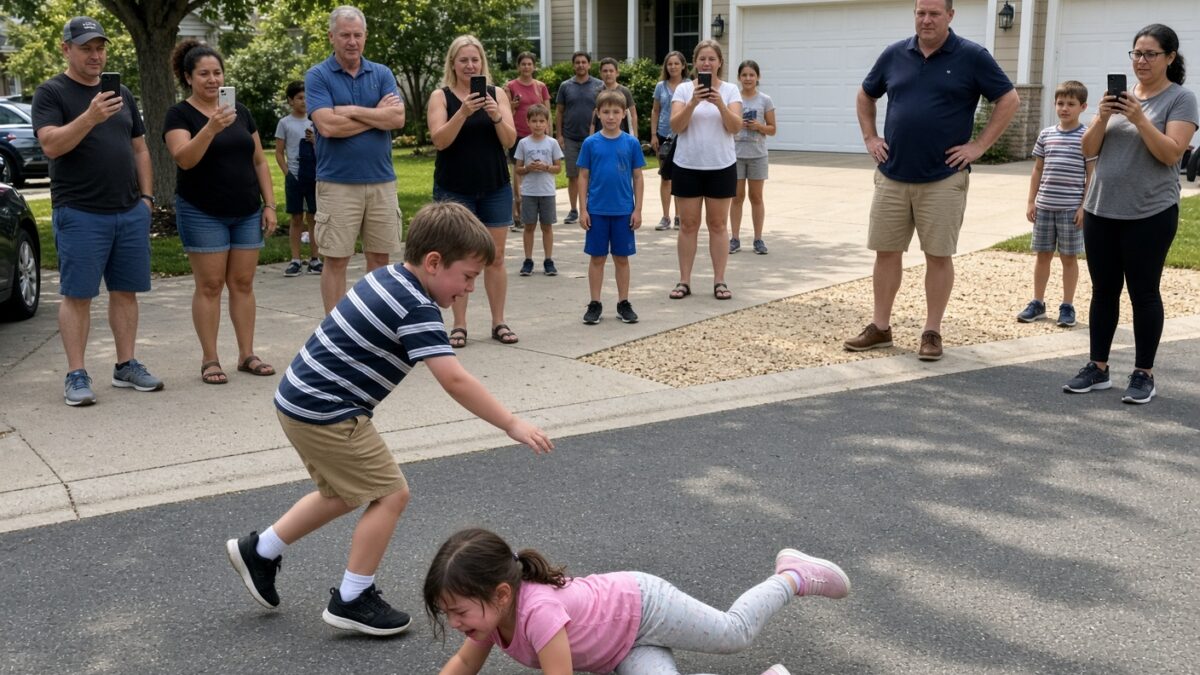
Lily whispered:
“I wasn’t running.”
Daphne ignored her.
“She entered the lane in front of my son. There was contact. She lost her balance.”
I looked at her son.
“What happened?”
Daphne answered for him.
“I just told you.”
“I asked him.”
Her jaw tightened.
The boy shrugged.
“She got in my way.”
“And?”
“I moved her.”
“How?”
Another shrug.
“With my hands.”
Lily’s fingers tightened around mine.
I asked:
“You pushed her?”
He gave a small smirk.
“So?”
Daphne shot him a warning look.
Not the horrified look of a mother realizing her son had admitted hurting a child.
The look of a lawyer watching a witness ruin a prepared story.
She snapped:
“Go inside.”
He rolled his eyes.
“Mom—”
“Now.”
He walked away muttering.
I watched him go.
Then looked at Daphne.
“You still want to call that a fall?”
“You’re making this dramatic.”
“My daughter is bleeding.”
“She has scrapes.”
“Her wrist is swelling.”
“Children get hurt.”
“He admitted pushing her.”
“He said he moved her.”
I stared at her.
“You actually think changing the verb changes what happened?”
Daphne pulled her binder against her chest.
“Your daughter was in a restricted driving area.”
“The yellow divider?”
“Yes.”
“That is not restricted.”
“It is a traffic-control lane.”
“You removed the pedestrian-yield sign there last month.”
“The sign was outdated.”
“And now your son is using the same lane to justify putting his hands on a smaller child.”
Her expression hardened.
“You need to lower your voice.”
My voice had never risen.
That seemed to bother her more.
A few neighbors had begun gathering.
Nobody came too close.
That was typical around Daphne Crowell.
Silver Ridge had lived under her version of order for three years.
Violation notices.
Fines.
Hearings.
Compliance inspections.
Warnings about landscaping.
Warnings about parking.
Warnings about holiday decorations.
Warnings about other warnings.
People joked privately that Daphne could find a violation in an empty room.
They rarely joked where she could hear them.
She had convinced half the neighborhood that challenging her meant months of paperwork and legal bills.
I had never been particularly impressed.
Daphne looked around at the growing number of witnesses and changed her tone.
“Reed, I’m trying to prevent this situation from becoming uglier than it needs to be.”
“Then start with the truth.”
“I have told you the truth.”
“No. You gave me a version.”
Her lips thinned.
“You’re not an investigator.”
“No.”
I crouched beside Lily again.
“But I know what a force pattern looks like.”
Daphne scoffed.
“This is a neighborhood parking lot, not a war zone.”
“That depends on who keeps turning ordinary situations into battles.”
She shifted her weight.
For the first time, I saw a tiny fracture in her certainty.
She knew what I had done professionally.
What she did not know was how much of that work involved reconstructing injuries.
I gently turned Lily’s hand.
She winced.
“Sorry, sweetheart.”
“It’s okay.”
I pointed toward her upper arm.
“That mark came from a hand.”
Daphne shook her head.
“You cannot possibly know that.”
“I can know it didn’t come from asphalt.”
“You are not qualified to accuse my son of assault.”
“I’m qualified to recognize that somebody pushed my daughter.”
Daphne took a step closer.
“Be extremely careful what you say next.”
That got my full attention.
“Why?”
“Because making false accusations against a minor can have consequences.”
“So can putting your hands on somebody.”
Her eyes flashed.
“Is that a threat?”
“No.”
I lifted Lily carefully.
She wrapped one arm around my neck.
“This is me telling you I’m going to document what happened and handle it properly.”
She stared at me.
Then I added:
“And before you try to bury this under HOA paperwork, remember something.”
“What?”
“My brother spent ten years training SWAT recruits.”
The change in her expression was small.
A slower blink.
A slight tightening around the mouth.
Then she recovered.
“Is that supposed to intimidate me?”
“No.”
“Because using a police connection to threaten a resident would be extraordinarily inappropriate.”
“I agree.”
That surprised her.
I continued.
“That’s why nobody is threatening you.”
I shifted Lily’s weight in my arms.
“My brother knows evidence. I know injuries. And you just watched your son admit he put his hands on my daughter.”
Daphne lifted her chin.
“This community knows my record.”
“Good.”
I looked around at the neighbors.
“Because I think they’re about to learn a lot more about it.”
A quiet voice came from behind me.
“I saw him push her.”
Everybody turned.
Mrs. Keating stood near a parked sedan.
She was in her seventies.
Soft-spoken.
Pastel sweater.
The kind of woman who apologized when somebody else bumped into her shopping cart.
Daphne stared at her.
“What did you say?”
Mrs. Keating swallowed.
“I saw your son shove Lily.”
“You did not see what happened before.”
“I saw enough.”
Daphne’s eyes became cold.
“Stay out of this, Margaret.”
Mrs. Keating physically stepped back.
That reaction told me almost as much as her statement.
Daphne had trained this neighborhood to fear being noticed by her.
I looked at Mrs. Keating.
“Thank you.”
Daphne snapped:
“This conversation is over.”
She pointed at me.
“I will file the incident with the board, and you will receive a formal notice concerning your daughter’s conduct in the parking area.”
I almost thought I had misheard her.
“My daughter’s conduct?”
“Yes.”
“The child on the ground gets the violation?”
“She entered an active driving lane.”
I stared.
Then nodded once.
“Put that in writing.”
She hesitated.
“Excuse me?”
“Everything you just said. Put it in writing.”
Her confidence flickered.
Then returned.
“I intend to.”
“Good.”
She turned sharply and walked away.
Her heels struck the asphalt with each step.
Lily whispered into my shoulder:
“Daddy?”
“Yes?”
“Am I in trouble?”
That question hurt worse than seeing the blood.
I carried her to the car.
“No.”
“He said I was weak.”
I opened the passenger door.
“You know what strength is?”
She shook her head.
“Strength is getting back up without becoming like the person who knocked you down.”
She looked at me.
“He was laughing.”
“I know.”
“Why?”
“I don’t know.”
I buckled her in.
“But we’re not going to let what he did decide who you are.”
The parking lot had history for us.
After Lily’s mother died, my daughter had been terrified of riding a bicycle.
Not because of the bicycle.
Because losing her mother had made the world feel unsafe.
Every fall hurt more.
Every mistake seemed dangerous.
I spent weeks teaching her in that parking lot.
The yellow divider stripe became our finish line.
At first, I held the back of the seat.
Then two fingers.
Then nothing.
The first time Lily rode from one end of the lot to the other without me, she crossed that yellow stripe and screamed:
“I DID IT!”
I remembered laughing so hard I nearly cried.
Now that same yellow line sat a few feet from where she had been thrown onto the asphalt.
I got into the driver’s seat.
Lily was quiet.
Too quiet.
Kids cry when pain is immediate.
Silence usually means the fear has gone deeper.
I drove her home.
I checked her wrist again.
Ice.
Cleaned the abrasions.
Wrapped the wrist for support.
Nothing suggested a major deformity, but I wasn’t going to play doctor with my own child.
We arranged to have it evaluated.
While Lily sat curled beneath her favorite blanket, there was a hesitant knock at my door.
Not Daphne.
Daphne knocked like she was serving a warrant from the kingdom of Silver Ridge.
This was soft.
Almost apologetic.
I opened the door.
Marissa Doyle stood there.
HOA secretary.
She usually appeared at meetings beside Daphne, taking notes on a tablet while Daphne controlled the room.
Tonight she wore jeans and a cardigan.
No board badge.
No folder.
She looked over her shoulder twice before speaking.
“Reed?”
“Yes?”
“Can I come in?”
I stepped aside.
She entered quickly.
When the door closed, she flinched.
Then she saw Lily.
Her face changed.
“Oh my God.”
She moved closer.
“Lily?”
My daughter looked up.
Marissa crouched.
“Are you okay?”
Lily nodded automatically.
Children do that.
They tell adults they are fine because they think adults need them to be fine.
Marissa looked at the bruising.
Her eyes filled.
Then she stood.
“Reed.”
“What?”
“I saw it.”
I waited.
She swallowed.
“I was walking from the mailbox area.”
Her hands twisted together.
“I heard Daphne’s son yelling.”
“What was he saying?”
“I couldn’t make out everything.”
“Tell me only what you know.”
That seemed to steady her.
“I saw Lily near the divider. He came up behind her. He said something. She turned. He stepped closer.”
Marissa looked toward Lily.
“And then he shoved her.”
“With one hand?”
“Both.”
“How hard?”
Marissa’s face tightened.
“Hard.”
Lily whispered:
“I told him to stop following me.”
I looked at her.
“You didn’t tell me that.”
She lowered her eyes.
“He kept saying I was a baby because Dad walks me to the car.”
Marissa covered her mouth.
I asked:
“What happened immediately after she fell?”
“Daphne was there within seconds.”
“Was she already nearby?”
“Yes.”
“And?”
“She yelled at her son.”
“For pushing Lily?”
Marissa shook her head.
“She told him to stop talking.”
That mattered.
Then Marissa said:
“She saw me.”
“And?”
“I froze.”
“You’re afraid of her.”
Marissa’s eyes filled.
“Everybody is.”
She sat down.
For several seconds, neither of us spoke.
Then the truth started coming out.
Daphne used technical violations selectively.
People who supported her received warnings.
People who challenged her received fines.
She controlled committee appointments.
She pushed management staff to reinterpret rules.
She kept lists of residents she considered “problem owners.”
Marissa had watched families spend months responding to petty notices.
One resident had received three landscaping citations after questioning the budget.
Another had been threatened with a hearing after complaining about parking enforcement.
“And you helped her,” I said.
Marissa flinched.
It wasn’t meant cruelly.
It was simply true.
“Yes.”
She looked at the floor.
“I told myself I was just recording decisions.”
“Were you?”
“Sometimes.”
“And the other times?”
“I knew.”
Her voice broke.
“I knew she was using the board.”
I said nothing.
She wiped her eyes.
“Today she told us Lily provoked her son.”
There it was.
“She already reported it?”
“She drafted the narrative before the board even met.”
“What does it say?”
“That Lily entered the lane aggressively. That she verbally confronted him. That he acted defensively.”
“Did anyone else approve that?”
“Not yet.”
“Did she mention Mrs. Keating?”
“No.”
“You?”
“No.”
Marissa looked toward the window.
Then lowered her voice.
“There’s something else.”
“What?”
“The parking cameras.”
I became very still.
“What about them?”
“Daphne changed the camera plan last winter.”
“Why?”
“She said there were privacy concerns.”
“Which cameras?”
“Mostly around the west parking divider.”
The exact location where Lily was hurt.
I had worked years earlier on emergency-response maps for the county.
I remembered the original camera layout because it was tied into parking-lot evacuation zones.
Three cameras once covered that area.
One directly.
One oblique.
One partial.
Marissa continued.
“She kept saying residents complained the cameras were too invasive.”
“Did they?”
“A few.”
“What happened?”
“One camera was redirected. Another removed from routine recording.”
“And the third?”
“Camera Seven.”
“What about it?”
Marissa hesitated.
Then:
“I think it was turned off today.”
The room seemed to shrink.
“You think?”
“I saw something in the maintenance system.”
“When?”
“After the incident.”
“What exactly?”
“A camera offline notice.”
“Was it broken?”
“I don’t know.”
“Who has authority to disable feeds?”
“Maintenance.”
“Anyone else?”
Marissa looked at me.
“Board president.”
I leaned back.
That did not prove Daphne had disabled anything.
And even if she had, it did not prove why.
I wasn’t going to make the mistake Daphne was making—deciding the story before collecting facts.
“Can you preserve whatever you saw?”
“I’m scared.”
“I understand.”
“No, Reed.”
She leaned forward.
“You don’t.”
Her voice shook.
“If Daphne thinks I’m helping you, she will destroy me on that board.”
“Then don’t do anything illegal.”
“What?”
“Don’t steal records. Don’t delete anything. Don’t access anything you aren’t authorized to access.”
She stared.
“What should I do?”
“If you already legitimately have access to records because you are secretary, preserve what you are authorized to preserve.”
She nodded.
“And if investigators request them, tell the truth.”
Marissa looked at Lily again.
“I want to help.”
“Then help with facts.”
She stood.
At the door, she stopped.
“Reed?”
“Yes?”
“She won’t stop.”
“Why?”
“Because stopping would mean admitting she was wrong.”
She looked genuinely frightened.
“Daphne would rather burn the whole board down than admit that.”
I watched her leave.
Then I called my brother.
Brooks answered on the first ring.
“What happened?”
He knew from my tone.
“Lily got hurt.”
Silence.
“What kind?”
“Parking lot. Daphne Crowell’s son shoved her.”
“Is Lily safe?”
“Yes.”
“Medical?”
“Getting checked.”
“Police?”
“Not yet.”
“Why?”
“I needed to stabilize her and figure out what happened.”
“Okay.”
Brooks never rushed to outrage.
That was one reason he was good at his job.
He had trained tactical teams for years.
His first question in every crisis was not:
Who do we punish?
It was:
What do we actually know?
I told him everything.
The shove.
Mrs. Keating.
Marissa.
The camera.
Daphne’s threat to file violations.
Brooks was quiet.
Then:
“Do not turn this into me versus the HOA.”
“I’m not.”
“I’m serious.”
“I know.”
“I can advise you on preserving information. Anything official goes through proper channels.”
“That’s exactly what I want.”
“Good.”
He paused.
“Take Lily’s injuries seriously. Get them documented professionally.”
“Already doing it.”
“Save every message.”
“Yes.”
“Write down your timeline before memory starts blending things.”
“I will.”
“And do not confront the kid.”
“I won’t.”
That last part mattered.
People hear “my brother runs SWAT” and imagine a team of armored officers arriving because somebody’s niece got hurt.
That is not how responsible law enforcement works.
Brooks would have been the first person to stop that nonsense.
His value to me was different.
He understood evidence.
He understood process.
And he understood exactly how bad decisions get worse when angry people start improvising.
After the call, I opened my laptop.
Silver Ridge’s public community portal still had the parking-lot design documents.
I pulled the current map.
Then an older county emergency diagram I legally had from my previous consulting work.
The difference was obvious.
Original layout:
Camera Five.
Camera Six.
Camera Seven.
New layout:
Five shifted.
Six removed from the corner.
Seven still covering part of the divider lane.
If Seven had been operating, it might have captured movement near the incident.
Not necessarily the shove itself.
But enough to establish timing and positions.
I took screenshots.
Then wrote down everything I remembered.
Time I heard Lily scream.
Where I entered.
Where she sat.
Where Daphne stood.
Where her son stood.
Mrs. Keating’s location.
Vehicle positions.
Injury pattern.
No dramatic language.
No “HOA tyrant.”
No “evil son.”
Just facts.
At 8:30 that night, someone knocked.
This time I knew exactly who it was.
Daphne Crowell.
I opened the door but did not invite her inside.
She carried a folder.
“Reed.”
“Daphne.”
“I’m delivering the formal incident determination.”
“Already?”
“The facts are straightforward.”
“That’s impressive considering the board hasn’t investigated.”
She ignored that.
“This notice documents unsafe behavior by a minor under your supervision.”
I actually laughed.
She shoved the folder toward me.
I did not take it.
“Read it.”
“You can leave it.”
“You need to acknowledge receipt.”
“No, I don’t.”
Her eyes narrowed.
“Your daughter obstructed the driving lane, initiated a verbal confrontation with another minor, and caused a disturbance.”
“Your son admitted pushing her.”
“He defended himself.”
“From what?”
“She approached him aggressively.”
“Lily?”
“Yes.”
“My daughter?”
“Yes.”
“The one who weighs maybe half what your son weighs?”
“Size does not determine aggression.”
“No. Witnesses do.”
Her expression changed.
“Witnesses?”
“Mrs. Keating.”
Daphne scoffed.
“Margaret is confused half the time.”
That sentence told me everything about how she planned to handle witnesses.
Discredit.
Intimidate.
Rewrite.
I leaned against the doorframe.
“Anyone else you want to insult before the investigation starts?”
“There will be no investigation.”
“How do you know?”
“This is an internal community matter.”
“My daughter being assaulted is not an internal HOA matter.”
Her chin lifted.
“Do not use that word.”
“Assault?”
“Yes.”
“Why?”
“Because it is inflammatory.”
“So is blaming the victim.”
She stepped closer.
“You have a history of hostility toward this board.”
“I have a history of disagreeing with you.”
“You challenge authority.”
“When authority is wrong.”
“You think your military background makes you special.”
“No.”
“You think your brother’s position does.”
“No.”
For the first time, I let some steel into my voice.
“But I do think your behavior tonight is telling me you’re worried about something.”
Her eyes narrowed.
“I am worried about irresponsible accusations damaging my son.”
“What about my daughter?”
“She’s fine.”
I stared at her.
“You haven’t asked her once.”
Daphne looked past me.
Lily was on the couch beneath her blanket.
The bruising had darkened.
For half a second, Daphne saw it.
I watched the recognition.
Then she looked away.
That was when I understood.
Daphne wasn’t confused.
She had simply decided that protecting her son and her authority mattered more than acknowledging what happened to Lily.
“Leave,” I said.
She looked back at me.
“You don’t order me around.”
“My porch.”
Silence.
“My house.”
Her jaw tightened.
“You’re making this worse.”
“No.”
I opened the door wider.
“You are.”
She left.
The next morning, the violation notice was followed by another.
Hostility toward board officials.
Then:
Interference with community safety procedures.
Then a warning that continued “defamation” against residents could trigger association legal action.
I forwarded everything to an attorney I trusted.
His first response was short:
Do not engage. Preserve all communications.
Good advice.
Then Brooks called.
“Any update?”
“Three HOA notices.”
He laughed once.
Not because it was funny.
“Predictable.”
“I found the old camera plan.”
“And?”
“Seven should cover part of the lane.”
“Do you have footage?”
“No.”
“Then you do not have evidence of what it recorded.”
“I know.”
“Good.”
He paused.
“Reed, you’re angry.”
“Yes.”
“Stay accurate.”
“I am.”
“That’s why I’m saying it.”
He was right.
Anger makes certainty seductive.
I was not going to become Daphne.
An hour later, Marissa texted:
Need to meet. Behind clubhouse. Ten minutes.
I hesitated.
Then replied:
Public area. I won’t ask you to access anything outside your authority.
She sent:
Understood.
When I reached the clubhouse, Marissa was standing beside the maintenance shed.
Arms folded against the cold.
She looked worse than the night before.
“Daphne knows someone talked.”
“How?”
“I don’t know.”
“What happened?”
“She came into the office this morning.”
Marissa took a breath.
“She asked me to remove Camera Seven’s maintenance log.”
My stomach tightened.
“What exactly did she say?”
“Delete the override record.”
“You have an override record?”
“Yes.”
“Did you delete it?”
“No.”
“Why?”
“Because the log is part of official HOA maintenance history.”
“Good.”
“She told me it was temporary troubleshooting and no longer relevant.”
“Who authorized the camera being disabled?”
Marissa’s eyes met mine.
“Daphne.”
“Before or after Lily was hurt?”
“Before.”
“How long?”
“Twenty-three minutes.”
That was significant.
But not proof of why.
“Do you have authorized access to the record?”
“I’m secretary. I maintain board records.”
“Then preserve it.”
“I already exported a copy into the normal board archive.”
“Do not alter anything else.”
“I won’t.”
Then she showed me a screenshot.
CAMERA 7 — DISABLED 4:18 P.M.
OVERRIDE AUTHORIZATION — PRESIDENT D. CROWELL
The incident occurred shortly after 4:40.
I stared at it.
“Why was it disabled?”
“I don’t know.”
“Has she said?”
“No.”
“Was maintenance scheduled?”
“Not that I can find.”
Then Marissa opened another document.
A draft board incident narrative.
Written after Lily was hurt.
It said:
Child approached resident minor in aggressive manner. Defensive physical contact occurred. Parent exaggerating injuries. Camera malfunctioned before event. Board should protect community reputation and avoid outside escalation.
I read it twice.
“Who wrote this?”
“Daphne.”
“You’re sure?”
“It’s in her board draft folder.”
That document was worse than the camera log in a different way.
The camera shutdown raised questions.
The draft showed a deliberate effort to create a narrative before an investigation.
“Marissa.”
“Yes?”
“You need to understand something.”
She looked frightened.
“If this becomes official, you may be interviewed.”
“I know.”
“Do not exaggerate.”
“I won’t.”
“Do not say Daphne turned off the camera so her son could attack Lily unless you actually know that.”
Marissa stared at me.
“I don’t.”
“Good. Then don’t say it.”
“But she ordered it shut off.”
“That fact is enough.”
Marissa nodded slowly.
I continued.
“What happened next is for investigators to determine.”
That distinction would matter later.
Daphne had spent days deciding what happened before collecting evidence.
I was not going to make the same mistake just because the evidence now looked terrible for her.
Marissa handed me a small flash drive.
“What is this?”
“Copies of records I’m authorized to maintain.”
“Are these original files?”
“Exported copies.”
“Keep your originals where they belong.”
“I am.”
I did not touch the drive immediately.
“Have you changed anything?”
“No.”
“Deleted anything?”
“No.”
“Good.”
She swallowed.
“She told me if this gets outside the HOA, the whole neighborhood will suffer.”
“Why?”
“Property values.”
“That’s not a reason to conceal evidence.”
“I know.”
“She also told me Lily will be blamed for the publicity.”
That made my stomach turn.
Not because I believed her.
Because I knew exactly how adults sometimes weaponize shame against children.
“Lily is not responsible for Daphne’s choices.”
Marissa nodded.
Then looked over her shoulder.
“I’m scared.”
“I know.”
“What if she comes after me?”
“Document it.”
“That’s your answer for everything.”
“It works.”
She almost smiled.
Then she walked away.
I returned home.
Lily was drawing at the kitchen table.
Her wrist had been evaluated.
No fracture.
Sprain and bruising.
Abrasions.
Painful but recoverable.
Best news I had received all day.
She looked at me.
“Did the lady tell you the truth?”
“Yes.”
“Is she scared?”
“Yes.”
“Of Mrs. Crowell?”
“Yes.”
Lily thought about that.
“Mrs. Crowell scares adults?”
“Sometimes.”
“That’s weird.”
“It is.”
She colored for a few seconds.
Then:
“Does Uncle Brooks scare her?”
I smiled.
“Your uncle scares a lot of people until they realize he mostly drinks bad coffee and complains about his knees.”
Lily laughed.
First real laugh since the incident.
I needed that.
Then I said:
“Uncle Brooks isn’t coming to scare anybody.”
“Oh.”
“He’s helping me make sure we do this correctly.”
“Because he’s SWAT?”
“Because he understands evidence.”
She nodded.
That was the lesson I wanted her to learn.
Not:
Power beats power.
But:
Truth survives when you protect it properly.
Brooks came by that evening off duty.
Plain clothes.
No tactical gear.
No dramatic entrance.
He hugged Lily carefully.
She whispered something in his ear.
He looked at her.
“You did nothing wrong.”
“Dad said that.”
“Your dad is occasionally correct.”
I stared at him.
“Occasionally?”
Lily smiled.
Brooks sat with me at the table.
I showed him the timeline.
Not the HOA records at first.
My own material.
Incident location.
Injury documentation.
Witness names.
He reviewed it.
Then:
“This is good.”
“Meaning?”
“Meaning boring.”
“Thanks.”
“Boring evidence is excellent evidence.”
I showed him the camera map.
He leaned closer.
“Seven definitely had the strongest angle.”
“Could it see the exact contact?”
“Maybe.”
“Not enough to say?”
“No.”
Then I showed him the maintenance-log screenshot Marissa had preserved.
Brooks sat back.
“Twenty-three minutes before.”
“Yes.”
“Reason?”
“Unknown.”
“Good.”
I looked at him.
“What?”
“You said unknown.”
“I’m learning.”
He studied the board draft.
“Now this is ugly.”
“Because?”
“Because she’s telling the board how to characterize an incident before the evidence is reviewed.”
“She calls the camera a malfunction.”
“While the log says presidential override.”
“Yes.”
Brooks pointed at the screen.
“That contradiction is worth preserving.”
“What do I do?”
“Make a normal report.”
“To county?”
“Start through proper public-safety channels. Include the injury report, witness names, HOA communications, and tell them there may be security-system records relevant to the incident.”
“Can you take it?”
“No.”
I looked at him.
He continued:
“I’m family.”
Exactly what I expected him to say.
“I can help you organize. I can tell you what not to contaminate. But I’m not going to turn agency access into your personal investigation.”
“That’s why I trust you.”
He nodded.
“If county investigators ask me about technical issues, I’ll cooperate like anybody else.”
Then he smiled slightly.
“But I can tell you right now, Daphne probably assumes my job means I’m about to arrive with an armored truck.”
“She asked if I was threatening her.”
“Of course she did.”
“She looked nervous when I mentioned you.”
“People get nervous around acronyms.”
I laughed.
Brooks grew serious again.
“Do not use my position as leverage.”
“I won’t.”
“Let the records do it.”
That sentence became the center of everything.
The records did not need muscle.
They needed daylight.
I prepared a packet.
Medical documentation.
Photographs.
My contemporaneous notes.
Mrs. Keating’s contact information.
Marissa’s willingness to speak.
The HOA violation notices.
Camera-layout information.
The fact that Camera Seven had reportedly been disabled before the incident.
I did not submit private board records as though they belonged to me.
Instead, Marissa agreed she would provide properly preserved copies directly when requested.
That mattered.
Chain of custody mattered.
Authorization mattered.
Truth handled carelessly becomes easier to attack.
The next morning, I filed a formal incident report and requested review of the security-system issue.
That afternoon, Daphne appeared at my house again.
Crimson blazer.
Folder.
Perfect posture.
Same perfume.
Different eyes.
Worried eyes.
“We need to talk.”
“No.”
She stopped.
“Excuse me?”
“We have talked.”
“This is more serious.”
“I agree.”
She held out a new notice.
“Hostility toward board officials.”
I stared at it.
“You actually printed another one.”
“You are harassing members of the association.”
“By reporting my daughter being hurt?”
“By spreading accusations.”
“To whom?”
She hesitated.
“The community.”
“I haven’t posted anything.”
“You’ve spoken to residents.”
“Witnesses.”
“You’re dividing the neighborhood.”
“Your son pushed a child.”
“He defended himself.”
“There it is again.”
“What?”
“The conclusion you decided before investigating.”
She stepped closer.
“You do not understand how much damage you are causing.”
“Damage to what?”
“Silver Ridge.”
“How?”
“If county officials start treating this community as unsafe, residents will panic. Buyers will hear about it. Insurance questions could follow.”
I stared at her.
“You are worried about property values.”
“I am responsible for protecting this association.”
“My daughter is part of this association.”
“That is different.”
“No.”
“It is.”
She lowered her voice.
“Reed, listen to me carefully. Drop this.”
I almost could not believe how direct she had become.
“Drop what?”
“The outside complaint.”
“No.”
“We can handle this internally.”
“No.”
“Her injuries are minor.”
“You do not get to decide the seriousness of what happened based on how inconvenient the consequences are for you.”
Her eyes hardened.
“This is my community.”
I looked around.
Townhouses.
Trees.
Driveways.
Children’s bicycles.
Neighbors’ porches.
“No.”
“What?”
“It’s everybody’s community.”
Her jaw tightened.
“The board elected me.”
“To manage HOA business.”
“Yes.”
“Not decide which children are allowed to tell the truth.”
She pointed a finger at me.
“You think having a brother in tactical law enforcement makes you untouchable.”
“No.”
“You keep invoking him.”
“I mentioned him once because you were trying to intimidate me.”
“You were trying to intimidate me.”
“Daphne.”
I stepped closer.
“My brother has done nothing to you.”
She stared.
“He hasn’t called you.”
Silence.
“He hasn’t contacted the board.”
Nothing.
“He hasn’t shown up in uniform.”
Her eyes flickered.
“He told me to file through normal channels.”
That seemed to confuse her more than a threat would have.
Because Daphne understood power as something people used personally.
The idea that someone might possess authority and refuse to misuse it did not fit her worldview.
I continued.
“You know what scares you?”
She said nothing.
“Not Brooks.”
I held up my phone.
“The fact that there is a record.”
Her face changed.
Just enough.
I saw it.
“What record?”
“Camera Seven.”
Her eyes narrowed.
“What about it?”
“It was disabled before Lily was hurt.”
“That camera was malfunctioning.”
“That’s interesting.”
“What?”
“You knew which camera I meant before I gave you the number.”
For once, she had nothing prepared.
She recovered quickly.
“I am the HOA president. I know the security system.”
“Then you know the maintenance log records overrides.”
Her face went still.
“You accessed private HOA records?”
“No.”
“Then how do you know that?”
“You should be asking why the camera was disabled.”
“Routine maintenance.”
“Who requested it?”
She didn’t answer.
“When?”
Nothing.
“Was there a work order?”
Her grip tightened around the folder.
“You are crossing a line.”
“No.”
I looked directly at her.
“I think we’re finally finding one you crossed.”
She turned and walked away.
Not marched.
Walked.
Fast.
That evening Marissa called.
“She knows.”
“Knows what?”
“That records were preserved.”
“How?”
“She demanded the maintenance log.”
“What did you do?”
“I gave her the official record.”
“Good.”
“She ordered me to remove the override entry.”
“Did you?”
“No.”
“Did you document the request?”
“Yes.”
“Good.”
Marissa started crying.
“She said I was disloyal.”
“You are secretary of an association, not a servant to its president.”
“I know.”
“She threatened to remove me from committees.”
“That may be within board politics.”
“She said she could make everyone think I sabotaged the cameras.”
That was different.
“Write down exactly what she said.”
“I already did.”
I smiled despite myself.
“You’re learning.”
She laughed weakly through tears.
Then:
“She called an emergency board meeting.”
“When?”
“Tomorrow evening.”
“Purpose?”
“To address you.”
“Of course.”
“She wants the board to formally sanction you and approve the incident report before county investigators request records.”
That was the moment the situation changed.
Not because Daphne had more power.
Because she was rushing.
People rush when time begins working against them.
“What is Marissa going to do?” Brooks asked when I called.
“Tell the truth if asked.”
“Good.”
“Daphne thinks the meeting will lock in her version.”
“It might lock in something else.”
“What?”
“Witnesses.”
The next day, county staff contacted Mrs. Keating.
Then Marissa.
Then me.
They requested that relevant HOA security records be preserved.
A formal preservation notice went to the association.
That meant no deleting logs.
No rewriting them.
No “routine cleanup.”
No quiet disappearance.
The board received the notice before the emergency meeting.
According to Marissa, Daphne nearly lost control when she read it.
She still refused to cancel.
The community hall was full by six-thirty.
Standing room.
People lined the walls.
Phones were out.
Conversations stopped when I entered.
I hated that part.
I did not want to become the center of Silver Ridge.
I wanted my daughter safe.
Mrs. Keating sat near the front.
Marissa was at the board table.
Daphne stood behind the podium wearing red.
Of course.
Her son was not there.
Probably the smartest decision anyone in that family made all week.
Daphne tapped the microphone.
“Let’s begin.”
The room quieted.
“This emergency meeting concerns escalating harassment directed at members of this board and the circulation of false claims concerning a minor incident in the west parking area.”
Whispers.
Minor incident.
I remained seated.
Daphne continued.
“Recently, Mr. Reed Lawson has made repeated allegations concerning another resident’s child.”
She looked directly at me.
“These accusations have been exaggerated using his professional background and family connections in law enforcement.”
More whispers.
I could feel people looking at me.
Daphne lifted a stack of papers.
“Mr. Lawson has also engaged in unauthorized contact with board personnel.”
Marissa stiffened.
“Challenged legitimate safety rules.”
I almost laughed.
“And threatened reputational harm to the association.”
A man near the back raised his hand.
“What happened to Lily?”
Daphne ignored him.
Another voice:
“Was she pushed?”
Daphne said:
“Please allow me to finish.”
Mrs. Keating spoke.
“I saw it.”
Every head turned.
Daphne’s face hardened.
“Margaret, this is not witness testimony.”
Mrs. Keating’s voice shook.
“I watched your son push that little girl.”
A murmur rolled through the room.
Daphne slapped one palm against the podium.
“Enough.”
The microphone amplified the impact.
Silence.
She took a breath.
“This emotional mob behavior is precisely why the board must restore order.”
That phrase did something to the room.
Restore order.
People had heard it too many times.
When a resident questioned a fine.
Restore order.
When somebody complained about selective enforcement.
Restore order.
When a board member disagreed with Daphne.
Restore order.
For years, it had sounded like leadership.
Tonight it sounded like a warning.
Daphne looked at me.
“Mr. Lawson, you have distributed inaccurate information concerning our security cameras.”
I stood.
“I haven’t distributed anything.”
“You have told residents a camera was intentionally disabled.”
“I said Camera Seven was disabled.”
“For maintenance.”
“Do you have a maintenance ticket?”
She paused.
Arthur Bell, the HOA attorney, was sitting beside the board.
He leaned toward her.
Whispered something.
She ignored him.
“This is not a courtroom.”
“No.”
I stepped into the aisle.
“That’s why I filed the evidence with people who investigate these things.”
The room erupted in whispers.
Daphne’s expression changed.
“You did what?”
“County public safety has the incident.”
“You had no right to involve outside authorities before exhausting internal remedies.”
That statement was so absurd that even Arthur closed his eyes.
I said:
“An HOA is not a criminal court.”
“Sit down.”
“No.”
“You are out of order.”
“This is not your private hearing.”
The crowd murmured louder.
Daphne pointed at the chair.
“Sit.”
I remained standing.
Then the back doors opened.
Brooks entered.
Not in tactical gear.
Not with a SWAT team.
Not carrying a rifle.
He wore his ordinary department uniform because he had come from work.
That alone changed the room.
People turned.
Daphne went pale.
Brooks stopped near the rear rather than walking onto the stage.
He did not speak.
That was important.
He was not there to arrest anybody.
He was there because county investigators had requested technical consultation regarding the security layout, and because after completing his work he intended to drive me and Lily home.
Daphne assumed something else.
“You.”
Brooks raised an eyebrow.
Arthur immediately leaned toward her.
“Daphne.”
She pointed.
“This is exactly what I mean. He is using family law-enforcement connections to intimidate the association.”
Brooks finally spoke.
“Ma’am, I haven’t spoken to you once.”
The room went quiet.
Daphne froze.
Brooks continued.
“I am not here representing SWAT enforcement against your HOA.”
Somebody near the back almost laughed.
“I provided technical context to the appropriate county personnel after being asked. I have no role in deciding charges or outcomes.”
Daphne looked at me.
“You brought him here.”
Brooks said:
“He didn’t ask me to threaten you.”
Then:
“And for clarity, nobody gets a tactical response because of an HOA meeting.”
Several neighbors laughed.
Even in the middle of the tension.
Daphne did not.
Arthur whispered to her again.
This time she listened.
Then she tried to regain control.
“The issue tonight is Mr. Lawson’s campaign against this board.”
Marissa suddenly said:
“No.”
The microphone at the board table caught it.
Everybody looked at her.
Daphne turned slowly.
“Excuse me?”
Marissa was shaking.
Actually shaking.
Her hands were flat on the table.
“I said no.”
Daphne’s voice became soft.
Dangerously soft.
“Marissa, we’ll discuss your concerns in executive session.”
“No.”
“Not now.”
“Yes.”
Marissa stood.
I had never seen her challenge Daphne publicly.
Apparently nobody else had either.
She looked terrified.
Then she looked at Lily.
My daughter was sitting beside Mrs. Keating near the aisle.
Her wrist still wrapped.
Marissa took a breath.
“I saw what happened.”
The room went silent.
Daphne said:
“Sit down.”
Marissa didn’t.
“I saw your son shove Lily.”
“Marissa.”
“I saw it.”
“You do not know what occurred before the contact.”
“I heard enough.”
Daphne stepped away from the podium.
Arthur immediately said:
“Daphne, remain where you are.”
She stopped.
Marissa continued.
“Afterward, you drafted the board narrative saying Lily was aggressive before witnesses were interviewed.”
A wave of noise moved through the crowd.
Daphne snapped:
“That is privileged board material.”
Arthur looked at her.
“Not necessarily.”
Her head turned toward him.
Betrayal everywhere now.
Marissa’s voice became stronger.
“You said the camera malfunctioned.”
“It did.”
“No.”
Daphne froze.
Marissa continued.
“Camera Seven was disabled by administrative override twenty-three minutes before the incident.”
People started talking at once.
Daphne shouted:
“Quiet!”
Nobody became quiet.
A resident called:
“Who disabled it?”
Marissa looked directly at Daphne.
“The override was authorized under President Crowell’s credentials.”
The room exploded.
Daphne pointed at Marissa.
“You had no authorization to release security information!”
Marissa shouted back for the first time:
“I am the secretary! Maintaining those records is my job!”
That silenced Daphne.
Marissa was crying now.
“You told me to delete the override log this morning.”
Gasps.
“No,” Daphne said.
Marissa stared at her.
“Yes.”
“You are lying.”
“I preserved the request.”
“You misunderstood.”
“You told me, ‘Remove the override entry before county people start fishing through our system.’”
Daphne’s face lost color.
Arthur stood.
“Daphne, do not respond further.”
She ignored him.
“I was trying to protect the association!”
There it was.
No denial.
Not exactly.
The room went silent enough to hear the ventilation system.
Daphne realized what she had said.
Arthur closed his folder.
Slowly.
Marissa wiped her face.
“You were protecting yourself.”
Daphne shook her head.
“No.”
“Your son.”
“No.”
“Your position.”
“I was protecting all of you!”
She turned toward the residents.
“Do you people understand what happens if this becomes public?”
That sentence ended her presidency before anyone voted.
Not:
I did not disable the camera.
Not:
I did not tell Marissa to remove the log.
Not:
My son did nothing.
Instead:
Do you understand what happens if this becomes public?
A resident near the back stood.
“What happens?”
Daphne stared.
“Property values suffer.”
The man laughed.
Not kindly.
“My property value?”
“Yes.”
“Your son hurts a kid, and you’re worried about Zillow?”
More voices.
“You threatened Reed!”
“You fined people who questioned you!”
“What else did you hide?”
“Did you shut down the camera for your son?”
That last question mattered.
Daphne shouted:
“No!”
For once, I believed she might be telling the truth.
At least partly.
Because we still did not know why Camera Seven had been disabled before the assault.
I stepped toward the microphone.
“Stop.”
People quieted gradually.
I looked around.
“We do not know why the camera was disabled before Lily was hurt.”
Daphne stared at me in disbelief.
She had probably expected me to accuse her of planning everything.
I continued.
“What we know is the camera was disabled under her authorization.”
Marissa nodded.
“We know after Lily was hurt, Daphne described it as a malfunction.”
More nods.
“We know she drafted an incident narrative blaming Lily before witnesses were properly interviewed.”
Silence.
“And Marissa says Daphne later ordered the override record removed.”
I looked at the residents.
“That is enough to investigate.”
Then at Daphne.
“We do not need to invent anything.”
Her expression changed.
For the first time, she understood the difference between what I was doing and what she had done.
She had filled gaps with whatever story protected her.
I was refusing to.
Brooks remained near the back.
Watching.
Not intervening.
That was exactly where I wanted him.
Arthur moved to the microphone.
“As counsel, I strongly recommend this meeting adjourn.”
People shouted:
“No!”
“Not yet!”
“We need a board vote!”
“Remove her!”
Daphne grabbed the microphone.
“You cannot remove me in an improperly noticed emergency session.”
Arthur said:
“She may be correct regarding formal removal procedures.”
Daphne almost smiled.
Then Gerald Pierce, a retired accountant on the board, stood.
“We can suspend presidential authority pending investigation.”
Arthur considered.
“Depending on the bylaws, potentially.”
Marissa opened the governing documents on her tablet.
“I have them.”
Of course she did.
For the next fifteen minutes, the meeting became exactly what Daphne hated most.
Procedure.
Real procedure.
Not whatever she declared from the podium.
Notice requirements.
Emergency authority.
Conflict of interest.
Temporary reassignment of presidential duties.
Board voting rules.
Resident motions.
Nobody screamed.
Nobody needed to.
Daphne had spent years weaponizing bylaws.
Now the bylaws were being read carefully.
The board voted to suspend her authority pending investigation.
Four to one.
Daphne was the one.
Her face went white.
“You can’t do this.”
Gerald answered:
“We just did.”
“This association will fall apart.”
“No.”
He looked around the room.
“It may finally start functioning normally.”
Applause.
Daphne stared at the residents.
The people who once lowered their eyes when she walked past.
Nobody looked away.
She turned toward Marissa.
“You betrayed me.”
Marissa whispered:
“I told the truth.”
“You’ll regret this.”
Brooks spoke from the rear.
“Ms. Crowell.”
Daphne looked at him.
He was calm.
“If you are going to make statements that could be interpreted as threats toward a witness, I suggest you stop.”
She froze.
Brooks did not move closer.
Did not raise his voice.
Did not need to.
Daphne picked up her folder.
Papers slipped out.
She grabbed them.
One page fell near the podium.
She left it.
Then she walked out.
Not like a queen.
Not like a tyrant.
Like a woman who had just discovered that authority disappears quickly when people stop agreeing to be afraid.
The door slammed behind her.
The room remained quiet.
Then somebody began clapping.
Another person joined.
I did not.
Neither did Brooks.
Marissa sat down and cried.
Mrs. Keating put an arm around her.
Lily came to me.
I lifted her.
“Are we done?” she whispered.
“With the meeting.”
“And Mrs. Crowell?”
“The adults who investigate this will handle the rest.”
“Is Uncle Brooks arresting her?”
Brooks heard that.
He walked over.
“Nope.”
Lily looked disappointed.
Brooks grinned.
“I mostly fill out paperwork.”
She looked at him suspiciously.
“That’s not what Dad says.”
“What does Dad say?”
“That you kick doors.”
Brooks looked at me.
I raised both hands.
“Historical context.”
Lily smiled.
That smile felt like the first actual victory.
Not Daphne losing the microphone.
Not the board vote.
My daughter smiling in the same room where adults had spent days trying to convince her that what happened did not matter.
The investigation continued after that night.
That part was slower.
Less dramatic.
And far more important.
County investigators collected statements.
Mrs. Keating gave hers.
Marissa gave hers.
Other residents who saw portions of the confrontation came forward.
The security records were preserved.
Investigators confirmed Camera Seven had been taken offline through an administrative override associated with Daphne’s authorization.
The reason for the original shutdown remained disputed.
Daphne claimed she had ordered the camera disabled because of a privacy complaint involving a nearby townhouse window.
There was some evidence such complaints had existed.
That meant nobody could honestly prove she shut it down because she expected her son to hurt Lily.
What investigators could examine was what happened afterward.
The false description of a malfunction.
The premature incident narrative.
The attempt to remove the override log after an outside report became likely.
Those were separate questions.
And serious ones.
The confrontation between her son and Lily was also handled through the appropriate juvenile process.
I will not pretend it turned into some twenty-year prison sentence.
It didn’t.
Nor should it have.
He was a teenager.
What he did was wrong.
He faced consequences.
His parents faced the uncomfortable reality that protecting him from every consequence had not helped him become safer.
Daphne initially argued that Lily had provoked him.
Witness statements did not support that.
Eventually even her son stopped claiming self-defense.
He had been mocking Lily.
Following her.
She told him to leave her alone.
He got angry.
Then shoved her.
Harder than he intended, according to him.
Maybe that was true.
Intent changes some things.
It does not put my daughter back on her feet before she hits the asphalt.
He later entered a diversion-style juvenile resolution that included counseling, community requirements, and restrictions on contact with Lily.
I agreed with that approach.
Some neighbors were surprised.
One asked me:
“After what he did, you’re okay with counseling?”
“Yes.”
“You don’t want him punished harder?”
“I want him to stop doing it.”
Those are not always the same goal.
Daphne’s situation was different.
She was an adult.
She understood records.
She understood board authority.
She understood that once a child was hurt, evidence mattered.
The county review and subsequent legal process focused heavily on her handling of security records and the statements she made afterward.
The HOA’s own attorney advised the association to cooperate fully.
Gerald became interim president.
His first email to residents was only six paragraphs.
That alone made him popular.
The email said something Silver Ridge should have heard years earlier:
The association exists to serve the community. It does not replace law enforcement, courts, parents, or basic human decency.
I printed that line.
Brooks saw it on my counter.
“You’re framing HOA emails now?”
“Only the historic ones.”
Lily’s wrist healed.
The bruising faded.
The scrapes disappeared.
The harder part was getting her comfortable in the parking lot again.
For two weeks, she would stop at the edge.
Look toward the yellow divider.
Then ask me to walk with her.
I always did.
One afternoon, I asked:
“Want to ride your bike?”
She shook her head.
“Not yet.”
“That’s fine.”
The next week:
“Bike?”
“No.”
“Okay.”
I never pushed.
Trauma does not respond well to deadlines.
Then one Saturday, I was checking tire pressure in the garage when Lily rolled her bike outside.
Helmet on.
She looked at me.
“You coming?”
I smiled.
“Absolutely.”
We went to the parking lot.
The yellow divider stripe had faded since the days I taught her.
She positioned the bike.
Looked toward the far end.
Then at me.
“Don’t hold the seat.”
“I wasn’t planning to.”
She pushed off.
Slow at first.
Then faster.
Across the asphalt.
Past the spot where she had fallen.
Across the yellow stripe.
She circled back.
“You saw?”
“I saw.”
“I didn’t fall.”
“Nope.”
She smiled.
Strength is not never being knocked down.
Sometimes strength is returning to the place where it happened and refusing to let the memory own it.
Silver Ridge changed too.
Without Daphne controlling every board conversation, residents started speaking.
Not just about Lily.
About years of selective enforcement.
Unnecessary fines.
Committee intimidation.
Parking rules applied differently depending on who was involved.
Some complaints were legitimate.
Some were exaggerated.
That happens when pressure breaks.
People start unloading everything at once.
Gerald and the new board did something boring and smart.
They hired outside counsel to review disputed enforcement actions.
Not every old violation disappeared.
Some homeowners actually had broken rules.
But dozens of questionable penalties were reduced or canceled.
The board adopted procedures requiring written explanations for discretionary fines.
No single officer could order security recordings deleted outside the normal retention policy.
Camera changes required documented approval.
Conflicts involving a board member’s family had to be handled by uninvolved directors.
Marissa stayed secretary.
At first.
A few months later, she resigned voluntarily.
Not because Daphne defeated her.
Because she was exhausted.
She came to my house one afternoon with coffee.
“I think I need to stop being the person who records everybody else’s arguments.”
“That sounds healthy.”
She smiled.
“Gerald says I can come back later.”
“Do you want to?”
“I don’t know.”
“Then don’t decide today.”
She looked toward the parking lot.
“I still feel guilty.”
“For what?”
“Not speaking immediately.”
“You spoke.”
“Late.”
“Yes.”
She looked at me.
“You’re not going to tell me that doesn’t matter?”
“No.”
Her eyes dropped.
“It matters.”
She nodded.
“But doing the right thing late is still different from never doing it.”
She looked relieved.
I continued.
“You cannot change the moment you froze. You can decide what you do next time.”
“I hope there isn’t a next time.”
“So do I.”
Mrs. Keating became something of a neighborhood legend.
The quiet seventy-year-old woman who stood up before anyone else.
People thanked her constantly.
She hated it.
“I said one sentence.”
“That sentence mattered.”
“I was terrified.”
“You still said it.”
She shrugged.
“Maybe being brave is just doing something while wishing somebody else would do it first.”
That sounded about right.
Daphne disappeared from board meetings after her suspension.
For a while, she stayed in Silver Ridge.
We occasionally saw her SUV.
She never approached me.
Her son stayed away from Lily under the terms that had been arranged.
Then, several months later, a FOR SALE sign appeared outside the Crowell house.
Lily noticed.
“Are they leaving?”
“Looks like it.”
“Because of us?”
“No.”
She looked at me.
“Are you sure?”
“Yes.”
I crouched beside her.
“Adults make choices. Adults deal with the results of those choices. That is not your responsibility.”
She nodded.
That was important.
I never wanted Lily growing up thinking telling the truth destroys families.
Daphne’s decisions caused Daphne’s consequences.
Lily did not.
Before the Crowells moved, Daphne came to my house one final time.
No crimson blazer.
No binder.
No heels.
Jeans.
Dark sweater.
She stopped at the walkway.
I stepped outside.
Neither of us spoke immediately.
Then she said:
“I’m not here to argue.”
“Okay.”
“My lawyer advised against coming.”
“That sounds like good advice.”
She almost smiled.
Almost.
“I wanted to say something before we leave.”
I waited.
She looked toward the parking lot.
“I should have handled that day differently.”
“Yes.”
“I saw Lily on the ground.”
Her voice was quieter than I had ever heard it.
“I knew my son had pushed her.”
That admission landed heavily.
“You knew immediately?”
“He told me before you reached us.”
I said nothing.
“I panicked.”
“Why?”
“Because he already had problems at school.”
That was new to me.
“Another incident?”
She nodded.
“Nothing this serious. But enough.”
“So you thought one more report would hurt him.”
“Yes.”
“And you decided Lily would carry the blame instead.”
Daphne closed her eyes.
“When you say it like that…”
“That is what happened.”
“Yes.”
She looked at me.
“I kept thinking if I controlled the story quickly enough, it would disappear.”
“Did you disable Camera Seven because you knew something would happen?”
Her head snapped up.
“No.”
“Why did you disable it?”
“There had been a complaint.”
“Then why lie and call it a malfunction?”
She looked down.
“Because once I realized what happened, I knew the timing would look terrible.”
There it was.
Not a mastermind shutting off a camera so her son could attack a child.
Something more ordinary.
And in a way more believable.
A legitimate—or at least plausible—administrative action became dangerous because Daphne lied about it afterward.
“Why did you tell Marissa to remove the log?”
“Because I was scared.”
“That was evidence.”
“I know.”
“You knew then.”
She didn’t answer.
I continued.
“You weren’t protecting your son anymore.”
She looked at me.
“You were protecting yourself.”
Tears appeared in her eyes.
“Yes.”
For a second, I saw what remained after all the titles were gone.
Not the tyrant in heels.
Not the clipboard queen.
Just a woman who had made a terrible decision and spent days making worse ones because admitting the first mistake felt unbearable.
“I am sorry about Lily.”
I studied her.
“Have you told her that?”
“No.”
“Why?”
“I didn’t think you’d let me.”
“You’re right.”
She nodded.
I wasn’t going to put my daughter in a position where she felt pressured to forgive an adult.
Daphne could apologize to me.
Lily’s space belonged to Lily.
Daphne said:
“I also owe you an apology.”
“Yes.”
“For the violations.”
“Yes.”
“For the board.”
“Yes.”
“For trying to make your brother sound like a threat.”
I almost smiled.
“He’ll survive.”
She looked down the street.
“I hated that you had somebody I couldn’t control.”
“That was your misunderstanding.”
“What?”
“Brooks was never the thing you couldn’t control.”
She looked at me.
“The truth was.”
That stayed between us for a moment.
Then Daphne nodded.
“I know.”
She left.
That was the last private conversation we ever had.
The Crowells moved.
Life did what life always does.
Continued.
Silver Ridge elected a new board.
Gerald refused to run for permanent president.
He said interim leadership had cured him of leadership.
A woman named Tessa Ramirez took the position.
Her first meeting lasted forty-seven minutes.
People applauded because it ended before midnight.
Security-camera policies were rewritten.
The west parking area got better pedestrian markings.
And, after an actual traffic review, the pedestrian-yield sign Daphne had removed returned.
When workers installed it, Mrs. Keating sent me a picture.
Underneath she wrote:
OUTDATED APPARENTLY.
I laughed harder than I expected.
Brooks remained Brooks.
He never led a raid on the HOA.
Never threatened Daphne.
Never arrested her.
Never used SWAT equipment.
He did exactly what professionals are supposed to do.
Advised me to preserve evidence.
Kept me from overreaching.
Helped technical reviewers understand scene geometry when requested.
And constantly reminded me that his badge was not a family weapon.
One evening we were grilling at my house.
Lily was playing in the yard.
I handed Brooks a beer.
“You know people tell this story like you showed up with twenty guys in tactical gear.”
He laughed.
“People are idiots.”
“They say Daphne’s face changed when she learned you run SWAT.”
“I train tactical teams.”
“Details.”
“Important details.”
“Fine.”
He took a drink.
“Want to know what actually scared her?”
“I already know.”
“What?”
“Paperwork.”
He pointed at me.
“Exactly.”
People think force is power because force is visible.
Uniforms.
Weapons.
Tactical vehicles.
Badges.
But most real accountability is much less cinematic.
Timestamps.
Witness statements.
Medical records.
Access logs.
Emails.
Preservation notices.
Meeting minutes.
A frightened secretary deciding not to delete one line from a maintenance file.
Those things changed Silver Ridge more than any SWAT team could have.
Lily eventually stopped asking me to walk her through the parking lot.
Then she stopped looking toward the Crowells’ old house.
The family who bought it had two young kids and a golden retriever that escaped constantly.
One afternoon, Lily returned the dog.
The new owner thanked her.
Life reclaimed the space.
That mattered to me.
I did not want the parking lot permanently becoming “the place where Lily was attacked.”
It was where she learned to ride a bike.
Where she scraped her knee at six.
Where she met Mrs. Keating’s granddaughter.
Where she eventually learned that being hurt by someone does not make every future moment belong to that person.
About a year after everything happened, Silver Ridge held a neighborhood summer cookout.
I considered skipping.
Lily wanted to go.
So we went.
Kids ran between tables.
Music.
Burgers.
Somebody burned hot dogs.
Gerald complained about the playlist.
Mrs. Keating brought enough potato salad for a military unit.
Marissa showed up late.
No tablet.
No board responsibilities.
Just a plate in her hand.
At one point, I stood near the edge of the parking lot.
Same yellow divider.
Same asphalt.
Different feeling.
Tessa, the new HOA president, walked over.
“Reed.”
“Tessa.”
“I need to ask you an official HOA question.”
“That sounds dangerous.”
She smiled.
“Should we repaint this divider?”
I looked down.
The yellow stripe was badly faded.
“Probably.”
“We’re thinking brighter markings and a designated pedestrian section.”
“Sounds reasonable.”
“See? Look at us cooperating.”
“It’s disturbing.”
She laughed.
Then:
“Seriously, thank you.”
“For what?”
“For not treating everybody here like Daphne.”
I looked toward the picnic tables.
“That would have been easy.”
“I know.”
“But wrong.”
She nodded.
That was another lesson.
When one person abuses authority, there is a temptation to condemn the entire institution.
Every resident.
Every board member.
Every rule.
But Mrs. Keating wasn’t Daphne.
Marissa wasn’t Daphne.
Gerald wasn’t Daphne.
The neighbors who eventually stood up were not Daphne.
A community is not one leader.
Sometimes its real character only becomes visible after that leader loses control.
Later, Lily came running over.
“Dad!”
I turned too quickly.
For half a second, the sound of her running voice pulled me back to the scream from that afternoon.
Then I saw her smiling.
Different sound.
Different day.
“Watch.”
She got on her bike.
“Watch what?”
“Uncle Brooks says I can beat him around the parking lot.”
I looked at Brooks.
He was standing beside a bicycle that was much too small for him.
“This feels unsafe.”
He pointed at Lily.
“She challenged me.”
Lily laughed.
They raced.
Brooks lost spectacularly.
Probably intentionally.
Probably.
When Lily crossed the faded yellow line first, she threw both hands into the air.
I remembered the little girl who had crossed that line years earlier after learning to balance.
I remembered the injured child sitting beside it with tears in her eyes.
And I watched who she was now.
Not unscarred.
But not defined by the scar.
That was enough.
People still tell the story wrong.
They say:
“HOA Karen’s son beat Reed Lawson’s daughter, and then she found out Reed’s brother runs SWAT.”
That makes it sound like the ending involved revenge.
It did not.
Brooks did not save us.
He helped me avoid making mistakes.
Mrs. Keating helped.
Marissa helped.
The county investigators helped.
The board members who finally stopped being afraid helped.
And Lily helped simply by telling the truth even when an adult in authority told everyone she was lying.
Daphne’s downfall was not that she picked a fight with a family connected to SWAT.
Her downfall was that she treated every challenge like something to control.
Her son hurt someone.
She controlled the narrative.
A witness existed.
She intimidated the witness.
A camera record looked inconvenient.
She called it a malfunction.
An override log remained.
She wanted it removed.
I reported the incident.
She issued violations.
The county got involved.
She tried to turn the neighborhood against a child.
Each decision required another decision to protect it.
That is how people build traps for themselves.
One lie becomes architecture.
Walls.
Doors.
Roof.
Soon you are living inside it.
The saddest part was that Daphne could have stopped on the first afternoon.
Imagine how different everything would have been if I reached the parking lot and found her kneeling beside Lily.
Imagine if she had said:
“My son pushed your daughter. I am sorry. We’re going to make sure she is okay, and he will face consequences.”
Would I have been angry?
Absolutely.
Would there still have been a report?
Probably.
Would her son still need accountability?
Yes.
But Daphne might have remained HOA president.
Marissa would never have had to choose between conscience and fear.
The camera logs would have been boring maintenance records.
The community would not have discovered years of intimidation all at once.
One honest sentence could have changed everything.
Instead she chose control.
That is what ultimately destroyed her control.
I learned something too.
When Lily screamed, every instinct I had wanted immediate action.
Find the kid.
Confront the mother.
Call Brooks.
Force the truth into the open.
That feeling is powerful.
Especially when your child is involved.
But anger is not evidence.
Being right about the broad situation does not excuse being careless about details.
For several hours, I believed Daphne might have intentionally disabled the camera because she knew her son was going to confront Lily.
The timing looked terrible.
But I could not prove that.
And later information suggested the shutdown may have started for an unrelated privacy issue.
Had I publicly accused her of premeditating the assault, I would have made my own case weaker.
Instead, we stayed with what the records supported.
The camera was disabled under her authorization.
The incident happened afterward.
She falsely described the shutdown as a malfunction.
She drafted a blame narrative early.
She asked Marissa to remove the override log when outside scrutiny approached.
Those facts were enough.
Truth does not need decorations.
That is something Brooks tells recruits.
“Do not improve the facts.”
He means that in tactical reporting.
If something looks bad, report it accurately.
If something looks good, report it accurately.
If you do not know, write that you do not know.
Confidence should come from evidence, not imagination.
I started using that principle outside work.
It works surprisingly well with HOAs too.
Years later, the most vivid memory I have is not Daphne dropping her folder.
Not the board suspending her.
Not Brooks standing in the back of the meeting hall.
It is Lily asking:
“Am I in trouble?”
A hurt child looked at me and believed there was a possibility that the adult who blamed her might be right.
That is the part I never forgot.
Adults underestimate how much authority means to children.
When a powerful adult says:
“You caused this.”
A child may believe it.
Even when she did not.
That is why I refused to let the issue disappear quietly.
Not because I wanted Daphne destroyed.
Because Lily needed to see that truth did not change just because somebody important spoke louder.
That lesson was worth every uncomfortable meeting.
Every document.
Every phone call.
Every ugly conversation.
The yellow divider line was eventually repainted.
Bright yellow.
Next to it, Silver Ridge added a pedestrian lane.
The sign said:
YIELD TO PEDESTRIANS
Simple.
Obvious.
The kind of rule nobody should need a crisis to understand.
One evening, Lily and I walked past it.
She stopped.
“Dad?”
“Yes?”
“Do you think Mrs. Crowell hates us?”
I considered lying.
“I don’t know.”
“Do you hate her?”
“No.”
“You were really mad.”
“I was.”
“She lied about me.”
“She did.”
“So why don’t you hate her?”
I leaned against a parked car.
“Because anger helped me protect you.”
She waited.
“Hate wouldn’t.”
She thought for a while.
“Is that one of Grandpa’s sayings?”
“No.”
“Uncle Brooks?”
“No.”
She smiled.
“You made it up?”
“Apparently.”
“Pretty good.”
“Thank you.”
She took my hand.
Then we kept walking.
Daphne Crowell thought power meant deciding what everyone else was allowed to call true.
Her son hurt my daughter.
She called it self-defense.
Lily screamed.
She called it dramatics.
A witness spoke.
She called the witness confused.
A camera had been deliberately taken offline.
She called it a malfunction.
Records survived.
She tried to make them disappear.
Neighbors questioned her.
She called them disorderly.
County investigators became involved.
She called that an attack on the community.
At every stage, reality gave her another opportunity to stop.
At every stage, she chose control again.
Until eventually there was nothing left to control.
Her board suspended her.
Residents stopped fearing her.
Marissa testified.
The records were preserved.
Her son faced consequences.
The investigation moved forward without her permission.
And Lily healed.
That last part matters most.
Not Daphne losing.
Lily healing.
If you asked my brother Brooks what the case proved, he would probably say something annoyingly professional about documentation and chain of custody.
If you asked Marissa, she would say fear works only until one person decides the cost of silence is higher.
Mrs. Keating would probably claim she did nothing special.
Gerald would tell you the HOA bylaws were much clearer after Daphne left.
Lily?
She would probably say Uncle Brooks still cheats when racing bicycles.
Me?
I think about the first moment in the parking lot.
Daphne standing over my daughter.
Binder under her arm.
Her son smirking.
Neighbors watching.
A smaller child on the asphalt.
And one adult already rewriting what everyone could see.
Daphne believed the most powerful person in that parking lot was her because she controlled the HOA.
Then she thought it might be my brother because he trained SWAT.
We were both wrong.
The most powerful thing in that parking lot was the truth.
It just needed people willing to stop looking away.
Mrs. Keating did.
Marissa eventually did.
The board did.
The county did.
And once enough people stopped looking away, Daphne’s authority could not protect her from the consequences of her own choices.
That is why, whenever somebody tells the story now and says:
“She didn’t know your brother ran SWAT.”
I correct them.
“That wasn’t what beat her.”
They usually ask:
“What did?”
I tell them the same thing.
“A witness who finally spoke.
A maintenance log she couldn’t erase.
A community that stopped being afraid.
And a little girl who told the truth.”
Because my brother never kicked down Daphne Crowell’s door.
He didn’t have to.
By the end, the evidence had already taken every door away.