My Billionaire Husband Bought His Mistress a $1.24 Million Necklace on My Birthday—So I Vanished Before He Came Home.k
part2:
“Emily, I’ll explain when I get home.”
“When is that?”
“Tomorrow.”
“You’re staying in Monte Carlo tonight?”
“I said I’ll explain.”
“That wasn’t an answer.”
He sighed.
Not guilty.
Annoyed.
That hurt more than panic would have.
“Lila is there for business.”
“With a million-dollar sapphire?”
“It’s complicated.”
“No.”
I said quietly.
“It actually isn’t.”
He lowered his voice.
“I don’t want you doing something emotional.”
There it was.
The old trick.
If I reacted to something cruel, the reaction became the problem.
If I questioned him, I was insecure.
If I wanted him home, I was demanding.
If I felt lonely, I didn’t understand the pressures of running a global company.
Adrian could convert almost any injury into evidence that I lacked sophistication.
So I didn’t argue.
I said:
“Come home when you’re finished.”
Then disconnected.
For several minutes, I remained at the table.
Our chef had gone home.
The house staff had withdrawn discreetly after realizing no guests were coming.
The penthouse was silent.
I reached for the cake knife.
Cut one narrow slice.
Ate three bites.
The cake was lemon.
My favorite.
Adrian probably didn’t know that.
His assistant did.
I put down the fork.
Then went to my dressing room.
Not to pack.
Most of my packing had been done ten months earlier.
That was the part Adrian didn’t know.
The necklace didn’t make me leave.
It merely told me I had been right to prepare.
Ten months before my fortieth birthday, I was sitting in a cardiologist’s office when a doctor told me I needed heart surgery.
Not that afternoon.
Not an emergency ambulance situation.
But soon.
A structural problem that had been monitored for years had progressed enough that waiting indefinitely was no longer the responsible choice.
Dr. Patel had diagrams.
Statistics.
Options.
Recovery timelines.
I remember almost none of them.
I remember one sentence.
“You’re young, Emily. The prognosis is excellent. But this is the point where you need to take your health seriously.”
Take your health seriously.
Something about those words broke through a wall I’d spent years building.
I left Northwestern Memorial and sat in the back of our car staring at people walking along East Huron Street.
People buying coffee.
Arguing on phones.
Holding hands.
Walking dogs.
Living ordinary lives.
Then I asked myself a question I had avoided for years.
If the surgery went wrong—and everyone kept assuring me it almost certainly wouldn’t—was I satisfied with the life I’d built?
The answer came immediately.
No.
Not because of the penthouse.
Not because of money.
Not because I’d wanted children and never had them.
Not because Adrian traveled too much.
Because somewhere inside our marriage, I had become an accessory to a man rather than a person standing beside him.
And I had helped it happen.
Adrian Blackwood wasn’t a monster when I met him.
That’s important.
People prefer stories where powerful men reveal themselves as villains on the first date.
Life is rarely that considerate.
I was twenty-five when we met.
Adrian was thirty.
Blackwood Global wasn’t yet an empire.
It was an investment firm with twenty-seven employees occupying one floor in Chicago.
He was ambitious.
Brilliant.
Restless.
Funny when nobody important was watching.
He remembered that I hated olives.
He brought coffee to my office himself.
He once spent four hours assembling a bookshelf in my apartment because he refused to pay someone else to do something he was certain he could learn from a video.
He put half the shelves backward.
I married that man.
Then the company grew.
Twenty-seven employees became hundreds.
Hundreds became thousands.
Adrian acquired a logistics company.
Then software.
Energy.
Real estate.
Private aviation.
Media.
He became the kind of businessman financial magazines described as “relentless.”
I learned what that word meant at home.
It meant every dinner could be interrupted.
Every vacation could become a transaction.
Every promise had an escape clause labeled business.
At first, I fought for time.
Then I adapted.
Eventually, I stopped asking.
The money grew faster than the marriage deteriorated, which made everything confusing.
People saw what I had.
The homes.
Cars.
Jewelry.
Staff.
Private planes.
They assumed luxury protected women from loneliness.
Sometimes it simply makes loneliness more expensive to decorate.
The first year Adrian forgot my birthday, he sent a Cartier bracelet from Dubai.
The second time, a painting.
The third, a car I hadn’t asked for.
Apology became procurement.
And I accepted it because refusing seemed dramatic.
Then came the cardiologist.
That evening I told Adrian about the surgery over dinner.
He looked up from his phone.
“What kind?”
I explained.
“When?”
“Probably within six months.”
He reached across the table.
For one moment, I saw my old husband.
He squeezed my hand.
“Whatever you need.”
I nearly cried.
Then his phone rang.
He answered it.
He spent the next forty minutes negotiating a merger.
The following morning, he flew to Singapore.
He did not mention my heart again for three weeks.
That was when I called a divorce attorney.
Her name was Rebecca Sloan.
Boston.
Sixty-two.
Silver hair.
Quiet voice.
No interest in gossip.
I chose someone outside Chicago because Adrian knew half the serious matrimonial lawyers in the city socially, professionally, or through board connections.
Rebecca’s first question was:
“Are you in danger?”
“No.”
“Physical danger?”
“No.”
“Financial control?”
I considered.
“Potentially.”
“Do you have independent assets?”
“Yes.”
“Access?”
“Yes.”
“Does your husband monitor your accounts?”
“His family office monitors joint accounts.”
“Then we’re going to separate privacy from secrecy.”
I remember that phrase.
Privacy from secrecy.
Rebecca didn’t help me hide marital assets.
She did the opposite.
She made me document everything so thoroughly that no one could accuse me of concealing anything later.
My inherited property remained separate.
My premarital investments were identified.
The personal shares legally held in my name were transferred to an independent custody account on her advice, with full records maintained.
I sold the small house in Connecticut my mother had left me because it had become expensive to maintain and carried too many memories.
The proceeds went into accounts under my sole control.
All disclosed.
All traceable.
Nothing stolen.
Nothing hidden from the eventual legal process.
Just no longer sitting in institutions where Adrian’s family office could see my balance every morning.
Then Rebecca asked:
“Where will you live?”
I stared.
I hadn’t thought that far.
“You don’t need a mansion.”
“I know.”
“You need somewhere you can sleep.”
That sentence stayed with me.
Somewhere I could sleep.
For almost fourteen years, I’d lived in properties worth more than small hotels.
Yet when Rebecca asked where I wanted to wake up after leaving Adrian, I couldn’t name one.
Eventually, I found a house outside Marblehead, Massachusetts.
Three bedrooms.
Gray cedar shingles.
Small porch.
Kitchen with scratched wooden floors.
You could smell the Atlantic when the wind turned.
The price probably equaled one of Adrian’s lesser watches.
I bought it under my maiden name.
Emily Hart.
Not to vanish from the government.
Not to commit some elaborate fraud.
Just because I wanted something in my own name again.
I furnished it slowly.
A sofa.
Bed.
Kitchen table.
Two lamps.
No decorator.
No art adviser.
No staff.
I bought plates at a local shop because I liked the blue rim.
Six plates.
Not twelve.
I went there three times before my birthday.
Never stayed long.
The first time, I stood in the empty living room and cried.
The second time, I slept one night.
The third, I left a toothbrush.
That felt more significant than buying the house.
The heart surgery happened four months before my birthday.
Adrian came to the hospital.
He stayed through admission.
Kissed my forehead before they took me back.
When I woke, he was gone.
There had been a crisis involving one of Blackwood Global’s European subsidiaries.
His assistant sat beside my bed instead.
Celeste looked mortified.
“Mr. Blackwood had to leave.”
Of course.
Adrian returned the following evening with flowers worth more than some people’s monthly rent.
I looked at them.
Then at him.
Something inside me had already detached.
Recovery gave me time.
I walked.
Slowly at first.
Then farther.
I slept.
Read.
Met with Rebecca.
Created copies of documents.
Updated my medical directives.
Changed emergency contacts.
Not from Adrian to a stranger.
From Adrian to my sister, Caroline.
That hurt.
My own husband was no longer the person I trusted to make decisions if I couldn’t speak.
Once you admit that, marriage becomes paperwork waiting for courage.
I did not know about Lila yet.
Not specifically.
But I suspected there had been women.
Perfume I didn’t wear.
Hotel charges in cities where Adrian claimed he never left the airport.
A second phone he said was for international security.
The way his expression changed when I entered a room unexpectedly while he was texting.
I never hired a private investigator.
Rebecca offered the name of one.
I said no.
I didn’t need proof to know I wanted out.
That turned out to matter.
If I had waited until I could prove adultery, Adrian could have spent another year teaching me that my instincts required a jury.
Instead, I prepared because the marriage itself was enough.
Then Lila Morgan appeared.
The first time I heard her name, Adrian mentioned her over breakfast.
“Lila’s handling the Monaco collection.”
“Who?”
“Lila Morgan.”
“Consultant.”
Art and luxury acquisitions for private clients.
Thirty-three.
Beautiful, though I didn’t know that yet.
British mother.
American father.
Educated in Paris.
Worked with auction houses, private collectors, family offices.
Adrian described her as brilliant.
That should have registered.
Adrian rarely complimented anyone unless he wanted something from them.
Two months later, Lila’s name appeared on an itinerary for a dinner in Geneva.
Then an art fair.
Then Monaco.
Then nowhere.
No receipts.
No calendar entries.
Nothing obvious.
I said nothing.
My birthday came.
I had originally planned a dinner for twelve.
My sister Caroline.
Two college friends.
A couple we’d known for years.
Adrian’s oldest business partner and his wife.
A few others.
Small by Blackwood standards.
I wanted ordinary food.
No press.
No photographers.
Adrian had promised he’d be there.
Three days before, he kissed me in our kitchen.
“Forty.”
“Don’t say it like a diagnosis.”
“You look thirty.”
“That’s because you pay dermatologists more than some universities pay professors.”
He laughed.
For one second, I saw him again.
The old Adrian.
Maybe that’s why the receipt hurt.
Not because I believed the marriage could still be saved.
Because memory is disloyal.
It keeps reminding you of the person someone used to be.
After our phone call, I didn’t sleep.
At eleven, I called Rebecca.
She answered on the third ring.
“Emily?”
“It’s happening.”
Silence.
Then:
“Are you safe?”
“Yes.”
“Where’s Adrian?”
“Monte Carlo.”
“With a woman.”
“Do you have proof?”
“An auction receipt worth one-point-two-four million dollars.”
Rebecca exhaled.
“Well.”
“That’s unusually specific.”
Despite everything, I laughed.
Then cried.
Not dramatically.
Just enough that I couldn’t speak.
Rebecca waited.
Finally, she said:
“You don’t have to leave tonight.”
“I know.”
“You don’t have to do anything because you’re angry.”
“I know.”
“Do you still want the divorce?”
“Yes.”
No hesitation.
“Then follow the plan.”
I did.
The plan was boring.
Boring saves people.
I took medication.
Passport.
Two suitcases.
Medical records.
A folder containing copies of financial documents.
My mother’s necklace.
Three photographs.
A wool coat.
Shoes I could actually walk in.
Everything else stayed.
Sixty-seven pairs of designer shoes.
Evening gowns.
Birkins.
Diamonds.
Paintings.
Watches.
The closet looked untouched.
I didn’t want Adrian claiming I had stripped the penthouse.
And honestly?
Most of it had never felt like mine.
He bought luxury the way other people bought flowers.
Possession wasn’t intimacy.
At 5:40 the next morning, I placed my wedding ring on the dressing table.
Next to it:
The black Blackwood Global credit card I carried for household expenses.
The auction receipt.
I circled Lila’s name in red.
Then wrote:
You told me not to turn this into a tragedy. I agree.
Nothing else.
No speech.
No list of grievances.
No threat.
Rebecca would handle the communication that mattered.
I turned off my phone.
Not because Adrian could magically track me through it like a movie villain.
Because I didn’t want nineteen calls changing my nerve.
Then I left it beside the note.
I took the service elevator to the garage.
Not my Bentley.
Not the Range Rover.
A car Rebecca had arranged through a rental company.
Ordinary gray sedan.
I drove east.
No private plane.
No chauffeur.
No security convoy.
For the first time in years, nobody knew where I was because nobody needed to.
I stopped outside Cleveland for coffee.
Then near Buffalo.
Slept four hours in a hotel registered under my legal maiden name.
Continued the next morning.
By the time Adrian landed in Chicago thirty-one hours after our call, I was crossing Massachusetts.
At 3:08 a.m. Chicago time, he entered the penthouse.
I know because the security log was later produced during discovery.
The cake was still on the table.
House staff had been told not to move it because apparently Adrian wanted to see exactly what I had left.
He found the bedroom empty.
Dressing room full.
Passport gone.
Medication gone.
Ring on the table.
Phone beside it.
Receipt.
Note.
At 3:16, he called my phone.
It rang six feet away.
He called again.
Nineteen times total.
Then he called his security chief.
His name was Marcus Reed.
Former federal protective-service officer.
Professional.
Discrete.
Adrian said:
“Find my wife.”
Marcus asked:
“Do you believe she’s in danger?”
“No.”
“Has she been abducted?”
“No.”
“Then what are we looking for?”
“She left.”
A pause.
“Voluntarily?”
“I don’t know.”
He did know.
That was the first thing Adrian had difficulty admitting.
Marcus asked:
“Where should we start?”
For perhaps the first time since Blackwood Global became powerful enough that entire governments returned his calls, Adrian Blackwood had no answer.
At 9:00 that morning, Rebecca Sloan’s Chicago co-counsel served the divorce petition.
Adrian was still awake.
He had not slept.
The petition contained no theatrical accusations.
Dissolution.
Property division.
Enforcement of our marital agreements.
Preservation of assets.
Formal request that communication regarding the proceedings go through counsel.
Then a letter from me.
Short.
Adrian, I am safe. I left voluntarily. Do not use company personnel to search for me. All necessary communication can go through counsel. I am not returning to the penthouse.
He called Rebecca.
She refused to put me on.
He called Caroline.
My sister had been instructed not to tell him anything.
He sent flowers to her home.
She donated them to a nursing facility.
He called again.
Then his attorney called Rebecca.
Then Blackwood Global’s general counsel called his attorney and apparently explained that using corporate security to locate an estranged spouse who had clearly stated she was safe would be a terrible idea.
Marcus Reed stopped searching.
That infuriated Adrian.
I learned later that he shouted:
“You work for me.”
Marcus answered:
“I work for Blackwood Global.”
Apparently that distinction had become important.
By noon, Adrian had found my email address.
He sent:
Where are you?
Then:
This is insane.
Then:
Come home and we’ll talk like adults.
Then:
You are making a permanent decision over one mistake.
One mistake.
I stared at that phrase from my kitchen in Marblehead.
Outside, gulls screamed over the harbor.
The house smelled faintly of fresh paint and coffee.
I was wearing sweatpants.
No makeup.
Hair tied badly.
I had never felt less like Mrs. Blackwood.
I had never felt more like myself.
I did not answer.
Rebecca did.
My client has requested no direct communication regarding the dissolution at this time. Please direct all further correspondence through counsel.
Adrian lasted four hours.
Then he sent:
Lila meant nothing.
That was worse.
If Lila meant nothing, then he’d humiliated me for nothing.
If she meant something, he’d lied.
Neither version helped.
I forwarded the email to Rebecca.
She replied:
Keep everything. Don’t engage.
So I didn’t.
The first night in the Marblehead house, I ate soup out of a chipped bowl.
I owned better dishes.
I chose the chipped one.
Then I slept nine hours.
No staff.
No elevator chime.
No late-night conference calls from the study.
No Adrian entering at two in the morning smelling of airplanes and somebody else’s life.
Just wind.
Old pipes.
Ocean.
I woke confused.
Then remembered.
I was free.
Freedom felt terrible.
That’s another thing no one tells you.
Leaving something unhealthy doesn’t automatically feel good.
Sometimes safety arrives before relief.
My body had spent fourteen years adapting to Adrian.
Where is he?
What mood?
What city?
Does dinner matter tonight?
Should I attend this event?
Did I say something wrong?
Who is calling?
Why did he cancel?
What explanation will I accept?
Then suddenly none of those questions mattered.
My nervous system didn’t know what to do with the empty space.
So it supplied guilt.
Maybe I’d overreacted.
Maybe forty was making me dramatic.
Maybe one necklace shouldn’t destroy fourteen years.
Then Rebecca called.
“Do not make yourself prosecute the necklace.”
“What?”
“You don’t need to prove the necklace is bad enough.”
I sat on my porch.
Cold Atlantic wind coming off the water.
“I know.”
“No.”
“You know intellectually.”
“Your marriage ended before Monte Carlo.”
“Yes.”
“The receipt simply prevented you from talking yourself out of leaving.”
That was exactly right.
The necklace wasn’t the crime.
It was evidence.
Not legal evidence in some grand adultery trial.
Evidence to me.
That Adrian still believed he could build one reality for himself and another for me.
London for the wife.
Monte Carlo for the mistress.
Emergency meeting for the wife.
Sapphire for the mistress.
And if discovered?
Don’t turn this into a tragedy.
I started laughing.
Rebecca asked:
“What?”
“Nothing.”
“I’m just realizing I finally listened to him.”
“What do you mean?”
“I didn’t turn it into a tragedy.”
“I turned it into a divorce.”
She laughed too.
The next stage was uglier.
Adrian began negotiating the way Adrian negotiated everything.
First:
Charm.
He sent an email through counsel offering marriage counseling.
A month away together.
Private therapist.
No business.
No phones.
He would end all contact with Lila.
He would “recommit.”
I declined.
Then:
Gifts.
A box arrived at Rebecca’s office.
Inside was the diamond bracelet Adrian had given me after forgetting my thirty-seventh birthday.
Along with a note:
Remember us before all this.
Rebecca sent it back.
Then:
Pressure.
His lawyers challenged whether certain accounts were separate property.
Normal legal maneuvering, Rebecca told me.
Not personal.
It felt personal.
Then Adrian requested an inventory of jewelry.
Fine.
We provided it.
He asked about artwork.
Fine.
He asked about my mother’s Connecticut property proceeds.
Fine.
Everything documented.
His team expected hidden transfers.
There weren’t any.
That frustrated them.
Adrian had spent years assuming preparation belonged to him.
I had prepared too.
My premarital investments had records.
My inheritance had records.
The small house had records.
My custody accounts had records.
The dates.
Statements.
Tax filings.
Everything.
Rebecca said:
“He cannot punish you financially just because he dislikes the divorce.”
“He’ll try.”
“He may.”
“But family court is not one of his boardrooms.”
I needed to hear that.
Adrian’s fortune made him powerful.
It did not make him the legal owner of everyone around him.
Then came Lila.
Not literally.
Her lawyer.
Apparently Adrian had not told her I was filing for divorce.
He had told Lila we had “been separated emotionally for years.”
Technically, maybe.
He also told her our financial arrangements were already resolved.
They weren’t.
Two weeks after I left, paparazzi photographed Adrian and Lila leaving a restaurant in Paris.
The photograph ran online.
Not front-page national news.
Business gossip.
Luxury press.
Enough.
The Blackwood Global communications team issued:
Mr. Blackwood does not comment on his private life.
I laughed when I saw it.
For fourteen years, his private life had been curated through magazine profiles featuring me.
Our marriage had been useful when it conveyed stability.
Now privacy mattered.
Caroline called.
“You okay?”
“Yes.”
“Liar.”
“Fine.”
“You want me to fly up?”
“No.”
“I’m flying up.”
She arrived the next afternoon carrying two grocery bags, a bottle of wine I wasn’t supposed to drink much of after surgery, and enough anger for both of us.
She walked through the house.
Stopped in the kitchen.
“This is it?”
I looked around.
“What?”
“You left a thirty-eight-million-dollar penthouse for this?”
“Don’t sound so supportive.”
“No.”
She put down the bags.
“I love it.”
Then she started crying.
I did too.
Caroline had never liked Adrian.
Not because he was rich.
Because he made every room organize itself around him.
She’d spent years watching me disappear in increments.
At dinner, she asked:
“When did you decide?”
“Cardiology appointment.”
“Ten months ago?”
“Yes.”
“You didn’t tell me.”
“I was afraid if I told anyone, it would become real.”
“So you bought a house instead?”
“Apparently.”
She stared.
“You’re insane.”
“Probably.”
“I’m proud of you.”
That was the first time anyone said it.
Not:
I’m sorry.
Not:
Are you sure?
Proud.
I needed that more than I expected.
My birthday passed by then.
Three weeks later, Caroline bought a supermarket cake.
One layer.
Too much frosting.
She put four candles on it because apparently ten candles per decade was efficient.
“Make a wish.”
“I already did.”
“That’s disgusting.”
“What?”
“Sentimental.”
I laughed.
Then blew them out.
That was my real fortieth birthday.
Four candles.
My sister.
Cheap cake.
Ocean outside.
No husband.
Perfect.
Adrian eventually found out where I lived.
Of course he did.
I was not hiding from lawful discovery.
The property was in my name.
The address appeared through the legal process.
Rebecca warned me.
“He knows.”
I felt something tighten.
“What will he do?”
“Probably come.”
“He can’t just—”
“You can tell him not to.”
So I did.
Through counsel:
Do not come to my residence without invitation.
Three days later, a black SUV stopped across the street.
I saw it through the window.
Adrian got out.
No driver.
No security.
Dark overcoat.
He stood on the sidewalk looking at the house.
I called Rebecca.
She said:
“Do you want police?”
“No.”
“Do you want to speak to him?”
I stared.
“Five minutes.”
“Outside.”
“Record if lawful where you are.”
“Do not let him inside.”
I stepped onto the porch.
Adrian looked tired.
That shocked me.
I’d seen him after forty-hour negotiations looking better.
He stared at me.
No jewelry.
Jeans.
Sweater.
Hair loose.
“Emily.”
“You weren’t supposed to come.”
“I needed to see you.”
“You’ve seen me.”
His eyes moved toward the house.
“This is where you’re living?”
“Yes.”
“Why?”
I almost laughed.
“Because I like it.”
“You could have taken one of the houses.”
“I didn’t want one.”
“We own property in New York.”
“Aspen.”
“London.”
“You own most of those through companies.”
“That’s not the point.”
“It is to me.”
He looked older.
“Can we talk?”
“We’re talking.”
“Inside?”
“No.”
The word landed.
Adrian wasn’t accustomed to being refused access to buildings.
Or people.
He slipped his hands into his coat pockets.
“Lila is over.”
I stared.
“I didn’t ask.”
“It ended.”
“When?”
“After Chicago.”
“After I left?”
“Yes.”
“So not because cheating was wrong.”
“Because it cost you something.”
His jaw tightened.
“You think everything I say is manipulation now.”
“No.”
“I think you’re finally hearing your own words without me translating them into something kinder.”
That hurt him.
I saw it.
For years, I’d softened Adrian even to myself.
He’s busy.
He’s tired.
He’s under pressure.
He isn’t good with emotions.
He shows love differently.
I had translated neglect into complexity.
He asked:
“Did you ever love me?”
That made me angry.
Not visibly.
Deeply.
“Don’t do that.”
“What?”
“Don’t turn fourteen years of my life into evidence against me.”
“I loved you.”
“That is why this took so long.”
He looked away.
The ocean wind pushed his coat.
“I made mistakes.”
“Yes.”
“People change.”
“Yes.”
“I can.”
“Maybe.”
He looked back.
“Then why won’t you give me the chance?”
“Because your chance does not have to be my marriage.”
He flinched.
I continued.
“You can become the best man in America tomorrow.”
“That does not create an obligation for me to return.”
For once, Adrian had no immediate answer.
Then he said:
“What do you want?”
That question would have been impossible a year earlier.
Now it was simple.
“Peace.”
“I can give you anything.”
“There.”
I said.
“That’s the problem.”
He frowned.
“You still think everything is something you give.”
“House.”
“Trip.”
“Jewelry.”
“Second chance.”
“You still haven’t understood that some things aren’t yours to distribute.”
He stared at me.
I was shaking.
But I kept going.
“My time isn’t yours.”
“My forgiveness isn’t yours.”
“My future isn’t yours.”
“And I don’t need you to buy me peace.”
“I already have it.”
He looked toward the small house again.
Then at me.
“Are you happy?”
I told the truth.
“Not yet.”
That surprised him.
“But I’m not disappearing anymore.”
He nodded once.
Very slightly.
Then walked back toward the SUV.
Before getting in, he turned.
“Happy birthday.”
Late.
Three weeks late.
Still.
“Thank you.”
I went inside.
Locked the door.
Then sat on the kitchen floor and sobbed for twenty minutes.
Boundaries don’t always feel powerful while you’re holding them.
Sometimes they feel like grief.
The divorce took eleven months.
Not because we fought over every fork.
Because large fortunes are complicated even when both sides have lawyers trying to behave professionally.
Valuations.
Trusts.
Business interests.
Separate property.
Joint property.
Real estate.
Insurance.
Tax issues.
Adrian’s lawyers wanted confidentiality.
So did mine.
I had no desire to become tabloid entertainment.
The sapphire necklace became relevant only as one factual piece in the broader chronology.
I didn’t ask for it.
Didn’t want it.
Apparently Lila returned it.
I learned that through discovery.
The auction house accepted it back for consignment months later.
Somewhere, another rich person probably bought it.
I hope they enjoyed it.
Adrian and I ultimately settled.
I retained my separate property.
My personal investment assets.
My Marblehead home.
A negotiated division of marital assets.
I waived claims I didn’t care about in exchange for clean separation on others.
I did not walk away from fourteen years empty-handed simply to prove moral purity.
Women are often expected to do that in stories.
Leave the mansion wearing one sweater and become spiritually superior because she refused money.
No.
Money represented years.
Partnership.
Legal rights.
I took what my lawyers advised was fair.
Then I stopped.
Adrian kept Blackwood Global.
Obviously.
I had no desire to become a hostile shareholder in my ex-husband’s life.
Some personal shares I already legally owned remained mine under the settlement.
I later sold most of them gradually.
Not because I thought the company would fail.
It didn’t.
Because I didn’t want my future tied to Adrian’s quarterly earnings.
Blackwood Global continued growing.
Adrian remained a billionaire.
That’s another thing people dislike about real endings.
Bad husbands don’t always lose their companies.
Wealth doesn’t evaporate because someone cheated.
Adrian did not become poor.
He did not get arrested.
His board did not throw him out because he bought a necklace.
Life is not a morality vending machine.
What he lost was me.
Whether that mattered as much as money?
Only Adrian could answer.
I stopped trying to measure consequences for him.
The divorce became final on a Tuesday morning.
Video hearing.
Efficient.
Almost absurd.
Fourteen years dissolved through a sequence of legal questions and electronic signatures.
The judge asked whether the marriage was irretrievably broken.
“Yes.”
Adrian said the same.
Then it was done.
Emily Blackwood no longer existed legally except in old documents.
I returned to:
Emily Hart.
The first time I saw the name on a new credit card, I cried.
Not because Hart was better.
Because I had chosen it.
That afternoon, Rebecca called.
“Congratulations feels inappropriate.”
“Thank you feels weird too.”
“How about finished?”
I smiled.
“Finished.”
I took a walk along the harbor.
No champagne.
No yacht.
No triumphant music.
Just cold air.
Fishing boats.
A dog pulling an old man down the sidewalk.
I bought coffee.
Sat on a bench.
Then did something I’d wanted to do since my birthday.
I lit a candle.
One.
A tiny bakery had sold me a cupcake.
I pushed a single candle into the frosting.
Forty-one was still months away.
Didn’t matter.
I lit it.
Made no wish.
Blew it out.
Life after Adrian was not immediately glamorous.
I had spent fourteen years with staff managing almost everything.
The first month in Massachusetts, I ruined a sweater by washing it incorrectly.
Locked myself out once.
Couldn’t figure out the ancient thermostat.
The dishwasher leaked.
A plumber named Ron told me whoever installed the kitchen plumbing had “committed a felony against PVC.”
I laughed harder than the joke deserved.
I cooked.
Badly.
Improved.
I learned which grocery store had better produce.
Joined a cardiac rehabilitation group even though technically I no longer needed the formal program.
Started walking with a woman named Susan who had undergone bypass surgery.
She had no idea who I had been married to for the first three weeks.
When she found out, she stopped in the middle of the sidewalk.
“You mean Blackwood Blackwood?”
“Yes.”
“Private jet?”
“Yes.”
“That guy?”
“Yes.”
She stared.
Then:
“You still owe me twelve dollars for lunch.”
I laughed so hard my chest hurt.
Susan became one of my closest friends.
She never asked for details unless I offered.
That’s how I learned the difference between interest and intrusion.
I started working again too.
Before marrying Adrian, I had been an analyst in nonprofit finance.
After marriage, I gradually moved into philanthropy through the Blackwood Foundation.
Eventually even that became part of the Blackwood machine.
Every initiative photographed.
Every donation announced.
Every gala another extension of the brand.
After the divorce, I spent six months doing nothing formal.
Then I joined the board of a small organization providing transitional housing for women leaving financially controlling relationships.
Not because every wealthy marriage is abuse.
Mine wasn’t something I needed to label for a fundraising brochure.
But I understood the fear of asking:
If I leave, where does my money come from?
Where do I sleep?
Who knows where I am?
What documents do I need?
How much is mine?
What happens if the other person controls every shared system?
I had resources.
Lawyers.
Education.
Separate assets.
Even then, leaving required ten months of planning.
What about someone with none of that?
That question became more interesting to me than Adrian’s current girlfriend.
Lila disappeared from the papers after a while.
Years later, I learned she had married someone else.
Good for her.
I never contacted her.
Never sent blame.
She didn’t make vows to me.
Did she know Adrian was lying?
Probably some version.
Maybe not all of it.
I decided not to spend my new life investigating another woman’s old choices.
Adrian dated.
Of course.
Business magazines kept publishing him.
Sometimes his photograph appeared on my screen.
I stopped flinching eventually.
Two years after the divorce, he sent me a letter.
Actual paper.
No lawyer.
No assistant.
Handwritten.
I considered throwing it away.
Then read it.
He wrote:
Emily,
I have started this letter six times. Every version sounded like a negotiation. You were right about that.
I stopped.
Continued.
I spent most of my adult life believing that if something was broken, the answer was to apply more resources. Money, people, leverage, information. I treated our marriage the same way. When you needed me, I sent things. When you were angry, I tried to solve the consequences instead of the cause. When you left, I thought the problem was that I could not find you. The problem was that you had stopped believing there was any reason to be found.
I read that line twice.
Then:
I am sorry about Lila. I am sorry about your birthday. I am sorry I left after your surgery. I am more sorry that those examples are only the obvious ones.
That was the first apology from him that did not contain a request.
No:
Come back.
No:
Call me.
No:
I have changed.
He ended:
You do not owe me a response. I hope the house by the water is still peaceful.
Adrian
I cried.
Then put the letter in a drawer.
I did not answer for three months.
Eventually, I wrote:
Thank you for saying it without asking me for anything. I hope you’re well.
Nothing more.
He replied once.
I understand.
That was our final personal exchange for years.
At forty-five, I had another cardiac checkup.
Everything looked good.
Dr. Patel asked:
“How’s stress?”
I laughed.
“Lower.”
“Exercise?”
“Daily.”
“Sleep?”
“Eight hours.”
“Marriage?”
“Gone.”
He looked up.
Then smiled carefully.
“I’m not sure whether to put that under treatment.”
“Preventive care.”
He laughed.
So did I.
On my forty-fifth birthday, Caroline came to Massachusetts.
So did Susan.
Rebecca, now technically retired, drove up from Boston.
Three other friends.
Seven people total.
I cooked dinner.
Badly enough that we ordered pizza.
The cake had one tier.
Forty-five candles would’ve set off the smoke detector, so Caroline used five again.
Before I blew them out, Susan said:
“Speech.”
“No.”
“Rich people always give speeches.”
“I’m not rich-people rich anymore.”
Caroline nearly choked on wine.
“You are still extremely rich.”
“Fine.”
I stood.
Looked around the table.
Seven people.
No place cards.
No staff.
No one absent because an assistant had canceled them.
I said:
“Five years ago I spent my birthday waiting for someone who wasn’t coming.”
Caroline’s eyes filled immediately.
I pointed.
“Don’t.”
She laughed.
I continued:
“I thought leaving would be the hardest thing I’d ever done.”
“It wasn’t.”
“The hardest thing was accepting that the life I left had once been something I truly wanted.”
That room became quiet.
“It is easier to walk away from something if you can convince yourself it was always terrible.”
“My marriage wasn’t.”
“Not always.”
“There were beautiful years.”
“That doesn’t mean I should have stayed for the bad ones.”
I lifted my glass.
“To not needing the past to be fake in order to choose a different future.”
Rebecca said:
“That was annoyingly good.”
Susan said:
“I still prefer pizza.”
We laughed.
Then I blew out the candles.
No wish.
I had stopped asking birthdays to predict the future.
A year later, I sold the last Blackwood Global shares I wanted to sell.
The transaction appeared in financial filings.
A reporter called Rebecca asking whether it symbolized “the final severing of ties between Emily Hart and the Blackwood empire.”
Rebecca forwarded the question.
I replied:
It symbolizes a stock sale.
She sent back three laughing emojis.
Some things don’t need metaphor.
The Marblehead house changed over time.
I renovated the kitchen.
Kept the scratched floors.
Bought a large wooden table.
Not twelve seats.
Eight.
I filled them.
Sometimes with friends.
Sometimes women from the housing nonprofit.
Sometimes Caroline’s children.
Sometimes no one.
That was the difference.
An empty table stopped feeling like abandonment when I was the one choosing the quiet.
I kept almost none of the jewelry from my marriage.
Some pieces were mine and legally stayed mine.
I sold many.
Donated portions of the proceeds.
Kept three.
My mother’s necklace.
A pair of earrings Adrian bought during our first year married, before gifts became apologies.
And my wedding ring.
Yes.
The ring I left on the dressing table came back through the property process.
Rebecca asked what I wanted done with it.
I didn’t know.
For years it stayed in a bank box.
Then one day I took it out.
Platinum.
Diamond.
Beautiful.
No longer painful.
Just an object.
I had it reset.
Not into another ring.
A small pendant.
Not because I wanted to honor the marriage.
Because fourteen years of my life did not need to be thrown away to prove I had survived them.
I wear it occasionally.
People who know the story find that strange.
I don’t.
The diamond didn’t cheat.
The ring didn’t neglect me.
Objects don’t carry moral guilt unless we insist they do.
I changed its shape.
Kept what was mine.
That seemed appropriate.
I never saw the sapphire necklace in person.
Sometimes that’s the funniest part.
The object that triggered my departure never entered my house.
One email.
One receipt.
One name circled in red.
For years, people who learned the story assumed the most humiliating part was the price.
$1.24 million.
It wasn’t.
Adrian could afford that necklace the way another husband might afford roses.
The number was almost irrelevant.
The cruelty was contrast.
He had made me believe business prevented him from being present.
But absence was a choice.
He wasn’t trapped in London.
He chose Monte Carlo.
He hadn’t forgotten gifts.
He chose someone else’s.
He hadn’t become incapable of romance.
He had redirected it.
That was the truth the receipt delivered.
And once I saw it, I stopped negotiating against myself.
I also stopped thinking of my departure as disappearing.
At first, yes.
Adrian came home and I was gone.
Phone left behind.
No address.
No conversation.
Dramatic.
But I hadn’t vanished.
I had reappeared somewhere else.
Emily Hart.
Small house.
Blue-rimmed plates.
Cardiac medication in a kitchen drawer.
A lawyer who knew where I was.
A sister who knew.
A future I had already begun constructing.
That’s another reason I reject the fantasy that leaving happened in one courageous night.
The courage was distributed across ten months.
First appointment with Rebecca.
Opening an independent account.
Buying the house.
Changing my medical directive.
Leaving a toothbrush there.
Moving important documents.
Practicing the drive.
Admitting to myself that I wanted a divorce before I had proof of another woman.
Each action looked small.
Together, they became an exit.
People waiting for one heroic moment sometimes stay trapped because real courage rarely announces itself.
Sometimes courage looks like photocopying a bank statement on a Tuesday.
I received a letter years later from a woman I’d met briefly through the housing nonprofit.
She wrote:
You once told us that preparation isn’t betrayal. I needed to hear that.
I remembered saying it.
She’d been married thirty-two years.
Her husband controlled all accounts.
She wasn’t ready to leave.
We didn’t tell her she had to.
We helped her understand documents.
Credit.
Property.
Safety planning.
The difference between joint and separate accounts under her state’s law.
Months later, she left.
Not because of me.
Because eventually she chose to.
But that sentence stayed with her.
Preparation isn’t betrayal.
I wish someone had told me that earlier.
For months, I felt guilty preparing before telling Adrian.
Shouldn’t spouses talk?
Shouldn’t I warn him?
Give him a chance?
Maybe.
In healthy marriages.
But by then, every serious conversation ended with me being persuaded to delay my own conclusion.
I needed enough internal distance to know what I thought before Adrian told me what I thought.
That wasn’t manipulation.
It was clarity.
The heart surgery gave me the deadline.
The necklace gave me the confirmation.
The house gave me somewhere to go.
The lawyer gave me structure.
I gave myself permission.
That’s the whole story.
Not:
Billionaire husband cheats and wife gets revenge.
I didn’t take his company.
Didn’t expose him publicly.
Didn’t humiliate Lila.
Didn’t spend the settlement trying to outperform his lifestyle.
I left.
For Adrian, maybe that was the one consequence he couldn’t negotiate away.
For me, it wasn’t revenge at all.
It was simply life continuing elsewhere.
I turned fifty last month.
Ten years since the birthday cake.
Ten years since the auction receipt.
The Marblehead house is still mine.
The porch needs repainting.
Again.
Ocean air is expensive in ways real-estate listings omit.
Susan brought dinner.
Caroline brought cake.
Rebecca sent flowers because retirement hasn’t stopped her from bossing me.
There were nine people around the table.
Someone asked whether I wanted fifty candles.
I said:
“Absolutely not.”
We used five.
Before I blew them out, Caroline said:
“Do you ever think about the penthouse?”
“Sometimes.”
“The cake?”
“Yes.”
“Adrian?”
I thought.
“Yes.”
“Do you regret any of it?”
That question deserved care.
“I regret staying after I knew I was lonely.”
She nodded.
“Do you regret marrying him?”
“No.”
She looked surprised.
“No?”
“No.”
“I loved him.”
“He loved me in the way he knew how for a while.”
“We had good years.”
“I learned things.”
“Then it ended.”
“Not every ending proves the beginning was a mistake.”
Caroline smiled.
“You got wise.”
“I got old.”
“Same thing if you’re lucky.”
Maybe.
I looked around the table.
Nine faces.
Nobody waiting for a billionaire to arrive.
Nobody checking a flight record.
Nobody explaining why my birthday needed to move around somebody else’s schedule.
I blew out five candles.
Everyone clapped.
Later that night, after they left, I cleaned the kitchen.
No staff.
Still.
I carried the last wineglass to the sink.
Then went upstairs.
In my bedroom, on a small desk near the window, I keep one document in a drawer.
Not the divorce decree.
Not the settlement.
The auction receipt.
The original printout.
$1,240,000.
Recipient: Lila Morgan.
Her name still circled in red.
Underneath it is a copy of the note I left Adrian:
You told me not to turn this into a tragedy. I agree.
For years, I wondered why I kept it.
Proof?
Anger?
Maybe at first.
Now it reminds me of something else.
There was a woman sitting alone at a twelve-place table on her fortieth birthday.
She believed her husband had abandoned her for one evening.
The truth was that she’d been abandoning herself for years.
Then an email arrived.
People love to say that was the moment everything changed.
It wasn’t.
Everything had been changing for ten months.
The doctor’s office.
The lawyer.
The separate account.
The small house.
The toothbrush.
The packed documents.
The surgery.
The quiet admission:
I don’t want to live like this anymore.
The sapphire receipt simply arrived at the exact moment I was finally ready to believe myself.
Adrian thought his worst mistake was getting caught.
It wasn’t.
His worst mistake was assuming I had nowhere else to go.
He believed the penthouse was home because it cost $38 million.
He believed the black card was security because it had no practical limit.
He believed the ring was marriage because it was expensive.
He believed I would stay because almost everything around me belonged to the life he had built.
What he never noticed was that, piece by piece, I had already built another one.
So when he walked into our bedroom at 3:08 that morning and found my ring, his card, and the receipt waiting beneath the lights, he thought his wife had disappeared.
I hadn’t.
For the first time in fourteen years, I had finally gone somewhere I could find myself.
My Billionaire Husband Bought His Mistress a $1.24 Million Necklace on My Birthday—So I Vanished Before He Came Home
On my fortieth birthday, my billionaire husband spent $1.24 million on a sapphire necklace for another woman while I sat alone beside a cake meant for twelve people in our $38 million Chicago penthouse. Adrian told me he was in London for an emergency board meeting, but an auction house accidentally sent the delivery receipt to my email—and when I confronted him, he told me not to “turn this into a tragedy.” Thirty-one hours later, he came home to find my wedding ring, his black credit card, and that receipt waiting on my dressing table, while the wife he’d underestimated for fourteen years was already gone.
My name is Emily Blackwood.
I turned forty on a Thursday.
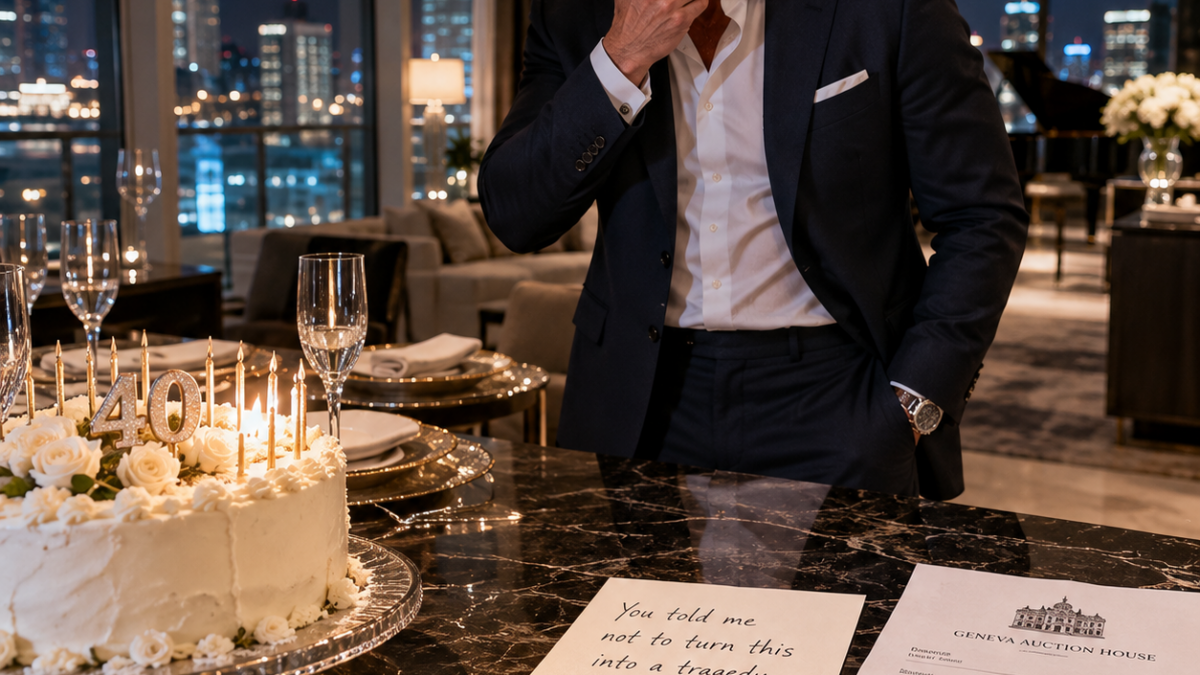
At 8:14 that evening, I sat alone at a dining table long enough to seat sixteen people and stared at forty unlit candles pressed into a three-tier cake covered in pale blue sugar flowers.
There were twelve plates.
Twelve champagne flutes.
Twelve linen napkins folded into perfect rectangles.
Not a single guest.
Our house manager had set everything exactly as Adrian’s office instructed.
At six that evening, his executive assistant, Celeste, had called.
“Mrs. Blackwood, I’m so sorry. Mr. Blackwood has been pulled into an emergency meeting in London.”
I remember looking toward the windows.
From the seventy-third floor, Chicago looked almost unreal.
Lake Michigan was black glass.
Traffic crawled far below.
Clouds reflected the city’s orange light.
“London?”
“Yes, ma’am.”
“He left this afternoon?”
A pause.
“Yes.”
“What about dinner?”
“Mr. Blackwood asked us to postpone the gathering.”
Nobody had told me.
Apparently his office had contacted our guests one by one and moved the dinner to “a later date.”
My husband had canceled my fortieth birthday party without ever speaking to me.
That should have hurt more than it did.
But Adrian had forgotten my birthday three times in five years.
He’d missed anniversaries.
Christmas Eve once.
My father’s memorial dinner.
He remembered acquisitions.
Quarterly numbers.
The names of senators he’d met once at fundraisers.
He remembered a twenty-seven-dollar discrepancy in a hotel invoice from Singapore.
But not me.
So I sat there.
Still wearing the dark green dress I’d bought two months earlier.
Diamond earrings.
Hair done.
Makeup perfect.
A wife arranged beautifully inside a life that no longer required her.
Then my phone vibrated.
An email.
Geneva.
Auction house.
DELIVERY CONFIRMATION.
I almost deleted it.
Then I saw Adrian’s name.
I opened the attachment.
Kashmir sapphire necklace.
Platinum.
Diamond surround.
Auction price plus premium and private handling:
$1,240,000.
Buyer:
Adrian Blackwood.
Recipient:
Lila Morgan.
Delivery address:
Suite 3701, Hôtel de Paris, Monte Carlo.
I read it once.
Then again.
I didn’t cry.
That surprised me.
Instead, I reached for my laptop.
Adrian’s private Gulfstream was registered through a Blackwood aviation subsidiary.
I knew the tail number because for fourteen years I had flown on it too.
The aircraft had departed Chicago.
But it hadn’t gone to London.
It had landed in Nice at 6:42 p.m.
I picked up my phone.
Called my husband.
He answered on the second ring.
“Happy birthday.”
I looked at the cake.
“Are you in London, Adrian?”
“Yes.”
“How’s the weather?”
Silence.
Then:
“Cold.”
I opened the aircraft record on my screen.
“Do you know the funny thing about owning a private jet?”
His breathing changed.
“Emily.”
“Every flight leaves a record.”
Another silence.
“Your plane landed in Nice.”
“Don’t do this.”
“And the necklace you bought Lila Morgan was delivered to her hotel suite in Monte Carlo.”
This time he said nothing for several seconds.
Then:
“Are you checking up on me?”
I almost laughed.
“No, Adrian.”
“The auction house sent the receipt to me.”
He cursed under his breath.
And then, in the same controlled voice he used when dismissing executives from companies he’d acquired, my husband said the sentence that ended our marriage.
“Don’t turn this into a tragedy.”
I looked at the twelve empty chairs.
At the birthday cake no one would eat.
At the reflection of a woman in the window who had spent fourteen years being reasonable.
“I agree.”
I said.
He didn’t understand.
Not yet.
PART2 AND FULL STORY IN THE FIRST COMMENT
“Emily, I’ll explain when I get home.”
“When is that?”
“Tomorrow.”
“You’re staying in Monte Carlo tonight?”
“I said I’ll explain.”
“That wasn’t an answer.”
He sighed.
Not guilty.
Annoyed.
That hurt more than panic would have.
“Lila is there for business.”
“With a million-dollar sapphire?”
“It’s complicated.”
“No.”
I said quietly.
“It actually isn’t.”
He lowered his voice.
“I don’t want you doing something emotional.”
There it was.
The old trick.
If I reacted to something cruel, the reaction became the problem.
If I questioned him, I was insecure.
If I wanted him home, I was demanding.
If I felt lonely, I didn’t understand the pressures of running a global company.
Adrian could convert almost any injury into evidence that I lacked sophistication.
So I didn’t argue.
I said:
“Come home when you’re finished.”
Then disconnected.
For several minutes, I remained at the table.
Our chef had gone home.
The house staff had withdrawn discreetly after realizing no guests were coming.
The penthouse was silent.
I reached for the cake knife.
Cut one narrow slice.
Ate three bites.
The cake was lemon.
My favorite.
Adrian probably didn’t know that.
His assistant did.
I put down the fork.
Then went to my dressing room.
Not to pack.
Most of my packing had been done ten months earlier.
That was the part Adrian didn’t know.
The necklace didn’t make me leave.
It merely told me I had been right to prepare.
Ten months before my fortieth birthday, I was sitting in a cardiologist’s office when a doctor told me I needed heart surgery.
Not that afternoon.
Not an emergency ambulance situation.
But soon.
A structural problem that had been monitored for years had progressed enough that waiting indefinitely was no longer the responsible choice.
Dr. Patel had diagrams.
Statistics.
Options.
Recovery timelines.
I remember almost none of them.
I remember one sentence.
“You’re young, Emily. The prognosis is excellent. But this is the point where you need to take your health seriously.”
Take your health seriously.
Something about those words broke through a wall I’d spent years building.
I left Northwestern Memorial and sat in the back of our car staring at people walking along East Huron Street.
People buying coffee.
Arguing on phones.
Holding hands.
Walking dogs.
Living ordinary lives.
Then I asked myself a question I had avoided for years.
If the surgery went wrong—and everyone kept assuring me it almost certainly wouldn’t—was I satisfied with the life I’d built?
The answer came immediately.
No.
Not because of the penthouse.
Not because of money.
Not because I’d wanted children and never had them.
Not because Adrian traveled too much.
Because somewhere inside our marriage, I had become an accessory to a man rather than a person standing beside him.
And I had helped it happen.
Adrian Blackwood wasn’t a monster when I met him.
That’s important.
People prefer stories where powerful men reveal themselves as villains on the first date.
Life is rarely that considerate.
I was twenty-five when we met.
Adrian was thirty.
Blackwood Global wasn’t yet an empire.
It was an investment firm with twenty-seven employees occupying one floor in Chicago.
He was ambitious.
Brilliant.
Restless.
Funny when nobody important was watching.
He remembered that I hated olives.
He brought coffee to my office himself.
He once spent four hours assembling a bookshelf in my apartment because he refused to pay someone else to do something he was certain he could learn from a video.
He put half the shelves backward.
I married that man.
Then the company grew.
Twenty-seven employees became hundreds.
Hundreds became thousands.
Adrian acquired a logistics company.
Then software.
Energy.
Real estate.
Private aviation.
Media.
He became the kind of businessman financial magazines described as “relentless.”
I learned what that word meant at home.
It meant every dinner could be interrupted.
Every vacation could become a transaction.
Every promise had an escape clause labeled business.
At first, I fought for time.
Then I adapted.
Eventually, I stopped asking.
The money grew faster than the marriage deteriorated, which made everything confusing.
People saw what I had.
The homes.
Cars.
Jewelry.
Staff.
Private planes.
They assumed luxury protected women from loneliness.
Sometimes it simply makes loneliness more expensive to decorate.
The first year Adrian forgot my birthday, he sent a Cartier bracelet from Dubai.
The second time, a painting.
The third, a car I hadn’t asked for.
Apology became procurement.
And I accepted it because refusing seemed dramatic.
Then came the cardiologist.
That evening I told Adrian about the surgery over dinner.
He looked up from his phone.
“What kind?”
I explained.
“When?”
“Probably within six months.”
He reached across the table.
For one moment, I saw my old husband.
He squeezed my hand.
“Whatever you need.”
I nearly cried.
Then his phone rang.
He answered it.
He spent the next forty minutes negotiating a merger.
The following morning, he flew to Singapore.
He did not mention my heart again for three weeks.
That was when I called a divorce attorney.
Her name was Rebecca Sloan.
Boston.
Sixty-two.
Silver hair.
Quiet voice.
No interest in gossip.
I chose someone outside Chicago because Adrian knew half the serious matrimonial lawyers in the city socially, professionally, or through board connections.
Rebecca’s first question was:
“Are you in danger?”
“No.”
“Physical danger?”
“No.”
“Financial control?”
I considered.
“Potentially.”
“Do you have independent assets?”
“Yes.”
“Access?”
“Yes.”
“Does your husband monitor your accounts?”
“His family office monitors joint accounts.”
“Then we’re going to separate privacy from secrecy.”
I remember that phrase.
Privacy from secrecy.
Rebecca didn’t help me hide marital assets.
She did the opposite.
She made me document everything so thoroughly that no one could accuse me of concealing anything later.
My inherited property remained separate.
My premarital investments were identified.
The personal shares legally held in my name were transferred to an independent custody account on her advice, with full records maintained.
I sold the small house in Connecticut my mother had left me because it had become expensive to maintain and carried too many memories.
The proceeds went into accounts under my sole control.
All disclosed.
All traceable.
Nothing stolen.
Nothing hidden from the eventual legal process.
Just no longer sitting in institutions where Adrian’s family office could see my balance every morning.
Then Rebecca asked:
“Where will you live?”
I stared.
I hadn’t thought that far.
“You don’t need a mansion.”
“I know.”
“You need somewhere you can sleep.”
That sentence stayed with me.
Somewhere I could sleep.
For almost fourteen years, I’d lived in properties worth more than small hotels.
Yet when Rebecca asked where I wanted to wake up after leaving Adrian, I couldn’t name one.
Eventually, I found a house outside Marblehead, Massachusetts.
Three bedrooms.
Gray cedar shingles.
Small porch.
Kitchen with scratched wooden floors.
You could smell the Atlantic when the wind turned.
The price probably equaled one of Adrian’s lesser watches.
I bought it under my maiden name.
Emily Hart.
Not to vanish from the government.
Not to commit some elaborate fraud.
Just because I wanted something in my own name again.
I furnished it slowly.
A sofa.
Bed.
Kitchen table.
Two lamps.
No decorator.
No art adviser.
No staff.
I bought plates at a local shop because I liked the blue rim.
Six plates.
Not twelve.
I went there three times before my birthday.
Never stayed long.
The first time, I stood in the empty living room and cried.
The second time, I slept one night.
The third, I left a toothbrush.
That felt more significant than buying the house.
The heart surgery happened four months before my birthday.
Adrian came to the hospital.
He stayed through admission.
Kissed my forehead before they took me back.
When I woke, he was gone.
There had been a crisis involving one of Blackwood Global’s European subsidiaries.
His assistant sat beside my bed instead.
Celeste looked mortified.
“Mr. Blackwood had to leave.”
Of course.
Adrian returned the following evening with flowers worth more than some people’s monthly rent.
I looked at them.
Then at him.
Something inside me had already detached.
Recovery gave me time.
I walked.
Slowly at first.
Then farther.
I slept.
Read.
Met with Rebecca.
Created copies of documents.
Updated my medical directives.
Changed emergency contacts.
Not from Adrian to a stranger.
From Adrian to my sister, Caroline.
That hurt.
My own husband was no longer the person I trusted to make decisions if I couldn’t speak.
Once you admit that, marriage becomes paperwork waiting for courage.
I did not know about Lila yet.
Not specifically.
But I suspected there had been women.
Perfume I didn’t wear.
Hotel charges in cities where Adrian claimed he never left the airport.
A second phone he said was for international security.
The way his expression changed when I entered a room unexpectedly while he was texting.
I never hired a private investigator.
Rebecca offered the name of one.
I said no.
I didn’t need proof to know I wanted out.
That turned out to matter.
If I had waited until I could prove adultery, Adrian could have spent another year teaching me that my instincts required a jury.
Instead, I prepared because the marriage itself was enough.
Then Lila Morgan appeared.
The first time I heard her name, Adrian mentioned her over breakfast.
“Lila’s handling the Monaco collection.”
“Who?”
“Lila Morgan.”
“Consultant.”
Art and luxury acquisitions for private clients.
Thirty-three.
Beautiful, though I didn’t know that yet.
British mother.
American father.
Educated in Paris.
Worked with auction houses, private collectors, family offices.
Adrian described her as brilliant.
That should have registered.
Adrian rarely complimented anyone unless he wanted something from them.
Two months later, Lila’s name appeared on an itinerary for a dinner in Geneva.
Then an art fair.
Then Monaco.
Then nowhere.
No receipts.
No calendar entries.
Nothing obvious.
I said nothing.
My birthday came.
I had originally planned a dinner for twelve.
My sister Caroline.
Two college friends.
A couple we’d known for years.
Adrian’s oldest business partner and his wife.
A few others.
Small by Blackwood standards.
I wanted ordinary food.
No press.
No photographers.
Adrian had promised he’d be there.
Three days before, he kissed me in our kitchen.
“Forty.”
“Don’t say it like a diagnosis.”
“You look thirty.”
“That’s because you pay dermatologists more than some universities pay professors.”
He laughed.
For one second, I saw him again.
The old Adrian.
Maybe that’s why the receipt hurt.
Not because I believed the marriage could still be saved.
Because memory is disloyal.
It keeps reminding you of the person someone used to be.
After our phone call, I didn’t sleep.
At eleven, I called Rebecca.
She answered on the third ring.
“Emily?”
“It’s happening.”
Silence.
Then:
“Are you safe?”
“Yes.”
“Where’s Adrian?”
“Monte Carlo.”
“With a woman.”
“Do you have proof?”
“An auction receipt worth one-point-two-four million dollars.”
Rebecca exhaled.
“Well.”
“That’s unusually specific.”
Despite everything, I laughed.
Then cried.
Not dramatically.
Just enough that I couldn’t speak.
Rebecca waited.
Finally, she said:
“You don’t have to leave tonight.”
“I know.”
“You don’t have to do anything because you’re angry.”
“I know.”
“Do you still want the divorce?”
“Yes.”
No hesitation.
“Then follow the plan.”
I did.
The plan was boring.
Boring saves people.
I took medication.
Passport.
Two suitcases.
Medical records.
A folder containing copies of financial documents.
My mother’s necklace.
Three photographs.
A wool coat.
Shoes I could actually walk in.
Everything else stayed.
Sixty-seven pairs of designer shoes.
Evening gowns.
Birkins.
Diamonds.
Paintings.
Watches.
The closet looked untouched.
I didn’t want Adrian claiming I had stripped the penthouse.
And honestly?
Most of it had never felt like mine.
He bought luxury the way other people bought flowers.
Possession wasn’t intimacy.
At 5:40 the next morning, I placed my wedding ring on the dressing table.
Next to it:
The black Blackwood Global credit card I carried for household expenses.
The auction receipt.
I circled Lila’s name in red.
Then wrote:
You told me not to turn this into a tragedy. I agree.
Nothing else.
No speech.
No list of grievances.
No threat.
Rebecca would handle the communication that mattered.
I turned off my phone.
Not because Adrian could magically track me through it like a movie villain.
Because I didn’t want nineteen calls changing my nerve.
Then I left it beside the note.
I took the service elevator to the garage.
Not my Bentley.
Not the Range Rover.
A car Rebecca had arranged through a rental company.
Ordinary gray sedan.
I drove east.
No private plane.
No chauffeur.
No security convoy.
For the first time in years, nobody knew where I was because nobody needed to.
I stopped outside Cleveland for coffee.
Then near Buffalo.
Slept four hours in a hotel registered under my legal maiden name.
Continued the next morning.
By the time Adrian landed in Chicago thirty-one hours after our call, I was crossing Massachusetts.
At 3:08 a.m. Chicago time, he entered the penthouse.
I know because the security log was later produced during discovery.
The cake was still on the table.
House staff had been told not to move it because apparently Adrian wanted to see exactly what I had left.
He found the bedroom empty.
Dressing room full.
Passport gone.
Medication gone.
Ring on the table.
Phone beside it.
Receipt.
Note.
At 3:16, he called my phone.
It rang six feet away.
He called again.
Nineteen times total.
Then he called his security chief.
His name was Marcus Reed.
Former federal protective-service officer.
Professional.
Discrete.
Adrian said:
“Find my wife.”
Marcus asked:
“Do you believe she’s in danger?”
“No.”
“Has she been abducted?”
“No.”
“Then what are we looking for?”
“She left.”
A pause.
“Voluntarily?”
“I don’t know.”
He did know.
That was the first thing Adrian had difficulty admitting.
Marcus asked:
“Where should we start?”
For perhaps the first time since Blackwood Global became powerful enough that entire governments returned his calls, Adrian Blackwood had no answer.
At 9:00 that morning, Rebecca Sloan’s Chicago co-counsel served the divorce petition.
Adrian was still awake.
He had not slept.
The petition contained no theatrical accusations.
Dissolution.
Property division.
Enforcement of our marital agreements.
Preservation of assets.
Formal request that communication regarding the proceedings go through counsel.
Then a letter from me.
Short.
Adrian, I am safe. I left voluntarily. Do not use company personnel to search for me. All necessary communication can go through counsel. I am not returning to the penthouse.
He called Rebecca.
She refused to put me on.
He called Caroline.
My sister had been instructed not to tell him anything.
He sent flowers to her home.
She donated them to a nursing facility.
He called again.
Then his attorney called Rebecca.
Then Blackwood Global’s general counsel called his attorney and apparently explained that using corporate security to locate an estranged spouse who had clearly stated she was safe would be a terrible idea.
Marcus Reed stopped searching.
That infuriated Adrian.
I learned later that he shouted:
“You work for me.”
Marcus answered:
“I work for Blackwood Global.”
Apparently that distinction had become important.
By noon, Adrian had found my email address.
He sent:
Where are you?
Then:
This is insane.
Then:
Come home and we’ll talk like adults.
Then:
You are making a permanent decision over one mistake.
One mistake.
I stared at that phrase from my kitchen in Marblehead.
Outside, gulls screamed over the harbor.
The house smelled faintly of fresh paint and coffee.
I was wearing sweatpants.
No makeup.
Hair tied badly.
I had never felt less like Mrs. Blackwood.
I had never felt more like myself.
I did not answer.
Rebecca did.
My client has requested no direct communication regarding the dissolution at this time. Please direct all further correspondence through counsel.
Adrian lasted four hours.
Then he sent:
Lila meant nothing.
That was worse.
If Lila meant nothing, then he’d humiliated me for nothing.
If she meant something, he’d lied.
Neither version helped.
I forwarded the email to Rebecca.
She replied:
Keep everything. Don’t engage.
So I didn’t.
The first night in the Marblehead house, I ate soup out of a chipped bowl.
I owned better dishes.
I chose the chipped one.
Then I slept nine hours.
No staff.
No elevator chime.
No late-night conference calls from the study.
No Adrian entering at two in the morning smelling of airplanes and somebody else’s life.
Just wind.
Old pipes.
Ocean.
I woke confused.
Then remembered.
I was free.
Freedom felt terrible.
That’s another thing no one tells you.
Leaving something unhealthy doesn’t automatically feel good.
Sometimes safety arrives before relief.
My body had spent fourteen years adapting to Adrian.
Where is he?
What mood?
What city?
Does dinner matter tonight?
Should I attend this event?
Did I say something wrong?
Who is calling?
Why did he cancel?
What explanation will I accept?
Then suddenly none of those questions mattered.
My nervous system didn’t know what to do with the empty space.
So it supplied guilt.
Maybe I’d overreacted.
Maybe forty was making me dramatic.
Maybe one necklace shouldn’t destroy fourteen years.
Then Rebecca called.
“Do not make yourself prosecute the necklace.”
“What?”
“You don’t need to prove the necklace is bad enough.”
I sat on my porch.
Cold Atlantic wind coming off the water.
“I know.”
“No.”
“You know intellectually.”
“Your marriage ended before Monte Carlo.”
“Yes.”
“The receipt simply prevented you from talking yourself out of leaving.”
That was exactly right.
The necklace wasn’t the crime.
It was evidence.
Not legal evidence in some grand adultery trial.
Evidence to me.
That Adrian still believed he could build one reality for himself and another for me.
London for the wife.
Monte Carlo for the mistress.
Emergency meeting for the wife.
Sapphire for the mistress.
And if discovered?
Don’t turn this into a tragedy.
I started laughing.
Rebecca asked:
“What?”
“Nothing.”
“I’m just realizing I finally listened to him.”
“What do you mean?”
“I didn’t turn it into a tragedy.”
“I turned it into a divorce.”
She laughed too.
The next stage was uglier.
Adrian began negotiating the way Adrian negotiated everything.
First:
Charm.
He sent an email through counsel offering marriage counseling.
A month away together.
Private therapist.
No business.
No phones.
He would end all contact with Lila.
He would “recommit.”
I declined.
Then:
Gifts.
A box arrived at Rebecca’s office.
Inside was the diamond bracelet Adrian had given me after forgetting my thirty-seventh birthday.
Along with a note:
Remember us before all this.
Rebecca sent it back.
Then:
Pressure.
His lawyers challenged whether certain accounts were separate property.
Normal legal maneuvering, Rebecca told me.
Not personal.
It felt personal.
Then Adrian requested an inventory of jewelry.
Fine.
We provided it.
He asked about artwork.
Fine.
He asked about my mother’s Connecticut property proceeds.
Fine.
Everything documented.
His team expected hidden transfers.
There weren’t any.
That frustrated them.
Adrian had spent years assuming preparation belonged to him.
I had prepared too.
My premarital investments had records.
My inheritance had records.
The small house had records.
My custody accounts had records.
The dates.
Statements.
Tax filings.
Everything.
Rebecca said:
“He cannot punish you financially just because he dislikes the divorce.”
“He’ll try.”
“He may.”
“But family court is not one of his boardrooms.”
I needed to hear that.
Adrian’s fortune made him powerful.
It did not make him the legal owner of everyone around him.
Then came Lila.
Not literally.
Her lawyer.
Apparently Adrian had not told her I was filing for divorce.
He had told Lila we had “been separated emotionally for years.”
Technically, maybe.
He also told her our financial arrangements were already resolved.
They weren’t.
Two weeks after I left, paparazzi photographed Adrian and Lila leaving a restaurant in Paris.
The photograph ran online.
Not front-page national news.
Business gossip.
Luxury press.
Enough.
The Blackwood Global communications team issued:
Mr. Blackwood does not comment on his private life.
I laughed when I saw it.
For fourteen years, his private life had been curated through magazine profiles featuring me.
Our marriage had been useful when it conveyed stability.
Now privacy mattered.
Caroline called.
“You okay?”
“Yes.”
“Liar.”
“Fine.”
“You want me to fly up?”
“No.”
“I’m flying up.”
She arrived the next afternoon carrying two grocery bags, a bottle of wine I wasn’t supposed to drink much of after surgery, and enough anger for both of us.
She walked through the house.
Stopped in the kitchen.
“This is it?”
I looked around.
“What?”
“You left a thirty-eight-million-dollar penthouse for this?”
“Don’t sound so supportive.”
“No.”
She put down the bags.
“I love it.”
Then she started crying.
I did too.
Caroline had never liked Adrian.
Not because he was rich.
Because he made every room organize itself around him.
She’d spent years watching me disappear in increments.
At dinner, she asked:
“When did you decide?”
“Cardiology appointment.”
“Ten months ago?”
“Yes.”
“You didn’t tell me.”
“I was afraid if I told anyone, it would become real.”
“So you bought a house instead?”
“Apparently.”
She stared.
“You’re insane.”
“Probably.”
“I’m proud of you.”
That was the first time anyone said it.
Not:
I’m sorry.
Not:
Are you sure?
Proud.
I needed that more than I expected.
My birthday passed by then.
Three weeks later, Caroline bought a supermarket cake.
One layer.
Too much frosting.
She put four candles on it because apparently ten candles per decade was efficient.
“Make a wish.”
“I already did.”
“That’s disgusting.”
“What?”
“Sentimental.”
I laughed.
Then blew them out.
That was my real fortieth birthday.
Four candles.
My sister.
Cheap cake.
Ocean outside.
No husband.
Perfect.
Adrian eventually found out where I lived.
Of course he did.
I was not hiding from lawful discovery.
The property was in my name.
The address appeared through the legal process.
Rebecca warned me.
“He knows.”
I felt something tighten.
“What will he do?”
“Probably come.”
“He can’t just—”
“You can tell him not to.”
So I did.
Through counsel:
Do not come to my residence without invitation.
Three days later, a black SUV stopped across the street.
I saw it through the window.
Adrian got out.
No driver.
No security.
Dark overcoat.
He stood on the sidewalk looking at the house.
I called Rebecca.
She said:
“Do you want police?”
“No.”
“Do you want to speak to him?”
I stared.
“Five minutes.”
“Outside.”
“Record if lawful where you are.”
“Do not let him inside.”
I stepped onto the porch.
Adrian looked tired.
That shocked me.
I’d seen him after forty-hour negotiations looking better.
He stared at me.
No jewelry.
Jeans.
Sweater.
Hair loose.
“Emily.”
“You weren’t supposed to come.”
“I needed to see you.”
“You’ve seen me.”
His eyes moved toward the house.
“This is where you’re living?”
“Yes.”
“Why?”
I almost laughed.
“Because I like it.”
“You could have taken one of the houses.”
“I didn’t want one.”
“We own property in New York.”
“Aspen.”
“London.”
“You own most of those through companies.”
“That’s not the point.”
“It is to me.”
He looked older.
“Can we talk?”
“We’re talking.”
“Inside?”
“No.”
The word landed.
Adrian wasn’t accustomed to being refused access to buildings.
Or people.
He slipped his hands into his coat pockets.
“Lila is over.”
I stared.
“I didn’t ask.”
“It ended.”
“When?”
“After Chicago.”
“After I left?”
“Yes.”
“So not because cheating was wrong.”
“Because it cost you something.”
His jaw tightened.
“You think everything I say is manipulation now.”
“No.”
“I think you’re finally hearing your own words without me translating them into something kinder.”
That hurt him.
I saw it.
For years, I’d softened Adrian even to myself.
He’s busy.
He’s tired.
He’s under pressure.
He isn’t good with emotions.
He shows love differently.
I had translated neglect into complexity.
He asked:
“Did you ever love me?”
That made me angry.
Not visibly.
Deeply.
“Don’t do that.”
“What?”
“Don’t turn fourteen years of my life into evidence against me.”
“I loved you.”
“That is why this took so long.”
He looked away.
The ocean wind pushed his coat.
“I made mistakes.”
“Yes.”
“People change.”
“Yes.”
“I can.”
“Maybe.”
He looked back.
“Then why won’t you give me the chance?”
“Because your chance does not have to be my marriage.”
He flinched.
I continued.
“You can become the best man in America tomorrow.”
“That does not create an obligation for me to return.”
For once, Adrian had no immediate answer.
Then he said:
“What do you want?”
That question would have been impossible a year earlier.
Now it was simple.
“Peace.”
“I can give you anything.”
“There.”
I said.
“That’s the problem.”
He frowned.
“You still think everything is something you give.”
“House.”
“Trip.”
“Jewelry.”
“Second chance.”
“You still haven’t understood that some things aren’t yours to distribute.”
He stared at me.
I was shaking.
But I kept going.
“My time isn’t yours.”
“My forgiveness isn’t yours.”
“My future isn’t yours.”
“And I don’t need you to buy me peace.”
“I already have it.”
He looked toward the small house again.
Then at me.
“Are you happy?”
I told the truth.
“Not yet.”
That surprised him.
“But I’m not disappearing anymore.”
He nodded once.
Very slightly.
Then walked back toward the SUV.
Before getting in, he turned.
“Happy birthday.”
Late.
Three weeks late.
Still.
“Thank you.”
I went inside.
Locked the door.
Then sat on the kitchen floor and sobbed for twenty minutes.
Boundaries don’t always feel powerful while you’re holding them.
Sometimes they feel like grief.
The divorce took eleven months.
Not because we fought over every fork.
Because large fortunes are complicated even when both sides have lawyers trying to behave professionally.
Valuations.
Trusts.
Business interests.
Separate property.
Joint property.
Real estate.
Insurance.
Tax issues.
Adrian’s lawyers wanted confidentiality.
So did mine.
I had no desire to become tabloid entertainment.
The sapphire necklace became relevant only as one factual piece in the broader chronology.
I didn’t ask for it.
Didn’t want it.
Apparently Lila returned it.
I learned that through discovery.
The auction house accepted it back for consignment months later.
Somewhere, another rich person probably bought it.
I hope they enjoyed it.
Adrian and I ultimately settled.
I retained my separate property.
My personal investment assets.
My Marblehead home.
A negotiated division of marital assets.
I waived claims I didn’t care about in exchange for clean separation on others.
I did not walk away from fourteen years empty-handed simply to prove moral purity.
Women are often expected to do that in stories.
Leave the mansion wearing one sweater and become spiritually superior because she refused money.
No.
Money represented years.
Partnership.
Legal rights.
I took what my lawyers advised was fair.
Then I stopped.
Adrian kept Blackwood Global.
Obviously.
I had no desire to become a hostile shareholder in my ex-husband’s life.
Some personal shares I already legally owned remained mine under the settlement.
I later sold most of them gradually.
Not because I thought the company would fail.
It didn’t.
Because I didn’t want my future tied to Adrian’s quarterly earnings.
Blackwood Global continued growing.
Adrian remained a billionaire.
That’s another thing people dislike about real endings.
Bad husbands don’t always lose their companies.
Wealth doesn’t evaporate because someone cheated.
Adrian did not become poor.
He did not get arrested.
His board did not throw him out because he bought a necklace.
Life is not a morality vending machine.
What he lost was me.
Whether that mattered as much as money?
Only Adrian could answer.
I stopped trying to measure consequences for him.
The divorce became final on a Tuesday morning.
Video hearing.
Efficient.
Almost absurd.
Fourteen years dissolved through a sequence of legal questions and electronic signatures.
The judge asked whether the marriage was irretrievably broken.
“Yes.”
Adrian said the same.
Then it was done.
Emily Blackwood no longer existed legally except in old documents.
I returned to:
Emily Hart.
The first time I saw the name on a new credit card, I cried.
Not because Hart was better.
Because I had chosen it.
That afternoon, Rebecca called.
“Congratulations feels inappropriate.”
“Thank you feels weird too.”
“How about finished?”
I smiled.
“Finished.”
I took a walk along the harbor.
No champagne.
No yacht.
No triumphant music.
Just cold air.
Fishing boats.
A dog pulling an old man down the sidewalk.
I bought coffee.
Sat on a bench.
Then did something I’d wanted to do since my birthday.
I lit a candle.
One.
A tiny bakery had sold me a cupcake.
I pushed a single candle into the frosting.
Forty-one was still months away.
Didn’t matter.
I lit it.
Made no wish.
Blew it out.
Life after Adrian was not immediately glamorous.
I had spent fourteen years with staff managing almost everything.
The first month in Massachusetts, I ruined a sweater by washing it incorrectly.
Locked myself out once.
Couldn’t figure out the ancient thermostat.
The dishwasher leaked.
A plumber named Ron told me whoever installed the kitchen plumbing had “committed a felony against PVC.”
I laughed harder than the joke deserved.
I cooked.
Badly.
Improved.
I learned which grocery store had better produce.
Joined a cardiac rehabilitation group even though technically I no longer needed the formal program.
Started walking with a woman named Susan who had undergone bypass surgery.
She had no idea who I had been married to for the first three weeks.
When she found out, she stopped in the middle of the sidewalk.
“You mean Blackwood Blackwood?”
“Yes.”
“Private jet?”
“Yes.”
“That guy?”
“Yes.”
She stared.
Then:
“You still owe me twelve dollars for lunch.”
I laughed so hard my chest hurt.
Susan became one of my closest friends.
She never asked for details unless I offered.
That’s how I learned the difference between interest and intrusion.
I started working again too.
Before marrying Adrian, I had been an analyst in nonprofit finance.
After marriage, I gradually moved into philanthropy through the Blackwood Foundation.
Eventually even that became part of the Blackwood machine.
Every initiative photographed.
Every donation announced.
Every gala another extension of the brand.
After the divorce, I spent six months doing nothing formal.
Then I joined the board of a small organization providing transitional housing for women leaving financially controlling relationships.
Not because every wealthy marriage is abuse.
Mine wasn’t something I needed to label for a fundraising brochure.
But I understood the fear of asking:
If I leave, where does my money come from?
Where do I sleep?
Who knows where I am?
What documents do I need?
How much is mine?
What happens if the other person controls every shared system?
I had resources.
Lawyers.
Education.
Separate assets.
Even then, leaving required ten months of planning.
What about someone with none of that?
That question became more interesting to me than Adrian’s current girlfriend.
Lila disappeared from the papers after a while.
Years later, I learned she had married someone else.
Good for her.
I never contacted her.
Never sent blame.
She didn’t make vows to me.
Did she know Adrian was lying?
Probably some version.
Maybe not all of it.
I decided not to spend my new life investigating another woman’s old choices.
Adrian dated.
Of course.
Business magazines kept publishing him.
Sometimes his photograph appeared on my screen.
I stopped flinching eventually.
Two years after the divorce, he sent me a letter.
Actual paper.
No lawyer.
No assistant.
Handwritten.
I considered throwing it away.
Then read it.
He wrote:
Emily,
I have started this letter six times. Every version sounded like a negotiation. You were right about that.
I stopped.
Continued.
I spent most of my adult life believing that if something was broken, the answer was to apply more resources. Money, people, leverage, information. I treated our marriage the same way. When you needed me, I sent things. When you were angry, I tried to solve the consequences instead of the cause. When you left, I thought the problem was that I could not find you. The problem was that you had stopped believing there was any reason to be found.
I read that line twice.
Then:
I am sorry about Lila. I am sorry about your birthday. I am sorry I left after your surgery. I am more sorry that those examples are only the obvious ones.
That was the first apology from him that did not contain a request.
No:
Come back.
No:
Call me.
No:
I have changed.
He ended:
You do not owe me a response. I hope the house by the water is still peaceful.
Adrian
I cried.
Then put the letter in a drawer.
I did not answer for three months.
Eventually, I wrote:
Thank you for saying it without asking me for anything. I hope you’re well.
Nothing more.
He replied once.
I understand.
That was our final personal exchange for years.
At forty-five, I had another cardiac checkup.
Everything looked good.
Dr. Patel asked:
“How’s stress?”
I laughed.
“Lower.”
“Exercise?”
“Daily.”
“Sleep?”
“Eight hours.”
“Marriage?”
“Gone.”
He looked up.
Then smiled carefully.
“I’m not sure whether to put that under treatment.”
“Preventive care.”
He laughed.
So did I.
On my forty-fifth birthday, Caroline came to Massachusetts.
So did Susan.
Rebecca, now technically retired, drove up from Boston.
Three other friends.
Seven people total.
I cooked dinner.
Badly enough that we ordered pizza.
The cake had one tier.
Forty-five candles would’ve set off the smoke detector, so Caroline used five again.
Before I blew them out, Susan said:
“Speech.”
“No.”
“Rich people always give speeches.”
“I’m not rich-people rich anymore.”
Caroline nearly choked on wine.
“You are still extremely rich.”
“Fine.”
I stood.
Looked around the table.
Seven people.
No place cards.
No staff.
No one absent because an assistant had canceled them.
I said:
“Five years ago I spent my birthday waiting for someone who wasn’t coming.”
Caroline’s eyes filled immediately.
I pointed.
“Don’t.”
She laughed.
I continued:
“I thought leaving would be the hardest thing I’d ever done.”
“It wasn’t.”
“The hardest thing was accepting that the life I left had once been something I truly wanted.”
That room became quiet.
“It is easier to walk away from something if you can convince yourself it was always terrible.”
“My marriage wasn’t.”
“Not always.”
“There were beautiful years.”
“That doesn’t mean I should have stayed for the bad ones.”
I lifted my glass.
“To not needing the past to be fake in order to choose a different future.”
Rebecca said:
“That was annoyingly good.”
Susan said:
“I still prefer pizza.”
We laughed.
Then I blew out the candles.
No wish.
I had stopped asking birthdays to predict the future.
A year later, I sold the last Blackwood Global shares I wanted to sell.
The transaction appeared in financial filings.
A reporter called Rebecca asking whether it symbolized “the final severing of ties between Emily Hart and the Blackwood empire.”
Rebecca forwarded the question.
I replied:
It symbolizes a stock sale.
She sent back three laughing emojis.
Some things don’t need metaphor.
The Marblehead house changed over time.
I renovated the kitchen.
Kept the scratched floors.
Bought a large wooden table.
Not twelve seats.
Eight.
I filled them.
Sometimes with friends.
Sometimes women from the housing nonprofit.
Sometimes Caroline’s children.
Sometimes no one.
That was the difference.
An empty table stopped feeling like abandonment when I was the one choosing the quiet.
I kept almost none of the jewelry from my marriage.
Some pieces were mine and legally stayed mine.
I sold many.
Donated portions of the proceeds.
Kept three.
My mother’s necklace.
A pair of earrings Adrian bought during our first year married, before gifts became apologies.
And my wedding ring.
Yes.
The ring I left on the dressing table came back through the property process.
Rebecca asked what I wanted done with it.
I didn’t know.
For years it stayed in a bank box.
Then one day I took it out.
Platinum.
Diamond.
Beautiful.
No longer painful.
Just an object.
I had it reset.
Not into another ring.
A small pendant.
Not because I wanted to honor the marriage.
Because fourteen years of my life did not need to be thrown away to prove I had survived them.
I wear it occasionally.
People who know the story find that strange.
I don’t.
The diamond didn’t cheat.
The ring didn’t neglect me.
Objects don’t carry moral guilt unless we insist they do.
I changed its shape.
Kept what was mine.
That seemed appropriate.
I never saw the sapphire necklace in person.
Sometimes that’s the funniest part.
The object that triggered my departure never entered my house.
One email.
One receipt.
One name circled in red.
For years, people who learned the story assumed the most humiliating part was the price.
$1.24 million.
It wasn’t.
Adrian could afford that necklace the way another husband might afford roses.
The number was almost irrelevant.
The cruelty was contrast.
He had made me believe business prevented him from being present.
But absence was a choice.
He wasn’t trapped in London.
He chose Monte Carlo.
He hadn’t forgotten gifts.
He chose someone else’s.
He hadn’t become incapable of romance.
He had redirected it.
That was the truth the receipt delivered.
And once I saw it, I stopped negotiating against myself.
I also stopped thinking of my departure as disappearing.
At first, yes.
Adrian came home and I was gone.
Phone left behind.
No address.
No conversation.
Dramatic.
But I hadn’t vanished.
I had reappeared somewhere else.
Emily Hart.
Small house.
Blue-rimmed plates.
Cardiac medication in a kitchen drawer.
A lawyer who knew where I was.
A sister who knew.
A future I had already begun constructing.
That’s another reason I reject the fantasy that leaving happened in one courageous night.
The courage was distributed across ten months.
First appointment with Rebecca.
Opening an independent account.
Buying the house.
Changing my medical directive.
Leaving a toothbrush there.
Moving important documents.
Practicing the drive.
Admitting to myself that I wanted a divorce before I had proof of another woman.
Each action looked small.
Together, they became an exit.
People waiting for one heroic moment sometimes stay trapped because real courage rarely announces itself.
Sometimes courage looks like photocopying a bank statement on a Tuesday.
I received a letter years later from a woman I’d met briefly through the housing nonprofit.
She wrote:
You once told us that preparation isn’t betrayal. I needed to hear that.
I remembered saying it.
She’d been married thirty-two years.
Her husband controlled all accounts.
She wasn’t ready to leave.
We didn’t tell her she had to.
We helped her understand documents.
Credit.
Property.
Safety planning.
The difference between joint and separate accounts under her state’s law.
Months later, she left.
Not because of me.
Because eventually she chose to.
But that sentence stayed with her.
Preparation isn’t betrayal.
I wish someone had told me that earlier.
For months, I felt guilty preparing before telling Adrian.
Shouldn’t spouses talk?
Shouldn’t I warn him?
Give him a chance?
Maybe.
In healthy marriages.
But by then, every serious conversation ended with me being persuaded to delay my own conclusion.
I needed enough internal distance to know what I thought before Adrian told me what I thought.
That wasn’t manipulation.
It was clarity.
The heart surgery gave me the deadline.
The necklace gave me the confirmation.
The house gave me somewhere to go.
The lawyer gave me structure.
I gave myself permission.
That’s the whole story.
Not:
Billionaire husband cheats and wife gets revenge.
I didn’t take his company.
Didn’t expose him publicly.
Didn’t humiliate Lila.
Didn’t spend the settlement trying to outperform his lifestyle.
I left.
For Adrian, maybe that was the one consequence he couldn’t negotiate away.
For me, it wasn’t revenge at all.
It was simply life continuing elsewhere.
I turned fifty last month.
Ten years since the birthday cake.
Ten years since the auction receipt.
The Marblehead house is still mine.
The porch needs repainting.
Again.
Ocean air is expensive in ways real-estate listings omit.
Susan brought dinner.
Caroline brought cake.
Rebecca sent flowers because retirement hasn’t stopped her from bossing me.
There were nine people around the table.
Someone asked whether I wanted fifty candles.
I said:
“Absolutely not.”
We used five.
Before I blew them out, Caroline said:
“Do you ever think about the penthouse?”
“Sometimes.”
“The cake?”
“Yes.”
“Adrian?”
I thought.
“Yes.”
“Do you regret any of it?”
That question deserved care.
“I regret staying after I knew I was lonely.”
She nodded.
“Do you regret marrying him?”
“No.”
She looked surprised.
“No?”
“No.”
“I loved him.”
“He loved me in the way he knew how for a while.”
“We had good years.”
“I learned things.”
“Then it ended.”
“Not every ending proves the beginning was a mistake.”
Caroline smiled.
“You got wise.”
“I got old.”
“Same thing if you’re lucky.”
Maybe.
I looked around the table.
Nine faces.
Nobody waiting for a billionaire to arrive.
Nobody checking a flight record.
Nobody explaining why my birthday needed to move around somebody else’s schedule.
I blew out five candles.
Everyone clapped.
Later that night, after they left, I cleaned the kitchen.
No staff.
Still.
I carried the last wineglass to the sink.
Then went upstairs.
In my bedroom, on a small desk near the window, I keep one document in a drawer.
Not the divorce decree.
Not the settlement.
The auction receipt.
The original printout.
$1,240,000.
Recipient: Lila Morgan.
Her name still circled in red.
Underneath it is a copy of the note I left Adrian:
You told me not to turn this into a tragedy. I agree.
For years, I wondered why I kept it.
Proof?
Anger?
Maybe at first.
Now it reminds me of something else.
There was a woman sitting alone at a twelve-place table on her fortieth birthday.
She believed her husband had abandoned her for one evening.
The truth was that she’d been abandoning herself for years.
Then an email arrived.
People love to say that was the moment everything changed.
It wasn’t.
Everything had been changing for ten months.
The doctor’s office.
The lawyer.
The separate account.
The small house.
The toothbrush.
The packed documents.
The surgery.
The quiet admission:
I don’t want to live like this anymore.
The sapphire receipt simply arrived at the exact moment I was finally ready to believe myself.
Adrian thought his worst mistake was getting caught.
It wasn’t.
His worst mistake was assuming I had nowhere else to go.
He believed the penthouse was home because it cost $38 million.
He believed the black card was security because it had no practical limit.
He believed the ring was marriage because it was expensive.
He believed I would stay because almost everything around me belonged to the life he had built.
What he never noticed was that, piece by piece, I had already built another one.
So when he walked into our bedroom at 3:08 that morning and found my ring, his card, and the receipt waiting beneath the lights, he thought his wife had disappeared.
I hadn’t.
For the first time in fourteen years, I had finally gone somewhere I could find myself.