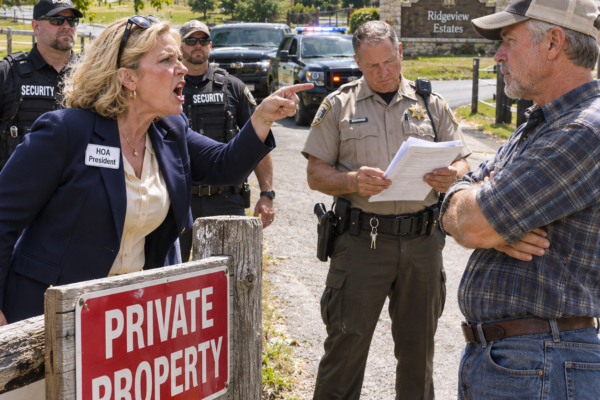
The HOA Called Me an Armed Squatter—Then the Sheriff Opened Their Evidence Bag.k
PART2:
Sheriff Daniel Ortega had been in office six years.
I’d known him professionally but not socially.
That distinction mattered.
I was a reserve county officer.
Not a full-time deputy.
I had spent most of my life ranching and running a small agricultural-equipment repair business, but after helping with volunteer emergency response for years, I joined the county reserve program in my forties.
I completed the required training.
Maintained my commission.
Worked occasional event security, storm response, prisoner transports, and staffing support when the county needed extra bodies.
I was not on duty that morning.
No uniform.
No weapon visible.
Jeans.
Work boots.
Old green shirt.
I had been replacing a hinge on the north equipment gate when the vehicles arrived.
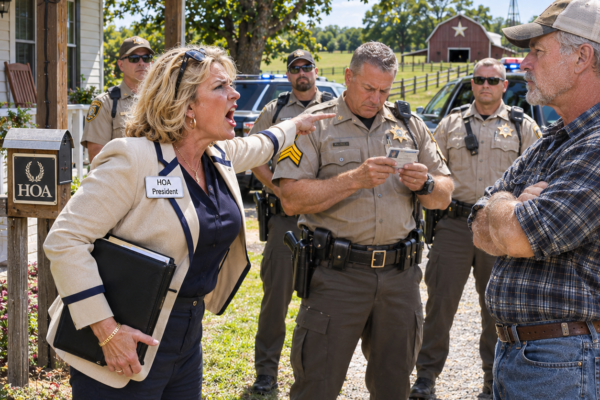
Sheriff Ortega stepped away from his unit.
“Morning, Caleb.”
“Sheriff.”
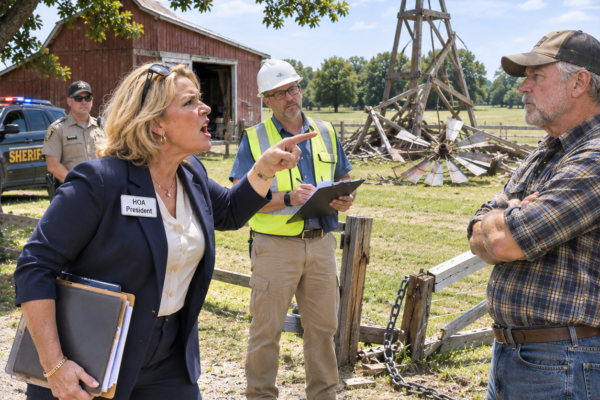
Cynthia immediately said:
“You know him?”
Ortega looked at her.
“I know a lot of people in this county.”
Then back to me.
“Let’s keep everybody calm.”
“Fine by me.”
Cynthia crossed her arms.
“Sheriff, with respect, we’ve already explained the situation.”
“You’ve explained your version.”
“I haven’t heard his.”
That quieted her for about two seconds.
Then:
“He’s occupying association property.”
“He’s been warned repeatedly.”
“He has firearms.”
“And he has impersonated law enforcement to intimidate board representatives.”
That last accusation surprised me.
I looked at Ortega.
“Impersonated?”
Cynthia said:
“You showed a badge to our compliance team.”
“No.”
“You absolutely did.”
“When?”
“Three weeks ago.”
I thought back.
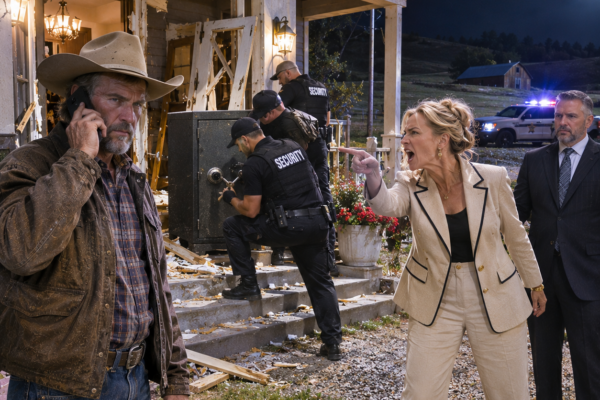
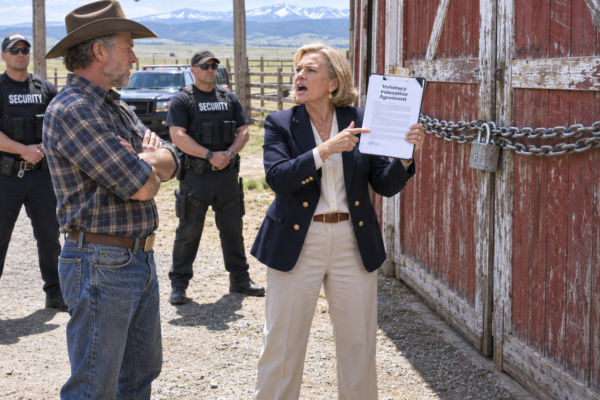
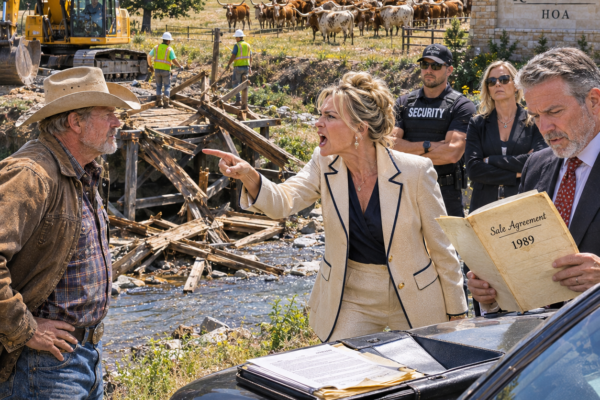
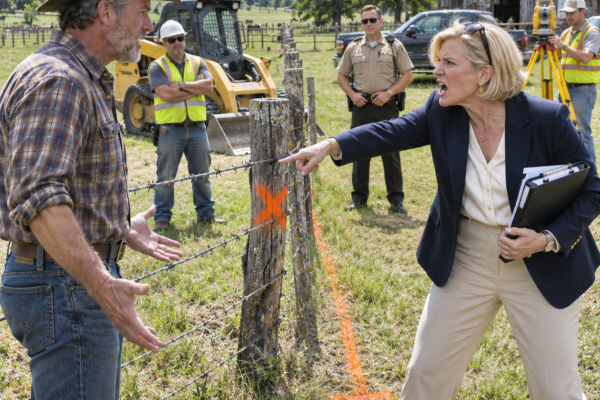
Three weeks earlier, Cynthia had sent two men onto the east pasture with orange survey flags.
I stopped them.
Asked who authorized entry.
They said Briar Ridge.
I told them to leave.
No threat.
No badge.
No weapon.
One of them asked whether I was “some kind of cop.”
I said:
“I work reserve with the county.”
That’s it.
Cynthia apparently had upgraded that conversation.
Ortega raised a hand.
“Everybody stop.”
He looked at me.
“Do you claim ownership of this ranch?”
“Yes.”
“How long?”
“My family seventy-plus years.”
“You personally?”
“Since Dad died eleven years ago.”
“Documents?”
“Everything.”
“Deed?”
“Yes.”
“Survey?”
“Yes.”
“Tax records?”
“Yes.”
“Any boundary agreement with Briar Ridge?”
“Yes.”
That got Cynthia’s attention.
She turned.
“What boundary agreement?”
“The one their developer signed eight years ago.”
Cynthia said:
“There is no such agreement.”
I looked at her.
“You should probably know that before calling me a squatter.”
Ortega cut in again.
“Caleb.”
“Documents first.”
Good.
I didn’t need him siding with me because I wore the same county patch occasionally.
I needed him reading the record.
I said:
“They’re inside.”
“I’ll get them.”
Ortega nodded.
“Deputy Hale goes with you.”
Not because he thought I’d run.
Because Cynthia had accused me of being armed.
Good procedure.
Deputy Hale followed me to the house.
I opened the mudroom safe where I kept important property records.
Not originals of everything.
Some originals lived in a bank box.
But enough certified copies to resolve most ordinary arguments.
Deed.
Recorded plat.
2018 survey.
Boundary agreement with Briar Ridge Development LLC.
Tax statements.
Title policy.
Prior deeds.
Aerial map.
I put everything in an old leather portfolio.
Deputy Hale glanced at it.
“You expecting trouble?”
“I’ve owned land next to an HOA for eight years.”
He laughed.
“Fair.”
When we returned, Ortega had moved everybody away from the gate so no one was crowding.
Cynthia stood beside her Lexus.
Two HOA employees had arrived in another vehicle while I was inside.
One was their property manager, Eric Tolman.
The other was a compliance contractor named Blake Dennis.
Blake was one of the men I’d removed from my pasture three weeks earlier.
He wouldn’t look at me.
Interesting.
Ortega set the documents on the hood of his SUV.
He did not skim.
That was one thing I liked about him.
He read.
Legal description first.
Plat.
Survey.
Then the boundary agreement.
The agreement had been recorded when Briar Ridge was developed.
The developer had needed temporary construction access along one edge of my land.
Dad was already gone by then.
I negotiated it myself.
In exchange for limited temporary access, both parties acknowledged the existing boundary so nobody could later claim construction activity had changed ownership.
The description was precise.
Coordinates.
Monuments.
Survey references.
Signed.
Notarized.
Recorded.
Ortega looked at Cynthia.
“Have you seen this?”
She leaned forward.
“That doesn’t look familiar.”
“Recorded 2018.”
“That predates this board.”
“Property records don’t expire because board members change.”
Her jaw tightened.
“The HOA has newer maps.”
“Let’s see them.”
Eric Tolman brought out a binder.
Color maps.
Briar Ridge logo.
Walking trails.
Drainage lines.
Landscaping zones.
One map shaded part of my east pasture green.
COMMON OPEN SPACE.
Ortega held the map beside my survey.
“What’s the source?”
Eric said:
“Our community master plan.”
“Recorded plat?”
“I believe so.”
“Where’s the recording information?”
Eric flipped pages.
Nothing.
Cynthia stepped in.
“The development plan has always shown that land as part of Briar Ridge.”
I said:
“A development plan can show Disneyland if somebody draws it there.”
Ortega gave me a look.
I stopped.
He asked Eric:
“Do you have a deed showing transfer of this parcel?”
“No.”
“Recorded easement?”
“There are community rights.”
“Recorded where?”
Eric looked at Cynthia.
She said:
“Our attorney has the full file.”
Ortega nodded.
“Then your attorney can provide it.”
Cynthia became impatient.
“This is exactly why we brought evidence.”
That was the first time she mentioned the evidence case.
Blake Dennis went to the back of their SUV.
He returned carrying a black hard-sided equipment case.
Not county property.
Private case.
Foam-lined.
Several plastic evidence-style bags inside.
Photographs.
Printed statements.
A few orange survey flags.
A broken section of wire.
And one small sealed pouch I couldn’t see clearly from where I stood.
Cynthia said:
“Our compliance team documented repeated trespass and intimidation.”
I stared at her.
“On my own ranch.”
She ignored me.
Ortega asked:
“Who collected this?”
“Briar Ridge enforcement personnel.”
“Law enforcement?”
“Compliance personnel.”
“Then let’s be precise.”
He looked at Blake.
“You?”
Blake nodded.
“Some of it.”
“Who labeled the bags?”
“I did some.”
“Others did some.”
“Who maintained custody?”
“Our office.”
“Do you have a log?”
Eric opened another folder.
A spreadsheet.
Dates.
Items.
Locations.
Collectors.
Ortega began matching bags to entries.
This is where Cynthia’s story started to fray.
Not collapse.
Fray.
First photograph:
A damaged fence post.
Label:
MERCER TRESPASS — SOUTH COMMON AREA.
Ortega asked me:
“Recognize it?”
“Yes.”
“That’s my north fence.”
Cynthia said:
“How can you tell from one picture?”
“Because I built that brace after the flood.”
“And the cedar tree behind it has three trunks.”
Ortega compared the image to a parcel map.
“North fence would be nowhere near Briar Ridge.”
“Correct.”
Eric said:
“Maybe the photo number is mismatched.”
Possible.
Mistakes happen.
Next.
Photograph showing tire tracks.
Label:
UNAUTHORIZED VEHICLE ACCESS — HOA LAND.
I recognized the area immediately.
“My cattle lane.”
Cynthia said:
“That’s disputed.”
Ortega asked:
“Coordinates?”
Blake read from the sheet.
I nearly laughed.
The coordinates landed more than nine hundred feet inside my property.
Ortega checked with his county GIS app.
GIS alone isn’t a final boundary survey, but nine hundred feet is not a minor mapping tolerance.
He wrote something down.
Next item.
Orange flag.
No issue.
Next.
Broken wire.
Blake said they’d found it where I “cut into HOA fencing.”
I looked at it.
“That isn’t HOA fence.”
“How do you know?”
“Because that’s Red Brand twelve-and-a-half gauge.”
Cynthia stared.
“Wire is wire.”
“Not to ranchers.”
I pointed.
“My father bought that roll.”
“There’s another two hundred feet in my barn.”
Again:
Not proof by itself.
But something to check.
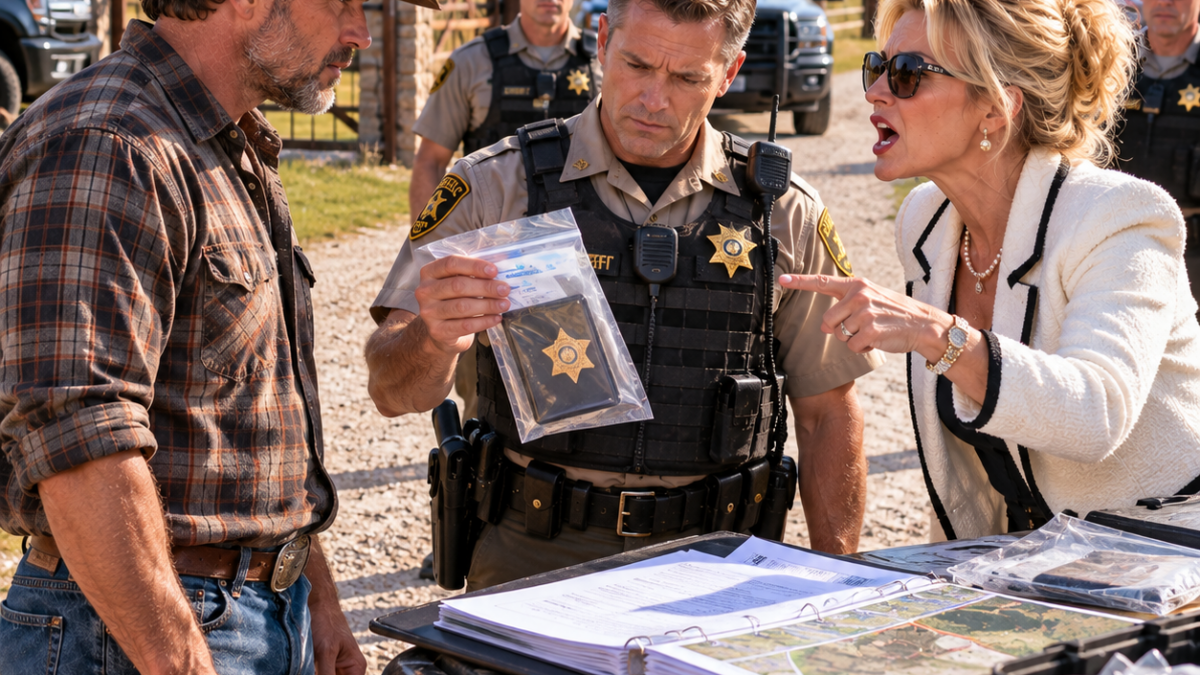
Then Ortega picked up the small evidence pouch.
Everything changed.
It contained a gold badge.
County star.
Blue center seal.
My name engraved below the county identifier.
Reserve Deputy Caleb Mercer.
My mouth went dry.
Ortega stared at it.
Then at me.
“Caleb.”
“Yes.”
“This yours?”
“Yes.”
“Where should it be?”
“In my duty equipment case.”
“Last time you saw it?”
I had to think.
“County fair detail.”
“Six weeks ago.”
“After that?”
“I put my reserve gear away.”
“Where?”
“Locked cabinet in my equipment office.”
Cynthia crossed her arms.
“There.”
“Proof.”
I looked at her.
“Proof of what?”
“That you were using law-enforcement credentials while trespassing.”
Ortega turned the evidence pouch over.
Label:
FOUND EAST BOUNDARY — NEAR MARKER 17
DATE: MAY 14
COLLECTOR: B. DENNIS
May 14.
Three weeks earlier.
Same day I’d removed Blake and another man from my pasture.
Ortega looked at Blake.
“You found this?”
Blake swallowed.
“Yes.”
“Exactly where?”
“Near the boundary.”
“Which side?”
“HOA side.”
“Near Marker 17?”
“Yes.”
I said:
“There is no Marker 17.”
Cynthia looked at me.
“Of course there is.”
“No.”
“My survey monuments are iron rods and capped pins.”
“They aren’t numbered like that.”
Ortega looked at Blake.
“What did Marker 17 look like?”
Blake hesitated.
“Orange post.”
“Metal.”
“Maybe fiberglass.”
“Which?”
“Metal.”
I said nothing.
Ortega did.
“You collected a county-issued badge you believed belonged to an individual involved in a dispute with your HOA.”
“Yes.”
“And instead of calling the sheriff’s office, you put it in your private evidence case?”
Blake looked toward Cynthia.
“She told us to preserve everything.”
Cynthia snapped:
“I said preserve evidence.”
“I didn’t tell you to conceal police property.”
That was the first moment Blake looked afraid.
Ortega turned to me.
“Do you carry that badge off duty?”
“Rarely.”
“Did you have it when you confronted these men?”
“No.”
“Any chance it fell from your pocket?”
“No.”
“You sure?”
“Yes.”
“Because it wasn’t in my pocket.”
“Where was your equipment case?”
“In the locked office inside my shop.”
“Who has access?”
“Me.”
“My son when he’s home.”
“Occasionally my foreman.”
“Was the office broken into?”
“Not that I noticed.”
Now we had a different problem.
The badge’s presence didn’t automatically prove planting.
It could have been lost earlier.
Stolen.
Moved.
Found somewhere else and mislabeled.
The possibilities mattered.
Ortega didn’t jump.
Good investigators don’t.
He said:
“This bag is now county evidence.”
He called Deputy Hale over.
Photographed the bag exactly where it sat.
Photographed the label.
Photographed the HOA case.
Then he placed the entire pouch into a county evidence envelope without opening the original private seal.
New label.
Time.
Date.
Collector.
Witness.
Chain of custody started there.
Cynthia said:
“You can’t take our evidence.”
Ortega looked at her.
“It’s county-issued law-enforcement identification reported as belonging to one of my reserve officers.”
“I am taking custody.”
“If you believe you have a legal objection, your attorney can call mine.”
She didn’t like that answer.
He continued reviewing.
One incident report stated I’d entered “Briar Ridge open space” at 4:12 p.m.
Attached photograph metadata showed 2:47 p.m.
Could be clerical error.
Another report claimed a photograph was taken from Trail Segment C.
The image showed my red equipment barn.
Trail Segment C had no line of sight to that barn because a ridge stood between them.
Another listed coordinates that fell inside a neighboring cattle lease unrelated to either Briar Ridge or me.
Individually?
Mistakes.
Together?
A reason to slow down.
Ortega closed the binder.
Then looked at Cynthia.
“I’m not removing Mr. Mercer from this property today.”
Her mouth fell open.
“You haven’t finished.”
“No.”
“I’ve seen enough to know I don’t have probable cause to treat him as a squatter based on what you’ve brought me.”
“He’s armed.”
Ortega looked at me.
“Are you carrying?”
“No.”
“Any weapons in the house?”
“Yes.”
“Legal?”
“Yes.”
He looked back at Cynthia.
“Owning firearms does not convert a property dispute into armed squatting.”
She flushed.
“This man has intimidated residents for months.”
“Then document specific conduct.”
“We have.”
“I just reviewed your documentation.”
That ended that.
Not the dispute.
The roadside part.
Ortega said he wanted an independent boundary confirmation because the HOA claimed conflicting maps.
I agreed immediately.
Cynthia did not.
“We already have professional plans.”
“Then a survey should support them.”
She said nothing.
The county did not summon a surveyor like an emergency technician.
That’s not how boundary work normally happens.
My attorney later arranged for a licensed surveyor who could review the recorded descriptions, monuments, and existing subdivision plat.
Because the criminal accusation depended partly on claimed property location, Ortega coordinated to obtain the resulting certified survey once complete.
I called attorney David Kim that morning.
David had handled ranch easements, mineral issues, and one miserable pipeline dispute for me over the previous twelve years.
He listened.
Then said:
“Do nothing.”
“I need a survey.”
“That’s not doing nothing.”
“That’s hiring somebody qualified.”
“What I mean is don’t confront the HOA.”
“Don’t demand your badge.”
“Don’t go looking for who touched your office.”
“Preserve.”
“Photograph.”
“Let the sheriff handle anything criminal.”
Good advice.
We hired Edwards Surveying.
Licensed professional surveyor named Maria Edwards.
She had no connection to me or Briar Ridge.
She began with records.
Deed.
Prior surveys.
Briar Ridge plat.
Boundary agreement.
County monument data.
Then field work.
Two days.
Not two hours.
That mattered.
Property lines deserve more than somebody waving a GPS phone around.
Maria recovered multiple monuments.
Checked bearings.
Distances.
Cross-referenced recorded descriptions.
Her final result was boring.
Beautifully boring.
The 2018 survey was correct within normal professional tolerance.
The recorded boundary agreement matched.
Briar Ridge ended east of my fence.
The disputed open-space shading on their internal map extended across land the HOA had never acquired.
The place Blake claimed was “Marker 17” sat approximately seventy-two feet inside my parcel.
No HOA monument there.
No common area.
No ambiguity.
The supposed armed squatter had been standing on his own ranch the entire time.
David sent the certified survey to Ortega.
And to Briar Ridge’s attorney.
And to the HOA’s registered management company.
No dramatic social-media post.
No neighborhood confrontation.
Documents.
Cynthia called me that evening.
I didn’t answer.
She called again.
Then texted:
We need to discuss the fraudulent survey.
I forwarded it to David.
He replied:
Do not engage.
The sheriff’s investigation shifted.
That doesn’t mean I became completely “cleared” in one cinematic moment.
It means the factual basis for Cynthia’s squatter claim had collapsed, while separate questions had appeared about the HOA evidence.
The badge became central.
Ortega called.
“I need to see your equipment office.”
“Come anytime.”
He arrived with an investigator.
Detective Lena Foster.
She had handled property crimes for years.
First question:
“Show me where the badge should’ve been.”
I took them to the shop.
My reserve gear lived inside a steel cabinet in a small office behind the repair bay.
Uniform shirts.
Duty belt.
Radio accessories.
Reflective vest.
Old training manuals.
Lockbox.
The badge case was there.
Empty.
I hadn’t noticed because I hadn’t worked a reserve detail since the county fair.
Foster photographed everything.
No obvious forced entry.
Door lock worked.
Window worked.
Cabinet lock worked.
She asked:
“Who knew this was here?”
“Anybody who has seen me get ready for reserve duty.”
“Names.”
I gave her my son Aaron.
Foreman Luis Mendoza.
Two longtime employees.
Maybe some friends.
No reason to hide anything.
She asked:
“Security cameras?”
“Exterior.”
“Shop interior?”
“No.”
“Retention?”
“Thirty days.”
The badge disappeared more than thirty days earlier if the HOA label was honest.
Exterior footage gone.
Bad luck.
Then Luis remembered something.
“A couple of HOA guys were here.”
“When?”
He thought.
“Month ago?”
“Maybe five weeks.”
My stomach tightened.
“Why?”
“They said they were checking drainage.”
“Did you let them inside?”
“No.”
“One asked to use the bathroom.”
“Which one?”
Luis looked at a photograph Foster showed him.
Blake Dennis.
“He went through the office hallway.”
“Was he alone?”
“For maybe two minutes.”
There it was.
Not proof.
Opportunity.
Detective Foster did not react like television.
She wrote.
Asked follow-up questions.
Who was working?
Where were you?
Did you see him enter the office?
No.
Cabinet?
No.
Could someone else have taken it?
Yes.
Could Caleb have misplaced it?
Yes.
Good investigation means keeping alternatives alive until evidence kills them.
Then the chain-of-custody sheet from Briar Ridge produced another problem.
According to their log, Blake collected my badge at 3:52 p.m. on May 14.
But his own compliance report said he left my property at 3:21.
Thirty-one minutes earlier.
Another employee, Heather Cole, had signed the evidence intake log at the HOA office at 3:40.
Twelve minutes before Blake supposedly found the badge.
Impossible as written.
Maybe time-entry mistakes.
Maybe paperwork created later.
Either way, credibility was deteriorating.
Foster interviewed Heather.
Then Eric.
Then Blake.
I wasn’t present.
Didn’t need to be.
David told me:
“Stop trying to solve the mystery.”
“I’m not.”
“You called me three times today.”
“That’s communication.”
“That’s retired-cop-adjacent obsession.”
“I’m not retired.”
“Reserve.”
“Worse.”
He hung up.
Fair.
A week later, Briar Ridge held an emergency board meeting.
I did not attend.
Not my HOA.
But one homeowner, Patricia Wells, called me afterward.
I’d known Patricia casually because she bought hay from me.
She said the meeting turned ugly.
Their attorney had explained:
The certified survey did not support the association’s squatter allegation.
The association’s internal map was not proof of title.
The badge issue created serious evidentiary concerns.
Every original file, image, message, and physical item had to be preserved.
No deleting.
No editing.
No “cleaning up” reports.
Cynthia reportedly insisted:
“Caleb is using county connections.”
Their attorney said:
“Then the best defense is accurate records.”
That line got repeated around Briar Ridge for months.
Accurate records.
Funny how threatening those words become when people have been careless.
The HOA formally withdrew its criminal trespass and squatter allegations against me within days.
Not because the badge mystery was solved.
Because their ownership theory no longer had factual support.
David insisted the withdrawal be in writing.
It was.
Briar Ridge acknowledged:
Mercer Ranch was not subject to its declaration.
The HOA claimed no ownership over my acreage.
No HOA enforcement authority over my structures, livestock, fences, or agricultural operations.
I should’ve felt victorious.
Instead, I kept thinking about the badge.
How did it leave my locked cabinet?
Who put it in that bag?
Why?
The sheriff’s office eventually answered most of that.
Not all.
Real investigations rarely tie every loose string into a ribbon.
Blake’s phone records showed he had exchanged multiple messages with Cynthia during the afternoon he entered my ranch.
One message, recovered from a cloud backup after the county obtained lawful process, read:
We need something that proves he’s playing cop.
Cynthia replied:
Then document whatever you find.
Ambiguous.
Could mean:
Photograph him showing a badge.
Could mean something worse.
Another message came hours later.
Blake:
Found what we needed.
Cynthia:
Good. Bag it and log it.
That was much harder to explain.
Investigators also found a photograph on Blake’s phone taken inside my shop hallway.
Timestamped during the bathroom visit Luis remembered.
Another image, taken less than a minute later, showed the edge of my office doorway.
No photograph showed him opening the cabinet.
No video captured him taking the badge.
But after investigators confronted him with the timeline problems, he changed his account.
First version:
He found my badge at Marker 17.
Second:
He found it near the east fence but wasn’t sure which marker.
Third:
Someone handed it to him after the confrontation.
Who?
He couldn’t remember.
Fourth:
It may have been in a bag of “items collected from disputed land.”
Every change made the previous version worse.
Eventually Blake hired a lawyer.
Good.
He needed one.
I stopped receiving details after that.
As a reserve officer and complainant, I did not have a right to sit inside every interview or view every investigative file while the case remained active.
That’s another thing television gets wrong.
Being involved does not make you commander of the investigation.
I stayed out.
Months later, the county attorney filed charges supported by the evidence they believed they could prove.
Not every suspicion became a count.
Blake ultimately faced charges relating to unlawful possession and mishandling of official identification, false reporting, and evidence fabrication or tampering under the applicable state law theories prosecutors believed fit the facts.
The exact language changed through the process.
He later entered a plea agreement to a narrower set of offenses.
No twenty-year sentence.
No dramatic chain gang.
Probation.
Custodial time measured in months rather than decades.
Restitution.
A bar on certain security and compliance work.
The important part for me was the factual admission.
The badge had not been found at my boundary.
Blake had taken it from my shop during the earlier visit.
He placed it into the HOA evidence collection afterward because he believed Cynthia wanted proof that I had “used police authority” against the association.
That answered the biggest question.
Then came Cynthia.
Did she tell him to steal it?
Investigators could not prove that beyond what her messages suggested.
Blake claimed she never explicitly said:
Go into Caleb’s office and take his badge.
Cynthia denied knowing how he obtained it.
The message:
We need something that proves he’s playing cop
looked terrible.
It was not the same as a recorded order to steal.
So prosecutors did not pretend it was.
That distinction frustrated some people.
Not me.
Evidence has limits.
Respect them.
Cynthia did face consequences connected to false statements in the complaint process and her role in submitting information after inconsistencies had become apparent.
Some issues resolved administratively.
Some civilly.
Some through the HOA’s insurer and attorneys.
Her biggest consequence came from Briar Ridge itself.
A special meeting was called.
Sixty-three households attended or voted by proxy.
Cynthia was removed as president by a wide margin.
The replacement was Patricia Wells.
The woman who bought hay from me.
When she called with the news, I laughed.
“You wanted this?”
“Absolutely not.”
“Then you’re perfect.”
“That is apparently what everyone said.”
Patricia’s first action was commissioning an independent title review.
Not just my boundary.
Every parcel adjoining Briar Ridge.
They found three other places where internal HOA maps differed from recorded ownership.
None as serious as mine.
One drainage strip.
One landscaping area.
One walking-path edge.
The new board corrected all three before they became another fight.
Their attorney instituted a rule:
No HOA enforcement involving a boundary until management verified the recorded declaration, plat, deed, easement, or licensed survey supporting jurisdiction.
Again:
A rule that should be obvious.
Apparently experience writes policies faster than wisdom does.
My badge remained county evidence until Blake’s case reached the appropriate stage.
When it was finally released, Detective Foster called.
“You want to pick it up?”
“Yes.”
I went to the sheriff’s office.
Not in uniform.
She brought out a sealed county property envelope.
Log attached.
Every transfer recorded.
Date collected from HOA case.
Deputy Hale.
Evidence technician.
Detective Foster.
Lab review where applicable.
Storage.
Release authorization.
She placed it on the counter.
“Check it.”
I opened the package.
My badge.
Small scratches I remembered.
My engraved name.
Nothing magical.
A piece of metal.
Yet for months it had carried the whole case.
I turned it over.
Foster said:
“You okay?”
“Yeah.”
Then:
“What’s strange?”
“What?”
“It feels smaller than I remember.”
She smiled.
“Evidence does that when the story gets bigger than the object.”
I signed for it.
Then asked:
“Can I still carry it?”
She laughed.
“Talk to reserve command.”
“I’m property crimes.”
Fair.
Sheriff Ortega later called me into his office.
I assumed something was wrong.
Instead he said:
“We need to talk about your reserve status.”
My stomach tightened.
“Am I being suspended?”
“No.”
“But you were personally involved in a significant dispute where your badge became evidence.”
“I know.”
“You did the right thing staying out of the investigation.”
“Thanks.”
“Now I’m giving you the option to return to duty after retraining and replacement credentials.”
“Replacement?”
“We’re issuing a new badge number.”
“Old one compromised.”
“Good.”
Then:
“Or if you’re tired of this, you can retire from reserve service with good standing.”
I looked at him.
Twenty years earlier, I would have answered immediately.
Stay.
Prove nothing changed.
At fifty-nine, I thought about why I’d joined.
Storm response.
County fair.
Search teams.
Helping when needed.
Not identity.
Not status.
Certainly not winning HOA arguments.
I said:
“Give me a week.”
He nodded.
I took two.
Then retired from reserve duty.
Quietly.
No big ceremony.
The county gave me a plaque.
Aaron made fun of it.
I put it in the shop bathroom.
Sheriff Ortega objected when he saw it.
“That’s insulting.”
“People see it every day.”
“Not the audience we intended.”
I left it there.
The new badge I never needed.
The old one, after being legally released and permanently retired from official use according to county procedure, went into a shadow box with my reserve patch.
Not because it proved anything about the HOA.
Because that chapter was over.
My property rights had never depended on it.
That was the lesson I kept coming back to.
Cynthia’s biggest mistake wasn’t stealing a badge.
She didn’t physically steal it.
Blake did.
Her biggest mistake was believing my authority as a reserve officer was somehow the central question.
It wasn’t.
If I had been a plumber, Mercer Ranch would still have been mine.
If I had been unemployed, same deed.
If I had never worn a county patch in my life, Briar Ridge’s declaration still stopped at its recorded boundary.
My badge didn’t give me property rights.
Their logo didn’t take them away.
Paper did not become true because it was inside an “evidence bag.”
Official-looking things are powerful because people assume someone verified them.
Sometimes nobody has.
That is why verification matters.
A badge.
A survey.
A complaint.
A photograph.
A map.
A spreadsheet.
None of those objects explains itself.
You ask:
Where did it come from?
Who created it?
What authority supports it?
Who handled it?
Does the time match?
Does the location match?
Can another source confirm it?
That is how Cynthia’s claim collapsed.
Not because Sheriff Ortega recognized my badge and suddenly declared me innocent.
The badge created a question.
The records answered it.
The survey answered another.
The timestamps answered another.
The custody log answered another.
Evidence rarely speaks in one dramatic sentence.
It accumulates.
Briar Ridge’s civil settlement with me happened almost a year after that first morning.
I sued no individual homeowner.
The association itself had submitted the complaint and sent personnel onto my ranch, so David negotiated through their insurer and counsel.
We sought documented losses.
Survey expense.
Attorney fees where recoverable or negotiated.
Repair costs from survey stakes and fence disturbance.
Security improvements after the badge theft.
Lost work time.
No million-dollar emotional-damage fantasy.
The agreement included financial compensation.
Enough to make me whole.
More important:
Briar Ridge recorded a formal acknowledgment of the Mercer boundary.
No HOA jurisdiction.
No common-area claim.
No recreational easement.
No architectural authority.
No agricultural restrictions.
The association also agreed that any future access request involving my land had to be made in writing.
Patricia came to my ranch after the documents were recorded.
She carried a pie.
Peach.
“Peace offering.”
“You already buy hay.”
“That’s business.”
“This is embarrassment.”
I took the pie.
“Not yours.”
“I voted for Cynthia.”
“That still doesn’t make the badge your fault.”
Patricia sighed.
“We trusted her.”
“Yes.”
“She sounded so certain.”
“Certainty is cheap.”
She smiled.
“I’m learning.”
We sat on the porch.
She looked across the eastern pasture.
“You know what caused all this?”
“Bad leadership?”
“Besides that.”
“What?”
“The walking trail.”
I frowned.
She explained.
Briar Ridge’s original concept plan showed a loop trail running close to my east fence.
When the subdivision was built, the developer shifted the constructed trail because of drainage.
But the sales map stayed in circulation.
Later boards kept using the old concept map.
On paper, the old trail line crossed into my pasture.
Over time, people stopped remembering that it had only been conceptual.
The map became “the boundary” in everyone’s head.
Then Cynthia took it literally.
That explained part of it.
Not the theft.
Not the false evidence.
But the origin of the land mistake.
A marketing map.
Not a deed.
Not a survey.
A picture designed to sell houses.
I laughed.
“All this over a walking trail that was never built?”
“Apparently.”
“That’s depressing.”
“Very.”
Patricia asked:
“Would you ever allow us an easement for a new trail?”
I stared at her.
She immediately raised both hands.
“Forget I asked.”
“No.”
“I’m thinking.”
That surprised her.
The eastern edge of my property contained a strip I barely used.
Rocky ground.
Too narrow for grazing.
If Briar Ridge wanted a trail badly enough, maybe there was a legitimate agreement available.
Not free.
Not informal.
Not because they’d bullied me.
Because neighbors can negotiate once everyone understands who owns what.
I said:
“Hire a surveyor.”
“Engineer drainage.”
“Insurance.”
“Maintenance.”
“No access near the cattle gate.”
“No lighting facing my house.”
“And we negotiate compensation.”
Patricia stared.
“You’d consider it?”
“Yes.”
“Why?”
“Because you asked.”
That shut her up.
The easement took six months.
Professional survey.
Attorney drafts.
Liability language.
Specific hours.
No motorized vehicles except maintenance and emergencies.
Fence requirements.
Drainage.
Compensation.
Recorded instrument.
Legal.
Boring.
The new trail opened the following spring.
Families walked it.
Joggers.
People with dogs.
Nobody stepped onto the pasture because the boundary was marked.
The first time I saw three Briar Ridge kids riding bicycles along the section where Cynthia once claimed I was a squatter, I laughed.
Aaron was visiting.
“What?”
“Nothing.”
“You’re staring.”
“I spent a year keeping them off this land.”
“And now they’re on it.”
“On an easement.”
“That’s different.”
He grinned.
“You really are old.”
Maybe.
Ownership isn’t saying no forever.
It’s having the right to say yes on terms you understand.
That is what Cynthia never understood.
She thought an HOA’s preference could substitute for permission.
It can’t.
Patricia understood.
That’s why we ended up with a trail instead of another lawsuit.
Years passed.
The story got exaggerated.
Naturally.
Someone at the feed store once told me:
“I heard the HOA planted your police badge and tried to have you arrested by the FBI.”
“No FBI.”
“They said federal agents came.”
“No.”
“Texas Rangers?”
“No.”
He looked disappointed.
“Just the sheriff?”
“Just the sheriff.”
“That’s less interesting.”
“Reality often is.”
Another version said I arrested Cynthia myself.
Impossible and absurd.
I was the complainant.
Reserve officers don’t get to use county authority to settle personal property disputes.
That would’ve been exactly the abuse I’d accused her side of imagining.
Sheriff Ortega handled the initial response.
Detective Foster investigated.
Prosecutors made charging decisions.
Surveyors surveyed.
Lawyers handled title.
Different roles.
That separation protected me as much as it protected everyone else.
I never want a system where being friends with the sheriff makes your deed stronger.
It doesn’t.
It shouldn’t.
My records were strong enough without favoritism.
A few years later, Ortega retired.
At his retirement reception, he found me near the food.
“Caleb.”
“Sheriff.”
“Not anymore.”
“Daniel.”
“That sounds weird.”
“You’ll survive.”
He laughed.
Then:
“You know I almost didn’t come out personally that morning.”
“Why did you?”
“Cynthia said there was an armed squatter impersonating county law enforcement.”
He shrugged.
“That sounded like something I should see.”
“Good instinct.”
“Then I saw you standing there with a fence hinge.”
I laughed.
“What did you think?”
“That either you’d finally lost your mind or somebody had made a very expensive mistake.”
He took a drink.
“Turned out to be the second one.”
I asked:
“What would’ve happened if I didn’t have the documents?”
“Probably nothing dramatic that morning.”
“We would’ve checked records.”
“Maybe told everybody to separate.”
“Property dispute still goes civil unless facts establish otherwise.”
“Your folder made it faster.”
That mattered.
Records don’t create truth.
They make truth easier to demonstrate.
My father taught me that.
He kept every deed.
Every survey.
Every tax receipt.
Every handwritten fence agreement.
I used to mock him.
“Dad, why do we need a tax receipt from 1989?”
He’d say:
“Because someday a man with a clipboard will tell you something you know is yours belongs to him.”
I thought he was being dramatic.
Then Cynthia arrived.
Dad would’ve enjoyed that.
Too much.
After the dispute, I digitized everything.
Three backups.
Cloud.
External drive.
Attorney.
Aaron said:
“You’ve become paranoid.”
“No.”
“I’ve become organized.”
“Same thing with passwords.”
Maybe.
Then I did something else Dad would’ve approved of.
I updated the ranch succession plan.
Aaron had never asked for the property.
He worked in Dallas.
Software engineering.
Loved the ranch but not cattle.
I did not want to die and leave him two hundred fourteen acres of unresolved expectations.
So we talked.
“What do you want?”
He looked uncomfortable.
“Dad.”
“Answer.”
“I don’t know.”
“Good.”
“That means we have time.”
We created a trust structure.
Clear title.
Management plan.
Instructions for sale if he didn’t want to keep it.
Conservation options.
No sentimental command that Mercer Ranch must remain unchanged forever.
I had spent too long defending my choice to make sure he had his.
That’s legacy.
Not forcing the next generation to repeat your decisions.
The old east pasture changed too.
The trail stayed outside the livestock fence.
Briar Ridge planted native grasses along their side.
I planted cedar posts along mine.
At one crossing, Patricia installed a small sign:
PRIVATE RANCH — REMAIN ON TRAIL.
No HOA logo bigger than necessary.
No threat.
Worked perfectly.
One Saturday, a little boy stepped through the fence chasing a soccer ball.
I was repairing a trough nearby.
He froze when he saw me.
“Sorry, sir.”
I picked up the ball.
Tossed it back.
“Stay on your side next time.”
“Yes, sir.”
That was it.
No violation notice.
No sheriff.
No evidence bag.
Boundaries can be enforced without turning every mistake into war.
Cynthia eventually moved.
Before she did, she sent me a letter.
I almost threw it away unopened.
Then decided not to let stubbornness make decisions for me.
It was handwritten.
Caleb,
I owe you an apology.
I read on.
She admitted she had trusted the development map because it matched the version of Briar Ridge she believed should exist.
She wrote:
I treated your repeated disagreement as hostility instead of information.
Good sentence.
Then:
When the reserve badge appeared in our evidence file, I believed it proved what I already thought about you—that you were using county status to intimidate us.
I should have asked how it got there before I used it to support the complaint.
Another good sentence.
She denied directing Blake to take it.
That matched what investigators had been able to prove.
She admitted telling staff they needed evidence I had “played cop.”
Then:
I created pressure for people working under me to produce the answer I expected.
That was the closest thing to responsibility I’d ever heard from her.
She apologized for calling me an armed squatter.
For filing the complaint before verifying title.
For refusing my recorded boundary agreement.
Then:
I was so certain I was protecting the community that I stopped asking whether the community actually had the rights I was protecting.
I sat with that.
Leadership failure in one sentence.
I wrote back.
Thank you for the apology. I accept that you are taking responsibility for your part.
That was all.
I didn’t say:
Everything is fine.
It wasn’t.
I didn’t say:
No hard feelings.
There had been hard feelings.
I didn’t say:
I forgive Blake.
Different person.
Different conduct.
But Cynthia’s letter deserved acknowledgment.
People should be allowed to become better after being wrong.
Otherwise what exactly are consequences for?
I never saw her again.
That’s fine.
The ranch remains.
I’m sixty-seven now.
Aaron visits more.
Not because he’s suddenly become a cowboy.
He still thinks cows are unnecessarily large.
But he brings his daughter, Emma.
She loves horses.
Of course.
I bought one after resisting for forty years because granddaughters are apparently immune to financial logic.
Emma rides along the east fence.
Sometimes Briar Ridge families wave from the trail.
She waves back.
No feud inherited.
That’s important.
I didn’t want her growing up hearing:
Those HOA people tried to steal our land.
That’s not fair to people who weren’t involved.
So I tell her the simpler version.
“There was a boundary mistake.”
“People made bad choices.”
“Then we fixed it.”
She once asked:
“Did they really steal your police badge?”
I looked at Aaron.
He had been talking.
I said:
“One man did.”
“Why?”
“He wanted something to be true.”
“Was it?”
“No.”
“Then why take it?”
“That’s the lesson.”
She frowned.
“What lesson?”
“Wanting evidence doesn’t create evidence.”
She thought about it.
Then asked if she could have a horse.
Conversation over.
The old reserve badge is still in my study.
Shadow box.
Not displayed prominently.
Sometimes people notice it.
“What happened there?”
Nothing visible.
They expect bullet damage.
Bent metal.
Something dramatic.
No.
It looks ordinary.
That is why the story mattered.
Ordinary objects can be made to carry false stories.
A badge in the wrong bag.
A photograph with the wrong location.
A map without recording information.
A report with the wrong time.
People see the object and assume the label is true.
Evidence isn’t just what you collect.
Evidence is provenance.
Context.
Custody.
Verification.
Without that, a plastic bag with handwriting is just a plastic bag with handwriting.
Detective Foster taught Blake that the expensive way.
My badge became useful evidence only after the county documented where it came from and investigated the path backward.
That chain mattered.
Who had it?
When?
Where?
Who labeled it?
Did the times match?
Did the collector’s story remain consistent?
The answers turned an accusation around.
Not because evidence “chose my side.”
Because properly tested evidence exposes weak stories.
That is why I kept my temper the first morning.
Not because I am unusually calm.
Ask Aaron.
Ask David.
Ask anyone who’s watched me repair equipment after somebody stripped a bolt.
I can get angry.
But anger would have given Cynthia another story.
Armed rancher confronts HOA.
Reserve deputy threatens board.
Hostile squatter refuses investigation.
Instead, I brought a folder.
Boring.
Heavy.
Full of paper.
Dad would’ve loved it.
When Sheriff Ortega asked me to get my records, I remember Cynthia smiling.
She thought I was stalling.
Then he opened the deed.
The survey.
Boundary agreement.
Her smile changed.
But even that wasn’t the moment I remember most.
It was the evidence bag.
Ortega holding my badge between two fingers.
Looking at the label.
Then at me.
“That looks familiar.”
At that moment, nobody knew what had happened.
Not me.
Not him.
Not Cynthia.
The easy response would have been:
They planted it.
I didn’t say that.
Because I didn’t know.
I said:
“That’s mine.”
Then we let the investigation answer the next question.
That restraint mattered.
If I’d accused Cynthia of theft immediately, I’d have been partly wrong.
Blake took it.
Cynthia created pressure and later relied on it, but evidence never proved she physically ordered the theft.
Truth is often less satisfying than our first theory.
Still better.
I learned that in reserve work.
Now I learned it on my own ranch.
One of my favorite things happened years after everything ended.
Briar Ridge needed emergency access after a storm washed out part of their internal road.
Patricia had moved away by then.
New president named James Hollowell.
He called.
“Mr. Mercer?”
“Yes.”
“We may need to route utility trucks through the trail easement and possibly across a short section of your cattle lane.”
“How long?”
“One day.”
“Maybe two.”
“Send me the route.”
He did.
Insurance.
Contractor names.
County emergency coordination.
Everything.
I walked the route.
Moved cattle.
Opened the gate.
Utility trucks passed.
Power restored.
James called afterward.
“Thank you.”
“No problem.”
He said:
“I know the history.”
“Then you know why paperwork matters.”
“I do.”
We laughed.
That’s where the story should end.
Not in a courtroom.
Not with Blake’s plea.
Not with Cynthia removed.
With an HOA president calling a rancher and asking permission.
Permission granted.
Work completed.
Gate closed.
Nobody’s rights threatened by cooperation.
Sometimes people think defending property means saying no.
No.
Defending property means preserving the ability to say yes voluntarily.
That distinction changed everything for me.
If Briar Ridge had approached me years earlier and asked for a walking-trail easement, maybe I’d have agreed.
Eventually I did.
If Cynthia had shown up saying:
“Our maps conflict with your survey.”
“Can we hire someone together?”
We could have fixed it in a week.
Instead, certainty became accusation.
Accusation became “evidence.”
Evidence became misconduct.
All because nobody wanted to begin with:
Maybe we’re wrong.
Those may be the three hardest words in leadership.
I was wrong.
Close second:
Let’s verify.
Sheriff Ortega never had to raise his voice that morning.
He didn’t threaten Cynthia.
Didn’t announce I was a fellow officer and therefore trustworthy.
Didn’t make the HOA people look foolish for sport.
He asked:
What do the records say?
Where was this collected?
Who handled it?
What time?
Which marker?
Show me.
Questions.
That’s real authority.
Not certainty.
Process.
When someone says:
Trust me because I have a title,
pay attention.
Sheriff.
HOA president.
Reserve officer.
Attorney.
Surveyor.
Anybody.
A title tells you what role someone occupies.
It does not make every statement true.
The reason Maria Edwards’s survey mattered wasn’t because she said:
Trust me.
She could show:
Monuments.
Measurements.
Recorded descriptions.
Method.
License.
The reason the deed mattered wasn’t because my father believed the ranch was ours.
It had a legal description tied to public records.
The reason my badge ultimately helped expose Blake wasn’t because I was a reserve officer.
It was because his story about where he found it couldn’t survive time, place, custody, and corroboration.
Evidence has architecture.
Good cases stand because the pieces support one another.
Bad ones require confidence to hold them upright.
Cynthia’s case needed confidence.
Once Ortega removed that support and started checking, it fell.
That’s what I tell people now when they ask how I “beat the HOA.”
I didn’t beat Briar Ridge.
I still sell hay to half of them.
Their kids use the trail.
Their utility trucks cross when we agree.
I beat nothing.
We corrected a false claim.
One employee committed a crime.
One president made serious mistakes.
A board learned an expensive lesson.
Then people moved forward.
That’s enough.
The ranch doesn’t need enemies to remain mine.
It needs records.
Maintenance.
Taxes.
Good fences.
And someone willing to pay attention.
Dad understood that.
I finally do too.
Last fall, Emma helped me replace the north gate hinge.
The same kind of job I was doing when Cynthia arrived years earlier.
She held the wrench.
I held the gate.
She asked:
“Grandpa?”
“Yeah?”
“If somebody says this gate is theirs, what do we do?”
I smiled.
“First?”
“Don’t punch them.”
“Good start.”
She laughed.
“Then?”
“Ask why they think it’s theirs.”
“And if they’re wrong?”
“Show them the records.”
“And if they still don’t leave?”
“Call someone whose job it is to deal with that.”
She considered it.
“That’s boring.”
“Yes.”
“Does it work?”
“Usually better than punching them.”
She nodded.
Then tightened the bolt too far.
I stopped her.
“Easy.”
“You’ll strip it.”
She backed off.
Good lesson there too.
Force has limits.
The afternoon sun was falling over the west pasture.
Briar Ridge roofs visible beyond the cedar.
A couple walked the trail along the recorded easement.
They waved.
Emma waved back.
Nothing dramatic.
No deputies.
No accusations.
No evidence cases.
No Cynthia.
No Blake.
Just a ranch and a neighborhood occupying the places their documents said they belonged.
That’s what peace looks like after a boundary fight.
Not victory banners.
Ordinary life.
I locked the gate.
Checked it twice.
Habit.
Then Emma asked:
“Can we ride before dinner?”
“Yes.”
She ran toward the barn.
I stayed by the gate for another second.
Years earlier, Cynthia had stood in almost that same place calling me an armed squatter.
She believed enough confidence could make a community map stronger than a deed.
Then her evidence case opened.
And inside it was the one object that should never have been there.
My badge.
Not because the badge proved who I was.
The county already knew who I was.
Not because it gave me authority over the ranch.
The deed did that.
The badge mattered because it forced one simple question:
How did you get this?
Once Sheriff Ortega asked that, every other question followed.
Where?
When?
Who?
Why?
What else in this case had been labeled without being verified?
And that was the moment the investigation stopped asking whether I was an armed squatter and started asking whether the evidence against me had ever been evidence at all.
I never had to threaten Cynthia.
Never had to wave my reserve status around.
Never had to prove I was tougher than her board.
My family’s deed did its job.
Maria’s survey did hers.
The timestamps did theirs.
Detective Foster followed the custody trail.
The prosecutor handled what could be proved.
The attorneys fixed the boundary record.
Then everybody went home.
Years later, that’s the part I value most.
Not that the HOA was wrong.
That the truth did not need me to make it louder.
It only needed someone willing to check.
And once the sheriff did, the story they had built around me could not survive the evidence sitting inside their own bag.