Six HOA Guards Surrounded Me—Then My Military K9s Rushed Out and Every One of Them Froze
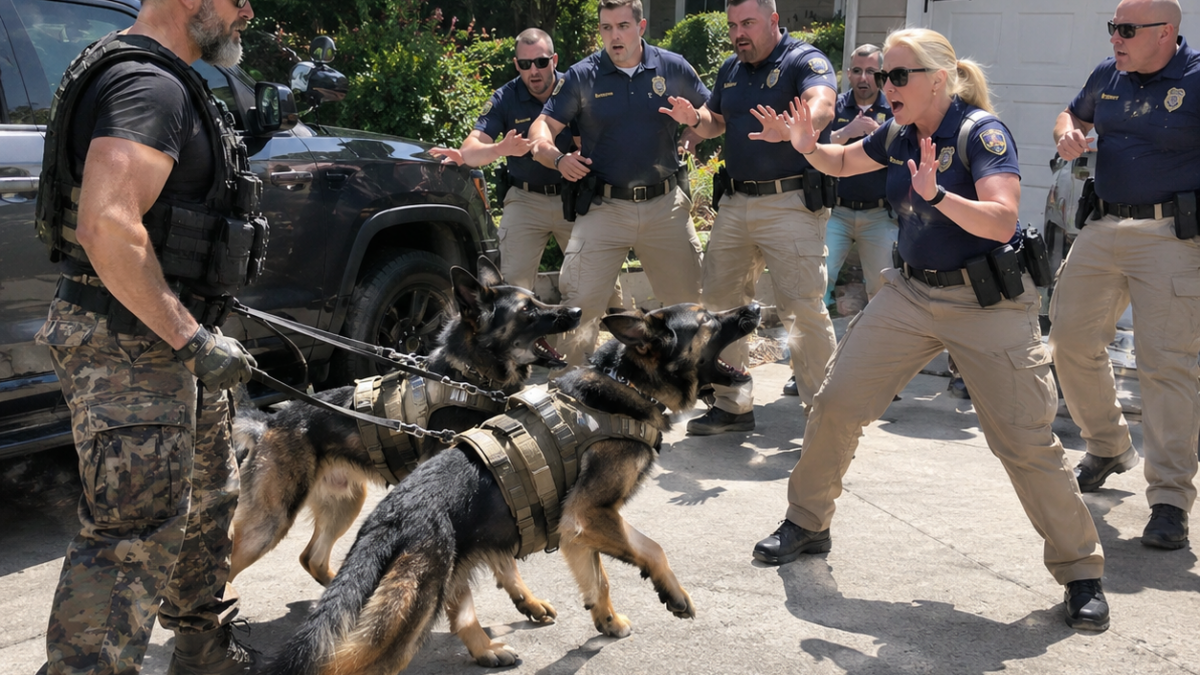
Six HOA Guards Surrounded Me—Then My Military K9s Rushed Out and Every One of Them Froze
Six men surrounded me in my own driveway before nine in the morning.
Not one of them knew what I used to do for a living.
That was the part everyone misunderstood later, when Hawthorne Bend tried to rewrite what happened as an unfortunate disagreement between an HOA security team and a difficult homeowner.
It wasn’t.
There was nothing accidental about the way those six men spread out.
Two came left.
Two moved right.
One stayed near the trucks.
The biggest man stepped directly in front of me.
Behind them sat two white patrol pickups with HAWTHORNE BEND SECURITY peeling off the doors.
And there I was in the middle of my driveway, wearing an old gray sweatshirt, holding a mug of coffee that had already started going cold.
I didn’t raise my voice.
Didn’t set the cup down.
Didn’t step backward.
The lead guard noticed that.
Men like him always notice when the person they expect to intimidate refuses to perform fear for them.
His name was Dale Puit.
Barrel chest.
Heavy belt.
Gray beginning at the temples.
Former county deputy, if neighborhood gossip was accurate.
He had the posture of someone who had spent twenty years expecting doors to open because he was walking toward them.
“Sir,” he said, “we’ve had a complaint.”
I took a sip of coffee.
“About what?”
His eyes narrowed.
“Aggressive animals.”
I looked toward the house.
“Mine?”
“Two large dogs. Off leash. Threatening a resident near the green belt.”
My dogs were inside.
Both of them.
They had been inside since before sunrise.
I knew that as certainly as I knew my own name.
“They haven’t been outside this morning.”
Puit took one step closer.
The five men behind him tightened their half circle.
“Board policy requires us to secure the animals pending review.”
I glanced at his truck.
Then back at him.
“Secure them.”
“Yes.”
“From inside my house.”
“If necessary.”
“Based on an unnamed complaint.”
“Based on a resident safety issue.”
Something in his tone told me he expected resistance.
Not physical resistance.
The ordinary kind.
Argument.
Fear.
Negotiation.
The little dance people perform when a uniform tells them the situation has already been decided.
I had spent too many years around real uniforms to confuse a costume with authority.
So instead of arguing, I whistled.
Two notes.
Low.
Short.
Every man around me changed expression.
The side door of my house swung open.
Ranger came through first.
Belgian Malinois.
Dark mask.
Lean.
Fast.
Vesper was half a stride behind him.
Neither barked.
Neither growled.
That was what scared the guards.
Not the breed.
Not the speed.
The silence.
Ranger cut left.
Vesper cut right.
They reached me almost simultaneously and stopped at my flanks.
No spoken command.
No leash.
No hesitation.
Perfect spacing.
Perfect focus.
Their bodies angled outward.
Eyes on the six men.
Not tense.
Ready.
The youngest guard whispered:
“Those aren’t pets.”
His name patch said CORY VANCE.
Maybe twenty-four.
I looked at him.
“No.”
Ranger’s ears moved.
Vesper’s eyes tracked Puit’s right hand.
Puit had been resting that hand near his belt.
He slowly let it fall away.
Nobody moved for eleven seconds.
I counted.
One.
Two.
Three.
Four.
By five, Cory had stopped breathing through his mouth.
By seven, the man nearest the trucks had taken half a step backward without realizing it.
By eleven, Dale Puit finally spoke.
“Doesn’t matter what they are.”
That was the first stupid thing he said.
The second came immediately after.
“Board resolution one-fourteen prohibits aggressive breed types over forty pounds unless specifically registered.”
I looked at Ranger.
Then Vesper.
Then back at Puit.
“You’ll want to call whoever sent you before you say that again.”
His jaw tightened.
“You threatening me?”
“No.”
I lifted my coffee.
“I’m helping you.”
That made him angrier.
“You are in violation.”
“I’m not a member of your board.”
“You live inside Hawthorne Bend.”
“I own a house inside the development.”
“Same thing.”
“No.”
He looked at the other men as though expecting them to reinforce him.
Nobody did.
Because every one of them had finally understood something Puit was still resisting.
Ranger and Vesper were not neighborhood dogs.
They were working animals.
And the man standing between them probably wasn’t what Hawthorne Bend had told them he was either.
Puit walked fifteen feet away and made a phone call.
I watched his shoulders.
That slight hunch people develop when receiving instructions they don’t entirely understand.
He turned once and looked toward the house.
Then toward me.
Then away.
When he came back, his voice was different.
Not kinder.
More careful.
“We’ll be filing a formal dangerous-animal complaint with the county.”
“Based on what evidence?”
“A resident statement.”
“Which resident?”
“Confidential.”
That word mattered later.
Confidential.
At the time, I simply nodded.
Ranger and Vesper stayed beside me.
Puit waited for me to react.
I didn’t.
Finally he gestured toward his men.
They backed away.
Loaded into the trucks.
Drove out of Large Hollow Court.
Mrs. Odum’s curtains twitched across the street.
A delivery driver stopped near the corner and held his phone up.
Somewhere behind the glass of one of those white security trucks, someone had just realized that the morning had not gone according to plan.
I stood there until the trucks disappeared.
Then I looked down.
“Inside.”
Ranger turned first.
Vesper followed.
No drama.
No barking.
They went through the side door.
I finished the cold coffee.
Then I walked into my study and opened a drawer I had not touched in three weeks.
Inside was a plain black folder.
No label.
No name.
Just a thin stack of papers my old friend Priya Ostrander had given me the day I moved into Hawthorne Bend.
I had promised myself I would not open it again unless I had a reason.
Six private security men surrounding me before breakfast?
That qualified.
My name is Silas Kane.
I was forty-one years old when all of this happened.
For nine years, I served as a military working dog handler.
Four of those years were spent attached to a joint task force whose exact operations I still don’t discuss in ordinary rooms.
Ranger and Vesper were both Belgian Malinois.
Both federally owned.
Both under temporary assignment to my custody through a reassignment protocol that civilians almost never encounter and local agencies tend to misunderstand unless somebody explains it carefully.
I didn’t move into Hawthorne Bend because I liked the golf course.
I moved there because Priya asked me to.
Eighteen months before those six guards stepped onto my driveway, she called me.
“Silas.”
“Priya.”
“How do you feel about doing something slow?”
I laughed.
“In your line of work, slow usually means miserable.”
“It means boring.”
“That sounds worse.”
“I need somebody who knows how to live quietly.”
“You called the wrong man.”
“I called exactly the right one.”
Priya had worked with my unit years earlier.
Not as military.
Different agency.
Different authority.
Same habit of appearing calm when everybody else had just discovered a reason to panic.
She explained as much as she was allowed to.
A pattern had appeared across several residential developments in two states.
Rezoning applications.
Land consolidation.
HOA enforcement actions.
One inconvenient homeowner in each location.
Pressure.
Complaints.
Legal threats.
Then the homeowner disappeared from the development.
Some sold.
One lost the property in litigation.
Another case had become strange enough that Priya’s agency wanted someone placed inside a fifth development before the pattern completed.
Hawthorne Bend.
“Why me?”
“You know dogs.”
“That narrows the country.”
“You know surveillance discipline.”
“Still not enough.”
“You don’t panic.”
I didn’t answer.
Then she said:
“And you’re boring when you choose to be.”
That was insulting enough to sound sincere.
So I moved.
Gray house.
End of Large Hollow Court.
Paid through an LLC.
Told the property manager I did remote logistics consulting.
Technically true.
Nobody asked much else.
That was the point.
For eleven months, I watched.
Hawthorne Bend occupied about four hundred acres in the Carolina foothills.
Matching mailboxes.
Matching shutters.
Brick entrance pillars.
Golf carts.
Clubhouse.
Pool.
A covenant book thick enough to stun a deer.
Behind my house ran a green belt.
Eleven hundred feet of undeveloped land.
Scrub pine.
Red clay.
Creek bed.
Officially protected as a permanent conservation easement under the original development plat.
Behind that?
Roughly four hundred additional acres.
Undeveloped.
Quiet.
Except it wasn’t quiet.
Survey stakes appeared twice.
Then disappeared.
A soil testing crew spent four hours there one March morning without filing the usual county notice.
An LLC called Larchmont Corridor Holdings submitted a rezoning application connected to the acreage.
Strangely, that application sat in preliminary review for eleven months.
No public hearing.
No obvious progress.
No withdrawal.
Almost as though someone needed one final piece before the process could move.
Priya had suspected access.
I suspected the same.
The green belt behind Large Hollow Court formed the only realistic corridor between the future commercial parcel and the main county road.
And my lot sat in the wrong place.
My backyard touched the corridor.
My deed included rights that would complicate any attempt to turn that conservation strip into a vehicle access route.
That was why I was there.
Not to investigate aggressively.
Not to confront anyone.
Watch.
Document.
Wait.
For eleven months, nothing happened.
Then Hawthorne Bend security showed up with six men to seize my dogs.
Two days after the driveway incident, the official complaint arrived by certified mail.
It was beautifully written.
That bothered me immediately.
The alleged incident supposedly occurred at 8:47 a.m.
Near the green belt trail.
Two aggressive dogs.
Resident forced to retreat.
Resident feared for personal safety.
Resident requested anonymity.
Very specific.
Except no witness name.
No photograph.
No video.
No physical injury.
No independent report.
And a reference to an HOA privacy section that didn’t exist.
I checked.
Twice.
The more detailed a false story becomes, the more opportunities it creates to collapse.
So I built a timeline.
First question:
How would this anonymous resident have reached that section of green belt at 8:47?
I walked the route.
There were only two practical access points.
My backyard.
And the adjoining lot belonging to an elderly widower named Haron Voss.
Haron had been in Charleston visiting his daughter all week.
Nobody could have legally accessed the alleged location from the community trail system because no trail connected there.
The complaint described a witness standing in a place the witness could not have reached.
I called Priya.
“They’re moving faster.”
“That worries me.”
“Why?”
“Because urgency usually comes from above.”
“HOA presidents generate plenty of urgency.”
“Not this kind.”
She paused.
“Boards don’t invent deadlines, Silas. Somebody hands them one.”
That sentence stayed with me.
I spent the afternoon pulling property files.
Rezoning.
Survey history.
Larchmont Corridor Holdings.
The shell structure went nowhere obvious.
Registered agent.
Another LLC.
Another agent.
Law firm in the state capital.
I sent the names to Priya.
Then the dangerous-animal petition escalated.
County Animal Services received a request for emergency temporary removal.
That part got under my skin.
I won’t pretend otherwise.
Ranger and Vesper had worked beside men and women under circumstances most people never experience.
They had found explosives.
Tracked armed subjects.
Cleared structures.
Protected handlers.
Lived through noise, chaos, heat, dust, and fear.
The idea that a fabricated HOA complaint could result in either animal being removed, confined, or even destroyed under the wrong interpretation of a municipal dangerous-dog ordinance?
I was angry.
For ten minutes.
Then I stopped being angry.
Rage is useful only if you’re about to break a door.
I needed clarity.
County procedure required an independent temperament evaluation before removal.
That saved us.
Dr. Renata Okafor conducted the assessment.
Thirty-one years of behavioral work.
She had the calm, tired eyes of someone who had seen every kind of animal and almost every kind of dishonest owner.
We met at the county facility Tuesday morning.
Ranger first.
Stranger approach.
Alert.
Controlled.
Sudden noise.
Ear flick.
Recovery immediate.
Food guarding.
None.
Leash pressure.
Responsive.
Vesper repeated the process.
Same results.
Then Karen Ashby arrived.
That was the first time I had stood close enough to study her face.
Karen was Hawthorne Bend’s HOA president.
Mid-fifties.
Always polished.
Always photographed at neighborhood events.
Always signing newsletters with language like community values and collective safety.
I expected arrogance.
What I saw was different.
Desperation.
She walked toward the assessment gate.
A county employee stopped her.
“Ma’am, restricted area.”
“I’m HOA president.”
“This is still restricted.”
“These are the animals that attacked one of my residents.”
She said it loudly.
Too loudly.
The performance was for the onlookers.
Ranger’s ears lifted.
Vesper shifted half an inch.
Neither dog moved.
Karen stared at them.
Almost challenging.
Dr. Okafor looked up.
“Ma’am.”
Karen ignored her.
“These dogs are dangerous.”
Dr. Okafor closed the clipboard.
“You need to step away.”
“I have every right to observe.”
“You have the right to leave voluntarily.”
Karen stiffened.
“Excuse me?”
“If you continue attempting to provoke a response during a formal assessment, I will document that conduct in my report.”
Karen stared.
Four seconds.
Then turned.
Walked away.
Before she reached her car, her phone was already at her ear.
Dr. Okafor looked at me.
“That happen often?”
“First time.”
She looked toward Karen.
“I doubt that.”
Her preliminary conclusion was simple.
Exceptional control.
No indicators supporting the complaint.
Formal report due in three days.
That evening, Priya called.
“I found Merrick.”
I sat straighter.
“Who?”
“Preston Vance Merrick.”
The law firm behind Larchmont’s registered agent employed him as contract counsel.
Specialty?
Community compliance restructuring.
“That sounds made up.”
“It’s legal language for making people leave without calling it eviction.”
“Connection to Hawthorne Bend?”
“None on paper.”
“Then why do we care?”
“Because he appears in four other developments.”
I said nothing.
Priya continued.
“Each had a stalled rezoning application.”
“Each had an enforcement target.”
“Yes.”
“What happened to them?”
“Two sold.”
“One fought.”
“And?”
“Lost the property. Bankrupted.”
“The fourth?”
Silence.
“Priya.”
“He disappeared from public records about eight months after pressure started.”
“What does that mean?”
“No forwarding address.”
“Could mean he moved.”
“Could.”
“But you don’t think so.”
“I think we don’t know.”
Ranger lay at my feet.
Vesper slept near the window.
“This is bigger than the dogs.”
“Yes.”
“The dogs are leverage.”
“Opening move.”
She paused.
“Whatever happens at the hearing, be ready for what happens after.”
Thursday morning, County Animal Services held the hearing.
Karen came with a folder thick enough to suggest insecurity.
I came with my attorney, Odalis Ferron.
Odalis spoke softly.
Never wasted a question.
Karen began with the complaint.
8:47 a.m.
Green belt.
Aggressive animals.
Resident feared attack.
Odalis waited.
Then stood.
“Mrs. Ashby, you cited a confidentiality provision protecting the resident’s identity.”
“Yes.”
“Which covenant section?”
Karen flipped pages.
“Let me find it.”
Nobody spoke.
More pages.
Nothing.
Odalis gave her time.
That was the cruelest part.
Eventually Karen said:
“I don’t recall the exact number.”
“Does the provision exist?”
“Yes.”
“Can you provide it?”
“Not at this moment.”
Odalis nodded.
“Let’s discuss access.”
Karen stiffened.
“The incident occurred near the green belt?”
“Yes.”
“Which trail entrance?”
“The community access.”
“Where?”
Karen paused.
Odalis waited.
“There are multiple access points.”
“No.”
Odalis placed the plat on the screen.
“There are two.”
She pointed.
“Mr. Kane’s private backyard.”
Then the neighboring lot.
“And Mr. Voss’s private backyard.”
She looked at Karen.
“Mr. Voss was in Charleston.”
Karen looked toward the gallery.
That was when I noticed him.
Silver hair.
Dark suit.
No expression.
Preston Merrick.
He sat two rows behind Karen.
Legal pad on his knee.
Never wrote anything.
He watched.
Men like him don’t attend to participate.
They attend to supervise.
Dr. Okafor’s report came next.
Exceptional impulse control.
Zero aggression indicators.
No behavior consistent with the complaint.
And one paragraph describing an attempt by an outside observer to provoke the dogs during evaluation.
Karen’s face tightened.
The hearing officer, Janice Felt, read everything.
Then looked up.
“I find insufficient grounds for emergency removal.”
I exhaled.
Barely.
“The complaint contains material inconsistencies, and the independent evaluation does not support the claimed danger.”
Ranger and Vesper stayed with me.
That should have ended it.
Instead, during the recess, Merrick stood.
Walked toward Karen.
Leaned close.
Said something.
Her face changed.
Not anger.
Fear.
After the hearing, Dale Puit waited near the elevator.
Same man who had surrounded me.
Different posture.
“Mr. Kane.”
I stopped.
Odalis looked at him.
“You need to hear something.”
“About what?”
“The morning we came to your house.”
I said nothing.
“My body camera was still recording.”
Odalis immediately said:
“Don’t hand us anything directly.”
Puit nodded.
“I know.”
He looked embarrassed.
“There are eleven seconds.”
“What eleven seconds?”
“After I called from the driveway.”
His jaw tightened.
“I was told to keep pressure on you.”
“By Karen?”
“Through Karen.”
“What did you hear?”
Puit looked down the hallway.
Karen stood with Merrick.
“She had spoken to him before we arrived.”
“How long before?”
“Four minutes.”
“And?”
“She said she didn’t feel right.”
My attention sharpened.
“What exactly?”
Puit swallowed.
“She said, ‘What if there isn’t a real complaint?’”
Odalis went still.
“And the answer?”
Puit looked at me.
“Karen, we need this parcel clean.”
Not safe.
Not protect the residents.
Clean.
Parcel.
Land language.
I looked toward Merrick.
He was already leaving.
Puit continued.
“I believed what I was told.”
“Why tell me now?”
“Because I watched her try to provoke those dogs.”
He looked tired.
“And I realized this was never what they said it was.”
Odalis arranged for the body camera evidence to be preserved properly.
Chain of custody.
Formal transfer.
No shortcuts.
That mattered later.
The next morning, I returned to the county building to collect final paperwork.
Two deputies waited in the marble hallway.
Preston Merrick stood behind them.
Legal pad in hand.
One deputy approached.
“Silas Kane?”
“Yes.”
“You’re under arrest.”
Odalis had warned me something might happen.
Still, the words hit differently.
“For what?”
“Impersonating a federal officer and unlawful possession of government property.”
I almost laughed.
Then I saw Merrick watching.
The complaint alleged that my credentials were fraudulent.
That Ranger and Vesper weren’t lawfully assigned.
That I had misrepresented myself to county officials.
The accusation didn’t need to be true.
It needed to be slow.
An impersonation charge triggered verification.
Verification triggered detention.
Detention created headlines.
Headlines created doubt.
Doubt created time.
Merrick needed time.
I understood that while the cuffs closed.
Six hours in holding.
That was his second move.
The dogs had failed.
So he attacked my identity.
Four hours in, Odalis arrived.
Behind her came Priya.
Gray suit.
Federal credentials.
Booking officers changed posture immediately.
Priya did not yell.
She didn’t need to.
“Mr. Kane’s credentials have been verified in federal databases continuously for the past eleven months.”
The sergeant looked uncomfortable.
Priya continued.
“Ranger and Vesper are lawfully assigned federal working animals under an active protocol.”
She placed documents on the desk.
“You are currently holding an individual attached to an eighteen-month federal inquiry based on a complaint generated by a private attorney whose financial interests overlap with the land under investigation.”
The sergeant read.
Then read again.
Priya added:
“I recommend contacting the district attorney before this becomes more complicated.”
Three hours later, the charge collapsed.
I walked out.
Ranger and Vesper were returned.
No celebration.
Because Merrick was gone.
He had left the building shortly after my arrest.
Priya found me in a conference room.
“He’ll run.”
“Like the fourth case.”
“Yes.”
“Can we stop him?”
“If we tie him directly to the fabricated complaint.”
“We have Puit’s audio.”
“We may have more.”
That evening, I did something Odalis later called reckless.
I visited Karen.
She answered the door herself.
No blazer.
No clipboard.
No HOA smile.
Just a tired woman in a pale yellow house.
“I know what you heard,” she said.
I had not spoken yet.
“Then tell me.”
She opened the door wider.
I stepped inside.
Her living room looked staged.
Perfect furniture.
Perfect pillows.
Nothing touched.
She sat.
I remained standing until she said:
“Please.”
Then I sat opposite her.
“Preston came to me almost two years ago.”
“Why?”
“Through the management company.”
“What did he tell you?”
“That there was an unregistered commercial dog operation on Large Hollow Court.”
I stared.
“He said the owner was using working dogs without proper association registration.”
“I wasn’t even living there yet.”
“I know that now.”
“You believed this for eighteen months?”
Karen looked down.
“I believed enough of it.”
“Why?”
“Because he told me children could be endangered.”
“Children who couldn’t access the green belt.”
“I didn’t check.”
“That’s the problem.”
She nodded.
“I know.”
For once, no argument.
No deflection.
“He told me enforcement had to escalate gradually.”
“Letters?”
“Yes.”
“Security notes?”
“Yes.”
“Complaint?”
“Yes.”
“Did he write it?”
Karen closed her eyes.
“He sent me a draft.”
There it was.
“Did you know it was false?”
“Not at first.”
“At first?”
“Three days before your driveway.”
She looked at me.
“I started doubting.”
“What changed?”
“Puit asked me where the original resident report was.”
“And?”
“There wasn’t one.”
Silence.
“I called Preston.”
“That’s the call.”
“Yes.”
“What did you say?”
“What Puit heard.”
Her voice dropped.
“I asked him if there had ever been a real complaint.”
“And he said?”
Karen looked sick.
“We need this parcel clean.”
“How did you interpret that?”
“I understood.”
“Immediately?”
“Yes.”
“And you still sent the guards.”
Her eyes filled with something close to shame.
“Yes.”
“Why?”
“Because admitting the truth meant admitting I had spent eighteen months targeting a man for a reason that had nothing to do with community safety.”
I said nothing.
She continued.
“I wanted to believe there was still something legitimate underneath it.”
“So you filed the complaint.”
“Yes.”
“You tried to provoke my dogs.”
“Yes.”
“You lied at the hearing.”
Karen looked at me.
“Yes.”
No excuse.
That mattered.
Not enough to erase anything.
But it mattered.
“Why help now?”
She laughed bitterly.
“Because he never even learned my name correctly.”
“What?”
“He called me Carol half the time.”
I almost smiled.
“He used you.”
“Yes.”
“I used myself.”
That answer was better than an excuse.
Karen agreed to give a full statement.
Not because I threatened her.
Because she was finished.
Over the next eleven days, the story stopped being an HOA dispute.
Federal investigators pulled records from five developments.
Merrick’s patterns lined up.
Same language.
Same enforcement escalations.
Same shell entities.
Same rezoning delays.
Same pressure against one inconvenient resident.
Puit’s eleven seconds of audio became central.
Not because eleven seconds were magical.
Because they connected motive to instruction.
Karen’s sworn statement filled the gaps.
Calendar entries.
Emails.
Draft complaints.
Calls.
She explained how Merrick isolated decisions.
How he bypassed board members likely to question him.
How he drafted enforcement language.
How he insisted certain residents be treated as “compliance obstacles.”
That phrase appeared repeatedly.
Obstacle.
Not neighbor.
Not homeowner.
Obstacle.
Dr. Okafor’s report became part of the larger record.
So did the fabricated animal complaint.
My false arrest.
The fake federal impersonation allegation.
The Larchmont Corridor application.
The conservation easement.
The shell-company ownership chain.
Everything finally converged in one federal proceeding.
Preston Vance Merrick sat at the defense table.
For the first time since I had seen him, he looked ordinary in the wrong way.
Not forgettable.
Exposed.
The prosecutor played Puit’s audio.
Karen’s voice.
“I don’t feel right about this, Preston. What if there’s no real complaint?”
Then Merrick.
Calm.
Almost bored.
“Karen, we need this parcel clean.”
Eleven seconds.
That was all.
Merrick’s attorney argued context.
Aggressive advocacy.
Miscommunication.
No direct instruction to fabricate.
Then Karen testified.
She explained the draft complaint Merrick sent.
The instructions.
The lack of original witness.
The land pressure.
The call.
She admitted her own role.
That mattered too.
Nobody treated her like a hero.
She wasn’t one.
She had made choices.
Bad ones.
Cowardly ones.
But she finally stopped lying.
Puit testified.
He admitted he had followed pressure he should have questioned.
He explained why the body camera kept recording.
How he was told to make the encounter look like an enforcement response.
How six men had been sent for two dogs that were inside a house.
The prosecutor asked:
“Did you ever receive evidence those dogs had threatened anyone before arriving?”
“No.”
“Did you ask?”
“Not enough.”
“What changed?”
Puit looked toward me.
“The dogs.”
The prosecutor frowned.
“The dogs?”
“They came out.”
He paused.
“Not aggressive. Controlled.”
“And?”
“I realized the man we’d been told was unstable had more discipline standing in his driveway holding coffee than six of us had arriving in two trucks.”
I looked down.
That line stayed with me.
Merrick’s defense tried to separate the developments.
Different clients.
Different HOAs.
Different land deals.
The government connected the language.
Repeated phrases.
Repeated vendors.
Repeated shell structures.
Same tactics.
Same kind of resident pressure timed to land deadlines.
And all of it connected to development value.
Hawthorne Bend’s corridor alone represented millions.
Across all five projects, the value climbed much higher.
The green belt behind my house was not about dogs.
Never had been.
It was about access.
A conservation corridor.
One parcel.
One man.
Two animals.
And a system that someone believed could be manipulated cheaply enough to clear the way.
Merrick’s attorney made one final argument.
“No direct proof links my client to a fabricated allegation against Mr. Kane.”
The magistrate replayed the eleven seconds.
Nobody moved.
“We need this parcel clean.”
Merrick’s face changed.
Just once.
A small tightening around the mouth.
The first honest expression I ever saw from him.
The eventual convictions covered fraud, conspiracy, witness tampering, and related conduct across the developments.
Larchmont Corridor Holdings was dissolved.
Its parent structures unraveled.
The Hawthorne Bend rezoning application was withdrawn.
The green belt remained under conservation protection.
No commercial access road.
No redevelopment corridor.
No quiet conversion through HOA pressure.
Karen resigned the same week she completed her testimony.
She wasn’t criminally charged.
Prosecutors considered her cooperation, Merrick’s documented manipulation, and her willingness to provide evidence.
Some Hawthorne residents were furious about that.
Others thought it was fair.
I had mixed feelings.
Karen had not been innocent.
Being manipulated doesn’t erase the moment you decide to manipulate someone else.
She lied.
Signed.
Pressured.
Sent men.
Filed a false complaint.
Tried to provoke my dogs.
Her consequences were real even without prison.
She lost the position she had built her identity around.
Lost trust.
Lost friends.
Lost the story she had told herself about being the protector of Hawthorne Bend.
That last one may have hurt most.
Dale Puit resigned from Hawthorne Bend Security.
A few months later, I heard he had taken a position with a county oversight unit.
When I asked him why, he said:
“I spent too long enforcing what people told me was true.”
He looked at me.
“I’d rather spend the rest of my career checking.”
I respected that.
As for Hawthorne Bend?
It changed.
Not dramatically.
HOAs rarely transform overnight.
The clubhouse still argued about fences.
Residents still complained about trash cans.
Somebody still wrote angry emails about golf carts.
But the security contract was rewritten.
Board enforcement required documented complaints.
Anonymous reports needed independent verification before escalation.
Private guards were prohibited from entering private property without legal authority.
Animal complaints went directly to county services instead of through HOA “enforcement.”
Nothing revolutionary.
Just safeguards.
The kind that only look obvious after someone proves why they’re necessary.
Six days after the final proceeding, I stood in my driveway.
Same place.
Same gray house.
Ranger and Vesper lay in the grass.
Off duty.
Really off duty.
A boy from two houses down was riding a bicycle in circles at the end of the cul-de-sac.
His mother watched from the porch.
Ranger tracked him with one eye.
Vesper was asleep.
Mrs. Odum came outside to collect her mail.
This time I waved.
She nearly dropped the envelopes.
I laughed.
She laughed too.
Apparently eleven months of not waving had created a reputation.
Priya called that afternoon.
“Still boring?”
“Trying.”
“How are the dogs?”
“Better behaved than most people.”
“Low bar.”
I looked toward the green belt.
“What happens now?”
“With you?”
“Yes.”
“You get to live in your house.”
“That’s it?”
“That was always the goal.”
“And the case?”
“Other people handle it.”
I understood.
That was the strange thing about long investigations.
You spend months waiting for the moment everything breaks open.
Then it does.
And afterward?
Laundry.
Coffee.
Dog food.
Mail.
Normal life.
I had missed normal life.
For a long time, people in Hawthorne Bend told the story as:
The morning six HOA guards surrounded Silas Kane and his military dogs came running.
That wasn’t wrong.
It just wasn’t the whole story.
Yes, Ranger and Vesper changed the driveway.
They stopped six men because those men recognized training when they saw it.
But the dogs didn’t destroy Preston Merrick.
Evidence did.
An impossible trail location.
A fake covenant provision.
A professional temperament evaluation.
A body camera nobody remembered was still recording.
A security officer deciding he didn’t want to remain part of a lie.
An HOA president finally admitting the story she had defended was false.
A federal investigator patient enough to wait eighteen months.
And eleven seconds.
People think corruption collapses under dramatic evidence.
Stacks of cash.
Secret videos.
Confessions.
Sometimes.
But sometimes the entire thing turns on one sentence nobody thought mattered enough to erase.
“We need this parcel clean.”
That phrase exposed everything.
Because safe people talk about safety.
Dog complaints talk about dogs.
HOA rules talk about covenants.
But land manipulators talk about parcels.
Merrick forgot who might be listening.
Karen forgot to ask why.
Puit remembered the recording.
That was the difference.
I walked across the lawn.
Ranger stood immediately.
Vesper lifted her head.
“Relax.”
Ranger sat.
Vesper rolled onto one side.
I crouched beside them.
When people ask whether Ranger and Vesper saved me that morning, I usually say no.
They saved themselves.
They behaved exactly as trained.
If either dog had barked aggressively, lunged, snapped, or reacted the way Karen needed them to react, the story could have gone very differently.
Instead, they stood.
Calm.
Controlled.
Silent.
Six men arrived expecting dangerous animals.
They found disciplined working dogs.
Six men arrived expecting an unstable homeowner.
They found a man holding coffee.
Karen arrived at the evaluation expecting fear.
The dogs gave her nothing.
Merrick built a plan around reaction.
That was his flaw.
He needed everyone else to become the worst version of the person he described.
He needed me angry.
The dogs aggressive.
Puit obedient.
Karen unquestioning.
County officials careless.
Residents afraid.
He got some of that.
For a while.
But not enough.
Eventually, one person stopped playing the role he had written for them.
Then another.
Then another.
Puit spoke.
Karen confessed.
Dr. Okafor documented.
Priya connected.
Odalis preserved.
And the whole structure collapsed.
That may be the real lesson.
Not that military dogs are intimidating.
They are.
Not that HOA presidents can overreach.
They can.
Not even that powerful people sometimes hide greed behind words like community safety.
They do.
The lesson is simpler.
A lie that requires everybody to keep behaving predictably becomes fragile the moment one person refuses.
Puit refused.
Karen eventually refused.
I refused before either of them.
Not dramatically.
I just didn’t move.
That first morning, Dale Puit wanted me to back up.
I didn’t.
Wanted me to surrender Ranger and Vesper.
I didn’t.
Wanted me to treat his private security uniform like a warrant.
I didn’t.
Then the dogs came through the door.
Ranger left.
Vesper right.
Six men froze.
People remember that part because it’s visual.
Because it feels like a movie.
But what I remember is the silence.
Eleven seconds.
Six armed men.
Two dogs.
One cup of coffee.
Nobody moving.
And somewhere inside that silence, Dale Puit started asking the first question Merrick’s entire scheme depended on nobody asking.
What if the story we were told isn’t true?
Everything followed from there.
Months later, Karen sent me a letter.
Not an email.
Actual paper.
Three pages.
I almost threw it away.
Then read it.
She didn’t ask forgiveness.
That surprised me.
She wrote that she had spent years confusing certainty with responsibility.
She believed leadership meant acting quickly.
Decisively.
Protecting people before they knew they needed protection.
Merrick had fed that belief.
Told her every hesitation placed the neighborhood at risk.
Every question delayed action.
Every skeptical board member was weak.
Every target was a threat.
By the time she understood what he was really doing, admitting it meant admitting almost two years of her own behavior had helped him.
So she doubled down.
That part was hers, she wrote.
Not his.
I respected the sentence.
I didn’t answer the letter.
Some things don’t require reconciliation.
Truth is enough.
The gray house stayed mine.
The green belt stayed green.
No road cut through the trees.
No construction crews.
No commercial corridor.
Haron Voss came home from Charleston and asked why half the county had been talking about his backyard.
I told him the short version.
He listened.
Then said:
“So they said I witnessed a dog attack while I was eating shrimp in South Carolina?”
“Basically.”
He shook his head.
“Idiots.”
That was his entire analysis.
Probably the best one.
The boy on the bicycle eventually asked whether he could meet Ranger and Vesper.
His mother nearly panicked.
I smiled.
“Not today.”
He looked disappointed.
“Why?”
“Because working dogs need introductions done correctly.”
“Are they mean?”
“No.”
“Do they bite?”
“They have.”
His eyes became enormous.
“Bad guys?”
I laughed.
“Sometimes.”
A week later, with his mother present and both dogs under controlled conditions, he met them.
Ranger sniffed his hand.
Vesper ignored him for thirty seconds, then leaned against his leg.
The boy looked at me.
“They don’t seem scary.”
“They’re not supposed to scare you.”
“What are they supposed to do?”
“Listen.”
He thought about that.
“They’re good at it.”
“Very.”
That evening, I stood at the edge of the green belt.
Sun low through the pine.
Red clay warm under my boots.
Ranger walked ahead.
Vesper behind.
No mission.
No surveillance.
No one watching us except maybe Mrs. Odum through her curtains.
I thought about the 400 acres beyond the trees.
Millions of dollars.
Shell companies.
Lawyers.
HOA pressure.
Five developments.
People displaced.
All of that machinery aimed at one simple thing.
Access.
People with enough money often begin to think obstacles are temporary.
A conservation easement?
Temporary.
A homeowner?
Temporary.
A title?
Negotiable.
A dog complaint?
Useful.
A false arrest?
Acceptable.
They stop seeing human beings.
They see friction.
Merrick saw me as friction.
Karen saw me as resistance.
Puit saw me as a complaint.
None of them knew who I was.
That was the point.
But here’s the part I’ve thought about most since.
Even if I had truly been just a remote logistics consultant with two ordinary dogs, none of what they did would have been acceptable.
My past didn’t make the complaint wrong.
My federal connection didn’t make the pressure corrupt.
Ranger and Vesper’s status didn’t create my rights.
The rights were already there.
That matters.
Because stories like this can easily become fantasies about the powerful target revealing he is secretly more powerful than the bullies.
That is not what made Merrick wrong.
He would have been wrong if I were nobody.
He would have been wrong if Ranger were a mutt from the shelter.
He would have been wrong if Priya had never called me.
The difference is only that this time, he chose a target positioned to prove it.
Other people weren’t so lucky.
That was why the investigation mattered.
Not for me.
For the fourth man.
The one whose records went quiet.
For the homeowner bankrupted.
For the two who sold.
For the next person who would have received a compliance letter and wondered whether fighting was worth losing everything.
Merrick’s pattern stopped.
At least this one did.
That is enough.
One year after the driveway confrontation, I made coffee and stepped outside at 8:47 in the morning.
Same time listed in the fabricated complaint.
Ranger followed.
Vesper followed.
The green belt was quiet.
Mrs. Odum waved.
I waved back.
A Hawthorne Bend security truck drove past.
Different company.
Different markings.
One guard inside.
He slowed.
Looked toward Ranger.
Then Vesper.
Then me.
I raised my coffee.
He raised one hand from the wheel.
Kept driving.
No half circle.
No threats.
No one demanding leashes.
Just a vehicle continuing down the street.
Ranger sat beside me.
Vesper leaned against my knee.
I looked toward the exact spot where Dale Puit had stood.
I could still see it.
Six men.
Two trucks.
The confidence.
Then the whistle.
The door opening.
Ranger left.
Vesper right.
Every guard freezing.
They thought they were surrounding one man.
They had no idea what they were walking into.
But the dogs weren’t the thing they should have feared.
Neither was my military past.
Neither was Priya’s investigation.
The dangerous thing was simpler.
Evidence.
Patience.
And the moment people inside a bad system finally decide they would rather tell the truth than keep protecting the lie.
That morning, Ranger and Vesper rushed to my side and six HOA guards froze.
Eleven seconds later, the first crack appeared in an eighteen-month scheme.
The rest just took time.
REVIEW
Six HOA Guards Surrounded Me—Then My Military K9s Rushed Out and Every One of Them Froze
Six men surrounded me in my own driveway before nine in the morning.
Not one of them knew what I used to do for a living.
That was the part everyone misunderstood later, when Hawthorne Bend tried to rewrite what happened as an unfortunate disagreement between an HOA security team and a difficult homeowner.
It wasn’t.
There was nothing accidental about the way those six men spread out.
Two came left.
Two moved right.
One stayed near the trucks.
The biggest man stepped directly in front of me.
Behind them sat two white patrol pickups with HAWTHORNE BEND SECURITY peeling off the doors.
And there I was in the middle of my driveway, wearing an old gray sweatshirt, holding a mug of coffee that had already started going cold.
I didn’t raise my voice.
Didn’t set the cup down.
Didn’t step backward.
The lead guard noticed that.
Men like him always notice when the person they expect to intimidate refuses to perform fear for them.
His name was Dale Puit.
Barrel chest.
Heavy belt.
Gray beginning at the temples.
Former county deputy, if neighborhood gossip was accurate.
He had the posture of someone who had spent twenty years expecting doors to open because he was walking toward them.
“Sir,” he said, “we’ve had a complaint.”
I took a sip of coffee.
“About what?”
His eyes narrowed.
“Aggressive animals.”
I looked toward the house.
“Mine?”
“Two large dogs. Off leash. Threatening a resident near the green belt.”
My dogs were inside.
Both of them.
They had been inside since before sunrise.
I knew that as certainly as I knew my own name.
“They haven’t been outside this morning.”
Puit took one step closer.
The five men behind him tightened their half circle.
“Board policy requires us to secure the animals pending review.”
I glanced at his truck.
Then back at him.
“Secure them.”
“Yes.”
“From inside my house.”
“If necessary.”
“Based on an unnamed complaint.”
“Based on a resident safety issue.”
Something in his tone told me he expected resistance.
Not physical resistance.
The ordinary kind.
Argument.
Fear.
Negotiation.
The little dance people perform when a uniform tells them the situation has already been decided.
I had spent too many years around real uniforms to confuse a costume with authority.
So instead of arguing, I whistled.
Two notes.
Low.
Short.
Every man around me changed expression.
The side door of my house swung open.
Ranger came through first.
Belgian Malinois.
Dark mask.
Lean.
Fast.
Vesper was half a stride behind him.
Neither barked.
Neither growled.
That was what scared the guards.
Not the breed.
Not the speed.
The silence.
Ranger cut left.
Vesper cut right.
They reached me almost simultaneously and stopped at my flanks.
No spoken command.
No leash.
No hesitation.
Perfect spacing.
Perfect focus.
Their bodies angled outward.
Eyes on the six men.
Not tense.
Ready.
The youngest guard whispered:
“Those aren’t pets.”
His name patch said CORY VANCE.
Maybe twenty-four.
I looked at him.
“No.”
Ranger’s ears moved.
Vesper’s eyes tracked Puit’s right hand.
Puit had been resting that hand near his belt.
He slowly let it fall away.
Nobody moved for eleven seconds.
I counted.
One.
Two.
Three.
Four.
By five, Cory had stopped breathing through his mouth.
By seven, the man nearest the trucks had taken half a step backward without realizing it.
By eleven, Dale Puit finally spoke.
“Doesn’t matter what they are.”
That was the first stupid thing he said.
The second came immediately after.
“Board resolution one-fourteen prohibits aggressive breed types over forty pounds unless specifically registered.”
I looked at Ranger.
Then Vesper.
Then back at Puit.
“You’ll want to call whoever sent you before you say that again.”
His jaw tightened.
“You threatening me?”
“No.”
I lifted my coffee.
“I’m helping you.”
That made him angrier.
“You are in violation.”
“I’m not a member of your board.”
“You live inside Hawthorne Bend.”
“I own a house inside the development.”
“Same thing.”
“No.”
He looked at the other men as though expecting them to reinforce him.
Nobody did.
Because every one of them had finally understood something Puit was still resisting.
Ranger and Vesper were not neighborhood dogs.
They were working animals.
And the man standing between them probably wasn’t what Hawthorne Bend had told them he was either.
Puit walked fifteen feet away and made a phone call.
I watched his shoulders.
That slight hunch people develop when receiving instructions they don’t entirely understand.
He turned once and looked toward the house.
Then toward me.
Then away.
When he came back, his voice was different.
Not kinder.
More careful.
“We’ll be filing a formal dangerous-animal complaint with the county.”
“Based on what evidence?”
“A resident statement.”
“Which resident?”
“Confidential.”
That word mattered later.
Confidential.
At the time, I simply nodded.
Ranger and Vesper stayed beside me.
Puit waited for me to react.
I didn’t.
Finally he gestured toward his men.
They backed away.
Loaded into the trucks.
Drove out of Large Hollow Court.
Mrs. Odum’s curtains twitched across the street.
A delivery driver stopped near the corner and held his phone up.
Somewhere behind the glass of one of those white security trucks, someone had just realized that the morning had not gone according to plan.
I stood there until the trucks disappeared.
Then I looked down.
“Inside.”
Ranger turned first.
Vesper followed.
No drama.
No barking.
They went through the side door.
I finished the cold coffee.
Then I walked into my study and opened a drawer I had not touched in three weeks.
Inside was a plain black folder.
No label.
No name.
Just a thin stack of papers my old friend Priya Ostrander had given me the day I moved into Hawthorne Bend.
I had promised myself I would not open it again unless I had a reason.
Six private security men surrounding me before breakfast?
That qualified.
My name is Silas Kane.
I was forty-one years old when all of this happened.
For nine years, I served as a military working dog handler.
Four of those years were spent attached to a joint task force whose exact operations I still don’t discuss in ordinary rooms.
Ranger and Vesper were both Belgian Malinois.
Both federally owned.
Both under temporary assignment to my custody through a reassignment protocol that civilians almost never encounter and local agencies tend to misunderstand unless somebody explains it carefully.
I didn’t move into Hawthorne Bend because I liked the golf course.
I moved there because Priya asked me to.
Eighteen months before those six guards stepped onto my driveway, she called me.
“Silas.”
“Priya.”
“How do you feel about doing something slow?”
I laughed.
“In your line of work, slow usually means miserable.”
“It means boring.”
“That sounds worse.”
“I need somebody who knows how to live quietly.”
“You called the wrong man.”
“I called exactly the right one.”
Priya had worked with my unit years earlier.
Not as military.
Different agency.
Different authority.
Same habit of appearing calm when everybody else had just discovered a reason to panic.
She explained as much as she was allowed to.
A pattern had appeared across several residential developments in two states.
Rezoning applications.
Land consolidation.
HOA enforcement actions.
One inconvenient homeowner in each location.
Pressure.
Complaints.
Legal threats.
Then the homeowner disappeared from the development.
Some sold.
One lost the property in litigation.
Another case had become strange enough that Priya’s agency wanted someone placed inside a fifth development before the pattern completed.
Hawthorne Bend.
“Why me?”
“You know dogs.”
“That narrows the country.”
“You know surveillance discipline.”
“Still not enough.”
“You don’t panic.”
I didn’t answer.
Then she said:
“And you’re boring when you choose to be.”
That was insulting enough to sound sincere.
So I moved.
Gray house.
End of Large Hollow Court.
Paid through an LLC.
Told the property manager I did remote logistics consulting.
Technically true.
Nobody asked much else.
That was the point.
For eleven months, I watched.
Hawthorne Bend occupied about four hundred acres in the Carolina foothills.
Matching mailboxes.
Matching shutters.
Brick entrance pillars.
Golf carts.
Clubhouse.
Pool.
A covenant book thick enough to stun a deer.
Behind my house ran a green belt.
Eleven hundred feet of undeveloped land.
Scrub pine.
Red clay.
Creek bed.
Officially protected as a permanent conservation easement under the original development plat.
Behind that?
Roughly four hundred additional acres.
Undeveloped.
Quiet.
Except it wasn’t quiet.
Survey stakes appeared twice.
Then disappeared.
A soil testing crew spent four hours there one March morning without filing the usual county notice.
An LLC called Larchmont Corridor Holdings submitted a rezoning application connected to the acreage.
Strangely, that application sat in preliminary review for eleven months.
No public hearing.
No obvious progress.
No withdrawal.
Almost as though someone needed one final piece before the process could move.
Priya had suspected access.
I suspected the same.
The green belt behind Large Hollow Court formed the only realistic corridor between the future commercial parcel and the main county road.
And my lot sat in the wrong place.
My backyard touched the corridor.
My deed included rights that would complicate any attempt to turn that conservation strip into a vehicle access route.
That was why I was there.
Not to investigate aggressively.
Not to confront anyone.
Watch.
Document.
Wait.
For eleven months, nothing happened.
Then Hawthorne Bend security showed up with six men to seize my dogs.
Two days after the driveway incident, the official complaint arrived by certified mail.
It was beautifully written.
That bothered me immediately.
The alleged incident supposedly occurred at 8:47 a.m.
Near the green belt trail.
Two aggressive dogs.
Resident forced to retreat.
Resident feared for personal safety.
Resident requested anonymity.
Very specific.
Except no witness name.
No photograph.
No video.
No physical injury.
No independent report.
And a reference to an HOA privacy section that didn’t exist.
I checked.
Twice.
The more detailed a false story becomes, the more opportunities it creates to collapse.
So I built a timeline.
First question:
How would this anonymous resident have reached that section of green belt at 8:47?
I walked the route.
There were only two practical access points.
My backyard.
And the adjoining lot belonging to an elderly widower named Haron Voss.
Haron had been in Charleston visiting his daughter all week.
Nobody could have legally accessed the alleged location from the community trail system because no trail connected there.
The complaint described a witness standing in a place the witness could not have reached.
I called Priya.
“They’re moving faster.”
“That worries me.”
“Why?”
“Because urgency usually comes from above.”
“HOA presidents generate plenty of urgency.”
“Not this kind.”
She paused.
“Boards don’t invent deadlines, Silas. Somebody hands them one.”
That sentence stayed with me.
I spent the afternoon pulling property files.
Rezoning.
Survey history.
Larchmont Corridor Holdings.
The shell structure went nowhere obvious.
Registered agent.
Another LLC.
Another agent.
Law firm in the state capital.
I sent the names to Priya.
Then the dangerous-animal petition escalated.
County Animal Services received a request for emergency temporary removal.
That part got under my skin.
I won’t pretend otherwise.
Ranger and Vesper had worked beside men and women under circumstances most people never experience.
They had found explosives.
Tracked armed subjects.
Cleared structures.
Protected handlers.
Lived through noise, chaos, heat, dust, and fear.
The idea that a fabricated HOA complaint could result in either animal being removed, confined, or even destroyed under the wrong interpretation of a municipal dangerous-dog ordinance?
I was angry.
For ten minutes.
Then I stopped being angry.
Rage is useful only if you’re about to break a door.
I needed clarity.
County procedure required an independent temperament evaluation before removal.
That saved us.
Dr. Renata Okafor conducted the assessment.
Thirty-one years of behavioral work.
She had the calm, tired eyes of someone who had seen every kind of animal and almost every kind of dishonest owner.
We met at the county facility Tuesday morning.
Ranger first.
Stranger approach.
Alert.
Controlled.
Sudden noise.
Ear flick.
Recovery immediate.
Food guarding.
None.
Leash pressure.
Responsive.
Vesper repeated the process.
Same results.
Then Karen Ashby arrived.
That was the first time I had stood close enough to study her face.
Karen was Hawthorne Bend’s HOA president.
Mid-fifties.
Always polished.
Always photographed at neighborhood events.
Always signing newsletters with language like community values and collective safety.
I expected arrogance.
What I saw was different.
Desperation.
She walked toward the assessment gate.
A county employee stopped her.
“Ma’am, restricted area.”
“I’m HOA president.”
“This is still restricted.”
“These are the animals that attacked one of my residents.”
She said it loudly.
Too loudly.
The performance was for the onlookers.
Ranger’s ears lifted.
Vesper shifted half an inch.
Neither dog moved.
Karen stared at them.
Almost challenging.
Dr. Okafor looked up.
“Ma’am.”
Karen ignored her.
“These dogs are dangerous.”
Dr. Okafor closed the clipboard.
“You need to step away.”
“I have every right to observe.”
“You have the right to leave voluntarily.”
Karen stiffened.
“Excuse me?”
“If you continue attempting to provoke a response during a formal assessment, I will document that conduct in my report.”
Karen stared.
Four seconds.
Then turned.
Walked away.
Before she reached her car, her phone was already at her ear.
Dr. Okafor looked at me.
“That happen often?”
“First time.”
She looked toward Karen.
“I doubt that.”
Her preliminary conclusion was simple.
Exceptional control.
No indicators supporting the complaint.
Formal report due in three days.
That evening, Priya called.
“I found Merrick.”
I sat straighter.
“Who?”
“Preston Vance Merrick.”
The law firm behind Larchmont’s registered agent employed him as contract counsel.
Specialty?
Community compliance restructuring.
“That sounds made up.”
“It’s legal language for making people leave without calling it eviction.”
“Connection to Hawthorne Bend?”
“None on paper.”
“Then why do we care?”
“Because he appears in four other developments.”
I said nothing.
Priya continued.
“Each had a stalled rezoning application.”
“Each had an enforcement target.”
“Yes.”
“What happened to them?”
“Two sold.”
“One fought.”
“And?”
“Lost the property. Bankrupted.”
“The fourth?”
Silence.
“Priya.”
“He disappeared from public records about eight months after pressure started.”
“What does that mean?”
“No forwarding address.”
“Could mean he moved.”
“Could.”
“But you don’t think so.”
“I think we don’t know.”
Ranger lay at my feet.
Vesper slept near the window.
“This is bigger than the dogs.”
“Yes.”
“The dogs are leverage.”
“Opening move.”
She paused.
“Whatever happens at the hearing, be ready for what happens after.”
Thursday morning, County Animal Services held the hearing.
Karen came with a folder thick enough to suggest insecurity.
I came with my attorney, Odalis Ferron.
Odalis spoke softly.
Never wasted a question.
Karen began with the complaint.
8:47 a.m.
Green belt.
Aggressive animals.
Resident feared attack.
Odalis waited.
Then stood.
“Mrs. Ashby, you cited a confidentiality provision protecting the resident’s identity.”
“Yes.”
“Which covenant section?”
Karen flipped pages.
“Let me find it.”
Nobody spoke.
More pages.
Nothing.
Odalis gave her time.
That was the cruelest part.
Eventually Karen said:
“I don’t recall the exact number.”
“Does the provision exist?”
“Yes.”
“Can you provide it?”
“Not at this moment.”
Odalis nodded.
“Let’s discuss access.”
Karen stiffened.
“The incident occurred near the green belt?”
“Yes.”
“Which trail entrance?”
“The community access.”
“Where?”
Karen paused.
Odalis waited.
“There are multiple access points.”
“No.”
Odalis placed the plat on the screen.
“There are two.”
She pointed.
“Mr. Kane’s private backyard.”
Then the neighboring lot.
“And Mr. Voss’s private backyard.”
She looked at Karen.
“Mr. Voss was in Charleston.”
Karen looked toward the gallery.
That was when I noticed him.
Silver hair.
Dark suit.
No expression.
Preston Merrick.
He sat two rows behind Karen.
Legal pad on his knee.
Never wrote anything.
He watched.
Men like him don’t attend to participate.
They attend to supervise.
Dr. Okafor’s report came next.
Exceptional impulse control.
Zero aggression indicators.
No behavior consistent with the complaint.
And one paragraph describing an attempt by an outside observer to provoke the dogs during evaluation.
Karen’s face tightened.
The hearing officer, Janice Felt, read everything.
Then looked up.
“I find insufficient grounds for emergency removal.”
I exhaled.
Barely.
“The complaint contains material inconsistencies, and the independent evaluation does not support the claimed danger.”
Ranger and Vesper stayed with me.
That should have ended it.
Instead, during the recess, Merrick stood.
Walked toward Karen.
Leaned close.
Said something.
Her face changed.
Not anger.
Fear.
After the hearing, Dale Puit waited near the elevator.
Same man who had surrounded me.
Different posture.
“Mr. Kane.”
I stopped.
Odalis looked at him.
“You need to hear something.”
“About what?”
“The morning we came to your house.”
I said nothing.
“My body camera was still recording.”
Odalis immediately said:
“Don’t hand us anything directly.”
Puit nodded.
“I know.”
He looked embarrassed.
“There are eleven seconds.”
“What eleven seconds?”
“After I called from the driveway.”
His jaw tightened.
“I was told to keep pressure on you.”
“By Karen?”
“Through Karen.”
“What did you hear?”
Puit looked down the hallway.
Karen stood with Merrick.
“She had spoken to him before we arrived.”
“How long before?”
“Four minutes.”
“And?”
“She said she didn’t feel right.”
My attention sharpened.
“What exactly?”
Puit swallowed.
“She said, ‘What if there isn’t a real complaint?’”
Odalis went still.
“And the answer?”
Puit looked at me.
“Karen, we need this parcel clean.”
Not safe.
Not protect the residents.
Clean.
Parcel.
Land language.
I looked toward Merrick.
He was already leaving.
Puit continued.
“I believed what I was told.”
“Why tell me now?”
“Because I watched her try to provoke those dogs.”
He looked tired.
“And I realized this was never what they said it was.”
Odalis arranged for the body camera evidence to be preserved properly.
Chain of custody.
Formal transfer.
No shortcuts.
That mattered later.
The next morning, I returned to the county building to collect final paperwork.
Two deputies waited in the marble hallway.
Preston Merrick stood behind them.
Legal pad in hand.
One deputy approached.
“Silas Kane?”
“Yes.”
“You’re under arrest.”
Odalis had warned me something might happen.
Still, the words hit differently.
“For what?”
“Impersonating a federal officer and unlawful possession of government property.”
I almost laughed.
Then I saw Merrick watching.
The complaint alleged that my credentials were fraudulent.
That Ranger and Vesper weren’t lawfully assigned.
That I had misrepresented myself to county officials.
The accusation didn’t need to be true.
It needed to be slow.
An impersonation charge triggered verification.
Verification triggered detention.
Detention created headlines.
Headlines created doubt.
Doubt created time.
Merrick needed time.
I understood that while the cuffs closed.
Six hours in holding.
That was his second move.
The dogs had failed.
So he attacked my identity.
Four hours in, Odalis arrived.
Behind her came Priya.
Gray suit.
Federal credentials.
Booking officers changed posture immediately.
Priya did not yell.
She didn’t need to.
“Mr. Kane’s credentials have been verified in federal databases continuously for the past eleven months.”
The sergeant looked uncomfortable.
Priya continued.
“Ranger and Vesper are lawfully assigned federal working animals under an active protocol.”
She placed documents on the desk.
“You are currently holding an individual attached to an eighteen-month federal inquiry based on a complaint generated by a private attorney whose financial interests overlap with the land under investigation.”
The sergeant read.
Then read again.
Priya added:
“I recommend contacting the district attorney before this becomes more complicated.”
Three hours later, the charge collapsed.
I walked out.
Ranger and Vesper were returned.
No celebration.
Because Merrick was gone.
He had left the building shortly after my arrest.
Priya found me in a conference room.
“He’ll run.”
“Like the fourth case.”
“Yes.”
“Can we stop him?”
“If we tie him directly to the fabricated complaint.”
“We have Puit’s audio.”
“We may have more.”
That evening, I did something Odalis later called reckless.
I visited Karen.
She answered the door herself.
No blazer.
No clipboard.
No HOA smile.
Just a tired woman in a pale yellow house.
“I know what you heard,” she said.
I had not spoken yet.
“Then tell me.”
She opened the door wider.
I stepped inside.
Her living room looked staged.
Perfect furniture.
Perfect pillows.
Nothing touched.
She sat.
I remained standing until she said:
“Please.”
Then I sat opposite her.
“Preston came to me almost two years ago.”
“Why?”
“Through the management company.”
“What did he tell you?”
“That there was an unregistered commercial dog operation on Large Hollow Court.”
I stared.
“He said the owner was using working dogs without proper association registration.”
“I wasn’t even living there yet.”
“I know that now.”
“You believed this for eighteen months?”
Karen looked down.
“I believed enough of it.”
“Why?”
“Because he told me children could be endangered.”
“Children who couldn’t access the green belt.”
“I didn’t check.”
“That’s the problem.”
She nodded.
“I know.”
For once, no argument.
No deflection.
“He told me enforcement had to escalate gradually.”
“Letters?”
“Yes.”
“Security notes?”
“Yes.”
“Complaint?”
“Yes.”
“Did he write it?”
Karen closed her eyes.
“He sent me a draft.”
There it was.
“Did you know it was false?”
“Not at first.”
“At first?”
“Three days before your driveway.”
She looked at me.
“I started doubting.”
“What changed?”
“Puit asked me where the original resident report was.”
“And?”
“There wasn’t one.”
Silence.
“I called Preston.”
“That’s the call.”
“Yes.”
“What did you say?”
“What Puit heard.”
Her voice dropped.
“I asked him if there had ever been a real complaint.”
“And he said?”
Karen looked sick.
“We need this parcel clean.”
“How did you interpret that?”
“I understood.”
“Immediately?”
“Yes.”
“And you still sent the guards.”
Her eyes filled with something close to shame.
“Yes.”
“Why?”
“Because admitting the truth meant admitting I had spent eighteen months targeting a man for a reason that had nothing to do with community safety.”
I said nothing.
She continued.
“I wanted to believe there was still something legitimate underneath it.”
“So you filed the complaint.”
“Yes.”
“You tried to provoke my dogs.”
“Yes.”
“You lied at the hearing.”
Karen looked at me.
“Yes.”
No excuse.
That mattered.
Not enough to erase anything.
But it mattered.
“Why help now?”
She laughed bitterly.
“Because he never even learned my name correctly.”
“What?”
“He called me Carol half the time.”
I almost smiled.
“He used you.”
“Yes.”
“I used myself.”
That answer was better than an excuse.
Karen agreed to give a full statement.
Not because I threatened her.
Because she was finished.
Over the next eleven days, the story stopped being an HOA dispute.
Federal investigators pulled records from five developments.
Merrick’s patterns lined up.
Same language.
Same enforcement escalations.
Same shell entities.
Same rezoning delays.
Same pressure against one inconvenient resident.
Puit’s eleven seconds of audio became central.
Not because eleven seconds were magical.
Because they connected motive to instruction.
Karen’s sworn statement filled the gaps.
Calendar entries.
Emails.
Draft complaints.
Calls.
She explained how Merrick isolated decisions.
How he bypassed board members likely to question him.
How he drafted enforcement language.
How he insisted certain residents be treated as “compliance obstacles.”
That phrase appeared repeatedly.
Obstacle.
Not neighbor.
Not homeowner.
Obstacle.
Dr. Okafor’s report became part of the larger record.
So did the fabricated animal complaint.
My false arrest.
The fake federal impersonation allegation.
The Larchmont Corridor application.
The conservation easement.
The shell-company ownership chain.
Everything finally converged in one federal proceeding.
Preston Vance Merrick sat at the defense table.
For the first time since I had seen him, he looked ordinary in the wrong way.
Not forgettable.
Exposed.
The prosecutor played Puit’s audio.
Karen’s voice.
“I don’t feel right about this, Preston. What if there’s no real complaint?”
Then Merrick.
Calm.
Almost bored.
“Karen, we need this parcel clean.”
Eleven seconds.
That was all.
Merrick’s attorney argued context.
Aggressive advocacy.
Miscommunication.
No direct instruction to fabricate.
Then Karen testified.
She explained the draft complaint Merrick sent.
The instructions.
The lack of original witness.
The land pressure.
The call.
She admitted her own role.
That mattered too.
Nobody treated her like a hero.
She wasn’t one.
She had made choices.
Bad ones.
Cowardly ones.
But she finally stopped lying.
Puit testified.
He admitted he had followed pressure he should have questioned.
He explained why the body camera kept recording.
How he was told to make the encounter look like an enforcement response.
How six men had been sent for two dogs that were inside a house.
The prosecutor asked:
“Did you ever receive evidence those dogs had threatened anyone before arriving?”
“No.”
“Did you ask?”
“Not enough.”
“What changed?”
Puit looked toward me.
“The dogs.”
The prosecutor frowned.
“The dogs?”
“They came out.”
He paused.
“Not aggressive. Controlled.”
“And?”
“I realized the man we’d been told was unstable had more discipline standing in his driveway holding coffee than six of us had arriving in two trucks.”
I looked down.
That line stayed with me.
Merrick’s defense tried to separate the developments.
Different clients.
Different HOAs.
Different land deals.
The government connected the language.
Repeated phrases.
Repeated vendors.
Repeated shell structures.
Same tactics.
Same kind of resident pressure timed to land deadlines.
And all of it connected to development value.
Hawthorne Bend’s corridor alone represented millions.
Across all five projects, the value climbed much higher.
The green belt behind my house was not about dogs.
Never had been.
It was about access.
A conservation corridor.
One parcel.
One man.
Two animals.
And a system that someone believed could be manipulated cheaply enough to clear the way.
Merrick’s attorney made one final argument.
“No direct proof links my client to a fabricated allegation against Mr. Kane.”
The magistrate replayed the eleven seconds.
Nobody moved.
“We need this parcel clean.”
Merrick’s face changed.
Just once.
A small tightening around the mouth.
The first honest expression I ever saw from him.
The eventual convictions covered fraud, conspiracy, witness tampering, and related conduct across the developments.
Larchmont Corridor Holdings was dissolved.
Its parent structures unraveled.
The Hawthorne Bend rezoning application was withdrawn.
The green belt remained under conservation protection.
No commercial access road.
No redevelopment corridor.
No quiet conversion through HOA pressure.
Karen resigned the same week she completed her testimony.
She wasn’t criminally charged.
Prosecutors considered her cooperation, Merrick’s documented manipulation, and her willingness to provide evidence.
Some Hawthorne residents were furious about that.
Others thought it was fair.
I had mixed feelings.
Karen had not been innocent.
Being manipulated doesn’t erase the moment you decide to manipulate someone else.
She lied.
Signed.
Pressured.
Sent men.
Filed a false complaint.
Tried to provoke my dogs.
Her consequences were real even without prison.
She lost the position she had built her identity around.
Lost trust.
Lost friends.
Lost the story she had told herself about being the protector of Hawthorne Bend.
That last one may have hurt most.
Dale Puit resigned from Hawthorne Bend Security.
A few months later, I heard he had taken a position with a county oversight unit.
When I asked him why, he said:
“I spent too long enforcing what people told me was true.”
He looked at me.
“I’d rather spend the rest of my career checking.”
I respected that.
As for Hawthorne Bend?
It changed.
Not dramatically.
HOAs rarely transform overnight.
The clubhouse still argued about fences.
Residents still complained about trash cans.
Somebody still wrote angry emails about golf carts.
But the security contract was rewritten.
Board enforcement required documented complaints.
Anonymous reports needed independent verification before escalation.
Private guards were prohibited from entering private property without legal authority.
Animal complaints went directly to county services instead of through HOA “enforcement.”
Nothing revolutionary.
Just safeguards.
The kind that only look obvious after someone proves why they’re necessary.
Six days after the final proceeding, I stood in my driveway.
Same place.
Same gray house.
Ranger and Vesper lay in the grass.
Off duty.
Really off duty.
A boy from two houses down was riding a bicycle in circles at the end of the cul-de-sac.
His mother watched from the porch.
Ranger tracked him with one eye.
Vesper was asleep.
Mrs. Odum came outside to collect her mail.
This time I waved.
She nearly dropped the envelopes.
I laughed.
She laughed too.
Apparently eleven months of not waving had created a reputation.
Priya called that afternoon.
“Still boring?”
“Trying.”
“How are the dogs?”
“Better behaved than most people.”
“Low bar.”
I looked toward the green belt.
“What happens now?”
“With you?”
“Yes.”
“You get to live in your house.”
“That’s it?”
“That was always the goal.”
“And the case?”
“Other people handle it.”
I understood.
That was the strange thing about long investigations.
You spend months waiting for the moment everything breaks open.
Then it does.
And afterward?
Laundry.
Coffee.
Dog food.
Mail.
Normal life.
I had missed normal life.
For a long time, people in Hawthorne Bend told the story as:
The morning six HOA guards surrounded Silas Kane and his military dogs came running.
That wasn’t wrong.
It just wasn’t the whole story.
Yes, Ranger and Vesper changed the driveway.
They stopped six men because those men recognized training when they saw it.
But the dogs didn’t destroy Preston Merrick.
Evidence did.
An impossible trail location.
A fake covenant provision.
A professional temperament evaluation.
A body camera nobody remembered was still recording.
A security officer deciding he didn’t want to remain part of a lie.
An HOA president finally admitting the story she had defended was false.
A federal investigator patient enough to wait eighteen months.
And eleven seconds.
People think corruption collapses under dramatic evidence.
Stacks of cash.
Secret videos.
Confessions.
Sometimes.
But sometimes the entire thing turns on one sentence nobody thought mattered enough to erase.
“We need this parcel clean.”
That phrase exposed everything.
Because safe people talk about safety.
Dog complaints talk about dogs.
HOA rules talk about covenants.
But land manipulators talk about parcels.
Merrick forgot who might be listening.
Karen forgot to ask why.
Puit remembered the recording.
That was the difference.
I walked across the lawn.
Ranger stood immediately.
Vesper lifted her head.
“Relax.”
Ranger sat.
Vesper rolled onto one side.
I crouched beside them.
When people ask whether Ranger and Vesper saved me that morning, I usually say no.
They saved themselves.
They behaved exactly as trained.
If either dog had barked aggressively, lunged, snapped, or reacted the way Karen needed them to react, the story could have gone very differently.
Instead, they stood.
Calm.
Controlled.
Silent.
Six men arrived expecting dangerous animals.
They found disciplined working dogs.
Six men arrived expecting an unstable homeowner.
They found a man holding coffee.
Karen arrived at the evaluation expecting fear.
The dogs gave her nothing.
Merrick built a plan around reaction.
That was his flaw.
He needed everyone else to become the worst version of the person he described.
He needed me angry.
The dogs aggressive.
Puit obedient.
Karen unquestioning.
County officials careless.
Residents afraid.
He got some of that.
For a while.
But not enough.
Eventually, one person stopped playing the role he had written for them.
Then another.
Then another.
Puit spoke.
Karen confessed.
Dr. Okafor documented.
Priya connected.
Odalis preserved.
And the whole structure collapsed.
That may be the real lesson.
Not that military dogs are intimidating.
They are.
Not that HOA presidents can overreach.
They can.
Not even that powerful people sometimes hide greed behind words like community safety.
They do.
The lesson is simpler.
A lie that requires everybody to keep behaving predictably becomes fragile the moment one person refuses.
Puit refused.
Karen eventually refused.
I refused before either of them.
Not dramatically.
I just didn’t move.
That first morning, Dale Puit wanted me to back up.
I didn’t.
Wanted me to surrender Ranger and Vesper.
I didn’t.
Wanted me to treat his private security uniform like a warrant.
I didn’t.
Then the dogs came through the door.
Ranger left.
Vesper right.
Six men froze.
People remember that part because it’s visual.
Because it feels like a movie.
But what I remember is the silence.
Eleven seconds.
Six armed men.
Two dogs.
One cup of coffee.
Nobody moving.
And somewhere inside that silence, Dale Puit started asking the first question Merrick’s entire scheme depended on nobody asking.
What if the story we were told isn’t true?
Everything followed from there.
Months later, Karen sent me a letter.
Not an email.
Actual paper.
Three pages.
I almost threw it away.
Then read it.
She didn’t ask forgiveness.
That surprised me.
She wrote that she had spent years confusing certainty with responsibility.
She believed leadership meant acting quickly.
Decisively.
Protecting people before they knew they needed protection.
Merrick had fed that belief.
Told her every hesitation placed the neighborhood at risk.
Every question delayed action.
Every skeptical board member was weak.
Every target was a threat.
By the time she understood what he was really doing, admitting it meant admitting almost two years of her own behavior had helped him.
So she doubled down.
That part was hers, she wrote.
Not his.
I respected the sentence.
I didn’t answer the letter.
Some things don’t require reconciliation.
Truth is enough.
The gray house stayed mine.
The green belt stayed green.
No road cut through the trees.
No construction crews.
No commercial corridor.
Haron Voss came home from Charleston and asked why half the county had been talking about his backyard.
I told him the short version.
He listened.
Then said:
“So they said I witnessed a dog attack while I was eating shrimp in South Carolina?”
“Basically.”
He shook his head.
“Idiots.”
That was his entire analysis.
Probably the best one.
The boy on the bicycle eventually asked whether he could meet Ranger and Vesper.
His mother nearly panicked.
I smiled.
“Not today.”
He looked disappointed.
“Why?”
“Because working dogs need introductions done correctly.”
“Are they mean?”
“No.”
“Do they bite?”
“They have.”
His eyes became enormous.
“Bad guys?”
I laughed.
“Sometimes.”
A week later, with his mother present and both dogs under controlled conditions, he met them.
Ranger sniffed his hand.
Vesper ignored him for thirty seconds, then leaned against his leg.
The boy looked at me.
“They don’t seem scary.”
“They’re not supposed to scare you.”
“What are they supposed to do?”
“Listen.”
He thought about that.
“They’re good at it.”
“Very.”
That evening, I stood at the edge of the green belt.
Sun low through the pine.
Red clay warm under my boots.
Ranger walked ahead.
Vesper behind.
No mission.
No surveillance.
No one watching us except maybe Mrs. Odum through her curtains.
I thought about the 400 acres beyond the trees.
Millions of dollars.
Shell companies.
Lawyers.
HOA pressure.
Five developments.
People displaced.
All of that machinery aimed at one simple thing.
Access.
People with enough money often begin to think obstacles are temporary.
A conservation easement?
Temporary.
A homeowner?
Temporary.
A title?
Negotiable.
A dog complaint?
Useful.
A false arrest?
Acceptable.
They stop seeing human beings.
They see friction.
Merrick saw me as friction.
Karen saw me as resistance.
Puit saw me as a complaint.
None of them knew who I was.
That was the point.
But here’s the part I’ve thought about most since.
Even if I had truly been just a remote logistics consultant with two ordinary dogs, none of what they did would have been acceptable.
My past didn’t make the complaint wrong.
My federal connection didn’t make the pressure corrupt.
Ranger and Vesper’s status didn’t create my rights.
The rights were already there.
That matters.
Because stories like this can easily become fantasies about the powerful target revealing he is secretly more powerful than the bullies.
That is not what made Merrick wrong.
He would have been wrong if I were nobody.
He would have been wrong if Ranger were a mutt from the shelter.
He would have been wrong if Priya had never called me.
The difference is only that this time, he chose a target positioned to prove it.
Other people weren’t so lucky.
That was why the investigation mattered.
Not for me.
For the fourth man.
The one whose records went quiet.
For the homeowner bankrupted.
For the two who sold.
For the next person who would have received a compliance letter and wondered whether fighting was worth losing everything.
Merrick’s pattern stopped.
At least this one did.
That is enough.
One year after the driveway confrontation, I made coffee and stepped outside at 8:47 in the morning.
Same time listed in the fabricated complaint.
Ranger followed.
Vesper followed.
The green belt was quiet.
Mrs. Odum waved.
I waved back.
A Hawthorne Bend security truck drove past.
Different company.
Different markings.
One guard inside.
He slowed.
Looked toward Ranger.
Then Vesper.
Then me.
I raised my coffee.
He raised one hand from the wheel.
Kept driving.
No half circle.
No threats.
No one demanding leashes.
Just a vehicle continuing down the street.
Ranger sat beside me.
Vesper leaned against my knee.
I looked toward the exact spot where Dale Puit had stood.
I could still see it.
Six men.
Two trucks.
The confidence.
Then the whistle.
The door opening.
Ranger left.
Vesper right.
Every guard freezing.
They thought they were surrounding one man.
They had no idea what they were walking into.
But the dogs weren’t the thing they should have feared.
Neither was my military past.
Neither was Priya’s investigation.
The dangerous thing was simpler.
Evidence.
Patience.
And the moment people inside a bad system finally decide they would rather tell the truth than keep protecting the lie.
That morning, Ranger and Vesper rushed to my side and six HOA guards froze.
Eleven seconds later, the first crack appeared in an eighteen-month scheme.
The rest just took time.