ARROGANT SHERIFF ARRESTED ME FOR “ATTITUDE”—FIVE MINUTES LATER, THE PENTAGON CALLED AND HIS ENTIRE EMPIRE BEGAN TO CRUMBLE
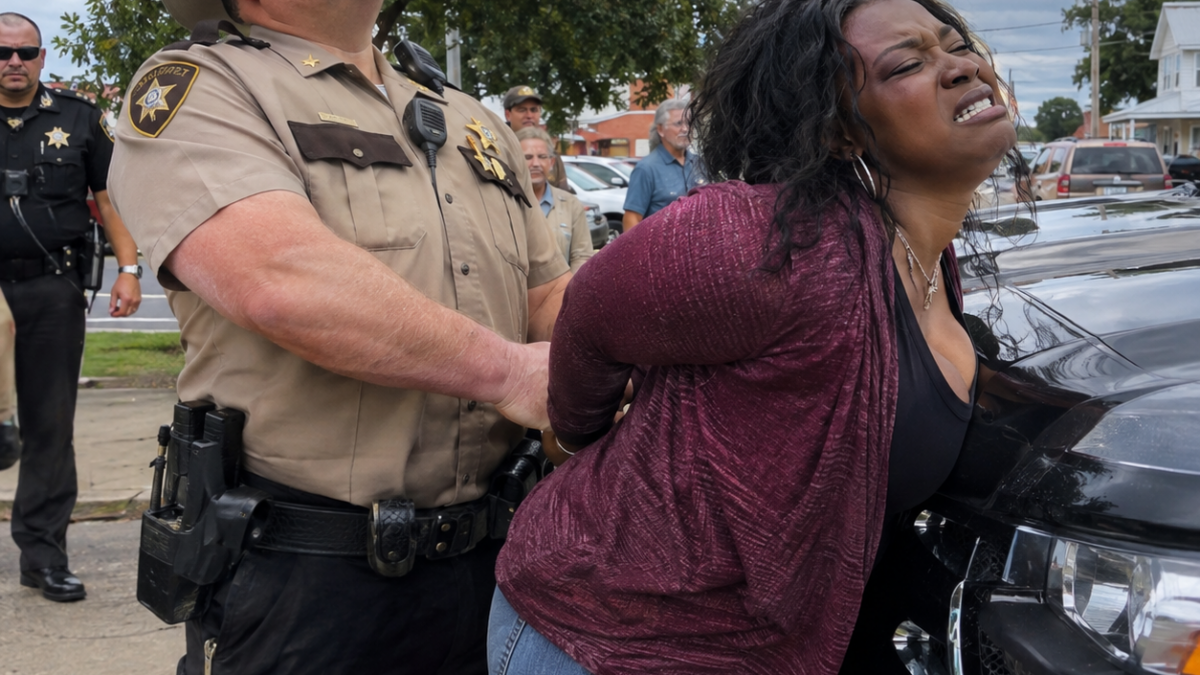
PART2
Sheriff Dale Bradock stood motionless beside the booking counter.
For a man who had spent the last hour shouting orders, the silence was extraordinary.
His thick fingers tightened around the handle of his coffee cup.
The red light on the dispatcher’s console continued flashing.
Across the small room, Deputy Toby Cook looked from his sheriff to me, then back to the speakerphone.
He was young enough that the uncertainty showed plainly on his face.
Clara, the dispatcher, hadn’t moved since announcing that the call came from the Department of Defense.
The voice on the speaker returned.
“Sheriff Bradock. I’m waiting.”
Bradock swallowed.
He had been so confident when he dragged me into the station.
So pleased with himself when he announced that he’d arrested a woman who didn’t know how to respect authority.
Now he looked like a man who had suddenly discovered he was standing on the wrong side of a very deep canyon.
“This is Sheriff Dale Bradock,” he said.
His voice cracked slightly.
He cleared his throat.
“I don’t know who you think you are, but this is a county law enforcement matter.”
The voice from Washington remained controlled.
“I am General Arthur Hayes. Captain Margot Jefferson is assigned to a classified Department of Defense mission. Confirm her condition immediately.”
Bradock glanced toward me.
I stood beside the booking counter with my wrists aching from the handcuffs he’d used.
I hadn’t raised my voice.
I hadn’t threatened him.
I had simply made the call he thought would humiliate me.
“She’s fine,” he muttered.
“That isn’t sufficient. Is she injured?”
Bradock looked toward Toby.
The deputy hesitated.
Then answered before his boss could stop him.
“Sir, she has marks on her wrists. The sheriff arrested her following a traffic stop.”
Bradock shot him a furious look.
“Toby!”
The general’s voice became colder.
“Deputy, identify yourself.”
“Deputy Toby Cook, sir.”
“Thank you for answering directly. Sheriff, I want Captain Jefferson released from restraints, her property secured, and the circumstances of her detention preserved for investigation.”
Bradock’s face tightened.
“You can’t just call from Washington and tell me how to run my department!”
There was a short silence.
Then General Hayes spoke.
“I’m not calling to discuss your pride, Sheriff. I am addressing the detention of an officer transporting sensitive national-defense materials.”
My eyes remained fixed on Bradock.
I had seen men like him before.
Different uniforms.
Different ranks.
Different kinds of authority.
But the same belief that respect meant unquestioning obedience.
Bradock had mistaken my calm for weakness.
Now he was struggling to understand why the woman he’d called a criminal had a four-star general asking about her safety.
“Captain Jefferson,” the general said, “can you hear me?”
“Yes, sir.”
“State your condition.”
“Conscious and stable. Minor abrasions from the restraints. No apparent serious injury.”
“Status of your assigned materials?”
“Secured inside my vehicle. Last known location is the shoulder of State Highway 118 near mile marker forty-two.”
“Was the container breached?”
“Negative, General. Sheriff Bradock attempted to open it but was unsuccessful.”
I saw Bradock flinch.
The general paused.
“Was the vehicle left unattended?”
“Yes, sir.”
That answer bothered me more than the pain in my wrists.
My SUV had been left beside the highway, with a secured container inside it.
The physical protection built into the case had held during Bradock’s attempted search.
But the vehicle should never have been abandoned.
That was why I’d made the emergency call.
Not because I needed someone powerful to rescue my pride.
Because a classified government asset had been placed at risk by a sheriff who couldn’t tolerate being questioned.
“Understood,” General Hayes replied. “Personnel are being coordinated to secure the vehicle.”
Bradock’s eyes darted toward the station door.
He seemed to be calculating whether he could make the problem disappear by apologizing.
But he’d moved far beyond an apology.
The general continued.
“Sheriff, you are to preserve all records relating to this detention. Do not alter the reports, the recordings, or the handling of her property.”
Bradock’s jaw worked.
Then he muttered, “Fine.”
“Captain Jefferson, are you still restrained?”
I looked toward my wrists.
“Not currently, sir. Deputy Cook removed the handcuffs so I could use the telephone. The sheriff has ordered them reapplied.”
Bradock turned sharply toward Toby.
The deputy froze.
General Hayes spoke again.
“Do not reapply them without lawful justification. Captain Jefferson, remain available for the federal personnel being sent to assist.”
“Yes, sir.”
“And Sheriff Bradock?”
Bradock leaned toward the speaker.
“What?”
“Do not mistake this conversation for the end of your problems.”
The call disconnected.
For several seconds, nobody moved.
The small sheriff’s station seemed suddenly much quieter than it had before.
The air conditioner rattled above the doorway.
An old clock ticked behind the dispatch counter.
Somewhere in the building, a printer started and stopped.
Then Bradock slowly set down his coffee.
He looked at me.
“You really are military?”
I met his eyes.
“I told you I had official business.”
“You never told me you were a captain.”
“You never asked. You were too busy threatening to arrest me for having an attitude.”
His face reddened again.
He took a step toward me.
Then stopped.
For the first time since we’d met, he seemed uncertain whether I would step back.
I didn’t.
I held his gaze.
The change in his expression was almost sad.
A man who’d spent years making other people afraid now found himself standing in a room where his usual methods no longer worked.
He looked toward Toby.
“Get her belongings.”
The deputy moved quickly.
My wallet and phone were on the booking counter.
He gathered them carefully.
“Captain Jefferson,” he said, “I’m sorry.”
I accepted the items.
“Thank you, Deputy.”
He looked down.
“I tried to tell him.”
“I heard you.”
His eyes flickered toward Bradock.
The sheriff said nothing.
I checked my phone.
The secure device was intact.
Bradock had spent several minutes examining it earlier, annoyed that it didn’t carry the familiar branding of a consumer smartphone.
He’d called it suspicious.
He’d accused me of transporting contraband.
And he’d attempted to open my briefcase because he didn’t like the way I answered his questions.
Now he was staring at the same phone as though it might explain how everything had gone wrong.
It wouldn’t.
The explanation was simple.
He had mistaken intimidation for authority.
And I’d refused to play along.
I slipped the phone into my blazer pocket.
Then heard Bradock speaking in a low voice to Clara.
“Where’s the cruiser recording?”
She looked confused.
“What recording?”
“The dash camera.”
I turned toward him.
He noticed.
His expression changed.
“Routine maintenance,” he said quickly.
I said nothing.
He looked back at Clara.
“Shut down the system. The main server.”
She stared at him.
“Sheriff?”
“Do it.”
Toby straightened.
“Sir, we need to preserve the footage.”
Bradock snapped toward him.
“I didn’t ask for your opinion!”
The deputy flinched.
I watched the sheriff’s face.
The fear had returned.
But this time it was different.
When the general called, Bradock had been frightened by consequences he didn’t understand.
Now he was frightened by evidence he understood perfectly.
The dash camera.
The recordings.
The false traffic allegations.
The unjustified arrest.
The way he’d treated me.
All of it could be examined.
And he knew what those recordings would show.
I stepped forward.
“Sheriff.”
He turned.
“Stay out of this!”
“Do not alter the evidence.”
His eyes narrowed.
“This is my department.”
“Then you’re responsible for preserving its records.”
He pointed toward Clara.
“Shut it down!”
She shook her head.
“I can’t.”
“Toby, go back there and pull the drives!”
The deputy remained where he stood.
“Sheriff, I can’t do that.”
Bradock’s face twisted.
“I’m giving you an order!”
Toby looked directly at him.
“It’s evidence.”
For a moment, the sheriff appeared ready to explode.
His hand dropped toward his belt.
I watched it carefully.
Then spoke in the same voice I’d used throughout the encounter.
“Don’t make another bad decision, Sheriff.”
He froze.
The room went silent again.
I wasn’t threatening him.
I wasn’t reaching for a weapon.
I was reminding him that every additional choice would become part of the investigation.
He slowly lowered his hand.
Then glared at me.
“You think you’re smarter than me?”
I looked at the old recording console behind Clara.
Then at the frightened deputy.
“I think you’ve spent a long time believing nobody could challenge you.”
He opened his mouth.
I continued.
“And I think you’ve just discovered how wrong you were.”
He stared at me.
Then turned away.
I sat on the wooden bench beside the booking counter.
Crossed my legs.
And waited for the federal personnel who were on their way.
But sitting there, with my wrists still aching and the station phone finally quiet, I couldn’t stop thinking about how the entire disaster had begun.
One cup of coffee.
One slice of cherry pie.
And a sheriff who believed that a Black woman passing through his town owed him an explanation for existing.
My name is Margot Jefferson.
I’m twenty-eight years old.
And on the day Dale Bradock arrested me, I was serving as a captain assigned to the United States Cyber Command.
My work involved advanced military cyber-defense systems.
Networks that ordinary civilians would never see.
Classified infrastructure.
Encrypted communications.
And complex security programs designed to protect American defense operations against sophisticated digital attacks.
I’d spent years working toward that responsibility.
Not because I enjoyed secrecy.
Not because I wanted authority over anyone.
But because I believed the work mattered.
A modern military depends on information networks almost as much as it depends on aircraft, ships, or ground forces.
An attack on the wrong system at the wrong moment can disrupt operations that thousands of people depend upon.
Protecting those systems was my job.
And I took it seriously.
I had worked with engineers, analysts, intelligence specialists, and senior military officers who understood that composure often mattered more than rank.
The loudest person in a room wasn’t necessarily the person with the best solution.
Sometimes the person who spoke least had already identified the problem everybody else was still arguing about.
I’d learned to listen before reacting.
To examine evidence.
To stay calm when circumstances became stressful.
And to treat people respectfully unless they gave me a compelling reason to change my approach.
Those habits had served me well.
They were also the reason Sheriff Bradock found me so infuriating.
He expected submission.
I gave him professionalism.
He interpreted that as disrespect.
I was traveling from Washington, D.C., toward a classified defense installation outside San Antonio.
My assignment involved transporting an encrypted storage device containing final structural information for a next-generation cyber-defense system.
The project was known internally as the Aegis grid.
Its purpose was to strengthen the protection of critical military networks.
The material in my possession was sensitive.
The briefcase was secured.
The communications equipment I carried was specially configured.
And my arrival time had been coordinated in advance.
I wasn’t supposed to attract attention.
I wasn’t supposed to discuss the mission with strangers.
I certainly wasn’t supposed to spend part of the afternoon explaining classified equipment to a county sheriff who thought an expensive SUV with Virginia plates was evidence of criminal activity.
But even military officers need food.
And after hours on the road, I was exhausted.
The late-August Texas heat seemed determined to cook the highway.
The sun hung over the flat landscape.
The air beyond the windshield shimmered.
I had been drinking bottled water and stale coffee for too long.
When I saw the signs for Pinecraft, I decided to stop.
The town was small.
Less than three thousand residents.
A few old brick storefronts.
A gas station.
A church.
A courthouse.
And a diner with faded lettering above the entrance.
I parked my SUV outside Maggie’s Diner.
The vehicle wasn’t ostentatious.
But it was newer and more expensive than many of the cars parked along the street.
Its Virginia plates drew a few glances.
I noticed.
Then dismissed them.
I was passing through.
I had nothing to hide from anyone who had a legitimate reason to ask questions.
Inside, the diner smelled of coffee, fried food, and old-fashioned pie crust.
The air conditioner was working hard but losing its battle against the afternoon heat.
A few people sat at the counter.
An elderly couple occupied a booth near the window.
Two men in work clothes were eating hamburgers.
The room had the comfortable, worn atmosphere of a place where people had been ordering the same meals for years.
A waitress approached.
She looked tired but friendly.
“What can I get you, hon?”
“Large black coffee, please.”
She smiled.
“Anything to eat?”
“Whatever pie is freshest.”
“Cherry came out this morning.”
“Perfect.”
She wrote it down.
“Be right back.”
I settled into a corner booth.
Placed my black briefcase beside me.
And opened my tablet.
The device contained material I was authorized to review while traveling.
I checked my schedule and several status indicators.
The mission remained on track.
My destination was still within reach before the scheduled briefing.
I took a slow breath.
For a few minutes, everything felt ordinary.
The waitress returned with coffee.
Then a slice of cherry pie.
“Here you go.”
“Thank you.”
She smiled.
“You look like you’ve been on the road a while.”
“I have.”
“Where you headed?”
“South.”
She laughed.
“Well, you’ve got plenty of that left.”
I smiled.
Then returned to my tablet.
The pie was good.
The coffee was strong.
And I was beginning to feel human again.
Then the diner door slammed open.
The sound was so abrupt that several people turned.
A heavyset man in a sheriff’s uniform entered with a young deputy behind him.
The older man’s badge shone beneath the fluorescent lights.
His utility belt was crowded with equipment.
His face was flushed.
And his expression suggested he expected everyone in the room to acknowledge his arrival.
The conversations stopped.
That was the first thing I noticed.
Not the badge.
Not the gun.
Not the size of the man.
The silence.
The elderly couple looked down at their food.
One of the men at the counter stopped talking in the middle of a sentence.
The waitress lowered her eyes.
It wasn’t the respectful quiet that follows the entrance of a familiar public official.
It was fear.
I had seen that reaction before.
And I recognized it immediately.
The sheriff stood near the door for a moment, surveying the room.
His gaze moved over the regular customers.
Then landed on me.
A young Black woman.
Alone.
Wearing a tailored navy blazer and a white blouse.
Working on an expensive-looking tablet.
With a black briefcase beside her.
I didn’t look away from my screen simply because someone in uniform had entered the building.
That was apparently my first offense.
The sheriff started toward my booth.
Heavy boots struck the linoleum.
The deputy followed.
He looked uncomfortable even before his boss spoke.
The sheriff stopped beside my table.
Then leaned over me.
“You lost, little lady?”
I finished reading the line on my tablet.
Then looked up.
“No, Sheriff.”
His eyebrows rose slightly.
“Where you headed?”
“Just passing through.”
He looked toward the window.
At my SUV.
Then back at me.
“Fancy car you got out there.”
“Thank you.”
“Virginia plates.”
“Yes.”
“What business you got in my county?”
I looked at my coffee.
Then at him.
“Coffee and pie, apparently.”
Somebody at the counter made a small sound.
Maybe a suppressed laugh.
Maybe a startled breath.
The sheriff’s face tightened.
“I’m asking a serious question.”
“I gave you a serious answer.”
He leaned closer.
“You always talk to law enforcement like that?”
I remained calm.
“Like what?”
“Like you’ve got something smart to say about everything.”
I studied him.
His badge identified him as Sheriff Dale Bradock.
His deputy’s nameplate read Cook.
The younger man looked as though he wished he were somewhere else.
I set my tablet down.
“Sheriff Bradock, I’m a traveler stopping for lunch. Is there a particular issue you need to discuss?”
He placed one broad hand on my table.
Hard enough to make the coffee cup rattle.
“We like people to show respect around here.”
“I’ve been respectful.”
“Don’t tell me what respectful is.”
I looked at his hand.
Then back at his face.
“Is drinking coffee in your county against the law?”
The diner went completely silent.
The waitress stopped near the counter.
The sheriff straightened.
His face grew darker.
“You’ve got a smart mouth, girl.”
I didn’t respond.
He leaned forward again.
“Where’d you get that car?”
I looked at him.
“I own it.”
“Doing what?”
“Working.”
“What kind of work?”
“I’d rather not discuss my employment with a stranger over lunch.”
His eyes widened.
“A stranger?”
“Yes.”
He tapped his badge.
“Do you see this?”
“I do.”
“Then you understand who you’re talking to.”
I closed my tablet.
“Sheriff, I understand perfectly. But I haven’t committed a crime, and I have somewhere I need to be.”
His jaw tightened.
For a moment, I wondered whether he’d step aside.
Instead, he looked toward the deputy.
“Toby, you hearing this?”
The deputy shifted.
“Sheriff, she hasn’t done anything.”
Bradock ignored him.
He turned back toward me.
“You big-city people think you can come down here and act however you want.”
I felt a familiar exhaustion settle over me.
Not the exhaustion of driving.
The exhaustion of dealing with someone who had decided what I was before hearing a single meaningful fact about me.
I’d faced prejudice before.
Sometimes subtle.
Sometimes painfully obvious.
But there was something especially ugly about a public official using a badge to demand personal submission.
I knew any escalation could complicate my mission.
The safest course was to disengage.
So I placed my tablet inside the briefcase.
Closed it.
Locked it.
Then stood.
I left a twenty-dollar bill on the table.
The coffee and pie had cost considerably less.
The waitress deserved the difference.
“Thank you for lunch,” I told her.
She nodded nervously.
Then I turned toward the door.
Sheriff Bradock stepped into my path.
“I didn’t say you could leave.”
I looked at him.
“Sheriff, please step aside.”
His eyes narrowed.
“Excuse me?”
“I have finished my meal. I’m leaving.”
He moved closer.
For a moment, his broad frame blocked the doorway.
I kept my briefcase beside me.
Maintained an ordinary distance.
And waited.
The deputy shifted behind him.
“Sheriff, maybe we should—”
Bradock raised one hand to silence him.
Then stared at me.
“You think you can order me around?”
“No. I’m asking you to let me leave.”
The words were simple.
But my tone was firm.
I had spent enough time briefing senior military officers to know how to speak clearly without shouting.
Bradock seemed almost startled by it.
He took a half step back.
I walked past him.
The bell above the door jingled as I entered the bright Texas afternoon.
I didn’t look over my shoulder.
I didn’t know that Sheriff Bradock had decided the conversation wasn’t over.
I also didn’t know how many other travelers he’d targeted before me.
All I knew was that I needed to reach my destination.
I got into the SUV.
Checked that the briefcase remained secured.
Started the engine.
And entered my route into the navigation system.
The air conditioner began cooling the cabin.
I adjusted my seat belt.
Then pulled onto the road.
For less than a mile, everything was quiet.
Then flashing red and blue lights appeared behind me.
I looked into the rearview mirror.
The sheriff’s cruiser.
Of course.
I activated my turn signal.
Pulled safely onto the shoulder.
Shifted into park.
And shut off the engine.
Then I placed both hands visibly on the steering wheel.
I took a slow breath.
Whatever this was about, I wasn’t going to give Bradock an excuse to claim I’d behaved aggressively.
I watched him approach through the side mirror.
Deputy Cook remained near the cruiser.
Bradock stopped beside my window.
He removed his sunglasses.
“License and registration.”
I looked toward him.
“May I ask why you’ve stopped me?”
He smiled without warmth.
“Speeding. Failure to signal.”
I stared at him.
“I signaled when I pulled out, and I haven’t exceeded the posted limit.”
He leaned closer.
“You calling me a liar?”
“I’m asking for clarification.”
“License. Registration. Now.”
I didn’t argue.
I retrieved the documents slowly.
My vehicle had a telemetry system that recorded speed, braking, and signaling data.
I knew the accusation was false.
But I also knew the roadside wasn’t the place to resolve it.
I handed him my civilian license and registration.
He studied the card.
“Margot Jefferson.”
“Yes.”
“Washington, D.C.”
“Yes.”
He looked toward the SUV’s Virginia registration information.
“Pretty far from home.”
“I’ve been traveling.”
“Yeah, I gathered that.”
He looked inside.
His eyes fell on my black briefcase.
“What’s that?”
“My work.”
“What kind of work?”
“Professional materials.”
He leaned farther into the window.
“You being difficult again?”
“No, Sheriff.”
“Then tell me what you’re carrying.”
I held his gaze.
“I’ve provided my identification and registration. If there’s a legitimate issue with the traffic stop, I’m prepared to address it.”
He straightened.
“Step out of the vehicle.”
I paused.
“Sheriff, is there a specific safety concern?”
He moved his face closer.
“Step out or I’ll drag you out.”
I looked past him.
Deputy Cook stood near the cruiser with one hand on his radio.
He looked worried.
I made a decision.
There was no benefit to physically resisting.
My mission was too important.
And I had nothing to gain by turning an improper traffic stop into a roadside struggle.
I spoke loudly enough for the deputy to hear.
“I am complying with your instruction.”
Then I unbuckled my seat belt.
Opened the door.
And stepped into the suffocating heat.
Bradock pointed toward the SUV.
“Hands on the roof.”
I complied.
The metal was hot.
The sun reflected off the windshield.
I could feel sweat gathering beneath the collar of my blouse.
Bradock searched me roughly.
He removed my secure phone.
Held it up.
And frowned.
“What kind of phone is this?”
“An official device.”
“Official for who?”
“I can’t discuss its functions with you.”
He turned it over.
“No Apple logo. No Samsung logo.”
He looked toward Toby.
“Looks suspicious to me.”
The deputy said nothing.
Bradock moved toward the open passenger door.
Then reached for the briefcase.
My voice sharpened.
“Sheriff, I do not consent to a search of that case.”
He laughed.
“You don’t consent?”
“No.”
He grabbed the handle.
Pulled.
The case didn’t move.
I’d secured it to the vehicle frame with a reinforced cable.
He pulled again.
Harder.
Still nothing.
His face darkened.
“Open it.”
“No, Sheriff.”
He turned toward me.
“You think you’re special?”
I remained still.
“I think you’re attempting to open property you have no lawful basis to search.”
He stepped closer.
“Don’t tell me about the law.”
I said nothing.
He grabbed my arm.
“Let me explain something to you.”
I felt his fingers tighten.
“You don’t come into my town, disrespect me in public, and then give me attitude on the road.”
I looked at him.
“My attitude isn’t a crime.”
His expression changed.
For a moment, I saw pure anger.
Not concern.
Not suspicion.
Not the measured judgment of a law enforcement officer.
Anger that a woman he believed should fear him was refusing to do so.
He pulled my left arm behind my back.
“You’re under arrest.”
I turned my head.
“For what?”
“Disorderly conduct.”
He twisted harder.
“Resisting arrest.”
I winced.
“I haven’t resisted.”
“Failure to obey a lawful order.”
His voice rose.
“Take your pick. I’ll decide what to put on the paperwork.”
Deputy Cook hurried forward.
“Sheriff, she cooperated. I don’t think—”
“Shut up, Toby!”
The deputy stopped.
I felt Bradock pull out his handcuffs.
The cold metal touched my wrist.
Then tightened.
Too tight.
Pain shot through my hands.
He secured the second cuff.
I breathed slowly.
Then looked directly at him.
“Sheriff Bradock.”
He sneered.
“What now?”
“You should remove these handcuffs.”
He laughed.
“Or what?”
“You’re making a serious mistake.”
He leaned closer.
“I’m shaking.”
I continued.
“This will have consequences you haven’t considered.”
His face twisted into a grin.
“Listen to her, Toby. She thinks she’s important.”
He pushed me toward the cruiser.
“Watch your head, criminal.”
I entered the back seat without struggling.
The door slammed behind me.
The windows were tinted.
The plastic seat was uncomfortable.
And the air conditioning barely reached the rear compartment.
I sat upright.
Looked through the windshield.
And began calculating what needed to happen next.
First, I had to protect the classified asset.
Second, I needed to notify the proper military authorities.
Third, I needed the evidence of this detention preserved.
And fourth, I needed to make sure Bradock didn’t create a more dangerous situation through ignorance or wounded pride.
I closed my eyes briefly.
I was tired.
Angry.
And deeply disappointed.
But I wasn’t frightened in the way he wanted me to be.
As he climbed into the driver’s seat, he turned toward the rearview mirror.
“Maybe now you’ll learn something about respect.”
I said nothing.
He started the engine.
Then drove toward the sheriff’s station.
He believed he’d won.
He had no idea the real consequences of his actions were only beginning.
The drive to the Pinecraft Sheriff’s Department took less than ten minutes.
Bradock made sure those minutes felt much longer.
He kept looking at me in the rearview mirror, speaking as though he were delivering a lecture to a disobedient child.
“You know what your problem is, Margot?”
I didn’t answer.
“You think because you come from Washington, you don’t have to respect ordinary people.”
I looked out the window.
The town’s faded storefronts passed slowly.
A service station.
An old hardware store.
A church sign advertising Sunday services.
I wondered how many people in Pinecraft had watched Bradock behave this way and decided it was safer to stay silent.
He continued.
“People from the big city come down here with fancy clothes and expensive cars, thinking they can do whatever they please.”
I watched a woman crossing the street with two grocery bags.
She glanced toward the cruiser.
Then quickly looked away.
“In this county,” Bradock announced, “I’m the one who decides what the rules are.”
That sentence interested me.
Not because it surprised me.
Because he said it so casually.
As though the law wasn’t something that existed independently of him.
As though holding elected office meant he could replace written statutes with personal preferences.
I looked toward his reflection in the mirror.
He was smiling.
He believed the ride was humiliating me.
In reality, he was revealing how little he understood about the responsibility attached to his badge.
“You listening back there?”
I remained quiet.
“Silent treatment?”
He laughed.
“That’s fine. You’ll have plenty of time to talk when you’re in a cell.”
Deputy Cook sat beside him.
He hadn’t spoken since we left the roadside.
I could see his shoulders were tense.
Several times, he looked toward me through the mirror.
Each time, he quickly turned away when Bradock noticed.
I wondered how long he’d worked for the sheriff.
Long enough to know his boss was dangerous.
Not long enough to feel confident challenging him.
I didn’t judge him entirely by his silence.
Fear can be powerful.
Especially when the person you’re expected to challenge controls your job, your reputation, and your future.
But I hoped he’d eventually understand that wearing a badge required more than following orders.
We entered the sheriff’s station through a rear parking lot.
The building was old.
Cinder blocks.
Faded paint.
A chain-link fence near the vehicle area.
The sort of facility that had been built decades earlier and maintained only when something broke badly enough to force a repair.
Bradock opened the rear door.
“Out.”
I stepped carefully from the cruiser.
The cuffs had cut into my wrists.
My shoulders ached.
The sheriff grabbed my arm and marched me toward a heavy metal entrance.
I didn’t resist.
I had already decided that unnecessary physical confrontation would put the mission at greater risk.
Inside, the station smelled of bleach, old paper, and coffee that had been sitting on a warmer too long.
A woman sat behind a dispatch window.
Her nameplate read Clara.
She looked up from her desk.
Then glanced at me.
Her eyebrows rose.
“Got somebody causing trouble, Dale?”
Bradock grinned.
“Got a smart-mouth outsider who needs to learn how things work around here.”
Clara looked at my blazer.
My briefcase wasn’t with me, but Bradock still carried my phone and wallet.
She looked toward Toby.
The deputy’s expression gave nothing away.
“What’s the charge?” she asked.
Bradock waved dismissively.
“Disorderly conduct. Resisting. Failure to comply.”
I spoke calmly.
“Deputy Cook can confirm I followed the sheriff’s instructions.”
Bradock spun toward me.
“Nobody asked you to speak!”
I looked at him.
“You’re describing an arrest. I’m clarifying the facts.”
He pointed toward the holding area.
“Process her.”
Toby hesitated.
Then approached.
“Ma’am, I need to inventory your belongings.”
“Understood.”
I gave him the items I could safely surrender.
My wallet.
My personal identification.
The contents of my pockets.
My secure device had already been confiscated by Bradock.
Toby placed the items on the counter.
He was careful.
Far more careful than the sheriff had been.
I noticed.
“Deputy, I’d like to make a telephone call.”
Bradock laughed.
“Oh, here we go.”
He walked toward the coffee machine.
“Gonna call your lawyer?”
“I need to notify someone of my detention.”
He poured a cup.
“Go right ahead. Tell them you’re in Pinecraft, Texas. See how fast they get here.”
Clara watched silently.
Bradock pointed toward an old telephone mounted near the holding cells.
“Use that one.”
Toby unlocked my cuffs long enough for me to make the call.
I rubbed my wrists once.
Red indentations marked the skin.
I flexed my fingers.
Then walked to the phone.
Bradock leaned against the counter, enjoying himself.
He probably imagined I would call a lawyer who couldn’t immediately help me.
Perhaps a worried relative.
Perhaps a friend in Washington who would tell me to stay calm until morning.
He had no idea how carefully I’d memorized the emergency notification procedure for my assignment.
I lifted the receiver.
Entered the secure routing sequence.
And waited.
The connection opened.
A voice answered.
“Verification.”
I provided my identification and authentication information.
There was a brief pause.
Then the voice returned.
“Captain Jefferson. State your status.”
I kept my words precise.
“Mission compromised. I’m being detained by local law enforcement in Pinecraft, Texas. My assigned materials remain secured in my vehicle, which was left unattended on State Highway 118.”
I could hear the change in the operator’s attention.
“Are you injured?”
“Minor abrasions. I remain operational.”
“Was the container opened?”
“Negative. The sheriff attempted access without authorization.”
“Understood.”
I took a breath.
“Notify General Arthur Hayes. Initiate the appropriate security response and arrange direct contact with the sheriff’s office.”
“Confirmed, Captain.”
The connection ended.
I placed the receiver back in its cradle.
Then turned.
Bradock had stopped smiling.
He stared at me.
“What the hell was that?”
I walked away from the telephone.
“An official notification.”
He laughed, but it sounded forced.
“Official? Who are you pretending to be?”
I looked at him.
“I’m a captain assigned to United States Cyber Command.”
Toby turned sharply.
Clara stopped typing.
Bradock scoffed.
“Sure you are.”
I said nothing.
He moved closer.
“What, you work for the Salvation Army or something?”
“No, Sheriff.”
“Then prove it.”
“My official identification is available for proper verification.”
He rolled his eyes.
“You expect me to believe some girl in a fancy suit is working for the Pentagon?”
I looked directly at him.
“I expect you to follow the law regardless of who I work for.”
He didn’t like that answer.
Not at all.
His face darkened.
“Lock her up, Toby.”
The deputy hesitated.
“Sheriff—”
“I said lock her up!”
Before Toby could move, the emergency telephone on Clara’s console began ringing.
It was not the ordinary administrative line.
The red indicator flashed.
Clara looked startled.
She picked up.
“Pinecraft Sheriff’s Department.”
She listened.
Her posture changed.
Then her face lost its color.
She glanced toward me.
Then toward Bradock.
“Sheriff?”
He turned.
“What?”
She swallowed.
“It’s the Department of Defense.”
The room fell silent.
That was the moment Bradock finally began to understand that the woman he’d arrested wasn’t bluffing.
Clara activated the speakerphone.
General Arthur Hayes identified himself.
He asked about my condition.
He ordered the preservation of the evidence.
And he made it clear that federal personnel were coming.
By the time the call ended, the atmosphere inside the station had changed completely.
Then Bradock tried to have the recordings destroyed.
And I realized that his fear wasn’t limited to the consequences of my arrest.
He was terrified of what a closer examination of his department might reveal.
I’d seen dishonest officials attempt to cover up mistakes before.
Sometimes they altered a report.
Sometimes they pressured a witness.
Sometimes they tried to make inconvenient evidence disappear.
But Bradock was prepared to order his own staff to disable the recording system in front of the person whose arrest was being investigated.
That told me something important.
He wasn’t acting like a man who feared an embarrassing reprimand.
He was acting like someone who believed a much larger secret might be exposed.
After General Hayes disconnected, Bradock turned toward Clara and Toby.
His voice had lost its theatrical confidence.
Now it carried raw panic.
“Get the recordings off that server.”
Clara shook her head.
“Dale, we can’t.”
“Don’t tell me what we can’t do!”
Toby looked at him.
“Sheriff, the general told us to preserve everything.”
Bradock slammed his palm against the counter.
“I don’t care what some general said!”
I watched his hands.
His breathing.
The way his gaze kept returning to the computer equipment behind the dispatch window.
He wasn’t merely frightened.
He was calculating.
Trying to determine how much he could erase before anyone arrived.
I took out my secure phone.
During the earlier detention, I’d been unable to maintain ordinary communications with my command.
Now the device was back in my possession.
I checked its status and connected with authorized security resources.
The urgent priority was preserving evidence relevant to the compromised mission and my detention.
As that process unfolded, information appeared indicating that records associated with the sheriff’s department might contain additional irregularities.
I examined what was available through the secured investigative channels.
The picture that emerged was unexpected.
There were archived recording references.
Dispatch entries.
Vehicle-stop records.
And financial information that didn’t appear to belong in an ordinary traffic-enforcement system.
Some of the records had been deliberately separated from the normal departmental files.
I stared at the screen.
Bradock noticed.
“What are you doing?”
I didn’t answer immediately.
He stepped closer.
“Hey. I’m talking to you.”
I looked up.
“Preserving records that may be relevant to the investigation.”
His eyes widened.
“You can’t touch my systems!”
I held his gaze.
“Sheriff, I’m not discussing the details of a classified or federal investigative response with you.”
He looked toward Clara.
“Did you give her access?”
Clara shook her head.
“No!”
Bradock turned back toward me.
“Then how the hell are you looking at that?”
I didn’t indulge his demand for technical explanations.
The truth was that the information had already been flagged for secure preservation and review.
The more immediate point was that disabling the station’s local equipment would not necessarily make the underlying evidence disappear.
I turned the screen just enough for him to see a preserved frame from the traffic stop.
There he was.
Leaning into my driver’s window.
His face twisted with anger.
The image was clear.
He stared at it.
Then slowly looked toward me.
“That’s my cruiser.”
“Yes.”
“You’ve got the recording?”
“The relevant evidence has been preserved.”
He went pale.
I continued.
“Destroying the local copy won’t change what happened.”
His mouth opened.
Nothing came out.
He glanced toward Toby.
Then Clara.
Neither moved.
For the first time since I’d entered Pinecraft, the sheriff had lost control of the room.
Not because somebody had shouted louder than him.
Not because a larger man had threatened him.
But because the people around him were beginning to understand that the law existed independently of his wishes.
I returned to the bench.
Set my phone beside me.
And waited.
Bradock sank into an office chair.
He stared at the floor for several seconds.
Then pulled out his personal cell phone.
I watched him scroll through his contacts.
He selected a number and called.
When someone answered, his voice became almost pleading.
“Judge Harmon? It’s Dale.”
I didn’t try to listen.
He was speaking loudly enough that much of the conversation carried across the small room anyway.
“I’ve got a problem down here.”
He paused.
“Some federal situation.”
Another pause.
Then his face changed again.
“What do you mean?”
He sat straighter.
“No, no, listen to me—”
The voice on the other end grew loud enough for me to hear a few words.
The Dallas FBI field office.
Warrants.
Departmental records.
Then Bradock said, “Harmon, I need your help.”
A longer silence followed.
The sheriff’s shoulders sagged.
Finally, he whispered, “You can’t do that.”
The call ended.
He stared at the phone.
Then placed it on his desk.
I studied him.
“What happened, Sheriff?”
He looked up sharply.
“None of your business.”
I nodded.
“Fair enough.”
But I could guess.
Whatever informal relationships Bradock had relied on were beginning to dissolve.
A local magistrate who’d once been willing to accommodate him might no longer want any involvement.
The situation had moved beyond Pinecraft.
And the people who knew Bradock were discovering that protecting him could make them part of the investigation.
Toby approached quietly.
“Captain Jefferson?”
I looked up.
“Yes?”
“Can I get you some water?”
I nodded.
“Thank you.”
He brought a paper cup from the cooler.
I accepted it.
His hands were trembling.
He lowered his voice.
“I’m sorry about what happened.”
I studied his face.
He looked genuinely ashamed.
“How long have you worked here, Deputy?”
“Almost two years.”
I nodded.
“Is this the first time you’ve watched the sheriff arrest someone after a personal disagreement?”
He looked toward Bradock.
Then back at me.
He didn’t answer.
I didn’t push.
His silence told me enough.
“Deputy Cook,” I said quietly, “whatever happens next, tell investigators the truth.”
He swallowed.
“Yes, ma’am.”
“Even if it makes someone uncomfortable.”
He looked at the floor.
“Yes, ma’am.”
I took a sip of water.
Then looked toward the window.
Outside, the sun still blazed over Pinecraft.
The town was going about its ordinary afternoon.
People were probably eating pie at Maggie’s Diner.
Children were arriving home from school.
A mechanic was changing oil at the garage down the street.
Most of them had no idea that their sheriff’s department was about to become the center of a federal investigation.
I felt tired.
More tired than I’d been when I entered the diner.
But I also felt something else.
A growing certainty that the day’s events were much larger than one unlawful arrest.
Because the preliminary records I’d seen suggested Sheriff Bradock had been using his office for purposes far removed from legitimate law enforcement.
And if those records meant what I thought they meant, he had been hurting innocent people for years.
The first distant sound of helicopter rotors reached the station shortly afterward.
At first, it was barely noticeable.
A low rhythm beneath the air conditioner.
Then the sound grew louder.
Clara looked toward the ceiling.
Toby went to the window.
Bradock lifted his head.
“What is that?”
Nobody answered.
The thudding became impossible to ignore.
I knew federal and military personnel were coordinating a response to secure the mission.
But the scale of what was approaching even surprised some of the local staff.
Outside, people began gathering along Main Street.
Two military helicopters moved over the area.
A convoy of dark federal vehicles entered town, accompanied by state law enforcement.
The vehicles approached the sheriff’s station.
Then stopped.
Doors opened.
Personnel moved quickly.
Inside, Bradock rose from his chair.
His face was pale.
He looked toward me.
“What did you bring to my town?”
I met his eyes.
“Accountability, Sheriff.”
He stared.
Then the rear entrance opened.
Federal agents and military investigators entered the building.
And Dale Bradock was about to learn that the real investigation had barely begun.
The first man through the rear entrance wore tactical gear.
He stepped aside as additional personnel entered, their movements deliberate and coordinated.
They weren’t the nervous local deputies Bradock was accustomed to commanding.
They weren’t town employees who worried about losing their jobs if they questioned him.
They were federal investigators and military security personnel who had arrived with specific responsibilities.
Their presence changed the room immediately.
Clara stepped away from her console.
Toby stood near the water cooler, his back straight.
Bradock adjusted his uniform as though the polished badge on his chest might somehow restore his authority.
Two men in suits entered behind the security team.
The first was tall, with silver hair and an FBI badge displayed at his waist.
The second wore a military uniform with the insignia of a lieutenant colonel.
The FBI agent looked toward me.
“Captain Jefferson?”
I stood.
“Yes.”
“Special Agent Richard Hughes. FBI public corruption and civil rights.”
He extended his hand.
I shook it.
“Captain Margot Jefferson.”
He nodded.
“Are you safe?”
“Yes. Minor injuries. No immediate medical concerns.”
He glanced toward the marks on my wrists.
“Those will be documented.”
“I understand.”
The military officer stepped forward.
“Lieutenant Colonel Bradley. We’ve secured your vehicle.”
I felt relief wash through me.
“The container?”
“Intact.”
“Any indication of unauthorized access?”
“None.”
I let out a breath.
For the first time since Bradock attempted to open my briefcase, the most important part of my mission was secure.
I could deal with my own injuries.
I could provide statements.
I could answer questions.
But the classified material had to remain protected.
Lieutenant Colonel Bradley continued.
“Transport has been arranged. Your destination has been notified.”
I nodded.
“Thank you.”
He saluted.
I returned it.
Across the room, Bradock looked as though he were watching an unfamiliar language being spoken.
Then he straightened.
“Now hold on!”
Hughes turned toward him.
Bradock stepped forward.
“I am the elected sheriff of this county. You people cannot come into my department and start issuing orders!”
Hughes studied him.
“Sheriff Dale Bradock?”
“Yes.”
“I need you to remain where you are.”
Bradock’s face darkened.
“Who the hell do you think you’re talking to?”
Hughes remained calm.
“An official whose conduct is under federal investigation.”
The sheriff stared at him.
The agent continued.
“Your department’s records are subject to preservation requirements. We have information concerning an unlawful detention, potential evidence tampering, and other possible offenses.”
Bradock looked toward the dispatch window.
Clara lowered her eyes.
“You have no idea what you’re doing,” he snapped.
Hughes opened a folder.
“I’d strongly advise you not to make assumptions about what we know.”
The room fell silent.
The agent looked toward Toby.
“Deputy Cook?”
“Yes, sir.”
“We’ll need your statement.”
Toby swallowed.
“I’ll cooperate.”
“Good.”
Then Hughes turned toward Clara.
“Ma’am, your name?”
“Clara.”
“We’ll need to preserve the dispatch records and speak with you as well.”
She nodded rapidly.
“Yes, sir.”
Bradock looked from one employee to the other.
The betrayal on his face was almost comical.
He’d spent years expecting unquestioning loyalty.
Now his deputy and dispatcher were cooperating with federal investigators instead of helping him hide evidence.
“Traitors,” he muttered.
Toby heard him.
His face tightened.
But he didn’t look away this time.
Hughes turned toward me.
“Captain Jefferson, we have the information you transmitted concerning the stop and the possible irregularities in the department’s records.”
I nodded.
“Some of the records appear inconsistent with ordinary traffic-enforcement activity.”
“We’ve begun reviewing them.”
“There are references to cash seizures and vehicle impoundments that deserve closer examination.”
Hughes’s expression hardened.
“They do.”
Bradock suddenly stepped forward.
“Those are confidential department files!”
Hughes looked at him.
“Then you’ll have an opportunity to explain them.”
“I don’t have to explain my department to you!”
The agent opened another document.
“Sheriff, those records appear to show a pattern of questionable seizures involving out-of-state drivers.”
Bradock’s face changed.
Only slightly.
But I saw it.
The flash of recognition.
The sudden fear.
He knew exactly which records Hughes meant.
Hughes continued.
“Vehicles stopped on questionable grounds. Cash confiscated under suspected narcotics investigations. Property retained or redirected through arrangements requiring further scrutiny.”
Toby looked toward his sheriff.
“Dale?”
Bradock didn’t answer.
Hughes examined the file.
“We’re also looking at financial transfers connected to a company registered in Odessa.”
I watched Bradock’s hands.
They began trembling.
His fear was no longer about the traffic stop.
It was about what investigators had found underneath it.
“That’s a lie,” he said.
Hughes looked up.
“Is it?”
Bradock’s mouth opened.
Then closed.
I stepped beside Hughes.
“The records indicate repeated incidents involving expensive vehicles with out-of-state plates.”
Hughes nodded.
“That’s consistent with what we’re reviewing.”
I looked toward Bradock.
“You didn’t stop me because I was speeding.”
He glared at me.
“You were driving suspiciously.”
“No. I was driving an expensive SUV with Virginia plates.”
He didn’t answer.
“And when I refused to act intimidated, you decided to make an example of me.”
Hughes watched the exchange.
I continued.
“You thought I was another traveler you could threaten until I gave you whatever you wanted.”
Bradock’s face darkened.
“You don’t know anything about my department!”
I held his gaze.
“I know you lied about the traffic violation. I know you arrested me without a proper basis. And I know you tried to have the recordings destroyed after you learned federal authorities were involved.”
Toby lowered his head.
Clara stood very still behind the dispatch window.
Hughes closed the folder.
“Sheriff Bradock, we’re going to need you to accompany us.”
Bradock looked confused.
“What?”
“You’re being placed under arrest on federal charges associated with the deprivation of rights under color of law and related conduct. Additional charges may follow as the investigation develops.”
The sheriff stared at him.
For a moment, he seemed unable to process the words.
Then he laughed.
A short, ugly sound.
“You can’t arrest the sheriff!”
Hughes didn’t smile.
“You’re not exempt from the law.”
Bradock looked toward the door.
Then toward the officers standing nearby.
His hand moved instinctively toward his belt.
The response was immediate.
Federal personnel ordered him to keep his hands visible.
He froze.
I watched his face.
The arrogance was gone.
So was the certainty.
He slowly raised his hands.
Hughes gave him another clear instruction.
Bradock complied.
The restraints closed around his wrists.
The sound was small.
Metallic.
Final.
I looked at the man who had slapped handcuffs on me less than an hour earlier.
He had laughed when he did it.
He’d told me I was going to spend the night in jail.
He’d called me a criminal.
Now he was the one in restraints.
But I didn’t feel the urge to laugh.
I felt tired.
And angry.
Not simply about what he’d done to me.
About the possibility that he’d done it to dozens or hundreds of other people who hadn’t possessed the resources to challenge him.
As investigators prepared to escort Bradock away, he turned toward me.
“This is your fault!”
I looked at him.
“No, Sheriff.”
He stared.
“You made these choices.”
He opened his mouth.
I continued.
“You decided a woman drinking coffee needed to be humiliated. You made up a traffic violation. You arrested me when I wouldn’t surrender my rights. And you tried to hide the evidence.”
I paused.
“Everything that happens next comes from those decisions.”
His face twisted.
Then he looked away.
The agents escorted him toward the door.
I watched until he disappeared.
Toby remained near the counter.
His expression was strained.
I approached him.
“Deputy Cook.”
He looked up immediately.
“Yes, Captain?”
“Cooperate fully with the investigators.”
He nodded.
“I will.”
“Tell them what you saw today. And tell them about anything else you believe they need to know.”
He swallowed.
“Yes, ma’am.”
I looked toward Clara.
“Same for you.”
She nodded, her eyes wet.
I wasn’t offering either of them immunity.
That wasn’t my authority.
They would have to answer for their own actions and omissions.
But I hoped they understood that the truth was the only path forward.
Hughes returned.
“Captain, your transport is ready.”
I nodded.
“Then we should move.”
He looked toward my wrists.
“Do you need medical evaluation?”
“I’ll have the abrasions documented. But I can continue the mission.”
“Understood.”
I gathered my belongings.
Then walked toward the station entrance.
Outside, the sun was blinding.
Federal vehicles lined the parking area.
State law enforcement personnel stood near the road.
The military helicopters were moving away from the immediate area.
I could see townspeople standing at a distance, watching the unusual activity.
Some looked shocked.
Others frightened.
A few appeared almost hopeful.
I wondered whether any of them had been stopped by Bradock.
Whether they’d paid questionable fines.
Whether he’d humiliated them in public.
Whether they were now watching the first real challenge to the man who had ruled their town through fear.
I climbed into a waiting vehicle.
Hughes took his seat.
The door closed.
And we left Pinecraft behind.
I looked through the rear window as the town receded.
The diner came into view briefly.
Maggie’s Diner.
The place where I’d stopped for coffee and cherry pie.
I wondered what the waitress was thinking.
Perhaps she was relieved.
Perhaps she’d seen too much over the years to believe one arrest could change anything.
I didn’t know.
But I hoped that when I came through town again, nobody would feel compelled to lower their eyes simply because the sheriff entered the room.
The convoy continued south.
My briefcase was secured.
My mission was back on course.
And somewhere behind us, investigators were beginning to examine the evidence of a corruption scheme that would make the original traffic stop look almost insignificant.
The drive toward the classified installation gave me time to think.
I sat in the front passenger seat of the lead vehicle.
My tablet rested on my lap.
The countryside changed as we moved farther south.
Flat stretches of scrubland gave way to rugged limestone hills.
The sky remained bright.
The road seemed endless.
Hughes drove with both hands on the wheel.
For a while, neither of us spoke.
Then he glanced toward me.
“You handled yourself well back there.”
I looked up.
“I followed the procedures I could.”
“You kept the situation from becoming worse.”
I considered that.
“I tried.”
He looked back toward the road.
“Bradock has been a problem longer than today.”
I turned.
“You knew about him?”
“We’ve had complaints. Scattered allegations. Travelers reporting unusual seizures and coercive behavior.”
I frowned.
“Why wasn’t he stopped sooner?”
“Complaints aren’t always enough to establish the complete case. Some victims were passing through. Others didn’t have the resources to challenge the seizures. Evidence wasn’t consistently preserved.”
I looked toward the dashboard.
“And the department controlled most of the records.”
“Exactly.”
I thought about the sheriff ordering Clara to shut down the server.
“He knew that.”
Hughes nodded.
“I believe he did.”
I leaned back.
The vehicle hummed along the highway.
I looked toward my wrists.
The red marks were still visible.
I’d been fortunate.
I was able to notify a chain of command that took the incident seriously.
I had the training to remain calm.
I understood why preserving evidence mattered.
And the material I carried made my detention an urgent matter for national-defense authorities.
But what about the other people?
The woman driving to visit family.
The truck driver passing through after a long shift.
The student traveling to college.
The retired couple heading home from vacation.
What happened when Bradock decided one of them hadn’t shown him enough respect?
I imagined a frightened driver standing beside a car on the shoulder of Highway 118.
A sheriff claiming to smell narcotics.
A threat to seize cash or impound the vehicle.
Then a demand for money to make the problem disappear.
I shook my head.
“You think he’s been running something organized?”
Hughes was quiet for a moment.
“That’s one of the questions we’re investigating.”
I nodded.
He glanced at me.
“But the preliminary information suggests the pattern is larger than a few bad traffic stops.”
I looked toward the road.
Then said, “I hope the victims get their money back.”
He didn’t answer immediately.
Finally, he said, “That’s what we’ll try to establish.”
The convoy turned from the main highway onto a less-traveled access road.
The landscape grew rougher.
Limestone hills rose around us.
Eventually, we approached an industrial-looking facility tucked into the terrain.
From the outside, it resembled an abandoned municipal site.
Old fencing.
Plain concrete structures.
Minimal signage.
Nothing that would attract much attention from someone passing nearby.
But as our vehicles approached, the security procedures made the installation’s purpose clear.
The gates opened after authorization.
The convoy entered.
Personnel checked credentials and confirmed our arrival.
We moved into a secured garage.
The air smelled faintly of metal, machinery, and industrial cooling systems.
Lieutenant Colonel Bradley met us.
“Captain Jefferson.”
I climbed out.
“Colonel.”
“The materials are secured. We’ve prepared the transfer.”
I accepted my briefcase after verification.
“Any damage?”
“None detected.”
That was a relief.
The case had survived being yanked by an angry county sheriff.
The protective cable had held.
And the sensitive storage device inside remained intact.
I followed the security team through several checkpoints.
The procedures were exacting.
Identity verification.
Controlled access.
Multiple layers of authorization.
Eventually, we entered an elevator leading below ground.
The doors closed.
The descent seemed to last much longer than it probably did.
I leaned against the wall for a moment.
The adrenaline from the afternoon was finally beginning to fade.
My wrists hurt.
My shoulders felt tight.
And I had a dull headache from the heat and stress.
But the work remained.
When the elevator doors opened, the noise of the facility surrounded me.
A low, constant hum of cooling systems.
Electronic equipment.
Voices moving through secure communications channels.
Rows of server racks stood behind protected partitions.
Analysts worked at multiple-monitor stations.
Large displays showed network status information and defensive assessments.
The installation was built to monitor and protect critical military systems.
Every piece had a purpose.
And the material in my briefcase was needed for the next stage of that work.
At the center of the command floor stood General Arthur Hayes.
He was reviewing a dossier when he noticed me.
“Captain Jefferson.”
I approached.
“General.”
He looked at the briefcase.
Then at me.
“You’re late.”
I kept my expression neutral.
“Unavoidable local interference, sir.”
He gave a short, humorless laugh.
“So I’ve heard.”
I handed him the secured container.
“The Aegis materials are intact. Ready for controlled transfer.”
He passed the case to the authorized technical team.
“Proceed with the verification and deployment preparation.”
The team moved immediately.
I felt the last weight of responsibility begin to lift from my shoulders.
The asset had reached its destination.
The mission could continue.
General Hayes studied me.
“Are you injured?”
“Minor abrasions. No serious concerns.”
He glanced at my wrists.
“I read the preliminary report.”
I nodded.
He looked toward the conference room overlooking the command floor.
“Come with me.”
We entered a quiet glass-walled room.
He poured two cups of black coffee.
Placed one in front of me.
Then sat.
For a moment, he said nothing.
I took a sip.
The coffee was strong.
Exactly what I needed.
Finally, the general spoke.
“I’ve reviewed quite a few operational disruptions over the years, Captain.”
“Yes, sir.”
“Most don’t involve a county sheriff arresting the person carrying a critical cyber-defense component.”
I looked at the cup.
“No, sir.”
He leaned back.
“Tell me your assessment.”
I explained what happened.
The diner.
The sheriff’s initial confrontation.
The false speeding allegation.
The attempt to open the briefcase.
The arrest.
The call.
The effort to destroy the recordings.
I didn’t exaggerate.
I didn’t turn the account into a story about personal revenge.
I described what I observed and what I could support.
General Hayes listened without interrupting.
When I finished, he nodded slowly.
“Bradock believed he could intimidate you into surrendering.”
“Yes, sir.”
“And when that didn’t work, he escalated.”
“Yes.”
“Then he discovered the consequences were beyond his control.”
I nodded.
He studied me.
“Would you have done anything differently?”
I thought about the question.
Perhaps I could have identified myself earlier.
Perhaps providing military credentials at the roadside would have changed his behavior.
But the mission’s security requirements discouraged unnecessary disclosure.
And I couldn’t assume a man who ignored basic constitutional limits would suddenly behave reasonably once he saw official identification.
“I might have made the notification sooner if I’d had a safe opportunity,” I said.
General Hayes nodded.
“Fair assessment.”
I looked toward the command floor.
“Sir, there’s something else.”
He raised an eyebrow.
“The sheriff’s records.”
His expression changed.
“Yes.”
“The irregular seizures looked systematic.”
“They are.”
I sat straighter.
He reached for a remote control.
A large monitor on the wall illuminated.
Financial diagrams appeared.
Accounts.
Transfers.
Related businesses.
Vehicle and cash seizure records.
The more I studied the chart, the more troubling it became.
General Hayes pointed toward one branch.
“The federal investigators have been reviewing the information associated with Bradock’s department.”
I nodded.
“They’ve established a connection to a company in Odessa.”
“Lonear Logistics?”
“Yes.”
I looked toward the screen.
The company had been identified in the records flagged during the investigation.
The preliminary evidence suggested that cash and property taken from motorists had been directed into financial channels associated with it.
“How much?” I asked.
“Approximately two million dollars in cash and vehicle value connected to the questionable seizure scheme.”
I shook my head.
Two million dollars.
Taken from travelers who probably believed they had no practical way to fight.
The general continued.
“But the seizure racket appears to have been only part of the operation.”
He changed the display.
Additional transfers appeared.
Some originated from offshore financial structures.
Others were linked to accounts already under scrutiny in narcotics-related investigations.
I leaned forward.
“These aren’t ordinary forfeiture receipts.”
“No.”
I studied the patterns.
The timing.
The repeated transfers.
The relationship between the accounts.
“Organized trafficking?” I asked.
General Hayes nodded.
“Investigators believe the network was connected to a cartel-linked distribution operation.”
I stared at him.
“Which one?”
“The Sinaloa cartel’s Texas network is implicated in the evidence currently being examined.”
For a moment, I said nothing.
I had expected a corrupt sheriff.
A small-town abuse-of-power case.
Maybe a scheme to steal cash from frightened drivers.
But this was much bigger.
Bradock wasn’t merely exploiting individual motorists.
The financial records suggested he’d been protecting a transportation corridor used by an organized criminal network.
The general continued.
“Investigators believe Bradock received recurring payments in exchange for ensuring certain vehicles moved through his jurisdiction without interference.”
I looked toward the screen.
The arrangement was deceptively simple.
A sheriff controlled local enforcement priorities.
He directed deputies.
He could decide which vehicles received attention and which were ignored.
A corrupt official in that position could become extremely valuable to a criminal organization moving contraband or money.
And Bradock appeared to have sold that influence.
I stared at the financial chart.
“How long?”
“Several years.”
I shook my head.
“And the travelers he stopped?”
“Those seizures may have served as both an additional source of money and a way to maintain his image as an aggressive law enforcement officer.”
The implications were sickening.
The sheriff had projected himself as a tough defender of public safety.
He humiliated people for minor perceived slights.
Stopped out-of-state drivers.
Confiscated money and vehicles.
And presented himself as the guardian of Pinecraft.
Meanwhile, the investigation suggested he’d been allowing far more serious criminal activity to move through the county in exchange for payment.
I looked at General Hayes.
“Does he understand what investigators have found?”
“Probably not the full extent.”
I sat back.
The room felt colder.
Bradock had built his authority on the idea that nobody could challenge him.
But his insistence on punishing one woman for refusing to fear him had exposed records connected to something far more dangerous.
I took another sip of coffee.
The general watched me.
“You did your job today, Captain.”
I looked up.
“The asset arrived intact.”
“Yes.”
“And I complied with the security procedures as far as the situation allowed.”
“You did.”
He gestured toward the financial charts.
“You also helped bring attention to evidence that may disrupt a major criminal operation.”
I stared at the screen.
For a moment, I remembered Bradock at my driver’s window.
His face red with anger.
His hand resting near his weapon.
His refusal to explain the stop.
His insistence that I recognize his personal authority.
I thought about how little he’d known.
Not merely about me.
About the consequences of his own actions.
“Sir,” I said quietly, “I warned him he was making a serious miscalculation.”
General Hayes raised an eyebrow.
“And?”
I looked toward the financial chart.
“I didn’t realize how much worse his math was than I thought.”
For the first time that afternoon, the general smiled.
A brief, tired smile.
Then he switched off the monitor.
“We have a mission to finish.”
I nodded.
“Yes, sir.”
I finished the coffee.
Stood.
And returned to the command floor.
The Aegis deployment preparations were underway.
Analysts were checking system integrity.
The technical team had verified the material I’d delivered.
Our defensive work continued.
And hundreds of miles away, Dale Bradock was learning that a federal investigation could reach far beyond the county lines he’d once treated as the borders of his personal kingdom.
Seventy-two hours after my arrest, Dale Bradock sat inside a federal interrogation room in Dallas.
I wasn’t there.
I’d returned to my assigned duties.
But later, as the investigation developed, I reviewed the authorized reports describing what happened.
The man in those reports barely resembled the sheriff who had towered over my booth at Maggie’s Diner.
He no longer wore his polished badge.
His uniform was gone.
The expensive belt.
The mirrored sunglasses.
The carefully maintained image of a sheriff who could never be challenged.
All gone.
He wore detention clothing.
His hands were restrained.
And he sat across from Special Agent Richard Hughes in a windowless room where nobody cared how many years he’d controlled Pinecraft.
According to the report, Bradock demanded his lawyer the moment Hughes entered.
“I want my attorney.”
Hughes sat down.
Placed a folder on the table.
And waited.
Bradock repeated the demand.
“I paid good money for a lawyer. I’m not saying another word until he’s here.”
His request for counsel was handled through the required process.
But Bradock soon learned that the financial empire he’d relied upon was collapsing.
Investigators had obtained legal orders freezing assets connected to the suspected criminal operation.
Accounts associated with his relatives and the Odessa company were under scrutiny.
Money he’d once used to influence people was no longer freely available to him.
That frightened him almost as much as the criminal charges.
His usual solutions had disappeared.
He couldn’t write someone a check.
He couldn’t call a friendly local official and expect the matter to vanish.
He couldn’t threaten a subordinate’s job.
And he couldn’t make the investigation stop simply by declaring that he was sheriff.
Eventually, after counsel-related issues were addressed, he began understanding the scale of what investigators had discovered.
The evidence went far beyond his encounter with me.
The department’s seizure records had revealed a pattern of motorists being stopped on questionable grounds.
Drivers with out-of-state license plates.
People carrying cash.
Families passing through.
Travelers who had little knowledge of the local legal system.
Bradock’s deputies had allegedly manufactured or exaggerated suspicions involving drug trafficking.
Vehicles were impounded.
Cash was seized.
And victims faced a difficult choice.
Spend money fighting the seizure.
Or leave town and abandon the property.
For many, the legal expense was greater than the amount taken.
They simply gave up.
That was what Bradock counted on.
His department could use the appearance of lawful enforcement to make the losses seem inevitable.
And the victims rarely remained in Pinecraft long enough to challenge him.
The financial records showed proceeds moving through related accounts and the Odessa company.
But investigators had also uncovered evidence that the company received money from a separate criminal network.
Large transfers.
Repeated payments.
Connections to trafficking investigations.
And communications suggesting local law enforcement protection had been sold.
The evidence pointed toward a recurring arrangement under which Bradock received approximately fifty thousand dollars each month.
In exchange, he allegedly ensured that selected shipments could move through the area without ordinary enforcement scrutiny.
He had spent years portraying himself as the toughest lawman in the county.
But investigators believed he’d been allowing dangerous criminal activity through the same roads where he harassed ordinary travelers.
I found that fact particularly disturbing.
He had looked at me—a woman drinking coffee at a diner—and decided I was a threat to his authority.
Meanwhile, the people genuinely threatening public safety appeared to be making payments to his associates.
His priorities weren’t merely distorted.
They had been corrupted.
The investigation also uncovered information concerning a much larger pool of cartel-linked money.
Approximately twelve million dollars in assets connected to the financial network became subject to federal seizure and legal proceedings.
That amount dwarfed the money Bradock had allegedly taken from passing motorists.
For a sheriff who believed his position made him untouchable, the situation was disastrous.
The criminal network he’d helped protect was being exposed.
The accounts were frozen.
And investigators were identifying the people who’d assisted him.
Bradock eventually tried to negotiate.
He offered names.
Locations.
Descriptions of arrangements.
Information about people he believed would be valuable to prosecutors.
But he was no longer the only person talking.
Deputy Toby Cook had begun cooperating.
So had Clara.
The dispatcher provided records that helped investigators reconstruct years of questionable stops and altered reports.
Toby explained what he’d witnessed inside the department.
The orders he’d received.
The threats.
The pressure to support Bradock’s version of events.
And the conduct he’d previously been too frightened to challenge.
Judge Harmon, the local magistrate Bradock had called after the Pentagon intervened, also came under investigation.
His handling of warrants and related matters was examined.
The network of people Bradock had depended on was unraveling.
And each new witness made it harder for him to pretend the problem had begun with one traffic stop.
It hadn’t.
My arrest was simply the event that exposed him.
There were years of misconduct behind it.
Years of people frightened into silence.
Years of money moving through accounts that should have raised questions.
Years of a sheriff behaving as though his badge belonged to him rather than to the public he was supposed to serve.
The federal case moved forward.
Investigators pursued charges arising from the civil rights violations, extortion, fraud, money laundering, racketeering, and the cartel-related conspiracy.
The scale of the allegations became impossible for Pinecraft to ignore.
The town that had once whispered about its sheriff began speaking openly.
People came forward.
Some had receipts.
Others had old traffic citations.
Several possessed records of seizures they’d never been able to challenge.
And some had simply witnessed Bradock humiliating people over the years.
For the first time, they believed someone might listen.
I thought about the people in Maggie’s Diner.
The elderly couple who lowered their eyes.
The waitress who had gone silent when Bradock entered.
The men at the counter who’d stopped talking.
Their behavior hadn’t been a coincidence.
They’d learned to protect themselves by avoiding his attention.
Now the source of that fear was in federal custody.
And the people he’d intimidated were finally beginning to reclaim their voices.
Three months later, Pinecraft looked different.
The local sheriff’s department had been dismantled and its law-enforcement responsibilities reorganized under state oversight.
The old cinder-block station was converted into a regional dispatch facility serving state police operations.
New procedures emphasized documented stops, proper oversight, and preservation of body-camera and vehicle-camera recordings.
The change wasn’t magical.
A new sign on a building couldn’t automatically erase years of abuse.
Trust would have to be earned.
Residents would need time to believe that the next officer who approached them was interested in enforcing the law rather than settling a personal grievance.
But the first steps had been taken.
The town was no longer organized around one man’s ego.
At Maggie’s Diner, people began talking freely again.
Customers sat at the counter.
The waitress poured coffee.
Families came in for lunch.
And the sound of conversation no longer disappeared whenever a patrol vehicle passed outside.
The building was the same.
The booths were the same.
The cherry pie was probably the same.
But the fear had begun lifting.
I was glad.
Not because Pinecraft owed me anything.
But because no town should have to live under the belief that its sheriff can destroy someone’s life for refusing to flatter him.
That wasn’t law enforcement.
That was intimidation.
And it had gone unchallenged for far too long.
By then, I had returned to Washington.
My work at Cyber Command continued.
The Aegis project had moved forward.
The sensitive material I’d been transporting was successfully delivered and incorporated into the authorized deployment process.
The systems team continued reviewing vulnerabilities.
Network defenses were strengthened.
And new threats demanded our attention almost daily.
There was no shortage of work.
International cyber espionage.
Hostile intrusion attempts.
Sophisticated digital attacks.
The sort of problems that don’t disappear simply because one corrupt sheriff has been arrested.
I was back at my desk one morning when a news alert appeared on a secondary monitor.
I glanced toward it.
Then stopped.
The headline concerned Dale Bradock.
The federal case had reached its conclusion.
Former Texas Sheriff Dale Bradock Sentenced to 50 Years in Federal Prison for Corruption and Cartel Ties.
I stared at the words.
Fifty years.
The sentence reflected the serious offenses established through the federal proceedings, including the corruption and criminal-network conduct exposed during the investigation.
A video clip showed Bradock leaving the courthouse in restraints.
His head was lowered.
His face looked older.
The polished confidence was gone.
There was no trace of the man who had stepped into Maggie’s Diner believing every person in the room owed him submission.
I watched the clip.
For three seconds, I saw him being escorted toward a waiting vehicle.
Then I closed the window.
I didn’t smile.
I didn’t celebrate.
There was no pleasure in knowing another human being would spend much of the rest of his life behind bars.
But there was satisfaction in knowing that a powerful official had finally been held accountable.
I thought about the first time I saw Bradock.
The diner door slamming open.
The way the room went silent.
His hand resting near his gun.
His contempt when I answered his questions without fear.
I remembered the hot metal of my SUV’s roof beneath my palms.
The pain in my arm.
The handcuffs cutting into my wrists.
The back seat of the cruiser.
And his voice in the rearview mirror.
In this county, I am the rule.
He’d believed that.
Truly believed it.
He thought being elected sheriff meant he could decide who deserved dignity.
Who deserved fair treatment.
Who could travel freely.
And who would spend a night in jail simply because they didn’t lower their eyes when he entered a room.
He thought his authority made him more important than the law.
And when I challenged that assumption by remaining calm, he couldn’t tolerate it.
I also thought about Toby Cook.
The deputy who had initially been too frightened to stop him.
Toby had a choice.
Continue supporting a corrupt sheriff.
Or cooperate with investigators and accept the consequences of telling the truth.
He eventually chose the truth.
Clara had faced a similar decision.
She could have helped destroy the recordings.
Instead, she preserved information and cooperated with the investigation.
Those choices mattered.
They reminded me that corrupt systems rarely survive through one person’s actions alone.
They survive because other people are persuaded to look away.
Sometimes through loyalty.
Sometimes through self-interest.
Often through fear.
But once enough people stop looking away, the system begins to weaken.
Bradock’s empire didn’t collapse simply because the Pentagon called.
That call exposed the limits of his power.
The evidence brought the rest down.
The recordings.
The financial records.
The witness statements.
The altered reports.
The suspicious property seizures.
And the connections between his department and organized crime.
All of those pieces had to be examined.
All of them had to be tested.
And all of them mattered far more than the sheriff’s reputation.
I looked toward the small coffee cup beside my keyboard.
Black coffee.
No sugar.
The same thing I’d ordered at Maggie’s Diner.
It seemed absurd that such an ordinary decision had led to everything that followed.
I hadn’t gone looking for a corrupt sheriff.
I hadn’t entered Pinecraft intending to expose a criminal organization.
I’d wanted a break from driving.
A slice of pie.
And perhaps ten quiet minutes before continuing toward San Antonio.
But Sheriff Dale Bradock decided that my refusal to bow to him was a challenge he had to crush.
He created the confrontation.
He escalated it.
He attempted to search sensitive materials.
He arrested me.
Then he tried to destroy the evidence.
And each choice moved him closer to the exposure of crimes he had spent years concealing.
I leaned back in my chair.
For a moment, I considered the strange chain of events.
If Bradock had simply allowed me to finish my coffee, I would have left the diner.
If he’d obeyed the law during the traffic stop, I might have continued my mission with little more than a delay.
If he’d recognized that calm disagreement wasn’t a crime, there would have been no unlawful arrest.
But he couldn’t tolerate the idea that someone—especially a young Black woman—might decline to treat him as the most powerful person in the room.
His arrogance had become his weakness.
And his weakness had exposed his crimes.
My secure terminal chimed.
A new work notification appeared.
There were reports to review.
Systems to assess.
And colleagues waiting for my input.
The world hadn’t stopped because Dale Bradock had been sentenced.
Nor should it.
I opened the next file.
Then picked up my coffee.
Before returning to work, I glanced one last time toward the closed news window.
I remembered the sheriff leaning into my SUV, asking whether I was calling him a liar.
I remembered answering calmly.
I remembered him threatening to teach me respect.
And I remembered what I’d told him when he snapped the handcuffs around my wrists.
Sheriff Bradock, you’re making a profound miscalculation.
He had laughed.
Now he was serving a fifty-year federal sentence.
I didn’t need to say anything more.
The outcome spoke for itself.
Dale Bradock thought his badge gave him the right to humiliate a Black woman for having “attitude.” He never imagined she was a Cyber Command officer transporting classified defense materials—or that his arrest of her would bring the Pentagon and federal investigators directly to his station.
Five minutes after my call, his confidence began collapsing. Within hours, investigators were examining the evidence of a multimillion-dollar corruption scheme. And the investigation ultimately exposed a criminal operation tied to a dangerous trafficking network.
He had spent years making people afraid of him.
But when the truth finally came out, the man who claimed to rule an entire county couldn’t even protect himself from the consequences of his own decisions.
I took another sip of coffee.
Returned my attention to the screen.
And went back to work.
Because my job had never been to make powerful men afraid.
It was to protect the people and systems I’d sworn to serve.
And no badge, uniform, or title should ever place someone above the law.