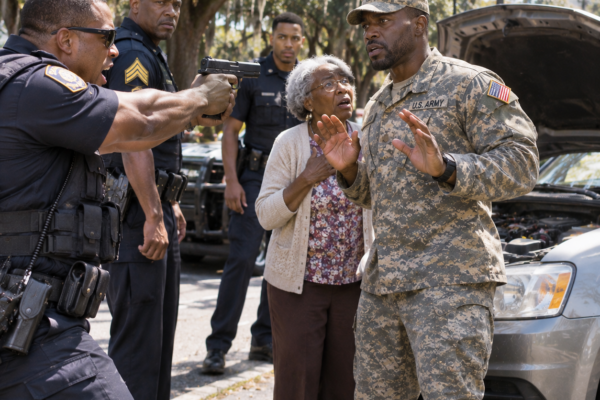
“Step Away From That SUV!” a Madison Police Officer Shouted as I Scraped Ice Off My Own Lincoln. I Was 72, My Bad Knee Was Buckling, and My Late Wife’s Birthday Cake Was Inside. He Refused to Check the Registration, Forced My Face Against the Frozen Hood, and Reported a Possible Weapon—Until Another Officer Heard My Name Over the Radio..K
Part 2:
“Sir, that is my Lincoln. Run the license plate and you’ll see my name.”
The officer didn’t even glance at the registration number.
“I said step away from the SUV. NOW!”
I was seventy-two years old, standing in a Wisconsin snowstorm with an ice scraper in my hand and six white roses’ worth of cemetery mud still clinging to my boots.
I’d spent twenty-four years as an Army medic. I’d treated wounded soldiers under conditions far more frightening than a grocery-store parking lot.
But the young police officer standing twenty feet away, with his right hand hovering near his holster, frightened me in a way I hadn’t felt for a long time.
Because he wasn’t listening to a word I said.
“Officer, I’m not resisting. I was clearing the windshield.”
“Then put that thing down!”
I lowered the scraper onto the snow.
“Hands where I can see them!”
I raised both hands.
“Now move away from the vehicle!”
I took two careful steps backward. My right knee, injured years earlier during my military service, protested sharply in the cold.
“That’s my car,” I repeated. “My registration is inside.”
The officer’s nameplate read KELLER.
He looked about forty, with a square jaw and the rigid posture of a man who expected everyone to obey him immediately.
“Don’t tell me how to do my job,” he snapped.
I looked toward my black Lincoln Navigator.
Eight months earlier, I’d bought that SUV after years of driving an aging pickup. My daughter, Rebecca, thought it was unnecessarily large.
I’d told her that after seven decades of living, I was entitled to buy one vehicle without asking permission.
Now I was standing beside it like a suspected criminal.
It was Thursday afternoon in Madison, Wisconsin, and snow had been falling since morning.
Forty minutes earlier, I’d been visiting Evergreen Memorial Cemetery, where my wife, Helen, had been buried four years before.
Today would have been her seventy-first birthday.
We’d been married thirty-eight years. Every year on her birthday, I brought her six white roses because she disliked red ones.
She used to say red roses were for men trying to apologize without admitting what they’d done.
I’d knelt beside her grave, brushed the snow off her headstone, and told her about Rebecca’s new responsibilities at work.
Then I’d driven to Northgate Plaza to purchase the small chocolate cake Helen always wanted on her birthday.
Rebecca and I planned to share it that evening.
The cake was sitting safely in the back of my Lincoln.
At least, I hoped it still was.
“Sir!” Keller shouted.
I returned my attention to him.
“Do you own this vehicle?”
“Yes.”
“Can you prove that?”
“My key is right here.”
I slowly opened my palm, showing him the black key fob.
“Don’t move!”
“I don’t need to move.”
With my thumb, I pressed the unlock button.
The Navigator’s headlights flashed. Its side mirrors unfolded, and the door locks clicked.
For half a second, Keller stared at the vehicle.
There was our answer.
Or so I thought.
“Stolen keys can open stolen vehicles,” he said.
I looked at him.
“That’s why I’m asking you to run the plate.”
His expression hardened.
“You can ask questions when I’m finished.”
“Then please finish before we both freeze out here.”
A few people had begun watching from beneath the grocery-store awning.
I noticed a young woman wearing a bakery apron and carrying a backpack. She stood near the entrance, staring at us.
Beyond her, a heavyset man in a parking-security jacket watched from beside a small booth.
I didn’t know that he’d been the person who called the police.
I certainly didn’t know what he’d told the dispatcher.
All I knew was that my shoulders were aching from holding my arms up, and the cold was getting through my coat.
“Officer,” I said, “I’m seventy-two. I have an old knee injury, and I’d like to go home.”
Keller stepped closer.
“You people always have an argument, don’t you?”
I studied his face.
“What do you mean by ‘you people’?”
“Keep your hands up!”
“They are up.”
“Stop talking!”
I closed my mouth.
A gust of wind drove snow beneath the open front of my coat.
Without thinking, I began lowering my left hand to pull the fabric closed.
Keller’s expression changed immediately.
“GET YOUR HAND OUT OF THERE!”
I froze.
“I’m just closing my coat.”
“What’s in your pocket?”
I looked down.
A small navy velvet case was visible inside my coat. It contained a military decoration I’d promised to return to the son of a friend who had recently died.
“It’s not a weapon,” I said.
“Don’t reach!”
“I’m not reaching!”
Keller lunged toward me.
His hand seized the front of my coat.
And before I could take another step, my back struck the side of my own SUV.
“Hands on the hood!” he shouted.
“My knee—”
“Now!”
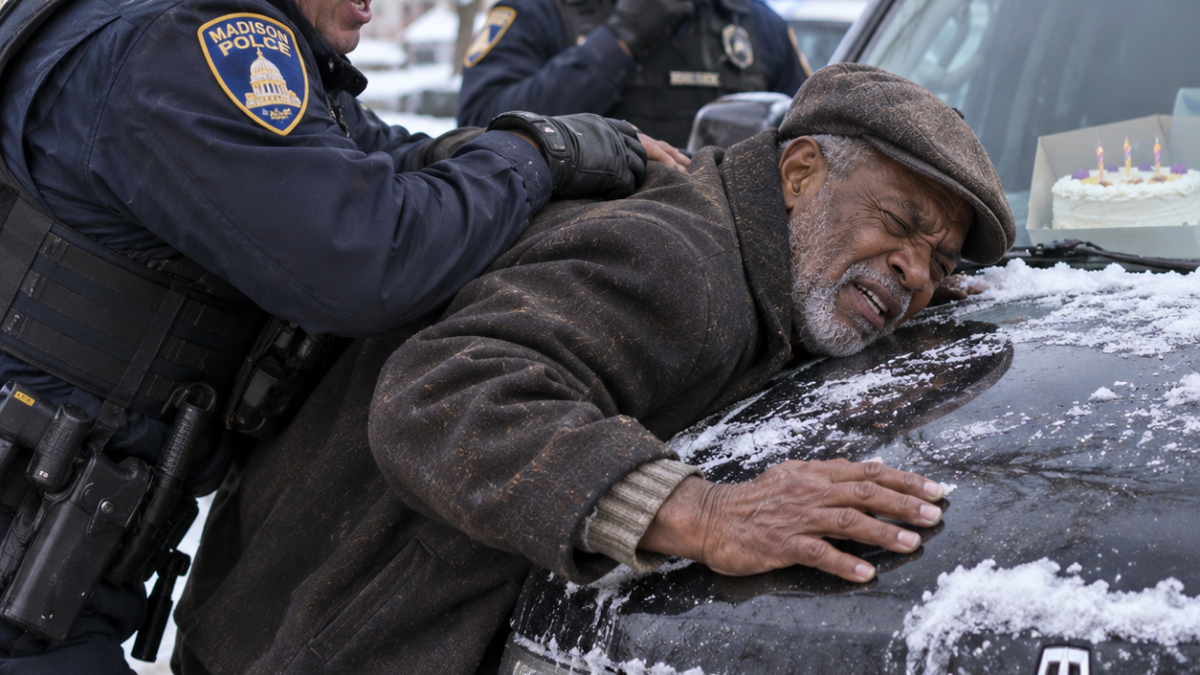
I turned as carefully as I could. My palms landed against the snow-covered hood, and ice water immediately soaked through my gloves.
Keller twisted my left arm behind me.
Pain shot across my shoulder and up the side of my neck.
“Easy,” I gasped. “I’ve had neck surgery. Please don’t push there.”
“Stop resisting.”
“I’m not resisting. You’re hurting me.”
His hand pressed against the back of my coat, forcing my upper body lower.
My cheek touched the frozen metal.
Twenty-four years in the Army had taught me the importance of clear communication when someone was frightened or injured. I’d spent countless hours telling young soldiers to keep breathing, follow instructions, and concentrate on the next manageable thing.
Now I tried giving myself that advice.
Breathe.
Keep your hands visible.
Don’t make a sudden movement.
But the pressure on my neck frightened me.
Seven years earlier, I’d undergone surgery to relieve compression in my cervical spine. The operation had helped, but I still had stiffness and occasional pain when I turned too quickly.
Keller’s hand was pressing almost directly over the old surgical area.
“Officer, I need you to ease up.”
“You’re not going to tell me what to do.”
“I’m telling you about a medical condition.”
He leaned harder.
My right knee trembled beneath me.
Somewhere behind us, a young woman’s voice rose above the wind.
“Officer! He wasn’t breaking into anything!”
Keller turned his head.
“Stay back!”
“He unlocked the car himself. I saw him!”
I couldn’t see her face from where I was bent across the hood, but I recognized the voice from the bakery counter.
She had sold me Helen’s birthday cake twenty minutes earlier.
“Maya?” I managed.
“Yes, sir! I’m right here!”
“Back away from the scene!” Keller shouted.
“Then let him stand up!”
I heard several people reacting beneath the grocery-store awning.
Someone asked whether an ambulance was needed.
Another person said the old man wasn’t doing anything.
Keller ignored them.
He reached toward his radio.
“Northgate unit. One male detained in the north parking lot. Subject is noncompliant, possibly armed. Request backup.”
My stomach tightened.
“I’m not armed.”
“Stop talking!”
“There’s a medal in my coat.”
“I told you to stop!”
I closed my eyes.
The navy velvet box belonged to Sergeant Daniel Mercer, my closest friend from our Army years.
Daniel had died two months earlier after a long illness. Before his death, he’d asked me to return his Silver Star medal to his son, Michael, when the young man came home from overseas.
Michael was arriving in Madison the following morning.
I’d carried the box with me because I intended to put it someplace safe before meeting him.
Now that small family responsibility had become part of a police report about a possible weapon.
My cheek was numb from the cold.
Then I noticed something more frightening.
My breathing wasn’t normal.
At first, I thought it was the pressure from Keller’s arm and the cold air.
But a dull ache had begun spreading beneath my breastbone.
I knew the difference between ordinary discomfort and symptoms that needed medical attention.
I’d spent too many years treating injured people not to recognize the warning signs.
“Officer,” I said, “I’m having trouble breathing.”
Keller didn’t loosen his grip.
“You were breathing fine a minute ago.”
“That doesn’t mean I’m fine now.”
“Stop making this difficult.”
The young woman shouted again.
“He needs help!”
I heard her footsteps moving closer.
Keller ordered her back.
She didn’t leave.
“My name’s Maya Thompson,” she said. “I’m a nursing student. His breathing doesn’t look right.”
“Then go practice somewhere else.”
I heard the anger in her voice.
“You’re hurting him!”
Keller’s grip tightened again.
“Ma’am, interfere one more time and you’ll be detained.”
I tried to lift my head.
The movement sent another sharp pain down my neck.
“Please,” I said. “Just let me breathe.”
Across the parking lot, another patrol car arrived.
I heard its tires crunch through the snow.
A man’s voice called out.
“Ryan!”
Keller didn’t respond.
“Officer Keller!”
“What?” Keller snapped.
“Ease off him.”
“Stay out of my detention.”
“I heard the dispatch update. The vehicle registration matches his name.”
“That doesn’t settle everything.”
“There’s no stolen vehicle report.”
“He reached into his coat.”
“Then secure the situation without crushing him against the hood.”
The second officer came closer.
I later learned his name was Ethan Cole.
He was twenty-six, with only nine months of patrol experience, and had been handling a minor traffic collision several blocks away when he’d heard the radio call.
At that moment, I knew nothing about him.
I could only hear that he was asking Keller to stop.
“Sir,” Ethan said, coming around the front of my Lincoln, “can you tell me your name?”
“Walter Hayes.”
“Mr. Hayes, are you hurt?”
“My neck. And my chest.”
Ethan looked toward Keller.
“Ryan, let him up. He’s reporting chest pain.”
“He’s trying to avoid being detained.”
“Then have EMS assess him. We don’t decide whether chest pain is real by arguing about it.”
Keller’s hand remained on my neck.
I felt my left fingers begin to tremble.
Maya called out, “He’s getting pale around his mouth!”
Ethan moved closer.
“Mr. Hayes, can you take a full breath?”
I tried.
The pressure beneath my chest increased.
“No.”
Ethan took out his radio.
“Request EMS immediately. Seventy-two-year-old male with chest discomfort and difficulty breathing. Possible neck injury.”
Keller turned toward him.
“I didn’t authorize that.”
Ethan looked directly at him.
“He needs an ambulance.”
“I’ve got control of the scene.”
“Then you need to recognize when control is making things worse.”
For a moment, nobody spoke.
I could feel the tension between them.
Keller had more years in uniform. Ethan was clearly the younger officer, and challenging him in front of a crowd couldn’t have been easy.
But Ethan didn’t step away.
“Ryan, release the pressure. Now.”
Keller finally loosened his grip.
I tried to straighten.
My knee nearly gave out.
Ethan caught my arm.
“Easy, sir. Don’t move too fast.”
I took one painful breath.
Then I heard a voice from behind the crowd.
“Dad?”
I knew that voice.
I’d heard it when its owner was a little girl asking me to check beneath her bed for monsters.
I’d heard it when she graduated from college.
I’d heard it over the telephone four years earlier, the night we both learned that Helen wasn’t going to survive.
“Dad!”
I turned my head.
My daughter was running across the parking lot.
Rebecca Hayes.
Forty-three years old.
Twenty years in law enforcement.
And scheduled to be sworn in as Madison’s next police chief the following morning.
She stopped when she saw me.
For a second, her face changed in a way I’d never seen before.
Then she ran harder.
“Daddy!”
Ethan looked from Rebecca to me.
Keller’s hand dropped away completely.
The crowd went quiet.
And my daughter reached me just as my knees began to buckle.
She caught my face between her gloved hands.
“Dad, look at me.”
“I’m looking, sweetheart.”
“Can you breathe?”
“Not very well.”
Her expression tightened.
She looked toward Ethan.
“Has an ambulance been called?”
“Yes, Deputy Chief. It’s on the way.”
Rebecca nodded.
Then she turned toward Keller.
Whatever she was about to say, I stopped her.
“Rebecca.”
She looked back.
“Dad—”
“Ambulance first.”
Her jaw tightened.
For a moment, I saw the little girl who had once come home furious because a classmate had bullied a smaller student.
Helen had taught her that anger could be useful, but only if she decided what to do with it.
I needed her to remember that lesson now.
“Please,” I whispered.
Rebecca took a breath.
Then she looked at Ethan.
“Stay with him.”
She stepped aside and spoke into her radio, requesting a field supervisor and emergency medical assistance.
Keller began explaining himself.
“Deputy Chief, I was responding to a possible vehicle theft. He kept reaching toward his coat—”
Rebecca turned.
“Officer Keller, a supervisor is coming to take over this incident. You’ll give your account to that supervisor. Right now, my father needs medical attention.”
He stared at her.
“Your father?”
“Yes.”
The words seemed to strike him harder than anything else that had happened.
His eyes moved from her face to mine.
Then he looked toward the Lincoln.
For the first time, he appeared to understand that the older man he’d pinned against the frozen hood had a life beyond the accusations he’d made.
But I didn’t want his understanding to depend on my daughter.
I had been seventy-two years old before Rebecca arrived.
The Lincoln had belonged to me before Rebecca arrived.
And I’d deserved fair treatment long before anyone knew whose father I was.
A paramedic team reached us several minutes later.
They helped me onto a stretcher and checked my vital signs.
My blood pressure was dangerously elevated, and the chest discomfort had not completely subsided.
Rebecca walked beside me while the paramedics prepared to transport me.
“Where’s the cake?” I asked.
She stared at me.
“Dad, what?”
“Your mother’s cake.”
“Dad, you’re going to the hospital.”
“I know that. But the cake—”
She glanced toward the rear passenger door of my Lincoln.
The bakery box had tipped sideways on the floor during the commotion. Chocolate frosting was smeared against the inside of the clear lid.
Rebecca looked at it, then back at me.
“It’s had a rough afternoon.”
I sighed.
“Your mother would complain about the frosting.”
Despite herself, Rebecca laughed.
“She complained about everything you bought.”
“That isn’t true.”
“She once made you return a toaster because she didn’t like the sound it made.”
I smiled faintly.
“She had very good hearing.”
Rebecca squeezed my hand.
Then her eyes filled.
“Dad, please just let them take care of you.”
I nodded.
Before they closed the ambulance doors, I remembered the velvet box.
“Rebecca, there’s something in my coat.”
Her expression changed.
“What?”
“Inside pocket. Navy case. It’s Daniel’s medal.”
She carefully removed it.
I watched her hold the small box.
“Michael’s coming tomorrow,” I told her. “Promise me you’ll keep it safe.”
“I promise.”
The ambulance doors closed.
Through the rear window, I saw Rebecca standing in the snow, holding the box against her chest.
Behind her, the police vehicles remained scattered across the parking lot.
The flashing lights blurred as we pulled away.
And for the first time since Keller had stepped out of his cruiser, I stopped trying to prove anything.
I simply let the paramedics do their work.
I woke in a hospital room with a heart monitor beeping beside the bed.
The first thing I noticed was the pain in my neck.
The second was Rebecca sitting in the chair beside me.
She had removed her uniform coat and folded it over the back of the chair. Her hair was coming loose around her face, and she looked exhausted.
“Morning, sweetheart.”
She lifted her head.
“Dad.”
“That’s usually what you call me.”
She didn’t smile.
“You scared me.”
“I wasn’t particularly fond of the afternoon myself.”
She reached for my hand.
For several moments, neither of us spoke.
Then Dr. Lena Brooks entered carrying a tablet.
She explained that the initial tests had shown no evidence of a heart attack. My cardiac evaluation and observation had been reassuring, though the severe stress and cold had contributed to a sharp rise in blood pressure.
I also had a cervical muscle strain, inflammation around my previous surgical area, and bruising along my shoulder and hip.
Imaging had not revealed an acute fracture or a new structural injury requiring surgery.
“You’re fortunate,” Dr. Brooks said. “But I don’t want you confusing fortunate with uninjured.”
“I’ve been accused of that before.”
She gave me a dry look.
“I imagine you have.”
She told me to rest, avoid heavy lifting, and follow up with my primary-care physician. I also needed to seek immediate attention if the chest pressure, weakness, or breathing difficulty returned.
Rebecca listened to every instruction.
When the doctor left, she stood and walked to the window.
“Keller is finished,” she said.
I looked at her.
“Rebecca.”
“He had the registration information available. Another officer told him the vehicle wasn’t reported stolen. You told him about your neck, and he kept pushing.”
“I know.”
“Dad, he could have seriously injured you.”
“I know that, too.”
She turned toward me.
“Then why are you looking at me like I’m doing something wrong?”
“Because you’re about to become the police chief, and I’m afraid you’ll let being my daughter interfere with doing that job properly.”
Her expression changed.
“He hurt my father.”
“Exactly.”
I shifted against the pillow.
“Listen to me. If you personally decide his punishment while you’re angry, people will argue about your relationship to me instead of examining what he did.”
“I’m not going to protect him.”
“I’m not asking you to.”
“Then what are you asking?”
“Protect the investigation.”
Rebecca sat down again.
I continued.
“Have another command officer handle the administrative decisions. Let independent investigators review the body camera, the dispatch recording, and the witnesses. You should give your statement like anybody else and stay out of the disciplinary decision.”
She looked down at her hands.
“You’re asking me to trust a process that failed you yesterday.”
“I’m asking you to make sure it doesn’t fail anybody else.”
For a long time, she said nothing.
Then she nodded.
“I’ll formally recuse myself from the disciplinary decision.”
“Good.”
She gave me a tired smile.
“You’re still lecturing me from a hospital bed.”
“I’ve been doing that since you were born.”
She leaned forward and rested her forehead against mine.
I could feel her shoulders trembling.
My daughter had built a career around remaining composed in emergencies. I’d watched her handle difficult situations with more discipline than I could have imagined at her age.
But she was still a daughter who’d found her father struggling to breathe under another officer’s hand.
I held her until she stopped shaking.
While I recovered, the investigation began moving through the department.
The first important evidence came from the radio and dispatch records.
A security manager named Frank Dalton had called police from Northgate Plaza.
According to the recording, he’d reported seeing a man attempting to get into an expensive SUV.
But when the dispatcher asked whether he’d actually witnessed a forced entry, Frank admitted that he hadn’t.
Then he said something that would become central to the review.
“He doesn’t look like he belongs with that vehicle.”
The dispatcher asked what made him suspicious.
Frank described my coat, the vehicle, and the way I was moving around the rear cargo area.
He didn’t mention seeing me unlock the Lincoln.
He didn’t mention the grocery bag I’d carried to it.
And he hadn’t seen anyone break a lock, smash a window, or force a door.
Then the dispatcher asked whether I had a weapon.
Frank said he couldn’t tell, but he thought he’d seen something beneath my coat.
That uncertainty became the warning about a possible weapon.
When investigators interviewed him, Frank acknowledged that he’d never actually seen a gun.
He’d seen the outline of something in my clothing and assumed it might be dangerous.
His employer later reviewed his conduct and determined that he’d overstated what he’d observed while making the emergency call.
Northgate Plaza dismissed him from his management position for violating its reporting procedures.
I didn’t know Frank personally.
I had no desire to watch him lose his livelihood.
But his decision to turn suspicion into a claim of criminal behavior had consequences for me that he’d never considered.
I wondered how differently that afternoon might have gone if he’d simply walked over and asked whether I needed help clearing the snow.
The department also recovered the body-camera footage from Keller and Ethan.
Keller’s camera showed me placing the scraper on the ground after being ordered.
It showed both of my hands raised.
It recorded me explaining that I owned the SUV and offering to show the registration.
The patrol computer and radio logs established when the vehicle information became available.
The Lincoln was registered to Walter James Hayes, at my address in Madison.
There was no stolen-vehicle report.
No outstanding warrant connected to me.
No verified report of a firearm.
The registration information didn’t automatically answer every safety question an officer might have.
But it removed the original suggestion that I was simply a stranger trying to steal the vehicle.
Yet Keller had continued treating me as though my refusal to accept his assumptions was evidence of guilt.
The most difficult footage for Rebecca was the recording taken by Maya Thompson.
Maya had been nineteen, studying nursing while working at the grocery bakery to help pay for school.
She had recognized me because I’d been a regular customer.
Three weeks earlier, she’d also seen me helping a homeless veteran outside the store. The man had an injured hand, and I’d stopped to help him cover the wound with a clean dressing before buying him lunch.
I didn’t remember anyone watching.
Maya did.
When she saw Keller forcing me against the Lincoln, she took out her phone.
Her recording began after the first confrontation, but it captured the most serious part.
Keller’s hand pressing down near my neck.
My warning about the previous surgery.
Ethan telling Keller that the car’s registration was valid.
Maya repeatedly saying I needed medical assistance.
And Keller continuing to argue that I was resisting.
The footage wasn’t perfectly steady.
Maya’s hands had been shaking from the cold.
But her voice was clear.
So was mine.
At one point, the recording captured me saying, “Please, I can’t breathe properly.”
Keller answered, “Stop making this difficult.”
Rebecca told me later that she’d needed to stop watching when she reached that moment.
Not because she’d forgotten what happened.
Because it was the first time she’d heard how frightened I was.
I asked her not to play the recording for me until my doctor cleared me to leave the hospital.
I’d already lived through it once.
I wasn’t ready to experience it again on a screen.
The following afternoon, Lieutenant Marcus Bell came to speak with me.
He was leading the department’s Professional Standards review under the oversight of a commander who had no family connection to me.
Rebecca was not involved in deciding Keller’s discipline.
Bell had a quiet voice and a habit of asking questions only after I’d finished answering the previous one.
He wanted to know exactly when I had lowered my hand toward my coat.
“After I’d been standing in the snow for several minutes,” I said.
“Had Officer Keller already told you to keep your hands raised?”
“Yes.”
“Why did you lower your hand?”
“To close the front of my coat. The wind was coming through.”
“Did you tell him what you were doing?”
“Yes. And I stopped when he ordered me to.”
Bell wrote that down.
He asked about the velvet box, my military service, and why I’d carried the medal with me.
Then he asked whether I thought Keller had recognized that the object wasn’t a weapon.
“I don’t know what he believed,” I said. “I only know what I told him.”
Bell nodded.
“That distinction matters.”
I looked at him.
“Lieutenant, I don’t expect police officers to ignore possible danger. I spent twenty-four years treating people who’d been injured because somebody underestimated a threat.”
“I understand.”
“But I also know that when new information comes in, you have to use it.”
Bell watched me carefully.
“If you could change one decision in that encounter, which would it be?”
I thought about the entire afternoon.
The scraper.
The registration.
The cold hood beneath my face.
Finally, I answered.
“The first time I told him the car was mine, he should have checked.”
Bell closed his notebook.
“That will be part of what we examine.”
Later that week, Ethan Cole visited me at the hospital.
He stood just inside the doorway wearing his patrol uniform, his hat turning slowly between his hands.
“You wanted to see me, sir?”
“Come in, son. You’re making the doorway nervous.”
He smiled and sat.
For a while, we talked about ordinary things.
The weather.
My recovery.
How difficult Wisconsin winters could be for anybody with an old knee injury.
Then he looked at his hat.
“Some people at work think I handled that situation badly.”
I studied him.
“Do you?”
“I think I did what I was supposed to do.”
“Then why are you asking?”
He sighed.
“Keller’s more experienced. Some officers think I embarrassed him in front of the public.”
“Did you?”
“I told him to stop putting pressure on you.”
“And did he need to stop?”
“Yes.”
“Then perhaps his embarrassment wasn’t the most important thing happening in that parking lot.”
Ethan looked up.
I smiled faintly.
He hesitated.
“Mr. Hayes, I think we’ve met before.”
I nodded.
“Police academy. Fourteen months ago.”
His eyes widened.
“You remember?”
“You asked me whether there was ever a situation where questioning a superior could do more harm than good.”
He laughed softly.
“I remember that.”
“What did I tell you?”
“That the question was whether staying silent would allow somebody to get hurt.”
“Sounds like decent advice.”
He looked down.
“I didn’t recognize you when I first arrived.”
“Good.”
He frowned.
“Good?”
“You didn’t step in because you recognized an old guest speaker. You stepped in because you saw a man who needed help.”
Ethan sat quietly.
Then he said, “I was scared.”
I nodded.
“Courage isn’t the absence of fear, son. If it were, most of the people I’ve admired in my life wouldn’t qualify.”
He smiled.
For the first time since entering the room, he seemed comfortable sitting there.
I asked him about Maya.
He told me she had provided her original recording to investigators and was cooperating with the review.
A local station had offered her money for an exclusive interview.
She’d declined.
“She said she just wanted the recording used properly,” Ethan told me.
I thought about that young woman standing in the snow, refusing to leave even when an officer threatened to detain her.
I’d spent years volunteering with a veterans’ community organization that helped former service members and their families.
I knew people who talked endlessly about courage.
Maya had demonstrated it without expecting recognition.
When I returned home, I contacted the foundation’s scholarship committee.
I told them about Maya’s volunteer work at Pinecrest Senior Center, where she’d been helping older residents for several years.
I made it clear that I didn’t want a scholarship treated as payment for filming me.
The foundation already had a nursing scholarship program, and applicants were evaluated through established criteria.
Maya applied.
Several weeks later, the independent committee selected her for an award based on her academic progress, financial need, and documented community service.
When she called to thank me, I laughed.
“Don’t thank me, young lady. You earned it.”
“But you told them about me.”
“I told them where to find your application.”
She was quiet for a moment.
Then she said, “I’m going to be a good nurse, Mr. Hayes.”
“I believe that.”
“Maybe I’ll work in emergency medicine.”
I smiled.
“Then remember something an old medic learned a long time ago.”
“What’s that?”
“Listen when a patient tells you something is wrong.”
“I will.”
I believed her.
Three months after the incident, I stood in my bathroom slowly turning my head from side to side.
The sharp pain had faded, though my neck still felt stiff on cold mornings.
My doctor had cleared me to drive again, return to my volunteer work, and resume most normal activities.
I was grateful.
But recovery had involved more than letting a muscle injury heal.
For weeks, I had hesitated every time I approached the Lincoln in a public parking lot.
I caught myself checking who was watching before unlocking the doors.
Sometimes I’d see a patrol car and feel the old tightness return to my chest.
I’d discussed those reactions with my doctor and accepted a referral for counseling. I hadn’t expected to need help with the fear that remained after the physical injuries improved.
But I wanted to be able to drive to the grocery store without remembering how it felt to have my face pressed against a frozen hood.
Gradually, the ordinary parts of life became ordinary again.
One morning, I took Daniel Mercer’s medal from the dresser.
His son Michael had postponed his visit after learning I was hospitalized, and we’d arranged to meet once I was recovering.
When I finally handed him the velvet box, he held it without speaking for a long time.
“Dad said you saved his life once,” he told me.
“Your father saved mine more times than I could count.”
Michael looked down at the Silver Star.
“He was proud of you.”
I smiled.
“Then he had questionable judgment.”
Michael laughed.
We spent two hours talking about Daniel.
I didn’t mention the police encounter until Michael asked about the stiffness in my neck.
Even then, I kept the explanation brief.
I wanted that afternoon to belong to his father.
Not to Ryan Keller.
A week later, Lieutenant Bell informed me that the administrative review had reached its conclusions.
The investigators had compared the dispatch recording, the patrol computer’s access logs, both officers’ body cameras, Maya’s recording, and the medical documentation.
They had also interviewed witnesses and examined Keller’s written report.
Several allegations were sustained.
The review found that Keller had used excessive force under the circumstances, failed to adequately consider readily available information, and continued applying physical pressure after receiving warnings that I was in medical distress.
Investigators also identified material inaccuracies and omissions in his account of the encounter.
Keller had described repeated resistance, but the video showed me lowering the scraper when ordered, raising my hands, stopping when instructed, and trying to provide information about my vehicle.
The review acknowledged that an officer responding to a report involving a possible weapon could initially take precautions.
But it also found that those precautions had to be reassessed as new information became available.
Keller had been told that the vehicle wasn’t reported stolen.
He’d been informed of my age and medical condition.
Another officer had challenged the continued force.
A witness had reported obvious signs of distress.
Yet he’d persisted.
The department completed its disciplinary process and dismissed Keller. He retained the ability to challenge the employment decision through the available procedures.
A separate state review of his law-enforcement certification followed.
Eventually, I learned that his certification had been revoked.
I read the final findings once.
Then I closed the folder.
Rebecca watched me from the kitchen table.
“Well?” she asked.
I looked at her.
“I’m glad somebody examined what happened.”
“Are you satisfied?”
“With the investigation? Yes.”
“And with the outcome?”
I thought carefully.
“I didn’t spend three months hoping a man would lose his career. I spent three months hoping the record would show that what happened wasn’t acceptable.”
She nodded.
“He made choices that led to those consequences.”
“I know.”
I rested the folder beside my coffee.
“But what happens when the next officer makes the same choices?”
Rebecca didn’t answer immediately.
Then she asked, “What would you like us to do differently?”
I thought about my years working as a medic.
Whenever something went wrong during a medical emergency, the best teams didn’t stop at identifying who’d made a mistake.
They studied the sequence.
They asked what information had been missed.
They asked where somebody could have intervened sooner.
And they changed procedures so the next person had a better chance of getting it right.
“Teach the whole encounter,” I said.
Rebecca frowned.
“What do you mean?”
“Don’t just show officers the part where Keller held me against the hood. Show them what came before it.”
“The dispatch call?”
“All of it. The call. The plate information. The moment I unlocked the car. The moment Ethan told him the registration was valid.”
I paused.
“Ask them where they would have stopped.”
Rebecca leaned back.
“You want the footage used in training.”
“Yes. With the appropriate permissions and privacy protections. Let recruits examine the decisions, not just the outcome.”
She looked thoughtful.
“And what else?”
“Make sure young officers know that intervening when a colleague uses unnecessary force isn’t disloyalty.”
Rebecca glanced toward the photograph of Helen on the kitchen wall.
“Mom would have liked that.”
I smiled.
“She would have told you to get moving instead of sitting here talking about it.”
Rebecca laughed.
“That’s exactly what she would have said.”
Over the following months, the department reviewed its training materials and procedures relating to vehicle-related detentions, medical distress, and an officer’s duty to intervene.
The changes went through the appropriate command, legal, and training review processes.
The resulting guidance emphasized that officers should verify readily available information when circumstances allowed, reassess suspicion as facts changed, and intervene when they reasonably believed unnecessary force was being used.
Rebecca wanted the department to learn from what had happened without turning the entire issue into a story about her father.
I appreciated that.
My name didn’t need to appear on a policy for the lesson to matter.
Ethan received a departmental commendation for intervening during the encounter and requesting medical assistance.
Rebecca had stayed out of the award decision, leaving the review to other commanders.
I attended the ceremony.
Ethan stood in the front row wearing a neatly pressed uniform, looking uncomfortable with all the attention.
When the citation was read, the room applauded.
I watched him accept the recognition.
Afterward, he found me near the refreshments.
“Mr. Hayes.”
“Officer Cole.”
He smiled.
“I didn’t know you’d be here.”
“Wouldn’t have missed it.”
He glanced toward the award in his hand.
“I still feel strange about getting this.”
“Why?”
“Because stopping someone from getting hurt should be part of the job.”
I nodded.
“It should.”
He looked uncertain.
“Then why celebrate it?”
“Because sometimes a young officer needs to see that speaking up won’t always leave him standing alone.”
Ethan considered that.
Then he held out his hand.
I shook it.
“Keep asking questions, son.”
“I will.”
“And don’t let anyone convince you that admitting uncertainty makes you weak.”
He smiled.
“I remember that from the academy.”
“Good. Then I haven’t wasted all those years talking.”
Three weeks later, I returned to the police academy as a guest speaker.
Twenty-eight recruits sat in a classroom beneath bright fluorescent lights.
Rebecca had arranged for the training division to use an approved version of the Northgate footage. I’d given permission for the relevant parts involving me to be shown.
Ethan stood quietly near the back.
On the screen behind me was a frozen image from that afternoon.
The black Lincoln.
The falling snow.
My body bent over the hood.
Keller standing beside me.
And Ethan approaching from the edge of the frame.
I let the recruits study it.
Then I asked, “Which officer has the most power in this picture?”
Several hands rose.
One young recruit said, “The officer controlling the suspect.”
I nodded.
“That’s one answer. Why?”
“Because he has physical control of the situation.”
“Fair enough.”
Another recruit suggested that my daughter had the most power once she arrived.
I pointed toward the screen.
“She isn’t in this picture yet.”
A few students smiled.
I turned toward Ethan’s figure.
“Let me ask you a different question. Which officer had the greatest opportunity to change what happened next?”
The room grew quiet.
I pointed toward the young man running across the parking lot.
“This one.”
One recruit frowned.
“But he wasn’t the senior officer.”
“No.”
“He wasn’t in command.”
“No.”
“Then how did he have more power?”
I looked around the classroom.
“He was willing to act on the information he had.”
I started the video.
We watched Keller question me.
We watched me lower the scraper.
We watched the Lincoln respond to its key.
I paused the recording.
“What could have happened here?”
A recruit raised her hand.
“He could have checked the registration.”
“Exactly.”
We continued.
The radio update played.
I stopped the video again.
“What changed?”
“The registered owner was identified,” another recruit said.
“And what should that do to the officer’s assessment?”
“It should reduce the suspicion that the vehicle is stolen.”
I nodded.
We continued until Ethan appeared and challenged the force being used.
I froze the image.
“What could he have done?”
“Called a supervisor,” someone answered.
“He did.”
“Requested medical assistance.”
“He did that, too.”
Another recruit raised his hand.
“He could have told Keller to stop.”
I pointed toward the screen.
“He did.”
The classroom was quiet.
I looked at the young people sitting before me.
“I spent twenty-four years as an Army medic. I learned that quick decisions sometimes save lives. I also learned that refusing to reconsider a decision can cost one.”
Nobody spoke.
“The most important question isn’t always whether you were right when you first arrived.”
I glanced toward the frozen image of my younger self’s hands against the Lincoln.
“Sometimes it’s whether you’re still right after the facts change.”
When the session ended, several recruits stayed behind to ask questions.
One wanted to know whether I’d been angry at Keller.
“Yes,” I said.
“Are you still?”
“Sometimes.”
“Then how do you keep that from affecting what you teach?”
I thought about Helen.
She’d been the person who could look at me across a kitchen table and tell me when I was letting pride do my thinking.
“I remind myself that anger doesn’t automatically make me wrong,” I said. “But it doesn’t automatically make me right, either.”
Ethan approached after the recruits left.
“How did it feel being back?”
I looked around the classroom.
“Better than last time.”
He smiled.
“You gave them a lot to think about.”
“Then I did my job.”
We walked toward the exit together.
Before leaving, I looked back at the empty classroom.
I didn’t know whether any of those recruits would ever face a situation like the one at Northgate Plaza.
I hoped they wouldn’t.
But if they did, I wanted them to remember that the person standing in front of them was more than a possible suspect.
He might be a mechanic closing his business.
A mother picking up her children.
A teenager walking home.
Or an old man buying a chocolate cake for his late wife’s birthday.
None of those people should need a powerful relative to be treated with care.
One year after the incident, snow fell again on Helen’s birthday.
Rebecca arrived at my house before noon.
She had been police chief for nearly a year, but she still believed being my daughter entitled her to criticize everything from my winter boots to the way I salted the driveway.
“Dad, are you sure you want to drive?”
“Rebecca, I’ve been driving since before you were born.”
“That’s what worries me.”
I put on my coat.
“You can stay home.”
She smiled.
“And miss Mom’s cake?”
We drove to Evergreen Memorial Cemetery.
I carried six white roses through the snow and placed them beside Helen’s headstone.
Rebecca stood quietly beside me.
For a while, we talked about Helen.
Her terrible singing.
Her habit of rearranging furniture in the middle of the night.
The way she’d always insist she didn’t want anything for her birthday and then complain if I forgot the cake.
I brushed snow from her name.
“We’re doing all right, sweetheart,” I whispered.
Rebecca touched my arm.
Then we walked back to the Lincoln.
At Northgate Plaza, I parked near the same grocery entrance.
The security booth had been repainted.
The parking lot looked smaller than I remembered.
I could see where the patrol car had stopped a year earlier.
For a moment, my hand tightened around the steering wheel.
Rebecca noticed.
“We can go somewhere else.”
I shook my head.
“No. This is where Helen always bought her cake.”
Inside, the bakery was warm and crowded.
Maya Thompson had stopped working there after receiving her nursing scholarship, but the woman at the counter remembered my order from previous years.
“Chocolate cake, dark frosting, white icing?”
“That’s the one.”
Rebecca carried the box while I paid.
As we walked outside, I saw a thin layer of snow beginning to gather on the Lincoln’s windshield.
I stopped beside the driver’s door.
For a brief moment, I remembered Keller’s voice.
The cold hood.
The pressure on my neck.
The sound of Ethan telling him to stop.
I stood there, letting the memory pass.
It didn’t disappear.
I knew it probably never would.
But it no longer controlled what I did next.
Rebecca stood beside me.
“Want me to drive?”
I held up the key fob.
“No, thank you.”
“Dad, you’re seventy-three.”
“And you’re still bossy.”
“I’m literally the police chief.”
I looked at her.
“Not in my car.”
She laughed.
I brushed the snow from the driver’s window, opened the door, and climbed inside.
Rebecca placed Helen’s cake carefully on the rear floor before taking the passenger seat.
I started the engine.
The headlights came on.
The side mirrors unfolded.
The same ordinary little movements that had once failed to convince an officer I owned my vehicle.
This time, nobody questioned them.
Rebecca buckled her seat belt.
“Ready, Dad?”
I glanced at the cake in the back.
Then I looked toward the road.
“Ready, sweetheart.”
I pulled out of the parking space and drove home through the falling snow, with my daughter beside me and Helen’s birthday cake safely behind us.