“People Like You Don’t Belong Here,” the Officer Snapped While I Sat Quietly With a Paid Cup of Coffee. The Café Owner Told Him I Was Welcome, but He Threatened Her Business License and Reached for My Briefcase. I Was Waiting for a City Employee Terrified of What He’d Found—and the Officer Had No Idea Why I Couldn’t Leave.K
“People Like You Don’t Belong Here,” the Officer Snapped While I Sat Quietly With a Paid Cup of Coffee. The Café Owner Told Him I Was Welcome, but He Threatened Her Business License and Reached for My Briefcase. I Was Waiting for a City Employee Terrified of What He’d Found—and the Officer Had No Idea Why I Couldn’t Leave.
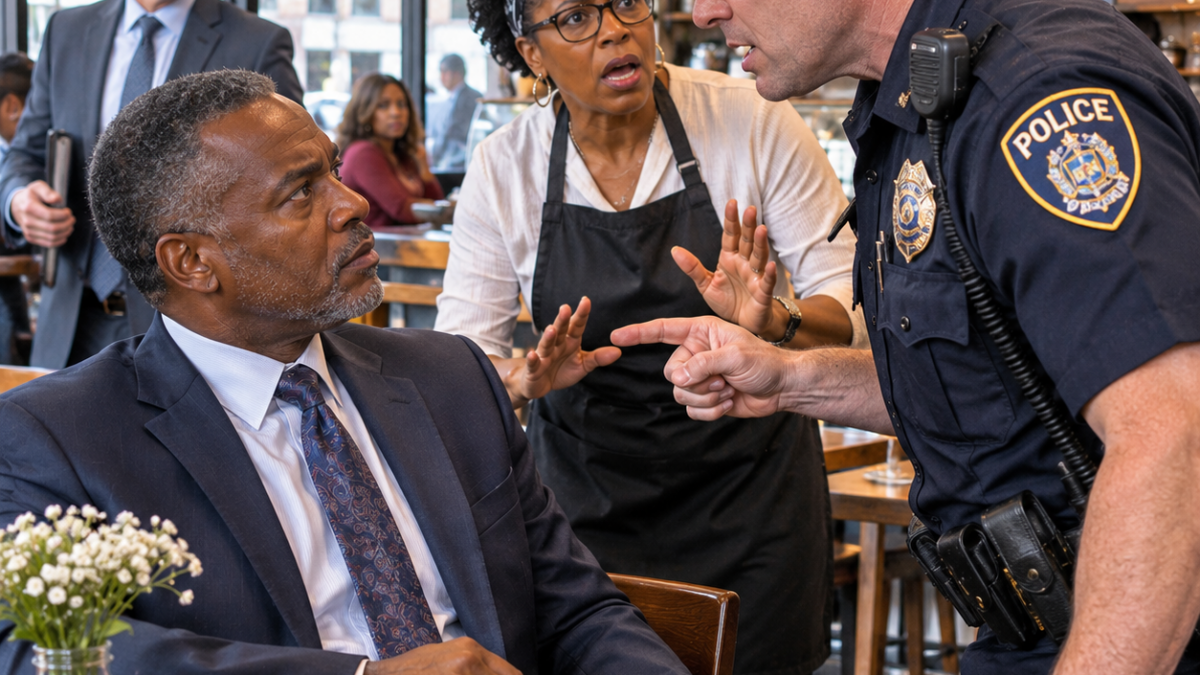
“Stand up, grab that cheap briefcase, and get out,” the officer said, loud enough for everyone inside Lantern Coffee House to hear. “People like you don’t belong in a place like this.”
I looked at the badge above his left pocket.
BRENT CALLOWAY.
Harbor Point Police Department.
“I paid for my coffee, Officer. The owner has told you I’m welcome. What law am I breaking?”
“Don’t get smart with me.”
“It’s a reasonable question.”
His hand settled near his gun.
“People like you always think you can argue your way out of following instructions.”
There were twenty-three customers inside the café that rainy Thursday morning. Several had stopped eating. A young mother pulled her little boy closer, and behind the counter, the owner was staring at the officer as though she couldn’t believe what she was hearing.
I was forty-four years old, Black, and dressed in an ordinary gray sweater and dark jeans.
Nothing about my appearance explained why a police officer had decided I was dangerous.
But I knew something he didn’t.
My name is Malcolm Hayes. For sixteen years, I’d worked for the Federal Bureau of Investigation. I was now a supervisory special agent assigned to a public-corruption investigation involving several Harbor Point officials.
And the frightened city employee I was supposed to meet that morning might have the evidence needed to expose an operation that had been driving families and small-business owners out of their neighborhood.
I couldn’t leave.
Not without risking months of work and possibly the safety of a man who had finally agreed to tell the truth.
The café stood on Waterman Street in the Old Harbor neighborhood of coastal Virginia.
It was the kind of place where retired dockworkers came for breakfast, delivery drivers stopped for coffee, and families still knew the names of people who’d lived above the same shops for thirty years.
Its owner, Hannah Park, had operated Lantern Coffee House for seventeen years.
Across the street stood Northshore Development’s temporary project office.
Northshore wanted to replace several blocks of old storefronts and apartments with luxury condominiums, restaurants, and a waterfront hotel.
Developing property wasn’t a crime.
But bribing officials to pressure unwilling owners into selling was.
For eight months, my team had been examining suspicious property transactions, licensing enforcement, and payments routed through consulting firms connected to public employees.
That morning, a city purchasing supervisor named Aaron Bell was supposed to bring us documents tying those transactions together.
I’d arrived early.
My black coffee sat beside a folded newspaper. Beneath the newspaper was my leather briefcase, containing a notebook and materials related to the meeting.
Aaron knew which table to approach.
Everything was going according to plan until Officer Calloway walked through the door.
He hadn’t asked Hannah whether there was a problem.
He hadn’t spoken to anyone sitting near me.
He’d walked straight to my table.
“We received a complaint about a suspicious individual,” he announced.
“Suspicious in what way?” I asked.
“Making customers uncomfortable.”
“Did somebody report a threat?”
“I’m asking the questions.”
Hannah came around the counter.
“Officer, Mr. Hayes hasn’t bothered anybody. He’s been sitting here drinking coffee.”
Calloway turned on her.
“Ma’am, stay out of police business.”
“This is my business,” Hannah replied. “And I’m telling you he hasn’t done anything wrong.”
Calloway stepped closer.
“You want the city taking another look at your operating license?”
I watched Hannah’s face change.
That threat meant something to her.
I knew why.
Hannah had rejected three offers from Northshore to purchase her building. Since then, she’d received repeated inspection notices for minor issues that other businesses were routinely given time to correct.
She wasn’t the only owner being pressured.
But until that morning, she hadn’t known I was investigating the people behind those notices.
“There’s no trespassing complaint,” I told Calloway. “The property owner has expressly permitted me to remain.”
He leaned over the table.
“You think knowing a few fancy words makes you special?”
“No. I think the facts matter.”
His eyes narrowed.
A second officer entered the café.
He was younger, with BENNETT printed above his badge.
“Brent,” he said, “dispatch didn’t mention any threats. What’s the complaint?”
“Suspicious behavior.”
“What behavior?”
Calloway glared at him.
“Stand by the door, Noah.”
Behind the counter, a young employee named Emily Torres was holding her phone at waist level.
I noticed the camera lens pointed in our direction.
Then, through the rain-streaked front window, I saw a familiar black umbrella passing Northshore’s office.
Aaron Bell.
He looked toward the patrol car.
Stopped.
And turned away.
My stomach tightened.
The man I’d spent weeks persuading to come forward had just seen a police officer confronting me.
If he believed his cover was blown, he might disappear before we could protect him.
Calloway reached toward my briefcase.
“What’s in the bag?”
“Personal and work documents.”
“Open it.”
“I don’t consent to a search.”
He smiled without warmth.
“Then you’re giving me a reason to be suspicious.”
“Refusing an unsupported search doesn’t create evidence of a crime.”
He grabbed the handle.
I placed my palm flat on the table.
“Officer, don’t open that case.”
“Stand up.”
“Am I under arrest?”
“You’re about to be.”
I looked past him toward the back of the café.
Aaron was gone.
And when Calloway reached for my arm, I realized the morning was becoming far more dangerous than a false arrest.
Part 2:
“Stand up, grab that cheap briefcase, and get out,” the officer said, loud enough for everyone inside Lantern Coffee House to hear. “People like you don’t belong in a place like this.”
I looked at the badge above his left pocket.
BRENT CALLOWAY.
Harbor Point Police Department.
“I paid for my coffee, Officer. The owner has told you I’m welcome. What law am I breaking?”
“Don’t get smart with me.”
“It’s a reasonable question.”
His hand settled near his gun.
“People like you always think you can argue your way out of following instructions.”
There were twenty-three customers inside the café that rainy Thursday morning. Several had stopped eating. A young mother pulled her little boy closer, and behind the counter, the owner was staring at the officer as though she couldn’t believe what she was hearing.
I was forty-four years old, Black, and dressed in an ordinary gray sweater and dark jeans.
Nothing about my appearance explained why a police officer had decided I was dangerous.
But I knew something he didn’t.
My name is Malcolm Hayes. For sixteen years, I’d worked for the Federal Bureau of Investigation. I was now a supervisory special agent assigned to a public-corruption investigation involving several Harbor Point officials.
And the frightened city employee I was supposed to meet that morning might have the evidence needed to expose an operation that had been driving families and small-business owners out of their neighborhood.
I couldn’t leave.
Not without risking months of work and possibly the safety of a man who had finally agreed to tell the truth.
The café stood on Waterman Street in the Old Harbor neighborhood of coastal Virginia.
It was the kind of place where retired dockworkers came for breakfast, delivery drivers stopped for coffee, and families still knew the names of people who’d lived above the same shops for thirty years.
Its owner, Hannah Park, had operated Lantern Coffee House for seventeen years.
Across the street stood Northshore Development’s temporary project office.
Northshore wanted to replace several blocks of old storefronts and apartments with luxury condominiums, restaurants, and a waterfront hotel.
Developing property wasn’t a crime.
But bribing officials to pressure unwilling owners into selling was.
For eight months, my team had been examining suspicious property transactions, licensing enforcement, and payments routed through consulting firms connected to public employees.
That morning, a city purchasing supervisor named Aaron Bell was supposed to bring us documents tying those transactions together.
I’d arrived early.
My black coffee sat beside a folded newspaper. Beneath the newspaper was my leather briefcase, containing a notebook and materials related to the meeting.
Aaron knew which table to approach.
Everything was going according to plan until Officer Calloway walked through the door.
He hadn’t asked Hannah whether there was a problem.
He hadn’t spoken to anyone sitting near me.
He’d walked straight to my table.
“We received a complaint about a suspicious individual,” he announced.
“Suspicious in what way?” I asked.
“Making customers uncomfortable.”
“Did somebody report a threat?”
“I’m asking the questions.”
Hannah came around the counter.
“Officer, Mr. Hayes hasn’t bothered anybody. He’s been sitting here drinking coffee.”
Calloway turned on her.
“Ma’am, stay out of police business.”
“This is my business,” Hannah replied. “And I’m telling you he hasn’t done anything wrong.”
Calloway stepped closer.
“You want the city taking another look at your operating license?”
I watched Hannah’s face change.
That threat meant something to her.
I knew why.
Hannah had rejected three offers from Northshore to purchase her building. Since then, she’d received repeated inspection notices for minor issues that other businesses were routinely given time to correct.
She wasn’t the only owner being pressured.
But until that morning, she hadn’t known I was investigating the people behind those notices.
“There’s no trespassing complaint,” I told Calloway. “The property owner has expressly permitted me to remain.”
He leaned over the table.
“You think knowing a few fancy words makes you special?”
“No. I think the facts matter.”
His eyes narrowed.
A second officer entered the café.
He was younger, with BENNETT printed above his badge.
“Brent,” he said, “dispatch didn’t mention any threats. What’s the complaint?”
“Suspicious behavior.”
“What behavior?”
Calloway glared at him.
“Stand by the door, Noah.”
Behind the counter, a young employee named Emily Torres was holding her phone at waist level.
I noticed the camera lens pointed in our direction.
Then, through the rain-streaked front window, I saw a familiar black umbrella passing Northshore’s office.
Aaron Bell.
He looked toward the patrol car.
Stopped.
And turned away.
My stomach tightened.
The man I’d spent weeks persuading to come forward had just seen a police officer confronting me.
If he believed his cover was blown, he might disappear before we could protect him.
Calloway reached toward my briefcase.
“What’s in the bag?”
“Personal and work documents.”
“Open it.”
“I don’t consent to a search.”
He smiled without warmth.
“Then you’re giving me a reason to be suspicious.”
“Refusing an unsupported search doesn’t create evidence of a crime.”
He grabbed the handle.
I placed my palm flat on the table.
“Officer, don’t open that case.”
“Stand up.”
“Am I under arrest?”
“You’re about to be.”
I looked past him toward the back of the café.
Aaron was gone.
And when Calloway reached for my arm, I realized the morning was becoming far more dangerous than a false arrest.
Calloway twisted my right wrist behind my back.
I rose rather than let him drag me out of the chair.
“I’m not resisting,” I said. “You’re hurting my shoulder.”
“Then stop making me work.”
The first handcuff closed.
I had disarmed armed suspects, served high-risk warrants, and spent years interviewing people who believed threats would make the federal government disappear. None of that experience gave me a safe way to argue with an angry officer whose hand kept returning to his holster.
The second cuff clicked shut.
Hannah came around the counter again.
“You cannot arrest a customer because he won’t let you search his bag.”
Calloway pointed toward her.
“One more word and I’ll arrest you for interfering.”
“Noah,” I said, looking at the younger officer, “you heard the owner say I could stay.”
Noah glanced at Hannah.
“I did.”
“Then make sure your report reflects it.”
Calloway shoved me toward the door.
“Don’t tell my partner how to do his job.”
My wallet slipped from my jacket pocket as he moved me past the table. Noah bent to pick it up.
The leather divider inside had opened slightly.
He saw enough of the identification behind it to stop moving.
“Brent,” he said carefully, “we need to verify something.”
Calloway snatched the wallet from his hand.
“We’ll identify him at the station.”
“There’s federal identification in there.”
Calloway turned toward me.
“What kind of stunt are you pulling?”
“My identification can be verified through official channels,” I said.
“Sure it can.”
He pushed me toward the cruiser.
I knew the moment to preserve my operational identity had passed. Keeping quiet now might create more danger for Aaron than revealing myself.
“My name is Malcolm Hayes,” I told him. “I’m a federal law enforcement officer. Call your supervisor and verify my credentials before this goes any further.”
Calloway laughed.
“Everybody’s somebody important when the cuffs go on.”
He opened the rear door and forced me inside.
Before he took my phone, I had managed to activate the emergency alert on my watch. It was a simple signal we’d agreed to use if our surveillance meeting was compromised.
I couldn’t know whether the alert had reached Rachel Morgan, my second-in-command.
But I knew she would notice when I missed our scheduled check-in.
Outside the cruiser, Noah was still speaking to Calloway.
I couldn’t hear the words through the closed window.
Then Calloway opened the driver’s door, slammed it, and pulled away.
As we passed Lantern Coffee House, I saw Hannah standing beneath the awning.
Emily was beside her, still holding her phone.
Across Waterman Street, the Northshore office blinds were closing.
Harbor Point Police Headquarters occupied a renovated municipal building six blocks from the waterfront.
Calloway brought me through a side entrance and placed me in a processing room.
He removed the handcuffs long enough to have my personal effects inventoried, then ordered another officer to restrain me to a fixed interview-room chair.
I kept my voice calm.
“I’m requesting an attorney. I’m also asking that the department preserve all records connected to my arrest, including the original dispatch call, body-camera footage, and booking video.”
Calloway pulled a chair toward a computer.
“You don’t get to run this investigation.”
“I’m giving you notice that the evidence needs to be preserved.”
He started typing.
I could see part of the report on his screen.
Subject refused lawful instructions and became verbally aggressive.
I looked at him.
“Are you really putting that in writing?”
He didn’t answer.
“Officer, I never threatened you.”
“You’ve been arguing since the minute I arrived.”
“Answering a question isn’t a threat.”
He typed another sentence.
Then he leaned back.
“You know what your problem is, Hayes? You think you can walk into a nice neighborhood, buy a cup of coffee, and tell everybody what their rules ought to be.”
I felt my jaw tighten.
“What’s different about that neighborhood?”
He looked up.
“What?”
“You said people like me don’t belong there. What exactly did you mean?”
Calloway’s expression hardened.
“Don’t try to turn this into a race thing.”
“I didn’t mention race.”
He stared at me.
For a second, neither of us spoke.
Then the door opened.
A heavyset sergeant with graying hair entered.
“What’s going on?”
Calloway stood.
“Disorderly conduct. Refusal to comply. Possible impersonation of a federal officer.”
The sergeant glanced at me.
“Name?”
“Malcolm Hayes.”
Something changed in his face.
It was slight.
A pause before he answered.
An almost imperceptible tightening around his mouth.
But I had interviewed enough people to notice when a name meant more to them than they expected.
“I’m Sergeant Wade Harlan,” he said. “What agency are you claiming to represent?”
“The FBI. Richmond Field Office. My credentials are in the property tray. I want them verified through the Bureau’s published contact information.”
Harlan looked toward the desk officer.
“Bring me his wallet.”
She placed it on the table.
Harlan opened the inner compartment.
He examined the credential long enough to read my name, photograph, and identifying information.
Then he closed it.
“This could be counterfeit.”
“Then verify it.”
“We’ll decide how to proceed.”
“Sergeant, your officer has arrested a federal agent engaged in an official investigation. You’re now aware of my identity. Continuing to ignore it isn’t going to make the situation simpler.”
Harlan’s eyes narrowed.
“Careful.”
The word sounded familiar.
I’d heard it from officials who were accustomed to confusing their authority with immunity from questions.
Harlan stepped into the hallway and called Calloway after him.
Through the partly open door, I heard him ask who had made the original complaint.
“Preston Vale,” Calloway answered.
Harlan swore quietly.
That was the moment I knew the arrest wasn’t merely an officer abusing his authority.
Preston Vale worked for Northshore Development.
He had negotiated property purchases with several owners who later reported threatening inspections or unexplained police visits.
And Harlan recognized both Vale’s name and mine.
Somebody connected to Northshore knew our investigation was getting close.
While I sat in the processing room, Emily Torres was facing a decision of her own.
I learned what happened from her later, during witness interviews.
After my arrest, Hannah had told the remaining customers they were welcome to stay but didn’t have to answer questions from reporters or post videos online.
Emily had saved her recording to a private account before Calloway took me away.
She was twenty-two, studying accounting at a community college while working mornings at the café and helping with her father’s delivery business on weekends.
Her father, Luis Torres, had been operating delivery vans in Old Harbor for eighteen years.
Over the previous six months, his trucks had been stopped repeatedly for supposedly missing permits.
Every time he corrected one issue, another appeared.
He’d lost two major customers because deliveries had been delayed.
Emily knew which officers had been involved.
Calloway was one of them.
When she called her father to tell him about the arrest, he became frightened.
“Emily, stay out of it.”
“Dad, they arrested a man for sitting at a table.”
“You don’t understand what those officers can do.”
“Then explain it to me.”
Luis went quiet.
“Just come home after your shift.”
Emily looked toward Hannah.
Her boss was standing beside the counter, reading another inspection notice that had been delivered that morning.
The notice threatened an emergency review of the café’s operating conditions.
Emily remembered the way Calloway had threatened Hannah’s license.
She was beginning to understand what her father had been afraid to tell her.
Then she heard something move near the rear delivery door.
A crate of coffee supplies had been pushed farther into the storage area than usual.
Emily walked over and found a narrow red notebook tucked beneath a stack of paper napkins.
She opened the cover.
Inside were columns of dates, dollar amounts, company names, and initials.
Several payments were marked inspection assistance.
Others carried the words owner pressure or transport compliance.
Beside multiple entries were the initials WH.
Emily turned another page.
The names of three businesses appeared there.
Her father’s delivery company was one of them.
She closed the notebook.
“Hannah?”
Her employer came over.
Emily showed her the entry.
Hannah stared at it.
“Where did you find this?”
“Behind the delivery crate.”
Hannah looked toward the rear door.
“Aaron was here.”
Emily frowned.
“Aaron Bell?”
“He called me last night and asked whether he could leave something in the storage room if he needed to. I thought he meant some paperwork for the neighborhood association.”
Emily looked down at the ledger.
“What is this?”
Hannah swallowed.
“I think it’s why they’re trying to take our building.”
Before they could decide what to do, two uniformed officers returned to the café.
They demanded to see Emily’s phone.
One told Hannah that inspectors were coming and the business might have to close immediately.
Hannah refused to surrender the café’s security recordings without appropriate legal process.
Emily handed over an old phone she’d kept behind the register for music.
Her actual recording was already saved elsewhere.
As soon as the officers left, Hannah locked the office door and called the federal number she’d been given months earlier when agents first contacted local business owners.
She said she had documents connected to Northshore and feared someone was in danger.
By then, Rachel Morgan was already looking for me.
Rachel had worked with me for six years.
She knew I didn’t miss scheduled check-ins without a reason.
When the emergency alert arrived, she called my phone.
No answer.
She called again.
Then she contacted our surveillance team.
One agent had seen the Harbor Point patrol cruiser leave Waterman Street.
Another had tracked its arrival at police headquarters.
Rachel contacted the assistant United States attorney supervising the corruption investigation.
The team had already obtained judicial authorization to search several locations for evidence connected to suspected bribery and extortion.
The warrants were scheduled to be executed the following morning.
My disappearance changed that plan.
The federal prosecutor contacted the appropriate authorities to address my detention, and Rachel organized the accelerated execution of the warrants.
She also instructed agents to preserve the surveillance recordings from outside Lantern Coffee House.
Everything had to be documented.
If Northshore’s lawyers later challenged the case, the investigation couldn’t rest on anger over my arrest.
It needed evidence collected properly.
At ten forty-eight, I heard vehicles stopping outside police headquarters.
A few moments later, voices filled the hallway.
The processing-room door opened.
Sergeant Harlan looked toward the entrance.
Then his face changed.
Rachel Morgan appeared beside a federal agent carrying the relevant court orders.
Behind them were investigators assigned to secure the evidence covered by the warrants.
“Where is Supervisory Special Agent Malcolm Hayes?” Rachel asked.
Harlan looked toward me.
Calloway stood behind him.
For the first time that morning, he seemed unsure of what to say.
Rachel entered the room.
She saw the restraints, my property laid out on the table, and the unfinished arrest report on Calloway’s computer.
“Malcolm?”
“I’m all right.”
She looked at Harlan.
“His credentials have been verified through official channels?”
Harlan hesitated.
“Yes.”
“Then explain why he’s still being held.”
Calloway stepped forward.
“He interfered with a lawful police investigation.”
Rachel didn’t raise her voice.
“What offense was being investigated at the café?”
Calloway opened his mouth.
Nothing came out.
Rachel turned to the senior city official who had accompanied the federal team after being contacted about my detention.
Within minutes, my restraints were removed.
A department supervisor confirmed that I was being released while the incident underwent review.
I stood carefully, rubbing the marks around my wrists.
Calloway stared at me.
I could see the realization settling over him.
The man he’d called a suspicious customer was an FBI agent.
And the people he’d spent the morning trying to intimidate had been preserving evidence of everything he’d done.
I looked at Rachel.
“Have we found Aaron?”
Her expression changed.
“No.”
My stomach tightened.
“What happened?”
“His phone went dark shortly after your arrest. The surveillance team lost sight of him behind the café.”
I glanced toward Harlan.
He was listening.
Rachel saw my expression.
“We’ll discuss it somewhere secure.”
I nodded.
Before leaving, I turned toward the city supervisor.
“I want the arrest records preserved. I want the original dispatch call, the booking footage, and every version of Calloway’s report.”
He nodded.
“That will be handled through the investigation.”
“And I want everybody here treated according to the law,” I added. “Nobody gets threatened or punished because they’re a witness.”
Rachel looked at me.
“Agreed.”
We walked out together.
I had been detained for nearly two hours.
But the most frightening part of the day was only beginning.
Aaron Bell was missing.
And if Harlan knew my name before examining my credentials, somebody had been watching our investigation long before Calloway entered that café.
At the federal field office, Rachel showed me the last image our surveillance team had captured of Aaron.
He was standing beneath a black umbrella near the rear entrance of Lantern Coffee House.
His face was turned toward the patrol cruiser.
He looked frightened.
The next camera showed him entering the delivery alley.
Then he disappeared from view.
“Did he call anybody?” I asked.
“His wife received a text saying the meeting had gone wrong,” Rachel said. “She hasn’t heard from him since.”
I looked at the photograph again.
Aaron was forty-one, a father of two, and a man who had spent most of his career believing that public service meant following rules.
He hadn’t come forward because he wanted attention.
He’d come forward because he discovered that people inside his own department were helping powerful investors strip families of property they’d owned for generations.
And when he finally decided to tell the truth, he’d walked into a meeting that had already been compromised.
Rachel’s phone rang.
She listened for several seconds.
Then she looked at me.
“Hannah Park and her employee are at the federal office downstairs. They found something.”
We went to meet them.
Emily Torres sat beside Hannah, holding a clear plastic container.
Inside was a small red ledger.
“This was hidden behind the delivery supplies,” Emily said. “I think Aaron left it.”
Hannah nodded.
“He’d asked permission to leave an envelope or a package if he couldn’t stay.”
Rachel called an evidence technician.
The ledger was photographed, packaged, and logged before investigators began examining its contents.
I watched Emily explain where she’d found it.
Her hands trembled.
“Am I in trouble for opening it?”
“No,” I told her. “You brought it to investigators instead of trying to use it yourself. That’s important.”
She looked at me.
“Officer Calloway has been stopping my father’s trucks for months.”
“I know.”
Her eyes widened.
“You know about my dad?”
“His company is one of the businesses we’ve been examining.”
Emily looked down.
“He never tells me how bad things are.”
Hannah touched her shoulder.
“He was trying to protect you.”
Emily shook her head.
“It’s not protecting me if the same people are trying to scare everybody.”
I thought about her standing behind the counter, recording Calloway while he threatened to arrest me.
She’d been frightened.
But she’d kept the camera steady.
Rachel opened the evidence photographs on a monitor.
The ledger contained dates, payment amounts, initials, and references to consulting firms.
Several entries matched transactions our financial analysts had already identified.
Others pointed toward companies we hadn’t investigated yet.
Then Rachel noticed one entry.
LANTERN — enforcement support.
The date was three days before Hannah received her first emergency inspection notice.
I looked at Hannah.
“Do you recognize the name beside that payment?”
She leaned closer.
“Preston Vale.”
I nodded.
It was the same man who had called police about me.
And according to the ledger, someone connected to Northshore had arranged enforcement activity against Hannah’s business months earlier.
Rachel turned toward the technicians.
“Compare every payment against the records we already have. Don’t assume the initials identify anyone until we can verify them.”
Then she looked at me.
“We have enough to keep moving.”
I shook my head.
“Not until we find Aaron.”
The first real lead came from a camera mounted above the café’s loading entrance.
It hadn’t been part of our original surveillance coverage.
Hannah voluntarily provided the recording after investigators explained what they were looking for.
The footage showed Aaron placing something inside the delivery crate.
He looked toward the street.
Then a dark SUV entered the alley.
Two men got out.
Aaron tried to move past them.
One grabbed his arm.
The other opened the rear passenger door.
The entire encounter lasted less than twenty seconds.
The SUV drove away toward the waterfront.
I watched the recording twice.
“Can we identify the vehicle?” I asked.
Rachel nodded.
“Traffic cameras caught it crossing the industrial district. We’re working on the registration and route.”
An analyst entered the room.
“The vehicle passed a private warehouse camera near the old ferry terminal. The image is clearer. We have a partial plate and a distinguishing mark on the rear panel.”
Rachel looked at me.
“We’ve already requested the relevant additional records.”
I examined the still photograph.
The SUV had a damaged rear light and a white company decal partially covered with black tape.
It looked familiar.
Then I remembered a surveillance photograph taken outside Harbor Point Police Headquarters two months earlier.
A similar vehicle had been parked beside the municipal garage.
“Check the vehicles assigned to the department’s investigative units,” I said.
Rachel gave the analyst a nod.
Within an hour, investigators connected the SUV to a vehicle regularly used by two Harbor Point detectives.
Both worked under Sergeant Harlan.
Neither had documented an official assignment involving Aaron Bell.
Private security cameras showed the vehicle entering the fenced service road near the abandoned ferry terminal.
No recording showed it leaving.
Rachel contacted the tactical supervisor.
I wanted to go with the rescue team.
She stopped me.
“Malcolm, you’re too close to this.”
“I’m supervising the investigation.”
“And you were unlawfully detained this morning. We have agents who can handle the rescue.”
I looked at her.
“That’s my witness.”
“He’s our witness,” she said. “Let me do my job.”
I hated that she was right.
I stayed at the command center while the tactical team prepared to search the terminal and surrounding buildings.
We had substantial reason to believe Aaron was being held against his will.
The team coordinated its response with prosecutors and supervisors, documenting the evidence supporting the urgent intervention.
At eleven thirty-eight that night, Rachel’s voice came through the secure radio.
“Team in position.”
I stood beside the monitor.
The abandoned ferry terminal appeared in grainy nighttime video.
Its windows were broken, and vegetation had grown through the old parking lot.
Beyond the building, the river reflected the lights of distant cargo ships.
Two agents moved toward the north entrance.
Another team covered the rear loading area.
Then Rachel spoke.
“Federal agents. Search team entering.”
I watched the images shift as agents moved through the building.
The radio filled with brief commands.
“Hands visible!”
“Get on the floor!”
“Don’t move!”
Then silence.
For several seconds, I couldn’t breathe.
Finally, Rachel’s voice returned.
“Two suspects detained. One civilian located.”
I gripped the edge of the desk.
“Is he alive?”
A pause.
“Alive. Conscious. Medical team moving in.”
I sat down.
Only then did I realize how tightly I’d been holding my hands.
Aaron Bell was alive.
I met him the following afternoon at a secure medical facility.
He had bruises around his wrists and a cut near his eyebrow.
His voice shook when he spoke.
“They knew I was meeting somebody.”
I sat across from him.
“Who did?”
“The detectives. They said I’d been talking to federal investigators.”
“Did they tell you where they got that information?”
Aaron shook his head.
“One kept saying I should have minded my own business.”
He took a sip of water.
“They wanted me to sign a statement.”
“What kind of statement?”
“One saying I’d made up the corruption allegations. That the financial records were ordinary business expenses. That you pressured me to lie.”
I felt my jaw tighten.
“Did you sign it?”
“No.”
He looked embarrassed.
“I was scared I might. They kept telling me nobody would find me.”
“You’re here now.”
His eyes filled.
“I thought about my children.”
I waited while he collected himself.
Then he told me about the files he’d carried.
Investigators had recovered his backpack from beneath a workbench at the terminal.
Inside was an encrypted storage device containing copies of procurement records, company invoices, and several recorded conversations.
Aaron had kept the recordings after becoming suspicious of meetings between Northshore executives and city officials.
He’d consulted an attorney before agreeing to provide them to investigators.
The files showed more than improper property deals.
They documented a coordinated system for targeting owners who refused to sell.
Certain city employees identified businesses with outstanding loans, permit issues, or tax debts.
Northshore representatives approached those owners with low purchase offers.
If they refused, pressure followed.
Inspections.
Traffic enforcement.
License reviews.
Threats of costly legal proceedings.
Sometimes the problems were genuine but exaggerated.
Sometimes the enforcement records appeared to have been created solely to manufacture leverage.
The pattern was too consistent to dismiss.
Aaron looked at me.
“I saw the documents months ago. I kept telling myself I needed more proof.”
I nodded.
“Coming forward was a difficult decision.”
“I kept thinking about my job. My mortgage. My kids.”
He swallowed.
“And then a man I’d known for twenty years lost his hardware store after they threatened to shut him down.”
He looked toward the window.
“I realized I was helping them by staying quiet.”
I thought about the shopkeepers on Waterman Street.
Most would never know the name of a city purchasing supervisor.
But his decision to preserve those records might allow them to challenge what had been done to their families.
“Your evidence matters,” I said.
Aaron nodded.
Then he looked directly at me.
“So does what happened to you.”
I almost dismissed it.
After all, I’d walked out of police headquarters.
Aaron had nearly lost his life.
But he shook his head.
“They arrested you because they thought nobody would question them.”
I looked at him.
“I know.”
“And they’ve been doing the same thing to people around here for years.”
I sat back.
He was right.
My arrest was only one visible example of a much larger method of intimidation.
That evening, I went home.
My wife, Denise, was waiting in the kitchen.
She’d worked as a nurse for twenty years and had learned long ago that I couldn’t discuss everything happening in my cases.
But she’d never stopped worrying when I failed to call.
When I walked through the door, she stood without speaking.
Then she wrapped her arms around me.
I held her for a long time.
“Rachel told me you were safe,” she whispered.
“I am.”
“You should have called sooner.”
“I know.”
She pulled back and looked at my wrists.
The marks from the handcuffs were still visible.
Her face changed.
“Malcolm.”
“I’m all right.”
She took my hands gently.
“Don’t do that.”
“Do what?”
“Tell me you’re fine when you’ve spent the whole day pretending nothing frightened you.”
I looked away.
We’d been married eighteen years.
She knew every version of my silence.
I sat down.
For several minutes, I told her what had happened at the café and police headquarters.
I couldn’t discuss the operational details involving Aaron.
But I could tell her why the arrest had affected me.
“I kept thinking about what would have happened if I weren’t an agent,” I said.
Denise sat across from me.
“What do you mean?”
“Calloway ignored the owner. He ignored the other officer. He ignored my identification. What would he have done to a man who didn’t have a badge to verify?”
She looked down.
“Probably what he’s been doing to other people.”
I nodded.
Our fifteen-year-old son, Jordan, appeared in the doorway.
He’d heard enough to understand what had happened.
“Dad?”
I looked up.
“Hey, buddy.”
“Did the officer know you were FBI?”
“Not at first.”
“And when you told him?”
“He didn’t believe me.”
Jordan stood there for several seconds.
Then he asked, “What if I was sitting in that coffee shop?”
The question hit harder than I expected.
I looked at my son.
He was tall for his age, with my brown eyes and Denise’s serious expression.
He’d started driving lessons that summer.
I knew he would eventually be out in the world without us.
“I’d want you to stay calm and keep yourself safe,” I said. “And I’d want the officer to treat you fairly.”
Jordan looked at my wrists.
“But he didn’t treat you fairly.”
“No.”
He nodded slowly.
Then he came over and hugged me.
I held him with both arms.
For the first time that day, I allowed myself to feel how frightened I had been.
The investigation continued for months.
Federal agents reviewed financial records, communications, procurement decisions, and property transactions.
The evidence connected Northshore Development executives to several public officials, including Police Chief Russell Vance and Sergeant Wade Harlan.
Preston Vale, the broker who’d called police on me, had helped identify business owners who were vulnerable to financial pressure.
He wasn’t simply an aggressive salesman.
According to the records investigators assembled, he coordinated with officials who could make a property owner’s life increasingly difficult.
Chief Vance had allegedly helped provide access to confidential city information and supported improper police activity.
Harlan had directed officers toward particular businesses and closed complaints when owners protested.
Calloway was one of the officers involved.
His arrest report against me became a separate piece of evidence.
The café cameras showed no threatening behavior.
Emily’s recording captured Hannah repeatedly saying I was welcome.
Noah Bennett’s body camera documented his questions about the absence of any reported crime.
And the original dispatch call identified Preston Vale as the person who’d complained about a suspicious Black customer.
There had been no report of violence, theft, or threats.
Calloway had taken a vague complaint and turned it into an arrest.
Investigators also found payments to a company connected to one of his relatives.
Those transfers coincided with several enforcement actions against businesses Northshore wanted to acquire.
Calloway initially denied knowing anything about the payments.
Later, his attorney argued that he’d acted under instructions from supervisors and hadn’t understood the larger scheme.
But following instructions didn’t erase the decisions he’d made inside Lantern Coffee House.
He’d threatened Hannah’s business license.
He’d tried to search my briefcase without establishing a lawful basis.
He’d arrested me when I questioned him.
And he’d written a report that contradicted the available recordings.
My federal credentials hadn’t made his conduct wrong.
It had been wrong before he knew who I was.
One of the most difficult interviews involved Luis Torres.
Emily’s father came to the field office carrying a folder of delivery records.
He looked exhausted.
For years, he’d operated three delivery vans from a small warehouse near the waterfront.
His business wasn’t large, but it supported his family and provided steady work for several drivers.
Then the inspections began.
“Every time I sent a truck out, somebody stopped it,” he told us.
He opened the folder.
There were citations for minor equipment issues.
Permit reviews.
Towing invoices.
Records showing missed delivery appointments.
“At first, I thought it was bad luck,” he said.
“What changed?” I asked.
He swallowed.
“A man told me the problems would stop if I paid a monthly compliance fee.”
“Who?”
Luis gave us the name of a company linked to Harlan’s associates.
He’d made several payments.
When he stopped, one of his vans was held for inspection long enough to spoil a refrigerated delivery.
His customer canceled the contract.
Luis stared at the table.
“I should’ve reported it.”
Emily sat beside him.
“Dad, you did complain.”
He shook his head.
“I complained to the same department that was taking the money.”
She reached for his hand.
For a moment, he looked like a father trying to explain why he hadn’t been able to protect his family.
I knew that feeling.
“Mr. Torres,” I said, “the records you kept are going to help establish what happened. We need the details, even the ones that are difficult to talk about.”
He nodded.
Then he looked at me.
“When I heard Officer Calloway had arrested you, I told Emily to stop recording.”
“I know.”
“I was afraid he’d come after her next.”
I glanced at Emily.
She was watching her father.
“That’s a reasonable fear when you’ve been threatened repeatedly,” I said. “But the recording she preserved was important.”
Luis wiped his eyes.
“I know that now.”
His daughter squeezed his hand.
“You were trying to keep me safe, Dad.”
He nodded.
“And you were trying to keep somebody else safe.”
I watched them hold on to each other.
The case involved millions of dollars in property transactions.
But to Luis Torres, the consequences had been much simpler.
He’d been frightened that protecting his livelihood might cost him his daughter.
Noah Bennett also came forward.
He provided a detailed account of my arrest and the conversations he’d heard afterward.
He’d been on the Harbor Point force for five years.
Before Calloway’s arrest, he’d already noticed complaints about certain officers being closed without meaningful review.
He’d questioned the pattern.
Harlan had warned him to stop making trouble.
During our interview, Noah looked uncomfortable.
“I should’ve challenged Calloway more directly.”
“You did question him,” I said.
“Not enough.”
He looked down.
“I watched him put the cuffs on you. I knew the owner hadn’t asked you to leave.”
I let him speak.
“Then I saw the federal identification, and he wouldn’t even let me verify it.”
Noah rubbed his forehead.
“I kept thinking about my job.”
I understood that concern.
But I also understood what happened when everyone inside an institution treated keeping a job as more important than stopping misconduct.
“What made you cooperate?” I asked.
He thought for a moment.
“Because if I stayed quiet, I’d spend the rest of my career pretending I didn’t know what happened.”
I nodded.
He looked at me.
“Do you think I should still be a police officer?”
I considered the question.
“That isn’t something I can decide for you.”
He waited.
“But I think the answer depends on what you do with what you’ve learned.”
Noah nodded.
He later testified about the arrest, the false report, and the pressure he’d experienced from Harlan.
His cooperation placed him at odds with several officers he’d once considered friends.
Some stopped speaking to him.
Others privately thanked him.
He learned that loyalty to the public and loyalty to a supervisor weren’t always the same thing.
Federal indictments followed after prosecutors presented the evidence to a grand jury.
Chief Vance, Harlan, Preston Vale, and several associates faced charges connected to bribery, extortion, obstruction, and conspiracy.
The detectives involved in Aaron’s abduction faced additional charges.
Calloway was charged in connection with his conduct during my arrest and his participation in improper enforcement activity.
The cases took different paths.
Several defendants entered plea agreements.
Others contested the charges.
Evidence had to be authenticated, witnesses questioned, and disputed facts tested through the court process.
There was no instant ending.
Meanwhile, the people of Old Harbor began challenging what had happened to their properties.
Hannah’s outstanding inspection penalties were reviewed and several were withdrawn after the city found that enforcement procedures hadn’t been followed properly.
Luis recovered the vans that had been held without a valid continuing basis.
Other owners filed civil claims over coercive property purchases.
Some settlements included compensation.
Other cases required additional litigation because a criminal prosecution couldn’t automatically reverse a recorded property sale.
Northshore’s redevelopment project stalled as financing partners withdrew and the company faced mounting legal exposure.
The company’s signs disappeared from Waterman Street.
Several empty storefronts reopened.
A neighborhood investment group began helping owners obtain financing and legal advice so they wouldn’t have to depend on promises from another developer.
Hannah was among the first to participate.
She’d spent seventeen years operating Lantern Coffee House under a lease that left her vulnerable whenever the building’s owner considered selling.
With assistance from a community lender and the neighborhood group, she negotiated a purchase of the property.
When she called to tell me, her voice shook.
“I signed the papers, Malcolm.”
“Congratulations.”
“It’s mine.”
I smiled.
“You earned it.”
She laughed softly.
“I still have a mortgage. Don’t make it sound like I won the lottery.”
“Then congratulations on your very expensive responsibility.”
She laughed again.
For the first time since we’d met, she sounded genuinely relaxed.
Eighteen months after my arrest, I returned to Lantern Coffee House on a bright spring morning.
The rain was gone.
Sunlight filled the front windows, and the smell of fresh coffee drifted onto Waterman Street.
Hannah was behind the counter.
She looked up when I entered.
“Malcolm Hayes.”
I smiled.
“Morning, Hannah.”
“Black coffee?”
“Please.”
She reached for a cup.
“On the house.”
I placed several bills beside the register.
“No, ma’am. I remember what happened the last time I bought coffee here. I’m not taking chances.”
She burst out laughing.
“Fair enough.”
I looked around.
The café had changed.
Fresh paint covered the old brick near the entrance.
The worn tables had been refinished.
A little bookshelf stood beside the window, filled with books donated by neighbors.
But table seven was still in the same place.
I sat down.
For a moment, I looked toward the door and remembered Calloway standing over me.
The contempt in his voice.
The way he’d dismissed Hannah.
The sudden pressure on my wrist when he decided that questioning him was enough to justify handcuffs.
I looked down at my coffee.
For months after the arrest, I’d replayed those moments.
Not because I regretted remaining calm.
Because I knew how easily the encounter could have ended differently.
I had experienced what countless people described when they said that being treated as suspicious could become dangerous even when they’d done nothing wrong.
My authority as an FBI agent hadn’t protected me from Calloway’s assumptions.
But it had helped me demand answers afterward.
Most people didn’t have that advantage.
That was why the evidence we’d collected mattered.
Across the street, the former Northshore office was being renovated into a community workspace.
Several local businesses had joined together to lease the building.
The luxury tower planned for that block was no longer moving forward.
The neighborhood wasn’t frozen in time.
New businesses were opening.
Old buildings were being repaired.
Property values were changing.
But residents had a stronger voice in what happened to the place they’d spent their lives building.
Emily Torres came over carrying a tray.
“Mr. Hayes?”
I looked up.
She smiled.
“Thought you might want something to eat with that coffee.”
She set down a warm blueberry muffin.
I raised an eyebrow.
“Does Hannah know you’re giving away food?”
Emily laughed.
“She told me to bring it.”
She was finishing her accounting degree and had begun working part-time with a nonprofit organization that helped small-business owners understand their finances.
Her father had stabilized his delivery company after recovering money through the legal proceedings and subsequent settlements.
He’d replaced one aging van and hired another driver.
Emily still worked occasional mornings at the café because, as she put it, Hannah had become family.
“How’s your dad?” I asked.
“Good. Complaining that the new van uses too much fuel.”
“Sounds like business is improving.”
“He’s sleeping better.”
Her smile softened.
“That’s the biggest difference.”
I nodded.
Sometimes the most important results never appeared in court records.
A father sleeping through the night.
A business owner opening a shop without worrying about another threatening inspection.
A daughter knowing her family wouldn’t be punished for telling the truth.
Emily glanced toward the front window.
“Look who’s here.”
I turned.
Aaron Bell was walking toward the café with his wife.
He’d spent months cooperating with prosecutors and rebuilding the life that had nearly been taken from him.
He wasn’t employed by the city anymore.
He’d accepted a position with an organization that trained public employees to report misconduct through safer, properly documented channels.
When he entered, he smiled.
“Agent Hayes.”
“Aaron.”
We shook hands.
He looked toward table seven.
“Mind if we sit?”
“Please.”
His wife sat beside him.
For a few minutes, we talked about their children, the weather, and the changes along Waterman Street.
We didn’t discuss the case.
We’d spent enough time doing that.
Across the street, I could see Luis Torres unloading packages from one of his delivery vans.
Near the corner, Noah Bennett stood beside a community information booth, helping residents find resources for filing police complaints and understanding public records procedures.
Noah had remained on the force after the investigation and had transferred into a community services assignment.
He’d told me the work wasn’t glamorous.
But it gave him a chance to help rebuild trust through daily contact with the people his department served.
I respected that more than any speech he could have given.
Hannah came over with another pot of coffee.
“Refill?”
“Please.”
She filled my cup.
Then she looked at Aaron and his wife.
“Anybody hungry?”
Aaron smiled.
“Always.”
She laughed and went back toward the kitchen.
I watched her pass the little wooden sign she’d hung near the counter.
It read:
EVERYONE WHO ENTERS HERE DESERVES RESPECT.
I looked at those words for a long moment.
The investigation had resulted in convictions, guilty pleas, civil settlements, and changes to the way Harbor Point handled complaints and evidence.
It had also exposed how easily people with authority could use ordinary government procedures to frighten families who had little money and few connections.
But the most important lesson wasn’t that a police officer had arrested the wrong man.
It was that Calloway had believed some people deserved less respect than others, and that belief had become useful to men who wanted power over an entire neighborhood.
His mistake hadn’t been failing to recognize an FBI agent.
His mistake had been deciding that the quiet Black man drinking coffee didn’t deserve to be heard.
I lifted my cup.
The coffee was hot.
The table was clean.
Outside, sunlight moved across the sidewalks where people were opening their shops for another ordinary day.
For the first time since that Thursday morning, I finished my coffee without looking toward the door.
And when Hannah asked whether I wanted another cup, I smiled.
“Yes, ma’am,” I said. “I think I’ll stay a little longer.”