The Morning After Our Wedding, My Husband Abandoned Me on a Train to Chicago, Stole My Purse, My ID, and My Late Mother’s Gold Ring, Then Left a Note Admitting He Married Me for My Uncle’s Money. I Had Nowhere to Go—Until an Elderly Café Owner Saved Me, and a Stranger’s Late-Night Visit Changed Everything I Believed About My Family..k
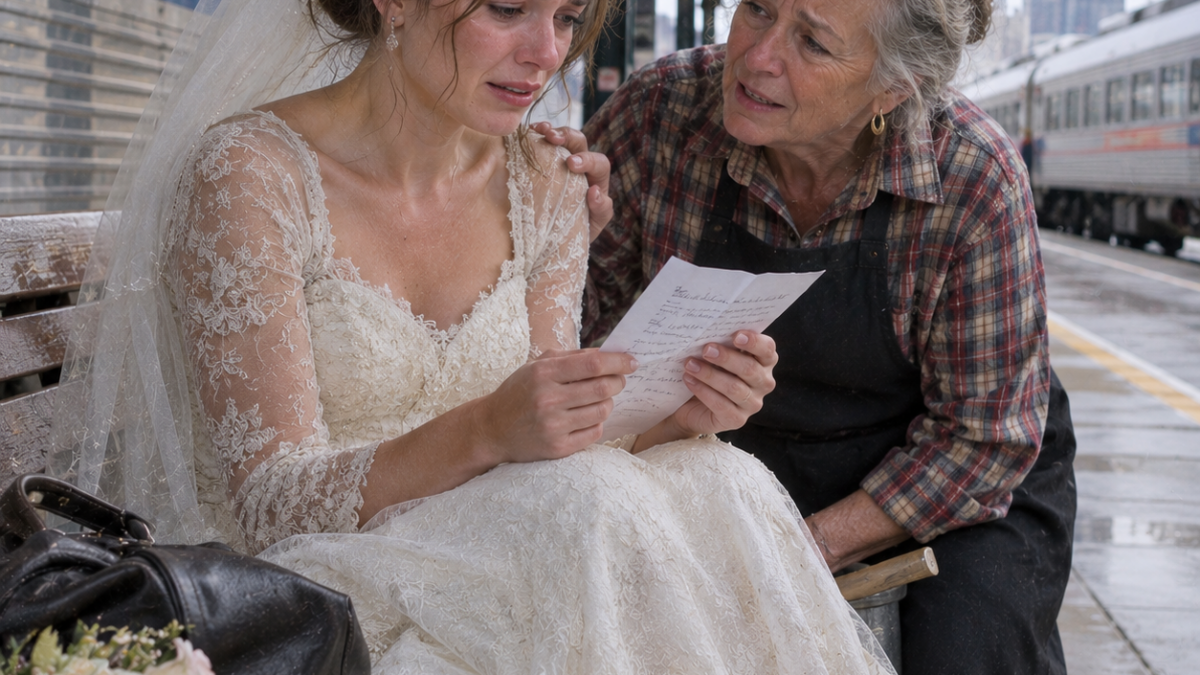
The Morning After Our Wedding, My Husband Abandoned Me on a Train to Chicago, Stole My Purse, My ID, and My Late Mother’s Gold Ring, Then Left a Note Admitting He Married Me for My Uncle’s Money. I Had Nowhere to Go—Until an Elderly Café Owner Saved Me, and a Stranger’s Late-Night Visit Changed Everything I Believed About My Family.
“Ma’am? Last stop. Chicago.”
I woke to a stranger gently touching my shoulder.
The train was almost empty.
Morning sunlight filtered through the windows, illuminating the seat beside me.
Brett was gone.
My husband of less than twenty-four hours had disappeared.
At first, I assumed he’d stepped off to get coffee.
Then I noticed my purse was missing.
My phone.
My wallet.
My driver’s license.
Three hundred dollars in wedding cash.
And the thin gold ring my mother had left me before she died.
I stood so quickly that my knees struck the seat.
“Brett?”
The conductor looked concerned.
“Is something wrong?”
“My husband. Where did he go?”
“The gentleman traveling with you? He got off as soon as we arrived.”
I searched the overhead compartment.
My suitcase was still there.
Then I saw a folded piece of paper tucked against the window.
My name was written across it.
Ivy.
My hands trembled as I unfolded the note.
Ivy, by the time you read this, I’ll be gone.
I married you for your uncle’s money. I got what I came for.
You’re a girl from a town with one stoplight. You never belonged in my world.
Don’t look for me. And don’t go back to Harlow Ridge. Your uncle doesn’t want you there.
Neither do I.
I read those words three times.
Yesterday, Brett Mercer had stood beside me in a Michigan church and promised to love me for the rest of our lives.
Now he’d stolen everything I could carry in a purse and left me alone in a city where I didn’t know a single person.
My name is Ivy Calloway. I was twenty-four years old, and I’d grown up on an apple orchard near Harlow Ridge, Michigan.
My father died when I was little.
My mother, June, raised me among apple trees, harvest wagons, and the roadside stand where we sold cider and homemade preserves.
She died five years before my wedding.
The orchard she left me was held in a trust managed by her brother, my uncle Walter Calloway, until my twenty-fifth birthday.
Walt always told me the farm was drowning in debt.
He said the apples barely paid the workers, the equipment needed replacing, and I should be grateful he’d kept a roof over my head.
I believed him.
I believed nearly everything people told me back then.
Especially Brett.
He’d arrived in Harlow Ridge four months earlier, claiming he was scouting land for a client.
He was handsome, attentive, and fascinated by my life.
He brought flowers to the roadside stand.
Listened when I talked about Mom.
And told me I deserved to see more of the world.
When he proposed, I thought I’d finally found someone who wanted me for myself.
Uncle Walt seemed delighted.
He even gave Brett money as a wedding present.
On the morning of the ceremony, Walt brought me a stack of documents.
“Just farm paperwork,” he said. “Sign where I’ve marked the pages so I can manage things while you’re on your honeymoon.”
I was wearing my wedding dress.
My bridesmaids were waiting.
I signed without reading.
Now, standing in Chicago Union Station with Brett’s note in my hand, I wondered what else I’d been foolish enough to believe.
I dragged my suitcase outside.
Two men near the entrance noticed I was alone.
One approached with a smile.
“Hey, sweetheart. Need help with that bag?”
“No, thank you.”
He grabbed the handle anyway.
I pulled back.
“Let go!”
The second man stepped behind me.
“Come on. You don’t need all that.”
“Help!” I screamed.
Nobody nearby seemed to understand what was happening.
Then an elderly woman’s voice cut through the noise.
“Get your hands off that girl’s suitcase!”
A woman with silver hair and a heavy brown coat hurried toward us, holding her phone.
“I’ve called 911,” she shouted. “You boys want to explain yourselves to the police?”
The men released my suitcase and ran.
My legs gave way.
The woman caught my elbow before I fell.
“Easy, honey. You’re safe.”
I started crying.
She guided me toward a small café across the street.
“My name’s Maggie,” she said. “What’s yours?”
“Ivy.”
“Well, Ivy, I think you need something warm to eat.”
“I can’t pay you.”
She stopped walking.
“Did I ask you for money?”
Inside, she placed a bowl of soup and fresh bread in front of me.
I told her about Brett.
The stolen purse.
The wedding.
The note.
She listened until I finished.
Then she quietly said, “You’re not sleeping on the street tonight.”
Maggie had an empty room above the café.
She also needed someone to wash dishes, wait tables, and help with the morning rush.
I asked whether she’d let me work.
She smiled.
“Honey, if you can show up and learn, you’ve already got half the qualifications.”
That evening, I called Uncle Walt from her phone.
“Brett left me,” I whispered. “He stole my things. Can I come home?”
Walt’s answer was colder than the note.
“That’s between you and your husband. You’re his responsibility now.”
“Uncle Walt, I have nowhere else.”
“Don’t come back to Harlow Ridge, Ivy.”
Then he hung up.
Three nights later, while I was working the café’s closing shift, a well-dressed stranger walked inside.
He looked exhausted.
“Double espresso,” he said. “As strong as you’ve got.”
I studied his tired eyes.
Then I remembered the tea Mom used to make when I couldn’t sleep.
“Actually,” I said, “I think I have something better.”
He raised an eyebrow.
“Better than coffee?”
“Apple-cinnamon tea. No caffeine.”
He almost smiled.
I didn’t know his name yet.
I didn’t know why a man dressed like that would visit a struggling café near the train station after midnight.
And I had no idea how closely his world was connected to the papers I’d signed on my wedding morning.
Part 2:
The train conductor had to wake me twice.
“Ma’am? We’ve reached Chicago. This is the last stop.”
I opened my eyes and reached toward the seat beside me.
“Brett?”
My hand touched cold upholstery.
For a moment, I thought my husband had gone to the restroom. Then I noticed his overnight bag was missing. So was the dark jacket he’d folded above our seats.
I sat up.
“Excuse me. Did you see where my husband went?”
The conductor checked his watch.
“The gentleman traveling with you got off when we arrived. About fifteen minutes ago.”
“Without waking me?”
He looked uncomfortable.
“I assumed you knew.”
I reached beneath my seat for my white purse.
It wasn’t there.
I checked the other side.
Looked under the seats.
Opened the overhead compartment.
My suitcase remained, but the purse was gone.
My phone was inside it. My wallet, driver’s license, and three hundred dollars in cash were inside it.
So was the only thing my mother had left me that I wore every day: a thin gold ring engraved with an apple blossom.
I felt my stomach drop.
Then I noticed a folded sheet of paper wedged beside the window.
My name was written on it.
Ivy.
The handwriting was Brett’s.
I opened the note.
By the time you read this, I’m gone.
I married you for your uncle’s money. I got what I came for.
You’re a girl from a town with one stoplight. You never belonged in my world.
Don’t look for me. And don’t go back to Harlow Ridge. Your uncle doesn’t want you there.
Neither do I.
I read it again.
Then a third time.
Twenty hours earlier, Brett Mercer had stood beside me in the little white church outside Harlow Ridge, Michigan, promising to love me for the rest of our lives.
He’d held my hands and smiled as if nothing in the world mattered more than me.
We’d cut a wedding cake decorated with tiny sugar apple blossoms.
He’d kissed me beneath the church arch while our guests applauded.
Then we’d boarded an overnight train for Chicago, where he claimed he’d arranged a romantic honeymoon before continuing west.
Now he was gone.
My purse was gone.
And the note said our marriage had been a business arrangement I hadn’t known I was entering.
The conductor helped me carry my suitcase onto the platform.
“Is there someone you can call?”
I shook my head.
I was twenty-four years old, standing in a city I’d never visited alone, with no identification, no money, and no telephone.
He directed me toward station personnel who could assist with reporting the theft and contacting someone.
I thanked him.
Then I sat on a bench and cried until I was too exhausted to keep crying.
My name is Ivy Calloway.
I’d spent nearly my entire life on an apple orchard outside Harlow Ridge, Michigan.
My father died when I was six.
My mother, June, raised me with the help of her brother, Walter Calloway.
Mom worked from sunrise until long after dark.
She tended the orchard, supervised harvest crews, and ran a roadside stand where we sold apples, cider, apple butter, and homemade pastries.
She knew which trees would produce the sweetest fruit after a cold spring.
She knew when to worry about a late frost.
And she knew how to stretch a small amount of money until the next harvest payment arrived.
Every Sunday, we sat at the kitchen table with invoices and receipts.
She’d let me check the figures while she explained the difference between money coming in and profit left after expenses.
“If you don’t understand your own numbers,” she’d say, “someone else will decide what they mean for you.”
I used to roll my eyes.
Now I wished I’d listened more carefully.
Mom died of cancer when I was nineteen.
She left the orchard in a trust that was intended to protect the property until I turned twenty-five.
Uncle Walt became the trustee.
He told me the farm was struggling.
He claimed equipment costs were rising, apple prices were falling, and the old roadside stand barely covered its expenses.
I had no reason to doubt him.
He was family.
And after Mom died, I didn’t have the strength to question the person who handled everything.
Then Brett appeared.
He came to Harlow Ridge four months before our wedding, claiming to be researching land for an investor.
He bought cider at our stand and returned the next afternoon.
Then again the following week.
He asked about my mother.
Listened to stories about the orchard.
Said he’d never met anyone who spoke about home the way I did.
When he proposed, I believed him.
Uncle Walt seemed delighted.
He gave Brett an envelope containing money and called it a wedding present.
On the morning of the ceremony, he brought me a stack of documents.
“Just orchard paperwork,” he said. “I need signatures so I can keep things running while you’re away.”
I was wearing my wedding dress.
My bridesmaids were calling from the hallway.
I signed wherever he’d placed yellow tabs.
I didn’t read the documents.
I didn’t realize until Chicago how expensive that mistake might become.
After reporting what had happened inside the station, I wheeled my suitcase outside to get some air.
Two men approached as I neared the sidewalk.
One looked at my suitcase.
“Need help with that, sweetheart?”
“No, thank you.”
He grabbed the handle.
I pulled back.
“Let go.”
His companion stepped closer.
“Don’t make a scene.”
I screamed.
The first man yanked again, nearly pulling me off my feet.
Then an older woman’s voice rang out.
“Get your hands off that girl!”
A woman in a brown coat strode toward us with her phone raised.
“I’ve called the police. You can wait for them if you’d like.”
The men released the suitcase and ran.
The woman caught my elbow.
“Easy, honey.”
I was shaking so badly I could barely stand.
She looked at my wrinkled wedding clothes.
Then at the suitcase.
“Where’s your family?”
I started crying again.
“My husband left me.”
She didn’t ask what I’d done wrong.
Didn’t tell me to calm down.
She simply took the suitcase handle.
“Well, you’ve got me now.”
Her name was Margaret Dawson, but everyone called her Maggie.
She owned a small café across the street from the station.
It had twelve tables, a narrow counter, a kitchen barely large enough for two cooks, and a sign that read MAGGIE’S in faded red letters.
She guided me into a booth and brought soup, bread, and hot tea.
“I can’t pay,” I whispered.
She pulled out the chair opposite me.
“Did I ask?”
I shook my head.
“Eat first. Questions later.”
I ate because she stayed until I did.
Then I told her everything.
The wedding.
The train.
The note.
My missing purse.
My mother’s ring.
Maggie read Brett’s letter and set it carefully on the table.
“Keep this,” she said. “And make a copy.”
A responding officer took my report and documented the missing items, including the ring’s identifying engraving. I provided Brett’s full name, the travel details, and the note.
The officer gave me a report number and information about replacing my identification.
Then I asked Maggie whether I could use her telephone.
She pointed to the one behind the counter.
I called Uncle Walt.
He answered on the fourth ring.
“Hello?”
“Uncle Walt. It’s Ivy.”
A pause.
“Where are you?”
“Chicago. Brett left me on the train.”
Silence.
“He stole my purse, my money, and Mom’s ring. I don’t know what to do.”
Walt’s voice hardened.
“That’s between you and your husband.”
I stared at the wall.
“Can I come home?”
“You’re married now, Ivy. Brett is responsible for you.”
“He disappeared.”
“Then find him.”
Tears ran down my face.
“Uncle Walt, please. I don’t have anywhere to go.”
His answer was immediate.
“Don’t come back to Harlow Ridge.”
Then he hung up.
I stood holding the phone until Maggie gently took it from my hand.
I expected her to ask what I’d done to upset my uncle.
Instead, she said, “There’s a room above the café.”
I stared at her.
“What?”
“It isn’t much. But it has a bed, a dresser, and a window that doesn’t leak anymore.”
“I can’t afford rent.”
“Then we’ll work something out.”
I looked toward the busy counter.
Maggie had been serving customers between our conversations, apologizing whenever she was late with an order.
“Do you need help here?” I asked.
She stopped.
“You want a job?”
“I’ll wash dishes. Sweep floors. Wait tables. Anything.”
She studied me.
Then smiled.
“Honey, I’ve needed another pair of hands since last spring.”
That afternoon, I helped clean the tables and restock the counter.
At closing, Maggie gave me clean clothes she’d saved from years earlier and showed me the room upstairs.
There was a narrow bed, a yellow quilt, and a small lamp beside the window.
I stood in the doorway.
“I don’t know how to thank you.”
She touched my shoulder.
“You can start by getting some sleep.”
That night, I put Brett’s wedding note inside an envelope and placed it in the dresser.
I couldn’t bring myself to throw it away.
Not because I wanted him back.
Because I wanted to remember exactly what I’d survived.
The following morning, I made Maggie tea.
Apple slices.
Cinnamon.
Hot water.
A little time for the flavor to deepen.
It was the tea Mom used to make when I was sick or frightened.
Maggie tasted it.
Then closed her eyes.
“Oh, Ivy.”
I smiled for the first time since arriving in Chicago.
“Good?”
She nodded.
“Your mother must’ve loved you very much.”
“She did.”
Maggie looked toward the window.
“I lost a daughter years ago.”
I set down the kettle.
“I’m sorry.”
“She would’ve been about forty now.”
Neither of us spoke for a moment.
Then Maggie reached across the counter and took my hand.
“Perhaps we can look after each other.”
I squeezed her fingers.
And for the first time since Brett abandoned me, I felt as though I’d found somewhere I could breathe.
I worked at Maggie’s for three weeks before I met Adrian Cole.
By then, I could carry three plates without dropping one, remember most regular customers’ orders, and close the register without needing Maggie to check every figure.
I still made mistakes.
Once I put salt in a sugar container.
Another time I forgot to turn off the coffee warmer and ruined a pot so badly that the smell lingered for hours.
Maggie scolded me for the coffee.
Then she showed me how to clean the warmer.
She never made a mistake feel like proof I didn’t belong.
That mattered more than she knew.
The first night Adrian came in, it was nearly closing time.
I was wiping down the counter when the door opened.
A tall man in a charcoal coat stepped inside.
He was in his early thirties, with dark hair, tired eyes, and the polished appearance of someone who hadn’t been comfortable in his own skin for a long time.
“Are you still serving?”
“Depends what you want.”
He looked toward the coffee machine.
“Double espresso. Strong as you’ve got.”
I glanced at the clock.
“It’s almost midnight.”
“I noticed.”
“Are you planning to sleep tonight?”
He gave me a faint smile.
“Sleep hasn’t been going particularly well.”
I looked at him.
Something about his expression reminded me of the first nights I’d spent in Maggie’s upstairs room.
I knew that exhausted look.
The one people wore when they were afraid of being alone with their thoughts.
I set down the cleaning cloth.
“How about tea?”
“I asked for coffee.”
“I know. But I have apple-cinnamon tea. No caffeine.”
He studied me.
“Do you always argue with customers?”
“Only the ones ordering espresso at midnight.”
He laughed.
A real laugh.
Then he sat at the counter.
“All right. Surprise me.”
I prepared the tea the way Mom had taught me.
Thin apple slices.
A cinnamon stick.
Hot water.
No added sugar unless the customer wanted it.
I poured him a cup.
He tasted it.
Then looked up.
“That’s excellent.”
“Told you.”
He took another sip.
“Where did you learn to make this?”
“My mother.”
“Is she still around?”
I shook my head.
“She died five years ago.”
His expression softened.
“I’m sorry.”
“Thank you.”
He looked into the cup.
“My father died earlier this year.”
I sat on the stool behind the counter.
“Were you close?”
He nodded.
“Very.”
I waited.
He stared toward the dark windows.
“Since he died, I’ve been working late and going home to a house full of things I don’t want to look at.”
I understood that more than I wanted to.
After Mom died, the orchard house had seemed full of her presence and empty of everything that mattered.
“I know what that feels like,” I said.
He looked at me.
“Do you?”
I nodded.
“For a long time, I kept finding reasons not to go into my mother’s room.”
He was quiet.
Then he said, “Maybe that’s why I keep looking for somewhere that isn’t home.”
I refilled his cup.
“Then you can sit here for a while.”
He stayed until Maggie came downstairs to ask whether I planned to sleep at all.
When he stood to leave, he placed a large bill on the counter.
I picked it up.
“Sir, your tea is four dollars.”
“Keep the change.”
I looked at the bill.
It was a hundred.
“That’s too much.”
He shrugged.
“Consider it appreciation.”
I handed it back.
“Not that kind.”
He looked surprised.
“Why?”
“Because I served you tea, not a hundred dollars’ worth of salvation.”
He smiled.
“What would be reasonable?”
“Five dollars.”
He gave me five.
Then held out his hand.
“Adrian.”
“Ivy.”
He shook my hand.
“Goodnight, Ivy.”
“Goodnight. And no espresso tomorrow.”
He laughed as he left.
The next night, he returned.
He ordered apple-cinnamon tea without pretending to want coffee.
The following evening, he came again.
Soon he was a familiar face at the counter.
Sometimes we talked about music.
Sometimes about the city.
Sometimes we sat quietly while I finished closing.
I told him about Maggie taking me in.
He told me he worked in the hotel business.
I assumed he managed a hotel or helped operate a small chain.
He understood invoices, staffing, suppliers, and guest service in a way that suggested he’d spent years in the industry.
He never volunteered more.
I didn’t press.
After Brett, I wasn’t interested in falling in love with a stranger.
But Adrian had a way of listening that made it easier to speak.
He remembered what I told him.
He didn’t make me feel foolish for growing up in a small town.
And when I said I missed the smell of apples after rain, he asked what kind of apples Mom grew.
Not how much the orchard was worth.
Not who owned the land.
Just what the trees were like.
One night, Maggie came downstairs after he’d left.
“Who was that smile for?”
I looked away.
“Nobody.”
She grinned.
“A very handsome nobody who keeps coming back for tea.”
“He likes the recipe.”
“Of course he does.”
She patted my shoulder.
“Just remember, honey, being lonely can make any kind voice sound like a promise.”
I nodded.
She was right.
I kept my distance.
Then Adrian helped me find something Maggie had been losing for years.
Money.
It began when I was entering supplier invoices into a spreadsheet.
Maggie had always kept paper records.
Shoeboxes.
Folders.
Receipts tucked inside old cookbooks when the counter got busy.
I offered to organize them.
She was delighted.
“Finally,” she said. “Someone who thinks a filing cabinet is exciting.”
I was comparing two invoices when I noticed the same number.
4471.
Same order.
Same delivery date.
Same quantities.
But different totals.
I pulled the original.
Then another copy.
The supplier had billed us twice.
When I examined the previous months, I found other irregularities.
Unit prices that didn’t match the agreement.
Charges for items we hadn’t ordered.
Repeated delivery fees.
Maggie stared at the papers.
“I knew everything was costing more.”
I showed her the calculations.
“It’s more than inflation. He’s changing the prices.”
Adrian arrived while we were reviewing the records.
He saw the invoices spread across the counter.
“Everything okay?”
I shook my head.
“Our supplier’s been overcharging us.”
He looked at the documents.
“Show me.”
I hesitated.
Then handed him the contract.
He read it carefully.
“Where are the original delivery slips?”
“In the drawer.”
We placed everything in order.
Adrian showed me how to compare the contracted unit price, delivered quantity, and total charged.
Mom had taught me similar lessons at the orchard.
But Adrian was more systematic.
“Start with repeats,” he said. “People who cheat you often reuse whatever works.”
I pointed toward invoice 4471.
“Like this?”
He smiled.
“Exactly.”
The following morning, the supplier arrived.
His name was Gary Simmons.
He’d been delivering coffee, flour, and other supplies to Maggie’s for years.
When he carried the new invoice inside, I asked him to sit down.
“We need to talk about the billing.”
He frowned.
“What about it?”
I placed the duplicate invoices on the counter.
“Number 4471 was billed twice. And several unit prices don’t match our contract.”
Gary looked irritated.
“Prices change.”
“Not without the adjustments required by our agreement.”
He pushed back his chair.
“Maggie, are you letting this girl accuse me of stealing?”
Maggie folded her arms.
“She’s showing me the numbers, Gary.”
He looked toward Adrian, who was drinking tea beside the window.
“This doesn’t concern you, pal.”
Adrian stood.
“It concerns anyone looking at the same contract.”
Gary’s face changed slightly.
Adrian continued.
“You can reconcile the disputed charges and refund the overpayments. Or Maggie can have her attorney pursue the claim.”
Gary stared at him.
Then looked down at the invoices.
For the first time, he stopped arguing.
We negotiated a written correction, repayment of the documented overcharges, and confirmation of future pricing under the contract.
When he left, Maggie hugged me.
“Oh, Ivy. You’ve saved us more than you know.”
I shook my head.
“You kept every receipt. I just looked at them.”
Adrian smiled.
“That’s how good businesses protect themselves.”
Afterward, I asked him why Gary had reacted so strangely when he spoke.
Adrian shrugged.
“Maybe he doesn’t like being confronted with paperwork.”
I studied him.
“You know a lot about business for someone who says he works in hotels.”
“I’ve had good teachers.”
“What do you do, exactly?”
He looked toward the door.
“Management. Investments. Operations.”
I narrowed my eyes.
“That sounds like three jobs.”
He laughed.
“Some days it feels like thirty.”
I should have asked more.
Instead, I began learning from him.
We reviewed Maggie’s food costs and ordering schedule.
We tracked how much bread was discarded each evening.
We adjusted preparation quantities so the kitchen wasted less.
I began calculating which menu items made money after ingredients and labor.
Maggie watched me at the desk one afternoon.
“You look just like your mother must have.”
I smiled sadly.
“She taught me to do the books for our farm stand.”
Adrian looked up.
“Your family had a farm?”
“An apple orchard.”
He leaned back.
“Tell me about it.”
I stared at the spreadsheet for a moment.
Then I told him the story I’d been avoiding.
My mother.
My uncle Walt.
The trust.
Brett.
The wedding.
And the papers I’d signed without reading.
Adrian listened until I finished.
Then he asked one question.
“Did you keep copies of those documents?”
I shook my head.
“Uncle Walt kept them.”
His expression changed.
“Ivy, you need a lawyer.”
“I can’t afford one.”
“Then we find someone who offers legal aid or a consultation you can manage.”
I looked at him.
“Why are you helping me?”
He considered his answer.
“Because somebody should have helped you before now.”
The following week, Maggie and I met a legal-aid attorney who referred us to a lawyer experienced in trust and property disputes.
Her name was Sarah Whitcomb.
She reviewed Brett’s note, the police report, and the information I had about my mother’s trust.
Sarah explained that I could pursue appropriate relief concerning the marriage, although fraud by itself didn’t automatically make every marriage void.
We would need to establish the legal grounds and follow the required process.
She also warned me that marriage and property ownership were separate questions.
Whatever Brett claimed, he didn’t automatically acquire ownership of my inherited orchard simply by marrying me.
That gave me some comfort.
Then she asked about the documents I’d signed.
“What did your uncle say they were?”
“Farm papers.”
“Did he explain whether they authorized a sale?”
“No.”
“Did anyone give you time to review them?”
“No.”
Sarah looked concerned.
“We need copies. The trust agreement, the power of attorney if one exists, any property transfer documents, and the financial records.”
“Will Walt give them to us?”
“We’ll make a formal request. And if necessary, we’ll pursue the appropriate court process.”
I left her office feeling frightened but clearer than I’d been since the wedding.
For the first time, someone was asking for evidence instead of telling me to accept whatever Uncle Walt said.
Then Adrian invited me to dinner by the lake.
We walked beside the water after sunset.
He told me about losing his father and how hard it had been to return to the house they’d shared.
I told him about Mom painting a white apple blossom on the red barn at our orchard.
“I can still see it when I close my eyes,” I said.
He took my hand.
“Maybe you’ll see it again.”
I looked at him.
“With you, I can breathe again.”
He smiled.
“With you, I remember how to laugh.”
I wanted to believe those words.
But part of me still remembered Brett’s promises.
I pulled my hand back gently.
“Adrian, I need you to understand something.”
“Anything.”
“The last man I trusted made me feel foolish for believing him.”
He nodded.
“I know.”
“I can’t go through that again.”
He looked at me for a long moment.
“Then I won’t ask you to trust me faster than you’re ready.”
I believed him.
And that frightened me almost as much as the possibility that he was lying.
The first person who tried to buy me out of Adrian’s life was his aunt.
I didn’t know she was his aunt when she walked into Maggie’s one afternoon.
She wore a cream-colored coat, carried a handbag that probably cost more than the café’s monthly rent, and looked around the room as though she was evaluating a building for demolition.
“Apple-cinnamon tea,” she said.
I smiled.
“Coming right up.”
She sat at the counter.
When I served her, she examined the cup.
“So you’re Ivy.”
I paused.
“Yes.”
“I’ve heard quite a bit about you.”
“Have we met?”
“No. But my nephew has skipped three family dinners recently.”
She opened her handbag.
“My name is Celeste Cole.”
I blinked.
“Adrian’s aunt?”
“That’s right.”
She looked toward the kitchen.
“He’s been coming here almost every night.”
I set down the towel in my hand.
“Adrian is welcome here.”
Celeste smiled without warmth.
“I’m sure.”
Then she asked where I came from.
I told her Michigan.
She asked what my family did.
I told her we grew apples.
“An orchard girl,” she said.
There was nothing friendly in her tone.
“That’s right.”
She looked toward the café window.
“Adrian has responsibilities. His family’s business is not something he can casually involve with a girl who pours tea near a train station.”
I felt my face grow hot.
“I’m not asking him for anything.”
“Of course not.”
She took out an envelope and slid it across the counter.
“Fifty thousand dollars.”
I stared at it.
“For what?”
“For you to leave Chicago. Stop seeing Adrian. Return to your little orchard.”
I looked at the envelope.
Then back at her.
“My dignity isn’t for sale, Ms. Cole.”
She smiled.
“Everyone has a price.”
“Then you’ve got the wrong person.”
Her expression hardened.
“Adrian marries women from his own world.”
Before I could answer, the café door opened.
Adrian walked inside.
He stopped when he saw her.
“Celeste?”
She turned.
“Adrian. I was just introducing myself.”
He looked at the envelope.
“What are you doing?”
“Protecting your future.”
He stepped beside me.
“My future is mine to decide.”
She stood.
“You don’t understand what this girl wants.”
He looked directly at her.
“Show her some respect.”
Celeste’s face flushed.
Then she picked up her handbag.
“We’ll discuss this later.”
She left without touching the tea.
I watched her through the window.
Then turned to Adrian.
“Who are you?”
He looked confused.
“I’m Adrian.”
“No. Who are you really?”
He hesitated.
And in that hesitation, I knew.
I took out my phone—an inexpensive replacement I’d bought after starting work—and searched his name.
ADRIAN COLE, CHAIRMAN AND CHIEF EXECUTIVE OFFICER, COLE HOTEL GROUP.
Forty hotels.
Luxury properties across the country.
A family fortune built over two generations.
Photographs of Adrian shaking hands with mayors, speaking at conferences, and standing beside prominent business leaders.
I stared at the screen.
“You told me you worked in hotels.”
“I do.”
“You own forty of them.”
He looked ashamed.
“I should’ve told you.”
“Why didn’t you?”
He glanced toward the door.
“Because people usually want to know about the money before they want to know me.”
I felt tears filling my eyes.
“The last man who lied to me about who he was left me on a train.”
Adrian stepped closer.
“I know. And I’m sorry.”
I backed away.
“I told you everything. Brett. My mother. The orchard. Everything.”
“I know.”
“And you let me think you were a hotel manager.”
“I wanted you to know me without all the rest.”
I shook my head.
“That’s not a choice you get to make for me.”
He didn’t argue.
“You’re right.”
I turned away.
“I need time.”
He nodded.
“Take all the time you need. I won’t push.”
Then he left.
For several days, I didn’t see him.
I missed him more than I wanted to admit.
But I also felt angry.
His explanation was understandable.
It didn’t excuse withholding something that important after I’d told him how much deception had hurt me.
Maggie listened while I talked.
Then she said, “A person can have a good reason for keeping a secret and still hurt someone by keeping it.”
I looked at her.
“So what do I do?”
“Decide what you need from him. Then tell him plainly.”
Before I could, a catering order arrived.
Three hundred servings of apple-cinnamon tea.
Pastries.
Service staff.
A generous deposit.
The event was the Cole Hotel Group’s annual gala.
The order had been placed two weeks earlier by Adrian’s office.
Maggie showed it to me.
“Ivy, we need the business. The oven repair is due, and property taxes are coming.”
I looked at the order.
Adrian had arranged it before telling me who he was.
Perhaps he’d meant to help.
Perhaps he wanted me near him.
I didn’t know.
But the catering agreement was with Maggie’s business, and the event was real work.
“We’ll do it,” I said.
Maggie studied me.
“You don’t have to attend personally.”
I shook my head.
“I helped develop the recipe and price the order. I’ll help serve it.”
She smiled.
“Then wear the green dress afterward, if you feel like it.”
I laughed.
“I’m going to work, Maggie. Not find a husband.”
She winked.
“One doesn’t always prevent the other.”
The gala was held in a grand hotel ballroom overlooking the Chicago River.
Crystal chandeliers hung above round tables.
Waiters carried trays of champagne.
A small orchestra played near the stage.
Maggie and I set up our tea and pastry station along one wall.
I was wearing a clean black service dress and apron.
Adrian came over during the reception.
He looked relieved to see me.
“You came.”
“For Maggie’s.”
He nodded.
“Of course.”
I glanced around.
“This is quite a party.”
“It’s a big night for the company.”
I thought about his aunt.
Then about the gala contract.
“Adrian, we need to talk afterward.”
He smiled gently.
“I’d like that.”
Before he could say more, a familiar voice sounded behind me.
“Well, look who’s pouring tea.”
I turned.
Brett Mercer stood beside a beautiful young woman in a silver dress.
He wore a dark suit, and his smile was exactly the one I’d fallen in love with.
For a moment, I couldn’t move.
Then I saw the woman’s hand resting on his arm.
She looked toward me.
“Brett, do you know her?”
He laughed.
“A farm girl I met in Michigan. She got a little attached.”
Something inside me went still.
“Attached?” I repeated.
He smiled.
“Don’t make a scene, Ivy.”
I looked at the woman.
“My name is Ivy Calloway. Brett married me in Michigan and abandoned me on a train the next morning.”
Her hand fell away from his arm.
“What?”
Brett’s expression hardened.
“Ivy, stop.”
I kept my eyes on her.
“He took my purse, my identification, my money, and the gold ring my mother left me. Then he wrote a letter admitting he married me for money.”
The woman stepped backward.
“Brett, you told me you were single.”
“I can explain.”
She looked at him.
“You’re married?”
I nodded.
“Unless and until the court says otherwise, yes.”
Brett glared at me.
“You think anybody here cares about some farm girl serving tea?”
Adrian stepped beside me.
“That’s enough.”
Brett looked at him.
“And who are you supposed to be?”
Adrian didn’t raise his voice.
“Someone who expects you to speak to her respectfully.”
I lifted one hand.
“Adrian, I can answer him.”
Then I looked at Brett.
“My attorney is handling the marriage. The police have your name and the theft report. You don’t get to frighten me anymore.”
For a moment, he looked almost uncertain.
Then he leaned closer.
“Your uncle promised me a lot more than he paid.”
I stared at him.
“What did you say?”
Brett’s expression changed.
He’d spoken too freely.
Before I could question him, a voice came over the ballroom speakers.
“Ladies and gentlemen, please direct your attention to the stage.”
A screen brightened behind the podium.
The presenter announced Cole Hotel Group’s first major lakeside resort development in Michigan.
The rendering showed a red barn.
A white apple blossom painted on the side.
Rows of mature trees.
And a familiar stretch of land beside a quiet road.
My knees went weak.
I knew that barn.
My mother had painted the apple blossom herself.
The screen displayed the project name.
COLE HARLOW RIDGE RESORT.
The presenter continued.
“The acquisition is scheduled to close in ten days.”
I heard Adrian ask if I was all right.
I couldn’t answer.
Then the presenter thanked the consultant who’d helped identify the property.
Brett Mercer.
I turned toward him.
He smiled.
“You see, Ivy? Your uncle finally found a way to make that orchard worth something.”
My hands were shaking.
“What have you done?”
He leaned closer.
“Your uncle sold your mother’s land.”
I stared toward the stage.
“He can’t.”
Brett smiled wider.
“Oh, he can.”
I suddenly remembered standing in the church office on my wedding morning.
Uncle Walt.
The stack of documents.
The yellow signature tabs.
The pen in my hand.
Brett followed my gaze.
“And the consent?” he whispered. “You signed it yourself.”
The room seemed to tilt.
Adrian caught my arm before I fell.
“Ivy?”
I looked at him.
“That land is mine.”
He stared at the rendering.
Then at me.
“What?”
“My mother left me that orchard. Your company is buying it.”
He went pale.
“I didn’t know.”
I looked at Brett.
He was smiling again.
Then I looked toward the stage, where Celeste Cole stood beside the executives celebrating the acquisition.
And suddenly, I understood why Adrian’s aunt had been so desperate to send me away.
Adrian stopped the presentation before the executives finished congratulating one another.
He approached the podium, spoke quietly to the event director, and asked the legal team to preserve all documents related to the Harlow Ridge acquisition.
Then he took me into a private meeting room with Maggie and Sarah, whom I’d called from the hallway.
Celeste arrived furious.
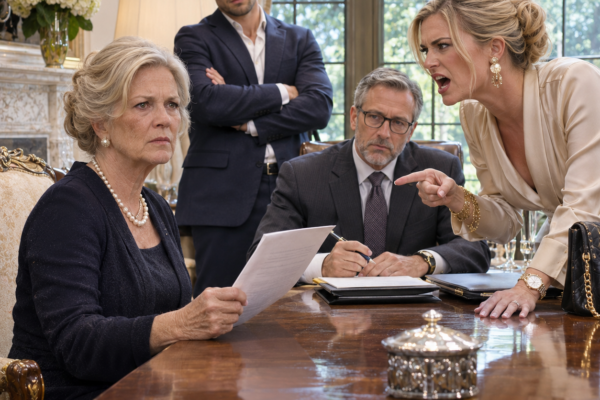
“Adrian, the board approved this project.”
“Then the board needs to know the seller’s beneficiary is standing outside.”
She looked at me.
“She’s not the seller.”
Sarah joined us on the phone.
“She is the beneficiary of the trust holding the property. My client disputes the validity of the consent and authority used for this transaction.”
Celeste crossed her arms.
“The consent was notarized. The purchase agreement is binding.”
“Then provide every document supporting it,” I said.
She looked offended.
Adrian turned to his legal counsel.
“Get the complete acquisition file to Ms. Whitcomb through the proper channels. No further steps toward closing until we’ve evaluated this.”
Celeste stared at him.
“You’re risking a multimillion-dollar development over a girl who didn’t read what she signed.”
I looked straight at her.
“I’m risking nothing. You’re trying to buy my mother’s orchard.”
That ended the conversation.
The next morning, Sarah laid the documents across her desk.
There was a power of attorney.
A written consent authorizing sale of the orchard.
And a notarized acknowledgment timestamped 10:42 a.m. on my wedding day.
I remembered signing them.
I also remembered Walt saying they were ordinary papers necessary to manage the farm during my honeymoon.
I hadn’t known they authorized its sale.
Sarah explained that we could revoke the power of attorney prospectively, but revocation wouldn’t automatically undo documents already signed or transactions already entered.
To stop the sale, we needed evidence of fraud, breach of trust, or other grounds for relief.
I signed the revocation.
Sarah arranged notice to Walt and the buyer.
Then we began examining the trust’s financial records.
Walt came to Maggie’s the following afternoon.
He walked inside as though he owned the building.
“I see you’ve made yourself comfortable.”
Maggie stood behind the counter.
“She’s welcome here.”
He ignored her and placed a document in front of me.
“Sign this.”
I read the first paragraph.
It was a release of claims relating to the orchard sale.
“Twenty thousand dollars,” Walt said. “Cash. Enough for you to start over.”
I looked up.
“You want me to give up my mother’s land for twenty thousand dollars?”
“It’s drowning in debt.”
“Then show me the accounts.”
“You wouldn’t understand them.”
“Try me.”
He leaned closer.
“Your mother had no right leaving that property to a girl who knows nothing about running it.”
I felt my face burn.
“How much did you pay Brett?”
Walt stopped.
“What?”
“How much did you pay him to marry me?”
He looked toward the door.
Then said, “Enough.”
My hands trembled.
Sarah had warned me not to argue.
So I placed the revocation notice in front of him.
“As of today, you can’t act under my power of attorney anymore.”
Walt laughed.
“The sale agreement’s already signed.”
He picked up his folder.
“And the closing has been moved up.”
I stared at him.
“To when?”
“Wednesday.”
Then he told me something worse.
He’d mortgaged the orchard.
The outstanding balance was approximately $912,000.
The loan was in default.
If the sale didn’t close and provide money to satisfy the lender, the property was scheduled for a foreclosure sale at the courthouse the following Friday.
“Your mother’s little farm isn’t worth anything to you if the bank takes it,” he said.
Then he walked out.
I sat down.
Maggie brought me tea.
I couldn’t drink it.
I’d thought stopping the resort sale would save the orchard.
Now I understood that Walt had built a second trap.
If he couldn’t sell the property himself, the bank might sell it for him.
Sarah obtained the lender’s figures and relevant records.
The amount required to bring the loan current and stop the scheduled sale was approximately $186,000, including overdue payments and applicable fees.
Not the entire outstanding balance.
That was the first piece of good news.
The second came when Adrian’s legal department provided the acquisition financial records Sarah was entitled to examine.
I spread five years of statements across Maggie’s kitchen table.
Wade—I nearly called him that because he reminded me of my uncle’s old farm manager—wasn’t there to explain the numbers.
Nobody was.
It was just me, the papers, and the lessons Mom had taught me.
I found a $68,000 charge for a new tractor.
We hadn’t purchased one.
The same old red tractor had stood beside our barn since I was nine.
I found wages paid to Harold Bixby for four hundred hours of apple picking.
Harold had died four years earlier.
I’d sung at his funeral.
Then I found invoice 8319.
Entered twice.
Same vendor.
Same amount.
Just like Gary’s invoice at the café.
I heard Adrian’s voice in my memory.
People who cheat you are lazy. If a trick works once, they’ll use it again.
We reconstructed the records with the help of a forensic accountant.
The apparent losses weren’t ordinary bad harvests.
Large amounts had been diverted through false expenses, unsupported payments, and transactions benefiting Walt.
The preliminary analysis identified roughly $200,000 a year in questionable withdrawals over several years.
Then I found the payment that connected the orchard sale to Adrian’s family.
LARKSPUR ADVISORY LLC — CONSULTING FEE: $300,000.
It was payable from the seller’s proceeds.
The listed business address matched Celeste Cole’s Chicago residence.
I stared at it.
Then called Adrian.
“Your aunt was getting paid from my orchard sale.”
He was silent.
“Adrian?”
“I’ll have independent counsel examine it immediately.”
“She pushed your board to approve the purchase.”
“I know.”
“And now she’s taking three hundred thousand dollars from the seller’s money?”
His voice became very quiet.
“Ivy, I’m sorry.”
I looked at the papers.
“Don’t apologize yet. Help me make sure nobody hides them.”
He did.
The acquisition committee held an emergency meeting.
Adrian disclosed his personal relationship with me and recused himself from the committee’s decision.
Independent directors reviewed the seller’s financial representations, the undisclosed related-party fee, and the evidence concerning my disputed consent.
The company terminated the acquisition under the contractual protections available for material misrepresentation and misconduct, and reserved its legal rights.
Celeste was removed from her executive responsibilities pending the separate investigation.
The resort project ended.
But the foreclosure deadline remained.
I had stopped the wrong sale.
Now I had to stop the bank’s sale.
And I had just over a week to do it.
Adrian offered to pay the bank.
I refused.
Not because I didn’t trust that he could afford it.
Because I’d spent the previous month being described as a woman who attached herself to wealthy men.
First Brett.
Then Celeste.
Then people at the gala who’d seen me standing beside Adrian after the confrontation.
I wasn’t going to let anyone say he’d bought my mother’s orchard for me.
He listened without arguing.
Then he said, “All right. What do you want to do?”
I thought about the harvest records.
Last year, the orchard had produced approximately 1.2 million pounds of apples.
Walt’s financial statements showed a failing business because he’d been moving money out of it.
But the trees hadn’t stopped producing.
The customers hadn’t disappeared.
The land still had value as a working orchard.
I looked toward Adrian.
“How many hotels do you operate?”
“Forty.”
“And how many serve breakfast?”
“All of them.”
I leaned forward.
“Then I have a proposal.”
Over the next two days, I worked with a produce distributor, Sarah, an independent accountant, and an experienced orchard manager willing to review the farm’s capacity.
We developed a five-year supply proposal.
Apples.
Cider.
Apple products for hotel breakfast service.
And a specially packaged version of Mom’s apple-cinnamon tea.
The initial-year purchase commitment would include $240,000 in advance funding once the orchard’s legal and operational conditions were satisfied.
Future purchases would be tied to delivery requirements, quality standards, and agreed pricing.
I wasn’t asking for a charitable donation.
I was proposing a contract the orchard would have to perform.
Adrian disclosed his conflict and did not participate in the purchasing committee’s vote.
The independent committee reviewed the proposal with the company’s procurement staff.
Then it approved the arrangement, subject to the conditions we’d discussed.
I cried when Sarah called me with the result.
But we still had a timing problem.
The first hotel payment wouldn’t arrive until after the orchard had been legally secured.
The bank needed $186,000 before the scheduled foreclosure sale.
Maggie listened as I explained the situation.
Then she went upstairs and returned with a folder.
Inside was a statement for a credit line secured by the café building.
She and her late husband, Frank, had bought the property years earlier and paid it off.
After Frank died, Maggie had arranged a standby line of credit.
She’d never used it.
“I can draw what you need,” she said.
I stared at her.
“Maggie, no.”
“Why not?”
“Because if something goes wrong, your café is at risk.”
She nodded.
“I know.”
“Then you can’t do this.”
She reached for my hand.
“I lost a daughter once, Ivy. I’m not going to pretend I haven’t grown to love you like one.”
Tears filled my eyes.
“Maggie—”
“I’m not giving you a present. We’ll have a proper loan agreement. Interest. Repayment dates. Security arrangements your lawyer approves. I expect you to pay it back.”
I looked down.
“What if I fail?”
“Then we work through the consequences like adults. But I won’t let fear make the decision for you.”
We met with independent counsel to document the loan and make sure Maggie understood the risk.
I promised I would use every lawful resource available to repay her.
Then Sarah called with another problem.
The bank had refused my attempt to arrange the cure payment because Walt was still the trustee of record.
He’d told the lender not to accept instructions from me.
Until the court appointed a different authorized fiduciary, we couldn’t safely complete the payment on behalf of the trust.
The emergency hearing was scheduled for Thursday morning.
The lender’s cure deadline was five that afternoon.
The foreclosure sale was Friday.
We had one day to win the court’s authorization and make the payment.
Then a Chicago detective called.
“Ms. Calloway, we recovered a ring from a pawnshop on Halsted Street.”
I sat down.
“An apple blossom engraved inside?”
“Yes.”
My throat tightened.
“That’s my mother’s.”
The detective said Brett had used his own identification when pawning it.
Investigators had also obtained messages connecting him to Walt’s plan.
Brett was now willing to provide information about the orchard transaction through his attorney, with any possible charging agreement to be decided by prosecutors.
He’d been paid ten thousand dollars to marry me.
Walt had promised another forty thousand after the resort sale closed.
The plan was for Brett to gain my trust, get me to sign the documents, take me out of Michigan, and make sure I didn’t return before the land changed hands.
That was why the honeymoon was supposed to be long.
That was why Walt had welcomed Brett so warmly.
And that was why my husband abandoned me on the train.
I hadn’t married a stranger who later became greedy.
I’d been targeted before he ever asked me to dinner.
Sarah arranged for Brett’s testimony and authenticated messages to be presented in the Michigan proceedings as the court permitted.
Then I bought a train ticket.
Chicago to Michigan.
This time, I paid for it myself.
Maggie and Adrian traveled with me.
When we crossed into Harlow Ridge, I saw the first familiar rows of apple trees.
Then the old red barn appeared beyond the bend in the road.
The white apple blossom Mom had painted was still visible on its side.
I pressed my hand against the window.
Five years after her death, the orchard was still there.
I whispered, “I’m coming home, Mom.”
The next morning, Walt stood outside the county courthouse speaking loudly to anyone who would listen.
He told them I’d abandoned the farm.
That I’d run away with a rich man.
That I was trying to steal property he’d spent years protecting.
I walked past him with Sarah.
He stopped talking.
“Ivy,” he said.
I looked at him.
For the first time in my life, I didn’t feel like a little girl waiting for her uncle to decide what I was allowed to have.
“This is my mother’s land,” I said.
Then I walked into court.
The courtroom was smaller than I’d imagined.
Walt sat beside his attorney, wearing the dark suit he’d worn at my wedding.
When he saw Brett enter with his lawyer, his expression changed.
Sarah began with the trust documents.
Mom had established the trust to protect the orchard until my twenty-fifth birthday.
Walt had authority to operate the farm and obtain financing within defined limits, but he owed fiduciary duties to manage its assets for my benefit.
Sarah presented the financial analysis.
The $68,000 tractor that had never been purchased.
The wages paid to a man who’d died years earlier.
Invoice 8319 recorded twice.
The unsupported transfers.
And the $300,000 consulting fee directed to Celeste’s company from the proposed sale proceeds.
Then she showed the court the documents I’d signed on my wedding morning.
The notary records and surrounding communications were examined.
Brett testified about his arrangement with Walt.
He described the ten-thousand-dollar payment, the promised additional forty thousand, and the instructions to get me onto the train and keep me away from Harlow Ridge.
Sarah introduced the relevant authenticated messages.
One said, Get her to sign at the wedding.
Another said, Don’t let her call anyone before closing.
Walt’s attorney challenged Brett’s credibility, pointing out that he had his own criminal exposure and reasons to cooperate.
That was fair.
But Brett’s testimony wasn’t the only evidence.
The messages, payment records, trust documents, and financial transactions supported important parts of his account.
Walt called the discrepancies bookkeeping errors.
Sarah asked him to explain the tractor charge.
He couldn’t identify the seller or produce delivery records.
She asked about Harold Bixby’s wages.
He couldn’t explain why a deceased worker remained on the payroll.
Then she asked about Larkspur Advisory.
Walt said it was a legitimate consulting arrangement.
But he couldn’t establish a reasonable basis for the payment or explain the undisclosed connection to Celeste.
The judge reviewed the evidence and issued emergency relief.
Walt was suspended and removed from control of the trust pending the remaining proceedings.
I was appointed interim successor trustee under court supervision.
The court also restrained further unauthorized transfers and found sufficient evidence of fraud and fiduciary misconduct to justify preserving the orchard while the disputed documents were resolved.
Records were directed to the relevant authorities for separate investigation.
I sat perfectly still.
Sarah touched my arm.
“Lucy—”
Then she caught herself.
“Ivy. We have the order.”
I stared at her.
“I’m trustee?”
“Yes.”
I looked toward Walt.
He was staring at the table.
For years, I’d believed his word was the final answer to every question about the farm.
Now the responsibility rested with me.
I didn’t feel triumphant.
I felt terrified.
Then Sarah looked at her watch.
“We have to get to the bank.”
It was already after one.
The lender’s representative reviewed the court order, confirmed my authority, and accepted the properly documented cure payment from the funds Maggie had arranged.
By late afternoon, the overdue amount and applicable fees had been paid.
The loan was brought current under the agreed cure terms.
The foreclosure sale scheduled for the following morning was canceled.
I stood outside the bank holding the confirmation.
For several moments, I couldn’t speak.
Then I called Maggie, who was waiting at the farmhouse.
“It’s done.”
She didn’t ask about the money.
She asked, “Are you coming home?”
I looked toward the road leading to the orchard.
“Yes,” I whispered. “I’m coming home.”
The months that followed were harder than the courtroom victory.
We had a farm to repair.
Accounts to reconstruct.
Employees to pay.
Equipment to inspect.
And customers to reassure.
The hotel supply agreement became effective after the court-approved conditions were satisfied.
The first advance payment arrived under its terms.
We used the contract to support production, packaging, staffing, and delivery arrangements.
With business financing, orchard revenue, and my own savings, I repaid Maggie’s bridge loan, including its agreed costs, without leaving her café exposed indefinitely.
When I showed her the final repayment confirmation, she hugged me.
“You kept your promise.”
I shook my head.
“You gave me a chance.”
She smiled.
“That’s what people do when they love someone.”
Separate proceedings continued concerning Walt’s misuse of the trust.
Investigators pursued the financial evidence, and he faced criminal charges and civil recovery claims arising from the diversion of orchard funds.
Celeste faced consequences for her undisclosed interest in the resort transaction and left her position with Cole Hotel Group.
Brett’s criminal case in Illinois ended with a guilty plea to charges connected with the theft and conspiracy.
The court imposed probation, restitution, and other conditions based on the applicable offenses and his cooperation.
My mother’s ring was returned after it was no longer needed as evidence.
I cried when the detective handed it back.
The apple blossom engraved inside was still there.
The separate marriage case took additional time.
Sarah helped coordinate counsel as the court examined the circumstances under which Brett had induced me to marry him.
The court eventually granted the appropriate declaration of invalidity based on the proven fraud.
When I received the final order, I read it twice.
Not because I still loved Brett.
Because for months, he’d tried to convince me that I was a foolish girl who deserved what he’d done.
Now the record told a different story.
He had deceived me.
He had stolen from me.
And he’d participated in a plan to take my mother’s property.
I was no longer obligated to carry his version of my life.
In October, I turned twenty-five.
The trust ended under its terms, and ownership of the orchard passed to me, subject to its legitimate remaining obligations.
Adrian came to Harlow Ridge for my birthday.
He brought no expensive jewelry.
No elaborate surprise.
Just a small wooden box.
Inside was a photograph of my mother standing beside the red barn.
He’d helped locate the original through an old farm photographer, but he’d asked before arranging for the photograph to be restored.
I stared at it.
“I haven’t seen this in years.”
He smiled.
“She looks like you.”
I looked at him.
“Adrian, I need to say something.”
He grew serious.
“Go ahead.”
“You hurt me when you hid who you were.”
“I know.”
“But you listened when I said I needed space. And when my orchard was in trouble, you helped me find a way to save it without treating me like something you could buy.”
He took my hand.
“I should have trusted you with the truth from the beginning.”
I nodded.
“Yes.”
He smiled faintly.
“No more secrets?”
“No more secrets.”
We didn’t rush into another wedding.
For a while, we simply built a life that could hold both of us.
I ran the orchard.
Adrian continued overseeing his hotels.
We traveled when our schedules allowed.
He visited Harlow Ridge.
I spent time in Chicago.
Maggie remained at the center of my life.
Then, one evening at her café, Adrian sat at the counter and asked for a double espresso.
I raised an eyebrow.
“At this hour?”
He smiled.
“Actually, I was hoping for something else.”
I looked at him.
“What?”
“One yes.”
He took out a small ring box.
I stared at him.
Then I laughed through sudden tears.
“Before I answer, there’s something you need to know.”
He waited.
“Maggie is my mother. Not by blood. But she’s my mother. Wherever I live, she will always have a home.”
Adrian looked toward the kitchen, where Maggie stood pretending not to listen.
Then he smiled.
“Then she’s my mother, too.”
I covered my mouth.
He reached for my hand.
“Ivy Calloway, will you marry me?”
This time, I knew the man asking.
I knew his work.
His flaws.
His family.
His fears.
And the truth of the life he was offering.
“Yes,” I whispered.
Our wedding was small.
Maggie stood beside me.
The orchard workers filled the first rows.
Adrian’s friends and colleagues came without turning the day into a corporate event.
And when the ceremony ended, Maggie held both of us so tightly that Adrian laughed.
“My kids,” she whispered. “My beautiful kids.”
I looked toward the red barn.
Mom’s white apple blossom shone in the afternoon light.
For a moment, I imagined her standing beside the doorway with a cup of tea, smiling at what we’d built.
I had arrived in Chicago alone, carrying a suitcase and a note telling me I belonged nowhere.
An elderly woman had opened a door.
A stranger had listened.
And when the people who were supposed to love me tried to take everything, I had learned to stand up for myself.
I touched the gold ring Mom had left me.
Then took Adrian’s hand.
The orchard was home again.
Maggie was family.
And the future was mine to choose.
For the first time in my life, I knew I belonged—not because anyone had given me permission, but because I had finally learned that no one else could decide my worth.