HOA Karen Called 911 to Shut Down My Son’s 10th Birthday—Then Police Put HER in Handcuffs
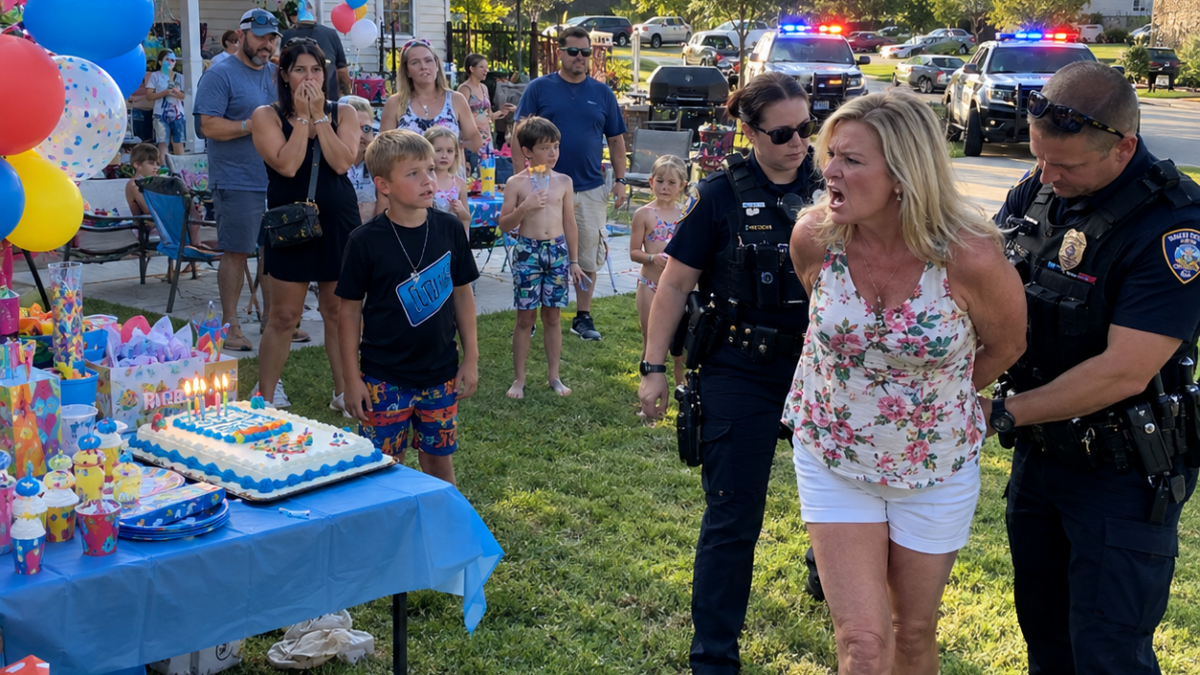
PART2
And for the first time all afternoon, Cedar Ridge’s self-appointed queen looked like she understood she was no longer the person controlling the conversation.
Three weeks earlier, none of us could have imagined it ending like this.
Especially not me.
All I wanted was to give my son a birthday party.
That was it.
Nothing elaborate.
Nothing irresponsible.
Nothing that should have required lawyers, police, witnesses, or an HOA president being placed in handcuffs beside a mailbox decorated with tiny cardboard rockets.
My name is Arthur Mitchell.
My wife, Natalie, and I had lived in Cedar Ridge Estates for six years.
Our son Leo was turning ten.
Double digits.
For him, it was enormous.
For months, he had been obsessed with space.
NASA documentaries.
Rocket launches.
Planet posters.
Books about Mars.
He could tell you the temperature on Venus, the number of moons around Jupiter, and exactly why Pluto deserved emotional respect even if astronomers refused to restore its planetary status.
So Natalie and I decided to give him a space-themed backyard birthday.
Nothing crazy.
Twenty kids.
A few parents.
A rented bounce house shaped vaguely like a rocket.
A ten-by-ten shade tent.
A cake.
Pizza.
Water balloons.
A piñata.
Three hours.
Done by four.
Cedar Ridge Estates, however, was the kind of HOA where “simple backyard party” still required paperwork.
So three weeks before the event, I submitted everything.
Guest estimate.
Start time.
End time.
Tent dimensions.
Bounce house dimensions.
Placement diagram.
Parking plan.
Temporary decorations.
I even included a note that we might use biodegradable water balloons if weather allowed.
Why?
Because Brenda Kensington had trained all of us.
You documented everything around Brenda.
Everything.
She had been HOA president for just over three years, and every household had a Brenda story.
The Henderson family once left their trash bins at the curb until 4:40 p.m.
Pickup had been completed at 4:30.
Brenda photographed the bins at 4:41.
Violation notice the next morning.
The Sterlings installed a small ceramic garden gnome behind a row of azaleas.
Brenda mailed them a certified letter because the architectural guidelines required approval for “permanent decorative lawn elements.”
The gnome was twelve inches tall.
Mrs. Carter hung warm-white Christmas lights instead of the association-approved cool-white color temperature.
Brenda called it “visual inconsistency.”
My personal favorite involved Mr. Avery’s bird feeder.
Apparently it attracted “excessive avian activity.”
That phrase appeared in an official warning.
Excessive avian activity.
Birds.
At a bird feeder.
That was Brenda.
She never saw herself as difficult.
She saw herself as essential.
Whenever somebody questioned her, she repeated the same phrases.
“Property values.”
“Community standards.”
“Uniform expectations.”
“Rules exist for a reason.”
And, of course:
“If we make one exception, where does it end?”
With Brenda, everything was a slippery slope toward civilization collapsing.
Let one family install a different mailbox and apparently by Christmas we would all be living beside abandoned cars and livestock.
So when I planned Leo’s birthday, I gave her nothing to work with.
I measured the bounce house twice.
Twelve feet exactly.
The covenant limit for temporary recreational structures was twelve feet.
I marked its location on a diagram.
It would sit behind the house, largely invisible from the street.
The shade tent was ten by ten.
Permitted.
Noise would end before five.
Permitted.
Guests would park along my side of the street and the overflow lot near the clubhouse.
Permitted.
No amplified music.
No commercial catering trucks.
No fireworks.
No alcohol.
Nothing remotely controversial.
Two days after submitting the application, approval arrived.
Signed by Brenda.
I kept the email.
Printed it.
Printed the attached approval.
Printed the diagram.
Then, because this is what life with Brenda had reduced me to, I put a copy in my desk and another in the kitchen drawer.
Natalie watched me.
“You know this is insane, right?”
“What?”
“You’re creating duplicate legal archives for a ten-year-old’s birthday.”
“I’m creating protection against Brenda.”
She laughed.
“You think she’ll show up?”
“She shows up when people repaint porch railings.”
“It’s a child’s party.”
“Exactly.”
Natalie shook her head.
“You’re becoming paranoid.”
“No.”
I held up the paperwork.
“Prepared.”
She rolled her eyes.
I wish I had been paranoid.
The morning of Leo’s birthday was perfect.
Seventy-five degrees.
Clear.
Barely any wind.
I woke before six because I was more excited than I wanted to admit.
Leo was still asleep.
Natalie had stayed up late finishing the cake with a local baker friend.
The thing was incredible.
Three tiers shaped like sections of a rocket.
Dark blue frosting.
Tiny stars.
Silver trim.
A little astronaut Leo on top.
I spent the morning hanging glow-in-the-dark stars beneath the pergola and taping cardboard planets along the fence.
The bounce-house company arrived at nine.
I met the driver outside.
“Height?”
“Twelve feet.”
“You sure?”
He laughed.
“HOA?”
“Brenda.”
His smile disappeared.
“Oh.”
Even the bounce-house guy knew Brenda.
He measured it with me anyway.
Eleven feet, eleven inches at the highest inflated seam.
Beautiful.
The shade tent went up beside the patio.
Ten by ten.
Exactly as submitted.
At eleven-thirty, families began arriving.
By noon, the backyard was alive.
Kids running.
Parents talking.
Music playing quietly from a small Bluetooth speaker at conversational volume.
Leo sprinted between groups wearing an astronaut T-shirt and the biggest smile I had seen on him in months.
I stood near the grill holding lemonade and thought:
This is why you tolerate HOA paperwork.
Because once you do everything correctly, they leave you alone.
At 12:28, Brenda walked up my driveway.
I saw the clipboard first.
Then the floral capri pants.
Then the blonde bob.
Natalie noticed my expression.
“No.”
I nodded.
“Yes.”
“Arthur.”
“I see her.”
“Don’t let her ruin this.”
“I won’t.”
Brenda entered the side yard without greeting anyone.
She stopped near the gate and looked around slowly.
Like a customs inspector.
Parents noticed.
Kids noticed.
Everyone who lived in Cedar Ridge knew her.
One father, Mike, leaned toward me.
“Is that…”
“Yes.”
He whispered:
“At a birthday party?”
“Apparently.”
Brenda marched toward me.
“I received reports of unauthorized structures.”
No hello.
No happy birthday to Leo.
Straight to enforcement.
I smiled.
“Good afternoon, Brenda.”
“This is serious.”
“It’s a bounce house.”
Her lips tightened.
“It appears oversized.”
“It isn’t.”
“And that canopy was not included in your application.”
“Yes, it was.”
“No.”
“Yes.”
She looked offended by my certainty.
“I reviewed the application personally.”
“Great.”
I reached into my back pocket.
That part gave me immense satisfaction.
I had the approval form folded there because I knew her too well.
I opened it.
“Page two. Item four. Temporary shade structure, ten feet by ten feet.”
She grabbed the paper.
Then looked toward the tent.
Then back at the paper.
“What is the bounce house height?”
“Twelve feet maximum.”
“It appears larger.”
“We measured.”
“With what?”
I stared.
“A tape measure.”
Behind me, someone made a choking noise.
Probably Mike trying not to laugh.
Brenda glanced toward the parents.
Then regained her official tone.
“I’ll need to verify.”
“Feel free.”
“You have a ladder?”
“No.”
“Then how did you measure the top?”
“The rental company had a telescoping measure.”
Her eyes narrowed.
“That is not association-certified equipment.”
I paused.
“Association-certified measuring equipment?”
“Yes.”
I looked around.
“Brenda, does Cedar Ridge own an official ruler?”
Several parents laughed.
She flushed.
“This is exactly the kind of attitude that makes compliance difficult.”
“No, the inflatable rocket makes compliance difficult.”
Natalie gave me a look.
Stop.
I obeyed.
“Brenda, everything was approved. Today is Leo’s birthday. If you see something genuinely unsafe, tell me. Otherwise, please let us enjoy the party.”
She looked past me toward the children.
“They are extremely loud.”
“They’re ten.”
“I can hear them from three houses away.”
“During the middle of the day.”
“Noise is noise.”
“It’s Saturday.”
“That doesn’t suspend the covenants.”
I took a breath.
“What’s the permitted quiet-hour start?”
She knew.
“Eight p.m.”
“What time is it?”
“12:35.”
“Then we’re doing fine.”
Her mouth tightened.
“You seem determined to push every limit.”
“No.”
I gestured around.
“I seem determined to host an approved birthday party.”
She straightened.
“I’ll be monitoring.”
“Of course you will.”
“Any violation will result in immediate enforcement.”
“Enjoy your Saturday, Brenda.”
She walked away.
Mike stepped beside me.
“Does she have hobbies?”
“Apparently this.”
“That’s bleak.”
I laughed.
Then Leo ran over.
“Dad! Piñata!”
And I forgot Brenda.
For almost forty minutes.
We hung the rocket piñata.
Twenty kids formed a line.
They took turns.
Someone hit Mike.
Someone hit the fence.
Nobody hit the piñata until a girl named Sophie absolutely destroyed it.
Candy exploded across the grass.
The kids screamed.
Everything became wonderfully chaotic.
Then cake.
Leo’s face when he saw the rocket was worth every hour of preparation.
Everyone sang.
He blew out ten candles.
I cut slices.
Natalie passed plates.
And then she leaned toward me.
“Don’t look now.”
I knew.
“Brenda?”
“Property line.”
I looked.
She stood near the sidewalk holding her phone horizontally.
Photographing us.
Not the house.
Not some alleged structural violation.
The party.
Children.
Parents.
My son.
I put down the cake knife.
Natalie caught my wrist.
“Arthur.”
“I’m not yelling.”
“Promise?”
“Promise.”
I wiped frosting from my hands and walked toward the fence.
Brenda lowered the phone slightly.
“What are you doing?”
“Documenting.”
“What?”
“Potential violations.”
“Brenda, you’re photographing children.”
“I’m photographing property conditions.”
“You’ve taken at least six photos while pointing directly into the yard.”
“The children happen to be present.”
“Then stop.”
“I have a duty.”
“No.”
Her eyes sharpened.
“You do not tell me how to carry out association duties.”
“I’m telling you you’re making my guests uncomfortable.”
“This is not about your guests.”
“Good. Then come back tomorrow.”
She looked almost insulted.
“Violations must be documented when occurring.”
“What violation?”
She raised the phone.
“The bounce house is visible from the street at an unauthorized angle.”
I stared at her.
“An unauthorized angle.”
“Yes.”
“What does that mean?”
“It was approved based on a limited visual profile.”
“Show me where.”
“The committee considered overall appearance.”
“Show me in the approval.”
She ignored that.
“And these mailbox decorations are non-regulation.”
I looked.
Three silver balloons tied to the mailbox.
“They’re temporary birthday balloons.”
“They obstruct the uniform appearance.”
“For three hours.”
“Rules do not become optional based on duration.”
“Actually, several do.”
Her face reddened.
“This is exactly the problem.”
“What is?”
“People think temporary exceptions don’t matter. First balloons. Then lawn ornaments. Then flamingos.”
I actually laughed.
I couldn’t help it.
“Flamingos?”
“Yes.”
“You’re worried Leo’s birthday balloons are the gateway to flamingos?”
Several parents had drifted closer.
They were pretending not to listen.
They were listening.
Brenda noticed.
Her pride took over.
“If we selectively ignore covenants, enforcement becomes impossible.”
I lowered my voice.
“Brenda, go home.”
Her eyes widened.
“Excuse me?”
“Please leave us alone for the rest of the party.”
“This is association business.”
“No. This is harassment.”
She gasped.
Actually gasped.
“You are accusing the president of harassment?”
“I’m accusing Brenda Kensington of standing outside a ten-year-old’s birthday taking photos after every issue you’ve raised has already been answered.”
Her eyes went cold.
“You need to watch your tone.”
There it was.
“I’m being calm.”
“You’re becoming hostile.”
“No.”
“You’re raising your voice.”
I wasn’t.
Parents were close enough to hear.
That mattered later.
“Go home, Brenda.”
She lifted her phone again.
“I’m documenting this interaction.”
“Great.”
I pointed toward the yard.
“I have about fifteen witnesses.”
Her face tightened.
Then Leo ran over.
Chocolate frosting around his mouth.
“Dad!”
I turned.
“What, buddy?”
“Can we do water balloons?”
He was vibrating with excitement.
“Yeah. Give me a minute.”
“All my friends are ready.”
Brenda stepped forward.
“Water balloons?”
Leo looked at her.
His smile faded.
“That wasn’t in the application.”
I stared.
“Brenda.”
“Water usage restrictions apply.”
“They do not.”
“Temporary irrigation limitations—”
“This is not irrigation.”
“Potential landscaping damage.”
“We have a tarp over the play zone.”
“Balloon fragments create litter.”
“They’re biodegradable, and the application mentions them.”
Her mouth opened.
I continued.
“Section 7.3 permits biodegradable party balloons when cleanup is completed same day.”
Her expression told me she hated that I knew her own rules.
I had studied them because of her.
I crouched beside Leo.
“Go tell everyone five minutes.”
He looked at Brenda.
Then at me.
“Is she stopping the party?”
That sentence hit me harder than anything Brenda had said.
My son was ten.
This was his birthday.
And he was asking whether an HOA president had the power to stop it.
“No.”
I smiled.
“She isn’t stopping anything.”
Brenda said:
“I haven’t decided whether—”
I stood.
“No.”
My voice changed.
Not loud.
Final.
“You approved this party. Everything is compliant. You are not going to stand here and make my son afraid his birthday can be canceled because you dislike balloons.”
She stared at me.
“Are you threatening me?”
“No.”
“You’re acting aggressively.”
“No.”
“I feel unsafe.”
I looked around.
Fifteen adults.
Twenty kids.
Cake.
Water balloons.
“Then leave.”
Her expression hardened.
“I will be reporting this.”
“Do whatever you need to do.”
That sentence would later become part of her excuse for calling 911.
I returned to the yard.
We had the water-balloon battle.
It was glorious.
Kids screamed.
Adults got hit accidentally.
Mike intentionally handed his daughter a balloon and pointed at him.
Natalie took a direct hit to the shoulder and retaliated against a ten-year-old.
Leo laughed so hard he fell onto the tarp.
For half an hour, the day became normal again.
Then Mike touched my shoulder.
“Arthur.”
I turned.
His face had changed.
“What?”
He nodded toward the street.
Police.
Two cruisers.
Brenda stood beside them.
My stomach dropped.
She had actually called 911.
I looked toward Leo.
He had noticed.
So had the other children.
The laughter slowed.
Natalie came beside me.
“She didn’t.”
“She did.”
“What did she tell them?”
“I don’t know.”
“Arthur.”
“I’ll handle it.”
“Calmly.”
“Yes.”
I wiped my hands on a towel.
Then walked toward the street.
As I got closer, I could hear Brenda.
“They are violating at least seven separate covenants, and when I attempted to correct the situation, the homeowner became hostile and threatening.”
Threatening.
That word changed my pulse.
Officer Ramirez noticed me.
“Sir, this your residence?”
“Yes.”
“My name is Arthur Mitchell.”
“You’re hosting the gathering?”
“My son’s tenth birthday.”
I pointed toward the backyard.
“It was approved three weeks ago by the HOA.”
Brenda shouted:
“Not like this!”
Ramirez raised a hand.
“Ma’am, please.”
I continued.
“Twenty children, invited parents, bounce house, shade tent, balloons. Everything in the submitted plan.”
“He is lying,” Brenda said.
I looked at her.
“There are copies.”
“The approval was for a smaller event.”
“It lists twenty children.”
“You exceeded the intended activity level.”
I almost laughed.
Officer Cole said:
“Activity level?”
Brenda straightened.
“The environment has become disruptive.”
Ramirez looked toward the children.
“Any fights?”
“No.”
“Injuries?”
“No.”
“Property damage?”
“No.”
“Alcohol?”
“No.”
“Weapons?”
Brenda hesitated.
“No.”
“Threats?”
She pointed at me.
“He told me to leave.”
“That isn’t a threat.”
“He did so aggressively.”
Ramirez turned to me.
“Sir, what happened?”
I explained.
Everything.
The inspection.
The bounce-house height.
The tent.
The noise complaint.
Photos.
Water balloons.
My request that she leave the children alone.
No insults.
No embellishment.
When I finished, Mike approached.
“Officer?”
Ramirez looked at him.
“Yes?”
“I witnessed most of it.”
Brenda spun.
“This is none of your business.”
Ramirez’s expression sharpened.
“Ma’am.”
Mike continued.
“Arthur never threatened her.”
Another parent stepped forward.
“Neither did Natalie.”
Then another.
“She was taking pictures of the kids.”
Brenda snapped:
“I was documenting property.”
The parent replied:
“My eight-year-old asked why the angry lady was photographing her.”
That hurt Brenda.
I could tell.
Not emotionally.
Socially.
Parents were now looking at her like she was something unpleasant they had stepped around.
Ramirez said:
“Sir, you mentioned paperwork?”
I almost smiled.
“Yes.”
I pulled it from my pocket.
Brenda stared.
“You still have that?”
“Today? Absolutely.”
Officer Cole unfolded it.
Read.
“Party approved for noon to four.”
“Yes.”
“Estimated twenty minors, accompanying adults.”
“Yes.”
“Inflatable temporary recreation structure maximum twelve feet.”
“Yes.”
“Ten-by-ten temporary shade canopy.”
“Yes.”
“Temporary mailbox decoration removed same day.”
I looked at Brenda.
“Yes.”
Cole continued.
“Biodegradable water balloons permitted provided debris is removed.”
I nodded.
“Exactly.”
He looked at Brenda.
She folded her arms.
“This doesn’t address excessive noise.”
“What noise ordinance has been violated?” Ramirez asked.
“Community nuisance standards.”
“Decibel level?”
Brenda hesitated.
“It’s obviously excessive.”
“Did you measure?”
“No.”
“Any complaint from another resident?”
“I received reports.”
“Who?”
“Confidential.”
I almost laughed.
Brenda loved confidential complaints.
They were everywhere and belonged to no one.
Officer Ramirez looked around.
“Ma’am, none of this appears to be a police matter.”
Brenda’s eyes widened.
“I called because I was threatened.”
Ramirez’s face became more serious.
“Then let’s address that.”
Good.
Because now Brenda had to commit.
“What exactly did Mr. Mitchell say?”
“He told me to go home.”
“Anything else?”
“He said I was harassing him.”
“Anything threatening physical harm?”
She hesitated.
“No.”
“Threatening damage?”
“No.”
“Did he approach you physically?”
“He walked toward me.”
“I walked from my yard to the property line.”
Mike said:
“He stayed at least six feet away.”
Brenda snapped:
“You don’t know the exact distance.”
Mike looked at her.
“I coach soccer. I know six feet.”
Several people laughed.
Even Officer Cole’s mouth twitched.
Brenda flushed.
Ramirez asked:
“Did he block you from leaving?”
“No.”
“Follow you?”
“No.”
“Touch you?”
“No.”
“Display a weapon?”
“No.”
“Raise a fist?”
“No.”
“Threaten future retaliation?”
“No.”
“Then what made this an emergency?”
And that brought us back to the question.
The question that changed everything.
Brenda stared at Ramirez.
“I felt threatened.”
“I understand that.”
Ramirez’s tone was careful.
“But feeling uncomfortable and reporting an active threat of violence are different things.”
“I didn’t say active violence.”
Officer Cole looked at his notes.
“Dispatch says you stated there was an escalating confrontation with potential violence.”
Brenda’s face changed.
“I was concerned it could become violent.”
“Why?”
“He was angry.”
I spoke.
“I was calm.”
She snapped:
“You were furious.”
“You don’t get to decide what emotion was in my head.”
“You were glaring.”
Officer Ramirez raised a hand.
“Stop.”
We both stopped.
Then she asked Brenda:
“Did you tell dispatch there were approximately thirty people present?”
“Yes.”
“Did you identify that most were children attending a birthday party?”
Brenda hesitated.
That was the first real crack.
“No.”
“Why not?”
“It wasn’t relevant.”
Ramirez looked toward the bounce house.
“It seems highly relevant.”
Brenda said:
“The number of people increased the risk.”
“What risk?”
“Uncontrolled crowd behavior.”
The kids were currently standing near the fence holding paper plates.
One wore an astronaut helmet.
Another was barefoot.
Uncontrolled crowd behavior was ambitious.
Ramirez looked at Brenda.
“Did you report that the homeowner was threatening residents?”
“I said neighbors were at risk.”
“Which neighbors?”
Brenda had no answer.
Officer Cole stepped away.
He radioed dispatch.
Asked for clarification on the original call.
Brenda watched him.
For the first time, real anxiety entered her face.
“Why are you doing that?”
He ignored her.
Thirty seconds.
Then a minute.
When he came back, his expression was different.
“Dispatch has the recording.”
Brenda swallowed.
He continued.
“You stated, quote, that the homeowner was ‘becoming violent’ and that you feared ‘children may be caught in the situation.’”
Every parent around me went quiet.
I stared at her.
“You used our kids to make it sound dangerous?”
Brenda looked at me.
“I was protecting them.”
Natalie had heard enough.
She came forward.
“No.”
Brenda turned.
Natalie rarely engaged with her.
That made it stronger.
“You stood outside taking pictures of our kids, upset them, tried to stop their games, and then called police claiming Arthur was putting them in danger.”
Brenda said:
“I acted responsibly.”
Natalie’s eyes hardened.
“My son thought you were going to shut down his birthday.”
“That isn’t my fault.”
“Yes, it is.”
Brenda looked toward the officers.
“Can someone control these people?”
Officer Ramirez stared at her.
“Ma’am, they’re standing on their own property.”
Brenda’s confidence cracked another inch.
Then Officer Cole asked:
“Did you tell the dispatcher you were the HOA president?”
“Yes.”
“And that you were carrying out enforcement?”
“Yes.”
“Did you believe police would enforce HOA covenants?”
“Of course.”
He blinked.
“Of course?”
“That is part of community law enforcement.”
“No, ma’am.”
“What?”
“HOA covenants are private civil rules. Police do not enforce your bounce-house restrictions.”
She looked genuinely shocked.
“So residents can just violate anything?”
“No. The HOA has civil enforcement processes.”
“I was using one.”
“You called 911.”
“Because he became hostile.”
“Which we’ve addressed.”
She folded her arms.
“You are taking his side.”
Ramirez’s voice turned colder.
“We are determining facts.”
“You came here because I called.”
“Yes.”
“So you should address my complaint.”
“We are.”
She didn’t understand.
Not yet.
Officer Cole stepped aside with Ramirez.
They spoke quietly.
I couldn’t hear.
Brenda started pacing.
Then she pointed toward my mailbox.
“The balloons are still noncompliant.”
I stared.
Police were reviewing whether she had filed a false emergency report and she was still thinking about balloons.
“Brenda.”
“What?”
“Stop.”
“You don’t get to tell me—”
Natalie interrupted.
“Yes, he does.”
Brenda turned.
“My son is ten.”
Natalie’s voice shook.
“Ten.”
She pointed toward Leo.
“He has spent the last fifteen minutes thinking his father might be arrested because you didn’t like his birthday decorations.”
Brenda looked at Leo.
For the briefest second, something like discomfort crossed her face.
Then pride killed it.
“I didn’t create the situation.”
“You called 911.”
“You created the situation,” Natalie said.
Brenda opened her mouth.
Officer Ramirez returned.
“Mrs. Kensington.”
Brenda turned immediately.
“Yes?”
“We need to clarify your statement.”
“I’ve already explained.”
“Did Mr. Mitchell threaten you at any point?”
“I felt threatened.”
“That’s not what I asked.”
Brenda looked around.
No one was helping her.
Not one parent.
Not one neighbor.
Not even her precious clipboard.
“No.”
“Did he make any statement indicating he intended to hurt you?”
“No.”
“Did he physically prevent you from leaving?”
“No.”
“Did he damage property?”
“No.”
“Was there any violence occurring when you called?”
“No.”
“Did you know this was a children’s birthday party?”
“Yes.”
“Did you know the HOA had approved it?”
Brenda looked at me.
Then the paperwork.
Then away.
“I knew there was an approval.”
“Did you sign it?”
Silence.
Ramirez repeated:
“Did you sign the approval?”
“Yes.”
There it was.
Officer Cole asked:
“So you knew the event was authorized, you knew there was no active violence, you knew the homeowner had not threatened physical harm, and you still told emergency dispatch that the situation was escalating toward violence?”
Brenda’s face became dark red.
“You are twisting my words.”
“We have the recording.”
“I was exercising judgment.”
“Emergency dispatch isn’t a tool for HOA enforcement.”
“Then who exactly am I supposed to call when homeowners become hostile?”
“The non-emergency line, if there is an actual police concern.”
“He told me to leave.”
“That is not a crime.”
“I am HOA president.”
“You were on his property.”
“I have inspection rights.”
“Do you have documentation allowing entry during this event?”
She lifted the clipboard.
“The covenants—”
“Do they allow you to remain after a homeowner asks you to leave?”
She hesitated.
I hadn’t even thought of that.
Neither, apparently, had Brenda.
Officer Ramirez asked me:
“Sir, did you ask her to leave?”
“Yes.”
“More than once?”
“Yes.”
“Did she?”
“She moved to the sidewalk and continued photographing.”
Ramirez nodded.
That wasn’t necessarily criminal by itself.
But it added context.
Brenda began realizing this.
“You’re investigating me now?”
Officer Cole said:
“We investigate the information we receive.”
“I am the complainant.”
“That doesn’t exempt you.”
“I have spent years protecting this community.”
“No one is discussing your HOA service.”
“You should.”
“Why?”
“Because it establishes credibility.”
Cole looked at her.
“Credibility comes from accurate information.”
That sentence hit hard.
Brenda’s mouth tightened.
Then she made the mistake that finished it.
She pointed at me and said:
“He has been a problem resident for years.”
I laughed.
Ramirez turned.
“Any prior police incidents?”
Brenda froze.
“No.”
“Any restraining orders?”
“No.”
“Any documented threats?”
“No.”
“Any violent behavior?”
“No.”
“Then why did you characterize him as dangerous?”
Brenda’s mouth opened.
Closed.
Then:
“Because he doesn’t respect authority.”
The silence was immediate.
Even the children seemed quiet.
Officer Ramirez stared.
“Your authority?”
Brenda knew instantly she had said too much.
“I mean association authority.”
“And that made him violent?”
“I didn’t say—”
“You told dispatch he was becoming violent.”
“He was challenging me.”
“Challenging HOA decisions is not violence.”
Brenda looked at me with pure hatred.
Not because I had said anything.
Because the officer had reduced her entire worldview to one humiliating sentence.
Challenging you is not violence.
Officer Cole stepped aside again.
Spoke over the radio.
Then asked Brenda:
“Could we see your phone?”
Her eyes narrowed.
“Why?”
“To verify the call timeline.”
“You have dispatch.”
“We do.”
“Then you don’t need my phone.”
“I’m asking voluntarily.”
“No.”
“That’s your right.”
She looked almost relieved.
Then Ramirez said:
“Please stay here.”
“I have association duties.”
“No. Stay here while we finish.”
Her face changed.
“Am I being detained?”
Ramirez looked at Cole.
Then back.
“Yes, for the moment.”
Brenda’s jaw dropped.
“What?”
“We are investigating a suspected false emergency report and misuse of emergency services.”
“You cannot be serious.”
“I am.”
“You came because I called.”
“Yes.”
“This is outrageous.”
Ramirez’s voice remained calm.
“Mrs. Kensington, stop interrupting.”
“I know the chief.”
Of course she did.
Or claimed she did.
“I sit on the community safety committee.”
“That doesn’t change the situation.”
“I will have your badge.”
Cole actually looked tired now.
“Ma’am, threats against officers’ employment are not helping.”
“I am not threatening you.”
“You said you’ll have her badge.”
“I said I know people.”
“Please stop.”
Brenda looked around.
Parents were staring.
Phones were out now.
Not the children.
Adults.
People who had endured her fines, notices, warnings, and lectures for years.
She finally understood how this looked.
“Can we discuss this privately?”
Ramirez shook her head.
“We can move away from the children.”
That seemed fair.
They walked several yards toward the cruisers.
I stayed back.
So did everyone else.
We could still hear Brenda.
“This is a misunderstanding.”
Then quieter.
“I was concerned.”
Then:
“I did not knowingly file anything false.”
Officer Cole said something.
Brenda answered sharply.
Then Ramirez spoke.
Brenda’s head jerked back.
“What?”
Another exchange.
Then came the moment none of us expected.
Officer Cole stepped behind Brenda.
“Mrs. Kensington, turn around and place your hands behind your back.”
Every adult in my yard stopped breathing.
Brenda laughed once.
A startled laugh.
“What?”
“Hands behind your back.”
“You’re joking.”
“No.”
“You cannot arrest me.”
“Turn around.”
“I am the president of the Cedar Ridge Estates Homeowners Association.”
The sentence sounded absurd now.
Cole said:
“That has no bearing on this.”
Brenda looked toward us.
At me.
Natalie.
The parents.
The children.
Her face showed pure disbelief.
“You’re arresting me because of him?”
Ramirez answered:
“No, ma’am. You’re being arrested based on your conduct and the information you provided to emergency services.”
“This is insane.”
“Turn around.”
Brenda refused for another few seconds.
Then finally turned.
Cole took her wrist.
The handcuff clicked.
You could hear it.
Even from where I stood.
Then the second.
Brenda’s entire posture changed.
The woman who had spent years standing taller whenever she issued a violation suddenly looked much smaller.
Not physically.
Institutionally.
Her clipboard meant nothing.
Her polo meant nothing.
Her title meant nothing.
Only the facts mattered.
She began talking rapidly.
“I demand counsel.”
“You have that right.”
“I will sue.”
“You have that right.”
“This arrest is unlawful.”
“You can contest it.”
“The board will hear about this.”
“Okay.”
“My attorney knows the mayor.”
No one responded.
She kept going.
“This is retaliation.”
Officer Ramirez opened the cruiser door.
“Watch your head.”
“I am not getting into that car.”
“Mrs. Kensington.”
“You don’t understand the consequences of humiliating me in front of my community.”
That sentence made several parents exchange looks.
Not her children.
Not Leo.
Not the false emergency call.
Her humiliation.
That was Brenda.
Even in handcuffs, the biggest injustice in the universe was somebody refusing to defer to her.
Officer Cole guided her into the back seat.
The door closed.
For about five seconds, nobody spoke.
Then Leo tugged at my shirt.
“Dad?”
I looked down.
“Yeah?”
“Did Brenda get arrested?”
Twenty children leaned closer.
I tried to choose my words carefully.
“The police think she may have broken some rules about calling 911.”
Leo frowned.
“She called 911 because of my party?”
“Yes.”
“Why?”
I looked toward the cruiser.
“I think she got carried away.”
He thought about that.
Then asked:
“Can we keep playing?”
That was my son.
I smiled.
“Yes.”
The kids erupted.
Not because Brenda had been arrested.
Because the party was continuing.
Officer Ramirez came back before leaving.
“Mr. Mitchell.”
“Yes?”
“I apologize for the interruption.”
“You don’t need to apologize.”
“We respond to the information provided.”
“I understand.”
“We may need formal statements from you and witnesses.”
“Whatever you need.”
“Keep the HOA approval.”
“I will probably have it laminated.”
That finally made her smile.
Then she lowered her voice.
“For what it’s worth, calling 911 with knowingly false or materially misleading emergency information is taken seriously.”
“I understand.”
“She’ll be processed. Charging decisions may be reviewed further.”
“Okay.”
I didn’t ask for more.
Did not ask whether she would go to jail.
Did not celebrate.
I mostly felt exhausted.
The cruisers left.
Brenda sat in the back.
Still talking.
Still furious.
Still convinced somebody would eventually recognize her importance and reverse everything.
When the vehicles disappeared, the yard stayed silent.
Then Mike began clapping.
Slowly.
I turned.
“Don’t.”
He stopped.
“What?”
“This is still Leo’s birthday.”
He looked embarrassed.
“Right.”
Natalie nodded toward the kids.
“Cake round two.”
That saved us.
Within five minutes, children were back in the bounce house.
Someone found the water balloons.
Leo returned to being ten.
Adults took longer.
Every conversation eventually circled back.
“Did that really happen?”
“She really called 911?”
“They actually arrested her?”
“Did she lie to dispatch?”
“What happens to the HOA now?”
I kept saying the same thing.
“Not today.”
Today was Leo.
Not Brenda.
We played games.
Opened presents.
Took photographs.
No police lights in those.
Thank God.
At four, exactly as approved, the party ended.
Parents collected children.
We cleaned every balloon fragment.
Took down the mailbox decorations.
Shut off the bounce house.
Folded the tent.
At 4:43, I stood in the backyard surrounded by deflated decorations.
Natalie handed me a beer.
“Now we can talk about it.”
I took the bottle.
“What the hell just happened?”
She laughed.
Then covered her face.
“I cannot believe she got arrested.”
“I cannot believe she called 911.”
“You warned me.”
“I did.”
“You said she’d show up.”
“I didn’t expect handcuffs.”
“Obviously.”
We sat.
A few minutes later, Leo came outside.
He had changed into pajamas despite it being late afternoon.
Birthday privilege.
“Dad?”
“Yeah?”
“Was I in trouble?”
That hurt.
“No.”
“Was the party illegal?”
“No.”
“Then why did she say police needed to come?”
I thought carefully.
“Sometimes adults get so convinced they’re right that they stop checking whether what they’re doing makes sense.”
He nodded.
“Like when I said Mars had oxygen people could breathe?”
“Exactly.”
He smiled.
“But I was six.”
“Also true.”
He looked toward the street.
“Is Brenda bad?”
That was harder.
“No.”
He frowned.
“She got arrested.”
“People can do bad things without being completely bad.”
“Do you like her?”
“No.”
He laughed.
Neither did Natalie.
The next morning, my inbox contained fourteen messages.
Most from neighbors.
One from Cedar Ridge’s vice president, Thomas Reed.
Subject:
URGENT BOARD NOTICE
Brenda Kensington had been temporarily suspended from presidential authority pending an emergency board review.
Thomas requested my statement.
I agreed.
By noon, everybody knew.
Not just our street.
The entire neighborhood.
I went to the grocery store and ran into Mr. Henderson.
He grinned the second he saw me.
“Birthday party?”
I sighed.
“Please.”
“She really got arrested?”
“Yes.”
“Trash cans.”
“What?”
He shook his head.
“She fined me over trash cans. I just needed to say that.”
“I remember.”
“Ten minutes.”
“I remember.”
He smiled.
“I slept extremely well last night.”
I laughed.
By Monday, things became less funny.
The board needed to review what Brenda had been doing before the arrest.
Thomas called me.
“Arthur, can I ask you something?”
“Sure.”
“Did Brenda ever tell you the party approval had changed?”
“No.”
“Any amended notice?”
“No.”
“Any violation issued before Saturday?”
“No.”
“Did she have board authorization to conduct an inspection during the event?”
“I have no idea.”
Silence.
“That sounds like no.”
“What are you finding?”
“I’m not ready to say.”
That phrase got my attention.
“What does that mean?”
“Just send me every communication you have.”
I did.
The original application.
Approval.
Brenda’s handwritten note.
Emails.
Party diagram.
Everything.
Two days later, the emergency board meeting was announced.
Residents packed the clubhouse.
I had never seen that many people at an HOA meeting.
Not when dues increased.
Not when the pool needed repairs.
Not when someone proposed changing roof colors.
Brenda was not there.
Her attorney had advised her not to attend while the criminal case was pending.
Thomas sat in the president’s chair.
He looked deeply uncomfortable.
“Before we begin,” he said, “I want everyone to understand this is not a trial.”
Someone muttered:
“Feels like one.”
Thomas ignored it.
“The board is reviewing Ms. Kensington’s conduct as president, separate from any criminal matter.”
He summarized the birthday incident.
Then the property manager spoke.
That was where things got worse for Brenda.
She had received no complaints about my party before arriving.
None.
Not one.
Her statement that she had “received reports of unauthorized structures” was false.
The property manager had no calls.
No emails.
No resident complaints.
No hotline messages.
Nothing.
She had gone there on her own.
Then we learned why.
Brenda had placed my address on something called an enhanced compliance watch list.
I laughed when I heard it.
Then stopped.
“What exactly is that?” I asked.
The manager looked uncomfortable.
“It isn’t an official category.”
“Then what is it?”
“Ms. Kensington maintained a personal list of properties she believed required additional monitoring.”
“How many?”
“Seventeen.”
Murmurs filled the room.
Mr. Henderson raised his hand.
“Am I on it?”
The manager looked down.
“Yes.”
He leaned back.
“Of course.”
Mrs. Sterling spoke.
“The gnome?”
A few people laughed.
The manager said:
“Yes, your address is listed.”
Her husband whispered something that made her smile.
Then Thomas said:
“Arthur’s home was marked due to prior disagreements regarding exterior lighting and fence repairs.”
I stared.
I had successfully appealed two incorrect notices the previous year.
That had apparently earned me enhanced monitoring.
“So because I appealed notices, she started watching my house?”
Thomas looked apologetic.
“That appears to be the case.”
Natalie squeezed my hand.
The meeting continued.
Brenda had used her president access to reopen closed violations.
Had directed management staff to create notices without full board review.
Had inspected properties personally despite no complaint.
Had maintained private notes about residents.
“Difficult.”
“Argumentative.”
“Anti-HOA.”
“Needs monitoring.”
My name had a note.
LIKELY TO CHALLENGE ENFORCEMENT. DOCUMENT CAREFULLY.
That almost made me laugh.
At least she had predicted correctly.
Then Thomas showed the party approval.
Signed by Brenda.
No ambiguity.
She had approved exactly what happened.
Twenty children.
Tent.
Bounce house.
Decorations.
Water balloons.
So when she called police saying the gathering was unauthorized and dangerous, she knew the underlying event was approved.
That mattered.
A lot.
The association attorney spoke next.
“This board should be very cautious about drawing conclusions regarding criminal intent.”
Fair.
“But from a governance perspective, the issue is straightforward. The president appears to have used association authority in a personal dispute, mischaracterized an approved resident event, and created significant liability exposure.”
Brenda’s supporters looked unhappy.
There were still a few.
One woman named Elaine stood.
“Brenda has protected this community for years.”
Mr. Henderson responded:
“From birds.”
People laughed.
Thomas banged the gavel.
“Please.”
Elaine continued.
“She may have overreacted, but removing her is extreme.”
Mrs. Sterling said:
“She called 911 on a child’s birthday party.”
“She felt unsafe.”
Mike, who had witnessed everything, stood.
“I was there.”
Everyone turned.
“She was not unsafe.”
Elaine crossed her arms.
“You can’t know what she felt.”
“No.”
Mike nodded.
“But I know Arthur never threatened her.”
Another parent stood.
“So do I.”
Then another.
And another.
Seven witnesses.
Adults.
Parents.
No connection to HOA politics.
Each told the same story.
Brenda arrived.
Brenda looked for violations.
Brenda photographed kids.
Brenda became angry when challenged.
Arthur stayed calm.
Brenda left.
Police arrived.
That consistency mattered.
Thomas finally called for executive session.
Residents waited almost forty minutes.
When the board returned, the room went silent.
Thomas read the decision.
Brenda Kensington was removed as HOA president effective immediately.
Suspended from all enforcement and compliance functions.
Her board seat would remain subject to a separate recall process under the bylaws.
The association also imposed a $1,000 internal conduct penalty permitted under board-member ethics provisions and referred several of her past enforcement actions for independent review.
The room erupted.
Not cheering exactly.
More like a collective release.
People had been waiting years.
I sat quietly.
Natalie whispered:
“You okay?”
“Yeah.”
“You don’t look happy.”
“I am.”
“Then?”
I looked around.
“This became way bigger than Leo’s birthday.”
She nodded.
“Because she made it bigger.”
That was true.
I had not asked for Brenda to lose office.
I had not called police.
I had not filed a recall petition.
I had simply submitted a birthday-party application.
She did everything else.
A week later, I had to give a formal statement regarding the emergency call.
The process was far less dramatic than the arrest.
No courtroom fireworks.
Just questions.
What did I say?
Where was Brenda standing?
Did I threaten her?
Who witnessed it?
Had we argued before?
Did I know she planned to call police?
I answered honestly.
So did the other parents.
The 911 recording became important.
I never heard the entire thing.
But investigators confirmed Brenda had described me as becoming violent, claimed guests were frightened, and implied immediate police intervention was needed to prevent escalation.
That simply was not what happened.
There were too many witnesses.
Videos too.
Mike had been filming his daughter in the bounce house when my first confrontation with Brenda occurred in the background.
The audio caught me saying:
“Please let the children enjoy the party.”
Not:
“I’ll hurt you.”
Not:
“You’ll regret this.”
Not anything threatening.
Another parent’s video captured the water-balloon discussion.
Again:
Calm.
Annoyed, yes.
Firm, definitely.
Violent?
Not remotely.
Brenda’s attorney eventually advised her to negotiate.
She accepted a plea agreement.
The final result was less dramatic than neighborhood rumors predicted.
A $500 fine.
Forty hours of community service.
Six months’ probation.
No jail.
That was fine with me.
I did not want her imprisoned.
I wanted her to stop.
Those are different things.
Her real punishment, if you want to call it that, happened socially.
Cedar Ridge stopped fearing her.
That was devastating for someone whose influence depended almost entirely on people believing resistance was more trouble than compliance.
Once residents saw Brenda in the back of a police cruiser, arguing that her HOA title should somehow matter to the officers, the spell broke.
People started questioning old notices.
The Hendersons challenged their administrative fee.
Refunded.
The Sterlings requested review of the garden-ornament warning.
Withdrawn.
Mr. Avery asked the board to remove “excessive avian activity” from his record.
Thomas laughed when he read it.
Removed.
A family two streets over discovered Brenda had fined them over exterior paint even though the color had been pre-approved.
Refund.
Another resident learned an alleged anonymous complaint about her patio furniture had come from Brenda herself.
The pattern was embarrassing.
Brenda had not been enforcing rules consistently.
She had been enforcing relationships.
Agree with her?
Minor issue.
Question her?
Violation.
Challenge her publicly?
Enhanced monitoring.
That was what destroyed her legacy.
Not the arrest alone.
The arrest simply forced people to look.
Her real estate firm placed her on administrative leave shortly after the story became public.
That surprised me.
I had no involvement.
Someone had apparently sent them a local news clipping about the arrest.
High-end real estate depends heavily on reputation.
An agent being charged after calling 911 on a child’s birthday did not fit the image they wanted.
I felt no joy about her employment situation.
Natalie did.
A little.
“She told Mrs. Henderson their Christmas wreath hurt property values.”
“That doesn’t mean she should lose her career.”
“She tried to get you arrested.”
“Still.”
Natalie looked at me.
“You are irritatingly reasonable.”
“It’s a gift.”
She threw a pillow.
Leo, meanwhile, became famous at school.
Not for the reason we wanted.
For two weeks kids asked:
“Did someone get arrested at your birthday?”
He hated it at first.
Then adapted.
Eventually his version became:
“The HOA lady called cops on my dad and got arrested herself.”
Technically oversimplified.
But he was ten.
I allowed it.
One evening, maybe a month later, Leo asked me:
“Dad, why did Brenda hate the party?”
“She didn’t hate the party.”
“Yes, she did.”
I thought.
“Okay. Maybe she did.”
“Why?”
That was harder.
“Because she couldn’t control it.”
He frowned.
“But she approved it.”
“Exactly.”
“So she could control it.”
“No.”
I sat beside him.
“She could approve whether we followed certain rules. She couldn’t control whether you had fun, whether the kids were loud within normal limits, whether people laughed, whether I disagreed with her.”
Leo thought about that.
“So she wanted to be the boss.”
“Yes.”
“But she was the boss.”
“Of the HOA.”
“What’s the difference?”
That may have been the smartest question in the whole story.
I said:
“Being in charge of something doesn’t mean being in charge of everyone.”
He nodded slowly.
“Like Coach Ramirez can’t tell me what to eat at home.”
“Exactly.”
“Or my teacher can’t decide my bedtime.”
“Exactly.”
“Or Mom can’t—”
I raised one hand.
“Careful.”
He laughed.
That became the lesson I actually wanted him to remember.
Not that bad people get arrested.
Not that police solve HOA disputes.
Not that every controlling neighbor eventually gets humiliated.
Those things aren’t always true.
I wanted him to understand boundaries.
Authority has limits.
Teachers.
Coaches.
Police.
HOA presidents.
Parents.
Everyone.
Good authority respects those limits.
Bad authority always wants one step more.
Brenda always wanted one step more.
The covenants allowed her to review an application.
She wanted to inspect the party.
The board allowed enforcement.
She wanted personal surveillance.
The rules allowed documentation.
She wanted photos of children.
She could issue civil notices.
She wanted police enforcement.
She was president of a homeowners association.
She wanted that title to function like a badge.
It didn’t.
That was what Officer Ramirez showed her.
A month after everything, I saw Brenda at the grocery store.
Frozen-food aisle.
I was pushing a cart.
She turned the corner.
Saw me.
Stopped.
For a second, we just stared at each other.
No clipboard.
No HOA polo.
No sunglasses.
She looked tired.
Smaller.
Then she immediately turned her cart around and started walking the other way.
“Brenda.”
She stopped.
I don’t know why I called her.
Maybe curiosity.
Maybe because avoiding each other forever seemed ridiculous.
She turned slowly.
“What?”
“How are you?”
She actually looked offended.
“How do you think?”
“Fair.”
“You destroyed my reputation.”
There it was.
I sighed.
“I didn’t call police.”
“You humiliated me.”
“I asked you to leave Leo’s birthday party alone.”
“You made me look unreasonable.”
“You called 911.”
“Because you became hostile.”
I stared.
Even now.
“You took a plea.”
Her face tightened.
“My attorney advised it.”
“Because there was a recording.”
“Recordings lack context.”
“And witnesses?”
“They were your friends.”
“Some were parents I barely knew.”
She looked away.
I could have walked off.
Instead, I asked:
“Why did you call?”
“I told you.”
“No.”
I shook my head.
“Why really?”
Her mouth tightened.
Then something in her expression changed.
Tiredness beat pride for maybe five seconds.
“You embarrassed me.”
“When?”
“At the party.”
“How?”
“You had an answer for everything.”
I almost laughed.
“The rules?”
“You carried the approval in your pocket.”
“Because I knew you might come.”
“Exactly.”
I stared.
“You’re angry because I was prepared for you?”
“You made me look ridiculous.”
“You said the tent wasn’t approved. It was.”
“You didn’t need to correct me in front of everyone.”
“You confronted me in front of everyone.”
She crossed her arms.
“You could have taken me aside.”
“You walked into the party.”
Silence.
Then she said:
“When people laughed, I knew they didn’t respect me.”
There it was.
Not safety.
Not property values.
Not noise.
Respect.
Or what Brenda thought respect meant.
Fear.
Deference.
Never being publicly wrong.
“So you called police.”
“I wanted you to understand there were consequences.”
The sentence chilled me.
“You wanted police to scare me?”
She looked away.
“I wanted the situation taken seriously.”
“No.”
I shook my head.
“You wanted to win.”
Her eyes came back.
“Maybe.”
At least that was honest.
For one second.
I asked:
“Did you really think I was violent?”
She did not answer.
That was answer enough.
“You knew I wasn’t.”
“I was upset.”
“You told 911 there were children at risk.”
Her face tightened.
“I know.”
“Leo thought I might be arrested.”
She looked down.
That one landed.
Good.
“He asked me whether his birthday was illegal.”
Brenda said nothing.
“You didn’t just fight with me that day.”
I continued.
“You scared a ten-year-old because adults laughed when you were wrong about a tent.”
Her eyes filled slightly.
Maybe anger.
Maybe shame.
I didn’t care which.
Finally she said:
“I made a mistake.”
That was the first time.
I had never heard Brenda Kensington voluntarily put those words together.
I didn’t celebrate.
I just nodded.
“Yes.”
She looked at me.
“I suppose you want an apology.”
“I wanted one for Leo.”
Silence.
Then:
“I’m sorry he was upset.”
Not perfect.
Still passive.
But something.
“I’ll tell him.”
She nodded.
We walked away in opposite directions.
That might have been the end.
But Cedar Ridge had one more moment waiting for Brenda.
Six months later, the HOA held its spring community picnic.
Thomas Reed was now officially president after winning the election comfortably.
He had introduced several reforms.
Written complaint tracking.
No anonymous enforcement except for safety concerns.
Board approval before enhanced inspections.
Clear distinction between HOA matters and police matters.
My favorite:
No board member could personally investigate a resident with whom they had an active dispute.
Everyone informally called it the Brenda Rule.
Nobody said that in front of Brenda.
At least not usually.
The spring picnic had a bounce house.
Twelve feet tall.
A ten-by-ten shade tent.
Balloons.
Children yelling.
Exactly the same categories of horror that had apparently threatened civilization at Leo’s party.
I stood beside Thomas.
“Did you get approval?”
He laughed.
“I signed it myself.”
“Dangerous.”
“Measured the bounce house too.”
“With association-certified equipment?”
He nearly dropped his drink.
“You’re never letting that go, are you?”
“No.”
Then I saw Brenda.
She still lived in Cedar Ridge.
She had every right to attend.
She stood near the food table with a paper plate.
No clipboard.
No enforcement polo.
Just another homeowner.
A group of children ran past screaming.
She flinched.
Old instinct.
Then caught herself.
One balloon floated loose from a table and landed near her shoe.
She picked it up.
I watched.
She looked toward the mailbox decorations.
Then toward Thomas.
For one glorious second, I saw her considering whether to say something.
Instead, she tied the balloon back.
And walked away.
Progress.
Small.
But real.
Leo’s next birthday was indoors.
Not because of Brenda.
He wanted laser tag.
I was relieved.
No HOA application.
No bounce-house measurement.
No water-balloon regulations.
No flamingo slippery slope.
On the drive home, he asked:
“Dad, remember when Brenda got arrested?”
“Yes.”
“Best birthday ever.”
I looked at him.
“Seriously?”
“Yeah.”
“What about the rocket cake?”
“That was second.”
I laughed.
Then he said:
“Mom said you’re not supposed to enjoy people getting in trouble.”
“She’s right.”
“But it was funny.”
“A little.”
“Are you allowed to say that?”
“Don’t tell your mother.”
From the passenger seat, Natalie said:
“I’m sitting right here.”
Leo laughed for five straight minutes.
Years from now, that will probably be how he remembers it.
Not the fear.
Not the tension.
The absurdity.
An HOA president tried to shut down his birthday because balloons, a bounce house, and happy children offended her sense of control.
Then she called 911 expecting police to enforce her authority.
Instead, they asked her questions.
That was all it took.
Questions.
What is the emergency?
What threat was made?
Where is the violence?
Who is in danger?
Did you know the party was approved?
Did you sign the approval?
Why did you tell dispatch otherwise?
Brenda had spent years operating in a system where most people didn’t ask enough questions.
She sent a violation.
People paid.
She demanded changes.
People complied.
She said there had been complaints.
Nobody asked for names.
She said a rule applied.
Few people opened the book.
She said she had authority.
People assumed she did.
Then two police officers arrived who did not care whether she was president.
They cared about facts.
That was the end of her power.
Not the handcuffs.
The questions.
The handcuffs only came afterward.
People still ask whether I felt satisfied watching her get arrested.
I usually say no.
That isn’t completely true.
There was satisfaction.
Not joy.
Relief.
For years Brenda had used uncertainty as leverage.
People never quite knew what she could do.
Fine you?
Lien?
Legal letter?
Board hearing?
She cultivated that uncertainty.
Watching an officer calmly tell her:
“No, ma’am. That’s not what police are for,”
felt like someone opening a window.
Suddenly the room had air again.
Her authority had edges.
Visible edges.
And once everybody saw those edges, they stopped being afraid to stand near them.
That changed Cedar Ridge more than the arrest did.
Board attendance increased.
Residents read the covenants.
People challenged notices politely.
Management staff stopped accepting Brenda-style verbal directives.
Rules became boring again.
Boring rules are healthy.
They apply.
They get explained.
They get documented.
Nobody needs to perform authority.
The year after Brenda left office, there were fewer violations issued than any year before.
Property values did not collapse.
No armies of flamingos invaded.
Mailboxes did not descend into chaos.
Children still played outside.
People still left trash cans out occasionally.
Civilization survived.
Sometimes I think about the exact moment Brenda made her mistake.
Was it when she came to the party?
When she started photographing kids?
When she argued about water balloons?
When she decided my request to leave was “hostile”?
No.
Those things were obnoxious.
But recoverable.
The real mistake was picking up her phone.
She could have walked home angry.
Written a stupid notice.
Complained at the board meeting.
I would have appealed.
She might have lost.
End of story.
Instead, she dialed emergency services because normal HOA authority wasn’t giving her the result she wanted.
She tried to borrow police power.
That was the line.
Brenda always wanted one step more.
And that day, one step more took her outside her own authority and directly into consequences she could not control.
She expected officers to arrive and look at me.
They did.
Then they looked at her.
She expected me to explain myself.
I did.
Then she had to explain herself.
She expected the HOA title to make her credible.
Instead, the 911 recording made credibility irrelevant.
She expected handcuffs for the problem resident.
They went on the president.
I never forgot the look on her face.
Not because it was satisfying.
Because it was the exact expression of someone discovering that the system was not built around her.
Shock first.
Then anger.
Then disbelief.
Then fear.
Her entire identity had become wrapped around being Cedar Ridge’s authority.
Officer Cole didn’t care.
To him, she was a caller whose story did not match the scene.
That is a powerful correction.
Six years after moving into Cedar Ridge, I finally understood something about HOAs.
The rules themselves were rarely the biggest problem.
Most rules were boring.
Don’t block roads.
Maintain property.
Control noise late at night.
Get approval for major exterior changes.
Fine.
The problem begins when somebody stops seeing the rules as shared agreements and starts seeing them as personal weapons.
Brenda wasn’t protecting the rules.
She was using them to protect her status.
That was why being publicly corrected felt like an attack.
That was why children’s balloons became disrespect.
That was why my paperwork made her angry.
That was why “please go home” became hostility.
If the rules were truly what mattered, she should have been pleased that my party complied.
Instead, compliance made her furious because it deprived her of a reason to control it.
That told me the truth.
Years later, I still have the party approval.
Not laminated.
I was joking about that.
But it sits in a folder with the police incident documents and the board notice removing Brenda.
Natalie thinks I’m weird for keeping it.
Maybe I am.
Sometimes I open the folder.
The original approval looks so ordinary.
Cedar Ridge Estates.
Temporary Gathering Approval.
Twenty children.
Noon to four.
Bounce house.
Tent.
Decorations.
Signed:
Brenda Kensington, HOA President.
A piece of paper that should have ended every dispute before it began.
Instead, the woman who signed it stood in my street telling police I was lying about what she had approved.
I think that is why documentation mattered so much.
Without it, the day might have become:
He said.
She said.
HOA president versus homeowner.
With it, everything became simpler.
Did she approve the party?
Yes.
Signature.
Was the tent included?
Yes.
Page two.
Were twenty children disclosed?
Yes.
Line three.
Water balloons?
Yes.
Note attached.
End time?
Four.
We finished before four.
Facts reduced her room to maneuver.
That is useful beyond HOA drama.
People who depend on intimidation hate records.
Records do not get nervous.
They do not forget.
They do not decide paying a fine is easier.
They just sit there until somebody asks the right question.
The last time I spoke to Brenda was two summers after the arrest.
I was walking Leo’s dog near the clubhouse.
Brenda was sitting alone on a bench.
She waved.
That surprised me.
I stopped.
“How are you?”
“Fine.”
“How’s Leo?”
“Twelve and somehow taller every morning.”
She smiled.
“They do that.”
There was silence.
Then she said:
“I saw the birthday decorations last week.”
“My neighbor’s daughter?”
“Yes.”
“Unicorn theme.”
She nodded.
“Large inflatable.”
I waited.
She saw my expression.
“Don’t.”
I smiled.
“I didn’t say anything.”
“You were thinking it.”
“Maybe.”
She sighed.
“I checked.”
I laughed.
“Of course you did.”
“Twelve feet.”
We both laughed.
That was bizarre.
Then she became serious.
“I was awful that day.”
I looked at her.
That was more direct than anything she had ever said.
“Yes.”
“I convinced myself you were trying to embarrass me.”
“I wasn’t.”
“I know.”
She looked toward the clubhouse.
“I thought if residents stopped taking me seriously, everything would unravel.”
“Why?”
“I don’t know.”
She shrugged.
“Maybe because being president was the only thing I felt particularly good at.”
That humanized her more than I expected.
Not enough to erase anything.
But enough to understand.
“I was terrified of losing control,” she said.
“So you lost it.”
She smiled sadly.
“Yes.”
We sat in silence.
Then she asked:
“Does Leo remember the arrest?”
“He calls it his best birthday.”
She covered her face.
“Oh God.”
“Rocket cake came second.”
She laughed despite herself.
“I deserve that.”
Probably.
Then she said:
“Tell him I’m sorry.”
“I will.”
We parted normally.
No dramatic reconciliation.
No friendship.
Just closure.
That suited me.
Because the real ending had happened long before.
The real ending was not Brenda at the grocery store.
Not the board removing her.
Not her plea agreement.
It was that afternoon when Officer Ramirez stood beside my driveway and asked:
“What exactly was the emergency?”
That question exposed everything.
There wasn’t one.
There was a birthday party.
A ten-year-old.
Twenty friends.
A bounce house exactly within height limits.
A tent listed on page two.
Biodegradable water balloons.
A rocket cake.
Parents drinking lemonade.
And one HOA president so furious that a homeowner had corrected her in public that she tried to turn embarrassment into an emergency.
She called 911 expecting authority to arrive.
Authority did arrive.
It just wasn’t hers.
I stood there holding the approval she had signed while Officer Cole placed handcuffs around her wrists.
Behind me, my son waited to find out whether his birthday could continue.
I looked at him.
Then at Brenda.
Then at the police.
And for the first time since she had walked up my driveway with that clipboard, everything became very simple.
The party was legal.
The children were safe.
I had done nothing wrong.
Brenda had.
So after the cruiser drove away, I went back into the yard.
Put the police incident out of my mind.
Found Leo.
Handed him another water balloon.
And said:
“Okay, birthday boy. Where were we?”
He pointed directly at me.
“Dad, you’re the target.”
I barely had time to react before twenty kids attacked.
Water balloons exploded across my shirt.
Parents laughed.
Natalie joined them.
Leo nearly fell over from laughing.
The bounce house bounced.
The balloons stayed on the mailbox until four.
The rocket cake disappeared.
And Cedar Ridge Estates somehow survived.
Brenda had called 911 because she thought a child’s birthday party proved nobody respected her authority anymore.
By the end of that afternoon, she was right.
But not for the reason she thought.
We stopped respecting the authority she had invented for herself.
The law took care of the rest.