HOA President Started a Fire That Burned My $3 Million Lake House—Then the Fire Marshal Found What She’d Buried on My Land
PART2
One far enough from my land that I had reluctantly accepted it that morning.
Another much closer.
Too close.
“So who lit that?”
Cynthia’s expression changed.
“It was a maintenance pile.”
Gary shook his head.
“My crew didn’t light it.”
“You must be mistaken.”
“I am not mistaken.”
Michael added:
“My company didn’t build it, didn’t mark it, and didn’t ignite it.”
Cynthia folded her arms.
“This is not the time to start blaming people.”
On that point, she was right.
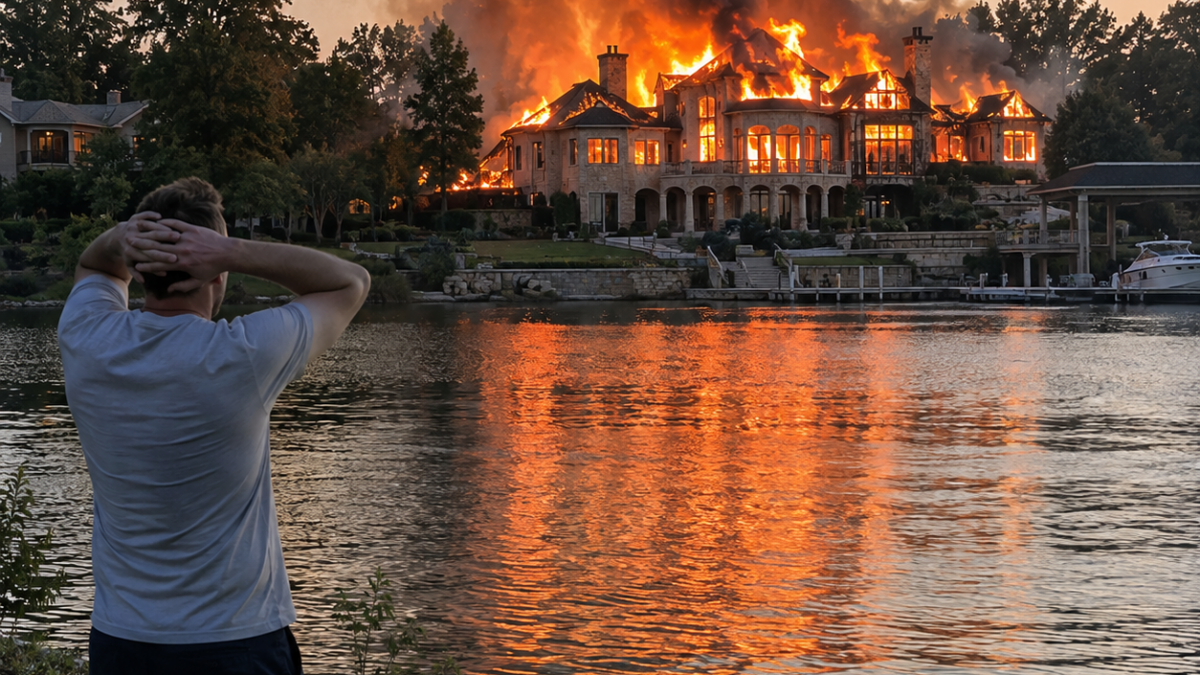
My house was still burning.
I called my wife.
Telling Laura was worse than seeing the flames.
For several seconds after I said the words, she didn’t answer.
Then she asked:
“Is everyone safe?”
“Yes.”
“No firefighters hurt?”
“Not that I know.”
“No one was inside?”
“No.”
She exhaled.
“Then everything else can be repaired.”
That was Laura.
People first.
Always.
I needed her to say it because at that moment, I was looking at nearly five decades of family memories disappearing behind smoke.
My grandfather had bought that lake property in 1978.
There had been almost nothing there.
Woods.
An old fishing cabin.
A dirt road that became mud whenever it rained.
My father slowly rebuilt the cabin into a real house.
Years later, I added a second floor.
New dock.
Stone patio.
Renovated kitchen.
My daughter Madison had learned to swim from that dock.
My father used to mark her height inside the closet of one upstairs bedroom every summer.
Laura and I had spent half our marriage there.
The place was worth a little over three million dollars by then, mostly because nine acres of waterfront land with more than six hundred feet of shoreline had become extremely valuable.
But when I watched that roof burn, I wasn’t thinking about three million dollars.
I was thinking about the pencil marks inside Madison’s closet.
I was thinking about my grandfather’s old metal fishing sign.
I was thinking about Christmas mornings and wet towels and family dinners on the deck.
And Cynthia kept saying:
“It was an accident.”
About forty minutes later, the county fire chief requested a fire marshal.
The fire had crossed a property boundary.
Nobody could agree on exactly where it started.
And one of the burn piles wasn’t part of the contractor’s permitted work.
The county fire marshal arrived around four that afternoon.
His name was Benjamin Ross.
Calm man.
No dramatic accusations.
No shouting.
He spoke to firefighters first.
Then Michael.
Then Gary.
Then Cynthia.
Then me.
I showed him my emails.
Especially the message I had sent Lake Haven weeks earlier.
No access. No clearing. No burning. No equipment. No contractors beyond the surveyed boundary without my written permission.
Benjamin read it.
“Did you give anyone permission to burn brush belonging to you today?”
“No.”
“Did you create any burn pile near this property line?”
“No.”
“Did you authorize the HOA to maintain this wooded strip?”
“No.”
Cynthia interrupted.
“The burn occurred on community land.”
Benjamin looked toward her.
Then at the remains of my deck.
Then back at her.
“If the ignition was entirely on community property, we’ll establish that.”
“I’m telling you it was.”
“I understand what you’re telling me.”
That was the first time Cynthia seemed irritated with him.
Benjamin spent more than an hour behind my house.
He photographed the ground.
Marked several locations with bright orange evidence flags.
Collected soil.
Checked the burn patterns.
Then he walked out of the trees carrying a scorched red metal fuel can.
Cynthia immediately said:
“That isn’t ours.”
Benjamin didn’t react.
He looked at me.
“Mr. Parker, yours?”
“No.”
“Mr. Harris?”
Michael shook his head.
“Green Ridge cans are yellow. Labeled. We inventory them.”
Benjamin turned toward Gary.
“Lake Haven maintenance?”
Gary frowned.
“We use red cans.”
Cynthia looked sharply at him.
“But they’re in the maintenance shed.”
“As far as I know.”
Benjamin said:
“Check.”
Gary left.
Cynthia started talking.
“Contractors abandon fuel containers all the time. We’ve had landscapers—”
Benjamin held up one hand.
“I’ll ask when I need something.”
For the first time that day, Cynthia stopped talking.
Then a firefighter came around the side of the damaged deck.
“Marshal?”
Benjamin turned.
“You need to see this.”
They disappeared beneath the deck.
I started after them.
Benjamin stopped me.
“Stay here for a minute.”
“What did they find?”
“I don’t know yet.”
Those were some of the longest minutes of my life.
When he came back, he was holding a clear evidence bag.
Inside was a partly burned plastic key card.
Gary stared at it.
“That’s Lake Haven.”
Benjamin looked at him.
“What kind of card?”
“Maintenance gate access.”
“Who carries them?”
“Me. Two maintenance employees. The property manager.”
Gary paused.
“And Cynthia.”
Cynthia immediately said:
“Half the staff has had those cards at one time or another.”
Benjamin nodded.
“A card doesn’t start a fire.”
He wasn’t accusing anyone.
Yet.
Then the firefighter called him again.
This time Benjamin stayed gone longer.
When he returned, he wasn’t carrying another object.
He had his camera.
He looked at me.
“Mr. Parker, what electrical service is under your rear deck?”
“Deck lights. Two outlets.”
“Anything else?”
“No.”
“Any buried line running from your house toward Lake Haven?”
I stared at him.
“No.”
He turned the camera.
The photograph showed a thick black cable emerging from burned ground beneath my deck.
Not house wiring.
Not something I recognized.
The cable continued beneath the woods toward the Lake Haven boundary.
Beside it sat a partly melted junction box.
On the lid, under black soot, were printed words.
LAKE HAVEN SHORELINE LIGHTING
SOUTH FEED
I felt something inside me go cold.
I looked directly at Cynthia.
“What is that doing under my house?”
She didn’t answer.
Gary stepped closer.
“We don’t have a south feed.”
Benjamin turned.
“What?”
“Our shoreline lighting ends near the walking trail.”
Benjamin looked back toward the burned woods.
“Not anymore.”
Another firefighter had followed the cable.
He was standing near a patch of disturbed soil inside my property.
Nearly forty feet inside my surveyed line.
Fire had burned away the leaves.
Beneath them was the lid of a small underground electrical cabinet.
The lock had melted.
Stamped across the metal:
PROPERTY OF LAKE HAVEN ESTATES HOA
That changed the investigation.
Immediately.
Benjamin called the county electrical inspector.
He ordered everyone away from the exposed wiring.
Cynthia started insisting:
“The HOA does not have equipment on Parker property.”
I pointed toward the box.
“It has your HOA’s name stamped on it.”
“I’ve never seen that cabinet.”
Gary said:
“Neither have I.”
Cynthia glared at him.
“You’re maintenance supervisor.”
“I know every outdoor panel we service.”
“Then you forgot.”
“No.”
Gary’s voice was firmer now.
“I’ve worked here five years. If Lake Haven owned a south shoreline feed, I would have it on inspection schedules.”
Benjamin asked:
“When was the normal shoreline lighting installed?”
Cynthia answered:
“Most of it came with development. There were some upgrades later.”
That created another problem.
My lake property existed decades before Lake Haven Estates.
If that buried equipment dated to original development, there should have been plans.
Permits.
Recorded access.
Some kind of agreement.
If it was newer, then someone had recently buried HOA electrical infrastructure on my property without permission.
The electrical inspector arrived before dark.
Raymond Lee.
He traced what survived.
The cable came from Lake Haven.
Crossed the wooded boundary.
Reached the underground cabinet.
Continued beneath my rear deck.
Then another branch ran toward the lake.
Raymond studied the insulation.
Connectors.
Burial depth.
“This is newer than the house wiring.”
“How new?”
“Likely within the last few years.”
“Why would Lake Haven run power beneath my deck?”
He looked at Benjamin.
“That’s what we need to figure out.”
The line toward the lake ended near landscape lights I had installed years earlier.
At first, I thought someone had connected into my system.
They hadn’t.
Lake Haven’s cable was completely separate.
It continued beneath the soil toward a cedar near my shoreline.
Under a flat landscaping stone, Benjamin uncovered another junction box.
Inside was a wireless control receiver.
Gary looked at it.
“Never seen that.”
Raymond checked the model number.
“It’s a remote switching unit.”
“For what?”
“Could control lights. Pumps. Gates. Heating equipment. Anything within load.”
“From a phone?”
“Potentially.”
That night, my lake house sat black, wet, and damaged beneath temporary lights while investigators tried to understand why my neighbor’s HOA had secretly buried remote-controlled electrical infrastructure beneath my property.
And that was only the beginning.
Six years earlier, when Lake Haven Estates was first built beside me, I had no major problem with the neighborhood.
Their property was theirs.
Mine was mine.
Simple.
My deed predated their subdivision by decades.
My driveway connected directly to a county road.
I had my own septic.
My own well.
My own shoreline permits.
My own dock.
I did not use their pool.
Did not use their private boat ramp.
Did not pay their dues.
I was not an HOA member.
Most residents understood that.
Cynthia Wallace never seemed to.
She became president about two years before the fire.
Cynthia was fifty-nine.
Smart.
Organized.
Relentless.
Residents either loved her or avoided arguing with her.
She pushed contractors.
Negotiated repairs.
Organized charity events.
Kept common areas immaculate.
If the entrance flowers died, Cynthia had new ones installed before half the neighborhood noticed.
That part was admirable.
Her dangerous trait was what happened after she decided something was good for Lake Haven.
Authority became secondary.
Our first disagreement was over my dock.
Lake Haven adopted a design rule that every dock visible from its shoreline should be dark brown.
Mine was gray.
Cynthia sent me a formal-looking letter.
I called her.
“I’m not in Lake Haven.”
“I know.”
“Then why am I receiving an HOA design rule?”
“Your dock is visible from Lake Haven.”
“So is the moon.”
She didn’t laugh.
“We’re trying to create a consistent shoreline appearance.”
“My dock is permitted through the county and lake authority.”
“I understand.”
“Then your rule doesn’t apply.”
“I’m asking for cooperation.”
“That’s different.”
If she had started there, maybe I would have considered painting it.
But she started by acting like she had authority.
I left it gray.
Our second problem involved trees.
Between my land and Lake Haven’s southern walking trail was a wooded strip about forty feet wide.
Most belonged to me.
A smaller section belonged to Lake Haven.
Cynthia wanted brush cleared so trail users could see the lake.
I agreed that workers could trim branches on the HOA side.
The landscape crew crossed the survey line and cut three young trees on mine.
Not valuable trees.
Not a major tragedy.
I called Cynthia.
She apologized.
The landscaper replaced them.
Problem fixed.
That was how normal neighbor disputes worked.
Then Lake Haven announced the Shoreline Beautification Project.
The plan included wider trails.
Benches.
Native flowers.
Two lake-view areas.
Brush removal.
None of that bothered me if it stayed on Lake Haven’s property.
But one proposed overlook was directly behind my lake house.
Their survey showed the HOA boundary ending before my trees.
Cynthia claimed older developer maps showed a “shared shoreline buffer.”
I asked for proof.
She sent a photocopy of an old concept drawing.
A dotted green strip behind future lots.
Not a deed.
Not an easement.
Not a recorded survey.
My attorney, Rebecca Grant, reviewed it.
“This gives them nothing.”
“That’s what I thought.”
“It’s a concept plan.”
I forwarded that conclusion to Cynthia.
She said Lake Haven’s attorney was reviewing the matter.
Fine.
Then she changed tactics.
“David, would you let us remove dead brush on your side? It’s a fire hazard.”
“A fire hazard?”
“There’s a lot of dry material.”
“I clear it every winter.”
“It’s September.”
“I know what month it is.”
Residents had apparently complained about fallen branches and snakes.
I agreed to walk the boundary with her.
Laura came with me.
Cynthia brought Gary Nelson.
Gary pointed out some dead limbs leaning toward the HOA trail.
Those were reasonable.
“If they’re hanging over your side, remove them.”
He nodded.
Then Cynthia pointed deeper into my property.
“This should all come out.”
“No.”
“It’s dead brush.”
“Some is. Some is healthy understory.”
“It looks neglected.”
“It’s woods.”
“The neighborhood pays a lot to maintain appearances.”
I pointed at the survey marker.
“Your neighborhood ends there.”
“We’re investigating that.”
“Investigate forever. Nobody crosses that marker without asking me.”
Gary nodded.
Cynthia didn’t.
Then she offered money.
“What if Lake Haven maintains this strip and pays you annually?”
“No.”
“One thousand dollars.”
“No.”
“Twenty-five hundred.”
“No.”
Laura asked me later:
“Why not take the money if they want to clear brush?”
“Because I don’t want them treating my property like an extension of their walking trail.”
She nodded.
“And you like the trees.”
“That too.”
For about a month, nothing happened.
Then orange ribbons appeared on trees inside my property.
I removed them.
Two days later, new ribbons.
I called Gary.
“I told the crews not to cross.”
“Someone marked my trees.”
“I’ll check.”
That evening, he called.
A contractor had marked vegetation according to a map Cynthia provided.
Gary stopped them before cutting.
The map showed the same fake “shared shoreline buffer.”
That was when Rebecca told me to write something stronger.
So I did.
No access. No clearing. No burning. No equipment. No contractors. No installation of any kind on Parker property without written permission.
Cynthia responded:
Understood. The HOA will remain within its claimed maintenance area while the boundary issue is reviewed.
I hated the phrase claimed maintenance area.
Rebecca hated it too.
She sent a formal letter.
The deed controlled.
The survey controlled.
A concept map did not.
Any entry beyond the marked line would be unauthorized.
Lake Haven’s attorney, Steven Brooks, answered.
To my surprise, he mostly agreed.
He found no recorded easement over my land.
He advised everyone to stop work near the disputed strip until a new survey removed any doubt.
That should have finished it.
Then Cynthia went quiet.
Laura noticed first.
“She stopped emailing.”
“That’s good.”
“Maybe.”
“What?”
“When Cynthia wants something, she doesn’t usually stop talking.”
My wife knew people better than I did.
The next week, Lake Haven hired Green Ridge Land Services.
Their crews cleaned brush on the HOA side.
Removed dead limbs.
Cut weeds.
Stayed where they belonged.
I waved to them once.
They waved back.
Normal.
Thursday afternoon, Gary called.
“David, they’re planning controlled burns tomorrow.”
I sat up.
“Where?”
“Brush piles along the trail.”
“How close to my property?”
“The nearest was about sixty feet from the line.”
September had been dry.
Very dry.
“Is that legal?”
“They say they have permits.”
“Who approved it?”
“Cynthia.”
I called the county fire office.
A permit existed for several brush piles on Lake Haven property.
I called Cynthia.
“Do not burn close to my woods.”
“We’re on our land.”
“It’s dry.”
“The contractor is professional.”
“Move the pile farther away.”
“That costs money.”
I almost laughed.
Then she said:
“David, you cannot control lawful work on HOA property.”
And technically, she was right.
Just as she could not control mine.
So I called Green Ridge.
Michael Harris listened.
“If conditions are too dry, we postpone.”
“Thank you.”
Friday morning, I drove to the lake house.
Michael showed me the equipment.
Water tanks.
Extinguishers.
Blowers.
Permit paperwork.
Their nearest pile had been moved farther away.
“That’s better.”
Michael smiled.
“We’re not trying to burn your house down.”
“I appreciate the ambitious standard.”
He laughed.
I left around eleven to meet my younger brother Adam for lunch.
At 12:47, Michael called.
I missed it.
At 12:49, he called again.
“David, get back here.”
My stomach tightened instantly.
“What happened?”
“The fire jumped.”
“How bad?”
“We’re calling the department.”
“My house?”
“It’s in the woods behind it.”
I ran.
Seventeen minutes later, I was watching the place burn.
After investigators found the hidden electrical system, the fire scene remained secured overnight.
Laura arrived after sunset.
She stood in the driveway and stared.
Plastic sheeting covered broken areas.
Water still dripped from upstairs.
Smoke hung low.
She walked to the front porch.
Touched a stone column my father built.
Then sat.
I sat beside her.
“We can rebuild.”
“I know.”
“The main structure survived.”
“I know.”
Then:
“Madison’s room?”
I hesitated.
“Damaged.”
That was when she cried.
Not because the house cost millions.
Because memories attach themselves to stupid little pieces of drywall.
The closet where Dad measured Madison.
Photos.
School projects.
Her first fishing trophy.
We stayed at a hotel that night.
I barely slept.
Around three in the morning, something bothered me.
Cynthia had spent months calling the woods behind my house a fire hazard.
She wanted them cleared.
She wanted a lake view.
Now a fire had burned exactly through that strip.
That didn’t prove anything.
I knew that.
Rebecca reminded me the next morning.
“Do not accuse Cynthia publicly.”
“I’m not.”
“Do not post theories online.”
“I won’t.”
“Save every shoreline email.”
That I could do.
I found Cynthia’s messages.
Dead brush.
View corridor.
Maintenance area.
Landscape fee.
Then an email from three months earlier.
She had asked whether Lake Haven could install low-voltage shoreline accent lighting near its trail.
I answered:
Only on HOA property. Nothing across my boundary.
She replied:
Understood.
Two months later, she accidentally copied me on another email.
To Gary:
South lighting may need to extend closer to Parker shoreline for visual continuity. Please price options.
Gary replied:
Cannot cross private line without owner approval.
Cynthia:
I’ll handle owner issue.
She never did.
I sent everything to Rebecca.
Rebecca sent it to Benjamin.
Meanwhile, Lake Haven’s board suspended all shoreline work.
Cynthia remained president temporarily.
Nonessential maintenance spending was frozen.
The board offered to help Laura and me with temporary housing.
We declined.
Insurance covered it.
But the gesture mattered.
Lake Haven residents were not responsible for Cynthia’s choices.
Susan Miller, one of the homeowners we knew well, came to our hotel carrying clothes, toiletries, food.
Laura hugged her.
“You didn’t have to do this.”
“I know.”
That was what made it kindness.
Two days later, we were allowed into safer parts of the house.
Madison drove from Nashville.
She came downstairs carrying a soaked cardboard box.
Her old fishing trophy survived.
So did the height marks in the closet.
She stared.
“I was tiny.”
“You were loud.”
“I’m still loud.”
“Correct.”
The house was damaged badly.
But not destroyed.
Insurance estimated eight to twelve months to restore.
Then Benjamin gave us the first major fire finding.
Green Ridge’s permitted controlled burn did not start the fire that reached my house.
Their pile burned normally.
Contained.
The source path began at the second southern burn circle.
The one nobody claimed.
Benjamin had found accelerant residue between that circle and brush closer to my boundary.
Not some ridiculous river of gasoline.
Enough to suggest someone encouraged the fire from one pile toward another.
I asked:
“Arson?”
His answer was careful.
“Potential intentional ignition and spread.”
“So someone deliberately started it?”
“Someone may have deliberately ignited or extended that second burn. That is not the same as proving who or why.”
Good investigators separate possibilities from conclusions.
Then Gary checked Lake Haven’s fuel inventory.
Four red containers listed.
Three present.
The burned can matched the missing type.
Still not proof of who carried it.
But “wind changed” was becoming difficult to believe.
Trail cameras added more.
At 9:18 that morning, Cynthia drove an HOA utility cart toward the southern trail.
Returned.
At 10:42, she drove south carrying cut branches.
At 10:55, the cart came back empty.
“What were you doing?” Benjamin asked later.
“Moving loose branches.”
“To where?”
“The southern pile.”
“The unpermitted southern pile.”
“I thought Green Ridge prepared it.”
Michael Harris said:
“No.”
His crews marked every official burn pile with orange flags.
The southern pile had none.
Then another clip.
11:37.
Cynthia’s cart heading south.
A red fuel container visible in the rear.
11:46.
Cynthia returning.
No visible fuel container.
Her attorney argued image quality was imperfect.
Fair.
Cynthia said she transported fuel for Green Ridge.
Michael checked logs.
Green Ridge brought all its own fuel.
Benjamin showed Cynthia the burned can.
She stopped answering on counsel’s advice.
Still, Benjamin didn’t arrest her.
He kept investigating.
That patience mattered.
Then came the electrical system.
Raymond traced Lake Haven’s legitimate shoreline lighting back to a panel near their clubhouse maintenance building.
The approved circuit had been added eighteen months earlier.
Permit plans ended on HOA property.
But the physical cable had been extended almost 180 feet farther.
Across my boundary.
Under my deck.
Toward my shoreline.
The original electrical contractor denied installing it.
His owner, Patrick Lewis, looked at the cable.
“That isn’t ours.”
“How do you know?”
“Different manufacturer. Different burial method. Different connectors.”
Official installation stopped where the permit showed.
Someone added the rest later.
Gary searched invoices.
He found one.
Four months earlier.
Wallace Property Solutions — $6,800
Southshore Lighting Completion / View Area Preparation
Wallace.
Same last name as Cynthia.
Steven Brooks asked at an emergency board meeting:
“What is Wallace Property Solutions?”
Cynthia answered through her attorney.
Her brother Mark owned it.
The board had never been told.
The $6,800 invoice was below the amount requiring a formal board vote.
Cynthia approved it herself.
Gary thought it was a normal subcontractor.
He didn’t know the owner was Cynthia’s brother.
Mark Wallace was interviewed.
He admitted his company installed an extension.
He claimed Cynthia told him Lake Haven possessed maintenance rights across a “shared shoreline buffer.”
Same concept map.
Same nonexistent right.
He said he believed the boundary was farther south.
Raymond showed him the surveyed stakes.
Mark stared.
“Those weren’t there when we worked.”
“Yes, they were,” I said later.
I had paid for a new survey six months earlier.
Bright pink-topped markers.
Visible.
Investigators walked the line.
Three survey stakes near the electrical route were missing.
Not burned.
Not knocked over.
Missing.
Mark denied removing them.
Cynthia’s lawyer told us not to speculate.
Fair.
Then Raymond opened the buried cabinet.
Two breakers.
One:
SHORELINE LIGHTING
The other:
VIEW CLEARING EQUIPMENT
I stared.
“What the hell is view clearing equipment?”
Nobody from Lake Haven maintenance knew.
The cable from that breaker didn’t go toward lights.
It ran toward the strip Cynthia wanted opened.
Benjamin and Raymond followed what remained.
Near the southern burn circle, they found a heavy outdoor outlet mounted low behind a tree.
Beside it were the remains of a portable electric brush heater.
Michael stared.
“My crew does not use that.”
Gary:
“Neither do we.”
It was equipment capable of producing high heat for outdoor vegetation work.
Then investigators found melted pieces of a remote receiver.
Same manufacturer as the wireless control near my shoreline.
Raymond explained:
“That means the heater could likely be switched remotely.”
“From the control system?”
“Yes.”
“Someone didn’t have to stand beside it?”
“Correct.”
I felt cold.
This wasn’t a simple brush pile somebody lost control of.
Somebody had buried remote-controlled equipment on my land.
Equipment my HOA neighbor’s maintenance department did not know existed.
Connected to a heater.
Positioned near the area the HOA wanted cleared.
Installed by Cynthia’s brother.
That evening, Lake Haven’s board suspended Cynthia.
All payments to Wallace Property Solutions were frozen.
Through her attorney, Cynthia released a statement:
She had never intended for my house to burn.
She had never authorized damage to private property.
Rebecca read that sentence twice.
“Interesting wording.”
“I know.”
“Don’t overread lawyer language.”
“I know.”
But it stayed with me.
Never intended for my house to burn.
Not:
I never authorized burning.
Not:
I had nothing to do with ignition.
Benjamin obtained manufacturer records for the remote system.
The hidden receiver had been activated four months earlier.
Account name:
Lake Haven Southshore Project
Administrator:
Cynthia’s HOA email.
Still not enough.
An administrator account can be shared.
Benjamin obtained device logs.
The brush-heater circuit activated at 11:58 a.m. on the day of the fire.
Off at 12:21.
On again at 12:29.
First 911 report:
12:44.
Commands came from Cynthia’s registered phone.
Not merely her account.
Her phone.
When confronted, Cynthia changed her story.
She admitted activating the heater.
Her explanation:
“I intended to dry and burn a small brush pile.”
“Where?” Benjamin asked.
“Inside Lake Haven’s maintenance area.”
“You had been told the area was disputed.”
“I believed the old buffer map was correct.”
“Did Green Ridge approve remote ignition?”
“I believed they understood the setup.”
Michael denied it completely.
He had never seen the heater.
Never inspected it.
Never approved it.
The southern pile was not on his permit.
Now there was no serious dispute that Cynthia had caused the fire.
Maybe she hadn’t intended to burn my house.
I actually believed she hadn’t.
But she intentionally activated unauthorized equipment to burn vegetation near my property after I had explicitly forbidden burning or clearing there.
The flames did the rest.
Then Benjamin asked:
“Why that day?”
Cynthia looked toward her lawyer.
She didn’t answer.
But investigators had found something inside the buried cabinet.
Behind the breakers was a plastic sleeve.
Inside:
A map.
Project schedule.
And a letter.
The map showed my property.
Lake Haven trail.
Wooded strip.
A proposed viewing platform extending partly across my boundary.
Project schedule:
Clear brush
Remove south tree line
Install view deck
Complete before property tour — October
I looked at Rebecca.
“What property tour?”
Benjamin turned the final page.
Luxury resort company:
Blue Harbor Retreats
The company was considering a partnership involving a large portion of Lake Haven’s lakefront common area.
Private resort events.
Clubhouse access.
Improved landscaping.
Potential payments worth several million dollars if the concept eventually moved forward.
One major selling point was a panoramic southern lake view.
My trees blocked it.
At the bottom of the schedule:
Parker still refusing. South buffer must be cleared before tour or deal may fail.
The handwriting looked like Cynthia’s.
Beneath it, another note in different ink:
If fire safety clearing becomes necessary, insurance may cover restoration.
Benjamin stared at that sentence.
Then at my damaged house.
“David, this may not have begun as a plan to burn your home.”
I waited.
“But someone was thinking about fire before the fire happened.”
Still, he refused to call it a conspiracy.
The handwriting wasn’t identified.
The sentence could theoretically mean ordinary fire-safety work.
It could mean landscaping restoration if controlled burning damaged HOA property.
Or it could mean someone was considering fire as a convenient way to solve the tree problem.
Evidence had to decide.
Not anger.
Cynthia admitted writing the first note.
The one saying I was still refusing.
She denied the insurance note.
But that admission established something important.
She wanted the tree line gone before Blue Harbor visited.
Blue Harbor cooperated with investigators.
Their project director, Allison Pierce, told me:
“We were never told private land was involved.”
“Who told you the view corridor belonged to Lake Haven?”
“Cynthia.”
Blue Harbor had never demanded that Lake Haven clear my property.
They believed the proposed overlook was entirely inside HOA common land.
Then they produced Cynthia’s presentation.
One slide showed the current view from Lake Haven’s southern trail.
My trees blocked much of the water.
Over that photo was a conceptual image.
Trees gone.
Lake wide open.
Wood viewing deck extending toward shore.
Caption:
PROPOSED SOUTHERN LAKE OVERLOOK — PHASE ONE
I pointed at it.
“That deck is on my property.”
Rebecca nodded.
“Part of it.”
“How could they propose this without asking me?”
“They can draw anything.”
She looked at me.
“Building is the part that requires permission.”
Again, paper wasn’t land.
A concept wasn’t consent.
Then Steven Brooks found the HOA minutes from the meeting where Cynthia first introduced Blue Harbor.
The board authorized her to explore a possible partnership.
That was all.
No viewing deck approval.
No permission to clear land.
No authorization to hire her brother.
No secret electrical installation.
No burn project.
One board member, Frank Delaney, had specifically asked whether the southern overlook required land outside Lake Haven.
Cynthia answered:
No. The project can be completed entirely within existing common area.
That statement was false.
And by the time she said it, Steven had already advised her there was no recorded easement across my land.
She could no longer claim innocent reliance on the old concept map.
The board permanently removed her as HOA president.
Nobody celebrated.
That mattered.
Cynthia had done good things for Lake Haven.
Organized charity drives.
Helped elderly residents during storms.
Forced the original developer to fix defects.
People could acknowledge that and still conclude she had become dangerous with authority.
William Harris became acting president.
His first letter to me was almost beautiful because of how boring it was.
Lake Haven Estates claims no maintenance rights over the Parker property, no right to remove trees, no right to install electrical equipment, and no right to build structures beyond the surveyed boundary.
I showed Laura.
“Best HOA letter I’ve ever received.”
“Frame it.”
“I might.”
“You’re becoming strange.”
“Becoming?”
The rebuild was exhausting.
Smoke reached almost every room.
Walls opened.
Electrical circuits replaced.
Roof framing repaired.
Kitchen gutted.
Deck demolished.
We saved what we could.
Grandfather’s fishing sign.
Madison’s closet marks.
Dad’s tackle box.
An oak dining table.
Laura found an old photo of herself with Madison on the dock twenty years earlier.
Water damaged around the edges.
Faces still visible.
She held it for a long time.
“This is why I want to rebuild.”
I understood.
Then Benjamin called.
The insurance note handwriting wasn’t Cynthia’s.
It strongly resembled Mark Wallace’s.
Investigators compared it against his invoices and job notes.
Mark came in with a lawyer.
Eventually he admitted writing it.
His explanation:
Cynthia had complained that if southern clearing became part of a formal fire-safety project, Lake Haven’s insurance might cover restoration if landscaping were damaged.
“Why write that on a viewing-deck schedule?” Benjamin asked.
Mark said:
“They were discussing several projects.”
Messy.
Possible.
But then he admitted he had installed nearly the entire hidden electrical system.
Cynthia hired him.
She showed him the old buffer map.
Told him the land was part of Lake Haven’s maintenance area.
“Did you verify it?”
“No.”
“Did you pull permits for the Parker side?”
“I thought it was HOA land.”
“Did you see survey markers?”
Mark hesitated.
“Yes.”
That mattered.
“What did you think they were?”
“I didn’t know.”
“Did you ask?”
“No.”
“Did you remove them?”
“No.”
“Did Cynthia mention them?”
Mark paused.
“She said old markers were confusing the project.”
That wasn’t proof she removed them.
But everything around Cynthia seemed to involve inconvenient facts being redefined.
Boundary.
Burn permit.
Concept map.
Electrical line.
My repeated no.
Blue Harbor itself turned out to be less financially certain than Cynthia’s papers suggested.
There was no guaranteed multimillion-dollar payment.
The company was exploring a potential long-term partnership.
Residents would eventually need to approve portions of it.
Cynthia had presented the deal as more mature than it was.
The board ended negotiations.
Blue Harbor withdrew without fighting.
Then insurance produced the first major estimate.
More than $900,000 in damage.
House.
Deck.
Personal property.
Landscaping.
Stabilization.
The three-million-dollar lake house wasn’t a total loss.
The carrier would pay to rebuild under policy terms, then pursue responsible parties.
That let Laura and me focus on the property instead of personally litigating every repair bill.
Then Benjamin called again.
The remote logs showed the hidden system had been used dozens of times during the previous four months.
Mostly at night.
Short activations.
Sometimes shoreline lights.
Other times:
VIEW CLEARING EQUIPMENT
The brush heater had been used before.
I stared at the dates.
A few matched nights when I remembered seeing strange light through the trees.
I thought Lake Haven’s trail lights were brighter.
Investigators searched the strip.
Under leaves, they found small blackened patches.
Three feet.
Four feet.
Old cut brush burned in place.
Near the same view corridor.
Mark eventually admitted he and Cynthia had “tested” the system several times.
“Tested what?” Benjamin asked.
“Small controlled clearing.”
“Where?”
Mark pointed to the old map.
“The buffer.”
Benjamin corrected him.
“Parker property.”
Mark stopped talking.
Those old burns made me angrier than the house fire in a strange way.
The major fire might be described as one terrible result.
The earlier fires showed repetition.
Secret entry.
Secret burning.
Small enough that I wouldn’t notice.
Cynthia’s lawyer continued saying she believed the shared buffer gave Lake Haven authority.
Rebecca pointed out the problem.
Cynthia had received multiple letters explaining the actual surveyed boundary.
She knew the ownership was disputed.
Even her own reply used the phrase claimed maintenance area.
She knew.
The district attorney’s office formally joined the investigation.
Nobody promised charges.
Then Gary found another document.
Three months before the fire, Cynthia submitted a maintenance request:
Remove several dead trees from southern strip.
Gary had written:
PRIVATE PROPERTY — CANNOT PROCEED WITHOUT PARKER APPROVAL
Underneath, Cynthia had written:
I WILL RESOLVE.
She never resolved anything with me.
Two weeks later, her brother began hidden electrical work.
The sequence was getting ugly.
Cynthia tried official HOA maintenance.
Gary refused.
She asked me.
I refused.
She hired her brother.
Hidden equipment appeared.
Small fires began.
Blue Harbor created a deadline.
Then the house burned.
That didn’t prove she wanted the house destroyed.
It proved that every time one legitimate path closed, Cynthia found another way around it.
A few weeks after the fire, while contractors were inside my damaged house, Cynthia stopped at the bottom of my driveway.
She didn’t enter.
She called.
“David, can we talk?”
I almost said no.
Then I remembered Laura once telling me:
“Listening isn’t surrender.”
I walked down.
Cynthia looked different.
No perfect makeup.
No binder.
No board-president posture.
“I never wanted your house to burn.”
“I believe you.”
She looked surprised.
“You do?”
“Yes.”
And I did.
I did not believe Cynthia woke up that morning planning to destroy my family home.
That almost made the story worse.
Because she caused enormous damage while convincing herself she was doing something smaller.
“I wanted the trees cleared,” she said.
“I know.”
“I thought the heater was safer than open burning.”
“Then why did you build a pile?”
She looked down.
“Some branches wouldn’t dry fast enough.”
“Green Ridge had a legal burn that day.”
“Yes.”
“So you thought if your little fire looked like part of theirs, no one would question it?”
She didn’t answer.
That was enough.
“Did you remove my survey stakes?”
“No.”
“Did Mark?”
“I don’t know.”
“Did you tell him they were confusing the project?”
“Yes.”
“Why?”
“Because the old map showed something different.”
“The old map wasn’t ownership.”
“I know that now.”
I shook my head.
“No, Cynthia. You knew that then. Your attorney told you.”
She started crying.
Quietly.
I didn’t comfort her.
I didn’t attack her either.
“Blue Harbor became an obsession,” she said.
Lake Haven dues had risen.
Pool retaining wall needed repair.
Insurance costs were up.
She thought a partnership could bring revenue without another major special assessment.
The unobstructed view became essential in her mind.
“So my trees became Lake Haven’s financial problem.”
“Yes.”
“And every time I said no?”
She looked at the ground.
“I kept thinking there had to be another solution.”
“There was.”
“What?”
“Accept no.”
She nodded.
Then I asked:
“Why did you call the fire an accident before anyone knew where it started?”
Her answer came quietly.
“Because I knew the heater was there.”
There it was.
When flames were still inside my roof, Cynthia already knew her unauthorized equipment might have caused the fire.
She didn’t tell firefighters.
She didn’t tell the fire marshal until evidence forced her.
Before leaving, she said:
“I’m sorry.”
I looked at the damaged roof.
“I believe you’re sorry.”
That was not forgiveness.
It was simply recognition.
A week later, prosecutors charged Cynthia and Mark in connection with the unauthorized burn and property damage.
No raid.
No dramatic arrest at the clubhouse.
Both surrendered through attorneys.
Processed.
Released under conditions.
Residents reacted predictably.
Some wanted them destroyed.
Some defended Cynthia because of her earlier community work.
Most were embarrassed.
William Harris sent everyone an email.
The courts will address individual responsibility. Our responsibility is ensuring this cannot happen again.
That was leadership.
Lake Haven hired outside engineers to inspect projects approved during Cynthia’s presidency.
Most were normal.
Some had paperwork issues.
Then engineers found another unapproved underground project near the clubhouse.
Wallace Property Solutions had installed electrical conduits for a potential Blue Harbor event area.
Again, Cynthia had divided invoices.
$4,900.
$5,700.
$6,200.
Each below the full-board approval threshold.
Together, one larger project.
Steven called it approval avoidance.
Not necessarily theft.
Not necessarily criminal by itself.
But a deliberate way to bypass oversight.
The board changed financial rules.
Related invoices would be treated as one project.
Family-owned vendors required written disclosure.
Boundary work required legal review.
And nobody could install remote burn equipment.
No one argued with that rule.
Then investigators found a sticker inside my burned cabinet.
Date:
Two days before the fire.
Initials:
MW
Mark Wallace.
His company calendar showed an appointment that day.
SOUTH BUFFER FINAL PREP FOR TOUR — 3 HOURS
Cynthia approved it.
Mark said he tested circuits.
Cleared weeds.
Then Benjamin recovered photos from Mark’s phone backup.
One showed the hidden outlet.
Another the heater.
Another my tree line.
The fourth made me feel sick.
Four of my trees had giant orange X marks painted on their trunks.
Behind them, through the branches, you could see open water.
Under the photo, Mark had written:
These four go first. Once they’re down, Blue Harbor gets the view.
Cynthia replied:
Good. Tour is next week. David cannot keep holding this up.
I stared at that sentence.
The fire had burned through two of those trees.
Two remained.
Rebecca noticed something at the base of one tree in the photo.
A clear plastic jug.
Partial label:
Vegetation Control Concentrate
Investigators traced the product.
Commercial herbicide designed to kill woody vegetation.
Legal when properly used.
Illegal to apply secretly to someone else’s trees.
Mark had purchased two gallons a week before the fire.
He claimed it was for HOA weeds.
An arborist inspected the two surviving marked trees.
Near their bases were small drilled holes.
Inside:
Chemical residue consistent with woody-plant killer.
Someone had already tried to kill them.
The burn was not the first attempt.
Benjamin called.
“David, we need to inspect the entire boundary.”
“Why?”
“If four trees were treated, there may be others.”
The next morning, investigators walked the full disputed strip.
For two hours, nothing.
Then the arborist stopped beside a large oak four hundred feet from my house.
Drilled hole.
Faded orange paint.
Next tree.
Same.
Next.
Same.
By noon:
Seventeen trees.
Seventeen trees on my land had been deliberately chemically treated.
All along the exact line needed to open Cynthia’s panoramic view.
Then an investigator found a buried plastic tube near one oak.
Inside was a rolled document protected from rain.
Benjamin opened it.
Work instruction.
Wallace Property Solutions.
SOUTH VIEW CORRIDOR TASK
CHEMICAL TREE REMOVAL / STAGED CLEARING
Special note:
DO NOT CUT UNTIL DECLINE IS VISIBLE. OWNER MAY ASSUME NATURAL LOSS.
At the bottom:
Mark Wallace’s signature.
And beneath it:
Approved — Cynthia Wallace
Dated almost three weeks before the fire.
For the first time, Cynthia could no longer claim the entire thing was a misunderstanding about brush.
She had approved chemical tree removal designed to look natural.
The goal was obvious.
Kill my trees quietly.
Wait.
Then remove them as dead or dangerous.
The fire hadn’t created the scheme.
The fire exposed it.
Rebecca stood beside me staring at the seventeen marked trunks.
“Don’t touch anything.”
I almost laughed.
For months, I told Lake Haven not to touch my land.
Now my own attorney was telling me not to touch my own trees because they were evidence.
The arborist said some could survive.
Others had absorbed too much herbicide.
Two near the house were weakened before the fire damaged them.
Investigators compared the work order to invoices.
Three separate “vegetation management” invoices.
All approved by Cynthia.
None mentioned Dalton Bend property.
None mentioned chemical treatment.
Each below the board-review threshold.
Together, they covered the precise period when my trees were drilled and poisoned.
Lake Haven terminated every remaining Wallace Property Solutions contract.
An independent accountant reviewed Cynthia’s spending.
There was no giant secret bank account.
No missing millions.
Most HOA money went where it was supposed to.
The problem was control.
Cynthia divided projects into smaller pieces.
Avoided votes.
Used relatives without disclosure.
Pushed work forward before anyone could ask inconvenient questions.
The criminal case became clearer too.
Prosecutors did not claim Cynthia wanted to burn my lake house down.
That mattered.
The evidence showed her goal was to remove trees.
Open the view.
Advance Blue Harbor.
But intent does not erase consequence.
She activated a heater.
On land she didn’t own.
Near a dry wooded area.
After I explicitly refused permission.
Using equipment hidden on my property.
During a day when another contractor’s legitimate burn could provide convenient cover.
Then the fire reached my house.
That was responsibility.
The case took nearly ten months.
Both Cynthia and Mark initially pleaded not guilty.
Their lawyers argued the house damage itself was accidental and that both had misunderstood Lake Haven’s historical maintenance rights.
Prosecutors focused on what could actually be proven.
Unauthorized burning.
Property damage.
Hidden electrical installation.
Chemical vegetation treatment.
Records showing both knew I objected.
Eventually, both accepted negotiated pleas.
Cynthia pleaded to offenses tied to reckless burning, property damage, and unauthorized interference with my land.
Mark resolved charges involving the electrical installation, chemical treatment, and property damage.
There were probation terms.
Restitution.
Community service.
Mark faced work restrictions until completing proper licensing and compliance requirements.
Nobody went to prison for twenty years.
Nobody needed to for the story to have consequences.
Cynthia also agreed never to serve again on the Lake Haven board as part of a civil resolution.
Wallace Property Solutions lost most of its HOA work.
Mark eventually closed it.
Later he took a supervisory job at a larger landscaping company where someone else reviewed projects before crews crossed property lines.
Part of me wanted him ruined forever.
Another part knew accountability is not the same thing as permanent destruction.
Insurance took longer.
My carrier paid the major reconstruction, then pursued Lake Haven’s liability carrier and Mark’s insurer.
Laura and I received compensation for actual losses not covered elsewhere.
Deductibles.
Temporary expenses.
Personal property.
Landscaping restoration.
The settlement was significant.
The damage was significant.
But nobody handed me ten million dollars because I was angry.
The purpose was to repair what had been harmed.
Seven of the seventeen chemically treated trees could not be saved.
Two had also been burned badly.
The arborist recommended removal.
That hurt more than I expected.
Those trees had blocked the view Cynthia wanted.
Now they were dying.
For one ugly moment, I thought:
She still got what she wanted.
Laura heard me say it.
Then she said:
“We don’t have to replace them the same way.”
“What do you mean?”
“It’s our property. Rebuild it our way.”
So we did.
An independent landscape architect designed a new buffer.
Native oaks.
Maples.
Evergreens.
Better erosion control.
Wildlife cover.
Privacy.
Several trees were planted slightly closer to the lake.
When they mature, Lake Haven’s southern view will actually be more screened than before.
Was there a little satisfaction in that?
Yes.
I’m not going to pretend otherwise.
The hidden electrical system was completely removed.
Raymond supervised.
Every Lake Haven cable on my side came out.
Cabinet removed.
Remote equipment removed.
Brush heater remained evidence until the criminal case ended, then was destroyed.
I installed a simple wooden sign near the survey line.
PRIVATE PROPERTY
NO HOA ACCESS WITHOUT OWNER PERMISSION
Laura looked at it.
“Subtle.”
“I considered flashing lights.”
“No.”
“Electric fence?”
“Absolutely not.”
Marriage saved Lake Haven from several bad ideas.
The house took almost a year to rebuild.
We preserved the original stone living room.
Madison’s closet wall survived.
Laura had contractors place a clear protective panel over the old height marks instead of covering them.
The kitchen became entirely new.
Laura chose the cabinets.
I offered one opinion.
She ignored it.
Probably wise.
The rear deck was rebuilt with more fire-resistant materials.
We created better separation between the house and woods.
That was the ironic part.
Cynthia had been correct that some vegetation management was useful.
Her concern was not completely imaginary.
Her method was indefensible.
A good concern does not excuse a bad method.
Lake Haven changed too.
William Harris’s board created stronger rules.
Family vendors disclosed.
Related invoices grouped together.
Any work within one hundred feet of neighboring property required a confirmed survey.
Burning required permits and direct licensed supervision.
Electrical installations required licensed review.
No HOA officer could authorize infrastructure on private neighboring land without a signed agreement.
Boring rules.
Excellent rules.
Blue Harbor never returned to the original deal.
Allison Pierce told Lake Haven the company wanted nothing to do with a project associated with unauthorized clearing and disputed land.
They later pursued another resort concept miles away.
Lake Haven lost the opportunity.
Some residents blamed Cynthia.
Some blamed the old board.
A handful blamed me for refusing to sacrifice my trees for the neighborhood’s view.
That annoyed me at first.
Then I stopped caring.
People were allowed to think I was stubborn.
I was stubborn.
The land was still mine.
Those facts could coexist.
Fourteen months after the fire, Rebecca emailed me.
“Cynthia wants to send you a letter.”
I read it at the rebuilt lake house.
First sentence:
I kept telling myself I was protecting Lake Haven from higher costs, and that became the excuse I used for every line I crossed.
More honest than I expected.
She wrote about rising dues.
The retaining wall.
Insurance costs.
Blue Harbor.
She had convinced herself the deal could solve several community problems at once.
Then my trees became the obstacle.
First, she believed I would agree.
Then she believed money would convince me.
Then she believed the old buffer map gave her enough authority.
Then she decided small clearing work would not matter.
Then she believed weakening trees would make removal easier.
Then she believed a controlled burn could finish part of the clearing before the tour.
Each step felt smaller because she had already justified the previous one.
Then she wrote a sentence Laura read twice.
I did not decide one morning to burn your house. I decided many smaller times that your “no” mattered less than my plan. The fire was where those decisions finally caught up with me.
That was probably the truest explanation of the whole disaster.
She apologized for the hidden electrical system.
For using her brother without disclosure.
For the chemical treatment.
For activating the heater.
For failing to immediately tell firefighters what she knew.
And finally:
My decision caused a fire that entered your property and damaged your family’s home. I cannot make that smaller by saying I did not mean for the house to burn.
I didn’t answer immediately.
A month later, I sent a short response.
I told her I believed she regretted it.
I hoped she learned the difference between responsibility and control.
Then I quoted something my father used to say:
If you have to hide how you are solving a problem, you probably already know the solution is wrong.
That was all.
We did not become friends.
Forgiveness does not magically restore trust.
Lake Haven residents remained part of our lives.
Susan still visited Laura.
Robert Jenkins helped me hang my grandfather’s fishing sign near the dock again.
William called before every project near our boundary.
Sometimes unnecessarily.
“David, we’re replacing two benches.”
“Are they on my property?”
“No.”
“Then why are you calling?”
“Habit.”
“Good habit.”
That was what changed.
People asked.
Nobody assumed.
One summer, Lake Haven held a charity cookout.
William invited us.
I hesitated.
Laura said:
“We should go.”
So we did.
People asked about the rebuilt house.
Several apologized.
I kept saying:
“You are not Cynthia.”
That mattered.
A community should not be punished forever because one leader abused authority.
Most Lake Haven residents had never known about the hidden cable.
The chemical treatment.
The small burns.
The Blue Harbor schedule.
They wanted normal things.
Safe roads.
Maintained trails.
Reasonable dues.
The lake house was completed just before fall.
Our first full weekend back, Madison came from Nashville.
We grilled on the rebuilt deck.
Laura opened the windows because she said new construction smelled “too clean.”
I sat looking at the new trees.
Young.
Small.
Moving in the evening wind.
The old woods were gone in places.
I missed them.
But every tree standing there now existed because we chose it.
Madison sat beside me.
“Do you miss how it used to look?”
“Yes.”
“Do you hate Cynthia?”
“No.”
She looked surprised.
“I thought you would.”
“I hate what she did.”
“That’s different?”
“Yes.”
She thought about it.
“Grandpa would say something like that.”
Probably.
My father believed anger was useful for five minutes.
Long enough to recognize danger.
Not long enough to build a life around.
Years later, people reduced the story to one sentence:
An HOA Karen burned David Parker’s lake house, and the fire marshal found a secret electrical system.
Technically true.
But incomplete.
The fire marshal didn’t find one secret.
He found a pattern.
A hidden cable.
Buried cabinet.
Remote brush heater.
Unapproved burn pile.
Missing survey markers.
Undisclosed family contractor.
Resort proposal.
Repeated secret burns.
Seventeen chemically treated trees.
A work instruction telling workers to make the trees look naturally sick.
And a paper trail showing that my repeated refusal had gradually become something Cynthia believed she had the right to work around.
Fire has an interesting quality.
It does not care what you call things.
Cynthia could call my woods a shared buffer.
She could call hidden wiring shoreline lighting.
She could call the remote heater view-clearing equipment.
She could call my trees a hazard.
She could call the whole thing community improvement.
Fire still follows fuel.
Heat.
Wind.
Physics.
Benjamin Ross followed those same facts backward.
From my roof.
To the deck.
To the woods.
To the southern pile.
To the heater.
To the hidden circuit.
To Cynthia’s phone.
To the buried cabinet.
To her brother’s invoices.
To Blue Harbor.
To the poisoned trees.
Facts were stubborn.
Property lines were stubborn too.
Sometimes that is a very good thing.
Today, my lake house stands again.
The stone fireplace survived.
Madison’s height marks survived.
My grandfather’s fishing sign survived.
The new trees are growing.
Lake Haven’s trail stays on Lake Haven property.
Its lights stop at the boundary.
Its contractors know exactly where the line is.
And before anyone burns so much as a pile of leaves near the southern trail, William Harris probably has three permits, two surveys, and a lawyer watching from fifty feet away.
I can live with that.
Sometimes I walk behind the house to the place where the hidden electrical cabinet used to sit.
There is nothing there now.
No cable.
No heater.
No buried HOA box.
Just grass and soil.
The emptiness feels peaceful.
Cynthia spent months trying to control that strip because Lake Haven could see it.
She learned the hardest possible version of a simple lesson:
Seeing something does not make it yours.
Wanting something does not make it yours.
Believing your community would benefit does not make it yours.
And a plan does not become noble simply because the person pushing it believes the outcome will be good.
My lake house burned because one person kept treating my word no as a temporary obstacle.
The fire marshal found everything she had tried to hide.
The courts handled the criminal consequences.
Insurance handled the money.
Contractors rebuilt the house.
But the most important part of the ending was much simpler.
The property line never moved.
On one side stood Lake Haven Estates.
On the other stood my home.
And after the fire, the investigation, the hidden wiring, the poisoned trees, the court case, and nearly a million dollars in damage, everyone finally understood the difference.