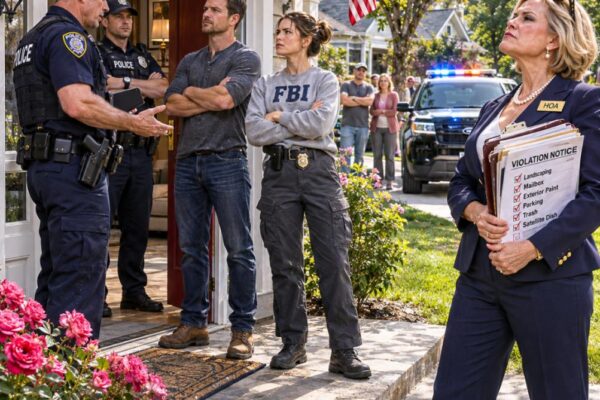
HOA Karen Called 911 to Have Me Removed From My Own Cabin—She Thought Her Word Was Enough.k
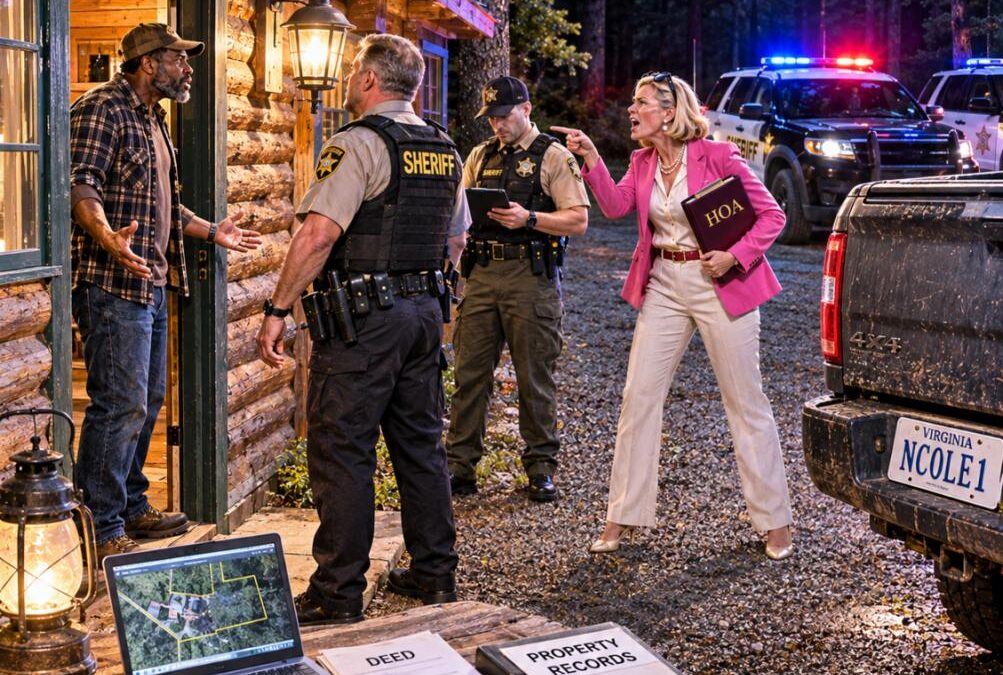
HOA Karen Called 911 to Have Me Removed From My Own Cabin—She Thought Her Word Was Enough
She told the dispatcher a suspicious Black man had broken into a cabin that had belonged to me for eleven years.
Then HOA Karen stood behind the arriving officers and insisted I was lying about owning my own property.
When one officer walked toward my truck and suddenly stopped at the license plate, the expression on his face told me this night was about to become something she hadn’t planned for.
The first thing I saw through my cabin window was red light moving across the pine trees.
Then blue.
Then red again.
For half a second, I thought there had been an accident on the narrow road below my property.
Then headlights swept across my porch.
Two sheriff’s cruisers came up my gravel drive.
My stomach tightened.
I set my coffee on the kitchen counter and walked toward the front door.
Before I reached it, someone knocked hard enough to rattle the old frame.
“Sheriff’s office.”
I stopped.
Through the narrow window beside the door, I saw two deputies standing on my porch.
Behind them, twenty yards down the driveway, stood Karen Whitmore.
Arms crossed.
Lips pressed into a satisfied line.
She lived in the cedar cabin across the road and served as president of the Pine Ridge Property Owners Association.
She had barely spoken ten sentences to me in the six months since she bought her place.
Apparently she’d found plenty to say to 911.
I opened the door slowly.
The older deputy stood slightly forward.
“Evening, sir. We received a report of a possible burglary or trespass in progress.”
I stared at him.
“At this cabin?”
“Yes, sir.”
“This is my cabin.”
Behind him, Karen spoke immediately.
“No, it isn’t.”
The younger deputy turned toward her.
I kept my hands where both officers could see them.
“My name is Nathan Cole. I own this property.”
Karen walked closer.
“He doesn’t live here.”
I looked at her.
“I don’t have to live here full-time to own it.”
“I’ve never seen you before this weekend.”
“You moved here six months ago.”
Her face tightened.
The older deputy raised one hand.
“Let’s have one person speaking at a time.”
Karen pointed toward my truck.
“He showed up yesterday in that vehicle. He’s been going in and out of the house. Nobody in the association knows him.”
“That isn’t true.”
“Then prove it.”
The younger deputy looked at me.
“Sir, do you have identification?”
“Yes.”
I moved slowly, told them I was reaching for my wallet, and handed over my driver’s license.
The address was my primary home outside Richmond, not the cabin.
Karen saw it.
“There. I told you.”
My chest went cold.
The younger officer looked at the license.
Then at the cabin.
“Do you have anything showing ownership?”
“Inside.”
Karen laughed.
“Of course he does.”
I looked at her.
“What exactly did you tell 911?”
“That there was a suspicious man occupying an empty property.”
“Empty?”
“This place is almost never used.”
“By you.”
Her smile disappeared.
The older deputy spoke.
“Sir, let’s keep this calm.”
“I am calm.”
I was.
On the outside.
Inside, my pulse was beating so hard I could feel it behind my eyes.
I knew what I looked like in that moment.
A Black man standing in the doorway of a remote cabin after dark while two armed deputies tried to determine whether he belonged there.
Karen knew it too.
That was the part I couldn’t stop thinking about.
The older deputy asked permission to step inside while I retrieved paperwork.
I said no.
Not because I had anything to hide.
Because I didn’t want the situation becoming more complicated than it already was.
“I can bring the deed to you.”
He nodded.
“That works.”
Then Karen pointed toward my truck again.
“You should run the plate. I wouldn’t be surprised if that’s stolen too.”
The older deputy’s face hardened.
He didn’t answer her.
He walked toward the truck.
His flashlight swept across the tailgate.
Then the license plate.
He stopped.
For several seconds, he didn’t move.
Then he leaned closer.
When he straightened, he wasn’t looking at the truck anymore.
He was looking at me.
“Nathan Cole?”
“Yes.”
He walked back slowly.
His expression had changed completely.
Not because of the cabin.
Not because of Karen.
Because he had recognized something she hadn’t.
“Sir,” he said quietly, “were you stationed at Fort Bragg in 2011?”
I felt my chest tighten for an entirely different reason.
“Yes.”
The deputy stared at me.
Then said something that made Karen’s confident expression vanish.
“General Cole?”
part 2
I had spent most of my adult life being called by rank.
Colonel.
Brigadier General.
Major General.
Sir.
General Cole.
After retirement, I worked very hard to become Nathan again.
So hearing that title on my cabin porch felt almost unnatural.
I looked at the deputy.
“Yes.”
His nameplate read HARRIS.
For a moment, he seemed younger than he had thirty seconds earlier.
“Sir, I was with the 82nd.”
That explained the recognition.
My truck carried a North Carolina-issued retired military plate with an airborne insignia and a small combat-service emblem. Most people saw decorative symbols.
Harris had seen history.
“Second Brigade?” I asked.
“Yes, sir.”
“Afghanistan?”
“2011 and 2012.”
I nodded.
Then I remembered him.
Not personally.
Not exactly.
But I remembered the unit.
A roadside bombing outside Kandahar had hit one of its patrols during a period when I was responsible for regional operations. I had visited wounded soldiers afterward.
Harris straightened.
Then, unexpectedly, he raised his right hand and saluted.
Not as a law-enforcement procedure.
Not because retired officers receive some magical privilege from police.
It was personal.
One veteran recognizing another.
I returned it automatically.
For perhaps two seconds, nobody spoke.
Then I lowered my hand.
“So,” I said, “can we go back to the part where someone reported me for burglarizing my own cabin?”
Harris’s face changed again.
Professional now.
“Absolutely, sir.”
I shook my head.
“Nathan is fine.”
Karen looked between us.
“What is happening?”
Harris turned toward her.
“We are verifying property ownership.”
“But you know him?”
“I recognize him.”
“That doesn’t prove this is his property.”
She was right.
And that mattered.
My military service did not prove I owned the cabin.
Rank does not replace a deed.
Service does not convert allegations into lies.
I was grateful Harris understood that.
He looked at me.
“You said you have ownership documents inside?”
“I do.”
I retrieved a folder from the desk just inside the door.
The cabin had belonged to me since 2015.
Recorded deed.
Property-tax statement.
Insurance declaration.
Utility bill.
Pine Ridge association assessment in my name.
The last document was almost funny.
Karen’s own association had sent me a dues invoice six weeks earlier.
I handed everything to Harris.
He read the name.
Parcel number.
Address.
Then he showed the younger deputy.
Karen stepped closer.
“That doesn’t explain why nobody knew he was here.”
I turned toward her.
“Who exactly needed to know?”
“The association.”
“I paid my assessment.”
“That’s not what I mean.”
“Then what do you mean?”
She folded her arms.
“Seasonal owners are expected to notify us when they arrive.”
“No.”
Her face sharpened.
“Yes.”
I looked at her.
“Show me the rule.”
The younger deputy shifted slightly.
Karen said, “It’s community practice.”
“That’s different.”
“We have safety concerns.”
“Then publish a rule if your documents allow one.”
“This is precisely the attitude I’ve been dealing with.”
I nearly laughed.
We had spoken twice.
The first time she asked why my porch light remained on overnight.
The second time she wanted to know whether my truck was “commercial.”
Apparently that qualified as dealing with me.
Harris handed the documents back.
“Mr. Cole appears to have documentation identifying him as the owner.”
Karen’s lips tightened.
“He could have gotten that information anywhere.”
I stared at her.
“Now the deed is counterfeit?”
“I didn’t say that.”
“You just implied it.”
“I said the situation is suspicious.”
“Because?”
She didn’t answer.
Harris did.
“Ms. Whitmore, what specifically did you observe that made you believe a burglary was occurring?”
Karen looked at him.
“A man I didn’t recognize entering a property that’s normally vacant.”
“Did you see forced entry?”
“No.”
“Broken window?”
“No.”
“Damaged door?”
“No.”
“Did he climb through anything?”
“No.”
“Carry property out?”
“No.”
“Threaten anyone?”
“No.”
“Did you ask him whether he owned the property?”
Her jaw tightened.
“I didn’t feel safe approaching him.”
That statement should have ended there.
Nobody should be required to confront a stranger they genuinely fear.
But Harris continued carefully.
“So before calling 911, did you contact the association manager, check ownership records available to the association, or call the owner number on file?”
Karen looked toward me.
“He was obviously not the owner we were expecting.”
I felt something inside me go still.
“What does the owner you were expecting look like?”
She realized what she’d said.
“That is not what I meant.”
“Then explain it.”
Harris raised his hand.
“Mr. Cole.”
I stopped.
He turned back to Karen.
“Did you have a name for the owner before tonight?”
She hesitated.
“The association records say Nathan Cole.”
“And when this gentleman identified himself as Nathan Cole?”
“He could have been lying.”
“Did you ask for identification before calling?”
“No.”
There it was.
The structure of the entire night.
She had not asked.
She had decided.
I wish I could say that realization made me angry enough to shout.
It did the opposite.
My voice became calm.
The kind of calm I used to get before difficult briefings.
The calmer I became, the more carefully everyone else listened.
I asked Harris one question.
“Was the call reported as a possible trespasser, or was it reported as a burglary in progress?”
He paused.
“We’ll need the dispatch recording for the exact language.”
Karen spoke quickly.
“I reported suspicious activity.”
The younger deputy looked toward Harris.
Something passed between them.
Harris said nothing.
That told me the dispatch notes might contain more than Karen wanted repeated.
I didn’t push.
Not on the porch.
Not that night.
The deputies apologized for disturbing me.
I told them they had responded to the information provided.
That distinction mattered.
They didn’t know the truth when they arrived.
Their job was to investigate.
My problem wasn’t that two deputies came to my cabin.
My problem was how they had been summoned.
Karen remained at the edge of my driveway after they returned to their vehicles.
I wanted her gone.
Instead, she walked closer.
“This could have been avoided.”
I stared at her.
“By me doing what?”
“Introducing yourself.”
“To you?”
“To the community.”
“I own property here.”
“That doesn’t mean you can just appear after months away and expect nobody to ask questions.”
“I can absolutely appear at my own cabin.”
“You know what I mean.”
There it was.
The phrase people use when they want you to accept an implication they don’t want to explain.
“No, Karen.”
I stepped down onto the porch.
“I don’t know what you mean.”
“You’re making this about something it isn’t.”
“I haven’t said what it’s about.”
“Your tone says enough.”
“My tone?”
She folded her arms tighter.
“You immediately became defensive.”
“Two deputies arrived at my door because you reported me as a trespasser.”
“I was protecting property.”
“Mine.”
She looked toward the cabin.
“You’re rarely here.”
“And?”
“People notice.”
“You didn’t notice the annual dues check?”
Her cheeks reddened.
“That isn’t the point.”
“Then what is?”
She stared at me.
Nothing.
I let the silence sit.
Finally she said, “This community has had theft problems.”
“Did you call 911 when the Hendersons’ nephew stayed in their cabin last month?”
Her eyes flickered.
I had seen him.
Young white guy.
Twenty-something.
Unfamiliar car.
Stayed almost a week.
“No.”
“Why not?”
“I knew who he was.”
“How?”
“His family told us.”
“Did you ask my family?”
“You’re twisting this.”
“No.”
I shook my head.
“I’m comparing.”
She stepped backward.
“You should be grateful I care enough to watch the neighborhood.”
I almost admired the sentence.
She had turned calling police on the property owner into a volunteer service.
“I want you off my property.”
Her expression changed.
“Excuse me?”
“You’re standing inside my property line.”
“The association has inspection rights.”
“Not tonight.”
“I am the president.”
“And I’m asking you to leave.”
She looked toward the patrol cars.
Maybe she expected support.
The deputies were still there.
Harris stepped out.
“Ma’am, if the property owner has asked you to leave his lot, you should leave.”
Karen looked humiliated.
That scared me more than her smugness had.
Humiliated people don’t always learn.
Sometimes they retaliate.
She turned and walked across the road.
I watched until her cabin door closed.
Then Harris came back toward me.
“Sir—Nathan.”
“Yes?”
“I want to apologize for the way this began.”
“You don’t need to apologize for responding to a call.”
He looked uncomfortable.
“The younger deputy asked if you could prove ownership before either of us asked the complainant what she’d actually seen.”
I said nothing.
He continued.
“We can do better.”
That mattered.
More than the salute.
A lot more.
I nodded.
“Thank you.”
Then I said something I would repeat several times in the months that followed.
“You should’ve treated me exactly the same if I had never worn a uniform.”
Harris held my gaze.
“Yes, sir.”
I smiled slightly.
“Nathan.”
“Yes… Nathan.”
The cruisers disappeared down the gravel road.
The forest became dark again.
I sat on the porch.
For forty minutes, I didn’t move.
I had survived artillery.
Roadside bombs.
Helicopter landings in places where men were shooting at the aircraft.
Briefings where a mistake could cost lives.
Yet there I was, sitting outside a cabin in Virginia, trying to understand why my hands were still trembling.
Military experience does not remove fear.
Sometimes it just teaches you how to function while feeling it.
When deputies appeared at my door, every story I’d ever read about a routine encounter turning catastrophic ran through my mind.
Keep hands visible.
Don’t move suddenly.
Don’t argue too fast.
Say what you’re reaching for.
Control your voice.
I hated that those calculations had happened automatically.
And I hated something else.
The salute had changed the emotional temperature.
Harris recognized me.
The younger deputy relaxed.
Karen lost confidence.
Everybody suddenly saw a decorated veteran where minutes earlier they had seen a possible intruder.
That bothered me.
Not because Harris had done anything wrong by recognizing me.
Because nothing about my humanity had changed.
The deed was the same.
My hands were the same.
My face was the same.
The only new information was that I had spent thirty-four years in uniform.
What if I hadn’t?
Would Karen’s certainty have carried more weight?
Would the younger deputy’s doubt have lasted longer?
Would I have felt safe insisting on my rights?
Those questions kept me awake.
By morning, military habit took over.
When emotions are messy, build a timeline.
6:02 p.m. — I returned from fishing.
6:17 — Karen’s vehicle passed slowly.
6:31 — I ate on porch.
7:06 — first cruiser entered driveway.
7:07 — contact at door.
7:12 — ownership documents reviewed.
7:18 — officers cleared scene.
I saved doorbell footage.
Driveway camera.
Text messages.
Association emails.
Property records.
Then I emailed Pine Ridge’s management company.
Subject:
REQUEST FOR INCIDENT PRESERVATION AND ASSOCIATION RECORDS.
I described the police response.
Requested preservation of any communications Karen had made using HOA email, phone, or messaging systems concerning me, my cabin, or alleged trespassing.
Asked whether the association had authorized her 911 call.
Asked for any rule requiring seasonal owners to notify the HOA before occupying their properties.
Then I called an attorney.
Her name was Evelyn Parker.
She had represented me in a land-use matter years earlier.
She listened without interrupting.
When I finished, she asked:
“What do you want?”
“That depends what happened.”
“Good answer.”
“I want the 911 record.”
“Public-record request.”
“Body camera?”
“Potentially obtainable depending on agency procedures and state law.”
“Association records.”
“We’ll request what you’re entitled to.”
“And if she lied?”
“Then we separate what is morally ugly from what is legally actionable.”
There was the lawyer sentence.
I smiled despite myself.
“What does that mean?”
“It means calling police based on an unreasonable assumption can be harmful without automatically satisfying every element of a civil claim.”
“I know.”
“If she knowingly made false factual statements, that matters.”
“I know.”
“If she merely said she saw an unknown person at a cabin she believed was vacant, that’s different.”
“I know.”
“If discrimination motivated housing-related harassment or different treatment, fair-housing law may become relevant depending on the facts.”
“I know.”
She paused.
“You’ve already been researching.”
“I spent thirty-four years reading briefings.”
“Fine.”
Paper rustled.
“One more thing.”
“What?”
“Do not make your military rank the center of the complaint.”
“I wasn’t planning to.”
“Good.”
“It’s actually the part bothering me most.”
She understood immediately.
“Because it shouldn’t have mattered.”
“Exactly.”
Three days later, the sheriff’s office released the incident report.
The dispatch summary was worse than I expected.
COMPLAINANT REPORTS UNKNOWN BLACK MALE POSSIBLY BREAKING INTO VACANT CABIN. SUBJECT HAS LARGE TRUCK. COMPLAINANT STATES HE DOES NOT RESIDE IN COMMUNITY AND MAY BE REMOVING PROPERTY.
Unknown Black male.
Possibly breaking in.
May be removing property.
She had never seen me remove anything.
I had unlocked the front door with a key.
My truck had been parked outside all weekend.
Evelyn read the report.
“This is useful.”
“That sounds clinical.”
“It is.”
“She mentioned race.”
“Dispatchers often ask for descriptors.”
That was true.
“Race appearing in the call isn’t by itself proof of racial motive.”
“I know.”
She continued.
“The important questions are what she claimed to observe and whether she had contradictory information.”
The 911 audio answered part of that.
Karen’s voice was calm.
Controlled.
Dispatcher: “Do you see forced entry?”
Karen: “I can’t tell, but he shouldn’t be there.”
Dispatcher: “How do you know?”
Karen: “That cabin belongs to an older retired gentleman who is almost never here.”
I stopped the recording.
Evelyn looked at me.
“Older retired gentleman.”
“I am sixty-one.”
“You don’t look ancient enough for Karen, apparently.”
I almost laughed.
Then we continued.
Dispatcher: “Do you know the owner’s name?”
Karen: “Cole. Nathan Cole.”
Dispatcher: “Have you asked the man who he is?”
Karen: “No. I am not approaching him.”
Dispatcher: “Is he carrying a weapon?”
Karen: “I don’t know.”
Dispatcher: “Is he removing items?”
Karen: “He’s been going between the truck and cabin.”
That was true.
I had unloaded fishing gear and groceries.
Dispatcher: “Did you see him force a door?”
Karen: “No, but people don’t just show up here.”
People.
The word sat there.
Not illegal.
Not explicit.
Context.
Then came the sentence that made Evelyn pause the audio.
Karen said:
“We have had issues with outsiders, and I don’t want this turning into one of those situations where everyone is afraid to say something until it’s too late.”
Evelyn looked at me.
“Do you know what ‘outsiders’ means in Pine Ridge?”
“Not yet.”
That became the next question.
Pine Ridge wasn’t technically a traditional HOA.
It was a property owners association serving ninety-six cabins and homes around a forested private-lake development.
Some residents lived there year-round.
Others, like me, used their properties seasonally.
The association maintained private roads, the boat launch, common trails, snow removal, and a small clubhouse.
My cabin predated the association’s current governing declaration.
I was still a member because later covenants had been recorded against the parcel before I bought it.
Karen had purchased across the road six months earlier.
Then, astonishingly, became president within four.
How?
Nobody else wanted the job.
That explained a lot.
I had never attended a meeting in person because meetings happened midweek and I lived two hours away.
I paid assessments.
Read newsletters.
Voted by proxy when required.
Apparently absence had converted me into folklore.
Karen had never met me.
She had seen my name.
She had formed an image.
Older retired gentleman.
Perhaps white.
Perhaps not.
I didn’t know.
Then I arrived.
The association manager responded to my email.
There was no rule requiring owners to announce visits.
No association authorization for Karen to call police.
No board resolution describing my cabin as vacant.
My account was current.
My contact information had been in the management system for years.
Including my photograph.
That last detail mattered.
“Photograph?” I asked.
The manager sent a screenshot.
My owner profile contained the image I had uploaded for the electronic gate-pass system three years earlier.
Clear headshot.
Black man.
Same face.
Gray hair now, but unmistakable.
Karen had access to the owner directory through the board portal.
Whether she had looked was another question.
So Evelyn requested audit logs.
That took longer.
The association initially resisted.
Not because they were hiding anything, their attorney claimed.
Because board-platform login data was maintained by a vendor.
Eventually, we got it.
Karen had accessed my property profile three weeks before the 911 call.
I stared at the timestamp.
Evelyn did too.
“Now this is significant.”
“She knew what I looked like.”
“She accessed a profile containing your photograph.”
“Why?”
“We don’t know yet.”
“Could she say she didn’t notice the picture?”
“She can say anything truthful she remembers. We need context.”
The context appeared in emails.
Two weeks before my cabin weekend, Karen had written the manager:
Nathan Cole’s property appears unoccupied for extended periods. Can we initiate an abandoned-maintenance review?
The manager replied:
No basis. Account is current, lawn vendor is active, utilities appear maintained, and owner uses property seasonally.
Karen:
Do we know whether he still personally uses it?
Manager:
Owner profile updated recently. Contact him directly if you need something.
Karen did not contact me.
Instead, when I arrived, she watched.
Then called 911.
That sequence bothered the association’s attorney almost as much as it bothered mine.
Pine Ridge scheduled a special board meeting.
I attended by video.
Karen sat at the clubhouse table.
Four other directors appeared around her.
Most looked exhausted.
The association lawyer sat beside the treasurer.
Karen opened with:
“I will not apologize for taking resident safety seriously.”
I had not asked for an apology yet.
She continued.
“An unfamiliar individual appeared at a rarely occupied cabin. I acted on a reasonable concern.”
I waited.
Then the treasurer, Ellen Price, asked:
“Did you check the owner directory?”
Karen looked at her.
“Not at the time of the incident.”
Ellen had the audit log.
“You accessed Mr. Cole’s profile three weeks earlier.”
Karen’s face changed.
“I access many profiles.”
“His photograph is on it.”
“I do not memorize every photograph.”
Fair answer.
Possible.
Then another director, George Wells, asked:
“Why were you reviewing his property in the first place?”
“Maintenance concerns.”
“What maintenance concerns?”
“The property is often vacant.”
George frowned.
“So are thirty cabins here.”
Karen looked toward him.
“Not all vacant properties raise the same concerns.”
That sentence landed badly.
I spoke for the first time.
“What made mine different?”
Karen looked at the screen.
“You are rarely present.”
“So is George’s.”
George nodded.
“My place is empty all winter.”
Karen ignored him.
I continued.
“My account was current.”
“Yes.”
“Lawn maintained.”
“Yes.”
“Cabin maintained.”
“From the exterior.”
“Any violation notices?”
“No.”
“Any burglary history?”
“No.”
“Any complaint about me?”
“No.”
“Then what concern?”
Karen’s jaw tightened.
“Your attitude tonight demonstrates exactly why direct contact was inappropriate.”
I almost smiled.
“You called the police before discovering my attitude.”
Silence.
The association lawyer looked down.
Karen said, “I was protecting residents.”
Ellen asked:
“Did you call police when the Bradley family’s adult son stayed at their cabin last month?”
“No.”
“Henderson nephew?”
“No.”
“Martinez cousins?”
Karen hesitated.
“No.”
“Were all of those individuals personally known to you?”
“Some.”
“All?”
“No.”
Ellen leaned back.
“Then I think we need to understand the difference.”
Karen’s expression hardened.
“You’re implying something disgusting.”
Ellen answered calmly.
“I am asking a governance question.”
That distinction became the backbone of everything that followed.
Questions.
Not assumptions.
The board voted to commission an independent review of police calls, trespass complaints, and owner-verification practices.
Karen opposed.
Three directors supported.
One abstained.
Then Karen did something that surprised everyone.
She turned directly toward me.
“You’ve turned an honest safety decision into a racial accusation because of one descriptor in a 911 call.”
I stayed quiet for a moment.
Then said:
“I haven’t accused you of anything in this meeting.”
She blinked.
“I’ve asked why you treated me differently.”
“You know what everyone thinks.”
“I don’t control what everyone thinks.”
“You’re a decorated general. Of course people are going to take your side.”
There.
The title.
The salute.
The thing I had been trying to keep out of the center.
I leaned closer to the camera.
“My military service is irrelevant to whether you should’ve checked who owned the cabin.”
Karen laughed sharply.
“It certainly wasn’t irrelevant to the deputy.”
“No.”
I nodded.
“And that’s exactly what bothers me.”
The room quieted.
“I didn’t become less suspicious because he recognized my rank.”
Karen looked confused.
“I was the same man before he walked to my truck.”
Nobody spoke.
“The deed did not change.”
I continued.
“My behavior did not change.”
I thought about that porch.
“The fact that I served this country for decades may tell you something about my life.”
I shook my head.
“It should not be the price of being presumed worthy of basic respect.”
Karen looked down.
I wasn’t finished.
“If I had been a plumber from Richmond, the cabin still would have been mine.”
“If I had been unemployed, the cabin still would have been mine.”
“If I had never worn a uniform, you still should have checked before telling police I might be stealing from it.”
Ellen nodded slowly.
“That is the issue.”
Karen said nothing.
The independent review took almost two months.
The association hired an outside attorney with no prior connection to Pine Ridge.
He reviewed board records, police calls made on behalf of or by directors, access logs, owner complaints, gate records, and interviews.
The results were uncomfortable.
There had been seven law-enforcement calls related to possible trespass in the prior four years.
Three were clearly justified.
One involved people breaking into the clubhouse.
Another involved an unknown vehicle repeatedly entering a closed construction area.
Another involved a person trying cabin doors during winter.
Two involved ambiguous circumstances and had been resolved without incident.
Then there were mine and one earlier call involving the Martinez family.
The Martinez case looked disturbingly familiar.
Their college-age son and two friends had arrived at his parents’ cabin before the parents.
A resident called the association.
Instead of contacting the owners, Karen—then still only a committee member—recommended sheriff notification because “unknown young men” were entering the property.
The Martinez son is Latino.
That didn’t automatically prove race motivated either call.
But the review found something else.
In four documented cases involving unfamiliar white visitors at seasonal properties, board members had called or texted the property owner first.
Police were not contacted.
The reviewer wrote:
The association lacks a consistent owner-verification or suspicious-person protocol. Available records demonstrate materially different escalation decisions in factually similar circumstances, creating substantial risk of discriminatory treatment and unnecessary law-enforcement contact.
Careful.
No declaration of what lived in Karen’s heart.
A documented disparity.
That was enough.
Then came the emails.
Karen had written about seasonal owners before becoming president.
One message said:
We need to protect Pine Ridge from becoming a transient environment where people we don’t know cycle through properties all season.
Another:
Longtime residents understand who belongs here. Newer owners don’t always appreciate why unfamiliar visitors concern people.
And one that hurt most:
If we lower our guard every time someone claims to be a guest or owner, we’ll eventually have people coming in who do not fit this community at all.
Who do not fit.
The phrase was vague.
That is what made it dangerous.
The reviewer flagged it as subjective language likely to encourage inconsistent treatment.
The board scheduled another special meeting.
This one was in person.
I drove to Pine Ridge on a Thursday afternoon.
No uniform.
No medals.
Khaki pants.
Blue shirt.
Nothing that announced what I had once done for a living.
That was intentional.
The clubhouse filled with perhaps seventy homeowners.
More than I’d ever seen at an association function.
Karen sat at the front table in an ivory blazer.
No pink that night.
I took a chair halfway back.
Several people approached me before the meeting.
A man thanked me for my service.
I thanked him and redirected the conversation.
An older woman wanted to shake my hand because her son had served in Iraq.
I shook it.
But I did not want the room deciding I deserved fairness because of my military career.
That would defeat the entire point.
The independent attorney summarized his findings.
No sensational language.
No declaration of racism.
Process failures.
Inconsistent escalation.
Insufficient owner verification.
Governance risk.
Potential fair-housing implications if differential treatment were connected to protected characteristics.
The association’s own counsel recommended immediate reforms.
Karen received time to respond.
She stood.
“I made a safety call.”
No one interrupted.
“I did not call because Mr. Cole is Black.”
I watched her.
“I called because I did not recognize him.”
George asked:
“Then why didn’t you call the owners when you didn’t recognize white visitors?”
Karen looked at him.
“I don’t remember every incident.”
“The review does.”
Her shoulders stiffened.
“That is an unfair comparison.”
“Why?”
“Circumstances differ.”
“How?”
Karen shuffled papers.
Some differences existed.
Time of day.
Number of people.
Vehicles.
Whether a neighbor knew the family.
But the pattern remained.
Then Evelyn whispered:
“You don’t need to destroy her.”
“I know.”
She meant legally.
Emotionally too.
When homeowner comments opened, the Martinez family spoke before me.
Mrs. Martinez’s voice shook.
“Our son stopped coming here for almost a year after deputies questioned him.”
Karen looked down.
“He asked us why our cabin could belong to us if everybody else got to decide whether he looked like family.”
That sentence hurt.
Because I understood it.
Then George spoke.
Then Ellen.
Then an owner who defended Karen.
He said she had organized emergency response after a winter storm.
True.
Another said she handled security because the association had experienced theft.
True.
One woman said everyone was afraid to say anything now because any safety concern might be labeled racist.
That fear was worth addressing.
When my turn came, I walked to the microphone.
I looked around the room.
“I don’t want anyone to leave tonight afraid to call 911.”
That surprised people.
“If you see someone breaking a window, call.”
“If someone is trying doors, call.”
“If somebody threatens you, call.”
I paused.
“The lesson is not ignore danger because you’re worried about being called prejudiced.”
I looked at Karen.
“The lesson is don’t invent danger when you haven’t checked the facts.”
Silence.
“Karen saw me unlock my cabin with a key.”
“She saw my truck in the driveway for an entire weekend.”
“She had access to a directory containing my name.”
“She had previously opened my owner profile.”
“She had been told by management that I was an active seasonal owner.”
I let each sentence stand.
“Then she called 911 without asking me a single question.”
I looked toward the Martinez family.
“The review shows another family experienced a similar escalation.”
Then I addressed the part everyone knew.
“The deputy recognized me.”
A few heads nodded.
“He saluted me.”
More nods.
“People keep telling that part like it’s the satisfying ending.”
I shook my head.
“It isn’t.”
Nobody moved.
“It bothers me.”
I thought about Harris.
Good man.
A veteran reacting naturally.
“The deputy did not do something wrong by recognizing someone he had served under.”
I paused.
“But imagine if I had never worn a uniform.”
I looked around the clubhouse.
“Would the ownership documents have become less valid?”
“No.”
“Would Karen’s assumptions have become more valid?”
“No.”
“Would I deserve less patience?”
No one answered.
They didn’t need to.
“My rank should not have been the twist that made me safe.”
The room was silent enough that I could hear the ventilation fan.
“The deed should have been enough.”
I stepped away.
The board considered several motions that night.
First:
Adopt an owner-verification protocol requiring reasonable attempts to contact the registered property owner or emergency contact before requesting law enforcement for ambiguous occupancy situations, unless immediate danger or suspected criminal conduct made delay inappropriate.
Passed unanimously.
Second:
Require annual fair-housing and bias-awareness training for directors, committee members, and management personnel involved in enforcement or security matters.
Passed four to one.
Karen opposed.
Third:
Create a board-level review process for law-enforcement referrals made in the association’s name when no emergency existed.
Passed four to one.
Then Ellen made the motion everyone expected.
Remove Karen as president pending a membership recall process.
The board could remove her officer title under the bylaws, though removing her elected director seat required member action.
Karen stared at Ellen.
“You’re doing this because you’re afraid of bad publicity.”
Ellen looked at her.
“No.”
“Then why?”
“Because you still don’t understand why the process matters.”
Vote.
Three to two.
Karen lost the presidency that night.
Not her board seat.
Not her home.
Not her membership.
The recall came later.
That distinction mattered.
Power should be removed according to rules, not revenge.
Karen remained seated after the vote.
For the first time I’d seen her, she looked uncertain.
Not furious.
Not defeated.
Uncertain.
Then she gathered her papers.
On her way past me, she stopped.
“I hope you’re satisfied.”
I looked at her.
“No.”
That seemed to surprise her.
“What more do you want?”
“I wanted you to check the owner directory.”
Her face tightened.
Then she walked away.
The recall petition began two weeks later.
I did not organize it.
The Martinez family did.
They had been quiet for years.
Now they weren’t.
The petition cited governance failures from the independent review, inconsistent escalation practices, and loss of confidence.
No accusation that Karen was secretly part of some racist conspiracy.
No demand that she be expelled from Pine Ridge.
Just removal from the board.
The membership vote occurred in January.
Karen lost by eleven votes.
Closer than people later claimed.
She still had supporters.
That mattered to me.
Some people believed she had made an understandable safety mistake.
Others believed the reaction had become disproportionate.
A few thought race had nothing to do with anything.
Several families strongly disagreed.
Pine Ridge did not become one mind.
It became a community forced to explain its procedures.
That was enough.
The sheriff’s office also reviewed the incident after I submitted a complaint—not against Harris personally, but about response practices.
I met with a lieutenant.
Then with Harris.
The younger deputy joined by video.
I told them the same thing I told the HOA.
“I don’t want deputies hesitating when someone reports a real burglary.”
The lieutenant nodded.
“My concern is how caller assumptions get framed before officers arrive.”
We discussed dispatch information.
Scene verification.
Separating caller conclusions from observed facts.
The sheriff’s office did not issue some dramatic confession of systemic wrongdoing.
It did something more useful.
Supervisors used the incident in roll-call training on caller bias, ownership disputes, and maintaining neutral threat assessment.
Harris called me afterward.
“Sir—Nathan.”
I laughed.
“You’re improving.”
He continued.
“I’ve thought about that salute.”
“So have I.”
“I hope I didn’t make things worse.”
“You didn’t.”
I meant it.
“You recognized me. That’s human.”
“But you were right.”
“About?”
“You shouldn’t have needed that.”
That conversation meant more than any public statement.
I invited Harris fishing that spring.
He accepted.
We spent four hours on the lake and caught almost nothing.
A perfect fishing trip.
Pine Ridge changed slowly.
The new board president was Ellen Price.
Her first newsletter began:
PLEASE READ THE ATTACHED PROCEDURES BEFORE CALLING ME.
I liked her immediately.
The association created an online arrival-notification option for seasonal owners who wanted it.
Optional.
Not mandatory.
Many people used it because it was convenient.
I did too.
That surprised Karen later.
But I had never opposed communication.
I opposed pretending an unwritten custom was law.
The new security protocol distinguished three categories.
Immediate danger.
Observable suspicious conduct.
Unfamiliar presence without observable wrongdoing.
Each had a different response.
No race.
No clothing.
No “doesn’t look like an owner.”
Behavior.
Facts.
Context.
The fair-housing attorney hired by several affected homeowners also worked through their separate complaints.
Some matters settled through training and policy commitments.
Nobody handed me a giant check.
Nobody sent Karen to prison.
There was no courtroom scene where a judge declared every ugly suspicion true.
Real life is less theatrical.
And more demanding.
It forces you to live with uncertainty.
Did Karen call because I was Black?
I still can’t give you a mathematical answer.
Race was part of how she described me.
The review found different escalation patterns involving minority visitors and owners.
Her language about people “fitting” the community raised legitimate concerns.
Her assumptions deserved scrutiny.
But I never found an email saying:
Call police because Nathan is Black.
Human bias is rarely that cooperative.
What I can say is that she saw me and interpreted ordinary behavior as suspicious without doing the basic verification she had done for others.
That is enough to matter.
Especially when the consequence is armed law enforcement arriving at someone’s door.
Karen avoided me for almost a year.
Then one autumn morning, I found her standing beside the association mailbox cluster while I was driving toward the lake.
I could have passed.
Instead I stopped.
She looked at the truck.
Then at me.
“Morning.”
“Morning.”
She seemed uncomfortable.
“So you really were a major general.”
I almost smiled.
“You thought the deputy invented it?”
“No.”
She looked embarrassed.
“I looked you up afterward.”
“Of course you did.”
“You have an entire biography online.”
“Occupational hazard.”
She shifted her weight.
“Why didn’t you tell people?”
“Tell them what?”
“When you first came.”
“That I’d been in the Army?”
“That you were… you know.”
“A property owner?”
She rolled her eyes.
“You’re impossible.”
I waited.
Then she said:
“I had an image in my mind.”
“Of me?”
“Of Nathan Cole.”
I understood.
“Older.”
“Yes.”
“White?”
Karen looked away.
That answer was an answer.
I did not rescue her.
After several seconds she said, “Probably.”
My chest tightened.
Not triumph.
Sadness.
“Why?”
“I don’t know.”
“That’s worth knowing.”
“I know.”
She looked toward the road.
“The first time I saw you unloading the truck, I thought you were doing work for the owner.”
There it was.
Not dramatic hatred.
Assumption.
“What kind of work?”
“I don’t know.”
“Contractor?”
“Yes.”
“Caretaker?”
“Maybe.”
“Why?”
She sighed.
“You’re going to make me say I don’t know again.”
“Yes.”
She looked at me.
“I don’t know.”
For the first time, I believed she actually meant it.
Then she said:
“I should have asked.”
“Yes.”
“I should have checked the directory.”
“Yes.”
“And I shouldn’t have told the dispatcher you might be removing property when I never saw that.”
“Yes.”
“You really enjoy making apologies difficult.”
“No.”
I shook my head.
“I don’t want you to apologize for something broader than you understand.”
That surprised her.
“What do you want?”
“Accuracy.”
She laughed softly.
“Still a general.”
“No.”
I looked toward the lake.
“Just old.”
She smiled.
Then became serious again.
“I am sorry, Nathan.”
I nodded.
“Thank you.”
That was it.
No hug.
No friendship.
No absolution.
An apology can be valuable without becoming erasure.
The next summer, Karen’s sister visited.
I saw a silver SUV parked at her cabin for three days.
I didn’t recognize the woman.
I did not call 911.
That was petty.
I admit it.
A week later, Karen caught me by the boat ramp.
“You’re smirking.”
“No.”
“You saw my sister.”
“Yes.”
“You didn’t recognize her.”
“No.”
“You’re enjoying this.”
“A little.”
She laughed.
Then pointed at me.
“Don’t become unbearable.”
“Too late.”
Our relationship settled there.
Civil.
Occasionally sarcastic.
Never close.
Pine Ridge became healthier not because Karen vanished.
Because she didn’t.
She remained a property owner.
She attended meetings.
She spoke during comment periods.
Sometimes her ideas were good.
Ellen even supported one of them—a better emergency-address marker system for seasonal cabins.
Watching that happen taught me something.
Justice did not require Karen to lose her voice.
It required her voice to stop carrying more legal weight than everybody else’s.
That is a subtler victory.
A better one.
Three years after the 911 call, I hosted a small gathering at the cabin.
Harris came.
The Martinez family came.
Ellen.
George.
My daughter, Claire, drove down with her husband and two children.
The porch barely held everyone.
We grilled.
Kids ran toward the lake.
Nobody wore a uniform.
Nobody called me General.
Except Harris once, because he thought it was funny.
“General, pass the mustard.”
I stared at him.
“You’re leaving.”
“Yes, sir.”
Everyone laughed.
Karen walked past on the road.
She slowed.
Claire looked at me.
“Is that her?”
“Yes.”
“You going to invite her?”
“No.”
Claire raised an eyebrow.
“Dad.”
I sighed.
Children remain capable of parenting you even after forty.
“Karen.”
She stopped.
“We have food.”
Her face registered genuine shock.
“You’re inviting me?”
“Don’t make me regret it.”
She came over ten minutes later carrying pie.
Of course she did.
At one point, Karen and Harris ended up talking near the railing.
I couldn’t hear them.
Later Harris came to me.
“She apologized to me.”
“For what?”
“Putting us in that position.”
I looked toward her.
“What’d you say?”
“That callers make mistakes and deputies make mistakes, and the whole point is learning before somebody pays a bigger price.”
That sounded like Harris.
Even after everything, he refused easy villains.
I respected him for it.
The cabin still belongs to me.
I use it more often now.
Not because Karen scared me into establishing residency.
Because retirement finally became real.
I fish.
Read.
Fix things that do not need fixing.
My grandchildren think the woods are boring until they lose cell service, then terrifying, then magical.
The old porch still creaks.
The lake still turns orange at sunset.
And sometimes, around the same hour when the cruisers came that first evening, red light from a neighbor’s taillamps moves through the trees.
My body notices before my mind does.
Memory works like that.
People assume soldiers become immune to fear.
We don’t.
We become good at cataloging it.
Distance.
Direction.
Threat.
Exit.
Breathing.
Hands.
Door.
Vehicle.
That night at the cabin taught me something combat never did.
Sometimes the threat isn’t a person intending violence.
Sometimes it is someone else’s certainty combined with an institution powerful enough to act on it.
Karen believed I did not belong.
She called someone with a gun to verify her belief.
The deputies arrived with incomplete information.
Nothing catastrophic happened.
I am grateful.
But “nothing catastrophic happened” is not the standard I want for my grandchildren.
I want something better.
Verification.
Proportionality.
Questions before conclusions when time allows.
Behavior instead of appearance.
Rules that do not change depending on who is being observed.
And the humility to admit when your first interpretation was wrong.
That last one is hardest.
For Karen.
For deputies.
For me.
Because I also had to question myself.
There were moments when I wanted her entire life reduced to one word.
Racist.
Maybe that label captured part of what happened.
Maybe more than part.
But if I used it as an excuse not to examine evidence, I would be committing my own version of the mistake she made.
She saw me.
Reached a conclusion.
Then searched for facts that supported it.
I refused to do the same.
I looked for what would prove my interpretation wrong.
Some things did.
Karen had called police on white strangers before when there was observable suspicious behavior.
She had helped a Black family during a winter storm years earlier.
Neither fact erased my experience.
Neither proved innocence.
They simply belonged in the record.
Other things strengthened my concern.
The owner profile.
The inconsistent verification.
The Martinez call.
The language about outsiders.
Her assumption that Nathan Cole would not look like me.
That belonged in the record too.
Truth doesn’t need protection from inconvenient facts.
That’s something the Army taught me better than anything else.
Bad intelligence kills people.
If you want an answer badly enough, you can always find a report that seems to confirm it.
Good leaders ask:
What are we missing?
What contradicts this?
What assumption are we treating as fact?
Karen’s failure was an intelligence failure before it was anything else.
She saw a Black man at a cabin.
Assumption:
He doesn’t belong.
She knew the cabin owner’s name.
Assumption:
That can’t be him.
She saw me moving between truck and house.
Assumption:
Property may be being removed.
She knew seasonal owners often appeared unexpectedly.
Assumption:
This case is different.
Every step hardened the one before it.
By the time she dialed 911, she wasn’t asking police to discover what was happening.
She was asking them to confirm what she had already decided.
The officer’s salute shattered that certainty.
But I don’t want that to be the lesson.
The lesson isn’t:
Be important enough that somebody recognizes you.
The lesson is:
Nobody should need to be important before you verify whether your suspicion is reasonable.
My medals stay in a drawer at my primary home.
I rarely look at them.
My deed stays in a fireproof document box at the cabin.
After that night, I started thinking the deed mattered more.
The medals describe service.
The deed describes ownership.
Karen called police because she believed I couldn’t be the man named on the second document.
Harris saluted because he recognized the man described by the first.
Both reactions came from images of who they thought I was.
Only one thing answered the question that actually brought everyone to my driveway.
The paperwork.
Nathan Cole.
Parcel 41-B.
Recorded owner.
Current taxes.
Current association dues.
Current insurance.
Home.
That’s all.
The last time Karen and I ever discussed that night, we were standing near the lake watching my granddaughter try to cast a fishing line.
She hooked a tree.
Karen laughed.
“Runs in the family?”
“I commanded twenty thousand people better than I command one eight-year-old.”
“Maybe you needed a clipboard.”
“Don’t start.”
She smiled.
Then looked toward my cabin.
“I really thought you were someone else.”
“I know.”
“That’s the part I can’t get over.”
I looked at her.
“Good.”
She frowned.
“Good?”
“Yes.”
“If you’re uncomfortable with that memory, maybe it keeps you from doing it again.”
She considered that.
Then nodded.
“Fair.”
My granddaughter finally freed the lure.
She shouted:
“Grandpa! Watch!”
I turned.
Her cast traveled perhaps twelve feet.
She celebrated as if she’d crossed the Atlantic.
I clapped.
Karen did too.
For a few minutes, we were simply two older neighbors watching a child fish.
Nothing dramatic.
No labels.
No titles.
No flashing lights.
That is how I prefer to remember Pine Ridge now.
Not as the place where a woman called 911 because she thought I didn’t belong.
As the place where people eventually had to decide what belonging actually meant.
It couldn’t mean being recognized by Karen.
It couldn’t mean having lived there longer.
It couldn’t mean looking like the owner someone imagined.
And it definitely couldn’t mean having enough medals to make a deputy salute.
Belonging was simpler.
I owned the cabin.
The Martinez family owned theirs.
Karen owned hers.
George owned his.
We paid assessments.
We followed the same recorded covenants.
We had the same right to enter our own properties without proving our humanity at the door.
Three years after that call, Pine Ridge’s owner-verification policy still exists.
Ellen sends it every spring.
I read it every time.
Not because I need to.
Because the boring document represents exactly what we fought for.
If there is immediate danger, call 911.
If you observe a crime, report what you actually saw.
If you see an unfamiliar person at a property but no crime, contact management or the owner when reasonably possible.
Do not assume guest status, ownership, or criminal intent based on appearance.
Simple.
No grand speech about justice.
Just instructions that make a dangerous assumption harder to turn into an armed encounter.
I like that.
At sixty-four, I have become deeply suspicious of justice that needs dramatic music.
The durable kind usually looks like policy.
A revised form.
A training session.
A vote.
A record.
A neighbor who asks before accusing.
An officer who separates what the caller believes from what the caller actually observed.
A woman who once said I did not belong eventually standing beside my granddaughter and cheering when she caught her first fish.
None of those moments erases the first one.
They don’t need to.
Justice is not forgetting.
It’s making repetition less likely.
Karen thought calling 911 would remove me from Pine Ridge.
Instead, the call forced the association to finally define what justified police involvement.
It forced the board to examine why some unfamiliar people received questions while others received deputies.
It forced the sheriff’s office to examine how assumptions arrived through dispatch.
And it forced Karen to confront a fact she had avoided from the beginning.
She had never asked who I was.
She had looked at me and decided.
The officer’s salute embarrassed her.
The deed defeated her assumption.
But the documents that came afterward changed the community.
And if I had to choose between those three, I would choose the documents every time.
Because I don’t want the next man standing in his own doorway to need stars on his old uniform before anyone believes the house behind him could possibly be his.
I want them to ask the question Karen never did.
“Sir, is this your property?”
And then be willing to listen to the answer.