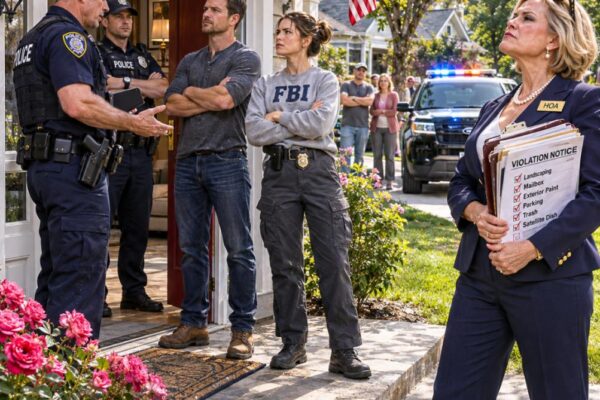
HOA Karen Claimed My Private Ranch Road, Smashed My Mailbox, and Threatened Me $250 a Day—I Refused to Surrender an Inch.k
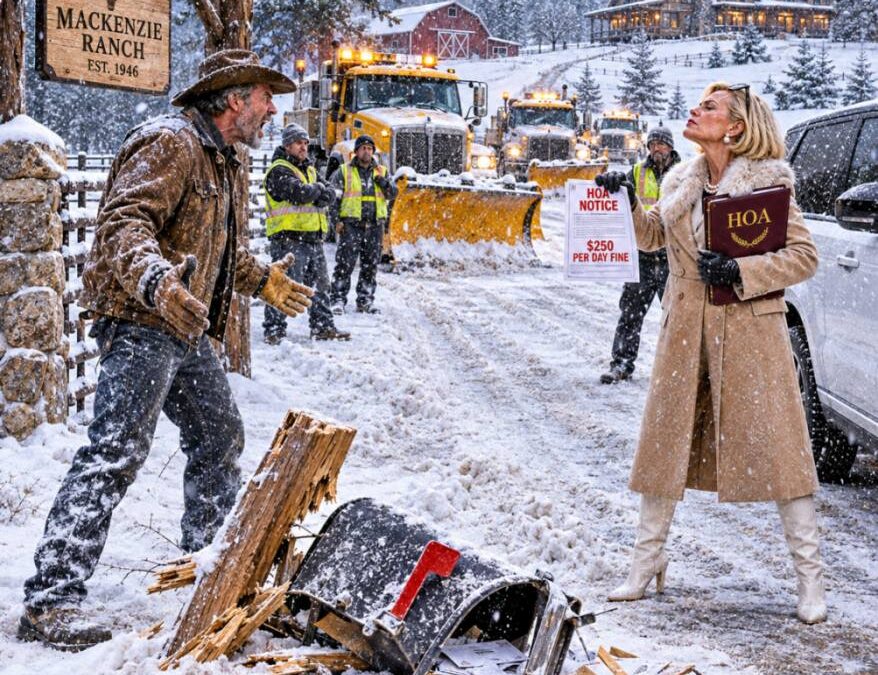
HOA Karen Claimed My Private Ranch Road, Smashed My Mailbox, and Threatened Me $250 a Day—I Refused to Surrender an Inch
She sent snowplows down a road my family had owned since 1946, flattened my mailbox, and handed me a letter declaring my land an HOA “community asset.”
When I showed her the recorded permit proving Willowbrook had only temporary winter permission to use my lane, she doubled down and threatened me with $250-a-day fines.
Ten days later, three plows, a salt truck, and HOA Karen herself were waiting at my gate in a blizzard—and she still believed I was the one who had nowhere to go.
The mailbox disappeared at 4:40 on a Monday morning.
I heard the impact from my kitchen.
A heavy metallic bang.
Then the grinding scrape of a snowplow blade dragging something through frozen gravel.
I set my coffee down and walked to the window.
Six inches of new snow covered Mackenzie Ranch, bright beneath the yard lights. The thermometer outside read twenty-two below zero. At the mouth of my private lane, a yellow plow truck was backing away from what had been my mailbox.
The cedar post lay snapped in the ditch.
The steel box was folded almost flat.
A second plow idled behind it.
Its headlights swept across my fence.
I pulled on insulated coveralls, boots, and gloves and walked down the lane.
The young driver climbed out before I reached him.
He wore a McBride Snow & Earth jacket.
“Morning,” he said carefully.
“You hit my mailbox.”
He looked at the wreckage.
“HOA told us to clear the connector all the way to Highway 14.”
“This isn’t a connector.”
“That’s what they call it.”
“Who’s they?”
The answer appeared behind him.
A white Range Rover rolled through the snow and stopped ten feet from me.
Harper McBride stepped out wearing a camel-colored coat, white boots, and the expression of someone arriving to correct an employee.
She was president of Willowbrook Estates, the 112-home subdivision north of my ranch.
We had spoken twice in fifteen years.
Both times she had misspelled my name afterward.
“Mr. Mackenzie,” she said. “Good. You’re awake.”
“My mailbox is in the ditch, Harper.”
She ignored that.
“The board needs to clarify your obligations regarding the connector.”
I looked past her toward my lane.
Mackenzie Lane ran 1.1 miles from State Highway 14 through 640 acres my grandfather had bought in 1946.
Willowbrook touched my north boundary.
That was all.
“My road.”
“Our residents have used it for fifteen years.”
“With permission.”
Harper opened a Willowbrook folder.
“The board’s position is that long-term community use established a continuing access right.”
“My permission established the use.”
She smiled.
The way adults smile at children who have misunderstood something simple.
“My attorney explained prescriptive access to us.”
“I’m sure he did.”
She pulled out a document.
“The board also considers your gate, mailbox, and cattle guards obstructions to safe winter access. You are not to interfere with plowing operations.”
She pressed the paper into my glove.
The heading read:
COMMUNITY EASEMENT ENFORCEMENT NOTICE.
Then I saw the demand.
Remove my mailbox.
Remove my gate.
Modify the cattle guards.
Stay off the lane while their contractors worked.
Or face $250 per day.
Harper turned toward the plow driver.
“Finish clearing it.”
I looked down at the document again.
One phrase stopped me.
As established by the winter use agreement.
I knew that agreement.
I had written half of it myself.
I looked at Harper.
“You’re relying on the 2011 permit?”
She smiled.
“Exactly.”
That was when I stopped being angry.
Because buried in my fireproof document box, fifteen years old and recorded at the county clerk’s office, was a sentence Harper McBride clearly had never read.
And she had just put her breach of it in writing.
part 2
My name is Robert Mackenzie.
I was sixty-two that winter, although twenty-eight years with the state highway department had trained me to look older whenever someone waved an unsigned piece of paper in my face and expected obedience.
I retired four years before Harper destroyed my mailbox.
For the last twelve years of my state career, I ran access management for the northern district.
Driveway permits.
Highway connections.
Subdivision access.
Temporary construction entrances.
Sight-distance reviews.
Traffic studies.
Emergency routes.
I had spent enough years explaining to developers that a road touching a highway did not automatically give anyone the right to use it that I could practically deliver the lecture in my sleep.
That background was about to become inconvenient for Willowbrook.
Mackenzie Ranch had been in my family since my grandfather came home from World War II and bought the first section in 1946.
He started with cattle.
My father added hay.
I added two neighboring parcels when land values were still low enough that a state employee could buy acreage without selling an organ.
By the time I retired, we had 640 contiguous acres along the Tall Grass River bench.
Nothing glamorous.
Cow pasture.
Hay meadow.
A machinery shed.
An old barn my grandfather built with timber cut locally.
My house sat roughly half a mile from Highway 14.
The lane started at the highway and ran north through my property until it met the fence line where Willowbrook Estates began.
The county map called it Mackenzie Lane.
The recorder called the ground beneath it Parcel 4.
My deed called it mine.
Willowbrook called it “the connector.”
That word caused most of the trouble.
Willowbrook had been built fifteen years earlier on what everyone around there still called the Hatcher place.
Meridian Land Partners bought the property, divided it into 112 residential lots, added internal roads, a clubhouse, and a decorative entrance off Old Mill Road.
During subdivision review, the county required adequate access.
The main entrance on Old Mill satisfied ordinary traffic.
A second connection was needed for emergency circulation and winter resilience because of the number of lots, local terrain, and fire-service concerns.
Meridian originally planned a western connection through Pine Hollow to Highway 14.
Then spring runoff washed out part of the construction route.
The developer had a problem.
I had a road.
That was how the winter use agreement happened.
In October 2011, Meridian’s project manager sat at my kitchen table with two maps and enough desperation to make a man unusually agreeable.
They asked permission to use Mackenzie Lane during winter while they worked on the permanent secondary access.
I did not object in principle.
Neighbors helping neighbors is normal in ranch country.
Developers helping themselves is another matter.
So I put everything in writing.
The recorded instrument was numbered 2011004417.
I remembered the number because highway people remember useless numbers the way ranchers remember cattle.
The document granted a revocable seasonal license.
Not an easement.
Not ownership.
Not permanent access.
The language was explicit.
November 1 through April 15.
Emergency egress and winter snow-removal access only.
No interference with ranch operations.
No ownership interest.
No right to alter my improvements without written permission.
No prescriptive rights created by use.
And, most important now, a breach clause.
If the user claimed ownership of the lane, interfered with my gates, cattle guards, fencing, or other improvements, or used the property beyond the granted purpose, I could terminate the license after written notice.
Meridian accepted those terms.
The document was recorded.
When Willowbrook’s HOA took over subdivision operations from the developer in 2014, I consented in writing to assignment of the seasonal license to the association.
Nothing else changed.
I assumed everyone understood that.
For more than a decade, it worked.
Every November, plows used Mackenzie Lane during certain storms.
The fire district knew the gate code.
I kept cattle away from the access during major weather.
Nobody argued about ownership.
Nobody called it communal property.
Nobody flattened my mailbox.
Then Harper McBride became HOA president.
The morning she handed me her “easement enforcement notice,” I did not argue because arguing at twenty-two below zero is inefficient.
I photographed everything instead.
Mailbox.
Broken post.
Truck plates.
Snowplow blade.
Range Rover.
Harper.
Timestamp.
Then I went home.
Harper probably interpreted that as surrender.
She was wrong.
I made another pot of coffee and opened the fireproof cabinet in my hallway.
The instrument folder was exactly where I had left it.
Certified copy of the license.
2014 assignment.
Correspondence with Meridian.
Survey.
County subdivision approval letter.
I put everything on the kitchen table.
Then I read Harper’s notice again.
Her problem was larger than claiming an easement.
She cited the winter use agreement while simultaneously denying the ownership relationship that made the agreement necessary.
That mattered.
At six o’clock, I called Katrina Ford.
Katrina was forty-five, a real-property and water-rights attorney who had represented my family for more than a decade.
Her voice sounded dangerous before sunrise.
“Robert, somebody better be dead.”
“Harper McBride just claimed my road.”
Silence.
Then a chair scraped somewhere on her end.
“Willowbrook Harper?”
“Yes.”
“Your Mackenzie Lane?”
“Yes.”
“In writing?”
“Yes.”
“I’m coming out.”
She arrived at seven with snow on her boots and a steel thermos in her hand.
I handed her Harper’s notice.
She read it.
Then she read the recorded license.
Then the notice again.
“She cited the license.”
“Yes.”
“And called the road community property.”
“Yes.”
Katrina tapped the breach clause.
“That is not a drafting mistake.”
“No.”
“That is evidence.”
She kept reading.
“Two hundred fifty dollars a day?”
“My land is not inside Willowbrook.”
“I noticed.”
“So their covenant fine means nothing.”
“It means something.”
“What?”
“It means Harper thinks letterhead can cross property boundaries.”
I smiled.
“That sounds unhealthy.”
“For her, maybe.”
Katrina wanted certified records before we did anything.
By nine, we were standing at the Carson County Recorder’s Office.
Joy Abernathy had worked there almost as long as I had worked for the state.
She pulled instrument 2011004417 and the 2014 assignment.
Certified both.
Raised seal.
Official stamps.
Then County Surveyor Hector Salinas joined us at the counter.
He unrolled the recorded parcel map.
Parcel 4.
Mackenzie Lane.
Owner: Robert Mackenzie.
No permanent easement to Willowbrook.
No access covenant granting community ownership.
Nothing except the seasonal license.
Katrina asked Hector for a written certification of the record status.
He gave us one.
That should have been enough.
Then I remembered the subdivision approval letter.
Willowbrook’s original plat approval had required a second approved connection.
Meridian had told everyone Pine Hollow would eventually become that connection.
I had not followed the subdivision after retirement.
The winter license worked.
Nobody asked questions.
But one thing bothered me.
A permanent connection from Pine Hollow to State Highway 14 would have required a state highway access permit.
I had run that program.
I could not remember approving one.
Katrina saw my face.
“What?”
“I want to go to the district office.”
“Why?”
“Because I don’t remember Pine Hollow.”
Forty minutes later, we were sitting in the state highway department building where I had spent most of my adult life.
The new access manager was Beatrice McCoy.
Her first week on the job fifteen years earlier, she submitted a driveway review to me and I returned it covered in red ink.
She reminded Katrina before I could.
“Mr. Mackenzie gave me eleven corrections on my first permit.”
“You counted?”
“I considered framing it.”
Katrina looked at me.
“You never told me you trained everybody in this state.”
“I corrected paperwork.”
Beatrice pulled the Highway 14 access file.
Mile marker 31.4.
Pine Hollow Cut.
Meridian had obtained a temporary construction-access permit in 2011.
It expired the following June.
No permanent permit had ever been issued.
No application.
No traffic study.
No engineering review.
No permanent driveway authorization.
Beatrice frowned at the screen.
“Has Willowbrook been using Pine Hollow?”
“Sometimes, apparently.”
“Vehicle traffic?”
“Snowplows, from what Harper said.”
“That’s a problem.”
She pulled the subdivision approval letter.
The county condition referenced a lawful secondary connection to the state highway.
Beatrice tapped the screen.
“This isn’t one.”
Katrina asked, “What happens if you inspect?”
“If the connection is being used without authorization, we issue notice and restrict use pending review.”
“Do you need a complaint?”
“No. But an inspection request makes the file easy.”
I said, “Consider it requested.”
Beatrice looked at me.
“Retirement made you vindictive.”
“Paperwork made me vindictive.”
“That sounds more like you.”
She scheduled inspection.
By noon, Katrina had drafted our breach notice.
She did not write dramatically.
Good lawyers rarely do.
The letter identified the recorded license, quoted the sections Harper had violated, attached the certified documents, and gave Willowbrook ten days’ notice that the winter license would terminate at noon on December 16.
No threats.
No speech.
Just terms.
We delivered copies to the HOA office, Harper personally, and Willowbrook’s attorney, Trevor Hale.
I also sent an invoice.
Mailbox.
Post.
Cattle guard damage from the plow blade.
$1,140.
Hale responded two days later.
He accused me of acting in bad faith and threatened to seek an injunction preventing termination.
Katrina answered with one page.
Certified license.
Certified parcel record.
Surveyor’s letter.
She ended with:
“Please identify the recorded easement upon which your client relies.”
Hale never answered that question.
That silence should have warned Harper.
Instead, she went around her own lawyer.
Four mornings after the notice, a lowboy trailer came up Mackenzie Lane carrying an excavator.
The trail camera caught it at 6:08.
The truck belonged to McBride Snow & Earth.
The company was owned by Harper’s brother-in-law, Wade McBride.
According to the board resolution later produced, Karen had persuaded the HOA board to authorize “removal of unauthorized access obstructions.”
They meant my gate.
I was feeding cattle about a quarter mile away.
My phone alerted.
I drove down slowly.
No rush.
I had already called the sheriff’s non-emergency number.
Deputy Patrick Hanratty met us at the gate.
Harper was not there yet.
Wade was unloading chains.
I handed Hanratty the parcel map, recorded license, and termination notice.
He read all three.
Then looked at Wade.
“This your equipment?”
“Yes.”
“You been given permission by the landowner to remove that gate?”
Wade pointed toward the paperwork in his cab.
“HOA says it’s a community road.”
Hanratty held up my certified deed.
“HOA isn’t the county recorder.”
Wade looked at me.
I shrugged.
Harper’s Range Rover arrived five minutes later.
She stepped out before the wheels stopped.
“Deputy, he is obstructing emergency access.”
Hanratty answered calmly.
“Ma’am, I’m looking at documentation showing private ownership and a temporary license.”
“It’s been used for fifteen years.”
“With permission.”
“That creates rights.”
“Maybe. Maybe not. That’s for civil court.”
She pointed toward me.
“Then arrest him for blocking access.”
Hanratty looked at me.
Then at my gate.
Then back at Harper.
“No.”
Her face reddened.
“You don’t understand the liability.”
“I understand enough not to order a property owner to remove his gate based on an HOA letter.”
“I’ll speak to your sheriff.”
Hanratty took out a business card.
“Number’s on there.”
I liked him immediately.
Wade loaded the excavator back onto the trailer.
Harper stood in the snow staring at me.
“You are endangering residents.”
“No.”
I kept my voice even.
“You’re losing permission.”
“There are 112 households depending on this road.”
“Then you should have read the permit before claiming the road.”
She stepped closer.
“You think you’re clever because you used to work for the state.”
“No.”
I looked at the broken mailbox post still waiting for replacement.
“I think you hit my property with a plow and told me it belonged to you.”
She left.
The $250-a-day fines began anyway.
That was almost funny.
Almost.
Every morning, a new violation appeared in my post-office box in town because I still had no mailbox at the ranch.
“Failure to remove obstruction.”
“Interference with community access.”
“Continued noncompliance.”
My land was not part of Willowbrook.
I had never agreed to its covenants.
The fines had no contractual foundation against me.
Katrina told me not to respond individually.
“File them.”
So I created a folder.
RETALIATION.
Harper also posted on Willowbrook’s online resident forum.
“One private landowner is threatening winter safety for 112 families.”
I screenshot everything.
Another post accused me of “weaponizing technicalities.”
That phrase made me laugh.
A recorded property instrument had become a technicality.
The weather forecast for December 16 deteriorated daily.
First six inches.
Then nine.
Then twelve to fourteen.
High winds.
The license would terminate at noon.
Katrina called me on December 14.
“You know what they’re going to argue.”
“Emergency.”
“Yes.”
“Fire district still has Old Mill.”
“Yes.”
“And Pine Hollow if the state approves it.”
“The state hasn’t.”
“Then Old Mill.”
She paused.
“Robert, you need to be very careful.”
“I know.”
“No games.”
“I’m not playing.”
“No locking people in.”
“I know.”
“No machinery.”
“I know.”
“No confrontation.”
“Katrina.”
“I know you.”
I smiled.
“Come out anyway.”
On the morning of December 16, three plows and a salt truck were already staged inside Willowbrook near my north gate.
Harper’s Range Rover sat in front.
Wade’s company had apparently planned to keep using my lane after the termination deadline.
That morning I installed a new heavy brass padlock on the north snow gate but left it open.
Deputy Hanratty parked forty yards away at Katrina’s request.
Not to enforce my contract.
To prevent stupidity.
Katrina stood beside me carrying a folder.
Wind drove ice crystals across the road.
At 11:50, Harper lowered her window.
“Mr. Mackenzie.”
“Harper.”
“You cannot close that gate.”
“The license terminates at noon.”
“There’s a winter storm warning.”
“Yes.”
“There are 112 homes behind me.”
“Yes.”
“We need direct highway access.”
“You have Old Mill Road.”
“It adds nearly a mile.”
“Yes.”
“It increases plow time.”
“Yes.”
“You planned this.”
I looked at my watch.
“You signed the breach notice.”
Her voice sharpened.
“You created the breach.”
I did not answer.
At 11:59, Wade climbed down from his plow.
“Robert.”
“Wade.”
“I just want to clear roads.”
“I know.”
He looked toward Harper.
Then back at me.
“This is going to become a mess.”
“It already is.”
At noon, I closed the gate.
The latch met the post.
I clicked the padlock shut.
Small sound.
Nothing dramatic.
Harper stared at it.
“You can’t do that.”
“I just did.”
“You are exposing this community to liability.”
“Call Trevor Hale.”
Her face tightened.
Wade leaned against his plow.
“Now what?”
Harper pointed west.
“Pine Hollow.”
My phone vibrated.
A message from Beatrice McCoy.
Inspection complete. Unauthorized highway connection. Restriction notice posting at 12:30.
I did not smile.
I wanted to.
Harper’s convoy turned around and headed toward Pine Hollow.
Old Mill Road was paved, legal, and slightly longer.
Pine Hollow was shorter.
Harper chose shorter.
That decision cost her the last of her leverage.
At 12:41, Wade’s lead plow reached the state-highway connection.
Orange cones blocked it.
A state pickup sat sideways across the entrance.
Beatrice stood beside a posted notice.
I was not there.
Katrina followed in her truck and later showed me the dash-camera footage Wade voluntarily provided.
Beatrice explained that the old temporary construction permit had expired years earlier.
Heavy vehicle use had to stop.
A permanent connection would require application, engineering review, and whatever safety improvements the agency deemed necessary.
Harper argued.
Beatrice did not.
State highway employees have a special ability to survive angry people by continuing to read paperwork.
Harper finally demanded a timeline.
“At least several months if a new application is complete,” Beatrice said.
“What are we supposed to use today?”
“Old Mill Road.”
Harper looked toward the plows.
Old Mill added distance.
Extra fuel.
Extra labor.
Extra storm time.
Not catastrophe.
Expense.
And inconvenience.
The same things she had tried to impose on me.
The convoy returned toward my gate.
At 12:58, Harper stopped on the subdivision side.
“Open it.”
“No.”
“Our salt yard is near Highway 14.”
“Then access it through the public road system.”
“You’re being vindictive.”
“The license ended.”
“We’ll open it ourselves.”
Katrina stepped forward.
“Harper, do not.”
Harper ignored her.
“Wade.”
Wade kept both hands on the steering wheel.
“No.”
Harper stared at him.
“The board will indemnify you.”
“No.”
“You’re under contract.”
“I’m contracted to plow streets, not cut a rancher’s lock in front of a deputy.”
Katrina said, “That’s the first smart sentence I’ve heard all week.”
Harper grabbed her phone.
She called Dale Foster, a grading contractor working in another subdivision.
Dale arrived thirteen minutes later in a pickup.
He had bolt cutters.
I remember looking at Hanratty.
The deputy stayed near his cruiser.
He had explained the situation before Dale arrived.
Private gate.
No permission.
Civil access dispute.
Potential criminal consequences if someone damaged property after notice.
Dale listened.
Then looked at Harper.
“You sure?”
“Yes.”
“HOA owns this access?”
I said, “No.”
Harper said, “Yes.”
Dale looked between us.
That should have been enough warning.
It wasn’t.
He put the bolt cutters around my lock.
Hanratty said:
“Mr. Foster, I’m advising you not to damage that property.”
Dale stopped.
Harper snapped, “Do it.”
The cutters closed.
The brass shackle broke.
That was the moment the dispute changed.
Before that, everything was contracts and records.
Now somebody had physically destroyed my property after being specifically warned.
Harper pulled the gate open herself.
“Go.”
Three plows, a salt truck, and her Range Rover entered Mackenzie Lane.
I did not trap them.
I did not close some secret gate to hold them hostage.
That part mattered.
My south highway gate was normally controlled remotely for ranch operations, but Katrina had already told me exactly what I was not going to do.
So I left the exit available.
Hanratty followed the convoy.
So did I.
At the highway end, he stopped the vehicles long enough to document what had occurred and identify everyone involved.
Cut lock.
Gate damage.
Plates.
Drivers.
Statements.
Wade told the truth.
“Harper ordered us through.”
The other drivers said the same.
Dale admitted cutting the lock after she instructed him.
Hanratty did not conduct a roadside criminal trial.
He documented probable offenses, issued Dale a citation for the property damage where local procedure allowed, and referred Harper’s conduct to the sheriff’s office and county prosecutor for review.
She demanded that I be arrested.
Hanratty looked tired.
“For what?”
“For obstructing emergency access.”
“You entered his land after the license ended.”
“This is an easement.”
“Then your lawyer can prove that in court.”
“He’s holding Willowbrook hostage.”
“No.”
Hanratty pointed south.
“Your vehicles can leave.”
That mattered.
I was not going to give Harper one legitimate claim by creating another problem.
The convoy exited onto Highway 14.
Then had to circle back to Willowbrook through Old Mill Road.
The storm hit around 2:30.
Hard.
Sideways snow.
Wind.
Old Mill remained open.
The plows worked.
Slowly.
Willowbrook survived.
Residents were angry.
Not at me for long.
Because bills started arriving.
Extra contractor hours.
Extra fuel.
Legal expenses.
Emergency board meetings.
And people began asking questions Harper should have expected from the beginning.
What exactly was the winter agreement?
Why had the HOA relied for fifteen years on a revocable license?
Why had the permanent second highway access never been permitted?
Why had Harper claimed ownership?
Why were residents paying legal bills to defend that claim?
Who authorized fines against a ranch owner outside the HOA?
Who authorized an excavator to remove my gate?
Who authorized Dale?
The answer to that last question was devastatingly simple.
Harper.
Willowbrook treasurer Cara Ford started reading old minutes.
Cara was quiet.
Retired accountant.
The sort of woman who could discover a twelve-dollar discrepancy in a million-dollar budget and lose sleep over it.
She called Katrina four days after the storm.
“I think we have a problem.”
Katrina put her on speaker.
“What kind?”
“The board has not reviewed the winter permit in years.”
“That does not surprise me.”
“I can’t find proof we maintained the insurance requirements either.”
I leaned toward the phone.
“Which insurance requirements?”
Cara read the old license.
The HOA had been required to maintain liability coverage related to its seasonal use.
The management file contained outdated certificates.
No one had checked.
Harper had inherited a system she barely understood, then treated it like ownership.
Cara continued.
“I also found the board vote authorizing the excavator.”
Katrina asked, “Was counsel consulted?”
“No.”
“Who made the motion?”
“Harper.”
“Who drafted the resolution?”
“Harper.”
“Did it state the property was HOA-owned?”
“Yes.”
I closed my eyes.
Harper had written the false assumption into board minutes.
Not maliciously, perhaps.
But repeatedly.
Confidently.
That confidence was becoming expensive.
The fire district chief wrote a letter.
He was careful too.
He did not take sides in the property dispute.
He simply stated that emergency planning could not continue relying on a revocable private seasonal license as though it were permanent public infrastructure.
The district needed predictable legal access.
That meant Willowbrook had to solve the underlying problem.
Apply for Pine Hollow.
Improve Old Mill coordination.
Negotiate with me.
Preferably all three.
The residents started a recall petition.
Sixty-three signatures in four days.
That was when Harper finally changed her language.
On December 29, Katrina received a letter on Willowbrook stationery.
I was at the ranch when she called.
“You need to come in.”
“Why?”
“They’re asking.”
“Asking what?”
“For the road.”
I drove to her office.
The letter began:
“Dear Mr. Mackenzie, the Board of Willowbrook Estates respectfully requests reinstatement of the seasonal winter-use license and acknowledges Mackenzie Lane as the private property of Robert Mackenzie.”
I read it twice.
“They spelled my name correctly.”
Katrina smiled.
“Progress.”
The board wanted immediate reinstatement.
I was willing.
That surprised Harper later.
I never wanted 112 families cut off from a useful winter route.
I wanted the relationship defined correctly.
Permission.
Not entitlement.
Katrina drafted proposed terms.
Five-year renewable license.
Seasonal fee of $18,000 per winter to cover maintenance, snow damage, administration, and wear.
Two-million-dollar liability policy naming Mackenzie Ranch as an additional insured where appropriate.
Replacement mailbox and post.
Repair of the damaged cattle guard.
Emergency access code controlled with the fire district.
Recorded acknowledgment that the license created no ownership or prescriptive rights.
Willowbrook responsible for pursuing a lawful permanent Pine Hollow connection.
Attorney fees attributable to defending my title claim.
Restitution for the cut gate lock and related damage.
Reasonable inspection and maintenance obligations.
Harper called the proposal extortion.
Katrina responded:
“You are free to decline it.”
That ended the argument.
Because alternatives matter.
Willowbrook had Old Mill Road.
It was not trapped.
It was inconvenienced.
The recall meeting was scheduled for January 22.
I did not attend.
It was not my HOA.
Cara later told me what happened.
The clubhouse was packed.
Harper opened with a statement accusing outside interests of exploiting a technical property dispute.
Then Cara read the timeline.
2011 license.
2014 assignment.
Mailbox incident.
Harper’s ownership claim.
Termination.
Excavator resolution.
Pine Hollow permit failure.
Cut lock.
Legal expenses.
Insurance problems.
One resident asked:
“Who told us we owned Mackenzie Lane?”
Nobody answered.
Another asked:
“Why did the president send $250-a-day fines to somebody who isn’t a member?”
Harper answered that enforcement authority was “debatable.”
The association lawyer apparently looked at the table.
Then someone asked about Harper’s attorney fees.
“How much?”
Cara read the amount.
The room erupted.
Then came the question that ended everything.
“Who authorized spending our dues to defend her claim after the recorder’s office confirmed the road was private?”
Silence.
The recall vote was seventy-four to twenty-one.
Harper walked out before the final tally was announced.
She did not go to jail.
That was never the point.
The prosecutor’s review of the gate incident resulted in a modest criminal case tied to trespass and property damage allegations, with Dale’s conduct treated separately from Harper’s role. The final outcome involved restitution and a negotiated resolution rather than some dramatic felony conviction.
Good.
The facts did not need decoration.
Harper lost what had allowed her to cause the problem.
Authority.
Cara became interim president.
On January 30, she drove out to Mackenzie Ranch with Willowbrook’s lawyer and signed the new seasonal license.
I signed last.
Before I did, I asked one question.
“Everybody understands what this is?”
Cara said, “Permission.”
I looked at the attorney.
“Permission.”
“And what isn’t it?”
He smiled slightly.
“An easement.”
I signed.
That winter, plows returned to Mackenzie Lane.
Legally.
The fire district received its code.
The mailbox was replaced.
The cattle guard repaired.
My attorney fees were reimbursed under the negotiated settlement.
Willowbrook paid the seasonal access fee.
And the state began the formal process for evaluating Pine Hollow as a potential permanent secondary connection.
It was not quick.
Real highway access permits rarely are.
Traffic analysis.
Drainage.
Sight distance.
Design.
Public costs.
Engineering.
That process would take time.
Exactly why Meridian had asked for my lane in the first place.
One March afternoon, Wade McBride stopped at my shop.
I was rebuilding a hydraulic cylinder.
He stood in the doorway.
“You mad at me?”
“You cut my mailbox off.”
“My driver did.”
“Your truck did.”
“Fair.”
He stepped inside.
“I told Harper not to push the gate.”
“I know.”
“She doesn’t listen well.”
“I noticed.”
He looked around at the equipment.
“Can I say something?”
“Depends.”
“I thought the road was ours too.”
That surprised me.
“Why?”
“Everybody called it the connector.”
There it was.
The power of language.
Fifteen years of people saying our connector.
Our route.
Our winter road.
Eventually, a generation of residents forgot that somebody owned the dirt.
The paperwork disappeared into a management file.
Permission became habit.
Habit became expectation.
Expectation became entitlement.
Harper had simply carried that progression farther than everyone else.
“I believe you,” I said.
Wade nodded.
“Sorry about the mailbox.”
“You already paid for it.”
“No. I mean sorry.”
I looked at him.
“Accepted.”
He pointed toward my hydraulic cylinder.
“You putting that seal in backward?”
“Get out.”
He laughed.
By April, the snow was gone.
The ranch softened.
The Tall Grass River came up with spring runoff.
Mallards returned to the culvert.
On April 15, the seasonal license period ended.
I drove to the north snow gate.
Thin sunlight.
Mud instead of ice.
I checked the new lock.
Then I set a cedar mailbox post beside Mackenzie Lane.
Katrina arrived with a thermos.
“You know you could pay someone to do that.”
“I know.”
“You billed Willowbrook for the post.”
“I know.”
“So technically, they already paid someone.”
“Go away.”
She laughed.
We set the mailbox.
Level.
Concrete.
Steel box.
Then I painted MACKENZIE on the side.
Katrina stood back.
“Subtle.”
“They kept misspelling it.”
“Trauma response?”
“Quality control.”
We sat on the tailgate afterward.
For a while we watched two mallards move through meltwater near the culvert.
Then Katrina said:
“Fifteen years.”
“Yeah.”
“Harper really thought fifteen years of use made it theirs.”
“People hear prescriptive rights and forget the hostile part.”
Katrina nodded.
“Use under express permission generally doesn’t become adverse merely because time passes.”
“Tell her that.”
“I did.”
“Tell her slower.”
Katrina smiled.
Then her expression turned serious.
“You know this was avoidable.”
“All of it.”
“If she had replaced the mailbox and called you that morning…”
“I would have renewed the winter permit.”
“Same fee?”
“No.”
“What fee?”
“Probably mailbox and gravel.”
Katrina shook her head.
“Eighteen thousand dollars a season.”
“Legal education is expensive.”
“That’s my line.”
The strange thing was, I did not hate Harper.
I hated what she did.
There is a difference.
For weeks, I had imagined the problem as one arrogant HOA president trying to steal my road.
That was true.
It was not the whole truth.
The larger failure was institutional.
Willowbrook had spent fifteen years depending on private access without reviewing the agreement.
Board members changed.
Management companies changed.
Residents moved in and out.
The original developer disappeared.
Nobody tracked the expiration risk.
Nobody pursued the permanent highway permit.
Nobody checked insurance.
Nobody reminded new leadership that Mackenzie Lane was borrowed access, not subdivision property.
Then Harper arrived with confidence and an incomplete legal theory.
The system had no brakes.
That was what Willowbrook fixed after the recall.
Cara created an annual contract calendar.
Every license.
Insurance certificate.
Permit.
Maintenance agreement.
Renewal deadline.
Nothing important would live in one forgotten folder again.
Large expenditures required documented authorization.
Outside counsel review became mandatory before the HOA asserted property rights against nonmembers.
Violation notices had to identify the actual covenant or rule.
And perhaps most importantly, the board stopped describing private neighboring property as community assets unless records actually supported it.
Boring reforms.
Useful reforms.
That summer, I attended one Willowbrook meeting.
Cara invited me because residents wanted to ask about the road.
I almost declined.
Then I thought about the people who had spent December believing I was trying to strand them.
So I went.
The clubhouse was full.
I stood near a map.
Not a speech.
A map.
“This is Mackenzie Ranch.”
I pointed.
“This is Willowbrook.”
Then Old Mill.
Pine Hollow.
Highway 14.
“This lane is private.”
Someone asked, “Why did you let us use it for fifteen years?”
“Because winters are bad.”
A few people smiled.
Another asked, “Why revoke it?”
“Because your president claimed ownership and tried to remove improvements the license protected.”
A man in the third row raised his hand.
“What if she hadn’t done that?”
“You’d probably still be using the old license.”
The room got quiet.
Cara looked toward me.
“Would you have charged us eighteen thousand?”
“No.”
Someone groaned.
Cara shook her head.
“Thank you, Harper.”
That got a laugh.
Then an older woman asked something better.
“Why didn’t you just sue us?”
I thought about it.
“Because I didn’t need to.”
She looked confused.
“I had the deed.”
I pointed toward the map.
“The permit.”
Then the county certification.
“The state records.”
Then the license.
“Court is where you go when people refuse to respect documents.”
I smiled slightly.
“Harper eventually made everybody read them.”
That line traveled.
A year later, I heard Willowbrook residents using it whenever board discussions got vague.
“Read the document.”
Good.
That was the legacy I wanted.
Not fear.
Precision.
Harper sold her Willowbrook house the following autumn.
I heard about it from Wade.
She moved south to be closer to her daughter.
Maybe the recall drove her out.
Maybe she had already been considering it.
Life rarely gives clean causes.
A week before she moved, a white Range Rover appeared at the ranch entrance.
I was repairing fence.
Harper got out.
No clipboard.
That was strange enough that I almost didn’t recognize her.
“Robert.”
“Harper.”
She stood outside the fence.
Good start.
“I wanted to talk.”
“Go ahead.”
She looked down Mackenzie Lane.
“They still call it the connector.”
“I know.”
“That bothers you?”
“No.”
She seemed surprised.
“Why not?”
“Names are cheap. Deeds aren’t.”
She looked toward the new mailbox.
“I paid for that.”
“Willowbrook did.”
Her mouth tightened.
Then relaxed.
“I suppose I deserved that.”
I waited.
Harper looked older without the presidency.
Not broken.
Not transformed.
Just less certain.
“I thought you were trying to hurt the subdivision.”
“I wasn’t.”
“I believed you wanted leverage.”
“At the end, I had leverage.”
“That’s what I mean.”
“No.”
I leaned on the fence post.
“Leverage came after you claimed my property.”
She looked away.
“I had an attorney tell me long use could create rights.”
“Long adverse use can matter under certain circumstances.”
She looked back.
“You know that.”
“Yes.”
“So I wasn’t completely wrong.”
“You omitted the part where you had written permission.”
Her face tightened.
“He didn’t have the agreement.”
“That should have been your first clue not to threaten me.”
She sighed.
“I should have looked.”
“Yes.”
“I should have called.”
“Yes.”
“I should’ve replaced the mailbox.”
“Yes.”
She almost smiled.
“You’re enjoying this.”
“A little.”
For several seconds, neither of us spoke.
Then Harper said:
“I never meant to take your ranch.”
“I know.”
She seemed relieved.
“I meant to control the road.”
The relief vanished from my face.
“That was the same problem.”
She nodded.
“I understand that now.”
Maybe she did.
Then she looked down the lane.
“You know what bothered me most?”
“What?”
“That one man could shut a route 112 families relied on.”
“That should bother you.”
She frowned.
I continued.
“It bothered me too.”
“You could have fooled me.”
“That’s why Willowbrook should finish Pine Hollow.”
She looked toward the subdivision.
“A community shouldn’t depend permanently on one private owner’s permission.”
“No.”
“And a private owner shouldn’t be forced to surrender property because the community failed to plan.”
Harper stared at me.
For the first time, we agreed on the actual problem.
Her voice softened.
“I handled it badly.”
“Yes.”
“I suppose that’s as close to an apology as you’re going to let me get.”
“You can apologize normally.”
She laughed once.
Then looked at the fence.
“I’m sorry about your mailbox.”
I smiled.
“Wade already used that one.”
Her eyes rolled.
“I’m sorry I claimed your road.”
There it was.
Better.
“Thank you.”
She nodded.
Then returned to her Range Rover.
Before getting in, she turned.
“It’s McKenzie with a capital K, right?”
I stared at her.
She smiled.
Then drove away.
My name is Mackenzie.
She had done that deliberately.
I laughed all the way back to the barn.
Two winters later, Willowbrook still used Mackenzie Lane under the new license.
Plows called ahead.
The fire district had access.
Contractors carried proper insurance.
My gate remained.
The cattle guards remained.
The mailbox remained.
Nobody told me to stay off my own road during snow operations.
When plows came through, I stayed out of their way because that was common sense.
Not because Harper had ordered me.
Pine Hollow eventually received conditional approval after engineering work and required improvements.
Willowbrook spent real money bringing it up to state standards.
Drainage.
Sight distance.
Approach geometry.
Signage.
The work took more than a year.
When it opened, Mackenzie Lane stopped being essential.
Cara called me.
“I suppose we don’t need the winter license anymore.”
“You probably don’t.”
“You sound disappointed.”
“I’m losing eighteen thousand dollars.”
She laughed.
“We may keep it for emergency redundancy.”
“I suddenly support redundancy.”
Of course I did.
They renewed at a reduced standby rate with emergency-use terms.
Again, negotiated.
Again, written.
Again, permission.
That difference never became small to me.
People often tell this story as though I beat an HOA with a padlock.
I didn’t.
A lock is hardware.
Harper had already demonstrated what bolt cutters can do to hardware.
What protected Mackenzie Ranch was paper.
Deed.
Parcel map.
Recorded license.
Assignment.
County letter.
State permit file.
Photographs.
Certified mail.
Sheriff’s report.
Board minutes.
Insurance records.
Every piece of evidence carried more weight than Harper’s confidence.
That was the part I wished more property owners understood.
You do not own something more because you shout.
You do not create an easement by printing the word EASEMENT in bold letters.
You do not extend HOA covenants onto neighboring ranch land by sending daily fines.
And fifteen years of permission does not magically become fifteen years of theft merely because somebody forgot who asked whom.
The last thing I changed was the sign at the north gate.
For years it had simply said:
MACKENZIE RANCH
PRIVATE ROAD
After everything, I considered adding:
NO HOA AUTHORITY.
Katrina loved it.
Cara begged me not to.
Wade offered to fabricate the metal sign for free.
I almost did it.
Then I thought about Harper’s obsession with proving who controlled what.
I did not want to spend the rest of my life arguing with a woman who had already left.
So I kept the old sign.
Simple.
Private road.
Enough.
One December morning, several years after the mailbox incident, I stood at the kitchen window with coffee.
Snow fell.
Not six inches.
Maybe three.
A Willowbrook plow appeared at the north end of Mackenzie Lane.
The driver stopped at the gate.
He entered the access code.
Opened it.
Drove through.
Closed it behind him.
Exactly as the new agreement required.
Ten minutes later he passed my house.
He slowed.
Raised one hand.
I waved back.
Then he continued toward Highway 14.
No Range Rover.
No clipboard.
No smashed mailbox.
No threat.
Just a contractor using somebody else’s road because both sides had agreed to it.
That was what Harper had never understood at the beginning.
Permission is not weakness.
A boundary is not hostility.
And cooperation stops being cooperation the moment one side decides gratitude can be replaced with ownership.
I finished my coffee.
Outside, fresh snow gathered along the cedar post beside Mackenzie Lane.
My name was painted clearly on the mailbox.
MACKENZIE.
Spelled right.
The plow passed it without touching a thing.
And after fifteen years of people calling that lane theirs, the most satisfying part was not that they had finally learned to ask.
It was that I was still willing to say yes.
THE STORY ENDS HERE
HOA Karen Claimed My Private Ranch Road, Smashed My Mailbox, and Threatened Me $250 a Day—I Refused to Surrender an Inch
She sent snowplows down a road my family had owned since 1946, flattened my mailbox, and handed me a letter declaring my land an HOA “community asset.”
When I showed her the recorded permit proving Willowbrook had only temporary winter permission to use my lane, she doubled down and threatened me with $250-a-day fines.
Ten days later, three plows, a salt truck, and HOA Karen herself were waiting at my gate in a blizzard—and she still believed I was the one who had nowhere to go.
The mailbox disappeared at 4:40 on a Monday morning.
I heard the impact from my kitchen.
A heavy metallic bang.
Then the grinding scrape of a snowplow blade dragging something through frozen gravel.
I set my coffee down and walked to the window.
Six inches of new snow covered Mackenzie Ranch, bright beneath the yard lights. The thermometer outside read twenty-two below zero. At the mouth of my private lane, a yellow plow truck was backing away from what had been my mailbox.
The cedar post lay snapped in the ditch.
The steel box was folded almost flat.
A second plow idled behind it.
Its headlights swept across my fence.
I pulled on insulated coveralls, boots, and gloves and walked down the lane.
The young driver climbed out before I reached him.
He wore a McBride Snow & Earth jacket.
“Morning,” he said carefully.
“You hit my mailbox.”
He looked at the wreckage.
“HOA told us to clear the connector all the way to Highway 14.”
“This isn’t a connector.”
“That’s what they call it.”
“Who’s they?”
The answer appeared behind him.
A white Range Rover rolled through the snow and stopped ten feet from me.
Harper McBride stepped out wearing a camel-colored coat, white boots, and the expression of someone arriving to correct an employee.
She was president of Willowbrook Estates, the 112-home subdivision north of my ranch.
We had spoken twice in fifteen years.
Both times she had misspelled my name afterward.
“Mr. Mackenzie,” she said. “Good. You’re awake.”
“My mailbox is in the ditch, Harper.”
She ignored that.
“The board needs to clarify your obligations regarding the connector.”
I looked past her toward my lane.
Mackenzie Lane ran 1.1 miles from State Highway 14 through 640 acres my grandfather had bought in 1946.
Willowbrook touched my north boundary.
That was all.
“My road.”
“Our residents have used it for fifteen years.”
“With permission.”
Harper opened a Willowbrook folder.
“The board’s position is that long-term community use established a continuing access right.”
“My permission established the use.”
She smiled.
The way adults smile at children who have misunderstood something simple.
“My attorney explained prescriptive access to us.”
“I’m sure he did.”
She pulled out a document.
“The board also considers your gate, mailbox, and cattle guards obstructions to safe winter access. You are not to interfere with plowing operations.”
She pressed the paper into my glove.
The heading read:
COMMUNITY EASEMENT ENFORCEMENT NOTICE.
Then I saw the demand.
Remove my mailbox.
Remove my gate.
Modify the cattle guards.
Stay off the lane while their contractors worked.
Or face $250 per day.
Harper turned toward the plow driver.
“Finish clearing it.”
I looked down at the document again.
One phrase stopped me.
As established by the winter use agreement.
I knew that agreement.
I had written half of it myself.
I looked at Harper.
“You’re relying on the 2011 permit?”
She smiled.
“Exactly.”
That was when I stopped being angry.
Because buried in my fireproof document box, fifteen years old and recorded at the county clerk’s office, was a sentence Harper McBride clearly had never read.
And she had just put her breach of it in writing.
part 2
My name is Robert Mackenzie.
I was sixty-two that winter, although twenty-eight years with the state highway department had trained me to look older whenever someone waved an unsigned piece of paper in my face and expected obedience.
I retired four years before Harper destroyed my mailbox.
For the last twelve years of my state career, I ran access management for the northern district.
Driveway permits.
Highway connections.
Subdivision access.
Temporary construction entrances.
Sight-distance reviews.
Traffic studies.
Emergency routes.
I had spent enough years explaining to developers that a road touching a highway did not automatically give anyone the right to use it that I could practically deliver the lecture in my sleep.
That background was about to become inconvenient for Willowbrook.
Mackenzie Ranch had been in my family since my grandfather came home from World War II and bought the first section in 1946.
He started with cattle.
My father added hay.
I added two neighboring parcels when land values were still low enough that a state employee could buy acreage without selling an organ.
By the time I retired, we had 640 contiguous acres along the Tall Grass River bench.
Nothing glamorous.
Cow pasture.
Hay meadow.
A machinery shed.
An old barn my grandfather built with timber cut locally.
My house sat roughly half a mile from Highway 14.
The lane started at the highway and ran north through my property until it met the fence line where Willowbrook Estates began.
The county map called it Mackenzie Lane.
The recorder called the ground beneath it Parcel 4.
My deed called it mine.
Willowbrook called it “the connector.”
That word caused most of the trouble.
Willowbrook had been built fifteen years earlier on what everyone around there still called the Hatcher place.
Meridian Land Partners bought the property, divided it into 112 residential lots, added internal roads, a clubhouse, and a decorative entrance off Old Mill Road.
During subdivision review, the county required adequate access.
The main entrance on Old Mill satisfied ordinary traffic.
A second connection was needed for emergency circulation and winter resilience because of the number of lots, local terrain, and fire-service concerns.
Meridian originally planned a western connection through Pine Hollow to Highway 14.
Then spring runoff washed out part of the construction route.
The developer had a problem.
I had a road.
That was how the winter use agreement happened.
In October 2011, Meridian’s project manager sat at my kitchen table with two maps and enough desperation to make a man unusually agreeable.
They asked permission to use Mackenzie Lane during winter while they worked on the permanent secondary access.
I did not object in principle.
Neighbors helping neighbors is normal in ranch country.
Developers helping themselves is another matter.
So I put everything in writing.
The recorded instrument was numbered 2011004417.
I remembered the number because highway people remember useless numbers the way ranchers remember cattle.
The document granted a revocable seasonal license.
Not an easement.
Not ownership.
Not permanent access.
The language was explicit.
November 1 through April 15.
Emergency egress and winter snow-removal access only.
No interference with ranch operations.
No ownership interest.
No right to alter my improvements without written permission.
No prescriptive rights created by use.
And, most important now, a breach clause.
If the user claimed ownership of the lane, interfered with my gates, cattle guards, fencing, or other improvements, or used the property beyond the granted purpose, I could terminate the license after written notice.
Meridian accepted those terms.
The document was recorded.
When Willowbrook’s HOA took over subdivision operations from the developer in 2014, I consented in writing to assignment of the seasonal license to the association.
Nothing else changed.
I assumed everyone understood that.
For more than a decade, it worked.
Every November, plows used Mackenzie Lane during certain storms.
The fire district knew the gate code.
I kept cattle away from the access during major weather.
Nobody argued about ownership.
Nobody called it communal property.
Nobody flattened my mailbox.
Then Harper McBride became HOA president.
The morning she handed me her “easement enforcement notice,” I did not argue because arguing at twenty-two below zero is inefficient.
I photographed everything instead.
Mailbox.
Broken post.
Truck plates.
Snowplow blade.
Range Rover.
Harper.
Timestamp.
Then I went home.
Harper probably interpreted that as surrender.
She was wrong.
I made another pot of coffee and opened the fireproof cabinet in my hallway.
The instrument folder was exactly where I had left it.
Certified copy of the license.
2014 assignment.
Correspondence with Meridian.
Survey.
County subdivision approval letter.
I put everything on the kitchen table.
Then I read Harper’s notice again.
Her problem was larger than claiming an easement.
She cited the winter use agreement while simultaneously denying the ownership relationship that made the agreement necessary.
That mattered.
At six o’clock, I called Katrina Ford.
Katrina was forty-five, a real-property and water-rights attorney who had represented my family for more than a decade.
Her voice sounded dangerous before sunrise.
“Robert, somebody better be dead.”
“Harper McBride just claimed my road.”
Silence.
Then a chair scraped somewhere on her end.
“Willowbrook Harper?”
“Yes.”
“Your Mackenzie Lane?”
“Yes.”
“In writing?”
“Yes.”
“I’m coming out.”
She arrived at seven with snow on her boots and a steel thermos in her hand.
I handed her Harper’s notice.
She read it.
Then she read the recorded license.
Then the notice again.
“She cited the license.”
“Yes.”
“And called the road community property.”
“Yes.”
Katrina tapped the breach clause.
“That is not a drafting mistake.”
“No.”
“That is evidence.”
She kept reading.
“Two hundred fifty dollars a day?”
“My land is not inside Willowbrook.”
“I noticed.”
“So their covenant fine means nothing.”
“It means something.”
“What?”
“It means Harper thinks letterhead can cross property boundaries.”
I smiled.
“That sounds unhealthy.”
“For her, maybe.”
Katrina wanted certified records before we did anything.
By nine, we were standing at the Carson County Recorder’s Office.
Joy Abernathy had worked there almost as long as I had worked for the state.
She pulled instrument 2011004417 and the 2014 assignment.
Certified both.
Raised seal.
Official stamps.
Then County Surveyor Hector Salinas joined us at the counter.
He unrolled the recorded parcel map.
Parcel 4.
Mackenzie Lane.
Owner: Robert Mackenzie.
No permanent easement to Willowbrook.
No access covenant granting community ownership.
Nothing except the seasonal license.
Katrina asked Hector for a written certification of the record status.
He gave us one.
That should have been enough.
Then I remembered the subdivision approval letter.
Willowbrook’s original plat approval had required a second approved connection.
Meridian had told everyone Pine Hollow would eventually become that connection.
I had not followed the subdivision after retirement.
The winter license worked.
Nobody asked questions.
But one thing bothered me.
A permanent connection from Pine Hollow to State Highway 14 would have required a state highway access permit.
I had run that program.
I could not remember approving one.
Katrina saw my face.
“What?”
“I want to go to the district office.”
“Why?”
“Because I don’t remember Pine Hollow.”
Forty minutes later, we were sitting in the state highway department building where I had spent most of my adult life.
The new access manager was Beatrice McCoy.
Her first week on the job fifteen years earlier, she submitted a driveway review to me and I returned it covered in red ink.
She reminded Katrina before I could.
“Mr. Mackenzie gave me eleven corrections on my first permit.”
“You counted?”
“I considered framing it.”
Katrina looked at me.
“You never told me you trained everybody in this state.”
“I corrected paperwork.”
Beatrice pulled the Highway 14 access file.
Mile marker 31.4.
Pine Hollow Cut.
Meridian had obtained a temporary construction-access permit in 2011.
It expired the following June.
No permanent permit had ever been issued.
No application.
No traffic study.
No engineering review.
No permanent driveway authorization.
Beatrice frowned at the screen.
“Has Willowbrook been using Pine Hollow?”
“Sometimes, apparently.”
“Vehicle traffic?”
“Snowplows, from what Harper said.”
“That’s a problem.”
She pulled the subdivision approval letter.
The county condition referenced a lawful secondary connection to the state highway.
Beatrice tapped the screen.
“This isn’t one.”
Katrina asked, “What happens if you inspect?”
“If the connection is being used without authorization, we issue notice and restrict use pending review.”
“Do you need a complaint?”
“No. But an inspection request makes the file easy.”
I said, “Consider it requested.”
Beatrice looked at me.
“Retirement made you vindictive.”
“Paperwork made me vindictive.”
“That sounds more like you.”
She scheduled inspection.
By noon, Katrina had drafted our breach notice.
She did not write dramatically.
Good lawyers rarely do.
The letter identified the recorded license, quoted the sections Harper had violated, attached the certified documents, and gave Willowbrook ten days’ notice that the winter license would terminate at noon on December 16.
No threats.
No speech.
Just terms.
We delivered copies to the HOA office, Harper personally, and Willowbrook’s attorney, Trevor Hale.
I also sent an invoice.
Mailbox.
Post.
Cattle guard damage from the plow blade.
$1,140.
Hale responded two days later.
He accused me of acting in bad faith and threatened to seek an injunction preventing termination.
Katrina answered with one page.
Certified license.
Certified parcel record.
Surveyor’s letter.
She ended with:
“Please identify the recorded easement upon which your client relies.”
Hale never answered that question.
That silence should have warned Harper.
Instead, she went around her own lawyer.
Four mornings after the notice, a lowboy trailer came up Mackenzie Lane carrying an excavator.
The trail camera caught it at 6:08.
The truck belonged to McBride Snow & Earth.
The company was owned by Harper’s brother-in-law, Wade McBride.
According to the board resolution later produced, Karen had persuaded the HOA board to authorize “removal of unauthorized access obstructions.”
They meant my gate.
I was feeding cattle about a quarter mile away.
My phone alerted.
I drove down slowly.
No rush.
I had already called the sheriff’s non-emergency number.
Deputy Patrick Hanratty met us at the gate.
Harper was not there yet.
Wade was unloading chains.
I handed Hanratty the parcel map, recorded license, and termination notice.
He read all three.
Then looked at Wade.
“This your equipment?”
“Yes.”
“You been given permission by the landowner to remove that gate?”
Wade pointed toward the paperwork in his cab.
“HOA says it’s a community road.”
Hanratty held up my certified deed.
“HOA isn’t the county recorder.”
Wade looked at me.
I shrugged.
Harper’s Range Rover arrived five minutes later.
She stepped out before the wheels stopped.
“Deputy, he is obstructing emergency access.”
Hanratty answered calmly.
“Ma’am, I’m looking at documentation showing private ownership and a temporary license.”
“It’s been used for fifteen years.”
“With permission.”
“That creates rights.”
“Maybe. Maybe not. That’s for civil court.”
She pointed toward me.
“Then arrest him for blocking access.”
Hanratty looked at me.
Then at my gate.
Then back at Harper.
“No.”
Her face reddened.
“You don’t understand the liability.”
“I understand enough not to order a property owner to remove his gate based on an HOA letter.”
“I’ll speak to your sheriff.”
Hanratty took out a business card.
“Number’s on there.”
I liked him immediately.
Wade loaded the excavator back onto the trailer.
Harper stood in the snow staring at me.
“You are endangering residents.”
“No.”
I kept my voice even.
“You’re losing permission.”
“There are 112 households depending on this road.”
“Then you should have read the permit before claiming the road.”
She stepped closer.
“You think you’re clever because you used to work for the state.”
“No.”
I looked at the broken mailbox post still waiting for replacement.
“I think you hit my property with a plow and told me it belonged to you.”
She left.
The $250-a-day fines began anyway.
That was almost funny.
Almost.
Every morning, a new violation appeared in my post-office box in town because I still had no mailbox at the ranch.
“Failure to remove obstruction.”
“Interference with community access.”
“Continued noncompliance.”
My land was not part of Willowbrook.
I had never agreed to its covenants.
The fines had no contractual foundation against me.
Katrina told me not to respond individually.
“File them.”
So I created a folder.
RETALIATION.
Harper also posted on Willowbrook’s online resident forum.
“One private landowner is threatening winter safety for 112 families.”
I screenshot everything.
Another post accused me of “weaponizing technicalities.”
That phrase made me laugh.
A recorded property instrument had become a technicality.
The weather forecast for December 16 deteriorated daily.
First six inches.
Then nine.
Then twelve to fourteen.
High winds.
The license would terminate at noon.
Katrina called me on December 14.
“You know what they’re going to argue.”
“Emergency.”
“Yes.”
“Fire district still has Old Mill.”
“Yes.”
“And Pine Hollow if the state approves it.”
“The state hasn’t.”
“Then Old Mill.”
She paused.
“Robert, you need to be very careful.”
“I know.”
“No games.”
“I’m not playing.”
“No locking people in.”
“I know.”
“No machinery.”
“I know.”
“No confrontation.”
“Katrina.”
“I know you.”
I smiled.
“Come out anyway.”
On the morning of December 16, three plows and a salt truck were already staged inside Willowbrook near my north gate.
Harper’s Range Rover sat in front.
Wade’s company had apparently planned to keep using my lane after the termination deadline.
That morning I installed a new heavy brass padlock on the north snow gate but left it open.
Deputy Hanratty parked forty yards away at Katrina’s request.
Not to enforce my contract.
To prevent stupidity.
Katrina stood beside me carrying a folder.
Wind drove ice crystals across the road.
At 11:50, Harper lowered her window.
“Mr. Mackenzie.”
“Harper.”
“You cannot close that gate.”
“The license terminates at noon.”
“There’s a winter storm warning.”
“Yes.”
“There are 112 homes behind me.”
“Yes.”
“We need direct highway access.”
“You have Old Mill Road.”
“It adds nearly a mile.”
“Yes.”
“It increases plow time.”
“Yes.”
“You planned this.”
I looked at my watch.
“You signed the breach notice.”
Her voice sharpened.
“You created the breach.”
I did not answer.
At 11:59, Wade climbed down from his plow.
“Robert.”
“Wade.”
“I just want to clear roads.”
“I know.”
He looked toward Harper.
Then back at me.
“This is going to become a mess.”
“It already is.”
At noon, I closed the gate.
The latch met the post.
I clicked the padlock shut.
Small sound.
Nothing dramatic.
Harper stared at it.
“You can’t do that.”
“I just did.”
“You are exposing this community to liability.”
“Call Trevor Hale.”
Her face tightened.
Wade leaned against his plow.
“Now what?”
Harper pointed west.
“Pine Hollow.”
My phone vibrated.
A message from Beatrice McCoy.
Inspection complete. Unauthorized highway connection. Restriction notice posting at 12:30.
I did not smile.
I wanted to.
Harper’s convoy turned around and headed toward Pine Hollow.
Old Mill Road was paved, legal, and slightly longer.
Pine Hollow was shorter.
Harper chose shorter.
That decision cost her the last of her leverage.
At 12:41, Wade’s lead plow reached the state-highway connection.
Orange cones blocked it.
A state pickup sat sideways across the entrance.
Beatrice stood beside a posted notice.
I was not there.
Katrina followed in her truck and later showed me the dash-camera footage Wade voluntarily provided.
Beatrice explained that the old temporary construction permit had expired years earlier.
Heavy vehicle use had to stop.
A permanent connection would require application, engineering review, and whatever safety improvements the agency deemed necessary.
Harper argued.
Beatrice did not.
State highway employees have a special ability to survive angry people by continuing to read paperwork.
Harper finally demanded a timeline.
“At least several months if a new application is complete,” Beatrice said.
“What are we supposed to use today?”
“Old Mill Road.”
Harper looked toward the plows.
Old Mill added distance.
Extra fuel.
Extra labor.
Extra storm time.
Not catastrophe.
Expense.
And inconvenience.
The same things she had tried to impose on me.
The convoy returned toward my gate.
At 12:58, Harper stopped on the subdivision side.
“Open it.”
“No.”
“Our salt yard is near Highway 14.”
“Then access it through the public road system.”
“You’re being vindictive.”
“The license ended.”
“We’ll open it ourselves.”
Katrina stepped forward.
“Harper, do not.”
Harper ignored her.
“Wade.”
Wade kept both hands on the steering wheel.
“No.”
Harper stared at him.
“The board will indemnify you.”
“No.”
“You’re under contract.”
“I’m contracted to plow streets, not cut a rancher’s lock in front of a deputy.”
Katrina said, “That’s the first smart sentence I’ve heard all week.”
Harper grabbed her phone.
She called Dale Foster, a grading contractor working in another subdivision.
Dale arrived thirteen minutes later in a pickup.
He had bolt cutters.
I remember looking at Hanratty.
The deputy stayed near his cruiser.
He had explained the situation before Dale arrived.
Private gate.
No permission.
Civil access dispute.
Potential criminal consequences if someone damaged property after notice.
Dale listened.
Then looked at Harper.
“You sure?”
“Yes.”
“HOA owns this access?”
I said, “No.”
Harper said, “Yes.”
Dale looked between us.
That should have been enough warning.
It wasn’t.
He put the bolt cutters around my lock.
Hanratty said:
“Mr. Foster, I’m advising you not to damage that property.”
Dale stopped.
Harper snapped, “Do it.”
The cutters closed.
The brass shackle broke.
That was the moment the dispute changed.
Before that, everything was contracts and records.
Now somebody had physically destroyed my property after being specifically warned.
Harper pulled the gate open herself.
“Go.”
Three plows, a salt truck, and her Range Rover entered Mackenzie Lane.
I did not trap them.
I did not close some secret gate to hold them hostage.
That part mattered.
My south highway gate was normally controlled remotely for ranch operations, but Katrina had already told me exactly what I was not going to do.
So I left the exit available.
Hanratty followed the convoy.
So did I.
At the highway end, he stopped the vehicles long enough to document what had occurred and identify everyone involved.
Cut lock.
Gate damage.
Plates.
Drivers.
Statements.
Wade told the truth.
“Harper ordered us through.”
The other drivers said the same.
Dale admitted cutting the lock after she instructed him.
Hanratty did not conduct a roadside criminal trial.
He documented probable offenses, issued Dale a citation for the property damage where local procedure allowed, and referred Harper’s conduct to the sheriff’s office and county prosecutor for review.
She demanded that I be arrested.
Hanratty looked tired.
“For what?”
“For obstructing emergency access.”
“You entered his land after the license ended.”
“This is an easement.”
“Then your lawyer can prove that in court.”
“He’s holding Willowbrook hostage.”
“No.”
Hanratty pointed south.
“Your vehicles can leave.”
That mattered.
I was not going to give Harper one legitimate claim by creating another problem.
The convoy exited onto Highway 14.
Then had to circle back to Willowbrook through Old Mill Road.
The storm hit around 2:30.
Hard.
Sideways snow.
Wind.
Old Mill remained open.
The plows worked.
Slowly.
Willowbrook survived.
Residents were angry.
Not at me for long.
Because bills started arriving.
Extra contractor hours.
Extra fuel.
Legal expenses.
Emergency board meetings.
And people began asking questions Harper should have expected from the beginning.
What exactly was the winter agreement?
Why had the HOA relied for fifteen years on a revocable license?
Why had the permanent second highway access never been permitted?
Why had Harper claimed ownership?
Why were residents paying legal bills to defend that claim?
Who authorized fines against a ranch owner outside the HOA?
Who authorized an excavator to remove my gate?
Who authorized Dale?
The answer to that last question was devastatingly simple.
Harper.
Willowbrook treasurer Cara Ford started reading old minutes.
Cara was quiet.
Retired accountant.
The sort of woman who could discover a twelve-dollar discrepancy in a million-dollar budget and lose sleep over it.
She called Katrina four days after the storm.
“I think we have a problem.”
Katrina put her on speaker.
“What kind?”
“The board has not reviewed the winter permit in years.”
“That does not surprise me.”
“I can’t find proof we maintained the insurance requirements either.”
I leaned toward the phone.
“Which insurance requirements?”
Cara read the old license.
The HOA had been required to maintain liability coverage related to its seasonal use.
The management file contained outdated certificates.
No one had checked.
Harper had inherited a system she barely understood, then treated it like ownership.
Cara continued.
“I also found the board vote authorizing the excavator.”
Katrina asked, “Was counsel consulted?”
“No.”
“Who made the motion?”
“Harper.”
“Who drafted the resolution?”
“Harper.”
“Did it state the property was HOA-owned?”
“Yes.”
I closed my eyes.
Harper had written the false assumption into board minutes.
Not maliciously, perhaps.
But repeatedly.
Confidently.
That confidence was becoming expensive.
The fire district chief wrote a letter.
He was careful too.
He did not take sides in the property dispute.
He simply stated that emergency planning could not continue relying on a revocable private seasonal license as though it were permanent public infrastructure.
The district needed predictable legal access.
That meant Willowbrook had to solve the underlying problem.
Apply for Pine Hollow.
Improve Old Mill coordination.
Negotiate with me.
Preferably all three.
The residents started a recall petition.
Sixty-three signatures in four days.
That was when Harper finally changed her language.
On December 29, Katrina received a letter on Willowbrook stationery.
I was at the ranch when she called.
“You need to come in.”
“Why?”
“They’re asking.”
“Asking what?”
“For the road.”
I drove to her office.
The letter began:
“Dear Mr. Mackenzie, the Board of Willowbrook Estates respectfully requests reinstatement of the seasonal winter-use license and acknowledges Mackenzie Lane as the private property of Robert Mackenzie.”
I read it twice.
“They spelled my name correctly.”
Katrina smiled.
“Progress.”
The board wanted immediate reinstatement.
I was willing.
That surprised Harper later.
I never wanted 112 families cut off from a useful winter route.
I wanted the relationship defined correctly.
Permission.
Not entitlement.
Katrina drafted proposed terms.
Five-year renewable license.
Seasonal fee of $18,000 per winter to cover maintenance, snow damage, administration, and wear.
Two-million-dollar liability policy naming Mackenzie Ranch as an additional insured where appropriate.
Replacement mailbox and post.
Repair of the damaged cattle guard.
Emergency access code controlled with the fire district.
Recorded acknowledgment that the license created no ownership or prescriptive rights.
Willowbrook responsible for pursuing a lawful permanent Pine Hollow connection.
Attorney fees attributable to defending my title claim.
Restitution for the cut gate lock and related damage.
Reasonable inspection and maintenance obligations.
Harper called the proposal extortion.
Katrina responded:
“You are free to decline it.”
That ended the argument.
Because alternatives matter.
Willowbrook had Old Mill Road.
It was not trapped.
It was inconvenienced.
The recall meeting was scheduled for January 22.
I did not attend.
It was not my HOA.
Cara later told me what happened.
The clubhouse was packed.
Harper opened with a statement accusing outside interests of exploiting a technical property dispute.
Then Cara read the timeline.
2011 license.
2014 assignment.
Mailbox incident.
Harper’s ownership claim.
Termination.
Excavator resolution.
Pine Hollow permit failure.
Cut lock.
Legal expenses.
Insurance problems.
One resident asked:
“Who told us we owned Mackenzie Lane?”
Nobody answered.
Another asked:
“Why did the president send $250-a-day fines to somebody who isn’t a member?”
Harper answered that enforcement authority was “debatable.”
The association lawyer apparently looked at the table.
Then someone asked about Harper’s attorney fees.
“How much?”
Cara read the amount.
The room erupted.
Then came the question that ended everything.
“Who authorized spending our dues to defend her claim after the recorder’s office confirmed the road was private?”
Silence.
The recall vote was seventy-four to twenty-one.
Harper walked out before the final tally was announced.
She did not go to jail.
That was never the point.
The prosecutor’s review of the gate incident resulted in a modest criminal case tied to trespass and property damage allegations, with Dale’s conduct treated separately from Harper’s role. The final outcome involved restitution and a negotiated resolution rather than some dramatic felony conviction.
Good.
The facts did not need decoration.
Harper lost what had allowed her to cause the problem.
Authority.
Cara became interim president.
On January 30, she drove out to Mackenzie Ranch with Willowbrook’s lawyer and signed the new seasonal license.
I signed last.
Before I did, I asked one question.
“Everybody understands what this is?”
Cara said, “Permission.”
I looked at the attorney.
“Permission.”
“And what isn’t it?”
He smiled slightly.
“An easement.”
I signed.
That winter, plows returned to Mackenzie Lane.
Legally.
The fire district received its code.
The mailbox was replaced.
The cattle guard repaired.
My attorney fees were reimbursed under the negotiated settlement.
Willowbrook paid the seasonal access fee.
And the state began the formal process for evaluating Pine Hollow as a potential permanent secondary connection.
It was not quick.
Real highway access permits rarely are.
Traffic analysis.
Drainage.
Sight distance.
Design.
Public costs.
Engineering.
That process would take time.
Exactly why Meridian had asked for my lane in the first place.
One March afternoon, Wade McBride stopped at my shop.
I was rebuilding a hydraulic cylinder.
He stood in the doorway.
“You mad at me?”
“You cut my mailbox off.”
“My driver did.”
“Your truck did.”
“Fair.”
He stepped inside.
“I told Harper not to push the gate.”
“I know.”
“She doesn’t listen well.”
“I noticed.”
He looked around at the equipment.
“Can I say something?”
“Depends.”
“I thought the road was ours too.”
That surprised me.
“Why?”
“Everybody called it the connector.”
There it was.
The power of language.
Fifteen years of people saying our connector.
Our route.
Our winter road.
Eventually, a generation of residents forgot that somebody owned the dirt.
The paperwork disappeared into a management file.
Permission became habit.
Habit became expectation.
Expectation became entitlement.
Harper had simply carried that progression farther than everyone else.
“I believe you,” I said.
Wade nodded.
“Sorry about the mailbox.”
“You already paid for it.”
“No. I mean sorry.”
I looked at him.
“Accepted.”
He pointed toward my hydraulic cylinder.
“You putting that seal in backward?”
“Get out.”
He laughed.
By April, the snow was gone.
The ranch softened.
The Tall Grass River came up with spring runoff.
Mallards returned to the culvert.
On April 15, the seasonal license period ended.
I drove to the north snow gate.
Thin sunlight.
Mud instead of ice.
I checked the new lock.
Then I set a cedar mailbox post beside Mackenzie Lane.
Katrina arrived with a thermos.
“You know you could pay someone to do that.”
“I know.”
“You billed Willowbrook for the post.”
“I know.”
“So technically, they already paid someone.”
“Go away.”
She laughed.
We set the mailbox.
Level.
Concrete.
Steel box.
Then I painted MACKENZIE on the side.
Katrina stood back.
“Subtle.”
“They kept misspelling it.”
“Trauma response?”
“Quality control.”
We sat on the tailgate afterward.
For a while we watched two mallards move through meltwater near the culvert.
Then Katrina said:
“Fifteen years.”
“Yeah.”
“Harper really thought fifteen years of use made it theirs.”
“People hear prescriptive rights and forget the hostile part.”
Katrina nodded.
“Use under express permission generally doesn’t become adverse merely because time passes.”
“Tell her that.”
“I did.”
“Tell her slower.”
Katrina smiled.
Then her expression turned serious.
“You know this was avoidable.”
“All of it.”
“If she had replaced the mailbox and called you that morning…”
“I would have renewed the winter permit.”
“Same fee?”
“No.”
“What fee?”
“Probably mailbox and gravel.”
Katrina shook her head.
“Eighteen thousand dollars a season.”
“Legal education is expensive.”
“That’s my line.”
The strange thing was, I did not hate Harper.
I hated what she did.
There is a difference.
For weeks, I had imagined the problem as one arrogant HOA president trying to steal my road.
That was true.
It was not the whole truth.
The larger failure was institutional.
Willowbrook had spent fifteen years depending on private access without reviewing the agreement.
Board members changed.
Management companies changed.
Residents moved in and out.
The original developer disappeared.
Nobody tracked the expiration risk.
Nobody pursued the permanent highway permit.
Nobody checked insurance.
Nobody reminded new leadership that Mackenzie Lane was borrowed access, not subdivision property.
Then Harper arrived with confidence and an incomplete legal theory.
The system had no brakes.
That was what Willowbrook fixed after the recall.
Cara created an annual contract calendar.
Every license.
Insurance certificate.
Permit.
Maintenance agreement.
Renewal deadline.
Nothing important would live in one forgotten folder again.
Large expenditures required documented authorization.
Outside counsel review became mandatory before the HOA asserted property rights against nonmembers.
Violation notices had to identify the actual covenant or rule.
And perhaps most importantly, the board stopped describing private neighboring property as community assets unless records actually supported it.
Boring reforms.
Useful reforms.
That summer, I attended one Willowbrook meeting.
Cara invited me because residents wanted to ask about the road.
I almost declined.
Then I thought about the people who had spent December believing I was trying to strand them.
So I went.
The clubhouse was full.
I stood near a map.
Not a speech.
A map.
“This is Mackenzie Ranch.”
I pointed.
“This is Willowbrook.”
Then Old Mill.
Pine Hollow.
Highway 14.
“This lane is private.”
Someone asked, “Why did you let us use it for fifteen years?”
“Because winters are bad.”
A few people smiled.
Another asked, “Why revoke it?”
“Because your president claimed ownership and tried to remove improvements the license protected.”
A man in the third row raised his hand.
“What if she hadn’t done that?”
“You’d probably still be using the old license.”
The room got quiet.
Cara looked toward me.
“Would you have charged us eighteen thousand?”
“No.”
Someone groaned.
Cara shook her head.
“Thank you, Harper.”
That got a laugh.
Then an older woman asked something better.
“Why didn’t you just sue us?”
I thought about it.
“Because I didn’t need to.”
She looked confused.
“I had the deed.”
I pointed toward the map.
“The permit.”
Then the county certification.
“The state records.”
Then the license.
“Court is where you go when people refuse to respect documents.”
I smiled slightly.
“Harper eventually made everybody read them.”
That line traveled.
A year later, I heard Willowbrook residents using it whenever board discussions got vague.
“Read the document.”
Good.
That was the legacy I wanted.
Not fear.
Precision.
Harper sold her Willowbrook house the following autumn.
I heard about it from Wade.
She moved south to be closer to her daughter.
Maybe the recall drove her out.
Maybe she had already been considering it.
Life rarely gives clean causes.
A week before she moved, a white Range Rover appeared at the ranch entrance.
I was repairing fence.
Harper got out.
No clipboard.
That was strange enough that I almost didn’t recognize her.
“Robert.”
“Harper.”
She stood outside the fence.
Good start.
“I wanted to talk.”
“Go ahead.”
She looked down Mackenzie Lane.
“They still call it the connector.”
“I know.”
“That bothers you?”
“No.”
She seemed surprised.
“Why not?”
“Names are cheap. Deeds aren’t.”
She looked toward the new mailbox.
“I paid for that.”
“Willowbrook did.”
Her mouth tightened.
Then relaxed.
“I suppose I deserved that.”
I waited.
Harper looked older without the presidency.
Not broken.
Not transformed.
Just less certain.
“I thought you were trying to hurt the subdivision.”
“I wasn’t.”
“I believed you wanted leverage.”
“At the end, I had leverage.”
“That’s what I mean.”
“No.”
I leaned on the fence post.
“Leverage came after you claimed my property.”
She looked away.
“I had an attorney tell me long use could create rights.”
“Long adverse use can matter under certain circumstances.”
She looked back.
“You know that.”
“Yes.”
“So I wasn’t completely wrong.”
“You omitted the part where you had written permission.”
Her face tightened.
“He didn’t have the agreement.”
“That should have been your first clue not to threaten me.”
She sighed.
“I should have looked.”
“Yes.”
“I should have called.”
“Yes.”
“I should’ve replaced the mailbox.”
“Yes.”
She almost smiled.
“You’re enjoying this.”
“A little.”
For several seconds, neither of us spoke.
Then Harper said:
“I never meant to take your ranch.”
“I know.”
She seemed relieved.
“I meant to control the road.”
The relief vanished from my face.
“That was the same problem.”
She nodded.
“I understand that now.”
Maybe she did.
Then she looked down the lane.
“You know what bothered me most?”
“What?”
“That one man could shut a route 112 families relied on.”
“That should bother you.”
She frowned.
I continued.
“It bothered me too.”
“You could have fooled me.”
“That’s why Willowbrook should finish Pine Hollow.”
She looked toward the subdivision.
“A community shouldn’t depend permanently on one private owner’s permission.”
“No.”
“And a private owner shouldn’t be forced to surrender property because the community failed to plan.”
Harper stared at me.
For the first time, we agreed on the actual problem.
Her voice softened.
“I handled it badly.”
“Yes.”
“I suppose that’s as close to an apology as you’re going to let me get.”
“You can apologize normally.”
She laughed once.
Then looked at the fence.
“I’m sorry about your mailbox.”
I smiled.
“Wade already used that one.”
Her eyes rolled.
“I’m sorry I claimed your road.”
There it was.
Better.
“Thank you.”
She nodded.
Then returned to her Range Rover.
Before getting in, she turned.
“It’s McKenzie with a capital K, right?”
I stared at her.
She smiled.
Then drove away.
My name is Mackenzie.
She had done that deliberately.
I laughed all the way back to the barn.
Two winters later, Willowbrook still used Mackenzie Lane under the new license.
Plows called ahead.
The fire district had access.
Contractors carried proper insurance.
My gate remained.
The cattle guards remained.
The mailbox remained.
Nobody told me to stay off my own road during snow operations.
When plows came through, I stayed out of their way because that was common sense.
Not because Harper had ordered me.
Pine Hollow eventually received conditional approval after engineering work and required improvements.
Willowbrook spent real money bringing it up to state standards.
Drainage.
Sight distance.
Approach geometry.
Signage.
The work took more than a year.
When it opened, Mackenzie Lane stopped being essential.
Cara called me.
“I suppose we don’t need the winter license anymore.”
“You probably don’t.”
“You sound disappointed.”
“I’m losing eighteen thousand dollars.”
She laughed.
“We may keep it for emergency redundancy.”
“I suddenly support redundancy.”
Of course I did.
They renewed at a reduced standby rate with emergency-use terms.
Again, negotiated.
Again, written.
Again, permission.
That difference never became small to me.
People often tell this story as though I beat an HOA with a padlock.
I didn’t.
A lock is hardware.
Harper had already demonstrated what bolt cutters can do to hardware.
What protected Mackenzie Ranch was paper.
Deed.
Parcel map.
Recorded license.
Assignment.
County letter.
State permit file.
Photographs.
Certified mail.
Sheriff’s report.
Board minutes.
Insurance records.
Every piece of evidence carried more weight than Harper’s confidence.
That was the part I wished more property owners understood.
You do not own something more because you shout.
You do not create an easement by printing the word EASEMENT in bold letters.
You do not extend HOA covenants onto neighboring ranch land by sending daily fines.
And fifteen years of permission does not magically become fifteen years of theft merely because somebody forgot who asked whom.
The last thing I changed was the sign at the north gate.
For years it had simply said:
MACKENZIE RANCH
PRIVATE ROAD
After everything, I considered adding:
NO HOA AUTHORITY.
Katrina loved it.
Cara begged me not to.
Wade offered to fabricate the metal sign for free.
I almost did it.
Then I thought about Harper’s obsession with proving who controlled what.
I did not want to spend the rest of my life arguing with a woman who had already left.
So I kept the old sign.
Simple.
Private road.
Enough.
One December morning, several years after the mailbox incident, I stood at the kitchen window with coffee.
Snow fell.
Not six inches.
Maybe three.
A Willowbrook plow appeared at the north end of Mackenzie Lane.
The driver stopped at the gate.
He entered the access code.
Opened it.
Drove through.
Closed it behind him.
Exactly as the new agreement required.
Ten minutes later he passed my house.
He slowed.
Raised one hand.
I waved back.
Then he continued toward Highway 14.
No Range Rover.
No clipboard.
No smashed mailbox.
No threat.
Just a contractor using somebody else’s road because both sides had agreed to it.
That was what Harper had never understood at the beginning.
Permission is not weakness.
A boundary is not hostility.
And cooperation stops being cooperation the moment one side decides gratitude can be replaced with ownership.
I finished my coffee.
Outside, fresh snow gathered along the cedar post beside Mackenzie Lane.
My name was painted clearly on the mailbox.
MACKENZIE.
Spelled right.
The plow passed it without touching a thing.
And after fifteen years of people calling that lane theirs, the most satisfying part was not that they had finally learned to ask.
It was that I was still willing to say yes.