HOA President’s Son Put Mine in a Coma Over a Parking Space—Then My SWAT Sniper Brothers Walked Into Her Secret Board Meeting
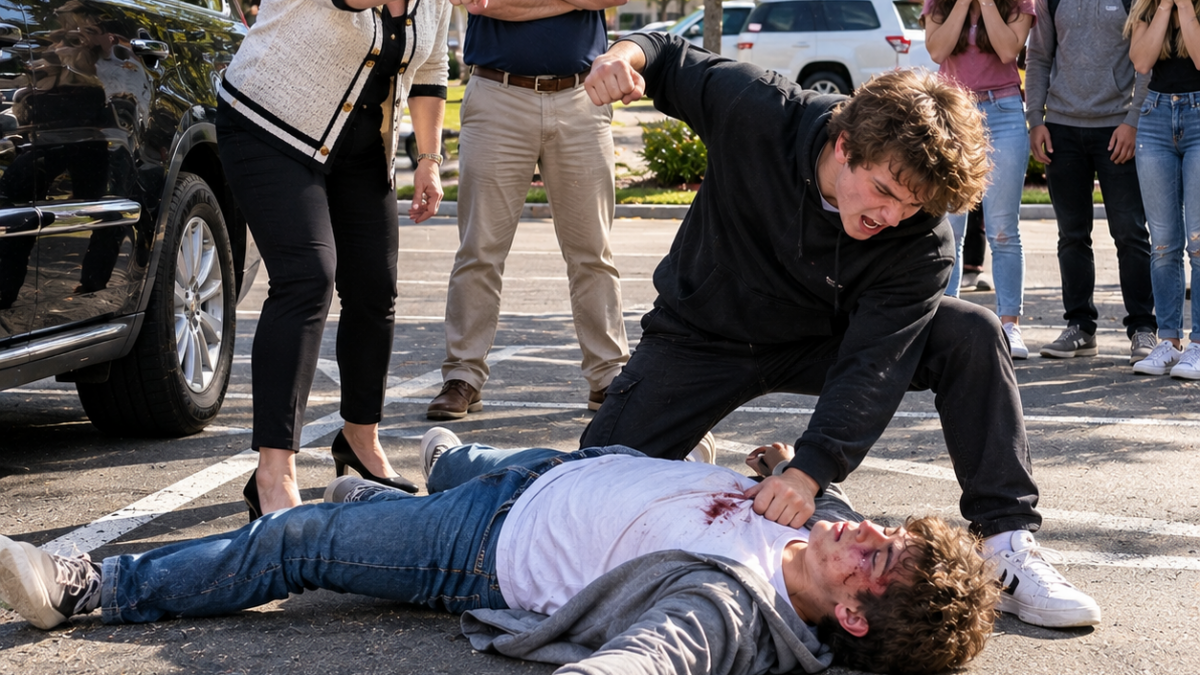
PART2
Then I looked at the position of his body.
The distance from the parking space.
The backpack.
The scrape on his temple.
Years of tactical training had conditioned me to notice geometry before emotion swallowed it.
I had spent most of my adult life training law-enforcement personnel in observation, movement, line-of-sight analysis, and target identification.
Not movie-sniper nonsense.
Real work.
Slow work.
The kind where centimeters matter.
Where a person’s position tells a story.
Where panic makes you miss things.
I forced myself to breathe.
“What happened?”
Darla answered for Caleb.
“Your son became confrontational over a parking space.”
I looked at her.
“I asked Caleb.”
She stiffened.
Caleb said nothing.
“Caleb?”
Darla stepped between us.
“He doesn’t have to answer you.”
“My son is unconscious.”
“And mine is a minor.”
“So is mine.”
“This is exactly what I mean about your behavior, Ethan. You escalate everything.”
I almost laughed.
Not because anything was funny.
Because the absurdity was so complete my brain didn’t know what else to do.
“My son is on the ground.”
“And your truck is across two parking designations.”
I stood.
Slowly.
Darla backed up one step.
I didn’t touch her.
Didn’t point at her.
Didn’t raise my voice.
I simply looked into her eyes.
“You might want to stop talking.”
Her chin lifted.
“Are you threatening me?”
“No.”
I glanced around the parking area.
The clubhouse.
The mail kiosk.
The light pole.
The stairwell.
The camera above the north entrance.
The camera above the maintenance gate.
Then back at her.
“I’m telling you this scene is about to become evidence.”
Her expression changed.
Barely.
A twitch.
“What does that mean?”
“It means don’t touch anything.”
“I’m HOA president.”
“That has nothing to do with what I just said.”
She scoffed.
“This isn’t a crime scene.”
“My child is unconscious after an altercation with your son.”
“You don’t know that.”
“I know enough not to contaminate it.”
Darla folded her arms.
“I manage this property.”
“And I train officers who document scenes.”
That got her attention.
She knew I worked around law enforcement.
She didn’t know exactly what I did.
Most people in Silver Ridge didn’t.
I preferred it that way.
My family had spent decades in tactical police work.
My oldest brother, known inside his unit as North, had served as a SWAT precision marksman for nearly twenty years.
My middle brother, East, worked tactical observation and sniper-team training.
My youngest brother, Ridge, had spent most of his career in counter-sniper and perimeter operations.
And I had built training systems for departments that taught officers how to read moving environments before making decisions.
We were not vigilantes.
We did not play soldier in suburban parking lots.
We believed the exact opposite.
Training meant restraint.
Observation.
Procedure.
Knowing when not to act.
Darla knew none of that.
She saw a father standing over his son.
She thought I was simply emotional.
Maybe that was why she made her next mistake.
She walked toward the metal railing near Mason’s backpack and put her bare hand on it.
I saw the exact spot.
“Don’t.”
She turned.
“What?”
“Take your hand off that.”
Her eyes narrowed.
“This is HOA property.”
“You just touched something connected to the incident.”
“Oh, please.”
She slid her hand along the rail as though deliberately proving she could.
I stared.
“You touched evidence without gloves after a child was seriously injured.”
Her expression flickered.
For the first time, something behind her confidence looked uncertain.
“Evidence of what?”
“That’s what the police get to determine.”
She dropped her hand.
“You’re being theatrical.”
“No.”
I looked toward Caleb.
“I’m being careful.”
Sirens sounded in the distance.
Darla recovered immediately.
She shoved the violation notice toward me again.
“You still need to sign acknowledgment.”
I pushed the paper gently back toward her.
“Not now.”
“You are refusing official documentation.”
“Yes.”
“I can add noncompliance.”
“Do whatever you think you need to do.”
Her lips curved.
“You always think you’re untouchable.”
I looked down at Mason.
“No.”
I knelt beside him again.
“I think you’re confused about what matters right now.”
Paramedics arrived first.
Then county patrol.
They moved me back just enough to work.
The lead medic asked:
“What happened?”
“My son was involved in some kind of physical confrontation. He was conscious briefly. Said his head hurt. Lost consciousness again.”
“Vomiting?”
“No.”
“Seizure?”
“No.”
“Do you know if he fell or was struck?”
I looked toward Caleb.
“I’m told there was a confrontation.”
Darla immediately inserted herself.
“He fell.”
The medic didn’t even look at her.
“Sir, were you present?”
“No.”
“Anyone witness?”
I looked around.
Several residents had gathered.
No one stepped forward.
Not yet.
Caleb stood behind Darla.
The medic stabilized Mason’s neck.
Loaded him onto the stretcher.
I stood beside him.
One patrol officer approached Caleb.
Darla moved in front.
“He is a minor.”
“Ma’am, I need to speak with him.”
“You can speak through me.”
“Are you his attorney?”
“I’m his mother.”
“I understand. I’m asking basic questions at this point.”
“He didn’t do anything.”
The officer looked toward Mason being loaded.
“Then the investigation will show that.”
Darla hated that answer.
I could see it.
She was used to certainty.
Her certainty.
The ambulance doors closed.
I followed in my truck after they left.
Before getting in, I looked back once.
Darla stood in the middle of the parking lot.
Arms folded.
Crimson blazer bright against gray pavement.
Caleb beside her.
She called:
“You should go to the hospital.”
I stopped.
Then she added:
“But don’t blame my son for your child’s clumsiness.”
That was the sentence.
The one I remembered later.
More than the violation notice.
More than her touching the railing.
More than her pretending nothing had happened.
Because Mason wasn’t even awake yet.
And she was already constructing the defense.
I looked at her.
“You just made this much bigger than it needed to be.”
She smiled.
“Good.”
I got into the truck.
For one second, rage told me to walk back.
Training told me to drive.
So I drove.
At the hospital, doctors took Mason directly for imaging.
I sat in a hallway under fluorescent lights and stared at a vending machine for almost forty minutes without seeing it.
A nurse asked if there was anyone she could call.
“No.”
Then I changed my mind.
I called North.
He answered after one ring.
“Ethan?”
“Mason’s in the hospital.”
Everything on his end went silent.
“What happened?”
“Fight. Maybe not a fight. I don’t know yet.”
“Condition?”
“Unconscious.”
“I’m coming.”
“Don’t.”
“What?”
“I said don’t come yet.”
“Ethan—”
“I need brothers right now, not operators.”
A pause.
“You have one.”
“Let me get facts first.”
“All right.”
Then:
“Call me when you know.”
“I will.”
The doctor came out around midnight.
She sat beside me.
Whenever a doctor sits, you notice.
“He has a significant head injury.”
My hands went cold.
“How significant?”
“Imaging shows trauma consistent with impact. There is swelling. We’re monitoring very closely.”
“Is he going to wake up?”
“We expect to know more with time.”
“That’s not an answer.”
“It’s the most accurate one I can give.”
I looked through the glass toward Mason.
Machines.
Lines.
White blankets.
My son.
Fourteen years old.
The kid who left cereal bowls in the sink no matter how many times I complained.
The kid who could identify every aircraft that passed over our house.
The kid who still called me when he forgot his locker combination.
Now a machine was measuring his breathing.
The doctor put one hand on my shoulder.
“He’s stable.”
“But unconscious.”
“Yes.”
“Coma?”
She hesitated.
“He is not responding normally. We’re treating this as a serious altered-consciousness state and monitoring neurologic function.”
The word didn’t matter.
Not really.
He wasn’t waking.
That mattered.
I sat beside him all night.
At around five in the morning, I rested my thumb on the back of his hand and moved it in small circles.
Something I had done when he was little.
When he was sick.
When thunderstorms scared him.
“Come on, kid.”
Nothing.
“Dad’s here.”
Machines beeped.
“Take your time. But come back.”
Around dawn, the doctor returned.
“He’s stable.”
I nodded.
“He hasn’t woken?”
“No.”
I lowered my head.
There are kinds of fear tactical training doesn’t touch.
A rifle doesn’t help.
A map doesn’t help.
A perfect plan doesn’t help.
You sit beside your child.
And you wait.
By late morning, I forced myself outside.
Hospital courtyard.
Cold wind.
Sun too bright.
I needed air.
Then I saw the crimson blazer.
Darla.
Leaning against the wall near the entrance.
Arms crossed.
Waiting.
I stopped.
“Are you stalking me?”
She pushed away from the wall.
“I heard you’ve been making accusations.”
“My son is upstairs unconscious.”
“And I’m sorry about that.”
She said it without sounding sorry.
“But I will not allow you to spread lies about Caleb.”
“I haven’t spoken publicly.”
“You spoke with police.”
“That’s called giving a statement.”
“You implied Caleb assaulted him.”
“I said there was an altercation and I did not witness it.”
“You’re telling neighbors.”
“No.”
She narrowed her eyes.
“People are talking.”
“Then ask them.”
She stepped closer.
“Boys roughhouse.”
“This wasn’t roughhousing.”
“You weren’t there.”
“Neither were you, apparently.”
Her face changed.
“I was on property.”
“That’s not the same thing.”
“Caleb said Mason became aggressive over a parking space.”
“What parking space?”
She paused.
“Our visitor lot has assigned overflow spaces.”
“Mason doesn’t drive.”
“He was standing in the space to hold it.”
I stared.
That was new.
“Hold it for who?”
“You.”
I almost laughed.
“I wasn’t even there.”
“That’s what Caleb said.”
“So my fourteen-year-old son was beaten unconscious because he stood in a parking space?”
“He wasn’t beaten.”
Her voice sharpened.
“He fell.”
“From what?”
“He lost his footing.”
“After Caleb touched him?”
“Barely.”
There it was again.
Barely.
I stepped closer.
“Intent doesn’t erase impact.”
She looked at me with that same boardroom expression.
“You are emotional.”
“Of course I’m emotional.”
“That’s why you need to be careful.”
“Careful about what?”
She lowered her voice.
“HOA violations can accumulate.”
I stared at her.
She continued.
“Parking infractions. Yard discrepancies. Noise. Unauthorized equipment. There are many ways residents become noncompliant.”
It took me a second to understand what she was doing.
Then I did.
“You came to a hospital to threaten me with HOA violations while my son is unconscious.”
Her face stayed calm.
“I’m advising you.”
“No.”
“You should know when to let something go.”
That sentence chilled me more than any shouted threat could have.
“You want me to let this go.”
“I want you to stop turning a tragic accident into an attack on my family.”
“Accident?”
“Yes.”
“Then why are you here?”
She frowned.
“What?”
“If it was simply an accident, why are you standing outside my son’s hospital room trying to manage what I tell police?”
“I am protecting Caleb.”
“From what?”
“False accusations.”
I studied her.
The posture.
The rehearsed language.
The repetition.
The camera.
Something clicked.
“What happened to the parking lot video?”
Her eyes moved.
Not much.
Enough.
“What video?”
“The north lot camera.”
“It malfunctioned.”
“How convenient.”
“Equipment fails.”
“When?”
“I don’t know.”
“You run the board.”
“I don’t personally service cameras.”
“But you already knew it failed.”
Her jaw tightened.
“That information was reported to me.”
“By who?”
“Maintenance.”
“When?”
Silence.
I stepped back.
“You’re too prepared.”
“You’re imagining things.”
“No.”
I shook my head.
“You walked in here already knowing the camera malfunctioned before I mentioned whether police had asked for footage.”
Her face lost color.
Only slightly.
“Stop creating conspiracies.”
“I’m looking for truth.”
“You won’t win this.”
I looked toward the hospital doors.
“This isn’t a board election.”
She turned away.
Then looked back.
“There are rules in our community, Ethan.”
“I know.”
“Don’t make yourself the exception.”
She walked to her Mercedes.
Drove away.
I stood there for another minute.
Then returned upstairs.
Mason still hadn’t moved.
But somebody was standing outside his room.
Jordan Hail.
Silver Ridge maintenance supervisor.
Forties.
Quiet.
Always looked uncomfortable at meetings.
He handled landscaping contracts.
Common-area repairs.
And the security cameras.
He saw me.
Flinched.
“Jordan.”
“Hey.”
“What are you doing here?”
“I heard about Mason.”
He looked through the glass.
“I’m sorry.”
“Thank you.”
He shifted his weight.
Looked down the hall.
Then toward the elevators.
Everything about his body said fear.
Not sadness.
Fear.
“You’re not here just to check on him.”
His shoulders tightened.
“I should go.”
“Jordan.”
He stopped.
“Did Darla send you?”
His eyes widened.
“No.”
Too quick.
“Did she tell you not to come?”
His silence answered.
I walked toward a quiet alcove near the vending machines.
“Come here.”
He followed.
Reluctantly.
Then leaned against the wall and covered his face.
“I didn’t mean for this.”
My pulse changed.
“What does that mean?”
“I never thought a kid would get hurt.”
“Jordan.”
He lowered his hands.
Eyes red.
“Darla told me to reset the camera.”
I stood completely still.
“When?”
“Morning of the incident.”
“Which camera?”
“North parking lot.”
“Why?”
“She said it was glitching.”
“Was it?”
“Not really.”
I breathed in slowly.
“What did you do?”
“System restart. Cleared local buffer.”
“Deleted footage?”
“Not intentionally.”
“But the restart removed stored segments.”
“Yes.”
“What did she tell you after Mason was hurt?”
His eyes filled.
“To mark the system nonoperational.”
“Why?”
“She said we couldn’t have partial corrupted footage creating false narratives.”
“That’s the phrase she used?”
“Almost exactly.”
“Did she know what happened?”
“I think so.”
“You think?”
Jordan shook his head.
“I saw Caleb push Mason.”
My fists tightened.
I forced them open.
“Say it again.”
He swallowed.
“I saw Caleb push your son.”
“How?”
“Hard.”
“Once?”
“I saw one push.”
“Where?”
“Near the rail.”
“Then?”
“Mason stumbled backward.”
“Hit?”
“The side of his head hit the corner.”
I closed my eyes for half a second.
There it was.
Not speculation.
Not Darla’s version.
A witness.
“Why didn’t you tell the police?”
Jordan’s face collapsed.
“Darla threatened my job.”
“Jordan.”
“She controls the board.”
“That doesn’t control police.”
“You don’t understand.”
“Then explain.”
He looked toward Mason’s room.
“I need this job.”
“So?”
“If she marks me for misconduct, I’m done.”
“Maintenance jobs exist elsewhere.”
“Not with my record if she poisons it.”
He swallowed.
“She told me she’d make sure no association in the county hired me again.”
“Can she?”
“I don’t know.”
“That’s not a reason to hide an assault.”
“I know.”
His voice cracked.
“I know.”
I softened.
Not much.
Enough.
“You didn’t push Mason.”
“No.”
“You didn’t cause the injury.”
“No.”
“But silence can help the person who did.”
He closed his eyes.
“I know.”
“Will you give a statement?”
“Not yet.”
My frustration rose.
But I stopped.
Fear does strange things to people.
Push too hard and he might disappear.
“You’ll have to choose.”
He nodded.
“I know.”
“Soon.”
“Yes.”
Jordan left.
I watched him walk down the hall.
Shoulders heavy.
The first crack in Darla’s story had appeared.
The next morning, she returned.
Her Mercedes was parked in the hospital fire lane.
Of course it was.
I almost appreciated the irony.
A woman obsessed with parking compliance illegally stopped in a fire lane so she could lecture me about rules.
She got out.
New blazer.
Maroon.
“You spoke to people last night.”
“No greeting?”
“You are destabilizing Silver Ridge.”
“My son is still unconscious.”
“You keep repeating that like it gives you immunity.”
“Immunity from what?”
“Consequences.”
“What consequences?”
“Reckless accusations.”
“You mean saying Caleb pushed Mason?”
Her face flickered.
“Jordan talked.”
I had not said Jordan’s name.
She had.
I stared at her.
She realized too late.
“Interesting.”
“What?”
“I didn’t mention Jordan.”
Her nostrils flared.
“You’ve been talking to maintenance.”
“You’re unraveling.”
“I’m protecting the community.”
“From a fourteen-year-old in a coma?”
“From you.”
I laughed once.
She raised her voice.
“You are unstable, Ethan.”
Two nurses leaving the building looked toward us.
Perfect.
That was exactly what Darla wanted.
An audience.
She continued louder.
“Threatening me will not wake your son.”
I kept my voice normal.
“Threatening you?”
“Yes.”
“What threat?”
“You’ve repeatedly referenced your tactical background.”
“No.”
“You implied I should be afraid of you.”
“I told you to preserve evidence.”
Her eyes narrowed.
“If I wanted to intimidate you, you would know the difference.”
That sentence came out harder than I wanted.
Not a threat.
Still too close.
I corrected myself.
“I’m not interested in intimidating you. I’m interested in the truth.”
She stepped backward.
“You’re not as powerful as you think.”
“And you’re not as untouchable as you pretend.”
Her face reddened.
“If you keep this up, you could lose everything.”
“My house?”
“If violations warrant action.”
“My reputation?”
“If people discover what you’re really like.”
“My peace?”
“Exactly.”
“You’re threatening me.”
“I’m warning you.”
“No.”
I shook my head.
“You came to a hospital twice to pressure the father of an unconscious child.”
She stared.
“This conversation never happened.”
“It did.”
Then my phone buzzed.
BROOKS: CALL ASAP. COUNTY INVESTIGATOR WANTS TO MEET.
Brooks was a county public-safety liaison I had trained years earlier.
He had no personal stake in Silver Ridge.
That was exactly what I needed.
Neutral ground.
I looked at Darla.
“Enjoy your fire lane.”
Then went inside.
Investigator Elena Ramirez met me at the county public safety annex that afternoon.
She was in her forties.
Sharp eyes.
No patience for dramatic storytelling.
I liked her immediately.
“Mr. Ward.”
“Ethan is fine.”
“Ethan.”
She opened a folder.
“I have preliminary medical information indicating your son’s injuries are inconsistent with a simple low-energy trip.”
“That matches what I’ve been told.”
“By whom?”
“I have a witness.”
“Name?”
“I need him to agree before I give you more.”
She didn’t like that.
“Do not play games with witnesses.”
“I’m not.”
“Then explain.”
I told her about Jordan.
Not every detail.
Enough.
Maintenance supervisor.
Saw the push.
Was instructed to reset camera system.
Threatened afterward.
Ramirez’s pen stopped.
“Did he tell you this directly?”
“Yes.”
“Will he give me a statement?”
“I think so.”
“That isn’t enough.”
“I know.”
She asked about Darla.
I described both hospital visits.
The HOA threats.
Her knowledge of the camera problem.
Her accidental mention of Jordan.
“Do you have recordings?”
“Some.”
“Messages?”
“Yes.”
“Violation notices?”
“Not yet.”
My phone buzzed.
Three email notifications.
I looked.
Then laughed.
Ramirez raised an eyebrow.
“What?”
“Now I have violation notices.”
I opened them.
Unauthorized contact with HOA employees.
Disorderly conduct on community property.
Misuse of parking lines.
All issued within the last hour.
Ramirez read them.
“Interesting timing.”
“Very.”
“Do not assume retaliation automatically.”
“I don’t.”
“Good.”
She closed the folder.
“Bring me Jordan.”
“If he comes voluntarily.”
“Correct.”
She looked at Mason’s medical summary again.
“And understand something. If evidence was intentionally destroyed or altered after a serious injury, that becomes much larger than an HOA disagreement.”
“I understand.”
“Do you?”
“Yes.”
Because that was exactly why I refused to let my brothers turn this into a show of force.
Truth mattered.
Not family reputation.
Not tactical backgrounds.
Truth.
When I got home, Darla’s SUV was parked near my property line.
She sat inside.
Watching.
I ignored her.
Walked toward my porch.
Her door opened.
“Heels on pavement,” I muttered.
She approached.
“We need to talk.”
“No.”
“You met with the county.”
“I did.”
“What did you tell them?”
“The truth.”
“Your version.”
“Facts.”
“You’re involving outsiders who don’t understand Silver Ridge.”
“That’s the point.”
She stepped in front of my door.
“You need to stop.”
“Move.”
“You’re causing serious problems.”
“My son is in a hospital.”
“And continuing to say that doesn’t excuse your behavior.”
“What behavior?”
“You’re questioning employees. Pressuring board staff.”
“I spoke to Jordan because he came to the hospital.”
Her face changed.
Not much.
Enough.
“So he did talk.”
There it was.
Again.
“You’re scared of him.”
“He’s unstable.”
“You’ve told me that twice.”
“He’s trying to protect his job.”
“You’re threatening his job.”
She lowered her voice.
“He should be afraid.”
That sentence hung between us.
I stared at her.
She realized it too.
Fear was making her sloppy.
“Go home, Darla.”
“You cannot order me around.”
“This is my property.”
“I’m standing on HOA-managed walkway.”
“No, you’re six feet inside my recorded parcel line.”
She glanced downward.
“Go home.”
She stepped back.
Then lifted her chin.
“You live under my rules.”
I turned toward her.
“Not forever.”
“What does that mean?”
“It means your employees are talking.”
Her face tightened.
“Jordan is a liar.”
“Your records will decide that.”
“You’re making a terrible mistake.”
“No.”
I opened my door.
“I think you did.”
Inside, my phone showed one new message.
JORDAN:
We need to talk.
Urgent.
We met behind the maintenance shed after dark.
Jordan was pacing.
Hands shaking.
He looked exhausted.
“She knows.”
“I noticed.”
“She cornered me this morning.”
“What did she say?”
“That if I keep talking, she’ll destroy my employment record.”
“Anything written?”
“No.”
“Anybody hear?”
“Maybe Luis.”
“Who’s Luis?”
“Grounds supervisor.”
“Will he talk?”
“I don’t know.”
Jordan dragged both hands through his hair.
“I can’t do this anymore.”
“Then don’t.”
He looked at me.
“There’s more.”
“Start from the beginning.”
He took a breath.
“What happened to Mason wasn’t random.”
My chest tightened.
“Explain.”
“Caleb has been talking about your family for weeks.”
“Why?”
“Darla complains about you constantly.”
“About what?”
“Parking. Yard equipment. Your work truck. The fact you challenge notices.”
“That doesn’t involve Mason.”
“Caleb made it involve Mason.”
“How?”
“He kept saying your family needed to learn to fall in line.”
My hands curled again.
I opened them.
“Did Darla tell him that?”
“Not exactly.”
“What exactly did she say?”
“Jordan.”
I stepped closer.
“Words matter.”
He nodded.
“She told Caleb that some residents only learn through consequences.”
“That’s vague.”
“Yes.”
“Anything direct?”
“Caleb bragged that he would make sure Mason stopped acting like your family owned the place.”
“When?”
“Last week.”
“Who heard?”
“Two maintenance kids. Maybe others.”
“Did you report it?”
“To Darla.”
“And?”
“She dismissed it.”
Jordan looked ashamed.
“There have been other complaints about Caleb.”
“What kind?”
“Bullying younger kids.”
“Physical?”
“Some.”
“How many?”
“At least four I know about.”
“Police?”
“No.”
“Why?”
“Parents complained to the HOA.”
“And Darla?”
“Buried them.”
“Deleted?”
“Marked resolved.”
“What does that mean?”
“She changed the complaint status.”
I stood there breathing slowly.
The story was getting bigger.
Not because I wanted it bigger.
Because every question revealed another decision.
“Why are you telling me now?”
Jordan looked toward my house.
“Because Mason is in a coma.”
Silence.
“I helped her hide things.”
“You didn’t hurt him.”
“I helped create a system where Caleb thought there were no consequences.”
That was more honest than anything Darla had said.
Jordan continued.
“There’s more.”
“Of course there is.”
“She’s planning a private board meeting tomorrow night.”
“Purpose?”
“Expel you.”
I almost laughed.
“From what?”
“Silver Ridge.”
“She can’t remove me from my house.”
“I know.”
“Does she?”
“She wants a motion declaring you a safety threat and authorizing all available enforcement measures.”
“Based on?”
“Your conduct since Mason was hurt.”
“Meaning questioning her.”
“Yes.”
“Calling county investigators.”
“Yes.”
“Talking to you.”
“Yes.”
I shook my head.
“This isn’t governance.”
“No.”
Jordan reached inside his jacket.
Pulled out a small notebook.
“I’ve been keeping this.”
I opened it.
Dates.
Meeting details.
Complaints.
Rules.
Darla’s instructions.
One entry made me stop.
BOARD ELECTION — MEMBER VERIFICATION NEVER FILED.
I looked up.
“What is this?”
Jordan’s face tightened.
“The election that put Darla in office.”
“What about it?”
“It wasn’t certified correctly.”
“Procedural mistake?”
“More.”
“How much more?”
“The incorporation paperwork itself wasn’t completed the way it should’ve been.”
“Meaning?”
“I don’t know legally.”
Good answer.
At least he didn’t pretend.
“But Darla knows there’s a problem.”
“How?”
“Former management counsel warned her.”
“When?”
“Almost two years ago.”
“And she kept operating.”
“Yes.”
“Can you prove that?”
“Emails exist.”
“Do you have them?”
“Some.”
“Get copies legally.”
He nodded.
“I already saved messages sent to me.”
“Good.”
He swallowed.
“Ethan.”
“What?”
“Your family.”
“What about them?”
“Darla keeps saying you won’t challenge her because she knows you’re all tactical people.”
I frowned.
“That makes no sense.”
“She thinks if you use your connections, she can frame it as intimidation.”
“That’s exactly why I won’t.”
“Good.”
He looked relieved.
“She’s expecting force.”
“She’ll get documents.”
That night, I messaged my brothers.
Not:
Bring rifles.
Not:
Come scare the HOA.
I wrote:
Need you tomorrow. Civilian clothes. No weapons beyond whatever you lawfully carry in normal life, preferably leave them secured. Observe only. I need witnesses who understand procedure.
North replied first.
Understood.
East:
No intervention unless immediate safety issue.
Ridge:
Eyes and ears.
Exactly.
My family’s tactical background mattered for one reason.
We were trained not to rush.
We understood angles.
Witness placement.
Observation.
Memory contamination.
Chain of custody.
We understood that the strongest response to a lie was not intimidation.
It was documentation.
The next morning, I went to the municipal records office.
I checked Silver Ridge filings.
Then checked again.
The truth was less dramatic than Jordan believed.
And, in some ways, worse for Darla.
The HOA itself had originally been incorporated properly years ago.
But the board election under which Darla claimed current authority had serious verification defects.
Required certification of member votes had not been filed.
Several amendments appeared unsupported by corresponding vote records.
Some enforcement authority she had claimed depended on procedures the association couldn’t document.
That did not mean every HOA covenant magically vanished.
Recorded property covenants were more complicated than that.
But it meant Darla’s favorite sentence—
“I am the board.”
—had a serious problem.
She might not lawfully be the board at all.
I paid for certified copies.
Then hired an attorney.
He reviewed everything.
“Do not walk into that meeting and declare every HOA rule void.”
“Why?”
“Because you don’t know that.”
“Fair.”
“But?”
“But the election issue is substantial.”
“And Darla?”
“Her authority to take extraordinary action against you is highly questionable.”
“Expel me?”
He almost laughed.
“No.”
“Remove me from my house?”
“No.”
“Fine me?”
“Depends on the underlying recorded authority and valid process. Her current notices are vulnerable.”
“Can I attend the private meeting?”
“Are you a member entitled to notice?”
“Under their records, yes.”
“Then I would challenge exclusion.”
“Can I bring witnesses?”
“Common meeting rules may apply. Do not force entry.”
“Understood.”
“Ethan.”
“Yes?”
“This is not where you prove you’re tougher.”
“I know.”
“Good.”
He tapped the folder.
“This is where you prove you read.”
I liked him too.
The next evening, my brothers arrived separately.
North first.
Tall.
Gray at the temples.
Civilian jacket.
East ten minutes later.
Quiet.
Analytical.
Ridge last.
Youngest of us.
Still older than me by two years, which he never let me forget.
We stood in my kitchen.
No rifles.
No tactical equipment.
No SWAT patches.
Just four brothers.
North asked:
“Mason?”
“Stable.”
“Movement?”
“Not yet.”
His jaw tightened.
East said:
“You sure you want us there?”
“Yes.”
“As brothers?”
“Yes.”
“Not operators.”
“Correct.”
Ridge leaned against the counter.
“If Caleb shows?”
“You do nothing.”
“If Darla threatens?”
“Nothing.”
“If somebody gets physical?”
“Call police unless immediate intervention is necessary to protect someone.”
North nodded.
“Good.”
I looked at all three.
“Darla expects intimidation.”
East smiled without humor.
“Then disappointment is useful.”
The meeting was scheduled for 9:30 p.m.
Invite-only.
At the clubhouse.
Jordan stood outside near the hydrangeas.
He looked like he hadn’t slept.
“You okay?”
“No.”
“Good enough.”
“She told me if I miss this meeting I’ll be written up for insubordination.”
“Your job isn’t supposed to depend on voting for her.”
“I know.”
“Do you have the emails?”
He handed me a flash drive.
“Copies of messages sent directly to me. Nothing I hacked. Nothing I wasn’t authorized to receive.”
“Good.”
North heard that.
Nodded once.
Procedure.
We walked toward the clubhouse.
My brothers stayed outside initially.
Not hiding in bushes.
Not positioning like snipers.
That would have been ridiculous.
They stood in public areas where anybody could see them.
Observers.
That was enough.
I knocked.
A board member opened.
Saw me.
“You weren’t invited.”
“I’m a member receiving enforcement action. I understand this meeting concerns me.”
He looked behind.
Darla appeared.
Crimson blazer.
Clipboard.
Of course.
“This is a closed executive session.”
“Under what authority?”
“Board privilege.”
“My attorney requested notice of any proceeding affecting my property or membership.”
Her eyes sharpened.
“You brought an attorney?”
“No.”
“Then leave.”
I held up a certified municipal filing.
“I have questions before you vote on expelling me.”
Several board members looked at each other.
Darla’s face tightened.
“There will be no discussion.”
“Then make sure your vote is legal.”
That got their attention.
One board member, Susan Hale, asked:
“What does that mean?”
Darla snapped:
“Nothing.”
I looked at Susan.
“It means the election certification for the current board appears incomplete.”
Silence.
Darla stepped closer.
“You do not know what you’re talking about.”
“I have certified copies.”
“You have paperwork you don’t understand.”
“Then let counsel explain it.”
“We don’t need counsel.”
Susan stared at her.
“For an expulsion vote?”
“There is no expulsion in the property sense.”
I said:
“Good. Then what are you voting on?”
Darla’s lips tightened.
“Behavioral restrictions.”
“Such as?”
“Suspending your access to common facilities.”
“Fine.”
“Restricting parking privileges.”
“Okay.”
“Imposing additional enforcement monitoring.”
“That phrase sounds invented.”
“It’s in draft.”
“Show me.”
“No.”
I placed the certified filing on the table.
“This board election lacks the verification the municipal record requires.”
A man named Robert Keller leaned forward.
“Darla?”
She didn’t look at him.
“Administrative records are incomplete all the time.”
“So you knew?”
“I knew there were filing questions.”
Jordan stepped into the doorway.
Darla saw him.
Her face changed.
“Get inside.”
He did.
Slowly.
I held up his notebook.
Darla went pale.
“You gave him private board materials?”
Jordan shook his head.
“My own notes.”
“Traitor.”
Susan flinched.
“Darla.”
“What?”
“You just called our maintenance supervisor a traitor in a governance meeting.”
“He breached confidentiality.”
“I documented what I saw.”
Jordan’s voice shook.
But he kept going.
“Meetings that never happened.”
Darla’s eyes widened.
“Stop.”
“Votes recorded before approval.”
“Jordan.”
“Complaints against Caleb marked resolved without review.”
“Enough.”
“Camera reset instructions.”
The room froze.
Darla turned white.
Robert asked:
“What camera?”
I answered:
“The camera overlooking the parking lot where my son was injured.”
Darla pointed.
“This is exactly the kind of reckless accusation we are meeting to address.”
Jordan said:
“She told me to reset it.”
Darla spun.
“You lying little—”
North stepped into view outside the open doorway.
Not threatening.
Hands visible.
Civilian clothes.
Darla stopped mid-sentence.
Her eyes moved from him to me.
Then East.
Then Ridge.
Three men standing several feet apart.
Watching.
“That’s your family.”
“Yes.”
“The snipers.”
North answered calmly:
“We’re Ethan’s brothers.”
Darla looked at him.
“You’re here to intimidate this board.”
“No.”
“Why are you here?”
“To observe.”
“All of you are SWAT.”
East said:
“What we do for work isn’t relevant to your meeting.”
“It is when you surround a building.”
Ridge looked behind himself at the open parking lot.
“We’re standing beside the sidewalk.”
One board member almost laughed.
Darla didn’t.
She pointed at me.
“You brought armed tactical officers to threaten us.”
I said:
“No one here is acting under police authority.”
North added:
“And I left my duty weapon secured before coming.”
East nodded.
“Same.”
Ridge:
“Same.”
That ended that argument.
I looked at the board.
“My family isn’t the evidence.”
I tapped the folder.
“This is.”
Certified filing.
Jordan’s notes.
Copies of Darla’s emails.
My retaliatory violations.
Medical report.
Witness information.
The room shifted.
Susan picked up the election certification record.
“Where is the member verification?”
Darla said:
“Management handled it.”
“Which management company?”
“The previous one.”
“They left three years ago.”
“Exactly.”
Robert asked:
“Do we have a certified vote count?”
“Yes.”
“Where?”
“In archived records.”
“Can we see it?”
“Not tonight.”
Susan leaned back.
“We are about to vote on disciplinary action against a resident whose child is hospitalized after an incident involving your son, while the board’s election file is incomplete and our maintenance supervisor is accusing you of camera interference.”
Darla stared at her.
“So?”
Susan blinked.
“So maybe we stop.”
That was the first domino.
Darla slapped her folder onto the table.
“This community functions because I make decisions.”
I said quietly:
“That may be the problem.”
She pointed at me.
“You think you can tear down everything I built because your son fell?”
North’s posture changed.
Not threatening.
Just sharper.
I held one hand slightly toward him.
I had it.
I looked at Darla.
“My son did not simply fall.”
“You can’t prove that.”
“Jordan witnessed the push.”
Darla looked at Jordan.
He swallowed.
Then said:
“I saw Caleb shove Mason.”
Darla’s face changed.
“He tripped.”
“No.”
Jordan’s voice grew louder.
“He shoved him hard enough that Mason hit the rail.”
“You’re mistaken.”
“I was there.”
“You were thirty yards away.”
“Twenty.”
“That’s too far to see clearly.”
I almost admired how quickly she adapted.
Jordan shook his head.
“I saw Caleb put both hands on him.”
Both.
That was new.
I stared.
“You’re sure?”
Jordan looked at me.
“Yes.”
“Why didn’t you say that before?”
“Because I was afraid.”
Darla snapped:
“Of him!”
She pointed at me.
Jordan turned toward her.
“No.”
His voice became surprisingly calm.
“Of you.”
Silence.
That silence lasted longer than any shouting could have.
Susan stood.
“I move that all extraordinary enforcement action against Ethan Ward be suspended pending independent legal review.”
Robert:
“Second.”
Darla turned.
“You cannot.”
Susan:
“I just did.”
“This meeting is under my authority.”
Robert looked at the certified filings.
“That’s exactly what we’re reviewing.”
Darla’s voice rose.
“I am this board.”
Susan stared at her.
“No.”
That word.
Simple.
Devastating.
“No, you are not.”
The board voted.
Not to remove Darla yet.
That would come later.
They voted to suspend action against me.
Preserve records.
Retain independent counsel.
And prohibit deletion or alteration of security-system logs.
Darla sat perfectly still.
My brothers never raised their voices.
Never touched anyone.
Never displayed weapons.
Their presence did one thing.
It prevented Darla from pretending later that the room had been chaotic or threatening.
Four trained observers.
Multiple board members.
Jordan.
Records.
That was enough.
When we walked outside, Ridge exhaled.
“Well.”
North looked at him.
“Don’t.”
“I was just going to say she seems pleasant.”
“Don’t.”
For the first time since Mason was hurt, I almost smiled.
Then my phone rang.
Hospital.
My heart stopped.
I answered immediately.
“Mr. Ward?”
“Yes.”
“Your son showed some purposeful hand movement.”
I leaned against the wall.
“What?”
“He squeezed during stimulation. It’s small, but it’s encouraging.”
My eyes closed.
North put a hand on my shoulder.
“Is he awake?”
“No.”
“But?”
“Movement.”
All three brothers exhaled at once.
Everything about the HOA disappeared.
For that moment, only Mason mattered.
I drove back to the hospital.
Sat beside him.
Put my thumb against his palm.
“Come on, kid.”
Nothing.
Then:
A tiny pressure.
Maybe reflex.
Maybe not.
I chose hope.
The next day, Investigator Ramirez interviewed Jordan.
Without me in the room.
Correctly.
He told her what he saw.
The push.
The camera reset.
Darla’s instructions.
The later pressure.
He provided messages.
Ramirez obtained system records.
The camera did not have usable video of the assault.
That part could not be magically restored.
But logs showed manual reset activity.
Timing matched Jordan’s account.
Other cameras captured Caleb entering the lot.
Mason arriving.
Darla arriving afterward.
Witness canvassing found two residents who heard shouting.
One had seen Caleb confronting Mason before the fall but not the exact push.
Another teenager said Caleb had been threatening Mason for days.
The case no longer depended on one frightened maintenance supervisor.
Caleb was interviewed with counsel.
Darla tried to accompany him.
Investigators controlled the process.
Not her.
I wasn’t told every detail.
I didn’t need to be.
I had spent enough time around investigations to know victims’ families do not own them.
That can be hard.
You want every answer.
Every minute.
Every confession.
The system moves slower.
But slow can protect truth.
Meanwhile, Silver Ridge exploded.
Not literally.
Socially.
Residents heard about the secret meeting.
Then the camera allegations.
Then Darla’s retaliatory violations against me.
Then the board-election problem.
By the following evening, the community center was overflowing.
More than a hundred people came.
Some stood against walls.
Others filled the hallway.
Darla sat at the front table.
No crimson blazer this time.
Charcoal jacket.
Hands tight.
Independent counsel sat beside the board.
That mattered.
A moderator opened.
“This meeting is to address allegations regarding board governance, resident safety, enforcement procedures, and records preservation.”
Darla stood immediately.
“This entire process is a smear campaign.”
People murmured.
She continued.
“One resident has weaponized a personal tragedy to destabilize this association.”
I stood.
The moderator looked at counsel.
Counsel nodded.
I walked forward.
Not as tactical instructor.
Not as SWAT brother.
Not as anything special.
A father.
“My son is in the hospital.”
The room quieted.
“He was injured in your parking lot after an altercation with Darla’s son.”
Darla shouted:
“Allegedly.”
Counsel raised a hand.
“Ms. Whitlock.”
She sat.
I continued.
“I am not asking this room to decide criminal responsibility.”
Important.
“That belongs to investigators.”
Ramirez had insisted on that boundary.
Good advice.
“I am asking why complaints about prior conduct were closed without review.”
People looked toward the board.
“Why a security camera was manually reset.”
Toward Jordan.
“Why the maintenance supervisor says he was pressured to label the system nonoperational.”
Darla looked furious.
“Why three violation notices were issued against me immediately after I met with a county investigator.”
Whispers.
“And why this board’s election and authority records are incomplete.”
I placed certified copies on the table.
Not dramatic.
Paper.
One woman raised her hand.
“I never voted in that election.”
Another:
“I thought it was electronic.”
A man:
“I received results but no ballot.”
Darla said:
“Not everyone remembers participating.”
The moderator said:
“We’ll take statements in order.”
Then Jordan stood.
He looked terrified.
His wife sat in the front row.
I had not known her before.
She held his hand until he stepped away.
He took the microphone.
“My name is Jordan Hail.”
Someone whispered:
“We know.”
Nervous laughter.
He swallowed.
“I need to apologize.”
The room quieted.
“I allowed fear to keep me silent.”
He explained his job.
Darla’s threats.
The camera reset.
Complaints.
Caleb.
He never called Darla criminal.
Never exaggerated.
He said what he personally knew.
That made him powerful.
“I saw Caleb confront Mason.”
Darla shifted.
“I saw him shove Mason with both hands.”
A woman gasped.
“I saw Mason go backward.”
Jordan’s voice cracked.
“I should have called police immediately.”
He looked at me.
“I didn’t.”
I nodded once.
“I was afraid of losing my job.”
He looked at the residents.
“I thought staying quiet protected my family.”
His wife wiped tears.
“But a kid is in a hospital.”
Silence.
“I don’t want to be afraid anymore.”
People didn’t applaud.
Not immediately.
Then someone in the back clapped once.
Another joined.
Then the room.
Not for me.
For him.
Darla grabbed the microphone.
“You are all being manipulated.”
The applause stopped.
She stood.
“Jordan is a disgruntled employee.”
Jordan sat.
“He has had performance issues.”
He looked up.
“That’s not true.”
Darla continued.
“Ethan Ward has spent days intimidating board staff with his tactical connections.”
North stood in the back.
He didn’t speak.
Darla pointed.
“There! His family!”
Everybody turned.
Three men.
Plain clothes.
Calm.
She said:
“They’re SWAT snipers.”
A murmur spread.
I walked back to the microphone.
“Yes.”
Darla smiled like she had finally caught me.
“My brothers work in tactical law enforcement.”
She pointed harder.
“Exactly.”
“And?”
“You brought them here to scare us.”
“No.”
I looked at North.
“Have you threatened anyone?”
“No.”
“East?”
“No.”
“Ridge?”
“No.”
“Displayed a weapon?”
All three:
“No.”
“Claimed police authority?”
“No.”
I faced Darla.
“They are witnesses.”
“You are weaponizing your family.”
“No.”
I pointed at the documents.
“I’m using paper.”
That got a laugh.
Darla hated it.
She turned toward the residents.
“I have kept Silver Ridge safe for years.”
Mrs. Benton from Oak Lane stood.
“You fined my daughter because her bicycle was on the grass for three minutes.”
“Rules matter.”
“You threatened towing over my husband’s work vehicle.”
“Commercial vehicles are restricted.”
A retired man raised his hand.
“You sent me six violations for my mailbox after I complained about your son driving through the stop sign.”
“That is unrelated.”
Another woman:
“My boy complained Caleb shoved him last summer.”
The room changed.
Darla froze.
The woman continued.
“You told me teenagers roughhouse.”
Same phrase.
Boys roughhouse.
It happens.
Darla said:
“There was no evidence.”
“Because you closed the complaint.”
Another parent stood.
“My daughter said Caleb cornered her brother near the basketball court.”
Darla shook her head.
“Rumors.”
Then another.
And another.
Not all accusations were verified.
Counsel repeatedly reminded people not to treat stories as findings.
Correctly.
But a pattern of unresolved complaints was becoming visible.
A board member, Robert, looked sick.
“How many complaints regarding Caleb were closed administratively?”
Darla answered:
“I don’t know.”
Jordan said from his seat:
“Seven that I remember.”
Seven.
I didn’t react.
Couldn’t.
The moderator called for order.
Independent counsel requested all complaint records be preserved and transferred.
Then Susan stood.
“I move that Darla Whitlock be suspended from all board authority pending independent review.”
Darla shot up.
“You cannot.”
Susan looked at counsel.
“Can we?”
Counsel said carefully:
“Under the emergency governance provisions still valid under the recorded documents, the remaining directors can temporarily restrict an officer’s administrative access pending investigation, subject to proper vote.”
Darla stared.
“So you’re siding with him.”
The attorney replied:
“I’m reading the documents.”
Perfect.
Vote.
Hands raised.
One by one.
Unanimous among eligible directors present.
Darla lost administrative access.
Temporary pending investigation.
Not movie justice.
Procedure.
She stood.
“You owe me loyalty.”
Susan answered:
“We owe the association fiduciary duty.”
Darla looked toward me.
“This is your fault.”
“No.”
I shook my head.
“My son being hurt made people ask questions.”
“That’s the same thing.”
“No.”
“It isn’t.”
Security escorted no one dramatically.
Darla left voluntarily after counsel instructed her she no longer controlled the meeting.
She shouted from the doorway:
“You will regret this.”
North leaned toward Ridge.
“Don’t.”
Ridge whispered:
“I didn’t say anything.”
“You were going to.”
“I was thinking.”
“Stop.”
I almost laughed again.
Then my phone buzzed.
Hospital.
Again.
I answered.
The nurse said:
“Mason is showing more purposeful response.”
My legs nearly gave out.
I left the meeting before any final applause.
Because none of it mattered compared to that.
At the hospital, Mason’s fingers curled weakly around mine.
His eyes remained closed.
But the neurologist sounded more hopeful.
“We’re seeing improvement.”
“How much?”
“Enough to be encouraged.”
“Will he wake?”
“We believe he is moving in the right direction.”
Right direction.
I held onto those words.
The next days became two parallel worlds.
Hospital.
Investigation.
Hospital.
Board review.
Hospital.
Legal filings.
Hospital.
Nothing mattered more than the first one.
Ramirez’s investigation expanded.
She did not tell me, “Darla is going down.”
Real investigators don’t talk that way.
She told me:
“We have corroboration.”
Caleb faced formal juvenile proceedings related to the assault.
Because he was seventeen, much of it remained protected.
Good.
I did not want his entire life turned into public entertainment.
He had done something serious.
He needed consequences.
That didn’t mean I needed strangers cheering for his destruction.
Darla faced separate scrutiny.
Not because she was Caleb’s mother.
Because of her own actions.
Pressure on Jordan.
Record handling.
Camera instructions.
Possible retaliation through HOA enforcement.
Those questions moved through appropriate channels.
Some became civil governance issues.
Some administrative.
Some potentially criminal depending on intent and evidence.
I let investigators decide.
That was difficult.
Rage likes certainty.
The law requires proof.
Meanwhile, the independent HOA audit uncovered what I had suspected.
The association itself existed.
But Darla’s election process had been defective.
Certain board actions lacked required approval.
Several rules were adopted without the documented votes their bylaws required.
Some enforcement notices were valid under older covenants.
Others were not.
The world was messier than “everything she ever did was illegal.”
That truth mattered.
We corrected what could be proved wrong.
We did not invent wrongdoing because we hated her.
Parking fines issued under nonexistent amendments were refunded.
Retaliatory violations were canceled.
The three notices sent to me disappeared immediately.
Improper complaint closures were reopened for review.
Election records were audited.
A legitimate special election was scheduled.
Residents could finally see minutes.
Budgets.
Votes.
Appeal procedures.
Nothing glamorous.
Exactly what should have existed all along.
North called one night.
“How’s Mason?”
“Same but better.”
“That sentence makes no sense.”
“You’d understand if you were here.”
“I’m coming tomorrow.”
“You don’t have to.”
“I know.”
He came.
Sat beside Mason.
For twenty minutes he didn’t say anything.
Then:
“Hey, kid. Uncle North.”
No movement.
“You owe me forty dollars.”
I looked at him.
“What?”
“He’ll wake up just to argue.”
Nothing.
North continued.
“Your dad told me you beat my time on that simulator.”
Mason’s finger moved.
North froze.
I laughed through tears.
“You saw that.”
“Yes.”
“You think he heard?”
“Yes.”
“Definitely?”
“No.”
Then he looked at Mason.
“But I’m claiming victory.”
East visited next.
Then Ridge.
Three SWAT snipers who had spent careers observing threats became utterly helpless around one unconscious teenager.
That humbled all of us.
Ridge brought a deck of cards.
“What is he supposed to do with those?”
“When he wakes, we play.”
“When.”
Ridge looked at me.
“Yes.”
“When.”
The family never marched into Silver Ridge carrying rifles.
No tactical trucks.
No scopes.
No intimidation campaign.
People online would probably have preferred that version.
Reality was stronger.
Three men trained to use force chose not to.
They watched.
Remembered.
Corroborated.
Kept me from doing anything stupid.
That was the best use of their training.
Darla hated that.
At one point she filed a complaint claiming I had brought “armed tactical personnel” to board proceedings.
North voluntarily spoke with the independent investigator.
“Were you armed?”
“No.”
“Did you identify yourself as police?”
“No.”
“Did you give any order?”
“No.”
“Did Ethan ask you to pressure board members?”
“No.”
“Why did you attend?”
“My nephew was hospitalized. My brother requested family support and witnesses.”
“Anything else?”
“No.”
Complaint closed.
Darla’s strongest weapon had always been implication.
Once everything had to be written in exact sentences, implication stopped working.
Two weeks after the community meeting, a legitimate election was held.
I was asked to run.
I refused.
People were surprised.
“You led all this.”
“No.”
“You exposed Darla.”
“Jordan did more than I did.”
“You understand procedures.”
“That doesn’t mean I want the job.”
Susan eventually ran.
So did Robert.
Several new candidates.
Ballots counted openly.
Independent observer.
Certified results.
Susan became president.
First thing she said after accepting:
“I am not the neighborhood.”
Good start.
Second:
“The board works for the documents and the members.”
Even better.
Third:
“If anyone sees me wearing a crimson blazer, remove me immediately.”
The room laughed.
I did too.
Darla did not attend.
By then she had stopped appearing publicly around Silver Ridge.
Her attorney handled most communications.
Rumors said she planned to sell.
I didn’t care.
My focus stayed in the hospital.
Then one morning, fifteen days after the parking-lot incident, I was sitting beside Mason when his eyelids moved.
Not the tiny flutter we had seen before.
Slow.
Intentional.
I stood.
“Mason?”
His eyes opened halfway.
Unfocused.
Then closed.
My heart nearly stopped.
“Nurse.”
I hit the call button.
“Mason.”
Eyes again.
The nurse rushed in.
Doctors followed.
I backed away because suddenly too many people were around him.
His eyes opened.
He looked confused.
Scared.
Then he found me.
His mouth moved.
No sound.
I leaned closer.
“I’m here.”
His lips moved again.
“Dad.”
That one word broke me harder than anything Darla had said.
I cried.
Not dignified tears.
Full-body, exhausted, shaking tears.
I pressed my forehead against his hand.
“I’m here, buddy.”
He couldn’t remember the parking lot.
Not immediately.
Doctors said that wasn’t unusual.
Recovery would take time.
Therapy.
Monitoring.
Possibly headaches.
Memory problems.
Balance issues.
Nobody promised easy.
I didn’t ask for easy.
He was awake.
That was enough.
Later, North walked in.
Mason blinked at him.
North said:
“You still owe me forty dollars.”
Mason whispered:
“No.”
North looked at me.
“Neurologically perfect.”
Even the nurse laughed.
The investigation into Caleb continued independently of Mason’s recovery.
That distinction mattered too.
A victim waking up does not make an assault disappear.
But I felt some anger loosen.
Not forgiveness.
Not yet.
Perspective.
Caleb was seventeen.
He had made a brutal decision.
The evidence supported that he confronted Mason over the parking area, shoved him forcefully, and caused the impact that led to the head injury.
Whether he intended a coma was another question.
Probably not.
That did not erase responsibility.
He entered the juvenile justice process.
Counsel.
Court supervision.
Consequences.
Requirements.
Because of his age, I won’t pretend I knew every detail.
I wasn’t supposed to.
I did learn that previous complaints became relevant to understanding the pattern.
That was painful.
Not because I wanted more ammunition.
Because maybe intervention earlier could have prevented Mason’s injury.
Darla had protected her son from smaller consequences.
And in doing so, she may have helped create the conditions for a much larger one.
That is one of the hardest things parents learn.
Protecting your child from every consequence is not the same as protecting your child.
Sometimes consequences teach boundaries before life teaches them brutally.
Darla had confused love with insulation.
Caleb learned the difference too late.
Months later, through attorneys, his family requested a restorative meeting.
I initially refused.
Mason surprised me.
“I want to hear him.”
“You don’t have to.”
“I know.”
“You sure?”
“No.”
Honest.
We waited until his therapist approved.
The meeting happened in a neutral conference room.
No Darla.
Just Caleb.
His attorney.
A youth counselor.
Me.
Mason.
Caleb looked completely different from the parking lot.
Smaller somehow.
No swagger.
He sat across from Mason.
Could barely look up.
Finally:
“I’m sorry.”
Mason said nothing.
Caleb continued.
“I was mad.”
Silence.
“I thought you were saving the spot for your dad.”
Mason’s voice was still weaker than before the injury.
“So?”
Caleb stared at the table.
“My mom kept saying your family ignored rules.”
I felt anger rise.
Mason beat me to it.
“So you shoved me?”
Caleb closed his eyes.
“Yes.”
“Why?”
“I don’t know.”
“That’s stupid.”
“Yes.”
Mason looked at him for a long time.
Then:
“I almost died.”
Caleb cried.
Not dramatically.
Quiet.
“I know.”
Mason looked toward me.
Then back.
“I’m not saying it’s okay.”
Caleb nodded.
“I know.”
“But I don’t want to hate you forever.”
That was my son.
Fourteen.
Recently out of a coma.
More mature than half the adults in Silver Ridge.
Caleb whispered:
“I understand.”
I wasn’t ready to forgive him the same way.
Maybe a father’s anger moves slower.
But I appreciated the meeting.
Accountability doesn’t require permanent hatred.
Darla never requested that kind of meeting with me.
Not then.
Her consequences unfolded differently.
The governance review found she had repeatedly exceeded her authority.
Several actions were reversed.
Insurance became involved.
Attorneys.
Board records.
Her access to HOA systems was terminated.
She was formally removed through legitimate procedures after the new election structure was established.
The camera matter remained part of the official investigation.
Jordan’s job was protected during the transition.
That was important.
The new board retained him.
Susan told him:
“You’re not being rewarded for staying silent.”
He looked down.
“I know.”
“You’re being retained because you eventually cooperated and because you know these systems better than anyone.”
“I understand.”
“And if I tell you to delete footage improperly?”
He almost smiled.
“I call counsel.”
“Perfect.”
Jordan’s wife hugged him outside the meeting.
I saw some of the guilt leave his face.
Not all.
That would take time.
Silver Ridge slowly changed.
The parking lot where Mason fell became a place I avoided.
For months.
Then physical therapy forced the issue.
Mason had to walk longer distances.
One afternoon he asked:
“Can we go there?”
“You sure?”
“No.”
Again.
Honest.
We drove.
I parked correctly inside one space.
He noticed.
“Really?”
“What?”
“You’re worried about the lines now?”
“Trauma changes a man.”
He laughed.
Good sound.
We walked to the rail.
The exact spot had been cleaned long before.
No blood.
No tape.
No obvious sign anything happened.
Mason stood quietly.
“I don’t remember hitting it.”
“Good.”
“I remember Caleb being mad.”
I waited.
“I remember him telling me to move.”
“You were standing in the spot?”
“Yes.”
That corrected something in my own understanding.
“Why?”
“Because you said you were coming to pick me up.”
“I didn’t ask you to save it.”
“I know.”
“Then why?”
“I thought it’d be funny.”
Teenagers.
I sighed.
“Not your finest decision.”
“No.”
He looked at me.
“But he still shouldn’t have pushed me.”
“Correct.”
Both things could be true.
Mason shouldn’t have been standing in the parking space.
Caleb shouldn’t have shoved him.
One behavior was annoying.
The other put a child in a hospital.
Rules do not become permission for violence.
That distinction became central to every conversation about the case.
Darla had tried to collapse them.
Mason broke parking etiquette, therefore Caleb’s anger was understandable, therefore the injury was an accident, therefore everyone should let it go.
No.
You can acknowledge the smaller wrong without minimizing the bigger one.
I told Mason:
“Next time, don’t stand in parking spaces.”
He nodded.
“Next time, don’t go into a coma.”
He stared at me.
Then laughed.
“Terrible joke, Dad.”
“I’m recovering too.”
He touched the railing.
“I want to go.”
We left.
That was enough.
The community installed additional camera coverage afterward.
Not because I demanded surveillance everywhere.
Because blind spots had helped uncertainty grow.
The system had new retention rules.
No single board officer could order deletion or reset after an incident.
Maintenance actions generated automatic logs.
Serious footage requests required two-person approval.
Boring.
Good.
The parking policy itself was rewritten in plain language.
No residents could “reserve” spaces by standing in them.
No HOA volunteer had physical enforcement authority.
Disputes required documentation.
Aggressive contact required law enforcement.
Again:
Rules that should have been obvious.
Written because experience proved obvious wasn’t enough.
The first annual meeting after Mason came home was packed.
Susan invited me to speak.
I declined.
She insisted.
“Five minutes.”
“Why?”
“Because people expect you.”
“That’s exactly why I shouldn’t.”
She looked confused.
I explained.
“If everybody starts treating me like the new moral authority, we learned nothing.”
She smiled.
“That’s irritatingly reasonable.”
“Thank you.”
Mason spoke instead.
Thirty seconds.
He walked to the microphone.
Still thinner than before.
Scar near his hairline.
He said:
“I don’t know anything about HOA law.”
People laughed softly.
“I do know people should not get hit over parking.”
More laughter.
Then quiet.
“And adults shouldn’t hide bad things because they’re embarrassed.”
Jordan looked down.
“And parents should let kids face consequences before the consequences get bigger.”
That one landed.
Mason stepped away.
No applause at first.
Then everyone stood.
I hated standing ovations normally.
That one I allowed.
My brothers attended.
North whispered:
“Kid’s better speaker than you.”
“He got that from his mother.”
“Obviously.”
Afterward, several residents approached Mason.
Not me.
Good.
He deserved to be seen as more than a victim.
One mother thanked him because her son had admitted Caleb bullied him too.
A teenager apologized for seeing the confrontation and walking away before Mason fell.
Mason told him:
“I probably would’ve walked away too.”
Empathy.
Again.
My son teaching adults.
Darla’s house remained at the end of the cul-de-sac for several more months.
Eventually, a FOR SALE sign appeared.
People celebrated online.
I didn’t.
When North sent me a photo with a laughing emoji, I replied:
Don’t.
He called.
“You’re no fun.”
“She’s still a mother whose son ruined part of his life.”
“And who tried covering it.”
“Yes.”
“You feel sorry for her?”
“Some.”
Silence.
“That’s annoyingly mature.”
“Go bother Ridge.”
I didn’t excuse Darla.
I never will.
She threatened me while Mason was unconscious.
She used HOA violations as leverage.
She pressured Jordan.
She minimized serious violence.
She chose control over truth repeatedly.
But once she lost power and the legal processes were moving, I didn’t need to watch her suffer.
I needed to help Mason heal.
That was enough work.
Before Darla moved, she came to our house once.
No crimson blazer.
No clipboard.
Jeans.
Gray sweater.
She stayed outside the property line.
That detail mattered.
I walked down.
“What do you want?”
“To talk.”
“About?”
“Mason.”
“He’s recovering.”
“I heard.”
Silence.
Then:
“I failed Caleb.”
That surprised me.
I said nothing.
“I kept solving problems for him.”
She looked toward the road.
“Every teacher complaint. Every neighbor complaint. Every argument.”
Her voice cracked.
“I thought I was protecting him.”
“You were protecting him from consequences.”
“I know.”
“That’s different.”
“I know that now.”
She looked at me.
“I also failed your son.”
“Yes.”
No comfort.
Truth.
She accepted it.
“I touched the camera issue because I panicked.”
I studied her.
“What exactly did you do?”
“I told Jordan the system should be marked unreliable.”
“Did you order him to delete footage?”
“No.”
“Reset?”
“I told him to correct the glitch.”
“He says you told him before the incident.”
Her eyes lowered.
“I knew Caleb had been arguing with kids there.”
That was as close as she came to admitting the full problem.
“Why reset it?”
“I thought the camera was generating complaints.”
“That doesn’t answer the question.”
“No.”
She looked at me.
“I don’t have a better answer.”
For once, that was honest.
“You threatened me at the hospital.”
“Yes.”
“You threatened Jordan.”
“Yes.”
“You filed violations against me.”
“Yes.”
“Why are you here?”
Her eyes filled.
“To say I’m sorry.”
I waited.
“To you.”
She looked toward the house.
“To Mason, if he ever wants to hear it.”
“He may not.”
“I understand.”
“And sorry doesn’t change the investigation.”
“I know.”
“Or Caleb’s consequences.”
“I know.”
“Or yours.”
“I know.”
Then she said something I remembered.
“I thought if I could control every part of the story, I could stop it from becoming the worst thing it was.”
I nodded.
“But it already happened.”
“Yes.”
That was Darla’s tragedy.
She had treated truth like an outcome she could manage.
It isn’t.
An event happens.
You can respond well.
Or poorly.
But you cannot change the original fact by issuing enough notices.
Mason had been shoved.
He had hit his head.
He had been unconscious.
Everything Darla did afterward only decided what kind of person she would become in response.
She chose badly.
Eventually, she understood.
Maybe too late.
Still.
She understood.
I did not invite her inside.
Did not shake her hand.
But when she walked away, I did not hate her the same way I had in the hospital parking lot.
That was progress.
For me.
Not for her.
Months became a year.
Mason returned to school gradually.
Headaches lingered.
Concentration took work.
He hated physical therapy.
Loved occupational therapy because the therapist let him use gaming equipment.
His grades recovered slowly.
His humor recovered immediately.
One morning I reminded him to finish homework.
He said:
“Be careful. Stress is bad for my neurological recovery.”
I stared.
He grinned.
“Too soon?”
“Extremely.”
He laughed.
That sound was worth every sleepless night.
North, East, and Ridge became even more annoying after the incident.
They checked on Mason constantly.
North brought tactical binoculars for his birthday.
I said:
“He’s fourteen.”
North:
“Good age for optics.”
“No.”
East brought a model aircraft kit.
Acceptable.
Ridge brought him a hoodie that said:
I SURVIVED THE HOA.
I threw it away.
Mason retrieved it from the trash.
Still owns it.
Family.
What can you do?
People in Silver Ridge kept referring to my brothers as “the snipers who took down the HOA.”
They hated that almost as much as I did.
At a neighborhood barbecue, one resident told North:
“You guys really scared Darla.”
North answered:
“If our presence scared her, that was her interpretation. We didn’t threaten anyone.”
The resident laughed.
“I know, but still.”
North pointed at me.
“He did more damage with a certified filing than I’ve ever done with a rifle.”
I said:
“That sentence sounds terrible.”
East added:
“But accurate.”
The truth was almost funny.
Darla expected a tactical family to respond tactically.
We responded administratively.
That was what beat her.
Public records.
Meeting procedures.
Witnesses.
Audit trails.
Medical evidence.
County investigators.
Independent counsel.
A teenager’s eventual testimony.
A maintenance worker finding courage.
The dramatic title was:
My Family of SWAT Snipers Showed Up.
The meaningful story was:
They showed up and did almost nothing.
They stood there.
Watched.
Supported me.
Kept me calm.
Let the process work.
That was the victory.
Because precision isn’t only about where to aim.
It’s about knowing when not to fire.
The new board eventually asked North to provide a voluntary safety seminar.
He refused initially.
Then agreed if the subject was de-escalation.
Residents expected dramatic SWAT stories.
Instead, he stood in the clubhouse and said:
“The safest confrontation is the one you don’t create.”
People looked disappointed.
He continued.
“Distance buys time. Time buys information. Information prevents mistakes.”
I sat in the back smiling.
He talked about calling professionals.
Preserving scenes.
Not crowding injured people.
Not touching evidence.
Not making assumptions.
Darla’s mistakes without her name.
Afterward, Susan said:
“That was less exciting than expected.”
North replied:
“That means you learned something.”
Perfect.
Jordan stayed at Silver Ridge.
His reputation recovered.
More importantly, his spine did.
The next board president couldn’t intimidate him.
Not that Susan tried.
One afternoon, she asked him to reset a camera during a parking dispute.
He said:
“Not until I save the existing footage.”
Susan laughed.
“Good.”
Then:
“Do exactly that.”
Institutional memory.
That is how systems improve.
Not by finding perfect people.
By designing procedures that make bad decisions harder.
Mason eventually returned to the parking lot without me.
I learned because he came home and told me.
“You went where?”
“The clubhouse.”
“Why?”
“Basketball.”
“With who?”
“Friends.”
“You didn’t tell me.”
“I’m fourteen.”
“Exactly.”
He rolled his eyes.
Then became serious.
“I stood in the spot.”
My stomach tightened.
“What?”
“For a second.”
“Why?”
“To prove I could.”
“That makes no sense.”
“I know.”
He smiled.
“Then I moved.”
I shook my head.
Kids heal differently.
He needed to reclaim the place.
I needed to stop turning it into sacred ground.
That afternoon, I drove past.
Didn’t stop.
Progress.
A year after the assault, the county case and juvenile proceedings had reached their normal legal resolutions.
I won’t pretend to know or share protected details.
What mattered to me was that the record no longer said:
Mason tripped.
It said what the evidence supported.
A physical assault occurred.
He suffered serious injury.
Caleb was held accountable through the juvenile system.
Darla’s interference and governance conduct were addressed separately.
The HOA could no longer be used to rewrite either.
That was justice.
Not maximum pain.
Accurate responsibility.
People sometimes asked:
“Don’t you wish Caleb had gotten worse?”
No.
What kind of father would I be if I wanted another parent’s child destroyed?
I wanted accountability.
Treatment if needed.
Supervision.
Consequences.
A chance to become somebody who never does that again.
Mason agreed.
“You really don’t hate him?”
He thought.
“I hate what he did.”
“Different?”
“Yeah.”
Again.
Fourteen-year-old.
Smarter than most of us.
The final Silver Ridge report was mailed to residents almost eighteen months after the incident.
It listed governance reforms.
Independent elections.
Complaint preservation.
Security footage retention.
Conflict-of-interest rules when complaints involve board relatives.
That last one should have existed from day one.
Board members could not control investigations involving spouses or children.
Outside review required.
Retaliatory enforcement prohibited.
Maintenance staff reporting channel independent of the president.
Whistleblower protection.
That one was for Jordan.
Plain-language parking rules.
Clear juvenile conduct reporting process.
No physical “HOA enforcement” by volunteers.
Susan joked:
“We wrote a lot of rules because Darla liked rules.”
I answered:
“Difference is these rules limit you too.”
She nodded.
“That’s why they’re good.”
Exactly.
One evening, Mason and I were walking home from the clubhouse.
He had finished physical therapy two weeks earlier.
Not perfectly recovered.
Better.
Strong enough.
We reached the parking lot.
The same space was empty.
He stopped.
“You know what’s stupid?”
“What?”
“This was over a parking space.”
“Yep.”
“Like, an actual rectangle painted on asphalt.”
“Yep.”
He shook his head.
“People are crazy.”
“Sometimes.”
He looked at me.
“Darla really gave you a parking violation while I was on the ground?”
“Yes.”
“That’s kind of hilarious now.”
“It was not hilarious then.”
“I know.”
He grinned.
“You still have it?”
Of course I did.
In a folder.
Evidence first.
Family joke later.
At home, I showed him.
VIOLATION:
IMPROPER VEHICLE LINE SPACING.
He laughed until he had to sit down.
I started laughing too.
Not because the event was funny.
Because healing sometimes changes the weight of objects.
That paper had once felt like proof of everything wrong with Darla.
Now it was absurd.
Mason held it up.
“Frame it.”
“No.”
“Please.”
“No.”
“Put it beside my hospital bracelet.”
“Absolutely not.”
“Dad.”
“Go do homework.”
He still asks.
I still refuse.
Maybe someday.
My brothers continue to tell the story differently.
North says:
“The key was evidence preservation.”
East says:
“The key was independent corroboration.”
Ridge says:
“The key was Darla being too arrogant to stop talking.”
All correct.
I say:
“The key was Mason waking up.”
Because if he hadn’t, none of the victories would have felt like victories.
No board reform could fix that.
No legal ruling.
No criminal consequence.
No public apology.
The fact he opened his eyes changed the entire shape of my life.
Everything else came after.
The last time I heard about Darla, she had moved two towns away.
Someone said she joined a neighborhood committee there.
I hoped the rumor was false.
Then I laughed.
Maybe she learned.
Maybe not.
Not my responsibility.
Silver Ridge stopped belonging to her.
It never really had.
That was the central lie beneath everything.
She had confused service with ownership.
Chairing an association made her responsible for a process.
She treated it like a throne.
Residents became subjects.
Rules became weapons.
Her son became protected territory.
Staff became servants.
Complaints became threats to her image.
Then one day her son shoved the wrong kid.
Not “wrong” because Mason’s family had tactical connections.
That would be another ugly lesson.
Wrong because every kid is the wrong kid to beat unconscious.
Every parent is the wrong parent to threaten at a hospital.
Every witness is the wrong witness to silence.
Every camera is the wrong camera to manipulate.
Every board is the wrong board to corrupt.
My brothers’ careers didn’t make Mason more worthy of justice.
They made Darla’s assumptions more ironic.
That’s all.
If Mason’s uncles had been mechanics, the evidence should have mattered the same.
If I trained accountants instead of officers, Jordan’s testimony should still matter.
If nobody in my family had ever held a weapon, Caleb’s responsibility wouldn’t change.
That is the lesson I made sure Mason understood.
“People tell the story like Uncle North scared Darla.”
He nodded.
“Did he?”
“Probably.”
“Then?”
“That wasn’t why we won.”
“What was?”
“Because she was wrong.”
He thought.
“And because you had documents.”
“Yes.”
“Jordan.”
“Yes.”
“Camera logs.”
“Yes.”
“Hospital report.”
“Yes.”
“Me.”
I smiled.
“Mostly you.”
He nodded.
“Obviously.”
Normal teenager.
Best possible ending.
One Saturday almost two years after everything happened, Silver Ridge held a community parking-lot cleanup.
Mason volunteered.
I accused him of enjoying irony.
He denied it.
They repainted the parking lines.
Fresh white stripes.
Mason ran the roller.
Susan took a picture.
I said:
“Do not post that with some inspirational caption.”
She said:
“I was absolutely going to.”
“No.”
Mason shouted:
“Post it!”
She did.
No dramatic caption.
Just:
NEW PARKING LINES. PLEASE PARK BETWEEN THEM.
Mason commented:
OR ELSE.
I made him delete it.
He changed it to:
SERIOUSLY, THOUGH.
That stayed.
I stood at the edge of the lot watching him work.
Same asphalt.
Same curb.
Different kid.
Different neighborhood.
No Darla.
No Caleb.
No violation notice.
No ambulance.
Just teenagers arguing about whether the lines were straight.
North arrived carrying coffee.
He stood beside me.
“Looks good.”
“Mason?”
“The lines.”
I punched his shoulder.
He laughed.
Then looked toward Mason.
“He really is okay.”
“Getting there.”
North nodded.
After a moment:
“You know, when you messaged us that night, I thought you wanted muscle.”
“I know.”
“Glad you didn’t.”
“Me too.”
He sipped coffee.
“Would’ve been a mistake.”
“Yes.”
“Darla expected it.”
“Exactly.”
He looked at me.
“That’s why you called us.”
“Partly.”
“What else?”
I watched Mason lean down and correct a crooked edge with the roller.
“Because I was scared.”
North said nothing.
“I didn’t trust myself.”
Still nothing.
“I wanted family around because I was angry enough to do something stupid.”
North nodded.
“That’s the part you never tell people.”
“No.”
“Maybe you should.”
I thought about it.
Maybe he was right.
Strength is not never wanting revenge.
Strength is recognizing the moment revenge would own you.
I had wanted Darla destroyed.
At the hospital, I wanted Caleb’s life destroyed too.
Those feelings were real.
I just didn’t act on them.
Instead, I called investigators.
Attorneys.
Brothers.
People who helped create distance between rage and decision.
That distance saved me.
Maybe saved all of us.
If I had threatened Caleb?
Darla would have used it.
If my brothers had shown up in tactical gear?
She would have used it.
If somebody had displayed a weapon?
Everything changes.
Instead, she was left with paperwork.
And paperwork doesn’t get angry.
That is why it beat her.
North finished his coffee.
“Want another?”
“No.”
“I’m getting one.”
“You asked.”
“Politeness.”
He walked away.
Mason shouted:
“Dad! Is this straight?”
I looked.
One parking line curved slightly near the end.
I smiled.
“No.”
He groaned.
“Come fix it!”
“Nope.”
“Why?”
“Not my jurisdiction.”
He threw the roller cover at me.
Missed.
I laughed.
Two years earlier, that lot held my unconscious son.
Now he was throwing paint supplies at me.
I’ll take that trade forever.
Darla once believed rules were the most important thing in Silver Ridge.
She was wrong.
People were.
Rules mattered because they served people.
Parking lines mattered because they kept traffic organized.
Boards mattered because shared property needed management.
Cameras mattered because safety mattered.
Procedure mattered because fairness mattered.
The moment rules became more important than the human beings they were meant to serve, everything went bad.
That was Darla’s failure before Caleb ever touched Mason.
The assault exposed it.
Her cover-up confirmed it.
The community finally corrected it.
And my family?
We went back to being a family.
North returned to his unit.
East to training.
Ridge to tactical observation.
I returned to work.
Mason returned to school.
Silver Ridge returned to boring arguments about landscaping budgets and pool furniture.
I loved every boring second.
The violation notice Darla tried handing me that day still sits in my filing cabinet.
Sometimes I open the folder.
Not often.
At the top:
Improper vehicle line spacing.
Below it:
Mason’s hospital discharge paperwork.
Then:
Camera-system logs.
Jordan’s statement.
Certified board records.
Election review.
New governance procedures.
The whole story in paper.
A ridiculous parking notice on top of a stack showing how quickly small abuses can turn into serious harm when nobody challenges them.
Darla thought the notice was power.
It wasn’t.
Power was Mason opening his eyes.
Jordan telling the truth.
Residents asking questions.
My brothers choosing restraint.
Investigators doing their jobs.
A community deciding fear was not governance.
That is what I remember.
Not the red blazer.
Not the shouting.
Not even the secret board meeting.
I remember the hospital.
Mason’s hand.
My thumb against his.
That first tiny squeeze.
Then his eyes.
“Dad.”
One word.
Everything else became secondary.
If Darla taught me anything, it was that people who abuse authority usually think conflict is about who looks strongest.
They are wrong.
The strongest person in that entire story was a fourteen-year-old boy relearning how to balance after a head injury.
The second strongest was a maintenance worker shaking so badly he could barely speak but telling the truth anyway.
My SWAT brothers?
They would agree.
Their job was easy.
Stand still.
Watch.
Don’t make it worse.
That was enough.
So yes.
Darla Whitlock’s son beat my son badly enough to put him into a coma after an argument over a parking space.
Yes, Darla tried to minimize it.
Yes, she pressured witnesses.
Yes, she used HOA violations to threaten me.
And yes, my brothers—all trained SWAT precision marksmen—showed up when she tried to use a secret board meeting to silence me.
But they didn’t show up with rifles.
They didn’t surround her house.
They didn’t threaten anybody.
They showed up as witnesses.
As family.
As men trained well enough to understand that precision means more than hitting a target.
Sometimes precision means identifying the exact problem and refusing to touch anything else.
The problem was not the HOA itself.
The problem was Darla abusing it.
The problem was not every board member.
Most of them had been afraid.
The problem was not every rule.
Some rules were perfectly reasonable.
The problem was using rules to hide violence.
Once we separated those things, the solution became clear.
Investigate the assault.
Preserve evidence.
Protect witnesses.
Audit authority.
Correct governance.
Let legal consequences follow proof.
Help Mason heal.
Then go home.
That is what we did.
Silver Ridge survived.
Better than survived.
It became normal.
And I learned something I hope I never have to relearn.
If somebody hurts your child, rage will tell you to become dangerous.
Don’t give rage the wheel.
Become precise.
Ask questions.
Document.
Find witnesses.
Preserve records.
Bring in people who can keep you steady.
Then let truth do what anger can’t.
Because anger would have given Darla another story to hide behind.
Truth gave her nowhere to go.
And in the end, when Mason stood in that same parking lot repainting the white line that started the whole nightmare, laughing because his stripe was crooked, I finally understood the difference between revenge and justice.
Revenge would have left me staring at what Darla lost.
Justice let me stand there and watch what my son got back.
His balance.
His voice.
His laugh.
His future.
That was enough.
More than enough.