HOA Painted Parking Spaces on My Private Driveway While I Was at Work—So I Called Tow Trucks and Cleared Every Car
PART2
He was right.
He usually was.
The driveway existed before the townhouse development next door.
Before their HOA.
Before their matching porch lights.
Before their identical beige siding.
Before anybody had ever heard the words “community parking plan.”
The survey was clear.
The deed was clear.
The county parcel map was clear.
The metal pins were still in the ground.
I paid taxes on every square foot of it.
There was no shared easement.
No access agreement.
No HOA interest.
Nothing.
For the first ten years, the property beside mine was an empty lot.
Tall weeds.
A few scrub trees.
Kids sometimes cut through it on bicycles.
Then a developer bought it.
Within months, bulldozers arrived.
Twelve narrow townhomes went up in two rows.
They weren’t bad-looking places.
Gray and beige siding.
Small front porches.
Two-car garages that looked spacious until you tried putting two actual vehicles inside.
The development had its own internal street and small visitor parking areas.
It also had one predictable problem.
Too many cars.
At first, it was occasional.
A guest parked along the curb.
A teenager got a first car.
Somebody had family staying over.
Then it became normal.
By the second year, their internal street looked crowded most evenings.
SUVs lined one side.
Pickups squeezed along the other.
Guests parked half on grass.
Delivery drivers stopped wherever they could.
Trash collection turned the entire place into a maze.
I noticed.
But I didn’t care.
Not my development.
Not my HOA.
Not my problem.
Every now and then I’d hear people discussing it when I was outside.
“They need more visitor spaces.”
“The garages are too small.”
“Marcus said they’re reviewing options.”
“The board needs to do something.”
I kept mowing.
I kept working.
I kept minding my own business.
That arrangement worked beautifully until one Friday in early summer.
I got home around six-thirty.
It had been a long day.
I had spent nine hours repairing equipment for the county parks department, and all I wanted was dinner, a shower, and maybe an hour in the workshop finishing a walnut table I’d promised a customer.
I turned onto Ashford Lane.
Nothing looked unusual.
Then I turned toward my driveway.
And hit the brakes.
At first I thought I had pulled into the wrong property.
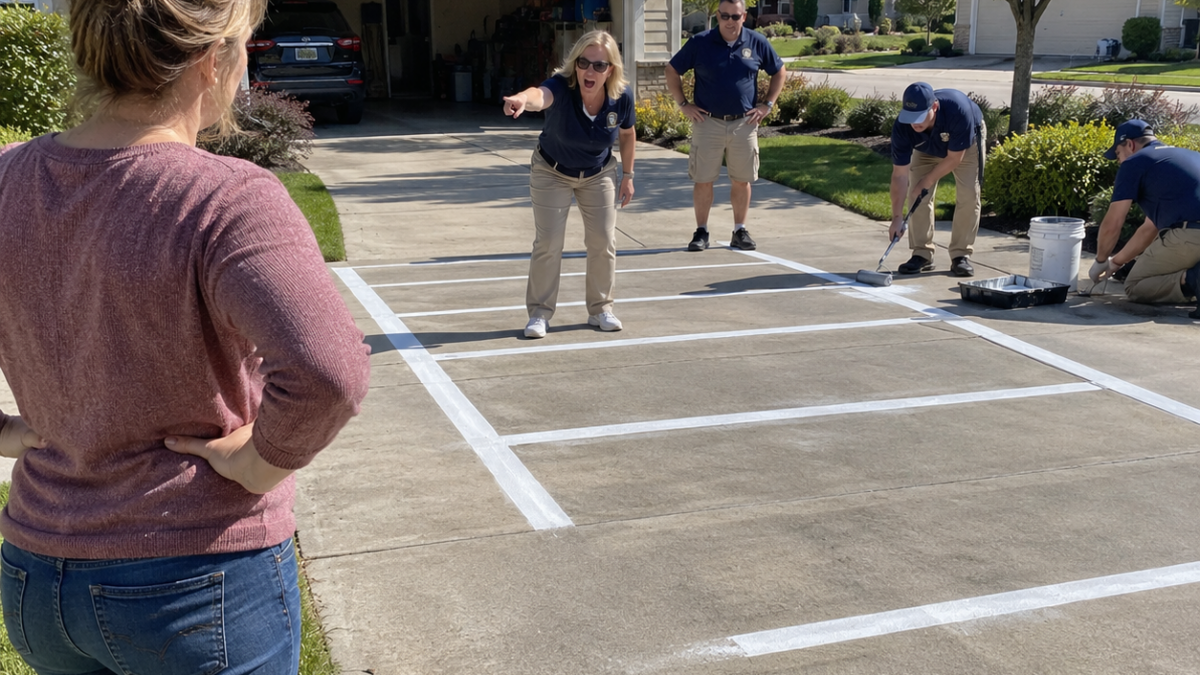
There were yellow lines across my concrete.
Not spray marks.
Not utility markings.
Parking spaces.
Actual parking spaces.
Straight, bright, professionally painted lines running along the side of my driveway.
Numbers were stenciled inside them.
And near the workshop, in white block letters:
RESIDENT PARKING ONLY.
I sat behind the steering wheel staring.
The engine was still running.
My hands stayed at ten and two.
For at least thirty seconds, my brain refused to process what my eyes were seeing.
Then I noticed the cars.
Three of them.
A white compact car.
A black SUV.
A silver crossover.
All parked on my driveway.
Ten feet from my workshop door.
The white car was sitting where I normally backed trailers.
The SUV was close enough to the building that I wouldn’t have been able to open the large shop door all the way.
I actually laughed once.
Not because it was funny.
It was the kind of laugh that comes out when something is so ridiculous your body doesn’t know what else to do.
I pulled forward slowly.
There wasn’t enough room to get past comfortably.
One vehicle had been parked at an angle.
I ended up driving two wheels onto my grass.
I shut off the engine.
Sat there.
Looked again.
Still parking lines.
Still cars.
Still my driveway.
I got out.
The SUV was close enough that I had to squeeze between it and my truck.
I walked to the edge of the concrete.
Crouched.
Brushed grass and dirt away with my fingers.
The metal survey pin appeared exactly where it had been since 2008.
I stared at it.
Then at the yellow line running several feet inside my property.
That was when Trent Hollis called from his porch.
“Hey, Caleb!”
I stood.
Trent lived in the townhouse closest to me.
Early forties.
Sales job.
Friendly enough most of the time.
We had spoken maybe twenty times in five years.
Weather.
Football.
Property maintenance.
Nothing important.
He stepped down from his porch carrying a drink.
“Looks good, right?”
I thought I had misheard him.
“What?”
“The parking.”
He smiled.
“Finally got some order around here.”
I looked behind me.
Then back at him.
“Order?”
“Yeah. Board had it striped today.”
He said it casually.
Like we were discussing a freshly painted crosswalk.
I walked closer to the fence line.
“Trent, that’s my driveway.”
His smile weakened.
“Well…”
“Well what?”
“The board said that side was basically shared access.”
“Shared with who?”
“The development.”
“No.”
He shifted.
“I mean, it runs right beside us.”
“So does my fence.”
He gave a half shrug.
“You never use all that width.”
I stared at him.
“That isn’t how ownership works.”
“I’m just telling you what they said.”
“Who said it?”
“Marcus.”
Of course.
Marcus Dane.
HOA president.
Mid-forties.
Finance job downtown.
Always wore polo shirts with company logos.
Always carried himself like he was five minutes away from presenting a quarterly report.
I had spoken with him maybe six times before that week.
Every conversation contained at least one phrase like “per the bylaws” or “from a community standpoint.”
He wasn’t loud.
That actually made him more irritating when he was wrong.
He had the smooth confidence of somebody used to meetings where everyone eventually nodded because they wanted to go home.
I pointed at the concrete.
“Did Marcus look at the survey?”
Trent held up his hands.
“Don’t ask me. I’m not on the board.”
“But you parked here?”
He glanced toward the white car.
“That one’s mine.”
“You didn’t think to ask?”
“They told us the spaces were approved.”
“Approved by who?”
“The board.”
“The board doesn’t own my driveway.”
His expression tightened slightly.
“Look, Caleb, I don’t want to get into the middle of this.”
“You already parked in the middle of it.”
He didn’t answer.
I didn’t yell.
I didn’t threaten him.
I just looked at his car and said, “Please move it tonight.”
He hesitated.
That hesitation bothered me more than if he had argued.
Finally he said, “You should talk to Marcus.”
Then he turned around and walked back toward his townhouse.
I stood there looking at the paint.
That should have told me how the next twenty-four hours were going to go.
I went inside.
I did not knock on Marcus’s door.
I knew myself well enough to know I was too angry for a useful conversation.
Instead, I poured water.
Sat at the kitchen table.
And looked through the window as another car turned into my driveway.
A red sedan slowed.
The driver checked the numbers.
Then parked in stall 9.
My stall 9.
I watched a woman get out carrying grocery bags.
She walked toward the townhomes without even glancing at my house.
That was when anger settled into something colder.
Someone hadn’t made a mistake.
This was organized.
A contractor had painted it.
The stalls were numbered.
Residents had been informed.
The board had clearly told people they were allowed to park there.
All without one phone call to the property owner.
I picked up my phone.
Marcus answered on the second ring.
“Caleb. What’s up?”
I almost admired the casual tone.
“What’s up is there are parking spaces painted on my driveway.”
There was a pause.
Not surprise.
Recognition.
Papers shuffled in the background.
“Right.”
Right.
That one word told me everything.
“You knew about it.”
“The board approved a parking optimization plan.”
“A what?”
“Parking optimization.”
“You painted my driveway.”
He sighed softly.
“We reviewed the layout of the block and determined the paved area along your side appeared to be unused excess pavement.”
I sat back.
“Unused excess pavement.”
“Yes.”
“Marcus, that pavement leads to my workshop.”
“I understand that, but you don’t use the full width.”
“That’s irrelevant.”
“Caleb, we have a serious parking shortage.”
“I don’t.”
“I’m asking you to look at this reasonably.”
“I am being extremely reasonable.”
“Several homeowners have elderly parents visiting. We’ve had residents circling for parking. Emergency access becomes difficult when cars line the internal street. We needed a practical solution.”
“So you took my property.”
“That’s an inflammatory way to characterize it.”
“What would you call painting numbered stalls on somebody else’s driveway?”
“The board believed the pavement functioned as shared access.”
“You believed wrong.”
“If you have documentation—”
I nearly laughed.
“Documentation?”
“Survey. Deed. Anything showing the exact boundary.”
“You mean the documents you should have checked before hiring somebody to paint my driveway?”
Another pause.
Then his voice hardened slightly.
“If you have them, email them. We’ll review everything at the next board meeting.”
“When?”
“Two Thursdays from now.”
I looked out the window.
Five cars now.
“Two weeks?”
“That’s our normal meeting cycle.”
“So strangers use my driveway for two weeks?”
“Residents.”
“What?”
“They aren’t strangers. They’re residents of the neighboring community.”
“Not my community.”
“We’re all part of the same neighborhood.”
“That doesn’t make my driveway yours.”
“You’re getting emotional.”
That sentence did it.
“You sent workers onto my property without permission, painted parking stalls on it, told people to park there, and now I’m emotional?”
“I’m trying to keep this productive.”
“Then answer one question.”
“Go ahead.”
“If I paint parking spaces in your garage tomorrow, do I get to use them until your next board meeting?”
Silence.
“That isn’t comparable.”
“It’s exactly comparable.”
“Your driveway is exposed pavement.”
“So is your front walk.”
“Caleb—”
“No. You don’t get to redefine my property based on how convenient taking it would be.”
His tone became the careful corporate voice.
“This is being done for the greater good.”
There it was.
Greater good.
Four words that have probably justified more bad decisions than anybody can count.
I said, “The greater good stops at my property line.”
“That’s a very individualistic attitude.”
“It’s an individually owned property.”
“We’ll discuss this formally.”
“Move the cars.”
“I cannot order people to move vehicles from spaces the board has designated while the matter is under review.”
I felt my hand tighten around the phone.
“You can’t designate what you don’t own.”
“Send the documents.”
“I will.”
“Good.”
“And Marcus?”
“Yes?”
“Do not send another contractor onto my land.”
“I hear you.”
“That isn’t agreement.”
“We’ll review everything.”
Then he hung up.
I sat there holding the phone.
For a long time.
Then I went into my office.
Second drawer of the filing cabinet.
Blue folder.
Inside:
Warranty deed.
2008 survey.
Plat map.
County parcel printout.
Tax statements.
Dad used to mock me for keeping everything.
“Caleb, you save paperwork like you’re expecting Congress to investigate your garage.”
That night, I was grateful for every sheet.
I scanned the documents.
Opened the survey.
Highlighted my boundary in red.
Added a simple note:
The paved driveway is entirely within Parcel 0147-22-118. There is no HOA easement or shared access agreement. Please advise immediate removal of all unauthorized vehicles and parking markings.
I attached everything.
Sent it to Marcus.
Copied the HOA’s general address.
Then I waited.
His response came fifty-eight minutes later.
Four sentences.
Caleb,
Thank you for forwarding the documents.
The board will discuss the boundary issue formally at its upcoming meeting. In the meantime, please be patient as we work toward a community solution that respects all parties involved.
Marcus Dane
President
I read “please be patient” three times.
He had my survey.
He had my deed.
He now knew.
And still he wanted me to tolerate the situation because correcting it would inconvenience his homeowners.
I looked outside.
Headlights swept across my bedroom ceiling every hour that night.
Cars entered.
Cars left.
Doors slammed.
People laughed.
At around eleven-thirty, someone remotely locked a vehicle.
BEEP-BEEP.
I lay awake.
Not furious anymore.
Thinking.
What bothered me most wasn’t the parking.
Paint could be removed.
Cars could move.
It was the assumption behind it.
Twelve households needed something.
One man had something useful.
Therefore, they had decided the useful thing should become communal.
Nobody asked.
Nobody offered rent.
Nobody proposed an easement.
Nobody said, “Caleb, we have a problem. Is there some arrangement we can make?”
They just painted.
They acted as if consent was an inconvenience.
Around midnight, I got up.
Walked to the window.
Five vehicles sat on my driveway.
Yellow lines glowed under the streetlights.
I remembered Dad standing beside that concrete fifteen years earlier.
I remembered writing the check.
I remembered paying property taxes.
I remembered Marcus saying “greater good.”
Then I went back to bed.
Saturday morning, I woke at six-thirty.
Made coffee.
Walked outside.
And stopped dead.
A silver Toyota Camry was parked sideways near the entrance.
Not in one of their painted stalls.
Across my driveway.
Its front bumper was near the street.
Its rear end blocked almost the entire concrete approach.
I could not get my truck out without driving across the lawn.
I stood there holding my coffee.
Steam curled in front of my face.
That was the moment the issue became simple.
They did not think they were borrowing my property.
They thought they had absorbed it.
If I kept waiting, every day the behavior would become more normal.
A week later, residents would say, “We’ve been parking here.”
A month later, “We’ve always used this area.”
A year later, maybe somebody would start talking about established access.
No.
I set the coffee on my hood.
I walked toward the townhouses.
The first door belonged to a woman named Denise.
She opened it wearing slippers.
“Morning.”
She squinted.
“Yes?”
“Do you know who owns the silver Camry blocking my driveway?”
She looked past me.
“Oh. I don’t know.”
“I need it moved.”
Her expression changed.
“Isn’t that HOA parking now?”
“No.”
“I thought the board designated it.”
“It’s private property.”
“Well, I don’t know whose car that is.”
She started closing the door.
“Denise.”
She paused.
“Please let people know the HOA made a mistake.”
Her face became defensive.
“You need to talk to Marcus.”
Door closed.
Two houses down, a young guy answered.
Messy hair.
Basketball shorts.
Bare feet.
“Whose Camry?”
He looked.
“Maybe Kelly’s boyfriend?”
“Can you contact him?”
“Why?”
“It’s blocking my driveway.”
He frowned.
“I thought that was parking.”
“It isn’t.”
“They painted it.”
“Paint isn’t a deed.”
He shrugged.
“Talk to the board, man.”
Door closed.
Third house.
No answer.
Fourth.
No answer.
Trent opened his door after I knocked twice.
He already looked uncomfortable.
“You know whose silver Camry that is?”
“No.”
“It’s blocking me in.”
He glanced toward it.
“Yeah, that’s bad.”
“Can you contact whoever owns it?”
“I can post in the resident group.”
“Please do.”
He pulled out his phone.
Then he looked at me.
“You’re not going to do anything crazy, right?”
I stared at him.
“Crazy like painting parking spaces on someone else’s property?”
“Come on.”
“Trent, I asked you to move your car last night.”
“I did.”
I looked.
He had.
“Thank you.”
“But everybody’s already angry.”
“At me?”
“At the whole situation.”
“You mean they’re angry the free parking wasn’t actually free.”
He exhaled.
“You know what I mean.”
“No. I really don’t.”
He rubbed his neck.
“Marcus told everyone the board had checked it.”
“He hadn’t.”
“Then that’s between you and him.”
“It became between me and everyone who parked here.”
He looked at the driveway again.
“I’ll post.”
I waited twenty minutes.
The Camry stayed.
Thirty minutes.
Nothing.
Forty.
Still there.
I had a customer scheduled at noon to pick up a custom walnut dining table.
He was bringing a trailer.
There was no way he could get through.
I called him.
“Don, we may need to move pickup.”
“What happened?”
“Parking problem.”
“Your place?”
“You wouldn’t believe me.”
After we rescheduled, I went inside.
Opened my file.
Picked up the deed and survey.
Then I called Ridgeway Towing.
I had used them twice before for abandoned vehicles dumped behind my shop.
The dispatcher answered.
“Ridgeway.”
“This is Caleb Turner on Ashford Lane.”
“Morning.”
“I’ve got unauthorized vehicles on private property blocking access.”
“How many?”
“Four at the moment.”
“You’re the owner?”
“Yes.”
“Have proof?”
“Deed and survey in my hand.”
“Posted property?”
“Not yet.”
“Blocking access?”
“One is completely blocking the entrance. Others are obstructing shop access.”
A pause.
“Text the address.”
“How many trucks can you send?”
“Two.”
I looked out at the Camry.
“Send them.”
After hanging up, my heart was pounding.
Not fear.
Weight.
Calling a tow truck is different from arguing.
Once the hook goes under the car, somebody pays money.
Somebody gets embarrassed.
Somebody gets furious.
I knew exactly what was about to happen.
For a minute I asked myself whether I should wait.
Call Marcus again.
Give one more warning.
Knock on every door.
Then I remembered the survey sitting in Marcus’s inbox.
He knew.
He had chosen not to act.
I wasn’t escalating.
I was stopping an escalation he had already created.
Before Ridgeway arrived, I drove carefully across the grass to get out.
At the hardware store, I bought two signs.
PRIVATE PROPERTY
NO UNAUTHORIZED PARKING
VEHICLES WILL BE TOWED AT OWNER’S EXPENSE
Large letters.
Metal.
I bought steel posts too.
When I returned, the Camry was still blocking the entrance.
I parked on the grass.
Mounted one sign near the road.
The second closer to the workshop.
No tricks.
No ambiguity.
Anyone pulling in now had to drive past a sign.
At 8:47, the first Ridgeway truck arrived.
Big diesel.
Amber lights flashing.
Hank Mercer climbed out.
Hank was probably fifty-eight.
Broad shoulders.
Gray beard.
The kind of man who could say more with one grunt than most people could with a paragraph.
He looked at the yellow lines.
Looked at me.
Then laughed.
“What the hell happened here?”
“HOA decided I opened a parking lot.”
“You in the HOA?”
“No.”
“They paint this?”
“Yesterday.”
He shook his head.
“Show me the line.”
I handed him the survey.
We walked to the metal pin.
He studied the map.
Looked at the pin.
Looked back toward the development.
“Whole concrete strip yours?”
“Every inch.”
“Any easement?”
“No.”
“Shared access?”
“No.”
He nodded.
“All right.”
The second tow truck pulled in behind him.
Driver’s name was Luis.
I showed him the same documents.
Hank pointed toward the Camry.
“That one first. Blocking ingress.”
Luis started positioning his truck.
The sound brought people outside.
Hydraulics.
Backup beeper.
Diesel.
Metal.
The Camry’s front wheels lifted.
Its alarm immediately started screaming.
HONK.
HONK.
HONK.
A door flew open.
A young woman ran outside.
“What are you doing?”
Hank kept working.
She ran toward me.
“THAT’S MY BOYFRIEND’S CAR!”
“It’s blocking my driveway.”
“You can’t tow it!”
“It’s on private property.”
“This is HOA parking!”
“No, it isn’t.”
She pointed at the lines.
“Then what are those?”
“Paint.”
“The HOA put them there!”
“The HOA doesn’t own the concrete.”
Her face went red.
“My boyfriend was told he could park there.”
“Then Marcus gave him bad information.”
“You need to stop them!”
“No.”
She stared at me.
“What do you mean, no?”
“I mean the truck is removing the vehicle.”
“He’s going to have to pay!”
“Yes.”
“That’s insane!”
“What’s insane is blocking a private driveway because somebody painted a number on it.”
She pulled out her phone.
“I’m calling Marcus.”
“Good.”
Hank finished securing the Camry.
The young woman stepped toward him.
“Can you put it down?”
Hank looked at her.
“Property owner requested removal.”
“I’m asking you.”
“Talk to him.”
She spun toward me.
“Please.”
That was the first moment she stopped shouting.
I didn’t enjoy it.
I wasn’t trying to punish her.
But if I stopped now, the message would be that all anybody had to do was argue hard enough.
“Your boyfriend can retrieve it from Ridgeway.”
Her expression hardened again.
“You’re unbelievable.”
The truck pulled away.
Alarm fading down the road.
By then, seven people were outside.
Phones appeared.
Someone shouted, “He’s towing cars!”
Hank walked toward the black SUV by my shop.
A man I didn’t recognize came running from the far row.
“That’s mine!”
“Then move it,” I said.
He stopped.
“What?”
“You’re here. Move it now.”
He looked at Hank.
Then me.
“You called towing?”
“Yes.”
“Why didn’t you tell anybody?”
“I emailed the board yesterday. I knocked on doors this morning. I posted signs.”
“I didn’t know!”
“Now you do.”
He rushed to the SUV.
Got in.
Started it.
For one second I thought the problem was becoming easier.
Then he backed halfway out and stopped beside me.
“You’re being a real asshole about this.”
I looked through his open window.
“Keep moving.”
He peeled away hard enough to chirp the tires.
Hank glanced at me.
“You want me to count that as a save?”
“Absolutely.”
He grinned.
One car gone without a fee.
Three left.
Then Trent came outside.
Barefoot.
Phone in hand.
“What the hell is happening?”
“Private property is being cleared.”
“You’re towing everybody?”
“Anyone who doesn’t move.”
“You can’t do that!”
“They can’t park here.”
“The board approved it!”
“The board was wrong.”
“Marcus said—”
“I sent Marcus the deed last night.”
That stopped him.
“You did?”
“And the survey.”
“He told us it was under review.”
“He knows where the boundary is.”
Trent looked toward the yellow lines.
“You could have waited.”
“Why?”
“Because there are procedures.”
“For your HOA.”
“Yes.”
“I’m not in your HOA.”
“That doesn’t mean you need to do this.”
I pointed toward where the Camry had been.
“I was blocked in.”
“That was one person.”
“And my workshop is blocked.”
Hank had moved toward the black SUV closest to my shop.
Trent’s eyes widened.
“Whose is that?”
“I don’t know.”
Then a blue crossover pulled into the development.
Marcus.
He stopped partly in the road.
Got out wearing jeans, a navy polo, and sunglasses.
He moved fast.
Not running.
But close.
“Stop.”
Hank ignored him.
Marcus raised his voice.
“STOP THE TOW.”
Hank looked at me.
I said, “Keep going.”
Marcus stared.
“Caleb.”
“Morning.”
“This is unnecessary.”
“What part?”
“The towing.”
“The parking was unnecessary.”
“We are trying to resolve that.”
“You were told where the boundary is.”
“We are reviewing the materials.”
“You’re in finance, Marcus.”
His jaw tightened.
“What does that have to do with anything?”
“You understand documents.”
“I understand that boundary questions can be complicated.”
“This one isn’t.”
“You’re not a surveyor.”
“The surveyor signed the survey.”
“Can we talk privately?”
“No.”
He glanced at the growing crowd.
“Caleb.”
“You created this publicly.”
“I’m trying to prevent this from getting worse.”
“So am I.”
The SUV alarm began blaring.
Marcus turned toward Hank.
“I am instructing you to stop.”
Hank leaned against the controls.
“You own this property?”
“No, but I’m president of the adjoining homeowners association.”
Hank looked at me.
Then back at Marcus.
“So no.”
Someone laughed.
Marcus flushed.
“We have a good-faith claim to shared access.”
“No, you don’t,” I said.
He ignored me.
“The board designated this area for resident parking.”
Hank scratched his beard.
“Is the board on the deed?”
Marcus’s mouth tightened.
“This is a civil matter.”
“Then talk to your lawyer.”
Hank went back to work.
Marcus stepped toward me.
“This is aggressive.”
“Painting my driveway was aggressive.”
“We believed it was shared.”
“You know now it isn’t.”
“We are still confirming that.”
“No. You’re delaying because fixing your mistake makes your residents angry.”
Several people murmured.
Marcus lowered his voice.
“You don’t understand the pressure we’re under.”
“Then explain it.”
“We have residents who can’t park near their homes.”
“I understand.”
“Elderly parents.”
“I understand.”
“Guests.”
“I understand.”
“Families with multiple vehicles.”
“I understand all of it.”
“Then you understand why we need space.”
“Yes.”
He seemed relieved for half a second.
Then I finished.
“But needing my property does not transfer ownership.”
His face hardened again.
“Nobody said ownership transferred.”
“You painted permanent-looking parking stalls.”
“They can be removed.”
“Do that.”
“We need board approval.”
“You didn’t need my approval to install them.”
“That was based on the information available.”
“Which information?”
He didn’t answer.
“The general map?” I asked.
He crossed his arms.
“We reviewed the site plan.”
“Did it show my parcel line?”
“It was not sufficiently detailed.”
“Then you chose to paint anyway.”
Nobody spoke.
That was the heart of it.
Not a complicated property dispute.
Not two surveys that contradicted each other.
Not an ancient easement.
They had incomplete information and acted because my driveway solved their problem.
Marcus changed tactics.
“Even if the driveway is technically within your parcel—”
“Technically?”
“You know what I mean.”
“I absolutely do.”
“This is about community.”
I laughed.
Not loudly.
“Community.”
“Yes.”
“You keep using that word as if it means I’m required to donate whatever your HOA needs.”
“That isn’t fair.”
“Neither was taking it.”
“You weren’t using these spaces.”
“They weren’t spaces until you painted them.”
“The pavement was sitting empty most of the day.”
“So is your dining room.”
He stared.
“What?”
“Can I store lumber in it while you’re at work?”
“That’s ridiculous.”
“Why?”
“It’s my house.”
I nodded toward the concrete.
“Exactly.”
A few neighbors looked away.
Marcus knew he had lost that argument.
Then the second SUV lifted.
The owner appeared too late.
A woman in yoga pants came rushing down the sidewalk.
“Wait! Wait! That’s mine!”
Hank paused.
She looked at me.
“Can I move it?”
“Yes.”
“Please put it down.”
Hank lowered it.
She jumped inside.
Marcus watched her drive away.
Two people had now avoided towing because they showed up and moved.
I wasn’t trying to collect vehicles.
I wanted the driveway empty.
The crowd seemed to realize that too.
Their tone changed slightly.
Less “He’s stealing cars.”
More “Move yours before the truck gets it.”
Within five minutes, another resident ran out and moved a Honda.
One remained.
A dark blue sedan near the shop.
Nobody claimed it.
Luis hooked it.
A man in the crowd said, “That belongs to the new couple’s visitor.”
“Then they can call Ridgeway,” I said.
Marcus rubbed his forehead.
“This could have been handled differently.”
I looked at him.
“You’re right.”
He looked almost surprised.
“You could have knocked on my door.”
His expression went flat.
“I already told you—”
“No. You told me why you needed parking. You still haven’t explained why asking me wasn’t part of the plan.”
“We thought—”
“You thought my answer might be no.”
He stopped.
There it was.
A simple truth.
If they had asked, I might have refused.
So they had chosen a method where they never had to hear the refusal.
Luis began pulling away with the blue sedan.
When the last tow truck finally left, the driveway was empty.
For the first time since Friday afternoon, I could see all the concrete.
Except now it was covered in ridiculous yellow boxes.
Resident parking only.
Marcus stood near the entrance.
His homeowners stood behind him.
Nobody seemed sure what to do next.
I pointed at the lines.
“Those come off.”
“We’ll discuss restoration.”
“No.”
“Caleb—”
“You put them there. You remove them.”
“We need to inspect the surface and determine the least damaging method.”
“Good. Determine it quickly.”
“We’re not going to authorize work under threat.”
“There is no threat.”
“You called two tow trucks.”
“For vehicles on my property.”
“You’re creating unnecessary hostility.”
I looked around at the houses.
“Marcus, yesterday morning there was no hostility here. There was my driveway. Your board created the rest.”
His face tightened.
“This will be discussed at the next meeting.”
“Bring the deed.”
He stared at me for another moment.
Then put his sunglasses back on.
Walked to his SUV.
Drove away.
The crowd gradually disappeared.
Trent stayed.
He looked at the empty driveway.
Then at me.
“Those towing fees are going to be brutal.”
“I know.”
“You don’t feel bad?”
I thought about it.
“Yes.”
That seemed to surprise him.
“Then why do it?”
“Because feeling bad doesn’t mean allowing something wrong to continue.”
He nodded slowly.
Then walked home.
I spent the rest of Saturday cleaning.
Not because anything needed cleaning.
I needed physical work.
I swept the concrete.
Reorganized the shop.
Finished sanding the table.
Repaired a carburetor.
Every twenty minutes I looked outside.
The yellow lines were still there.
By Sunday, the story had spread.
I knew because people I barely knew started slowing down when they drove past.
Monday morning, my email inbox looked like I had been elected to something.
Subject:
UNNECESSARY ACTION.
Subject:
TOWING INCIDENT.
Subject:
COMMUNITY HOSTILITY.
Subject:
REQUEST FOR REIMBURSEMENT.
One resident demanded I pay his brother’s towing fee because he had relied on “official HOA guidance.”
Another told me property boundaries should not be “weaponized.”
That phrase was impressive.
Property boundaries.
Weaponized.
I printed that one.
Marcus sent the longest email.
Caleb,
Saturday’s events were deeply unfortunate. Regardless of the ongoing boundary discussion, the unilateral towing of resident and guest vehicles created unnecessary financial harm and has significantly damaged neighborhood relations.
The board continues to believe that reasonable communication would have produced a less confrontational outcome.
We request that you refrain from additional towing activity until the matter can be addressed formally.
Marcus
I read it.
Then opened a blank email.
I didn’t write angry.
Angry emails feel wonderful for five minutes and terrible when an attorney prints them later.
Instead, I attached photographs.
One showed the Camry blocking my entrance.
Timestamp visible.
Another showed the yellow lines.
Another showed the survey pin.
Another showed the private-property sign.
Then I attached the deed.
Survey.
Parcel map.
And I wrote a formal notice.
The parking markings were installed without authorization.
The association had no ownership interest or easement.
Vehicles had obstructed access to my residence and workshop.
Any future unauthorized vehicle would be subject to removal consistent with local law.
The association was expected to restore the concrete at its expense.
No insults.
No sarcasm.
No debate.
Facts.
Sent.
That afternoon Marcus replied with one sentence:
Received. The board is consulting counsel.
Good.
Consult everybody.
Tuesday was quiet.
Wednesday morning I heard a truck.
Not a tow truck.
Contractor van.
I stepped out of the workshop.
Three men climbed out.
One looked familiar.
Same contractor who had painted the lines.
Only now nobody looked proud of the work.
The foreman walked toward me.
“Mr. Turner?”
“Yes.”
“We’re here for striping removal.”
“Authorized by?”
“Townhouse association.”
I almost smiled.
“Go ahead.”
They unloaded a concrete grinder.
Marcus did not appear.
Neither did Trent.
Nobody filmed.
The grinder started.
The sound was brutal.
A high metallic scrape that carried down the entire block.
Yellow paint disappeared slowly.
Dust filled the air.
One number after another vanished.
Resident parking only disappeared last.
I stood in the workshop doorway watching.
The same organization that had told me I needed to wait two weeks somehow found a contractor within forty-eight hours after the tow trucks arrived.
Interesting how fast procedure moves when consequences show up.
The grinding took hours.
When they finished, the concrete looked scarred.
Faint lines remained.
Gray-white shadows.
The foreman walked over.
“Paint penetrated a little.”
“I can see.”
“We got as much as we could without taking too much surface.”
“Not your fault.”
He hesitated.
“For what it’s worth, we were told the HOA owned this strip.”
“I figured.”
He nodded.
“Sorry.”
“You did the work you were hired to do.”
He left.
That evening an HOA-wide email went out.
Trent forwarded it to me.
After further review of property documentation, the board has determined that the paved area adjacent to Lot 14 is privately owned and is not designated for association parking.
Not designated.
I read that phrase and shook my head.
They still couldn’t simply write:
We were wrong.
The concrete never belonged to us.
Instead, they made it sound like some neutral technical discovery.
But I didn’t push.
The lines were gone.
The cars were gone.
My access was restored.
It should have ended there.
In practical terms, it did.
Emotionally, the neighborhood had changed.
For the next several days, people next door avoided eye contact.
When I took my trash out, conversations quieted.
One afternoon, somebody drove past slowly and stared.
At the grocery store, I saw Marcus near the produce section.
He saw me.
Turned his cart down another aisle.
I didn’t chase him.
I wasn’t interested in winning socially.
I wanted my property left alone.
Still, I noticed the resentment.
From their perspective, several people had lost hundreds of dollars.
One car owner had apparently paid nearly three hundred after storage and release charges.
That hurts.
I understood why they were angry.
But what bothered me was how many blamed the towing rather than the decision that caused it.
A week later, I met Trent at the mailbox.
He hesitated.
Then walked over.
“Can I say something?”
“Sure.”
“People are still pretty upset.”
“I know.”
“One guy paid three hundred bucks.”
“So I heard.”
“He says you could’ve warned everyone.”
“I did.”
“Not him personally.”
“Trent, I don’t have a directory of your HOA residents and their guests.”
“He was visiting.”
“Exactly.”
“He trusted the sign.”
I looked at him.
“What sign?”
“The painted space.”
“That wasn’t a sign. That was unauthorized work.”
“You know what I mean.”
“I do. He trusted your HOA.”
Trent shoved his hands into his pockets.
“I guess.”
“Then his complaint is with the people who told him private property was theirs.”
“You’re never going to admit the towing was harsh, are you?”
“I already told you I felt bad.”
“That’s different.”
I looked at him for a long moment.
Then I said, “Do you know what felt harsh?”
He didn’t answer.
“Coming home after work and finding my property converted into a parking lot.”
He looked toward my driveway.
“I get that.”
“Do you?”
“Yes.”
“Because the first night I told you it was mine.”
He nodded.
“And you told me to take it up with Marcus.”
He looked down.
“That’s true.”
“The next morning I was blocked in. I knocked on doors. People told me it wasn’t my driveway anymore.”
Trent winced slightly.
“I didn’t know that.”
“One woman literally said, ‘That’s not your driveway anymore, is it?’”
He was quiet.
“That’s what happens when a board acts first and asks questions later. People assume authority exists because somebody in a polo shirt said it does.”
He almost smiled.
“Marcus does love polos.”
I smiled too.
Tiny crack in the tension.
Then Trent said, “For what it’s worth, I told him he should apologize.”
“What’d he say?”
“That this needs to be handled through counsel.”
“That sounds like Marcus.”
Trent nodded.
“I’m not saying you were wrong.”
“Sounds like you’re trying very hard not to say I was right.”
He laughed once.
“Maybe.”
Then he walked away.
I spent the next weekend repairing the driveway.
The grinder had left rough patches.
I cleaned the surface.
Sealed the affected sections.
Installed heavier signs.
Private property.
No unauthorized parking.
I also put up two cameras.
Not pointed into anybody’s windows.
One covered the entrance.
One covered the workshop side.
Clear view of license plates.
I didn’t want arguments anymore.
If a car parked there, I wanted documentation.
For several weeks, nothing happened.
No parking.
No new paint.
No letters.
The townhouse street stayed crowded.
Their original problem still existed.
Some nights cars lined the internal road.
Visitors walked farther.
Residents complained.
But the problem stayed where it belonged.
Inside their property.
About a month later, I received certified mail.
The return address belonged to a law firm.
I opened it at the kitchen table.
The letter was carefully written.
No threats.
No lawsuit.
It acknowledged that the driveway was my property.
It confirmed the HOA would not authorize parking there.
Then came the paragraph that made me lean back.
In the interest of maintaining harmonious relations between neighboring properties, the Association requests that Mr. Turner provide reasonable advance notice to the Association prior to arranging removal of any vehicle that may inadvertently enter or park upon the property in the future.
I read it twice.
They wanted notice.
After everything.
I understood the logic.
Tow fees created anger.
The HOA wanted a chance to contact residents.
Fine.
But the wording still treated towing like the root problem.
It wasn’t.
Unauthorized use was.
I did not answer immediately.
For two nights I thought about it.
I walked the driveway after dinner.
Kids played in the townhouse courtyard.
Garage doors opened.
Music came through an upstairs window.
A couple laughed while carrying groceries.
Normal people.
That mattered.
Most of them had not conspired to steal land.
They trusted their board.
They saw painted stalls.
They assumed somebody had checked.
Even the angry people were mostly ordinary homeowners who had suddenly been handed a towing bill.
I did not want to spend the next ten years at war with twelve families.
So I replied carefully.
I wrote that I preferred communication whenever reasonably possible.
I also wrote that my property was clearly marked and that any future unauthorized use obstructing access would be handled according to law without any obligation for additional notice.
Clear.
Calm.
Final.
No more letters followed.
Summer moved on.
July became August.
August became September.
The yellow shadows faded.
The neighborhood tension faded too.
Not completely.
But enough.
Then one afternoon in early fall, I was inside the workshop sanding a cabinet door.
Ear protection on.
Dust collector running.
I noticed someone standing in the doorway.
Marcus.
He didn’t step inside.
Just knocked on the metal frame.
I shut off the sander.
Pulled off my earmuffs.
“Marcus.”
“Caleb.”
He looked different.
No polo shirt.
No sunglasses.
Jeans.
Plain gray sweatshirt.
“Got a minute?”
I considered saying no.
Then nodded.
He stepped inside.
Looked around.
Workbench.
Table saw.
Clamps.
Half-finished cabinets.
A mower engine on a stand.
He had probably never been in the shop before.
Maybe seeing it mattered.
This wasn’t an empty driveway attached to unused pavement.
It was access to a working space.
My working space.
Marcus touched the edge of the walnut tabletop.
“You make this?”
“Yep.”
“Nice.”
“Thanks.”
Silence.
The overhead lights hummed.
Finally he said, “I shouldn’t have handled it the way I did.”
No speech.
No dramatic apology.
Just that.
I waited.
He continued.
“I was getting hammered at meetings.”
“About parking.”
“Constantly.”
He rubbed one hand across his jaw.
“We had people complaining every week. Visitor spaces full. Cars getting too close to hydrants. Older residents saying family couldn’t visit. Board members wanted solutions.”
“I understand.”
“I kept looking at your driveway.”
I didn’t say anything.
“It’s wide.”
“I know.”
“Most weekdays it looked empty.”
“Because I was at work.”
“Right.”
He nodded.
“And I convinced myself it was basically excess pavement.”
“Because that solved your problem.”
He looked at me.
“Yes.”
That one word was more honest than every email he had sent.
He continued.
“We had an old development map that didn’t show the parcel detail clearly. One board member thought there was some kind of access easement.”
“Did anyone verify it?”
“No.”
“Why?”
He exhaled.
“Because I thought I already knew the answer.”
There it was.
Not evil.
Not conspiracy.
Arrogance.
Maybe the most common explanation in the world.
“I scheduled the striping because I thought once people started using it, you’d see that it wasn’t hurting anything.”
I stared at him.
“You planned to ask forgiveness instead of permission.”
“Basically.”
“And when I objected?”
“I thought you were overreacting.”
“You had my survey.”
“By then I had already emailed residents telling them the spaces were available.”
“So correcting it would’ve made you look bad.”
His mouth tightened.
“Yes.”
I appreciated the admission.
He looked around the shop again.
“I didn’t expect the towing.”
“I figured.”
“I thought you’d wait.”
“For your meeting.”
“Yes.”
“Two weeks.”
He nodded.
“I honestly thought you would.”
“That was your biggest mistake.”
He gave a short laugh.
“Apparently.”
I leaned against the workbench.
“Marcus, if you’d knocked on my door before painting, this whole thing would’ve gone differently.”
“I know.”
“You could’ve asked.”
“I should have.”
“You could’ve offered compensation.”
He nodded.
“Or even a temporary arrangement.”
“Maybe.”
He looked surprised.
“You would have considered it?”
“Depending on conditions.”
That seemed to bother him.
Not because I was refusing.
Because he realized there might actually have been a path.
I explained.
“If you had said, ‘We have a temporary parking shortage. Can residents use the outer ten feet Friday evenings, no overnight parking, never block the shop, HOA carries liability, and we pay you,’ I would have listened.”
Marcus stared at the floor.
“I assumed you’d say no.”
“Maybe I would have.”
“That’s why—”
I raised a hand.
“And that is why you had to ask.”
He nodded slowly.
“Fair.”
“Compromise requires both sides to choose it.”
“I get that now.”
“I hope so.”
Silence again.
Then Marcus said, “I’m sorry.”
Simple.
No qualifiers.
No “if you felt.”
No “misunderstanding.”
No “regret that events occurred.”
“I’m sorry I authorized the striping without confirming ownership. And I’m sorry I kept pushing after you sent the survey.”
That was enough.
I nodded.
“Accepted.”
His shoulders dropped slightly.
He had probably expected more.
A lecture.
A demand.
Maybe humiliation.
I had no interest in any of that.
He turned to leave.
Then stopped.
“One question.”
“What?”
“Would you really have had my car towed if I’d parked there?”
“Yes.”
He laughed.
“I believe you.”
Then he left.
That was the last serious conversation Marcus and I ever had about the driveway.
The HOA parking problem never magically disappeared.
It couldn’t.
They had twelve homes designed around limited space.
On holidays, cars still line their internal street.
At Christmas, visitors park farther away.
Sometimes somebody complains.
But nobody uses my driveway.
The signs remain.
The cameras remain.
Every once in a while, a new resident moves in and doesn’t know the history.
One winter afternoon, a young couple parked halfway onto the concrete while unloading furniture.
I walked over.
“Hey, guys.”
The man looked nervous.
“Are we blocking you?”
“A little. This is private.”
“Oh, sorry.”
They moved immediately.
No tow truck.
No shouting.
No problem.
That is how normal boundaries work.
Someone says something.
The other person listens.
Nobody paints anything.
I still see Trent.
We’re fine.
Not close friends.
Neighbor fine.
He waves.
I wave.
Once he brought over an extension cord because mine had failed.
I repaired his snowblower the next winter and refused payment.
He left a case of beer beside my shop anyway.
Marcus and I nod when we see each other.
The hostility eventually burned itself out.
But the driveway never looked exactly the same.
Even after sealing the surface, if the light hits at the right angle, I can still see faint ghosts of the parking stalls.
Lines.
Numbers.
Shadows where RESIDENT PARKING ONLY used to be.
For months, those marks irritated me.
Then they started to feel useful.
A reminder.
Not just about property.
About assumptions.
Marcus’s biggest mistake wasn’t needing parking.
His residents had a legitimate problem.
His biggest mistake wasn’t even noticing that my driveway looked underused.
The mistake was the quiet calculation that came next.
We need it.
He seems not to.
Therefore, we can act first.
That calculation shows up everywhere.
In workplaces.
Families.
Neighborhoods.
Governments.
Organizations.
Someone decides your boundary is inconvenient.
Then they start calling the violation cooperation.
They call your refusal selfishness.
They call their demand community.
And if you’re not careful, you begin defending yourself against language instead of looking at the underlying fact.
The underlying fact in my case was concrete.
Literally.
I owned it.
There were legal ways to ask for access.
There were respectful ways to negotiate.
They chose neither.
The yellow paint wasn’t a compromise.
It was an assumption made permanent enough to look official.
That’s why the towing mattered.
Not because I enjoyed watching somebody’s car disappear.
I didn’t.
Not because I wanted residents to lose money.
I didn’t.
It mattered because until there was a consequence, the board had every incentive to delay.
Think about the timeline.
Friday:
They painted.
I objected.
Marcus told me to wait two weeks.
Saturday:
I towed.
By Wednesday:
The paint was being ground off.
Same board.
Same property.
Same paperwork.
Different urgency.
Nothing clarified their thinking faster than realizing my driveway wasn’t going to function as free parking while they “reviewed” whether I owned it.
People sometimes tell me I should have waited.
Maybe.
Maybe I could have spent two weeks squeezing around cars.
Maybe I could have canceled deliveries.
Maybe I could have moved my work.
Maybe nobody else would have blocked me.
Maybe every resident would have respected access despite believing the driveway belonged to them.
But why was all the burden supposed to fall on me?
That was the part nobody could answer.
The HOA created the mistake.
Yet their solution was for me to absorb the inconvenience.
Their residents parked.
I should be patient.
They painted.
I should wait.
They blocked access.
I should communicate.
They got to act.
I was expected to negotiate.
That imbalance was exactly why I didn’t wait.
Dad died three years before all this happened.
Sometimes I wish he had been there that Saturday.
He would have hated the yellow lines.
He was a quiet man, but property boundaries were almost sacred to him.
Not because he was greedy.
Because he had spent his whole life working for what he had.
When we built the house, he made me walk the property corners with him.
“Know your lines,” he said.
I laughed.
“What, you think the neighbors are going to steal Ohio?”
“No.”
He tapped one survey stake.
“But if you don’t know where your line is, somebody else eventually decides for you.”
At twenty-something, I thought he was being old-fashioned.
Fifteen years later, I watched an HOA literally paint across that line.
Turns out Dad knew people.
The funniest part is that my driveway is usually empty now.
Not completely.
My truck is there.
Customers come and go.
Trailers.
Deliveries.
But yes, there are hours when large sections of pavement sit unused.
And every time I look at that empty concrete, I remember Marcus calling it wasteful.
Maybe it is.
So what?
Ownership includes the right not to maximize something.
My workshop can sit empty.
My truck can sit unused.
My yard can have a section I never walk on.
A thing does not become communal because somebody thinks they could use it more efficiently.
That idea sounds obvious when you say it plainly.
It becomes less obvious once someone wraps it in words like “community.”
One evening the following spring, almost a year after the towing, I was washing my truck when Marcus walked past.
He had started taking evening walks around the block.
He stopped near the driveway entrance.
The old yellow marks were barely visible.
“You know,” he said, “I still get parking complaints.”
I laughed.
“I figured.”
“Last meeting lasted two hours.”
“Sounds healthy.”
He shook his head.
“We’re adding two visitor spaces near the mailboxes.”
“On your property?”
He looked at me.
“Very funny.”
“I had to ask.”
He smiled.
“Yes. On HOA property.”
“Then I fully support the project.”
He started walking again.
After a few steps, he turned.
“And we checked the survey.”
I laughed.
That was probably the real ending.
Not the tow trucks.
Not the angry emails.
Not the grinder removing the yellow paint.
Not even the apology in my workshop.
The real ending was an HOA president joking about checking the survey before touching land.
Lesson learned.
Painfully.
But learned.
These days, when I turn into my driveway after work, I still sometimes think about that Friday.
I remember headlights.
Fresh yellow paint.
Three vehicles beside my workshop.
I remember sitting inside my truck wondering whether I had somehow misunderstood my own property.
That feeling lasted maybe thirty seconds.
But I remember it clearly.
Because unauthorized confidence can be disorienting.
When somebody acts like they have every right to do something outrageous, part of your brain automatically checks itself.
Maybe I missed something.
Maybe there’s an agreement.
Maybe there’s a rule.
Maybe I’m wrong.
That instinct can be useful.
It keeps people humble.
But once I checked the pin, the deed, and the survey, there was nothing left to doubt.
That is why documents matter.
Memory argues.
People reinterpret.
Organizations issue revised explanations.
Paint creates appearances.
A survey is less emotional.
A metal pin doesn’t care how many households need parking.
The deed doesn’t care whether Marcus has a difficult board meeting.
Facts are boring like that.
Which is probably why they work.
I still have every document in the same blue folder.
The original survey.
The HOA emails.
Photographs.
The certified attorney letter.
Even a picture of the Camry being lifted.
I didn’t frame anything.
I’m not that sentimental.
But I kept them.
Maybe because the entire mess taught me something I don’t want to forget.
You don’t defend a boundary by being louder than the person crossing it.
You defend it by knowing where it is.
Then acting consistently.
I didn’t threaten Marcus.
I didn’t damage anybody’s car.
I didn’t paint insulting messages.
I didn’t block their road.
I didn’t park on their lawns.
I cleared my property.
Then I asked them to repair what they had changed.
That’s all.
The dramatic part came from how hard they resisted accepting such a simple fact.
One Saturday, months later, Trent came over while I was building shelves.
He leaned against the doorway.
“You ever think about what would’ve happened if you hadn’t towed?”
“Sometimes.”
“What do you think?”
I set down the drill.
“You want the polite answer?”
“No.”
“I think your board would have delayed.”
He laughed.
“Probably.”
“I think people would have kept parking.”
“Probably.”
“I think Marcus would’ve gone into the meeting saying residents had relied on the new arrangement and removing it would create hardship.”
Trent’s smile disappeared.
“Yeah.”
“Then maybe somebody would propose a temporary agreement.”
“Sounds reasonable.”
“Except the temporary agreement would start after you’d already taken the property.”
He nodded.
“That’s different.”
“Exactly.”
He looked toward the driveway.
“You think Marcus did it intentionally?”
“Intentionally steal land?”
“Yeah.”
“No.”
That answer surprised him.
“You don’t?”
“No. I think he intentionally skipped the step where he confirmed he had permission.”
Trent thought about that.
“That may be worse.”
“It’s more common.”
He laughed.
Then grew serious.
“You know I was pissed at you that weekend.”
“I knew.”
“My sister’s friend was one of the people who got towed.”
“I didn’t know.”
“She called me crying.”
“That sucks.”
“Yeah.”
He paused.
“But I also remember you telling me the night before it was your driveway.”
I waited.
“I could’ve told people.”
“You could have.”
“I didn’t.”
“No.”
“Because I didn’t want to get involved.”
“Most people don’t.”
He nodded slowly.
“I guess that’s how stuff like that gets bigger.”
“Usually.”
He looked at me.
“Sorry.”
“For what?”
“For acting like the paint mattered more than what you were saying.”
I nodded.
“Accepted.”
He pointed toward the shelves.
“Need help?”
“Can you cut straight?”
“Absolutely.”
He could not.
But that’s another story.
Over time, the whole incident became neighborhood folklore.
New residents sometimes heard a version of it.
The Tow Truck Saturday.
The Parking-Line Fight.
Some versions made me sound like a lunatic who called four wreckers before sunrise.
Some versions made Marcus sound like he tried to seize my house.
Neither was true.
Real life is usually less clean than the stories people tell afterward.
Marcus made a bad decision under pressure.
Residents trusted him.
I reacted firmly.
Some people paid money because they were caught in the middle.
The HOA corrected the mistake.
Marcus apologized.
That was enough.
I never wanted him destroyed.
I wanted the behavior stopped.
There’s a difference.
If I had wanted revenge, I could have made the situation uglier.
I could have hired an attorney immediately.
Could have demanded damages beyond restoration.
Could have tried to make every board member personally miserable.
Could have put up hostile signs.
Could have turned every interaction into war.
I didn’t.
Once the driveway was clear and repaired, I went back to living.
Because boundaries aren’t supposed to become your entire personality.
You enforce them so life can return to normal.
That is exactly what happened.
My walnut table customer eventually picked up his order the following weekend.
He backed his trailer all the way to the shop.
No cars blocked him.
While we loaded the table, he noticed the faded stripes.
“What happened here?”
I told him the short version.
He laughed.
“HOA painted your driveway?”
“Yep.”
“You’re kidding.”
“Nope.”
“What’d you do?”
“Had the cars towed.”
He stared at me.
Then started laughing so hard he had to put down his end of the table.
“Your dad would’ve loved that.”
He had known Dad.
I smiled.
“He would’ve complained about the towing price.”
“That too.”
After the customer left, I stood near the entrance.
Sun low.
Concrete warm.
The private-property sign cast a long shadow.
Across the fence, townhouse residents came and went.
Nobody paid attention to me.
Exactly how I liked it.
I thought about that first Friday again.
The lines had looked so official.
Straight.
Bright.
Numbered.
That was the strange power of appearances.
If you paint a line cleanly enough, people assume somebody had the right to put it there.
If you attach a title to something, people assume authority.
HOA president.
Board-approved parking.
Resident space.
Shared access.
But official-looking isn’t the same as legitimate.
Sometimes the most important thing you can do is ask the dumbest possible question.
Who actually owns this?
Everything unraveled from there.
The answer was me.
Not the HOA.
Not Marcus.
Not twelve households.
Me.
And once that fact was established, there was never really anything else to debate.
I don’t hate HOAs.
That surprises people.
I understand why they exist.
Shared roofs.
Shared landscaping.
Private roads.
Common property.
Somebody has to manage those things.
Rules can prevent one person from creating a problem for everyone else.
But rules have jurisdiction.
Boards have limits.
Community authority stops somewhere.
In my case, it stopped at a metal survey pin buried beside the concrete.
Marcus crossed that line because he convinced himself solving a collective problem justified taking a shortcut.
The moment he did that, he stopped managing his community and started managing me.
I had never given him that authority.
That is the lesson I carried forward.
Whenever somebody tells you something is “for everyone,” ask who is paying.
Whenever somebody says a sacrifice is “small,” ask whose sacrifice it is.
Whenever somebody describes your boundary as an obstacle, make sure they aren’t simply annoyed that they need your consent.
Consent slows things down.
That is its purpose.
It forces people to acknowledge that another human being has a choice.
Marcus wanted efficiency.
Paint the pavement Friday.
Parking problem solved Saturday.
No messy negotiation.
No possibility of rejection.
It was efficient.
Until two tow trucks arrived.
Then suddenly consultation looked pretty attractive.
The driveway is still mine today.
No painted numbers.
No resident-only stencil.
No unauthorized vehicles.
The shop still smells like sawdust and machine oil.
The private-property signs have faded slightly from weather, but they remain easy to read.
The cameras blink at night.
Most days, none of that matters.
I turn in.
Drive the length of the concrete.
Park beside the shop.
Open the door.
Go to work.
Ordinary.
That ordinariness feels good.
Because that was all I wanted before anyone painted the first line.
I never wanted a fight.
I wanted a driveway.
My driveway.
A space my father helped me build.
A path to my workshop.
Something completely unremarkable until somebody else decided that because it looked useful, they were entitled to use it.
Sometimes I still see one faint yellow streak near the edge where the grinder didn’t quite reach deep enough.
Maybe I could remove it.
Another pass with a grinder would probably do it.
I haven’t.
I leave it there.
Not because I enjoy remembering the argument.
Because it reminds me of something Dad told me before we ever poured the slab.
Know your lines.
Back then I thought he meant property.
Now I know he meant more than that.
Know what you’re willing to share.
Know what requires permission.
Know when compromise is real.
Know when somebody is simply demanding surrender and calling it cooperation.
And when somebody paints right across that line because they assume you won’t object, don’t waste all your energy yelling.
Know your facts.
Know your rights.
Give them the chance to correct it.
Then, if they keep pretending the line doesn’t exist, sometimes the clearest answer in the world is the sound of a tow truck backing down your driveway.
BEEP.
BEEP.
BEEP.
That Saturday morning, Marcus called it aggressive.
A year later, his HOA checked the survey before creating two new parking spaces on its own land.
As far as I’m concerned, that means the lesson finally landed.
And the best part?
They never painted my driveway again.