HOA Karen Called 911 on My Army Wife and Tried to Have Her Removed From Our Own Lake Cabin—She Has Vastly Underestimated My Intelligence.k
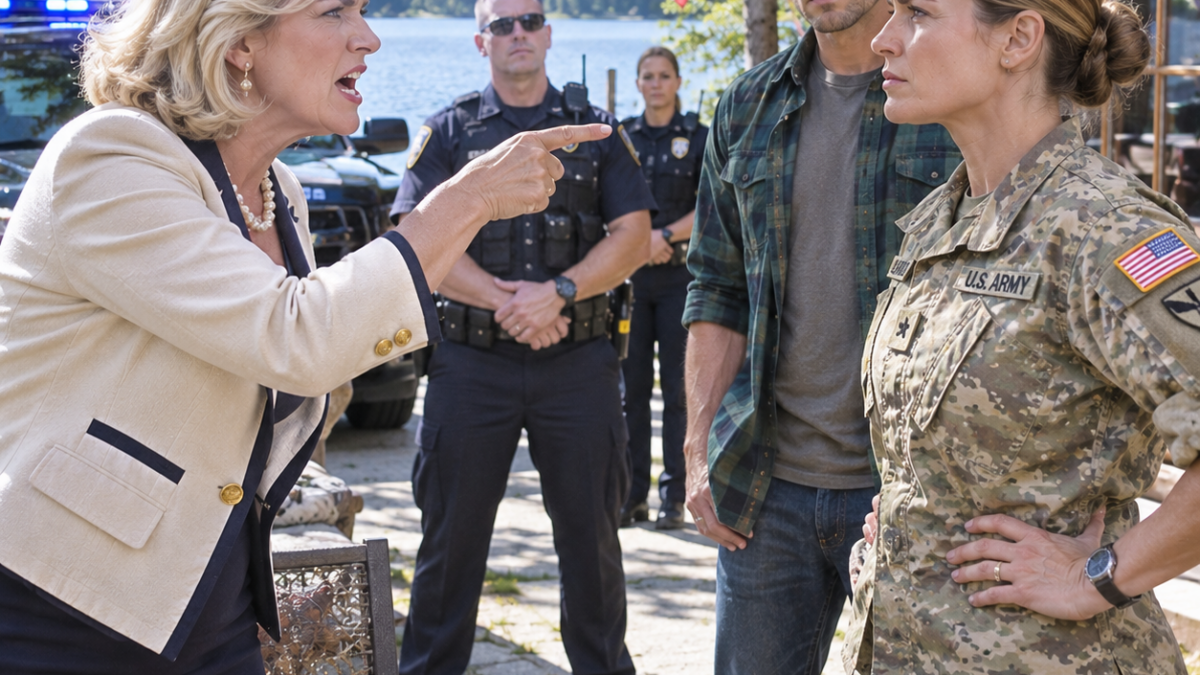
HOA Karen Called 911 on My Army Wife and Tried to Have Her Removed From Our Own Lake Cabin—She Has Vastly Underestimated My Intelligence
She called my wife a squatter three days after she came home from a ten-month deployment and demanded police remove her from the cabin her name was already on.
When that failed, our car was keyed, our dock bolts vanished, and somebody began leaving threats outside our door in the middle of the night.
HOA Karen thought enough fear would make us sell, but every escalation left another piece of evidence behind.
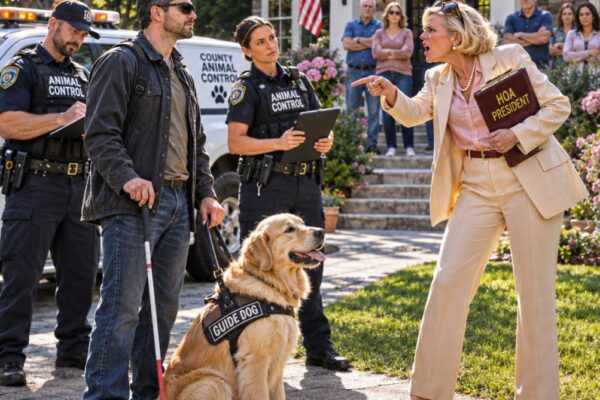
The police lights reached the lake before the cruisers reached my driveway.
Blue and red reflections rolled across Silverpine Lake, breaking apart over the black water and flashing against the cedar siding of the cabin my father had left me fifteen years earlier.
My wife stood on the porch.
Sergeant Olivia Reed had been home from deployment for seventy-two hours.
She was wearing an Army T-shirt, gray running shorts, and the same expression I had seen when an airline lost her duffel bag in Germany—annoyed, tired, but nowhere near intimidated.
Across the yard, Linda Mercer was losing her mind.
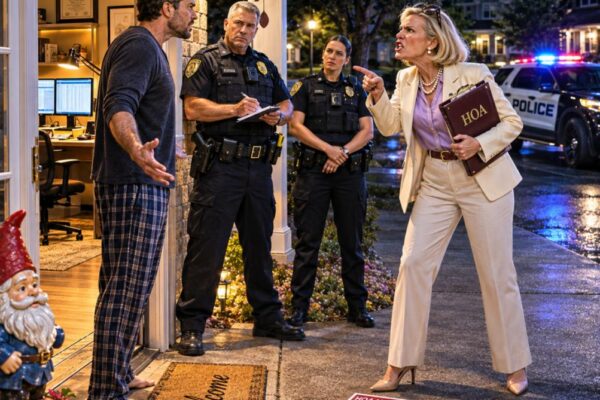
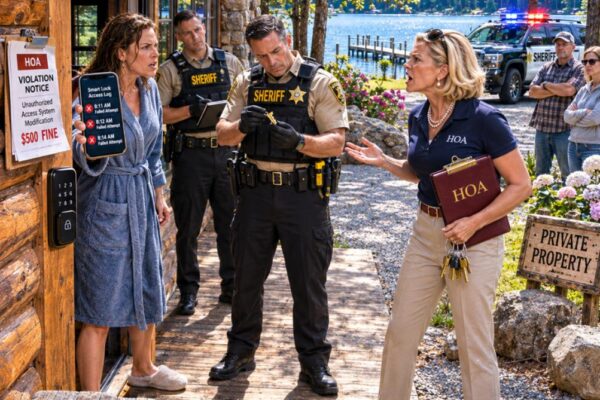
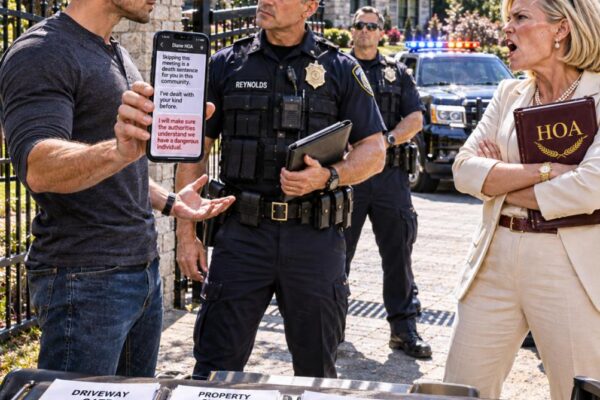
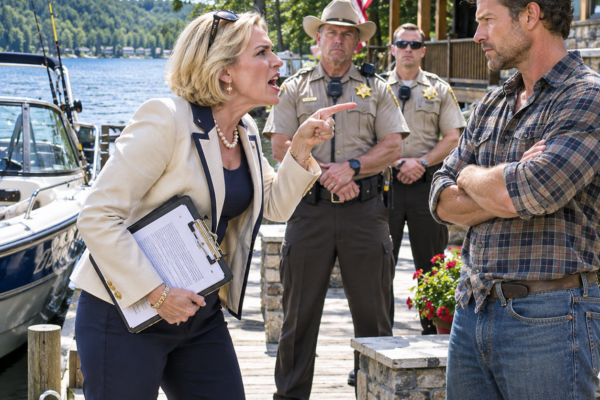
“She broke in!” Linda shouted as two sheriff’s deputies approached. “I already told her this property has not been approved for additional occupancy!”
I stepped out from the cabin with my phone recording.
“Linda, she’s my wife.”
“That doesn’t matter.”
One deputy stopped.
“What?”
Linda clutched her burgundy clipboard harder.
“This community requires residency authorization. He cannot simply move another person into a recreational structure without HOA approval.”
Olivia looked at me.
I could tell she was trying not to laugh.
The younger deputy asked, “Ma’am, what exactly did you report to dispatch?”
“An unknown woman unlawfully occupying a vacant cabin.”
Olivia’s head turned slowly.
“Vacant?”
Linda pointed at her.
“You have not established legal residency.”
Olivia reached into the small running belt around her waist.
Both deputies stiffened automatically.
She stopped.
“Military ID.”
The older deputy nodded.
“Go ahead.”
Olivia removed the card and handed it over.
Then she reached through the open cabin door and took a folded document from the console table.
“Our deed amendment.”
The deputy read the first page.
His eyebrows rose.
“You’re Olivia Reed?”
“Yes.”
“And this is your residence?”
“My husband inherited it. We recorded survivorship and ownership paperwork before my deployment.”
Linda stepped forward.
“That’s irrelevant to HOA occupancy rules.”
The younger deputy pinched the bridge of his nose.
“Ma’am, you called about a burglary.”
“I called about unauthorized entry.”
“By someone whose name is on the deed.”
“The HOA has independent jurisdiction.”
“No, ma’am.”
Her face went red.
“You don’t understand how this community works.”
Olivia took her ID back.
“If you need anything else, I can get my unit administrator on the phone.”
Linda laughed sharply.
“Your military status doesn’t make you special.”
Olivia’s eyes hardened.
“I didn’t say it did.”
That silenced everyone for half a second.
Then Linda made the mistake that changed the whole afternoon.
She pointed at Olivia and said, “People like her come and go, and the rest of us are the ones who have to protect property values.”
The older deputy looked at Linda.
“What exactly does ‘people like her’ mean?”
Linda froze.
Before she could answer, a violent metallic whoosh erupted from the side of the cabin.
Then white-gray smoke rolled past the corner of the house.
Olivia turned before I did.
“Back!”
She shoved me toward the porch as orange flame flashed beside the grill.
One of the deputies grabbed a fire extinguisher from his cruiser.
Olivia sprinted toward the propane cylinder, using her sleeve to reach the valve.
I saw a steel wrench lying in the grass.
I also saw Linda backing away.
And for the first time since she had called 911, she looked genuinely afraid.
part 2
My name is Nathan Reed.
I was forty-one when Linda Mercer decided my wife did not belong at Silverpine Lake.
I had known the cabin longer than I had known almost anyone alive.
My father bought the place when I was nine.
Back then, it was barely more than a cedar box with a roof, a woodstove, and a dock that leaned five degrees toward Canada.
Every summer, Dad and I repaired something.
Deck boards.
Roof shingles.
Dock posts.
Screens.
A stubborn water pump that failed every August like it was observing a holiday.
When he died, the cabin came to me.
Not through some dramatic inheritance battle.
His will was simple.
Silverpine goes to Nathan.
He knew I would never sell it.
He was right.
Years later, after Olivia and I married, we updated the ownership documents so she had a recorded legal interest too.
That mattered a lot more than either of us expected.
Silverpine Lake used to be the kind of place where people waved from boats and nobody cared what color your shed was.
Then property values climbed.
Old seasonal cabins became year-round homes.
New construction arrived.
Then came the homeowners association.
Technically, the Silverpine Lake Community Association had existed in some form for years, mostly to manage shared roads, storm drainage, shoreline maintenance, and a small private launch.
Nobody treated it like a government.
Dad paid dues.
Went to one meeting every three years.
Complained afterward.
Life continued.
Then Linda Mercer became president.
At least that was what Linda said.
Nobody I knew remembered voting for her.
That fact seemed funny at first.
Later, it became important.
Linda was fifty-seven.
Blonde.
Perfectly styled.
Always dressed as though a photographer might appear without warning.
She drove a white SUV with an HOA parking placard tucked behind the windshield, despite there being no reason an HOA president required special parking.
Her favorite accessory was a burgundy clipboard.
Her second favorite was the phrase:
“Under association authority.”
Trash can?
Association authority.
Dock stain?
Association authority.
Boat trailer?
Association authority.
Garden flag?
Association authority.
The woman could turn a hummingbird feeder into constitutional law.
I mostly ignored her.
Olivia was deployed for ten months with an Army logistics unit.
Her job was not glamorous.
No classified commando missions.
No kicking down doors.
She was a senior noncommissioned officer who specialized in transportation and supply coordination.
She had spent twelve years in uniform and was good at making complicated operations boring enough to function.
That was one of the reasons I loved her.
I was chaos.
Olivia was lists.
She came home on a Thursday afternoon.
I picked her up at the airport.
She walked toward me carrying a duffel over one shoulder, wearing a faded hoodie and jeans.
She looked exhausted.
Beautiful.
Older somehow.
I hugged her and neither of us spoke for a long time.
The cabin had been cleaned top to bottom.
New sheets.
Fresh groceries.
Her favorite coffee.
I even repaired the dock railing she had complained about before leaving.
That first night, we barely talked.
We sat on the porch watching the lake darken.
Olivia leaned her head against my shoulder.
“That’s it?”
“What?”
“No emergency.”
“Give Linda time.”
“Who’s Linda?”
I should have said nothing.
Instead, I told her.
She laughed.
That was my second mistake.
The next morning Olivia ran around the lake.
When she came back, she was breathing hard and looking irritated.
“Blonde woman followed me in a white SUV.”
“Linda.”
“I assumed.”
“She say anything?”
“Asked which property I was staying at.”
“What did you say?”
“Yours.”
“Ours.”
Olivia looked at me.
“Good recovery.”
Then she went inside.
That afternoon, she fell asleep on the dock with a book on her chest.
I was inside making sandwiches when I heard voices.
Linda stood at the edge of the dock taking photographs.
Olivia was awake now.
“What are you doing?”
“Documenting unauthorized dock usage.”
Olivia sat up.
“You’re documenting me reading?”
“This dock is registered to Lot 18.”
“Yes.”
“Do you reside at Lot 18?”
“Yes.”
Linda stared at her.
“Your name isn’t in our resident directory.”
“I’ve been deployed.”
“That’s not an exemption.”
“From what?”
“Registration.”
Olivia stood.
She was five-foot-ten and physically fit from twelve years of Army life.
Linda took half a step backward.
“I need your full legal name.”
“No.”
“Then I’ll issue the violation to Nathan.”
“Do that.”
“You’re being confrontational.”
“I’m standing on my own dock while a stranger photographs me.”
Linda’s lips tightened.
“This community has procedures.”
Olivia smiled.
“I’ve got more IDs than you’ve got procedures.”
Linda snapped another picture and left.
Olivia watched her go.
“You weren’t exaggerating.”
“No.”
“She’s not just annoying.”
“What is she?”
Olivia looked toward the white SUV disappearing between the trees.
“Collecting.”
That was the word.
Collecting.
Information.
Reactions.
Patterns.
People.
Olivia did that too.
But she did it because the Army had taught her that every system reveals itself through repetition.
For three days, Linda watched.
Then she called police and reported a break-in.
That was the afternoon the grill nearly caught the side of the cabin on fire.
The deputies extinguished the flames before they spread.
The county fire crew arrived minutes later.
One firefighter inspected the propane system.
He found the regulator connection loosened more than normal use would explain.
The cylinder valve had also been opened.
The metal wrench in the grass fit the fitting.
That did not prove sabotage.
It proved somebody had manipulated the equipment.
I had not touched the grill since the previous evening.
Olivia had not either.
Linda had been in our yard for several minutes before deputies arrived.
That did not prove she touched it.
Olivia understood that better than I did.
One deputy asked Linda where she had been before they pulled in.
“Near the driveway.”
“Were you beside the grill?”
“No.”
Olivia said:
“No one accused you.”
Linda turned.
“I’m clarifying.”
The deputy wrote that down.
No arrest.
No accusation.
Fire report.
Photographs.
Evidence preserved.
That was enough.
That night, Olivia and I sat on the bed beneath the old Army blanket she had mailed home from a previous posting.
She stared at the ceiling.
“She’ll do it again.”
“You think Linda touched the grill?”
“I don’t know.”
“That sounded like yes.”
“No.”
She turned her head toward me.
“I’m saying escalation doesn’t reverse itself unless something stops it.”
I knew she was right.
The next morning, we received three violations.
Unauthorized resident.
Unregistered vehicle.
Improper flag display.
The flag was a standard American flag attached to our porch.
Olivia pinned the notices to the refrigerator.
“What are you doing?”
“Decorating.”
“You’re weird.”
“I’ve lived in barracks.”
“Fair.”
Two days later, someone keyed Olivia’s car.
Three letters carved into the driver’s door.
HOA.
My anger became physical.
I wanted to walk to Linda’s house.
Olivia took my keys.
“No.”
“She did this.”
“You don’t know that.”
“Who else?”
“That is not evidence.”
“She’s been targeting you.”
“That’s motive.”
She pointed toward the cabin camera.
“Do we have footage?”
The car had been parked outside the camera angle.
“No.”
“Then we have damage and a police report.”
“You’re too calm.”
“No.”
Her voice lowered.
“I’m furious.”
That was worse.
Olivia angry was quiet.
The sheriff’s deputy photographed the car.
We filed the report.
Insurance handled the repair.
Then the dock tilted.
I stepped onto it one morning and nearly went into the lake.
Two mounting bolts were missing.
Not loose.
Missing.
I crawled beneath the framing.
The bolts had been backed out cleanly.
Olivia crouched beside me.
“That didn’t happen from weather.”
“No.”
We had security cameras installed that afternoon.
Front.
Rear.
Dock approach.
Driveway.
Nothing aimed at neighbors.
Just our property.
Linda sent another violation.
“Unauthorized exterior surveillance equipment.”
Olivia pinned it to the refrigerator.
The collection was getting impressive.
By then, we had hired attorney James Carver.
James was a former JAG officer who had moved into civilian property and veterans’ legal work.
He did not take us pro bono because Olivia wore a uniform.
We paid him.
He later reduced some fees after seeing the scale of the case, but I learned quickly that realistic legal help comes with invoices.
James reviewed the covenants.
Then the association filings.
Then the notices.
He looked up.
“Where is Linda getting these rules?”
“That’s what we’d like to know.”
“She’s citing sections that don’t exist.”
Olivia leaned forward.
“Association itself valid?”
“Yes.”
That disappointed me slightly.
“So she’s really president?”
James turned the laptop.
“That’s less clear.”
Silverpine Lake Community Association existed as a nonprofit entity.
Its covenants were recorded.
Its board had legitimate responsibilities.
But the last documented election we could verify was almost three years earlier.
Linda had been vice president.
The president resigned after moving.
According to the bylaws, the board could fill a vacancy temporarily until the next required member election.
Linda apparently assumed the office.
No subsequent election record could be found.
James asked the association for minutes.
They sent incomplete copies.
Then he found something more concerning.
Linda had created an “enforcement committee.”
Three people.
Linda.
Her husband.
And neighbor Paul Grayson.
No formal appointment appeared in the minutes.
The committee issued nearly all recent violations.
“Not automatically illegal,” James said.
“But?”
“But authority still has to come from somewhere.”
Olivia smiled.
“I like him.”
James did not smile back.
“I’m expensive.”
“We noticed.”
He sent a formal records demand.
Budgets.
Election records.
Violation logs.
Committee appointments.
Enforcement policies.
Vendor contracts.
Meeting minutes.
Insurance.
The association’s attorney responded.
That was the first sign Linda’s confidence was not shared by everyone around her.
The attorney granted some access and quietly suggested the board would be “reviewing governance procedures.”
Linda went ballistic.
A neighborhood-wide email accused “certain residents” of attacking volunteer leadership using outside legal pressure.
Then another notice appeared on our door.
$1,200.
“Unauthorized year-round conversion of seasonal structure.”
Our cabin had been legally recognized as a residence for years.
James sent the county occupancy record.
Notice withdrawn.
No apology.
Then somebody tampered with our trash bins.
Someone dumped construction debris near our property line.
Someone left a dead fish on the porch.
Immature.
Disgusting.
Not criminal masterminding.
We documented everything.
The first real break came from Ruth Ellis.
Ruth lived two roads over.
Seventy-six.
Widowed.
She called me one afternoon.
“Nathan, I think Linda lied to me.”
That sentence led us to her kitchen.
Olivia came too.
Ruth had been paying “supplemental enforcement assessments.”
$300.
$450.
$275.
Different amounts.
No explanation beyond community-security expenses.
Her statements showed payments mailed to Silverpine Community Services.
Not Silverpine Lake Community Association.
Different name.
Olivia looked at me.
I knew that look.
Collecting.
James checked.
Silverpine Community Services was an LLC.
Owner:
Paul Grayson.
Registered agent:
Linda Mercer.
That did not prove fraud.
Associations can hire management companies.
So James requested the management contract.
There wasn’t one.
At least none anyone could produce.
Then more neighbors shared statements.
Security inspections.
Violation administration fees.
Emergency compliance charges.
Some payments went through the actual HOA account.
Others went to Community Services.
The distinction was nearly invisible on the notices.
Olivia created a spreadsheet.
“Don’t enjoy this too much,” I said.
“I love logistics.”
“You’re terrifying.”
“Yes.”
We found twenty-three households with questionable payments totaling more than $38,000 over eighteen months.
Not three hundred twenty-seven discrimination complaints.
Not hundreds of veterans targeted.
That version came later when the story traveled online.
The real numbers were smaller.
More believable.
And because they were real, more dangerous to Linda.
The board treasurer was a woman named Susan Park.
She had recently become suspicious too.
When James contacted her, she agreed to meet with independent counsel.
That triggered the HOA’s internal review.
Linda called it a coup.
Paul Grayson called it harassment.
Homeowners called it overdue.
Then came the 3:12 a.m. motion alert.
Olivia’s phone vibrated on the nightstand.
She sat up instantly.
“Rear camera.”
Two figures stood near our shed.
Dark hoodies.
One carried something long.
Crowbar.
Maybe.
Olivia whispered:
“Call the sheriff.”
I did.
She did not grab a gun and “pin a team against the shed.”
Olivia was trained enough to know armed confrontation with unknown people at three in the morning is exactly how people get killed.
We stayed inside.
Lights off.
Doors locked.
Camera recording.
The dispatcher stayed on the line.
One figure tried the shed door.
The other walked toward the cabin.
Then floodlights snapped on automatically.
They ran.
Deputies intercepted a car leaving the road less than three minutes later.
Two men.
A crowbar.
Gloves.
One carried a printed map of our property.
They claimed they had been hired to “scare” us.
The payment?
Two hundred dollars each.
Not fifty.
Who hired them?
The first man said a woman named Linda.
The second said he only knew Paul.
That created probable cause for more investigation.
It did not immediately prove Linda had sent them.
Detectives followed the money.
A payment-service record showed funds moving from an account tied to Silverpine Community Services to one of the men two days earlier.
Paul claimed it was for cleanup work.
The man disagreed.
Paul’s story began collapsing.
Linda’s attorney told her not to speak.
She spoke anyway.
Online.
She posted that Olivia was “militarizing a private neighborhood dispute.”
That phrase spread.
Some neighbors defended Linda.
Others turned on her.
Then the county attorney’s office became involved.
Not HUD.
Not the VA.
Military service alone does not transform an HOA dispute into a federal housing case.
But Olivia’s active-duty status did matter in some contexts, and her military legal-assistance office helped connect her with appropriate resources.
More importantly, the local conduct mattered regardless of her uniform.
Trespass.
Property damage.
Harassment.
Possible fraudulent charges.
Potential conspiracy.
Those were ordinary laws protecting ordinary people.
The investigation expanded.
Susan Park gave detectives the HOA books.
Actual books.
Bank statements.
Invoices.
Checks.
Vendor payments.
Several charges were legitimate.
Road maintenance.
Dock repair.
Insurance.
Tree work.
Others were harder to explain.
Silverpine Community Services received substantial payments without clear contracts.
Paul’s company paid Linda “consulting reimbursements.”
Linda had never disclosed that relationship.
Another vendor charged for security patrols no one could verify.
Then detectives subpoenaed records.
That is how real financial cases grow.
Not by dramatic confession.
Bank records.
Emails.
Contracts.
Tax forms.
Checks.
Linda filed a civil lawsuit against us before the criminal investigation finished.
Defamation.
Intentional infliction of emotional distress.
Interference with property value.
She alleged our accusations and cameras had damaged her reputation.
James read the complaint at his office.
Then set it down.
“She is trying to regain control of the narrative.”
“Can we get it dismissed?”
“Parts, maybe.”
Olivia asked:
“Restraining order?”
“Separate issue.”
We had enough documented incidents by then to seek protective relief.
The court entered an order prohibiting Linda from entering our property or contacting Olivia directly except through counsel on legitimate association matters.
Not because she was unpopular.
Because of the documented pattern.
The grill incident.
Repeated baseless reports.
The 3:12 a.m. trespass investigation.
Property damage remained unproven against her personally, but the overall pattern concerned the court.
Then the anonymous letter arrived.
YOU THINK THIS IS OVER.
No signature.
No proof.
We gave it to detectives.
A week later, another envelope appeared at 2:43 in the morning.
Our camera caught Linda.
Clearly.
She walked from the road.
Hood up.
Placed the envelope beside our mailbox.
Left.
Inside was a torn, partially burned American flag and a message:
TRAITORS DON’T BELONG HERE.
That word—not “traders,” as later retellings mangled it—changed the case.
Olivia stared at the flag for a long time.
Her face went completely blank.
I wanted to tear the letter apart.
She stopped me.
“Evidence bag.”
“We don’t have an evidence bag.”
“Plastic sleeve. Touch edges only.”
“You’re impossible.”
“Do it.”
The detective watched the footage that morning.
Linda’s attorney withdrew shortly afterward.
Her civil lawsuit began falling apart too.
Security video contradicted several allegations.
The court dismissed major portions.
Remaining claims were later withdrawn.
Linda was now facing potential criminal charges related to the threatening communication and violation of the protective order.
Then Paul Grayson made his mistake.
He had worked for the county school system’s IT department.
During forensic review of devices seized under warrant in the financial case, investigators found files containing information about residents.
Addresses.
Property records.
Vehicle data.
Some publicly available.
Some not.
Among them were photographs of Olivia near her installation.
Not on secure areas.
Public roads and entrances.
Still disturbing.
Messages suggested Paul had searched databases he had access to through work for information unrelated to his job.
That created a separate investigation.
The school district suspended him.
Forensic review found improper access to certain employee and family data.
Not military classified systems.
Not some national database.
A local employee abusing legitimate access.
Paul eventually admitted he had helped Linda research residents.
People who challenged fines.
People with legal backgrounds.
People with military connections.
People likely to fight back.
Why?
Because Linda believed certain residents threatened “community stability.”
That phrase appeared repeatedly.
So did “outsiders.”
Olivia and I had owned the cabin longer than Linda had lived at Silverpine.
Outsiders.
That was the irony.
Then investigators found maps of our property in Paul’s files.
Wedding photographs copied from public social-media accounts.
Screenshots of Olivia’s unit’s public Facebook page.
Notes about when she deployed.
When she returned.
Nothing classified.
Nothing sophisticated.
But obsession doesn’t have to be sophisticated to be frightening.
Paul agreed to cooperate.
He said Linda had wanted us gone.
Why?
Partly because I ignored her authority.
Partly because Olivia’s return threatened the “seasonal occupancy” argument.
But money mattered too.
A real-estate investment group had been quietly offering to buy older lakefront cabins.
Community Services received referral fees when owners sold through certain agents.
Our cabin sat on one of the better shoreline lots.
That gave the harassment a financial motive.
Not a giant criminal empire.
A smaller, uglier scheme.
Pressure difficult owners.
Increase costs.
Make them tired.
Offer an exit.
Sometimes people took it.
Investigators found six transactions worth examining closely.
Three involved owners who had received unusually aggressive fines before selling.
One owner, Elena Torres, had challenged $9,000 in assessments before finally selling at a discount.
She cried when detectives contacted her.
“I thought I was bad at owning property.”
That sentence broke Olivia.
Not in public.
At home.
She sat on our porch after Elena left and stared at the lake.
“I hate this.”
“I know.”
“She thought it was her.”
“I know.”
“That is how this works.”
Olivia looked at me.
“You punish someone until they start policing themselves.”
That was exactly what Linda had tried to do.
Make us feel like the problem.
Make us question the cabin.
Make Olivia question whether returning home created trouble.
Make me wonder whether selling would be easier.
Linda’s arrest came months after the first police call.
Not in a motel under an alias.
At her attorney’s office after prosecutors approved charges and she surrendered.
Much less dramatic.
Much cleaner.
Charges included financial offenses tied to association funds and the affiliated company, harassment-related conduct, conspiracy connected to the attempted intimidation, and violation of court orders.
Prosecutors separately reviewed the grill incident.
They could prove tampering.
They could prove Linda was nearby.
They could not prove beyond a reasonable doubt that she had loosened the fitting.
No arson charge.
I hated that.
Olivia didn’t.
“Evidence.”
“That fire could’ve killed us.”
“Yes.”
“So she gets away with it?”
“We don’t know who did it.”
“You think she did.”
“I think lots of things.”
She looked at me.
“That is why courts require more.”
I married the wrong woman to support revenge fantasies.
Paul faced charges involving unlawful data access, conspiracy, and financial conduct.
The two men from our yard pleaded to trespass-related offenses and cooperated.
Neither was a hardened criminal.
One was twenty-three.
The other twenty-six.
Both had assumed scaring a homeowner for a few hundred dollars was easy money.
Olivia asked the prosecutor not to exaggerate their role.
I was surprised.
“They tried to break into our shed.”
“Yes.”
“Why are you defending them?”
“I’m not.”
She looked at me.
“Linda had years of control and money. Those two had bad judgment and a crowbar.”
“That’s a generous description.”
“Proportionality matters.”
She was right.
Again.
I found it exhausting.
The HOA held an emergency membership meeting after Linda’s arrest.
The clubhouse was packed.
For the first time, association counsel chaired the first portion.
He explained which parts of the organization were legitimate.
Which board appointments had not followed procedure.
Which fines were under review.
Which accounts were frozen.
Linda had not invented the HOA.
She had captured it.
That difference mattered.
The association had real covenants.
Real common property.
Real expenses.
Real authority.
But Linda and Paul had built an unofficial enforcement apparatus inside it and routed some functions through an affiliated company that had never been properly approved.
Homeowners had stopped paying attention.
That gave them room.
Susan Park stood for president.
Someone nominated Olivia.
She declined immediately.
“I already have one chain of command.”
The room laughed.
Susan won.
Real vote.
Recorded.
No drama.
The first thing she did was suspend all disputed enforcement pending audit.
Then new rules.
Violation notices required exact citations.
Board approval for major fines.
Conflict disclosure.
Vendor ownership disclosure.
No board officer receiving compensation from association vendors without explicit, lawful approval.
Records access.
Appeal procedures.
Limits on surveillance.
No collecting personal information unrelated to legitimate HOA functions.
And no law-enforcement calls on behalf of the association unless the caller could identify an actual safety concern or crime—not merely “noncompliance.”
That did not stop individual residents from calling police when they genuinely believed help was needed.
It stopped Linda-style weaponization under HOA authority.
The audit reviewed five years.
Three hundred twenty-seven complaints did appear in the records.
That number from the exaggerated version of the story was real in one sense.
But they were not all targeting veterans, women, or minorities.
They were complaints of every kind.
Noise.
Trash.
Dock issues.
Parking.
Pets.
Landscaping.
The important part was the pattern inside them.
Properties associated with residents who challenged Linda received dramatically more discretionary enforcement.
Some minority families and women living alone appeared disproportionately among those targets.
Veterans were not uniquely singled out, though several had been labeled “aggressive” in internal notes after disputing fines.
The audit did not declare every disparity discriminatory.
It recommended fair-housing review and consistent enforcement controls.
That was more useful than a slogan.
Elena Torres’s old account was reopened.
Some of her penalties were unsupported.
The association refunded what it reasonably could and negotiated the rest through counsel.
Her old house was gone.
You cannot undo everything.
She told us that.
“I don’t want the house back.”
We were sitting beside the lake.
“What do you want?” I asked.
“To stop believing my parents were right about me.”
I didn’t understand.
Elena explained.
“My father said I would never be responsible enough to own anything.”
She looked toward the water.
“When I lost that place, I thought he had been right.”
Olivia reached across the table and took her hand.
“You didn’t lose it because you were weak.”
Elena cried.
That scene never made the news.
It should have.
The criminal trial began almost eighteen months after Linda first called police on Olivia.
By then Olivia had deployed again for a shorter assignment and returned.
She appeared in civilian clothes for most hearings.
Not full dress uniform for dramatic effect.
Her service record was relevant only where specific threats referenced it.
The prosecution started with money.
Bank records.
Vendor relationships.
Referral payments.
Invoices.
Then HOA records.
Selective enforcement.
Internal messages.
Paul’s cooperation.
Then the 3:12 a.m. trespass attempt.
The burned-flag letter.
Video of Linda placing it.
The protective order.
The first 911 call.
The prosecution played the deputy’s body-camera recording.
Linda yelling:
“She’s trespassing.”
Olivia handing over identification and deed paperwork.
The deputy saying:
“Her name’s on the property, ma’am.”
Then Linda:
“People like her come and go.”
The prosecutor paused.
“Mrs. Mercer, what did you mean?”
Linda’s defense attorney objected.
The judge sustained.
That question went to motive, but the trial was not a public referendum on every ugly phrase.
Evidence had rules.
Linda testified.
I did not expect that.
She said she had been trying to stabilize Silverpine after years of neglect.
She claimed homeowners demanded stricter enforcement.
Some had.
She said Community Services existed because the HOA lacked administrative capacity.
Also partly true.
She claimed referral payments were legitimate consulting compensation.
She denied sending anyone to frighten us.
Paul, she said, had acted independently.
The two men lied.
The burned flag was, according to her, “a symbolic protest” not a threat.
That did not help.
Then the prosecutor showed her the letter:
TRAITORS DON’T BELONG HERE.
“You wrote this?”
Linda paused.
“Yes.”
“You placed it at the Reeds’ property at 2:43 a.m. while subject to a court order restricting contact?”
“I did not consider leaving an item contact.”
The jury stared.
“Did you know Sergeant Reed was active-duty military?”
“Yes.”
“Did you burn part of the American flag?”
“I damaged fabric.”
That answer was technically clever.
Emotionally disastrous.
Then came the payment records.
Community Services had received referral fees tied to sales.
One payment occurred eleven days after the Torres property closed.
Another followed an elderly couple’s sale after months of fines.
Linda tried to call them consulting commissions.
The prosecutor asked:
“Did affected owners know the same people enforcing violations against them stood to benefit if they sold?”
“No.”
“Why not?”
“It wasn’t relevant.”
That was probably the worst answer she gave.
Because it revealed the central problem.
To Linda, conflicts mattered only if Linda decided they mattered.
The jury convicted her on the principal financial and conspiracy counts and on several harassment-related offenses.
She was acquitted of some charges where proof was weaker.
Again, that mattered.
The system was not rubber-stamping our anger.
At sentencing, Elena spoke.
Ruth Ellis spoke.
Susan spoke.
Olivia spoke briefly.
She did not say:
“I know danger. She is dangerous.”
Instead:
“I spent twelve years in the Army learning that authority is accountable upward, downward, and sideways. What happened here was authority without accountability.”
She looked toward Linda.
“No resident should need rank, money, or legal counsel to be treated fairly in their own home.”
Then she sat.
Linda received a substantial prison sentence, but not eight years simply because the story needed a satisfying number. The judge imposed punishment based on the specific convictions, financial losses, prior history, harassment conduct, and court-order violations. Restitution was ordered.
Paul received a shorter sentence after cooperation but still faced consequences for data misuse and his role in the scheme.
The two men who came onto our property received probationary and custodial terms appropriate to their convictions and cooperation.
Nobody celebrated.
At least not us.
After sentencing, reporters waited outside.
One shouted:
“Sergeant Reed, do you feel justice was served?”
Olivia kept walking.
Another:
“Mr. Reed, do you think Linda targeted your family because your wife is military?”
I stopped.
Then remembered James’s advice.
“Read the record.”
That became the only quote they used.
I hated how much I sounded like a lawyer.
The HOA survived.
That surprised me.
Some residents wanted to dissolve it entirely.
I understood.
But Silverpine still had shared roads.
Drainage.
Lake-access infrastructure.
Insurance.
Dock administration.
Those responsibilities did not vanish because Linda abused the structure.
So the community rebuilt instead.
Volunteer committees.
Real elections.
Published budgets.
Independent bookkeeping.
No private enforcement company.
No secret surveillance notes.
No president with unilateral control over complaints.
One evening Susan Park came to our cabin.
She carried a box.
“Please don’t tell me that’s violations.”
“Old records.”
She set it on our table.
Inside were every notice Linda had issued us.
Unauthorized residence.
Flag.
Vehicle.
Dock.
Surveillance cameras.
Occupancy.
The absurd collection Olivia had pinned to the refrigerator.
“What do you want us to do with these?” I asked.
“Keep them, destroy them, frame them.”
Olivia picked up the “unregistered tenant” notice.
“I like this one.”
Susan laughed.
“I thought you might.”
Then she became serious.
“I owe you an apology.”
“You didn’t call police.”
“I voted to uphold one of Linda’s early notices.”
“Which?”
“The dock registration issue.”
Olivia looked at her.
“Why?”
“I assumed Linda had checked.”
There it was.
The sentence behind almost everything.
I assumed she had checked.
Olivia nodded.
“Now you check.”
“Yes.”
“Then we’re good.”
Susan left.
I watched her walk toward the road.
“That easy?” I asked.
“What?”
“You forgave her.”
“She admitted the failure.”
“That’s enough?”
“It’s a start.”
Olivia picked up another old notice.
“Also, she isn’t trying to burn our flag.”
“High standard.”
“You’d be surprised.”
The cabin became peaceful again slowly.
For months, every motion alert woke us.
Every car slowing near the driveway made me look up.
Olivia handled it better outwardly.
Not internally.
One night, I woke and found her sitting on the porch at 3:00 a.m.
“You okay?”
“Yes.”
“No.”
She looked toward the lake.
“I hate that I’m more alert here than I was on deployment.”
That hurt.
“This was supposed to be home.”
“I know.”
“I knew the rules over there.”
She rested her elbows on her knees.
“You know what a guarded gate means. You know what a perimeter means. Here, somebody smiles at a meeting and then sends strangers into your yard.”
I sat beside her.
“Do you want to sell?”
The question sat between us.
She looked toward the dock.
“No.”
“You sure?”
“No.”
Then:
“Still no.”
That was enough.
Olivia eventually began volunteering with a military family support organization after leaving active duty several years later.
Not counseling veterans professionally.
She wasn’t a therapist.
She helped transitioning service members understand housing paperwork, leases, HOA documents, and consumer protections.
She called it boring work.
She loved it.
“People think the hard part of leaving the Army is losing structure,” she told me.
“What is it?”
“Discovering civilian systems have structure too, but nobody gives you the manual.”
I laughed.
“Linda gave us several manuals.”
“Fake ones.”
“Fair.”
The Silverpine board began holding homeowner orientation once a year.
Actual rules.
Actual appeal rights.
Actual contacts.
No one attended unless free food was provided.
Susan discovered pizza was more effective than democracy.
Olivia approved.
A plaque was never installed.
No grand monument.
No slogan about tyranny.
The community did something better.
It became ordinary.
Kids swam from docks.
Neighbors argued about wake zones.
Someone’s dog kept escaping.
The annual meeting lasted ninety minutes instead of four hours.
The biggest controversy one year was whether black metal mailboxes should be allowed.
I voted yes.
Olivia abstained because she considered the entire question “an insult to consciousness.”
We lost.
Mailboxes stayed bronze or cedar.
Freedom survived.
Linda’s old house sold.
A young couple bought it.
The first week, they came to introduce themselves.
The husband looked embarrassed.
“We’ve heard… things.”
“None of them are your problem.”
His wife looked toward Olivia.
“Did she really call the police because you moved into your own house?”
Olivia smiled.
“Yes.”
“That’s insane.”
“Yes.”
“Did she really try to have you evicted?”
“Something like that.”
The woman looked at me.
“And the grill?”
I answered before Olivia could.
“Nobody ever proved who touched it.”
She nodded.
That detail mattered to me even years later.
I refused to turn suspicion into fact merely because Linda had been convicted of other crimes.
Truth does not become less important after you win.
If anything, winning makes accuracy more important because people stop challenging your version.
That was something Olivia drilled into me.
“Don’t become what you hated.”
Easier said than done.
Years later, a local documentary producer contacted us.
He wanted to tell the story.
His proposed title:
THE HOA QUEEN WHO HUNTED A SOLDIER
Olivia rejected it instantly.
“I wasn’t hunted.”
“You were harassed.”
“Yes.”
“Same thing?”
“No.”
He tried:
WHEN AN HOA DECLARED WAR ON A VETERAN
“No.”
“Why?”
“Because then the story becomes about me being military.”
“You were military.”
“So?”
She leaned forward.
“Would Linda’s behavior have been acceptable if Nathan had been single?”
The producer went quiet.
“If I were a nurse?”
Silence.
“A teacher?”
He shook his head.
“Then don’t build the moral around my uniform.”
That was Olivia.
The documentary never happened.
Probably for the best.
The truth was less marketable.
Linda did not fall because she picked the wrong military family.
She fell because she accumulated authority nobody audited, mixed private financial interests with HOA enforcement, retaliated against people who questioned her, and eventually created enough evidence that other institutions could intervene.
Olivia’s service made some of Linda’s rhetoric uglier.
It did not make our property rights stronger.
That distinction became the part I cared about most.
One Veterans Day, years after everything ended, Olivia stood at the cabin flagpole.
She had left active duty by then.
No uniform.
Jeans.
Flannel shirt.
Gray beginning at her temples.
She raised the flag.
I watched from the porch.
No ceremony.
No photographs.
No neighborhood newsletter.
Just Olivia.
Halfway up, she stopped.
“What?”
She looked toward me.
“Remember that burned one?”
“Yes.”
“I kept a piece.”
I didn’t know that.
“Why?”
She thought.
“Couldn’t throw it away.”
I walked toward her.
“Does it bother you?”
“Not anymore.”
She raised the flag the rest of the way.
Wind caught it.
Then she looked toward the lake.
“I used to think service meant protecting things.”
“Country?”
“People. Rules. Systems.”
She smiled slightly.
“Now I think half of it is knowing which things shouldn’t be protected just because they’ve existed a long time.”
I understood.
Silverpine had almost protected Linda because she was familiar.
People confused longevity with legitimacy.
Confidence with authority.
Order with fairness.
They told themselves she was difficult but necessary.
Strict but effective.
Annoying but useful.
Until the costs became impossible to ignore.
That is how community exclusion often hides.
Not always in obvious hatred.
Sometimes in rules applied selectively.
In “people like her.”
In calling a legal resident an outsider.
In collecting information on certain families.
In using safety language against whoever challenges authority.
The answer is not to abolish every rule.
It is to force rules into daylight.
Who wrote this?
Who voted?
Who benefits?
Is it applied equally?
What is the appeal?
Where is the evidence?
Those questions saved Silverpine.
Not the fact that Olivia wore dog tags.
Not James’s veteran background.
Not some federal cavalry charge.
Questions.
Records.
Cameras.
Bank statements.
Votes.
Witnesses.
Process.
The same boring things Linda tried to avoid.
My father’s old cabin still stands.
We replaced the siding scorched beside the grill.
The repair never matched perfectly.
The new cedar aged differently.
For years, I considered restaining the entire wall.
Never did.
The difference became a kind of timestamp.
Before.
After.
The dock was rebuilt too.
New bolts.
Locking hardware.
Camera covering the approach.
Not because we were afraid forever.
Because learning something once and refusing to adapt is stupidity.
One summer evening, Olivia and I sat at the end of the dock.
She had retired from the Army that spring.
Twenty years.
No parade.
Small ceremony.
Family.
Friends.
She received the usual plaques and speeches.
Then came home to Silverpine.
Our lake.
The sun dropped behind the pines.
A pontoon boat moved slowly across the water.
Somewhere two cabins over, children yelled.
Olivia leaned against me.
“This is what I wanted.”
“What?”
“Boring.”
I laughed.
“You spent twenty years in the Army and married me. Your judgment is questionable.”
“True.”
We sat quietly.
Then headlights appeared on the road.
My body reacted before my mind.
Shoulders tight.
Eyes up.
Olivia felt it.
“Relax.”
“I am relaxed.”
“You’re tracking the car.”
“So are you.”
She smiled.
The vehicle passed.
Pizza delivery.
We laughed.
Some scars become reflexes instead of wounds.
That is probably as close to healing as most people get.
Later that night, we walked back toward the cabin.
The porch light came on automatically.
The same light Linda once cited because it was “excessively bright.”
I stood beneath it.
Olivia unlocked the door.
“Coming?”
I looked toward the lake one last time.
There had been a period when I wondered whether the cabin was worth the trouble.
Sell it.
Escape Linda.
Escape the fines.
Escape the cameras, lawyers, police reports, court dates.
But leaving would have turned fear into a property transaction.
That was exactly what the scheme depended on.
Not everybody can stay.
Some people need to leave for safety, money, sanity.
There is no shame in that.
We were lucky enough to have resources.
A lawyer.
Cameras.
Savings.
Time.
Olivia’s discipline.
Neighbors willing to speak.
Not everyone Linda pressured had those things.
That was why our ending could not simply be:
We fought and won.
A fair ending had to change the structure for the next person.
No homeowner should need a spouse in uniform.
No one should need expensive counsel just to discover who has authority.
No widow should have to guess whether a “mandatory” fee is real.
No family should need security cameras because questioning an HOA president made them a target.
Silverpine did not become perfect after Linda.
It became accountable.
That was better.
I stepped inside.
Olivia locked the door.
She placed the deed folder in the drawer beside the entry table.
I had teased her about keeping it there.
“Most people don’t keep deeds beside their keys.”
“Most people haven’t had police called because someone said they didn’t live in their own house.”
Fair.
She turned off the porch light.
I looked through the glass at the dark water.
The first night she returned from deployment, I had imagined home was a place where nothing threatened you.
I was wrong.
Home is not guaranteed safety.
It is a place where you have the right to stand.
A place whose boundaries mean something.
A place where authority must show its paperwork before crossing your door.
Linda had tried to make Olivia prove she belonged.
Years later, that still bothered me.
Not because Olivia had failed to prove it.
She had military ID.
Deed.
Marriage certificate if anyone wanted to get ridiculous.
The proof was easy.
The insult was the premise.
Nobody should have to become impressive before they are treated fairly.
That was the part Linda never understood.
She thought she had picked the wrong family because Olivia knew how to fight back.
The truth was simpler.
Linda had picked a family she had no right to target in the first place.
That would have been true if I had been alone.
If Olivia had never served.
If we had no cameras.
If James had refused our case.
If no neighbor ever apologized.
Rights do not become real only when the person holding them is strong enough to defend them.
A community worthy of the word makes sure strength is not the admission price for belonging.
Outside, Silverpine Lake settled into darkness.
No police lights.
No strange headlights.
No woman with a clipboard deciding who counted.
Just water against the dock.
Wind moving through pine branches.
And the old cabin my father left me, standing exactly where it had always stood.
This time, nobody was coming to tell my wife she didn’t belong there.
THE STORY ENDS HERE
HOA Karen Called 911 on My Army Wife and Tried to Have Her Removed From Our Own Lake Cabin—She Has Vastly Underestimated My Intelligence
She called my wife a squatter three days after she came home from a ten-month deployment and demanded police remove her from the cabin her name was already on.
When that failed, our car was keyed, our dock bolts vanished, and somebody began leaving threats outside our door in the middle of the night.
HOA Karen thought enough fear would make us sell, but every escalation left another piece of evidence behind.
The police lights reached the lake before the cruisers reached my driveway.
Blue and red reflections rolled across Silverpine Lake, breaking apart over the black water and flashing against the cedar siding of the cabin my father had left me fifteen years earlier.
My wife stood on the porch.
Sergeant Olivia Reed had been home from deployment for seventy-two hours.
She was wearing an Army T-shirt, gray running shorts, and the same expression I had seen when an airline lost her duffel bag in Germany—annoyed, tired, but nowhere near intimidated.
Across the yard, Linda Mercer was losing her mind.
“She broke in!” Linda shouted as two sheriff’s deputies approached. “I already told her this property has not been approved for additional occupancy!”
I stepped out from the cabin with my phone recording.
“Linda, she’s my wife.”
“That doesn’t matter.”
One deputy stopped.
“What?”
Linda clutched her burgundy clipboard harder.
“This community requires residency authorization. He cannot simply move another person into a recreational structure without HOA approval.”
Olivia looked at me.
I could tell she was trying not to laugh.
The younger deputy asked, “Ma’am, what exactly did you report to dispatch?”
“An unknown woman unlawfully occupying a vacant cabin.”
Olivia’s head turned slowly.
“Vacant?”
Linda pointed at her.
“You have not established legal residency.”
Olivia reached into the small running belt around her waist.
Both deputies stiffened automatically.
She stopped.
“Military ID.”
The older deputy nodded.
“Go ahead.”
Olivia removed the card and handed it over.
Then she reached through the open cabin door and took a folded document from the console table.
“Our deed amendment.”
The deputy read the first page.
His eyebrows rose.
“You’re Olivia Reed?”
“Yes.”
“And this is your residence?”
“My husband inherited it. We recorded survivorship and ownership paperwork before my deployment.”
Linda stepped forward.
“That’s irrelevant to HOA occupancy rules.”
The younger deputy pinched the bridge of his nose.
“Ma’am, you called about a burglary.”
“I called about unauthorized entry.”
“By someone whose name is on the deed.”
“The HOA has independent jurisdiction.”
“No, ma’am.”
Her face went red.
“You don’t understand how this community works.”
Olivia took her ID back.
“If you need anything else, I can get my unit administrator on the phone.”
Linda laughed sharply.
“Your military status doesn’t make you special.”
Olivia’s eyes hardened.
“I didn’t say it did.”
That silenced everyone for half a second.
Then Linda made the mistake that changed the whole afternoon.
She pointed at Olivia and said, “People like her come and go, and the rest of us are the ones who have to protect property values.”
The older deputy looked at Linda.
“What exactly does ‘people like her’ mean?”
Linda froze.
Before she could answer, a violent metallic whoosh erupted from the side of the cabin.
Then white-gray smoke rolled past the corner of the house.
Olivia turned before I did.
“Back!”
She shoved me toward the porch as orange flame flashed beside the grill.
One of the deputies grabbed a fire extinguisher from his cruiser.
Olivia sprinted toward the propane cylinder, using her sleeve to reach the valve.
I saw a steel wrench lying in the grass.
I also saw Linda backing away.
And for the first time since she had called 911, she looked genuinely afraid.
part 2
My name is Nathan Reed.
I was forty-one when Linda Mercer decided my wife did not belong at Silverpine Lake.
I had known the cabin longer than I had known almost anyone alive.
My father bought the place when I was nine.
Back then, it was barely more than a cedar box with a roof, a woodstove, and a dock that leaned five degrees toward Canada.
Every summer, Dad and I repaired something.
Deck boards.
Roof shingles.
Dock posts.
Screens.
A stubborn water pump that failed every August like it was observing a holiday.
When he died, the cabin came to me.
Not through some dramatic inheritance battle.
His will was simple.
Silverpine goes to Nathan.
He knew I would never sell it.
He was right.
Years later, after Olivia and I married, we updated the ownership documents so she had a recorded legal interest too.
That mattered a lot more than either of us expected.
Silverpine Lake used to be the kind of place where people waved from boats and nobody cared what color your shed was.
Then property values climbed.
Old seasonal cabins became year-round homes.
New construction arrived.
Then came the homeowners association.
Technically, the Silverpine Lake Community Association had existed in some form for years, mostly to manage shared roads, storm drainage, shoreline maintenance, and a small private launch.
Nobody treated it like a government.
Dad paid dues.
Went to one meeting every three years.
Complained afterward.
Life continued.
Then Linda Mercer became president.
At least that was what Linda said.
Nobody I knew remembered voting for her.
That fact seemed funny at first.
Later, it became important.
Linda was fifty-seven.
Blonde.
Perfectly styled.
Always dressed as though a photographer might appear without warning.
She drove a white SUV with an HOA parking placard tucked behind the windshield, despite there being no reason an HOA president required special parking.
Her favorite accessory was a burgundy clipboard.
Her second favorite was the phrase:
“Under association authority.”
Trash can?
Association authority.
Dock stain?
Association authority.
Boat trailer?
Association authority.
Garden flag?
Association authority.
The woman could turn a hummingbird feeder into constitutional law.
I mostly ignored her.
Olivia was deployed for ten months with an Army logistics unit.
Her job was not glamorous.
No classified commando missions.
No kicking down doors.
She was a senior noncommissioned officer who specialized in transportation and supply coordination.
She had spent twelve years in uniform and was good at making complicated operations boring enough to function.
That was one of the reasons I loved her.
I was chaos.
Olivia was lists.
She came home on a Thursday afternoon.
I picked her up at the airport.
She walked toward me carrying a duffel over one shoulder, wearing a faded hoodie and jeans.
She looked exhausted.
Beautiful.
Older somehow.
I hugged her and neither of us spoke for a long time.
The cabin had been cleaned top to bottom.
New sheets.
Fresh groceries.
Her favorite coffee.
I even repaired the dock railing she had complained about before leaving.
That first night, we barely talked.
We sat on the porch watching the lake darken.
Olivia leaned her head against my shoulder.
“That’s it?”
“What?”
“No emergency.”
“Give Linda time.”
“Who’s Linda?”
I should have said nothing.
Instead, I told her.
She laughed.
That was my second mistake.
The next morning Olivia ran around the lake.
When she came back, she was breathing hard and looking irritated.
“Blonde woman followed me in a white SUV.”
“Linda.”
“I assumed.”
“She say anything?”
“Asked which property I was staying at.”
“What did you say?”
“Yours.”
“Ours.”
Olivia looked at me.
“Good recovery.”
Then she went inside.
That afternoon, she fell asleep on the dock with a book on her chest.
I was inside making sandwiches when I heard voices.
Linda stood at the edge of the dock taking photographs.
Olivia was awake now.
“What are you doing?”
“Documenting unauthorized dock usage.”
Olivia sat up.
“You’re documenting me reading?”
“This dock is registered to Lot 18.”
“Yes.”
“Do you reside at Lot 18?”
“Yes.”
Linda stared at her.
“Your name isn’t in our resident directory.”
“I’ve been deployed.”
“That’s not an exemption.”
“From what?”
“Registration.”
Olivia stood.
She was five-foot-ten and physically fit from twelve years of Army life.
Linda took half a step backward.
“I need your full legal name.”
“No.”
“Then I’ll issue the violation to Nathan.”
“Do that.”
“You’re being confrontational.”
“I’m standing on my own dock while a stranger photographs me.”
Linda’s lips tightened.
“This community has procedures.”
Olivia smiled.
“I’ve got more IDs than you’ve got procedures.”
Linda snapped another picture and left.
Olivia watched her go.
“You weren’t exaggerating.”
“No.”
“She’s not just annoying.”
“What is she?”
Olivia looked toward the white SUV disappearing between the trees.
“Collecting.”
That was the word.
Collecting.
Information.
Reactions.
Patterns.
People.
Olivia did that too.
But she did it because the Army had taught her that every system reveals itself through repetition.
For three days, Linda watched.
Then she called police and reported a break-in.
That was the afternoon the grill nearly caught the side of the cabin on fire.
The deputies extinguished the flames before they spread.
The county fire crew arrived minutes later.
One firefighter inspected the propane system.
He found the regulator connection loosened more than normal use would explain.
The cylinder valve had also been opened.
The metal wrench in the grass fit the fitting.
That did not prove sabotage.
It proved somebody had manipulated the equipment.
I had not touched the grill since the previous evening.
Olivia had not either.
Linda had been in our yard for several minutes before deputies arrived.
That did not prove she touched it.
Olivia understood that better than I did.
One deputy asked Linda where she had been before they pulled in.
“Near the driveway.”
“Were you beside the grill?”
“No.”
Olivia said:
“No one accused you.”
Linda turned.
“I’m clarifying.”
The deputy wrote that down.
No arrest.
No accusation.
Fire report.
Photographs.
Evidence preserved.
That was enough.
That night, Olivia and I sat on the bed beneath the old Army blanket she had mailed home from a previous posting.
She stared at the ceiling.
“She’ll do it again.”
“You think Linda touched the grill?”
“I don’t know.”
“That sounded like yes.”
“No.”
She turned her head toward me.
“I’m saying escalation doesn’t reverse itself unless something stops it.”
I knew she was right.
The next morning, we received three violations.
Unauthorized resident.
Unregistered vehicle.
Improper flag display.
The flag was a standard American flag attached to our porch.
Olivia pinned the notices to the refrigerator.
“What are you doing?”
“Decorating.”
“You’re weird.”
“I’ve lived in barracks.”
“Fair.”
Two days later, someone keyed Olivia’s car.
Three letters carved into the driver’s door.
HOA.
My anger became physical.
I wanted to walk to Linda’s house.
Olivia took my keys.
“No.”
“She did this.”
“You don’t know that.”
“Who else?”
“That is not evidence.”
“She’s been targeting you.”
“That’s motive.”
She pointed toward the cabin camera.
“Do we have footage?”
The car had been parked outside the camera angle.
“No.”
“Then we have damage and a police report.”
“You’re too calm.”
“No.”
Her voice lowered.
“I’m furious.”
That was worse.
Olivia angry was quiet.
The sheriff’s deputy photographed the car.
We filed the report.
Insurance handled the repair.
Then the dock tilted.
I stepped onto it one morning and nearly went into the lake.
Two mounting bolts were missing.
Not loose.
Missing.
I crawled beneath the framing.
The bolts had been backed out cleanly.
Olivia crouched beside me.
“That didn’t happen from weather.”
“No.”
We had security cameras installed that afternoon.
Front.
Rear.
Dock approach.
Driveway.
Nothing aimed at neighbors.
Just our property.
Linda sent another violation.
“Unauthorized exterior surveillance equipment.”
Olivia pinned it to the refrigerator.
The collection was getting impressive.
By then, we had hired attorney James Carver.
James was a former JAG officer who had moved into civilian property and veterans’ legal work.
He did not take us pro bono because Olivia wore a uniform.
We paid him.
He later reduced some fees after seeing the scale of the case, but I learned quickly that realistic legal help comes with invoices.
James reviewed the covenants.
Then the association filings.
Then the notices.
He looked up.
“Where is Linda getting these rules?”
“That’s what we’d like to know.”
“She’s citing sections that don’t exist.”
Olivia leaned forward.
“Association itself valid?”
“Yes.”
That disappointed me slightly.
“So she’s really president?”
James turned the laptop.
“That’s less clear.”
Silverpine Lake Community Association existed as a nonprofit entity.
Its covenants were recorded.
Its board had legitimate responsibilities.
But the last documented election we could verify was almost three years earlier.
Linda had been vice president.
The president resigned after moving.
According to the bylaws, the board could fill a vacancy temporarily until the next required member election.
Linda apparently assumed the office.
No subsequent election record could be found.
James asked the association for minutes.
They sent incomplete copies.
Then he found something more concerning.
Linda had created an “enforcement committee.”
Three people.
Linda.
Her husband.
And neighbor Paul Grayson.
No formal appointment appeared in the minutes.
The committee issued nearly all recent violations.
“Not automatically illegal,” James said.
“But?”
“But authority still has to come from somewhere.”
Olivia smiled.
“I like him.”
James did not smile back.
“I’m expensive.”
“We noticed.”
He sent a formal records demand.
Budgets.
Election records.
Violation logs.
Committee appointments.
Enforcement policies.
Vendor contracts.
Meeting minutes.
Insurance.
The association’s attorney responded.
That was the first sign Linda’s confidence was not shared by everyone around her.
The attorney granted some access and quietly suggested the board would be “reviewing governance procedures.”
Linda went ballistic.
A neighborhood-wide email accused “certain residents” of attacking volunteer leadership using outside legal pressure.
Then another notice appeared on our door.
$1,200.
“Unauthorized year-round conversion of seasonal structure.”
Our cabin had been legally recognized as a residence for years.
James sent the county occupancy record.
Notice withdrawn.
No apology.
Then somebody tampered with our trash bins.
Someone dumped construction debris near our property line.
Someone left a dead fish on the porch.
Immature.
Disgusting.
Not criminal masterminding.
We documented everything.
The first real break came from Ruth Ellis.
Ruth lived two roads over.
Seventy-six.
Widowed.
She called me one afternoon.
“Nathan, I think Linda lied to me.”
That sentence led us to her kitchen.
Olivia came too.
Ruth had been paying “supplemental enforcement assessments.”
$300.
$450.
$275.
Different amounts.
No explanation beyond community-security expenses.
Her statements showed payments mailed to Silverpine Community Services.
Not Silverpine Lake Community Association.
Different name.
Olivia looked at me.
I knew that look.
Collecting.
James checked.
Silverpine Community Services was an LLC.
Owner:
Paul Grayson.
Registered agent:
Linda Mercer.
That did not prove fraud.
Associations can hire management companies.
So James requested the management contract.
There wasn’t one.
At least none anyone could produce.
Then more neighbors shared statements.
Security inspections.
Violation administration fees.
Emergency compliance charges.
Some payments went through the actual HOA account.
Others went to Community Services.
The distinction was nearly invisible on the notices.
Olivia created a spreadsheet.
“Don’t enjoy this too much,” I said.
“I love logistics.”
“You’re terrifying.”
“Yes.”
We found twenty-three households with questionable payments totaling more than $38,000 over eighteen months.
Not three hundred twenty-seven discrimination complaints.
Not hundreds of veterans targeted.
That version came later when the story traveled online.
The real numbers were smaller.
More believable.
And because they were real, more dangerous to Linda.
The board treasurer was a woman named Susan Park.
She had recently become suspicious too.
When James contacted her, she agreed to meet with independent counsel.
That triggered the HOA’s internal review.
Linda called it a coup.
Paul Grayson called it harassment.
Homeowners called it overdue.
Then came the 3:12 a.m. motion alert.
Olivia’s phone vibrated on the nightstand.
She sat up instantly.
“Rear camera.”
Two figures stood near our shed.
Dark hoodies.
One carried something long.
Crowbar.
Maybe.
Olivia whispered:
“Call the sheriff.”
I did.
She did not grab a gun and “pin a team against the shed.”
Olivia was trained enough to know armed confrontation with unknown people at three in the morning is exactly how people get killed.
We stayed inside.
Lights off.
Doors locked.
Camera recording.
The dispatcher stayed on the line.
One figure tried the shed door.
The other walked toward the cabin.
Then floodlights snapped on automatically.
They ran.
Deputies intercepted a car leaving the road less than three minutes later.
Two men.
A crowbar.
Gloves.
One carried a printed map of our property.
They claimed they had been hired to “scare” us.
The payment?
Two hundred dollars each.
Not fifty.
Who hired them?
The first man said a woman named Linda.
The second said he only knew Paul.
That created probable cause for more investigation.
It did not immediately prove Linda had sent them.
Detectives followed the money.
A payment-service record showed funds moving from an account tied to Silverpine Community Services to one of the men two days earlier.
Paul claimed it was for cleanup work.
The man disagreed.
Paul’s story began collapsing.
Linda’s attorney told her not to speak.
She spoke anyway.
Online.
She posted that Olivia was “militarizing a private neighborhood dispute.”
That phrase spread.
Some neighbors defended Linda.
Others turned on her.
Then the county attorney’s office became involved.
Not HUD.
Not the VA.
Military service alone does not transform an HOA dispute into a federal housing case.
But Olivia’s active-duty status did matter in some contexts, and her military legal-assistance office helped connect her with appropriate resources.
More importantly, the local conduct mattered regardless of her uniform.
Trespass.
Property damage.
Harassment.
Possible fraudulent charges.
Potential conspiracy.
Those were ordinary laws protecting ordinary people.
The investigation expanded.
Susan Park gave detectives the HOA books.
Actual books.
Bank statements.
Invoices.
Checks.
Vendor payments.
Several charges were legitimate.
Road maintenance.
Dock repair.
Insurance.
Tree work.
Others were harder to explain.
Silverpine Community Services received substantial payments without clear contracts.
Paul’s company paid Linda “consulting reimbursements.”
Linda had never disclosed that relationship.
Another vendor charged for security patrols no one could verify.
Then detectives subpoenaed records.
That is how real financial cases grow.
Not by dramatic confession.
Bank records.
Emails.
Contracts.
Tax forms.
Checks.
Linda filed a civil lawsuit against us before the criminal investigation finished.
Defamation.
Intentional infliction of emotional distress.
Interference with property value.
She alleged our accusations and cameras had damaged her reputation.
James read the complaint at his office.
Then set it down.
“She is trying to regain control of the narrative.”
“Can we get it dismissed?”
“Parts, maybe.”
Olivia asked:
“Restraining order?”
“Separate issue.”
We had enough documented incidents by then to seek protective relief.
The court entered an order prohibiting Linda from entering our property or contacting Olivia directly except through counsel on legitimate association matters.
Not because she was unpopular.
Because of the documented pattern.
The grill incident.
Repeated baseless reports.
The 3:12 a.m. trespass investigation.
Property damage remained unproven against her personally, but the overall pattern concerned the court.
Then the anonymous letter arrived.
YOU THINK THIS IS OVER.
No signature.
No proof.
We gave it to detectives.
A week later, another envelope appeared at 2:43 in the morning.
Our camera caught Linda.
Clearly.
She walked from the road.
Hood up.
Placed the envelope beside our mailbox.
Left.
Inside was a torn, partially burned American flag and a message:
TRAITORS DON’T BELONG HERE.
That word—not “traders,” as later retellings mangled it—changed the case.
Olivia stared at the flag for a long time.
Her face went completely blank.
I wanted to tear the letter apart.
She stopped me.
“Evidence bag.”
“We don’t have an evidence bag.”
“Plastic sleeve. Touch edges only.”
“You’re impossible.”
“Do it.”
The detective watched the footage that morning.
Linda’s attorney withdrew shortly afterward.
Her civil lawsuit began falling apart too.
Security video contradicted several allegations.
The court dismissed major portions.
Remaining claims were later withdrawn.
Linda was now facing potential criminal charges related to the threatening communication and violation of the protective order.
Then Paul Grayson made his mistake.
He had worked for the county school system’s IT department.
During forensic review of devices seized under warrant in the financial case, investigators found files containing information about residents.
Addresses.
Property records.
Vehicle data.
Some publicly available.
Some not.
Among them were photographs of Olivia near her installation.
Not on secure areas.
Public roads and entrances.
Still disturbing.
Messages suggested Paul had searched databases he had access to through work for information unrelated to his job.
That created a separate investigation.
The school district suspended him.
Forensic review found improper access to certain employee and family data.
Not military classified systems.
Not some national database.
A local employee abusing legitimate access.
Paul eventually admitted he had helped Linda research residents.
People who challenged fines.
People with legal backgrounds.
People with military connections.
People likely to fight back.
Why?
Because Linda believed certain residents threatened “community stability.”
That phrase appeared repeatedly.
So did “outsiders.”
Olivia and I had owned the cabin longer than Linda had lived at Silverpine.
Outsiders.
That was the irony.
Then investigators found maps of our property in Paul’s files.
Wedding photographs copied from public social-media accounts.
Screenshots of Olivia’s unit’s public Facebook page.
Notes about when she deployed.
When she returned.
Nothing classified.
Nothing sophisticated.
But obsession doesn’t have to be sophisticated to be frightening.
Paul agreed to cooperate.
He said Linda had wanted us gone.
Why?
Partly because I ignored her authority.
Partly because Olivia’s return threatened the “seasonal occupancy” argument.
But money mattered too.
A real-estate investment group had been quietly offering to buy older lakefront cabins.
Community Services received referral fees when owners sold through certain agents.
Our cabin sat on one of the better shoreline lots.
That gave the harassment a financial motive.
Not a giant criminal empire.
A smaller, uglier scheme.
Pressure difficult owners.
Increase costs.
Make them tired.
Offer an exit.
Sometimes people took it.
Investigators found six transactions worth examining closely.
Three involved owners who had received unusually aggressive fines before selling.
One owner, Elena Torres, had challenged $9,000 in assessments before finally selling at a discount.
She cried when detectives contacted her.
“I thought I was bad at owning property.”
That sentence broke Olivia.
Not in public.
At home.
She sat on our porch after Elena left and stared at the lake.
“I hate this.”
“I know.”
“She thought it was her.”
“I know.”
“That is how this works.”
Olivia looked at me.
“You punish someone until they start policing themselves.”
That was exactly what Linda had tried to do.
Make us feel like the problem.
Make us question the cabin.
Make Olivia question whether returning home created trouble.
Make me wonder whether selling would be easier.
Linda’s arrest came months after the first police call.
Not in a motel under an alias.
At her attorney’s office after prosecutors approved charges and she surrendered.
Much less dramatic.
Much cleaner.
Charges included financial offenses tied to association funds and the affiliated company, harassment-related conduct, conspiracy connected to the attempted intimidation, and violation of court orders.
Prosecutors separately reviewed the grill incident.
They could prove tampering.
They could prove Linda was nearby.
They could not prove beyond a reasonable doubt that she had loosened the fitting.
No arson charge.
I hated that.
Olivia didn’t.
“Evidence.”
“That fire could’ve killed us.”
“Yes.”
“So she gets away with it?”
“We don’t know who did it.”
“You think she did.”
“I think lots of things.”
She looked at me.
“That is why courts require more.”
I married the wrong woman to support revenge fantasies.
Paul faced charges involving unlawful data access, conspiracy, and financial conduct.
The two men from our yard pleaded to trespass-related offenses and cooperated.
Neither was a hardened criminal.
One was twenty-three.
The other twenty-six.
Both had assumed scaring a homeowner for a few hundred dollars was easy money.
Olivia asked the prosecutor not to exaggerate their role.
I was surprised.
“They tried to break into our shed.”
“Yes.”
“Why are you defending them?”
“I’m not.”
She looked at me.
“Linda had years of control and money. Those two had bad judgment and a crowbar.”
“That’s a generous description.”
“Proportionality matters.”
She was right.
Again.
I found it exhausting.
The HOA held an emergency membership meeting after Linda’s arrest.
The clubhouse was packed.
For the first time, association counsel chaired the first portion.
He explained which parts of the organization were legitimate.
Which board appointments had not followed procedure.
Which fines were under review.
Which accounts were frozen.
Linda had not invented the HOA.
She had captured it.
That difference mattered.
The association had real covenants.
Real common property.
Real expenses.
Real authority.
But Linda and Paul had built an unofficial enforcement apparatus inside it and routed some functions through an affiliated company that had never been properly approved.
Homeowners had stopped paying attention.
That gave them room.
Susan Park stood for president.
Someone nominated Olivia.
She declined immediately.
“I already have one chain of command.”
The room laughed.
Susan won.
Real vote.
Recorded.
No drama.
The first thing she did was suspend all disputed enforcement pending audit.
Then new rules.
Violation notices required exact citations.
Board approval for major fines.
Conflict disclosure.
Vendor ownership disclosure.
No board officer receiving compensation from association vendors without explicit, lawful approval.
Records access.
Appeal procedures.
Limits on surveillance.
No collecting personal information unrelated to legitimate HOA functions.
And no law-enforcement calls on behalf of the association unless the caller could identify an actual safety concern or crime—not merely “noncompliance.”
That did not stop individual residents from calling police when they genuinely believed help was needed.
It stopped Linda-style weaponization under HOA authority.
The audit reviewed five years.
Three hundred twenty-seven complaints did appear in the records.
That number from the exaggerated version of the story was real in one sense.
But they were not all targeting veterans, women, or minorities.
They were complaints of every kind.
Noise.
Trash.
Dock issues.
Parking.
Pets.
Landscaping.
The important part was the pattern inside them.
Properties associated with residents who challenged Linda received dramatically more discretionary enforcement.
Some minority families and women living alone appeared disproportionately among those targets.
Veterans were not uniquely singled out, though several had been labeled “aggressive” in internal notes after disputing fines.
The audit did not declare every disparity discriminatory.
It recommended fair-housing review and consistent enforcement controls.
That was more useful than a slogan.
Elena Torres’s old account was reopened.
Some of her penalties were unsupported.
The association refunded what it reasonably could and negotiated the rest through counsel.
Her old house was gone.
You cannot undo everything.
She told us that.
“I don’t want the house back.”
We were sitting beside the lake.
“What do you want?” I asked.
“To stop believing my parents were right about me.”
I didn’t understand.
Elena explained.
“My father said I would never be responsible enough to own anything.”
She looked toward the water.
“When I lost that place, I thought he had been right.”
Olivia reached across the table and took her hand.
“You didn’t lose it because you were weak.”
Elena cried.
That scene never made the news.
It should have.
The criminal trial began almost eighteen months after Linda first called police on Olivia.
By then Olivia had deployed again for a shorter assignment and returned.
She appeared in civilian clothes for most hearings.
Not full dress uniform for dramatic effect.
Her service record was relevant only where specific threats referenced it.
The prosecution started with money.
Bank records.
Vendor relationships.
Referral payments.
Invoices.
Then HOA records.
Selective enforcement.
Internal messages.
Paul’s cooperation.
Then the 3:12 a.m. trespass attempt.
The burned-flag letter.
Video of Linda placing it.
The protective order.
The first 911 call.
The prosecution played the deputy’s body-camera recording.
Linda yelling:
“She’s trespassing.”
Olivia handing over identification and deed paperwork.
The deputy saying:
“Her name’s on the property, ma’am.”
Then Linda:
“People like her come and go.”
The prosecutor paused.
“Mrs. Mercer, what did you mean?”
Linda’s defense attorney objected.
The judge sustained.
That question went to motive, but the trial was not a public referendum on every ugly phrase.
Evidence had rules.
Linda testified.
I did not expect that.
She said she had been trying to stabilize Silverpine after years of neglect.
She claimed homeowners demanded stricter enforcement.
Some had.
She said Community Services existed because the HOA lacked administrative capacity.
Also partly true.
She claimed referral payments were legitimate consulting compensation.
She denied sending anyone to frighten us.
Paul, she said, had acted independently.
The two men lied.
The burned flag was, according to her, “a symbolic protest” not a threat.
That did not help.
Then the prosecutor showed her the letter:
TRAITORS DON’T BELONG HERE.
“You wrote this?”
Linda paused.
“Yes.”
“You placed it at the Reeds’ property at 2:43 a.m. while subject to a court order restricting contact?”
“I did not consider leaving an item contact.”
The jury stared.
“Did you know Sergeant Reed was active-duty military?”
“Yes.”
“Did you burn part of the American flag?”
“I damaged fabric.”
That answer was technically clever.
Emotionally disastrous.
Then came the payment records.
Community Services had received referral fees tied to sales.
One payment occurred eleven days after the Torres property closed.
Another followed an elderly couple’s sale after months of fines.
Linda tried to call them consulting commissions.
The prosecutor asked:
“Did affected owners know the same people enforcing violations against them stood to benefit if they sold?”
“No.”
“Why not?”
“It wasn’t relevant.”
That was probably the worst answer she gave.
Because it revealed the central problem.
To Linda, conflicts mattered only if Linda decided they mattered.
The jury convicted her on the principal financial and conspiracy counts and on several harassment-related offenses.
She was acquitted of some charges where proof was weaker.
Again, that mattered.
The system was not rubber-stamping our anger.
At sentencing, Elena spoke.
Ruth Ellis spoke.
Susan spoke.
Olivia spoke briefly.
She did not say:
“I know danger. She is dangerous.”
Instead:
“I spent twelve years in the Army learning that authority is accountable upward, downward, and sideways. What happened here was authority without accountability.”
She looked toward Linda.
“No resident should need rank, money, or legal counsel to be treated fairly in their own home.”
Then she sat.
Linda received a substantial prison sentence, but not eight years simply because the story needed a satisfying number. The judge imposed punishment based on the specific convictions, financial losses, prior history, harassment conduct, and court-order violations. Restitution was ordered.
Paul received a shorter sentence after cooperation but still faced consequences for data misuse and his role in the scheme.
The two men who came onto our property received probationary and custodial terms appropriate to their convictions and cooperation.
Nobody celebrated.
At least not us.
After sentencing, reporters waited outside.
One shouted:
“Sergeant Reed, do you feel justice was served?”
Olivia kept walking.
Another:
“Mr. Reed, do you think Linda targeted your family because your wife is military?”
I stopped.
Then remembered James’s advice.
“Read the record.”
That became the only quote they used.
I hated how much I sounded like a lawyer.
The HOA survived.
That surprised me.
Some residents wanted to dissolve it entirely.
I understood.
But Silverpine still had shared roads.
Drainage.
Lake-access infrastructure.
Insurance.
Dock administration.
Those responsibilities did not vanish because Linda abused the structure.
So the community rebuilt instead.
Volunteer committees.
Real elections.
Published budgets.
Independent bookkeeping.
No private enforcement company.
No secret surveillance notes.
No president with unilateral control over complaints.
One evening Susan Park came to our cabin.
She carried a box.
“Please don’t tell me that’s violations.”
“Old records.”
She set it on our table.
Inside were every notice Linda had issued us.
Unauthorized residence.
Flag.
Vehicle.
Dock.
Surveillance cameras.
Occupancy.
The absurd collection Olivia had pinned to the refrigerator.
“What do you want us to do with these?” I asked.
“Keep them, destroy them, frame them.”
Olivia picked up the “unregistered tenant” notice.
“I like this one.”
Susan laughed.
“I thought you might.”
Then she became serious.
“I owe you an apology.”
“You didn’t call police.”
“I voted to uphold one of Linda’s early notices.”
“Which?”
“The dock registration issue.”
Olivia looked at her.
“Why?”
“I assumed Linda had checked.”
There it was.
The sentence behind almost everything.
I assumed she had checked.
Olivia nodded.
“Now you check.”
“Yes.”
“Then we’re good.”
Susan left.
I watched her walk toward the road.
“That easy?” I asked.
“What?”
“You forgave her.”
“She admitted the failure.”
“That’s enough?”
“It’s a start.”
Olivia picked up another old notice.
“Also, she isn’t trying to burn our flag.”
“High standard.”
“You’d be surprised.”
The cabin became peaceful again slowly.
For months, every motion alert woke us.
Every car slowing near the driveway made me look up.
Olivia handled it better outwardly.
Not internally.
One night, I woke and found her sitting on the porch at 3:00 a.m.
“You okay?”
“Yes.”
“No.”
She looked toward the lake.
“I hate that I’m more alert here than I was on deployment.”
That hurt.
“This was supposed to be home.”
“I know.”
“I knew the rules over there.”
She rested her elbows on her knees.
“You know what a guarded gate means. You know what a perimeter means. Here, somebody smiles at a meeting and then sends strangers into your yard.”
I sat beside her.
“Do you want to sell?”
The question sat between us.
She looked toward the dock.
“No.”
“You sure?”
“No.”
Then:
“Still no.”
That was enough.
Olivia eventually began volunteering with a military family support organization after leaving active duty several years later.
Not counseling veterans professionally.
She wasn’t a therapist.
She helped transitioning service members understand housing paperwork, leases, HOA documents, and consumer protections.
She called it boring work.
She loved it.
“People think the hard part of leaving the Army is losing structure,” she told me.
“What is it?”
“Discovering civilian systems have structure too, but nobody gives you the manual.”
I laughed.
“Linda gave us several manuals.”
“Fake ones.”
“Fair.”
The Silverpine board began holding homeowner orientation once a year.
Actual rules.
Actual appeal rights.
Actual contacts.
No one attended unless free food was provided.
Susan discovered pizza was more effective than democracy.
Olivia approved.
A plaque was never installed.
No grand monument.
No slogan about tyranny.
The community did something better.
It became ordinary.
Kids swam from docks.
Neighbors argued about wake zones.
Someone’s dog kept escaping.
The annual meeting lasted ninety minutes instead of four hours.
The biggest controversy one year was whether black metal mailboxes should be allowed.
I voted yes.
Olivia abstained because she considered the entire question “an insult to consciousness.”
We lost.
Mailboxes stayed bronze or cedar.
Freedom survived.
Linda’s old house sold.
A young couple bought it.
The first week, they came to introduce themselves.
The husband looked embarrassed.
“We’ve heard… things.”
“None of them are your problem.”
His wife looked toward Olivia.
“Did she really call the police because you moved into your own house?”
Olivia smiled.
“Yes.”
“That’s insane.”
“Yes.”
“Did she really try to have you evicted?”
“Something like that.”
The woman looked at me.
“And the grill?”
I answered before Olivia could.
“Nobody ever proved who touched it.”
She nodded.
That detail mattered to me even years later.
I refused to turn suspicion into fact merely because Linda had been convicted of other crimes.
Truth does not become less important after you win.
If anything, winning makes accuracy more important because people stop challenging your version.
That was something Olivia drilled into me.
“Don’t become what you hated.”
Easier said than done.
Years later, a local documentary producer contacted us.
He wanted to tell the story.
His proposed title:
THE HOA QUEEN WHO HUNTED A SOLDIER
Olivia rejected it instantly.
“I wasn’t hunted.”
“You were harassed.”
“Yes.”
“Same thing?”
“No.”
He tried:
WHEN AN HOA DECLARED WAR ON A VETERAN
“No.”
“Why?”
“Because then the story becomes about me being military.”
“You were military.”
“So?”
She leaned forward.
“Would Linda’s behavior have been acceptable if Nathan had been single?”
The producer went quiet.
“If I were a nurse?”
Silence.
“A teacher?”
He shook his head.
“Then don’t build the moral around my uniform.”
That was Olivia.
The documentary never happened.
Probably for the best.
The truth was less marketable.
Linda did not fall because she picked the wrong military family.
She fell because she accumulated authority nobody audited, mixed private financial interests with HOA enforcement, retaliated against people who questioned her, and eventually created enough evidence that other institutions could intervene.
Olivia’s service made some of Linda’s rhetoric uglier.
It did not make our property rights stronger.
That distinction became the part I cared about most.
One Veterans Day, years after everything ended, Olivia stood at the cabin flagpole.
She had left active duty by then.
No uniform.
Jeans.
Flannel shirt.
Gray beginning at her temples.
She raised the flag.
I watched from the porch.
No ceremony.
No photographs.
No neighborhood newsletter.
Just Olivia.
Halfway up, she stopped.
“What?”
She looked toward me.
“Remember that burned one?”
“Yes.”
“I kept a piece.”
I didn’t know that.
“Why?”
She thought.
“Couldn’t throw it away.”
I walked toward her.
“Does it bother you?”
“Not anymore.”
She raised the flag the rest of the way.
Wind caught it.
Then she looked toward the lake.
“I used to think service meant protecting things.”
“Country?”
“People. Rules. Systems.”
She smiled slightly.
“Now I think half of it is knowing which things shouldn’t be protected just because they’ve existed a long time.”
I understood.
Silverpine had almost protected Linda because she was familiar.
People confused longevity with legitimacy.
Confidence with authority.
Order with fairness.
They told themselves she was difficult but necessary.
Strict but effective.
Annoying but useful.
Until the costs became impossible to ignore.
That is how community exclusion often hides.
Not always in obvious hatred.
Sometimes in rules applied selectively.
In “people like her.”
In calling a legal resident an outsider.
In collecting information on certain families.
In using safety language against whoever challenges authority.
The answer is not to abolish every rule.
It is to force rules into daylight.
Who wrote this?
Who voted?
Who benefits?
Is it applied equally?
What is the appeal?
Where is the evidence?
Those questions saved Silverpine.
Not the fact that Olivia wore dog tags.
Not James’s veteran background.
Not some federal cavalry charge.
Questions.
Records.
Cameras.
Bank statements.
Votes.
Witnesses.
Process.
The same boring things Linda tried to avoid.
My father’s old cabin still stands.
We replaced the siding scorched beside the grill.
The repair never matched perfectly.
The new cedar aged differently.
For years, I considered restaining the entire wall.
Never did.
The difference became a kind of timestamp.
Before.
After.
The dock was rebuilt too.
New bolts.
Locking hardware.
Camera covering the approach.
Not because we were afraid forever.
Because learning something once and refusing to adapt is stupidity.
One summer evening, Olivia and I sat at the end of the dock.
She had retired from the Army that spring.
Twenty years.
No parade.
Small ceremony.
Family.
Friends.
She received the usual plaques and speeches.
Then came home to Silverpine.
Our lake.
The sun dropped behind the pines.
A pontoon boat moved slowly across the water.
Somewhere two cabins over, children yelled.
Olivia leaned against me.
“This is what I wanted.”
“What?”
“Boring.”
I laughed.
“You spent twenty years in the Army and married me. Your judgment is questionable.”
“True.”
We sat quietly.
Then headlights appeared on the road.
My body reacted before my mind.
Shoulders tight.
Eyes up.
Olivia felt it.
“Relax.”
“I am relaxed.”
“You’re tracking the car.”
“So are you.”
She smiled.
The vehicle passed.
Pizza delivery.
We laughed.
Some scars become reflexes instead of wounds.
That is probably as close to healing as most people get.
Later that night, we walked back toward the cabin.
The porch light came on automatically.
The same light Linda once cited because it was “excessively bright.”
I stood beneath it.
Olivia unlocked the door.
“Coming?”
I looked toward the lake one last time.
There had been a period when I wondered whether the cabin was worth the trouble.
Sell it.
Escape Linda.
Escape the fines.
Escape the cameras, lawyers, police reports, court dates.
But leaving would have turned fear into a property transaction.
That was exactly what the scheme depended on.
Not everybody can stay.
Some people need to leave for safety, money, sanity.
There is no shame in that.
We were lucky enough to have resources.
A lawyer.
Cameras.
Savings.
Time.
Olivia’s discipline.
Neighbors willing to speak.
Not everyone Linda pressured had those things.
That was why our ending could not simply be:
We fought and won.
A fair ending had to change the structure for the next person.
No homeowner should need a spouse in uniform.
No one should need expensive counsel just to discover who has authority.
No widow should have to guess whether a “mandatory” fee is real.
No family should need security cameras because questioning an HOA president made them a target.
Silverpine did not become perfect after Linda.
It became accountable.
That was better.
I stepped inside.
Olivia locked the door.
She placed the deed folder in the drawer beside the entry table.
I had teased her about keeping it there.
“Most people don’t keep deeds beside their keys.”
“Most people haven’t had police called because someone said they didn’t live in their own house.”
Fair.
She turned off the porch light.
I looked through the glass at the dark water.
The first night she returned from deployment, I had imagined home was a place where nothing threatened you.
I was wrong.
Home is not guaranteed safety.
It is a place where you have the right to stand.
A place whose boundaries mean something.
A place where authority must show its paperwork before crossing your door.
Linda had tried to make Olivia prove she belonged.
Years later, that still bothered me.
Not because Olivia had failed to prove it.
She had military ID.
Deed.
Marriage certificate if anyone wanted to get ridiculous.
The proof was easy.
The insult was the premise.
Nobody should have to become impressive before they are treated fairly.
That was the part Linda never understood.
She thought she had picked the wrong family because Olivia knew how to fight back.
The truth was simpler.
Linda had picked a family she had no right to target in the first place.
That would have been true if I had been alone.
If Olivia had never served.
If we had no cameras.
If James had refused our case.
If no neighbor ever apologized.
Rights do not become real only when the person holding them is strong enough to defend them.
A community worthy of the word makes sure strength is not the admission price for belonging.
Outside, Silverpine Lake settled into darkness.
No police lights.
No strange headlights.
No woman with a clipboard deciding who counted.
Just water against the dock.
Wind moving through pine branches.
And the old cabin my father left me, standing exactly where it had always stood.
This time, nobody was coming to tell my wife she didn’t belong there.