HOA Karen Fined My Wife for Growing Tomatoes and Forged My Signature to Force Us Out—but She Vastly Underestimated What I’d Spent 40 Years Doing.k
HOA Karen Fined My Wife for Growing Tomatoes and Forged My Signature to Force Us Out—but She Vastly Underestimated What I’d Spent 40 Years Doing
She turned my wife’s backyard vegetable garden into a thousand-dollar enforcement campaign because we refused to let her decide what beauty was allowed to look like.
Then HOA Karen produced a document carrying my signature that supposedly gave her association the right to escalate against our home.
The problem was simple: after forty years trying cases, I knew exactly how my own signature looked—and that one wasn’t mine.
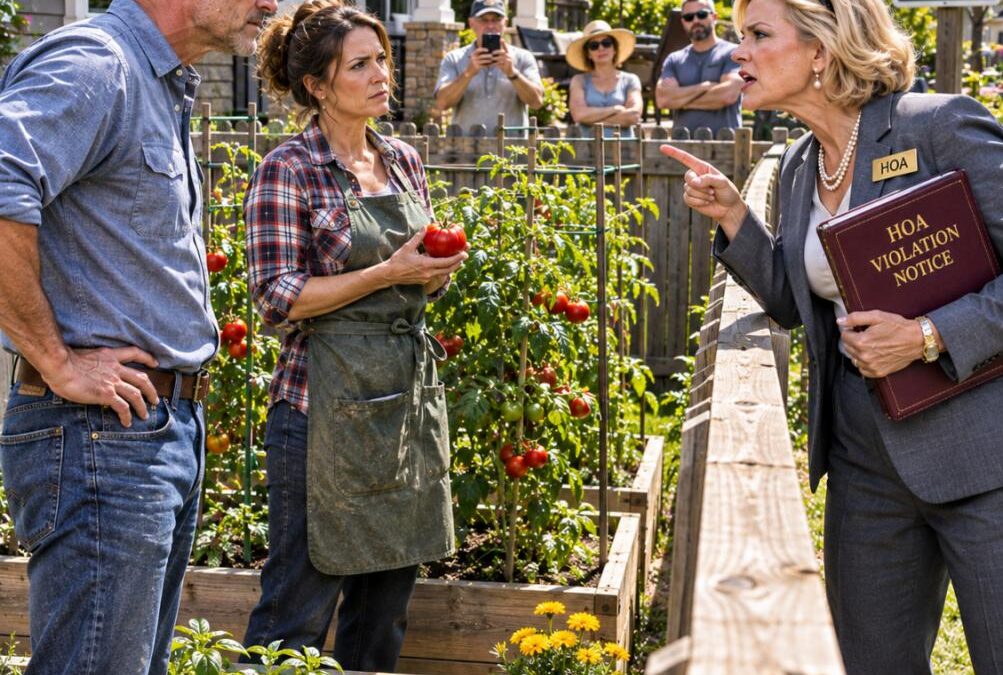
At 9:31 on a Tuesday morning, Patricia Langston stood on the other side of my backyard fence looking at a tomato like it had personally insulted her.
Emma had picked it less than thirty seconds earlier.
A perfect beefsteak.
Heavy.
Deep red.
Warm from the June sun.
She was holding it in both hands when Patricia appeared beside the fence in a tailored gray suit, black pumps, and a burgundy leather folder tucked under one arm.
“What,” Patricia said, “is that?”
I looked at the tomato.
Then at her.
“Breakfast, eventually.”
Her mouth tightened.
“I mean this.”
She swept one hand toward the garden.
Two raised cedar beds filled the sunny back corner of our lot.
Tomatoes.
Zucchini.
Lettuce.
Basil.
Peppers.
Nothing taller than the fence.
Nothing visible from the street unless somebody deliberately walked down the narrow common drainage strip behind our property and looked over.
Emma put the tomato into her basket.
“It’s a garden.”
“I know what a garden is.”
Patricia’s voice had the crisp tone of someone who considered volume unnecessary because authority should already be listening.
“It violates Section Eight, Subsection D.”
I had read the declaration before closing.
Twice.
“Which sentence?”
“Landscaping must maintain an ornamental character consistent with Cedar Grove standards.”
“There’s no vegetable prohibition.”
“Vegetables are not ornamental.”
Emma looked at her tomato.
“I think it’s beautiful.”
Patricia ignored her.
I set my coffee on the patio table.
“Has the architectural committee adopted a written standard banning food plants?”
“I don’t require a separate written standard to interpret the declaration.”
“Actually, interpretation gets interesting when it starts creating prohibitions nobody voted on.”
Her eyes narrowed.
“You’re a retired attorney, correct?”
“Trial lawyer.”
“That explains a lot.”
“Usually explains my billing rate.”
Emma touched my arm.
Warning.
Behave.
Patricia opened the folder.
“You have twenty-four hours to remove the vegetable beds.”
“No.”
She stared at me.
“No?”
“No.”
A small muscle moved in her jaw.
“You’ll begin accruing fines.”
“Send the notice.”
“You think this is amusing?”
“No.”
I looked at Emma.
Her smile was gone.
That bothered me more than Patricia.
“We bought this house with the garden area already approved as landscaping.”
“Ornamental landscaping.”
“Show me the vegetable ban.”
“I am telling you what the rule means.”
I looked back at Patricia.
“And I’m telling you that’s not enough.”
For the first time, the polished HOA-president smile disappeared completely.
She stepped closer to the fence.
“You’ve been here four months, Mr. Wilson.”
“David.”
“I built Cedar Grove’s standards over fourteen years.”
“Then fourteen years should have given you enough time to write them down.”
Her face hardened.
“This community works because residents understand that harmony requires cooperation.”
“Cooperation isn’t obedience to rules that don’t exist.”
Emma whispered my name.
Too late.
Patricia closed the folder.
“You’ll regret turning a simple correction into a fight.”
Then she walked away.
Her heels clicked against the drainage path until the sound disappeared.
Emma stared at me.
“You had to say the fourteen-year thing?”
“Yes.”
“No, you didn’t.”
“Probably not.”
She looked at the tomato in her basket.
For a second, she seemed smaller.
“This was supposed to be the peaceful place.”
I walked over and put my arm around her.
“It still is.”
I believed that when I said it.
Twenty-four hours later, a violation notice appeared on our front door.
Six weeks after that, the fines had climbed past a thousand dollars.
And three months later, I opened a certified envelope containing a document that claimed I had voluntarily agreed to surrender rights involving my own home.
My signature was at the bottom.
Almost.
part 2
My name is David Wilson.
I was sixty-seven when Patricia Langston declared war on Emma’s tomatoes.
I had practiced law for forty-one years.
Civil litigation mostly.
Business disputes.
Real-estate cases.
Contract fights.
Partnership breakups.
A few professional-liability cases.
The sort of work where grown adults spend millions of dollars arguing over sentences everyone wishes they had read more carefully before signing.
I loved trial work when I was younger.
There is a moment in every good cross-examination when the room changes.
The witness hears the problem in their own answer before anyone else does.
Jurors notice.
Opposing counsel notices.
Sometimes even the judge leans back.
At thirty-five, that moment felt like electricity.
At sixty-five, it felt like heartburn.
Emma knew before I did that I was finished.
One night, she found me at our apartment dining table surrounded by deposition transcripts.
“You’re reading the same page again.”
“I’m analyzing.”
“You’ve been analyzing page 414 for twenty minutes.”
“Complex witness.”
“You’re burned out.”
I took off my glasses.
“I’m tired.”
“No. You’re becoming somebody who thinks being tired is a profession.”
That’s marriage after thirty-eight years.
No opening statement.
Straight to the verdict.
We had spent most of our adult lives in the city.
Good careers.
Good friends.
No complaints.
But our apartment had a balcony barely large enough for two chairs.
Emma had always wanted soil.
Not a flowerpot.
Soil.
She grew herbs in window boxes.
Tomatoes in five-gallon containers.
Basil anywhere sunlight landed.
Every spring, she would show me houses online with backyards I had no intention of buying.
Then I retired.
Three months later, we toured Cedar Grove.
Tree-lined streets.
Single-family homes.
Walking paths.
Community pond.
Clubhouse.
Lots large enough that neighbors could be friendly without hearing each other’s refrigerators.
The backyard sold Emma.
The listing agent opened the patio door.
Emma walked into the sun, turned slowly, and looked at the southeast corner.
“Garden.”
The agent smiled.
“Lots of residents garden.”
I noticed the phrase.
“What kind?”
“Flowers mostly. Some herbs. I think one family has peppers behind a privacy screen.”
I asked for the declaration.
The agent laughed.
“Attorney?”
“Retired.”
“Those are the worst kind.”
I read every page before closing.
The landscaping provision Patricia later cited said:
Front and side-yard landscaping visible from common streets shall maintain an ornamental residential appearance consistent with approved community standards.
Our garden was in the rear.
Behind a privacy fence.
The architectural guidelines contained plant recommendations but no ban on vegetables.
The bylaws gave the board authority to adopt reasonable guidelines through a defined process.
No vegetable guideline existed.
That was why I did not worry when Emma built two raised beds.
Sam Bennett warned me anyway.
Sam lived next door.
Seventy-two.
Retired electrician.
Widower.
Owner of an impressive collection of theories involving county government, telecommunications companies, and the decline of American coffee.
He arrived on moving day carrying muffins that appeared to have been baked during a house fire.
“Welcome.”
“Thanks.”
He leaned closer.
“Watch Patricia.”
“Who?”
“Langston.”
“The HOA president?”
“The Empress.”
Emma laughed.
Sam did not.
“She fined Carl Henson over a red birdhouse.”
“Was red prohibited?”
“No idea.”
“Was the birdhouse prohibited?”
“No.”
“Then why did he pay?”
Sam shrugged.
“Carl hates conflict.”
I bit into the muffin.
Almost lost a crown.
“Maybe Patricia’s using these as enforcement tools.”
Sam looked proud.
“My late wife made them.”
I swallowed carefully.
“Excellent texture.”
That first week, Patricia came to our door with a bound copy of the rules even though the association had already emailed them.
“Know them,” she said.
“Already do.”
She smiled.
“Everyone says that.”
I should have noticed how much she disliked the answer.
At first, our interactions were harmless.
She reminded us that trash bins had to be hidden by eight the evening after pickup.
Fine.
Mailbox paint had to match approved colors.
Ours already did.
Exterior holiday lights had a removal deadline.
We complied.
The lawn standard irritated me because the guidelines recommended a range of roughly two to four inches but Patricia behaved as if 2.25 inches was a religious requirement.
Still, I mowed.
Peace has value.
Then spring came.
Emma planted.
The first violation arrived the day after Patricia’s backyard visit.
UNAPPROVED NONORNAMENTAL LANDSCAPING.
Cure period: twenty-four hours.
Fine: fifty dollars.
I appealed.
The management company acknowledged it.
Patricia sent a separate email.
Mr. Wilson,
Your reliance on hypertechnical readings of association documents is inconsistent with the cooperative culture of Cedar Grove.
I replied:
Dear Ms. Langston,
Please identify the provision prohibiting vegetables in a rear yard or provide the duly adopted guideline establishing that restriction.
Sincerely,
David Wilson
She did not.
Instead, the board scheduled a hearing.
The clubhouse had approximately thirty folding chairs and acoustics designed to punish everyone equally.
Patricia sat at the center of the board table.
Four directors beside her.
Robert Gaines.
Linda Mercer.
Frank Holt.
Susan Parker.
I recognized the structure immediately.
Patricia spoke first.
Everyone else waited for permission to breathe.
She displayed photographs of our garden.
One showed Emma kneeling beside a zucchini plant.
I didn’t like that.
“Who took this?”
Patricia looked at me.
“Association inspection.”
“From where?”
“Common property.”
The photograph angle was high enough to see over our privacy fence.
Interesting.
I made a note.
Then she continued.
“The vegetable beds are inconsistent with Cedar Grove’s ornamental landscape standards.”
I held up the declaration.
“Those standards specifically address front and side yards visible from common streets.”
Patricia said:
“The board has historically applied aesthetic requirements throughout lots.”
“Can you show me a written interpretation?”
“We do not need to memorialize every obvious application.”
“Has anybody else been permitted to grow vegetables?”
A board member shifted.
Patricia said:
“That’s irrelevant.”
“Then there are other vegetable gardens?”
“No one else has created a comparable situation.”
I already knew that wasn’t true.
Sam grew tomatoes behind his garage.
Small bed.
Invisible from Patricia’s preferred walking route.
Another homeowner, Elaine Morris, had peppers and cucumbers along her rear fence.
I had photographs taken from places I was legally allowed to stand.
I did not present them yet.
I wanted to see how committed Patricia was.
Very.
The board voted four to one to uphold the violation.
Susan Parker voted against.
I appreciated that.
I asked:
“What exact standard am I required to meet?”
Patricia answered:
“Remove the beds.”
“That’s a remedy. What’s the standard?”
Her smile tightened.
“This isn’t a courtroom.”
“No.”
I gathered my papers.
“In a courtroom, somebody eventually has to answer the question.”
The fine increased.
Fifty.
Then one hundred.
Then two hundred.
Management added administrative charges.
By July, our account showed $850.
Emma stopped enjoying the garden.
That was what made me angry.
I could handle Patricia.
I had spent decades dealing with people who confused certainty with accuracy.
Emma had not retired to become evidence in a governance dispute.
One morning, she found the first tomato plant snapped near the base.
Not storm damage.
The support cage had been pulled sideways.
The stem broken cleanly.
No camera.
No witness.
We reported it as vandalism.
I did not accuse Patricia.
That distinction mattered.
Sam did.
“She did it.”
“You don’t know that.”
“Who else hates tomatoes?”
“Half the insect population.”
“She hates you.”
“Also not proof.”
“Lawyers ruin instinct.”
“Instinct ruins cases.”
We installed cameras.
Not aimed at neighbors.
Our gates.
Patio.
Garden.
Two nights later, a motion alert showed a person approaching our rear fence at 11:18 p.m.
The image was too dark for identification.
Whoever it was stopped outside the property.
Then left.
Nothing criminal.
Saved anyway.
The harassment became social too.
At a Saturday coffee gathering near the clubhouse, two residents who had been friendly suddenly turned quiet when Emma approached.
One later apologized.
“Patricia says David is trying to bankrupt the HOA with legal threats.”
I had not threatened litigation.
“Did she say how?”
“She said you’re forcing unnecessary attorney expenses.”
I had written two appeals.
That was apparently financial warfare.
Then came the town hall.
Patricia called it:
PRESERVING CEDAR GROVE VALUES.
No mention of us in the flyer.
She didn’t need one.
She spent twenty minutes describing “new residents who arrive believing individual preference should outweigh community expectations.”
Heads turned toward me.
Emma squeezed my hand.
Patricia continued.
“When one homeowner refuses compliance, every other homeowner pays.”
I stood.
Emma whispered:
“David.”
I leaned down.
“I’ll behave.”
“You don’t know how.”
Fair.
I waited until homeowner comments.
Then walked to the microphone.
“If this meeting concerns us, say our name.”
Patricia smiled.
“Mr. Wilson, if you recognize yourself in the example, perhaps that says something.”
“It says your example is obvious.”
Laughter.
Not much.
Enough.
I continued.
“Have you adopted a rule banning vegetable gardens?”
“We have discussed this repeatedly.”
“That’s not my question.”
Patricia’s smile vanished.
“The declaration gives the board authority to preserve aesthetics.”
“Within its language and properly adopted standards.”
She leaned toward her microphone.
“Should rules apply to everyone?”
Several people answered yes.
She looked pleased.
I nodded.
“Good.”
Then:
“Let’s start with a real rule.”
That turned the room.
Patricia spoke over the murmurs.
“You’ve accumulated nearly a thousand dollars in unpaid penalties.”
“Which are under appeal.”
“Appeal does not equal exemption.”
“Neither does presidency equal legislative power.”
Emma closed her eyes.
I had promised to behave.
Technically, I thought I had.
We left early.
That evening, she said:
“Maybe we should remove it.”
I knew she meant the garden.
“Do you want to?”
“No.”
“Then no.”
“It’s plants, David.”
I looked at her.
“No.”
I took her hand.
“It’s your home.”
Her eyes filled.
“I don’t want every tomato to feel like a lawsuit.”
That sentence shut me up.
The next day, I called the association’s outside attorney directly.
His name was Kevin Wallace.
We had crossed paths professionally years earlier.
Not friends.
Competent lawyer.
“David?”
“Kevin.”
“Retirement going well?”
“I’m suing zucchini.”
He laughed.
Then realized I wasn’t entirely joking.
I explained.
He was careful.
“I represent the association, not you.”
“I understand.”
“Then what are you asking?”
“Whether you’ve advised the board that vegetables are prohibited.”
“No comment on privileged advice.”
“Fair.”
“Send your position to management. I’ll make sure the board has it.”
I did.
Six pages.
Not forty.
Restraint.
The next fine stopped temporarily.
Patricia did not.
Our newspaper began landing in the garden instead of the driveway.
Could have been delivery error.
Sprinkler valve failed.
Mechanical wear.
One irrigation head had been manually twisted away from the garden.
Could have been accidental.
I refused to turn suspicion into fact.
The cameras caught nothing useful.
Then came the certified envelope.
I signed at the door.
RETURN SERVICE REQUESTED.
Inside:
STIPULATED COMPLIANCE AND PROPERTY ENFORCEMENT AGREEMENT.
The document claimed that two weeks earlier I had met with Patricia and management and agreed to several terms.
Remove vegetable beds.
Waive pending appeals.
Acknowledge all outstanding fines.
Grant the HOA a continuing lien for enforcement costs.
Consent to expedited collection remedies if default occurred.
And—most alarming—agree not to contest association enforcement proceedings arising from the settlement.
At the bottom:
DAVID WILSON.
My signature.
Emma read over my shoulder.
Her face went pale.
“You didn’t sign this.”
“No.”
“David.”
“I know.”
The signature was decent.
Too decent.
The person who made it had copied a clean example.
Most people misunderstand forged signatures.
They think a forgery looks sloppy.
Sometimes it does.
Sometimes the problem is the opposite.
Real signatures vary.
Mine certainly did.
Forty years signing pleadings, settlement documents, letters, checks.
I wrote fast.
The forged signature looked like someone slowly drew my name while staring at an example.
The loops were too faithful.
The baseline too careful.
The pressure transitions wrong.
But I did not need to become my own handwriting expert.
I called Kevin first.
“Did your office draft a settlement agreement with my signature on it?”
Silence.
“What agreement?”
I emailed it.
He called back four minutes later.
“David.”
“Yes.”
“Do not communicate with Patricia about this.”
“I wasn’t planning to.”
“Where did you get it?”
“Certified mail from the association’s management address.”
Another silence.
“I’m calling the board.”
Then I called Rachel Stone.
Rachel had been one of my associates twenty years earlier.
Now she ran her own litigation firm.
She answered:
“I thought you retired.”
“So did I.”
“What happened?”
“My HOA forged my signature.”
She laughed.
Then stopped.
“You’re serious.”
“Yes.”
“Send it.”
I did.
Twenty minutes later:
“Do you have the envelope?”
“Yes.”
“Keep it.”
“Certified receipt?”
“Yes.”
“Digital scan?”
“Yes.”
“Original signature samples?”
I laughed.
“Forty years’ worth.”
“Do not touch the questioned document more than necessary.”
“I’m not an idiot.”
“You’re my former boss. The categories overlap.”
Emma heard that from across the room.
For the first time all day, she smiled.
Rachel hired Dr. Anna Petrov.
Forensic document examiner.
Not a magician.
Not someone who could glance at ink and announce Patricia’s guilt.
She compared the questioned signature with dozens of known samples.
She examined line quality.
Hesitations.
Pen lifts.
Proportions.
Rhythm.
Natural variation.
Her preliminary opinion was strong.
The signature was not naturally executed by me and showed characteristics consistent with simulation or tracing.
Useful.
But the bigger question was:
Who created the document?
The settlement itself contained clues.
Metadata from the PDF attachment in management’s document system showed an earlier version had been created on a board computer.
Author field:
P. LANGSTON.
That did not prove Patricia forged the signature.
She could have drafted the form.
Then someone else manipulated it.
We needed records.
Rachel sent a preservation letter immediately.
Emails.
Draft agreements.
Board communications.
Digital logs.
Fine records.
Management correspondence.
Security footage.
Access logs.
Financial documents connected to my account.
I formally notified the board in writing:
I did not sign the agreement.
I rejected every purported waiver.
I disputed every term.
No lien or collection action should proceed based on it.
Kevin responded the same day.
Association enforcement against us was temporarily suspended pending investigation.
Patricia sent me a personal email two hours later.
You are making a very serious allegation.
I replied:
Yes.
Nothing more.
Then things got stranger.
Sam came over carrying a pie.
Different from the muffins.
Still overcooked.
“What did you do?”
“What?”
“Patricia canceled tonight’s board workshop.”
“I didn’t do anything.”
“Everybody says you caught her forging documents.”
“Everybody should stop saying things they don’t know.”
“So she didn’t?”
“I said stop.”
He looked disappointed.
“Law is less fun when you’re involved.”
Correct.
Rachel requested association records under the governing documents and applicable state law.
We did not demand every piece of paper the HOA had ever created.
Targeted records.
Financial statements.
Vendor payments.
Board minutes.
Enforcement expenditures.
Contracts.
The association produced some.
Delayed others.
Patricia insisted several categories were confidential.
Kevin disagreed.
That became our first sign she was no longer controlling the legal response.
The records showed something unrelated to my garden.
Cedar Grove’s landscaping expenses had increased dramatically over four years.
Not impossible.
Labor costs rise.
Material prices rise.
The neighborhood had added common areas.
But one vendor received an extraordinary amount.
Cedar Grove Landscape Solutions LLC.
Similar name.
Not actually owned by the HOA.
Payments totaling roughly $430,000 over four years.
Some legitimate services appeared to have been performed.
Mowing.
Mulching.
Tree removal.
But invoices were vague.
“Community beautification.”
“Special landscape remediation.”
“Emergency aesthetic services.”
Rachel hired a forensic accountant, Melissa Grant.
Not a private investigator digging into people’s personal lives.
A CPA specializing in fraud examinations.
She reviewed invoices against bank records and board approvals.
Some bills lacked proper authorization.
Several invoices repeated identical descriptions and amounts.
One vendor address was a mailbox service.
The registered owner of the LLC:
Nathan Langston.
Patricia’s older brother.
That alone was not illegal.
Family businesses can perform legitimate work.
The problem was disclosure.
Board conflict policies required related-party relationships to be disclosed.
No minutes showed Patricia disclosing Nathan’s ownership.
Then Melissa found another issue.
The HOA had paid $18,500 for “irrigation modernization” in a common greenbelt.
The irrigation controller had never been replaced.
Sam knew because he had volunteered on the facilities committee.
He walked us to the box.
Original controller.
Serial number matched old maintenance logs.
“What did eighteen grand buy?” Rachel asked.
Sam spread his hands.
“Apparently spiritual irrigation.”
More contracts followed.
Some work had occurred.
Some appeared inflated.
Some could not be verified.
The total potentially questionable amount was significant.
But we did not jump to $550,000 stolen.
An audit would determine actual loss.
That’s where the original story people later told about Cedar Grove went wrong.
Fraud cases are not strengthened by multiplying numbers until they sound impressive.
We had enough without fantasy.
Meanwhile, the forged agreement became easier to trace.
Management’s IT provider recovered prior versions.
Version one:
No signature.
Version two:
A scanned image of my signature inserted.
Version three:
Flattened PDF, making the signature appear part of the document.
The login associated with the upload belonged to Patricia.
Again:
Account access did not prove who sat at the keyboard.
Then the IP log showed upload from Patricia’s home internet connection.
Stronger.
Then investigators located the signature source.
A prior architectural request I had filed months earlier.
I had signed it by hand.
The forged signature image was nearly identical to that signature.
Dr. Petrov demonstrated the match.
Same small ink irregularity.
Same flourish.
Same accidental flattening at the end of the n.
A real second signature would never reproduce those microscopic features exactly.
The image had been copied.
That was the moment the forgery became difficult to explain away.
Rachel said:
“We notify law enforcement.”
I nodded.
“I know.”
“You are the victim. You are not the prosecutor.”
“I know.”
“You don’t confront Patricia.”
“I know.”
“You don’t announce embezzlement at a board meeting.”
“I know.”
“You don’t call the local news.”
“I know.”
She smiled.
“You were much more difficult as a boss.”
“I had authority then.”
“Exactly.”
The police report went to detectives who handled financial crimes.
They requested records through proper legal process.
The association’s insurer was notified.
An independent accounting firm took over the HOA audit.
Patricia was asked by three board members to temporarily step aside as president.
She refused.
That’s when Susan Parker called me.
“I owe you an apology.”
“For what?”
“I kept voting with her because it was easier.”
“You voted against the garden fine.”
“Once.”
“That mattered.”
“Not enough.”
She sounded tired.
“I thought Patricia was controlling, but I thought she was controlling because someone had to keep things organized.”
“And now?”
“Now I’m wondering how much we let her do because nobody wanted to ask questions.”
That was the real Cedar Grove problem.
Not Patricia alone.
Habit.
She spoke first.
People agreed.
She drafted.
People signed.
She described the rules.
People assumed she’d read them.
The board stopped governing and became an audience.
Susan, Frank, and Linda called a special board meeting.
Patricia objected.
Kevin attended.
So did independent counsel hired by the association’s insurer.
I was invited for the portion involving our account.
Rachel came with me.
Emma insisted on attending too.
The meeting began at seven.
Patricia wore charcoal gray.
No smile.
Kevin summarized the situation.
The agreement carrying my purported signature had not been authorized by the full board.
Management had no record of a settlement meeting with me.
No board vote approved those terms.
No association attorney had reviewed the final version.
Then Rachel spoke.
“Mr. Wilson did not sign it.”
Patricia interrupted.
“That remains disputed.”
Rachel looked toward her.
“Dr. Petrov’s preliminary report disagrees.”
“She’s being paid by him.”
“Correct.”
Rachel smiled.
“That’s why the association is free to retain its own examiner.”
Patricia looked at Kevin.
He did not help her.
Susan asked:
“Patricia, where did this document come from?”
“It was part of ongoing enforcement.”
“Who drafted it?”
“I don’t remember.”
“The metadata says you.”
“That doesn’t mean I was the only one.”
“Who inserted David’s signature?”
“I don’t know.”
Emma squeezed my hand.
I said nothing.
Susan continued.
“Did David ever meet with you and agree to these terms?”
Patricia hesitated.
“He had multiple opportunities to comply.”
“That isn’t my question.”
I almost smiled.
Susan was learning.
“Did he agree?”
Patricia looked directly at me.
“He knew enforcement would escalate.”
Rachel quietly wrote something.
Susan repeated:
“Did he sign that agreement in your presence?”
“No.”
There it was.
“Did anyone witness him sign it?”
“I don’t know.”
Frank Holt leaned forward.
“How can we have a settlement agreement nobody saw him sign?”
Patricia snapped:
“Electronic signatures happen every day.”
I finally spoke.
“This isn’t an electronic signature.”
Everyone looked at me.
I kept my voice calm.
“It’s an image lifted from another document.”
Patricia turned pale.
Not dramatically.
But enough.
I had watched witnesses hear dangerous facts for four decades.
Same reaction.
Stillness first.
Then too much explanation.
She said:
“Documents get reused. Signatures get migrated during administrative processing.”
Rachel’s pen stopped.
I looked at her.
She looked at me.
Patricia had just introduced the idea that signatures were “migrated” by someone during administrative processing.
Susan said:
“Who migrates signatures?”
Patricia realized the sentence was worse than silence.
“I’m not an IT person.”
The meeting recessed.
When it resumed, the board voted three to one to suspend Patricia’s officer authority pending independent investigation.
Patricia voted no.
Of course.
She remained a director because removal required a separate membership process under the bylaws.
But she was no longer president.
Susan became acting president.
All enforcement against Emma’s garden was suspended.
For the first time in months, Emma slept through the night.
I didn’t.
Because once Patricia lost control, records started talking.
The independent audit examined Cedar Grove Landscape Solutions.
Nathan Langston had a criminal record.
That was true.
Fraud-related conviction years earlier.
But I refused to turn that into automatic proof that every contract was fake.
Melissa Grant agreed.
“We follow money.”
She traced payments.
Some landscaping invoices matched real work.
Some did not.
Several large payments moved from the vendor account into Nathan’s personal accounts.
That, by itself, was his company’s business.
Then some funds moved to Patricia.
She described them as repayment of personal loans she had previously made to her brother.
Possible.
Records existed showing she had given him money years earlier.
Not every payment was kickback money.
This became complicated.
Good.
Real evidence often does.
The clearest problems were narrower.
Patricia had participated in awarding contracts to her brother’s company without proper disclosure.
Several invoices appeared fabricated or materially inflated.
Some work billed to the HOA had not been performed.
The association had suffered losses.
Nathan appeared more deeply involved in creating invoices than Patricia.
Whether Patricia knowingly participated in each false billing became a criminal question.
Then investigators found texts.
Nathan:
Need another 12 before month end.
Patricia:
Board will notice.
Nathan:
They never notice.
Patricia:
Use drainage remediation.
Nathan:
Same area as last time?
Patricia:
Nobody checks.
That was difficult to explain innocently.
Another message:
David Wilson is pushing records.
Nathan:
Then shut him up.
Patricia:
Working on it.
Nathan:
Lien him.
Patricia:
Garden case isn’t strong enough yet.
Nathan:
Make it strong.
I listened to Rachel read those aloud in her office.
Emma was beside me.
Her face had gone completely still.
I said:
“That’s why the forged agreement appeared.”
Rachel answered carefully.
“It’s evidence of motive.”
“Not proof Nathan ordered the forgery.”
“Correct.”
Emma looked at me.
“You’re both impossible.”
She was right.
Then came another exchange.
Patricia:
I can get him to sign a compliance agreement.
Nathan:
And if he doesn’t?
Patricia:
He will one way or another.
That didn’t prove exactly how the signature was inserted.
But combined with digital logs, it mattered.
The criminal investigation accelerated.
Still no dramatic courtroom confession.
No judge ordering Patricia arrested after a handwriting expert pointed at a screen.
That’s not how our case unfolded.
Instead, prosecutors worked for months.
Subpoenas.
Bank records.
Computer examinations.
Interviews.
The association filed its own civil claims against Nathan’s company seeking recovery for unsupported payments.
My lawsuit came later.
Rachel and I initially tried to resolve the garden and forged-document issue without broader litigation.
Patricia’s attorney—she had her own by then—wanted a confidentiality agreement.
I refused one term.
They wanted both sides prohibited from “disparaging” each other.
Rachel asked:
“Why?”
“Because stating that somebody forged my signature shouldn’t become a contract violation if it’s established as true.”
No agreement.
So we filed.
Claims involving the fabricated settlement document.
Improper enforcement.
Declaratory relief concerning the garden restrictions.
Damages resulting from the wrongful charges and related conduct.
We did not sue the HOA for owning ugly shrubs.
We did not claim millions in emotional distress.
Targeted case.
Real remedies.
The first hearing concerned temporary relief.
By then, Cedar Grove had recorded no foreclosure against our home.
That is another detail people exaggerated later.
The fabricated agreement could have been used to support aggressive collection measures, but the board’s suspension prevented that before it progressed.
My nightmare scenario was not an actual completed eviction.
It was a forged waiver being placed into the association’s file and later used as evidence that I had admitted debt and surrendered defenses.
That was serious enough.
Judge Margaret Klein reviewed the documents.
The HOA, now under Susan’s leadership, did not defend Patricia’s signature document.
Its new counsel stipulated that the association would not rely on it.
The disputed fines would remain frozen.
No lien enforcement would occur while the merits were litigated.
Judge Klein looked at me.
“Mr. Wilson, you practiced law?”
“Forty-one years.”
“You’re represented today?”
“Yes, Your Honor.”
“Good.”
Rachel whispered:
“She likes me better.”
“Everyone does.”
The judge heard that.
Her mouth moved slightly.
I should have known better.
The handwriting evidence came later.
Dr. Petrov did not declare who committed the forgery.
Important distinction.
She testified that the signature was not independently written by me.
It had been reproduced from a known source.
Metadata experts traced document creation.
The state’s digital-forensics examiner corroborated key logs.
Then Patricia faced deposition.
Rachel let me attend.
She would not let me conduct it.
“You are emotionally compromised.”
“I’m retired.”
“You are emotionally retired.”
“That’s not a thing.”
“It is today.”
Patricia entered wearing navy.
No clipboard.
Her attorney sat beside her.
Rachel began gently.
Name.
Position.
Years on board.
Authority.
Then the garden.
Patricia insisted the declaration gave discretionary aesthetic power.
Rachel asked:
“Can you identify another homeowner fined for rear-yard vegetables before the Wilson matter?”
“No.”
“Any adopted guideline banning vegetables?”
“No.”
“Any board resolution interpreting ornamental landscaping to prohibit vegetables?”
“Not formal.”
“Any legal opinion saying it did?”
“Not that I recall.”
Then:
“Why did you tell Mr. Wilson he had twenty-four hours?”
“Because the garden was visibly inconsistent.”
“Visible from where?”
“The common strip.”
“Could a person standing on the street see it?”
“No.”
“Could someone standing normally on the common strip see the beds over the privacy fence?”
Patricia hesitated.
“Parts.”
Rachel showed the inspection photograph.
Taken from an elevated angle.
“Who took this?”
“I did.”
“How?”
“I held my phone up.”
“Above the fence?”
“Yes.”
“Why?”
“To document the violation.”
“Before determining whether anything visible without doing that violated a rule?”
Patricia’s attorney objected.
Rachel moved on.
Then the fabricated agreement.
“Did Mr. Wilson sign Exhibit Twenty-Seven in your presence?”
“No.”
“Did he ever tell you he signed it?”
“No.”
“Did you receive a copy bearing his signature?”
“Yes.”
“From whom?”
“I don’t remember.”
“Did you create the original digital file?”
“Possibly.”
“Did you upload the signed version?”
“I don’t recall.”
“Was your home internet connection used?”
“I’ve been told that.”
“Who had access to your home computer?”
“My brother sometimes.”
There it was.
Nathan.
Rachel asked:
“Was Nathan at your home on the date the signed version was uploaded?”
“I don’t remember.”
“Phone records place him there that evening.”
Patricia looked at her attorney.
He said nothing.
“Did Nathan know about the Wilson enforcement dispute?”
“Yes.”
“Did he encourage you to escalate?”
“He had opinions.”
“Did he say, ‘Make it strong’?”
Her jaw tightened.
“I don’t recall.”
Rachel showed the text.
Patricia read it.
No answer.
Then:
“Did you tell Nathan, ‘He will one way or another,’ in response to whether David Wilson would sign a compliance agreement?”
Patricia looked at me.
First time all day.
“Yes.”
“What did you mean?”
“That I believed he’d eventually comply.”
“By signing?”
“Yes.”
“And if he didn’t?”
“I didn’t mean forge anything.”
Rachel waited.
Silence became heavy.
Then:
“I never told Nathan to forge David’s signature.”
That was the first time anyone had asked.
Rachel nodded.
“I didn’t ask whether you did.”
Patricia stopped breathing for a second.
Old trial instinct woke in me.
There.
The room had changed.
Rachel had it.
She moved on.
Months later, prosecutors filed charges against Nathan involving fraudulent HOA billing and document-related offenses.
Patricia also faced charges tied to her participation in the scheme, though narrower than Nathan’s.
Neither was arrested in the middle of my civil hearing.
No handcuffs in front of the tomato garden.
They appeared through counsel and were processed through the ordinary system.
Nathan initially denied everything.
Then his computer records became a problem.
Investigators recovered a file containing my copied signature image.
Filename:
WILSON_SIG.png.
It had been created from the architectural request I’d signed.
Another folder contained draft versions of the false compliance agreement.
Nathan had created at least one of them.
Patricia’s login had uploaded the final version into the HOA records system.
That left an important question.
How much did she know?
A message answered much of it.
Nathan:
Loaded Wilson agreement. You’re covered.
Patricia:
Signature?
Nathan:
Handled.
Patricia:
I don’t want details.
Nathan:
Then don’t ask.
That was not a cinematic confession.
It was worse.
Deliberate ignorance.
The prosecutors believed they could prove she knowingly used a document she had reason to understand was fraudulent.
Her attorney negotiated.
She ultimately entered a plea to charges reflecting her role in the fraudulent-document and financial misconduct.
Nathan pleaded to more serious offenses involving false billing and document fraud.
He received a custodial sentence.
Patricia received a combination of probationary supervision, restitution obligations, financial penalties, and community-service conditions.
No judge gave a ten-minute speech about tomatoes.
Judge Klein was not the criminal judge anyway.
The association’s civil audit concluded that roughly $190,000 in payments to Nathan’s company were unsupported, inflated, or otherwise recoverable.
Not $550,000 stolen.
Not every dollar paid to his company was fictitious.
That mattered.
Cedar Grove recovered part through insurance, settlement, restitution, and civil claims.
Some money was never recovered.
Homeowners were furious.
They should have been.
Their dues had been treated like nobody was watching.
At the special membership meeting, Patricia’s remaining board seat came up for removal.
Emma and I attended.
I did not speak.
I had said enough.
Susan presented the audit.
Kevin explained governance failures.
Sam sat beside us wearing his only sport coat.
He whispered:
“She’s finished.”
I whispered back:
“This isn’t a horse race.”
“Same atmosphere.”
Patricia spoke.
Her voice was different now.
Smaller.
“I made serious mistakes.”
A resident called out:
“Mistakes?”
Susan hit the gavel.
Patricia continued.
“I believed maintaining control of the association was necessary because too many owners did not understand what protecting property values required.”
There it was again.
Control.
She looked toward me.
“I also let a personal conflict with Mr. Wilson influence decisions that should have been handled objectively.”
Emma went still.
Patricia continued:
“The garden issue should never have escalated the way it did.”
Not everything.
But true.
The membership removed her overwhelmingly.
Susan became president in the next regular election.
Frank stayed.
Linda stayed.
Robert resigned.
The new board hired professional management with stricter controls.
Vendor contracts over a threshold required multiple bids unless an emergency was documented.
Related-party vendors required disclosure and recusal.
Financial reports went to every director.
No president could approve their own enforcement interpretation without board process.
Fine schedules were standardized.
Appeal hearings required a written statement of the actual rule.
And yes:
The landscaping guidelines changed.
The new language was almost comically specific.
Vegetable gardens are permitted in rear-yard areas, subject to ordinary maintenance, nuisance, setback, and visibility requirements.
Emma read it at the kitchen table.
“Subject to ordinary maintenance.”
“Yes.”
“So I can’t grow twelve-foot tomatoes.”
“Please try.”
“Setback.”
“Don’t invade Sam.”
“Visibility.”
“Patricia would hate that word.”
I smiled.
“She’s no longer relevant.”
That took longer for Emma to believe.
For months, every time she went into the garden she looked toward the fence.
Waiting.
The first tomato after the settlement ripened in late June.
She brought it inside.
Set it on the counter.
Then stared at it.
“You’re not happy.”
“I am.”
“You don’t look happy.”
She touched the tomato.
“I keep remembering the broken plant.”
I understood.
Winning does not automatically restore joy.
The association had corrected our account.
All fines disappeared.
Legal fees were resolved through settlement.
The fabricated agreement was formally repudiated.
We received compensation for documented losses and some additional negotiated damages.
None of that made a tomato feel innocent again.
So we did something simple.
We gave it away.
To Sam.
He held it in both hands.
“This is evidence.”
“No.”
“Symbol of resistance.”
“No.”
“Fruit of revolution.”
“It’s a tomato.”
“Vegetable.”
“Botanically—”
“If you start lawyering produce, I’m leaving.”
He made sandwiches.
They were excellent.
His baking remained criminal.
Cedar Grove slowly became a different place.
Not because Patricia vanished.
She still owned her house for another year.
Not because every neighbor suddenly became brave.
People are people.
But meetings changed.
Directors asked questions.
Owners requested documents.
Nobody treated disagreement as treason.
The first major dispute under Susan involved solar panels.
Half the community thought they looked ugly.
The architectural committee reviewed the governing documents, state law, and adopted standards.
Then issued a written policy.
No improvisation.
No “because I said so.”
Sam nearly cried.
“Democracy.”
“Administrative process.”
“Same thing.”
“Not remotely.”
Emma expanded the garden the following spring.
Not dramatically.
One additional bed.
Green beans.
Carrots.
More tomatoes.
She planted marigolds along the border because she liked the color.
Patricia saw them once while walking.
She slowed near our property.
Emma was kneeling in the soil.
I was on the patio reading.
Patricia stopped.
For several seconds, nobody spoke.
Then she said:
“The marigolds look nice.”
Emma sat back.
“Thank you.”
Patricia walked on.
That was the entire interaction.
Afterward, Emma looked at me.
“What was that?”
“Possibly civilization.”
“Don’t ruin it.”
Patricia eventually sold her house.
Before she moved, she sent us a letter.
No lawyer.
No board letterhead.
Handwritten.
David and Emma,
I owe both of you an apology.
I turned a disagreement over a garden into a personal contest for control. I used association authority to pursue that contest when I should have stepped back.
I also allowed my brother access to association systems and failed to stop conduct I knew was improper. There is no excuse for what happened with David’s signature.
Emma did not deserve to have something she loved turned into a source of fear.
I am sorry.
Patricia.
Emma read it twice.
Then handed it to me.
“What do you think?”
“Better than most deposition testimony.”
“David.”
I looked at the letter again.
“I think she means it.”
“Forgive her?”
“Maybe.”
“That’s very evolved.”
“I said maybe.”
We kept the letter.
Not on display.
In the file.
The garden kept growing.
A funny thing happened after the new rule.
Vegetable beds started appearing everywhere.
Elaine Morris expanded hers.
Susan planted herbs.
A young couple on Magnolia Lane built raised beds for peppers.
Sam planted tomatoes badly and blamed the soil.
At the summer community picnic, Cedar Grove added a produce table.
People brought surplus vegetables.
Squash.
Cucumbers.
Beans.
Enough zucchini to threaten local infrastructure.
Nobody called it rebellion anymore.
That was my favorite part.
What had once been treated as a threat became ordinary.
That’s how you know a bad rule has truly lost power.
Not when everyone celebrates defeating it.
When nobody remembers why it mattered.
One Saturday, a new homeowner named Trevor knocked on our door.
Thirty-something.
Two children.
Nervous expression.
“I heard you’re the lawyer.”
“Retired.”
“Still counts.”
“Usually means I complain for free now.”
He held up an HOA notice.
Tree removal.
He had taken down a dead ornamental pear after a storm.
The notice said architectural approval had been required.
He looked worried.
“What do I do?”
I read it.
The guideline actually did require notification for removal of visible landscape trees except emergencies.
His tree had partially fallen toward the sidewalk.
There was an emergency exception.
“Send photographs from the storm.”
“I have them.”
“Ask management to apply the emergency provision.”
“So fight it?”
“No.”
He looked confused.
“What?”
“Use the process.”
“But everybody says you fought Patricia.”
“I fought invented enforcement.”
I handed the notice back.
“This rule exists.”
He nodded slowly.
“That’s less exciting.”
“Good governance usually is.”
He sent the photos.
Notice withdrawn.
No war.
I felt absurdly proud.
Retirement finally became what Emma had wanted.
Mostly.
I volunteered at a legal-aid clinic twice a month because apparently forty years of law had not cured me.
Emma joined a master gardener group.
We traveled.
Sam watched the house and invented new conspiracies about our smart thermostat.
I stopped checking HOA email like incoming artillery.
That took time.
For nearly a year after the forgery, certified mail made my stomach tighten.
Imagine that.
Forty years as a trial lawyer.
Thousands of court notices.
Demand letters.
Subpoenas.
Judgments.
And one fake signature from a woman with a clipboard trained my body to fear the mail.
That taught me something humbling.
Legal experience does not make you immune to being violated.
Knowing the remedy doesn’t erase the shock.
I had spent my career telling clients:
“We’ll deal with what’s provable.”
Useful sentence.
Emotionally incomplete.
Emma understood before I did.
One evening, she found me reading the old forged agreement.
Again.
“Why?”
“I don’t know.”
“You won.”
“I know.”
“The fines are gone.”
“I know.”
“She’s gone.”
“I know.”
“Then why are you reading it?”
I looked at the signature.
Because it had my name.
That was what bothered me.
Somebody had taken the mark I used to consent, agree, promise, settle, authorize—and made it say something I never chose.
After forty years in law, I knew exactly how powerful a signature could be.
Seeing mine stolen felt strangely intimate.
Emma sat beside me.
“Shred the copy.”
“Evidence.”
“The case is over.”
“I have scanned originals.”
“Then shred this one.”
I hesitated.
She held out her hand.
I gave it to her.
We fed it into my office shredder.
The machine struggled.
Emma laughed.
“Even the shredder hates Patricia.”
That helped more than I expected.
I kept the official records.
Of course.
I wasn’t cured of being a lawyer.
But I stopped keeping the forged agreement on top of my desk.
Years passed.
Cedar Grove’s vegetable policy became so ordinary that new residents had no idea there had once been a fight.
One afternoon, I was watering tomatoes when a little girl from two houses down stopped at the fence.
“Mr. Wilson?”
“Yes?”
“My mom says your tomatoes are famous.”
“Your mother exaggerates.”
“Can I have one?”
I looked toward her mother, who was walking behind.
She waved.
I picked a ripe tomato.
Handed it over.
The girl stared at it.
“That’s huge.”
“Emma grows them.”
“Why?”
I laughed.
“Excellent question.”
Emma called from the porch:
“Because they taste better than store tomatoes!”
The girl ran home.
I stood there holding the hose.
For a moment, I remembered Patricia on that first morning.
What is this?
A garden.
Such a ridiculous beginning for so much damage.
But that’s often how abuse of authority works.
It rarely introduces itself with the worst thing first.
Nobody opens with forgery.
They start with a preference.
Then they call the preference a rule.
Then disagreement becomes defiance.
Defiance becomes a threat.
Threat justifies escalation.
And somewhere along the way, the person enforcing order stops noticing they are breaking every principle that gave their authority legitimacy in the first place.
Patricia didn’t forge a document because tomatoes were dangerous.
The tomatoes became dangerous because they proved I could say no.
That’s what she could not tolerate.
Nathan exploited that weakness.
He needed money.
She needed control.
Our garden dispute gave both of them a convenient target.
The strange thing is that they almost succeeded in the part that mattered most.
Not taking our house.
That was never as easy as the fake agreement made it sound.
Not legally.
They almost made Emma want to leave.
That was the real danger.
One night during the worst of it, she had looked around our kitchen and said:
“I don’t feel like this is ours.”
That sentence scared me more than any lien notice could have.
Homeownership is paperwork.
Home is psychological.
You can win the first and lose the second.
We were lucky enough to recover both.
I never mounted a sign saying PATricia LOST.
Never planted tomatoes in her front yard.
Never used my old professional connections to humiliate her.
People suggested versions of all three.
Sam wanted a plaque.
He drafted one.
CEDAR GROVE TOMATO LIBERATION SITE.
Emma banned it.
Correct decision.
The best consequence was simpler.
Patricia lost the authority she abused.
Nathan faced consequences for the fraud he committed.
The association recovered what money it could.
Procedures changed.
People asked questions.
Emma gardened.
That was enough.
On our fifth anniversary in Cedar Grove, Susan organized a small community garden behind the clubhouse.
Individual plots.
Water access.
Compost.
A bench.
She asked Emma to cut the ribbon.
Emma refused.
“Why?”
“Because that’s ridiculous.”
Susan insisted.
Emma compromised by bringing tomato seedlings.
Twenty-four.
One for each plot.
Sam attended carrying muffins.
I intercepted them.
“For public safety.”
“They’re better now.”
“They could only improve.”
He looked toward the garden.
“You know none of this happens without you.”
“No.”
“David.”
“Patricia created the conflict.”
“You fought her.”
“Emma planted vegetables.”
Sam considered that.
“So Emma defeated the dictatorship.”
“More accurate.”
Emma overheard.
“Stop making my tomatoes political.”
We laughed.
The new gardeners planted.
Children carried watering cans.
A retired teacher argued about compost ratios.
Someone’s toddler stepped directly into a lettuce bed.
No one filed a violation.
I sat on the bench beside Emma.
“You got your garden.”
She leaned against me.
“I had my garden before.”
I knew what she meant.
The backyard.
Our small sanctuary.
That remained the important one.
That evening we walked home.
The sun was low.
Cedar Grove looked almost exactly like the brochure that had sold us on the place.
Neat houses.
Trim lawns.
Trees arching over the street.
What had changed wasn’t the appearance.
It was the assumption underneath it.
Uniformity no longer meant one person’s taste becoming everybody else’s obligation.
At least not without a fight.
I retired from litigation because I was tired of conflict.
Then conflict found me over a tomato.
Life has a sense of humor.
But Cedar Grove taught me something four decades in court had not.
The best legal victory is often the one that makes law less visible afterward.
When rules become clear, people stop needing lawyers to interpret every disagreement.
When appeals are fair, homeowners don’t treat hearings as theater.
When boards disclose conflicts, audits become boring.
When leaders understand that authority ends somewhere, neighbors can go back to being neighbors.
That’s what happened.
Boring governance replaced Patricia.
I loved it.
The final time I thought seriously about the forged signature was on a Sunday morning.
Emma had gone inside for a basket.
I stood alone near the raised beds.
The first beefsteak tomato of the season hung low on the vine.
Deep red.
Almost identical to the one Patricia had stared at years earlier.
I picked it.
Heavy in my palm.
Warm.
Emma came back outside.
She looked at it.
“Perfect.”
“Pretty close.”
“You going to make a legal argument that it’s ornamental?”
“I can.”
“I’ll leave you.”
“Then definitely not.”
She laughed.
I handed her the tomato.
Across the fence, Sam called:
“I heard that!”
“No one invited you into this conversation.”
“I have historic conversational access!”
I laughed so hard I nearly dropped my coffee.
Emma shook her head.
“Do not give him ideas.”
I looked at the garden.
Zucchini leaves spreading.
Lettuce under shade cloth.
Basil beside the peppers.
Nothing revolutionary.
Nothing threatening.
Nothing that should ever have required a lawyer.
That was exactly why it mattered.
Patricia once believed she had the right to decide what belonged in Cedar Grove.
Not through a clear rule.
Through herself.
She was the president.
Therefore her judgment became policy.
Her preference became enforcement.
Her irritation became fines.
Her fear of losing control became fraud.
What stopped her was not that I had been a trial lawyer for forty years.
That helped.
But another homeowner with less experience should not have needed my résumé to survive the same abuse.
What stopped her was evidence.
Written rules.
Digital records.
Independent directors finally willing to act.
A document examiner who could explain why a copied signature was not consent.
Accountants who followed money instead of gossip.
Police and prosecutors who handled actual crimes separately from neighborhood drama.
A court that cared about what could be proved.
And one board member—Susan—who finally understood that “Patricia says so” was not governance.
I picked up my coffee.
Emma carried the tomato inside.
No cameras watching.
No violation notice taped to the door.
No certified envelope waiting in the mailbox.
Just a summer morning in the home we’d chosen for peace.
The garden stayed.
Not because vegetables defeated an HOA.
Because authority finally had to prove it was authority.
And once Patricia was forced to show exactly where her power came from, everyone could finally see the truth.
It ended at our property line.
Right beside the tomatoes.