HOA Karen Called Police Over My Smart Lock and Tried to Have Me Removed From My Own Lake Cabin—She Has Vastly Underestimated What My Cameras Recorded.k
HOA Karen Called Police Over My Smart Lock and Tried to Have Me Removed From My Own Lake Cabin—She Has Vastly Underestimated What My Cameras Recorded
She called police and reported a break-in because I installed a smart lock on the front door of the lake cabin I legally owned.
Then officers discovered HOA Karen had been standing inside my property line minutes before they arrived, carrying an old emergency key she had no right to possess.
What frightened me wasn’t the false report—it was the access log showing someone had already tried my door three times while I was in the shower.
“Ma’am, open the door now.”
The voice slammed through my cabin hard enough to make me drop the towel I was reaching for.
I froze in the hallway.
Water still ran from my hair down the back of my neck.
Then came another knock.
Harder.
“Police department. Come to the door.”
Behind the frosted glass of the front door, red and blue light moved across the floorboards.
My heart started pounding.
Nobody was supposed to be there.
I had returned from visiting my sister less than two hours earlier. Groceries were still in the trunk. My suitcase sat unopened beside the couch.
I pulled on my robe and moved toward the front window.
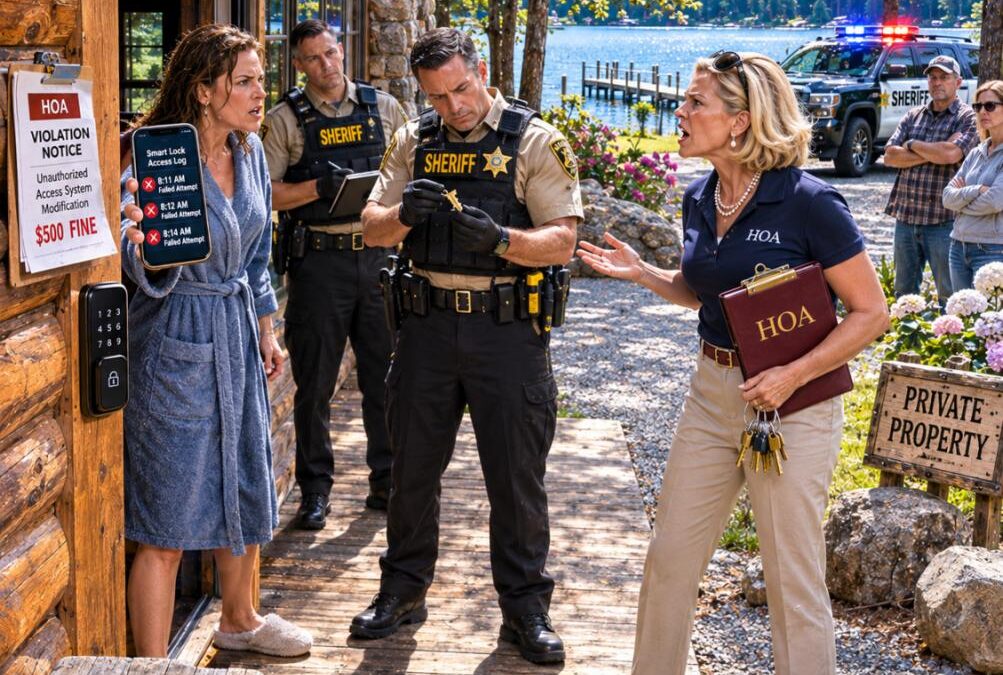
Two sheriff’s deputies stood on my porch.
Behind them, beside the walkway, was Victoria Hayes.
HOA vice president.
Navy polo.
Khaki pants.
Arms crossed.
Smiling.
I unlocked the deadbolt but left the door closed.
“What is this about?”
The older deputy stepped closer.
“Ma’am, we received a report of unauthorized entry at this residence.”
“I live here.”
“Can you identify yourself?”
“Ellen Ramsay. I own this cabin.”
Victoria spoke from behind him.
“No, she has occupancy rights. The association controls the property.”
I stared at her.
“What?”
She pointed toward the small black keypad beside my door.
“That lock isn’t authorized. We received an alert that somebody changed the access system.”
“You received an alert?”
“Community cabins require emergency HOA access.”
“This is not a community cabin.”
She laughed.
“You’ve been told repeatedly.”
The deputy raised one hand.
“Everybody stop.”
I opened the door.
He looked at my robe, wet hair, bare feet.
Then at Victoria.
“Mrs. Hayes, you said the person inside might be burglarizing the property.”
“She was gone for days.”
“I was visiting my sister.”
“You didn’t notify the association.”
“I don’t have to.”
The younger deputy looked toward the smart lock.
“Ma’am, can you show ownership?”
“Yes.”
“Identification too.”
“Yes.”
I turned toward the kitchen.
Then the older deputy said something that stopped me.
“Before you do—Mrs. Hayes, stay where you are.”
Victoria’s smile disappeared.
“Why?”
“Because dispatch location data places the original call from inside this parcel, not from the public road.”
“So?”
“You told dispatch you were observing a suspected intruder from outside the property.”
Victoria’s face tightened.
“I was checking compliance.”
The younger deputy walked toward the side yard.
A minute later he returned holding something between two gloved fingers.
A broken brass key.
“Found this beside the rear door.”
I looked at Victoria.
She said nothing.
I grabbed my phone.
Opened the smart-lock application.
Three failed entry attempts.
8:11 a.m.
8:12.
8:14.
I had been in the shower.
Then I opened my rear camera.
The video loaded.
Victoria appeared on-screen.
Standing at my back door.
Trying a key.
The deputy leaned closer.
And behind Victoria, half-hidden by the trees, was a second person I had never seen before.
part 2
For several seconds, none of us spoke.
The deputy watched the clip again.
Victoria inserted something into my rear lock.
Twisted.
Stopped.
Tried again.
Then looked toward the woods.
Someone stood near the pine line wearing a dark jacket and baseball cap.
The image wasn’t sharp enough for a face.
But the person was clearly waiting.
“Mrs. Hayes,” the older deputy said, “is that you?”
Victoria folded her arms.
“I was verifying whether the homeowner had made an unauthorized lock change.”
“With a key?”
“We have emergency-access keys.”
“To my house?”
“Legacy emergency-access program.”
I stared at her.
“What legacy program?”
Victoria looked at the deputy instead of me.
“The association historically maintained emergency access for lake cabins.”
“Historically,” I said.
She ignored me.
The younger deputy asked, “Do you have written authorization from Ms. Ramsay?”
“The authority predates her purchase.”
“Show me.”
“I don’t carry association files around.”
“You’re carrying a clipboard.”
Her jaw tightened.
The older deputy looked toward me.
“Ms. Ramsay, how long have you owned the property?”
“Two years.”
“Do you know of any HOA right to enter?”
“No.”
“Any rental arrangement?”
“No.”
“Any emergency key agreement?”
“No.”
Victoria interrupted.
“She received the governing documents.”
I looked at her.
“I read them.”
“Apparently not carefully.”
That sentence did something to me.
For months, Victoria had been leaving notices about my smart lock.
She called it incompatible with historic design.
Unauthorized technology.
A security concern.
She had photographed my door.
Walked my porch.
Peered through windows while pretending to inspect siding.
I had treated her as an annoying HOA officer.
Now I was watching her attempt to unlock my home while I was naked in the shower.
The difference between annoying and dangerous had just become very clear.
The deputy asked Victoria to step away from my porch.
She protested.
He repeated himself.
This time she moved.
Not handcuffed.
Not arrested.
Not yet.
The officers documented the broken key, the camera footage, the app log, and the original call.
They asked me whether I wanted to make a trespass report.
“Yes.”
Victoria laughed.
“You cannot trespass an association officer performing assigned duties.”
The deputy turned.
“That’s a legal conclusion you may want to let counsel make.”
Her face went red.
Then he asked the question that made my stomach drop.
“Ms. Ramsay, do you know whether she ever had a valid key?”
“No.”
He held up the broken fragment.
“Because this appears old.”
That detail mattered.
The metal was worn.
Not newly cut.
I suddenly remembered something.
A note.
The previous owner had left a folder in the kitchen drawer when I bought the cabin.
Appliance manuals.
Septic information.
Old repair invoices.
A handwritten page that said:
Emergency spare once kept in HOA box by west fence. Confirm removed.
I had read it during closing.
Then forgotten it.
I looked toward the side yard.
“There used to be a lockbox.”
The deputies followed me.
We found it behind a hedge near the old fence post.
Small metal box.
Rust around the mounting bolts.
Door hanging open.
Pried.
Empty.
Victoria said, “That box hasn’t been used in years.”
The deputy looked at her.
“How do you know?”
She stopped.
Too late.
I noticed.
So did he.
“My cousin is HOA president,” she said. “I know the old systems.”
Her cousin was Paul Hayes.
He lived on the north side of Lake Haven.
Retired insurance agent.
Friendly enough.
When Victoria first started complaining about my smart lock, I had asked Paul whether the rules prohibited it.
He laughed.
“Victoria thinks the whole neighborhood should still use brass keys and rotary phones.”
Then he’d waved it away.
I should have asked more questions.
The officers left after giving me a case number.
They took the broken key fragment with my permission as potential evidence.
Victoria left separately.
No dramatic arrest.
No handcuffs.
But her smile was gone.
Before driving away, she looked at my cameras.
Then at me.
Not angry.
Measuring.
That frightened me more.
My name is Ellen Ramsay.
I’m fifty-seven years old.
I spent thirty-one years working in public education, twenty-two of them as a principal.
There are few things suburban adults can do that frighten someone who has already mediated cafeteria fights between middle-schoolers.
I can handle shouting.
Threats.
Parents convinced their eleven-year-old has never lied.
Budget meetings.
School-board politics.
What I had not prepared for was the feeling of standing in my own house and wondering who possessed a key.
I bought the cabin after my youngest left for college.
My marriage had ended years earlier without drama.
My children were grown.
My retirement paperwork was finished.
For the first time since I was twenty-five, nobody needed me to be somewhere at 7:00 every morning.
Lake Haven felt like an exhale.
The cabin was small.
Two bedrooms.
Stone fireplace.
Knotty-pine walls.
Old hardwood floors that creaked everywhere except the places you expected.
No private dock.
Just a grassy slope leading down to the water.
Two pines supported a hammock.
I drank tea on the back porch and watched herons.
My nephew Ryan came down twice a month to fish.
He was twenty-nine, worked in network security in Omaha, and had the irritating confidence of a person who believes every household problem can be solved with a router.
When I bought the cabin, the title work showed a straightforward fee-simple purchase.
The property was inside Lake Haven’s HOA.
That meant I was subject to legitimate covenants.
Exterior alterations.
Parking.
Common road maintenance.
Shoreline rules.
Basic architectural controls.
The association did not own my cabin.
Nothing in the declaration gave officers a permanent right to enter the interior whenever they chose.
The old emergency-key program was not mentioned in my closing documents.
That became important.
Victoria had lived in Lake Haven for fourteen years.
Her cousin Paul became HOA president three years before I moved in.
Victoria was appointed vice president and compliance chair.
Paul was mild.
Victoria wasn’t.
She was the type of person who called a trash can “an ongoing visual event.”
My first warning came over porch chairs.
Too modern.
I appealed.
The architectural committee admitted no chair style was specified.
Second warning:
Reflective bird deterrent near garden.
I removed it because it was ugly anyway.
Third:
Unapproved smart lock.
That one I refused.
I installed the lock after noticing footprints around my rear steps while I’d been away.
My old deadbolt also stuck during humid weather.
Ryan recommended a model with encrypted access logs, temporary codes, and tamper alerts.
Black housing.
Simple keypad.
Nothing flashy.
Victoria left the first warning two days later.
EXTERIOR TECHNOLOGY ALTERATION.
I emailed:
Please identify the covenant requiring architectural approval for a replacement lock.
She responded:
All visible modifications affecting the historical appearance of Lake Haven structures require review.
I searched.
The rule mentioned doors, windows, exterior finishes, roofing, additions, and permanent fixtures.
Locks weren’t listed.
Maybe a lock could qualify as a fixture.
I wasn’t unreasonable.
So I submitted an after-the-fact application.
The architectural committee approved it three to one.
Victoria was the dissenting vote.
I assumed that ended the matter.
It didn’t.
She left another notice.
Then another.
One contained a photograph of my front door taken from the porch.
That bothered me.
I emailed Paul.
“Why is Victoria walking onto my porch to photograph an approved lock?”
He called.
“She’s overzealous.”
“That’s not an answer.”
“I’ll talk to her.”
“Does the association claim access rights to my porch?”
“No.”
“Inside my home?”
“Of course not.”
I remember his exact tone.
Of course not.
That sentence would haunt him later.
Two weeks after that call, my camera alerted at 10:06 p.m.
Victoria was on my porch.
Flashlight.
Clipboard.
She leaned toward the lock.
Took notes.
Then tested the door handle.
Locked.
She left.
I confronted her the next afternoon.
“What were you doing at my door last night?”
“Inspection.”
“At ten?”
“I was in the area.”
“You tried my handle.”
“Only rule breakers worry about documentation.”
There are things you hear in life that sound stupid immediately and sinister later.
That was one.
I added two cameras.
Front and back.
Motion alerts.
No camera pointing into neighboring homes.
No audio beyond my immediate property.
Then I went to visit my sister in Cedar Falls.
I was gone five nights.
When I returned, Victoria called 911.
After the deputies left, I called Ryan.
He answered over a keyboard.
“Aunt Ellen?”
“Someone tried to get into the cabin.”
Silence.
Then his voice changed.
“What?”
“I think Victoria had an old key.”
“Are you okay?”
“Yes.”
“Are you alone?”
“Yes.”
“No.”
“What does that mean?”
“It means I’m coming.”
“Ryan—”
“I’ll be there Friday.”
“You live six hours away.”
“Five and a half.”
“That’s not the point.”
“It is now.”
He arrived Friday carrying two laptops, a tool case, a duffel bag, and enough networking equipment to open a small branch of the Pentagon.
I hugged him.
He immediately inspected the doors.
“Show me the logs.”
Three failed attempts.
The smart lock itself hadn’t been compromised.
The physical keyway showed fresh scratches.
Rear strike plate had marks too.
Ryan crouched.
“Someone tried more than one method.”
“What does that mean?”
“Old key first. Maybe override tool.”
He examined the HOA lockbox.
“Pried recently.”
“How can you tell?”
“Bare metal under the rust.”
I called the sheriff’s office and added the information to the report.
Then Ryan reviewed every camera clip from the previous month.
Victoria appeared eleven times.
Not always entering my property.
Sometimes walking the road.
Twice photographing the cabin.
Once standing by the old lockbox.
Then we found a clip I hadn’t noticed.
Three weeks before the police visit.
1:16 p.m.
I was at my sister’s birthday lunch.
Victoria walked to the side fence.
A man followed.
Tall.
Gray jacket.
He photographed the cabin from multiple angles.
Windows.
Back entrance.
Roofline.
Then Victoria pointed toward my bedroom side.
Ryan paused the video.
“Know him?”
“No.”
“HOA contractor?”
“Maybe.”
I sent a screenshot to Paul.
He responded fifteen minutes later.
Call me.
Not text.
Call.
His voice sounded different.
“Ellen, where did you get that?”
“My security camera.”
“That’s Carl Weaver.”
“Who?”
“Real-estate investor.”
“Why is a real-estate investor photographing my bedroom window with your vice president?”
Silence.
“Paul?”
“I don’t know.”
“You recognized him instantly.”
“I know who he is.”
“How?”
“He’s looked at properties around the lake.”
“For the HOA?”
“Sometimes.”
“What does sometimes mean?”
“We explored long-term redevelopment options.”
My stomach tightened.
“My cabin?”
“No.”
“You just hesitated.”
“Ellen, don’t jump.”
“I’m not jumping. I’m asking.”
He exhaled.
“I need to check some records.”
That was becoming everyone’s favorite phrase.
The next afternoon, Paul appeared at my door.
He looked ten years older than usual.
Ryan stayed in the living room.
I kept Paul on the porch.
“Victoria had access to old emergency keys,” he said.
There it was.
“How many?”
“We don’t know.”
“You don’t know?”
“The program predates my presidency.”
“What program?”
Paul sat in one of the porch chairs.
“In the 1990s and early 2000s, some seasonal owners voluntarily left spare keys with the HOA for emergency access. Frozen pipes. Storm damage. Welfare checks. Things like that.”
“Voluntarily.”
“Yes.”
“Was mine one?”
“I think so.”
“You think?”
“The previous owner, Harold Carter, participated.”
“The program transferred when I bought?”
“No.”
“Then why did Victoria have a key?”
Paul looked miserable.
“She handled archived compliance materials.”
“That isn’t an answer.”
“She found the old key inventory.”
“And?”
“Apparently she retained some.”
I stared at him.
“Apparently?”
“I didn’t authorize it.”
“Did you know?”
“No.”
“Did the board?”
“No.”
“Did management?”
“Not that I can find.”
I felt cold despite the afternoon heat.
“How many homes?”
“The old spreadsheet lists twenty-three historical keys.”
“Twenty-three?”
“Some were marked returned. Some destroyed. Some unverified.”
“Mine?”
“Unverified.”
I looked toward Ryan.
He was standing just inside the screen door.
Paul continued.
“I’ve ordered every old lockbox removed and the key inventory frozen.”
“You’re about six months late.”
“I know.”
“Why was Victoria photographing my cabin with Carl Weaver?”
Paul rubbed his forehead.
“There was a redevelopment discussion.”
“What redevelopment?”
“Lakefront rental management.”
“Meaning?”
“Some owners have asked about short-term-rental coordination.”
“I never did.”
“No.”
“Then why my cabin?”
“I don’t know.”
“Stop saying that.”
He looked at me.
“I genuinely don’t know.”
For the first time, I believed him.
That did not comfort me.
Ryan started searching public records.
Not hacking.
Not accessing HOA servers.
Public business registrations.
Property records.
Corporate filings.
Carl Weaver controlled a company called Pineshore Property Ventures.
Another company, Pineshore Rentals LLC, shared the same registered office.
They managed vacation properties.
Several around Lake Haven.
Nothing illegal about that.
Then we found one that bothered me.
An old cached listing.
“COMING SOON — LAKE HAVEN RETREAT.”
The photograph wasn’t my cabin.
But the description referenced:
Expansion of the exclusive west-cove rental portfolio.
I lived on the west cove.
Still not proof.
Then the envelope appeared.
Brown manila.
No return address.
Stuffed beneath my screen door.
Inside were photographs.
Me walking near the lake.
Ryan working on the rear lock.
Me carrying groceries.
One taken through my bedroom window from outside.
I felt physically sick.
The last photograph showed Ryan hugging me the morning after he arrived.
On the back:
YOU SHOULDN’T HAVE BROUGHT HIM HERE.
Ryan’s face went flat.
Not frightened.
Angry.
“We’re calling the sheriff.”
This time Deputy John Grimm came.
Different officer.
Older.
Very little patience for amateur detective work.
He examined the photographs.
“Do not touch the envelopes more than necessary.”
“We already did.”
“I know.”
He documented everything.
Asked where each photo could have been taken from.
The bedroom shot required someone to stand inside my side yard.
That elevated things.
“Ms. Ramsay, do you have somewhere else you can stay?”
“This is my home.”
“I’m asking about tonight.”
“No.”
Ryan said, “I’ll stay.”
Grimm looked at him.
“You carrying a firearm?”
“No.”
“Good.”
I almost laughed.
Ryan looked offended.
Grimm continued.
“If someone comes onto the property, call us. Do not chase them into the woods.”
“We won’t.”
“Do not confront them.”
“We won’t.”
“People always say that.”
That night at 2:43, the rear camera triggered.
A hooded figure crouched near the back fence.
Ryan hit the floodlights from his phone.
The person ran.
We called immediately.
Deputies arrived.
Boot prints.
Scrape marks on the post where one of my exterior cameras had previously been mounted before I moved it higher.
No arrest.
No cinematic chase.
But the trespass pattern was becoming undeniable.
The next morning, Ryan checked the attic.
Not because we believed someone lived there.
Because he wanted to inspect possible cable runs and make sure no unauthorized equipment had been installed through the old eaves.
He climbed the folding ladder.
Ten seconds later:
“Aunt Ellen?”
“What?”
“You need to come up here.”
I hated his tone.
The attic was unfinished.
Insulation.
Dust.
Old Christmas decorations left by Harold Carter.
Near the gable vent, someone had moved several boxes aside.
There was a blanket.
Fast-food wrappers.
Two empty water bottles.
Nothing proving somebody had lived there for months.
But somebody had spent time there.
A small hole had been drilled through the wooden trim beside an old vent.
Through it, you could see part of the living room.
My stomach turned.
Ryan whispered, “Don’t touch anything.”
We backed down.
Called Grimm.
Forensics photographed the area.
Fingerprints weren’t magically useful.
The attic had decades of contamination.
But one water bottle yielded DNA suitable for comparison if a suspect emerged.
More importantly, the attic access hatch showed marks suggesting it had been opened with a flat tool at some point.
My cabin had exterior access to a utility crawlspace that connected to an older service chase.
Not easy.
Not impossible.
Suddenly the old emergency-key program became more frightening.
Someone knew the structure.
Someone knew how seasonal cabins were built.
Someone knew when owners were gone.
That afternoon, a woman named Miriam Thornton came to my cabin.
Seventy-two.
Gray coat.
Silver hair.
Hands shaking.
“I owned this house before Harold Carter.”
I kept the screen door locked.
“Okay.”
“I need to explain something.”
“Sheriff first.”
She nodded.
Good answer.
Grimm arrived forty minutes later.
Only then did I let Miriam sit on the porch.
Her story was painful.
And very different from the wild version Ryan and I had begun imagining.
Miriam had not secretly owned the cabin.
No forged sale by her husband while she was hospitalized.
Title records would have exposed that quickly.
She had owned a one-half interest decades earlier with her husband.
During their divorce, he received the cabin under a court-approved property settlement.
He later sold to Harold Carter.
Miriam had fought the settlement emotionally but not successfully.
She never stopped loving the place.
“That doesn’t give you the right to enter,” Grimm said.
“I know.”
She looked at me.
“I came back sometimes.”
“How?”
“Through the woods.”
“Into my yard?”
“Yes.”
“Inside?”
Miriam looked down.
“Once.”
My throat tightened.
“How?”
“An old service key.”
There it was.
“From the HOA?”
She nodded.
“My husband left one in the emergency box. Years later, Victoria contacted me.”
“Why?”
“She said the cabin might become available again.”
I stared.
“For sale?”
“She said the association was trying to consolidate rental properties on the west cove.”
“Did you tell her I wanted to sell?”
“No.”
“She said owners often change their minds once compliance costs rise.”
Grimm stopped writing for a second.
“Say that again.”
Miriam repeated it.
Then she told us about Carl Weaver.
He had approached her through Victoria.
Asked about old floor plans.
Access routes.
Property history.
Whether she’d be interested in “coming home” if Pineshore acquired the cabin.
Miriam admitted she’d become emotionally invested.
She walked the property.
Watched the cabin.
Even entered the attic once using information she remembered from decades earlier.
I was furious.
She cried.
I didn’t comfort her.
Understanding someone’s grief does not create permission for them to spy through your wall.
“Did you send these photographs?”
I showed the envelope.
She looked horrified.
“No.”
“Did you take any?”
“From the woods, yes.”
“Bedroom?”
“No.”
“Ryan?”
“No.”
Grimm asked about Carl.
Miriam’s face changed.
“He takes pictures.”
“What kind?”
“Everything.”
Then she said something worse.
“Victoria said Carl needed enough documentation to show the cabin was being poorly managed.”
My cabin was immaculate.
“What for?”
“So the board could classify it as a problem property.”
There it was.
Not selling my house out from under me.
That would have been legally absurd.
Something more realistic.
Pressure.
Fines.
Violation notices.
Architectural enforcement.
Nuisance allegations.
Maybe liens if valid unpaid assessments accumulated.
Enough aggravation that an owner might decide selling was easier.
Then Pineshore could make an offer.
We didn’t know whether that had happened elsewhere.
Yet.
Ryan found a GPS tracker on my car two days later.
Magnetic.
Cheap.
Attached beneath the rear bumper.
He didn’t touch it until Grimm arrived.
The tracker had a serial number.
Investigators later linked its subscription account to a contractor used by Pineshore.
That moved the case again.
Then came the locksmith.
8:55 a.m. Tuesday.
White van.
Uniformed technician.
Work order.
He knocked politely.
“Ms. Ramsay?”
“Yes.”
“I’m scheduled for an emergency lock replacement.”
“No, you’re not.”
He looked at the paperwork.
“Lake Haven HOA.”
I called Grimm.
The locksmith waited.
He was legitimate.
The order wasn’t.
It claimed my property had been “administratively repossessed for safety access.”
No such legal procedure existed.
No court order.
No foreclosure.
No lawful transfer.
The document carried Paul’s electronic signature.
Paul denied signing it.
The metadata later showed the PDF originated from an account used by Victoria.
That was the moment Paul finally stopped calling her overzealous.
He called her dangerous.
The HOA board suspended Victoria immediately.
Not because she was guilty of every allegation.
Because she had admitted trying my lock, possessed old access information, and was connected to the forged work order.
Then homeowners started talking.
A twenty-two-family meeting happened in the clubhouse.
Not secret.
Not revolutionary.
Just frightened people comparing paperwork.
A widow named Sharon had received unexplained “vacancy maintenance” fees after spending three months with her daughter.
A couple from Des Moines came home to find their lock cylinder replaced after an alleged emergency water inspection.
They had assumed management was responsible.
Management denied it.
Another owner received repeated pressure to sell after refusing a rental-management agreement with Pineshore.
A family with a seasonal cabin had been threatened with legal collection over questionable administrative fees.
One by one.
Not every case involved crime.
Some were plain HOA mistakes.
Some were valid violations.
But a pattern existed around west-cove cabins and owners who were frequently away.
The independent audit that followed found something significant.
Pineshore Rentals had a consulting agreement with the HOA.
It was supposedly for “vacancy monitoring and seasonal property support.”
The board had approved a limited version two years earlier.
What most directors did not know was that Victoria had expanded the arrangement informally.
Pineshore was receiving access to vacancy reports.
Old emergency-key records.
Violation histories.
Owner contact patterns.
That was private information with obvious commercial value.
Carl Weaver used it to identify owners likely to sell or rent.
Then Pineshore made offers.
Some perfectly lawful.
Some after periods of unusually aggressive enforcement.
Investigators found emails.
One from Carl:
Cabin 14 looks promising if compliance pressure continues.
Victoria:
Owner is stubborn. Smart lock complicates legacy access.
Carl:
Document exterior condition and absence periods. We’ll revisit after season.
My cabin was Cabin 14.
Another email:
Need west-cove inventory before resort package closes.
Resort package.
That was the real plan.
Not stealing houses by changing locks.
Consolidating enough rentals and purchase options around the west cove to market a private boutique resort concept.
My cabin sat in the middle.
I had no interest in selling.
Therefore I was inconvenient.
The smart lock did something more dangerous than change the appearance of my door.
It destroyed their quiet access.
Every attempt created a record.
Every code failure.
Every tamper alert.
Every entry.
That was why Victoria hated it.
The technology hadn’t violated their system.
It exposed it.
The sheriff’s office referred the case to the county prosecutor.
Because the evidence crossed multiple categories.
Potential burglary attempts.
Stalking.
Unlawful tracking.
Forgery.
Possible fraud.
Misuse of HOA information.
Conspiracy between private actors.
The prosecutor, Susan Price, did not announce seven arrests at a dramatic press conference.
She convened a grand-jury investigation where appropriate and issued subpoenas.
Police executed search warrants based on developed evidence.
Victoria’s house and office were searched.
Carl’s business records were seized.
Pineshore’s storage facility was reviewed under warrant.
Paul surrendered HOA devices voluntarily.
He was not arrested.
Neither were five random board members.
Most had been careless, not criminal.
Victoria was eventually charged with several offenses tied to unlawful entry attempts, forged documents, and misuse of association records.
Carl faced broader fraud and stalking-related charges.
A Pineshore employee who had installed tracking devices cooperated.
The HOA clerk who had provided vacancy information was not charged after investigators determined she believed she was sending records for an authorized safety program.
Reality separated incompetence from intent.
That mattered.
Miriam Thornton faced a trespass charge for entering the cabin and admitted what she had done.
Her case resolved through a plea with probation and a no-contact order.
I had complicated feelings about that.
She had violated me.
She had also been manipulated through decades of grief.
Both were true.
Carl disappeared before his first scheduled interview.
That part of the original nightmare was real.
His house was nearly empty.
Office cleared.
Vehicle found at a regional airport.
For six days, nobody knew where he was.
During those six days, I received another envelope.
One photograph.
Ryan standing inside the sheriff’s public lobby handing a bagged piece of evidence to a deputy.
The photograph had clearly been taken from the public waiting area or hallway.
On the back:
YOU SHOULD HAVE STOPPED.
I sat at the kitchen table staring at it.
Ryan looked over my shoulder.
“That’s inside the station.”
“Public side?”
“Probably.”
“Still.”
He nodded.
“Still.”
That envelope went directly to investigators.
No social media.
No neighborhood board.
No dramatic post.
Susan Price referred the broader stalking evidence to state investigators because activity had crossed county lines through Pineshore’s businesses and contractors.
That was when the structure became clear.
Pineshore was not some nationwide criminal syndicate.
It was a regional property-acquisition and short-term-rental company willing to operate far closer to the legal line than anyone should.
In some communities, they simply bought distressed vacation properties.
Legal.
In Lake Haven, evidence suggested certain people had helped manufacture distress.
Aggressive fines.
Access problems.
Lock changes.
False maintenance orders.
Surveillance.
Pressure to sell.
Then the buyer appeared.
That’s what made the scheme work.
Nothing looked dramatic individually.
A fine.
A lock issue.
A missed letter.
A safety inspection.
An investor offer.
Only when homeowners compared experiences did the pattern appear.
The storage unit came from a tip.
Not anonymous magic.
A former Pineshore contractor contacted police after seeing Carl’s face in local coverage.
He identified a rented storage unit where old property files were kept.
A warrant followed.
Inside were archived work orders.
Old keys.
Printed HOA owner lists.
Photographs.
Lock-change forms.
Proposed rental conversions.
And a development rendering.
My cabin was on it.
Not demolished for a resort pool exactly.
But replaced.
The concept drawing showed the west cove after “Phase Three Consolidation.”
My cabin parcel had become part of a shared lakefront recreation terrace with a pool.
I stared at the rendering.
My stone fireplace gone.
Pines gone.
Hammock gone.
Everything converted into straight lines and lounge chairs.
Ryan stood beside me at the investigator’s office.
“You okay?”
“No.”
It was only a proposal.
They didn’t own my land.
They couldn’t build it without buying me out.
But somebody had looked at the place I loved and already erased me from the picture.
That was the emotional center of everything.
Not the money.
Not even Victoria.
Erasure.
The belief that my ownership was temporary because someone else’s plan was larger.
The Lake Haven homeowners formed a coalition.
Not to replace law enforcement.
To protect themselves civilly.
We retained independent counsel.
Requested records.
Filed appropriate claims against the HOA and Pineshore.
Sought an injunction against unauthorized access and use of owner information.
The court entered temporary restrictions while the dispute proceeded.
The HOA terminated the Pineshore contract.
Every old physical key in association custody was inventoried and either returned, destroyed with documentation, or transferred only where an owner expressly requested emergency storage.
The emergency-key program ended.
Nobody needed to ban lockboxes entirely.
Some owners wanted them.
The rule became simple.
Owner consent.
Documented.
Revocable.
No secret inventory.
The HOA also adopted a policy prohibiting officers from entering private residential property except under clearly defined legal authority, genuine emergency circumstances, or explicit owner permission.
Again, obvious after the fact.
Paul resigned as president.
That surprised people.
He wasn’t charged.
He hadn’t forged my lock order.
He hadn’t stalked me.
But he had spent too long calling Victoria “overzealous.”
At the resignation meeting, he stood before us.
“I saw warning signs.”
The room was silent.
“I kept treating them as personality issues.”
He looked at me.
“Ellen told me Victoria was walking her porch.”
I nodded.
“I told her I would handle it.”
Another pause.
“I didn’t.”
That apology mattered.
Then he said something even more important.
“If a system depends on one reasonable person stopping an unreasonable person, it is not a good system.”
I wrote that down.
Retired principals collect sentences too.
Lake Haven hired professional management.
Board members lost unilateral access to owner records.
Vendor contracts required conflict disclosures.
Vacancy information was restricted.
Enforcement notices had to cite actual provisions.
Property-entry authority had to be documented.
Appeals were independent.
Security data could not be shared with vendors except for specific authorized purposes.
No more informal spreadsheets of who was home and who wasn’t.
My case moved slowly.
Carl was found eleven days after he disappeared.
Not hiding in a trailer.
He had driven to another state and checked into a motel under his own name.
The dramatic criminal genius had apparently forgotten credit cards exist.
He surrendered through counsel.
His defense argued Pineshore was an aggressive real-estate company, not a criminal organization.
Some activity was legal.
Buying houses is legal.
Making low offers is legal.
Using public information is legal.
Even sending repeated purchase offers can be legal.
The prosecutor focused narrowly on the conduct that wasn’t.
Forged documents.
Unauthorized tracking.
Coordination around unlawful entry attempts.
Use of confidential owner data obtained through improper means.
The evidence concerning my cabin was among the strongest because the smart-lock logs, camera footage, forged locksmith order, GPS tracker, and emails overlapped.
Victoria eventually entered a plea agreement.
She admitted participating in the forged access order and unlawfully using HOA-held information to assist Pineshore’s acquisition efforts.
Other charges were dismissed as part of the plea.
She received a custodial sentence followed by supervision.
Not decades.
Not public ruin as entertainment.
Carl went to trial on several counts.
Convicted on some.
Acquitted on others.
That part mattered too.
Justice isn’t the government proving every accusation people tell at neighborhood meetings.
It’s proving specific charges to the required standard.
The civil cases produced money.
Insurance.
Pineshore assets.
Settlements.
Restitution.
Homeowners received refunds for unsupported charges.
Some legal costs were reimbursed.
The HOA had to pay more than anyone liked.
Our dues increased temporarily because accountability still costs money even when ordinary owners did nothing wrong.
That caused another round of arguments.
One man told me:
“Why should I pay because Victoria was crazy?”
I understood his anger.
But the HOA was a corporation acting through people it had empowered.
There are consequences for governance failure.
We negotiated what we could.
Insurance covered part.
Wrongdoers contributed through settlements and restitution where ordered.
Owners covered the remaining legitimate association obligations.
Nothing about that felt satisfying.
That was real.
I replaced the rear door.
Not because I had to.
Because I couldn’t stand the scratches.
Ryan installed the new smart lock.
He held it up.
“Same model?”
“Better model.”
“Of course.”
“Local-only encryption option.”
“I don’t know what that means.”
“It means you’re safer.”
“That’s what you said last time.”
He stared.
“Last time the lock caught the person.”
Fair.
We replaced two windows.
Fixed attic access.
Installed better lighting.
Closed the old service chase.
Repaired the fence.
Then Ryan tried to install six additional cameras.
“No.”
“Four.”
“No.”
“Three.”
“Ryan.”
“One at the driveway.”
“I already have one.”
He looked personally wounded.
I hugged him.
Then sent him home.
The cabin became quiet again.
For a while, quiet frightened me.
Every branch against a window made me sit up.
Every motion notification stopped my breathing.
I checked the lock app three times before bed.
Then five.
Then again at two in the morning.
The technology that had protected me also made it possible to obsess over every movement.
I finally turned off nonhuman alerts.
Squirrels had become terrorists.
I spoke to a counselor.
Not because I was weak.
Because being watched changes the way you occupy space.
I had spent thirty-one years telling children that asking for help is a skill.
Eventually I decided I should listen to myself.
That helped more than another camera.
Miriam wrote me a letter six months after her plea.
I nearly threw it away.
I read it instead.
She apologized without explaining herself for four pages.
That impressed me.
No “but I loved the cabin.”
No “Victoria manipulated me.”
No “I was grieving.”
Just:
I entered a home that was no longer mine because I could not accept that memory did not equal ownership.
That sentence stopped me.
Memory did not equal ownership.
That was the opposite mistake from Victoria’s.
Victoria thought authority over the HOA made my property available to her.
Miriam thought emotional history made it still partly hers.
Both had converted desire into permission.
I understood that too well by then.
I wrote back once.
I told her I accepted the apology.
I did not invite her to visit.
Forgiveness does not require reopening the door.
The Lake Haven Coalition stayed active after the lawsuits ended.
Not as an anti-HOA mob.
We became the people who read things.
Budgets.
Contracts.
Insurance renewals.
Meeting minutes.
Boring people.
Useful people.
Ryan built a simple document portal for us.
Volunteer access.
Searchable rules.
Vendor disclosures.
Board votes.
He named the software NO MORE MYSTERY KEYS.
I made him change it.
He changed it to LAKE HAVEN DOCUMENT HUB.
Less fun.
More professional.
We held workshops for seasonal owners.
Smart-lock security.
Key management.
Scam awareness.
How to verify an HOA notice.
When to call police.
When not to call police.
How liens actually work.
Why a violation letter is not an eviction order.
Why a board cannot simply sell your property because it dislikes your lock.
Simple knowledge.
That turned out to be the best protection.
The firework happened almost a year after the original police visit.
People assume it was part of the conspiracy.
We never proved that.
Someone launched a large firework from the wooded edge during the Fourth of July weekend.
It broke my kitchen window.
A threatening note was attached to debris found outside.
FINAL WARNING.
Investigators treated it seriously.
No one was charged.
Could have been connected.
Could have been an idiot exploiting the story.
I learned something by then.
Not knowing is not permission to invent.
I replaced the window.
Preserved the evidence.
Let investigators investigate.
And kept living.
That last part became important.
There is a danger in turning survival into your identity.
For a year, everything was about Victoria.
Carl.
Pineshore.
Locks.
Cameras.
Court dates.
Evidence.
At some point, I realized they were still controlling my cabin even from courtrooms and prison cells because every room held their shadow.
So I reclaimed ordinary things.
Tea.
Birdsong.
Books.
The hammock.
I invited my sister for a weekend.
Ryan came fishing.
My daughter brought her fiancé.
I hosted Thanksgiving.
People spilled cranberry sauce on the rug.
Nobody documented it.
It was glorious.
Two years after the case ended, a new HOA president asked if I would run for the board.
I laughed.
“No.”
“You’d be good.”
“I was a principal for twenty-two years. I’ve attended enough meetings for several lifetimes.”
“You know the system.”
“That’s why I’m staying a homeowner.”
I did agree to serve six months on a security-policy committee.
Six months.
Not seven.
Our biggest recommendation was almost embarrassingly simple:
The association should never possess access credentials to an owner’s dwelling unless that owner has affirmatively opted into a written emergency-access program.
Not inherited consent.
Not previous-owner consent.
Not “historical practice.”
Current owner.
Current agreement.
Current key.
Revocable.
We added audit logs.
Two-person authorization for emergency access.
Owner notification.
Annual verification.
And if a key had no documented owner consent?
Destroy it.
Victoria’s old archive contained nineteen physical keys and eleven codes that nobody could confidently match to current authorization.
Every one was removed from use.
I watched the locksmith cut the old brass keys in half.
Mine wasn’t among them.
The broken fragment from the police morning had probably been the last.
Part of me wanted it back after the case.
The evidence technician asked why.
“I don’t know.”
He gave it to me after release was authorized.
I put it in a glass jar.
Ryan saw it.
“That’s creepy.”
“You built a server called NO MORE MYSTERY KEYS.”
“Fair.”
The jar sits beside my fireplace.
Not as a trophy.
A reminder.
Keys are strange objects.
Tiny.
Ordinary.
They mean nothing until somebody decides they have the right to use one.
The smart lock mattered because it asked a question the old brass key never could.
Who entered?
When?
How?
Failed attempt.
Successful attempt.
User code.
Manual key.
Tamper alert.
Evidence.
Victoria hated the lock because it converted invisible access into recorded access.
That was the whole case in miniature.
Bad systems thrive in spaces nobody logs.
Informal access.
Unwritten permission.
Verbal approvals.
Side arrangements.
Legacy practices.
Friendly favors.
The solution isn’t to turn every neighborhood into a surveillance state.
I learned that too.
It’s to make power leave a trail.
Who approved the vendor?
Who accessed the owner data?
Who changed the lock?
Who authorized entry?
Who received the key?
Who issued the fine?
Who reviewed the appeal?
When?
Why?
A good system can answer.
A bad system says:
We’ve always done it this way.
Victoria loved that sentence.
The old emergency program had existed for decades.
Therefore she believed the keys were hers to use.
Pineshore had advised the HOA informally.
Therefore she believed owner data was theirs to see.
The board had tolerated her inspections.
Therefore she believed my porch was hers to enter.
Every boundary eroded one reasonable-sounding exception at a time.
Until police were standing outside my door because the woman trying to enter my house had called me the intruder.
That’s the part I still find almost unbelievable.
Not that she lied.
People lie.
That she believed the structure around her would make the lie plausible.
And for a few minutes, it did.
Police came to me.
Not her.
I was the one ordered to the door.
I was the one asked for identification.
I was the one in a robe with my hands visible.
That’s why documentation mattered.
The deed.
The lock log.
The camera footage.
The old note about the key box.
Facts changed the direction of the morning.
But I think about people who don’t have everything organized.
What if I’d bought the house through a family trust and couldn’t immediately explain it?
What if I panicked?
What if there were no camera?
What if the smart lock hadn’t logged attempts?
What if Victoria sounded more credible than I did?
That’s why the HOA reforms mattered more than her sentence.
Punishing Victoria solved Victoria.
Fixing access controls solved the next person.
Paul moved away eventually.
Before leaving, he came to my porch.
“I keep thinking about what I told you.”
“What?”
“That Victoria was overzealous.”
I remembered.
“You were trying to calm me.”
“I was trying to calm myself.”
That was more honest.
He sat.
“I didn’t want to believe my cousin would abuse access.”
“So you minimized it.”
“Yes.”
He stared toward the lake.
“I thought because I wasn’t doing anything wrong, the system couldn’t be that wrong.”
I said nothing.
Then he added:
“I was president. That makes it worse.”
“Yes.”
He nodded.
No argument.
“I should have investigated the first time you complained.”
“Yes.”
“I am sorry.”
“Thank you.”
He looked at the new lock.
“Still using the smart one?”
“Absolutely.”
He laughed.
Then left.
No dramatic reconciliation.
Enough.
My children asked whether I regretted buying the cabin.
Never.
That surprised them.
The place had become the center of the most frightening year of my life.
Still no.
Why?
Because danger didn’t make the cabin less mine.
If anything, leaving would have allowed Victoria’s story to end with me disappearing.
I wasn’t staying as protest.
I stayed because I liked my porch.
The lake.
The fireplace.
The hammock.
The ridiculous creak beside the kitchen that no contractor can eliminate.
Ordinary attachment is powerful.
People think resistance must always look dramatic.
Sometimes it looks like replacing a window and making tea.
Carl’s old resort rendering eventually became public through litigation.
I obtained a copy.
For months I kept it rolled in the closet.
Then one rainy afternoon I opened it.
Beautiful drawing.
Luxury pool.
Cabana.
New docks.
Stone terrace.
Landscaped paths.
My cabin gone.
I expected rage.
Instead I felt almost amused.
They had spent thousands designing a future on land they did not own.
All that confidence.
All those plans.
And one stubborn retired principal who liked tea had ruined the geometry.
I framed a small portion of the rendering.
Ryan thought I’d lost my mind.
“Why put that on the wall?”
“Perspective.”
“What perspective?”
I pointed toward the illustrated pool where my living room would have been.
“They forgot to ask.”
That’s the whole story.
They forgot to ask.
Would you sell?
No.
Would you participate in a rental program?
No.
Will you allow emergency access?
No.
Can we enter your property?
No.
Can we track you?
Absolutely not.
Instead of accepting the answers, Victoria treated no as the beginning of enforcement.
That is what abuse of authority often looks like.
Not somebody announcing:
I am going to steal your home.
Something subtler.
Your choice is inconvenient.
Therefore we will create enough pressure that your choice changes.
A questionable fine.
A lock issue.
An inspection.
Another notice.
An investor call.
A rumor.
A forged work order.
Eventually the owner becomes tired enough to leave voluntarily.
Then everybody can say there was never coercion.
That strategy works best when nobody compares notes.
Lake Haven compares notes now.
Aggressively.
Sometimes too aggressively.
At one meeting, a resident demanded forensic review of a thirty-eight-dollar mulch reimbursement.
I told him to calm down.
He looked offended.
“You taught us to check everything.”
“Check proportionally.”
That became the new lesson.
Transparency without paranoia.
Security without obsession.
Rules without tyranny.
Not easy.
Better.
Five years after the police stood outside my door, Ryan came down with his wife and baby daughter.
That made me a great-aunt to someone who believed every object belonged in her mouth.
We sat on the back porch.
Ryan checked the smart-lock app.
I slapped his hand.
“Stop.”
“What?”
“You’re off duty.”
“I don’t have duty here.”
“Exactly.”
His wife laughed.
The baby slept.
The lake turned orange.
At some point Ryan said, “You know your old lock saved you.”
“No.”
He looked surprised.
“What do you mean? The logs—”
“The lock gave us evidence.”
“Exactly.”
“That isn’t the same as saving me.”
“What did?”
I thought.
“The fact that you came.”
He looked embarrassed.
“Also Grimm. The deputies. Paul eventually telling the truth. Miriam telling the truth. Homeowners comparing records. Susan Price. The auditors.”
I looked at him.
“Nobody solves something like that alone.”
He smiled.
“You’re getting sentimental.”
“I’m retired.”
“Same thing.”
The baby woke.
Conversation ended.
Good timing.
I don’t like turning survival into speeches.
Still, one truth stayed with me.
The morning Victoria called police, I thought the danger was the person outside my door.
Later I thought the danger was the old key.
Then Carl.
Then Pineshore.
Eventually I understood the real danger was the system of small unquestioned permissions that let all of them get close.
Victoria had authority to inspect common areas.
Somehow that became photographing private doors.
The HOA once had voluntary emergency keys.
Somehow that became archived access no current owner knew about.
Pineshore had a limited consulting contract.
Somehow that became vacancy intelligence and acquisition strategy.
Each step looked small.
Together they reached my bedroom window.
That is why I tell homeowners something very different now when they ask for advice.
Don’t start by assuming everybody is corrupt.
Most aren’t.
Don’t start by refusing every rule.
Some rules protect you.
Don’t start by threatening lawsuits.
Half the time, a clear written question solves the problem.
Start by asking:
What exactly is authorized?
By whom?
In writing?
For how long?
And who reviews it?
Those questions would have stopped almost everything that happened to me.
Victoria couldn’t answer them.
Neither could Pineshore.
The broken key in the jar still catches sunlight some mornings.
When that happens, I remember standing in my robe while officers asked whether I could prove I owned the cabin.
I used to feel humiliated by that memory.
Now I feel something else.
Prepared.
My deed is in the safe.
Digital backup elsewhere.
Smart-lock records export automatically.
Emergency contacts current.
HOA documents downloaded.
Not because I expect war.
Because ownership deserves maintenance beyond paint and roof repairs.
You maintain the paper too.
My youngest once teased me.
“Mom, you’ve become one of those people with folders.”
I said, “I was a principal. I was born with folders.”
She laughed.
Then asked:
“Do you still feel safe there?”
I looked around.
Stone fireplace.
Pine walls.
Lake through the window.
“Yes.”
That answer took years.
Safety isn’t believing nobody bad will ever knock.
It’s knowing the door is yours.
Knowing the key is yours.
Knowing nobody can transform an old custom into a secret permission slip without challenge.
Knowing that if someone tries, the evidence doesn’t disappear when they leave the porch.
That’s what peace means to me now.
Not ignorance.
Clarity.
The cabin remained small.
Creaky.
Imperfect.
Exactly what I wanted.
I never added the resort pool.
Never added a dock.
Still have the hammock.
Still make tea.
Still walk barefoot over cold wood after showers.
Only one thing changed permanently.
When someone pounds on my door now, I check the camera first.
Not out of fear.
Out of habit.
Most of the time it’s Ryan.
He refuses to remember his code.
Sometimes my daughter.
Sometimes a neighbor.
Once a delivery driver who left somebody else’s package.
Ordinary people.
Ordinary knocks.
No police lights.
No HOA vice president waiting to explain why my home belonged to someone else.
And every time I unlock that smart lock with my phone, I hear the little motor turn and think about Victoria calling it unauthorized technology.
She was right about one thing.
It did change Lake Haven.
Just not the way she expected.
It made invisible power visible.
And once everybody could see who had been trying the doors, nobody ever again let the HOA pretend that access and ownership meant the same thing.