HOA Karen Moved a Stranger Into My Lakeside Cabin and Called Me an Abuser When I Came Home—She Has Vastly Underestimated My Intelligence.k
HOA Karen Moved a Stranger Into My Lakeside Cabin and Called Me an Abuser When I Came Home—She Has Vastly Underestimated My Intelligence
She put another woman’s name on my utilities, filled my house with her belongings, and told police I was stalking her when I came home early.
HOA Karen had spent months learning my travel schedule, waiting for the week she thought I would be three states away and unable to defend my own property.
When the responding officer looked at the paperwork in her hand and told me there was already a protective order with my name on it, I finally understood how far someone had gone to make my own home reject me.
The keys were still in my hand when I saw the woman inside my house.
For several seconds, I couldn’t move.
She stood in front of my stone fireplace holding a phone at arm’s length, smiling into the camera as if she were giving a house tour.
“And this is my favorite room,” she said. “The lake view is unreal in the mornings.”
My lake view.
My fireplace.
My grandfather’s cedar mantel.
I stepped closer to the window.
Photographs I had never seen stood beside the picture of Grandpa holding a six-pound bass.
A vase of fake eucalyptus sat where my coffee grinder belonged.
White curtains had replaced the dark green ones I’d hung five years earlier.
A woman’s coat was draped over my chair.
Her SUV sat in my driveway.
I unlocked the door.
“Excuse me.”
She spun around.
Her phone dropped almost to her waist.
The smile disappeared.
“Who are you?”
I stared at her.
“Who am I?”
She stepped backward.
“This is private property.”
“Yes.”
I looked around.
“Mine.”
Her face changed so quickly that if I hadn’t spent fifteen years debugging systems for a living, I might have missed the sequence.
Confusion.
Recognition.
Then fear.
Not natural fear.
Prepared fear.
“Oh my God.”
She lifted her phone again.
“You’re not supposed to be here.”
My stomach went cold.
“What?”
She backed toward the kitchen.
“Stay away from me.”
“I don’t even know you.”
“Don’t come closer.”
I hadn’t moved.
Then tires screamed outside.
A white SUV shot into the driveway.
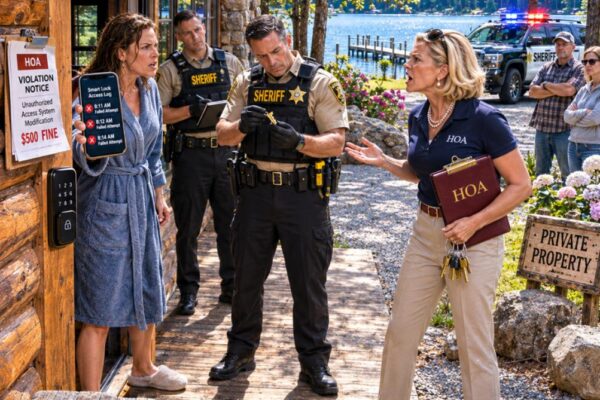
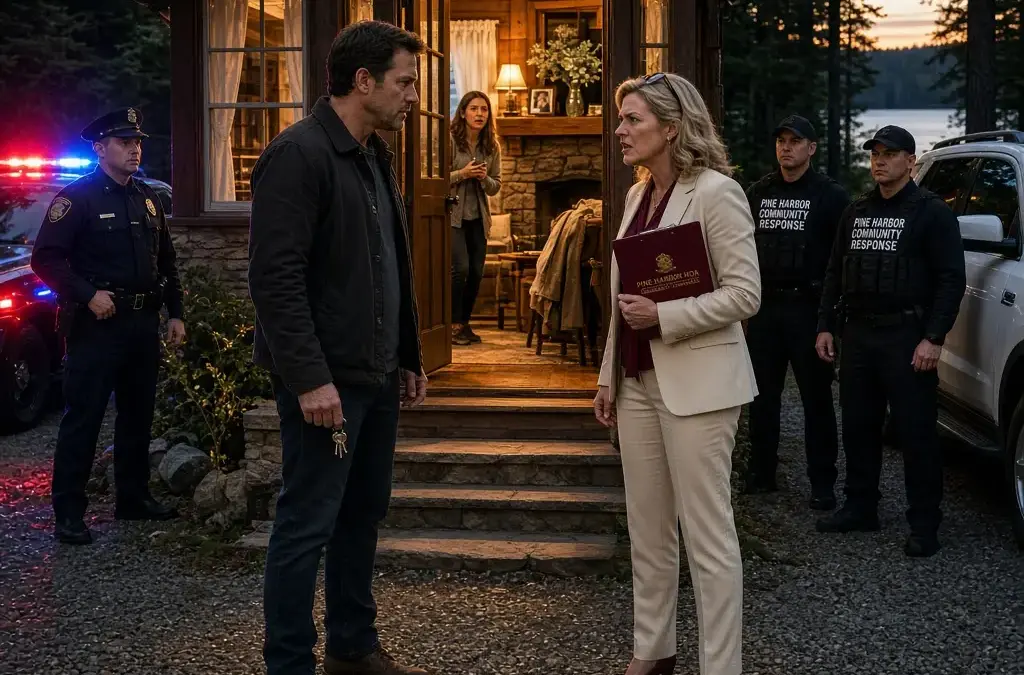
Karen Mitchell climbed out wearing an ivory blazer, oversized sunglasses on her head, and a burgundy HOA clipboard clutched against her chest.
Behind her came two men wearing dark vests labeled PINE HARBOR COMMUNITY RESPONSE.
Karen saw me through the doorway.
Her expression hardened.
Then she pulled out her phone.
“I’m calling 911.”
“You should.”
She stared at me.
“This man is violating an active safety order.”
The woman inside began crying.
Instantly.
“He found me.”
Karen raised the phone.
“I need police at 47 Lake Hollow Road. Domestic violence emergency. The protected woman’s former partner has located her safe residence.”
My entire body went still.
“Former partner?”
The woman covered her mouth.
Karen pointed at me.
“Do not approach Emily.”
“I’ve never met Emily.”
“You’ve been stalking her for months.”
“What are you talking about?”
“You need to leave.”
“This is my cabin.”
Emily shouted, “He’s lying!”
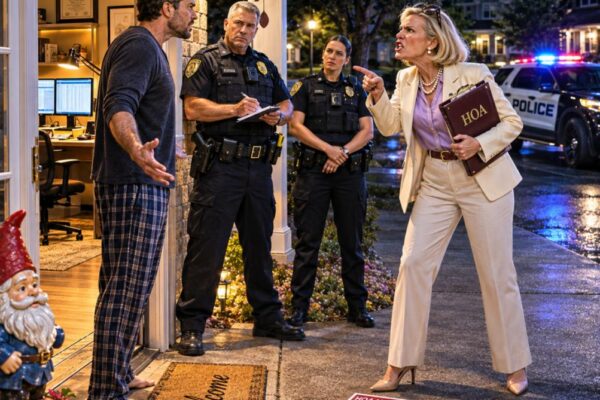
Red and blue lights appeared through the trees twelve minutes later.
Officer Thompson stepped out first.
Karen met him before he reached the porch.
She handed him a folder.
He read the first page.
Then looked at me.
His expression changed.
“Mr. Carter?”
“Yes.”
He glanced toward Emily.
Then back at the document.
“Sir, I need you to keep your hands visible and stay where you are.”
I did.
“This is my house.”
“I understand that’s what you’re saying.”
“I have the deed.”
Karen spoke behind him.
“He always says that.”
I stared at her.
Always?
Thompson opened the folder again.
Then his voice lowered.
“Mr. Carter, there appears to be an emergency protective order identifying you by name.”
For the first time since I opened my own front door, I stopped thinking about the stranger in my living room.
Because somebody hadn’t just moved her into my house.
Somebody had built a legal story before I ever came home.
part 2
I looked at Officer Thompson.
“Protective order from where?”
He kept his voice professional.
“I need to verify the document.”
“Please do.”
Karen interrupted.
“It was issued because Ethan refuses to accept the end of the relationship.”
I stared at her.
“What relationship?”
Emily began crying harder.
Karen stepped toward her.
“Don’t engage him.”
I felt as if everyone around me had read a script except me.
My name is Ethan Carter.
I’m thirty-nine years old.
I am a software engineer, not a celebrity, not a politician, not anybody whose romantic life should require police paperwork.
I had been divorced once, seven years earlier.
No children.
No restraining orders.
No domestic violence history.
No Emily Harris.
Yet Officer Thompson was holding a document with my full legal name on it.
Date of birth.
Primary address.
Vehicle description.
Even the last four digits of a phone number I had stopped using two years earlier.
That detail frightened me more than the tears.
Somebody had researched me.
Thompson called dispatch.
The second officer, Martinez, separated Karen and Emily from me.
I remained at the edge of my driveway.
Not inside.
That mattered.
I had stepped back out when police arrived because I wasn’t about to create a physical possession dispute inside a house with a woman claiming I abused her.
The cabin could wait.
My freedom mattered more.
After several minutes Thompson returned.
His expression had changed again.
“The order exists.”
My stomach dropped.
“Against me?”
“Yes.”
“Who filed it?”
“Emily Harris.”
I looked toward the woman standing beside my porch.
“I’ve never seen her in my life.”
She recoiled theatrically.
“Please stop.”
I held up both hands.
“I’m talking to him.”
Thompson continued.
“The order was issued yesterday by a magistrate in Riverton County.”
“Riverton is two hours away.”
“Do you have any connection there?”
“No.”
“Ms. Harris?”
“I don’t know her.”
Karen said:
“She stayed there after escaping him.”
Thompson turned.
“Ms. Mitchell, let me speak to him.”
Karen went silent.
I almost thanked him.
Then remembered where I was.
“My laptop is inside.”
“Do you need medication or anything essential?”
“No.”
“Can you stay somewhere tonight while this gets sorted out?”
The question made me angry.
I swallowed it.
“Are you ordering me to leave my own property?”
“I’m telling you there is an active order prohibiting contact with the protected person. Right now she is inside the residence. I’m trying to prevent anybody from accidentally violating it before we understand the underlying property dispute.”
That distinction mattered.
He wasn’t declaring Emily owned my home.
He wasn’t handing her my deed.
He was trying to keep an active protective order from turning the situation into an arrest.
I nodded.
“I’ll leave.”
Karen smiled.
That was the first mistake she made in front of me.
Not the lies.
The smile.
Small.
Satisfied.
As if the system had behaved exactly as expected.
I looked at Thompson.
“I want the incident number.”
“You’ll get it.”
“I also want it documented that I dispute ever having had a relationship with Ms. Harris and that I claim ownership of this property.”
“I’ll document it.”
“And that I provided a key.”
“You did.”
“Good.”
Karen said:
“Keys can be copied.”
I looked at her.
“You should know.”
Her smile disappeared.
I walked to my truck.
The cabin had belonged to my grandfather, Thomas Carter.
He built it in 1987 on the north side of Lake Mercer when the road was still gravel and Pine Harbor Estates was mostly woods.
I inherited it twelve years earlier.
Not recently.
Twelve years.
My name had been on the deed for more than a decade.
Property taxes came to me.
Insurance came to me.
The HOA billed me.
I had remodeled the kitchen.
Replaced the roof.
Rebuilt the dock.
Every contractor invoice carried my name.
Yet when I looked through the front window before leaving, I saw Emily standing beside my fireplace as if the house had swallowed my identity and replaced it with hers.
Her framed photographs.
Her groceries.
Her furniture.
Her story.
Karen closed my front door.
My front door.
And locked it.
I spent that night in a motel eight miles away.
At 11:16 p.m., Nathan Cole called me.
Nathan was an attorney specializing in property litigation and business disputes.
He had represented my software company years earlier during a contract mess.
He listened without interrupting.
Then said:
“Do not go back to the cabin.”
“I know.”
“Do not message Emily.”
“I don’t have her number.”
“Do not message Karen.”
“That one is harder.”
“Ethan.”
“Fine.”
“Send me the protective-order number, deed, tax record, utility records, insurance declaration, travel records, and every HOA communication you’ve had with Karen for the last year.”
“Why HOA communications?”
“Because you sound like you already know why.”
I did.
Eight months earlier, Karen Mitchell had painted her house purple.
Not lavender.
Not gray with a slight violet tint.
Purple.
Bright enough that during sunset the entire western side of the street looked like it had been sponsored by grape soda.
Normally I wouldn’t care.
People should be able to paint their houses ridiculous colors if their documents allow it.
Pine Harbor’s documents didn’t.
Exterior colors required architectural approval from a published palette unless owners received a variance.
Karen was HOA president.
She skipped the process.
Several homeowners complained privately.
Nobody wanted to put their name on it.
I did.
That decision would haunt me.
Not because I was wrong.
Because I underestimated how personally she would take being subjected to the same rules she enforced on everyone else.
At the annual meeting, I asked:
“Was the purple exterior approved?”
Karen’s face hardened.
“This is not relevant to tonight’s agenda.”
“It is listed under architectural compliance.”
A few neighbors looked at the floor.
I continued.
“I was required to submit paint chips when I stained my shutters.”
“That is different.”
“How?”
“I used a professional design consultation.”
I actually laughed.
“What rule exempts professional design?”
The architectural chair, a retired accountant named Miriam Wells, opened her binder.
None.
The board eventually voted that Karen’s color violated the adopted palette and had never been approved.
She appealed.
Lost.
The repaint cost almost fifteen thousand dollars because her lakefront house was enormous and required extensive preparation.
I didn’t fine her.
I didn’t order the paint.
I didn’t set the price.
I asked a question in a public meeting.
Karen blamed me anyway.
Afterward she cornered me near the dock.
“You enjoyed that.”
“No.”
“Don’t insult me.”
“I asked whether the rule applied to you.”
“You embarrassed me in front of fifty people.”
“You’re the president.”
“Exactly.”
That word told me everything.
Exactly.
To Karen, presidency was supposed to produce deference.
Instead it had produced accountability.
For months afterward, she became almost friendly.
Too friendly, in retrospect.
She asked about my work.
“Still traveling to Seattle?”
“Sometimes.”
“How long are those trips?”
“Depends.”
“Anyone watching the cabin?”
“Alarm system.”
She complimented my hydrangeas.
Asked which weekends I usually stayed at the lake.
Asked whether I rented the place while traveling.
No.
Never.
Then one morning she brought muffins and asked whether my smart lock was “one of those systems you can operate from another state.”
I joked:
“Planning to rob me?”
She laughed.
So did I.
That joke stopped being funny in the motel.
Nathan called again after reviewing the protective order.
“This is strange.”
“Helpful.”
“The application claims you and Emily lived together intermittently for approximately fourteen months.”
“Impossible.”
“It claims you provided the Lake Mercer cabin as a residence.”
“No.”
“She alleges escalating control, financial abuse, stalking, and a confrontation in Riverton three weeks ago.”
“I was in Seattle three weeks ago.”
“Good.”
“What do you mean good?”
“I mean evidence is useful.”
I sat on the edge of the motel bed.
“Why would a magistrate issue this?”
“Emergency orders can be issued on one party’s sworn allegations when the legal threshold is met. The court is trying to prevent immediate harm before a fuller hearing. That’s why there is a prompt follow-up process.”
“So a stranger can say we’re together and take my house?”
“No.”
Nathan’s tone sharpened.
“Do not confuse temporary protective relief with property ownership.”
“She is inside.”
“Yes.”
“That feels like ownership.”
“I know.”
“What do we do?”
“First, challenge the order.”
“Tomorrow?”
“I’m already working on it.”
“Then the house?”
“Separately.”
I hated that word.
Separately.
Law separates things emotion wants combined.
Protective order.
Possession.
Title.
Trespass.
Fraud.
Forgery.
Each had its own rules.
My brain wanted one answer:
That is my house. Remove her.
Nathan wanted evidence.
He won.
The next morning, I sent him everything.
Seattle hotel receipts.
Airline records.
Credit-card transactions.
Client access logs.
Git commits.
VPN authentication.
Video conference invitations.
A coworking-space keycard log.
I had been in Seattle during two of the dates Emily alleged I assaulted or confronted her in Virginia.
Software engineers accidentally document their entire existence.
For once, that was useful.
Then we examined the protective-order application more carefully.
One allegation said I confronted Emily outside Franklin Bakery in Riverton on September 12.
Problem.
Franklin Bakery had opened September 26.
I knew that because Emily had mentioned it during the confrontation at the cabin.
She had shouted:
“You followed me from Franklin Bakery!”
At the time, the detail meant nothing.
Now it became a timestamp error.
Someone had written a story using local details gathered too recently.
Nathan smiled when I told him.
“Good.”
“You say good at terrible moments.”
“It means we have something independently verifiable.”
The emergency hearing happened the following afternoon.
Emily appeared remotely with an attorney provided through a domestic violence advocacy referral.
That complicated my emotions.
She wasn’t standing beside Karen.
She looked terrified.
Maybe the fear was acting.
Maybe it wasn’t.
Nathan warned me not to assume.
The judge reviewed travel documentation.
The bakery opening date.
My sworn denial of any relationship.
Emily’s attorney asked for time to investigate.
Then the judge asked Emily directly:
“Have you ever lived with Mr. Carter?”
Emily hesitated.
“Yes.”
“Where?”
“The cabin.”
“For how long?”
“About nine months.”
Nathan stood.
“Your Honor, utility records changed into Ms. Harris’s name eleven days ago.”
Silence.
Her attorney turned toward her.
I felt something shift.
Nathan continued.
“Mr. Carter’s smart-lock logs show his personal code was used regularly through August when he occupied the home. Ms. Harris’s first recorded access code appears to have been created during his current Seattle trip.”
The judge looked at Emily.
“Who gave you the code?”
She looked down.
“Karen.”
There it was.
Not the whole truth.
Enough.
The court dissolved the emergency order as to me pending further proceedings.
It did not declare Emily a criminal.
It did not evict her from the cabin from the bench.
The judge simply found the evidence presented no longer supported continuing the protective order against me.
Nathan and I walked outside.
“Can I go home?”
“Not yet.”
I nearly screamed.
“Why?”
“Because now we handle possession correctly.”
“She admitted Karen gave her access.”
“Yes.”
“She has been there eleven days.”
“According to what we know.”
“Then call police.”
“We’ll communicate through counsel first.”
I stared at him.
“You’re enjoying this.”
“Absolutely not.”
“You look calm.”
“That is how attorneys experience joy.”
We sent Emily’s lawyer a written demand that she vacate voluntarily and preserve all communications, documents, videos, photographs, utility applications, and anything Karen provided.
Her attorney called Nathan an hour later.
The conversation lasted nineteen minutes.
Afterward Nathan looked at me.
“She wants to leave.”
“Good.”
“She says Karen told her she was entering a legitimate safe-housing arrangement.”
I stopped.
“What?”
“Emily claims Karen represented that you had abandoned the property, that there was a domestic violence relocation program, and that occupancy would be protected.”
“She filed a protective order accusing me personally.”
“Yes.”
“How does she explain that?”
Nathan’s expression hardened.
“She says Karen supplied the allegations and documents and told her the order was necessary because you might return and falsely claim she was trespassing.”
My anger changed direction.
Not away from Emily.
She still signed sworn paperwork.
But toward Karen.
“Does Emily understand what she did?”
“She’s starting to.”
Emily vacated the cabin that evening under a written agreement negotiated by counsel.
I was allowed back after she left.
Officer Thompson met me there because Nathan wanted an independent record of condition.
The first thing I noticed was how thoroughly the house had been transformed.
Not damaged.
Colonized.
Different bedding.
Different towels.
Her toiletries.
Her food.
Mail addressed to Emily Harris at my address.
A utility welcome letter.
Internet account.
A renter’s insurance declaration.
Three framed photographs.
A lease.
That stopped us.
Nathan read it at my kitchen island.
LANDLORD: Ethan Carter.
TENANT: Emily Harris.
Twelve-month term.
$1,450 per month.
Electronic signature.
My name.
My email.
My supposed initials on every page.
I stared.
“I didn’t sign that.”
“I know.”
“How?”
“That’s what we’re going to find out.”
The lease wasn’t crude.
It looked like a legitimate e-signature platform.
Timestamp.
IP metadata.
Document certificate.
Nathan downloaded everything without altering the original files.
The certificate showed the lease had been sent from an email address resembling mine.
ethancarter.dev@—
Mine was ethancarter.devops@—
One missing word.
Easy to miss.
The digital-signature IP resolved to a commercial VPN.
The fake email account had been created six weeks earlier.
Karen had been planning this long before my Seattle trip.
Then we found my utilities.
Power had been transferred into Emily’s name through an online tenant-change portal using the fake lease.
Water billing had been changed.
Internet service had been opened separately.
Nothing about those transactions transferred title.
But visually?
They were powerful.
A person inside a house.
Lease.
Utility bills.
Mail.
Personal belongings.
Photos.
Renter’s insurance.
A protective order.
Karen hadn’t created one lie.
She had created layers.
Each layer made the next one easier to believe.
Then Officer Thompson asked:
“Do you have cameras inside?”
“No.”
“Outside?”
“Doorbell and dock camera.”
I opened the cloud account.
The doorbell system had been offline for nine days.
Not disconnected physically.
Admin-disabled.
My stomach turned.
Only two people had administrator access.
Me.
And the HOA’s security vendor, because Pine Harbor had negotiated a bulk monitoring discount years earlier that I stupidly accepted for the exterior system.
Nathan looked at me.
“Karen have access?”
“Not supposed to.”
The vendor did.
That distinction became important.
We requested access logs.
The vendor’s administrator account had disabled my camera remotely eleven days earlier.
Who requested it?
A service ticket.
Requester:
Karen Mitchell, Pine Harbor HOA President.
Reason:
Owner-requested privacy suspension during contractor access.
Owner requested.
I had done no such thing.
The vendor’s employee had failed to verify with me directly because Karen was a recognized HOA account administrator.
Another layer.
Another misuse of trust.
That night I sat alone in the cabin after everyone left.
Emily’s things were gone.
But the house still didn’t feel mine.
I found one of her hair ties beneath the sofa.
A grocery receipt on the counter.
Two holes in the wall where she’d moved my grandfather’s photograph and hung her own.
I should have felt victorious.
Protective order dissolved.
Cabin returned.
Evidence building.
Instead, I felt violated.
For eleven days, strangers had inhabited not just my property but my identity.
Someone had pretended to be me in a lease.
Someone had turned my absence into abandonment.
Someone had taught another person how to describe me as dangerous.
Then I found the photograph.
My grandfather’s picture had been shoved into a kitchen drawer.
I sat down.
That was when the anger finally arrived.
Not explosive.
Cold.
Grandpa built the cabin because he hated hotels.
He used to say:
“If I want somebody else’s sheets, I’ll stay with relatives.”
He died before the purple-house fight.
He never met Karen.
He would have despised her instantly.
Not because she was controlling.
Because she had touched his photographs.
The next morning, I treated the situation like a software failure.
No revenge.
No confrontation.
Trace dependencies.
What changed?
Who had access?
Which systems were trusted?
Where did input become authority?
I built a spreadsheet.
Date.
Event.
Source.
Verification.
Contradiction.
June 14 — purple-house vote.
June 17 — Karen first asks about Seattle travel.
July 2 — Karen asks whether cabin is rented.
July 19 — HOA security portal accessed my owner record.
August 6 — fake email created.
August 9 — Karen requested management copy of my emergency contact details.
August 22 — Emily first appeared in Pine Harbor on a community camera, according to publicly shared event photos.
September 3 — fake lease executed.
September 4 — renter’s insurance opened.
September 5 — utility transfer requested.
September 6 — my exterior cameras disabled through vendor service ticket.
September 7 — Karen posted that a “new resident escaping hardship” would be staying in the neighborhood and requested privacy.
September 8 — Emily moved in.
September 11 — protective-order application prepared.
September 12 — false Franklin Bakery allegation.
September 20 — I returned early.
The pattern looked deliberate.
But spreadsheets don’t prove motive.
We needed people.
The first was Jack Sullivan.
Retired detective.
Seventy-one.
Lived near the marina.
He stopped me in the grocery store.
“You’re Carter.”
I looked at him.
“Depends who’s asking.”
He smiled.
“Good answer.”
Then his face hardened.
“That woman in your house wasn’t your girlfriend.”
“No.”
“Thought so.”
“How?”
“I’ve spent thirty years watching people lie badly.”
“She lied pretty well.”
“Exactly.”
Jack had seen Emily arrive.
Not with luggage from a domestic violence relocation agency.
With Karen.
Two SUVs.
Moving boxes.
A furniture truck.
“Karen supervised.”
“Did you photograph anything?”
“No.”
“Camera?”
“My driveway camera might catch part of the road.”
It did.
Timestamped footage showed Karen’s SUV leading Emily’s vehicle toward my cabin.
Then a box truck.
No proof of conspiracy by itself.
Evidence of involvement.
Jack also remembered something else.
A similar situation two years earlier.
Different neighborhood.
A man named Harold Finch owned a seasonal cottage fifteen miles away.
Returned to find someone claiming tenancy.
Fake lease dispute.
Months of litigation.
He eventually sold.
“Karen involved?”
“No.”
“Then why does it matter?”
“Because the woman claiming tenancy was Rachel Brooks.”
I searched public court records.
Rachel Brooks had been involved in multiple civil occupancy disputes.
Not convictions.
Disputes.
In three cases, she claimed verbal rental arrangements.
In one, a court found documents unreliable and ordered possession returned.
In another, the property settled.
Nathan warned me:
“Do not call her a professional squatter based on lawsuits.”
“I know.”
“Do not post her name online.”
“I know.”
“Do not contact her.”
“I know.”
Jack laughed.
“Lawyers are no fun.”
Then Emily called Nathan.
She wanted to talk.
Not to me directly.
Good.
Her attorney arranged a recorded interview attended by counsel.
Emily looked different.
No camera makeup.
No performance.
Thirty-four.
Recently divorced.
Credit-card debt.
No stable lease after losing an apartment.
She said Karen approached her through an online housing-support group.
“I thought she ran a nonprofit.”
“What nonprofit?” Nathan asked.
“Harbor Haven Housing Justice.”
It existed.
State nonprofit registration.
New.
Six months old.
Karen listed as director.
Mission:
Emergency housing support for women experiencing displacement, abuse, or coercive relationships.
I felt sick.
Not because helping abused women was suspicious.
Because Karen had wrapped fraud in something morally difficult to question.
Emily continued.
“Karen said some properties were donated temporarily by owners or recovered through legal advocacy.”
“Did she tell you Ethan donated this cabin?”
“At first.”
“And later?”
“She said you were trying to reverse it.”
“Why?”
“She said you were controlling.”
I said nothing.
Nathan asked:
“Did you believe you had been in a relationship with him?”
Emily started crying.
“No.”
“Then why did you swear to that?”
Her attorney shifted.
Emily wiped her face.
“Karen said the court wouldn’t protect the house unless I qualified under relationship-based protective-order law.”
My hands curled beneath the table.
“She told you to lie under oath.”
“Yes.”
“Did you understand it was a lie?”
“Yes.”
At least she didn’t hide.
Nathan asked:
“What evidence did she provide?”
Emily produced a folder.
Photographs of bruises.
Therapy notes.
Screenshots of messages allegedly from me.
A medical intake summary.
A police incident report.
All fake or altered.
The bruises?
Makeup.
Emily admitted that.
The therapy notes came from a template.
The police report used a real incident number from an unrelated noise complaint, altered with my name.
The messages came from a spoofed account.
This was no longer only Karen’s revenge.
It was organized.
Then Emily said:
“Karen didn’t create everything.”
Nathan stopped.
“Who did?”
“Rachel.”
Rachel Brooks.
There it was.
Not nationwide criminal mastermind.
A repeat participant.
Emily had attended two online training sessions run by Rachel under the Harbor Haven program.
They were presented as “survivor preparation.”
Some advice was legitimate.
How to preserve evidence.
How to speak clearly.
How to seek emergency housing.
Then the instruction crossed the line.
If documentation was “insufficient,” Rachel taught women to “build continuity.”
Photographs.
Messages.
Medical narratives.
Occupancy evidence.
Karen had applied those methods to my property.
Emily’s voice shook.
“I thought we were bending rules to protect women who wouldn’t otherwise be believed.”
Nathan asked:
“When did you realize this was about taking Ethan’s house?”
“After he came home.”
“What changed?”
“I found Karen’s notebook.”
My pulse jumped.
“What notebook?”
Emily had been packing when she found it behind a stack of kitchen folders Karen left.
Handwritten.
Addresses.
Owner travel patterns.
Property values.
Mortgage estimates.
HOA disputes.
Notes.
My address.
Beside it:
E. Carter — high equity / seasonal occupancy / retaliatory leverage / Seattle windows predictable.
Retaliatory leverage.
I stared at the phrase.
The purple house.
There it was.
Next page:
Emily — sympathetic profile / credible occupancy / utility conversion / protective narrative.
Emily began crying again.
“I was a profile.”
I didn’t comfort her.
Not then.
She had lied about me in court.
But I understood the horror of discovering you weren’t a partner.
You were an ingredient.
Emily photographed every page before handing the notebook to Karen, who later retrieved it.
Those photographs went to her attorney.
Then to police.
Then things moved beyond us.
The local detective assigned to the forgery and false-report investigation contacted the state insurance-fraud unit because the fake medical documentation involved fraudulent records.
The nonprofit’s finances came under review.
Property transactions connected to Karen and Rachel surfaced.
Not forty-seven stolen homes.
Not yet.
But enough questionable transactions to justify serious investigation.
Five properties in three counties had followed broadly similar patterns.
Seasonal or older owner.
Dispute.
Occupancy claim.
Pressure.
Settlement or sale.
A company tied to Harbor Haven later acquired an interest.
Some deals may have been legitimate.
Others looked increasingly troubling.
Nathan kept repeating:
“Let investigators sort it.”
So I did.
That was harder than any code project I’d ever handled.
I wanted answers.
Instead, I got subpoenas I couldn’t see.
Interviews I wasn’t part of.
Weeks of silence.
Meanwhile, Karen remained HOA president.
That became intolerable.
Not because I wanted revenge.
Because she still had access to owner travel notices.
Emergency contacts.
Architectural files.
Security-vendor information.
Potentially exactly the data someone could use to identify empty homes.
Nathan sent the board a formal demand for emergency suspension of Karen’s access pending investigation.
The board attorney responded within hours.
Special meeting.
Karen arrived in an ivory suit.
Calm.
Prepared.
She had already built her counterstory.
“This is retaliation by Ethan Carter because the HOA enforced architectural standards against him.”
I almost admired the inversion.
Nathan whispered:
“Let her.”
Karen continued.
“Mr. Carter has coordinated with a disgruntled temporary occupant to manufacture accusations.”
Temporary occupant.
Not abuse survivor now.
Interesting.
Board member Susan Blake asked:
“Did you authorize the security vendor to disable Ethan’s cameras?”
Karen hesitated.
“For resident privacy.”
“Did Ethan request it?”
“I understood the occupant had authority.”
“Whose name was on the security account?”
Karen looked at me.
“Technicalities.”
Susan’s expression changed.
“No.”
She shook her head.
“That sounds important.”
Then board treasurer William Hale asked:
“Did you access Ethan’s owner profile while he was traveling?”
“As president, I access many profiles.”
“Did you disclose his travel schedule to anyone?”
“No.”
“Did you help Emily move into his cabin?”
Karen’s jaw tightened.
“I helped a woman in crisis.”
“Did you verify Ethan consented?”
“She had a lease.”
“A lease he says was forged.”
“That is under investigation.”
“Did you witness his signature?”
“No.”
“Did you contact him?”
“No.”
“Why not?”
Karen stared at him.
“Because Emily was afraid.”
Susan asked:
“Afraid of a man she’d never met?”
Silence.
That broke the room.
Karen looked at me.
“You coached her.”
Emily wasn’t there.
“I’ve never spoken to Emily alone.”
“You’re manipulating everyone.”
Nathan whispered:
“Still.”
I stayed seated.
The board voted to suspend Karen’s access to resident records and security systems pending investigation.
Four to one.
Karen voted against.
She remained president in title until the governing process could address that separately.
Then she turned toward me as the room emptied.
“You think you’ve won.”
“No.”
“You ruined my home.”
That stunned me.
“Your home?”
“My reputation.”
“No.”
I shook my head.
“The purple paint?”
Her face tightened.
“You knew what that cost me.”
“I didn’t paint your house.”
“You forced the board to act.”
“I asked whether the rule applied to you.”
“You humiliated me.”
There it was.
Eight months compressed into one sentence.
I stood.
“You moved a stranger into my house because you had to repaint yours?”
“You don’t understand what you’ve done to people.”
“What does that mean?”
She stepped closer.
“Men like you weaponize systems and then call yourselves victims when somebody uses the system back.”
I stared at her.
“Men like me?”
“Property owners who think paperwork makes them untouchable.”
That answer told me Karen had built a philosophy around revenge.
Not just against me.
Against owners.
Maybe Harbor Haven had begun with legitimate anger at people abusing vulnerable tenants or partners.
Maybe Karen had convinced herself she was balancing scales.
Then somewhere along the way, she stopped caring whether the target had actually harmed anyone.
She only needed a justification.
My purple-house complaint had made me eligible.
The criminal investigation accelerated after Emily made a controlled cooperation agreement through her attorney.
Not immunity.
That distinction mattered.
She had admitted committing crimes.
Prosecutors decide what cooperation is worth.
Nobody promised she would walk away clean.
Emily agreed to preserve communications and, under investigator supervision, communicate with Karen and Rachel.
I was kept out.
Good.
Weeks later, investigators told Nathan they had obtained enough evidence for search warrants.
That’s all.
No details.
Then local and federal agents executed coordinated searches at several properties and offices connected to Harbor Haven and related businesses.
Seven women were located across different properties.
Not “rescued from my neighborhood” like later social-media rumors claimed.
Some were undocumented domestic workers recruited with false job promises.
Others were women genuinely escaping abusive situations who had been funneled into questionable housing arrangements.
The truth was messy.
That made it more disturbing.
A legitimate cause had been used as cover for fraud, coercion, and property schemes.
Investigators found forged leases.
Identity documents.
Owner profiles.
Property lists.
Financial records.
My cabin was one file among many.
Not forty-seven.
Not five hundred.
Nine properties became central to the first prosecution.
Other transactions remained under review.
Rachel Brooks was arrested while attempting to fly to Mexico.
Not with $200,000 stuffed in luggage.
She had normal bags.
Agents arrested her on a warrant at the airport after travel monitoring showed a booked international flight.
The dramatic cash story came later from gossip.
I refused to repeat it.
Karen was arrested at home.
No six-hour standoff.
No barricade.
No livestream meltdown.
She opened the door to agents with her attorney already on the phone.
That was almost disappointing.
Then I reminded myself that peaceful arrests are better than entertaining ones.
The federal case alleged a conspiracy involving housing fraud, identity misuse, wire fraud, document falsification, coercive conduct, and exploitation of vulnerable women.
Some participants had different roles.
Karen’s alleged role involved property identification, owner information, HOA access, recruitment through Harbor Haven, and facilitation of false occupancy narratives.
Rachel specialized in documents and claimant coaching.
Others handled shell companies and property transfers.
The scale was significant.
Millions in disputed property value across the transactions investigators could substantiate.
Not fifty million.
Not five hundred families.
Reality didn’t need that much inflation.
It was already grotesque.
The purple house became part of motive evidence.
Not because repainting was criminal.
Because Karen’s messages showed my complaint changed how she viewed me.
One text to Rachel, weeks after the HOA meeting, read:
Carter is perfect. Seasonal owner, arrogant, thinks rules only work one direction.
Another:
He leaves for Seattle regularly. Need a clean occupant story.
Another:
If he fights, make him fight the abuse narrative too. Men fold when reputation gets expensive.
I read that one three times.
Reputation gets expensive.
That was the plan.
Not steal my house instantly.
Make defending it costly enough that I would settle, sell, or disappear.
The viral social-media video was part of that pressure.
Emily’s “fleeing my abuser” post did spread widely.
Not half a million immediately.
Tens of thousands first.
Then more as people reposted.
My name circulated.
My employer placed me on paid leave while reviewing whether the allegations created a client risk.
I understood.
Still hurt.
My truck was keyed at the motel.
Someone taped a printed page to my windshield:
BELIEVE SURVIVORS.
I do believe survivors deserve to be heard.
That was what made the whole thing so poisonous.
Karen had weaponized a principle meant to protect real victims.
Every fake document risked making the next genuine woman less believable.
That made me angrier than the property fraud.
Emily understood eventually.
She asked to speak to me after her cooperation became public.
Nathan advised against it until her criminal exposure was resolved.
Months later, we met in a conference room with attorneys present.
She couldn’t look at me.
“I ruined your life.”
“No.”
She looked up.
“You tried.”
That was harsh.
True.
“I believed Karen.”
“You also lied.”
“I know.”
“You swore we’d been together.”
“I know.”
“You told a court I hurt you.”
She cried.
I didn’t stop.
“You posted my face and called me your abuser.”
“I know.”
“People followed me.”
“I know.”
“My employer investigated me.”
“I know.”
“You were scared and desperate.”
She nodded.
“That explains why Karen could recruit you.”
I paused.
“It doesn’t make the choices disappear.”
She wiped her face.
“I don’t expect forgiveness.”
“Good.”
That surprised her.
“I mean it.”
I leaned back.
“Forgiveness isn’t a court order. Nobody gets to demand it because remorse would make the ending cleaner.”
She nodded.
Then said:
“I want to testify.”
“Against Karen?”
“Against all of them.”
“That is between you and prosecutors.”
“I want people to know how they did it.”
That part I understood.
Emily eventually entered a plea to a reduced set of offenses connected to false statements and document use.
Her cooperation substantially affected the outcome.
She received supervised probation, mandatory counseling, restitution obligations tied to specific harm, and restrictions rather than a long prison sentence.
Some people thought that was too lenient.
Others thought she was primarily a victim.
I thought both descriptions could contain truth.
She had been exploited.
She had also exploited me.
Human beings don’t always fit the role labels court stories prefer.
Karen’s trial came almost eighteen months after I found Emily inside my cabin.
I testified for less than two hours.
The prosecutor asked about ownership.
Travel.
The purple-house dispute.
Karen’s questions about my schedule.
The camera shutdown.
The messages.
The false lease.
The protective order.
I did not give speeches.
Trials are not HOA meetings.
Karen did not represent herself.
She had competent counsel.
No screaming about AI.
No courtroom meltdown.
Her defense argued she believed Harbor Haven was helping women obtain secure housing and that Rachel had manipulated documents without fully informing her.
Then prosecutors showed communications demonstrating Karen knew owners had not consented.
Messages about pressure.
Acquisition value.
Travel windows.
Reputational leverage.
That was harder to explain away.
The jury convicted her on several counts and acquitted on others.
That mattered.
“All charges” makes a cleaner story.
Real juries separate evidence.
Rachel pleaded guilty before her trial and cooperated against other participants.
Additional defendants entered their own pleas or faced separate proceedings.
Sentences varied.
Karen received a substantial federal prison sentence, though nowhere near the mythical thirty-five years people online later repeated.
Restitution and forfeiture applied to assets prosecutors tied to offenses.
Her personal home was eventually sold as part of her financial collapse and legal obligations, but no judge handed it to me.
My cabin never changed title.
That is another rumor worth killing.
Karen never legally owned it.
Emily never legally owned it.
The fraud created possession, paperwork, pressure, and confusion.
Not valid ownership.
My deed remained my deed.
Six months after sentencing, I was sitting on the cabin porch when Jack Sullivan walked up carrying beer.
“You famous yet?”
“No.”
“You were on television.”
“Local news.”
“Counts.”
He handed me a bottle.
The lake was flat.
No wind.
Grandpa’s picture had been returned to the mantel.
I had repaired the holes in the wall.
Reinstalled the green curtains.
Changed every lock.
Removed the HOA-linked security vendor entirely.
My cameras were now mine.
Only mine.
Jack sat down.
“Feels like your place again?”
I looked around.
“Mostly.”
Mostly was honest.
Places remember violation.
Not literally.
You do.
For months I’d enter the cabin and notice where Emily’s chair had stood.
Where Karen had set paperwork.
Where Thompson told me there was a protective order.
Memory overlays architecture.
Eventually the newer memories became stronger.
Fishing.
Coffee.
Friends.
Silence.
Pine Harbor changed too.
Karen was removed from the HOA board immediately after arrest under the governing procedures.
The board hired outside counsel.
Then an independent management company.
They conducted an access audit.
Who could see travel notices?
Who could request security-service changes?
Who could download owner contact data?
Too many people.
That ended.
No single board officer could disable a homeowner security account.
Travel notices became optional and separately permissioned.
Board members could not access emergency contacts without a documented purpose.
Every owner-profile lookup was logged.
Outside vendors required direct owner confirmation for account changes.
Privacy became governance instead of an afterthought.
Miriam Wells became president.
The same woman who had opened the architectural binder during Karen’s purple-house dispute.
At her first meeting, she said:
“I would like to begin by apologizing to everyone for not realizing how much information one officer could access.”
Then she looked at me.
“Especially Ethan.”
I stood.
“No.”
She blinked.
“Excuse me?”
“Don’t make this about one officer.”
The room quieted.
“Karen abused access.”
I nodded.
“But the system gave her too much.”
Miriam considered that.
Then said:
“Fair.”
That became Pine Harbor’s real reform.
Not finding a nicer president.
Making the presidency less powerful.
People kept asking me to join the board.
I refused.
I had enough.
Then Grandpa’s old neighbor, Susan Blake, cornered me at the marina.
“You complain about governance but won’t serve.”
“I write software.”
“You attend meetings.”
“Under protest.”
“You read every packet.”
“Because I’ve been traumatized.”
She smiled.
“Committee.”
“No.”
“Privacy committee.”
I stopped.
That one got me.
I joined.
Not because I wanted authority.
Because access control is basically software architecture with worse snacks.
We rewrote the data rules.
Least privilege.
Two-person approval for sensitive exports.
Audit logs.
Vendor verification.
Retention limits.
No board member permitted to browse owner records because they were curious.
Miriam called me insufferable.
I considered it a compliment.
The HOA also reviewed the purple-house episode.
That surprised me.
Karen had violated the paint rule.
The board’s decision had been procedurally valid.
My complaint had been legitimate.
That mattered.
We didn’t rewrite history to make Karen innocent before she became criminal.
She had been wrong about the paint.
I had been right to question it.
The problem was what she did afterward.
Justice does not require your original opponent to have been correct.
It requires proportionality.
A $15,000 repaint did not justify forging a lease.
Public embarrassment did not justify creating a false abuse allegation.
Having authority challenged did not entitle Karen to destroy the challenger.
That boundary sounds obvious.
To her, it wasn’t.
My employer eventually completed its internal review and restored me fully.
No disciplinary finding.
They paid me during leave.
Still, one executive told me:
“You understand why we had to look.”
“I do.”
That honesty helped.
I changed how I thought about reputation afterward.
I had believed reputation was a record of what you had done.
Karen taught me reputation can also be an information system.
Whoever supplies the first input shapes the next interpretation.
Emily cries on video.
Now I’m abusive.
Police visit.
Now the accusation feels validated.
Protective order.
Now it looks official.
Motel.
Now it looks like I’ve been removed.
Coworkers distance themselves.
Now social proof grows.
Every step feeds the next.
That is how false narratives become structurally persuasive.
The answer isn’t shouting louder.
It’s breaking the chain with verifiable facts.
Travel log.
Bakery opening date.
Lock access.
Lease metadata.
Utility timing.
Security ticket.
Board records.
One contradiction at a time.
I still use that lesson in software.
When a system fails, people guess.
Database.
Network.
Bad deploy.
Third-party API.
The fastest engineer in the room is often the one who guesses least.
Trace the state.
Check the logs.
Test assumptions.
Karen was a human version of a corrupted system.
She depended on everybody trusting the interface.
HOA president.
Nonprofit director.
Victim advocate.
Neighbor.
Each label made the next request look legitimate.
The deeper problem lived underneath.
Unauthorized access.
Conflicts.
Forgery.
Pressure.
Rachel once taught participants to “build continuity.”
That’s exactly what Karen did to me.
Continuity of accusation.
The irony is that evidence defeated her the same way.
Continuity of fact.
Emily eventually moved out of state.
She did not become a therapist within six months.
That would have been absurd.
She completed counseling, worked ordinary jobs, and later began volunteering with a legal-aid nonprofit after her probation officer approved it.
Years later she asked whether I’d participate in a panel about coercive fraud.
I declined the first time.
Accepted the second.
We sat on opposite sides of a stage.
No inspirational friendship.
No hugging.
She described how desperation made her vulnerable to someone offering housing, identity, and a moral justification for dishonest acts.
I described what it feels like to be turned into a fictional villain because the fiction solves somebody else’s problem.
During questions, a woman asked:
“Do you forgive each other?”
Emily looked at me.
I answered first.
“I don’t think our relationship is organized around forgiveness.”
The moderator looked surprised.
I continued.
“She told the truth when continuing the lie would have been easier.”
Emily nodded.
“I respect that.”
She said:
“He didn’t destroy me when he could have made public hatred worse.”
I shook my head.
“I wasn’t entitled to destroy you.”
That was the point.
Accountability is not ownership over another person’s suffering.
Karen had forgotten that.
I refused to copy her.
The national-crime-network version of our case became ridiculous online.
People claimed hundreds of homes had been stolen.
Fifteen HOA presidents arrested.
Judges bribed.
Dirty cops.
Fifty million dollars.
None of that came from the prosecution I knew.
There were additional investigations.
Additional property-fraud schemes.
Connections across state lines.
But the internet stitched every rumor into one giant conspiracy because giant conspiracies are more entertaining than fragmented fraud.
I stopped correcting strangers.
You cannot debug the entire internet.
I only corrected the story when it mattered.
No, I didn’t hack anyone.
No, FBI agents did not use me as a civilian field operative.
No, Emily was not immediately immune.
No, Karen did not legally steal my deed.
No, my cabin doubled in value because of media attention.
That one made me laugh.
If anything, having your address attached to a federal housing-fraud case does not create a luxury premium.
I received compensation through insurance, restitution mechanisms, and civil settlements for specific losses, legal costs, property damage, and related harm.
Not a magical half-million-dollar jackpot.
Some amounts remained confidential.
My life wasn’t “reborn.”
It was repaired.
Slowly.
There is a difference.
Jack died three years after the case.
Heart attack.
His daughter gave me the old driveway camera he had used to capture Karen bringing Emily to my property.
“Dad said you’d understand why he kept it.”
I did.
I put it on a shelf in my office.
Not plugged in.
A reminder.
Good neighbors don’t need to be heroes.
Sometimes they just need to notice.
Miriam served two terms as HOA president.
Then stepped down voluntarily.
At her last meeting, she handed me the gavel.
I recoiled.
“No.”
Everyone laughed.
“We’re not electing you.”
“Good.”
“It’s ceremonial.”
“Still no.”
She gave it to Susan.
Better.
Pine Harbor eventually added an annual privacy and fraud-awareness session to the homeowners meeting.
Not “Truth Day.”
That name sounded like a cult.
We reviewed scams.
Fake liens.
Contractor impersonation.
Utility-account fraud.
Emergency protective-order abuse.
Unauthorized board access.
Most importantly:
How to question suspicious documentation without teaching people to dismiss legitimate abuse claims.
That balance mattered to me.
The lesson was never:
Don’t believe victims.
The lesson was:
Believe people deserve safety, and verify legal claims through processes designed to handle them.
Real abuse survivors suffer when fraudsters exploit protective systems.
The answer cannot be to make those systems impossible to access.
It has to be better verification when facts are contested.
That is harder.
Most useful reforms are.
Years after the case, Officer Thompson came to a Pine Harbor barbecue.
Not as an officer.
His wife had friends in the neighborhood.
We stood near the dock.
He looked toward my cabin.
“I think about that day sometimes.”
“Me too.”
“I hated making you leave.”
“You had an active order.”
“Yes.”
“You kept me from accidentally violating it.”
He looked relieved.
“I appreciate you saying that.”
“I hated you for about twelve hours.”
He laughed.
“Fair.”
Then he became serious.
“Would you have done anything differently?”
I thought.
“I would’ve asked how the order was verified.”
“We did verify it.”
“I know.”
“I mean before the encounter.”
He understood.
“You couldn’t.”
“Exactly.”
Then I asked:
“What about you?”
He looked toward the lake.
“I ask more questions now about what I’m actually being asked to enforce.”
That was enough.
Karen’s sentence eventually ended.
Not soon.
Years later.
I found out because the restitution office sent an update.
I felt nothing dramatic.
No fear.
No satisfaction.
She was no longer the central character in my life.
That surprised me.
For so long, every conversation had started with:
Karen did this.
Karen planned that.
Karen used Emily.
Karen used the HOA.
Karen used Harbor Haven.
Eventually, healing meant sentences stopped beginning with her name.
The cabin reclaimed its own story.
Grandpa’s mantel.
My code.
Fishing.
Bad coffee.
Rain hitting the metal roof.
Friends showing up without needing permission from an HOA president.
One spring morning, I found a new family standing near the dock.
They had recently bought the neighboring property.
The husband apologized.
“Sorry. Our son wandered over.”
A seven-year-old boy was staring at Grandpa’s old fishing boat.
“No problem.”
The boy asked:
“Is that yours?”
“Yes.”
“Can I see it?”
His father immediately said:
“Don’t bother him.”
I smiled.
“Ask first.”
The boy did.
“Can I?”
“Sure.”
That tiny exchange caught me off guard.
Ask first.
Permission.
Boundaries.
So much of what happened to me could be reduced to people deciding permission was optional.
Karen accessed my data without a proper purpose.
Disabled my security without my consent.
Moved Emily into my home.
Created a lease in my name.
Used my travel schedule.
Placed someone else’s identity inside my property.
Then told me I was the intruder.
People called it an elaborate property scam.
It was.
But underneath all the paperwork was a simpler violation.
Someone decided my no did not matter.
My absence became consent.
My silence became permission.
My property became an opportunity.
That’s why the cabin matters more to me now.
Not because it’s valuable.
Because it remained mine even while everybody around it briefly acted as if documents could erase reality.
The deed mattered.
But ownership was more than paper.
It was history.
Grandpa’s hammer marks beneath the porch.
The height chart inside the pantry where he measured me as a kid.
The dent in the dock from the summer I tried tying up a boat in a storm.
The coffee stain beneath the window.
Emily couldn’t know those things.
Karen couldn’t manufacture them.
A forged lease can imitate legal form.
It can’t build memory.
That doesn’t mean memory wins in court.
Documents do.
But memory tells you why the fight matters enough to keep opening the documents.
I still travel to Seattle occasionally.
First time after the case, I almost canceled.
Then realized that would leave Karen controlling my behavior long after incarceration.
So I went.
Before leaving, I locked the cabin.
Checked the cameras.
Then stopped myself before checking them a third time.
The privacy committee had rebuilt the system.
Only my account could authorize changes.
Two-factor authentication.
Hardware key.
Direct vendor verification.
Overkill?
Probably.
I’m a software engineer.
Overkill is a love language.
Halfway through the trip, Susan texted:
Your hydrangeas look terrible. HOA violation.
I stared at it.
Then replied:
Show me the rule.
She sent a laughing emoji.
That’s how I knew Pine Harbor had healed.
Not because nobody abused authority again.
Because questioning authority no longer made you dangerous.
I keep one item from Emily’s brief occupation.
Not intentionally at first.
A small ceramic mug she left behind.
White.
Blue letters:
HOME IS WHERE YOU FEEL SAFE.
I found it weeks later behind a stack of plates.
For a long time, I hated it.
Then I understood why she had bought it.
She had been looking for safety too.
Karen exploited that.
The mug sits in my office now.
Not as forgiveness.
As warning.
People searching desperately for safety can be manipulated into harming others if somebody convinces them the harm is justice.
Karen’s genius—if I can use that word—wasn’t forging paperwork.
It was giving every participant a moral reason.
Emily wasn’t stealing a house.
She was reclaiming safety.
Karen wasn’t retaliating over paint.
She was protecting women.
Rachel wasn’t teaching fraud.
She was helping victims overcome systems that fail them.
The HOA wasn’t spying.
It was maintaining community security.
Every ugly action wore a noble name.
That is how people cross lines without seeing themselves cross.
The defense against that isn’t cynicism.
It’s boundaries.
Good causes still need consent.
Safety still needs truth.
Authority still needs limits.
And justice still needs evidence.
The day I came home early, Karen thought she’d constructed a story too complete to challenge.
Emily lived there.
Utilities.
Photos.
Food.
Mail.
Lease.
Protective order.
Police.
Social media.
Every screen showed the same version.
I looked like the glitch.
That’s what nearly worked.
Then one tiny inconsistency appeared.
A bakery that didn’t exist on the date Emily claimed I followed her there.
One bad timestamp.
One impossible detail.
Software people understand that.
A system can look perfect until one state cannot possibly exist.
Then you trace backward.
Bakery date.
Travel logs.
Lock records.
Utility conversion.
Camera shutdown.
Fake lease.
HOA access.
Karen.
Rachel.
Harbor Haven.
Properties.
Money.
The truth didn’t arrive in one explosion.
It compiled.
Line by line.
And in the end, Karen’s biggest mistake wasn’t underestimating my intelligence.
It was assuming reality could be overwritten simply because she’d created enough files saying otherwise.
Reality is stubborn.
So was I.
My grandfather’s cabin still stands at the end of Lake Hollow Road.
Same fireplace.
Same island.
Same porch.
Same deed.
When I unlock the door now, I sometimes pause before stepping inside.
Not from fear.
Habit.
Then I look at Grandpa’s photograph back where it belongs.
And I remember the day a stranger stood in front of it telling thousands of viewers that my home was hers.
Karen thought possession would become truth if she layered enough authority around it.
She had the HOA.
A nonprofit.
A terrified woman.
A lease.
A protective order.
A police response.
For one night, it almost worked.
But authority isn’t truth.
Paper isn’t truth just because it has a signature.
And sympathy isn’t truth just because the person crying appears more believable than the person standing outside with a deed.
Truth has to survive verification.
Hers didn’t.
Mine did.
That is why I never call the cabin the house Karen tried to steal.
That gives her too much ownership of the story.
It is still what it always was.
My grandfather’s place.
My refuge.
My home.
And nobody gets to rewrite that without my permission again.