My Wife Left Me for My Best Friend After Twenty Years of Friendship, and I Started Over in a Basement With My Eight-Year-Old Son and Two Baby Pine Trees We Had Nowhere to Plant. Ten Years Later, at Owen’s Graduation, My Ex and Her Husband Finally Learned Why Green Trucks Marked “Little Pine” Were Everywhere—and Why the Principal Asked Me to Stand.k
My Wife Left Me for My Best Friend After Twenty Years of Friendship, and I Started Over in a Basement With My Eight-Year-Old Son and Two Baby Pine Trees We Had Nowhere to Plant. Ten Years Later, at Owen’s Graduation, My Ex and Her Husband Finally Learned Why Green Trucks Marked “Little Pine” Were Everywhere—and Why the Principal Asked Me to Stand.
“Twenty years, Trav.”
My voice sounded strange even to me.
Flat.
Too calm for what I was looking at.
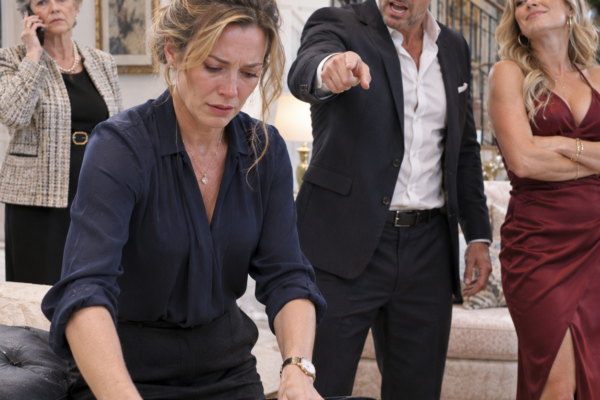
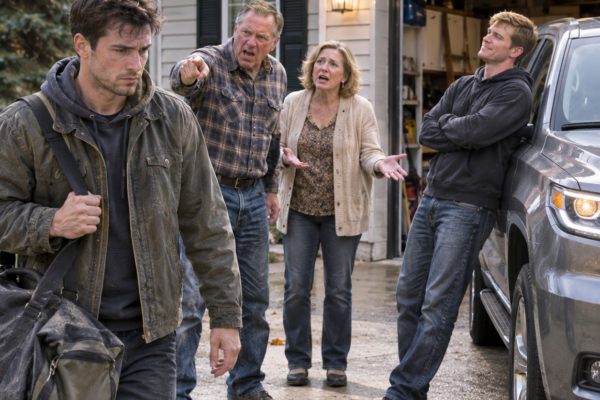
Travis stood halfway down my driveway with one hand in his jacket pocket.
My wife, Courtney, remained beside his truck.
She wouldn’t meet my eyes.
“You were my best man,” I said.
Travis looked toward the street.
“Don’t do this in the driveway, man.”
“Where would you prefer?”
Nobody answered.
Our son, Owen, was asleep upstairs.
Eight years old.
Two baby pine trees waited beside the garage because I had promised him we would plant them on Saturday.
That was the thing I kept staring at.
Not Courtney.
Not Travis.
The trees.
Finally I asked:
“How long?”
Courtney spoke.
“Ben—”
“How long?”
Travis answered.
“Almost a year.”
My stomach turned.
Almost a year.
Birthday dinners.
Marina cookouts.
Little League games.
Christmas.
Travis had stood beside me through all of it.
Everybody at the marina knew, he admitted.
Everyone except me.
Courtney wiped at her face.
“I didn’t plan this.”
“No?”
“No.”
Travis said:
“She wanted more.”
I looked at him.
“More than what?”
He shrugged.
“More than this.”
This.
Our three-bedroom house.
My job maintaining a golf course.
Courtney’s part-time bookkeeping.
Owen’s drawings taped to the refrigerator.
Two little pine trees waiting to go into the ground.
Courtney finally looked at me.
“At least Travis is building something.”
I don’t remember what I said after that.
Maybe nothing.
The divorce took six weeks.
We sold the house.
Split what was left almost exactly down the middle.
Courtney married Travis the following fall on a pontoon boat at his marina.
Owen was the ring bearer.
I rented a basement apartment with windows so high you could only see people from the knees down when they walked past.
The first time Owen stayed there, he stood in the middle of the room holding the two pine trees.
“Is this where you live now?”
“For now.”
He looked around.
“Can trees live down here?”
“Not for long.”
“Then where do they go?”
I didn’t know.
That weekend, an older woman stopped me in the parking lot of a hardware store because she recognized the mower sticking out of the back of my pickup.
“Is that Harold’s mower?”
I looked at her.
“No, ma’am. Mine.”
She apologized.
Then explained her husband Harold had died after forty-one years of marriage and her yard hadn’t been touched in three weeks.
Her name was Agnes Thorsen.
I mowed her lawn that afternoon.
She tried to pay me twenty dollars.
I told her twenty-five.
“Don’t argue with an accountant,” she said.
“You’re an accountant?”
“Retired. Which means I’m still an accountant, just unpaid.”
She watched me load the mower.
“With a trailer, you could do ten yards on a Saturday.”
“Trailer’s not in the budget.”
“Then neither are the other nine yards.”
That was Agnes.
No sympathy without arithmetic.
When she saw the pine trees in my basement a week later, she frowned.
“Trees belong in dirt.”
“I’m working on that.”
“I’ve got a backyard nobody uses.”
Owen looked at me.
Agnes pointed toward her back fence.
“Put them there until you get a yard of your own.”
Owen planted the larger tree himself.
“That one’s you, Dad.”
“Why?”
“Big Pine.”
Then he patted the smaller one.
“And this is me. Little Pine.”
Agnes wrote the names on wooden garden markers.
Owen made me promise we would measure them every year.
“Every year?”
“Pinky promise.”
I hooked my little finger around his.
“Every year.”
That winter, after I had picked up eleven mowing customers—mostly widows from Agnes’s church—she sat at her kitchen table with my notebook.
“You don’t have a business.”
“I have eleven customers.”
“You have eleven people paying a man with a mower.”
“What’s the difference?”
“A business survives January.”
I smiled.
“Grass doesn’t grow in January.”
Agnes looked out at the first snow of the season.
“What does?”
I followed her eyes.
That was the beginning.
Years later, when sixty-one people worked for Little Pine Lawn & Snow and green trucks were clearing hospitals, clinics, schools, and nearly 150 commercial properties across the county, people assumed I had always planned it.
I hadn’t.
I had two trees.
An eight-year-old son.
A basement apartment.
A used mower.
And an eighty-dollar notebook Agnes made me balance every Sunday night.
That was the entire business plan.
Part 2:
“Twenty years, Trav.”
My voice sounded strange even to me.
Flat.
Too calm for what I was looking at.
Travis stood halfway down my driveway with one hand in his jacket pocket.
My wife, Courtney, remained beside his truck.
She wouldn’t meet my eyes.
“You were my best man,” I said.
Travis looked toward the street.
“Don’t do this in the driveway, man.”
“Where would you prefer?”
Nobody answered.
Our son, Owen, was asleep upstairs.
Eight years old.
Two baby pine trees waited beside the garage because I had promised him we would plant them on Saturday.
That was the thing I kept staring at.
Not Courtney.
Not Travis.
The trees.
Finally I asked:
“How long?”
Courtney spoke.
“Ben—”
“How long?”
Travis answered.
“Almost a year.”
My stomach turned.
Almost a year.
Birthday dinners.
Marina cookouts.
Little League games.
Christmas.
Travis had stood beside me through all of it.
Everybody at the marina knew, he admitted.
Everyone except me.
Courtney wiped at her face.
“I didn’t plan this.”
“No?”
“No.”
Travis said:
“She wanted more.”
I looked at him.
“More than what?”
He shrugged.
“More than this.”
This.
Our three-bedroom house.
My job maintaining a golf course.
Courtney’s part-time bookkeeping.
Owen’s drawings taped to the refrigerator.
Two little pine trees waiting to go into the ground.
Courtney finally looked at me.
“At least Travis is building something.”
I don’t remember what I said after that.
Maybe nothing.
The divorce took six weeks.
Courtney and I did not fight over furniture.
We did not spend a year in court.
We sold the house.
Split the equity down the middle.
I put every dollar of my half into a savings account and didn’t touch it.
Owen spent one week with me and one week with his mother.
Courtney moved into Travis’s place near the marina.
I rented a basement apartment six miles away.
It had one bedroom.
Concrete walls.
Small kitchen.
Windows so high you could only see the legs of people walking past on the sidewalk.
The first time Owen stayed overnight, he walked through the place carrying the two pine trees.
We had dug them back out before the house closed.
He set them beside the tiny window.
“Is this where you live now?”
“For now.”
He looked around.
“Can trees live down here?”
“Not for long.”
“Then where do they go?”
I had no answer.
We ate frozen pizza on folding chairs.
At bedtime, I gave him the bedroom.
I slept on a secondhand sofa.
At three in the morning I woke to him standing beside me.
“Dad?”
“Yeah, bud?”
“Are you poor?”
That one hurt.
I sat up.
“No.”
“Mom said you had to move somewhere cheap.”
“That’s true.”
“So we’re poor.”
“We’re starting over.”
“What’s the difference?”
I thought about it.
“Poor is a number. Starting over is a direction.”
He stared.
“That sounds like something an old person says.”
“Go to bed.”
He smiled.
That was the first laugh I had managed in weeks.
I was thirty-eight.
Eight years at Pine Ridge Golf Club.
Grounds crew first.
Then assistant superintendent.
Steady paycheck.
Health insurance.
Retirement contribution.
I liked the work.
Cutting grass is satisfying if you like seeing where you’ve been.
A rough lawn becomes straight lines.
A broken sprinkler gets fixed.
A bunker gets raked.
At the end of the day, the place looks better than when you arrived.
Courtney used to tell people I “worked at a golf course.”
Travis owned one marina and had plans for a second.
He bought boats.
Sold boats.
Financed docks.
Talked constantly about expansion.
Next to him, I probably looked small.
That bothered me for about six months after the divorce.
Then I met Agnes Thorsen.
I was leaving Carlson Hardware on a Saturday with a mower blade in one hand when an older woman called:
“Young man.”
I turned.
She pointed toward the mower in my pickup bed.
“That Harold’s?”
“No, ma’am.”
She blinked.
“Sorry.”
Then stared again.
“Looks exactly like his.”
“Craftsman made more than one.”
That made her smile.
“My husband died in May.”
I stopped smiling.
“I’m sorry.”
“Forty-one years.”
She folded her arms.
“The grass doesn’t care.”
I didn’t know how to answer.
She continued.
“You mow lawns?”
“Mostly one very large one.”
“Golf course?”
“Yes.”
“Can you do mine?”
I should have said no.
Saturday was one of the few days I had Owen every other week.
But he was with Courtney that weekend.
I asked:
“How big?”
“Twenty-five.”
“Twenty-five what?”
“Dollars.”
“I meant the yard.”
She waved.
“Follow me.”
That was Agnes.
She lived three blocks from the hardware store in a white ranch house with green shutters.
The yard wasn’t large.
It was just overgrown.
I mowed.
Trimmed.
Blew off the sidewalk.
Took about forty minutes.
She handed me a twenty-dollar bill.
I said:
“Twenty-five.”
She raised an eyebrow.
“You said twenty?”
“You said twenty.”
“I said twenty-five.”
“You did not.”
“Don’t argue with an accountant.”
“You’re an accountant?”
“Retired.”
“Then you should remember twenty and twenty-five are different numbers.”
She stared at me.
Then laughed so hard she had to sit on the porch.
I charged her twenty.
She paid twenty-five.
The next Saturday, she had two neighbors waiting.
Widows from her church.
Both needed lawns.
By July, I had eleven.
Most were older people.
Small yards.
Nobody wanted fancy landscaping.
They wanted someone who showed up.
I used my push mower and a borrowed string trimmer.
Owen came with me on Saturdays.
He picked up sticks.
Dragged empty yard bags.
Eventually learned to edge badly.
Agnes kept records.
At first I didn’t ask her to.
She simply appeared one afternoon with a three-ring binder.
“What’s this?”
“Your business.”
“I don’t have a business.”
“You have eleven people paying you.”
“That’s side work.”
“Side work pays tax too.”
I stared.
She pointed at the binder.
“Income here. Gas here. Repairs here. Set aside tax here.”
“Agnes.”
“And every time money comes in, pay yourself first.”
“I already get paid.”
“No. You spend what comes in on gas and equipment and call whatever survives yours.”
“That seems normal.”
“It is. That’s why normal people stay broke.”
I hated when she made sense.
Then she saw the pine trees.
Owen and I had brought them to the basement’s small back patio for sunlight.
Agnes stared.
“Those cannot stay in pots.”
“I know.”
“You have somewhere to plant them?”
“No.”
She looked at Owen.
“Your trees?”
He nodded.
“Big Pine and Little Pine.”
“Which is which?”
He pointed.
“Big one is Dad.”
Then the smaller one.
“Little one’s me.”
Agnes looked at me.
Something softened.
“I’ve got a backyard nobody uses.”
“You don’t have to—”
“I know.”
She pointed at the back fence.
“Plant them there.”
Owen looked at me.
“Can we?”
I hesitated.
Something about planting trees in someone else’s yard felt like admitting we didn’t have one.
Agnes must have understood.
She said:
“They can stay until you get a yard of your own.”
So we planted them.
Owen dug most of the holes.
Badly.
I fixed them.
He made wooden signs.
BIG PINE.
LITTLE PINE.
He measured each with a school ruler.
Big Pine: twelve inches.
Little Pine: nine.
“Promise we measure every year.”
“Every year?”
“Pinky promise.”
I hooked my finger around his.
“Every year.”
That fall, Courtney married Travis.
Pontoon boat.
Marina decorated with white lights.
Owen wore a navy blazer and carried the rings.
I did not attend.
Obviously.
When Owen came back Sunday evening, he placed his small duffel beside my sofa.
“Travis says you just cut grass.”
I looked at him.
“What did you say?”
“Nothing.”
“Good.”
“Is that what you do?”
“Yes.”
“For now.”
He frowned.
“What does ‘for now’ mean?”
“I don’t know yet.”
That bothered him.
He liked answers.
So did I.
Winter gave us one.
The first real snow arrived in December.
Six inches overnight.
I was at Agnes’s at seven with a shovel.
She opened the door.
“What are you doing?”
“Clearing your driveway.”
“I didn’t ask.”
“You were going to shovel it yourself?”
“No.”
“Exactly.”
She watched me.
“You get paid for this?”
“Not by you.”
“That wasn’t the question.”
I kept shoveling.
At her kitchen table afterward, she asked:
“Grass pays in July.”
“Yes.”
“What pays in January?”
I looked outside.
“Snow.”
“Same customers?”
“Could be.”
“Twelve months instead of six.”
I smiled.
“Plow truck costs money.”
“Does your half of the house still exist?”
I froze.
Every dollar did.
I hadn’t touched it because I was terrified of making the wrong move.
Agnes knew.
I had told her one afternoon after too much coffee.
“How much?” she asked.
“Enough for a used truck and plow.”
“Cash?”
“Yes.”
“Then why haven’t you?”
“Because that’s my safety net.”
She pointed toward my notebook.
“A safety net can also be a ladder if you don’t cut it all up.”
“That sounds suspiciously motivational.”
“Don’t get sentimental.”
She asked what percentage of my savings the truck would consume.
We did the numbers.
Then she gave me one rule:
“Never borrow for something worth less the day after you buy it if you can reasonably pay cash.”
“That sounds broad.”
“It’s supposed to.”
I bought a used three-quarter-ton pickup with a plow.
Cash.
Not pretty.
Green.
Rust near one wheel well.
Owen loved it.
“You painted it?”
“Previous owner did.”
“Cute.”
“No man wants his truck called cute.”
“Little Pine should be green.”
“We don’t have a company.”
“You should.”
I ignored him.
First storm, nine residential driveways.
Second storm, thirteen.
I still worked the golf course full time.
On snow nights, I drove from midnight until six, went home, showered, then reported to Pine Ridge.
I learned how to carry spare hydraulic hoses.
Extra belts.
Fuses.
Salt.
Tow straps.
One morning, I was clearing a driveway when a woman in scrubs came running outside.
“My car’s stuck.”
Her name was Linda Pruitt.
Dialysis nurse.
Shift began at six.
I looked at the clock.
5:04.
Her car had backed into a snowbank.
I pulled it free.
Then my plow hose burst.
Linda stared.
“I’m going to be late.”
“No.”
“That hose says otherwise.”
I carried a spare.
Replaced it in the dark.
Gloves soaked.
Hands numb.
At 5:26, her driveway was clear.
She asked:
“What do I owe you?”
“Nothing.”
“You’ve been here half an hour.”
“You’ve got patients at six.”
She looked at me for a long moment.
“Thank you.”
Three years later, that half hour changed my business.
At the time, I forgot about it.
Life became work.
Owen and I measured the trees every spring.
Big Pine: nineteen inches.
Little Pine: sixteen.
“I’m losing,” he said.
“You’re just getting started.”
He kept a notebook.
Agnes insisted.
By my second winter, I had thirty-eight residential snow customers.
By third summer, twenty-six weekly lawns.
The side business was paying almost as much as Pine Ridge.
Agnes made me prove it over twelve consecutive months.
“Not one good summer,” she said.
“A business has seasons. You need to know the whole year.”
I tracked every dollar.
When the combined lawn and snow income equaled my golf-course salary for twelve straight months, I walked into Agnes’s kitchen.
“I can quit.”
She looked at the spreadsheet.
“Four months of personal expenses saved?”
“Yes.”
“Separate business cushion?”
“Yes.”
“How much?”
I told her.
She nodded.
“Then yes.”
“That’s it?”
“What do you want? Balloons?”
“I thought you’d argue.”
“I argue when you’re wrong.”
I gave two weeks’ notice at Pine Ridge.
Eight years.
My superintendent looked at the letter.
“Well. Good luck with the lawn thing…”
He paused.
“Ben.”
I smiled.
“Ben.”
“Right.”
That afternoon, I ran into Travis at a gas station.
He had a new truck.
Marina logo on the door.
“Heard you quit the golf course.”
“Yep.”
“For this?”
He looked at my old green plow truck.
“For this.”
He nodded toward the marina.
“Second location breaks ground next spring.”
“Congratulations.”
“You ever think about a real job?”
I almost laughed.
“I have one.”
“I mean benefits. Stability. I could put you on the docks.”
“No thanks.”
“Owen talks about your company like it’s something.”
“It is something.”
Travis shrugged.
“Offer stands.”
He drove away.
I sat in my truck for a full minute before starting it.
The old version of me would have wanted to prove something.
The new version had lawns to finish.
My first commercial contract came from Linda Pruitt.
Three winters after I pulled her car free, she called.
“Ben?”
“Linda?”
“You remember me?”
“Dialysis clinic.”
“You remembered.”
“Hard morning to forget.”
“Our plow company didn’t show.”
“Today?”
“Right now.”
I looked outside.
Eight inches and falling.
“We’ve got patients coming at six. One night technician already fell by the entrance.”
“I’m on my way.”
I cleared the lot.
Walks.
Salt.
Entrances.
Linda asked:
“What do I owe you?”
“Whatever you normally pay the company that didn’t show.”
She gave me a number.
I nearly choked.
Commercial snow work paid differently.
Then she said something more valuable.
“Homeowners call you when they remember. A clinic needs you every storm.”
She introduced me to the facilities director.
He offered a seasonal contract.
They asked for the business name.
I had never formally chosen one.
“Halvorsen Lawn and Snow?”
I looked through the office window.
My old green truck sat outside.
Then I thought about Agnes’s backyard.
Two trees.
One large.
One small.
“Little Pine Lawn & Snow.”
Linda smiled.
“Little Pine?”
“A promise I made.”
“I like it.”
The name stuck.
My first employee was Andre Fields.
Twenty-six.
Former warehouse worker.
Showed up forty minutes early to an interview during a blizzard.
I hired him before he sat down.
“Why?”
“Because you’re early in this.”
He looked outside.
“It’s snow.”
“Exactly.”
Andre became our best route driver.
Then crew leader.
Then operations manager.
By the end of the next year, we had three green trucks.
Fourteen commercial lots.
Forty-two residential properties.
Linda left the dialysis clinic—not nursing, the administrative side—to run my office.
She was better at scheduling than I was.
Better at billing.
Better at telling customers no.
Agnes approved immediately.
“Finally,” she said. “A competent adult.”
“I built this company.”
“You built chaos with trucks.”
Linda laughed.
I bought a house.
Small rambler.
Three bedrooms.
Fenced yard.
Paid a large down payment and kept the mortgage modest.
Owen was twelve.
The first night there, he walked through every room.
“Mine?”
“Yours.”
“Forever?”
“That’s the plan.”
Then he asked:
“What about Big Pine and Little Pine?”
“They stay at Agnes’s.”
“Why?”
“Because we promised her.”
He thought about it.
“Can we plant more here?”
We did.
But the originals stayed.
Every spring, we measured them.
Travis opened his second marina.
Both locations filled with boats.
He borrowed heavily.
I knew because everyone knew.
New docks.
Showroom.
Inventory.
Marketing.
Owen sometimes talked about it.
“Travis says you could grow faster if you borrowed more.”
“He might be right.”
“Then why don’t you?”
“Debt isn’t evil.”
“Agnes says it is.”
“Agnes says things for effect.”
I explained.
Borrowing to buy something productive can make sense.
Borrowing just because growth feels impressive can bury you.
Then I repeated Agnes’s favorite line:
“Never borrow for something worth less the day after you buy it unless the cash flow is certain.”
Owen grinned.
“And boats?”
“Worth less the second they get wet.”
He laughed.
I found out later he repeated that to Travis.
That did not help family relations.
At fourteen, Owen joined my summer crews.
Courtney asked:
“Doing what?”
“Mowing.”
She looked disappointed.
He didn’t.
He wore a green Little Pine shirt and came home exhausted.
Andre treated him worse than everybody else.
I encouraged that.
“You’re the owner’s kid,” Andre told him. “Means you get the worst rake.”
Owen loved it.
The company grew.
Thirty employees in peak season.
Then forty.
Two hospitals.
A dozen clinics.
Office parks.
Schools.
Retail centers.
Apartment complexes.
We still had residential customers, including some of Agnes’s original church widows.
I still drove the old green truck during storms.
Linda begged me to replace it.
“No.”
“It looks terrible.”
“It runs.”
“It has duct tape.”
“Structural.”
“Ben.”
“Sentimental.”
She stopped arguing.
Then came the winter that nearly broke us.
No snow.
Not a little snow.
Almost none.
November dry.
December mild.
January rain.
By February, our snow revenue was down roughly $110,000.
At the time, most customers paid per push.
No snow meant no invoice.
Payroll still existed.
Insurance.
Truck payments—some newer vehicles were financed despite Agnes’s original rule, because eventually cash efficiency matters.
Rent.
Fuel.
Benefits.
Eighteen employees depended on us year-round.
Linda sat across from me.
“We can lay off nine and make it to spring comfortably.”
I stared.
“Nine?”
“Half the field crew.”
“Everybody else doing it?”
“Dahlberg let twenty go Monday.”
Andre stood near the door.
“The guys are asking.”
I went home.
Didn’t eat.
Sat at my kitchen table looking at numbers.
At ten, I called Agnes.
She had moved into senior living the previous year.
“I wondered when you’d call.”
“How?”
“Linda called me.”
“Traitor.”
“Smart woman.”
“I’m about to lay off nine people.”
“No, you’re not.”
I laughed bitterly.
“You haven’t seen the numbers.”
“I taught you the numbers.”
“We’re down a hundred ten thousand.”
“What’s the cushion?”
I told her.
Silence.
Then:
“What do you think that money was for?”
“Equipment.”
“No.”
“Expansion.”
“No.”
“What?”
“This.”
I said nothing.
“I didn’t make you save in the good years so you could admire the account balance, Ben.”
“It won’t cover the whole winter.”
“Then what else can eighteen people do?”
I stared.
“They mow.”
“No. They work outside.”
The next morning, I brought everyone in.
I stood in front of eighteen employees.
Andre beside me.
Linda near the office door.
“Nobody’s getting laid off.”
Silence.
One guy actually said:
“What?”
“No snow. So we make winter something else.”
I wrote on the whiteboard.
TREE TRIMMING.
STORM CLEANUP.
HAULING.
GUTTER WORK.
HOLIDAY LIGHT REMOVAL.
BRUSH CLEARING.
ICE PREP.
“If it’s outside and it’s winter, we do it.”
Andre smiled.
“You heard him.”
The cushion carried most of us.
A small credit line covered the rest.
I hated taking the line.
Agnes approved it.
“Now you’re borrowing to protect productive people, not buy shiny things.”
That mattered.
By April, we had survived.
Paid off the credit line by June.
Nobody missed a paycheck.
That same spring, interest rates jumped and boat sales collapsed.
Travis’s marina group had expanded at the worst possible time.
The second location carried too much debt.
Inventory sat.
A larger regional chain bought both marinas at a discount.
Travis stayed on in sales.
Courtney called once.
Not to gloat.
Not to apologize.
Just to tell me Owen might be quiet that week.
“Travis is taking it hard.”
“I’m sorry.”
She sounded surprised.
“You are?”
“I don’t want him destroyed.”
There was a long pause.
“I thought you’d enjoy this.”
“I spent too many years rebuilding to enjoy watching somebody else fall apart.”
She said:
“You changed.”
“So did you.”
We left it there.
I converted every major commercial snow contract to flat seasonal pricing after that.
Customers paid for readiness, not just pushes.
Some resisted.
The hospitals understood immediately.
So did clinics.
Schools took longer.
But no-snow winter changed how I thought about risk.
Agnes had taught me to save.
The bad winter taught me to redesign revenue.
That was the year Little Pine became a company instead of a hardworking man with trucks.
Owen entered high school.
Construction management became his obsession.
He loved drawings.
Site plans.
Scheduling.
Budgets.
He hated mowing.
I considered that fair.
One morning, when he was seventeen, he said:
“I’m not taking over Little Pine.”
I looked up from coffee.
“Good.”
He blinked.
“Good?”
“I didn’t build it to trap you.”
“I thought you’d be disappointed.”
“No.”
“What if I work construction?”
“Then work construction.”
“What if I move?”
“Then move.”
“What if I never come back?”
That one hurt.
I answered anyway.
“Then call.”
He stared at me.
“Mom says you always plant things for other people.”
I smiled.
“She used to say that like it was criticism.”
“Is it?”
“No.”
Halfway through Owen’s senior year, the school principal called me.
My first thought was something had happened.
“Mr. Halvorsen?”
“Yes.”
“Owen is fine.”
My heart slowed.
“Then you might want to lead with that.”
“Sorry.”
She asked me to come in.
Principal Rebecca Sloan had run the district’s facilities program before becoming principal.
She knew Little Pine because we had cleared district lots for seven winters.
I sat across from her.
She said:
“Our facilities director first called you because the dialysis clinic down the road was always cleared before our lots.”
“Linda’s clinic.”
“Yes.”
“Small world.”
“Your company hasn’t missed one opening in seven winters.”
“That’s Andre’s route.”
“I know.”
She folded her hands.
“Every June I watch students walk across this stage who don’t want four-year college.”
I waited.
“They want to fix diesel engines. Wire houses. Weld. Build. Run equipment.”
“That’s real work.”
“Exactly.”
She continued:
“And too often, nobody has ever told them it counts.”
I understood where this was going.
“I want to establish a skilled-trades scholarship.”
“How much?”
“I was hoping Little Pine might fund it.”
I smiled.
“Five thousand a year.”
She looked surprised.
“I hadn’t given you a number yet.”
“Five.”
“Conditions?”
“Three.”
“Go ahead.”
“District administers it separately from our snow contract.”
“Agreed.”
“You’re not on the selection committee.”
“Agreed.”
“And it never goes to Owen.”
She smiled.
“Definitely agreed.”
Then she asked:
“Why Little Pine?”
I told her.
Basement apartment.
Two trees.
Agnes’s backyard.
Eight-year-old Owen.
Big Pine.
Little Pine.
Pinky promise.
She listened.
Then asked:
“Would you send me that story in writing?”
“For the file?”
“For the scholarship.”
“Sure.”
I did.
Then forgot about it.
Graduation week arrived.
Owen had been accepted into a construction management program at a state university.
Courtney and Travis attended.
Agnes came from senior living.
Eighty-six.
Walker.
Blue dress.
Still dangerous.
Linda sat with employees.
Andre brought his wife.
I wore work boots.
Owen noticed.
“You’re wearing those to graduation?”
“On purpose.”
“Why?”
“Comfort.”
“You own dress shoes.”
“Oppressive.”
He laughed.
The ceremony was held in the school gym because rain was forecast.
Hundreds of families.
Blue gowns.
Noise.
Phones.
Flowers.
Principal Sloan announced academic awards.
Then community scholarships.
Finally:
“This year, we’re introducing a new scholarship for a graduate entering the skilled trades.”
I leaned forward.
Owen whispered:
“That yours?”
“Company’s.”
“You never told me.”
“You weren’t eligible.”
He rolled his eyes.
Principal Sloan continued.
“For seven winters, before the first bus arrived, this district’s parking lots were already clear.”
Travis looked toward me.
Not yet understanding.
“The company responsible also services two hospitals, twelve clinics, and nearly 150 commercial properties across this county.”
Courtney turned slightly.
I looked straight ahead.
“In peak season, they employ sixty-one people.”
Agnes leaned toward me.
“Look at you.”
“Quiet.”
“Starting this year, that company will provide $5,000 annually to a graduate building a career in the skilled trades.”
Applause.
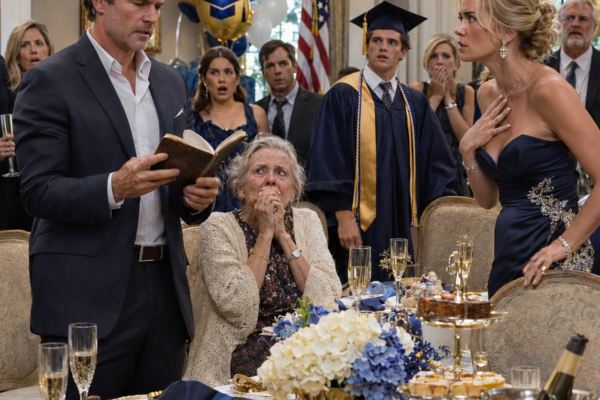
“It is called the Little Pine Scholarship.”
Owen froze beside me.
Principal Sloan smiled from the podium.
“I asked the founder where the name came from.”
My stomach dropped.
She was going to tell it.
“Ten years ago, that founder and his eight-year-old son had no yard of their own.”
Courtney stopped clapping.
“They had two baby pine trees and nowhere to plant them.”
Owen looked at me.
I looked at Agnes.
She was crying.
“An older neighbor gave those trees a temporary home in her backyard.”
Principal Sloan continued.
“The larger tree became Big Pine.”
People laughed softly.
“The smaller one became Little Pine.”
Owen whispered:
“No way.”
I nodded.
“The father promised his son they would measure those trees every year.”
Principal Sloan looked toward our row.
“That boy graduates today.”
Owen’s face changed.
I had never seen him look eight years old again until that moment.
“And the founder of Little Pine Lawn & Snow is here with him.”
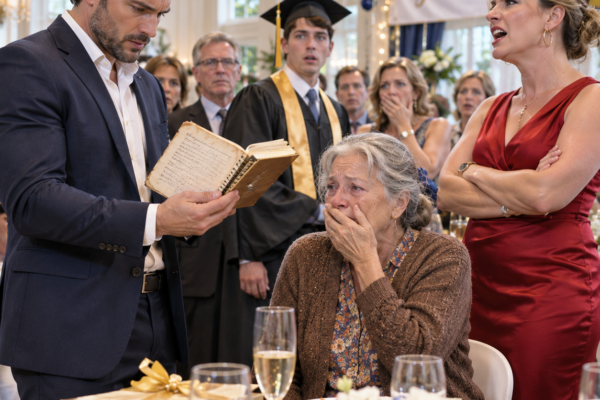
Travis turned fully toward me.
Courtney covered her mouth.
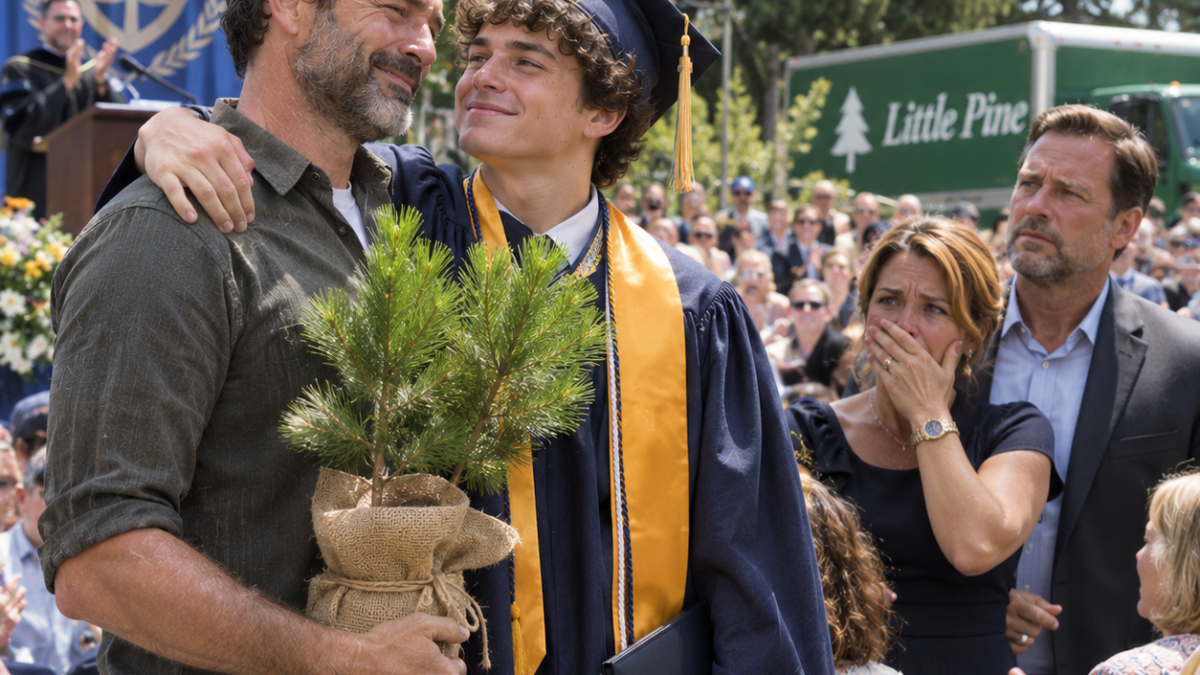
“Mr. Ben Halvorsen, would you join me to present the first Little Pine Scholarship?”
I stood.
Owen grabbed my arm.
“Dad.”
“What?”
“You never told anyone.”
“You knew.”
“I knew it was your company.”
“Then who mattered?”
He shook his head.
I walked to the stage.
The scholarship recipient was Isaiah Banks.
Seventeen.
Going into diesel technology.
His hands shook when he took the certificate.
I shook his hand.
“Go build something.”
“Yes, sir.”
That was all.
When I returned to my seat, Agnes whispered:
“You wore the boots because you knew.”
“I knew about the scholarship.”
“Liar.”
After the ceremony, the gym became chaos.
Families.
Photos.
Flowers.
Owen disappeared with friends.
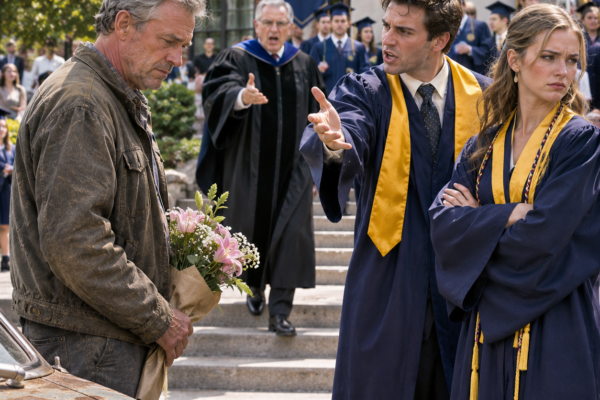
I found him later outside with Courtney and Travis.
Courtney looked at me.
“Those green trucks…”
“Yes.”
“At the school?”
“Yes.”
“And the clinic?”
“Yes.”
“Our street?”
“Some of it.”
Travis stared.
“I thought you worked for Little Pine.”
I almost smiled.
“I do.”
“You own it?”
“Yes.”
“Owen never said.”
Owen shrugged.
“You never asked.”
That landed.
Not cruelly.
Just accurately.
Travis looked toward the parking lot where two Little Pine trucks sat because our crews had helped with event setup that morning.
“How big?”
“Big enough.”
He laughed once.
Not happily.
“I figured you were mowing for somebody.”
“I still mow sometimes.”
“You drive that old truck.”
“Most storms.”
He shook his head.
For the first time in ten years, I could see he didn’t know what to say to me.
Courtney did.
“I got a lot wrong.”
I looked at her.
She had aged.
So had I.
The anger that once lived permanently under my ribs was gone.
Not forgiven exactly.
Not forgotten.
Just finished.
She said:
“I told you your whole life was planting things for other people.”
“You did.”
“I meant it like a weakness.”
“I know.”
She looked toward Owen.
“Maybe I was wrong.”
I nodded.
“Maybe.”
Travis held out his hand.
“Congratulations.”
I shook it.
“Thanks.”
“For everything.”
I didn’t ask what he meant.
He said:
“Take care of yourself.”
“You too.”
That was enough.
Agnes called from twenty feet away:
“Ben!”
I turned.
She stood beside the curb with her walker.
“Yes?”
“Are you making me walk all the way over there?”
I went to her.
She grabbed my arm.
“That’s the boat man?”
“That’s Travis.”
She looked past me.
“Well.”
“What?”
“I hope somebody finally taught him not to borrow against anything that floats.”
“Agnes.”
“What? I’m eighty-six. Manners are optional.”
I laughed so hard I had to stop walking.
Owen came over.
“Ready?”
“For what?”
He held up a tape measure.
I stared.
“No.”
“Yes.”
“Today?”
“Every year.”
Agnes smiled.
“Pinky promise.”
So after graduation, before dinner, before parties, before anything else, we drove to Agnes’s old house.
New family lived there now.
They knew about the trees.
When Agnes sold the property, she made the buyers promise to leave them.
They had.
Big Pine towered over the back fence.
Little Pine had nearly caught it.
Owen stood beneath them in his graduation clothes.
I held the tape.
He looked up.
“Remember when they were in the basement?”
“Yep.”
“I thought that place was permanent.”
“So did I.”
“You lied.”
“About what?”
“You said starting over was a direction.”
“That wasn’t a lie.”
“You didn’t know.”
“Correct.”
He smiled.
“Then it was a guess.”
“Educated.”
We measured.
Not in inches anymore.
Feet.
The little tree had become substantial enough to shade part of the yard.
Owen touched the trunk.
“Mom was right about one thing.”
“What?”
“You do plant things for other people.”
I looked at him.
“She meant businesses?”
“No.”
He pointed toward the trees.
Then toward the street.
“The clinic. The school. The scholarship. Agnes. All those employees.”
I shook my head.
“Most of that wasn’t planned.”
“Doesn’t matter.”
He leaned against Little Pine.
“That’s the whole point.”
I looked around the yard.
Ten years earlier, I had believed two baby trees were evidence of everything I had lost.
No house.
No marriage.
No yard.
No certainty.
I thought they were leftovers from my old life.
Instead, they became the name of the new one.
Owen left for college that fall.
He did not take over Little Pine.
Good.
He interned with a commercial builder.
Then a civil contractor.
He called whenever he needed money and pretended the call was about advice.
I pretended not to notice.
Little Pine kept growing.
Not explosively.
I had learned too much to chase explosive growth.
We expanded one route at a time.
One contract at a time.
Flat seasonal snow agreements.
Diversified winter services.
Cash reserve equal to several months of payroll.
Agnes demanded quarterly reports even after she stopped understanding some of the newer software.
“Print it.”
“You hate paper.”
“I hate your explanations more.”
Linda printed it.
Andre eventually became part owner through a long-term incentive plan.
That mattered to me.
He had shown up forty minutes early in a blizzard.
People remember founders.
Founders should remember who stayed.
The scholarship continued.
Five thousand every year.
Diesel technicians.
Electricians.
HVAC students.
Welders.
Heavy-equipment operators.
One year, the recipient went into arboriculture.
Agnes loved that.
“Tree person.”
“Yes.”
“Little Pine finally makes sense.”
“It always made sense.”
“To you.”
She died at eighty-nine.
Peacefully.
Her funeral was packed.
Widows from the old church.
Former accounting clients.
Little Pine employees.
People whose taxes she had prepared forty years earlier.
Owen flew home.
Afterward, we went to the trees.
Big Pine.
Little Pine.
No measuring that year.
We just stood there.
Owen said:
“She saved you.”
I thought about it.
“No.”
“She did.”
“She gave me math.”
“That counts.”
I smiled.
“She gave me a backyard.”
“That too.”
Then he said:
“She made you believe a small thing could become a real thing.”
That was closer.
Agnes never told me I was destined for greatness.
She never said I had hidden potential.
She said:
“Twenty-five means twenty-five.”
“Pay yourself first.”
“Hold back taxes.”
“Save for the bad year.”
“Don’t borrow just to look successful.”
“Show up when you said you would.”
Useful things.
Boring things.
Things that compound.
Courtney and I eventually became civil.
Owen’s wedding helped.
Years after graduation, he married a woman named Claire who worked in civil engineering.
At the rehearsal dinner, Courtney sat beside me for ten minutes.
She said:
“Do you ever think about that night?”
“What night?”
“The driveway.”
I knew.
“Sometimes.”
“I was cruel.”
“Yes.”
She nodded.
“I thought ambition had to look big.”
I waited.
“Travis looked big then.”
“He was doing well.”
“He was.”
She looked toward Owen.
“And you looked…”
“Small?”
“Still.”
That was interesting.
She continued:
“You were always doing one thing at a time.”
“That was mostly because I only had enough money for one thing.”
She laughed.
Then her eyes filled.
“I’m sorry, Ben.”
I believed her.
That didn’t rewrite anything.
It didn’t need to.
“I know.”
Travis and Courtney were still married.
Their life had changed after the marina sale.
Travis worked for the national chain for several years.
Eventually became regional sales manager.
Good at it.
He stopped trying to be an owner.
Maybe that made him happier.
Maybe not.
I never asked.
At Owen’s wedding, he approached me near the bar.
“No hard feelings?”
I looked at him.
“Twenty years late.”
He laughed nervously.
“I deserved that.”
“Yes.”
Then I held out my hand.
He took it.
Not friendship.
Not reconciliation.
Closure.
That word gets overused.
But sometimes it is simply reaching the point where the old injury no longer gets a vote.
Little Pine became employee-owned in stages as I approached sixty.
I kept a controlling share at first.
Then less.
Andre ran operations.
Linda remained chief administrative officer until retirement.
I still plowed.
Because I was an idiot.
Owen said:
“You employ sixty people.”
“Not in this truck I don’t.”
“Dad.”
“The hospital route starts at three.”
“That’s Andre’s job.”
“Andre has a newborn granddaughter.”
“You’re using family guilt now?”
“Effective, isn’t it?”
He gave up.
One morning, Travis saw me plowing the lot at the marina chain’s regional showroom.
He walked out with coffee.
“All these years and you’re still pushing snow?”
“Still pushing snow.”
“Corporate gave this contract to Little Pine.”
“Yep.”
“They got you subcontracting?”
I looked at him.
“Something like that.”
He smiled.
“Good for you.”
I didn’t correct him.
Not because I wanted another future reveal.
Because it no longer mattered whether Travis understood me.
That was probably the biggest difference between thirty-eight and fifty-eight.
At thirty-eight, I wanted everyone who underestimated me to know they were wrong.
At fifty-eight, I had invoices due.
People depending on payroll.
A son who called.
A scholarship banquet.
Two pine trees.
That was enough.
Owen once asked why I never put my name on the company.
“Halvorsen Landscaping would’ve sounded normal.”
“Too long.”
“That’s your reason?”
“No.”
“Then what?”
I told him:
“Little Pine reminded me what the business was for.”
“What was it for?”
“At first?”
“Yeah.”
“Rent.”
He laughed.
“After that?”
I thought.
“Choice.”
He waited.
“I wanted to choose where I lived. Choose whether I missed your school events. Choose whether one bad winter could decide who got laid off. Choose whether a bad boss or bad marriage defined the next twenty years.”
He nodded.
“And now?”
“Now it belongs to more people than me.”
That made him smile.
“Planting things for other people.”
“Don’t start.”
He did anyway.
The scholarship grew too.
We increased it to $7,500 after ten years.
Then created paid summer internships with local trade companies.
Not just Little Pine.
Diesel shops.
Electric contractors.
HVAC companies.
Construction firms.
I insisted.
A scholarship should open a path, not recruit cheap labor for me.
The district agreed.
At the tenth scholarship ceremony, Principal Sloan—retired by then—returned.
She found me near the back.
“You know what I remember?”
“What?”
“You telling me it could never go to Owen.”
“I didn’t want anyone thinking I was funding his tuition.”
“He never applied.”
“I know.”
“He told me once he thought that rule was the first time he understood the company wasn’t his inheritance.”
That surprised me.
“What did he think it was?”
“A thing you were responsible for.”
I smiled.
“Smart kid.”
“He was eighteen.”
“Still.”
She looked at the stage where that year’s recipient stood.
“Agnes would like this.”
“Yes.”
“She’d criticize the budget.”
“Immediately.”
That evening, I drove by her old house.
Big Pine and Little Pine were huge now.
The newer owners had added a bench beneath them.
I parked.
Sat for a while.
No dramatic revelation.
Just two trees moving in the wind.
I thought about the basement apartment.
The folding chairs.
Owen asking whether we were poor.
The golf course.
My first used trailer.
The winter hose bursting at Linda’s clinic.
Andre showing up early.
The year without snow.
Agnes saying:
“What did you think the cushion was for?”
The school principal saying:
“Would the founder of Little Pine please stand?”
All of it looked inevitable backward.
None of it felt inevitable while happening.
That is the lie success stories tell.
They make the ending look like a plan.
There was no plan.
There were decisions.
Some good.
Some lucky.
Some stupid.
I bought equipment too early once.
Lost a contract I thought was guaranteed.
Hired the wrong foreman.
Underbid jobs.
Overworked.
Missed dinners.
Argued with Owen when he wanted less responsibility, not more.
Agnes was not always right either.
She hated online billing until the day paper invoices stopped arriving on time.
Then she claimed digital billing had been her idea.
People become legends after they die because the inconvenient parts get edited out.
I try not to do that.
Agnes was stubborn.
Controlling.
Terrible at receiving help.
Generous.
Brilliant.
Lonely.
She needed me too.
That matters.
When Harold died, she had a house full of silence.
I gave her numbers to fix.
She gave me a company to build.
Fair trade.
Courtney once said my whole life was planting things for other people.
She had meant that I spent too much time maintaining things instead of chasing bigger ones.
The golf course.
Neighbors’ lawns.
Trees.
Snow routes.
Employees.
Scholarships.
Maybe she was right about the pattern.
Wrong about the value.
I still believe building something for yourself matters.
You need money.
Security.
A place to sleep.
Savings.
Choice.
But somewhere along the way, the most satisfying part changed.
It became seeing Andre buy a house.
Linda retire comfortably.
A clinic open on time during a storm.
A school bus pull into a cleared lot.
A teenager use scholarship money for diesel tools.
Owen graduate without needing Little Pine to become his.
Those things did not make me rich in some sentimental sense.
The business also made actual money.
We should be honest about that.
Generosity is easier when payroll clears.
Agnes would insist I say so.
She hated stories where people pretended numbers didn’t matter.
Numbers matter.
They just aren’t the only thing.
The year I turned sixty, Owen brought his own son to the trees.
His name was Henry.
Five years old.
He touched Big Pine.
“Which one is Grandpa?”
Owen pointed.
“That one.”
“Why’s it bigger?”
“Grandpa had a head start.”
Then Henry pointed to Little Pine.
“That’s you?”
“Yep.”
“Where’s mine?”
Owen looked at me.
I smiled.
“You know what comes next.”
We went to a nursery.
Bought a third baby pine.
Henry chose the smallest one.
We planted it between the originals but far enough away to give it room.
He made a marker.
TINY PINE.
I objected.
“Terrible name.”
He crossed his arms.
“My tree.”
Fair.
Then he took out a ruler.
Owen laughed.
“We’re doing this?”
“Every year.”
I held out my little finger.
Henry stared.
“What?”
“Pinky promise.”
He hooked his finger around mine.
“Every year.”
On the drive home, Owen said:
“You realize we’ve created a problem.”
“What?”
“In twenty years, there’ll be thirty pine trees in that yard.”
“Not my house.”
“That’s your solution?”
“Planning.”
He laughed.
Then looked out the window.
“Dad?”
“Yeah?”
“That night in the driveway.”
I waited.
“You ever wish it hadn’t happened?”
That was not an easy question.
For years, I knew the answer.
Yes.
Of course.
I wanted my marriage back.
My house.
My friend.
Owen under one roof.
I wanted not to feel stupid.
Not to miss half his weeks.
Not to watch another man stand beside him in family photographs.
But decades change the shape of regret.
“If I could keep you exactly as you are and erase the pain?”
“Yeah.”
“Sure.”
“That’s cheating.”
“Life questions usually are.”
He smiled.
“What if you had to choose?”
“Then no.”
He looked at me.
“Really?”
“Really.”
Not because betrayal was good.
It wasn’t.
Not because Courtney and Travis did me a favor.
They didn’t.
But that night forced me into a life I would never have voluntarily chosen.
And then the life became mine.
That is different from gratitude for the wound.
I don’t thank the knife because the scar healed well.
I’m grateful for what I built afterward.
The basement.
Agnes.
The mower.
The first trailer.
The green truck.
Little Pine.
All of it belonged to the after.
Owen nodded.
Then said:
“I’m glad you didn’t take Travis’s dock job.”
I laughed.
“Me too.”
“He probably would’ve fired you.”
“Definitely.”
“Too stubborn.”
“Runs in the family.”
That spring, we measured all three trees.
Big Pine.
Little Pine.
Tiny Pine.
Henry wrote the numbers.
Bad handwriting.
Owen corrected him.
I told Owen to leave him alone.
Agnes would have corrected both.
The sun was going down behind the fence.
Three generations standing in someone else’s backyard because, decades earlier, a retired accountant had noticed two baby trees trapped in a basement and said:
“Trees belong in dirt.”
I looked at Little Pine.
At the trunk thick enough now that Owen couldn’t wrap both arms around it.
Ten years after the divorce, at his graduation, I thought the scholarship reveal was the ending.
Courtney finally understood.
Travis finally understood.
People applauded.
My son learned the company carrying his childhood nickname was bigger than he realized.
That felt like an ending.
It wasn’t.
The real ending is quieter.
There probably isn’t one.
The trucks still roll before storms.
Employees still complain about schedules.
Customers still call at impossible hours.
The scholarship still goes out every June.
Owen builds things for other people now.
Henry has a tree.
And every spring, somebody brings a tape measure.
That night in the driveway, with Courtney beside Travis and two little pines waiting by the garage, I thought those trees were all I had left.
I was wrong.
They were not what was left.
They were what came next.