For Fourteen Months, I Walked Ten Miles to Clean a Millionaire’s House and Ten Miles Home to Save My Mother’s Thirty-Year-Old Store. My Boss Began Driving Me, Buying Groceries From Mom, and Saying Our Street Deserved a Future. Then a Riverline Demolition Surveyor Saw Him Beside Me, Stopped Mid-Sentence, and Called Him “Sir”—Just Days Before Our Building Was Due to Be Sold.K
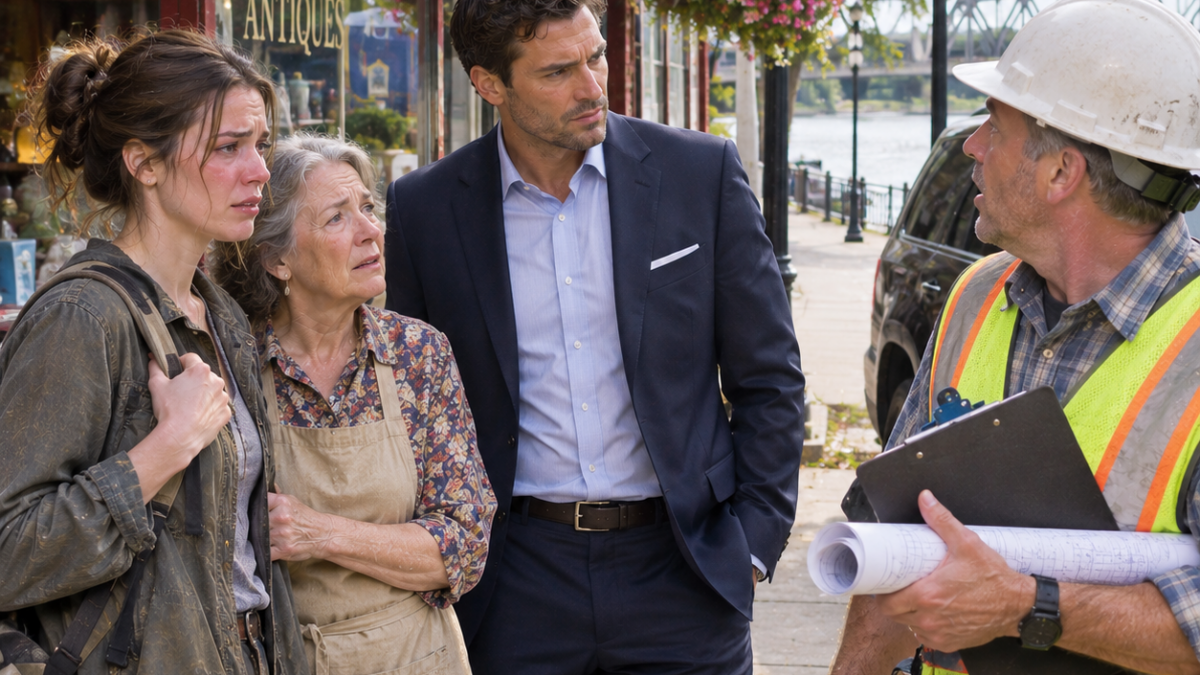
For Fourteen Months, I Walked Ten Miles to Clean a Millionaire’s House and Ten Miles Home to Save My Mother’s Thirty-Year-Old Store. My Boss Began Driving Me, Buying Groceries From Mom, and Saying Our Street Deserved a Future. Then a Riverline Demolition Surveyor Saw Him Beside Me, Stopped Mid-Sentence, and Called Him “Sir”—Just Days Before Our Building Was Due to Be Sold.
The notice taped to my mother’s corner-store window said PRE-DEMOLITION SITE ASSESSMENT.
Underneath it was the name of the company planning to tear down our entire block.
Riverline Partners.
I stood on the sidewalk with my aching feet, staring at those words while my mother tried to peel the tape off the glass.
“They haven’t even bought the buildings yet,” she said. “And they’re already measuring where to put the bulldozers.”
I looked through the window at the shelves she’d stocked for thirty years.
The old refrigerator hummed behind the counter. A handwritten sign advertised coffee for a dollar. Above the register hung a photograph of my father, taken before the heart attack that left Mom to run the store alone.
Everything we had worked to protect was inside that little brick building.
And unless we found another $13,000 before our purchase deadline, it might all be gone.
My name is Imani Bridges. I was thirty-one years old, and for fourteen months I’d been walking ten miles to work and ten miles home, four days a week.
I cleaned a wealthy man’s house outside Hartford, Connecticut. His name was Julian Holloway, and he lived behind iron gates in a glass-and-stone mansion overlooking the river.
He paid me fairly through a housekeeping agency, but I hadn’t owned a car since the previous spring.
I’d sold my twelve-year-old Honda for $6,400 and put every dollar toward buying my mother’s store.
Mom had been renting that corner building for three decades. Twelve years earlier, the landlord had signed a purchase-option agreement that credited part of her rent toward an agreed price.
Now we needed the final $40,000 to complete the purchase before the option expired.
We had $27,000.
I’d counted it that morning in the old coffee can Mom kept locked beneath the register.
The landlord had already warned us that a developer wanted the entire block.
Forty stories of luxury apartments overlooking the river.
To the people planning it, our street was a collection of outdated buildings.
To us, it was home.
Mr. Holloway knew I cleaned his house four days a week. He didn’t know I spent nearly six hours walking on those same days.
At least, I didn’t think he did.
Until Thursday afternoon.
I was three miles from home when a dark SUV slowed beside the shoulder.
The passenger window rolled down.
“Imani?”
I nearly stepped into the weeds.
Mr. Holloway was behind the wheel.
“Mr. Holloway? What are you doing out here?”
“I could ask you the same question. Did your ride break down?”
“I don’t have a ride.”
He frowned.
“Your car?”
“Sold it.”
He looked at the narrow shoulder, the passing trucks, and my worn sneakers.
“How far are you walking?”
“Ten miles home.”
“From my house?”
“Yes, sir.”
“And you do this every day you work?”
“Four days a week.”
He stared at me.
“Get in. I’m taking you home.”
I hesitated.
“Mr. Holloway, you don’t have to—”
“Imani, please. Those trucks are practically brushing your elbow.”
I climbed into the passenger seat.
He didn’t turn on the radio. For several minutes, he seemed more interested in the road than in speaking.
Then he asked why I’d sold my car.
I told him about Mom’s store, the purchase agreement, and the money we were trying to save.
When I mentioned Riverline Partners, his fingers tightened around the steering wheel.
I noticed.
But I didn’t understand why.
That evening, he met my mother.
She stood behind the register in her blue apron, counting quarters into a coffee can while Earl Dawson, the barber next door, complained about another Riverline survey truck.
Mom greeted my employer with her usual suspicion of people wearing shoes that cost more than our weekly grocery bill.
“So you’re the gentleman who lives in the big house on the hill?”
Julian smiled.
“That’s me.”
“You planning to charge my daughter for that ride?”
“No, ma’am.”
“Good. She’s already paid enough just getting to work.”
He looked embarrassed.
Then he offered to drive me to work and back on the days I cleaned his house.
I tried to refuse.
He insisted.
Mom said she’d accept on one condition: I wouldn’t lose a penny of my wages.
Julian agreed.
Over the next few days, something unexpected happened.
He started coming into our store for coffee. He listened to Earl tell stories about the neighborhood. He even bought groceries from Mom instead of the expensive market near his house.
For the first time in months, I began to believe that someone outside our block might understand what we were fighting for.
Then, one afternoon, a white Riverline survey truck stopped outside Mom’s store.
A man wearing a reflective vest climbed out, glanced at Julian standing beside me, and froze.
“Mr. Holloway? I didn’t realize you’d be here. We were told—”
Julian stepped toward him.
“Finish your measurements,” he said sharply. “We’ll discuss the rest elsewhere.”
The surveyor’s expression changed.
“Yes, sir.”
I looked from one man to the other.
“Julian,” I asked, “how exactly does a Riverline demolition surveyor know your name?”
Part 2:
The notice taped to my mother’s corner-store window said PRE-DEMOLITION SITE ASSESSMENT.
Underneath it was the name of the company planning to tear down our entire block.
Riverline Partners.
I stood on the sidewalk with my aching feet, staring at those words while my mother tried to peel the tape off the glass.
“They haven’t even bought the buildings yet,” she said. “And they’re already measuring where to put the bulldozers.”
I looked through the window at the shelves she’d stocked for thirty years.
The old refrigerator hummed behind the counter. A handwritten sign advertised coffee for a dollar. Above the register hung a photograph of my father, taken before the heart attack that left Mom to run the store alone.
Everything we had worked to protect was inside that little brick building.
And unless we found another $13,000 before our purchase deadline, it might all be gone.
My name is Imani Bridges. I was thirty-one years old, and for fourteen months I’d been walking ten miles to work and ten miles home, four days a week.
I cleaned a wealthy man’s house outside Hartford, Connecticut. His name was Julian Holloway, and he lived behind iron gates in a glass-and-stone mansion overlooking the river.
He paid me fairly through a housekeeping agency, but I hadn’t owned a car since the previous spring.
I’d sold my twelve-year-old Honda for $6,400 and put every dollar toward buying my mother’s store.
Mom had been renting that corner building for three decades. Twelve years earlier, the landlord had signed a purchase-option agreement that credited part of her rent toward an agreed price.
Now we needed the final $40,000 to complete the purchase before the option expired.
We had $27,000.
I’d counted it that morning in the old coffee can Mom kept locked beneath the register.
The landlord had already warned us that a developer wanted the entire block.
Forty stories of luxury apartments overlooking the river.
To the people planning it, our street was a collection of outdated buildings.
To us, it was home.
Mr. Holloway knew I cleaned his house four days a week. He didn’t know I spent nearly six hours walking on those same days.
At least, I didn’t think he did.
Until Thursday afternoon.
I was three miles from home when a dark SUV slowed beside the shoulder.
The passenger window rolled down.
“Imani?”
I nearly stepped into the weeds.
Mr. Holloway was behind the wheel.
“Mr. Holloway? What are you doing out here?”
“I could ask you the same question. Did your ride break down?”
“I don’t have a ride.”
He frowned.
“Your car?”
“Sold it.”
He looked at the narrow shoulder, the passing trucks, and my worn sneakers.
“How far are you walking?”
“Ten miles home.”
“From my house?”
“Yes, sir.”
“And you do this every day you work?”
“Four days a week.”
He stared at me.
“Get in. I’m taking you home.”
I hesitated.
“Mr. Holloway, you don’t have to—”
“Imani, please. Those trucks are practically brushing your elbow.”
I climbed into the passenger seat.
He didn’t turn on the radio. For several minutes, he seemed more interested in the road than in speaking.
Then he asked why I’d sold my car.
I told him about Mom’s store, the purchase agreement, and the money we were trying to save.
When I mentioned Riverline Partners, his fingers tightened around the steering wheel.
I noticed.
But I didn’t understand why.
That evening, he met my mother.
She stood behind the register in her blue apron, counting quarters into a coffee can while Earl Dawson, the barber next door, complained about another Riverline survey truck.
Mom greeted my employer with her usual suspicion of people wearing shoes that cost more than our weekly grocery bill.
“So you’re the gentleman who lives in the big house on the hill?”
Julian smiled.
“That’s me.”
“You planning to charge my daughter for that ride?”
“No, ma’am.”
“Good. She’s already paid enough just getting to work.”
He looked embarrassed.
Then he offered to drive me to work and back on the days I cleaned his house.
I tried to refuse.
He insisted.
Mom said she’d accept on one condition: I wouldn’t lose a penny of my wages.
Julian agreed.
Over the next few days, something unexpected happened.
He started coming into our store for coffee. He listened to Earl tell stories about the neighborhood. He even bought groceries from Mom instead of the expensive market near his house.
For the first time in months, I began to believe that someone outside our block might understand what we were fighting for.
Then, one afternoon, a white Riverline survey truck stopped outside Mom’s store.
A man wearing a reflective vest climbed out, glanced at Julian standing beside me, and froze.
“Mr. Holloway? I didn’t realize you’d be here. We were told—”
Julian stepped toward him.
“Finish your measurements,” he said sharply. “We’ll discuss the rest elsewhere.”
The surveyor’s expression changed.
“Yes, sir.”
I looked from one man to the other.
“Julian,” I asked, “how exactly does a Riverline demolition surveyor know your name?”
For a moment, he said nothing.
Then he glanced at the truck.
“I’ve worked with construction companies for years. You meet the same contractors.”
“Doesn’t explain why he looked frightened.”
“He probably thought I’d complain about the work.”
“Were you going to?”
Julian looked past me toward Mom’s store.
“I might have a few questions.”
I wanted to ask more, but Earl leaned out of his barbershop and called that Mom needed help unloading a delivery.
When I looked back, Julian was already speaking quietly to the surveyor.
I caught only a few words.
“Not without authorization.”
The man nodded rapidly.
Julian returned a minute later and offered to carry the grocery cartons inside.
I should have insisted on an explanation.
Instead, I accepted the help.
That is one of the memories I’ve returned to most often. Not because I was foolish, but because trust usually grows through ordinary moments. Someone remembers how you take your coffee. Someone notices you’re tired. Someone helps your mother carry a box without being asked.
By the time you realize they’ve kept something important from you, you have a hundred smaller memories telling you they’re a good person.
Julian had become one of those people.
He’d driven me for almost a week by then, and I was beginning to recognize his car before he pulled up outside the store.
The first morning, I’d been waiting at five forty-five with a travel mug and the backpack I’d carried for years.
He arrived three minutes early.
“Morning,” he said.
“Morning, Mr. Holloway.”
He glanced at the backpack.
“Is that everything?”
“Unless you want to carry my mother’s grocery list.”
“I’d rather not discover what she thinks I should be eating.”
“Too late. She already has opinions.”
He laughed.
Once we were moving, I noticed he’d put a small bottle of water and a banana in the cup holder.
“For you,” he said.
“You didn’t have to do that.”
“I know.”
I took the banana.
“Thank you.”
He turned on the radio.
Soft instrumental music filled the SUV.
I listened for about thirty seconds before asking, “Did you choose this?”
“Yes.”
“On purpose?”
He looked offended.
“What’s wrong with it?”
“It sounds like music they play while you wait for a root canal.”
Julian laughed so suddenly that he nearly missed the turn.
“I paid someone to make that playlist.”
“You should ask for a refund.”
“Then what would you recommend?”
“Tomorrow, you let me choose.”
“Deal.”
By Friday, we were listening to old soul music and a local station that played songs Mom had loved since she was young.
Julian didn’t recognize half of them.
I couldn’t believe it.
“How does a man with a house that big have such terrible taste in music?”
“I worked a great deal while everyone else was learning about music.”
“That isn’t a defense.”
“It was the best one I had.”
He grinned.
For someone who lived behind gates and owned expensive cars, he seemed strangely unpracticed at ordinary conversation.
He asked questions about my neighborhood, but unlike many wealthy people I’d met, he usually listened to the answers.
I told him about the old manufacturing plant that closed when I was in middle school, leaving hundreds of families without steady incomes.
I told him about Earl’s barbershop, the church basement where neighbors held winter clothing drives, and the apartment building above our store where three generations of the same family had lived.
Then I told him about the night my father died.
I hadn’t planned to.
We were stopped at a red light when Julian asked why Mom had never moved the store to a larger shopping center.
“Dad loved that corner,” I said. “He helped her open it.”
Julian waited.
“He was supposed to bring in the produce delivery on a Tuesday morning. Instead, he collapsed at home. By lunchtime, Mom knew he wasn’t coming back.”
“I’m sorry.”
“Thank you.”
I looked out the window.
“People came by the store for weeks afterward. They brought meals, paid outstanding tabs, fixed things that had been broken for years. Earl practically lived behind the register for a month.”
“Your mother must mean a lot to them.”
“She does.”
“And the store?”
“That’s where Dad’s still part of our lives.”
Julian said nothing for the rest of the light.
When we arrived at his house, he helped me bring my cleaning supplies inside.
Usually, I worked through the downstairs rooms while he spent the morning in his office.
That day, he appeared three times.
First, he asked whether the coffee machine needed cleaning.
Then he wanted to know where I’d put the blue cleaning cloths.
Finally, he appeared in the hallway holding an empty mug.
I stopped dusting.
“Mr. Holloway, are you lost?”
He looked confused.
“Lost?”
“In your own house. Your office is that way. The kitchen is the opposite direction.”
He glanced toward the kitchen.
“Right.”
“Are you checking whether I’m working?”
“No.”
“Then why have you walked through this hallway four times?”
He gave an embarrassed smile.
“I like talking to you.”
I lowered the dust cloth.
He continued, “I’ve been inventing reasons to come out of my office. Apparently, I’m not very good at it.”
I laughed before I could stop myself.
“Not even a little.”
Then I grew serious.
“Julian, I need this job.”
“I know.”
“I don’t want misunderstandings.”
He nodded immediately.
“Neither do I. I’m sorry if I’ve made you uncomfortable.”
“You haven’t. I just want us to be clear.”
“Fair enough.”
He returned to his office, and I finished cleaning.
But after that conversation, something changed.
He stopped pretending to need things from the hallway. When he wanted to talk, he asked whether I had time.
Sometimes I did.
Sometimes I didn’t.
He accepted either answer.
That was new to me.
Most people who employed housekeepers assumed our time belonged to them until the last minute of our shifts.
Julian began asking about my plans as though they mattered.
One afternoon, I found him standing in the pantry, staring at a grocery receipt.
“What’s wrong?” I asked.
He held it up.
“Twelve dollars for cereal.”
I laughed.
“You’re just noticing?”
“I’ve never really looked.”
“Mom sells that same box for four dollars and complains she’s charging too much.”
Julian examined the receipt.
“Maybe I should shop at your mother’s store.”
“She’d like that.”
“I’ll stop tomorrow.”
“Fair warning. She won’t let you leave until she’s counted every penny of your change.”
“Good. Somebody should.”
He kept his word.
The following afternoon, he walked into the store wearing jeans and an old navy sweater.
Mom was rearranging canned goods.
“Well, look who’s back.”
“I came for cereal.”
She narrowed her eyes.
“Cereal?”
“And coffee.”
“And?”
“A soda, if you have one.”
Mom smiled.
“You live in a house with a refrigerator bigger than this counter. Don’t tell me you drove all the way here for a soda.”
Julian smiled.
“Maybe I like the company.”
She gave him a knowing look.
Then she rang up his purchases.
When he handed her a hundred-dollar bill, she frowned.
“Julian, this is a corner store, not a bank.”
“It’s the smallest I have.”
“Then stand right there while I count.”
She counted the change twice.
Julian tried to leave the extra money.
Mom pushed it back.
“I don’t take ninety dollars for a few groceries.”
“Put it toward the building.”
“No.”
“Why not?”
“Because you’re paying for groceries. You don’t owe me anything else.”
Julian leaned against the counter.
“Didn’t you once let people buy groceries without paying?”
Mom’s face changed.
“Imani talks too much.”
“Only when she’s telling good stories.”
Mom looked at him for a moment.
Then she took the extra cash, placed it in an envelope, and wrote his name and the amount on the front.
“This is a contribution,” she said. “Not payment for the groceries. And if you ever need it back, you ask.”
Julian shook his head.
“I won’t.”
“That’s your decision. But we’re keeping records.”
I laughed.
Mom had kept handwritten accounts since the day the store opened.
When Dad was alive, he’d teased her that she could tell the difference between two jars of pennies just by lifting them.
She never laughed at that joke.
To Mom, every dollar represented a decision.
And every decision mattered.
That evening, after Julian left, she leaned against the counter.
“That man seems lonely.”
I looked at her.
“Julian?”
“Yes.”
“He has friends.”
“People with money always have people around them. That doesn’t mean they have someone who knows when they’re tired.”
I rolled my eyes.
“Mom, please.”
She smiled.
“I didn’t say anything.”
“You’re thinking it.”
“I’m allowed to think.”
She went back to counting receipts.
I helped close the store, but her words stayed with me.
Julian was lonely.
I could hear it in the quiet of his house, see it in the way he lingered over coffee, and feel it whenever he asked whether I’d had a good afternoon working beside Mom.
I’d never considered that a person who had everything money could buy might still be missing something important.
And I hadn’t yet realized that the thing he was missing wasn’t nearly as dangerous as the truth he was keeping from me.
A week later, Earl Dawson decided Julian needed a haircut.
He stepped out of his barbershop as Julian parked beside the store.
“Hey, Mr. Fancy Shoes!”
Julian looked over his shoulder.
Earl pointed at his head.
“You planning to let that hair grow until it reaches your collar?”
Julian touched his hair.
“Is it that bad?”
“Worse.”
I laughed.
“Go on. Earl won’t stop bothering you until you do.”
Julian looked at me.
“Will he make me listen to the same music you play in the car?”
“Probably.”
“Then I suppose I’m ready.”
Earl’s barbershop had two chairs, a faded red-and-white pole outside, and more photographs than wall space.
Julian sat while Earl fastened a cape around his neck.
I stayed near the doorway, sorting some grocery receipts for Mom.
Earl pointed at a framed photograph.
“See that?”
Julian leaned forward.
It showed a Fourth of July picnic from decades earlier. Folding tables lined the street, children held sparklers, and my parents stood behind a long table covered with food.
“That was the summer after the plant announced layoffs,” Earl said. “Your girl’s daddy and Loretta fed half the block.”
Julian looked at the photograph.
“Where was the money coming from?”
“Wasn’t much money involved.”
Earl picked up his scissors.
“People brought what they could. Somebody brought potatoes. Somebody had a freezer full of chicken. Loretta cooked for three days.”
He began trimming Julian’s hair.
“When my shop flooded, I couldn’t work for almost two months. Loretta let me take groceries home on credit. When I tried paying her back, she told me to spend the money repairing this place.”
“She never collected?”
“Nope.”
Julian looked toward the street.
“Why would she do that?”
Earl stopped cutting.
“Because when my lights are on, her lights stay on. When her refrigerator breaks, I know somebody who can fix it. When somebody gets sick, we take turns taking supper over. That’s what a neighborhood is.”
He resumed cutting.
“Those Riverline people see old buildings. We see thirty years of people making sure nobody falls all the way down.”
I watched Julian in the mirror.
He seemed deeply troubled.
“What would happen if the block was demolished?” he asked.
Earl snorted.
“I’d be finished. I’m sixty-eight. I don’t have a retirement account big enough to start a shop someplace else.”
“Couldn’t you relocate?”
“With what money? And who would follow me?”
Julian looked down.
Earl set his scissors aside.
“You build things, don’t you?”
Julian nodded.
“Something like that.”
“Then tell me something. Why do people always think the only way to improve a neighborhood is to remove everybody who made it worth living in?”
Julian didn’t answer.
I didn’t expect him to.
It was the sort of question nobody could answer with a sales pitch.
When the haircut was finished, Earl handed him a mirror.
Julian examined his reflection.
“Best haircut I’ve had in years.”
“That’s because you finally went to somebody who knows what he’s doing.”
Julian paid, left a reasonable tip after Earl refused anything excessive, and walked with me to the store.
For several minutes, he said nothing.
Then he asked, “Imani, if your mother owned this building tomorrow, what would you change?”
I thought about it.
“First, the wiring in the back room. The cooler needs replacing, too. Then I’d fix the upstairs apartment so Mom could rent it out without worrying about plumbing leaks.”
“And after that?”
“I’d hire somebody to help with the store.”
“So your mother could rest?”
I smiled.
“Exactly.”
“You’d run it yourself?”
“That’s the dream.”
I had never told him that.
I’d been saving for the building, but the bigger plan was mine.
Mom was tired.
She’d worked nearly every Saturday for three decades, and even after her arthritis became painful, she insisted on handling the morning deliveries herself.
I wanted to give her a chance to enjoy the life she’d spent building for everyone else.
Julian stopped walking.
“You’d be good at it.”
“You don’t know that.”
“I’ve watched you organize my house better than the people I pay to manage my office.”
“That’s a low bar,” I said.
He laughed.
But then he looked toward Mom’s store.
“I hope you get the chance.”
I smiled at him.
“So do I.”
At that moment, I believed he meant every word.
The following Tuesday, I found a photograph on Julian’s desk.
I hadn’t been looking through his things. It was lying beside an open folder, where I’d moved a glass to wipe a ring of coffee off the wood.
The photograph showed a little grocery store with a striped awning and a hand-painted sign.
A woman stood behind the counter, smiling at a boy who couldn’t have been older than nine.
“That’s you?” I asked when Julian came into the room.
He looked at the photograph.
“Yes.”
“Where was it?”
“Outside New Haven. A long time ago.”
“Your family owned a store?”
“No. We were customers.”
He picked up the photograph.
“My father lost his job when I was nine. For four months, we lived on whatever my mother could make cleaning offices.”
I looked at him.
“Really?”
He nodded.
“Some weeks, she didn’t have enough money for groceries. The owner of that store kept a notebook behind the counter. He’d write down what we took and tell her to pay when she could.”
“What happened?”
“My father found work. My mother paid him back.”
Julian sat on the edge of his desk.
“But I remember how embarrassed she was every time she walked through that door. I hated that feeling. I promised myself I’d make enough money that nobody could ever make my family feel small again.”
I looked around the enormous office.
“Seems like you kept that promise.”
He gave a humorless laugh.
“I kept the money part.”
“What do you mean?”
He looked at the photograph.
“Somewhere along the way, I started believing that building bigger things was the same as making life better.”
I sat in the chair across from him.
“Sometimes it is.”
“And sometimes?”
“Sometimes you need to ask the people who live there.”
He looked at me for a long moment.
Then he put the photograph back on his desk.
“You remind me of that shopkeeper.”
“Because I sell things?”
“Because you understand something he understood.”
“What?”
He smiled faintly.
“That helping somebody doesn’t make them less than you.”
I didn’t know how to answer.
For the first time, I saw something behind Julian’s confidence that looked like regret.
I wanted to believe we understood each other.
Then Friday arrived, and our landlord came into the store.
His name was Leonard Talbot.
He owned several buildings on the East Side, although he rarely visited any of them unless rent was due.
Mom was checking inventory when he walked in carrying a leather folder.
“Loretta,” he said, “we need to talk about your purchase.”
Mom straightened.
“Good. I was hoping you’d finally answer my questions about those survey notices.”
Leonard ignored that.
“The buyer wants to close early. I need your remaining forty thousand by Monday.”
I stared at him.
“Monday?”
Mom stepped out from behind the counter.
“Our agreement says the last day of next month.”
“Circumstances have changed.”
“Then your buyer can wait.”
Leonard sighed.
“Loretta, I’ve given you twelve years to exercise this option.”
“And I’ve paid every dollar you asked for.”
“I understand. But I can’t risk losing a major sale because you’re having trouble finding the money.”
Mom’s voice hardened.
“I’m not having trouble understanding the agreement.”
Leonard took a paper from his folder.
“This is notice that I need your decision by Monday.”
I looked at the document.
It wasn’t a court order. It was a letter he’d prepared himself, demanding early payment.
“Does the contract say you can change the deadline?” I asked.
Leonard gave me an irritated look.
“Imani, this is between your mother and me.”
“It’s my money in that coffee can, too.”
Mom touched my arm.
“Let me handle him.”
She turned back to Leonard.
“I’m not surrendering my option. If you think you can change the agreement, put your reasons in writing and let my lawyer review them.”
Leonard’s face reddened.
“You’re going to spend money on a lawyer when you’re already short?”
“I’ll spend money making sure you honor what you signed.”
He gathered his papers.
“Monday, Loretta. Don’t say I didn’t warn you.”
After he left, Mom sat down heavily.
For a long moment, she said nothing.
Then she took the purchase agreement from the safe beneath the counter.
She’d paid for a lawyer to prepare it twelve years earlier, when Leonard agreed to apply part of her rent toward the property’s purchase price. A recorded memorandum of the option was supposed to protect her rights even if he sold the building.
Mom traced the date on the final page.
“We need somebody to look at this again.”
I nodded.
“We’ll call the lawyer.”
Then I looked at the coffee can.
Over the previous two weeks, we’d added another $2,000 from my wages, store profits, and contributions from several neighbors.
We had $29,000.
Eleven thousand short.
I sat beside Mom.
“We could hold a fundraiser.”
She shook her head.
“People around here have their own bills.”
“I know. But they care about this store.”
“I don’t want anybody thinking they owe me.”
“They don’t owe you. They want the store to survive.”
Mom looked toward the photograph of Dad.
After a long silence, she nodded.
“All right. But if people contribute, we’re going to account for every dollar.”
“Of course.”
“And we can’t promise them that a fundraiser alone will fix this.”
“I know.”
That evening, Earl offered to give haircuts at Little Pine Park.
The woman who ran the flower stand volunteered to sell bouquets.
The church ladies offered to bake pies.
A local electrician promised to donate a portion of his weekend earnings.
By Saturday morning, half the neighborhood was setting up folding tables beneath the park trees.
Julian arrived carrying a cooler of bottled water.
I was surprised to see him.
“What are you doing here?”
“Your mother told me about the cookout.”
“So you came?”
“I said I wanted to understand this neighborhood.”
I looked at him carefully.
“Is that the only reason?”
He smiled.
“No.”
I felt my cheeks warm.
He looked toward the grill, where Earl was arguing with a neighbor about the proper way to cook hamburgers.
“Do you need help?”
I handed him a spatula.
“Can you cook?”
“Of course.”
Ten minutes later, he burned his first hamburger.
Earl took one look and shook his head.
“Son, you’ve built expensive houses, but I wouldn’t trust you with a hot dog.”
Everyone laughed.
Julian laughed, too.
I couldn’t remember the last time I’d felt so happy.
For one afternoon, our block wasn’t a collection of buildings waiting to be demolished.
It was a neighborhood celebrating itself.
Children played beside the picnic tables.
Older women argued over whose potato salad was better.
Earl gave twenty-two haircuts beneath an oak tree.
Mom sold every plate of barbecue she’d prepared.
By four o’clock, we had raised $4,000.
Thirty-three thousand dollars.
Seven thousand short.
I counted the money with Mom and Earl while Julian helped fold the tables.
“That’s more than I expected,” Mom whispered.
I nodded.
“It’s a lot.”
“But not enough for Monday.”
I looked at her.
“We’re calling the lawyer first thing.”
She pressed the lid onto the coffee can.
“We’re not giving up.”
Near sunset, Julian bought the remaining sunflowers from the flower vendor.
He handed the entire bouquet to me.
“What’s this for?”
“You’ve worked all day.”
“So has everybody else.”
“Yes,” he said. “But I wanted to give these to you.”
I smiled despite myself.
“Thank you.”
He looked nervous.
“Imani, there’s something I need to tell you.”
Something in his voice made me stop smiling.
“What?”
“About the property. About why I was on that road the first day.”
I held the flowers against my chest.
“Okay.”
He glanced toward Mom.
“I think she should hear it, too.”
We found her beside the store, checking that the folding chairs had been returned.
“Mama,” I called, “Julian wants to tell us something.”
Mom looked up.
“Has he finally learned how to cook?”
Julian gave a strained smile.
“No, ma’am.”
Then a white pickup truck pulled beside the curb.
Two men got out carrying rolls of bright orange notices.
I recognized the Riverline logo immediately.
One of the men spotted Julian.
“Mr. Holloway?”
Julian went completely still.
The man approached him.
“Didn’t know you were here, sir. The acquisition committee closed on the Talbot properties this morning. We’re posting the new ownership notices.”
I looked at Julian.
“What did he call you?”
The man glanced between us.
“Mr. Holloway. He’s the founder of Riverline Partners.”
My stomach dropped.
I looked at Julian’s face.
He didn’t deny it.
“Imani,” he said quietly.
I stepped back.
“Riverline is your company?”
“Yes.”
I stared at him.
“The company trying to tear down my mother’s store?”
He swallowed.
“Yes.”
Mom gripped the back of a folding chair.
Julian stepped toward us.
“I was going to explain.”
“How long?” I asked.
He hesitated.
“How long have you known?”
“Since the first day I came here.”
I felt as though the ground had shifted beneath me.
“The first day?”
“I saw you walking home. I followed the road because I was trying to understand why you were out there. When I reached the block, I realized it was part of a project my company was developing.”
I stared at him.
“And you didn’t tell me?”
“I should have.”
“You drove me to work.”
“I know.”
“You sat in my mother’s store. You listened to her talk about saving this building.”
“Imani—”
“You knew she was trying to buy property your company planned to demolish.”
He looked devastated.
“Yes.”
The sunflowers slipped from my hands.
They landed on the pavement between us.
For a moment, nobody moved.
Then I asked the question that hurt most.
“Was any of it real?”
Julian looked at me.
“All of it.”
I shook my head.
“How am I supposed to believe that?”
He stepped closer.
“I tried to delay the project. I’ve been working on a different plan.”
“Without telling us who you were?”
“I wanted to understand what the block meant before making any decisions.”
“And you couldn’t understand that by telling the truth?”
He had no answer.
Mom’s voice was quiet.
“Julian, you sat at my counter and counted change with me.”
He turned toward her.
“Mrs. Bridges, I’m sorry.”
“You let me tell you how afraid I was.”
“I know.”
“You let my daughter believe you were helping us fight the people who wanted to destroy this place.”
His face tightened.
“I never wanted to hurt either of you.”
Mom looked at him for a long moment.
“Wanting isn’t the same as doing.”
Julian lowered his head.
I could barely breathe.
“Please leave,” I said.
“Imani, let me explain what happened with the purchase.”
“No.”
“The company wasn’t supposed to close before—”
“I don’t want to hear about your company’s paperwork.”
My voice cracked.
“You could have told me the truth any day you drove me home. You had weeks.”
He looked at me.
“I was afraid you’d stop trusting me.”
I laughed bitterly.
“And look what happened.”
Julian didn’t move.
I pointed toward his SUV.
“Go.”
He looked toward Mom.
She turned away.
Finally, he walked back to his car.
I watched him drive off, then bent down to pick up the sunflowers.
Several petals had been crushed beneath someone’s shoe.
I carried them inside and set them on the counter.
Mom stood beside the coffee can.
Thirty-three thousand dollars.
Fourteen months of walking.
A neighborhood’s contributions.
And the man I’d begun to fall in love with owned the company threatening to take everything away.
That night, Mom and I stayed at the store until almost midnight.
We read the purchase agreement again.
The original deadline was still printed clearly on the final page.
Neither of us knew whether the sale to Riverline had changed our rights.
But we knew we weren’t going to surrender them without asking.
On Monday morning, Mom called the attorney who had prepared the agreement.
His office referred her to a younger lawyer named Patricia Ellis, who specialized in commercial real estate.
Patricia reviewed our documents that afternoon.
Then she looked at us over her desk.
“Mrs. Bridges, your option doesn’t automatically disappear because the landlord sold the property.”
Mom leaned forward.
“Then he can’t just move our deadline?”
“Not under the language I’m reading. He also recorded a memorandum of the option, which means the buyer should have been aware of it during the title search.”
I felt the first small movement of hope.
“So Riverline has to honor it?”
“They may be obligated to. I need to examine the acquisition documents and confirm what was disclosed, but the company appears to have purchased the building subject to your existing rights.”
Mom let out a long breath.
Patricia continued.
“Your next step is to exercise the option in the manner specified by the agreement, before the actual deadline. That means we also need a plan for the remaining seven thousand dollars.”
“We have thirty-three thousand,” I said.
“That’s an excellent start.”
Mom folded her hands.
“Can we borrow the rest?”
“We can explore financing. We may also be able to negotiate a short installment arrangement with the new owner.”
I looked toward the window.
For the first time since Saturday, the problem seemed like something we might actually solve.
But that didn’t erase what Julian had done.
He’d known our fears.
He’d watched us save.
He’d sat at our table and asked about our future while withholding the fact that he controlled the project threatening it.
I could understand why he’d wanted to know the neighborhood.
I could even believe he’d developed real feelings for me.
But I couldn’t understand why he’d decided he was entitled to make those choices without telling us the truth.
That evening, I called the housekeeping agency.
I asked to be reassigned from Julian’s house.
The coordinator was sympathetic and offered me several other clients, though none paid quite as well or provided as many hours.
I accepted two assignments and put my name down for additional work.
Then I sent Julian one message.
I won’t be returning to your house. Please don’t contact my mother or me until we’ve had time to decide what we want to do. All matters involving the building can go through our lawyer.
He replied once.
I understand. I’m sorry, Imani.
I didn’t answer.
The following Thursday, I walked to my new job.
Not the full ten miles. The agency had placed me closer to town.
But I still walked most of the way, and my feet remembered every step of the old route.
I missed the music in Julian’s car.
I missed teasing him about his expensive groceries.
I missed having someone ask whether I’d slept well.
And I hated myself a little for missing those things.
At home, Mom was packing boxes from the storage room.
“Why are you doing that?” I asked.
She looked up.
“Because even if we win the right to buy, the building needs repairs. I might as well sort through thirty years of things we’ve forgotten we own.”
I sat beside her.
She pulled out an old ledger.
Inside were names, dates, and grocery amounts written in her familiar handwriting.
Some pages had been crossed out.
Others were marked paid.
Several still contained balances.
“Why didn’t you ever collect these?” I asked.
Mom smiled sadly.
“Some people couldn’t pay.”
“But you kept the records.”
“Your father said everybody deserved the dignity of knowing what they owed. I kept the books, and when somebody needed help, we decided together what to forgive.”
She turned a page.
There was Earl’s name.
A year’s worth of groceries after his shop flooded.
I stared at the numbers.
Mom closed the ledger.
“This store has never made us rich, Imani.”
“I know.”
“But it gave us a place in the world.”
I looked around the stockroom.
The cracked tile.
The shelves Dad had built.
The window where Mom kept a little plant he’d bought her on their twentieth anniversary.
“I don’t know how to save it,” I whispered.
Mom touched my cheek.
“We’re going to do what we’ve always done. We’ll work with what we have and ask for help when we need it.”
I leaned against her shoulder.
For the first time in years, I let myself admit how tired I was.
And for the first time since meeting Julian, I understood that being loved wasn’t enough if the person you loved couldn’t be honest with you.
Two weeks passed before I saw Julian again.
By then, Patricia had confirmed that Mom’s purchase option remained enforceable against Riverline. The original deadline still applied, and Leonard Talbot had no contractual right to shorten it.
But we were still seven thousand dollars short.
Patricia was helping us apply for a small commercial loan when Earl called from the store.
“Imani, there’s a man out here asking for you.”
“Who?”
“Your rich friend.”
I closed my eyes.
“Julian?”
“Unless you’ve got another millionaire who looks like he walked through a hurricane.”
I hurried downstairs.
Julian was standing outside the store.
His shirt was damp with sweat, and his trousers were dusty around the ankles.
He leaned slightly against the brick wall.
“What happened to you?” I asked.
He straightened.
“I walked here.”
I stared at him.
“From where?”
“My house.”
“Julian, that’s ten miles.”
“I know.”
“Why would you do that?”
He looked toward the road.
“Because I wanted to understand something I spent too long pretending I understood.”
I shook my head.
“You could have called.”
“You asked me not to.”
“So you thought walking here would change that?”
“No.”
He looked directly at me.
“I know this doesn’t earn me anything. I came because I owe you and your mother an apology, and I wanted to ask whether you’d hear it. If you want me to leave, I will.”
I looked at his exhausted face.
Then at his shoes.
He’d clearly underestimated how difficult the walk would be.
“Sit down before you fall down,” I said.
Earl brought him water.
Mom came from behind the counter.
When she saw Julian, her expression tightened.
“What are you doing here?”
He stood.
“Mrs. Bridges, I owe you an apology.”
She folded her arms.
“Then say it.”
Julian took a breath.
“I knew Riverline was pursuing this block when I first came into your store. I knew your purchase agreement could interfere with the development. I should have told you who I was.”
He looked at me.
“I kept quiet because I was afraid you’d stop talking to me. That was selfish. Every day I stayed silent made the lie worse.”
I didn’t move.
He continued.
“I let you trust me while I knew something that could affect your entire future. You were honest with me about everything that mattered, and I didn’t give you the same honesty.”
Mom studied him.
“And the building?”
Julian nodded.
“The company bought the block. That happened under an acquisition authority our board had already approved. I asked for the project vote to be delayed, but I failed to stop the property closing.”
“So you still own it,” Mom said.
“Yes. But Riverline bought it subject to your purchase option. Your lawyer is right about that.”
Mom’s expression didn’t soften.
“And what happens now?”
Julian opened the folder he’d carried with him.
“Riverline’s board approved a revised development plan yesterday. The forty-story tower is canceled.”
I stared at him.
“Canceled?”
“Yes. We’re keeping the existing buildings.”
Mom looked suspicious.
“Just like that?”
“No, ma’am. It was a difficult decision. We had contracts to renegotiate, design expenses to absorb, and investors who expected a different project.”
He set several papers on the counter.
“I used my controlling voting interest to support a rehabilitation plan, but the company still needed the required board and financing approvals. Those are now in place.”
Earl stepped closer.
“What kind of rehabilitation?”
“Electrical systems, roofs, accessibility improvements, plumbing, and exterior repairs. We plan to keep the storefronts and the residential units.”
“And the tenants?” I asked.
Julian looked at me.
“Riverline is offering existing tenants long-term leases with limits on rent increases and protections against redevelopment-related displacement. The attorneys are preparing the agreements. Your lawyer can review them.”
Mom picked up one of the documents.
“You understand why a promise isn’t enough anymore.”
“Yes,” Julian said. “That’s why I brought the board resolution and the proposed agreements. I’m not asking you to take my word for it.”
I examined the pages.
There were signatures, dates, and references to the revised project.
It wasn’t a drawing on a napkin.
It wasn’t a speech about caring for the neighborhood.
It was the beginning of something legally meaningful.
Still, I looked at him.
“What made you change the project?”
Julian hesitated.
“I should have listened to the people who lived here before making plans for their property.”
“That isn’t an answer.”
He nodded.
“You’re right.”
He sat down again.
“When my father lost his job, a corner-store owner helped keep my family fed. I built my company because I never wanted to depend on somebody else’s kindness again.”
He glanced toward Mom.
“Somewhere along the way, I convinced myself old buildings were obstacles. I forgot that people can build a life around a place long before a developer sees its value.”
I listened.
“Then I met you,” he said.
I looked away.
“Julian.”
“I’m not saying you fixed me. You didn’t. You told me the truth about what mattered to you, and I had to decide whether I was willing to act on it.”
He looked toward the street.
“The tower was profitable. The revised project can still work financially, but it won’t deliver the same return. Some investors are unhappy. I’ve agreed to absorb certain cancellation costs personally, and the company is restructuring the financing.”
Mom remained quiet.
Julian turned toward her.
“I can’t undo what I did. But I’m going to make sure this property is managed responsibly, whether you ever forgive me or not.”
I felt tears pressing behind my eyes.
I’d spent weeks imagining the things I wanted to say to him.
Now that he was here, most of them seemed less important than the question I still needed answered.
“Why didn’t you tell me before you started caring about me?”
Julian looked at me.
“Because at first I thought I could fix the project before you found out. Then I realized how much I enjoyed being with you, and I became afraid of losing it.”
He shook his head.
“I kept finding reasons to wait another day.”
“And every day made it worse.”
“Yes.”
I wiped my cheek.
“You should have trusted me with the truth.”
“I know.”
Mom set the papers on the counter.
“There’s still the matter of buying my building.”
Julian turned toward her.
“Your option remains valid. Riverline will honor the original price and deadline.”
“We have thirty-three thousand dollars.”
“I know.”
“We’re seven thousand short.”
Julian nodded.
“If you’d prefer, the company can consider financing the remaining balance under a written installment agreement. Your attorney would negotiate the terms.”
Mom studied him.
“So you’re not giving me the building?”
“No, ma’am. I’m honoring the contract you already earned.”
She nodded.
“Good.”
Julian smiled faintly.
“I had a feeling that would be your answer.”
Mom opened the coffee can.
“Thirty-three thousand dollars. We counted it twice.”
Julian looked at the money.
“I believe you.”
“You’d better. There’s a whole neighborhood that helped us put it there.”
For the first time, Mom’s expression softened.
But she didn’t offer forgiveness.
Neither did I.
That afternoon, Julian left the documents with Patricia and arranged for a driver to take him home.
I didn’t offer him a ride.
He didn’t ask.
Before leaving, he looked at me.
“I understand if you never want to see me again.”
I took a breath.
“I don’t know what I want yet.”
He nodded.
“Then I’ll respect that.”
And he did.
Over the next month, Patricia negotiated with Riverline’s attorneys.
The legal process was slower than anything in the movies.
There were title documents to examine, loan terms to review, and maintenance obligations to separate from our purchase agreement.
But the important facts held.
Mom’s option was valid.
The purchase price remained the agreed amount.
Riverline accepted $33,000 at closing and financed the final $7,000 through a documented promissory note secured by the property, with payments Mom could afford from the store’s income.
We weren’t getting a free building.
We were completing a purchase Mom had worked toward for twelve years.
And for her, that distinction mattered.
When we signed the closing documents, Mom sat beside me wearing the same blue dress she’d worn to my college graduation.
She insisted on bringing the coffee can.
The closing attorney smiled when she placed it on the table.
“Mrs. Bridges, the funds have already been deposited into the escrow account.”
“I know,” Mom said. “I brought the can anyway.”
“Why?”
“Because I want to remember what it took to fill it.”
After we signed, the attorney handed her the closing packet.
Mom held it for a long moment.
Then she looked at me.
“We did it.”
I couldn’t speak.
She pulled me into her arms.
I thought about the fourteen months of walking, the mornings I’d left before sunrise, and the evenings I’d returned with blisters on my heels.
I thought about Dad.
About Earl.
About every customer who had bought a plate at the fundraiser.
We’d reached the finish line, not because one wealthy man had decided we deserved a gift, but because we’d kept working, asked for help, and insisted on the agreement we’d earned.
Mom kissed my forehead.
“This is yours someday,” she whispered.
I shook my head.
“Not someday. We’re running it together.”
She smiled.
“For a little while.”
Then she laughed.
“After that, I’m retiring.”
The neighborhood celebrated on a Saturday.
Earl brought his barber chair outside and offered free haircuts to children.
The church ladies baked pies.
Mom made her famous barbecue.
Someone hung a banner across the storefront.
BRIDGES FAMILY MARKET — HERE TO STAY.
Julian didn’t attend.
He’d sent a brief message congratulating Mom and me, and I thanked him.
That was all.
For the next several months, we focused on rebuilding the store.
Riverline contractors repaired the building’s exterior, while the improvements to the property Mom now owned were coordinated separately with us.
We replaced the aging cooler, updated the electrical system, and finally repaired the upstairs apartment.
Mom began taking Wednesdays off.
At first, she didn’t know what to do with herself.
She’d come downstairs at eight in the morning, sit behind the counter, and tell me what I was doing wrong.
“Mama, you’re supposed to be retired.”
“I’m supervising.”
“From your apartment?”
“Somebody has to.”
I laughed.
Gradually, she learned to rest.
She started visiting friends.
She took a gardening class.
She even went away for a weekend with her sister, something she hadn’t done in years.
Watching her leave the store without worrying about whether it would survive was worth every blister I’d ever had.
Meanwhile, the rehabilitation project moved forward.
Not everything went smoothly.
Contractors discovered old plumbing problems, and several buildings needed more expensive repairs than expected.
There were disagreements about parking, deliveries, and construction hours.
But Riverline’s local project team met regularly with residents and business owners.
When someone complained, the company had to answer.
I attended those meetings as a property owner and store operator.
Julian attended some of them, too.
At first, we barely spoke.
Then, gradually, our conversations became easier.
He asked about the store.
I asked about the renovation schedule.
He listened when I told him a proposed loading area would interfere with customers entering Earl’s shop.
The plans were revised.
He never reminded me how much money Riverline was spending.
He never suggested I owed him gratitude.
And that mattered.
By the end of the summer, I had stopped working through the housekeeping agency.
Mom and I could afford to pay me a regular salary from the store, and I’d completed a small-business management course at the local community college.
For the first time, my future wasn’t tied to cleaning Julian’s house.
Whatever happened between us would be a choice.
Not a paycheck.
One evening, he came into the store just before closing.
I was counting the register.
“Coffee?” I asked.
He smiled.
“Only if you’re not busy.”
I poured two cups and joined him at the small table beside the window.
He looked around.
“You’ve changed a lot.”
“New shelves. New cooler. Better lighting.”
“I noticed.”
“Earl says we’re getting too fancy.”
Julian laughed.
“Earl told me the same thing about my haircut last week.”
We sat quietly.
Then he looked at me.
“Imani, can I ask you something?”
“Sure.”
“Would you consider having dinner with me? Somewhere that isn’t a construction meeting or your mother’s store?”
I looked at him.
“You mean a date?”
He nodded.
“A date.”
I thought about everything we’d been through.
The rides.
The music.
The flowers.
The betrayal.
The apology.
And the months he’d spent showing me, through actions rather than promises, that he understood why I’d been hurt.
“I’d like that,” I said.
His expression changed.
“Really?”
“Yes.”
I pointed at him.
“But no expensive restaurant where the cereal costs twelve dollars.”
He laughed.
“Understood.”
“And no surprises about what you own.”
“Never again.”
We started slowly.
Dinner once a week.
A walk along the river.
Sunday afternoons at the store when Mom needed an extra pair of hands.
I discovered that Julian was terrible at assembling shelving, surprisingly good at washing dishes, and still hopeless at cooking hamburgers.
He learned that I hated being late, loved old movies, and could hold a grudge against a broken cash register longer than seemed reasonable.
We argued sometimes.
But we learned to tell each other difficult things before they became secrets.
Six months after the renovation work on our block was completed, we stood outside the store watching the evening lights come on.
Earl was closing his shop.
Mom sat near the window, pretending not to watch us.
Julian reached for my hand.
“Can I tell you something?”
I smiled.
“You always start serious conversations that way.”
“I’ve been trying to find the right words.”
“Then say the plain ones.”
He looked at me.
“I love you, Imani.”
I felt the warmth of his hand around mine.
For a moment, I thought about the woman I’d been fourteen months earlier, walking along a highway with sore feet and a head full of worries.
She couldn’t have imagined standing here.
But she would have understood why I needed time before answering.
I looked at Julian.
“I love you, too.”
He smiled.
Then I added, “And if you ever hide something that important from me again, you’ll be walking home.”
He laughed.
“Fair enough.”
Behind us, Mom called through the open door.
“Are you two going to stand out there all evening, or is somebody helping me close?”
I shook my head.
“She’s supposed to be retired.”
Julian grinned.
“Some things never change.”
We went inside.
Mom handed me the keys to the register.
“You’re in charge now,” she said.
I looked at her.
“Are you sure?”
She smiled.
“Imani, I’ve been sure for years.”
She touched the old photograph of Dad above the counter.
“Your father and I built this store. You gave it a future.”
I hugged her.
Then I turned the sign to CLOSED, switched off the lights, and locked the front door.
Julian was waiting on the sidewalk.
“Ready?” he asked.
I nodded.
We had two cars parked nearby, but the evening was beautiful, and I didn’t feel like driving.
“Let’s walk for a while.”
He smiled.
“Where to?”
“Doesn’t matter.”
He took my hand.
We walked past Earl’s barbershop, the renovated apartments, and the flower stand where he’d once bought me sunflowers.
The road ahead was quiet.
I no longer had to walk twenty miles to earn a living.
I no longer had to wonder whether my mother’s store would survive another month.
And I no longer had to carry the future of our family entirely on my shoulders.
Julian looked at me.
“You know we could have driven.”
“I know.”
“Then why are we walking?”
I squeezed his hand.
“Because this time, I get to choose.”
He smiled and matched his steps to mine.
For fourteen months, every mile had been something I endured to protect the people and the place I loved.
Now, with our store standing behind us and someone I trusted walking beside me, I finally understood how different a road could feel when I wasn’t walking it alone.