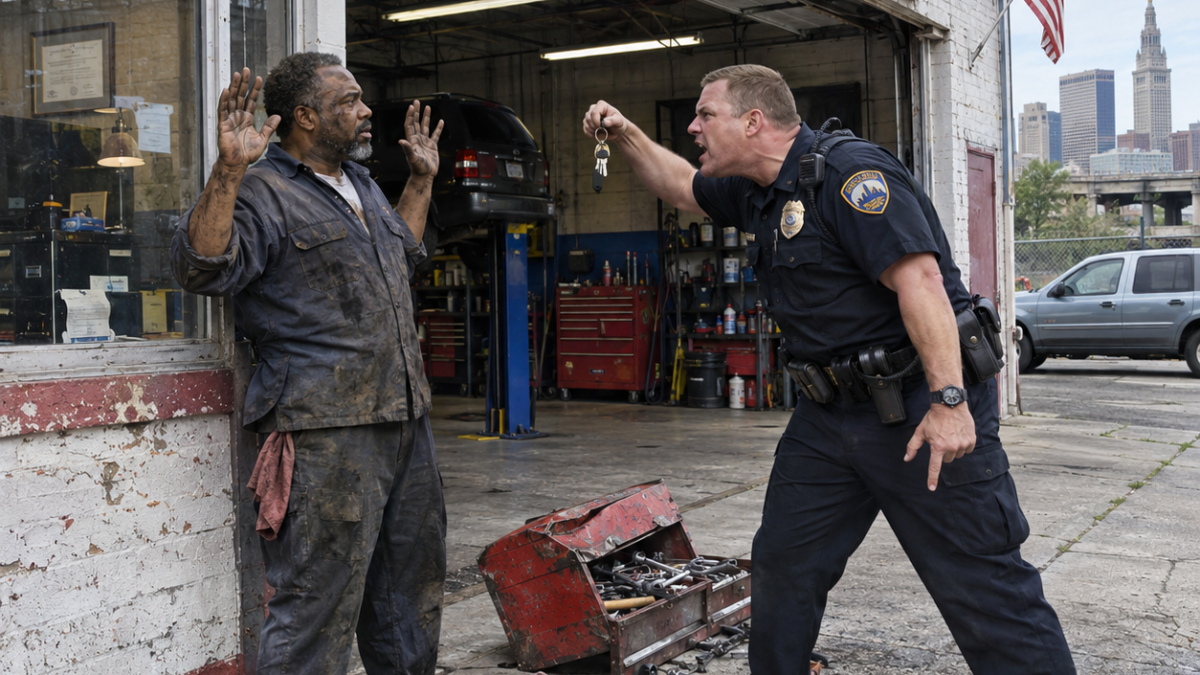
“Move Again and I’ll Cuff You!” a Cleveland Police Officer Shouted After Seizing My Keys Outside the Auto Shop I’d Owned for 22 Years. I Put Down My Wrench, Raised Both Hands, and Told Him My Business License Was Hanging Behind the Glass. He Smashed My Toolbox and Punched Me Anyway—Then I Told Him to Read the Name Above the Garage.K
Part 2:
“Move again and I’ll put you in handcuffs.”
The officer had one hand pressed against my shoulder, pinning me to the driver’s door of my own pickup. My keys were lying on the hood of his patrol car. My wrench was on the concrete where he’d ordered me to put it.
And the building behind us had my last name painted across the front in letters two feet tall.
“Officer, I’m not resisting,” I said. “This is my business.”
“Then stop talking and do what you’re told.”
“I’ve done everything you’ve asked.”
He stepped closer.
“You want to make this worse?”
I was fifty-three years old, with a bad left knee, twenty-seven years of experience working on engines, and absolutely no interest in fighting a police officer.
All I wanted was to lock my shop and go home.
It was 5:38 on a Thursday afternoon in Cleveland, Ohio. I’d spent the previous eleven hours at Collins Auto Repair, finishing a brake job, replacing a water pump, and arguing with a supplier about a radiator that had arrived damaged.
My last employee had gone home twenty minutes earlier.
The garage door was halfway down, the office light was still on, and my old Chevrolet Silverado was parked beside the service bay.
I was tightening one final bolt beneath the truck’s hood when the patrol car pulled into my lot.
The officer stepped out without greeting me.
“What are you doing here?”
I straightened.
“Finishing up a repair.”
“On whose vehicle?”
“Mine.”
He looked toward the garage.
“You work here?”
“I own the place.”
He didn’t look convinced.
His nameplate read M. REED.
I later learned his name was Mason Reed, a thirty-two-year-old patrol officer who’d been with the department for four years.
At the time, he was just an armed stranger demanding answers in the parking lot I’d owned for more than two decades.
“Put the wrench down,” he ordered.
I placed it beside my toolbox.
“Hands where I can see them.”
I raised both hands.
“Identification.”
“My wallet’s inside, but there’s a business license hanging in that office window. My name’s Andre Collins.”
He didn’t turn around.
“Don’t tell me where to look.”
“I’m trying to help you verify who I am.”
“Give me your keys.”
I hesitated.
“Why do you need my keys?”
His expression hardened.
“Because I told you to.”
The keys were already looped around my fingers. When I opened my hand, he grabbed the ring and walked toward his cruiser.
I heard metal strike metal as he tossed them onto the hood.
“Officer, those are my garage keys and truck keys. I need them to lock up.”
“You’ll get them when I’m finished.”
I could feel anger rising, but I kept my hands open.
Twenty-two years earlier, I’d borrowed money from my uncle and bought the building when it was little more than an abandoned tire warehouse. I’d replaced the roof, poured concrete for the service bays, and worked through winters when the furnace barely kept the pipes from freezing.
My father helped me paint the original sign before his arthritis became too painful for him to climb a ladder.
I had spent almost half my adult life keeping that business alive.
Now I was being treated like a trespasser standing outside its doors.
“My registration is on my phone,” I said. “It’s right there on the worktable. You can check the truck against my name.”
I indicated the phone without moving toward it.
Reed’s hand dropped toward his belt.
“Don’t reach for anything.”
“I wasn’t reaching.”
“Then keep your hands up.”
I did.
He moved closer and told me to turn around. My left knee had been stiff all afternoon from kneeling beneath a customer’s car, and I shifted my weight before turning.
Apparently, I didn’t move quickly enough.
His hand struck my shoulder.
My hip slammed against the pickup.
“Stop resisting!”
“I’m not resisting!”
Pain ran down my leg. I caught myself against the truck and raised my hands again.
Reed turned toward the red metal toolbox beside my front tire.
“Open that.”
“Why?”
“I want to see what’s inside.”
“It’s my personal toolbox. There are sockets and wrenches in it. I’m not consenting to a search.”
He stared at me.
Then he pulled the baton from his belt.
I barely had time to speak before he swung it against the toolbox lid.
The latch broke with a sharp metallic crack.
The lid twisted sideways, and several sockets spilled across the concrete.
“Hey!” I shouted.
I took one startled step toward my damaged tools.
Reed spun around, grabbed the front of my coveralls, and punched me across the left cheek.
My shoulder struck the truck as I stumbled backward.
I tasted blood where my teeth had caught the inside of my mouth.
“Don’t move!” he yelled.
He pressed his baton horizontally against my chest.
I raised my empty hands again.
“I’m not touching you. I’m not fighting you.”
For a moment, we stood there breathing hard.
My cheek throbbed. My toolbox was broken. My keys were still on his cruiser.
And I could see the tiny recording light on his body camera.
I looked past his shoulder toward the office.
“Officer Reed,” I said, forcing my voice to remain steady, “you’ve been asking me to prove that I belong here.”
“Keep your mouth shut.”
“Then turn around.”
He tightened his grip.
“Don’t give me orders.”
“Just read the name above that garage.”
For the first time since he’d arrived, his eyes moved away from me and toward the building.
The letters were impossible to miss.
COLLINS AUTO REPAIR.
Below them, in smaller blue lettering, were the words Owned and Operated by Andre Collins.
My father had insisted on putting my full name there when we painted the sign. I’d argued that it was unnecessary. Dad said a man who put everything he owned into a business ought to be proud enough to put his name on it.
For twenty-two years, customers had driven past those words.
Now Mason Reed was finally reading them.
His baton eased away from my chest.
He looked back at me.
“That’s your name?”
“Yes.”
“You have paperwork showing that?”
“Through that window. On the wall behind the counter.”
I kept my hands visible while he turned toward the office.
The framed license was hanging exactly where it had been since the previous renewal. My name appeared beneath the business information.
Reed stared through the glass.
Then he looked at my truck.
“Registration?”
“On the phone I tried to show you before you hit me.”
His jaw tightened.
“Watch your tone.”
I didn’t answer.
After another moment, he allowed me to retrieve the phone from the worktable.
I moved carefully, because my knee was aching and I no longer trusted him to interpret an ordinary movement correctly.
I opened the vehicle information I’d saved from my registration and showed him the license plate number.
It matched the Silverado.
The registered owner was Andre Collins.
Reed looked at the screen, then at the plate.
I waited.
He handed back the phone.
“All right. You can go.”
I stared at him.
“That’s it?”
“What?”
“You took my keys, pushed me into my own truck, destroyed my toolbox, and punched me in the face.”
“You made several movements after being instructed not to.”
“I put down the wrench. I kept my hands up. I stopped when you told me to stop.”
“You got aggressive when I checked your equipment.”
“You smashed my toolbox with a baton.”
His expression hardened.
“Do you want to be detained?”
I looked at the body camera.
“No, Officer Reed. I want your supervisor.”
He didn’t answer immediately.
Then he walked to his patrol car, retrieved my keys, and placed them on the hood of my pickup.
“Contact the department if you have a complaint.”
He returned to his cruiser.
I watched him back out of the lot.
No apology.
No explanation of what had made him suspect a burglary.
He hadn’t even asked whether I needed medical attention.
For several minutes, I stood beside the Silverado, looking at the keys lying on its hood.
They were my keys.
The truck was mine.
The garage was mine.
Every document he’d finally examined confirmed what I’d told him before he touched me.
I picked up the keys and called the police department’s nonemergency number.
I explained what had happened and asked to speak with a supervisor.
The dispatcher took my location and told me someone would contact me.
I didn’t go inside immediately.
I took pictures of the toolbox, the scattered sockets, the dent in my truck door, and the marks on my face.
Then I photographed the entire parking lot, including the sign above the garage and the office window.
My hands were shaking so badly that several pictures came out blurry.
I took them again.
Inside the office, I found a clean towel and pressed it against my cheek.
The left side of my face was swelling.
I washed the blood from my mouth, then sat at the counter where I’d written customer invoices for more than two decades.
My daughter, Naomi, had sent me three text messages.
Dad, are you still at the shop?
Dinner’s getting cold.
Everything okay?
Naomi was twenty-seven. She worked at a public library and had recently moved into an apartment ten minutes from my house.
We usually ate dinner together on Thursdays.
I called her.
“Hey, sweetheart.”
“Dad, where are you?”
“At the garage.”
“What’s wrong with your voice?”
I looked toward the window.
“Something happened with a police officer.”
“What kind of something?”
“He thought I was breaking into the shop.”
She laughed once.
Then she realized I wasn’t joking.
“Dad?”
“He hit me, Naomi.”
Silence.
Then she said, “I’m coming.”
“Sweetheart, I’m all right.”
“You just told me a police officer hit you. I’m coming.”
She hung up before I could argue.
About fifteen minutes later, a patrol supervisor arrived.
Sergeant Denise Walker introduced herself and asked whether I wanted medical assistance.
I told her I intended to go to urgent care.
She photographed the damaged toolbox and my cheek, took my account of the encounter, and wrote down Reed’s name and patrol car number.
“Was there a burglary report?” I asked.
“I’ll need to review the dispatch records.”
“Did somebody call about me?”
“I can’t answer that until I’ve checked.”
I appreciated that she didn’t pretend to know.
She explained how to submit a formal complaint and gave me a reference number for her initial report.
Before leaving, she looked at the sign above the garage.
“How long have you owned this place, Mr. Collins?”
“Twenty-two years.”
She nodded slowly.
“I’ll make sure your complaint reaches the appropriate people.”
I wanted to believe her.
But I had believed that a business license, a vehicle registration, and a sign with my name on it would be enough to prove I belonged at my own shop.
That afternoon had changed my understanding of what ought to be enough.
Naomi arrived before the sergeant had finished.
She took one look at my face and stopped walking.
“Oh, Dad.”
“It’s not as bad as it looks.”
“Don’t do that.”
“Do what?”
“Tell me not to worry when your face is swollen.”
She put her arms around me.
I hadn’t realized how badly I needed that until she did.
We went to urgent care.
The doctor examined my cheek, shoulder, and hip. My left knee was swollen, and I had a cut inside my mouth, but the initial evaluation found no fracture or other injury requiring emergency surgery.
I was told to rest, use ice as directed, and return if certain symptoms developed.
The doctor documented my injuries and gave me copies of the visit summary.
Naomi drove me home.
For most of the ride, she was quiet.
Then she asked, “Did you do anything to make him think you were dangerous?”
I turned toward her.
She immediately shook her head.
“I don’t mean you did something wrong. I’m trying to understand how it happened.”
“I was holding a wrench when he pulled in.”
“Then what?”
“He told me to put it down, so I put it down.”
“And after that?”
“I tried to show him who I was.”
She gripped the steering wheel.
“That’s what doesn’t make sense.”
I looked out at the passing houses.
“No,” I said. “It doesn’t.”
That evening, Naomi brought me dinner and stayed while I wrote everything down.
I recorded the time the patrol car arrived, the questions Reed asked, the order of his commands, and each time I’d tried to show him the sign, license, or registration.
I wrote about the toolbox.
About the punch.
About the way he’d changed his explanation after finally seeing my name on the building.
I also saved the photographs, medical paperwork, and Sergeant Walker’s reference number.
Naomi noticed something I hadn’t considered.
“Dad, doesn’t your shop have a security camera pointed toward the parking lot?”
I looked up.
The camera above the main service bay.
I’d installed it after someone stole catalytic converters from two customers’ cars.
It wasn’t aimed directly at the area beside my Silverado, but part of the driveway and toolbox should have been visible.
I opened the camera application.
The recording was there.
From the high angle, I could see Reed’s patrol car entering the lot.
I could see myself placing the wrench on the ground.
I could see Reed taking my keys.
The picture didn’t show every detail clearly, but it showed enough to establish the positions of both men.
When the baton struck the toolbox, the movement was unmistakable.
The punch happened partly behind the truck’s open hood, but the camera captured Reed grabbing my coveralls and my body jolting backward.
Naomi watched silently.
When the recording ended, she turned toward me.
“Dad, you didn’t go after him.”
“I know.”
“You took one step because he broke your toolbox.”
“I know.”
“Then why did he say you were resisting?”
I didn’t have an answer.
I saved a copy of the recording to an external drive and left the original stored in the camera system.
Before going to bed, I took another photograph of my face.
The swelling had gotten worse.
I stood in front of the bathroom mirror, studying the purple mark forming beneath my eye.
For most of my life, I’d believed that if I stayed calm, worked hard, and explained myself clearly, a misunderstanding could be resolved.
I’d built a business on those habits.
Customers trusted me to tell them when their cars needed expensive repairs and when they didn’t.
Employees trusted me to pay them on time.
My daughter trusted me to answer the phone when she needed help.
Now I was looking at a bruise caused by a man who’d asked questions and refused to listen to the answers.
I couldn’t make sense of that.
And I wasn’t willing to pretend it was finished just because he’d driven away.
Luis Ortega arrived at the garage at seven the next morning.
He’d worked for me for eight years, starting as an apprentice and gradually becoming the mechanic I trusted with the most difficult jobs.
When he saw the toolbox, he stopped.
“What happened to your tools?”
Then he looked at my face.
“Andre, who did that?”
I explained.
He listened without saying a word.
When I finished, he walked outside and studied the tire marks where the patrol car had been parked.
“Somebody should’ve called me.”
“What would you have done?”
“Been here.”
I looked at him.
“You would’ve seen the same thing I did.”
“Maybe. But you wouldn’t have been alone.”
That was Luis.
He wasn’t a man who talked much about loyalty. He just showed up when a job needed doing.
We spent the morning recovering the scattered sockets and sorting through the damaged tools.
The toolbox’s lid was bent beyond practical repair. The latch had broken, and several pieces of equipment had been damaged when they struck the concrete.
I had owned that toolbox for seventeen years.
My father had given it to me after the garage’s fifth anniversary.
He’d bought it secondhand, sanded the worst scratches, and painted it red.
It wasn’t especially valuable compared with the modern equipment inside the shop.
But it was mine.
I stood over the broken lid longer than I expected.
Luis noticed.
“We can fix some of it,” he said.
“Not all of it.”
“No.”
He waited.
Then he added, “We don’t have to throw it away today.”
I nodded.
“Put it in the storage room.”
We had customer vehicles scheduled for pickup that afternoon.
I could have canceled everything, but I needed the work, and I didn’t want the incident to shut down the business.
Luis handled the heavier repairs while I managed invoices and ordered parts.
By lunchtime, my cheek had begun throbbing again.
I took the medication recommended by the doctor and rested in the office.
At two, a regular customer named Mrs. Evelyn Bell arrived to collect her Buick.
She’d brought her car to my shop since her husband was alive.
When she saw my face, she frowned.
“Andre Collins, what happened to you?”
I hesitated.
“Had a disagreement with somebody yesterday.”
She leaned closer.
“Looks like somebody disagreed with a fist.”
I managed a smile.
“Something like that.”
She didn’t press.
But before leaving, she put her hand over mine.
“Your father used to tell me that you were too stubborn to quit anything worth finishing.”
I laughed softly.
“He had a point.”
“Then whatever this is, don’t let it finish you.”
That evening, Naomi helped me submit a formal complaint to the department.
We included a detailed statement, photographs, medical documentation, and a description of the garage camera recording.
I specifically requested preservation of Officer Reed’s body-camera footage, patrol vehicle recordings, dispatch records, radio communications, and any reports connected with the encounter.
Naomi also helped me contact a civil rights attorney named Erica Benton.
Erica had handled police misconduct and municipal liability cases in northeastern Ohio for nearly fifteen years.
She agreed to meet us the following Monday.
I brought everything.
Photographs.
Medical bills.
Business records.
The security camera recording.
My written timeline.
Erica examined the documents before asking me to describe the incident from the beginning.
She didn’t interrupt.
When I finished, she asked, “Did Officer Reed explain why he approached you?”
“He said he wanted to know what I was doing beside a closed garage.”
“Did he mention a burglary call?”
“No.”
“Did he say your truck had been reported stolen?”
“No.”
“Did he tell you that you were under arrest?”
“No.”
She made notes.
“Did you threaten him?”
“No.”
“Did you raise the wrench toward him?”
“No. I put it down when he told me to.”
“Did you try to strike him after he damaged the toolbox?”
“No.”
Erica leaned back.
“I want to be careful about what I tell you. An officer can approach someone and ask questions. Depending on the circumstances, there may also be grounds for a temporary detention. But every use of force still has to be evaluated based on what the officer reasonably knew and what was happening at that moment.”
I nodded.
“I’m not asking you to say he couldn’t speak to me.”
“What are you asking?”
“That somebody explain why speaking to me turned into punching me.”
She studied me.
“That’s exactly the question the evidence needs to answer.”
Erica agreed to represent me in pursuing the matter.
She explained that the administrative investigation and any civil claim would follow different processes and that neither would necessarily move quickly.
She also warned me against publicly circulating edited clips of the encounter before the evidence had been preserved and reviewed.
“I know people will tell you to put this online immediately,” she said. “You have every right to discuss what happened. But I’d rather establish the complete record than let the case become an argument over a fifteen-second video.”
I considered that.
“I’m not trying to become famous.”
“What do you want?”
I thought about the broken toolbox, the medical bills, and the feeling of being trapped against my own truck.
“I want the department to examine what he did. I want the damage paid for. And I want him to understand that having a badge doesn’t mean every answer he dislikes is resistance.”
Erica nodded.
“Then we’ll start there.”
The following week, the department confirmed that my complaint had been assigned to Internal Affairs.
Lieutenant Daniel Harper contacted me to schedule an interview.
He was forty-six, with close-cropped hair and the patient manner of someone accustomed to hearing accounts of difficult encounters.
We met in an interview room at police headquarters.
Erica sat beside me.
Harper began by explaining that he was examining Reed’s conduct, including the initial contact, the seizure of my keys, the damage to the toolbox, the physical force, and the accuracy of the officer’s written account.
“I understand this was upsetting, Mr. Collins,” he said. “I’m going to ask you some detailed questions because the order of events matters.”
“That’s fine.”
He opened a notebook.
“When Reed approached, were you holding the wrench?”
“Yes.”
“What did you do when he ordered you to put it down?”
“I placed it on the concrete.”
“Before or after he took your keys?”
“Before.”
“Did you retrieve the wrench at any point?”
“No.”
Harper continued through the encounter.
He asked about the phone, the keys, my knee, the toolbox, and the single step I’d taken after the baton struck the metal lid.
I answered as precisely as I could.
Then he asked something I hadn’t expected.
“Why did you take that step?”
I looked at him.
“Because he smashed my toolbox.”
“Were you moving toward Officer Reed?”
“I was moving toward the tools. He was standing beside them, but I wasn’t trying to touch him.”
“How far did you move?”
“One step. I stopped when he turned.”
Harper made another note.
“Did you say anything?”
“I shouted, ‘Hey.’ Then he grabbed me.”
He closed his notebook.
“Thank you.”
I hesitated.
“Lieutenant, can I ask you something?”
“Certainly.”
“Why didn’t he look at the sign?”
Harper’s expression remained neutral.
“That’s one of the decisions we’re reviewing.”
“My name was right above his head.”
“I understand.”
“I didn’t expect him to believe everything I said without checking. I expected him to check.”
Harper nodded.
“That distinction is important.”
After the interview, Erica walked with me to the parking garage.
“How do you think it went?” I asked.
“You gave a consistent account and answered his questions directly.”
“Do you think he believes me?”
“His job isn’t to decide based on whether he likes you. His job is to examine the evidence.”
I thought about that during the drive home.
For the first time since the confrontation, somebody seemed interested in what had happened between the commands, not just what Reed had claimed I’d done.
Several weeks passed.
The garage continued operating, but I wasn’t quite the same.
Before the incident, I often stayed late to work on my pickup.
Those quiet evenings had been my favorite part of owning the place.
No ringing phones.
No customers waiting for estimates.
Just the smell of oil and the sound of a ratchet turning beneath the hood.
Now I found myself checking the street whenever a patrol car passed.
Sometimes I’d hear tires on the driveway and feel my shoulders tighten before I even looked up.
I hated that.
I had spent twenty-two years making Collins Auto Repair a place where I felt comfortable.
I wasn’t going to let one officer turn it into somewhere I feared being alone.
But telling myself that didn’t make the reaction disappear.
Naomi noticed.
One evening, she stopped by while I was closing.
“You’re checking the road again,” she said.
“Am I?”
“Third time since I got here.”
I looked away.
She leaned against the counter.
“Dad, you don’t have to pretend you’re fine.”
“I’m still working.”
“That wasn’t what I said.”
I sighed.
“Every time a patrol car passes, I wonder whether somebody’s going to pull in and start the whole thing again.”
She was quiet.
Then she said, “Maybe you should talk to somebody.”
“I’ve talked to the lawyer. I’ve talked to Internal Affairs.”
“I mean someone who can help you with what happened to you, not just the paperwork.”
I looked at her.
She didn’t push.
Instead, she picked up the stack of invoices beside the register.
“Come on. I’ll help you finish so we can get dinner.”
Over the following month, I met several times with a counselor who worked with people recovering from frightening incidents.
I didn’t suddenly become fearless.
But I began recognizing the moments when my body reacted to a memory rather than something happening in front of me.
That helped.
So did having Naomi and Luis around.
Neither treated me like a helpless man.
They simply made sure I didn’t have to carry every part of the experience alone.
The investigation took an important turn when Erica received notice that the department had completed its initial evidence preservation and was allowing a supervised review of the relevant body-camera footage.
The appointment was at police headquarters.
I went with her.
I’d seen the recording from my own security camera, but that footage came from high above the service bay.
It didn’t capture everything that happened between Reed and me.
The body camera was different.
It showed the encounter from the officer’s chest.
At first, I barely recognized my own voice.
I sounded calm when he asked what I was doing.
I heard myself explain that the truck belonged to me.
Then came the command to drop the wrench.
On the video, I placed it on the concrete almost immediately.
Reed stepped closer.
I told him the business license was behind the office glass.
He didn’t turn.
I offered to show him the registration on my phone.
He ordered me not to move.
I stopped.
Then he took the keys.
Hearing them strike the hood of his patrol car made my stomach tighten.
The next section moved quickly.
Reed ordered me to turn.
I shifted my weight because of my knee.
He shoved me against the pickup.
I heard myself say, “I’m not resisting.”
Then he moved toward the toolbox.
I watched the baton strike.
The metal lid snapped open.
My body moved one step.
Exactly one.
My hands remained open.
Before I could move again, Reed grabbed my coveralls.
The camera jolted as he struck my cheek.
I heard the impact.
For a moment, the image showed the side of my Silverado, the concrete beneath my feet, and part of Reed’s arm.
Then his baton pressed across my chest.
My hands were visible above it.
I looked away from the screen.
Erica touched my arm.
“We can pause.”
I nodded.
I needed a minute.
The video continued after I was ready.
There was my voice telling him to read the sign.
There was the moment he finally turned around.
And there was the long silence afterward.
When the recording ended, Erica asked whether I wanted to watch it again.
“No,” I said.
I didn’t need another look.
The first time had been enough.
Harper’s investigation focused heavily on a seventy-three-second sequence beginning with Reed taking my keys and ending shortly after the punch.
That section contained nearly every decision that had turned the encounter from questioning into force.
It also exposed problems with Reed’s written report.
The report described me as a suspicious individual standing beside a closed business while holding a wrench.
That part was true.
But it didn’t make clear how quickly I’d put the tool down after being ordered.
The report referred to me reaching toward an unidentified object.
The recording showed that I’d already explained my phone contained the truck registration and that I’d stopped moving when Reed instructed me not to touch it.
Reed described my behavior as increasingly aggressive.
The camera showed me keeping my hands visible and repeatedly offering information that could verify my explanation.
His report also stated that I’d advanced toward him after being ordered to remain still.
Technically, I had taken one step.
But the report didn’t explain that Reed had just smashed my toolbox, that my movement was toward the scattered tools, or that I’d stopped before reaching him.
Those missing details mattered.
Without them, someone reading the report could imagine a man charging at an officer.
The video showed something different.
Reed had also described striking the toolbox as a safety measure connected to checking its contents.
But the recording showed no specific threat coming from the closed metal box.
It showed him striking the lid with his baton after I’d questioned the need for a search.
Erica explained that investigators would have to evaluate each action in context.
Not every error in a report proved deliberate dishonesty.
Not every movement an officer considered concerning justified physical force.
The question was whether the record accurately described what happened and whether Reed’s response was reasonable under the circumstances.
Then the dispatch records arrived.
There had been no burglary call from Collins Auto Repair.
No activated alarm.
No report of someone breaking into the building.
My truck had not been reported stolen.
Reed had noticed me while passing, turned into the parking lot, and initiated the contact himself.
That didn’t necessarily make it wrong for him to approach me.
I understood that.
A man working with a wrench outside a nearly closed business might reasonably attract an officer’s attention.
But there was a difference between asking someone what he was doing and refusing to consider the answer.
Reed could have checked the license plate.
He could have looked through the office window.
He could have read the sign.
Instead, each time I tried to provide proof, the situation became more aggressive.
The body camera showed that the escalation wasn’t caused by new evidence of wrongdoing.
It happened while the original uncertainty could have been reduced.
That was the part I couldn’t stop thinking about.
One afternoon, Erica called to explain that Harper wanted a follow-up interview.
This time, he had specific questions about my truck, the keys, and the layout of the garage.
We met again at headquarters.
Harper placed a diagram of the parking lot on the table.
“I want to understand the distances,” he said.
He pointed to the location where Reed’s patrol car had been parked.
“Was this the position of the vehicle?”
“Approximately.”
“And your toolbox was beside the truck’s front tire?”
“Yes.”
“After Reed struck the toolbox, where did you move?”
I pointed to the spot.
“About here.”
Harper measured the distance against the diagram.
“Did you attempt to retrieve the keys from his patrol car?”
“No.”
“Did you ever grab his baton?”
“No.”
“Did you strike him?”
“No.”
He nodded.
Then he showed me an enlarged still frame from the body camera.
My hands were visible.
Both were open.
The baton was across my chest.
I looked at the picture for several seconds.
“That was after he punched me.”
“Yes.”
“I remember thinking that if I touched his arm, he’d say I was fighting him.”
Harper watched me.
“So you kept your hands up?”
“Yes.”
He wrote that down.
At the end of the interview, I asked whether Reed had explained why he ignored the sign.
Harper chose his words carefully.
“Officer Reed has provided an account of his perception of the situation. We evaluate that account against the available evidence.”
“Do you believe I was trying to hurt him?”
“I can’t give you a conclusion before the review is complete.”
I nodded.
He added, “But I can tell you the footage has been examined closely, including the order in which you complied with commands.”
That was all he could say.
I appreciated that he didn’t promise an outcome he wasn’t authorized to deliver.
By then, the case had been open for months.
A local reporter contacted me after learning that a complaint involving force had been filed against a patrol officer.
She wanted an interview outside the garage.
I declined.
I didn’t want cameras crowding the lot while customers were trying to pick up their cars.
I didn’t want strangers arriving to take pictures of the sign.
I wanted to keep fixing vehicles.
One afternoon, a customer asked whether I was the mechanic involved in the police complaint.
“Yes,” I said.
He looked embarrassed.
“I hope it gets sorted out.”
“So do I.”
Then I asked him whether the new brakes on his truck were working properly.
He smiled.
“Perfectly.”
We talked about brakes for ten minutes.
It was the first completely ordinary conversation I’d had with a stranger about the garage in weeks.
I hadn’t realized how much I’d missed that.
During the investigation, the department also reviewed Reed’s training records and his explanation of the encounter.
He maintained that he’d been concerned about officer safety because I was initially holding a wrench and because he believed my movements were unpredictable.
The review didn’t dismiss the possibility that the wrench had concerned him when he first arrived.
But the camera showed that I’d placed it on the ground when instructed.
It never returned to my hand.
The phone remained on the worktable.
My keys were taken while I was standing beside the truck.
And my single step occurred immediately after Reed damaged the toolbox.
The more the investigators reconstructed the timeline, the harder it became to treat the entire encounter as one continuous threat.
Different moments required different judgments.
A concern that might have been reasonable during the first few seconds didn’t automatically justify everything Reed did afterward.
The review also identified the places where he could have slowed down.
He could have checked the business license.
He could have confirmed the truck registration.
He could have examined the sign.
He could have asked me to retrieve my identification while maintaining a safe distance.
Each of those possibilities existed before the encounter became physical.
By the time Reed punched me, the footage showed I’d already complied with several instructions and had made no attempt to strike him.
I tried not to become obsessed with the outcome.
But some nights, after the shop was closed, I found myself sitting at the kitchen table replaying the same questions.
What if I’d turned a little faster?
What if I’d left my wrench in the toolbox before the patrol car arrived?
What if I’d kept my mouth shut when he took the keys?
Naomi caught me doing it one evening.
“Dad, you keep asking what you could have done differently.”
“I know.”
“Did you have a crystal ball telling you a police officer would punch you for standing beside your own truck?”
I almost smiled.
“No.”
“Then stop pretending you were responsible for predicting every bad decision he made.”
I looked down at my hands.
“I just don’t want something like that happening again.”
“Neither do I.”
She sat across from me.
“But that’s why you’re pursuing the complaint. So the decisions he made get examined, not so you can spend the rest of your life blaming yourself for them.”
She had grown into a wiser person than I remembered raising.
I told her so.
She laughed.
“That’s because you taught me to speak up when something isn’t right.”
I thought about my father.
He’d been a mechanic too.
He wasn’t a wealthy man, and he hadn’t left me much money.
But he’d taught me that when you made a mistake, you admitted it and corrected it.
If a customer’s brakes weren’t safe, you told him.
If you damaged something while making a repair, you paid for it.
And if someone asked a fair question, you answered it honestly.
I wondered what he’d think of the whole situation.
Then I realized I already knew.
He’d want the facts checked.
And he’d want me back at work.
Six months after the encounter, Erica called.
“The administrative review is complete.”
I was standing beside a customer’s Honda, checking the cooling system.
I put down my flashlight.
“What did they find?”
She paused.
“Several of your allegations were sustained.”
I closed my eyes.
The department had concluded that Reed’s use of force was not justified by the recorded circumstances.
The review also found that damaging my toolbox was improper and that his written account failed to accurately convey important parts of the encounter.
The findings addressed his seizure and handling of my property, the escalation after I complied with commands, and the failure to use reasonable opportunities to verify my explanation.
The department had removed Reed from ordinary patrol duties during the later stages of the investigation.
Following a separate disciplinary process, he was dismissed from the department.
His right to challenge that employment decision through the applicable procedures remained, but the administrative findings themselves were now documented.
I sat down on a stool.
For months, I’d imagined hearing that the department had found something wrong with what happened.
Now the words were real.
“How do you feel?” Erica asked.
I looked at my hands.
“Relieved.”
I hesitated.
“And tired.”
“I understand.”
“Does this mean the city will pay for the damage?”
“The civil claim is still separate. But the findings strengthen our position.”
I nodded.
I knew it wouldn’t be finished overnight.
Still, the report meant something important.
The official record no longer consisted only of Reed’s description of me as an uncooperative man who’d required force.
It also contained a detailed account of what the camera showed.
The wrench being placed down.
The phone left untouched.
The keys being taken.
The toolbox being smashed.
The single step.
The punch.
And the sign that had been there from the beginning.
A few weeks later, Erica arranged a meeting with representatives handling the city’s civil claim process.
We discussed the medical expenses, damage to my tools and truck, lost work time, and the emotional effects of the incident.
The city initially offered to reimburse some of the direct expenses without resolving the broader claim.
Erica explained why that wasn’t sufficient.
The problem hadn’t ended with a broken toolbox or a bruised cheek.
I’d been subjected to force while complying with instructions, and the written account had created an inaccurate picture of my behavior.
The administrative findings supported that concern.
Negotiations continued.
We eventually reached a settlement that covered my documented losses and provided additional compensation for the injuries and distress I’d experienced.
The agreement didn’t require me to pretend the incident hadn’t happened or withdraw the factual statements I’d made.
I didn’t receive a fortune.
I received enough to pay the remaining medical expenses, replace the damaged equipment, and recover the financial losses connected to the encounter.
More importantly, the department’s findings remained part of the record.
I asked Erica whether I should feel happier.
She smiled gently.
“You don’t have to feel any particular way.”
I thought about that.
For months, I’d expected justice to arrive like a dramatic moment in a movie.
Somebody would apologize.
Somebody would admit they’d been wrong.
Somebody would finally tell me I hadn’t imagined what happened.
Instead, it came through reports, interviews, meetings, and pages of carefully written findings.
There wasn’t a crowd cheering outside a courthouse.
There wasn’t a microphone waiting for me.
There was simply a documented conclusion that Reed’s actions had been improper, followed by consequences that hadn’t existed before the investigation.
That was enough for me to begin moving forward.
The department also reviewed its procedures for documenting encounters and evaluating force after a person had complied with commands.
I didn’t pretend one review would prevent every future mistake.
But the recommendations addressed something I’d been saying from the beginning.
An officer could ask questions.
He could investigate suspicious circumstances.
He could protect himself when there was a genuine threat.
But he also had to recognize when information changed the situation.
A wrench placed on the ground wasn’t still a wrench being held.
A phone identified as containing registration wasn’t automatically a concealed weapon.
A startled step toward damaged property wasn’t the same as an attack.
The difference mattered.
It had mattered to me while I stood against the pickup.
And it mattered in the investigation that followed.
Nearly a year after the confrontation, Collins Auto Repair looked much the same as it always had.
The red toolbox had been replaced.
The new one wasn’t quite as sturdy as the old one, but Luis had already covered its surface with enough grease marks and scratches to make it look familiar.
The truck’s dent had been repaired.
I finally fixed the small scratch along the door where I’d struck the metal during the shove.
The office license remained behind the glass.
The sign still stood above the garage.
Naomi came by one Friday afternoon carrying a container of homemade chicken soup.
I was finishing a repair beneath the hood of my Silverado.
She stopped beside me.
“Dad, you’re working late again?”
“Just one last adjustment.”
She looked toward the street.
Then she looked back at me.
“You okay staying here?”
I considered the question.
There had been a time, shortly after the incident, when I wouldn’t have wanted to be alone in the lot after closing.
Now I felt more like myself.
“Yeah,” I said. “I’m okay.”
She smiled.
“Good. Because I brought dinner, and I’m not eating cold soup.”
I laughed.
“Give me five minutes.”
She carried the container inside.
I tightened the last bolt, checked the connection, and closed the hood.
The sun was beginning to sink behind the buildings across the street.
A patrol car passed on the road.
For a moment, I watched it.
It didn’t slow down.
It didn’t turn into my driveway.
It continued toward the intersection and disappeared.
I looked back at the garage.
Twenty-two years earlier, my father had stood on a ladder painting our family name across the front of that building.
I remembered him climbing down, wiping blue paint from his fingers, and asking whether the letters were straight.
I’d told him one side looked a little crooked.
He’d stepped back, studied the sign, and shrugged.
“People will know where they are,” he’d said.
For more than two decades, they had.
Customers came because they trusted me with their cars.
Employees stayed because they knew I’d treat them fairly.
Neighbors stopped by when they needed a tire inflated or a battery checked.
The sign had never been intended to prove anything about me.
It was simply the name of the business I’d built.
I reached into my pocket and took out my keys.
The same familiar ring.
Truck key.
Office key.
Service bay key.
A small brass tag my father had given me years earlier.
I turned it over in my palm.
For a while, those keys had reminded me of the afternoon someone took them away and refused to believe they belonged to me.
Now they felt ordinary again.
I walked to the service bay, lowered the door, and checked the lock.
Naomi called from inside.
“Dad, the soup’s getting cold!”
“Coming!”
I glanced up at the sign one last time.
COLLINS AUTO REPAIR.
My father had painted those letters long before Mason Reed drove into the parking lot.
They had been there while I was being questioned.
They had been there when I was shoved, struck, and threatened with handcuffs.
And they remained there after every report, recording, and investigation confirmed what I’d told the officer from the start.
I hadn’t needed a special title, powerful connections, or some hidden authority to deserve fair treatment.
I’d been a mechanic closing his own shop.
That should have been enough.
I turned off the office light, locked the door, and went inside to have dinner with my daughter.