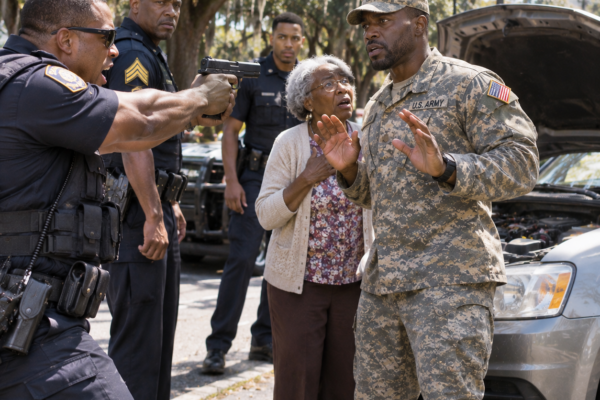
“Hands Up, Now,” the Detective Shouted as He Pointed His Gun at Me Outside a College Fundraiser. I Was a 65-Year-Old Black Federal Judge Driving a Silver Sedan, Not the Young Robbery Suspect in a Dark SUV. When He Found My Judicial Credentials, He Lowered the Gun—But That Night, His Department Claimed I’d Reached for a Gun.K
Part 2:
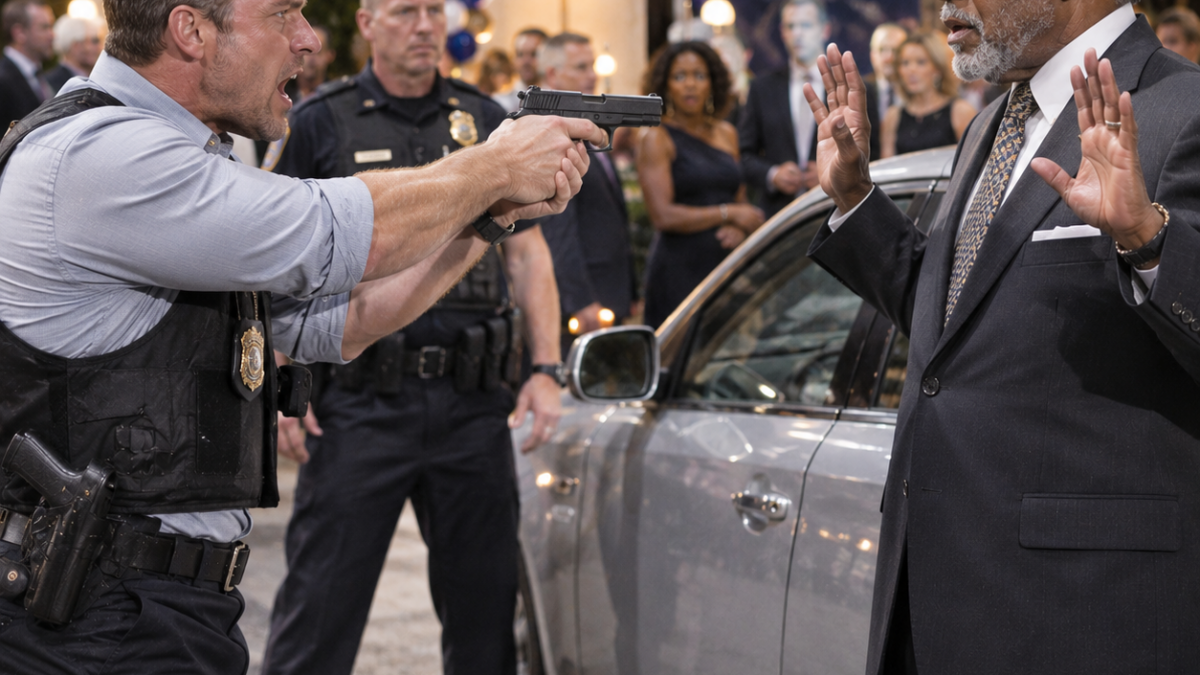
“Hands where I can see them. Now.”
The detective’s pistol was pointed at my chest before I had taken my car keys out of my purse.
I stood in the parking lot of Westbridge Community College, ten miles outside Richmond, with my scholarship luncheon program tucked under one arm. Rainwater shone on the pavement. Students were crossing between the brick buildings. One of them stopped when he saw the gun.
“My hands are right here,” I said, holding them away from my body. “Please tell me why you’ve stopped me.”
“A robbery suspect,” the detective said. “Black female, dark vehicle.”
I looked toward my silver Lexus sedan. “What age?”
“Don’t get smart.”
“I’m sixty-five.”
“Then act like it and follow instructions.”
The younger officer behind him shifted uneasily. His nameplate read BELL. The detective’s read KEENE.
I had been a federal district judge for thirteen years, after more than a decade on the state bench. I knew the difference between a lawful investigative stop and an officer making the facts up as he went. But I also knew what happened when someone with a gun decided that a calm question was an act of defiance.
So I stayed still.
Detective Travis Keene motioned toward my purse. “Open it.”
“I’ll keep my hands visible,” I told him. “But I don’t consent to a search.”
“You can argue downtown.”
He reached for the bag himself. My key fob slid from the outside pocket and struck the wet pavement with a plastic click.
“Gun!” he shouted.
He moved his weapon closer.
“That’s a car key,” Officer Bell said sharply. “Travis, it’s a key.”
I couldn’t see Keene’s face clearly beyond the barrel. I could see the little red light on Bell’s body camera. Across the lot, the student was holding up a phone.
“Turn around,” Keene ordered.
I turned slowly. He pressed me against the cold hood of my own car and searched my purse. The humiliation was almost secondary to the fear: one wrong movement, one misunderstanding, and my daughter might receive a phone call no mother should force on her child.
Keene pulled out my credential wallet. He opened it, read the identification inside, and stopped.
HON. MARION WHITFIELD. UNITED STATES DISTRICT JUDGE.
He stepped away as though the pavement had shifted beneath him.
“Judge?”
I straightened my coat. My hands were trembling now, but I kept my voice level.
“The question you should be asking,” I said, “is whether you would have put that gun away if I’d been somebody else.”
Neither officer answered.
Keene handed back my belongings. He offered no apology. Bell watched me carefully as I picked up the key fob, then the luncheon program, both wet at the edges.
I drove home without turning on the radio. At a traffic light, I noticed I’d gripped the steering wheel so tightly that my fingers hurt. My husband, David, had been gone three years. He used to reach over from the passenger seat and loosen my hands when I drove angry. There was no one beside me now.
At 8:46 that evening, the Riverton Police Department released a statement. It said officers had stopped a woman reasonably believed to match an armed robbery suspect. It said she’d made a sudden movement toward an object believed to be a firearm. It described the encounter as a necessary safety response.
By then my daughter, Camille, had already seen an eighteen-second video posted by the student in the parking lot. She drove from Richmond without calling ahead. We’d barely spoken in eleven weeks, not since an argument about how much time I’d spent in court during the last months of her father’s life.
She stood in my kitchen wearing a raincoat, held up her phone, and showed me the video. On the screen, I raised my hands while Keene pointed his pistol straight at me.
“Mom,” she said, “we have to put everything out there tonight.”
I looked from her phone to the police statement on my tablet. Then I remembered the body camera flashing on Officer Bell’s chest—and the silence when Keene told him to stop talking.
“First,” I said, “we need to make sure they can’t erase what that camera saw.”
Camille wanted to call every reporter she knew. I wanted to call my lawyer.
“You are a reporter,” I said, putting her phone facedown on the kitchen table. “You know how easily a story changes once people start choosing which seventeen seconds to show.”
“Eighteen,” she corrected. “And the eighteen seconds I have show a gun pointed at your face.”
“They do. But the video doesn’t show what dispatch told those officers. It doesn’t show whether the cameras were recording, or what happened after the student stopped filming.”
“He didn’t have a reason to stop you.”
“Then we can prove it.”
She made a frustrated sound and went to the sink, where she stood with her back to me. For eleven weeks we’d communicated through messages about bills and birthdays, never anything that required us to say what we meant. I wasn’t prepared to repair our relationship at ten on a Friday night. But having her in my kitchen was a relief I could barely acknowledge.
I called Lydia Marsh, a civil-rights attorney who had represented public employees and private citizens for more than twenty years. I didn’t ask anyone at the courthouse to intervene. I told Lydia exactly what had happened, including what I’d said and what I hadn’t. She asked whether I’d sought medical attention. I had a bruise forming on my forearm where Keene had pinned it against the car. She suggested I have the injury documented and write a detailed account before my memory became crowded with other people’s versions.
The preservation letters went out that night: the police department, the college, the city’s camera contractor, and the dispatch center. Lydia asked them to retain body-camera footage, cruiser recordings, radio traffic, computer-aided dispatch entries, incident reports, and all messages connected to the stop. The letters couldn’t guarantee compliance, but they established notice. On Monday, she would pursue formal legal process for anything the department refused to preserve or disclose.
“You think they’ll destroy evidence?” Camille asked.
“I think someone has already chosen to write a statement that isn’t true. I don’t intend to assume that person will stop there.”
At eleven I finally noticed the overnight bag beside the stairs. Camille had brought enough clothes for several days.
“I’m staying,” she said before I could ask.
“I wasn’t going to object.”
She looked surprised. I couldn’t blame her. Since David died, I had become very good at making the house sound as though it had no room for anybody else’s grief.
The police chief called at eight the next morning. Roland Pike had led the Riverton department for a decade and was famous for appearing at every civic breakfast with a carefully practiced smile. I put the call on speaker so Camille could hear.
“Judge Whitfield, I’d hoped we could resolve yesterday’s unfortunate incident quietly,” he began.
“The public statement wasn’t quiet, Chief.”
“We’re conducting an internal review. Detective Keene reacted to a potential armed suspect.”
“What was the incident number for that robbery?”
“I’d rather not discuss active investigative information over the telephone.”
“Then have your department provide it to my attorney.”
He sighed. “You have a distinguished career, Judge. So do some of the people involved here. It would be regrettable to damage reputations over an encounter where nobody was seriously injured.”
Camille stiffened across the table.
“One of those people pointed a loaded weapon at me,” I said. “I’m not prepared to call that a harmless misunderstanding.”
“I certainly didn’t mean—”
“And I won’t discuss a proposed private resolution while your department publicly accuses me of reaching for a gun.”
I ended the call. Camille stared at the screen.
“Did he just threaten you?”
“He reminded me that powerful people worry about their reputations.”
“He sounded worried about his.”
By Monday morning, Lydia had obtained the initial public incident report, the version Keene signed before midnight. It claimed I had matched a robbery bulletin, refused repeated instructions, and moved my hand toward an unidentified object that appeared to be a weapon. It omitted Bell’s warning that the object was a key. It also claimed I’d invoked my judgeship to threaten the officers with professional consequences.
“I didn’t tell them my occupation,” I said. “He found the credentials himself.”
Lydia highlighted the line. “Then it’s a material falsehood. But it will help if we can establish the sequence independently.”
A separate request to the regional dispatch center produced a redacted timeline of calls handled during the relevant period. There had been a report of an attempted robbery at a pharmacy twenty minutes away. The limited description referred to a young woman in a dark SUV. No alert had directed officers to stop a senior citizen in a silver sedan at the college. Whether Keene had heard the original call was still unknown.
I read the report twice. There was another thing I recognized: his name. Keene had testified in two federal suppression hearings before me while assigned to a joint narcotics task force. During the more recent one, I’d found part of his account inconsistent with a timestamped recording, although the case had been resolved on other evidence. I had directed the transcript to the appropriate supervisory attorneys for review.
That had been six weeks before the parking lot.
I told Lydia. I also notified my court’s chief judge that I might need to step aside from matters involving the detective or the Riverton department. My judicial position didn’t give me power to investigate my own assault. If anything, it required greater care in keeping my personal case separate from my docket.
“Maybe he recognized you,” Camille said after Lydia left.
“Maybe.”
“Maybe he knew exactly whose car he was stopping.”
I didn’t answer. The possibility frightened me more than a random error. A detective prepared to retaliate against a judge would have practiced using his authority against people who couldn’t call a lawyer from their kitchen table.
Camille began looking for them.
Her editor at a Richmond television station was uneasy about assigning her to cover an incident involving her own mother. They agreed she could help identify records and sources, but a separate reporter would lead the coverage and make publication decisions. She accepted the restriction, then started with court dockets, municipal contracts, and public complaint records.
The first person who agreed to talk was a mechanic named Walter Benton. He owned a two-bay garage near the river. Three years earlier, Keene had stopped him while he was driving to purchase a used alignment machine. He had $16,800 in a bank envelope, money saved from his shop and withdrawn for the sale. The machine seller had changed the meeting time. Walter was taking the cash home.
“They said carrying that much money was suspicious,” he told us at the garage. “They searched the truck, found nothing, and took the envelope anyway.”
“Were you charged with a crime?” Camille asked.
“Never. They gave me a seizure receipt and a case number. Months later I found out the forfeiture notice went to my old address. By the time I could get help, there was an order against the money.”
He opened a dented file cabinet and brought out a folder. It contained the receipt, bank withdrawal slip, a letter from his attorney, and a default order from a state forfeiture case. He’d spent thousands trying to reopen it and eventually stopped because the legal bills threatened to finish his business.
“Most people figure that if the police took it, I must’ve done something,” Walter said. “My own brother asked me what I was hiding.”
I recognized the look on his face. It was the same one I’d seen in my bathroom mirror after the stop: anger made smaller by the knowledge that strangers had already decided what kind of person you were.
Camille asked permission to copy the documents. Walter agreed, but only if we promised to contact him before anything went on television.
“I don’t want a story,” he said. “I want the truth about where my money went.”
Walter wasn’t the only one. In the following week Camille and her colleague identified thirty-eight forfeiture matters involving Keene or two detectives who frequently worked alongside him. Some ended with property returned. Some were still open. Several owners had not been charged with any crime. The records didn’t prove the seizures were unlawful, but the repeated appearance of the same officers deserved closer examination.
One towing company appeared in case after case: Greenline Recovery. Its storage fees had consumed the value of several seized vehicles before their owners could obtain release orders. Greenline also held a lucrative contract with Riverton to remove abandoned vehicles from city streets.
Camille traced the business registration to a man whose sister was married to Chief Pike’s brother. A relationship wasn’t proof of misconduct; small communities were full of relatives doing business together. But the city’s public contracts showed that Greenline had won a series of agreements after the normal bidding process was shortened or waived. Camille asked the procurement office for the reasons. Her request went unanswered.
Then she found the Riverton Public Safety Partnership, a nonprofit that advertised youth basketball programs and emergency equipment grants. Its publicly available filings listed donations from Greenline and several other police contractors. The charity had also reported substantial payments for “strategic consulting” to a firm sharing a business address with Pike’s brother.
Camille covered the page with sticky notes. “That’s an awful lot of money passing between people who know one another.”
“It is,” I said. “But it doesn’t mean the seized cash went into that foundation. We need to keep the transactions separate unless somebody can show a connection.”
She gave me an exasperated look. “I know how to report, Mom.”
“I know you do.”
The words were true, but my tone hadn’t sounded like it. She folded the papers and went upstairs. That night I found a plate of reheated chicken outside the guest-room door, untouched. David would have knocked, brought in two forks, and stayed until we talked. I went to bed instead.
The next morning, Walter called Camille. Two city inspectors were standing in his garage. They had cited an expired fire-extinguisher inspection and improper storage of cleaning solvents. The problems were real and had to be fixed. The frightening part was the timing: the inspectors had appeared the day after he’d spoken to a journalist about Keene.
By afternoon a temporary restriction prevented him from using one of his service bays. Walter sent photographs of the notices and asked the city for the same correction period routinely allowed to comparable shops. Camille documented the sequence rather than declaring the inspections fraudulent. A neighboring mechanic helped Walter move the solvents, and a retired electrician repaired a defective exit light. People from the neighborhood brought lunch and offered small jobs to keep his workers earning money.
“They could have wiped me out with one clipboard,” Walter said when I stopped by. “Instead, everybody on this block knows what’s happening. I don’t feel so easy to push around now.”
I admired him. I was also deeply concerned. If somebody had directed inspectors toward Walter as punishment, that was an abuse independent of whether his shop had genuine violations.
On Thursday evening, I found an envelope between my screen door and the frame. Inside was a photograph of Camille leaving my house. A black marker had been used to circle her face. There was no message.
For several seconds I thought about calling her and demanding she leave the city. Then I photographed the envelope where I found it and called Lydia. She notified the U.S. Marshals Service, which had responsibility for protecting federal judges, and arranged for the evidence to be handled through an independent investigation rather than the Riverton department. I installed additional security at the house on their advice.
Camille came downstairs while I was still speaking with the deputy marshal.
“What’s happened?”
I showed her the photograph. She looked at it without a word.
“You’re coming back to Richmond tonight,” I said.
“I’m already in Richmond, Mom. That’s where you live, too.”
“You know what I mean. Stay somewhere else. With a friend.”
She took the envelope from me. “If someone wanted to scare us, that worked. But I’m not dropping a story because a man sent you a photograph.”
“This isn’t about your byline.”
“It never is, when you want to tell me what to do.”
She left the kitchen. I followed her into the hallway, furious at her recklessness and more frightened than I had been at the college. But when she turned, I could see she was frightened too.
“You don’t get to decide what risks matter to me,” she said.
“I’m your mother.”
“You remember that when you think I might get hurt.”
The words were unfair and, underneath them, terribly familiar. I asked her to sit down. She shook her head until I said David’s name.
“I missed things,” I told her. “The last year he was sick, I missed appointments. I stayed late at court. I came home after you’d spent whole afternoons sitting with him.”
“You came home and asked whether he’d taken his pills,” Camille said. “As though I’d been running a nursing station instead of losing my father.”
I sat on the stairs. She remained standing, the photograph in her hand.
“I didn’t know what to say to him,” I admitted. “In court, there was always something I could do. Ask another question. Read another motion. Make a decision. At home he was getting weaker, and I couldn’t make an order that would stop it. I let you handle the part I couldn’t bear.”
Tears gathered in Camille’s eyes. “I thought you didn’t want to be with him.”
“I wanted every hour we had. I was afraid of watching them run out.”
She sat beside me. I remembered David teaching her to tie her shoes on those same steps, patiently loosening the knots she pulled too tight. When Camille began crying, I put my arm around her. Neither of us tried to turn the embrace into an easy forgiveness. We just stayed there.
Later she agreed to let a deputy marshal review her safety precautions and to stop posting her movements online. I agreed not to hide threats from her or try to make decisions on her behalf. It wasn’t a complete repair. But the next morning we ate breakfast at the same table for the first time in months.
Officer Evan Bell was making his own decisions that week. I didn’t know that until much later.
He was twenty-nine, married, and expecting his first child in the spring. After the college stop, Keene had told him to keep his report consistent with the detective’s account. Bell had submitted a short report that omitted his warning about the key fob. He told himself an omission wasn’t a lie. By Monday he knew the difference had been an excuse.
His body camera had recorded the full stop. Keene’s camera showed only the first few seconds before its recording ended. When Bell asked a supervisor about preservation, he was instructed to stop discussing the case outside Internal Affairs.
Then Chief Pike summoned him. According to the account Bell later gave investigators, Pike placed a prepared statement on the table, alleging I had threatened to use my position to destroy Keene’s career. Pike told him that refusing to sign would make the department question his loyalty and truthfulness. He mentioned Bell’s pregnant wife and the mortgage on their house.
Bell signed. He took a copy home and sat at his kitchen table until his wife, Tara, asked what was wrong. When he finally told her, she didn’t comfort him by saying everyone would have done the same.
“Our baby is going to ask you what your job meant,” she said. “I can’t answer that for you.”
The next day Bell contacted a lawyer outside Riverton. His attorney arranged a meeting with investigators from Virginia State Police and the FBI, who were separately examining complaints about seizures involving the department. Bell surrendered his copy of the false statement, described the pressure to sign it, and identified the official body-camera and cruiser files that needed to be secured through legal process. He also told them about a conversation he’d heard between Keene and Pike: they were worried that if one stop was exposed as dishonest, people who had lost vehicles and cash would begin challenging years of cases.
Bell didn’t become a hero the moment he told the truth. He had already helped produce a false record. He understood he might lose his job, and that truthful cooperation wouldn’t erase his part in the cover-up. But for the first time since the parking lot, he was no longer helping Keene tell the story.
Three weeks after the college stop, another attempt to change the story appeared outside the courthouse.
I had parked in a reserved section of the garage before an early hearing. A security supervisor named Franklin Webb caught up with me at the employee entrance and asked me not to return to my car. One of his officers had noticed a black canvas pouch on the pavement behind my rear tire. A caller had already told the city police that a judge was carrying a concealed handgun into the building.
I stopped walking. “Did anyone touch the pouch?”
“No, ma’am. We have the area secured. County deputies are on their way, and we’re preserving the garage video.”
I had no idea what was inside the bag. I told Franklin I hadn’t placed it there and went with him to the security office. In the camera footage, a Greenline Recovery truck entered the service lane a little after five that morning. A man in a reflective jacket stepped out, walked directly to my parking space, bent beside the rear wheel, and returned to the truck. It took perhaps ten seconds.
The county deputies collected the bag and documented a small handgun inside it. An investigator told me that simply finding a weapon on the ground near my vehicle established nothing about ownership. No one accused me of possessing it. But by the time I finished my hearing, a local blog had published a photograph of my car beneath a headline suggesting that a gun had been discovered “at the judge’s parking spot.”
I could not stop people from repeating the insinuation. Lydia could, however, provide the independent investigators with the security footage, the report of the anonymous tip, and the name of the towing company already linked to disputed seizures. The allegation had been intended to attach a weapon to the woman Keene claimed to fear. Instead, it supplied another place to look for the people protecting him.
I spent that afternoon performing my ordinary duties, which felt almost absurd. I ruled on a discovery dispute, reviewed a motion in a contract case, and asked counsel to clarify a missing exhibit. I was grateful to have work I could finish. Yet whenever I heard footsteps in the hallway, I glanced at the door. The marshals increased security around my home and travel. That protection was appropriate for my position and the threat assessment, but I couldn’t forget Walter, who had to put a padlock on his garage and hope it was enough.
The investigation was moving beyond what Camille or I could see. Bell’s cooperation gave outside investigators grounds to obtain and preserve department recordings. A city finance employee provided information about irregular invoices to investigators through counsel. Subpoenas and judicially authorized warrants produced records the public couldn’t access: bank transfers, internal approvals, vendor communications, and entries showing when seized property had been logged or transferred.
I learned the broad findings months later through charging documents and testimony, not through privileged briefings. That separation was important. I was a complainant and an eventual witness, not a member of the investigation team.
The financial trail led from Greenline and two other contractors to shell companies that billed the Public Safety Partnership for consulting services never adequately performed. Payments moved onward to accounts controlled by Pike’s relatives and associates. Investigators found evidence that Pike had used his influence over towing assignments and police purchasing decisions to reward contractors willing to participate. Keene and other officers had generated questionable traffic stops and seizures that benefited the same network through towing and storage fees.
Not every seizure in the records was improper, and the investigators didn’t claim otherwise. They examined particular encounters, the legal basis for each stop, whether owners received required notices, and where money and vehicles actually went. That careful distinction made the findings harder to dismiss as politics.
One Friday morning, six weeks after my encounter, search teams arrived at Riverton police headquarters, Greenline’s business office, and several properties connected to the partnership. The warrants had been approved by judges with no connection to me. Investigators secured computers, paper files, and electronic backups. A former municipal technology employee had told them how the city’s financial system retained audit copies even when entries were changed locally.
Pike wasn’t at headquarters. Investigators located him the next day at a hunting cabin owned by a family trust in the Blue Ridge foothills. He surrendered without a chase. Keene was arrested on separate charges later that week. Both men were presumed innocent of the criminal charges until adjudicated; I reminded myself of that even while reading the allegations and remembering the gun pointed at my chest.
Camille’s station published its first detailed investigation after the searches. The lead reporter laid out the stop, the false police statement, the forfeiture cases, the towing contracts, and the payment trail, carefully identifying which facts came from public documents and which remained allegations. Camille’s contributions were credited, along with a disclosure that I was her mother. The report included Walter’s account, given on camera with his permission.
At the end, he said something I had not expected. “Everybody kept asking what I’d done to deserve being searched. Nobody asked what they’d done to deserve taking my money.”
Watching him, I remembered how quickly Keene had decided that my educated voice was insolence and my car key was a weapon. I had lived most of my life believing that my careful preparation and reputation would protect me from the worst abuses of power. The encounter had taught me that those protections could vanish in seconds. Walter had known it long before I did.
When the body-camera footage became public through the criminal proceedings, it was worse than the student video. It showed me keeping my hands visible. It captured Bell identifying the key fob. It recorded Keene calling the object a gun anyway. The cruiser microphone also picked up his instruction to Bell afterward: “We’ll write it the way it needed to happen.”
My colleagues asked how I could bear to watch it. I told them I watched the entire recording once with Lydia, then put it away. I didn’t need to relive my fear every time somebody wanted a reaction. The evidence could do its work without becoming the only picture people ever saw of me.
The criminal cases did not end with the arrests. They lasted through document exchanges, defense motions, grand jury proceedings, and months in which the news cycle moved on while the people who’d lost property kept waiting. Pike’s attorneys challenged portions of the financial evidence. Keene argued that his decisions at the college had been the product of stress and mistaken perception. Their lawyers were entitled to make those arguments, and the courts considered them.
I gave a recorded statement to investigators, later answered questions under oath, and otherwise kept my distance. I had no role in selecting prosecutors or judges. When a federal matter involving a related agency came before my chambers, I disclosed the potential conflict and followed the appropriate reassignment procedures. I continued hearing unrelated cases. My profession had taught me how easily justice could be distorted when the person most hurt by an event demanded to control its outcome.
Camille hated the waiting. One Sunday, she arrived carrying takeout barbecue and a stack of pages she wanted me to review. I told her I couldn’t advise on the legal framing of her station’s investigation. She placed the papers in her bag, looked at the food, and said, “All right. Then let’s have dinner.”
I was so surprised that I laughed. For years our family had allowed work to occupy every available silence. That evening we ate at the kitchen table and talked about her apartment, my stubborn roses, and whether David had truly believed he could teach our old dog to fetch the newspaper. Camille insisted he had. I remembered him standing in the yard, newspaper in one hand, a treat in the other, while the dog slept through the lesson.
We began having Sunday dinner again. Sometimes we still argued. Camille could make a disagreement sound like a cross-examination, and I had a bad habit of replying from the bench. But now one of us usually noticed and changed course. When she asked why I hadn’t taken more time off during David’s illness, I didn’t defend myself with the number of cases on my docket. I told her I was sorry. It was smaller than an explanation, and it helped more.
Fourteen months after the college stop, Keene entered a guilty plea to federal charges arising from the unlawful detention and falsified official account, as well as his role in the property-seizure conspiracy. The court accepted the plea after questioning him about what he had done and whether he understood the consequences. He had to admit, on the record, that the robbery description did not justify stopping me and that he knew the key fob was not a firearm before he completed his report.
Pike contested his charges longer. Eventually, a jury convicted him of conspiracy, bribery-related offenses, and obstruction connected to the contractor scheme. The evidence included payment records, messages about the towing assignments, witness testimony, and accounting backups. His appeal would take time; the conviction was not the same thing as instantly settling every civil claim tied to the scandal.
The courts imposed prison sentences in separate proceedings. Neither man shouted at me in a hallway. There was no dramatic confrontation for television cameras. I heard the outcomes from Lydia and read the judgments afterward, at home, sitting beside the window where David used to read on Sunday mornings.
Walter’s case took longer than either news headline suggested. His lawyer sought relief from the old forfeiture judgment using the new evidence about Keene’s conduct and the notice problems in his file. The state eventually agreed to return his $16,800 as part of a negotiated resolution, and a separate civil settlement addressed a portion of the legal expenses he’d incurred. He called me the day the payment cleared.
“I paid off the alignment machine I finally bought,” he said. “Now I can stop telling customers to come back next month.”
I could hear equipment running behind him. He sounded tired and pleased and entirely unlike a man delivering a speech.
Other owners sought to reopen their cases. Some recovered money; others faced legitimate disputes over the original seizures. Independent reviewers examined complaints that had been ignored. The city revised its towing procurement rules, introduced an external audit of seized-property records, and strengthened the preservation requirements for police recordings. The reforms were public, imperfect, and subject to future budgets and administrators. They were not proof that the town had suddenly become just. They were mechanisms people could use when it wasn’t.
Bell faced consequences as well. His cooperation helped establish the truth, but the false statement he’d signed triggered an administrative investigation of his own conduct. He resigned from the department while the review was pending and accepted restrictions on his future law-enforcement employment. When his daughter was born, he sent Lydia a brief message asking that she pass along his gratitude for my willingness to give an accurate account of his actions, both the good ones and the bad. I wrote back that accuracy was all I had ever wanted from him. I didn’t call him a hero. He hadn’t asked me to.
My civil case against the city ended in a negotiated settlement that included compensation and commitments to improve stop documentation, independent complaint review, and recording retention. I did not sign a nondisclosure agreement about what happened. Lydia explained that a settlement could not guarantee future compliance. The city would have to be held to its commitments through the ordinary channels of oversight. I was comfortable with that. Ordinary channels were precisely what people like Walter had been denied.
A few weeks later, I returned to Westbridge Community College. The students had invited me to speak at a small scholarship reception. I nearly refused. I had no desire to turn the parking lot into a permanent monument to my worst afternoon. But the student who recorded the stop had written to say he’d considered deleting the video because he was afraid of being identified. He wanted to know whether he had done the right thing.
At the reception I told the students that observing a wrong and documenting it carefully could matter, but they should never put themselves in danger to obtain a recording. I spoke about institutions, their obligations to preserve evidence, and the importance of lawyers and reporters who checked facts rather than announcing verdicts ahead of time. I talked about scholarships too. The students had come to celebrate their futures, not merely to hear about my past.
When the event ended, Camille walked with me toward the lot. The pavement was dry. My silver sedan stood beneath the same row of maples. For a moment my stomach tightened anyway.
She noticed. “Want me to drive?”
“No,” I said, then reconsidered. “Actually, yes. I’d like that.”
She smiled without making a joke. I handed her the keys.
On the way home, we passed the turnoff toward Walter’s garage. I asked if she wanted to stop for a minute. He was closing up for the evening when we arrived, wiping his hands with a rag while a young apprentice swept the floor. He waved us inside and showed us the alignment machine he’d finally finished paying for.
There was nothing ceremonial about it. He demonstrated how the equipment worked and complained about the price of replacement parts. Camille asked the apprentice about his training. Walter insisted we take two bottles of cold water from the office refrigerator before leaving. For once, nobody asked him to describe the day his money was taken.
Back in the car, Camille rested both hands on the steering wheel. “Dad would’ve liked him.”
“Very much.”
“He would’ve liked that you came back here, too.”
I looked at her. “Do you think so?”
She nodded. “He always said you were at your best when you listened without trying to run the whole conversation.”
I laughed. “That sounds like him.”
The next morning, I returned to my courtroom for a routine hearing. A defense attorney questioned a police report’s description of his client’s conduct. The prosecutor had a different account. Neither version was enough on its own. I asked for the recordings, the timestamps, and the basis for the disputed statements. Then I set a schedule that gave both sides an opportunity to respond.
It was not a remarkable hearing. No cameras, no scandal, no audience waiting for a declaration. I did the work I was supposed to do and kept my own experience out of the ruling.
Afterward, I found a message from Camille asking whether I wanted her to bring dessert to Sunday dinner. I wrote back that I had already made David’s favorite peach cobbler. She replied with three question marks and a warning that she remembered my first attempt at it.
I put the phone in my bag and walked out of the courthouse. A young deputy held the door for a woman using a cane, then waited as she adjusted the strap on her purse. Nobody hurried her. Nobody demanded that she explain why she belonged there.
I watched only a moment before continuing to my car. I still lived with what happened at Westbridge. There were mornings when an unexpected shout made me turn too quickly, and nights when I woke remembering the pistol. The convictions did not remove that fear. They also did not define the rest of my life.
On Sunday, my daughter would come to dinner. Walter would open his garage on Monday. A student at Westbridge would receive a scholarship and begin classes. Those ordinary futures mattered just as much as any verdict. I unlocked my car, placed my bag on the passenger seat, and drove home.