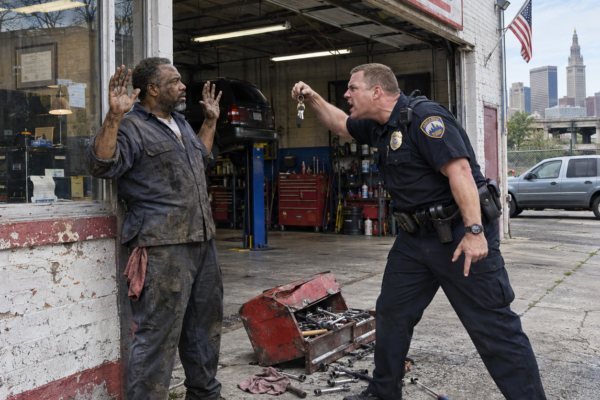
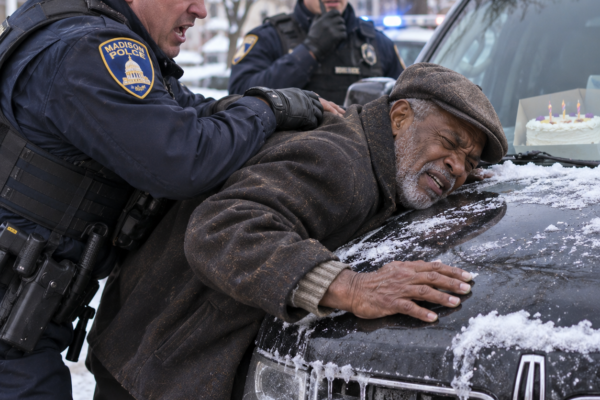
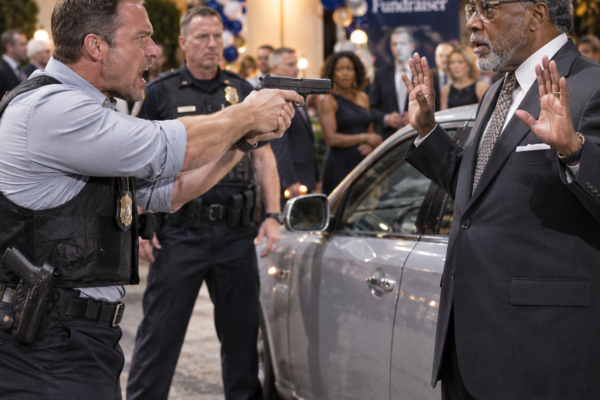
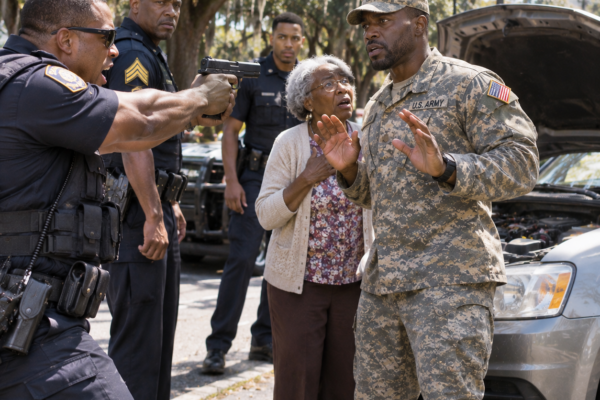
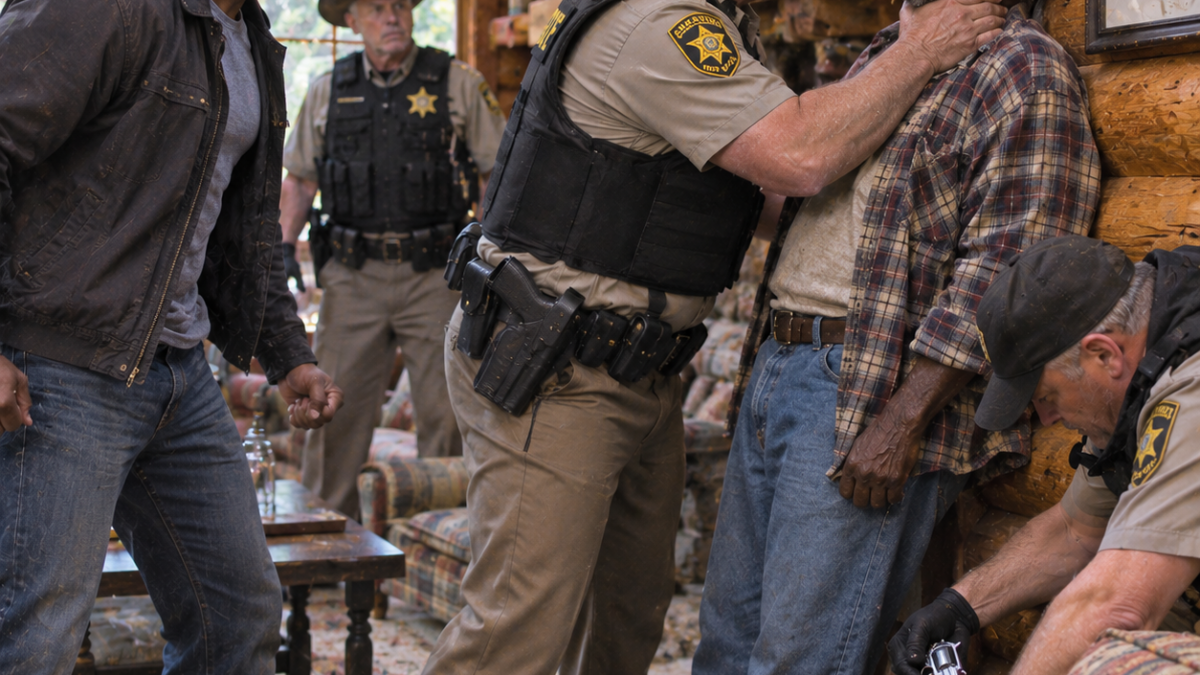
A Sheriff’s Lieutenant Put His Hand Around My 74-Year-Old Father’s Throat Inside the Cabin My Grandfather Built, Demanding a Signature for a Luxury Resort Road. I Came Home After Five Years Away and Found Dad Barely Able to Breathe. The Sheriff Then Ordered His Deputies to Search Our Living Room—and One of Them Pulled a Revolver From Under the Sofa.K
Part2
Harland reached for the paper.
“That’s enough talking.”
I stepped between him and Dad.
“You can leave that document where it is.”
The younger deputy, whose badge read RYAN KELLER, watched us silently.
Then another patrol car came up the driveway.
Within minutes, Sheriff Douglas Vance arrived.
He listened while Harland claimed Dad had become violent during a lawful firearm investigation.
Dad tried to explain that the officer had entered without permission and demanded a signature on a developer’s access agreement.
Vance barely examined the bruises on his neck.
“We’ll sort this out,” the sheriff said.
Then he ordered two deputies to check the cabin for weapons.
“Sheriff,” I said, “my father hasn’t consented to a search.”
Vance ignored me.
One deputy moved toward the living-room sofa.
He crouched, reached underneath, and pulled out a short-barreled revolver.
“Sheriff! Found something.”
Dad stared at the weapon.
“I’ve never seen that gun.”
Harland gave a satisfied little smile.
Vance turned toward me.
“Major Carter, I’d suggest you stop interfering. Right now, your father is looking at serious charges.”
I looked from the revolver to the bruises around Dad’s throat.
Then I noticed the younger deputy, Ryan Keller, staring at Harland.
His face had gone pale.
And when Sheriff Vance ordered him to help handcuff my father, Ryan didn’t move.
Instead, he took one step forward and spoke.
“Sheriff, before you arrest either of them, there’s something you need to know about what happened in this room.”
Vance turned slowly.
“What?”
Ryan swallowed.
“My body camera was recording before we entered the house.”
Harland’s expression changed.
The sheriff looked at Ryan’s chest.
“All of it?”
“Yes, sir.”
“Give me the camera.”
Ryan hesitated.
“Sir, department policy requires the recording to be preserved as evidence.”
“I know department policy, Deputy.”
Ryan unclipped the camera.
I watched him place it in Vance’s hand.
The sheriff slipped it into his jacket pocket without checking whether the recording had already been uploaded.
That bothered me more than anything he’d said.
He had barely looked at my father’s injured neck. He hadn’t questioned how a revolver supposedly connected to a burglary had appeared beneath our sofa.
But the moment Ryan mentioned a recording, Vance acted as though it was the most important thing in the house.
Dad began coughing again.
I turned toward him.
His voice sounded worse.
“I’m calling an ambulance,” I said.
Harland stepped forward.
“Your father is being detained.”
“Then your detained subject needs emergency medical care.”
I took out my phone and called 911.
Nobody stopped me.
When the paramedics arrived, Dad was struggling to swallow. One examined his neck while another checked his oxygen level.
The older paramedic looked at the sheriff.
“Who put pressure on his throat?”
Vance answered before I could.
“There was a physical confrontation.”
The paramedic glanced toward me.
I spoke carefully.
“Lieutenant Harland held him against the wall by his neck. I witnessed part of it.”
She wrote something down.
“Sir, we’re taking you to the hospital.”
Dad tried to protest.
“I’ve got animals to feed.”
“I’ll handle the animals,” I said.
He looked at me.
“You don’t even know where the feed is.”
“Then I’ll find it.”
For a moment, he almost smiled.
Then another coughing spell bent him forward.
I climbed into the ambulance beside him.
Through the rear window, I saw Vance speaking quietly with Harland.
Ryan stood several feet away.
He was looking at the ground.
At Blackpine Regional Hospital, a doctor named Natalie Brooks examined Dad.
She ordered imaging of his neck because strangulation injuries can become dangerous even when the outside bruising initially appears limited.
Dad complained the entire time.
“I’ve had worse injuries falling off a tractor.”
Dr. Brooks wasn’t impressed.
“Mr. Carter, you’ve had pressure applied to your airway. I’m more interested in what the examination shows than how tough you think you are.”
I liked her immediately.
After reviewing the scans, she told us there was no evidence of major vascular damage or a fracture. His airway was stable, but she wanted him observed because swelling could develop.
Then she noticed an older bruise high on his left arm.
“This didn’t happen today.”
Dad looked away.
I leaned forward.
“Dad?”
He adjusted the hospital blanket.
“It’s nothing.”
“Who did that?”
“Caleb.”
“Dad.”
He sighed.
“Harland shoved me against my truck a couple of months ago.”
I stared at him.
“He’s put his hands on you before?”
Dad looked irritated.
“I told him to get off my property. He didn’t appreciate it.”
“Did you report him?”
“To whom? His boss?”
I had no answer.
He looked toward the window.
“You don’t know how things have been around here.”
“Then tell me.”
He was quiet for a long moment.
Finally, he said, “They’ve been trying to buy this land for nearly a year.”
I waited.
“Four offers. Started at seven hundred thousand. Last one was a million two.”
I looked at him.
“For sixty-two acres?”
“Not just the acreage. They want the road.”
“What road?”
“The old western corridor. Your grandfather bought it with the property.”
I tried to remember the survey maps Dad kept in the cabinet beside his desk.
He’d shown me those boundaries when I was a teenager, back when I thought I’d live in West Virginia forever.
“Why do they need it?”
“Because they can’t get their trucks up the other side of the mountain without rebuilding half the county road.”
He rubbed his throat.
“After I turned down the last offer, county inspectors started showing up.”
“How often?”
“Enough that I stopped being surprised.”
“Did you keep the notices?”
“Every one.”
I sat back.
My father had always been stubborn, but he’d never been careless with documents.
He’d spent thirty-one years driving a school bus after leaving his railroad job. He had a filing system for everything from property taxes to tractor repairs.
If he’d been collecting notices, there was a reason.
“Why didn’t you call me?”
He looked at me.
“You were overseas.”
“I’ve had a phone for twenty years.”
“You had your own responsibilities.”
I felt a familiar argument rising.
Dad and I had been having different versions of it since I joined the Army.
He believed needing help meant he’d failed to take care of himself.
I believed being far away meant I couldn’t do much to help even if he asked.
Both ideas had allowed us to avoid talking honestly.
“Dad, a man nearly killed you today.”
He looked down at his hands.
“I know.”
The admission frightened me more than his stubbornness.
The next morning, I turned our kitchen table into a temporary office.
Dad sat near the window with a mug of coffee and a soft collar the doctor had recommended for comfort.
I spread his documents across the table.
Seventeen county notices.
Four purchase offers.
Three letters from Black Ridge Development threatening to withdraw favorable terms if he delayed.
Photographs of survey stakes.
Copies of property tax receipts.
A map showing the western access corridor.
The notices covered four months.
One claimed Dad’s septic system was creating a public health concern.
Another cited an unsafe outbuilding.
A third claimed his old tractor was an abandoned vehicle.
The tractor had been parked in the same shed for twenty years.
I looked at the dates.
One notice reported that Dad had refused access to a county inspector on June 12.
“Dad, weren’t you in Charleston that week?”
He looked up.
“Cardiology appointment.”
“You stayed overnight?”
“Yes.”
I showed him the citation.
“Then how did you personally refuse an inspection here at two in the afternoon?”
He took the paper.
Read it.
Then read it again.
His expression hardened.
“That’s a good question.”
I put the citation into a separate folder.
It wasn’t proof of a conspiracy by itself.
But it was a record that could be checked against hospital appointments, travel receipts, and whoever claimed to have spoken with him.
I had learned that evidence rarely arrived as one perfect document.
More often, it came from ordinary details that didn’t fit together until somebody made the effort to compare them.
At the bottom of the stack was a folded survey dated May 1948.
I opened it carefully.
My grandfather, Samuel Carter, had purchased sixty-two acres, including a narrow strip of land running west toward Blackpine Road.
The strip was sixty feet wide.
Dad tapped it with his finger.
“That road belongs to us.”
I studied the boundaries.
It wasn’t merely permission to use someone else’s property. The recorded deed described the strip as part of the Carter tract.
Black Ridge couldn’t simply declare it a public road.
They would need Dad’s agreement or some other lawful means to obtain access.
I opened the developer’s project proposal.
The resort had a name.
SUMMIT CROWN.
A hundred and forty hotel rooms.
Luxury mountain homes.
A private golf course.
A hunting lodge.
An artificial lake.
The estimated development cost was $180 million.
The plans showed a new service road crossing our western corridor.
I followed the route with my finger.
Heavy trucks would enter from Blackpine Road, cross Dad’s land, and climb gradually toward the proposed construction site.
The eastern approach was far steeper.
I looked at him.
“You’re not just another parcel they want to buy.”
Dad gave me a tired smile.
“Took you long enough.”
“They need this access.”
“Yes.”
“And you won’t sell.”
“No.”
“Even for a million dollars?”
He looked toward the porch.
“Your grandfather built this place with his hands. Your mother planted those apple trees. I buried her ashes up on the hill because that’s where she wanted to be.”
His voice tightened.
“I’m not selling our home because somebody thinks a mountain would look better with a golf course on it.”
I folded the map.
“All right.”
He watched me.
“All right, what?”
“We find out who has been helping them pressure you.”
By noon, I was at the county records office with a reporter named Evelyn Price.
I’d called the Black Pine Sentinel after finding several articles she’d written about unusual land sales.
Evelyn was thirty-eight, with shoulder-length brown hair and a legal pad already full of questions.
She didn’t seem impressed by my rank.
“Major Carter,” she said, “your father’s situation isn’t the first one I’ve heard about.”
“Then why hasn’t anyone reported it?”
“I’ve reported pieces. I haven’t had enough evidence to establish what’s connecting them.”
She opened her notebook.
Three names were written across the top.
Walter Pierce.
Gloria Massie.
Harold Finch.
All older property owners.
All people who had sold land to Black Ridge or its affiliates after receiving repeated enforcement notices.
We searched recorded deeds and publicly available county records.
Helen Dawson, the longtime records clerk, helped us locate the older survey books.
She’d worked in that office for nearly forty years and seemed to know the filing system better than the computer.
When Evelyn mentioned the Carter access corridor, Helen stopped.
“I remember that map.”
She disappeared into the storage room.
A few minutes later, she returned with a large bound survey book.
The original map was exactly where it should have been.
Helen placed it on the counter.
“Your grandfather had this properly recorded,” she told me. “I’ve seen people lose years arguing over boundaries because somebody never filed the paperwork. Samuel Carter wasn’t one of them.”
I examined the survey.
The corridor was unmistakable.
Evelyn photographed the public record for her notes.
Then she pointed toward a recently filed planning document.
“Look at this.”
Black Ridge had submitted a preliminary transportation plan to the county.
The western access route crossed Dad’s property.
I compared the documents.
The developer had known exactly what land it needed.
That made the timing of the county notices harder to dismiss.
Evelyn looked at me.
“Black Ridge has purchased eleven properties in this area during the last eighteen months. Six of those owners received clusters of county citations before selling.”
“Could be coincidence,” I said.
“It could.”
She turned another page.
“But three also reported law enforcement visits connected to supposed complaints about their property.”
I looked at her.
“What happened?”
“One was arrested. Another had an old case involving a family member suddenly brought up. The third stopped answering calls after the sale.”
I thought about Harland’s hand around Dad’s throat.
“Who investigates the sheriff?”
Evelyn closed her notebook.
“That’s what I’m hoping we can find out.”
That evening, our neighbor Martha Bell came over carrying a casserole.
Martha was sixty-nine and had lived across the valley for more than thirty years.
She’d known my mother since before I started school.
She set the casserole on the kitchen counter and looked at Dad’s bruised neck.
“Oh, Isaiah.”
He tried to smile.
“Don’t start fussing.”
She ignored him.
“Your father never did know when to ask for help,” she told me.
“I’ve noticed.”
She sat down.
Then she looked at the folders spread across the table.
“I need to tell you something.”
Dad turned toward her.
Martha folded her hands.
“Black Ridge bought twelve acres from me last spring.”
I frowned.
“Dad told me.”
She swallowed.
“I didn’t want to sell.”
The room became quiet.
“Harland came to my house two days before I signed,” she said. “He brought up an old probation case involving my son.”
I leaned forward.
“What did he say?”
“That people might start asking questions if my family kept making trouble.”
“Did he threaten to reopen the case?”
“Not in those exact words.”
She looked down.
“He just made sure I understood he knew everything about it.”
Dad reached across the table and took her hand.
“Why didn’t you tell me?”
Martha’s eyes filled.
“Because I was ashamed.”
I felt anger rising.
Not at Martha.
At the idea that someone had convinced her she should feel ashamed for being frightened.
“What did Black Ridge pay?” I asked.
She told me.
It was considerably less than the value of comparable land nearby.
I wrote it down.
“Would you be willing to speak with an independent investigator?”
She hesitated.
Then she nodded.
“Yes.”
Dad squeezed her hand.
“You won’t be alone.”
I looked around our kitchen.
For the first time, I understood the size of the problem.
This wasn’t only about one stubborn old man refusing a developer’s offer.
It was about people who had spent decades building their lives in the county, then discovered that the people entrusted with protecting them might be helping someone else take their property.
Two days later, Ryan Keller contacted me through an attorney.
I was surprised.
After the confrontation at Dad’s cabin, Sheriff Vance had placed him on administrative leave.
Ryan’s attorney explained that he had provided information to an independent state investigation and wanted to make sure Dad knew he’d preserved his account.
I agreed to meet in the attorney’s office.
Ryan arrived without his uniform.
He looked exhausted.
“Major Carter,” he said.
“Caleb.”
He nodded.
We sat across from each other.
For a moment, he stared at his hands.
Then he spoke.
“I should have stopped Harland.”
I didn’t answer immediately.
Ryan continued.
“He turned off his body camera before we went inside. He told me not to record.”
“But you did.”
“Yes.”
“Why?”
“Because the whole thing felt wrong.”
I studied him.
“What did he tell you before you reached the cabin?”
“That we were following up on a firearm complaint.”
“And the paper?”
Ryan looked down.
“I didn’t know about the land agreement until he pulled it out.”
He took a breath.
“Your father asked for a warrant. Harland didn’t have one. Then he started threatening citations if your father refused to sign.”
I leaned forward.
“You saw that?”
“Yes.”
“And the assault?”
Ryan closed his eyes.
“I saw Harland take your father’s phone and shove him. I saw him grab his throat.”
“Why didn’t you intervene?”
He looked at me.
“I was afraid.”
There it was.
Not an excuse.
An admission.
“He’s been a lieutenant longer than I’ve been an officer,” Ryan said. “Every time somebody questioned him, Vance backed him up.”
I thought about Dad struggling for air.
“You were wearing the same badge he was.”
“I know.”
“You had a responsibility.”
“I know that, too.”
His voice broke.
“I’ve been thinking about it every night.”
I let the silence sit between us.
Then I asked, “What happened to your recording?”
Ryan looked toward his attorney.
“The camera synchronized part of the file with the department system before Vance took the device. The original was retained by the recording provider.”
“Can Vance delete it?”
“Not without leaving an audit trail. State investigators have obtained a preservation order and secured the recording.”
I leaned back.
“Does it show what happened?”
Ryan nodded.
“Yes.”
For the first time since returning to West Virginia, I felt something other than anger or fear.
Relief.
Not because the case was over.
Because Dad’s account no longer depended solely on whether powerful men decided to believe him.
Before leaving, Ryan looked at me.
“I know you probably hate me.”
I stood.
“I don’t know you well enough for that.”
He swallowed.
“But I know what you failed to do.”
He nodded.
“And I know what you’re doing now.”
Ryan looked toward the floor.
“I don’t expect your father to forgive me.”
“Then don’t ask him to.”
I offered my hand.
“Tell the investigators everything. That’s what matters.”
He shook it.
The recording changed the investigation.
I didn’t see the complete footage immediately.
State investigators were still examining the evidence, and Ryan’s attorney had warned him not to circulate copies while the criminal inquiry was active.
But the investigators had enough to begin asking questions that Black Pine officials didn’t want to answer.
They interviewed Dad again.
They photographed his injuries.
They reviewed the original recorded deed and the county notices.
They questioned the deputy who claimed to have found the revolver.
That deputy’s account shifted between interviews.
First, he said he’d noticed the weapon from the doorway.
Then he said he’d discovered it while checking beneath the sofa.
The crime-scene photographs didn’t clearly support either explanation.
The gun was taken for forensic examination, and investigators documented discrepancies in the original evidence log.
Meanwhile, I hired a local attorney, Sarah Whitcomb, to represent Dad in the property dispute and any related civil claims.
Sarah was direct and practical.
“Caleb, you need to separate what you know from what you suspect.”
“I know Harland assaulted my father.”
“You witnessed it, and the medical records support an injury. That’s evidence.”
“I know the developer is behind it.”
“We have reasons to investigate that connection. We don’t yet have admissible proof of every part of it.”
I appreciated her honesty.
I needed somebody who wouldn’t tell me what I wanted to hear just because I was angry.
Sarah filed challenges to several county citations and requested the underlying inspection records.
She also sent formal notices preserving Dad’s property rights and warning Black Ridge that no access agreement had been granted.
The company responded through its lawyers.
They denied any involvement in improper enforcement actions.
They insisted their offers were voluntary.
And they maintained that Summit Crown would benefit the county through jobs and tax revenue.
Sarah read their response aloud.
Dad listened from his chair.
Then he said, “If they’re so sure this is a good project, why don’t they build it on land somebody wants to sell?”
Sarah smiled faintly.
“That’s a question I’d like their executives to answer under oath.”
The first real threat after the hospital came at two thirteen on a Sunday morning.
I’d installed security cameras around Dad’s property.
Not military equipment.
Ordinary motion-activated cameras with cloud storage and a local backup.
One covered the driveway.
Another watched the barn.
A third faced the small document shed behind the cabin.
My phone vibrated beside the bed.
I opened the camera application.
A man was walking behind the barn with a flashlight.
He wore civilian clothes.
But I recognized his build.
Wade Harland.
He approached the document shed and tried the lock.
Twice.
Then a dog began barking somewhere across the valley.
Harland stopped.
He turned toward the woods and disappeared.
I saved the footage and called the state investigator who’d been assigned to Dad’s case.
I didn’t chase him.
I didn’t wake Dad and send him outside with a flashlight.
I’d spent enough years dealing with dangerous situations to know that catching someone in the act was less important than keeping the people inside the house safe.
The investigator told me to preserve the recording and avoid disturbing the area until someone could examine it.
Dad was furious when I showed him the video the next morning.
“That man walked around my property like he owned it.”
“He may have been looking for documents.”
“Then he should’ve asked.”
I almost laughed.
“Dad, I don’t think he was planning a polite conversation.”
He looked toward the barn.
“Your grandfather stored the original surveys in that shed for years.”
“I know.”
“Harland knows it, too. Everybody around here knows that’s where I used to keep the old land books.”
I turned toward him.
“Used to?”
Dad smiled.
“I moved the important originals after they started sending those letters.”
“Where?”
He pointed toward the locked metal cabinet beside his bedroom.
I stared at him.
“You let me install six cameras without telling me you’d already moved the documents?”
He shrugged.
“You didn’t ask.”
I laughed despite myself.
For seventy-four years, Isaiah Carter had made a habit of surviving other people’s bad decisions.
I was beginning to understand that I hadn’t come home to save a helpless man.
I’d come home because my father had been fighting a battle I hadn’t bothered to notice.
Evelyn Price published her first major article the following week.
The headline asked why so many older property owners had received enforcement notices shortly before selling land to the same developer.
She included documented dates, recorded property transfers, and statements from residents willing to speak publicly.
She did not accuse every official of taking a bribe.
She didn’t need to.
The pattern was disturbing enough without speculation.
Within days, more people contacted her.
A retired electrician brought copies of citations issued after he’d rejected a purchase offer.
A former school secretary described a county inspector who’d told her selling would be easier than paying fines.
A widowed farmer produced letters threatening increasingly expensive compliance actions against equipment he’d used for decades.
Dad invited several of them to our cabin.
I watched him sit at the kitchen table, his neck still bruised, and listen to each person.
He didn’t promise to fix their problems.
He didn’t tell them to be brave.
He simply said, “Tell us what happened, and let’s see what we can prove.”
That was when I understood why so many people trusted him.
He wasn’t loud.
He wasn’t rich.
He didn’t have a badge.
He had spent decades showing up when somebody needed help, and now they were showing up for him.
Martha brought another casserole.
Earl Finch brought a box of inspection records.
Gloria Massie brought a handwritten timeline.
By the end of the afternoon, our dining table looked like a county archive.
I studied the stacks of paper and thought about the $180 million resort proposal.
One enormous project.
Dozens of smaller families.
And people powerful enough to make ordinary homeowners feel that resistance was pointless.
But paper had a weakness.
It kept dates.
It kept signatures.
It kept names.
And when enough people compared those details, the story started changing.
The investigation became much more serious when a Black Ridge accountant contacted Evelyn.
His name was Nathan Wells.
He’d worked for the development company for six years and had begun noticing payments that didn’t match any legitimate services.
Some were labeled security consulting.
Others appeared as community risk mitigation.
At first, he assumed they were ordinary project expenses.
Then he compared the dates against property acquisition reports.
Several payments occurred shortly before county enforcement actions against owners who’d refused to sell.
Nathan contacted an attorney before providing records to investigators.
The documents were preserved through appropriate legal channels, and federal authorities became involved after evidence suggested public officials had been receiving concealed benefits connected to their official actions.
I learned about it when Sarah called.
“Caleb, the FBI is now investigating the financial side.”
I sat down.
“Do they have evidence against Vance?”
“They’re examining payments, communications, and official actions. I can’t tell you what charges may follow.”
I looked toward Dad, who was outside repairing a fence.
“Does he need protection?”
“We should discuss that with investigators. Keep the cameras running and report anything suspicious.”
I nodded.
Then Sarah said something that stayed with me.
“Caleb, don’t try to finish this yourself.”
I knew what she meant.
I’d spent my career solving problems by taking action.
Waiting for lawyers and investigators felt unnatural.
But this wasn’t a battlefield.
And the outcome would depend on evidence collected properly, witnesses protected, and decisions that could survive scrutiny in court.
“Understood,” I said.
The first major public release of the body-camera footage came after investigators completed essential witness interviews and the court addressed the parties’ requests concerning disclosure.
By then, the recording had been authenticated.
It showed Harland approaching the cabin.
It showed him entering without a warrant or Dad’s consent.
It captured him placing the land-access agreement on our table before making any meaningful attempt to investigate the alleged firearm complaint.
Then came Dad’s refusal.
Harland’s threats.
The moment he seized Dad’s phone.
The shove.
And his hand closing around Dad’s throat.
The video showed Ryan ordering Harland to release him.
Then it showed me entering the doorway.
I watched the footage with Dad and Sarah.
Seeing the assault from another angle was worse than I’d expected.
Dad looked smaller than I remembered.
His back struck the wall.
His hands reached desperately for Harland’s wrist.
I had arrived just as his strength was giving out.
Dad watched without speaking.
When the recording ended, he stood slowly and walked onto the porch.
I followed.
He leaned against the railing.
“I thought he was going to kill me,” he said.
His voice was barely above a whisper.
I looked at him.
He’d never said those words before.
“I know, Dad.”
“No, son. I mean I really thought I was going to die right there in my own kitchen.”
I put my hand on his shoulder.
He looked across the valley.
“Then I heard your voice.”
I swallowed.
“I should’ve been here sooner.”
He shook his head.
“You came when you did.”
“Five years, Dad.”
“I counted.”
The words hurt.
He glanced at me.
“But you came home.”
For a long moment, we stood together.
Then he said, “Don’t spend the rest of your life trying to repay one afternoon.”
I looked at him.
“What should I do?”
“Stay long enough to remember who your family is.”
I didn’t answer.
Because I was afraid he was right.
The video spread quickly.
Television stations across West Virginia aired portions of it.
National reporters began asking about the land dispute.
Sheriff Vance’s office issued a statement promising full cooperation with investigators.
By then, the evidence showed that cooperation had been anything but complete.
Federal agents obtained communications and financial records through warrants and other legal process.
They found payments routed through consulting companies connected to Black Ridge contractors.
Some legitimate political donations had gone to committees supporting Vance.
Those donations alone weren’t evidence of a crime.
But investigators found separate transfers and communications linking certain payments to specific official actions.
One message discussed creating additional pressure on a landowner who refused an access agreement.
Another referenced getting the Carter corridor signed before the project’s financing deadline.
A county administrative spreadsheet listed property owners under headings such as cooperative, legal review, and enforcement priority.
Dad’s name appeared near the bottom.
Beside it were two words.
FINAL PRESSURE.
When Sarah showed us that portion of a federal filing, Dad stared at it for a long moment.
Then he said, “So that’s what I was to them.”
I looked at him.
“What?”
“A problem to be pushed until it moved.”
He folded the paper.
“Well, I didn’t move.”
The corruption inquiry reached Black Ridge’s executive offices.
Charles Rourke, the company’s chief executive, had spent decades developing luxury properties.
He’d presented Summit Crown as a project that would revive the local economy.
Now investigators were examining whether his company had paid intermediaries to influence public officials and intimidate landowners.
Rourke denied authorizing improper payments.
His attorneys maintained that any wrongdoing had been committed by outside contractors without his knowledge.
But the financial records were becoming harder to explain.
Meanwhile, several county employees began cooperating.
Some admitted they’d been instructed to prioritize inspections involving specific landowners.
Others described pressure to issue citations even when violations were questionable.
One inspector acknowledged filing a report for a visit he had never made.
It was the same day Dad had been in Charleston for his medical appointment.
I remember watching him read that admission.
He shook his head.
“All that trouble because I wouldn’t sign one piece of paper.”
I sat beside him.
“It was never just one piece of paper.”
He nodded.
“I know.”
Outside, autumn had begun turning the mountains gold.
I had planned to stay only a few days when I drove up from Charleston.
Now I’d been home for weeks.
My Army leave couldn’t continue indefinitely.
I needed to return to my unit and decide what came next.
For the first time in my adult life, I wasn’t sure I wanted another assignment that would take me away for months.
I was forty-five.
I’d served more than twenty years.
I had nothing left to prove by staying away.
But saying that aloud frightened me.
I wasn’t certain who I’d be without the Army.
Dad seemed to understand before I did.
One evening, while we repaired a broken porch step, he looked at me.
“You thinking about retiring?”
I stopped driving a screw.
“What makes you ask?”
“You’ve been staring at your phone like it’s about to give you orders.”
I smiled.
“Maybe.”
He nodded.
“Your mother would’ve liked having you around.”
I looked toward the apple trees.
“What about you?”
Dad shrugged.
“I’ve got along fine without you.”
I laughed.
“Thanks.”
Then he added quietly, “Doesn’t mean I wanted to.”
I put down the drill.
For years, I’d mistaken his independence for not needing me.
Now I realized that a person could survive alone and still be lonely.
The final confrontation happened just after midnight on a cold October night.
Two days earlier, federal investigators had executed additional search warrants connected to the corruption inquiry.
By then, Harland was under investigation and no longer performing regular patrol duties.
But he hadn’t been arrested.
I knew he was frightened.
The videos had exposed his conduct.
The financial records were closing in.
And investigators had begun asking about the suspicious revolver found beneath Dad’s sofa.
That evening, I received another motion alert from the barn camera.
Three men were moving along the fence line.
One carried a gasoline container.
Another had a pry bar.
The third was Harland.
I watched the screen for several seconds.
Then I called 911 and the state investigator who had given me an emergency contact number after the earlier trespass.
I told Dad to stay inside.
He stood near the hallway, watching my face.
“Who is it?”
“Harland.”
Dad’s expression hardened.
“What’s he doing?”
“Trying to get into the barn.”
I guided him away from the windows.
“Stay here.”
He looked offended.
“Caleb—”
“Dad. Please.”
He saw something in my face and stopped arguing.
I locked the exterior doors and turned on the camera system’s outdoor floodlights remotely.
The yard lit up.
Harland froze beside the barn.
The man with the pry bar stepped backward.
The third man dropped the gasoline container.
I watched from inside.
I had no intention of confronting three men who might be armed, especially when one had already assaulted my father.
The cameras recorded them moving toward the shed.
Then Harland looked directly at the light mounted above the barn.
He seemed to realize he was being filmed.
I heard him shout something at the other men.
They turned toward the woods.
Sirens sounded from the county road.
State troopers arrived within minutes.
One of the men surrendered near the driveway.
Another was stopped along the fence.
Harland tried to run through the trees but was caught after a short search.
I watched the arrest from the porch with Dad standing beside me.
Neither of us said much.
The men were taken away.
Investigators secured the tools and containers they’d carried.
The barn door had been damaged, but the documents inside were safe.
More importantly, Dad was safe.
He looked at the broken lock.
Then at me.
“You think they’ll finally leave us alone?”
I put my arm around his shoulders.
“I think they’re going to have a much harder time coming back.”
Dad nodded.
For the first time since I’d arrived, I saw him breathe without glancing toward the driveway.
The legal consequences took time.
There was no single courtroom scene where every corrupt official confessed and the entire county suddenly became honest.
Investigators had to establish what each person knew, what they’d authorized, and which actions could be proved beyond a reasonable doubt.
Federal prosecutors brought charges against Vance, Harland, and several individuals connected to the development scheme.
The cases involved allegations of bribery, extortion, obstruction, and violations of civil rights.
The charges against Harland included the assault on Dad and his participation in efforts to interfere with the investigation.
Evidence from the barn incident supported additional charges.
Two men involved in the attempted break-in entered plea agreements and testified about instructions they’d received.
Harland eventually pleaded guilty to several charges rather than proceed to trial on every count.
Vance fought the case longer.
But bank records, witness testimony, recovered communications, and evidence of falsified enforcement actions established a pattern that his attorneys couldn’t explain away as coincidence.
He was convicted on multiple federal charges.
Charles Rourke and other Black Ridge executives faced their own proceedings.
The resort financing collapsed as investors withdrew and the company became entangled in litigation.
Summit Crown was canceled.
The proposed western road was never built.
But the consequences extended beyond Dad’s property.
Several families challenged land sales they said had been secured through coercion.
Some cases ended in settlements.
Others required separate civil proceedings because ownership couldn’t simply be reversed by a criminal verdict.
Martha pursued a claim over the twelve acres she’d sold.
With legal assistance and evidence of the threats surrounding her transaction, she eventually reached a settlement that returned most of the land to her.
The morning she received the final documents, she came to our cabin carrying another casserole.
Dad opened the door.
She held out the deed.
“They gave it back,” she whispered.
He examined the paper.
Then he looked at her.
“You fought for it.”
She began crying.
Dad hugged her.
I stood in the doorway, watching two people who’d spent their lives protecting their homes finally understand that they hadn’t been fighting alone.
Fourteen months after I first came home, the mountains looked almost exactly as they had before.
The same ridges surrounded Black Pine County.
The same creek ran below our cabin.
The same old men argued over coffee at Miller’s Diner.
But the county had changed.
Several officials had resigned or been replaced.
The sheriff’s department adopted revised procedures for body-camera evidence, internal complaints, and supervisory review.
County enforcement practices faced outside scrutiny.
People who had spent years afraid to challenge questionable citations now had a clearer process for appealing them.
It wasn’t a perfect transformation.
No community changes completely because one scandal becomes public.
But the people responsible for the scheme no longer controlled the system that had protected it.
Evelyn Price published a series documenting the land acquisitions and enforcement abuses.
She called it The Land They Tried to Take.
Ryan Keller resigned from the sheriff’s department.
He told Dad he wanted to start over somewhere that would give him the chance to become the officer he’d once believed he could be.
Dad listened.
Then he said, “Next time you see somebody being hurt, don’t wait for another man to walk through the door.”
Ryan nodded.
“I won’t.”
Dad shook his hand.
That was all.
I respected him for telling the truth.
Dad respected him for admitting he’d been afraid.
Neither of us pretended that recording the assault erased his hesitation.
But his decision to preserve the evidence had mattered.
And he would have to build the rest of his career around what he’d learned.
As for me, I submitted my retirement paperwork.
After more than twenty years of service, I was leaving the Army.
Some of my friends thought I was making a mistake.
I had opportunities ahead of me.
Assignments that would have looked impressive on a résumé.
But I’d spent too much of my life believing that if I stayed busy enough, I wouldn’t have to think about what I was missing.
My mother had been gone nine years.
My father was seventy-five now.
There would always be another job.
There wouldn’t always be another year with him.
The morning I told Dad my retirement was approved, he was repairing an old lawn mower behind the barn.
He didn’t look up.
“So you’re home for good?”
“For the foreseeable future.”
He tightened a bolt.
“That’s a long answer.”
I smiled.
“Yes, Dad. I’m home.”
He nodded.
“Good.”
Then he handed me a wrench.
“Since you’re here, make yourself useful.”
The barn became our first big project.
The same building Harland had tried to break into was old enough that several beams needed replacing.
We rebuilt it into a community workshop.
Dad insisted on keeping the original stone foundation.
I wanted proper ventilation, updated electrical service, and safe storage for tools.
We argued about almost everything.
Then we found a local contractor who was willing to work with both of us.
The workshop opened the following spring.
Retired mechanics taught engine repair.
Carpenters helped teenagers build small furniture.
Veterans volunteered to teach basic equipment maintenance.
Earl Finch, the retired electrician, came twice a week to supervise electrical projects.
Martha organized refreshments and made certain nobody left hungry.
Dad taught woodworking.
He was a terrible instructor if you expected praise for sloppy work.
One afternoon, I watched him examine a board a sixteen-year-old boy had cut.
“What’s wrong with it?” the boy asked.
Dad held up a square.
“It’s crooked.”
“Only a little.”
Dad looked at him.
“Son, wood doesn’t care how hard you tried.”
The boy laughed.
Dad handed the board back.
“Measure again.”
I stood in the doorway smiling.
For decades, Dad had helped children get to school safely.
Now he was helping another generation learn how to use their hands, solve problems, and take pride in doing something properly.
The workshop didn’t make us rich.
It wasn’t supposed to.
It made the property useful to more people without requiring Dad to surrender ownership.
That mattered to him.
And to me.
One October morning, I woke before sunrise and carried two fishing rods down toward the creek.
The air was cold enough to fog my breath.
Leaves covered the path in gold and red.
Dad followed more slowly than he once had.
His knees bothered him, but the bruises had disappeared long ago.
I stopped beside the water.
“Got something for you.”
He looked suspicious.
“What did you break?”
“Nothing.”
“That’s usually what you say when you broke something.”
I laughed.
Then I handed him the restored fishing rod.
He stared at it.
The cork handle had been replaced.
The old reel worked smoothly.
The guides gleamed in the morning light.
He ran his fingers along the rod.
“Where’d you find this?”
“In your shed.”
“When?”
“Before I came home last year. I took it to a guy who restores old fishing equipment.”
He examined the reel.
“How much did you spend?”
“Don’t ask.”
“Caleb.”
“Dad.”
He shook his head.
“Probably could’ve bought three new ones.”
“Probably.”
He looked toward the creek.
“This was your grandfather’s.”
“I know.”
“He gave it to me when I was fourteen.”
“I remember you telling me.”
Dad stood quietly.
Then he looked at me.
“You kept it all this time.”
I nodded.
“I meant to give it to you the day I came home.”
He understood immediately.
The day I’d found Harland inside the cabin.
The day everything had changed.
Dad looked at the rod again.
Then he smiled.
“Well, you took your time.”
I laughed.
“Five years too long?”
He nodded.
“About that.”
We walked down to the creek.
Dad found a flat rock and sat carefully.
I stood beside him, looking at the water moving between the stones.
For a while, neither of us spoke.
Then he said, “You know, your mother used to tell me you’d come home when you were ready.”
I looked at him.
“What did you say?”
“That she was too optimistic.”
I laughed.
Dad smiled.
“She would’ve been proud of you.”
I swallowed.
“I wish I’d been here more.”
He nodded.
“I do, too.”
The honesty hurt.
But it was better than pretending neither of us had missed those years.
I sat beside him.
“I’m here now.”
Dad looked toward the water.
“I know.”
We stayed there until the sun climbed above the ridge.
Then Dad cast his line.
I did the same.
Neither of us caught much.
Dad complained about the bait.
I complained about the cold.
We argued over which side of the creek had better fish.
And somewhere between those ordinary complaints, I realized that this was what I’d been missing.
Not a dramatic reunion.
Not another emergency.
Just time with my father.
When we returned to the cabin, I stopped beside the wooden sign at the entrance.
It had stood there since I was a child.
CARTER FAMILY LAND — EST. 1948.
I’d repaired the cracked corner and repainted the lettering.
Beneath the original words, I’d added four more.
NOT FOR SALE.
Dad stood beside me, examining the sign.
“You made the letters too big.”
I smiled.
“People need to see them.”
“They could see the old sign just fine.”
“Dad.”
He looked at the new words.
Then he gave a small nod.
“Leave it.”
I laughed.
That was as close to approval as I was going to get.
He walked toward the porch.
I followed, carrying both fishing rods.
Behind us, the mountains stood quiet and unchanged.
No sheriff’s cruiser blocked the driveway.
No developer’s survey stakes marked our pasture.
No stranger waited inside with a document demanding my father’s signature.
The land was still ours.
The cabin was still standing.
And my father was still here to complain about the way I repaired things.
He stopped at the porch steps and turned toward me.
“Caleb?”
“Yes, Dad?”
“You staying for supper?”
I smiled.
“I’m staying.”
He nodded toward the kitchen.
“Then you can cook.”
I laughed and followed him inside.
For most of my adult life, I’d believed that serving my country meant being ready to go wherever I was needed.
It took a terrible afternoon in my father’s cabin to remind me that sometimes the people who need us most are the ones we’ve left waiting at home.
I couldn’t give Dad back the five years I’d missed.
But I could give him the next morning.
And the next.
And every ordinary day we were fortunate enough to have together.