Fake HOA Cops Kicked In My Ranch Door at Midnight—Then Froze When They Saw the Armed Retired Police Sergeant Inside
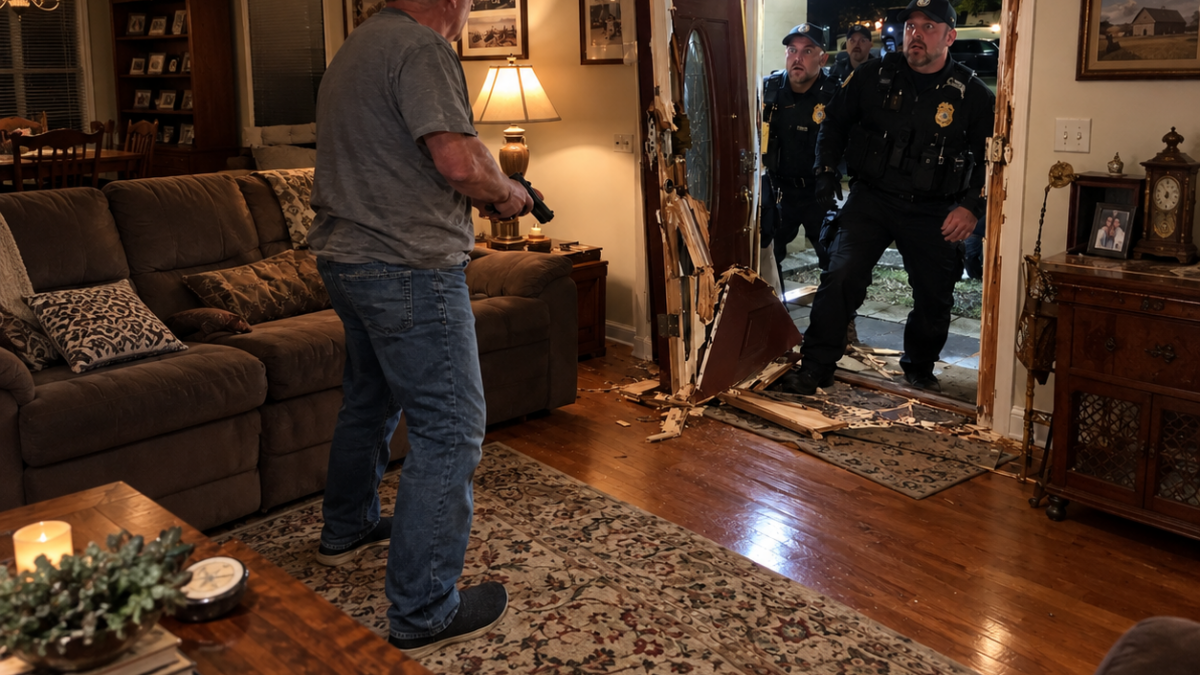
PART2
The dispatcher said deputies were approaching.
Then another kick hit.
The lock tore partly away from the frame.
Derek shouted:
“GO!”
The damaged door swung inward several inches.
He shoved it again.
Then he stepped into the opening.
And froze.
For the first time all night, Derek Shaw stopped acting like the loudest man on the property.
He looked down the hallway.
Looked at me.
Looked at what I was holding safely pointed toward the floor.
And suddenly the fake cop at my door understood something very real.
I wasn’t walking toward him.
I wasn’t threatening him.
But I also wasn’t the frightened, defenseless old rancher he had expected.
“Put that down!” he yelled.
“No.”
“You’re threatening an officer!”
I stared at him.
“You’re not an officer.”
His face changed.
“We are Cedar Ridge enforcement.”
“You’re private security.”
“We have authority here.”
“No. You don’t.”
The man standing behind Derek took one look inside and immediately said:
“Derek, back up.”
Derek ignored him.
Then, far down my driveway, I heard something that ended the argument.
A real siren.
The second patrol man looked toward the road.
“We need to leave.”
Derek hesitated.
He had spent months behaving like authority was something you created by sounding confident enough.
Now actual authority was coming up my driveway.
Fast.
The first sheriff’s cruiser appeared through the trees.
Then another.
Real emergency lights washed over my barn.
My fencing.
The porch.
The black Cedar Ridge SUV.
A deputy stepped out and shouted:
“HANDS WHERE I CAN SEE THEM!”
And just like that, the fake police operation collapsed.
But the story did not begin with those men kicking my door.
It began six months earlier with a white envelope nailed to my fence.
My name is Frank Dawson.
I was sixty-one years old when all this happened, and Dawson Ridge Ranch had been part of my family for more than forty years.
My father bought the original property when I was still a teenager.
Back then there wasn’t much around us.
Dry grass.
Pine.
Dirt roads.
Cattle.
Horses.
A few families spread miles apart.
Dad built the ranch slowly.
Nothing fancy.
Our house wasn’t large.
The barn wasn’t pretty.
Our fences were repaired according to whatever material happened to be available when a section failed.
Some posts were wood.
Some steel.
Some sections looked like they had survived three wars.
But they held cattle.
That was what mattered.
Dad taught me that rural neighbors survived by helping each other.
Truck stuck in snow?
You stopped.
Barn roof damaged?
You brought tools.
Horse loose on the road?
You didn’t ask whose animal it was before helping.
Nobody cared about mailbox colors.
Nobody held architectural committee meetings.
Then Cedar Ridge was built east of us.
A developer bought a large piece of land.
First came expensive houses.
Then more houses.
Then stone entrance pillars.
A golf course.
Pool.
Walking trails.
Streetlights.
Landscaping.
Finally, the Cedar Ridge Homeowners Association.
I had no problem with any of it.
Their property was theirs.
Mine was mine.
The closest Cedar Ridge home sat almost half a mile from my ranch boundary.
Dawson Ridge had never joined the HOA.
My deed wasn’t connected to their covenants.
My parents had owned the ranch decades before Cedar Ridge existed.
For years, everybody understood that.
Most Cedar Ridge residents were fine.
Some stopped to buy eggs.
Parents brought children to look at horses.
A few residents became people I genuinely liked.
Then Cedar Ridge elected Vanessa Cole as HOA president.
I met her one Tuesday morning in March.
I was repairing the west fence when a silver SUV pulled onto the shoulder.
A woman climbed out wearing clean white shoes.
Those shoes lasted about five seconds before ranch dust changed their color.
She looked down at them.
Then at me.
“Mr. Dawson?”
“That’s me.”
“I’m Vanessa Cole. President of the Cedar Ridge HOA.”
I wiped my hands on a rag.
“Nice to meet you.”
She didn’t smile.
“We’ve received complaints.”
I looked behind me.
Three cows stood beside a water trough.
“Did the cows insult somebody?”
She stared.
I smiled.
She did not.
“Complaints about your property.”
“My property did something?”
“The appearance of Dawson Ridge affects our community.”
I leaned on the fence.
“How?”
She opened a folder.
“Your northern fencing is inconsistent.”
“It’s a ranch fence.”
“Several sections are wood. Others are metal.”
“That happens after forty years of repairs.”
“You also have two visible farm vehicles.”
“Tractors.”
“Yes.”
“That’s usually where I keep them.”
Her jaw tightened.
She pointed toward the barn.
“The roof color doesn’t comply with Cedar Ridge’s approved exterior palette.”
That was the exact moment I realized she was completely serious.
“Vanessa.”
“Yes?”
“I’m not in Cedar Ridge.”
She gave me the most condescending smile I had seen in years.
“We’re aware there have been questions about surrounding properties.”
“There aren’t questions about mine.”
“Our recent legal review identified several parcels that may fall within Cedar Ridge’s community influence area.”
I almost laughed.
“What is a community influence area?”
“Properties whose appearance and use can affect neighborhood value.”
“That sounds like a phrase somebody invented because ‘not our land’ wasn’t getting the answer they wanted.”
Her smile vanished.
“This may need to be discussed by counsel.”
“Okay.”
That surprised her.
“Okay?”
“Have your attorney call me.”
Then I turned back to the fence.
She stayed.
“Mr. Dawson.”
I looked over.
“You should understand Cedar Ridge takes compliance seriously.”
“So do I.”
“Good.”
“I comply with laws.”
She stared at me for a second.
Then returned to her SUV.
Three days later, I found a white envelope nailed to my fence.
CEDAR RIDGE HOA PROPERTY COMPLIANCE WARNING.
According to that paper, my crimes included:
Mismatched fencing.
Visible machinery.
Unapproved barn color.
Commercial livestock activity.
Failure to maintain approved landscaping.
Landscaping.
On a cattle ranch.
At the bottom, the letter warned that fines would begin after fourteen days.
I called the number.
Vanessa answered.
“This is Frank Dawson.”
“Yes, Mr. Dawson?”
“I received your letter.”
“Good.”
“Come get it.”
Silence.
“What?”
“You nailed paper to my fence. Come remove it.”
“The notice is official.”
“No. It’s paper.”
“The board has determined—”
“I’m not in your HOA.”
“We’ve already explained that boundaries are being reviewed.”
“Has a judge changed my deed?”
“No.”
“Has the county changed my parcel?”
“No.”
“Did I sign an HOA covenant?”
“That is not the only method of—”
“Then we’re finished.”
I hung up.
I wasn’t trying to be rude.
I was trying to be clear.
My father used to say a good fence keeps cows home and a clear answer keeps trouble away.
Apparently, Dad never met Vanessa Cole.
The fines started anyway.
Two hundred dollars for the fence.
Three hundred for the barn.
Five hundred for livestock activity.
Then daily penalties for “continued noncompliance.”
I put every letter into a cardboard box.
I paid nothing.
My neighbor Bill Turner heard about it.
Bill owned a small horse property two miles west.
He stopped by one afternoon with coffee.
“You getting Cedar Ridge letters?”
“Yep.”
He laughed.
“They sent me one too.”
“For what?”
“My horse trailer.”
“What’s wrong with it?”
“Visible from the road.”
I looked at his pickup.
“Terrible crime.”
“Vanessa came by yesterday.”
“What’d you say?”
“That I’m not in Cedar Ridge.”
“And?”
“She told me boundaries are complicated.”
I shook my head.
Bill sipped his coffee.
“You think they’re expanding?”
That question stayed with me.
Cedar Ridge had almost no empty lots left.
My ranch sat beside one of the largest undeveloped areas near the neighborhood.
“I think somebody wants land.”
Bill nodded.
“Me too.”
A week later, we got our first proof.
A Cedar Ridge homeowner named Laura Bennett came to see me.
Laura had bought eggs from me before.
Sometimes she brought her son to look at the horses.
That afternoon she looked uncomfortable.
“Frank, can I ask something?”
“Sure.”
“Did you agree to sell part of your ranch?”
“No.”
Her face changed.
“I knew something was wrong.”
“What happened?”
She showed me a photograph from an HOA presentation.
Future expansion.
New homes.
A park.
New clubhouse facilities.
And a road.
That road crossed the northeast corner of Dawson Ridge Ranch.
I stared at the image.
“Where did this come from?”
“HOA meeting.”
“When?”
“Monday.”
“What did Vanessa say?”
“That the board was working on incorporating nearby properties.”
“Did she mention me?”
Laura hesitated.
“Yes.”
“What did she say?”
“That your ranch is already subject to certain community restrictions.”
I laughed once.
“That’s news to the owner.”
“People asked if you had agreed.”
“What did she say?”
“That negotiations were ongoing.”
Negotiations.
Interesting word.
Vanessa and I had never negotiated anything unless being told to repaint my barn counted.
I thanked Laura.
Then called Thomas Grant.
Thomas had handled property issues for my family for years.
He sat across from me in his office reading HOA letters.
Then he examined my deed.
Finally, he looked up.
“Frank, you’re not in Cedar Ridge.”
“I know.”
“No shared covenant.”
“I know.”
“No annexation agreement.”
“I know.”
“No document I can find gives them authority over your ranch.”
“So why are we having this conversation?”
“Because apparently they haven’t read the same documents.”
Thomas sent a formal letter.
Stop sending fines.
Stop claiming HOA authority.
Stop entering Dawson Ridge property.
Stop telling residents annexation negotiations existed when they did not.
For two weeks, everything became quiet.
I fed cattle.
Repaired a gate.
Helped Bill move two horses after a storm damaged fencing.
Life almost returned to normal.
Then the black SUV appeared.
CEDAR RIDGE COMMUNITY PATROL.
I had seen it inside the neighborhood.
Private security didn’t bother me.
Communities had every right to hire security.
What bothered me was seeing it parked outside my ranch.
I walked toward the gate.
Two men sat inside.
One lowered the window.
Dark uniform.
Metal badge.
Utility belt.
“Can I help you?”
“We’re conducting patrol.”
“This is a public road. Enjoy yourself.”
I turned.
“Mr. Dawson.”
I stopped.
He knew my name.
“We’ve received reports of unauthorized vehicles entering this property.”
“Unauthorized by whom?”
“Cedar Ridge.”
I stared at him.
“Cedar Ridge doesn’t authorize vehicles on my ranch.”
He looked irritated.
“We’re just doing our job.”
“So am I.”
“What job is that?”
“Keeping strangers from bothering cattle.”
His partner laughed.
He didn’t.
The SUV stayed another twenty minutes.
Then left.
It became a pattern.
Drive past.
Stop.
Watch.
Photograph.
Once I saw them near my barn entrance.
I called Thomas.
“If they stay on the public road?”
“They can generally be there.”
“If they cross the gate?”
“Document it and call the sheriff if necessary.”
Good advice.
I had spent three decades in police work before retiring.
Patrol officer.
Investigations.
Night shifts.
Eventually sergeant.
I supervised younger officers.
Handled disputes.
Domestic calls.
Trespassing complaints.
False alarms.
Actual emergencies.
More frightened, angry, intoxicated, confused, and unreasonable people than I could ever count.
That career taught me something very simple.
The loudest person at a scene is not automatically the person in control.
Vanessa had not learned that yet.
In May, Cedar Ridge sent something new.
FINAL COMPLIANCE ORDER.
It demanded I allow HOA inspectors onto Dawson Ridge.
I refused.
Then came another letter threatening “community enforcement action.”
Thomas called Cedar Ridge’s attorney.
The attorney said something interesting.
He had never approved that language.
Two weeks later, he stopped representing Cedar Ridge entirely.
A new firm appeared on their correspondence.
Then, in June, Vanessa arrived at my ranch again.
This time she brought Derek Shaw.
Derek introduced himself as director of Cedar Ridge Community Patrol.
He was in his forties.
Large.
Close-cut hair.
Dark sunglasses.
Black uniform.
Shiny badge reading COMMUNITY OFFICER.
He stood with his hands near his belt like he wanted me to notice where they were.
Vanessa held out a folder.
“Frank, this needs to end.”
“I agree.”
“Good.”
“Tell your people to leave me alone.”
“That isn’t what I meant.”
“I know.”
Derek stepped toward me.
“You’ve ignored multiple lawful directives.”
I looked at him.
“Lawful according to what law?”
He paused.
“Community regulations.”
“My ranch isn’t in your community.”
Vanessa interrupted.
“We have a boundary claim under legal review.”
“Then let a court review it.”
“We’d prefer not to make this expensive.”
“That’s considerate.”
Her eyes narrowed.
“We’re offering one last opportunity to cooperate.”
“With what?”
“Inspection.”
“No.”
Derek moved another step closer.
“Refusal could lead to enforcement.”
I looked at his badge.
“What agency are you with?”
His face hardened.
“Cedar Ridge Community Patrol.”
“That wasn’t my question.”
Vanessa pushed the folder toward me.
I did not take it.
She placed it on the fence.
“Read it.”
Then they left.
The paper announced that Cedar Ridge inspectors would enter my ranch Monday at 9:00 a.m.
Not request permission.
Enter.
Thomas gave simple advice.
“Do not let them in.”
“I wasn’t planning to.”
Monday, 8:50 a.m., I stood beside my locked gate drinking coffee.
At exactly nine, the black patrol SUV arrived.
Derek driving.
Another patrol employee beside him.
Vanessa behind them in her silver SUV.
Derek got out.
“We’re here for inspection.”
“No.”
He looked at Vanessa.
She walked forward.
“Frank, don’t make this difficult.”
“It isn’t difficult. Gate stays closed.”
“We gave notice.”
“You could give notice you’re landing on the moon. Doesn’t make it happen.”
Her face reddened.
Derek grabbed the chain.
My voice changed.
“Don’t touch that.”
He looked at me.
“Are you threatening me?”
“No.”
I kept my voice level.
“I’m telling you not to enter private property.”
Nobody moved.
Then Laura Bennett happened to drive past.
She slowed.
Vanessa noticed her.
I think that saved the confrontation from escalating.
Vanessa looked at me.
“Fine.”
Then:
“But this isn’t over.”
“I believe you.”
They left.
Almost a month passed.
No letters.
No patrol SUV.
No calls.
I thought maybe their new attorney had finally explained reality.
I wanted to believe that.
I did not enjoy fighting.
People sometimes confuse strength with defeating everyone who disagrees with you.
I never believed that.
Sometimes the strongest thing you can do is give another person room to stop making a bad decision.
Then July arrived.
Bill called one Friday evening.
“Frank.”
Something in his voice made me sit upright.
“What?”
“Those Cedar Ridge patrol guys are here.”
“At your place?”
“Yep.”
“What do they want?”
“They say my horse trailer violates HOA rules.”
“Don’t let them in.”
“I didn’t.”
“Good.”
“They say they can seize it.”
I stood.
“They said what?”
“Derek says Cedar Ridge has enforcement authority over surrounding parcels.”
“That’s nonsense.”
“I know.”
Then shouting came through the phone.
“Bill?”
“They’re opening the gate.”
“Call the sheriff.”
“Already doing it.”
The call ended.
I drove there.
A county deputy was already on scene.
The difference between him and Derek was obvious.
Real patrol vehicle.
Official markings.
Real department badge.
Actual legal authority.
The deputy pointed toward Derek.
“This owner told you to leave.”
“We are enforcing Cedar Ridge regulations.”
“This property is not Cedar Ridge.”
“We have expanded authority under—”
“Leave.”
Derek tried again.
The deputy didn’t care.
“Private property. Owner told you to leave. Go.”
Vanessa arrived five minutes later.
She argued too.
Same answer.
Leave.
I thought that embarrassment would finally stop them.
As Vanessa headed toward her SUV, she saw me.
“You caused this.”
“No.”
“You’ve been encouraging residents and landowners to resist.”
“People don’t need encouragement to tell strangers to leave their land.”
“You think you’re smarter than everybody.”
“No.”
“You think because you own a few acres, rules don’t apply.”
“Laws apply.”
“You know what I mean.”
“I actually don’t.”
She stepped closer.
“Cedar Ridge is expanding.”
“Not onto my ranch.”
Her voice dropped.
“We’ll see.”
That was different.
Not an HOA complaint.
Not a disagreement.
A promise.
I looked directly at her.
“Vanessa. Stop.”
She blinked.
“I’m serious.”
“You’re warning me?”
“I’m asking you.”
“Why?”
“Because nobody needs this to become ugly.”
For a moment, something in her expression changed.
Then Derek walked over.
“We’re leaving.”
Vanessa looked at me one last time.
“This isn’t finished.”
Three nights later, at 11:40 p.m., my dog woke me.
Not his normal bark.
His warning bark.
Bright lights swept across my bedroom wall.
I looked outside.
Black SUV.
CEDAR RIDGE COMMUNITY PATROL.
Coming up my private driveway.
My locked ranch gate stood open behind it.
Three men got out.
Derek was one.
They walked toward my porch.
I picked up my phone.
The pounding started.
“CEDAR RIDGE ENFORCEMENT!”
I didn’t answer.
Another hit against the door.
“FRANK DAWSON! OPEN UP!”
I called county dispatch.
Then Derek shouted:
“We have authority to remove you from this property!”
That sentence made my blood turn cold.
There was no court order.
No sheriff.
No eviction.
No legal service.
No judge.
Nothing.
Yet three private security workers had arrived near midnight saying they were going to remove me from my home.
Then came the first kick.
The second.
The third.
Which brought us back to the moment Derek broke my door.
When real deputies entered the driveway, I secured my firearm before they entered the house.
Deputy Ryan Cooper came through the damaged doorway after the scene outside was stabilized.
“Frank Dawson?”
“Yes.”
“You hurt?”
“No.”
“Anyone else inside?”
“Dog.”
“Any weapons?”
“Yes. Secured now.”
“Okay.”
Professional.
Calm.
No assumptions.
Outside, deputies separated the three Cedar Ridge patrol men.
Derek saw me on the porch and immediately started shouting.
“He pointed a gun at us!”
Deputy Cooper turned.
“Stop talking.”
“He threatened officers!”
“Stop.”
“We are enforcement officers!”
Cooper looked at Derek’s uniform.
“What law enforcement agency?”
“Cedar Ridge Community Patrol.”
“That’s not a law enforcement agency.”
Derek opened his mouth.
The deputy raised a hand.
“I told you to stop talking.”
Derek finally did.
Deputies photographed the door.
Tire marks.
SUV.
Uniforms.
Then someone found my gate chain.
Cut.
Not unlocked.
Cut.
They had brought equipment specifically capable of getting through my locked entrance.
That destroyed any argument that they had accidentally entered the ranch.
Deputy Cooper took my statement.
I explained everything.
The fines.
Vanessa.
Expansion map.
Inspections.
Bill.
Derek.
The midnight visit.
“You said you’re retired law enforcement?”
“Yes.”
“Agency?”
I told him.
He recognized it.
“You were county police?”
“For thirty years.”
“What rank?”
I hesitated.
“Sergeant.”
Derek heard.
His head snapped toward me.
“You were a cop?”
Cooper turned.
“Didn’t I tell you to stop talking?”
Derek looked at me like I had tricked him.
As if I had somehow behaved unfairly by not informing the men breaking into my home that I used to supervise police officers.
I felt no satisfaction.
My background should not have mattered.
They shouldn’t have done that to anybody.
Then a deputy searched their SUV.
He brought a folder to Cooper.
The first page said:
PROPERTY REMOVAL AUTHORIZATION.
My name appeared underneath.
It claimed Cedar Ridge Community Patrol was authorized to remove Frank Dawson from Dawson Ridge Ranch because of unpaid HOA penalties.
No judge.
No court seal.
No sheriff.
Nothing legally meaningful.
Just official-looking HOA paperwork pretending to be something it wasn’t.
More equipment came out of the SUV.
Dark jackets.
Badges.
Handcuffs.
Portable radios.
Traffic cones.
Red and blue dashboard light.
None of those things individually made somebody a police officer.
Combined with forced entry and false commands?
Different story.
Derek was put into a patrol car.
The younger men were separated.
One named Travis started cooperating.
I couldn’t hear everything.
I heard Vanessa’s name.
Then:
“She told us it was legal.”
An hour later, Captain James Walker arrived.
I knew him.
Years earlier, when he was a young patrol officer, we had worked together.
He got out.
Looked at my damaged door.
Then at me.
“Frank Dawson.”
“James Walker.”
He shook his head.
“I heard the address and thought there couldn’t be two of you.”
“Unfortunately not.”
He studied the Cedar Ridge SUV.
“What did you get yourself into?”
“I was about to ask you the same.”
He reviewed everything.
Then returned looking concerned.
“This may be bigger than an HOA dispute.”
“I figured.”
“They had information about your property.”
“County records are public.”
“Some of this isn’t.”
That got my attention.
“What?”
“A diagram of your house.”
My smile disappeared.
“What kind?”
“Room layout.”
The ranch house was old.
My father had expanded it over decades.
As far as I knew, no detailed current floor plan existed online.
“How did they get that?”
“We don’t know yet.”
James continued.
“They also have a list of surrounding properties Cedar Ridge apparently wants to bring under its control.”
“Bill?”
“Yes.”
“How many?”
“Eleven.”
That changed everything.
This wasn’t Vanessa being angry about tractors.
There was planning behind it.
Money, maybe.
Organization.
The deputies finally left around four in the morning.
My door wouldn’t close.
Bill arrived before sunrise carrying plywood, screws, and a cordless drill.
He didn’t ask if I needed help.
He just showed up.
He looked at the damage.
“Wow.”
“Yep.”
“They really kicked it in.”
“Almost.”
“What happened to Derek?”
“Deputies took all three.”
Bill smiled.
“What?”
“You never told them.”
“Told them what?”
“That you were Sergeant Dawson.”
“I didn’t think it mattered.”
He laughed.
“Oh, I think it mattered when Derek found out.”
“Maybe.”
But I didn’t feel proud.
If anything, it bothered me.
My rights weren’t stronger because I used to wear a badge.
Derek shouldn’t kick in a retired teacher’s door either.
Or a mechanic’s.
Or a widow’s.
Or anybody else’s.
Bill and I patched the entrance.
Then drank coffee while the sun came up.
“What do you think Vanessa does now?” he asked.
“I don’t know.”
“You think she ordered this?”
“Travis apparently says she did.”
Bill shook his head.
“You still feeling generous toward her?”
“I don’t know that I ever felt generous.”
“You kept giving her chances.”
“That’s different.”
“How many chances does somebody get?”
I looked at the broken frame.
“Probably fewer than I gave.”
By noon, Laura called.
“Frank, there are rumors everywhere.”
“What rumors?”
“Vanessa says you attacked the patrol.”
I nearly dropped the phone.
“I attacked them?”
“She sent an emergency email.”
Laura forwarded it.
I read:
Last night, members of our community patrol attempted to conduct a lawful property enforcement action at a disputed neighboring parcel. During this action, the property occupant confronted patrol staff while armed. County law enforcement involvement was required.
Our patrol members acted according to instructions and community safety policy.
—Vanessa Cole, HOA President.
I read it twice.
Then called Thomas.
“You saw this?”
“Yes.”
“She’s making them sound like victims.”
“Yes.”
“What do I do?”
“Nothing publicly.”
“Nothing?”
“Let the sheriff’s report speak.”
“She’s telling hundreds of people I confronted security with a gun.”
“And evidence will show they cut your gate and kicked your door.”
I hated the advice.
Which usually meant it was good.
So I stayed quiet.
Vanessa did not.
She sent more messages.
Claimed Cedar Ridge possessed inspection authority.
Claimed the patrol had performed a board-approved enforcement action.
Local reporters heard.
One headline read:
RETIRED POLICE SERGEANT INVOLVED IN ARMED HOA DISPUTE.
That made me furious.
Not because every word was technically false.
Because context changed everything.
I didn’t go looking for a fight.
I didn’t confront them outside.
I stayed inside my home.
They came to me.
James called.
“I figured you’d hate the coverage.”
“I’ve had better mornings.”
“I can’t discuss the investigation.”
“I know.”
“But keep doing what you’re doing.”
“What’s that?”
“Nothing.”
I laughed.
“Best police advice I’ve ever heard.”
Then his voice changed.
“There’s something else.”
“What?”
“One patrol guy is cooperating.”
“Travis?”
“I’m not confirming names.”
“Of course.”
“Frank, they believed the house would be empty.”
I stopped.
“What?”
“They did not expect you home.”
“That doesn’t make sense. They shouted my name.”
“We’re trying to understand that.”
After the call, I checked my security cameras.
Four cameras.
Barn.
Driveway.
Back entrance.
Equipment shed.
The front camera stopped recording at 11:20.
Twenty minutes before Derek arrived.
I checked the wire.
Cut.
James returned with a deputy.
The barn camera showed someone in dark clothing near my house at 11:18.
The person moved directly toward the front camera.
Somebody had arrived before the patrol SUV.
Somebody disabled surveillance.
That was when Thomas obtained a temporary court order.
No Cedar Ridge patrol personnel near my ranch.
No HOA agents entering.
No direct contact except through counsel.
Then Cedar Ridge residents finally turned on Vanessa.
Nearly three hundred people packed an emergency HOA meeting.
Vanessa claimed Derek misunderstood instructions.
A resident asked:
“Then why did your email call it a lawful enforcement action?”
No good answer.
Another asked why HOA money was being spent trying to regulate ranches outside Cedar Ridge.
Another demanded attorney opinions proving authority existed.
There weren’t any.
Then Derek’s wife walked into the meeting carrying documents.
She said her husband kept copies at home because he didn’t trust Vanessa.
Patrol instructions.
Emails.
Payment records.
That last phrase changed everything.
Cedar Ridge wasn’t paying the patrol men directly.
A development company was.
Stonewell Properties.
One of the largest developers in our county.
Thomas came to my ranch that evening with property records.
Stonewell had bought land east of Cedar Ridge.
Then land south.
Then another parcel north of Bill.
Thomas spread maps across my kitchen table.
The pattern was obvious.
“They’re surrounding us.”
“Yes.”
My ranch sat in the middle.
“So this was never about my barn.”
“No.”
Thomas showed me an early Stonewell development proposal.
Hundreds of homes.
Commercial space.
Trails.
Parks.
One major access road.
Straight across Dawson Ridge.
Without my ranch, the route became significantly longer and more expensive.
“So Vanessa was pressuring me for Stonewell.”
“That’s one possibility.”
“Why?”
“Money would be my first guess.”
“You have proof?”
“Not yet.”
That word mattered.
Proof.
Years in policing taught me never to fall in love with a theory.
Then the proof came.
James asked me to come to the station.
Thomas joined.
On the conference table sat the fake property-removal order.
Beside it was an email from Vanessa.
ENTER DAWSON RIDGE RANCH AFTER 11:30 P.M.
REMOVE FRANK DAWSON FROM THE RESIDENCE IF PRESENT.
SECURE THE PROPERTY.
CHANGE ACCESS LOCKS.
WAIT FOR FURTHER INSTRUCTIONS FROM STONEWELL REPRESENTATIVES.
My mouth went dry.
“She told them to take control.”
James nodded.
“That’s what it appears to say.”
Then Thomas pointed to an attachment name.
DAWSON PROPERTY TRANSFER — FINAL.
James placed another document in front of us.
A sales contract.
My ranch.
My name.
Stonewell Properties.
Purchase price: $1.8 million.
Signature at the bottom.
Supposedly mine.
I stared.
“That is not my signature.”
Thomas looked.
“No. It isn’t.”
Notary stamp.
Closing date.
Monday.
Three days away.
“They were planning to sell my ranch.”
James chose his words carefully.
“We’re still determining exactly what everyone believed and intended.”
I pointed to the document.
“My name is on a sale I never agreed to.”
“I know.”
Thomas flipped through the contract.
Then froze.
At the bottom was the name of the person Stonewell claimed had negotiated for me.
Vanessa Cole.
Title:
PROPERTY ACQUISITION CONSULTANT.
Nobody spoke.
For months she had been telling me she was protecting community standards.
Now a developer described her as its property acquisition consultant.
Then James placed a bank record on the table.
Forty thousand dollars.
Paid to Vanessa through a company linked to Stonewell.
Description:
ACQUISITION CONSULTING — DAWSON PARCEL.
“When?”
“Two weeks before the break-in.”
My anger changed.
It became quieter.
Heavier.
Then James showed us more payments.
Fifteen thousand.
Twenty thousand.
Ten thousand.
Other nearby properties.
Bill’s ranch.
Harold and June Mason.
Patricia Wells, who operated a small horse-boarding property.
“She was doing this to everybody.”
James didn’t answer directly.
“The investigation includes several properties.”
Thomas looked at the list.
“The eleven parcels.”
Exactly.
The HOA was camouflage.
Fines gave Vanessa excuses to contact owners.
Inspections gave her access.
Patrol gave her pressure.
Boundary claims created confusion.
Meanwhile, developer land acquisition sat underneath everything.
I felt stupid for not realizing sooner.
Then remembered something Dad used to say.
Big lies often hide inside small annoyances.
Keep a man arguing about the color of his gate and he may forget to ask why you want the gate open.
Thomas immediately contacted the title company scheduled to handle the closing.
The woman on the phone became very quiet when she learned the supposed seller was sitting beside his attorney and had never signed anything.
Closing frozen.
Stonewell’s lawyers contacted Thomas.
Their position:
They believed Vanessa had authority to represent me.
Thomas asked why a major developer accepted that claim without directly speaking to the ranch owner.
Their answer wasn’t impressive.
Vanessa had supposedly provided identification copies.
Emails.
Messages.
A signed authorization.
All fake.
Stonewell said it had been deceived.
Maybe.
Maybe not.
I refused to assume.
Big companies can be victims of fraud.
They can also become careless when the lie benefits them.
Investigators would determine which.
Then Cedar Ridge locked Vanessa out of its offices.
She disappeared from neighborhood business.
Rumors said she fled.
James refused to discuss her location.
I did what I had spent thirty years telling others to do.
Ignored rumors.
Waited for facts.
Normal life became harder, though.
Every engine at night woke something in me.
Every headlight on the road made me look.
Fear had entered a place that used to feel completely safe.
I hated that more than the broken door.
But fear is another kind of trespasser.
You cannot always stop it from arriving.
You can refuse to give it the deed.
So I kept living.
Fed cattle.
Fixed fences.
Drank coffee with Bill.
Laura came one afternoon with her son and an apple-cherry pie.
“People in Cedar Ridge want to apologize.”
“For what?”
“For believing Vanessa.”
“She was their president.”
“We should have asked more questions.”
“Probably.”
She looked ashamed.
“We donated to the HOA legal fund.”
“I know.”
“That money may be gone.”
“Probably.”
She looked at me.
“You’re not angry at us?”
“I’m angry at people who did things.”
I pointed toward the neighborhood.
“I’m not interested in blaming three hundred households because one person lied.”
She smiled weakly.
Her son ran toward the horse fence.
“Eat pie,” I said.
Three days later, James called.
“We found Vanessa.”
“Safe?”
“Yes.”
That was enough initially.
Later, he asked me to identify property recovered during searches.
Boxes.
Maps.
Deeds.
Property photos.
HOA records.
Files on local landowners.
One folder labeled:
DAWSON.
Thick.
Inside:
Photos of my barn.
House.
Tax records.
Old newspaper articles.
And photographs from my police career.
Including one from the year I made sergeant.
I stared at it.
“Vanessa knew.”
James nodded.
“For months, apparently.”
Derek had genuinely looked shocked when learning I was retired police.
That meant Vanessa had deliberately not told him.
Then James showed me an email.
Derek had asked whether I had a security or law-enforcement background.
Vanessa replied:
NO MEANINGFUL BACKGROUND. OLDER RANCH OWNER. LIVES ALONE. SHOULD COMPLY ONCE CONFRONTED.
I read it twice.
“She lied to her own security guy.”
“Yes.”
“Why?”
“Maybe she worried he wouldn’t go if he knew.”
That was dark.
Fake authority worked best when the people wearing it believed the target was weak.
Vanessa knew I wasn’t.
She sent them anyway.
Then came another document.
If Dawson Ridge transferred successfully, Vanessa would receive an additional bonus.
“How much?”
Thomas answered.
“Two hundred fifty thousand.”
I laughed once.
Not because it was funny.
Because sometimes your mind doesn’t know how else to react.
“So she gets a quarter million if somebody steals my ranch correctly.”
“That appears to be the agreement.”
Cedar Ridge removed Vanessa from every HOA position.
Derek’s company lost its contract.
The black patrol SUV disappeared.
State investigators joined the case.
The county prosecutor became involved.
Stonewell publicly announced an internal review.
Vanessa hired an attorney.
She claimed she had merely assisted negotiations.
She denied creating the forged contract.
Denied ordering a break-in.
Said her emails were misunderstood.
Claimed her payments were legitimate consulting fees.
And insisted Cedar Ridge had genuinely been considering boundary expansion.
Sometimes people don’t deny events.
They deny meaning.
Eventually the case reached a preliminary hearing.
Sitting in a courtroom for something involving me felt strange.
For decades, I had entered courtrooms professionally.
Now I sat beside Thomas.
Bill behind me.
Laura several rows away.
Derek appeared without the black uniform.
He looked smaller.
Tired.
Human.
That mattered.
It was easy to reduce him to the man shouting while kicking my door.
But bad actions are committed by human beings, not monsters from somewhere else.
That doesn’t make the actions less serious.
It makes accountability more important.
The prosecutor laid out the timeline.
Fake HOA fines.
Expansion plan.
Developer payments.
Forged sales agreement.
Midnight patrol visit.
Cut ranch chain.
Disabled camera.
Broken door.
Fake removal authorization.
Then they played my 911 recording.
Hearing it again was harder than I expected.
Derek shouting.
The kicks.
Wood cracking.
My dog barking.
My own voice telling them real deputies were approaching.
Then Derek entering.
His voice:
“PUT THAT DOWN! YOU’RE THREATENING AN OFFICER!”
My answer:
“You’re not an officer.”
Bill leaned toward me.
“Still a good line.”
“Quiet.”
Investigators testified about uniforms.
Badges.
Handcuffs.
Lights.
The cut gate.
Camera wire.
House diagram.
Then Derek testified under an agreement with prosecutors.
He admitted he had no police powers.
Admitted Cedar Ridge Patrol was private security.
Admitted Vanessa repeatedly told him the HOA had enforcement power over disputed neighboring land.
Then the prosecutor asked:
“Why did you go to Dawson Ridge Ranch at night?”
Derek looked down.
“Vanessa said the property needed to be secured before Monday.”
“What was Monday?”
“Transfer.”
“Transfer of what?”
“The ranch.”
My jaw tightened.
“Did you believe Mr. Dawson had sold the property?”
“Yes.”
“Then why would he need to be removed?”
Derek paused.
“Vanessa said he was having second thoughts.”
There it was.
The lie inside the operation.
Not:
Frank never sold.
But:
Frank sold and changed his mind.
That story let Derek convince himself he wasn’t stealing a man’s home.
He was supposedly enforcing a completed transaction.
The prosecutor asked:
“What instructions did you have if Mr. Dawson refused to leave?”
Derek looked toward me.
“Get him outside.”
“How?”
Silence.
“How, Mr. Shaw?”
“Whatever was necessary.”
A murmur moved through the courtroom.
The judge ordered silence.
Then came the question I cared about most.
“Did Vanessa tell you Mr. Dawson was a retired police sergeant?”
“No.”
“Did you know?”
“No.”
“Would you have gone if you knew?”
Derek looked down.
“No.”
I felt no satisfaction.
That answer made me angrier.
Because my career should not have been the thing protecting me.
You don’t get to kick in the door of a mechanic because he lacks police training.
You don’t get to drag out a teacher because she doesn’t own a firearm.
You don’t get to impersonate authority against a widow because nobody important lives with her.
The law isn’t more real behind the door of a former sergeant.
Vanessa’s attorney suggested Derek was blaming her to save himself.
Maybe he was trying.
That was exactly why documentary evidence mattered.
Emails.
Payments.
Instructions.
One message from Vanessa read:
DAWSON WILL RESIST. DO NOT ALLOW HIM TO CONTROL THE SITUATION. ONCE STONEWELL HAS POSSESSION, EVERYTHING BECOMES EASIER.
Her lawyer argued “possession” meant legal possession after a valid closing.
The prosecutor showed my forged signature.
No valid closing existed.
After two days, the judge allowed the major charges to proceed.
That was not a conviction.
And I understood the distinction.
Evidence had to be tested.
Defenses heard.
Proper legal process followed.
Outside the courthouse, reporters surrounded me.
“How did being a retired police sergeant help that night?”
I thought.
“It helped me stay calm.”
“Did your training save your life?”
“I don’t know.”
“Would things have been different if you weren’t armed?”
“I don’t speculate.”
“Were you afraid?”
“Yes.”
That answer surprised them.
“You were afraid?”
“Of course.”
I looked at the cameras.
“Courage isn’t pretending you’re not afraid. It’s making good decisions while you are.”
That was what mattered.
I could have opened the door.
I could have gone outside.
I could have screamed threats.
I could have chased them when they tried to leave.
Any one of those decisions might have turned an ugly situation into a funeral.
Instead:
Stay inside.
Call sheriff.
Create distance.
Protect myself only if necessary.
Let real deputies take control.
Then let evidence speak.
Cedar Ridge changed completely afterward.
Residents elected a new board.
Laura Bennett became president.
When she told me, I laughed.
“What?”
“HOA presidents don’t have a strong reputation around Dawson Ridge.”
“I’m hoping to improve the average.”
She did.
Every fake fine sent to outside properties was canceled.
Written apologies were issued.
The so-called Community Patrol program was terminated.
Cedar Ridge hired a normal licensed security provider.
Their instructions were simple.
Their jurisdiction ended at Cedar Ridge property boundaries.
The expansion map disappeared.
Stonewell removed the road across my ranch from its latest proposal.
Months later, Stonewell sent me something almost funny.
A legitimate purchase offer.
Through attorneys.
Normal paperwork.
No fake signature.
No midnight security.
Thomas came over.
“Want to hear the number?”
“No.”
“You don’t know it.”
“I know the answer.”
He smiled.
“Not interested?”
“Not interested.”
I wasn’t against development.
People needed homes.
Towns grew.
Land changed.
That’s reality.
But development doesn’t require bullying owners into surrendering land.
If Stonewell wanted Dawson Ridge, they were free to ask.
I was free to say no.
That was ownership.
Nearly a year after the door incident, I replaced the last damaged section of the original frame.
I could have done it sooner.
I think part of me left the crack there because I wasn’t ready to erase it.
Bill held the new board while I fitted it.
“You should keep the old piece.”
“Why?”
“Historic artifact.”
“It’s broken wood.”
“It’s the door three fake cops kicked before realizing they picked a retired police sergeant.”
“You enjoy that detail too much.”
He laughed.
We installed the new frame.
Door closed perfectly.
Bill stepped back.
“Good as new.”
“Better.”
He looked down the driveway.
“No black SUV.”
“Nope.”
“No Vanessa.”
“Nope.”
“No HOA inspection?”
I looked at him.
“If you say that again, I’m making you leave.”
We sat on the porch afterward.
Evening settled across the ranch.
Cattle moved through pasture.
A hawk circled above the field.
Nobody wanted my barn painted.
Nobody cared that the tractor was visible.
Nobody measured my fence.
Laura drove past and waved.
I waved back.
Maybe that was the strangest ending.
I didn’t become enemies with Cedar Ridge.
I became actual neighbors with them.
Not because a covenant forced us together.
Because people finally began talking normally.
That fall, Cedar Ridge children visited the ranch on a school trip.
I showed them cattle feeding.
Bill showed them horses.
Laura’s son asked:
“Did you ever arrest a bank robber?”
“No.”
He looked disappointed.
Then:
“Did you ever arrest fake HOA cops?”
Laura nearly choked laughing.
“Ask again when you’re older.”
People like telling the story as if I was some action hero.
Old police sergeant.
Loaded gun.
Fake officers kick door.
Big reveal.
That wasn’t how it felt.
I was a sixty-one-year-old man standing inside his house hoping three foolish strangers would leave before someone got hurt.
Yes, I was armed.
Yes, I had police experience.
But the most useful thing I possessed that night was experience.
Experience said:
Don’t open the door.
Don’t approach them.
Don’t chase them.
Call real law enforcement.
Keep distance.
Don’t let anger choose.
Derek and his men brought fake authority.
Uniforms.
Lights.
Badges.
Handcuffs.
A fake order.
Their power depended on somebody believing the performance.
Then real deputies arrived.
The performance ended immediately.
Bullies often misunderstand power.
If your authority only works while nobody questions it, you don’t have authority.
You have intimidation.
Vanessa thought HOA letterhead could make my ranch part of Cedar Ridge.
It couldn’t.
She thought fines could force me to surrender.
They couldn’t.
She thought private security could frighten me into leaving.
It didn’t.
She believed enough pressure would eventually turn ownership into negotiation.
She was wrong.
But I learned something too.
Being right does not give you permission to become cruel.
I could have hated every Cedar Ridge resident.
That would have been easy.
And lazy.
Laura didn’t kick my door.
Her son didn’t cut my camera.
Most homeowners never saw the forged contract.
Some residents trusted Vanessa because she was their elected HOA president.
Some questioned her.
Some were fooled.
Some eventually helped.
People had to be judged by what they actually did.
Not by the neighborhood they lived in.
Bill showed up before sunrise with tools.
Laura brought information before anyone else did.
Derek’s wife brought documents.
Travis cooperated.
Residents removed Vanessa.
Investigators followed evidence.
Thomas kept reminding me that suspicions were not proof.
James refused to tell me what I wanted to hear simply because we had once worked together.
Those differences mattered.
Eventually, the criminal cases involving Vanessa, Derek, and others moved through the legal system.
I attended when required.
I didn’t turn the courthouse steps into a victory stage.
There was nothing triumphant about adults convincing themselves that fake paperwork and imitation authority gave them permission to frighten people out of their homes.
The evidence surrounding the forged land transfer, patrol instructions, payments, trespass, and forced entry had consequences.
Vanessa lost every position connected to Cedar Ridge.
Derek lost his security operation there and faced consequences for his own decisions.
The fake transfer collapsed.
Stonewell’s development plans changed.
Whatever claims anyone had about surrounding ranches were forced back into the normal process:
Ask.
Negotiate.
Prove ownership.
Accept no as an answer.
Months later, I found the cardboard box where I had stored the first Cedar Ridge violation notices.
The top letter still complained about my fence.
I read it again.
UNAPPROVED MIXED MATERIALS.
Then another.
VISIBLE AGRICULTURAL MACHINERY.
Another.
NONCOMPLIANT BARN EXTERIOR.
I laughed.
Those silly letters had looked like the problem in the beginning.
They weren’t.
They were noise.
The real issue was land.
Access.
Expansion.
Money.
My father had been right.
Big lies hide inside little annoyances.
I burned none of the documents.
Threw nothing away.
Thirty years as a cop had taught me that paperwork you find ridiculous today can matter tomorrow.
So I put the box in my office.
Above my desk, I hung the small piece of broken doorframe Bill had convinced me to keep.
Below it, an old photograph of my police badge.
Not as a shrine.
Not because I wanted visitors thinking I was tough.
The two objects reminded me of the difference between real authority and pretend authority.
A real badge never meant I could do whatever I wanted.
Quite the opposite.
It meant limits.
Rules.
Procedure.
Evidence.
Responsibility.
Derek’s fake badge meant whatever he wanted it to mean that night.
That was the danger.
Years earlier, when I supervised young officers, I used to tell them:
“If the badge is the only reason you think you’re right, you probably need to slow down.”
Authority without restraint becomes ego quickly.
Vanessa never wore a police badge.
But she fell into the same trap.
HOA president became more than a volunteer leadership role in her mind.
It became permission.
Permission to send fines beyond her boundaries.
Permission to tell ranch owners what they could store outside.
Permission to send inspectors.
Permission to invent “community influence areas.”
Permission to call private guards “enforcement.”
Then, eventually, permission to help people pretend they could remove a man from his own property.
No title gives that kind of permission.
Not HOA president.
Not police sergeant.
Not mayor.
Not developer.
Nobody.
A year after everything ended, Cedar Ridge held a community meeting about wildfire planning.
Laura invited nearby landowners.
I attended.
Bill came too.
One new resident recognized me.
“You’re the ranch guy.”
“That’s what I’ve been told.”
“The one with the fake cops?”
“Unfortunately.”
He looked embarrassed.
“I moved here after all that.”
“Good timing.”
He laughed.
Then asked something sincere.
“Do you hate the HOA?”
“No.”
He looked surprised.
“I hate people abusing authority. That’s different.”
The new board was boring.
I mean that as praise.
Budgets.
Roof repairs.
Drainage.
Pool maintenance.
Landscaping inside Cedar Ridge.
Actual Cedar Ridge.
No mysterious patrol orders.
No ranch inspections.
No midnight operations.
Laura once apologized because a meeting ran almost three hours over a discussion about replacing playground equipment.
I told her:
“This is the most comforting HOA problem I’ve ever heard.”
She laughed.
Bill leaned toward me.
“Still time for somebody to annex your barn.”
“Go home.”
Dawson Ridge remained exactly what it had always been.
Working land.
The barn stayed its old color.
Two tractors remained visible from the road.
My fence was still a collection of wood, steel, repaired corners, newer posts, older posts, and one section I kept promising myself I would rebuild next year.
Nobody fined me.
Nobody inspected me.
Nobody cared.
Stonewell eventually built elsewhere.
The longer road cost more.
That was its problem.
One afternoon, a Stonewell representative called through Thomas asking whether I might reconsider selling a small easement at the far northern edge.
A legitimate request.
Maps.
Market-value offer.
Clear conditions.
No pressure.
I reviewed it.
Thought about it.
Said no.
They said:
“Understood.”
That conversation lasted eleven minutes.
Six months of chaos had started because Vanessa believed “no” was merely the opening stage of surrender.
It could have been eleven minutes.
That is another lesson I kept.
A respectful no saves everybody time.
Some people hear no as insult.
Some hear it as challenge.
Some as negotiation.
Often no simply means no.
You can dislike it.
Build another road.
Change your plan.
Offer more money.
Ask later.
But another person’s refusal does not authorize punishment.
The ranch became peaceful again slowly.
The first month after the break-in, I still checked the gate twice at night.
Then once.
Eventually, sometimes I forgot.
That felt like recovery.
The front camera was replaced.
The gate chain upgraded.
Not because I wanted the place becoming a fortress.
Because reasonable precautions made sense.
Then I stopped obsessing.
I refused to let Derek own my evenings.
That would have been another victory for him.
One summer night, almost two years later, I woke around midnight because my dog barked.
For one instant, I was back in that hallway.
Lights.
Door shaking.
Derek shouting.
Then I listened.
Different bark.
I checked outside.
A deer stood near the porch.
I laughed at myself.
Went back to bed.
That moment probably meant more than any courtroom result.
The ranch felt like home again.
Bill and I still argue about what happened.
He tells the story dramatically.
Three fake cops came storming in.
I correct him.
“They didn’t get fully inside.”
“They kicked through the door.”
“One entered the doorway.”
“With you standing there armed.”
“Yes.”
“Retired police sergeant.”
“Apparently.”
“And then sheriff’s deputies surrounded them.”
“Yes.”
“You realize that is dramatic.”
“It was mostly terrifying.”
“Still dramatic.”
He isn’t wrong.
But the most important parts happened quietly.
Calling dispatch.
Staying inside.
Not firing.
Preserving evidence.
Letting officers work.
Not posting angry accusations online.
Waiting.
Reading documents.
Following money.
Freezing the fake closing.
Separating Cedar Ridge residents from Vanessa’s choices.
Those decisions don’t look exciting in a headline.
They are why the ending was better.
If I had acted like the men outside, the story could have ended with somebody dead.
If police had believed uniforms without checking, it could have ended differently.
If Thomas had ignored paperwork, my property records might have become a legal disaster.
If Laura had stayed silent, I might not have seen the expansion plan early.
If Derek’s wife had hidden documents, investigators might have taken much longer to find the payments.
A good outcome rarely comes from one hero.
Usually it comes from several people making one decent decision after another.
The last time I spoke privately with Laura about Vanessa, she asked:
“Do you think she ever believed any of the HOA part?”
I thought for a long time.
“Probably some of it.”
“You don’t think the whole thing was fake?”
“I think people are capable of believing whatever helps them justify what they already want.”
She nodded slowly.
Vanessa may genuinely have believed Cedar Ridge should expand.
Maybe she believed my ranch hurt property values.
Maybe she thought development was inevitable.
Maybe she told herself I was selfish for refusing.
Then money appeared.
Payments.
Bonuses.
A developer with a road problem.
At some point, belief became incentive.
That is where people become dangerous.
When they stop asking:
“Is this right?”
And start asking:
“How do I make it happen?”
Derek made the same mistake.
He could have stopped at my gate.
Stopped at Bill’s gate.
Stopped when a county deputy told him he had no authority.
Stopped before midnight.
Stopped before cutting my chain.
Stopped before disabling a camera.
Stopped before the first kick.
Stopped before the second.
Stopped before the third.
He had dozens of opportunities.
He chose forward every time.
People often imagine disasters happen because there was one giant irreversible choice.
Usually there were twenty small exits people refused to take.
That night, Derek finally took one when the real sirens arrived.
Late.
But better than never.
One evening, I was repairing the west fence where I had first met Vanessa.
Same section.
Probably some of the same posts.
Laura drove past and stopped.
“Fence still not uniform.”
I looked at the wood post beside a steel one.
“Terrible.”
“Visible from Cedar Ridge.”
“Shocking.”
“And your tractor is out.”
I looked toward it.
“I’ll hide it behind a cow.”
She laughed.
Then became quiet.
“Funny how all of this started here.”
“Not funny.”
“You know what I mean.”
I did.
The entire nightmare had started with somebody believing the appearance of my property entitled them to control it.
It ended with an entire neighborhood learning something that should have been obvious.
Their property line mattered.
Mine did too.
The fact Cedar Ridge had more residents didn’t erase mine.
The fact Stonewell had more money didn’t erase mine.
The fact Vanessa had a title didn’t erase mine.
And my former police rank didn’t make mine more important.
Rights are easiest to believe in when they protect somebody you like.
They matter most when they protect somebody ordinary.
That is why Derek discovering I was Sergeant Frank Dawson was never the real victory.
It was almost an accident.
The real victory would have been if he had never kicked the door of a stranger regardless of who stood behind it.
Still, I kept that photograph of my badge beneath the broken piece of frame.
Every once in a while, someone new visits the ranch and asks.
“What’s that wood?”
“Door frame.”
“What happened?”
“Long story.”
Bill usually appears before I can escape.
“Oh, I’ll tell you.”
Then he gives the dramatic version.
By the end, I’m apparently standing in the hallway like some Western gunslinger while ten fake cops surrender at the sight of my old badge.
I correct him.
“Three.”
“Fine. Three.”
“I called the sheriff.”
“Sure.”
“I stayed back.”
“Still.”
“Nobody knew I was a retired sergeant until afterward.”
“That makes it better.”
“For you.”
He smiles every time.
Maybe stories become exaggerated because people prefer clean heroes and clean villains.
Real life isn’t clean.
I was scared.
Derek was reckless.
Two men followed him because they trusted bad instructions.
Vanessa manipulated people.
Some Stonewell employees may have believed forged paperwork was legitimate.
Cedar Ridge residents believed their elected president.
Some people corrected themselves.
Some didn’t.
Evidence separated them.
That is why I still trust process even after everything.
Real authority can be slow.
Frustrating.
Boring.
It asks for warrants.
Signatures.
Proof.
Hearings.
Records.
Statements.
That slowness protects people.
Fake authority hates waiting.
Derek wanted immediate compliance.
Vanessa wanted immediate inspections.
Immediate fines.
Immediate enforcement.
Immediate possession.
Why?
Because time allows questions.
Questions destroy fake authority.
“Show me your court order.”
They couldn’t.
“Show me the covenant.”
They couldn’t.
“Show me the annexation.”
They couldn’t.
“Show me the judge.”
None.
“Show me a valid sale contract.”
Forged.
“Show me my authorization.”
Fake.
“Show me the police agency behind that badge.”
There wasn’t one.
By the end, all their power disappeared under very simple questions.
That might be the most useful thing I learned from the entire experience.
You do not always defeat intimidation by becoming more intimidating.
Sometimes you defeat it by making the person prove what he is claiming.
I still live at Dawson Ridge.
Still wake early.
Still complain about weather.
Still feed cattle.
Still have tractors visible from the road.
The barn roof is still a color Cedar Ridge never approved.
My fence remains offensively inconsistent.
Bill still arrives without calling.
Laura still buys eggs occasionally.
Her son is older now.
He asked me recently:
“Can you finally tell me about the fake cops?”
I looked at Laura.
She sighed.
“He’s heard half of it anyway.”
So I told him a simplified version.
At the end he asked:
“Were you scared?”
“Yes.”
He seemed disappointed.
“You were a police sergeant.”
“Police sergeants get scared.”
“But you had a gun.”
“Guns don’t make people unafraid.”
He thought.
“What made you not panic?”
“Practice.”
Then I added:
“And knowing I didn’t have to prove anything to those men.”
He looked confused.
So I explained.
“They wanted me to react to their authority. I knew they didn’t have any.”
That was the advantage of my police experience.
Not marksmanship.
Not toughness.
Recognition.
I knew what legitimate police conduct looked like.
I knew what an actual warrant looked like.
I knew how real deputies identified themselves.
I knew private security could not evict a ranch owner.
I knew an HOA could not create criminal authority by printing a form.
I knew the correct move was to call the people who actually had legal jurisdiction.
The fake officers depended on confusion.
I didn’t give them any.
Years later, the night has become a story.
At the time, it wasn’t.
It was cracked wood.
A barking dog.
A dispatcher’s voice.
A man counting backward outside.
My own heartbeat.
Headlights.
Then real sirens.
Sometimes I walk past the spot in the hallway where that picture frame fell.
There’s no mark now.
Door is repaired.
Paint touched up.
Everything normal.
That is exactly how I wanted it.
Not a monument to conflict.
A home.
Because the point of protecting your property is not to spend the rest of your life thinking about the people who attacked it.
It is to continue living there afterward.
That’s what I did.
Vanessa wanted Dawson Ridge to become a line in a development plan.
Derek wanted it to become an enforcement target.
Stonewell wanted it to become an acquisition.
To me, it remained home.
My father’s work.
My mother’s memories.
Cattle.
Old fences.
A barn.
A kitchen table.
Bill drinking my coffee without asking.
Kids looking at horses.
A dog barking at deer.
That is why I said no when Stonewell finally made a legitimate offer.
Not because development is evil.
Not because money doesn’t matter.
Because some things are worth more to the person who owns them than to the person calculating them.
They understood eventually.
Or at least they learned to accept the answer.
The last Cedar Ridge document I ever received was not a fine.
It was a letter from Laura’s board.
No threats.
No legal language.
Just a written acknowledgment that Dawson Ridge Ranch lay outside Cedar Ridge HOA jurisdiction and that any future matter involving my property would be handled directly with me or my attorney.
I read it.
Folded it.
Put it in the same box as Vanessa’s original violation letters.
Perfect ending to the file.
The first document said:
You belong to us.
The last one said:
We understand that you don’t.
That difference cost everybody far too much.
One broken door.
A criminal investigation.
Forged documents.
Lost HOA money.
Destroyed trust.
Multiple legal cases.
A development plan rewritten.
A private security operation shut down.
All because certain people couldn’t accept a boundary.
Physical boundaries are simple.
Fence.
Gate.
Survey marker.
Property line.
The harder boundaries are human.
No.
Stop.
You don’t have permission.
You don’t have authority.
Leave.
Vanessa crossed all of them because each earlier crossing went unanswered strongly enough to stop her.
A fake fine became an inspection.
An inspection became patrol.
Patrol became trespass.
Trespass became forced entry.
That is why I no longer dismiss small abuses of authority as merely annoying.
You challenge them calmly.
Early.
In writing.
Not because every stupid HOA notice leads to a midnight break-in.
Most don’t.
Because bad assumptions become habits when nobody corrects them.
My father’s old saying turned out to be more accurate than I realized.
A good fence keeps cows home.
A clear answer keeps trouble away.
I would add one line now.
And when trouble ignores the clear answer, document everything.
The evening after I put the final Cedar Ridge letter away, Bill came over.
He looked at the repaired door.
Then at me.
“So it’s really over?”
“As over as anything gets.”
“No more HOA?”
“They have their HOA.”
“Not yours?”
“Definitely not mine.”
“No patrol?”
“No.”
“No Stonewell?”
“They know my answer.”
He nodded.
Then pointed at the barn.
“You know, roof really is an ugly color.”
I stared at him.
He grinned.
“I’m going home.”
“You should.”
He walked toward his truck laughing.
I stood on the porch.
Sun going down.
Cattle in the pasture.
Tractor sitting exactly where it could be seen from the road.
Mismatched fencing running toward the trees.
Everything Vanessa had once called a violation.
Everything that belonged exactly where it was.
My dog lay beside the porch steps.
No flashing lights.
No shouting.
No boots on wood.
Just quiet.
I looked back through the open front door.
Above the desk inside hung the piece of broken frame.
Underneath, the photograph of my old badge.
Two different reminders.
One of what happened when people pretended they had authority.
The other of what real authority was supposed to mean.
Not fear.
Not control.
Responsibility.
That distinction was the whole story.
Three fake HOA cops came to my ranch late at night believing uniforms, handcuffs, flashing lights, and a fake “property removal authorization” would scare an old rancher out of his home.
They cut my gate.
Disabled my camera.
Kicked my door until the frame split.
Then Derek stepped into that opening and discovered the man he had been ordered to intimidate was armed, calm, already on the phone with the real sheriff’s department, and had spent thirty years as a police officer before retiring as Sergeant Frank Dawson.
He thought that was his mistake.
It wasn’t.
His mistake happened long before he learned who I was.
His mistake was believing my rights depended on whether I was someone important.
They didn’t.
My deed mattered before he knew my name.
My front door mattered before he knew my career.
My right to say no mattered before he saw my firearm.
And the boundary of Cedar Ridge ended at exactly the same place whether the rancher standing on the other side was a retired police sergeant or a man nobody had ever heard of.
That is the part I want remembered.
Not that they kicked the wrong door because a retired cop happened to be behind it.
They kicked the wrong door because it wasn’t theirs to kick.
Period.