HOA Built a Tennis Court on My Cattle Meadow—So I Let My Angus Walk Straight Through Their Brand-New Net
PART2
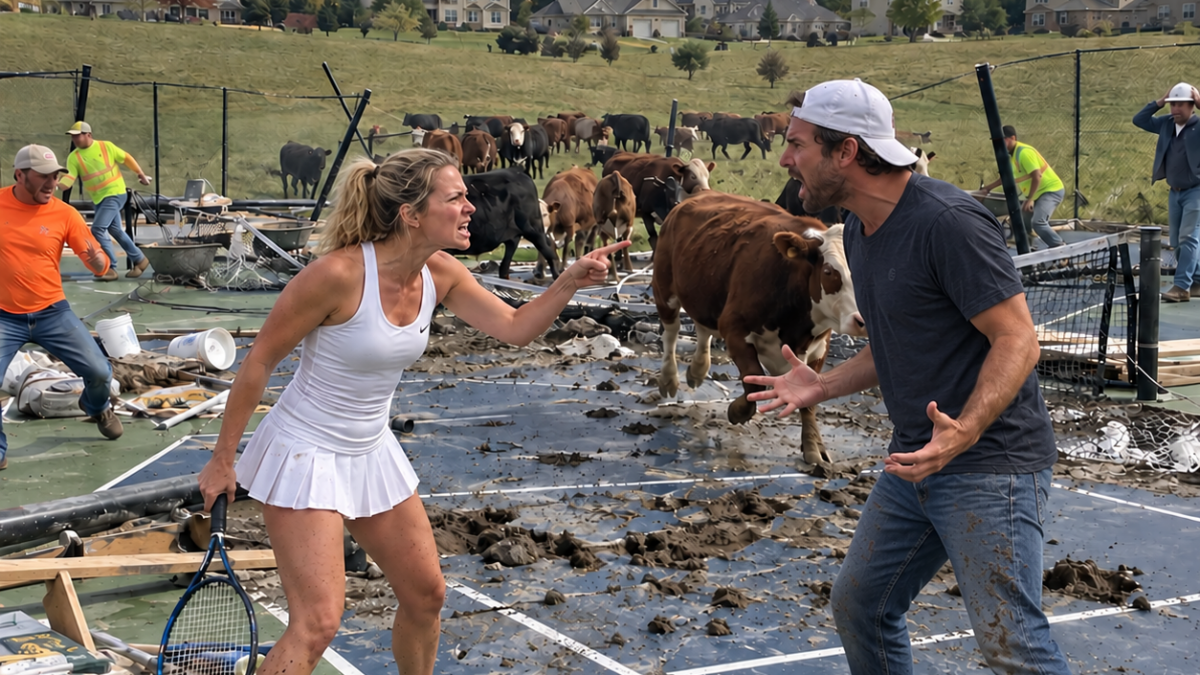
I pointed toward the broken section of temporary fencing the HOA contractor had installed.
“This has been grazing land longer than your subdivision has existed. Your court is blocking my cattle.”
“You could have fenced them out.”
“Of my own meadow?”
Patricia opened her mouth.
Then closed it.
A truck appeared behind her.
Two sheriff’s deputies got out.
Deputy Chen was one of them.
She had been standing in that same meadow months earlier, before the tennis court existed, telling Patricia and me that she could not resolve a property dispute without a judge.
Now there was a court order.
There had been several, actually.
And the most important one said something Patricia had spent months refusing to accept.
The meadow belonged to me.
The tennis court did not.
Deputy Chen looked at the cows.
Then the collapsed net.
Then me.
“Travis.”
“Morning.”
She tried very hard not to smile.
Patricia pointed at the herd.
“Arrest him.”
“For what?”
“Destruction of property.”
Deputy Chen looked at me.
“Did you intentionally drive these cattle onto the tennis court?”
“No.”
Patricia shouted, “He knew they would come here!”
I nodded.
“They graze this meadow every day.”
Deputy Chen turned toward Patricia.
“Then why is the tennis court inside their pasture?”
That question was almost too perfect.
Patricia’s jaw tightened.
And that morning became the moment everybody around Meadowbrook Heights remembered.
The HOA president had built a tennis court on my cattle meadow.
The judge had already ruled the land was mine.
The HOA was under orders to remove the structure.
And before demolition crews arrived, my Angus cattle wandered straight across it and tore the net down without understanding a single thing about HOAs, property law, or suburban tennis.
People later called it karma.
I called it Tuesday.
But the story did not start with cows on a tennis court.
It started months earlier when I came home one evening and found an electric-green construction fence cutting through the best grazing meadow my family owned.
My name is Travis Guthrie.
At the time, I was fifty-six years old.
I owned a cattle ranch that had been in my family since 1947.
My grandfather bought the original property when the nearest paved road was miles away and nobody had ever heard the phrase “planned residential community.”
He raised cattle.
Then my father did.
Then I did.
The ranch was not enormous by western standards, but it was productive.
Rolling pasture.
A few wooded slopes.
Two barns.
A spring-fed pond.
A creek.
And an eastern meadow that was particularly useful because it stayed green longer than most of our higher ground.
The spring ran through limestone below it.
Even during dry months, cattle usually found decent forage there.
My Angus herd loved that meadow.
So did I.
You could stand near the upper fence in late summer and look across black cattle scattered over green grass with the mountains behind them.
It was the kind of view people paid ridiculous money to imitate with landscaping.
I didn’t need to imitate it.
It was a working pasture.
Then Meadowbrook Heights appeared on the other side of my eastern boundary.
The development went in gradually.
Large houses.
Decorative entrance.
Clubhouse.
Walking trails.
Playground.
Pool.
Landscaped common areas.
And eventually, an HOA with enough committees to govern a small country.
Most residents were fine.
That is something I need to say early.
They were not all villains.
They were teachers.
Business owners.
Retired couples.
Families.
Kids riding bicycles.
People walking dogs.
A few bought beef from me.
One older resident named Gerald Simmons once helped me push a stranded trailer out of mud.
Another woman, Nancy Carter, brought homemade peach preserves every summer.
Meadowbrook Heights itself was not the problem.
The problem was Patricia Drummond.
Patricia became HOA president about two years before the tennis court disaster.
She was organized.
Confident.
Relentless.
She had the polished voice of someone who believed every conversation eventually became a meeting she was chairing.
If you interrupted her, she would wait with a little smile until you finished, then continue exactly where she had left off.
She dressed like every day might unexpectedly require a television interview.
To some residents, she was wonderful.
She negotiated contractor discounts.
Got potholes fixed.
Pushed the developer to finish landscaping.
Increased reserve funds.
Organized events.
She got things done.
That phrase—gets things done—can become dangerous when nobody asks how.
My first real encounter with Patricia was over a fence.
Meadowbrook Heights wanted to replace a decorative fence along one of its walking trails.
The contractor called me because the survey line was close.
We walked it together.
No dispute.
They stayed on their property.
I thanked him for asking.
That should have been the template for every future interaction.
Then Meadowbrook announced a recreation expansion.
The HOA wanted two new tennis courts.
Not pickleball.
Actual tennis.
Apparently several residents complained that the existing recreational area was too crowded.
The subdivision owned land near the clubhouse, but building there meant removing part of a landscaped garden and relocating utilities.
The eastern side of the neighborhood looked easier.
Flat.
Open.
Beautiful.
There was only one problem.
Most of that open land was mine.
The first indication I had that anyone was interested came through a survey crew.
I found two men near the eastern fence one afternoon.
They were standing on Meadowbrook’s side.
Perfectly legal.
One pointed across my meadow.
“Mr. Guthrie?”
“That’s me.”
“We’re confirming boundary references for a recreation project.”
“What project?”
“Not sure. We were hired for topography.”
“On their side?”
He glanced at his map.
“Mostly.”
That word caught my attention.
“Mostly?”
He showed me a preliminary drawing.
A rectangular recreation area extended toward my meadow.
“Where’d you get this boundary?”
“Client map.”
“County deed map?”
“Client-provided base plan.”
I pointed toward an old survey pin.
“My line is there.”
He looked at the map again.
“That doesn’t match this.”
“Then somebody should probably check before they build anything.”
He agreed.
Reasonable man.
Two weeks later, I received a letter.
Not asking permission.
Informing me.
NOTICE OF ADJACENT COMMON AREA IMPROVEMENT
Meadowbrook Heights HOA planned to construct a tennis facility near my boundary.
There would be temporary construction noise.
I called the management office.
A woman named Rebecca answered.
“I got your construction notice.”
“Yes, Mr. Guthrie.”
“Does the plan cross my land?”
“I’m not qualified to answer boundary questions.”
“Who is?”
“President Drummond is overseeing the project.”
Patricia called me that afternoon.
“Mr. Guthrie.”
“Travis is fine.”
“Very well. Travis.”
She spoke slowly.
“The tennis facility is being placed on HOA common land.”
“Your survey crew seems less certain.”
“We’ve had the property reviewed.”
“By whom?”
“Our project team.”
“That doesn’t answer the question.”
“County mapping supports our ownership.”
“My deed supports mine.”
She sighed.
“There are inconsistencies in old agricultural parcels.”
“Not mine.”
“That is what everyone says.”
I didn’t like that answer.
“Patricia, before you build anything, have a licensed surveyor check the recorded deed.”
“We have sufficient information.”
“Do you have a deed showing my meadow was transferred to Meadowbrook?”
“We have county common-area maps.”
“That wasn’t my question.”
She went quiet.
Then:
“The project has been approved.”
“Approval doesn’t move a property line.”
She became colder.
“Mr. Guthrie, the HOA is proceeding.”
“Then proceed on HOA land.”
“We intend to.”
That was the last conversation before construction.
Three weeks later, I came home just before sunset.
The eastern meadow should have been peaceful.
Instead, a bright green construction fence cut directly through it.
Heavy-equipment tracks crossed the grass.
Concrete forms sat inside rectangular excavations.
Stacks of lumber.
Rebar.
Portable lights.
A large project board stood beside the temporary entrance.
MEADOWBROOK HEIGHTS TENNIS EXPANSION
Two full courts.
Floodlights.
Benches.
Small storage building.
Landscaping.
My stomach dropped.
I walked toward the board.
Permits were stapled under a plastic cover.
Patricia Drummond’s signature.
Contractor approvals.
County paperwork.
Site plan.
The proposed courts sat almost entirely inside my eastern meadow.
I did not touch anything.
That surprised even me.
My first instinct was to rip the project sign out of the ground.
Second instinct was to get my tractor.
I did neither.
I called my lawyer.
Daniel Price.
Daniel had represented my family on land matters for years.
“Daniel.”
“Travis.”
“I have a problem.”
“What kind?”
“There’s a tennis court being built in my cow pasture.”
Silence.
Then:
“I’m sorry?”
“I’m looking at concrete footings.”
“On your side of the fence?”
“Way on my side.”
“Whose project?”
“Meadowbrook.”
Another pause.
“That doesn’t make sense.”
“Tell that to the cement mixer.”
His tone changed immediately.
“Do not touch anything.”
“I figured.”
“Take photographs.”
“Already doing it.”
“Everything. Project signs. Stakes. Fence line. Equipment. Permits.”
For the next hour I documented.
I photographed every survey stake.
Every excavation.
The temporary fence.
Old boundary monuments.
Equipment tracks.
The distance from my historic fence.
The project board.
County permit numbers.
Then I walked back to the barn.
My cattle were bunched near the upper pasture.
They did not understand why their normal grazing route had been blocked.
One cow pushed her nose against the temporary construction fence.
I moved them into another section for the night.
Then I went inside.
I barely slept.
At exactly seven the next morning, my phone rang.
Unknown local number.
“Travis Guthrie?”
“Yes.”
“Patricia Drummond.”
I sat up.
“Good morning, Patricia.”
“Our crews are returning this morning.”
“I assumed.”
“Please keep your cattle away from the construction zone.”
I actually laughed once.
Short.
Not because it was funny.
“Excuse me?”
“The livestock need to remain outside the fenced project area.”
“That is my pasture.”
“I’m afraid you’re mistaken.”
I stood.
“My family has owned that meadow since 1947.”
“The tennis facility is on HOA common property according to county filings.”
“My deed says otherwise.”
“The board reviewed the matter.”
“You didn’t answer me yesterday. Do you have a deed transferring it from my family?”
“I do not have time to debate title history by telephone.”
“That’s convenient.”
“The project is approved.”
“By your board.”
“And permitted.”
“A permit doesn’t give you land.”
“If you interfere with contractors, the association will take legal action.”
I stared at the wall.
“You are threatening to sue me for interfering with construction on my own farm?”
She answered without hesitation.
“Yes, if necessary.”
Then she hung up.
Outside, engines were already approaching.
Two pickups.
Flatbed trailer.
Crew van.
Workers began unloading forms and lumber.
I walked down.
The site manager introduced himself as Carl Henderson.
Hard hat.
Clipboard.
Tired eyes.
He looked like a man who had spent twenty years solving construction problems and did not want to become part of a property war.
“Carl, this is private ranch property.”
He held up paperwork.
“We were told HOA common land.”
“You’ve seen the deed?”
“No, sir.”
“Survey?”
“The client provided one.”
“The county is wrong.”
He frowned.
“We have permits.”
“My attorney is filing for an emergency order.”
That got his attention.
“I need to call Patricia.”
“Please do.”
Five minutes later, Carl came back.
His expression said he had not received the answer he wanted.
“We’ve been told to continue.”
“By Patricia?”
“Yes.”
I nodded.
“Then keep a record that I objected.”
“I will.”
Concrete work started.
I called Daniel.
“I’m drafting.”
“How fast?”
“I’m going to court.”
I called the sheriff.
Dispatcher said deputies were handling a serious traffic collision.
They would send someone when available.
I waited.
And watched.
There is something uniquely infuriating about watching somebody alter your land while everyone tells you the correct legal response is to wait.
Concrete poured into forms.
Workers measured.
Rebar went down.
My cattle stood at the edge of the pasture watching.
Almost noon before a sheriff’s SUV finally arrived.
Deputy Chen got out.
Young woman.
Calm.
She listened to me.
Then Carl.
Then Patricia by phone.
She looked at my deed copy.
Looked at the permits.
Looked at the survey map.
Then said the sentence I already expected.
“This appears to be a civil property dispute.”
“So they can keep building?”
“I cannot order a contractor off the site based only on conflicting documents without a court order.”
“It’s my land.”
“I understand what you’re saying.”
“Then this looks like trespassing.”
“It may be. But title disputes are civil unless there’s another criminal issue. I need a judge’s order or clear direction.”
I didn’t like it.
But Deputy Chen was doing her job.
That distinction matters too.
I thanked her.
She looked surprised.
“You’re not happy.”
“No.”
“But you understand.”
“I understand you didn’t create the problem.”
Daniel called fifteen minutes later.
“Hearing at four.”
That changed everything.
I spent the next few hours pulling records.
Old deeds.
Grandfather’s purchase.
Inheritance documents.
Tax maps.
Surveys.
County agricultural classification.
Any paper touching the eastern meadow.
I drove to the courthouse carrying a box that could have anchored a boat.
Daniel met me outside.
“They’re here.”
“Who?”
“Patricia and Meadowbrook’s attorney.”
The lawyer was Arthur Blackstone.
HOA specialist.
Expensive suit.
Perfect hair.
He shook Daniel’s hand like they were meeting for drinks.
Patricia barely looked at me.
Judge Evelyn Morrison took the bench at four.
She did not waste time.
“Mr. Price.”
Daniel stood.
“My client owns the agricultural parcel identified here.”
He introduced the chain of title.
Grandfather’s deed.
Estate transfer.
Current deed.
Survey.
Tax parcel.
Agricultural use records.
Then photographs of the active construction.
Judge Morrison examined the site plan.
“Mr. Blackstone?”
Arthur stood.
“The association’s position is that the project is within Meadowbrook common property based on county planning maps and the development survey.”
The judge looked at him.
“Do you have a deed?”
He hesitated.
“We have recorded subdivision materials.”
“That was not my question.”
Patricia shifted.
Judge Morrison repeated:
“Do you have evidence showing this land transferred from the Guthrie family to Meadowbrook Heights or its predecessor?”
Arthur turned pages.
“There is a survey indicating the area was available for future common recreational use.”
“Available?”
“Yes, Your Honor.”
“Owned?”
He paused.
“The chain is somewhat unclear.”
Daniel stood.
“It is clear.”
The judge looked toward him.
He handed up the deed.
No transfer.
No easement.
No dedication.
Nothing.
Judge Morrison looked back at Arthur.
“You began construction based on a planning map?”
Arthur said:
“The association relied on professional guidance.”
The judge’s voice sharpened.
“Did anyone review Mr. Guthrie’s deed?”
Patricia whispered something.
Arthur answered:
“Not before the project commenced.”
Judge Morrison stared at him.
For a long second.
Then:
“You are building permanent improvements on land for which you cannot presently establish ownership.”
Arthur tried:
“We believe further discovery—”
“Further discovery can occur while no additional concrete is poured.”
Temporary restraining order.
Immediate halt.
No construction.
No contractor entry beyond safety measures.
No alteration.
Patricia’s face flushed.
Arthur requested permission to complete work necessary to stabilize what had already been installed.
Judge Morrison allowed limited safety work only.
Then looked directly at the HOA table.
“Do not interpret that as permission to continue construction.”
Court adjourned.
Outside, Patricia approached.
“This is temporary.”
“Yes.”
“We will establish ownership.”
“Good luck.”
“You’re enjoying this.”
“No.”
I looked at her.
“I’d rather be feeding cattle.”
“This facility benefits hundreds of families.”
“That doesn’t change the deed.”
“You are blocking community improvement over unused grass.”
I stared at her.
“Unused?”
“Yes.”
“My cattle graze it.”
“There is plenty of other pasture.”
That sentence told me almost everything about Patricia.
She saw land.
Not work.
Not grazing rotation.
Not water.
Not family history.
Just open space.
And if open space wasn’t landscaped, paved, fenced, or scheduled on an HOA app, she considered it unused.
“That meadow is not yours to evaluate.”
She walked away.
The project stopped.
Concrete forms sat in the sun.
Half-built foundations hardened.
Temporary fencing remained.
For the next few weeks, Meadowbrook sent letters.
Some were legal.
Others were intimidation wearing legal stationery.
Allow access or face claims for project delay.
Allow access or reimburse contractor costs.
Allow access or risk liability for interfering with approved community improvements.
Daniel answered every one.
Usually in language much more polite than mine would have been.
Then the violation notices started.
First:
Unmaintained agricultural fencing adjacent to community boundary.
Then:
Visual nuisance — equipment storage.
Then:
Livestock noise disturbance.
Then:
Exterior barn noncompliance.
I called Daniel after the fourth.
“Can an HOA fine someone who isn’t a member?”
“No.”
“Can they fine a barn built before their subdivision existed?”
“No.”
“Then what are these?”
“Paper.”
“What do I do?”
“Send them to me.”
He sounded almost amused.
I wasn’t.
Meaningless notices still wear a person down.
They arrived every few days.
Formal envelopes.
Deadlines.
Threats.
Late fees.
One notice claimed my tractor violated “community parking standards.”
My tractor.
Inside my barnyard.
Daniel finally wrote:
Mr. Guthrie is not a member of Meadowbrook Heights HOA. Please identify any recorded covenant subjecting his property to association authority. Absent such evidence, cease issuing notices.
They didn’t have one.
The letters slowed.
Then stopped.
Meanwhile, the tennis court foundation remained in my meadow.
I couldn’t graze that section safely.
Rebar.
Forms.
Equipment.
Temporary fence.
My cattle had to rotate around it.
I started calculating lost grazing value and restoration costs.
Patricia changed strategies.
One evening, she came to my house.
With two board members.
Gerald Simmons was one.
The other was a woman named Elaine Porter.
I knew Gerald.
He looked uncomfortable.
Patricia did not.
“We’d like to resolve this without further litigation.”
“That would be nice.”
“We’re prepared to purchase an easement.”
“For what?”
“The tennis facility.”
“You don’t need an easement for a permanent court. You need the land.”
“Then a long-term recreational easement.”
“No.”
Patricia opened a folder.
“Fifty thousand dollars.”
“No.”
Gerald shifted.
“Travis, could we at least talk through—”
“The meadow isn’t for sale.”
Patricia said:
“Seventy-five thousand.”
“No.”
“You haven’t even considered it.”
“I considered it before you arrived.”
“The court occupies a small section.”
“It occupies my grazing land.”
“There are economic benefits to the community.”
“Not my community.”
“We could provide you with annual compensation.”
“No.”
Her face hardened.
“Everyone has a price.”
“I don’t.”
“That’s childish.”
Gerald looked at her.
“Patricia.”
She ignored him.
“Do you understand what prolonged litigation costs?”
“I do.”
“Our association has significant legal resources.”
“So do I.”
“You may win one temporary motion and still spend years fighting.”
“Then we’ll spend years.”
“You could lose far more than seventy-five thousand in attorneys’ fees.”
I stepped toward my front door.
“I guess we’ll both spend money.”
Patricia stared.
“You’re making a serious mistake.”
“No. Your serious mistake is believing money turns no into yes.”
She started to respond.
I opened the door.
“Get off my porch.”
Gerald sighed.
Elaine looked embarrassed.
Patricia spun around.
Their SUV left in a cloud of dust.
The full hearing came several weeks later.
This time the courtroom was crowded.
Meadowbrook board members.
Residents.
Surveyors.
Attorneys.
Contractor representatives.
A local reporter sat near the back.
Apparently a tennis court property dispute had become entertainment.
Daniel called Tom Webster.
Tom had been surveying land for thirty years.
He knew local records.
He displayed the current deed.
Historic deed.
Recorded pins.
Measurements.
“My opinion is not complicated,” he said.
“This meadow belongs to Mr. Guthrie.”
Arthur Blackstone tried to create ambiguity.
“Are old rural surveys always perfect?”
“No.”
“Can fence lines move?”
“Yes.”
“Can county planning documents reflect later intended transfers?”
“They can.”
“So there is room for interpretation?”
Tom looked at the map.
“Not here.”
Arthur paused.
Tom pointed.
“These pins match the recorded deed. The chain of title is complete. There is no conveyance to the developer or HOA.”
Then Meadowbrook’s own surveyor testified.
Daniel asked:
“When you prepared the tennis site plan, did you review Travis Guthrie’s individual deed?”
The man shifted.
“I reviewed county GIS and development materials.”
“That was not my question.”
“No.”
“Did you examine the historic boundary survey?”
“No.”
“Did you locate the Guthrie deed monuments?”
“Not before issuing the preliminary plan.”
“Why?”
“I was asked to confirm the subdivision common-area limits shown on client documents.”
“So you started with a map provided by Meadowbrook.”
“Yes.”
“And assumed the map was correct.”
“I relied upon it.”
Daniel nodded.
“Did you later examine Mr. Guthrie’s deed?”
“Yes.”
“And?”
The surveyor looked toward Patricia.
Then answered.
“The deed line places the tennis site on the Guthrie parcel.”
You could feel the courtroom shift.
Arthur closed his eyes for half a second.
Then Patricia took the stand.
Daniel approached calmly.
“Ms. Drummond, before construction began, did Mr. Guthrie tell you the meadow belonged to him?”
“Yes.”
“Did he ask you to review his deed?”
“He disputed our ownership.”
“That wasn’t my question.”
“Yes.”
“Did you personally obtain his deed before authorizing construction?”
“I relied on professional maps.”
“Did you obtain the deed?”
“No.”
“Why not?”
“It wasn’t necessary at the time.”
Judge Morrison looked up.
Daniel waited.
“Not necessary?”
“The county records showed the land as part of a planned common area.”
“Yet Mr. Guthrie told you those records were wrong.”
“He is not a surveyor.”
“Neither are you.”
Arthur objected.
Judge Morrison overruled.
Daniel continued.
“Your own project surveyor has now testified he did not check Mr. Guthrie’s deed before relying on your base map.”
Patricia’s jaw tightened.
“Based on information available, we believed the project was valid.”
“When Mr. Guthrie objected, did you stop voluntarily?”
“No.”
“Did you tell contractors to continue?”
“Yes.”
“Did you threaten legal action if he interfered?”
“I advised him not to obstruct an approved project.”
“Approved by whom?”
“The board.”
“Does your board have authority to approve construction on land it does not own?”
Arthur objected again.
Judge Morrison said:
“I think the answer is evident.”
Patricia’s face turned red.
After hours of testimony, Judge Morrison ruled.
The eastern meadow was Guthrie property.
No HOA ownership.
No recreational easement.
No recorded transfer.
No covenant subjecting my ranch to Meadowbrook authority.
Construction had been unauthorized.
The HOA was ordered to remove all tennis infrastructure from my land.
Restore the meadow.
Pay documented damages.
Pay a substantial portion of my attorneys’ fees.
And stop issuing HOA enforcement notices against my ranch.
Patricia stood immediately.
“We request a stay pending appeal.”
Judge Morrison looked at Arthur.
“Counsel?”
He whispered to Patricia.
Then asked formally.
Denied.
On the spot.
Daniel touched my shoulder.
“We won.”
I should have felt triumphant.
Mostly, I felt tired.
Outside, reporters asked questions.
I gave one sentence.
“I want my meadow back.”
That was it.
Demolition began two weeks later.
Jackhammers broke concrete that never should have been poured.
Loaders removed debris.
Workers pulled light foundations.
Electrical conduits came out.
The contractor who ran demolition was different from the original crew.
He walked the site with me every morning.
“Anything you want protected?”
“That spring drainage.”
“Marked.”
“Old fence corner.”
“Marked.”
“Topsoil stays separate.”
“Understood.”
Amazing what cooperation looks like when the person controlling the project accepts who owns the land.
Patricia did not.
Even after losing.
She filed complaints.
Livestock noise.
Dust.
Agricultural odor.
Fence appearance.
She sent notices even after the judge specifically said my property was outside HOA enforcement.
Daniel filed a motion.
Most notices vanished immediately.
Then Meadowbrook’s management company sent a letter saying the communications had been issued “in error.”
I did not believe that.
But I accepted the correction.
The concrete disappeared.
Topsoil returned.
The land was graded.
Seeded.
Restoration would take time.
I planned to keep cattle off the disturbed section until grass rooted properly.
For a few days, I thought the war might finally end.
Then I woke one morning and found my fence moved.
Not damaged.
Moved.
A brand-new fence stood approximately thirty feet inside my ranch.
The original boundary fence had been cut in several places.
New posts ran parallel to it.
That effectively removed a strip of grazing land from my use.
My cattle stood confused behind the new barrier.
I stared for almost a minute.
Then called Daniel.
“You’re not going to believe this.”
“At this point, try me.”
“Someone moved my fence.”
“How far?”
“About thirty feet.”
“Toward your property?”
“Yes.”
“Photograph everything.”
“I already am.”
Then I remembered the cameras.
After the construction fight started, I installed trail cameras near the eastern meadow.
Not because I expected sabotage.
Because I wanted a record of contractors coming and going.
I walked back to the house.
Pulled the memory card.
The footage was clear.
11:46 p.m.
White pickup.
HOA windshield sticker.
Three people.
Two men unloaded posts and wire.
A third figure stood beside them.
Woman.
Expensive outdoor jacket.
Flashlight.
Pointing.
Directing.
Even in infrared, I recognized Patricia.
One worker cut the old fence.
Another drove new posts.
Patricia pointed repeatedly toward the altered line.
They spent almost two hours moving the boundary physically inward.
I called Deputy Chen.
This time, when she arrived, the situation was not an ambiguous civil disagreement.
There was already a court judgment.
There was a recorded survey.
There was a video.
She watched it twice.
“Is that Patricia Drummond?”
“Yes.”
Daniel arrived later.
He watched.
Then said:
“This is different.”
“How?”
“She no longer has a plausible unresolved ownership claim.”
“What happens?”
“Let the sheriff handle the criminal side. We handle the civil side.”
Deputies went to Patricia.
Her explanation?
She believed she was within her rights.
Again.
She said the HOA needed a temporary buffer while meadow restoration occurred.
She claimed cattle threatened subdivision landscaping.
Nobody on the board had authorized the fence move.
The HOA’s attorney had not authorized it.
The management company hadn’t.
Patricia apparently arranged the work through a maintenance contact herself.
Deputy Chen later told me:
“She keeps using the phrase ‘within my rights.’”
I said:
“That phrase has caused a lot of expensive problems.”
Charges followed.
Trespass.
Property damage.
Vandalism-related counts depending on how the prosecutor framed the conduct.
No dramatic SWAT team.
No handcuffs in the clubhouse.
Patricia appeared through counsel.
But the local newspaper obtained the booking photograph.
That changed Meadowbrook.
Residents who had tolerated the tennis dispute as a legal misunderstanding saw something different now.
The court had ruled.
Then their president had gone onto my property at night and physically moved the fence anyway.
The HOA called an emergency meeting.
I did not attend.
Gerald called afterward.
“She’s out.”
“Resigned?”
“Removed.”
The vote had been overwhelming.
Patricia argued that she had been protecting Meadowbrook’s interests.
Residents asked why protecting their interests required midnight fence work on somebody else’s ranch.
She had no answer that satisfied them.
Gerald became interim president.
Two days later, he called.
“Travis, could I come over?”
“Alone?”
“Yes.”
He arrived in an old pickup.
No folder at first.
Just a man looking embarrassed.
“I owe you an apology.”
“You personally didn’t build the tennis court.”
“I voted for it.”
“Based on what you were told.”
“That doesn’t excuse not checking.”
“No.”
He nodded.
Then pulled out papers.
“The new board wants a clean reset.”
“What does that mean?”
“Meadowbrook will pay for the fence restoration. Any remaining land restoration. Costs tied to the unauthorized notices. We will sign a formal letter acknowledging that your property has never been part of our HOA.”
“That last part matters.”
“I know.”
“No language about disputed historic claims.”
“No.”
“No shared recreational rights.”
“No.”
“No buffer.”
“No.”
“No right to regulate cattle.”
He almost smiled.
“Definitely no.”
Daniel reviewed everything.
The final document was notarized.
Recorded where appropriate.
Clear.
My ranch was not subject to Meadowbrook Heights HOA.
The eastern meadow belonged solely to me.
No recreational easement.
No common-area claim.
No enforcement authority.
No implied future rights from historical maps.
Meadowbrook paid damages.
Fence rebuilt.
Restoration completed.
Legal expenses addressed.
The criminal case involving Patricia moved slower.
She eventually accepted a plea.
Probation.
Fines.
Community service.
Restitution tied to property damage.
No prison spectacle.
No ruined-for-life fantasy.
Consequences.
That was enough for me.
Some people expected me to celebrate.
I didn’t.
Watching somebody destroy her reputation over a tennis court did not feel satisfying.
Patricia had made one bad decision.
Then another.
Then another.
Each one apparently designed to avoid admitting the previous one had been wrong.
By the time she was moving fences at midnight, the original disagreement about a survey map barely mattered.
Pride had taken over.
Eventually, she moved away.
I don’t know exactly where.
I never asked.
The new Meadowbrook board behaved differently.
Almost excessively carefully.
Gerald called me before contractors trimmed trees anywhere near the boundary.
“Travis?”
“Yes?”
“We’re pruning three branches on our side.”
“Okay.”
“I’m sending a map.”
“You don’t need to.”
“I’m sending it anyway.”
I laughed.
“Fine.”
The meadow took a season to recover.
Concrete removal had disturbed more soil than I liked.
Heavy equipment compacted areas.
Construction gravel got mixed into places it shouldn’t.
The HOA-funded restoration crew removed what it could.
Then I took over.
Native grass seed.
Soil testing.
Aeration.
Patience.
Cattle stayed out of the most damaged section until roots established.
That spring, the green returned.
Not exactly the same.
You could see a slightly different shade where the courts had been.
Nature remembers disturbance.
But she also knows how to reclaim space if you give her time.
When the grass was strong enough, I opened the pasture gate.
Daisy entered first.
Of course she did.
She walked toward the restored ground.
Sniffed once.
Then began eating.
The rest followed.
Black Angus scattered across the meadow.
Calves running.
Mountains behind them.
No concrete.
No floodlights.
No tennis nets.
No project board.
That afternoon, a local kid named Tyler was helping me repair equipment.
He was sixteen.
Worked weekends.
Good kid.
He had heard the entire story from adults, which meant he had heard at least five inaccurate versions.
He asked:
“Did you really turn cattle loose on their tennis court?”
I looked at him.
“They were already loose in the meadow.”
“But they went through the net?”
“Yes.”
“On purpose?”
“The cows?”
He laughed.
“No. You.”
“I didn’t stop them.”
He grinned.
“That’s awesome.”
“It was expensive.”
“For the HOA.”
“For everybody.”
That confused him.
I explained.
“Court fights cost money. Lawyers cost money. Contractors lost work. Residents paid assessments. My pasture was damaged. Patricia ended up charged. Nothing about it was free.”
“But you won.”
“I kept my land.”
“That’s winning.”
“Yes.”
I thought about it.
“That’s different from enjoying the fight.”
He nodded like he understood.
Maybe he did.
A reporter called near the end of the year.
She was doing a feature about property disputes and homeowner associations.
“Do you think HOAs are bad?”
“No.”
She seemed surprised.
“After all that?”
“An HOA is paperwork. People make decisions.”
“So you don’t blame Meadowbrook?”
“I blame the people who acted without checking authority.”
“What should HOAs learn?”
“Read deeds before pouring concrete.”
She laughed.
“I’m serious.”
“I know.”
“And if an owner says your map is wrong, stop long enough to investigate.”
“What about property owners?”
“Document everything.”
“Would you ever join an HOA?”
“No.”
She laughed again.
“That sounded faster.”
“It was.”
Then she asked:
“What would you say to Patricia if you saw her today?”
I thought for a while.
“Hello.”
“That’s all?”
“Probably.”
“You don’t hate her?”
“No.”
“Why?”
“Holding a grudge just means she still controls part of my day.”
The reporter went quiet.
Then said:
“That’s going in the story.”
“Use whatever you want.”
A few ranchers called after the article.
People with fence disputes.
Access disagreements.
Developer issues.
They wanted the secret.
There wasn’t one.
“Get your deed.”
“Survey?”
“Yes.”
“Lawyer?”
“If the stakes justify it.”
“Should I confront them?”
“Don’t do anything stupid.”
That became my standard advice.
People want dramatic solutions.
Park a tractor across the road.
Cut down somebody’s sign.
Rip out construction stakes.
Turn cattle loose deliberately.
Sometimes those things feel satisfying.
They can also make your attorney want to retire early.
My success came from the opposite approach.
Photographs.
Deeds.
Surveys.
Court order.
Documentation.
The cattle walking through the tennis net was memorable.
The deed won the case.
That distinction gets lost when people retell it.
If I had destroyed the half-built court before the judge ruled, Meadowbrook could have turned the story around.
They could have called me violent.
Unreasonable.
Destructive.
Instead, Patricia’s own choices remained the focus.
She ignored warnings.
She relied on a planning map.
She didn’t check my deed.
She continued construction after direct notice.
She tried to apply HOA rules to a nonmember.
Then after losing in court, she moved my fence at night.
I didn’t need to exaggerate any of that.
The truth was enough.
That might be the strongest lesson from the whole mess.
You do not have to out-arrogant arrogant people.
Let documents do the work.
I still have the first tennis project map.
Daniel told me I could throw it away.
I kept it.
Not because I like remembering the fight.
Because the map is a perfect example of how something official-looking can still be wrong.
Color-coded lines.
County parcel numbers.
Engineering notes.
Signatures.
Project title.
Everything looked professional.
Everything looked authoritative.
And the most important line on the page was in the wrong place.
One wrong assumption traveled from a concept map to a survey base.
From the survey base to an HOA presentation.
From the presentation to a board vote.
From the board vote to permits.
From permits to contractors.
From contractors to concrete.
At every step, somebody thought the previous person had verified ownership.
Nobody did.
Until I did.
That is how big mistakes happen.
Not always because everyone involved is corrupt.
Sometimes because everybody assumes somebody else checked.
Patricia’s real failure was what happened after I told her.
Once she had actual notice, she had a choice.
Pause.
Check.
Correct.
Instead, she doubled down.
Why?
I’ve thought about that.
Maybe she feared losing credibility with residents.
She had championed the tennis project.
Promised timelines.
Shown renderings.
Talked about increasing property values.
Maybe admitting the site was wrong felt like admitting leadership failure.
So she chose the more dangerous option.
She tried to prove the site right.
That’s something people do.
They confuse consistency with strength.
Real strength is being able to say:
“I was wrong. Stop the concrete.”
Had Patricia said that after my first call, the entire thing might have cost Meadowbrook a survey fee and some embarrassment.
Instead it cost them demolition.
Restoration.
Legal fees.
Damages.
Fence repair.
And their president.
One afternoon, Gerald visited after the meadow had mostly recovered.
He stood at the fence.
“You know what the residents voted for last night?”
“What?”
“A new tennis court.”
I stared at him.
He laughed.
“Inside Meadowbrook.”
“That sounds innovative.”
“We checked the deed.”
“Even better.”
They built one near the clubhouse.
Smaller than Patricia’s original design.
No floodlights facing neighboring property.
No land dispute.
No lawsuit.
People played tennis.
World kept turning.
Gerald invited me to the opening.
“No.”
“Why?”
“I don’t play tennis.”
“That has not stopped you from becoming famous for tennis.”
“Unfortunately.”
He laughed.
Then said:
“Travis, I really am sorry.”
“I know.”
“Some residents were angry with you.”
“I know.”
“They thought you were being stubborn.”
“I was.”
He looked surprised.
“You admit that?”
“Of course.”
“Then why not sell the meadow?”
“Because stubbornness and being wrong aren’t the same.”
He nodded slowly.
“That’s fair.”
People often use stubborn as though it ends an argument.
Sometimes stubborn means refusing compromise when compromise would be reasonable.
Other times it means maintaining a boundary somebody else finds inconvenient.
Only one of those is a character flaw.
My meadow mattered to my operation.
It also mattered emotionally.
My grandfather grazed cattle there.
My father did.
I learned to fix fence there.
Madison—my niece—learned to drive a pickup there when she was fourteen and nearly put it into the spring.
You cannot put all of that into an appraisal.
Even if the HOA offered enough money to make selling rational, I still had the right to say no.
That is what ownership means.
Not that landowners are kings.
We have taxes.
Environmental rules.
Zoning.
Water regulations.
Animal-welfare obligations.
A thousand laws.
Ownership doesn’t mean unlimited control.
But it does mean your neighbor’s recreation committee cannot take your meadow because it would look good beside a subdivision.
Years passed.
The scars faded more.
The repaired fence weathered gray.
The spring kept running.
Calves were born.
Old cows left.
New heifers joined the herd.
Meadowbrook changed boards a couple of times.
Relations stayed civil.
One Christmas, Gerald brought me a gift.
A tennis ball.
I stared at him.
“You have a death wish?”
He laughed so hard he almost dropped the box.
It had a note attached.
For Daisy.
I actually did give it to her.
She sniffed it.
Licked it.
Then stepped on it.
That seemed appropriate.
The story kept traveling.
Online versions became ridiculous.
Some claimed I intentionally stampeded fifty cows through an active tennis tournament.
Never happened.
Another claimed Patricia was playing tennis when the herd destroyed the court.
No.
Another said I had secretly owned the entire Meadowbrook subdivision.
Definitely not.
The reality was better because it was believable.
An HOA relied on a bad map.
Its president refused to stop after the actual owner objected.
They poured concrete.
The owner went to court.
The HOA lost.
The court ordered restoration.
Cattle later walked through a structure that had been improperly built inside their grazing pasture.
Then the president, unable to accept the result, crossed a much clearer line and moved the owner’s fence at night.
That got her into real legal trouble.
No conspiracy required.
Just arrogance compounded by refusal to correct.
One summer evening, I was standing in the eastern meadow while the sun dropped behind the ridge.
Daisy was older by then.
She lay in the grass chewing slowly.
Two calves chased each other downhill.
A few cows stood near the spring.
The mountains turned pink.
Gold.
Then purple.
If you didn’t know where to look, there was no sign a tennis complex had ever been there.
I could still see it.
A slightly different patch of grass.
The old compacted area.
Maybe I would always see it.
But that didn’t bother me anymore.
Scars are not always ugly.
Sometimes they prove something healed.
Tyler, the kid who helped me on weekends, had graduated by then.
He stopped by before leaving for college.
We walked the meadow.
He pointed.
“So that’s where the court was?”
“Yes.”
“Hard to tell.”
“That’s the idea.”
He kicked at the grass.
“Would you do anything differently?”
I thought about it.
“Maybe install cameras sooner.”
He laughed.
“Seriously.”
“I’m serious.”
Then:
“I might also have ordered a professional survey immediately instead of hoping they would realize the mistake.”
“But you still would’ve fought?”
“Yes.”
“No matter what it cost?”
I looked across the pasture.
“There’s always a point where cost matters.”
“So when does fighting become stupid?”
“Good question.”
I leaned on the fence.
“If you’re fighting because you can’t stand losing, that’s dangerous.”
He nodded.
“If you’re fighting because the thing matters and giving in would create a bigger wrong, sometimes you keep going.”
“How do you know the difference?”
“You ask yourself what you would want if nobody else knew you won.”
He looked confused.
I explained.
“If nobody published a story. Nobody praised you. Nobody saw the other side lose. Would you still need the outcome?”
He looked across the meadow.
“You’d still want your land.”
“Yes.”
“That means it mattered.”
“Exactly.”
That question helped me understand my own anger.
I never really wanted Patricia embarrassed.
I didn’t need residents applauding.
I didn’t care whether the newspaper called me stubborn or heroic.
If the entire dispute happened privately, I still would have wanted the same result.
My cattle meadow intact.
My boundary respected.
That meant the fight was worth having.
Patricia’s fight was different.
Eventually, her original stated goal—building tennis courts—stopped being the real issue.
She could have relocated them.
What she could not tolerate was losing authority.
That turned a planning mistake into a personal campaign.
The false violations.
The threats.
The fence move.
Once being right becomes more important than the original problem, people start doing very strange things.
I suppose that is why the final document mattered so much.
When Gerald brought me the notarized acknowledgment, I read every word.
The Guthrie property has never been subject to the Meadowbrook Heights Declaration of Covenants.
Good.
The eastern meadow is not and has never been common property of the Association.
Better.
The Association claims no recreational easement, maintenance right, grazing restriction, architectural authority, or other control over the parcel.
Very good.
No prior planning map, concept drawing, survey base, or HOA record shall be interpreted as creating property rights inconsistent with the Guthrie deed.
Perfect.
I signed acknowledgment of receipt.
Not agreement to give anything.
Just receipt.
Daniel recorded the relevant boundary paperwork.
That was the real ending.
Not cows tearing down a net.
Not Patricia’s booking photograph.
Not residents voting her out.
Paper.
The right paper this time.
I often think about Deputy Chen’s first visit.
She stood between me and contractors and told me:
“I cannot decide this.”
At the time, that felt infuriating.
Later, I appreciated it.
We expect police to fix problems quickly.
But some questions belong in court.
Who owns land?
What does a deed say?
Which survey controls?
Those things require evidence.
Process can feel slow when you’re watching concrete cure in your pasture.
But the alternative is a deputy guessing who has the better-looking paperwork.
I would not want that system either.
Judge Morrison did what courts are supposed to do.
Read documents.
Hear experts.
Ask the question everybody should have asked before construction:
Where is the proof this land ever became HOA property?
There wasn’t any.
That one missing answer collapsed the entire project.
The funny part is that Patricia had dozens of opportunities to find out.
My first phone call.
My attorney’s letter.
The survey pins.
The temporary hearing.
Even after the restraining order, she could have accepted reality and negotiated restoration.
Every step offered an exit.
She chose escalation.
That is another lesson I have tried to remember in smaller arguments.
Always leave yourself a door.
If new evidence proves you wrong, take it.
There is no prize for driving deeper into a mistake.
Patricia drove hers all the way into a criminal case.
I heard years later that she was doing fine.
New town.
Job.
No HOA presidency.
Good.
I meant that.
Accountability should correct behavior when possible.
It does not need to become permanent humiliation.
If I saw her tomorrow, I meant what I told the reporter.
I would probably say hello.
Maybe she would say hello back.
Then we would continue walking.
That is enough.
The meadow does not need her apology anymore.
It already has grass.
My cows do not remember the tennis court.
They don’t remember lawsuits.
They certainly don’t remember HOA notices.
To them, property law has one simple expression.
Fence open?
Walk.
Grass available?
Eat.
Fence closed?
Find another spot.
Maybe humans could learn something from that.
We build documents and governments and committees because our lives are more complicated.
But sometimes we use complexity to avoid something simple.
Ask permission.
Respect boundaries.
If somebody says something belongs to him and you think he is wrong, verify before pouring concrete.
Do not threaten him because your board approved something.
Your board cannot approve away another person’s deed.
Today, there is a tennis court at Meadowbrook Heights.
A perfectly good one.
On Meadowbrook property.
Kids play there.
Adults argue over line calls.
Nobody bothers me.
And my eastern meadow is still pasture.
On certain summer evenings, if the light hits just right, the grass where the original court sat looks a fraction darker than the rest.
That is the only visible reminder.
Sometimes I stand there.
Not because I am nostalgic for the conflict.
Because I like the contrast.
Patricia’s project looked permanent.
Concrete.
Steel.
Floodlight bases.
Survey stakes.
Permits.
Board approvals.
Lawyers.
For a while, it looked like all that machinery of authority had transformed the land.
But underneath it, the deed never changed.
The boundary never moved.
The meadow never stopped being mine.
Once the concrete was gone, grass returned.
Then cattle.
The land resumed being what it had always been.
That feels poetic, even to somebody like me.
They built plans.
I had a deed.
They poured concrete.
I had a boundary.
They put up a tennis net.
My cows eventually walked through it.
In the end, the cows did not really beat the HOA.
The cows had no idea there was a fight.
The deed beat the HOA.
The survey beat the bad map.
The camera beat the midnight fence move.
And eventually common sense beat Patricia’s need to control something she never owned.
When people ask me what I learned, I tell them three things.
First, keep your documents.
A fifty-year-old deed can become very modern very quickly when somebody shows up with a bulldozer.
Second, do not confuse confidence with authority.
Patricia sounded certain from the first phone call.
She was still wrong.
Third, once you know your boundary, defend it.
Not recklessly.
Not violently.
Not because you enjoy conflict.
Defend it because a boundary ignored once becomes easier to ignore twice.
That does not only apply to land.
Companies.
Neighbors.
Bosses.
Governments.
People.
Everyone has a tendency to take what is convenient if nobody reminds them where permission ends.
My grandfather understood that.
His old fences were never particularly pretty.
Some posts leaned.
Wire had patches.
But he knew every line.
He used to tell me:
“Good neighbors don’t need tall fences. They need to know whose side they’re standing on.”
I think Patricia would have hated that sentence.
Or maybe, after everything, she would understand it.
One evening not long ago, I drove my old diesel down the gravel driveway.
The seat was still cracked.
Toolbox still welded to the bed.
Meadowbrook’s stone entrance still looked polished in the distance.
Landscapers still came Thursdays.
My ranch still looked like a ranch.
Dust.
Cattle.
Fence.
Tractor.
Nothing dramatic.
I parked near the eastern pasture.
Daisy’s granddaughter was grazing where the baseline of Patricia’s tennis court once ran.
A calf trotted behind her.
There was no net to knock down this time.
No concrete beneath their hooves.
Just grass.
I leaned on the fence and watched until the sun disappeared behind the mountains.
I thought about that first green construction fence slicing across my property.
How official everything looked.
How powerless I felt watching strangers pour concrete.
Then I thought about the final morning when the restored meadow opened to cattle again.
Same land.
Same boundary.
Different understanding.
And maybe that is the part I value most.
I did not get something new.
I did not win Meadowbrook’s property.
I did not receive a fortune.
I did not destroy the HOA.
I kept what was already mine.
Sometimes that is all justice needs to accomplish.
Not give you more.
Just stop somebody else from taking what was never theirs.
So yes.
An HOA built a tennis court in my cattle meadow.
And yes.
My Angus eventually walked straight through the net.
It made a great photograph.
It made a better story.
But the photograph was not the victory.
The victory came months later, when I could open that pasture gate, watch my cattle spread across clean grass, and know nobody on the other side of the fence believed they had the authority to stop them.
Because this time the HOA had finally learned something my grandfather understood in 1947.
You can draw whatever line you want on a planning map.
You can stamp it.
Approve it.
Vote on it.
Build beside it.
Hire lawyers to defend it.
But none of that moves the real property line.
And when somebody forgets that long enough to pour a tennis court on a cattle meadow, eventually somebody has to remind them.
In my case, the judge did it first.
The deed did it permanently.
And Daisy finished the lesson by walking directly through the net.
REVIEW
HOA Built a Tennis Court on My Cattle Meadow—So I Let My Angus Walk Straight Through Their Brand-New Net
The first cow stepped onto the brand-new tennis court like she owned it.
Which, considering the court was sitting in the middle of my meadow, was close enough to the truth.
Her name was Daisy.
Twelve hundred pounds of black Angus muscle, mud, and complete indifference to suburban recreation.
She walked across the fresh green surface, stopped near the service line, lowered her head, and began chewing the grass growing along the edge where the construction crew had failed to finish grading.
Behind her came six more cattle.
Then three calves.
One calf nudged the tennis net.
The center strap snapped loose.
The net sagged.
Daisy pushed forward.
The entire thing folded across her shoulders.
She kept walking.
By the time Patricia Drummond’s white SUV came flying down the gravel lane, half my herd was standing inside the fenced tennis complex she had built in my pasture.
Patricia jumped out wearing expensive hiking boots that had probably never stepped in anything more agricultural than decorative mulch.
“What are you doing?”
I leaned against the original fence post that marked my family’s property line.
“I’m watching my cattle graze.”
“On the tennis court!”
“Yes.”
“They’re destroying HOA property!”
I looked at the cracked green surface, the sagging net, the cattle hoofprints, and then at Patricia.
“That’s interesting.”
“What is?”
“You finally noticed the word property.”
Her face turned red.
“Get them out!”
“No.”
“You cannot let livestock damage community facilities!”
I smiled.
“There’s another interesting phrase.”
“What?”
“Community facilities.”
I pointed at the meadow around us.
“You built that court on my land.”
“It is not your land.”
“It has been Guthrie land since 1947.”
“Our survey says otherwise.”
“Your surveyor never checked my deed.”
She stepped closer.
“You’ve lost this argument already, Travis.”
“Have I?”
“The court is complete. The board spent more than two hundred thousand dollars. We have permits. Contractors. County filings. Residents have already reserved playing time.”
One calf pushed through the net again.
A steel post bent sideways.
Patricia flinched.
“You are going to pay for that.”
I looked at Daisy.
Then back at Patricia.
“You should probably send her the invoice.”
“This isn’t funny.”
“No.”
My smile disappeared.
“It stopped being funny when your contractors poured concrete in my cattle meadow after I told you the land belonged to me.”
She pointed toward the cattle.
“This is deliberate retaliation.”
“No. Retaliation would be me loading those cows into trailers, hauling them here, and turning them loose inside your court.”
She stared at me.
“They were already in this pasture.”
I pointed toward the broken section of temporary fencing the HOA contractor had installed.
“This has been grazing land longer than your subdivision has existed. Your court is blocking my cattle.”
“You could have fenced them out.”
“Of my own meadow?”
Patricia opened her mouth.
Then closed it.
A truck appeared behind her.
Two sheriff’s deputies got out.
Deputy Chen was one of them.
She had been standing in that same meadow months earlier, before the tennis court existed, telling Patricia and me that she could not resolve a property dispute without a judge.
Now there was a court order.
There had been several, actually.
And the most important one said something Patricia had spent months refusing to accept.
The meadow belonged to me.
The tennis court did not.
Deputy Chen looked at the cows.
Then the collapsed net.
Then me.
“Travis.”
“Morning.”
She tried very hard not to smile.
Patricia pointed at the herd.
“Arrest him.”
“For what?”
“Destruction of property.”
Deputy Chen looked at me.
“Did you intentionally drive these cattle onto the tennis court?”
“No.”
Patricia shouted, “He knew they would come here!”
I nodded.
“They graze this meadow every day.”
Deputy Chen turned toward Patricia.
“Then why is the tennis court inside their pasture?”
That question was almost too perfect.
Patricia’s jaw tightened.
And that morning became the moment everybody around Meadowbrook Heights remembered.
The HOA president had built a tennis court on my cattle meadow.
The judge had already ruled the land was mine.
The HOA was under orders to remove the structure.
And before demolition crews arrived, my Angus cattle wandered straight across it and tore the net down without understanding a single thing about HOAs, property law, or suburban tennis.
People later called it karma.
I called it Tuesday.
But the story did not start with cows on a tennis court.
It started months earlier when I came home one evening and found an electric-green construction fence cutting through the best grazing meadow my family owned.
My name is Travis Guthrie.
At the time, I was fifty-six years old.
I owned a cattle ranch that had been in my family since 1947.
My grandfather bought the original property when the nearest paved road was miles away and nobody had ever heard the phrase “planned residential community.”
He raised cattle.
Then my father did.
Then I did.
The ranch was not enormous by western standards, but it was productive.
Rolling pasture.
A few wooded slopes.
Two barns.
A spring-fed pond.
A creek.
And an eastern meadow that was particularly useful because it stayed green longer than most of our higher ground.
The spring ran through limestone below it.
Even during dry months, cattle usually found decent forage there.
My Angus herd loved that meadow.
So did I.
You could stand near the upper fence in late summer and look across black cattle scattered over green grass with the mountains behind them.
It was the kind of view people paid ridiculous money to imitate with landscaping.
I didn’t need to imitate it.
It was a working pasture.
Then Meadowbrook Heights appeared on the other side of my eastern boundary.
The development went in gradually.
Large houses.
Decorative entrance.
Clubhouse.
Walking trails.
Playground.
Pool.
Landscaped common areas.
And eventually, an HOA with enough committees to govern a small country.
Most residents were fine.
That is something I need to say early.
They were not all villains.
They were teachers.
Business owners.
Retired couples.
Families.
Kids riding bicycles.
People walking dogs.
A few bought beef from me.
One older resident named Gerald Simmons once helped me push a stranded trailer out of mud.
Another woman, Nancy Carter, brought homemade peach preserves every summer.
Meadowbrook Heights itself was not the problem.
The problem was Patricia Drummond.
Patricia became HOA president about two years before the tennis court disaster.
She was organized.
Confident.
Relentless.
She had the polished voice of someone who believed every conversation eventually became a meeting she was chairing.
If you interrupted her, she would wait with a little smile until you finished, then continue exactly where she had left off.
She dressed like every day might unexpectedly require a television interview.
To some residents, she was wonderful.
She negotiated contractor discounts.
Got potholes fixed.
Pushed the developer to finish landscaping.
Increased reserve funds.
Organized events.
She got things done.
That phrase—gets things done—can become dangerous when nobody asks how.
My first real encounter with Patricia was over a fence.
Meadowbrook Heights wanted to replace a decorative fence along one of its walking trails.
The contractor called me because the survey line was close.
We walked it together.
No dispute.
They stayed on their property.
I thanked him for asking.
That should have been the template for every future interaction.
Then Meadowbrook announced a recreation expansion.
The HOA wanted two new tennis courts.
Not pickleball.
Actual tennis.
Apparently several residents complained that the existing recreational area was too crowded.
The subdivision owned land near the clubhouse, but building there meant removing part of a landscaped garden and relocating utilities.
The eastern side of the neighborhood looked easier.
Flat.
Open.
Beautiful.
There was only one problem.
Most of that open land was mine.
The first indication I had that anyone was interested came through a survey crew.
I found two men near the eastern fence one afternoon.
They were standing on Meadowbrook’s side.
Perfectly legal.
One pointed across my meadow.
“Mr. Guthrie?”
“That’s me.”
“We’re confirming boundary references for a recreation project.”
“What project?”
“Not sure. We were hired for topography.”
“On their side?”
He glanced at his map.
“Mostly.”
That word caught my attention.
“Mostly?”
He showed me a preliminary drawing.
A rectangular recreation area extended toward my meadow.
“Where’d you get this boundary?”
“Client map.”
“County deed map?”
“Client-provided base plan.”
I pointed toward an old survey pin.
“My line is there.”
He looked at the map again.
“That doesn’t match this.”
“Then somebody should probably check before they build anything.”
He agreed.
Reasonable man.
Two weeks later, I received a letter.
Not asking permission.
Informing me.
NOTICE OF ADJACENT COMMON AREA IMPROVEMENT
Meadowbrook Heights HOA planned to construct a tennis facility near my boundary.
There would be temporary construction noise.
I called the management office.
A woman named Rebecca answered.
“I got your construction notice.”
“Yes, Mr. Guthrie.”
“Does the plan cross my land?”
“I’m not qualified to answer boundary questions.”
“Who is?”
“President Drummond is overseeing the project.”
Patricia called me that afternoon.
“Mr. Guthrie.”
“Travis is fine.”
“Very well. Travis.”
She spoke slowly.
“The tennis facility is being placed on HOA common land.”
“Your survey crew seems less certain.”
“We’ve had the property reviewed.”
“By whom?”
“Our project team.”
“That doesn’t answer the question.”
“County mapping supports our ownership.”
“My deed supports mine.”
She sighed.
“There are inconsistencies in old agricultural parcels.”
“Not mine.”
“That is what everyone says.”
I didn’t like that answer.
“Patricia, before you build anything, have a licensed surveyor check the recorded deed.”
“We have sufficient information.”
“Do you have a deed showing my meadow was transferred to Meadowbrook?”
“We have county common-area maps.”
“That wasn’t my question.”
She went quiet.
Then:
“The project has been approved.”
“Approval doesn’t move a property line.”
She became colder.
“Mr. Guthrie, the HOA is proceeding.”
“Then proceed on HOA land.”
“We intend to.”
That was the last conversation before construction.
Three weeks later, I came home just before sunset.
The eastern meadow should have been peaceful.
Instead, a bright green construction fence cut directly through it.
Heavy-equipment tracks crossed the grass.
Concrete forms sat inside rectangular excavations.
Stacks of lumber.
Rebar.
Portable lights.
A large project board stood beside the temporary entrance.
MEADOWBROOK HEIGHTS TENNIS EXPANSION
Two full courts.
Floodlights.
Benches.
Small storage building.
Landscaping.
My stomach dropped.
I walked toward the board.
Permits were stapled under a plastic cover.
Patricia Drummond’s signature.
Contractor approvals.
County paperwork.
Site plan.
The proposed courts sat almost entirely inside my eastern meadow.
I did not touch anything.
That surprised even me.
My first instinct was to rip the project sign out of the ground.
Second instinct was to get my tractor.
I did neither.
I called my lawyer.
Daniel Price.
Daniel had represented my family on land matters for years.
“Daniel.”
“Travis.”
“I have a problem.”
“What kind?”
“There’s a tennis court being built in my cow pasture.”
Silence.
Then:
“I’m sorry?”
“I’m looking at concrete footings.”
“On your side of the fence?”
“Way on my side.”
“Whose project?”
“Meadowbrook.”
Another pause.
“That doesn’t make sense.”
“Tell that to the cement mixer.”
His tone changed immediately.
“Do not touch anything.”
“I figured.”
“Take photographs.”
“Already doing it.”
“Everything. Project signs. Stakes. Fence line. Equipment. Permits.”
For the next hour I documented.
I photographed every survey stake.
Every excavation.
The temporary fence.
Old boundary monuments.
Equipment tracks.
The distance from my historic fence.
The project board.
County permit numbers.
Then I walked back to the barn.
My cattle were bunched near the upper pasture.
They did not understand why their normal grazing route had been blocked.
One cow pushed her nose against the temporary construction fence.
I moved them into another section for the night.
Then I went inside.
I barely slept.
At exactly seven the next morning, my phone rang.
Unknown local number.
“Travis Guthrie?”
“Yes.”
“Patricia Drummond.”
I sat up.
“Good morning, Patricia.”
“Our crews are returning this morning.”
“I assumed.”
“Please keep your cattle away from the construction zone.”
I actually laughed once.
Short.
Not because it was funny.
“Excuse me?”
“The livestock need to remain outside the fenced project area.”
“That is my pasture.”
“I’m afraid you’re mistaken.”
I stood.
“My family has owned that meadow since 1947.”
“The tennis facility is on HOA common property according to county filings.”
“My deed says otherwise.”
“The board reviewed the matter.”
“You didn’t answer me yesterday. Do you have a deed transferring it from my family?”
“I do not have time to debate title history by telephone.”
“That’s convenient.”
“The project is approved.”
“By your board.”
“And permitted.”
“A permit doesn’t give you land.”
“If you interfere with contractors, the association will take legal action.”
I stared at the wall.
“You are threatening to sue me for interfering with construction on my own farm?”
She answered without hesitation.
“Yes, if necessary.”
Then she hung up.
Outside, engines were already approaching.
Two pickups.
Flatbed trailer.
Crew van.
Workers began unloading forms and lumber.
I walked down.
The site manager introduced himself as Carl Henderson.
Hard hat.
Clipboard.
Tired eyes.
He looked like a man who had spent twenty years solving construction problems and did not want to become part of a property war.
“Carl, this is private ranch property.”
He held up paperwork.
“We were told HOA common land.”
“You’ve seen the deed?”
“No, sir.”
“Survey?”
“The client provided one.”
“The county is wrong.”
He frowned.
“We have permits.”
“My attorney is filing for an emergency order.”
That got his attention.
“I need to call Patricia.”
“Please do.”
Five minutes later, Carl came back.
His expression said he had not received the answer he wanted.
“We’ve been told to continue.”
“By Patricia?”
“Yes.”
I nodded.
“Then keep a record that I objected.”
“I will.”
Concrete work started.
I called Daniel.
“I’m drafting.”
“How fast?”
“I’m going to court.”
I called the sheriff.
Dispatcher said deputies were handling a serious traffic collision.
They would send someone when available.
I waited.
And watched.
There is something uniquely infuriating about watching somebody alter your land while everyone tells you the correct legal response is to wait.
Concrete poured into forms.
Workers measured.
Rebar went down.
My cattle stood at the edge of the pasture watching.
Almost noon before a sheriff’s SUV finally arrived.
Deputy Chen got out.
Young woman.
Calm.
She listened to me.
Then Carl.
Then Patricia by phone.
She looked at my deed copy.
Looked at the permits.
Looked at the survey map.
Then said the sentence I already expected.
“This appears to be a civil property dispute.”
“So they can keep building?”
“I cannot order a contractor off the site based only on conflicting documents without a court order.”
“It’s my land.”
“I understand what you’re saying.”
“Then this looks like trespassing.”
“It may be. But title disputes are civil unless there’s another criminal issue. I need a judge’s order or clear direction.”
I didn’t like it.
But Deputy Chen was doing her job.
That distinction matters too.
I thanked her.
She looked surprised.
“You’re not happy.”
“No.”
“But you understand.”
“I understand you didn’t create the problem.”
Daniel called fifteen minutes later.
“Hearing at four.”
That changed everything.
I spent the next few hours pulling records.
Old deeds.
Grandfather’s purchase.
Inheritance documents.
Tax maps.
Surveys.
County agricultural classification.
Any paper touching the eastern meadow.
I drove to the courthouse carrying a box that could have anchored a boat.
Daniel met me outside.
“They’re here.”
“Who?”
“Patricia and Meadowbrook’s attorney.”
The lawyer was Arthur Blackstone.
HOA specialist.
Expensive suit.
Perfect hair.
He shook Daniel’s hand like they were meeting for drinks.
Patricia barely looked at me.
Judge Evelyn Morrison took the bench at four.
She did not waste time.
“Mr. Price.”
Daniel stood.
“My client owns the agricultural parcel identified here.”
He introduced the chain of title.
Grandfather’s deed.
Estate transfer.
Current deed.
Survey.
Tax parcel.
Agricultural use records.
Then photographs of the active construction.
Judge Morrison examined the site plan.
“Mr. Blackstone?”
Arthur stood.
“The association’s position is that the project is within Meadowbrook common property based on county planning maps and the development survey.”
The judge looked at him.
“Do you have a deed?”
He hesitated.
“We have recorded subdivision materials.”
“That was not my question.”
Patricia shifted.
Judge Morrison repeated:
“Do you have evidence showing this land transferred from the Guthrie family to Meadowbrook Heights or its predecessor?”
Arthur turned pages.
“There is a survey indicating the area was available for future common recreational use.”
“Available?”
“Yes, Your Honor.”
“Owned?”
He paused.
“The chain is somewhat unclear.”
Daniel stood.
“It is clear.”
The judge looked toward him.
He handed up the deed.
No transfer.
No easement.
No dedication.
Nothing.
Judge Morrison looked back at Arthur.
“You began construction based on a planning map?”
Arthur said:
“The association relied on professional guidance.”
The judge’s voice sharpened.
“Did anyone review Mr. Guthrie’s deed?”
Patricia whispered something.
Arthur answered:
“Not before the project commenced.”
Judge Morrison stared at him.
For a long second.
Then:
“You are building permanent improvements on land for which you cannot presently establish ownership.”
Arthur tried:
“We believe further discovery—”
“Further discovery can occur while no additional concrete is poured.”
Temporary restraining order.
Immediate halt.
No construction.
No contractor entry beyond safety measures.
No alteration.
Patricia’s face flushed.
Arthur requested permission to complete work necessary to stabilize what had already been installed.
Judge Morrison allowed limited safety work only.
Then looked directly at the HOA table.
“Do not interpret that as permission to continue construction.”
Court adjourned.
Outside, Patricia approached.
“This is temporary.”
“Yes.”
“We will establish ownership.”
“Good luck.”
“You’re enjoying this.”
“No.”
I looked at her.
“I’d rather be feeding cattle.”
“This facility benefits hundreds of families.”
“That doesn’t change the deed.”
“You are blocking community improvement over unused grass.”
I stared at her.
“Unused?”
“Yes.”
“My cattle graze it.”
“There is plenty of other pasture.”
That sentence told me almost everything about Patricia.
She saw land.
Not work.
Not grazing rotation.
Not water.
Not family history.
Just open space.
And if open space wasn’t landscaped, paved, fenced, or scheduled on an HOA app, she considered it unused.
“That meadow is not yours to evaluate.”
She walked away.
The project stopped.
Concrete forms sat in the sun.
Half-built foundations hardened.
Temporary fencing remained.
For the next few weeks, Meadowbrook sent letters.
Some were legal.
Others were intimidation wearing legal stationery.
Allow access or face claims for project delay.
Allow access or reimburse contractor costs.
Allow access or risk liability for interfering with approved community improvements.
Daniel answered every one.
Usually in language much more polite than mine would have been.
Then the violation notices started.
First:
Unmaintained agricultural fencing adjacent to community boundary.
Then:
Visual nuisance — equipment storage.
Then:
Livestock noise disturbance.
Then:
Exterior barn noncompliance.
I called Daniel after the fourth.
“Can an HOA fine someone who isn’t a member?”
“No.”
“Can they fine a barn built before their subdivision existed?”
“No.”
“Then what are these?”
“Paper.”
“What do I do?”
“Send them to me.”
He sounded almost amused.
I wasn’t.
Meaningless notices still wear a person down.
They arrived every few days.
Formal envelopes.
Deadlines.
Threats.
Late fees.
One notice claimed my tractor violated “community parking standards.”
My tractor.
Inside my barnyard.
Daniel finally wrote:
Mr. Guthrie is not a member of Meadowbrook Heights HOA. Please identify any recorded covenant subjecting his property to association authority. Absent such evidence, cease issuing notices.
They didn’t have one.
The letters slowed.
Then stopped.
Meanwhile, the tennis court foundation remained in my meadow.
I couldn’t graze that section safely.
Rebar.
Forms.
Equipment.
Temporary fence.
My cattle had to rotate around it.
I started calculating lost grazing value and restoration costs.
Patricia changed strategies.
One evening, she came to my house.
With two board members.
Gerald Simmons was one.
The other was a woman named Elaine Porter.
I knew Gerald.
He looked uncomfortable.
Patricia did not.
“We’d like to resolve this without further litigation.”
“That would be nice.”
“We’re prepared to purchase an easement.”
“For what?”
“The tennis facility.”
“You don’t need an easement for a permanent court. You need the land.”
“Then a long-term recreational easement.”
“No.”
Patricia opened a folder.
“Fifty thousand dollars.”
“No.”
Gerald shifted.
“Travis, could we at least talk through—”
“The meadow isn’t for sale.”
Patricia said:
“Seventy-five thousand.”
“No.”
“You haven’t even considered it.”
“I considered it before you arrived.”
“The court occupies a small section.”
“It occupies my grazing land.”
“There are economic benefits to the community.”
“Not my community.”
“We could provide you with annual compensation.”
“No.”
Her face hardened.
“Everyone has a price.”
“I don’t.”
“That’s childish.”
Gerald looked at her.
“Patricia.”
She ignored him.
“Do you understand what prolonged litigation costs?”
“I do.”
“Our association has significant legal resources.”
“So do I.”
“You may win one temporary motion and still spend years fighting.”
“Then we’ll spend years.”
“You could lose far more than seventy-five thousand in attorneys’ fees.”
I stepped toward my front door.
“I guess we’ll both spend money.”
Patricia stared.
“You’re making a serious mistake.”
“No. Your serious mistake is believing money turns no into yes.”
She started to respond.
I opened the door.
“Get off my porch.”
Gerald sighed.
Elaine looked embarrassed.
Patricia spun around.
Their SUV left in a cloud of dust.
The full hearing came several weeks later.
This time the courtroom was crowded.
Meadowbrook board members.
Residents.
Surveyors.
Attorneys.
Contractor representatives.
A local reporter sat near the back.
Apparently a tennis court property dispute had become entertainment.
Daniel called Tom Webster.
Tom had been surveying land for thirty years.
He knew local records.
He displayed the current deed.
Historic deed.
Recorded pins.
Measurements.
“My opinion is not complicated,” he said.
“This meadow belongs to Mr. Guthrie.”
Arthur Blackstone tried to create ambiguity.
“Are old rural surveys always perfect?”
“No.”
“Can fence lines move?”
“Yes.”
“Can county planning documents reflect later intended transfers?”
“They can.”
“So there is room for interpretation?”
Tom looked at the map.
“Not here.”
Arthur paused.
Tom pointed.
“These pins match the recorded deed. The chain of title is complete. There is no conveyance to the developer or HOA.”
Then Meadowbrook’s own surveyor testified.
Daniel asked:
“When you prepared the tennis site plan, did you review Travis Guthrie’s individual deed?”
The man shifted.
“I reviewed county GIS and development materials.”
“That was not my question.”
“No.”
“Did you examine the historic boundary survey?”
“No.”
“Did you locate the Guthrie deed monuments?”
“Not before issuing the preliminary plan.”
“Why?”
“I was asked to confirm the subdivision common-area limits shown on client documents.”
“So you started with a map provided by Meadowbrook.”
“Yes.”
“And assumed the map was correct.”
“I relied upon it.”
Daniel nodded.
“Did you later examine Mr. Guthrie’s deed?”
“Yes.”
“And?”
The surveyor looked toward Patricia.
Then answered.
“The deed line places the tennis site on the Guthrie parcel.”
You could feel the courtroom shift.
Arthur closed his eyes for half a second.
Then Patricia took the stand.
Daniel approached calmly.
“Ms. Drummond, before construction began, did Mr. Guthrie tell you the meadow belonged to him?”
“Yes.”
“Did he ask you to review his deed?”
“He disputed our ownership.”
“That wasn’t my question.”
“Yes.”
“Did you personally obtain his deed before authorizing construction?”
“I relied on professional maps.”
“Did you obtain the deed?”
“No.”
“Why not?”
“It wasn’t necessary at the time.”
Judge Morrison looked up.
Daniel waited.
“Not necessary?”
“The county records showed the land as part of a planned common area.”
“Yet Mr. Guthrie told you those records were wrong.”
“He is not a surveyor.”
“Neither are you.”
Arthur objected.
Judge Morrison overruled.
Daniel continued.
“Your own project surveyor has now testified he did not check Mr. Guthrie’s deed before relying on your base map.”
Patricia’s jaw tightened.
“Based on information available, we believed the project was valid.”
“When Mr. Guthrie objected, did you stop voluntarily?”
“No.”
“Did you tell contractors to continue?”
“Yes.”
“Did you threaten legal action if he interfered?”
“I advised him not to obstruct an approved project.”
“Approved by whom?”
“The board.”
“Does your board have authority to approve construction on land it does not own?”
Arthur objected again.
Judge Morrison said:
“I think the answer is evident.”
Patricia’s face turned red.
After hours of testimony, Judge Morrison ruled.
The eastern meadow was Guthrie property.
No HOA ownership.
No recreational easement.
No recorded transfer.
No covenant subjecting my ranch to Meadowbrook authority.
Construction had been unauthorized.
The HOA was ordered to remove all tennis infrastructure from my land.
Restore the meadow.
Pay documented damages.
Pay a substantial portion of my attorneys’ fees.
And stop issuing HOA enforcement notices against my ranch.
Patricia stood immediately.
“We request a stay pending appeal.”
Judge Morrison looked at Arthur.
“Counsel?”
He whispered to Patricia.
Then asked formally.
Denied.
On the spot.
Daniel touched my shoulder.
“We won.”
I should have felt triumphant.
Mostly, I felt tired.
Outside, reporters asked questions.
I gave one sentence.
“I want my meadow back.”
That was it.
Demolition began two weeks later.
Jackhammers broke concrete that never should have been poured.
Loaders removed debris.
Workers pulled light foundations.
Electrical conduits came out.
The contractor who ran demolition was different from the original crew.
He walked the site with me every morning.
“Anything you want protected?”
“That spring drainage.”
“Marked.”
“Old fence corner.”
“Marked.”
“Topsoil stays separate.”
“Understood.”
Amazing what cooperation looks like when the person controlling the project accepts who owns the land.
Patricia did not.
Even after losing.
She filed complaints.
Livestock noise.
Dust.
Agricultural odor.
Fence appearance.
She sent notices even after the judge specifically said my property was outside HOA enforcement.
Daniel filed a motion.
Most notices vanished immediately.
Then Meadowbrook’s management company sent a letter saying the communications had been issued “in error.”
I did not believe that.
But I accepted the correction.
The concrete disappeared.
Topsoil returned.
The land was graded.
Seeded.
Restoration would take time.
I planned to keep cattle off the disturbed section until grass rooted properly.
For a few days, I thought the war might finally end.
Then I woke one morning and found my fence moved.
Not damaged.
Moved.
A brand-new fence stood approximately thirty feet inside my ranch.
The original boundary fence had been cut in several places.
New posts ran parallel to it.
That effectively removed a strip of grazing land from my use.
My cattle stood confused behind the new barrier.
I stared for almost a minute.
Then called Daniel.
“You’re not going to believe this.”
“At this point, try me.”
“Someone moved my fence.”
“How far?”
“About thirty feet.”
“Toward your property?”
“Yes.”
“Photograph everything.”
“I already am.”
Then I remembered the cameras.
After the construction fight started, I installed trail cameras near the eastern meadow.
Not because I expected sabotage.
Because I wanted a record of contractors coming and going.
I walked back to the house.
Pulled the memory card.
The footage was clear.
11:46 p.m.
White pickup.
HOA windshield sticker.
Three people.
Two men unloaded posts and wire.
A third figure stood beside them.
Woman.
Expensive outdoor jacket.
Flashlight.
Pointing.
Directing.
Even in infrared, I recognized Patricia.
One worker cut the old fence.
Another drove new posts.
Patricia pointed repeatedly toward the altered line.
They spent almost two hours moving the boundary physically inward.
I called Deputy Chen.
This time, when she arrived, the situation was not an ambiguous civil disagreement.
There was already a court judgment.
There was a recorded survey.
There was a video.
She watched it twice.
“Is that Patricia Drummond?”
“Yes.”
Daniel arrived later.
He watched.
Then said:
“This is different.”
“How?”
“She no longer has a plausible unresolved ownership claim.”
“What happens?”
“Let the sheriff handle the criminal side. We handle the civil side.”
Deputies went to Patricia.
Her explanation?
She believed she was within her rights.
Again.
She said the HOA needed a temporary buffer while meadow restoration occurred.
She claimed cattle threatened subdivision landscaping.
Nobody on the board had authorized the fence move.
The HOA’s attorney had not authorized it.
The management company hadn’t.
Patricia apparently arranged the work through a maintenance contact herself.
Deputy Chen later told me:
“She keeps using the phrase ‘within my rights.’”
I said:
“That phrase has caused a lot of expensive problems.”
Charges followed.
Trespass.
Property damage.
Vandalism-related counts depending on how the prosecutor framed the conduct.
No dramatic SWAT team.
No handcuffs in the clubhouse.
Patricia appeared through counsel.
But the local newspaper obtained the booking photograph.
That changed Meadowbrook.
Residents who had tolerated the tennis dispute as a legal misunderstanding saw something different now.
The court had ruled.
Then their president had gone onto my property at night and physically moved the fence anyway.
The HOA called an emergency meeting.
I did not attend.
Gerald called afterward.
“She’s out.”
“Resigned?”
“Removed.”
The vote had been overwhelming.
Patricia argued that she had been protecting Meadowbrook’s interests.
Residents asked why protecting their interests required midnight fence work on somebody else’s ranch.
She had no answer that satisfied them.
Gerald became interim president.
Two days later, he called.
“Travis, could I come over?”
“Alone?”
“Yes.”
He arrived in an old pickup.
No folder at first.
Just a man looking embarrassed.
“I owe you an apology.”
“You personally didn’t build the tennis court.”
“I voted for it.”
“Based on what you were told.”
“That doesn’t excuse not checking.”
“No.”
He nodded.
Then pulled out papers.
“The new board wants a clean reset.”
“What does that mean?”
“Meadowbrook will pay for the fence restoration. Any remaining land restoration. Costs tied to the unauthorized notices. We will sign a formal letter acknowledging that your property has never been part of our HOA.”
“That last part matters.”
“I know.”
“No language about disputed historic claims.”
“No.”
“No shared recreational rights.”
“No.”
“No buffer.”
“No.”
“No right to regulate cattle.”
He almost smiled.
“Definitely no.”
Daniel reviewed everything.
The final document was notarized.
Recorded where appropriate.
Clear.
My ranch was not subject to Meadowbrook Heights HOA.
The eastern meadow belonged solely to me.
No recreational easement.
No common-area claim.
No enforcement authority.
No implied future rights from historical maps.
Meadowbrook paid damages.
Fence rebuilt.
Restoration completed.
Legal expenses addressed.
The criminal case involving Patricia moved slower.
She eventually accepted a plea.
Probation.
Fines.
Community service.
Restitution tied to property damage.
No prison spectacle.
No ruined-for-life fantasy.
Consequences.
That was enough for me.
Some people expected me to celebrate.
I didn’t.
Watching somebody destroy her reputation over a tennis court did not feel satisfying.
Patricia had made one bad decision.
Then another.
Then another.
Each one apparently designed to avoid admitting the previous one had been wrong.
By the time she was moving fences at midnight, the original disagreement about a survey map barely mattered.
Pride had taken over.
Eventually, she moved away.
I don’t know exactly where.
I never asked.
The new Meadowbrook board behaved differently.
Almost excessively carefully.
Gerald called me before contractors trimmed trees anywhere near the boundary.
“Travis?”
“Yes?”
“We’re pruning three branches on our side.”
“Okay.”
“I’m sending a map.”
“You don’t need to.”
“I’m sending it anyway.”
I laughed.
“Fine.”
The meadow took a season to recover.
Concrete removal had disturbed more soil than I liked.
Heavy equipment compacted areas.
Construction gravel got mixed into places it shouldn’t.
The HOA-funded restoration crew removed what it could.
Then I took over.
Native grass seed.
Soil testing.
Aeration.
Patience.
Cattle stayed out of the most damaged section until roots established.
That spring, the green returned.
Not exactly the same.
You could see a slightly different shade where the courts had been.
Nature remembers disturbance.
But she also knows how to reclaim space if you give her time.
When the grass was strong enough, I opened the pasture gate.
Daisy entered first.
Of course she did.
She walked toward the restored ground.
Sniffed once.
Then began eating.
The rest followed.
Black Angus scattered across the meadow.
Calves running.
Mountains behind them.
No concrete.
No floodlights.
No tennis nets.
No project board.
That afternoon, a local kid named Tyler was helping me repair equipment.
He was sixteen.
Worked weekends.
Good kid.
He had heard the entire story from adults, which meant he had heard at least five inaccurate versions.
He asked:
“Did you really turn cattle loose on their tennis court?”
I looked at him.
“They were already loose in the meadow.”
“But they went through the net?”
“Yes.”
“On purpose?”
“The cows?”
He laughed.
“No. You.”
“I didn’t stop them.”
He grinned.
“That’s awesome.”
“It was expensive.”
“For the HOA.”
“For everybody.”
That confused him.
I explained.
“Court fights cost money. Lawyers cost money. Contractors lost work. Residents paid assessments. My pasture was damaged. Patricia ended up charged. Nothing about it was free.”
“But you won.”
“I kept my land.”
“That’s winning.”
“Yes.”
I thought about it.
“That’s different from enjoying the fight.”
He nodded like he understood.
Maybe he did.
A reporter called near the end of the year.
She was doing a feature about property disputes and homeowner associations.
“Do you think HOAs are bad?”
“No.”
She seemed surprised.
“After all that?”
“An HOA is paperwork. People make decisions.”
“So you don’t blame Meadowbrook?”
“I blame the people who acted without checking authority.”
“What should HOAs learn?”
“Read deeds before pouring concrete.”
She laughed.
“I’m serious.”
“I know.”
“And if an owner says your map is wrong, stop long enough to investigate.”
“What about property owners?”
“Document everything.”
“Would you ever join an HOA?”
“No.”
She laughed again.
“That sounded faster.”
“It was.”
Then she asked:
“What would you say to Patricia if you saw her today?”
I thought for a while.
“Hello.”
“That’s all?”
“Probably.”
“You don’t hate her?”
“No.”
“Why?”
“Holding a grudge just means she still controls part of my day.”
The reporter went quiet.
Then said:
“That’s going in the story.”
“Use whatever you want.”
A few ranchers called after the article.
People with fence disputes.
Access disagreements.
Developer issues.
They wanted the secret.
There wasn’t one.
“Get your deed.”
“Survey?”
“Yes.”
“Lawyer?”
“If the stakes justify it.”
“Should I confront them?”
“Don’t do anything stupid.”
That became my standard advice.
People want dramatic solutions.
Park a tractor across the road.
Cut down somebody’s sign.
Rip out construction stakes.
Turn cattle loose deliberately.
Sometimes those things feel satisfying.
They can also make your attorney want to retire early.
My success came from the opposite approach.
Photographs.
Deeds.
Surveys.
Court order.
Documentation.
The cattle walking through the tennis net was memorable.
The deed won the case.
That distinction gets lost when people retell it.
If I had destroyed the half-built court before the judge ruled, Meadowbrook could have turned the story around.
They could have called me violent.
Unreasonable.
Destructive.
Instead, Patricia’s own choices remained the focus.
She ignored warnings.
She relied on a planning map.
She didn’t check my deed.
She continued construction after direct notice.
She tried to apply HOA rules to a nonmember.
Then after losing in court, she moved my fence at night.
I didn’t need to exaggerate any of that.
The truth was enough.
That might be the strongest lesson from the whole mess.
You do not have to out-arrogant arrogant people.
Let documents do the work.
I still have the first tennis project map.
Daniel told me I could throw it away.
I kept it.
Not because I like remembering the fight.
Because the map is a perfect example of how something official-looking can still be wrong.
Color-coded lines.
County parcel numbers.
Engineering notes.
Signatures.
Project title.
Everything looked professional.
Everything looked authoritative.
And the most important line on the page was in the wrong place.
One wrong assumption traveled from a concept map to a survey base.
From the survey base to an HOA presentation.
From the presentation to a board vote.
From the board vote to permits.
From permits to contractors.
From contractors to concrete.
At every step, somebody thought the previous person had verified ownership.
Nobody did.
Until I did.
That is how big mistakes happen.
Not always because everyone involved is corrupt.
Sometimes because everybody assumes somebody else checked.
Patricia’s real failure was what happened after I told her.
Once she had actual notice, she had a choice.
Pause.
Check.
Correct.
Instead, she doubled down.
Why?
I’ve thought about that.
Maybe she feared losing credibility with residents.
She had championed the tennis project.
Promised timelines.
Shown renderings.
Talked about increasing property values.
Maybe admitting the site was wrong felt like admitting leadership failure.
So she chose the more dangerous option.
She tried to prove the site right.
That’s something people do.
They confuse consistency with strength.
Real strength is being able to say:
“I was wrong. Stop the concrete.”
Had Patricia said that after my first call, the entire thing might have cost Meadowbrook a survey fee and some embarrassment.
Instead it cost them demolition.
Restoration.
Legal fees.
Damages.
Fence repair.
And their president.
One afternoon, Gerald visited after the meadow had mostly recovered.
He stood at the fence.
“You know what the residents voted for last night?”
“What?”
“A new tennis court.”
I stared at him.
He laughed.
“Inside Meadowbrook.”
“That sounds innovative.”
“We checked the deed.”
“Even better.”
They built one near the clubhouse.
Smaller than Patricia’s original design.
No floodlights facing neighboring property.
No land dispute.
No lawsuit.
People played tennis.
World kept turning.
Gerald invited me to the opening.
“No.”
“Why?”
“I don’t play tennis.”
“That has not stopped you from becoming famous for tennis.”
“Unfortunately.”
He laughed.
Then said:
“Travis, I really am sorry.”
“I know.”
“Some residents were angry with you.”
“I know.”
“They thought you were being stubborn.”
“I was.”
He looked surprised.
“You admit that?”
“Of course.”
“Then why not sell the meadow?”
“Because stubbornness and being wrong aren’t the same.”
He nodded slowly.
“That’s fair.”
People often use stubborn as though it ends an argument.
Sometimes stubborn means refusing compromise when compromise would be reasonable.
Other times it means maintaining a boundary somebody else finds inconvenient.
Only one of those is a character flaw.
My meadow mattered to my operation.
It also mattered emotionally.
My grandfather grazed cattle there.
My father did.
I learned to fix fence there.
Madison—my niece—learned to drive a pickup there when she was fourteen and nearly put it into the spring.
You cannot put all of that into an appraisal.
Even if the HOA offered enough money to make selling rational, I still had the right to say no.
That is what ownership means.
Not that landowners are kings.
We have taxes.
Environmental rules.
Zoning.
Water regulations.
Animal-welfare obligations.
A thousand laws.
Ownership doesn’t mean unlimited control.
But it does mean your neighbor’s recreation committee cannot take your meadow because it would look good beside a subdivision.
Years passed.
The scars faded more.
The repaired fence weathered gray.
The spring kept running.
Calves were born.
Old cows left.
New heifers joined the herd.
Meadowbrook changed boards a couple of times.
Relations stayed civil.
One Christmas, Gerald brought me a gift.
A tennis ball.
I stared at him.
“You have a death wish?”
He laughed so hard he almost dropped the box.
It had a note attached.
For Daisy.
I actually did give it to her.
She sniffed it.
Licked it.
Then stepped on it.
That seemed appropriate.
The story kept traveling.
Online versions became ridiculous.
Some claimed I intentionally stampeded fifty cows through an active tennis tournament.
Never happened.
Another claimed Patricia was playing tennis when the herd destroyed the court.
No.
Another said I had secretly owned the entire Meadowbrook subdivision.
Definitely not.
The reality was better because it was believable.
An HOA relied on a bad map.
Its president refused to stop after the actual owner objected.
They poured concrete.
The owner went to court.
The HOA lost.
The court ordered restoration.
Cattle later walked through a structure that had been improperly built inside their grazing pasture.
Then the president, unable to accept the result, crossed a much clearer line and moved the owner’s fence at night.
That got her into real legal trouble.
No conspiracy required.
Just arrogance compounded by refusal to correct.
One summer evening, I was standing in the eastern meadow while the sun dropped behind the ridge.
Daisy was older by then.
She lay in the grass chewing slowly.
Two calves chased each other downhill.
A few cows stood near the spring.
The mountains turned pink.
Gold.
Then purple.
If you didn’t know where to look, there was no sign a tennis complex had ever been there.
I could still see it.
A slightly different patch of grass.
The old compacted area.
Maybe I would always see it.
But that didn’t bother me anymore.
Scars are not always ugly.
Sometimes they prove something healed.
Tyler, the kid who helped me on weekends, had graduated by then.
He stopped by before leaving for college.
We walked the meadow.
He pointed.
“So that’s where the court was?”
“Yes.”
“Hard to tell.”
“That’s the idea.”
He kicked at the grass.
“Would you do anything differently?”
I thought about it.
“Maybe install cameras sooner.”
He laughed.
“Seriously.”
“I’m serious.”
Then:
“I might also have ordered a professional survey immediately instead of hoping they would realize the mistake.”
“But you still would’ve fought?”
“Yes.”
“No matter what it cost?”
I looked across the pasture.
“There’s always a point where cost matters.”
“So when does fighting become stupid?”
“Good question.”
I leaned on the fence.
“If you’re fighting because you can’t stand losing, that’s dangerous.”
He nodded.
“If you’re fighting because the thing matters and giving in would create a bigger wrong, sometimes you keep going.”
“How do you know the difference?”
“You ask yourself what you would want if nobody else knew you won.”
He looked confused.
I explained.
“If nobody published a story. Nobody praised you. Nobody saw the other side lose. Would you still need the outcome?”
He looked across the meadow.
“You’d still want your land.”
“Yes.”
“That means it mattered.”
“Exactly.”
That question helped me understand my own anger.
I never really wanted Patricia embarrassed.
I didn’t need residents applauding.
I didn’t care whether the newspaper called me stubborn or heroic.
If the entire dispute happened privately, I still would have wanted the same result.
My cattle meadow intact.
My boundary respected.
That meant the fight was worth having.
Patricia’s fight was different.
Eventually, her original stated goal—building tennis courts—stopped being the real issue.
She could have relocated them.
What she could not tolerate was losing authority.
That turned a planning mistake into a personal campaign.
The false violations.
The threats.
The fence move.
Once being right becomes more important than the original problem, people start doing very strange things.
I suppose that is why the final document mattered so much.
When Gerald brought me the notarized acknowledgment, I read every word.
The Guthrie property has never been subject to the Meadowbrook Heights Declaration of Covenants.
Good.
The eastern meadow is not and has never been common property of the Association.
Better.
The Association claims no recreational easement, maintenance right, grazing restriction, architectural authority, or other control over the parcel.
Very good.
No prior planning map, concept drawing, survey base, or HOA record shall be interpreted as creating property rights inconsistent with the Guthrie deed.
Perfect.
I signed acknowledgment of receipt.
Not agreement to give anything.
Just receipt.
Daniel recorded the relevant boundary paperwork.
That was the real ending.
Not cows tearing down a net.
Not Patricia’s booking photograph.
Not residents voting her out.
Paper.
The right paper this time.
I often think about Deputy Chen’s first visit.
She stood between me and contractors and told me:
“I cannot decide this.”
At the time, that felt infuriating.
Later, I appreciated it.
We expect police to fix problems quickly.
But some questions belong in court.
Who owns land?
What does a deed say?
Which survey controls?
Those things require evidence.
Process can feel slow when you’re watching concrete cure in your pasture.
But the alternative is a deputy guessing who has the better-looking paperwork.
I would not want that system either.
Judge Morrison did what courts are supposed to do.
Read documents.
Hear experts.
Ask the question everybody should have asked before construction:
Where is the proof this land ever became HOA property?
There wasn’t any.
That one missing answer collapsed the entire project.
The funny part is that Patricia had dozens of opportunities to find out.
My first phone call.
My attorney’s letter.
The survey pins.
The temporary hearing.
Even after the restraining order, she could have accepted reality and negotiated restoration.
Every step offered an exit.
She chose escalation.
That is another lesson I have tried to remember in smaller arguments.
Always leave yourself a door.
If new evidence proves you wrong, take it.
There is no prize for driving deeper into a mistake.
Patricia drove hers all the way into a criminal case.
I heard years later that she was doing fine.
New town.
Job.
No HOA presidency.
Good.
I meant that.
Accountability should correct behavior when possible.
It does not need to become permanent humiliation.
If I saw her tomorrow, I meant what I told the reporter.
I would probably say hello.
Maybe she would say hello back.
Then we would continue walking.
That is enough.
The meadow does not need her apology anymore.
It already has grass.
My cows do not remember the tennis court.
They don’t remember lawsuits.
They certainly don’t remember HOA notices.
To them, property law has one simple expression.
Fence open?
Walk.
Grass available?
Eat.
Fence closed?
Find another spot.
Maybe humans could learn something from that.
We build documents and governments and committees because our lives are more complicated.
But sometimes we use complexity to avoid something simple.
Ask permission.
Respect boundaries.
If somebody says something belongs to him and you think he is wrong, verify before pouring concrete.
Do not threaten him because your board approved something.
Your board cannot approve away another person’s deed.
Today, there is a tennis court at Meadowbrook Heights.
A perfectly good one.
On Meadowbrook property.
Kids play there.
Adults argue over line calls.
Nobody bothers me.
And my eastern meadow is still pasture.
On certain summer evenings, if the light hits just right, the grass where the original court sat looks a fraction darker than the rest.
That is the only visible reminder.
Sometimes I stand there.
Not because I am nostalgic for the conflict.
Because I like the contrast.
Patricia’s project looked permanent.
Concrete.
Steel.
Floodlight bases.
Survey stakes.
Permits.
Board approvals.
Lawyers.
For a while, it looked like all that machinery of authority had transformed the land.
But underneath it, the deed never changed.
The boundary never moved.
The meadow never stopped being mine.
Once the concrete was gone, grass returned.
Then cattle.
The land resumed being what it had always been.
That feels poetic, even to somebody like me.
They built plans.
I had a deed.
They poured concrete.
I had a boundary.
They put up a tennis net.
My cows eventually walked through it.
In the end, the cows did not really beat the HOA.
The cows had no idea there was a fight.
The deed beat the HOA.
The survey beat the bad map.
The camera beat the midnight fence move.
And eventually common sense beat Patricia’s need to control something she never owned.
When people ask me what I learned, I tell them three things.
First, keep your documents.
A fifty-year-old deed can become very modern very quickly when somebody shows up with a bulldozer.
Second, do not confuse confidence with authority.
Patricia sounded certain from the first phone call.
She was still wrong.
Third, once you know your boundary, defend it.
Not recklessly.
Not violently.
Not because you enjoy conflict.
Defend it because a boundary ignored once becomes easier to ignore twice.
That does not only apply to land.
Companies.
Neighbors.
Bosses.
Governments.
People.
Everyone has a tendency to take what is convenient if nobody reminds them where permission ends.
My grandfather understood that.
His old fences were never particularly pretty.
Some posts leaned.
Wire had patches.
But he knew every line.
He used to tell me:
“Good neighbors don’t need tall fences. They need to know whose side they’re standing on.”
I think Patricia would have hated that sentence.
Or maybe, after everything, she would understand it.
One evening not long ago, I drove my old diesel down the gravel driveway.
The seat was still cracked.
Toolbox still welded to the bed.
Meadowbrook’s stone entrance still looked polished in the distance.
Landscapers still came Thursdays.
My ranch still looked like a ranch.
Dust.
Cattle.
Fence.
Tractor.
Nothing dramatic.
I parked near the eastern pasture.
Daisy’s granddaughter was grazing where the baseline of Patricia’s tennis court once ran.
A calf trotted behind her.
There was no net to knock down this time.
No concrete beneath their hooves.
Just grass.
I leaned on the fence and watched until the sun disappeared behind the mountains.
I thought about that first green construction fence slicing across my property.
How official everything looked.
How powerless I felt watching strangers pour concrete.
Then I thought about the final morning when the restored meadow opened to cattle again.
Same land.
Same boundary.
Different understanding.
And maybe that is the part I value most.
I did not get something new.
I did not win Meadowbrook’s property.
I did not receive a fortune.
I did not destroy the HOA.
I kept what was already mine.
Sometimes that is all justice needs to accomplish.
Not give you more.
Just stop somebody else from taking what was never theirs.
So yes.
An HOA built a tennis court in my cattle meadow.
And yes.
My Angus eventually walked straight through the net.
It made a great photograph.
It made a better story.
But the photograph was not the victory.
The victory came months later, when I could open that pasture gate, watch my cattle spread across clean grass, and know nobody on the other side of the fence believed they had the authority to stop them.
Because this time the HOA had finally learned something my grandfather understood in 1947.
You can draw whatever line you want on a planning map.
You can stamp it.
Approve it.
Vote on it.
Build beside it.
Hire lawyers to defend it.
But none of that moves the real property line.
And when somebody forgets that long enough to pour a tennis court on a cattle meadow, eventually somebody has to remind them.
In my case, the judge did it first.
The deed did it permanently.
And Daisy finished the lesson by walking directly through the net.