HOA Built a Toll Gate Across My Ranch—Then 8 Fire Engines Hit “ACCESS DENIED” While Their Clubhouse Burned
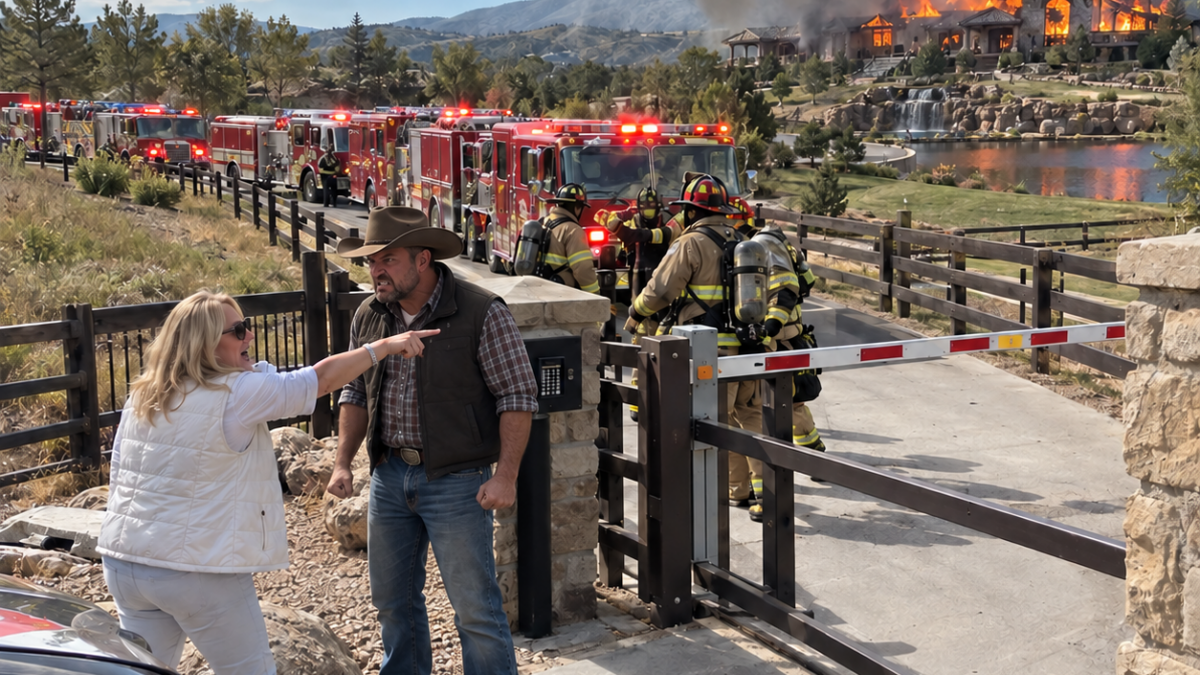
PART2
The fire captain stopped for half a second.
Then looked back toward the black gate.
That explained why all eight engines were there.
The route Pine Ridge had spent almost a year calling an “emergency corridor” had become the only practical way into their neighborhood.
And the HOA had locked it behind a machine designed to collect seven dollars from visitors.
That morning was the moment the whole argument finally became obvious to everyone.
But it had started almost a year earlier with something much smaller.
Six cars.
A Saturday morning.
And one driver telling me my private ranch road had become Pine Ridge’s new exit.
My name is William Harper.
I owned Harper Creek Ranch in western North Carolina.
Just over 160 acres.
Pasture.
Hardwood woods.
A creek.
Two barns.
A small farmhouse.
And one gravel road cutting across the northeastern corner of the ranch before reaching the county highway.
Old Mill Road.
The name caused half the trouble.
It sounded public.
It wasn’t.
My father had improved most of it himself back in the late 1970s.
Long before Pine Ridge existed, there had been an old sawmill farther up the mountain.
People used a rough path through that area when the whole valley was mostly farmland.
By the time my family bought the ranch, the sawmill was gone.
The route became part of our property.
We maintained it.
Graded it.
Cleared snow.
Repaired washouts.
Replaced culverts.
Cut fallen trees after storms.
Nobody cared about Old Mill Road until Pine Ridge Estates appeared north of us.
Pine Ridge started about twelve years before the toll-gate mess.
A developer bought mountain acreage and built a gated community.
First a handful of homes.
Then more.
Eventually a pool.
Tennis courts.
Walking trails.
And a large timber clubhouse with stone chimneys overlooking the valley.
It was a beautiful neighborhood.
Most people living there were perfectly decent.
George Wallace bought beef from me every fall.
Linda Foster rode her bicycle down toward my ranch sometimes and would stop to talk.
Several residents helped during a bad ice storm once.
I helped them too.
That mattered.
The story people tell afterward is always “Rancher versus evil HOA.”
Reality was more complicated.
My problem was not with every person in Pine Ridge.
It was with the moment the HOA decided kindness meant control.
Pine Ridge’s official entrance was a paved road curving around the mountain to the county highway.
Beautiful drive.
Terrible shortcut.
From the clubhouse, it took about fifteen minutes to reach the highway through their main gate.
Old Mill Road was much shorter.
A small Pine Ridge service lane reached my northeastern boundary.
Cross my ranch corner.
Follow Old Mill Road.
Six minutes.
During storms, my father had occasionally allowed neighbors through.
I did the same.
If snow blocked the mountain road, I wasn’t going to stand there quoting property records to people trying to reach home.
If an ambulance needed the shorter route, of course it could use it.
If a family needed to evacuate because of a storm, I opened the gate.
That is what neighbors do.
But permission only works when the person receiving it remembers that it is permission.
The first real problem happened in October.
I was replacing wire along a pasture fence when six vehicles came down Old Mill Road one after another.
SUV.
Sedan.
Pickup.
Another SUV.
Minivan.
Then a small crossover.
Nothing about them looked urgent.
No storm.
No emergency.
No road closure.
Just Saturday traffic.
I waved down the last driver.
He lowered his window.
“Everything okay?”
“Where are you folks headed?”
He pointed toward the highway.
“Town.”
“Why are you using this road?”
He looked confused.
“This is the new Pine Ridge exit.”
I stared at him.
“The what?”
“West exit.”
“Who told you that?”
“The HOA emailed everybody.”
I waited until he left.
Then I called Pine Ridge.
Cynthia Parker answered.
She had become HOA president only a few months earlier.
“This is William Harper.”
“Yes?”
“I own Harper Creek Ranch.”
“Oh.”
That one word told me she already knew what the call was about.
“Your residents are being told Old Mill Road is Pine Ridge’s new exit.”
“We’re testing secondary access.”
“Across my property.”
“We understand there may be historical access rights.”
“Show them to me.”
Pause.
“Mr. Harper, the road has been used for decades.”
“With permission.”
“That is one interpretation.”
I nearly laughed.
“No. That is literally what happened.”
“We’re reviewing county documents.”
“Good. Until you finish, stop telling residents they can use my road.”
“We cannot restrict use while the legal status remains uncertain.”
“You absolutely can stop advertising a road you don’t own.”
Her tone cooled.
“Pine Ridge needs secondary access.”
“I understand.”
“Then we should be able to cooperate.”
“I’m happy to cooperate for emergencies.”
“That isn’t enough.”
“What do you want?”
“Routine access.”
“No.”
Silence.
“No?” she repeated.
“No daily traffic.”
“Why?”
“Because it’s a ranch road.”
“We can help maintain it.”
“I don’t want your maintenance.”
“It would benefit you.”
“I don’t want the traffic.”
“Residents already use it.”
“Because you told them to.”
Cynthia sighed as though I was refusing to understand something obvious.
“Mr. Harper, this route is safer and more efficient for many residents.”
“That doesn’t make it yours.”
The call ended badly.
Two weeks later, I found a sign beside Old Mill Road.
PINE RIDGE WEST EXIT
I pulled it out.
Three days later, another appeared.
I removed that one too.
Cynthia called.
“You cannot remove HOA traffic signs.”
“They were on my ranch.”
“The road is disputed.”
“The sign wasn’t.”
Silence.
Then:
“Our attorney will contact you.”
“Good.”
And I meant it.
Sometimes two stubborn people arguing at a fence need to stop and let professionals read the paperwork.
My attorney was Sarah Collins.
Sarah had handled ranch boundaries and easement questions for me before.
She reviewed everything.
Deed.
County maps.
Old surveys.
Title records.
Historical plats.
She found no Pine Ridge ownership.
No subdivision easement.
No public roadway dedication.
There was one narrow 1984 utility document allowing power-company personnel to access lines.
That was it.
Sarah wrote Pine Ridge’s attorney, David Keller.
Stop advertising Old Mill Road as an HOA entrance.
Stop installing signs.
Stop encouraging regular traffic.
Emergency use could continue with my permission.
The road remained private.
David’s first response was actually reasonable.
He said he would review the records with the board.
I thought we were finished.
Instead, Cynthia changed the vocabulary.
Old Mill Road stopped being called the West Exit.
Now Pine Ridge called it the:
Emergency Community Corridor
That sounded official.
What qualified as an emergency?
Apparently traffic.
Residents started using it whenever the main Pine Ridge road became “congested.”
Then delivery drivers.
Landscapers.
Contractors.
One morning I found a moving truck stuck beside my cattle gate.
The driver looked mortified.
“Sorry, sir. GPS sent me here.”
“GPS?”
He showed me his phone.
Pine Ridge had added Old Mill Road to private community driving directions.
I helped him reverse the truck.
He hadn’t caused the problem.
That distinction mattered to me.
It is easy to become angry at everyone when one person is creating the conflict.
But anger spreads.
The delivery driver was doing his job.
So I helped him.
Then I called Cynthia.
“This needs to stop.”
“We’re developing a permanent solution.”
“I have one.”
“What?”
“Use your entrance.”
She hung up.
Traffic continued.
I installed a sign.
PRIVATE PROPERTY
NO THROUGH TRAFFIC WITHOUT OWNER PERMISSION
Someone removed it.
I installed another.
Four days later, that one disappeared too.
Then one morning, I found Cynthia’s silver SUV parked near Old Mill Road.
Two men were measuring the shoulder.
One had a survey wheel.
The other was taking pictures.
“What are you doing?”
The closest man answered:
“Gate planning.”
My stomach tightened.
“What gate?”
Cynthia stepped forward.
“Pine Ridge is considering traffic-control improvements.”
“On my land?”
“At the western access.”
“There is no western access.”
She opened a folder.
Inside was a drawing.
Steel barrier gate.
Automatic arm.
Guard booth.
Camera.
Keypad.
Payment kiosk.
I looked at her.
“You’re kidding.”
“No.”
“You want to charge people to drive across my ranch?”
“The toll will offset maintenance expenses.”
“I maintain the road.”
“Pine Ridge traffic increases wear.”
“Then stop sending traffic.”
She frowned.
“We need the route.”
“Need does not mean own.”
She closed the folder.
“We believe Pine Ridge may have acquired access rights through long-term use.”
There it was.
Exactly what Sarah had warned me about.
Months of increased traffic.
Then:
Look how much we use it.
We must have rights.
I stared at Cynthia.
“Is that why you started routing everybody through here?”
Her face changed.
Just slightly.
“I don’t know what you mean.”
“I think you do.”
She walked away.
Sarah was not surprised.
“They may be trying to strengthen an access claim.”
“Can they?”
“Not the way they’re doing it. You’ve objected continuously.”
“Then why?”
“Pressure.”
That word stayed with me.
If hundreds of residents started depending on the road, Pine Ridge could later argue that closing it created hardship.
Then they might pressure me into signing an easement.
Selling the strip.
Accepting HOA management.
My father used to say:
“If somebody keeps borrowing your hammer after you ask for it back, eventually they stop calling it borrowing.”
I understood him better every year.
Sarah sent another notice.
This one specifically rejected any claim that repeated permissive use created permanent HOA access.
For a while, things calmed down.
Winter came.
And this part matters.
I still opened Old Mill Road twice for Pine Ridge during dangerous ice conditions.
One night, an elderly resident needed medical care.
The ambulance used my ranch because it saved time.
Of course I let them.
That was the entire argument.
I was not trying to block emergencies.
I was protecting the difference between emergencies and convenience.
George Wallace stopped at my place one afternoon.
“You know most residents think Pine Ridge owns this road?”
“I’m discovering that.”
“Cynthia says the HOA is going to improve it.”
“Not unless she has a magic wand that works from her property.”
George laughed.
Then stopped.
“There’s talk about a gate.”
“I know.”
“People think you agreed.”
“I didn’t.”
He looked uncomfortable.
“What?”
“They’re saying you’ll receive part of the toll revenue.”
I stared at him.
“Toll revenue?”
“Five dollars for visitors. Residents use stickers.”
That was the first time I realized Cynthia had already presented the gate as approved.
I called Sarah the next morning.
She sent a formal warning to the entire HOA board.
No construction.
No digging.
No electrical equipment.
No gate.
No booth.
No toll system.
No work anywhere on Harper Creek Ranch.
Pine Ridge’s attorney acknowledged receipt.
For three weeks, nothing happened.
Then I visited my sister in Virginia.
I left Friday.
Returned Sunday afternoon.
I turned onto Old Mill Road.
And almost drove into a black steel barrier.
I stopped so suddenly my groceries fell off the passenger seat.
There it was.
Not a drawing.
Not a proposal.
Built.
Two steel posts sunk in concrete.
Automatic arm.
Camera.
Keypad.
Small guard booth.
Payment machine.
Large sign:
PINE RIDGE WEST ACCESS
Two contractors were finishing electrical work.
I climbed out.
“What are you doing?”
One man looked confused.
“Finishing the toll system.”
“Who authorized this?”
“Pine Ridge HOA.”
“This is my property.”
He immediately stopped working.
I respected him for that.
He called his supervisor.
Supervisor called Pine Ridge.
Twenty minutes later, Cynthia arrived.
She got out already looking annoyed.
“You were notified.”
“No, I wasn’t.”
“We sent a construction notice.”
“After my attorney told you not to build?”
“The structure is within Pine Ridge’s claimed access corridor.”
I pointed at the ground.
“This is my parcel.”
“That is disputed.”
“No court has said that.”
“No court has said otherwise.”
I laughed.
“That isn’t how ownership works.”
She crossed her arms.
“The gate is already installed.”
“So remove it.”
“No.”
I called Sarah.
Then the sheriff.
Deputy Nathan Brooks arrived.
He looked at my deed.
Looked at Pine Ridge’s map.
Looked at the gate.
“This appears to be a civil property dispute.”
Cynthia smiled slightly.
Then Nathan added:
“And until it’s resolved, nobody should destroy or alter the structure.”
That meant I couldn’t just hook a chain to the barrier and drag it out.
Fine.
I didn’t want to.
I wanted a judge to see exactly what they had done.
Sarah filed for emergency relief.
But courts move slower than construction crews.
Pine Ridge activated the gate the next morning.
Residents got windshield stickers.
Visitors paid five dollars.
Then, a few weeks later, seven.
Pine Ridge HOA was literally charging people to cross my ranch.
A friend told me:
“You might be the only cattle rancher in North Carolina whose HOA charges admission to his cows.”
I laughed.
But underneath, I was furious.
Then I discovered something more serious than the money.
I tested the gate one quiet afternoon.
Sticker.
Payment.
Code.
Those were the options.
I searched for a fire-service release.
There was a locked cabinet.
No obvious public override.
I called the company that installed it.
The technician checked the project.
“Normally we provide emergency-service access.”
“What kind?”
“Could be a Knox switch, universal code integration, emergency override, depending on local requirements.”
“Does this gate have one?”
He paused.
“Looks like the HOA declined the upgraded emergency package.”
“Why?”
“You’d have to ask them.”
I had a pretty good guess.
Cost.
I emailed Cynthia.
And every board member.
This gate could delay fire trucks, ambulances, or law enforcement. You need an emergency access plan immediately.
Her response came about an hour later.
Pine Ridge emergency services use the main entrance. West access is supplemental.
I stared at the screen.
Then wrote:
Then stop calling it an emergency corridor.
No response.
Sarah saved every message.
A month passed.
Court date scheduled.
Meanwhile, Pine Ridge behaved as though the issue was settled.
The toll increased to seven dollars.
I photographed the machine.
Saved copies of visitor receipts.
Documented traffic.
Logged road damage.
Linda Foster stopped near my fence one Saturday.
“This is embarrassing.”
“You didn’t build it.”
“We let her.”
“Some people voted against it.”
“Not enough.”
She looked at the gate.
“Do you really think it’s dangerous?”
“Yes.”
“What if the main entrance is blocked?”
“That’s exactly what I asked.”
She shook her head.
“People love gates until they need to get through one.”
Three nights later, a mountain storm rolled through.
Heavy rain.
Lightning.
Strong wind.
Nothing extraordinary for the area.
Around 5:40 in the morning, I woke to sirens.
A lot of sirens.
I stepped outside.
Smoke was rising above Pine Ridge.
My phone rang.
George Wallace.
“William?”
“What happened?”
“The clubhouse is on fire.”
I looked toward the mountain.
Orange light flashed through the trees.
“Everybody out?”
“Caretaker got out. I think everyone’s safe.”
“Fire department?”
“Coming.”
I could hear engines on the highway.
Then the first truck turned onto Old Mill Road.
And slammed to a stop.
The barrier stayed down.
Second engine.
Third.
Fourth.
Within minutes:
Eight emergency vehicles.
The machine kept flashing red.
ACCESS DENIED.
I ran toward the gate.
A firefighter tried the box.
“Code?”
“I don’t have one.”
“You own the road?”
“Yes.”
“Gate?”
“Pine Ridge installed it.”
He gave me a look that said we would discuss that insanity later.
Then Cynthia arrived.
“Open it!”
The captain shouted:
“We need the emergency release!”
Her silence answered him.
Then dispatch reported the fallen tree blocking Pine Ridge’s official entrance.
The argument was over.
We needed another route.
“I have a lower cattle lane.”
“How wide?”
“Brush trucks, pickups, maybe department SUVs.”
“Take me.”
I unlocked the chain.
The cattle lane had never been intended for public traffic.
Narrow.
Sharp first turn.
Mud along one edge.
But the smaller emergency vehicles made it.
One brush truck.
Then another.
Department SUV.
Deputy unit.
They headed toward Pine Ridge.
The eight full-sized engines remained trapped.
The clubhouse needed water.
Real water.
Not what two brush trucks could carry.
I drove my tractor toward the toll gate.
Firefighters were trying to force the barrier mechanism.
The machine beeped.
ACCESS ERROR.
Again.
ACCESS ERROR.
Again.
Months earlier, Cynthia had bragged about how secure the system was.
Now it was extremely secure.
Secure against firefighters.
One man pointed to fencing beside the road.
“Can we cut that?”
“That fence is mine.”
“Permission?”
“Take it down.”
Wire cutters came out.
They opened the shoulder.
Then we saw the next problem.
Drainage ditch.
Too deep for heavy engines.
I knew exactly what we needed.
“North pasture.”
The captain looked at me.
“What?”
“I have a gravel pile.”
“How much?”
“Enough to fill that ditch.”
“Can you move it?”
“I own a tractor.”
For the next fifteen minutes, nobody was HOA.
Nobody was rancher.
Nobody was board president.
Nobody was attorney.
We were just people trying to get fire engines to a burning building.
I moved gravel.
Load after load.
Firefighters spread it.
A county road crew arrived.
They helped pack the crossing.
Someone brought a compact loader.
The fire captain tested it with a lighter unit.
It held.
“Bring the first engine.”
The driver eased around the still-locked toll gate.
Across the newly filled ditch.
Past the cut ranch fence.
Onto Old Mill Road.
Then the second engine.
Third.
Fourth.
All eight.
The last one cleared.
Nobody really cheered.
Not much.
There was still a clubhouse on fire.
The trucks accelerated up the mountain.
I climbed off my tractor.
My hands were shaking from adrenaline.
Cynthia stood near the gate.
Her white jacket was wet.
Hair stuck against her face.
She walked toward me.
“William?”
I waited.
“Thank you.”
That surprised me.
“You’re welcome.”
She looked up the road.
“I didn’t know the main entrance would be blocked.”
“Nobody did.”
“I didn’t think…”
She stopped.
I knew the rest.
I didn’t think the gate could become a problem.
But I didn’t say it.
There are moments when being right doesn’t matter.
She watched the smoke.
“I hope everyone is okay.”
“So do I.”
Then she began crying quietly.
No dramatic collapse.
No shouting.
She turned away.
I gave her room.
Firefighters battled the blaze for hours.
The clubhouse did not survive.
The roof collapsed.
The main interior was destroyed.
Part of one stone chimney remained standing.
But the fire did not spread into the surrounding homes.
The caretaker survived.
Two firefighters suffered minor injuries.
Both went home later.
Nobody died.
That was what mattered.
That afternoon, Deputy Nathan Brooks stopped while I was repairing the fence firefighters cut.
He leaned against his patrol vehicle.
“You know Pine Ridge can probably pay for that.”
“The fence?”
“Yes.”
“I’ll survive.”
He looked at the toll gate.
The arm was hanging crooked by then.
Firefighters eventually forced part of the mechanism once they reached equipment from the neighborhood side.
“That thing caused a hell of a mess.”
“I mentioned that possibility once or twice.”
“I heard.”
He smiled.
Then became serious.
“County emergency management wants the gate records.”
“Why?”
“It was represented as emergency access.”
“Cynthia says their main entrance was for emergency services.”
“Apparently.”
“And this was supplemental.”
“Apparently.”
“But Pine Ridge also called it an emergency corridor.”
Nathan nodded.
“That contradiction is getting attention.”
“Good.”
Not because I wanted revenge.
Because I never wanted to watch eight fire engines stare at a seven-dollar toll machine again.
The next morning, Sarah called.
“Have you seen the news?”
“No.”
“You’re on it.”
“Wonderful.”
Local television had footage.
Eight red fire engines lined up behind a black gate.
Smoke behind them.
Headline:
FIRE CREWS DELAYED BY PRIVATE HOA GATE DURING PINE RIDGE CLUBHOUSE FIRE
It looked terrible.
Because it was terrible.
Cynthia declined interviews.
So did I.
Sarah said:
“Let the documents speak.”
They had a lot to say.
My warning emails.
Installation records.
The emergency-access question.
Minutes from an HOA meeting.
One board member had asked whether fire services should receive direct gate access.
According to the minutes, Cynthia replied:
Emergency crews can coordinate through security if necessary.
I asked Sarah:
“What security?”
“Exactly.”
Pine Ridge did not have staffed security twenty-four hours a day.
No guard at dawn.
No person sitting in that booth.
The booth was mostly decorative.
The gate functioned automatically.
At 5:40 in the morning, there was nobody to coordinate with.
Just:
Keypad.
Toll machine.
Locked box.
Barrier.
Then investigators found another issue.
The permit.
Or the lack of a proper property authorization.
Pine Ridge had electrical approval for the toll equipment.
But documents given to the contractor identified the HOA as controlling the installation site.
Sarah looked at the paperwork.
“They represented they controlled land they knew you disputed.”
“I already knew that.”
“No. I mean they signed documents saying it.”
That mattered.
The county ordered the toll system disabled.
Immediately.
Barrier open.
Payment machine off.
No stickers.
No charges.
Until ownership and access were resolved, Pine Ridge could not operate the system.
I stood beside Old Mill Road when technicians shut it down.
Silence.
For months, that stupid machine beeped every time someone drove through.
Now nothing.
George drove down later.
Stopped beside me.
“Free at last.”
“Still private.”
He laughed.
“Right.”
Then he said:
“You saved them time.”
“Everybody did.”
“You opened the cattle lane.”
“Firefighters did the hard part.”
“You didn’t stand there saying ‘I told you so.’”
“I thought it several times.”
George laughed.
That was true.
I am not a saint.
Part of me wanted to point at Cynthia while smoke rolled across the mountain and read her own email aloud.
But what would that have accomplished?
Kindness matters most when you have a reason not to show it.
Two weeks after the fire, Pine Ridge held an emergency meeting.
Their clubhouse was gone, so they rented a church hall.
George asked me to attend.
I refused.
Sarah said:
“You should go.”
“Why?”
“They’re discussing Old Mill Road.”
“That sounds like their problem.”
“It is your road.”
Fair point.
More than two hundred residents showed up.
Cynthia sat at the front.
She looked exhausted.
The first part concerned insurance.
Rebuilding.
Temporary community space.
Safety.
Then the toll gate came up.
The atmosphere changed instantly.
A man stood.
“My wife watched eight fire trucks waiting behind that thing.”
Another resident shouted:
“Why didn’t they have emergency access?”
Cynthia leaned toward the microphone.
“The fire occurred during unusual storm conditions.”
People groaned.
“The main entrance was unexpectedly blocked.”
George stood.
“That is exactly why we needed a second emergency route.”
Applause.
Cynthia frowned.
“We had a second route.”
A voice from the back shouted:
“No! We had a toll booth!”
Louder applause.
The HOA attorney tried to calm everyone.
Then Linda Foster stood.
“Did Mr. Harper warn us?”
Silence.
Cynthia looked down.
Linda repeated:
“Did William Harper warn this HOA that the gate could delay emergency vehicles?”
One board member answered quietly.
“Yes.”
The room exploded.
People shouted.
“Show us!”
“When?”
“Why wasn’t anything done?”
The attorney asked everyone to sit.
Eventually Richard Lane, another board member, requested that the emails be read.
Cynthia objected.
“These are legal communications.”
The attorney said:
“Not all of them.”
Richard read my email.
This gate could delay firefighters, ambulances, or deputies. You need an emergency access plan now.
Silence.
Then Cynthia’s response:
Pine Ridge emergency services use the main entrance. The west gate is supplemental.
Someone muttered:
“Unbelievable.”
Cynthia looked like she wanted the floor to open.
Months earlier, I imagined how satisfying that moment might be.
It wasn’t.
It felt sad.
Because the warning had been simple.
The consequences were enormous.
Then the attorney stood again.
“There is another issue we need to address.”
He looked toward me.
“After reviewing county records, deeds, surveys, and historical agreements, legal counsel recommends that Pine Ridge cease any claim that Old Mill Road is HOA-owned.”
I stared at him.
First time Pine Ridge had said it publicly.
A woman asked:
“Then who owns it?”
The attorney pointed toward me.
“Mr. Harper.”
Almost every head turned.
I would have preferred they didn’t.
He continued.
“There may be limited historical permission involving utilities and emergency access by consent. We have not found evidence supporting routine Pine Ridge traffic or toll collection.”
Now people were angry for a completely different reason.
“You charged us on a road we don’t own?”
“How much?”
The treasurer opened a file.
“Just under forty-three thousand dollars.”
The room erupted.
Forty-three thousand dollars.
Collected from residents and visitors.
For crossing my property.
George leaned toward me.
“You should charge them rent.”
“Do not give Sarah ideas.”
Unfortunately, Sarah already had ideas.
Unauthorized road use.
Road damage.
Construction damage.
Legal expenses.
Gate installation.
Toll revenue.
There were several claims I could pursue.
I thought about it.
For days.
Then Carol Mason came to my ranch.
She brought her twelve-year-old grandson.
I recognized her from the meeting.
Didn’t know her personally.
“My husband died last year.”
“I’m sorry.”
“Thank you.”
She looked toward Pine Ridge.
“I almost voted for Cynthia again.”
I didn’t know what to say.
“She helped us when my husband was sick.”
That surprised me.
“She organized meals. Drove me to the hospital once.”
I looked toward the mountain.
People are complicated.
Carol said:
“I’m not defending the gate.”
“I know.”
“I just don’t want everyone pretending Cynthia has always been terrible.”
“I don’t either.”
Carol looked surprised.
“She drove me crazy.”
We both laughed.
Then I said:
“People are usually more than their worst mistake.”
My mother taught me that.
She believed in consequences.
Strong ones when deserved.
But she also believed turning a person into a cartoon villain makes it easier to stop thinking carefully.
Cynthia made arrogant decisions.
Dangerous decisions.
She ignored warnings.
That didn’t erase every good thing she had done before.
A month after the fire, Cynthia resigned.
She did not wait for a recall.
Her letter admitted mistakes in how she handled Old Mill Road and the gate.
Not every mistake I would have listed.
But enough.
Richard Lane became temporary HOA president.
His first call was to me.
“Mr. Harper, could we meet?”
“Yes.”
Richard came to my kitchen table with the HOA attorney and George.
The attorney started.
“Pine Ridge is prepared to formally recognize Old Mill Road as private Harper Creek Ranch property.”
“Good.”
“We would like to negotiate emergency access.”
“That has always been available.”
Richard nodded.
“We want it written.”
That made sense.
After the fire, assumptions were no longer good enough.
The proposal was simple.
Old Mill Road available during actual emergencies.
Main entrance blocked.
Wildfire.
Medical response.
Police.
Fire.
Utility emergencies.
No daily commuting.
No delivery shortcuts.
No landscapers.
No HOA patrols.
No tolls.
I agreed.
Then added:
“No automated gate.”
Richard almost smiled.
“Obviously.”
“Emergency responders get direct access.”
“Yes.”
“And if Pine Ridge ever wants regular access?”
“We ask you.”
“Not send a map.”
George laughed.
The lawyer tried not to.
Then Richard asked:
“What do you want done with the toll structure?”
“Remove it.”
“All of it?”
“Every post.”
He nodded.
That part was easy.
Then came the money.
Forty-three thousand dollars in toll revenue.
Sarah believed I could pursue it.
I decided not to.
Instead:
“Use it for emergency improvements.”
Richard stared.
“What?”
“Fix your main entrance. Improve emergency signage. Then donate part to the volunteer fire departments that responded.”
“You don’t want the toll money?”
“No.”
“They collected it on your property.”
“I don’t want money residents paid because somebody else made a bad decision.”
He looked surprised.
“The fire departments need it more.”
Pine Ridge added reserve funds.
The final donation helped one volunteer station replace aging equipment.
That felt better than receiving a check.
The toll gate came down on a cold Tuesday morning.
Same installation company.
One technician recognized me.
“Long time coming.”
“You could say that.”
They disconnected the machine.
Pulled the barrier arm.
Removed the booth.
Jackhammered concrete.
Loaded the steel posts.
Within hours, Old Mill Road almost looked like Old Mill Road again.
The ground still showed where concrete had been poured.
I stood staring at the empty space.
Then a silver SUV stopped near the county road.
Cynthia.
She got out.
No HOA jacket.
No folder.
No board members.
Just Cynthia.
For a while, neither of us spoke.
Then:
“I owe you an apology.”
I waited.
“I should have listened.”
“Yes.”
She nodded.
“I thought you were trying to block the community.”
“I was trying to block daily traffic.”
“I know that now.”
“You knew some of it then.”
She looked down.
“That’s fair.”
Silence.
Then:
“Thank you for helping during the fire.”
“You already thanked me.”
“I know.”
She looked at me.
“I needed to say it when nothing was burning.”
That made me smile.
“Fair enough.”
She looked toward Pine Ridge.
“I thought the gate would solve a problem.”
“Most bad ideas do at first.”
She laughed quietly.
Then:
“I was afraid.”
“Of what?”
“That residents would think I wasn’t doing enough.”
That might have been the most honest thing she ever told me.
The main entrance had problems.
Residents complained.
Cynthia wanted a solution.
Old Mill Road looked easy.
Then I said no.
Instead of accepting that my property limited her options, she began treating my refusal as a criticism of her leadership.
From there, pride did the rest.
I said:
“Being in charge doesn’t mean you have to fix everything.”
She looked at me.
“I wish somebody had told me that sooner.”
“Someone probably did.”
She laughed again.
Then she left.
That was our last serious conversation.
Pine Ridge rebuilt the clubhouse.
Smaller.
Safer.
Better fire systems.
Emergency planning was completely redone.
Part of their main entrance was widened.
Dangerous roadside trees removed.
The county helped establish an actual emergency-access plan.
Old Mill Road became part of it.
But only during real emergencies.
I installed a simple ranch gate at my end.
No payment machine.
No sticker scanner.
No camera deciding whether an ambulance had permission to pass.
Emergency responders had direct access.
I had access.
Everyone else needed permission.
George suggested a sign.
PINE RIDGE EMERGENCY EXIT
FREE DURING ACTUAL EMERGENCIES
I nearly ordered it.
Sarah said:
“Do not encourage yourself.”
Years later, people still tell the story.
Usually wrong.
They say eight fire engines never reached Pine Ridge because Cynthia’s toll gate trapped them.
That isn’t true.
They were delayed.
We found a way around it.
Smaller units used my cattle lane.
Then firefighters and county workers helped fill the ditch.
We cut ranch fence.
The big engines drove around the toll gate.
They reached the clubhouse.
They fought the fire.
Most importantly, everybody survived.
But the image people remember is real.
Eight emergency vehicles.
Flashing red lights.
A burning clubhouse in the distance.
And a toll machine blinking:
ACCESS DENIED.
The same HOA that installed that gate because it wanted control eventually needed that gate gone more desperately than anyone else.
The fire taught Pine Ridge something I had been trying to explain for months.
A road is not just a line on a map.
Sometimes a road is convenience.
Sometimes it is money.
Sometimes it is six minutes instead of fifteen.
But during a real emergency, a road becomes time.
And time can become lives.
You do not call something an emergency corridor when you want to justify using it, then call it supplemental when someone asks about emergency safety.
You do not build a toll gate on land you do not own because the owner keeps refusing to surrender control.
And you definitely do not save money by skipping the emergency-release system on the route you keep telling everyone is necessary for emergencies.
I never wanted Pine Ridge’s clubhouse to burn.
I never wanted Cynthia humiliated.
I never wanted eight fire engines stuck outside my ranch.
I wanted something much simpler.
Respect my property.
That was all.
Eventually, that was what I got.
Old Mill Road remained mine.
Pine Ridge got a written emergency agreement.
Fire departments got reliable access.
Residents got better safety planning.
The toll gate disappeared.
And the forty-three thousand dollars people had paid to cross my ranch ended up helping the firefighters who had once been trapped behind it.
Every once in a while, I stand near the northeastern pasture and look at the place where that black steel gate used to be.
You can still see faint patches in the gravel where the concrete footings were removed.
The rest has almost disappeared.
Grass grew back along the shoulder.
The ranch fence was repaired.
Cows graze where firefighters cut through that morning.
Old Mill Road looks ordinary again.
That is exactly how I like it.
Sometimes George stops by and jokes that I should charge Pine Ridge seven dollars every time an emergency vehicle uses the route.
I tell him:
“Emergency vehicles ride free.”
He laughs.
Then I always add:
“Everybody else needs to ask.”
Because that was the point from the beginning.
Not revenge.
Not toll money.
Not keeping neighbors trapped behind their own mountain.
Permission.
A simple word Cynthia spent almost a year trying to turn into something complicated.
My father understood it.
If the answer is yes, be grateful.
If the answer is no, respect it.
And if someone allows you through during an emergency, do not turn that generosity into evidence that you own the road.
Pine Ridge eventually learned.
The hard way.
On the morning their clubhouse burned, Cynthia stood beside the gate she had forced onto my ranch and watched eight fire engines hit ACCESS DENIED.
For months, she had believed I was the obstacle.
That morning, she finally saw the obstacle for herself.
It wasn’t the rancher.
It wasn’t the property line.
It wasn’t even Old Mill Road.
It was the gate she had built because she refused to accept the word no.
REVIEW
HOA Built a Toll Gate Across My Ranch—Then 8 Fire Engines Hit “ACCESS DENIED” While Their Clubhouse Burned
The first fire engine hit the brakes so hard I heard the tires scream from nearly a hundred yards away.
Then the second engine stopped behind it.
Then the third.
Within less than two minutes, eight emergency vehicles were lined up along Old Mill Road, red lights flashing against the wet trees, sirens echoing through the mountains.
Every one of them was trapped behind a black steel toll gate.
The gate had one message glowing on its electronic screen.
ACCESS DENIED.
Beyond it, Pine Ridge HOA’s clubhouse was burning.
Not smoking.
Burning.
Orange flames were flashing through the trees on the mountain above us.
A black column of smoke rolled into the early morning sky.
Somewhere up there, something exploded hard enough that birds burst out of the treetops.
A firefighter jumped from the first engine.
“WHO HAS THE CODE?”
Nobody answered.
He tried the keypad.
Red light.
ACCESS DENIED.
Another firefighter ran to the locked control box mounted beside the barrier.
“Emergency release?”
Nothing.
A sheriff’s deputy came running up.
“We need this open now!”
I stood beside my ranch fence looking at a gate that should never have existed.
The strangest part?
It was standing on my land.
Pine Ridge HOA had installed the whole thing across my private ranch road without my permission.
Steel posts.
Barrier arm.
Camera.
Keypad.
Toll machine.
Guard booth.
They had spent months telling me they needed it to control traffic on what they called their “private emergency corridor.”
Except the road was not theirs.
The land was not theirs.
And four months earlier, I had warned their president exactly what would happen if emergency vehicles ever needed that road and the automated gate failed.
She had laughed.
Now eight fire engines were sitting behind the same gate while her clubhouse burned.
A Pine Ridge board member came running down the road in slippers and a rain jacket.
She was crying.
“Break it!”
The fire captain shouted back:
“We’re trying!”
Behind the trees, another boom rolled across the mountain.
The woman covered her mouth.
Then a silver SUV came flying down Pine Ridge’s service lane.
Cynthia Parker slammed on the brakes, jumped out, and pushed through the crowd.
Cynthia was the HOA president.
The woman who had ordered the gate installed.
The woman who had refused to remove it.
The woman who had told me, with a straight face, that fire trucks would never need it.
She looked at the line of emergency vehicles.
Then at the smoke.
Then at the barrier.
“Why aren’t they inside?”
A deputy pointed directly at the gate.
“Because your access system is locked.”
Her eyes widened.
“That’s impossible.”
The fire captain turned.
“Do you have an emergency override?”
Cynthia froze.
“An override?”
“A fire-service release. Knox access. Manual emergency control. Anything.”
She looked at the keypad.
Then the toll machine.
Then the control box.
Nobody said anything.
Everyone was watching her.
I had asked Cynthia that same question four months earlier.
Her answer then had been:
“Emergency services use the main Pine Ridge entrance, Mr. Harper. This gate is supplemental.”
I looked toward the smoke.
Then back at her.
“I warned you.”
Her face snapped toward me.
“This is not the time.”
She was right.
That might surprise people who heard the story later.
They expected me to stand there smiling while her clubhouse burned.
I didn’t.
I never wanted anybody’s home or property destroyed.
I didn’t want firefighters delayed.
I didn’t want Cynthia humiliated.
And I certainly wasn’t about to watch a building burn just so I could win an argument over a gate.
I turned toward the fire captain.
“I have another way through.”
He looked at me immediately.
“How?”
“Lower cattle lane. Too narrow for the engines, but brush trucks and department SUVs can make it.”
“Show me.”
I ran.
At sixty-two, I didn’t run very often unless one of my cows was headed somewhere she absolutely shouldn’t be.
That morning I ran harder than I had in years.
And while we were trying to find a way around Pine Ridge’s toll gate, a dispatcher came across the deputy’s radio.
“Main entrance is blocked. Repeat, Pine Ridge main entrance blocked by storm-fallen tree.”
The fire captain stopped for half a second.
Then looked back toward the black gate.
That explained why all eight engines were there.
The route Pine Ridge had spent almost a year calling an “emergency corridor” had become the only practical way into their neighborhood.
And the HOA had locked it behind a machine designed to collect seven dollars from visitors.
That morning was the moment the whole argument finally became obvious to everyone.
But it had started almost a year earlier with something much smaller.
Six cars.
A Saturday morning.
And one driver telling me my private ranch road had become Pine Ridge’s new exit.
My name is William Harper.
I owned Harper Creek Ranch in western North Carolina.
Just over 160 acres.
Pasture.
Hardwood woods.
A creek.
Two barns.
A small farmhouse.
And one gravel road cutting across the northeastern corner of the ranch before reaching the county highway.
Old Mill Road.
The name caused half the trouble.
It sounded public.
It wasn’t.
My father had improved most of it himself back in the late 1970s.
Long before Pine Ridge existed, there had been an old sawmill farther up the mountain.
People used a rough path through that area when the whole valley was mostly farmland.
By the time my family bought the ranch, the sawmill was gone.
The route became part of our property.
We maintained it.
Graded it.
Cleared snow.
Repaired washouts.
Replaced culverts.
Cut fallen trees after storms.
Nobody cared about Old Mill Road until Pine Ridge Estates appeared north of us.
Pine Ridge started about twelve years before the toll-gate mess.
A developer bought mountain acreage and built a gated community.
First a handful of homes.
Then more.
Eventually a pool.
Tennis courts.
Walking trails.
And a large timber clubhouse with stone chimneys overlooking the valley.
It was a beautiful neighborhood.
Most people living there were perfectly decent.
George Wallace bought beef from me every fall.
Linda Foster rode her bicycle down toward my ranch sometimes and would stop to talk.
Several residents helped during a bad ice storm once.
I helped them too.
That mattered.
The story people tell afterward is always “Rancher versus evil HOA.”
Reality was more complicated.
My problem was not with every person in Pine Ridge.
It was with the moment the HOA decided kindness meant control.
Pine Ridge’s official entrance was a paved road curving around the mountain to the county highway.
Beautiful drive.
Terrible shortcut.
From the clubhouse, it took about fifteen minutes to reach the highway through their main gate.
Old Mill Road was much shorter.
A small Pine Ridge service lane reached my northeastern boundary.
Cross my ranch corner.
Follow Old Mill Road.
Six minutes.
During storms, my father had occasionally allowed neighbors through.
I did the same.
If snow blocked the mountain road, I wasn’t going to stand there quoting property records to people trying to reach home.
If an ambulance needed the shorter route, of course it could use it.
If a family needed to evacuate because of a storm, I opened the gate.
That is what neighbors do.
But permission only works when the person receiving it remembers that it is permission.
The first real problem happened in October.
I was replacing wire along a pasture fence when six vehicles came down Old Mill Road one after another.
SUV.
Sedan.
Pickup.
Another SUV.
Minivan.
Then a small crossover.
Nothing about them looked urgent.
No storm.
No emergency.
No road closure.
Just Saturday traffic.
I waved down the last driver.
He lowered his window.
“Everything okay?”
“Where are you folks headed?”
He pointed toward the highway.
“Town.”
“Why are you using this road?”
He looked confused.
“This is the new Pine Ridge exit.”
I stared at him.
“The what?”
“West exit.”
“Who told you that?”
“The HOA emailed everybody.”
I waited until he left.
Then I called Pine Ridge.
Cynthia Parker answered.
She had become HOA president only a few months earlier.
“This is William Harper.”
“Yes?”
“I own Harper Creek Ranch.”
“Oh.”
That one word told me she already knew what the call was about.
“Your residents are being told Old Mill Road is Pine Ridge’s new exit.”
“We’re testing secondary access.”
“Across my property.”
“We understand there may be historical access rights.”
“Show them to me.”
Pause.
“Mr. Harper, the road has been used for decades.”
“With permission.”
“That is one interpretation.”
I nearly laughed.
“No. That is literally what happened.”
“We’re reviewing county documents.”
“Good. Until you finish, stop telling residents they can use my road.”
“We cannot restrict use while the legal status remains uncertain.”
“You absolutely can stop advertising a road you don’t own.”
Her tone cooled.
“Pine Ridge needs secondary access.”
“I understand.”
“Then we should be able to cooperate.”
“I’m happy to cooperate for emergencies.”
“That isn’t enough.”
“What do you want?”
“Routine access.”
“No.”
Silence.
“No?” she repeated.
“No daily traffic.”
“Why?”
“Because it’s a ranch road.”
“We can help maintain it.”
“I don’t want your maintenance.”
“It would benefit you.”
“I don’t want the traffic.”
“Residents already use it.”
“Because you told them to.”
Cynthia sighed as though I was refusing to understand something obvious.
“Mr. Harper, this route is safer and more efficient for many residents.”
“That doesn’t make it yours.”
The call ended badly.
Two weeks later, I found a sign beside Old Mill Road.
PINE RIDGE WEST EXIT
I pulled it out.
Three days later, another appeared.
I removed that one too.
Cynthia called.
“You cannot remove HOA traffic signs.”
“They were on my ranch.”
“The road is disputed.”
“The sign wasn’t.”
Silence.
Then:
“Our attorney will contact you.”
“Good.”
And I meant it.
Sometimes two stubborn people arguing at a fence need to stop and let professionals read the paperwork.
My attorney was Sarah Collins.
Sarah had handled ranch boundaries and easement questions for me before.
She reviewed everything.
Deed.
County maps.
Old surveys.
Title records.
Historical plats.
She found no Pine Ridge ownership.
No subdivision easement.
No public roadway dedication.
There was one narrow 1984 utility document allowing power-company personnel to access lines.
That was it.
Sarah wrote Pine Ridge’s attorney, David Keller.
Stop advertising Old Mill Road as an HOA entrance.
Stop installing signs.
Stop encouraging regular traffic.
Emergency use could continue with my permission.
The road remained private.
David’s first response was actually reasonable.
He said he would review the records with the board.
I thought we were finished.
Instead, Cynthia changed the vocabulary.
Old Mill Road stopped being called the West Exit.
Now Pine Ridge called it the:
Emergency Community Corridor
That sounded official.
What qualified as an emergency?
Apparently traffic.
Residents started using it whenever the main Pine Ridge road became “congested.”
Then delivery drivers.
Landscapers.
Contractors.
One morning I found a moving truck stuck beside my cattle gate.
The driver looked mortified.
“Sorry, sir. GPS sent me here.”
“GPS?”
He showed me his phone.
Pine Ridge had added Old Mill Road to private community driving directions.
I helped him reverse the truck.
He hadn’t caused the problem.
That distinction mattered to me.
It is easy to become angry at everyone when one person is creating the conflict.
But anger spreads.
The delivery driver was doing his job.
So I helped him.
Then I called Cynthia.
“This needs to stop.”
“We’re developing a permanent solution.”
“I have one.”
“What?”
“Use your entrance.”
She hung up.
Traffic continued.
I installed a sign.
PRIVATE PROPERTY
NO THROUGH TRAFFIC WITHOUT OWNER PERMISSION
Someone removed it.
I installed another.
Four days later, that one disappeared too.
Then one morning, I found Cynthia’s silver SUV parked near Old Mill Road.
Two men were measuring the shoulder.
One had a survey wheel.
The other was taking pictures.
“What are you doing?”
The closest man answered:
“Gate planning.”
My stomach tightened.
“What gate?”
Cynthia stepped forward.
“Pine Ridge is considering traffic-control improvements.”
“On my land?”
“At the western access.”
“There is no western access.”
She opened a folder.
Inside was a drawing.
Steel barrier gate.
Automatic arm.
Guard booth.
Camera.
Keypad.
Payment kiosk.
I looked at her.
“You’re kidding.”
“No.”
“You want to charge people to drive across my ranch?”
“The toll will offset maintenance expenses.”
“I maintain the road.”
“Pine Ridge traffic increases wear.”
“Then stop sending traffic.”
She frowned.
“We need the route.”
“Need does not mean own.”
She closed the folder.
“We believe Pine Ridge may have acquired access rights through long-term use.”
There it was.
Exactly what Sarah had warned me about.
Months of increased traffic.
Then:
Look how much we use it.
We must have rights.
I stared at Cynthia.
“Is that why you started routing everybody through here?”
Her face changed.
Just slightly.
“I don’t know what you mean.”
“I think you do.”
She walked away.
Sarah was not surprised.
“They may be trying to strengthen an access claim.”
“Can they?”
“Not the way they’re doing it. You’ve objected continuously.”
“Then why?”
“Pressure.”
That word stayed with me.
If hundreds of residents started depending on the road, Pine Ridge could later argue that closing it created hardship.
Then they might pressure me into signing an easement.
Selling the strip.
Accepting HOA management.
My father used to say:
“If somebody keeps borrowing your hammer after you ask for it back, eventually they stop calling it borrowing.”
I understood him better every year.
Sarah sent another notice.
This one specifically rejected any claim that repeated permissive use created permanent HOA access.
For a while, things calmed down.
Winter came.
And this part matters.
I still opened Old Mill Road twice for Pine Ridge during dangerous ice conditions.
One night, an elderly resident needed medical care.
The ambulance used my ranch because it saved time.
Of course I let them.
That was the entire argument.
I was not trying to block emergencies.
I was protecting the difference between emergencies and convenience.
George Wallace stopped at my place one afternoon.
“You know most residents think Pine Ridge owns this road?”
“I’m discovering that.”
“Cynthia says the HOA is going to improve it.”
“Not unless she has a magic wand that works from her property.”
George laughed.
Then stopped.
“There’s talk about a gate.”
“I know.”
“People think you agreed.”
“I didn’t.”
He looked uncomfortable.
“What?”
“They’re saying you’ll receive part of the toll revenue.”
I stared at him.
“Toll revenue?”
“Five dollars for visitors. Residents use stickers.”
That was the first time I realized Cynthia had already presented the gate as approved.
I called Sarah the next morning.
She sent a formal warning to the entire HOA board.
No construction.
No digging.
No electrical equipment.
No gate.
No booth.
No toll system.
No work anywhere on Harper Creek Ranch.
Pine Ridge’s attorney acknowledged receipt.
For three weeks, nothing happened.
Then I visited my sister in Virginia.
I left Friday.
Returned Sunday afternoon.
I turned onto Old Mill Road.
And almost drove into a black steel barrier.
I stopped so suddenly my groceries fell off the passenger seat.
There it was.
Not a drawing.
Not a proposal.
Built.
Two steel posts sunk in concrete.
Automatic arm.
Camera.
Keypad.
Small guard booth.
Payment machine.
Large sign:
PINE RIDGE WEST ACCESS
Two contractors were finishing electrical work.
I climbed out.
“What are you doing?”
One man looked confused.
“Finishing the toll system.”
“Who authorized this?”
“Pine Ridge HOA.”
“This is my property.”
He immediately stopped working.
I respected him for that.
He called his supervisor.
Supervisor called Pine Ridge.
Twenty minutes later, Cynthia arrived.
She got out already looking annoyed.
“You were notified.”
“No, I wasn’t.”
“We sent a construction notice.”
“After my attorney told you not to build?”
“The structure is within Pine Ridge’s claimed access corridor.”
I pointed at the ground.
“This is my parcel.”
“That is disputed.”
“No court has said that.”
“No court has said otherwise.”
I laughed.
“That isn’t how ownership works.”
She crossed her arms.
“The gate is already installed.”
“So remove it.”
“No.”
I called Sarah.
Then the sheriff.
Deputy Nathan Brooks arrived.
He looked at my deed.
Looked at Pine Ridge’s map.
Looked at the gate.
“This appears to be a civil property dispute.”
Cynthia smiled slightly.
Then Nathan added:
“And until it’s resolved, nobody should destroy or alter the structure.”
That meant I couldn’t just hook a chain to the barrier and drag it out.
Fine.
I didn’t want to.
I wanted a judge to see exactly what they had done.
Sarah filed for emergency relief.
But courts move slower than construction crews.
Pine Ridge activated the gate the next morning.
Residents got windshield stickers.
Visitors paid five dollars.
Then, a few weeks later, seven.
Pine Ridge HOA was literally charging people to cross my ranch.
A friend told me:
“You might be the only cattle rancher in North Carolina whose HOA charges admission to his cows.”
I laughed.
But underneath, I was furious.
Then I discovered something more serious than the money.
I tested the gate one quiet afternoon.
Sticker.
Payment.
Code.
Those were the options.
I searched for a fire-service release.
There was a locked cabinet.
No obvious public override.
I called the company that installed it.
The technician checked the project.
“Normally we provide emergency-service access.”
“What kind?”
“Could be a Knox switch, universal code integration, emergency override, depending on local requirements.”
“Does this gate have one?”
He paused.
“Looks like the HOA declined the upgraded emergency package.”
“Why?”
“You’d have to ask them.”
I had a pretty good guess.
Cost.
I emailed Cynthia.
And every board member.
This gate could delay fire trucks, ambulances, or law enforcement. You need an emergency access plan immediately.
Her response came about an hour later.
Pine Ridge emergency services use the main entrance. West access is supplemental.
I stared at the screen.
Then wrote:
Then stop calling it an emergency corridor.
No response.
Sarah saved every message.
A month passed.
Court date scheduled.
Meanwhile, Pine Ridge behaved as though the issue was settled.
The toll increased to seven dollars.
I photographed the machine.
Saved copies of visitor receipts.
Documented traffic.
Logged road damage.
Linda Foster stopped near my fence one Saturday.
“This is embarrassing.”
“You didn’t build it.”
“We let her.”
“Some people voted against it.”
“Not enough.”
She looked at the gate.
“Do you really think it’s dangerous?”
“Yes.”
“What if the main entrance is blocked?”
“That’s exactly what I asked.”
She shook her head.
“People love gates until they need to get through one.”
Three nights later, a mountain storm rolled through.
Heavy rain.
Lightning.
Strong wind.
Nothing extraordinary for the area.
Around 5:40 in the morning, I woke to sirens.
A lot of sirens.
I stepped outside.
Smoke was rising above Pine Ridge.
My phone rang.
George Wallace.
“William?”
“What happened?”
“The clubhouse is on fire.”
I looked toward the mountain.
Orange light flashed through the trees.
“Everybody out?”
“Caretaker got out. I think everyone’s safe.”
“Fire department?”
“Coming.”
I could hear engines on the highway.
Then the first truck turned onto Old Mill Road.
And slammed to a stop.
The barrier stayed down.
Second engine.
Third.
Fourth.
Within minutes:
Eight emergency vehicles.
The machine kept flashing red.
ACCESS DENIED.
I ran toward the gate.
A firefighter tried the box.
“Code?”
“I don’t have one.”
“You own the road?”
“Yes.”
“Gate?”
“Pine Ridge installed it.”
He gave me a look that said we would discuss that insanity later.
Then Cynthia arrived.
“Open it!”
The captain shouted:
“We need the emergency release!”
Her silence answered him.
Then dispatch reported the fallen tree blocking Pine Ridge’s official entrance.
The argument was over.
We needed another route.
“I have a lower cattle lane.”
“How wide?”
“Brush trucks, pickups, maybe department SUVs.”
“Take me.”
I unlocked the chain.
The cattle lane had never been intended for public traffic.
Narrow.
Sharp first turn.
Mud along one edge.
But the smaller emergency vehicles made it.
One brush truck.
Then another.
Department SUV.
Deputy unit.
They headed toward Pine Ridge.
The eight full-sized engines remained trapped.
The clubhouse needed water.
Real water.
Not what two brush trucks could carry.
I drove my tractor toward the toll gate.
Firefighters were trying to force the barrier mechanism.
The machine beeped.
ACCESS ERROR.
Again.
ACCESS ERROR.
Again.
Months earlier, Cynthia had bragged about how secure the system was.
Now it was extremely secure.
Secure against firefighters.
One man pointed to fencing beside the road.
“Can we cut that?”
“That fence is mine.”
“Permission?”
“Take it down.”
Wire cutters came out.
They opened the shoulder.
Then we saw the next problem.
Drainage ditch.
Too deep for heavy engines.
I knew exactly what we needed.
“North pasture.”
The captain looked at me.
“What?”
“I have a gravel pile.”
“How much?”
“Enough to fill that ditch.”
“Can you move it?”
“I own a tractor.”
For the next fifteen minutes, nobody was HOA.
Nobody was rancher.
Nobody was board president.
Nobody was attorney.
We were just people trying to get fire engines to a burning building.
I moved gravel.
Load after load.
Firefighters spread it.
A county road crew arrived.
They helped pack the crossing.
Someone brought a compact loader.
The fire captain tested it with a lighter unit.
It held.
“Bring the first engine.”
The driver eased around the still-locked toll gate.
Across the newly filled ditch.
Past the cut ranch fence.
Onto Old Mill Road.
Then the second engine.
Third.
Fourth.
All eight.
The last one cleared.
Nobody really cheered.
Not much.
There was still a clubhouse on fire.
The trucks accelerated up the mountain.
I climbed off my tractor.
My hands were shaking from adrenaline.
Cynthia stood near the gate.
Her white jacket was wet.
Hair stuck against her face.
She walked toward me.
“William?”
I waited.
“Thank you.”
That surprised me.
“You’re welcome.”
She looked up the road.
“I didn’t know the main entrance would be blocked.”
“Nobody did.”
“I didn’t think…”
She stopped.
I knew the rest.
I didn’t think the gate could become a problem.
But I didn’t say it.
There are moments when being right doesn’t matter.
She watched the smoke.
“I hope everyone is okay.”
“So do I.”
Then she began crying quietly.
No dramatic collapse.
No shouting.
She turned away.
I gave her room.
Firefighters battled the blaze for hours.
The clubhouse did not survive.
The roof collapsed.
The main interior was destroyed.
Part of one stone chimney remained standing.
But the fire did not spread into the surrounding homes.
The caretaker survived.
Two firefighters suffered minor injuries.
Both went home later.
Nobody died.
That was what mattered.
That afternoon, Deputy Nathan Brooks stopped while I was repairing the fence firefighters cut.
He leaned against his patrol vehicle.
“You know Pine Ridge can probably pay for that.”
“The fence?”
“Yes.”
“I’ll survive.”
He looked at the toll gate.
The arm was hanging crooked by then.
Firefighters eventually forced part of the mechanism once they reached equipment from the neighborhood side.
“That thing caused a hell of a mess.”
“I mentioned that possibility once or twice.”
“I heard.”
He smiled.
Then became serious.
“County emergency management wants the gate records.”
“Why?”
“It was represented as emergency access.”
“Cynthia says their main entrance was for emergency services.”
“Apparently.”
“And this was supplemental.”
“Apparently.”
“But Pine Ridge also called it an emergency corridor.”
Nathan nodded.
“That contradiction is getting attention.”
“Good.”
Not because I wanted revenge.
Because I never wanted to watch eight fire engines stare at a seven-dollar toll machine again.
The next morning, Sarah called.
“Have you seen the news?”
“No.”
“You’re on it.”
“Wonderful.”
Local television had footage.
Eight red fire engines lined up behind a black gate.
Smoke behind them.
Headline:
FIRE CREWS DELAYED BY PRIVATE HOA GATE DURING PINE RIDGE CLUBHOUSE FIRE
It looked terrible.
Because it was terrible.
Cynthia declined interviews.
So did I.
Sarah said:
“Let the documents speak.”
They had a lot to say.
My warning emails.
Installation records.
The emergency-access question.
Minutes from an HOA meeting.
One board member had asked whether fire services should receive direct gate access.
According to the minutes, Cynthia replied:
Emergency crews can coordinate through security if necessary.
I asked Sarah:
“What security?”
“Exactly.”
Pine Ridge did not have staffed security twenty-four hours a day.
No guard at dawn.
No person sitting in that booth.
The booth was mostly decorative.
The gate functioned automatically.
At 5:40 in the morning, there was nobody to coordinate with.
Just:
Keypad.
Toll machine.
Locked box.
Barrier.
Then investigators found another issue.
The permit.
Or the lack of a proper property authorization.
Pine Ridge had electrical approval for the toll equipment.
But documents given to the contractor identified the HOA as controlling the installation site.
Sarah looked at the paperwork.
“They represented they controlled land they knew you disputed.”
“I already knew that.”
“No. I mean they signed documents saying it.”
That mattered.
The county ordered the toll system disabled.
Immediately.
Barrier open.
Payment machine off.
No stickers.
No charges.
Until ownership and access were resolved, Pine Ridge could not operate the system.
I stood beside Old Mill Road when technicians shut it down.
Silence.
For months, that stupid machine beeped every time someone drove through.
Now nothing.
George drove down later.
Stopped beside me.
“Free at last.”
“Still private.”
He laughed.
“Right.”
Then he said:
“You saved them time.”
“Everybody did.”
“You opened the cattle lane.”
“Firefighters did the hard part.”
“You didn’t stand there saying ‘I told you so.’”
“I thought it several times.”
George laughed.
That was true.
I am not a saint.
Part of me wanted to point at Cynthia while smoke rolled across the mountain and read her own email aloud.
But what would that have accomplished?
Kindness matters most when you have a reason not to show it.
Two weeks after the fire, Pine Ridge held an emergency meeting.
Their clubhouse was gone, so they rented a church hall.
George asked me to attend.
I refused.
Sarah said:
“You should go.”
“Why?”
“They’re discussing Old Mill Road.”
“That sounds like their problem.”
“It is your road.”
Fair point.
More than two hundred residents showed up.
Cynthia sat at the front.
She looked exhausted.
The first part concerned insurance.
Rebuilding.
Temporary community space.
Safety.
Then the toll gate came up.
The atmosphere changed instantly.
A man stood.
“My wife watched eight fire trucks waiting behind that thing.”
Another resident shouted:
“Why didn’t they have emergency access?”
Cynthia leaned toward the microphone.
“The fire occurred during unusual storm conditions.”
People groaned.
“The main entrance was unexpectedly blocked.”
George stood.
“That is exactly why we needed a second emergency route.”
Applause.
Cynthia frowned.
“We had a second route.”
A voice from the back shouted:
“No! We had a toll booth!”
Louder applause.
The HOA attorney tried to calm everyone.
Then Linda Foster stood.
“Did Mr. Harper warn us?”
Silence.
Cynthia looked down.
Linda repeated:
“Did William Harper warn this HOA that the gate could delay emergency vehicles?”
One board member answered quietly.
“Yes.”
The room exploded.
People shouted.
“Show us!”
“When?”
“Why wasn’t anything done?”
The attorney asked everyone to sit.
Eventually Richard Lane, another board member, requested that the emails be read.
Cynthia objected.
“These are legal communications.”
The attorney said:
“Not all of them.”
Richard read my email.
This gate could delay firefighters, ambulances, or deputies. You need an emergency access plan now.
Silence.
Then Cynthia’s response:
Pine Ridge emergency services use the main entrance. The west gate is supplemental.
Someone muttered:
“Unbelievable.”
Cynthia looked like she wanted the floor to open.
Months earlier, I imagined how satisfying that moment might be.
It wasn’t.
It felt sad.
Because the warning had been simple.
The consequences were enormous.
Then the attorney stood again.
“There is another issue we need to address.”
He looked toward me.
“After reviewing county records, deeds, surveys, and historical agreements, legal counsel recommends that Pine Ridge cease any claim that Old Mill Road is HOA-owned.”
I stared at him.
First time Pine Ridge had said it publicly.
A woman asked:
“Then who owns it?”
The attorney pointed toward me.
“Mr. Harper.”
Almost every head turned.
I would have preferred they didn’t.
He continued.
“There may be limited historical permission involving utilities and emergency access by consent. We have not found evidence supporting routine Pine Ridge traffic or toll collection.”
Now people were angry for a completely different reason.
“You charged us on a road we don’t own?”
“How much?”
The treasurer opened a file.
“Just under forty-three thousand dollars.”
The room erupted.
Forty-three thousand dollars.
Collected from residents and visitors.
For crossing my property.
George leaned toward me.
“You should charge them rent.”
“Do not give Sarah ideas.”
Unfortunately, Sarah already had ideas.
Unauthorized road use.
Road damage.
Construction damage.
Legal expenses.
Gate installation.
Toll revenue.
There were several claims I could pursue.
I thought about it.
For days.
Then Carol Mason came to my ranch.
She brought her twelve-year-old grandson.
I recognized her from the meeting.
Didn’t know her personally.
“My husband died last year.”
“I’m sorry.”
“Thank you.”
She looked toward Pine Ridge.
“I almost voted for Cynthia again.”
I didn’t know what to say.
“She helped us when my husband was sick.”
That surprised me.
“She organized meals. Drove me to the hospital once.”
I looked toward the mountain.
People are complicated.
Carol said:
“I’m not defending the gate.”
“I know.”
“I just don’t want everyone pretending Cynthia has always been terrible.”
“I don’t either.”
Carol looked surprised.
“She drove me crazy.”
We both laughed.
Then I said:
“People are usually more than their worst mistake.”
My mother taught me that.
She believed in consequences.
Strong ones when deserved.
But she also believed turning a person into a cartoon villain makes it easier to stop thinking carefully.
Cynthia made arrogant decisions.
Dangerous decisions.
She ignored warnings.
That didn’t erase every good thing she had done before.
A month after the fire, Cynthia resigned.
She did not wait for a recall.
Her letter admitted mistakes in how she handled Old Mill Road and the gate.
Not every mistake I would have listed.
But enough.
Richard Lane became temporary HOA president.
His first call was to me.
“Mr. Harper, could we meet?”
“Yes.”
Richard came to my kitchen table with the HOA attorney and George.
The attorney started.
“Pine Ridge is prepared to formally recognize Old Mill Road as private Harper Creek Ranch property.”
“Good.”
“We would like to negotiate emergency access.”
“That has always been available.”
Richard nodded.
“We want it written.”
That made sense.
After the fire, assumptions were no longer good enough.
The proposal was simple.
Old Mill Road available during actual emergencies.
Main entrance blocked.
Wildfire.
Medical response.
Police.
Fire.
Utility emergencies.
No daily commuting.
No delivery shortcuts.
No landscapers.
No HOA patrols.
No tolls.
I agreed.
Then added:
“No automated gate.”
Richard almost smiled.
“Obviously.”
“Emergency responders get direct access.”
“Yes.”
“And if Pine Ridge ever wants regular access?”
“We ask you.”
“Not send a map.”
George laughed.
The lawyer tried not to.
Then Richard asked:
“What do you want done with the toll structure?”
“Remove it.”
“All of it?”
“Every post.”
He nodded.
That part was easy.
Then came the money.
Forty-three thousand dollars in toll revenue.
Sarah believed I could pursue it.
I decided not to.
Instead:
“Use it for emergency improvements.”
Richard stared.
“What?”
“Fix your main entrance. Improve emergency signage. Then donate part to the volunteer fire departments that responded.”
“You don’t want the toll money?”
“No.”
“They collected it on your property.”
“I don’t want money residents paid because somebody else made a bad decision.”
He looked surprised.
“The fire departments need it more.”
Pine Ridge added reserve funds.
The final donation helped one volunteer station replace aging equipment.
That felt better than receiving a check.
The toll gate came down on a cold Tuesday morning.
Same installation company.
One technician recognized me.
“Long time coming.”
“You could say that.”
They disconnected the machine.
Pulled the barrier arm.
Removed the booth.
Jackhammered concrete.
Loaded the steel posts.
Within hours, Old Mill Road almost looked like Old Mill Road again.
The ground still showed where concrete had been poured.
I stood staring at the empty space.
Then a silver SUV stopped near the county road.
Cynthia.
She got out.
No HOA jacket.
No folder.
No board members.
Just Cynthia.
For a while, neither of us spoke.
Then:
“I owe you an apology.”
I waited.
“I should have listened.”
“Yes.”
She nodded.
“I thought you were trying to block the community.”
“I was trying to block daily traffic.”
“I know that now.”
“You knew some of it then.”
She looked down.
“That’s fair.”
Silence.
Then:
“Thank you for helping during the fire.”
“You already thanked me.”
“I know.”
She looked at me.
“I needed to say it when nothing was burning.”
That made me smile.
“Fair enough.”
She looked toward Pine Ridge.
“I thought the gate would solve a problem.”
“Most bad ideas do at first.”
She laughed quietly.
Then:
“I was afraid.”
“Of what?”
“That residents would think I wasn’t doing enough.”
That might have been the most honest thing she ever told me.
The main entrance had problems.
Residents complained.
Cynthia wanted a solution.
Old Mill Road looked easy.
Then I said no.
Instead of accepting that my property limited her options, she began treating my refusal as a criticism of her leadership.
From there, pride did the rest.
I said:
“Being in charge doesn’t mean you have to fix everything.”
She looked at me.
“I wish somebody had told me that sooner.”
“Someone probably did.”
She laughed again.
Then she left.
That was our last serious conversation.
Pine Ridge rebuilt the clubhouse.
Smaller.
Safer.
Better fire systems.
Emergency planning was completely redone.
Part of their main entrance was widened.
Dangerous roadside trees removed.
The county helped establish an actual emergency-access plan.
Old Mill Road became part of it.
But only during real emergencies.
I installed a simple ranch gate at my end.
No payment machine.
No sticker scanner.
No camera deciding whether an ambulance had permission to pass.
Emergency responders had direct access.
I had access.
Everyone else needed permission.
George suggested a sign.
PINE RIDGE EMERGENCY EXIT
FREE DURING ACTUAL EMERGENCIES
I nearly ordered it.
Sarah said:
“Do not encourage yourself.”
Years later, people still tell the story.
Usually wrong.
They say eight fire engines never reached Pine Ridge because Cynthia’s toll gate trapped them.
That isn’t true.
They were delayed.
We found a way around it.
Smaller units used my cattle lane.
Then firefighters and county workers helped fill the ditch.
We cut ranch fence.
The big engines drove around the toll gate.
They reached the clubhouse.
They fought the fire.
Most importantly, everybody survived.
But the image people remember is real.
Eight emergency vehicles.
Flashing red lights.
A burning clubhouse in the distance.
And a toll machine blinking:
ACCESS DENIED.
The same HOA that installed that gate because it wanted control eventually needed that gate gone more desperately than anyone else.
The fire taught Pine Ridge something I had been trying to explain for months.
A road is not just a line on a map.
Sometimes a road is convenience.
Sometimes it is money.
Sometimes it is six minutes instead of fifteen.
But during a real emergency, a road becomes time.
And time can become lives.
You do not call something an emergency corridor when you want to justify using it, then call it supplemental when someone asks about emergency safety.
You do not build a toll gate on land you do not own because the owner keeps refusing to surrender control.
And you definitely do not save money by skipping the emergency-release system on the route you keep telling everyone is necessary for emergencies.
I never wanted Pine Ridge’s clubhouse to burn.
I never wanted Cynthia humiliated.
I never wanted eight fire engines stuck outside my ranch.
I wanted something much simpler.
Respect my property.
That was all.
Eventually, that was what I got.
Old Mill Road remained mine.
Pine Ridge got a written emergency agreement.
Fire departments got reliable access.
Residents got better safety planning.
The toll gate disappeared.
And the forty-three thousand dollars people had paid to cross my ranch ended up helping the firefighters who had once been trapped behind it.
Every once in a while, I stand near the northeastern pasture and look at the place where that black steel gate used to be.
You can still see faint patches in the gravel where the concrete footings were removed.
The rest has almost disappeared.
Grass grew back along the shoulder.
The ranch fence was repaired.
Cows graze where firefighters cut through that morning.
Old Mill Road looks ordinary again.
That is exactly how I like it.
Sometimes George stops by and jokes that I should charge Pine Ridge seven dollars every time an emergency vehicle uses the route.
I tell him:
“Emergency vehicles ride free.”
He laughs.
Then I always add:
“Everybody else needs to ask.”
Because that was the point from the beginning.
Not revenge.
Not toll money.
Not keeping neighbors trapped behind their own mountain.
Permission.
A simple word Cynthia spent almost a year trying to turn into something complicated.
My father understood it.
If the answer is yes, be grateful.
If the answer is no, respect it.
And if someone allows you through during an emergency, do not turn that generosity into evidence that you own the road.
Pine Ridge eventually learned.
The hard way.
On the morning their clubhouse burned, Cynthia stood beside the gate she had forced onto my ranch and watched eight fire engines hit ACCESS DENIED.
For months, she had believed I was the obstacle.
That morning, she finally saw the obstacle for herself.
It wasn’t the rancher.
It wasn’t the property line.
It wasn’t even Old Mill Road.
It was the gate she had built because she refused to accept the word no.