HOA’s Fake Cop Smashed Through My Gate and Hit My Wife—Then I Came Home With a Shotgun and His Entire Empire Collapsed
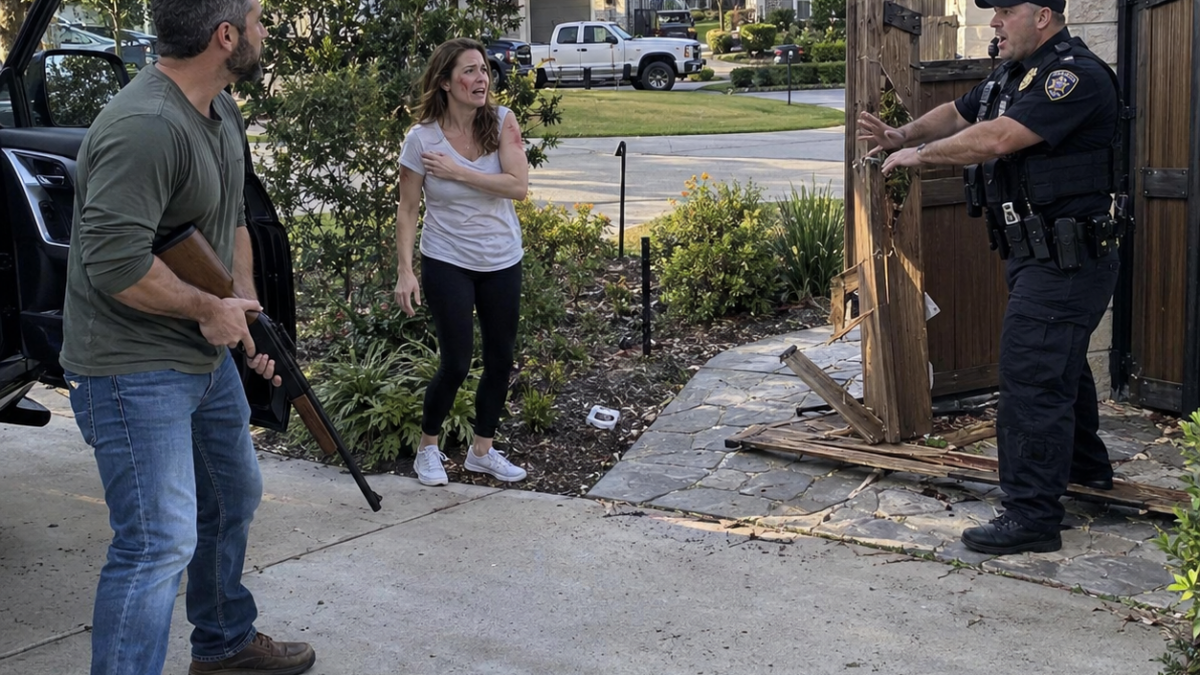
PART2
Forty minutes outside Houston.
Gated neighborhood.
Oak trees lining the streets.
Large lots.
Families.
A community pool.
Nothing extravagant by some standards, but for us, it felt like the reward for years of doing everything the hard way.
I had spent years in the Army Rangers before moving into private security consulting.
Elena had spent a decade as a pediatric nurse at Texas Children’s Hospital.
Neither of us came from money.
The down payment represented years of overtime, deployments, night shifts, postponed vacations, and saying no to things our friends bought without thinking twice.
When we finally purchased the house, it needed work.
Kitchen.
Flooring.
Back patio.
Fence.
A bathroom that looked like it had survived the 1980s out of spite.
We did most of the renovation ourselves.
That Tuesday morning, the last contractor had finished.
The boxes were finally gone.
Elena and I sat on the back patio with coffee.
The sun was coming up beyond the fence.
She leaned back in her chair.
“We actually finished.”
I looked toward the house.
“Almost.”
“No.”
She pointed at me.
“Do not say almost.”
“The shed could use—”
“If you touch one more project this month, I’m filing for divorce.”
“You don’t mean that.”
“I will cite irreconcilable renovations.”
I laughed.
She smiled.
Then looked around.
“I love this place.”
That mattered.
Elena had moved repeatedly as a kid.
Apartments.
Rental houses.
Her mother working two jobs.
Home, for her, had always meant temporary.
When we bought Cypress Grove, she planted herbs the first week.
Hung pictures before every box was unpacked.
Ordered patio furniture too expensive for my taste.
She was building permanence.
So was I.
“This is ours,” she said.
“Yeah.”
“No landlords.”
“No landlords.”
“No moving boxes.”
“Hopefully.”
She kicked my shin lightly.
“No military relocation.”
“Definitely.”
She rested her head against my shoulder.
For the first time in years, I felt like my life had shifted from preparing for the next thing to simply living in the thing I had worked toward.
At eight, I left for work.
Driving toward the main gate, I noticed a black SUV parked along the shoulder.
SECURITY was written across the doors in faded white lettering.
The vehicle looked old.
The kind of fleet SUV that had changed owners without ever changing decals.
A man sat behind the wheel.
Heavyset.
Dark uniform.
Short hair.
He watched me approach.
I raised two fingers off the wheel in greeting.
He did not respond.
Not even a nod.
His head followed my truck until I passed.
I noticed.
Then forgot about him.
At two that afternoon, Elena called me.
The moment I answered, I knew something was wrong.
Her voice was controlled.
Too controlled.
“Hey.”
“What happened?”
“Nothing happened.”
“Elena.”
There was a pause.
“Someone came to the house.”
“Who?”
“Security.”
I sat straighter.
“What security?”
“The HOA guy.”
“What did he want?”
“He asked why my car was in the driveway.”
I waited.
“And?”
“That was basically it.”
“Elena.”
“He said cars should be kept in garages whenever possible because visible vehicles affect community standards.”
“Is that in the rules?”
“I don’t think so.”
“Did he give you a notice?”
“No.”
“What exactly did he do?”
She exhaled.
“He stood too close.”
My attention sharpened.
“How close?”
“I opened the door maybe halfway. He stepped onto the porch. I told him my car was fine. He moved closer.”
“Inside?”
“No.”
“Did he touch the door?”
“No.”
“What did he say?”
“He looked at the car. Then at me.”
I waited.
“And?”
“He said, ‘I’ll make a note of this.’”
Something about the way she repeated it bothered me.
Not the words.
The tone.
“How long was he there?”
“Maybe three minutes.”
“What did he look like?”
She described him.
Tall.
Heavy.
Dark uniform.
Patch.
Badge.
Black SUV.
The man at the gate.
“Did you get his name?”
“No.”
“Camera?”
“Ring should have him.”
“Save it.”
“I already did.”
That made me smile despite everything.
“Good.”
“Do you think I’m overreacting?”
“No.”
“You didn’t even see him.”
“I don’t need to.”
“He didn’t technically do anything.”
“You told me he made you uncomfortable.”
“He did.”
“Then I believe you.”
She went quiet.
That mattered too.
Women spend too much time being told to explain away the thing their instincts are screaming.
Maybe he’s awkward.
Maybe you misunderstood.
Maybe he was just doing his job.
I had no interest in teaching my wife to distrust herself.
That evening I watched the footage.
Garrett—though I did not know his name yet—stood on our porch exactly as Elena described.
He positioned himself in a way that made closing the door awkward.
Not impossible.
Just uncomfortable.
He never crossed the threshold.
Never raised his voice.
Never threatened.
But after working security and threat assessment for years, I understood positioning.
He was testing.
Testing how much space he could take.
Testing whether Elena would yield it.
Testing how easily authority language made people comply.
I paused the video on the badge.
Couldn’t read the agency.
Only:
SECURITY ENFORCEMENT.
That phrase was strange.
The next morning, I searched the Texas licensing databases.
Cypress Grove Security Services.
Nothing obvious.
I tried several variations.
Still nothing.
That didn’t automatically prove criminal activity.
Companies use trade names.
Records can be filed differently.
But if someone was being paid to provide private security services, I expected a clean trail.
I found none.
So I saved screenshots.
Old habit.
Evidence first.
Emotion second.
Later that morning, I met Marcus Taylor at the mailbox cluster.
He was fifty-two.
Retired firefighter.
Broad shoulders.
Friendly face.
The kind of neighbor who introduces himself with a handshake and tells you which hardware store has better lumber before asking what you do for work.
“You’re the Callahans, right?”
“Daniel.”
“Marcus.”
We shook.
“You guys finished that renovation?”
“Mostly.”
“Looks good.”
“Thanks.”
He nodded toward our street.
“Security giving you trouble yet?”
That stopped me.
“What?”
His expression changed.
“Black SUV?”
“Yes.”
“Big guy?”
“Yes.”
“Garrett Wade.”
There it was.
“You know him?”
“Everybody knows him.”
“That sounds ominous.”
“It is.”
Marcus lowered his voice.
“Former Houston cop.”
“Former?”
“Fired.”
“For what?”
“Excessive force. Traffic stop.”
“Who was the victim?”
He gave me a look.
“A woman.”
My stomach tightened.
Marcus continued.
“He’s been doing enforcement for the HOA a few years now.”
“Licensed?”
Marcus laughed.
“You asking serious questions already?”
“Yes.”
“I don’t know.”
“I can’t find his license.”
“That doesn’t surprise me.”
“What does he actually do?”
“Whatever Margaret lets him do.”
“Margaret?”
“HOA president. Margaret Sinclair.”
I recognized the name from board emails.
Marcus leaned against the mailbox structure.
“Garrett gave me seven notices last year.”
“For what?”
“Fence stain. Trash cans. Work truck. Noise.”
“Legitimate?”
“One was maybe legitimate.”
“And the others?”
“Retaliation.”
“For?”
“I complained about him.”
He paused.
“Then somebody keyed my car.”
“You think Garrett?”
“I can’t prove it.”
“But?”
“I think Garrett.”
Marcus looked toward my house.
“Your wife home alone often?”
The question sounded intrusive until I saw his face.
Concern.
“Sometimes.”
He nodded slowly.
“Be careful.”
“What aren’t you saying?”
He hesitated.
“Men like Garrett don’t like being challenged.”
I waited.
“Especially by women.”
That was the second warning.
The first had come from Elena’s instincts.
I did not ignore either.
That afternoon, I installed two more cameras.
Front gate.
Back door.
Redundancy.
People call cameras paranoia until the day they become witnesses.
Three days later, the first violation arrived.
Email.
CYPRESS GROVE ESTATES HOA.
Violation: improper driveway vehicle storage.
Fine: $150.
Signed:
Garrett Wade
Security Enforcement Officer
I read it twice.
Then pulled up the bylaws.
No prohibition on parking a normal passenger vehicle in your own driveway.
There were rules against abandoned vehicles.
Commercial machinery.
Vehicles blocking sidewalks.
Nothing about Elena’s car.
I emailed the HOA.
Please identify the specific covenant provision allegedly violated.
The response came from Garrett.
Community enforcement determinations are discretionary based on aesthetic impact.
That sentence was nonsense.
I wrote back:
Please provide the recorded governing authority authorizing discretionary fines absent a specific covenant violation.
No response.
Instead, another notice arrived four days later.
Trash container at curb outside approved placement period.
$100.
The trash can had gone out two minutes before the written start time.
Two minutes.
I checked the front camera.
Garrett’s SUV passed at 6:58.
Approved time began at 7:00.
He had been watching closely enough to fine us for one hundred twenty seconds.
Then the lawn.
Grass supposedly four-tenths of an inch above the community maximum.
$150.
No measurement photo.
No inspection report.
Just Garrett.
Then an unauthorized decorative object.
Elena’s grandmother had given her a ceramic garden gnome years earlier.
It was ugly.
I had told her it was ugly.
She loved it because it reminded her of her grandmother.
Garrett fined us $200 for it.
By then, I was almost grateful.
Not because the fines were amusing.
Because the pattern was becoming obvious.
This wasn’t compliance.
It was targeted pressure.
Every email went into a folder.
Every camera clip backed up.
Every timestamp documented.
Then came the first face-to-face confrontation.
Saturday afternoon.
I was trimming hedges.
The black SUV stopped across the street.
Garrett stepped out.
He moved slowly.
Deliberately.
Uniform neat.
Badge polished.
He wore a duty-style belt.
No visible firearm that day.
He stopped on the sidewalk.
Watched me for maybe twenty seconds.
I kept working.
Finally:
“Mr. Callahan.”
I shut off the trimmer.
“That’s me.”
“You need to come with me.”
I almost laughed.
“Where?”
“HOA office.”
“Why?”
“To discuss your violations.”
“I’m available by email.”
“That wasn’t a request.”
There it was.
I set the trimmer down.
“Do you have authority to arrest me?”
His face tightened.
“This isn’t an arrest.”
“Then I don’t need to go.”
“I’m exercising enforcement authority granted by the association.”
“That authority doesn’t let you compel a resident to accompany you.”
“You’re misunderstanding.”
“No.”
I stepped toward the driveway.
“You’re private security.”
“I’m an enforcement officer.”
“You’re not a peace officer.”
“You don’t know my credentials.”
“I checked.”
That landed.
He stared.
I continued.
“I can’t find an active private security license under the company name you use.”
His jaw moved.
“You’ve been researching me?”
“You came to my house.”
He stepped off the sidewalk.
Onto my driveway.
I pointed.
“Stop.”
He kept walking.
“This property is within Cypress Grove.”
“It’s still private property.”
“I’m authorized to inspect.”
“Show me.”
“I don’t need to show you anything.”
“Yes.”
I smiled slightly.
“You do.”
He stopped about ten feet from me.
His smile appeared then.
Not friendly.
Not amused.
Predatory.
“You think because you have some military background, you’re special?”
I had never told him about the Rangers.
Which meant someone had looked.
“Who told you that?”
He ignored the question.
“I can make your life very difficult here.”
I nodded toward the camera mounted near the garage.
“This entire conversation is being recorded.”
His smile vanished.
I continued.
“You have been told to leave private property.”
Silence.
“If you stay, I will document criminal trespass.”
He stared.
Then backed away.
Slowly.
“You’re making an enemy you don’t need.”
“No.”
I picked up the trimmer.
“You’re making choices you don’t need.”
He returned to the SUV.
Before getting in, he said:
“This isn’t over.”
I looked directly at him.
“I’m counting on it.”
That night, I backed up the footage to two separate cloud accounts.
Elena watched me.
“You really think it’s going that far?”
“Yes.”
She hated that answer.
So did I.
Then she told me what had happened while I was running errands earlier.
Garrett had driven past the house four times.
First pass slow.
Second pass stopped.
Third pass nearly ten minutes at the corner.
Fourth pass directly in front.
Engine idling.
Garrett staring toward the kitchen window.
Elena’s voice stayed level.
But both hands were around her mug.
“I looked up,” she said, “and he was just there.”
“How long?”
“Maybe thirty seconds.”
“Any interaction?”
“No.”
“Did he wave?”
“No.”
“Smile?”
“No.”
“What did it feel like?”
She looked at me.
“Like he was waiting for me to react.”
That was stalking behavior.
Not enough on its own.
But part of a pattern.
Monday, I filed a records request regarding Garrett’s Houston Police Department history.
Then emailed the HOA board requesting a formal meeting.
Margaret Sinclair replied.
Three sentences.
Mr. Wade is a licensed security professional whose credentials have been verified by the Board.
All enforcement concerns should be directed through established HOA channels.
Repeated interference with authorized security activity may itself constitute a violation.
I read it twice.
Licensed.
Verified.
The public database disagreed.
Either Margaret had verified badly or she was lying.
I went to Marcus.
He was not surprised.
“Margaret protects him.”
“Why?”
He hesitated.
Then:
“You know who owns Cypress Grove Security Services?”
“No.”
“Her son.”
That changed everything.
“Brian Sinclair?”
“Yep.”
“How much is the contract?”
Marcus whistled.
“Rumor is fifteen grand a month.”
“For one guard?”
“For Garrett.”
“There are county patrols.”
“I know.”
“Fifteen thousand monthly?”
“Ask for the budget.”
So I did.
Public HOA financials.
Security services:
$180,000 annually.
One contractor.
One principal.
Brian Sinclair.
Margaret’s son.
Now we had motive.
I reviewed the cameras from the previous week.
Garrett’s SUV appeared eleven times in one day.
Eleven.
Morning.
Midday.
Afternoon.
After dark.
At one point, headlights off, parked near the corner for almost ten minutes.
That wasn’t code enforcement.
That was surveillance.
I contacted an attorney.
Victoria Reyes.
HOA disputes.
Civil-rights litigation.
Property harassment.
She had the personality of someone who considered intimidation an administrative inconvenience.
We sat in her office while she reviewed everything.
Violation notices.
Videos.
Database searches.
Marcus’s statements.
The financial connection.
She stopped at the footage of Garrett standing in front of our house after dark.
“How long?”
“Nine minutes forty-three seconds.”
“Any HOA work visible?”
“No.”
“Contact?”
“No.”
“Your wife present?”
“Yes.”
“Did he know?”
“Probably.”
Victoria leaned back.
“You have a harassment case developing.”
“Developing?”
“Pattern matters.”
“What about stalking?”
“Potentially.”
“He keeps watching Elena.”
“I know.”
She tapped the file.
“But if we’re going to accuse him, I want this cleaner than his badge.”
“What next?”
“Cease and desist.”
She drafted it that afternoon.
Garrett.
Cypress Grove Security Services.
HOA board.
No direct contact with me or Elena.
No appearance at our property absent a legitimate emergency or lawful basis.
All communications through counsel.
Evidence preservation notice.
Reference to licensing irregularities.
Reference to requested HPD employment records.
Victoria looked at me.
“This won’t stop him.”
“That’s comforting.”
“It isn’t meant to be comforting.”
“Then why send it?”
“Because reasonable people stop.”
“And Garrett?”
“If he doesn’t, every step after today becomes more deliberate.”
That mattered.
Letter delivered Thursday.
Friday morning, Elena called.
“Daniel.”
One word.
I knew.
“He’s there?”
“Yes.”
“Where?”
“Front.”
“Inside property line?”
“No. Street.”
“Camera?”
“Yes.”
“How long?”
“Ten minutes.”
I called the sheriff’s non-emergency number.
Deputy James Hartley responded.
Garrett left after a short conversation.
Hartley called me afterward.
“I’m going to speak candidly.”
“Please.”
“Wade’s name is familiar.”
“How familiar?”
“Multiple calls.”
“Charges?”
“No.”
“Why?”
“Nothing individually crossed enough lines.”
“He’s parked outside a woman’s house less than twenty-four hours after receiving a cease letter.”
“I know.”
“He’s unlicensed.”
“We’re checking that.”
“What does he call himself?”
“HOA enforcement.”
Hartley sighed.
“He acts like he’s still carrying an HPD badge.”
“He doesn’t.”
“That’s the problem.”
I asked the question I hoped I would never need answered.
“What happens if he enters my house?”
Hartley went quiet.
“What kind of entry?”
“Unlawful. Forced. Especially if Elena is home.”
“Call 911 first.”
“Obviously.”
“If somebody unlawfully forces entry into an occupied residence and presents an imminent threat, Texas law can provide strong self-defense protections.”
He paused.
“But Daniel.”
“Yes?”
“Everything leading up to that moment matters.”
“I know.”
“Warnings.”
“Yes.”
“Documentation.”
“Yes.”
“Attempts to disengage.”
“Yes.”
“If the day comes, God forbid, you want a record showing you did everything possible to avoid that day.”
“That’s what we’re building.”
“Good.”
He didn’t tell me to become a hero.
Didn’t encourage confrontation.
Didn’t give me macho nonsense.
He told me to document.
That was why I trusted him.
Victoria’s investigator completed the business research Monday.
It was worse than Marcus had suggested.
Cypress Grove Security Services had been formed eight years earlier.
Two months after Margaret Sinclair became HOA president.
Brian Sinclair listed as owner.
One known employee.
Garrett Wade.
Single major client.
Cypress Grove Estates HOA.
Fifteen thousand dollars per month.
Almost two hundred thousand annually.
Then the investigator found complaints.
Three formally documented.
All involving Garrett.
All dismissed by Margaret personally.
Marcus was one.
Another woman, Helen Kelly, still lived in the neighborhood.
I knocked on her door that evening.
She looked through the gap before opening.
“Mr. Callahan?”
“Daniel.”
“I know who you are.”
That surprised me.
“Okay.”
“You’re having trouble with Garrett.”
Not a question.
“Yes.”
She let me in.
Helen was in her forties.
Quiet.
Careful.
The kind of person who checked the street before closing the door.
Her story made my skin crawl.
Six months earlier, Garrett confronted her over her elderly mother’s car parked overnight.
Helen questioned him.
After that, he began appearing.
Mailbox.
Grocery store.
Restaurant.
Once outside her gym.
“He told me community safety requires pattern awareness.”
“What does that mean?”
“I asked.”
“And?”
Helen swallowed.
“He leaned close and said, ‘It means I pay attention to people who interest me.’”
My stomach tightened.
“Did you report it?”
“Yes.”
“To Margaret?”
“Yes.”
“What did she say?”
“That I was being dramatic.”
Helen retrieved her phone.
Showed me screenshots.
Unknown number.
Home late tonight.
You left the living room light on.
You look tired.
Nothing overtly threatening.
Everything threatening.
“Do you know it was him?”
“No.”
“But?”
“He would appear the next day.”
She looked embarrassed.
“I started changing my routine.”
“You shouldn’t have had to.”
“I stopped going to the same grocery store.”
Silence.
“I changed where I parked at work.”
More silence.
“I stopped eating out.”
That was the damage.
Garrett did not need to touch Helen.
He had made himself present in her decisions.
I asked:
“Will you testify?”
She stared at the phone.
Long pause.
Then:
“Yes.”
“Are you sure?”
“No.”
Honest answer.
She continued.
“But I spent six months thinking maybe I was imagining it.”
“You weren’t.”
“I know that now.”
When I told Elena that night, she became very quiet.
We sat at the kitchen table.
“I knew it.”
“What?”
“The way he looked at me.”
“Yes.”
“I knew it wasn’t normal.”
“No.”
She looked angry now.
“Margaret knew?”
“She dismissed complaints.”
“That’s not the same as knowing.”
“No.”
“But close.”
“Yes.”
We talked about safety.
Not in the abstract.
Specific routines.
Doors locked.
Cameras.
Neighbors.
No opening the door for Garrett.
No confrontations.
Elena listened.
Then said:
“Stop looking at me like I’m fragile.”
“I’m not.”
“You are.”
“I’m worried.”
“So am I.”
She folded her arms.
“I grew up with brothers who hunted.”
“I know.”
“You trained me.”
“I know.”
“I can protect myself.”
“I know.”
She leaned forward.
“Fear is not helplessness.”
That sentence stayed with me.
I added another camera.
Living room.
Facing the main entry.
Redundancy.
Then came Tuesday.
Three weeks after the first visit.
I was forty-five minutes away.
Meeting ran late.
Phone buzzed.
Elena.
Two words.
HE’S HERE.
I stood immediately.
Called.
She answered in a whisper.
“He’s at the door.”
“What’s he saying?”
“Gas leak.”
“What?”
“He says somebody reported a gas leak and he needs to inspect.”
“Do you smell gas?”
“No.”
“Any alert?”
“No.”
“Do not open the door.”
“I’m not.”
“Call 911 if he tries entry.”
“He’s knocking again.”
I could hear it.
Bang.
Bang.
Bang.
Not a polite knock.
The flat of a hand.
“Open the door, Mrs. Callahan.”
Garrett’s voice.
I was already in the elevator.
Elena said through the door:
“There is no gas smell. Leave.”
“This is a safety inspection.”
“You are not authorized to enter.”
“You are interfering with an emergency response.”
I reached my truck.
“Elena, stay on the phone.”
“I am.”
I drove.
Forty-five minutes.
At first.
Then traffic opened.
Thirty-five.
Thirty.
Every red light felt personal.
Seven minutes later, Elena whispered:
“He’s going around back.”
“Where are you?”
“Living room.”
“Stay away from glass.”
I heard rattling.
Metal.
Then Garrett’s voice faintly outside.
“Open the gate.”
Elena said:
“No.”
A hard impact.
The phone microphone distorted.
Wood or metal cracking.
Another impact.
Elena’s breathing accelerated.
“Daniel.”
“I’m here.”
“The gate—”
Crash.
Then footsteps.
“Call 911 now.”
“I’m calling.”
She put me on one line while dialing from another device.
Another sound.
Back door.
Garrett shouting.
“Open up!”
Elena:
“Get off my property!”
Impact.
Again.
Then glass shattered.
The sound came through the phone like ice dumped onto concrete.
“Elena!”
She didn’t answer.
I heard yelling.
Movement.
Something heavy knocked over.
Elena shouted:
“Don’t touch me!”
Then the phone clattered.
Static.
Open line.
No voice.
I have spent time in places where people shoot at each other.
I have moved toward danger because that was the job.
Nothing I had experienced made that eighteen-minute drive feel less terrifying.
Because war has structure.
Mission.
Team.
Information.
This was my wife alone in our house while a man who had already targeted women forced entry.
I called 911 myself.
Told them what was happening.
Location.
Suspect.
History.
Wife inside.
Potentially injured.
Then I drove.
Fast.
Too fast.
I will not pretend otherwise.
I reached Cypress Grove eighteen minutes after Elena’s second call.
The gate lay on the walkway.
Not open.
Destroyed.
Bent hinge.
Splintered mounting post.
I saw the back door from the side yard.
Glass gone.
Frame damaged.
My chest tightened.
I opened the truck safe.
Removed the backup shotgun.
Loaded and secured.
I did not run blindly.
That sounds cold.
It wasn’t.
It was the only way I knew to function.
Look.
Listen.
Identify.
I entered through the front.
“ELENA?”
Movement.
Living room.
I came around the corner.
Saw her.
On the floor beside the couch.
Garrett stood over her.
He turned.
Shotgun came up.
Everything narrowed.
His chest.
Hands.
Waist.
No visible weapon.
Distance.
Elena.
Backdrop.
“Don’t move.”
Garrett froze.
Then his face changed.
Recognition.
“Callahan.”
“Step away from her.”
“I’m conducting—”
“Stop.”
He lifted his hands.
“This is official.”
“No.”
“You need to lower the weapon.”
“No.”
“You don’t understand.”
“I understand you broke into my house.”
“There was a reported emergency.”
“There was no emergency.”
“Your wife became combative.”
I looked at Elena.
Split lip.
Swollen cheek.
Wrist held tight.
Something inside me screamed.
Garrett continued.
“She attacked me.”
Elena said from the floor:
“He hit me.”
Garrett snapped:
“Shut up.”
That almost ended his life.
Not legally.
Not tactically.
Emotionally.
My finger remained outside the trigger guard.
I heard Hartley’s voice in my memory.
Everything before that moment matters.
Warnings.
Documentation.
Disengagement.
Then another voice.
My own.
Shooting him now would not be defense if he no longer presented an immediate threat.
It would be anger.
Revenge dressed in legal language.
I had seen enough revenge to know what it cost.
“Down.”
Garrett looked at me.
“You don’t have authority.”
I almost smiled.
“Neither do you.”
“Daniel,” Elena whispered.
I never took my eyes off Garrett.
“Down.”
He hesitated.
I cycled the action.
Not because I wanted drama.
Because he was still calculating resistance.
The sound made the calculation easier.
He lowered himself.
“Face down.”
He complied.
“Hands behind your head.”
He complied.
Elena dragged herself farther from him.
I moved only enough to place myself between them.
Then I heard sirens.
Garrett whispered:
“You’re going to regret this.”
I said:
“No.”
Real deputies entered less than two minutes later.
The moment I saw uniforms through the entryway, I lowered the shotgun.
Placed it on the floor.
Hands visible.
“Homeowner.”
They secured me first.
Correct procedure.
Then Garrett.
Then medical.
One deputy knelt beside Elena.
Another cuffed Garrett.
He began talking immediately.
“I’m HOA security. I was conducting a welfare check. He threatened me with a firearm.”
Deputy looked at the shattered door.
Then the destroyed gate.
Then Elena’s face.
Then me.
“Okay.”
Not agreement.
Just collecting.
Paramedics arrived.
Elena tried to refuse transport.
I gave her a look.
She said:
“Don’t.”
“You’re going.”
“I’m fine.”
“You are bleeding.”
“So are people at work every day.”
“You’re going.”
A medic smiled.
“He’s right.”
Elena glared at both of us.
She went.
Deputy Hartley arrived later.
Saw the house.
His face hardened.
“Garrett?”
“In custody.”
“Your wife?”
“Hospital.”
“You fire?”
“No.”
He looked at me.
“Good.”
I hated the relief in that word.
Not because I wished I had fired.
Because it meant Hartley had been afraid I might need to.
We reviewed footage.
Front camera.
Garrett arriving.
Ringing.
Knocking.
Claiming gas leak.
No county utility truck.
No fire department.
No emergency notification.
Side camera.
Garrett at gate.
Rattling.
Elena telling him to leave.
He struck the gate.
Once.
Twice.
Third impact tore it free.
Back camera.
Garrett approached the glass door.
Demanded entry.
Elena visible inside calling 911.
He slammed something against the frame.
Glass shattered.
He reached through.
Unlocked.
Entered.
Living-room camera.
Most painful footage I have ever watched.
Elena backing away.
Garrett moving toward her.
She told him to leave.
He grabbed her arm.
She pulled free.
He shoved.
She hit the side table.
He moved again.
She struck him with the edge of a lamp.
He hit her across the face.
She fell.
Her wrist buckled under her.
Then me entering.
Every accusation he made collapsed.
Welfare check?
No.
Gas leak?
No.
Emergency authority?
None.
Self-defense?
The video showed him pursuing Elena through her own home.
Hartley turned off the footage.
He sat quietly.
Then said:
“You did exactly what you needed to do.”
I didn’t answer.
“You hear me?”
“Yes.”
“You didn’t fire because you didn’t need to once he complied.”
“Yes.”
“That matters.”
“I know.”
“You did good.”
I looked toward the shattered glass.
“No.”
He waited.
“I got here late.”
Hartley’s expression softened.
“You got here.”
“That’s not the same.”
“No.”
He didn’t argue.
Elena had a concussion.
Facial contusions.
Split lip.
Hairline fracture in her wrist.
No internal bleeding.
No skull fracture.
Painful.
Terrifying.
Not life-threatening.
I repeated those words in the hospital waiting room until they lost meaning.
Not life-threatening.
Not life-threatening.
Not life-threatening.
At nine that night, Victoria called.
“Daniel.”
“I’m here.”
“Elena?”
“Stable.”
“Garrett?”
“Charged.”
“What counts?”
“Burglary of a habitation. Assault causing bodily injury. Trespass. More being reviewed.”
She exhaled.
Then:
“This changes everything.”
“I don’t care about the lawsuit tonight.”
“I know.”
“Victoria.”
“Yes?”
“She warned me.”
“About?”
“First day.”
“What?”
“She said the way he looked at her was wrong.”
Silence.
“I believed her.”
“Yes.”
“And it still happened.”
“You didn’t cause this.”
“I documented. Lawyers. Sheriff. Letter. Cameras.”
“Yes.”
“And he still came through the door.”
Victoria’s voice became very quiet.
“Systems reduce risk.”
I waited.
“They do not control violent people.”
That was hard to accept.
“The record matters now.”
“I know.”
“Daniel, Garrett is the symptom.”
“What?”
“The people who protected him are still sitting on the board.”
Margaret.
Brian.
The contract.
The dismissed complaints.
“She knew.”
“We’re going to find out how much.”
Elena came home two days later.
Wrist brace.
Bruising.
Concussion protocol.
She hated the plywood covering the back door.
“I feel like we live in a construction site again.”
“I thought you loved renovations.”
“I will kill you.”
“Good. Sense of humor intact.”
She smiled.
Then winced because her lip hurt.
The first week was worse at night.
She woke suddenly.
Sometimes convinced someone was at the door.
Sometimes she could not explain why she was awake.
I stayed awake with her.
We did not force conversations.
People imagine trauma recovery as dramatic confession.
Sometimes it is silence at three in the morning while your spouse counts breathing until the room feels safe again.
Garrett’s criminal case moved quickly at first.
Charges confirmed within seventy-two hours.
Bail set at seventy-five thousand dollars.
Then we learned who posted it.
Cypress Grove Security Services.
Brian Sinclair’s company.
The company had paid to release the man who committed violent felonies during something he claimed was HOA enforcement.
Victoria called it what it looked like.
“An admission of responsibility paid in cash.”
Media found the story.
LOCAL HOA SECURITY OFFICER ARRESTED IN HOME INVASION.
PRIVATE ENFORCEMENT OFFICER ACCUSED OF ASSAULTING RESIDENT.
Reporters called.
We declined.
Victoria released one statement.
A private citizen operating under the appearance of HOA security had engaged in a documented pattern of harassment culminating in unlawful entry and assault.
That was enough.
The pressure did something Garrett’s previous victims had never been able to do alone.
It made people talk.
Helen called first.
“I’ll testify publicly.”
“You don’t have to.”
“I know.”
Marcus next.
Then David Henderson.
His seventeen-year-old daughter had once been cornered by Garrett after parking along the curb.
He stood between her and the house.
Asked where she had been.
Who she was with.
Why she was out late.
She came inside shaking.
Stopped driving herself for months.
David complained.
Margaret dismissed it as “routine security interaction.”
Then Sarah Nguyen.
She and her wife returned from vacation to find their backyard gate open.
Patio furniture moved.
Cigarette butts near the back door.
Neighbor had seen Garrett’s SUV.
Margaret told them there was no proof.
One story.
Another.
Another.
Twelve formal complaints in eighteen months.
All dismissed.
All involving Garrett.
All under Margaret.
Victoria built a timeline.
Then civil discovery cracked open the money.
The security contract alone was ugly.
$15,000 monthly.
One employee.
Services duplicating county patrols.
But then bank statements showed separate payments.
Cypress Grove Security Services to Margaret Sinclair.
$5,000 every month.
Consulting fees.
Sixty thousand dollars annually.
For eight years.
Margaret approved the contract.
Her son owned the company.
The company paid her.
She dismissed complaints against the only employee.
This was no longer bad governance.
It looked like corruption.
Victoria spread the documents across her conference table.
“Here.”
She pointed.
“HOA pays Brian.”
Next.
“Brian’s company pays Margaret.”
Next.
“Margaret dismisses complaints.”
Next.
“Garrett keeps enforcement authority.”
I stared.
“How much?”
“Hundreds of thousands over time.”
“Residents knew?”
“No.”
“Board?”
“Not fully.”
“How?”
“Rubber-stamp budgeting. Bundled line items. Minimal attendance.”
I looked away.
“People paid dues to fund the man terrorizing them.”
“Yes.”
Victoria didn’t soften it.
Then came Garrett’s employment file.
HPD termination.
Excessive force.
Female driver.
Separation mandatory.
Background report attached.
Acknowledgment form.
Margaret Sinclair’s signature.
She knew.
Before hiring him.
She knew exactly why he had been fired.
She hired him anyway.
I called Elena.
She sat beside me while we read it.
Her face became still.
“She knew he hurt a woman before.”
“Yes.”
“And she sent him into a neighborhood.”
“Yes.”
“And when women complained…”
“She dismissed them.”
Elena took off her glasses.
Pressed fingers against her eyes.
“This isn’t incompetence.”
“No.”
“She chose him.”
“Yes.”
Victoria filed suit.
Garrett Wade.
Cypress Grove Security Services.
Brian Sinclair.
Margaret Sinclair.
HOA.
Claims involving assault, negligent hiring, intentional emotional harm, conspiracy, and other theories counsel believed supported by the record.
Damages demanded.
Money mattered.
Medical bills.
Lost work.
Therapy.
Repairs.
But exposure mattered more.
Discovery would make hiding difficult.
Then Garrett started talking.
His public defender contacted prosecutors.
Garrett’s strategy was obvious.
Shift blame upward.
He claimed Margaret had told him to “handle” us.
We had hired a lawyer.
Created problems.
Challenged board authority.
Margaret supposedly wanted us uncomfortable enough to sell.
Bonus if we moved within six months.
I did not believe that part at first.
Then discovery produced emails.
Not speculation.
Written communication.
Margaret to Brian.
The Callahans are becoming disruptive.
Another.
Garrett needs to establish presence.
Another.
Do not allow counsel letters to undermine enforcement.
Then the one that mattered.
Three days before the attack:
Make sure Garrett handles the Callahan situation, whatever it takes.
Whatever it takes.
Four words.
Elena read them.
No reaction.
Then stood.
Walked outside.
I followed.
She stopped in the backyard.
Near the repaired section of fence.
“What are you thinking?”
She looked at the place where Garrett entered.
“She knew.”
“Yes.”
“She knew he had hurt a woman.”
“Yes.”
“She knew he had been following Helen.”
“She had complaints.”
“She knew he watched me.”
“She knew enough.”
“And she told him whatever it takes.”
I did not answer.
Elena’s eyes filled.
Not fear.
Rage.
“I want to go to the meeting.”
“What meeting?”
“Annual HOA.”
“No.”
“Yes.”
“Elena.”
“No.”
She turned toward me.
“He attacked me in my own house.”
“I know.”
“I am not hiding while Margaret sits behind a table pretending none of this happened.”
“You don’t owe anyone public testimony.”
“I know.”
“Then don’t.”
“I want to.”
I studied her.
“Because you’re angry?”
“Yes.”
“Anything else?”
“Yes.”
“What?”
“Because Helen spent six months thinking she was crazy.”
That ended the argument.
The annual meeting took place the third Saturday of November.
More than two hundred residents packed the community center.
Standing room.
Local reporter in back.
Camera operator.
Deputy Hartley present.
Margaret sat at the board table.
Navy blazer.
Pearls.
Perfect hair.
Brian beside her.
He looked less composed.
Margaret rushed through the agenda.
Budget.
Landscaping.
Pool maintenance.
Holiday decorations.
She spoke faster than usual.
Then:
“If there is no further business, I move to adjourn.”
I stood.
“There is homeowner comment.”
She looked at me.
“That period is suspended tonight.”
Victoria stood.
“No, it isn’t.”
Margaret’s eyes narrowed.
Victoria held up the bylaws.
“Section seven, subsection three.”
Residents murmured.
Margaret stared.
“Five minutes.”
I walked to the projector.
Connected the laptop.
Elena sat in front.
Brace gone now.
Wrist mostly healed.
Bruise faded.
But I could still remember every mark.
I looked at the room.
“Three weeks ago, a man employed by this HOA broke into my home and assaulted my wife.”
Silence.
“He is facing felony charges.”
I clicked.
Slide one.
Twelve complaints.
Dates.
Names.
Outcomes.
Dismissed.
Dismissed.
Dismissed.
Every one approved by Margaret.
Murmurs.
Margaret said:
“These were investigated.”
I looked at her.
“By who?”
She did not answer.
Next slide.
Garrett’s HPD termination.
Excessive force.
Female victim.
Then Margaret’s signed acknowledgment.
The room changed.
Not loud yet.
Angry.
A woman near the aisle whispered:
“She knew.”
I said:
“This form was signed before he was hired.”
Margaret interrupted.
“My signature confirms receipt, not agreement with every allegation.”
Victoria said:
“Termination was not an allegation.”
Margaret glared.
Next slide.
Security contract.
$15,000 monthly.
Cypress Grove Security Services.
Owner: Brian Sinclair.
Someone shouted:
“That’s your son!”
Margaret grabbed the microphone.
“This contract was competitively evaluated.”
I clicked.
There had been no competing bids in the records produced.
Then the bank transfers.
$5,000 monthly.
Security company to Margaret.
Consulting fees.
The room exploded.
“What?”
“Are you kidding?”
“Our dues?”
“How long?”
Margaret stood.
“This presentation is defamatory.”
I said:
“These are bank records.”
“You are mischaracterizing legitimate consulting compensation.”
“For what consulting?”
She opened her mouth.
Nothing.
Helen stood.
Nobody asked her to.
She faced the room.
“My name is Helen Kelly.”
People quieted.
“Garrett followed me for six months.”
Margaret said:
“That allegation was never substantiated.”
Helen did not look at her.
“He appeared at places I had never told anyone I was going.”
The room stayed silent.
“He texted me from unknown numbers about when I got home.”
She held up her phone.
“I reported it.”
She finally looked toward Margaret.
“She told me I was being dramatic.”
Margaret started speaking.
Helen continued.
“I changed where I shopped.”
Her hands shook.
“I changed where I parked.”
Her voice did not.
“I stopped going out at night.”
She looked at the residents.
“I thought I was losing my mind.”
Then Marcus stood.
“Seven violation notices after I complained.”
He paused.
“Then my car was keyed.”
Margaret said:
“You have no proof Garrett vandalized—”
Marcus held up a hand.
“I didn’t say I had proof.”
That took away her defense.
He continued:
“I said what happened.”
Then David Henderson.
“My daughter was seventeen when Garrett cornered her beside her car and demanded to know where she had been.”
He looked directly at Margaret.
“You called that routine.”
Another family.
Another account.
Each short.
Each specific.
The pattern grew in front of the room.
Margaret tried to stand above it.
“These are unrelated grievances being combined into a political attack.”
Then Elena rose.
I had not known whether she would speak.
She walked slowly toward the front.
Margaret watched her.
Elena did not look away.
“My name is Elena Callahan.”
Everybody already knew.
“Garrett Wade broke through my gate.”
Pause.
“Then through my back door.”
No one moved.
“He grabbed my arm.”
Her voice stayed steady.
“He shoved me.”
I felt my hands tighten.
“He hit me in the face.”
Silence.
“And when I filed no complaint that afternoon—because I was too busy going to the hospital—this HOA’s security company posted his bail.”
A man near the back said:
“Jesus.”
Elena looked at Margaret.
“You knew what he had done before you hired him.”
Margaret shook her head.
“No.”
Elena pointed to the screen.
“Your signature says otherwise.”
“I did not personally conduct his background investigation.”
“You signed it.”
Margaret turned toward Brian.
He stared at the table.
“Brian?”
Nothing.
“Brian.”
He looked at the crowd.
Reporter.
Deputy.
Residents.
Then at his mother.
He said nothing.
Margaret’s composure finally cracked.
“I was trying to keep this community safe!”
Someone shouted:
“By hiring him?”
Another:
“By paying yourself?”
Another:
“You buried complaints!”
Noise filled the room.
Margaret struck the table with a gavel.
“Order!”
That made people angrier.
She kept hitting.
“Order!”
Nobody cared.
A resident stood.
“I move to remove the board.”
Another voice:
“Second.”
Another:
“Third.”
Margaret shouted:
“You cannot do that!”
Victoria spoke from beside me.
“Yes, they can.”
Margaret glared.
“Not without notice.”
“Emergency removal provision.”
Victoria cited the exact bylaw.
Margaret tried three procedural objections.
Victoria answered all three.
The vote happened.
Overwhelming.
Margaret.
Brian.
Two board allies.
Removed.
Under sixty seconds.
Eight years of accumulated authority evaporated in less time than it took Garrett to break through our gate.
Hartley stepped forward afterward.
He did not arrest anyone.
He simply said:
“The financial information presented tonight will be referred for investigation.”
Margaret stared at him.
“This is a private association matter.”
“Not if public criminal statutes are implicated.”
Her face went white.
Outside, residents gathered in groups.
Anger.
Shock.
Embarrassment.
Some apologizing to Helen.
Some to Marcus.
Some to us.
Elena took my hand.
“Is it over?”
I looked back at the building.
“No.”
She nodded.
“I know.”
Brian approached Victoria in the parking lot.
They spoke privately.
Ten minutes later, she returned.
“He wants to cooperate.”
“With us?”
“With prosecutors.”
“Against Margaret?”
“Against everyone necessary.”
“That’s his mother.”
Victoria gave me a look.
“People discover strong moral principles when prison becomes possible.”
Brian had kept records.
Everything.
Bank statements.
Emails.
Instructions.
Private board communications.
Maybe as insurance.
Maybe because people committing financial misconduct often document more than they should.
His cooperation made the next phase easier.
Six weeks later, a grand jury reviewed the evidence.
Garrett talked too.
He wanted a deal.
His version:
He had only intended to intimidate Elena.
The situation “got out of control.”
The prosecutor reportedly asked:
“You broke a gate, broke a glass door, entered an occupied residence after being refused entry, grabbed a woman, shoved her, and struck her. At what point was it under control?”
Garrett had no answer.
Brian’s testimony was worse for Margaret.
He claimed his mother viewed Garrett’s willingness to use force as useful.
“A man willing to push,” she had supposedly said, “keeps residents compliant.”
That quote traveled through Cypress Grove like wildfire.
Then the “whatever it takes” email.
Then the money.
Then the ignored complaints.
Margaret’s defense became nearly impossible.
Her attorney tried blaming Brian.
Tried blaming Garrett.
Tried portraying Margaret as an older woman who had trusted the wrong people.
The documents would not cooperate.
Her signature.
Her payments.
Her email.
Her decisions.
Her dismissals.
One after another.
Garrett eventually pleaded guilty to serious felony charges involving the burglary and assault.
Margaret faced fraud and conspiracy-related charges tied to the broader scheme.
Brian cooperated enough to avoid the worst outcome, though not consequences.
The sentencing hearing happened on a gray Thursday in February.
The courtroom was full.
Residents.
Reporters.
Investigators.
Victims.
Elena sat beside me.
Her wrist had healed.
Mostly.
Cold weather made it ache.
She had prepared a statement.
I had read none of it.
She wanted it that way.
When called, she walked to the podium.
Garrett sat at one table.
Margaret at another.
Elena looked at the judge.
“I’m not going to describe what he did to me.”
I felt the room change.
“The court already knows.”
She continued.
“I want to describe what happened after.”
Her voice was calm.
“For weeks, I woke up believing someone was inside my house.”
My throat tightened.
“I stopped standing near windows.”
“I checked locks I had already checked.”
“I flinched when delivery drivers knocked.”
She paused.
“I considered leaving.”
I looked at her.
She had never told me that directly.
She continued.
“Then one morning I realized I was rearranging my entire life around a man who was no longer in it.”
Silence.
“So I started running again.”
Her morning routine.
She had stopped after the attack.
“I ran one block.”
Pause.
“Then two.”
Another.
“The first week, I turned around every time I saw a black SUV.”
My chest tightened.
“The second week, I didn’t.”
She looked toward Garrett.
“This is not about proving I’m fearless.”
Then toward Margaret.
“I was afraid.”
Back to the judge.
“I just refuse to make fear my permanent address.”
Nobody moved.
“That is what their choices cost me.”
She stepped away.
Helen spoke.
Marcus.
David.
Each one described not just what Garrett did.
What changed afterward.
The judge returned after deliberation.
Garrett received a lengthy state-prison sentence for the violent felony conduct.
Margaret received prison time tied to fraud and conspiracy findings and was ordered to pay substantial restitution.
Brian received probation and restitution under his cooperation agreement and restrictions connected to future corporate responsibility.
The numbers mattered to the court.
But sitting there, I cared more about finality.
Garrett looked smaller without the uniform.
No badge.
No belt.
No SUV.
Just prison clothing and the consequences of choices he had spent years pretending were authority.
Margaret looked straight ahead.
The judge discussed abuse of trust.
Financial self-interest.
Ignored warning signs.
The danger created when private organizations imitate public power without accountability.
Margaret did not cry.
Not until the sentence was announced.
Then something in her face collapsed.
Eight years of control ended in a courtroom where she could not bang a gavel and declare herself right.
Civil settlement followed.
Insurance.
Assets.
Negotiation.
Money distributed among multiple victims.
Our share covered legal bills.
Medical costs.
Repairs.
Security improvements.
Lost time.
Therapy.
We had money left.
Neither of us celebrated.
A settlement check is not a time machine.
It doesn’t rebuild the moment before the glass breaks.
It does not erase the sound of your wife hitting furniture.
It does not make three a.m. peaceful.
It acknowledges damage.
That matters.
But it is not magic.
Spring came.
Slowly.
The house became ours again.
That was not automatic either.
The gate was rebuilt.
Stronger hinges.
Not because I expected another Garrett.
Because the old one was destroyed.
The back door replaced.
Elena chose the glass.
“Not that one.”
“Why?”
“Looks too much like the old door.”
We picked another.
The living room side table was repaired.
There was a dent in the floor where it had fallen.
I offered to replace the board.
Elena said no.
“Why?”
“Because I don’t want every scar erased.”
I understood.
The backyard changed most.
Elena planted a garden near the fence.
Tomatoes.
Rosemary.
Basil.
Flowers.
I came outside one morning and saw her kneeling almost exactly where Garrett had crossed after breaking the gate.
Hands in soil.
Sunlight.
Plants.
I stood there.
She noticed.
“What?”
“Nothing.”
“You’re staring.”
“I like the garden.”
She smiled.
“You hated the plan.”
“I was wrong.”
“Can I record that?”
“No.”
“Shame.”
Life grew over the scene.
Not hiding it.
Reclaiming it.
Helen Kelly became HOA president.
Unopposed.
That would have been unthinkable six months earlier.
She had once varied grocery routes because Garrett watched her.
Now she stood in front of board meetings and asked uncomfortable questions without shaking.
Her first action:
Terminate the security contract.
Cypress Grove Security Services dissolved shortly after.
Second:
Independent audit.
The audit found more.
Fake maintenance vendors.
Questionable reimbursements.
Payments for meetings that never occurred.
Small thefts.
Eight years of them.
Nothing as dramatic as Garrett.
But corruption rarely survives alone.
People who steal a little and get away with it become comfortable.
Comfort becomes entitlement.
Entitlement becomes architecture.
The new HOA changed its bylaws.
Conflict-of-interest rules.
Competitive bidding.
Mandatory disclosure.
Independent complaint review.
No enforcement employee reporting solely to one board member.
Security credentials verified through the state.
Meeting attendance increased.
Thirty people.
Forty.
Sometimes sixty.
Before, five residents might show up.
Fear isolates people.
Transparency makes them curious.
Marcus organized a community event in April.
He planted a magnolia tree near the playground.
About fifty residents attended.
He hated speeches.
So his was short.
“We kept thinking somebody else would say something.”
He looked around.
“Then somebody did.”
He nodded toward Elena.
Toward Helen.
Toward me.
Then shook his head.
“Actually, a lot of people did.”
He touched the tree.
“This is for that.”
No plaque.
No grand slogan.
Just a young magnolia.
Children running around it.
Neighbors talking.
A place that had once felt like a collection of houses finally behaving like a community.
After the ceremony, Marcus came over.
“You staying?”
I knew what he meant.
Elena and I had discussed moving.
Quietly.
Many times.
New neighborhood.
New house.
No broken-door memory.
No street where Garrett’s SUV had idled.
No community center where Margaret sat.
But leaving began to feel complicated.
Was it healing?
Or surrender?
There is no universal answer.
For us, eventually, we chose to stay.
“This is home,” I told Marcus.
He smiled.
“Good.”
Elena returned to Texas Children’s full time.
That transition was hard.
Crowded hallways.
Sudden noises.
Men standing too close in elevators.
Some days she came home exhausted from managing reactions nobody else could see.
But she went back.
Then started a weekly support group.
Women dealing with trauma.
Harassment.
Assault.
Stalking.
Not all HOA-related.
Obviously.
Pain does not care about categories.
Eight women came regularly.
Sometimes more.
One evening she returned late.
“You okay?”
“Yes.”
“How was group?”
“Hard.”
“Useful?”
“Yes.”
She sat beside me.
“One woman said she thought fear meant she was weak.”
“What did you say?”
“I told her fear is information.”
I smiled.
“That sounds familiar.”
“She improved it.”
“What was the improvement?”
“She said courage is what you do after you get the information.”
I thought about that.
“Better.”
“Much.”
Deputy Hartley visited one afternoon off duty.
I made iced tea.
We sat on the porch.
He looked at the repaired gate.
“Stronger?”
“Probably.”
“Cameras?”
“Still there.”
“Shotgun?”
“Secured.”
He nodded.
Then:
“You know I’ve thought about that afternoon.”
“So have I.”
“I’ve been doing this twenty-two years.”
I waited.
“I’ve seen people fire when they didn’t have to.”
I looked at him.
“Sometimes legally defensible.”
He nodded.
“Fear.”
“Anger.”
“Adrenaline.”
“Yes.”
He leaned back.
“You had all three.”
“Yes.”
“You didn’t shoot.”
“No.”
“You ever wonder if you should have?”
I answered immediately.
“No.”
That surprised him.
“Not once?”
“I wonder about getting home sooner.”
“That isn’t what I asked.”
“I know.”
He waited.
I looked toward the backyard.
“He was contained.”
“Yes.”
“Elena was conscious.”
“Yes.”
“He complied.”
“Yes.”
“Shooting him after that would have been me choosing what I wanted to feel over what the situation required.”
Hartley nodded.
“That’s why I came.”
“What?”
“To tell you that.”
“I already know.”
“Knowing it alone at two in the morning and hearing it from somebody else are different things.”
He was right.
I hated when people were right in my own house.
The Remington stayed secured.
Not displayed.
Not celebrated.
Not a trophy from the day I “won.”
It was a tool.
I had used the threat of lawful defensive force to stop an immediate danger.
Then stopped escalating when the danger stopped.
That was the part I was proud of.
Not the gun.
The restraint.
People sometimes heard the story and said:
“I would’ve shot him.”
Maybe.
Maybe not.
Nobody knows until the moment exists.
What I learned long ago is that violence is easier to imagine than to carry.
Pulling a trigger takes a fraction of a second.
Living afterward takes the rest of your life.
If Garrett had continued advancing toward Elena or me, the decision might have changed.
He didn’t.
So it didn’t.
Six months after the attack, Elena and I sat on the back patio again.
Same chairs.
Different people.
The oak trees had filled out.
Azaleas bloomed near the fence.
Children laughed somewhere down the street.
A dog barked.
Someone called a kid home for dinner.
Ordinary neighborhood sounds.
I poured coffee.
Elena leaned against my shoulder.
“Do you regret moving here?”
I thought.
“Yes and no.”
“That’s cheating.”
“Then no.”
“Really?”
“I regret what happened.”
“Obviously.”
“But moving here?”
I looked around.
Marcus’s house.
Helen’s street farther down.
The repaired fence.
Garden.
Our home.
“No.”
She was quiet.
“Why?”
“Because we stayed.”
She looked at me.
“That’s your reason?”
“Part of it.”
I continued.
“Because Helen stopped hiding.”
“Okay.”
“Marcus stayed.”
“Yes.”
“David’s daughter drives again.”
Elena smiled.
“Yes.”
“The board changed.”
“Miracle.”
“And you planted tomatoes.”
“That is obviously the most important part.”
“Obviously.”
She rested her head against me.
Then asked:
“We really staying?”
I looked at the house.
“This is ours.”
She nodded.
No dramatic speech.
We did not need one.
The phrase already meant more than it had that first morning.
Originally, “ours” meant mortgage documents and renovation receipts.
Now it meant something else.
A place can belong to you legally and still feel unsafe.
Reclaiming that feeling takes time.
We had done it.
Not completely.
Maybe never completely.
But enough.
The scars became quieter.
Elena woke less often.
I stopped compulsively checking the cameras.
At first, every notification made my pulse jump.
Eventually, the cameras became what they should have been.
Tools.
Like smoke detectors.
There if needed.
Mostly ignored.
The settlement money sat in investment accounts after expenses.
We paid some mortgage.
Donated some.
Saved some.
No sports cars.
No dramatic victory vacation.
We considered one.
Then decided to redo the patio.
Apparently trauma does not cure home renovation.
Elena reminded me of her original divorce threat.
I told her statutes of limitation had expired.
She threw a cushion at me.
Garrett appealed parts of his case.
Expected.
Margaret’s attorneys fought pieces too.
Expected.
Legal consequences are rarely as clean as a television ending.
But the core facts never changed.
Video.
Records.
Money.
Emails.
Witnesses.
Every attempt to rewrite the story met documentation.
That became the deepest lesson from all of it.
Garrett’s power had never come from law.
It came from performance.
Uniform.
Badge.
Vehicle.
Language.
“Compliance.”
“Enforcement.”
“Inspection.”
“Welfare check.”
He knew most people do not challenge someone who looks official.
Margaret knew it too.
That was why she hired him despite his history.
Maybe because of his history.
She needed a man willing to make residents uncomfortable enough that the board’s demands felt inevitable.
A fake cop for an HOA that wanted real-police obedience.
The system worked for years because people complied individually.
Marcus thought he was alone.
Helen thought she was imagining things.
David’s daughter thought she had somehow provoked the encounter.
Sarah thought maybe her gate had been left open.
Everyone had one piece.
Margaret kept the pieces separated.
Then Garrett broke into our house.
Violence connected the dots.
Suddenly, people compared stories.
That was the collapse.
Not the shotgun.
Not my Ranger background.
Not the lawsuit.
The moment victims stopped being isolated.
One story can be dismissed.
Twelve form a pattern.
A pattern plus financial records becomes motive.
Motive plus written instructions becomes accountability.
Margaret’s greatest weapon was not Garrett.
It was silence.
Her greatest mistake was giving everyone a reason to speak at once.
Months later, Helen called me after her first difficult board meeting.
“I almost quit.”
“Why?”
“Forty people arguing about pool furniture.”
I laughed.
“You wanted democracy.”
“I made a terrible mistake.”
“Want Garrett back?”
“Absolutely not.”
“Then enjoy the chairs.”
She groaned.
I liked that.
Normal problems.
Pool furniture.
Landscaping budgets.
Gate access codes.
The kind of petty disputes HOAs are supposed to have.
Not armed men breaking into houses.
Not secret kickbacks.
Not stalking.
Boring was victory.
A year after the attack, Elena replaced the garden gnome.
The original one had been broken when Garrett entered the backyard.
I had forgotten about it.
She came home with another ceramic gnome.
Even uglier.
I stared.
“No.”
“Yes.”
“It’s horrifying.”
“It’s beautiful.”
“It looks intoxicated.”
“It has character.”
“It has a felony record.”
She set it in the flower bed.
Same approximate place.
Then looked at me.
“Think the HOA will fine us?”
I smiled.
“Let them try.”
She laughed.
That sound hit me harder than expected.
The first violation Garrett sent us had been over that stupid gnome.
At the time, it felt absurd.
Then the absurd became dangerous.
Now the gnome was absurd again.
Full circle.
Helen later sent an email.
Subject:
UNAUTHORIZED DECORATIVE OBJECT.
My stomach dropped for half a second.
Then I opened it.
Body:
It’s hideous. No fine. Welcome back.
I laughed until Elena came over.
“What?”
I showed her.
She replied:
Jealousy is unbecoming of an HOA president.
That was the community we had wanted.
Rules without fear.
Authority without intimidation.
Disagreement without threat.
It shouldn’t have felt revolutionary.
But after Margaret, it did.
One afternoon, a new family moved into the house across from us.
The husband walked over while I was washing the truck.
“Hey.”
“Hey.”
“I’m Chris.”
“Daniel.”
He glanced toward the security cameras.
“You expecting trouble?”
I smiled.
“No.”
He looked confused.
“That’s a lot of cameras.”
“Old habit.”
“Military?”
“Yeah.”
“Which branch?”
“Army.”
“Nice.”
He did not know the story.
I liked that.
To him, I was not the guy with the shotgun.
Elena was not the woman who got attacked.
Our house was not the crime scene from local news.
We were neighbors.
Eventually someone probably told him.
But the fact that our identities had become ordinary again mattered.
For a while, trauma had made every introduction feel contaminated by the past.
Now the past was becoming context.
Not definition.
On the second anniversary of the attack, Elena and I did nothing.
Deliberately.
No remembrance.
No dinner.
No symbolic ritual.
I went to work.
She worked.
We came home.
Cooked.
Watched a terrible movie.
At eleven, she looked at the clock.
“Today.”
“Yeah.”
“You remembered?”
“Yes.”
“Me too.”
She took my hand.
“Feels different.”
“Better?”
“Yes.”
Then:
“Still hate him.”
“Fair.”
She smiled.
“I’m not a saint.”
“Never accused you.”
“Good.”
We went to bed.
She slept through the night.
I noticed in the morning.
Did not tell her.
She knew anyway.
One weekend, Deputy Hartley retired.
Cypress Grove residents invited him to a barbecue.
He protested.
Came anyway.
Marcus gave a speech.
Hartley hated speeches almost as much as Marcus.
Then Elena walked over and hugged him.
He looked embarrassed.
“Ma’am.”
“You answered.”
“That’s my job.”
“You listened before that day too.”
He nodded.
“I wish we’d had enough to stop him sooner.”
“So do I.”
Hartley looked toward me.
“We had pieces.”
I said:
“We all did.”
He nodded.
That was the tragedy.
Every institution had fragments.
HPD had the termination history.
HOA had complaints.
Residents had stories.
State licensing records had the absence of credentials.
Sheriff’s office had prior calls.
Nobody combined them.
Until we did.
After Hartley retired, the new HOA established a formal liaison with county law enforcement for serious security issues.
Not to turn deputies into HOA enforcers.
The opposite.
To ensure private security stayed private.
Clear lines.
No fake police language.
No detention authority.
No entry rights without consent or lawful emergency authority.
Credentials displayed.
Complaint process independent.
Simple rules.
Amazing how much damage occurs when simple rules are ignored.
Garrett once told investigators he believed residents “needed structure.”
That quote bothered me.
He did not mean structure.
He meant submission.
Real structure has boundaries on the person enforcing rules too.
Who can enter.
Who can detain.
Who can issue penalties.
Who reviews complaints.
Who watches the watcher.
Margaret removed those boundaries because Garrett’s intimidation benefited her.
That was why the entire system rotted.
Not because rules existed.
Because accountability didn’t.
Years later, when people ask why I didn’t shoot Garrett, I sometimes answer with another question.
“Why would I?”
They usually look surprised.
“He attacked your wife.”
“Yes.”
“He broke into your home.”
“Yes.”
“You had him.”
“Yes.”
“That’s why.”
“No.”
I shake my head.
“That’s why I stopped him.”
Different thing.
Stopping is defense.
Punishing is something else.
By the time I had the shotgun on him, he faced a choice.
Continue threatening us.
Or comply.
He complied.
That ended my need to use greater force.
The justice came later.
Deputies.
Prosecutors.
Jury system.
Court.
Prison.
Restitution.
Civil settlement.
Community removal.
It took longer.
It was less emotionally immediate.
It was also cleaner.
I did not have to wonder afterward whether I had killed a man because I was angry.
I did not give Margaret a dead employee she could recast as a hero.
I did not give Brian an argument that I had overreacted.
I gave them video of Garrett lying face down while I waited for real law enforcement.
That image said more than a gunshot ever could.
Their entire system depended on pretending Garrett was authority.
The ending showed him for what he was.
A private citizen on someone else’s floor waiting for deputies.
The last conversation I ever had about Margaret happened with Helen.
We were standing near the community pool.
New landscaping project.
She handed me a folder.
“Final audit report.”
“I don’t want it.”
“You helped start this.”
“I’m retired from HOA drama.”
“You still live here.”
“Unfortunate.”
She laughed.
Then became serious.
“Nearly half a million in questionable benefits over the years.”
I exhaled.
“Recovered?”
“Some.”
“Rest?”
“Gone.”
“Residents angry?”
“Yes.”
“They should be.”
Helen looked toward the clubhouse.
“You know what bothers me?”
“What?”
“I defended her once.”
“When?”
“Years ago.”
I waited.
“Someone said Margaret was controlling.”
I smiled slightly.
“That is not exactly a shocking accusation.”
“I said strong women get called controlling.”
I nodded.
“Fair point generally.”
“Not this time.”
“No.”
She looked at me.
“I confused confidence with integrity.”
That was something we had all done.
Margaret was polished.
Organized.
Decisive.
The kind of person residents were relieved to let handle boring work.
Budgets.
Contracts.
Enforcement.
Nobody wanted to spend Tuesday nights reading vendor bids.
So she accumulated power by volunteering to handle things others avoided.
Then she used that trust privately.
That was the warning I took from her.
Abuse rarely begins with villains announcing themselves.
Sometimes it begins with a competent person saying:
“I’ll handle it.”
Then no one checks.
Cypress Grove checked now.
Almost excessively.
Vendor bids were debated like international treaties.
Helen complained constantly.
I told her that was democracy’s revenge.
She stopped calling me for sympathy.
Elena’s support group grew.
One evening, she invited me to speak briefly about documentation and safety planning.
I hesitated.
“Are you sure?”
“Yes.”
“I don’t want to turn it into tactical nonsense.”
“Then don’t.”
So I didn’t.
I talked about preserving messages.
Telling someone.
Trusting patterns.
Using legal channels early.
Having copies.
Not confronting stalkers alone.
Calling professionals.
Recognizing that self-defense is not about winning fights.
It is about surviving danger.
Afterward, one woman approached.
“My ex keeps driving past my workplace.”
“Have you documented?”
She nodded.
“Police?”
“They say one pass isn’t enough.”
“Then keep documenting and talk to an attorney or advocate about the pattern.”
No heroics.
No guns.
No revenge.
That felt important.
The shotgun had become the headline.
But preparation saved us long before the shotgun mattered.
Cameras gave investigators clarity.
Cease-and-desist established notice.
Complaints established pattern.
Records established motive.
Neighbors established corroboration.
The firearm mattered for maybe three minutes.
The evidence mattered for years.
That distinction is why I still dislike the simplified version of what happened.
“HOA cop broke in. Army Ranger grabbed shotgun. Bad guy went to prison.”
True.
Incomplete.
The real story was:
A neighborhood allowed one man to perform authority without legal accountability.
A board president profited from the arrangement.
Residents complained separately.
Complaints were buried.
A predator interpreted silence as permission.
Then one family documented everything.
One violent escalation exposed the structure.
Victims connected.
Evidence accumulated.
And the system finally reacted.
That story is less cinematic.
It is also more useful.
The repaired gate still has marks near one hinge.
Not damage.
New reinforcement plates.
I see them every morning when I leave.
For months, I thought about Garrett every time.
Now I mostly think:
Need to oil that hinge.
Progress.
The gnome is still ugly.
Elena’s tomatoes grow too aggressively.
Marcus still complains about HOA newsletters.
Helen still sends emails too long for any normal human.
Kids still ride bikes after dark.
County deputies still patrol occasionally.
No private “enforcement officer” follows them home.
Cypress Grove did not become perfect.
Perfect neighborhoods do not exist.
But it became ours again.
That mattered more.
On a warm May evening, Elena and I sat outside with coffee.
Almost exactly eight months after the attack.
Sun dropped behind the fence.
Orange and purple over the Texas sky.
She rested against me.
I watched the light move across the garden.
Then she asked:
“If you could go back to that first morning, knowing all of it, would you still buy this house?”
I did not answer immediately.
I thought about the gate crashing.
The broken glass.
The hospital.
Legal meetings.
Courtrooms.
Nightmares.
Money.
Anger.
Garrett’s face behind bars.
Margaret’s signature.
Helen shaking while she testified.
Marcus’s magnolia.
Elena laughing about the gnome.
People finding one another because somebody finally refused to stay quiet.
“Yes.”
She lifted her head.
“Really?”
“Yes.”
“You’re crazy.”
“Probably.”
“Why?”
I looked toward the house.
“Because it’s ours.”
She smiled.
“That again?”
“That again.”
I took her hand.
“We fought for it.”
She squeezed mine.
“We shouldn’t have had to.”
“No.”
That was important too.
There is nothing romantic about being forced to defend basic safety.
I would have preferred boring.
But we did have to.
And once we did, staying became our choice.
Not Garrett’s.
Not Margaret’s.
Not fear’s.
Ours.
The sun disappeared.
Streetlights came on.
Somewhere nearby, someone’s dog barked.
A child laughed.
A garage door closed.
Ordinary.
Beautifully ordinary.
Elena rested her head on my shoulder.
The world had not become harmless.
I had stopped believing safety meant nothing bad could ever happen.
Safety was preparation.
Boundaries.
Community.
Evidence.
People who listen.
Systems that can be forced to work when individuals abuse them.
And sometimes, yes, it means being capable of defending the person you love when every other layer fails.
But capability without judgment is just another version of Garrett.
That was the lesson I never forgot.
Garrett had a uniform.
I had a shotgun.
Neither object made either of us right.
What mattered was what we did with power when we had it.
He used a fake badge to intimidate.
He used an HOA title as permission.
He forced entry because a woman told him no.
He struck her because defiance made him angry.
Then, when he finally met force he could not dominate, he expected me to become the same kind of man he was.
I didn’t.
I stopped him.
Then I stopped myself.
That second part mattered just as much.
Because when real deputies walked through my door, I wanted them to see one story.
Clearly.
A man had broken into a home.
Attacked a woman.
Been confronted.
Surrendered.
Been held safely until police arrived.
No ambiguity.
No revenge.
No dead body Garrett’s defenders could weaponize.
No moment of rage that Margaret could point to and say:
See? We were right about him.
Instead, the cameras showed everything.
And when the truth finally exploded through Cypress Grove, it didn’t destroy our home.
It destroyed the lie surrounding Garrett.
It destroyed Margaret’s power.
It destroyed a corrupt security contract.
It exposed years of ignored victims.
It forced the neighborhood to rebuild itself on something stronger than fear.
The gate was rebuilt.
The glass was replaced.
Elena healed.
Garrett went to prison.
Margaret lost everything she had abused.
And the shotgun went back into the closet.
Locked.
Clean.
Unused.
Exactly where I hoped it would stay.
Because the best ending to a story involving a weapon is not somebody pulling the trigger.
It is getting everyone you love home alive.
We did.
And after everything Garrett tried to take from us, that was the one thing he never got.