I Caught HOA Karen Repainting My Dad’s Barn for “Curb Appeal”—So I Locked the Gate and Made Her Explain It to the Police
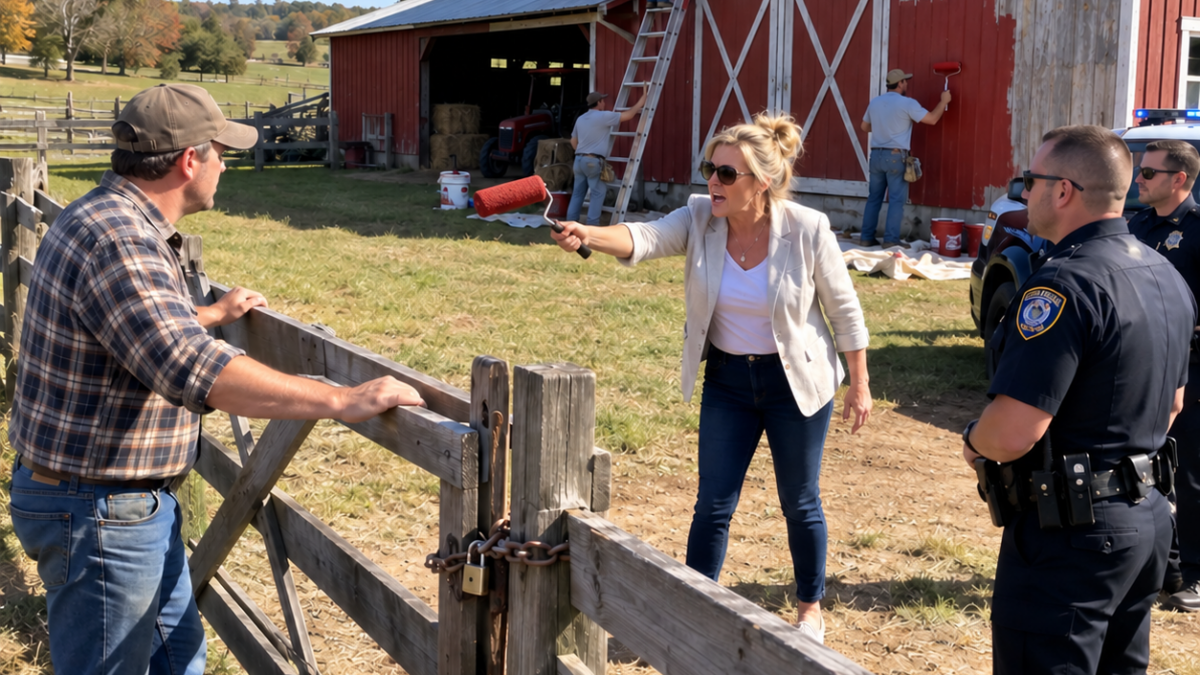
PART2
Melissa stepped between us verbally before the man could say more.
“This is routine compliance work.”
I nodded once.
Then I walked past her.
Toward the side gate of the fenced service yard.
Melissa followed.
“What are you doing?”
I closed the gate.
Ran the chain through the latch.
And locked it.
The painters stopped.
Melissa stared at me.
“What do you think you’re doing?”
“Making sure nobody disappears before this gets documented.”
“You cannot lock contractors in.”
“I can close my property gate while I call the police and establish who entered my land and damaged my building.”
Her face hardened.
“You’re being ridiculous.”
“No.”
I held up my phone.
“I’m being careful.”
Then I called the local non-emergency number.
Not 911.
There was no active violence.
Nobody was hurt.
I didn’t need sirens.
I needed a report.
The dispatcher answered.
I gave my name and address.
“I have contractors on my property performing unauthorized alterations to a private structure. I’m not asking for anybody to be arrested. I need an officer to document who authorized entry and what work is being performed.”
The dispatcher asked whether anyone was threatening anyone.
“No.”
“Any weapons involved?”
“No.”
“Is the situation stable?”
“Yes.”
“We’ll send someone when a unit is available.”
“Thank you.”
I ended the call.
Melissa laughed once.
“You called the police over paint.”
“No.”
I looked at the barn.
“I called the police because people entered my property without permission and started altering a structure they don’t own.”
“You were notified.”
“No.”
“You’ve received multiple compliance notices.”
“That is not permission to physically modify my property.”
“The board has enforcement rights.”
“Then you’ll have no problem showing the officer exactly where those rights are written.”
Her mouth tightened.
For the first time since I arrived, she looked less confident.
That barn was not decorative to me.
It wasn’t just an outbuilding.
Twenty-two years earlier, my father and I built it together.
I was thirty-two.
He was fifty-nine.
He had owned more tools than any human being realistically needed, including an old aluminum level he’d had since the 1970s.
We set the corner posts by hand.
Dug trenches.
Mixed concrete in a rented drum mixer.
Measured everything twice.
Then Dad measured it a third time because he didn’t trust me.
I complained constantly.
He ignored me constantly.
We cut the cross-bracing ourselves.
Installed every beam.
Hung the doors.
Built the loft.
Treated the cedar correctly because Dad believed shortcuts were debts that came due later.
“Do it wrong today,” he used to say, “and tomorrow charges interest.”
So we sealed the cedar.
Oil first.
Then stain.
Deep red.
Not bright red.
Not decorative barn red.
A dark natural color that deepened with age.
It took us almost an entire summer.
Less than two years later, Dad was diagnosed with cancer.
That barn was the last large thing we built together.
After he died, I could still walk inside and find his pencil marks.
Measurements on a beam.
A little arrow where he corrected one of my cuts.
His initials hidden behind the workbench because he had joked that every builder deserved to sign his mistakes.
So when I pulled into my driveway and saw beige latex swallowing that wood, I didn’t see a color dispute.
I saw somebody painting over a piece of my father because they thought “curb appeal” gave them permission.
Our HOA technically governed the subdivision.
That part was true.
I wasn’t one of those people claiming HOAs were automatically illegitimate.
When my wife and I bought the property, we knew the association existed.
We paid dues.
Shared private road maintenance.
Snow removal.
Drainage work.
Common-area insurance.
Nothing unusual.
But our lot sat at the edge of the development.
The original developer had classified it as mixed-use residential-agricultural.
That classification mattered.
It was why I bought the place.
The residential house participated in normal association obligations.
But certain agricultural structures and land uses had specific exemptions.
My barn was one of them.
I knew because I had read the documents before closing.
All of them.
My wife thought I was insane.
We sat at the kitchen table the first week after receiving the disclosure package.
She looked at the stack.
“You are not actually reading every page.”
“Yes.”
“There are two hundred pages.”
“Then I have two hundred pages to read.”
“Why?”
“Because somebody will eventually tell me one of them says something it doesn’t.”
She rolled her eyes.
Turns out I underestimated how correct that prediction would become.
Melissa Grant had been elected HOA president eight months before the painting incident.
Her campaign had been built around “modernizing” the neighborhood.
Cleaner lines.
Updated landscaping.
Consistent exterior colors.
Better signage.
Higher property values.
Especially higher property values.
She said that phrase constantly.
At meetings.
In newsletters.
In emails.
“We must protect property values.”
“We must preserve property values.”
“Our duty is to strengthen property values.”
She spoke about property values like they were a religious doctrine.
Some of her ideas were reasonable.
Replacing rotting entrance fencing.
Updating old playground equipment.
Fixing drainage near the clubhouse.
No problem.
Then she started treating every visible difference as a defect.
Bright front doors.
Older mailboxes.
Utility trailers.
Work trucks.
Sheds.
Vegetable beds.
And eventually my barn.
The first notice arrived one month after she took office.
VISUAL NONCONFORMITY ADVISORY.
That was the actual title.
It stated:
The detached agricultural structure located on Lot 47 presents a visual inconsistency with updated community exterior standards.
I read it twice.
Then opened the bylaws.
Article 7.
Subsection C.
Detached agricultural structures on mixed-use lots were exempt from aesthetic conformity standards unless declared structurally unsafe or substantially modified after adoption of later architectural rules.
My barn was neither.
I wrote back politely.
Not sarcastically.
Not aggressively.
I quoted Article 7.
Attached the original developer classification map.
Attached the county property record.
Attached a photograph showing the barn’s existing condition.
I ended with:
Please confirm the association has corrected its records and withdrawn this notice.
Melissa never acknowledged the attachments.
Instead, ten days later, I received another email.
Subject:
COMMUNITY COHESION REMINDER.
She wrote:
While certain historic classifications may exist, all owners share an obligation to support the visual integrity of the community.
That sentence told me almost everything I needed to know about how she governed.
I replied:
Please identify the governing provision superseding Article 7, Subsection C.
No answer.
Another notice came.
Then another.
The wording became more formal.
The legal authority remained nonexistent.
I responded every time.
Article.
Section.
Date.
Attachment.
Map.
She responded with phrases.
Community character.
Modern standards.
Neighborhood expectations.
Curb appeal.
I govern by documents.
Melissa governed by implication.
For months, the conflict remained paper.
Annoying.
But manageable.
I never expected her to cross from letters into physical action.
Yet there she stood beside my barn while strangers painted it beige.
After calling police, I pulled up my email archive.
No thirty-day corrective notice.
No scheduled hearing.
No architectural appeal decision.
No formal violation finding from any documented meeting.
No disclosed board vote approving physical remediation.
If a vote had happened, the minutes had not been published.
Melissa watched me scroll.
“What are you looking for?”
“The authorization you say exists.”
“You have received numerous notices.”
“Not the same thing.”
“We warned you.”
“Not the same thing.”
“You ignored us.”
“I responded every time.”
“You refused compliance.”
“Because your rule doesn’t apply.”
She folded her arms.
“The board disagrees.”
“Excellent. Show me the vote.”
“We don’t carry meeting records around in our pockets.”
“Then I’m sure the officer can note that.”
One of the painters approached the gate.
“Sir?”
“Yes?”
“Can we at least stop working?”
“Absolutely.”
Melissa immediately said:
“Keep going.”
The painter looked between us.
I said:
“You should probably call your supervisor before putting another gallon on that wall.”
Melissa snapped:
“The HOA hired you.”
The man took out his phone anyway.
Smartest person there.
I also started recording audio on my phone.
Our state allowed one-party consent.
I didn’t announce it.
I put the phone in my shirt pocket.
Melissa stepped closer.
“If you interfere with authorized enforcement, the board can assess additional fines.”
“I’m aware of what the board can assess when it acts inside its authority.”
“Daily fines.”
“Okay.”
“And if they remain unpaid, the association can pursue a lien.”
“Okay.”
Her voice sharpened.
“You don’t seem to understand how serious this can become.”
I looked straight at her.
“You may have just committed trespass and caused property damage.”
That changed her expression.
Not fear yet.
Irritation.
Like the idea that her decision could create consequences for her personally was offensive.
She took out her phone.
“Fine.”
“Who are you calling?”
“The association attorney.”
“Good.”
She put him on speaker.
His name was Martin Vale.
I had seen him at two annual meetings.
Calm.
Polished.
The kind of attorney who could make the phrase “you are completely wrong” sound like a weather forecast.
“Martin,” Melissa said, “I’m at Lot 47. The owner is interfering with corrective work and has now locked the contractor crew inside the service enclosure.”
Martin paused.
“Corrective work involving what?”
“The noncompliant agricultural building.”
My eyebrows lifted.
Apparently, nobody had told him.
Melissa continued:
“We are enforcing the updated community exterior standards.”
Martin switched into professional mode.
“Under the governing documents, the association generally retains authority to enforce architectural uniformity after notice of violation.”
I waited.
He talked about board authority.
Covenants.
Enforcement.
Remedies.
Then he stopped.
I asked:
“Martin?”
“Yes?”
“Does the HOA’s insurance policy cover unauthorized structural alteration on a parcel excluded from architectural control?”
Silence.
“What exclusion?”
“Article 7, Subsection C.”
Melissa immediately said:
“That doesn’t apply.”
I ignored her.
“Detached agricultural structures on mixed-use lots. Original development classification. My barn is listed inside that exemption.”
Another pause.
Martin said:
“Do you have the recorded classification?”
“Yes.”
“And the barn predates current architectural amendments?”
“Yes.”
Melissa snapped:
“This has already been reviewed.”
Martin asked:
“By whom?”
She hesitated.
“The board.”
“When?”
“We’ve discussed it for months.”
“That isn’t what I asked.”
Her own lawyer had just used my favorite phrase.
I almost smiled.
Then I added:
“The crew is applying exterior latex directly over treated cedar without the compatible seal system. A restoration contractor may need to strip it. So this is no longer just color.”
Martin’s tone changed completely.
“Melissa, tell the crew to stop work.”
Her face hardened.
“They’re almost finished with this wall.”
“Stop the work.”
She stared at the phone.
“Martin—”
“Stop the work until I review the parcel documents.”
That was the moment authority became liability.
She didn’t like it.
Not at all.
“Keep going,” she told the crew.
The lead painter looked at her.
“Ma’am, our supervisor told us to pause.”
Apparently he had made his own call.
Good.
Melissa looked at me.
“You’re obstructing association business.”
“I’m waiting for the responding officer.”
“You cannot detain people.”
“I’m maintaining the scene until the unauthorized work is documented. Nobody is being threatened.”
“I could call 911.”
“You’re welcome to tell them exactly where you are.”
She didn’t.
About twenty minutes later, a patrol car arrived.
One officer.
No lights.
No drama.
Officer Grant Sullivan stepped out.
Middle-aged.
Calm.
He looked at the locked gate.
Then the paint.
Then the painters.
Then me.
Then Melissa.
“Who called?”
“I did.”
I raised my hand.
Melissa spoke at the same time.
“This man is preventing an HOA enforcement crew from leaving.”
Grant looked toward the painters.
“Anyone injured?”
“No,” the lead painter said.
“Anyone threatened?”
“No.”
“Anyone ask to leave?”
The painter looked at me.
“We were waiting for our supervisor once the dispute started.”
Grant nodded.
Then looked at me.
“Sir, open the gate for me.”
I did immediately.
That mattered.
I wasn’t trying to imprison anyone.
I wanted a stable, documentable scene.
Once a real officer asked for access, the gate opened.
Grant spoke with the contractors separately.
Their work order said:
EXTERIOR COMPLIANCE REFINISHING — LOT 47 AGRICULTURAL STRUCTURE.
Authorized by:
Cedar Grove Homeowners Association.
Contact:
Melissa Grant, Board President.
The crew had been told the HOA possessed exterior maintenance authority.
They had not been told the owner objected.
They had not been shown my emails.
They had not been told the barn sat within an agricultural carve-out.
The lead painter looked embarrassed.
“If we’d known there was an ownership dispute, we wouldn’t have started.”
“I believe you.”
Melissa said:
“There isn’t an ownership dispute.”
I looked at her.
“Correct. I own it.”
Grant suppressed something that might have been a smile.
He took photographs.
Documented the wall.
Got names.
Recorded the work order number.
Asked when the crew entered.
Asked whether a gate had been open.
It had.
I had left it open that morning because a feed delivery was expected.
That was how they got inside.
Melissa argued that the open gate constituted access.
Grant answered:
“An open gate isn’t blanket permission to alter a structure.”
She stopped talking for a moment.
The painter supervisor arrived.
Looked at the barn.
Looked at the crew.
Asked one question:
“Do we have written owner consent?”
Melissa said:
“The HOA is the enforcing authority.”
He looked at her.
“That isn’t what I asked.”
Another person learning quickly.
He ordered his crew to pack up.
Grant gave me an incident number.
“No arrest is being made based on what I see here.”
“I didn’t ask for one.”
“I understand.”
He looked at Melissa.
“This is likely primarily a civil property matter unless additional facts change it. But the report will document unauthorized alteration allegations and the contractor’s work order.”
“That’s all I wanted.”
Melissa muttered:
“Unbelievable.”
I looked at the beige wall.
“Yes.”
Unbelievable was one word for it.
That night, I couldn’t sleep.
Not because of Melissa.
Because I kept thinking about Dad.
I walked into the barn after dinner.
The smell had changed.
Fresh latex overwhelmed cedar, hay, oil, dust.
That bothered me more than I expected.
I ran my hand across an unpainted interior beam.
One Dad and I had squared together.
His old pencil mark was still there.
I remembered that summer.
Heat.
Mosquitoes.
Arguments over measurements.
Dad telling me I was holding the level wrong.
Me telling him a level only had one job and couldn’t possibly care who held it.
He laughed so hard he dropped a box of screws.
That memory lived in the wood.
Melissa called the barn visually inconsistent.
To me it was one of the last places where my father’s hands still felt close.
I went back to the house.
Opened my filing cabinet.
And started reading.
County property filings.
Developer annexation maps.
Original subdivision plats.
Amendments.
Declarations.
Enforcement procedures.
I didn’t read looking for revenge.
I read because I wanted to know exactly where I stood.
The barn footprint was easy.
The original plat map contained a shaded improvement-control overlay.
My house and immediate residential yard were inside it.
The agricultural section extended beyond it.
The barn stood just outside the architectural improvement boundary.
Our lot was part of the association for common road maintenance and dues.
But the agricultural carve-out remained.
Not vague.
Not implied.
Mapped.
Then I checked the amendment history.
Six years after the barn was built, the HOA expanded architectural review authority.
Melissa loved citing that amendment.
But it contained grandfathering language.
Existing structures lawfully built before adoption remained exempt unless materially altered.
My barn predated it.
By years.
I had not materially altered it.
Melissa had.
That irony almost made me laugh.
Then I found something more important.
Enforcement procedures.
Even when a violation was confirmed, the association could not physically modify an owner’s structure without either:
Written owner consent.
Or judicial authorization.
They had neither.
No clause allowing a board president to hire painters and walk onto private property because she disliked stain color.
Then came the liability section.
State nonprofit law.
Board members usually had significant protection when acting in good faith inside their duties.
That made sense.
Volunteer board members shouldn’t risk personal bankruptcy every time somebody argues about a mailbox.
But actions knowingly or recklessly outside governing authority could jeopardize indemnification.
Personal exposure wasn’t automatic.
It wasn’t even common.
But it was possible.
That changed the equation.
Melissa had been thinking only in terms of what the HOA could do to me.
Fines.
Hearings.
Liens.
Compliance.
She had apparently never considered what happened when a board member acted outside the HOA’s authority and caused actual property damage.
I scanned everything.
Article 7.
Plat map.
Amendment chronology.
Consent requirement.
State nonprofit provisions.
Police incident report information.
Then I emailed the package.
To Martin Vale, the HOA attorney.
To the association’s management company.
And to the HOA’s insurance carrier.
Professional subject line:
NOTICE OF UNAUTHORIZED PROPERTY ALTERATION — LOT 47.
No insults.
No capital letters.
No threats.
Just:
Here are the documents.
Here is what happened.
Here is the potential loss.
Please preserve all relevant communications.
I did not copy Melissa separately.
Not yet.
The next morning, I paid for one hour with an independent property attorney named David Chen.
I put everything on his desk.
He spent forty minutes reading.
Then asked:
“Did you ever consent to repainting?”
“No.”
“Did they get a court order?”
“No.”
“Did the HOA formally classify the barn as unsafe?”
“No.”
“Any recorded amendment removing the agricultural exemption?”
“No.”
He leaned back.
“Your position is strong.”
“That’s it?”
“What were you hoping for?”
“Maybe dramatic music.”
He smiled.
“Keep it procedural.”
Best legal advice I received.
Not:
Destroy them.
Not:
Sue everybody.
Not:
Go public.
Keep it procedural.
We drafted a certified demand.
Immediate cessation of all unauthorized work.
Professional restoration at association expense.
Preservation of board emails, texts, work orders, meeting records, and communications with contractors.
Formal notice that work had been initiated without owner consent or judicial authorization.
Notice that individuals acting outside governing authority could face issues with indemnification.
And a request for an emergency board meeting within seventy-two hours.
No threat saying:
PAY ME OR ELSE.
I wasn’t interested in money.
I wanted my barn restored.
I also hired a restoration contractor.
Not to perform work yet.
To document damage.
He came that afternoon.
Looked closely at the painted cedar.
Scraped a tiny test area.
Measured moisture.
Photographed everything.
His written assessment said the latex coating was incompatible with the existing cedar treatment system and would likely develop adhesion problems.
Professional removal would be required.
Mechanical stripping had to be done carefully to avoid damaging the cedar grain.
Then oil-based treatment restored.
Then stain matched.
Estimated cost:
A lot more than whatever the HOA paid to paint it beige.
Shortcuts charge interest.
Dad was right again.
Everything was dated.
Photographed.
Saved.
The certified letter went out.
Email too.
Within four hours, the management company acknowledged receipt.
By evening, Martin Vale responded:
The association is reviewing the matter and has instructed all contractors to suspend activity.
Twenty minutes later, Melissa emailed me directly.
YOU ARE MISCHARACTERIZING A ROUTINE ENFORCEMENT ACTION AND CREATING UNNECESSARY LEGAL EXPOSURE FOR THE COMMUNITY.
I read it.
Didn’t respond.
Ten minutes later:
YOUR REFUSAL TO WORK COOPERATIVELY HAS ESCALATED A SIMPLE APPEARANCE ISSUE.
Still didn’t respond.
Then:
I HOPE YOU UNDERSTAND YOUR ACTIONS MAY COST YOUR NEIGHBORS MONEY.
That one almost got me.
Because it was designed to.
The implication:
If the HOA had to pay restoration costs, it was my fault.
Not the person who ordered the unauthorized painting.
I forwarded the email to David.
He replied with one sentence.
Do not engage.
So I didn’t.
The emergency board meeting was scheduled for Thursday evening.
Word traveled fast.
Usually, HOA meetings attracted twelve people.
Maybe fifteen if somebody was angry about landscaping.
That Thursday the clubhouse parking lot was full.
More than sixty homeowners showed up.
Apparently, “HOA president sends painters onto private barn without permission” had more entertainment value than the annual budget.
My wife came.
She rarely attended HOA meetings.
“You want moral support?”
“Yes.”
“You want me to stop you from saying something sarcastic?”
“Also yes.”
We sat near the front.
Melissa sat at the board table.
Martin Vale beside her.
Four other board members.
The management representative.
The association’s insurance representative attended by video.
That alone told everyone this wasn’t a routine color dispute anymore.
Melissa opened.
Her voice was calm.
Measured.
Professional.
She described months of failed efforts to bring my structure into compliance.
She said the board had a duty to protect community aesthetics.
She said enforcement action occurred only after repeated noncooperation.
She never said:
We entered his land and painted his barn without written permission.
Interesting omission.
She continued:
“This matter has unfortunately been escalated by an owner who refuses reasonable community standards.”
Several people looked toward me.
I waited.
When she finished, the board secretary asked if I wanted to speak.
“Yes.”
I walked to the front.
No speech.
No emotional introduction.
I connected my laptop to the projector.
First slide:
ORIGINAL SUBDIVISION PLAT.
I highlighted my lot.
Then the improvement-control boundary.
Then the barn.
Outside it.
Next slide.
ARTICLE 7, SUBSECTION C.
Detached agricultural structures on mixed-use parcels exempt from aesthetic conformity unless unsafe or materially altered under applicable later provisions.
Next.
ORIGINAL BUILD DATE.
Twenty-two years earlier.
Next.
ARCHITECTURAL AMENDMENT DATE.
Sixteen years later.
Next.
GRANDFATHERING LANGUAGE.
A homeowner near the back whispered:
“Oh.”
I continued.
Next slide.
ENFORCEMENT PROCEDURE.
Physical alteration requires owner consent or court order.
I looked at the board.
“I gave no consent.”
Next line.
“I received no court order.”
Then I submitted the police incident report number.
Contractor work order.
Photographs.
Restoration assessment.
Email history showing that I had responded to every prior notice with citations.
I didn’t call Melissa a liar.
I didn’t accuse her of criminal conduct.
I didn’t speculate.
Then came the final slide.
State nonprofit law regarding board conduct outside authorized scope and indemnification risk.
I did not read the entire statute.
Just the relevant excerpt.
The room felt different afterward.
Not loud.
Different.
People had arrived expecting an argument over barn color.
Now they were looking at maps.
Dates.
Authority.
Insurance exposure.
I closed the laptop.
Then asked one question.
“Under what authority did the board authorize entry onto my property and physical alteration of my barn without my consent?”
Melissa immediately turned toward Martin.
Martin adjusted his glasses.
Cleared his throat.
Then answered very carefully.
“The applicability of the improvement-control boundary to the structure may require additional review.”
That sentence destroyed Melissa’s position more effectively than anything I could have said.
A homeowner asked:
“Does that mean you’re not sure the HOA controlled the barn?”
Martin replied:
“I’m saying the matter is not as straightforward as previously understood.”
Another homeowner:
“Did we have a court order?”
“No.”
“Owner consent?”
“No.”
“Then why did painters go there?”
Nobody answered immediately.
Melissa finally said:
“Because the board had an obligation to act after prolonged noncompliance.”
One board member named Robert Keller looked at her.
“Did the board vote to hire painters?”
Silence.
I looked at him.
Melissa said:
“We discussed corrective action.”
“That’s not what I asked.”
Again.
That phrase kept returning.
Robert looked toward the secretary.
“Is there a recorded motion?”
She opened her binder.
Scrolled through digital minutes.
“No formal motion specifically authorizing repainting.”
The room shifted again.
Martin closed his eyes briefly.
Probably imagining his weekend disappearing.
Another director asked Melissa:
“Who signed the contractor work order?”
She didn’t answer quickly enough.
The management representative did.
“President Grant approved it directly.”
Someone in the audience whispered:
“Without a vote?”
Melissa turned toward the room.
“The president has authority to implement approved compliance policy.”
Martin interrupted.
“Melissa.”
She stopped.
His tone said enough.
Robert Keller made a motion.
“Immediate suspension of all enforcement actions regarding Lot 47 until legal review is completed.”
Seconded.
Then:
“Association-funded professional restoration of any alteration determined unauthorized.”
Seconded.
Then:
“Independent review of procedures used to approve contractor access.”
The votes passed.
Not unanimously.
But clearly.
No screaming.
No applause.
No dramatic movie moment.
Just motions.
Votes.
Minutes.
A record.
Authority met documentation.
Documentation won.
After the meeting, several homeowners approached.
One man said:
“I thought this was about you refusing to paint.”
“So did half the neighborhood.”
“Melissa told us the barn violated the covenants.”
“She told me too.”
A woman asked:
“Did you really lock the painters inside?”
“I locked my service gate and called police. Opened it the moment the officer asked.”
She smiled.
“That version sounds less exciting.”
“Reality usually does.”
My wife appeared beside me.
“She did lock his crew inside sounds better.”
“Please don’t help.”
She laughed.
Melissa left through a side door without speaking to me.
For the next week, the association attorney reviewed everything.
The conclusion came in writing.
The barn was exempt.
The agricultural classification remained valid.
The structure predated the later architectural rules.
No consent had been obtained.
No court order existed.
The physical modification was unauthorized.
The HOA accepted responsibility for restoration.
That letter mattered.
I printed two copies.
One for my records.
One for the barn file I suddenly realized I needed.
The restoration company arrived the following Monday.
Unlike the painters Melissa hired, they knew cedar.
They tested several removal methods.
Heat.
Chemical stripping.
Light mechanical sanding.
The goal was to remove latex without destroying the aged surface beneath it.
Work took almost two weeks.
Slow.
Careful.
Expensive.
Every day I watched pieces of beige disappear.
At first the cedar underneath looked wounded.
Pale areas.
Uneven surface.
Then treatment began.
Oil seal.
Proper cure time.
New stain matched to the original deep red-brown.
Not perfect.
Nothing restored after damage is exactly what it was before.
But close.
Close enough that one evening, when the scaffolding came down, I stood across the yard and felt my shoulders relax for the first time in weeks.
My wife came beside me.
“Looks like your dad’s barn again.”
“Yeah.”
“You okay?”
“Yeah.”
I wasn’t completely.
But I was getting there.
During restoration, another issue unfolded inside the HOA.
The insurance carrier had questions.
A lot of them.
Who authorized the work?
Was board approval documented?
Did counsel approve?
Why was the agricultural exemption ignored?
Why did enforcement move from notices to physical alteration without a hearing?
Why was the contractor told the HOA had exterior authority?
Those questions weren’t mine to answer.
Melissa suddenly had to explain herself to the same organization whose protection she had assumed would cover everything.
Two board members requested an independent governance review.
Three homeowners asked for copies of their own previous violation files.
Someone discovered an elderly couple had paid hundreds in fines over a shed that might also have been grandfathered.
Another owner questioned a fence violation issued under a rule adopted after his fence was built.
One mistake had caused people to start reading.
That may have worried Melissa more than my attorney ever could.
Once people stop assuming authority and begin checking it, bureaucracies become much more careful.
Melissa missed the next regular board meeting.
The official explanation was “personal scheduling.”
She attended the one after that.
Quiet.
No long speeches about property values.
No lecture about community cohesion.
Two months after the barn incident, homeowners received a short email.
Melissa Grant was resigning as HOA president for personal reasons.
No detailed explanation.
No apology to the neighborhood.
No final defense.
Just a resignation.
My attorney called.
“You know, depending on what the records show, we could still evaluate a personal claim.”
“For damages?”
“Yes.”
“Against her?”
“Potentially.”
I looked through the kitchen window at the barn.
Freshly restored.
Dark red again.
“What would I get?”
“Depends. Actual losses have mostly been covered by the association. There might be other claims depending on evidence.”
“I don’t want money.”
“You sure?”
“Yes.”
“What do you want?”
“Boundaries.”
He was quiet.
Then:
“That’s a reasonable answer.”
I didn’t sue.
Some people thought I should have.
A neighbor told me:
“You could teach her a lesson.”
I thought she had already received one.
She lost the presidency.
Her decisions were reviewed.
Her authority disappeared.
The HOA paid significantly more restoring the barn than she would have spent leaving it alone.
Every homeowner now knew exactly what happened.
I didn’t need her bank account too.
There is a difference between accountability and revenge.
I wanted the first.
Not the second.
The next board meeting was completely different.
New president.
Temporary, at first.
Robert Keller.
His first announcement:
“All enforcement notices involving exterior structures will include the exact covenant or rule cited.”
Good.
Second:
“Physical entry onto owner property for corrective work requires documented consent or counsel-confirmed legal authority.”
Better.
Third:
“Grandfathered structures will receive formal status review before enforcement.”
Excellent.
Then he said something I never expected to hear at an HOA meeting.
“If we cannot explain our authority clearly, we should not exercise it.”
I almost applauded.
Didn’t.
My wife did.
Afterward, homeowners stayed.
Not to complain about me.
To read documents.
One asked for the amendment history.
Another asked how exemptions worked.
A third wanted copies of meeting minutes.
For years, most of us had paid dues and assumed somebody else understood the paperwork.
Melissa unintentionally cured that.
People started reading.
That might have been her most productive achievement as president.
Months passed.
The barn returned to normal life.
Hay.
Tools.
Equipment.
Dust.
Nothing visually glamorous.
Exactly as intended.
One evening, I walked inside alone.
Sunlight came through the western opening.
It hit the cedar beams.
The smell was right again.
Wood.
Oil.
Hay.
Not latex.
I ran my hand along one of the main posts.
Dad and I had set that post on a July morning twenty-two years earlier.
I remembered him standing in the trench.
Sweating.
Shirt covered in concrete dust.
He looked up at me and said:
“If this thing leans in ten years, I’m blaming you.”
I said:
“If it leans in ten years, I’m telling everyone you designed it.”
He laughed.
The barn never leaned.
Dad didn’t get ten years.
Cancer took him sooner.
That memory was why I had been so angry.
Not because beige was ugly.
It was.
But that wasn’t the point.
People sometimes see property disputes as money fights.
Sometimes they are.
Sometimes a barn is just a barn.
Sometimes it’s the last thing you built with your father.
The HOA never knew that before ordering the paint.
Would knowing have stopped Melissa?
I don’t know.
It shouldn’t have mattered legally.
That is important.
I should not have needed a sentimental story to make my property rights worthy of respect.
If the barn had been ugly.
If my father hated it.
If I planned to demolish it next year.
The HOA still had no right to repaint it without authority.
Property rights cannot depend on whether your reason sounds emotional enough to strangers.
That became something I explained later when people said:
“But I understand why you fought so hard. It was your dad’s barn.”
Yes.
But I also would have fought if it were an ordinary tool shed.
Maybe with less anger.
Same documents.
Same boundary.
One Saturday, the lead painter from the original crew returned.
His name was Eric.
He parked outside the gate.
Called first.
That detail made me smile.
I went out.
“Everything okay?”
“Yeah. I was nearby on another job.”
He looked toward the barn.
“Restoration looks good.”
“It does.”
He rubbed the back of his neck.
“I wanted to apologize.”
“You didn’t know.”
“We should’ve asked.”
“You had a work order from an HOA.”
“Still.”
He shrugged.
“My boss changed company policy after your job.”
“How?”
“Any association work on individually owned property now requires proof of owner consent or legal authorization.”
I laughed.
“So my barn improved your paperwork.”
“Apparently.”
“Then something good came out of it.”
He looked relieved.
Before leaving, he said:
“When that lady told us to keep painting after the HOA attorney said stop, that’s when I knew we had a problem.”
“Same.”
We shook hands.
I never blamed the painters.
They were workers sent to a job.
They had been told the association had authority.
Once they understood the dispute, they stopped.
That difference matters.
People make mistakes.
What they do after discovering the mistake tells you much more.
Melissa discovered the problem and doubled down.
Eric discovered the problem and called his supervisor.
One response creates resolution.
The other creates lawsuits.
I also learned something uncomfortable about myself.
Locking that gate had felt satisfying for about thirty seconds.
Too satisfying.
That made me think.
Anger likes dramatic gestures.
Shut the gate.
Make them stay.
Force them to confront what they did.
But once Officer Sullivan arrived and asked me to open it, I did.
Immediately.
Because the point wasn’t to punish workers.
It was to create a record.
If I had turned the situation into a physical confrontation, I could have weakened my own position.
Maybe badly.
My strongest tools that day were not the lock.
They were:
The phone call.
The camera.
The contractor work order.
The plat map.
The bylaws.
The police report.
The restoration assessment.
Documentation.
Boring things.
Boring things win a surprising number of fights.
A year after Melissa resigned, the neighborhood looked almost the same.
That amused me.
Property values did not collapse because my barn remained dark red.
Nobody abandoned a house because a horse trailer was visible.
Children continued playing.
Grass continued growing.
Homes sold.
The sky did not fall.
At one annual meeting, the treasurer actually presented sales data showing neighborhood prices had increased.
My wife whispered:
“Maybe your barn caused it.”
“Historic character.”
“Premium rustic aesthetic.”
“Mixed-use authenticity.”
She almost laughed loudly enough to get us thrown out.
Even Robert, now elected permanently, became more relaxed.
One day he stopped by while I was replacing a gate hinge.
“Can I ask you something unofficial?”
“Depends.”
“If the HOA wanted to repaint the entrance monument—”
“No.”
He laughed.
“Not your barn. Our monument.”
“Oh.”
“What color?”
“Beige.”
I stared at him.
He started laughing before I could answer.
“Absolutely not.”
“Good.”
The story had become a joke.
That meant it was over.
But every once in a while, a new resident heard about it.
Usually distorted.
“I heard you trapped an HOA painting crew for six hours.”
“No.”
“I heard the president got arrested.”
“No.”
“I heard you sued the HOA for a million dollars.”
“Definitely no.”
“What actually happened?”
I would point toward the barn.
“She sent painters onto my property without permission.”
“And?”
“I called police to document it.”
“You locked them in.”
“I locked my service gate until the scene could be documented.”
“That sounds like locking them in.”
“Temporarily.”
“Did she go crazy?”
“She called the attorney.”
“Did you sue?”
“No.”
“Why not?”
That question came constantly.
People love lawsuits when the dispute isn’t theirs.
I always answered the same way.
“I wanted the barn fixed.”
That was the objective.
Once it was restored and the authority question was settled, the rest would have been about anger.
I had enough anger already.
Dad used to say:
“If you keep carrying a tool after the job is done, eventually you’ll use it on something that doesn’t need fixing.”
He meant actual tools.
But it applied.
The legal threat was a tool.
Necessary until the boundary was restored.
After that?
Put it away.
Two years after the incident, I found the old beige-painted test sample the restoration crew had removed.
A narrow cedar strip.
Half beige.
Half original stain.
I had forgotten they left it in the workshop.
I almost threw it away.
Then I kept it.
Not as a trophy.
As a reminder.
I mounted it inside a cabinet.
On the back I wrote:
READ THE DOCUMENTS.
My wife saw it.
“You’ve become your father.”
“He would approve.”
“He would say your handwriting is terrible.”
“That too.”
She was right.
The HOA eventually revised its compliance handbook.
One entire section dealt with:
Scope of authority.
Property access.
Historic exemptions.
Owner consent.
Grandfathering.
Board authorization.
Legal review.
It was probably the driest document ever produced in our county.
I loved it.
Good governance is boring.
You want boring.
Boring means nobody wakes up to strangers repainting the structure their father built.
Boring means forms.
Notice.
Hearings.
Votes.
Permission.
Appeals.
Paper trails.
People mock procedure until somebody decides procedure doesn’t apply to them.
Then suddenly everybody discovers why it exists.
Melissa thought procedure was an obstacle.
Something slowing down the “modernization” she wanted.
To me, procedure was the line between a board sending a notice and a board sending strangers onto private property.
That line matters.
Years later, I still think about the moment she said:
“The board authorized this.”
She said it with complete certainty.
That certainty was what made her dangerous.
She wasn’t sneaking.
She wasn’t embarrassed.
She genuinely believed her title converted preference into authority.
HOA president.
Board vote.
Community standards.
Curb appeal.
Property values.
Each phrase added another layer of confidence.
But confidence is not jurisdiction.
That rule applies far beyond HOAs.
Government.
Businesses.
Schools.
Workplaces.
Clubs.
Families.
People often treat certainty as proof.
It isn’t.
The louder someone says:
“We have the authority,”
the more reasonable it is to ask:
“Show me.”
Not insult them.
Not threaten them.
Show me.
What section?
What map?
What vote?
What notice?
What order?
What consent?
If the authority is real, documentation should eventually appear.
If it doesn’t, the title at the top of the letter doesn’t save it.
Melissa had a title.
I had Article 7.
She had community standards.
I had a plat map.
She had “curb appeal.”
I had an exemption.
She had a contractor.
I had the consent requirement.
She threatened fines.
I had the enforcement procedure.
She implied a lien.
I had the state statute.
She had volume.
I had paper.
Paper won.
There was one final conversation with Melissa.
Almost three years after the incident.
I saw her at a grocery store.
I was in the hardware aisle because apparently the grocery store had decided people needed nails beside cereal.
She recognized me.
We both hesitated.
Then she said:
“How’s the barn?”
“Still standing.”
She smiled slightly.
“I figured.”
I could have walked away.
Instead, I asked:
“How are you?”
“Good.”
She looked older.
Not dramatically.
Just less intense.
We stood awkwardly beside a shelf of lightbulbs.
Then she said:
“I handled that badly.”
No qualifiers.
No:
But you were difficult.
No:
The board believed.
No:
My intentions were good.
Just:
I handled that badly.
I nodded.
“Yes.”
She laughed once.
“I suppose I deserved that.”
“I wasn’t trying to be mean.”
“I know.”
Another silence.
Then:
“I thought if I could get the neighborhood updated quickly, people would see I was effective.”
“That sounds exhausting.”
“It was.”
She looked at me.
“I started seeing every disagreement as somebody trying to stop me.”
That sentence explained more than any board meeting ever had.
“What changed?”
“Your barn.”
I raised an eyebrow.
She continued:
“Not the barn itself. The meeting. Watching the attorney read documents I should have read first.”
I said nothing.
“I really believed we had authority.”
“I know.”
“That might be worse.”
“Sometimes.”
She looked down.
“I should’ve apologized then.”
“Probably.”
“Well.”
She held out her hand.
“I’m sorry.”
I shook it.
“Thank you.”
That was all.
No friendship.
No dramatic reconciliation.
Just an apology three years late.
I appreciated it.
When I got home, I walked past the barn.
Same color.
Same beams.
Same faded marks.
I thought about Dad.
He would have loved the whole dispute for one reason.
Not because he enjoyed conflict.
Because he loved being right after telling me to read instructions.
Every piece of machinery came with a manual.
Dad read them.
Every building permit came with rules.
Dad read them.
Every deed had restrictions.
Dad read them.
When I was younger, I mocked him.
“You planning to take a test?”
He’d say:
“No. I’m planning not to be surprised.”
That was the real inheritance he left me.
Not the barn.
Not only the barn.
The habit.
Read before signing.
Measure before cutting.
Know the boundary.
Do the work correctly.
Don’t assume.
Shortcuts show up later.
Melissa took a shortcut.
She assumed authority.
Sent a crew.
Skipped notice.
Skipped formal approval.
Skipped consent.
Skipped the documents.
The result looked efficient for about half an afternoon.
Then the shortcut charged interest.
Police report.
Attorney review.
Insurance claim.
Restoration cost.
Board investigation.
Resignation.
Policy reform.
Weeks of work.
All to return the barn to exactly how it looked before she touched it.
Efficiency without authority is expensive.
That may have been the most practical lesson.
The most personal lesson was different.
I had spent the first days after the incident thinking:
How dare she touch Dad’s barn?
Later, I realized that thought contained a danger.
The barn belonged to me now.
Dad was gone.
I could preserve it.
Change it.
Repair it.
Someday maybe rebuild it.
Honoring him did not mean freezing everything exactly as it was.
What made Melissa’s action wrong wasn’t that she disturbed a shrine.
It was that she made the decision for me.
Ownership includes the right to choose change.
If one day I paint that barn blue, that’s my choice.
My wife says she would divorce me.
Probably exaggerating.
But still my choice.
If I tear it down because the structure becomes unsafe?
Painful.
Still my choice.
If I leave it red until I’m gone?
Also my choice.
That is what a boundary protects.
Not objects.
Decisions.
That afternoon when I locked the gate, I wasn’t really protecting paint.
I was protecting who had the right to decide what happened next.
Melissa thought the board did.
The documents said otherwise.
Simple.
Not emotionally simple.
Legally simple.
One evening, years later, my son helped me replace a section of siding on the south wall.
He was close to the age I had been when Dad and I built it.
I caught myself telling him:
“Measure again.”
“I already measured twice.”
“Again.”
He looked at me.
“Grandpa did this to you, didn’t he?”
“Yes.”
“So this is generational trauma.”
“This is carpentry.”
He laughed.
We fitted the board.
Perfect.
He asked:
“Is this the wall the HOA painted?”
“East wall.”
“Still can’t believe that happened.”
“Neither can I.”
“Why didn’t you sue?”
I gave him the same answer.
“I wanted boundaries.”
He nodded.
Then:
“If somebody did that to my barn, I’d sue.”
“You don’t have a barn.”
“When you die, I do.”
“Comforting.”
He smiled.
Dad would have liked him.
After we finished, I stood back.
Another repair.
New cedar beside old cedar.
The colors didn’t match perfectly.
Funny.
Twenty years earlier that would have become exactly the kind of “visual inconsistency” Melissa hated.
I left it.
Weather would darken it.
Time would blend it.
Buildings live.
They change.
That is different from somebody changing them without permission.
By then, the HOA knew the difference too.
The association and I eventually had a perfectly functional relationship.
I paid dues.
Used the roads.
Reported drainage problems.
Attended meetings occasionally.
Voted when something mattered.
Nobody treated the HOA as an enemy.
Nobody needed to.
An HOA can be useful.
Shared infrastructure needs management.
Rules can protect people from genuine nuisances.
The problem isn’t the existence of authority.
The problem is authority forgetting its edges.
Every map has edges.
Every contract has edges.
Every office has edges.
A president’s power ends somewhere.
So does a homeowner’s.
That is why I never bought into the idea that my story proved all HOAs were evil.
It proved something more ordinary.
Give any organization unclear habits and a confident leader, and eventually someone may assume more power than the documents actually give.
The cure is not rage.
It is participation.
Records.
Questions.
Homeowners who read.
Board members who challenge each other.
Attorneys who say stop when the answer is unclear.
Insurance carriers asking uncomfortable questions.
Procedure.
After Melissa resigned, meeting attendance doubled for almost a year.
Then slowly dropped.
People went back to normal life.
That’s natural.
But one change stayed.
Whenever the board proposed enforcement involving an older structure, somebody asked:
“Have we checked grandfathering?”
Whenever a contractor needed access:
“Do we have owner permission?”
Whenever a rule was cited:
“Which section?”
That was enough.
Institutional memory.
The barn had become a cautionary tale.
Robert once told me:
“We refer to it as the Barn Rule.”
“What is the Barn Rule?”
“Don’t touch things we don’t own.”
“That seems like a rule children learn at four.”
“Apparently adults needed a policy.”
Fair.
The story spread outside our subdivision too.
One contractor told another.
An attorney mentioned the general issue at a local association training seminar.
Someone even asked if I wanted to speak to an HOA board workshop.
I declined.
“Why?” my wife asked.
“Because I’d rather repair actual fences than explain metaphorical ones.”
She approved.
I’m not an activist.
I didn’t want a crusade.
I wanted a barn.
Quiet.
Red.
Unmolested.
Eventually, that is exactly what I got.
And the day the restoration company finished, I did something I hadn’t done since Dad died.
I opened his old toolbox.
Most of the tools were outdated.
Several duplicates.
A wood-handled hammer with the grip worn smooth.
The aluminum level.
The same one he had owned since the seventies.
I brought it into the barn.
Set it against one of the beams.
Still level.
Of course.
Dad would have loved that.
I left it hanging on a nail near the workbench.
Not useful compared with modern tools.
But neither was the faded sign at the gate.
Not everything has to be optimized.
That’s another thing people like Melissa sometimes forget.
Value is not always visual.
Or financial.
Curb appeal measures what strangers see from the road.
Life is mostly what happens after you turn into the driveway.
The barn didn’t need to impress anyone driving past.
It needed to hold equipment.
Protect hay.
Shelter animals.
And remind me of a summer I had with my father before either of us knew how limited our time would be.
No paint committee could price that.
No board vote could improve it.
No neutral palette could make it more valuable.
Then again, I didn’t need the HOA to understand any of that.
I only needed them to understand one sentence.
Not yours.
That’s the sentence at the heart of every property boundary.
Not yours to paint.
Not yours to enter.
Not yours to redesign.
Not yours to control.
Unless the documents say otherwise.
And when Melissa believed they did, all she had to do was show me.
She couldn’t.
That should have ended the issue at the first notice.
Instead, she sent another.
Then another.
Then a crew.
That escalation was her choice.
My response was mine.
I chose the police non-emergency line instead of confrontation.
I chose a property attorney instead of social media.
I chose the plat map instead of insults.
I chose restoration instead of revenge.
I chose not to sue after the objective was achieved.
People sometimes hear that ending and think it’s anticlimactic.
They want Melissa arrested.
They want huge punitive damages.
They want the HOA dissolved.
They want me to buy her house with settlement money.
Real life doesn’t need that to have a satisfying ending.
The barn was restored.
The rule was clarified.
The president resigned.
The HOA changed its procedures.
Homeowners learned to read what governed them.
I kept my property.
And no one ever touched that barn without asking again.
That is enough.
More than enough.
On the twenty-fifth anniversary of when Dad and I finished the barn, I stood outside with a beer.
My wife joined me.
“You celebrating a building now?”
“Apparently.”
She looked at the cedar.
“You know what your dad would say.”
“What?”
“Took you twenty-five years and an HOA fight to finally appreciate all the work he made you do.”
Probably.
She touched my shoulder.
“He’d like that you kept it.”
I looked at the old level hanging inside.
“He’d like that it’s still square.”
“That too.”
We stood there as the sun went down.
No ladders.
No beige paint.
No HOA president.
No lawyers.
Just the barn.
That was the ending I wanted.
Not victory over somebody.
Restoration.
There’s a difference.
I still have the first compliance notice in my records.
VISUALLY INCONSISTENT WITH UPDATED COMMUNITY STANDARDS.
Every once in a while I read it.
Not because I’m angry.
Because it makes me laugh now.
Visually inconsistent.
Absolutely.
The barn was old.
The subdivision was newer.
It was agricultural.
The houses were suburban.
It was dark cedar.
They wanted neutral paint.
That inconsistency was real.
But difference is not automatically violation.
That seems obvious.
It wasn’t obvious to Melissa.
She believed uniformity had value.
Sometimes it does.
But uniformity pursued beyond authority becomes control.
And control likes soft words.
Standards.
Cohesion.
Consistency.
Appearance.
Improvement.
Those words aren’t bad.
They become dangerous when they hide the question:
Who gets to decide?
I know who decides now.
So does the HOA.
If they want something on my property, they ask.
If I want something on common property, I follow the rules.
That’s how neighbors live together.
Not by eliminating every difference.
By respecting the lines between us.
The barn is still there.
The cedar is darker now than it was the day Dad and I finished.
Weather will do that.
The stain has been refreshed twice since the restoration.
Properly.
Oil seal first.
No shortcuts.
My son helped the last time.
When he reached for the brush, I said:
“You know what happens if you use beige.”
He stared at me.
“I lock you inside?”
I laughed so hard I had to sit down.
Apparently every family story eventually becomes a joke.
Good.
That means the wound closed.
But the lesson stayed.
Twenty-two years after my father and I built that barn, an HOA president stood outside it and decided her office gave her the right to cover our work because she believed beige paint would improve curb appeal.
She was wrong.
I didn’t need to scream that.
I didn’t need to threaten anyone.
I closed the gate.
Called for a police report.
Opened the governing documents.
Found the plat.
Found the exemption.
Found the grandfather clause.
Found the consent requirement.
Documented the damage.
Sent the records to the lawyer and insurer.
Then placed everything on a screen in front of the board and asked one question:
“Under what authority did you do this?”
They didn’t have an answer.
That was the entire case.
Everything else was emotion around it.
The HOA paid to remove the paint.
They paid to repair the surface.
They paid to reseal the cedar.
They paid to restore the original stain.
The president resigned two months later.
I took no settlement check.
Filed no revenge lawsuit.
Asked for no public apology.
I got what I wanted.
My barn back.
My boundary respected.
And one quiet evening after the restoration crew left, I walked inside, ran my hand across the beam my father and I had squared together, and smelled cedar again instead of latex.
That mattered more than winning.
Because property rights were never about aggression to me.
They were about responsibility.
My responsibility was to care for what Dad and I built.
The HOA’s responsibility was to know where its authority ended.
And bureaucracy’s oldest habit is expansion.
One more notice.
One more rule.
One more assumption.
One more step across somebody else’s line.
It expands until somebody calmly points to the map and says:
“No farther.”
That afternoon, apparently, that somebody was me.