Karen’s Son Kept Trespassing Into My Private Pond—Then He Sank Waist-Deep in the Mud She Blamed Me For
PART2
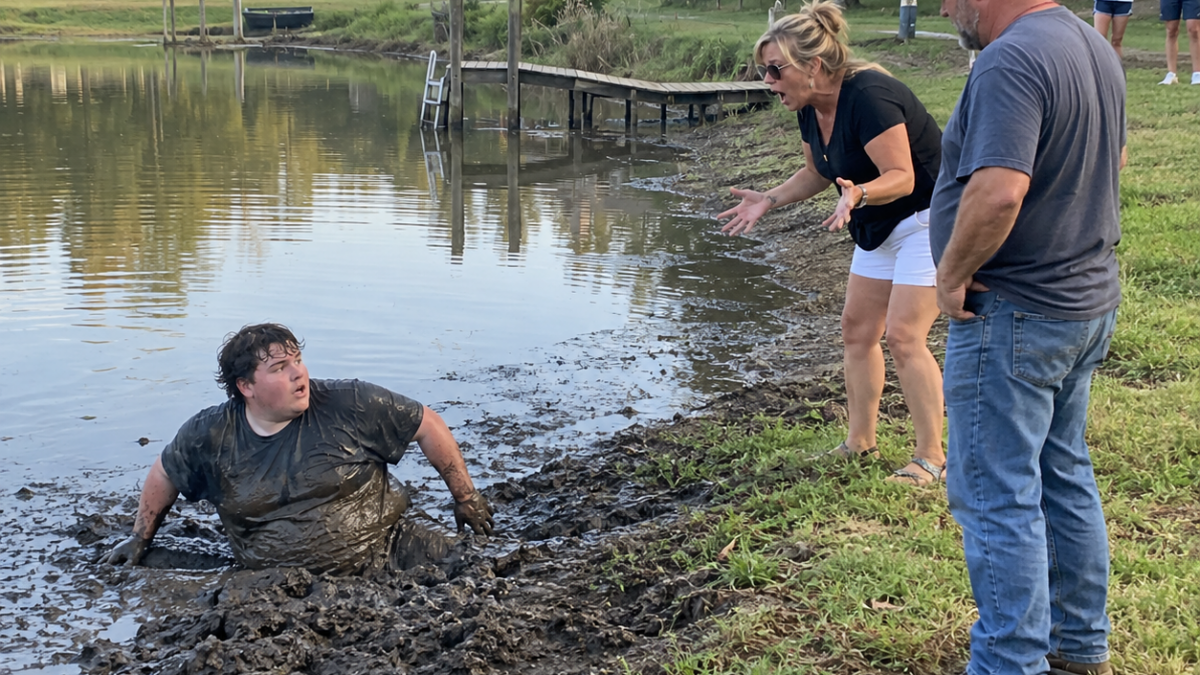
She pointed at my chest.
“If he gets hurt, I’m suing you for everything you have.”
I looked at Jason again.
He wasn’t injured.
He wasn’t underwater.
The mud was holding his legs, but he was stable.
The pond edge there was shallow.
I knew exactly how to get him out.
Slow movements.
Shift his weight.
Free one leg at a time.
What Jason needed most was to stop fighting the mud.
What Karen needed most was apparently an audience.
She got one.
A voice came from behind us.
“What happened?”
My neighbor Denise was standing near the property line.
Her husband Frank was a few steps behind her.
Another neighbor, Carl, had come out onto his back deck after hearing the shouting.
Karen looked around.
That was when I saw the first crack in her confidence.
She had come roaring across the yard expecting a private confrontation in which volume would decide who was right.
Now people were watching.
And unfortunately for Karen, at least two of them knew exactly how many times I had told Jason to stop trespassing.
Denise looked toward the pond.
“Is that Jason?”
“He trapped my son!” Karen shouted.
Denise’s eyes shifted to me.
I didn’t say anything.
Then she looked at the mud.
“You built something there?”
“No.”
Karen answered before I could.
“He obviously did!”
I finally spoke.
“That mud has been there for years.”
Frank nodded immediately.
“Yeah. It has.”
Karen stared at him.
He continued.
“That whole corner has always been soft. I lost a boot there helping clear brush two summers ago.”
Karen’s mouth tightened.
Jason pulled again.
The mud grabbed tighter.
“I said stop doing that,” I told him.
“I can’t get out!”
“You can. But you’re making it harder.”
Karen threw both hands up.
“Then get him out!”
“No.”
She stared at me like she hadn’t heard correctly.
“What?”
“I’m not climbing into that mud because your son trespassed.”
“You’re leaving him there?”
“I’m going to tell him how to get out.”
“That is not good enough.”
“It’s plenty.”
“You are unbelievable.”
“No, Karen. What’s unbelievable is that this is the first consequence either of you has taken seriously.”
Her face went bright red.
To understand why I was not in a hurry to destroy a pair of boots dragging Jason out of mud he had walked into entirely on his own, you need to understand what had been happening for months.
My property was not fancy.
I didn’t have gates with stone pillars.
No electronic entrance.
No security booth.
No giant estate sign announcing some dramatic ranch name.
I owned a few quiet acres outside town.
Enough room for a house, a shed, some trees, and the pond.
That pond was the reason I loved the place.
It sat low in the property where the ground gently dropped away from the house.
Not huge.
Not a lake.
But big enough for bass and bluegill.
Big enough for frogs in the spring.
Big enough that mist sometimes hovered over the surface on cool mornings.
I maintained it.
I cleared invasive weeds.
Managed the banks.
Stocked fish.
Kept trash out.
Trimmed problem branches.
Checked runoff after storms.
My family fished there.
Sometimes we just sat by it.
It was the quietest corner of my life.
And when you spend years taking care of a piece of land, you start knowing it in details other people never notice.
I knew where the bank stayed firm after heavy rain.
I knew which old stump was just under the surface.
I knew where turtles liked to crawl out in the afternoon.
I knew which patch of cattails the red-winged blackbirds nested in every spring.
And I knew about the mud.
At the far western edge of the pond, groundwater kept one section permanently saturated.
The top looked almost solid in dry weather.
It wasn’t.
Take two steps into the wrong place and your boot could drop six inches.
Three more careless steps and you could sink to your knees.
If you panicked and started yanking straight upward, the suction could make it feel much worse than it really was.
I had put a small warning marker near that side years earlier.
Not because the area was deadly.
Because I didn’t want guests losing shoes.
People who belonged on my property knew to avoid it.
People who didn’t belong on my property should never have been near it anyway.
Then Karen moved into the house beyond my eastern boundary.
I wish I could tell you our problems started with some major event.
They didn’t.
They started with little things.
People like Karen usually do.
The first time we met, she walked halfway up my driveway without knocking and asked if I could stop cutting grass before nine because Jason liked to sleep late during summer vacation.
I thought she was joking.
She wasn’t.
I told her I usually mowed whenever the weather allowed.
She frowned.
“But weekends are family time.”
“So?”
“So people should be considerate.”
I remember looking toward her house.
Her husband was running a leaf blower.
It was 8:20 in the morning.
I looked back at her.
She didn’t seem to notice the contradiction.
That was my introduction to Karen.
Rules weren’t rules.
They were instructions for other people.
A month later, I found two soda cans beside the pond.
Then a chip bag.
Then a plastic bottle.
I assumed wind had carried them over.
Then one afternoon I saw Jason cut directly across my property with two friends.
He was around sixteen.
Old enough to drive.
Old enough to know what private property meant.
They came through the tree line and headed toward the pond.
I stepped off my porch.
“Hey.”
They stopped.
Jason recognized me.
His friends didn’t.
“You guys need to go around.”
Jason looked confused.
“Why?”
“Because this is private property.”
“We’re just cutting through.”
“I know.”
He shrugged.
“So what’s the problem?”
I remember that response because it sounded exactly like something his mother would say.
“The problem is I’m asking you not to.”
One of his friends immediately said, “Sorry.”
Good kid.
He started turning around.
Jason stayed where he was.
“My mom said this isn’t really private because there’s no fence.”
I stared at him.
“She said what?”
“She said property has to be fenced if you don’t want people walking on it.”
I almost admired the confidence.
“No.”
Jason shrugged again.
“Well, that’s what she said.”
“Your mother is wrong.”
His expression changed.
Teenagers don’t like hearing that.
Especially teenagers raised by parents who tell them they’re never wrong.
“Whatever.”
He walked back toward the property line.
His friends followed.
I thought that would be the end of it.
Two days later, Karen came over.
Not to apologize.
Of course not.
She wanted to discuss my “interaction” with Jason.
She stood at the edge of my driveway wearing sunglasses so large they covered half her face.
“I don’t appreciate strangers yelling at my son.”
“I didn’t yell.”
“He said you confronted him.”
“I told him not to trespass.”
“He was walking.”
“On my land.”
“He wasn’t hurting anything.”
“That doesn’t matter.”
She crossed her arms.
“Are you seriously going to be one of those neighbors?”
“One of what neighbors?”
“The kind who thinks every inch of grass is sacred.”
I looked past her.
“Karen, he can use the road.”
“That adds ten minutes.”
“That sounds manageable.”
“He and his friends use the pond trail.”
“There is no public pond trail.”
“There’s clearly a path.”
“Yes. My path.”
She sighed theatrically.
“Look, I’m trying to be reasonable.”
“No. You’re trying to tell me your son gets to use my property because it’s convenient.”
“He’s a teenager.”
“That isn’t a land-use category.”
Her sunglasses came off.
“You don’t need to be rude.”
“I’m not being rude.”
“You called me wrong.”
“You were wrong.”
Her lips tightened.
That conversation ended exactly as badly as it began.
I made one thing very clear.
Jason was not allowed on my property without permission.
Karen rolled her eyes.
Actually rolled them.
“Fine.”
Then she walked away like I had forced her to sign an international peace treaty.
For about a week, I didn’t see Jason.
Then I found rocks in the pond.
Not naturally placed rocks.
Big landscaping stones.
Thrown into the shallows.
A broken fishing bobber lay nearby.
So did another soda bottle.
The next afternoon, I caught him again.
This time he was alone.
He had a stick and was smacking it against the water.
“Jason.”
He turned.
Not surprised.
Not guilty.
Annoyed.
“What?”
“What did I tell you?”
“I’m leaving.”
“That wasn’t my question.”
He started walking.
“Jason.”
He stopped.
“Do not come back here.”
He laughed under his breath.
I heard it.
“What’s funny?”
“Nothing.”
“No, go ahead.”
He looked at me.
“You act like it’s some national park.”
“It’s mine.”
“It’s a pond.”
“Yes.”
“You have fish in it.”
“Yes.”
“So?”
“So they’re my fish in my pond on my property.”
He smirked.
“You sound crazy.”
That one almost got me.
Almost.
I took a breath.
“You need to leave.”
He walked away.
That evening Karen texted me.
She had somehow gotten my number from another neighbor.
Her message said:
STOP HARASSING MY SON.
I stared at it.
Then replied:
Tell him to stay off my property.
Her response came immediately.
HE HAS A RIGHT TO WALK THROUGH THE NEIGHBORHOOD.
I typed:
He does. My property is not the neighborhood.
Three dots appeared.
Disappeared.
Appeared again.
Then:
YOU ARE MAKING THIS A BIGGER DEAL THAN IT NEEDS TO BE.
I didn’t answer.
The next morning there was a bag of chips beside the pond.
Maybe Jason.
Maybe not.
At that point, though, my patience was gone.
I replaced the old PRIVATE PROPERTY sign near the path with a larger one.
NO TRESPASSING.
I wasn’t trying to intimidate anyone.
I wanted zero ambiguity.
A week later, I watched Jason walk past it.
He didn’t miss the sign.
He looked directly at it.
Then continued.
I happened to be coming around the shed.
“Seriously?”
He stopped.
“What?”
“You just walked past the sign.”
“What sign?”
He was standing maybe fifteen feet from it.
I pointed.
He turned.
“Oh.”
“Go home.”
“I’m not doing anything.”
“Go home.”
“Why do you care?”
“Because I said you can’t be here.”
“My mom said you can’t legally keep me from walking through if there’s no fence.”
There it was again.
I rubbed my forehead.
“Jason.”
“What?”
“Your mother does not know what she’s talking about.”
He took out his phone.
“I’m recording you.”
“Great.”
“You’re threatening a minor.”
“I’m telling you to go home.”
“My mom’s going to sue you.”
“Okay.”
That disappointed him.
He wanted a reaction.
I didn’t give him one.
“Go home.”
He finally did.
That night Karen appeared at my door.
She didn’t knock normally.
She pounded.
When I opened it, she was already talking.
“You need to stop approaching Jason.”
“He’s approaching me.”
“He says you threatened him.”
“I told him to leave.”
“He has video.”
“Good.”
“You think this is funny?”
“No.”
“He feels unsafe around you.”
“Then he should stop coming onto my property.”
She pointed at me.
“You do not get to intimidate my child.”
“And you do not get to teach your child that other people’s boundaries are optional.”
Her eyes widened.
“Excuse me?”
“You heard me.”
“You don’t know anything about my parenting.”
“I know your sixteen-year-old has been told repeatedly not to trespass and keeps doing it because he thinks you’ll defend him.”
“You’re obsessed with this.”
“No. I want to be left alone.”
“It is a pond!”
She practically screamed it.
“Correct.”
“You’re acting like he broke into your house.”
“I’m acting like I’ve asked him to stay off my property.”
“Maybe if you weren’t so hostile, children wouldn’t feel the need to challenge you.”
I stared at her.
That sentence explained everything.
Jason trespassed.
My fault.
Jason ignored warnings.
My fault.
Jason littered.
Probably my fault.
Because in Karen’s world, consequences only belonged to other families.
I opened the door wider and stepped aside.
“This conversation is over.”
“You cannot just dismiss me.”
“I can in my house.”
Her face tightened.
“Fine.”
She stormed down the steps.
Then turned from the walkway.
“If you ever touch my son—”
“I have never touched your son.”
“If you ever do—”
“I won’t need to.”
I closed the door.
For the next couple of weeks, things quieted down.
I hoped Karen had finally gotten through to him.
Maybe one of his friends told him he was being ridiculous.
Maybe he simply found another shortcut.
I didn’t care why.
The pond was quiet again.
Summer settled in.
Hot afternoons.
Cicadas.
Still water.
Dragonflies hovering over the shallows.
Exactly what I wanted.
Then came the afternoon everything finally blew up.
It was brutally hot.
The kind of day where even the birds seemed irritated.
I had been working inside most of the afternoon because the sun was too strong to do much outdoors.
Around four, I heard something.
Splashing.
At first I ignored it.
Could have been a bird.
A fish.
Then came another splash.
Bigger.
Then laughter.
I stood.
Walked to the back window.
Couldn’t see the far end of the pond clearly through the trees.
Then I heard a voice.
Jason.
Of course.
I put on my boots and headed outside.
As I came down the path, I saw muddy footprints.
Sneakers.
Fresh.
Right past the sign.
My jaw tightened.
I reached the pond.
Jason was standing knee-deep in the shallows.
Shirt off.
Shorts wet.
He had apparently decided my pond was now his private swimming hole.
He saw me.
And smiled.
Not embarrassed.
Not apologetic.
Smiled.
“You have got to be kidding me.”
He splashed water with one hand.
“It’s hot.”
“Get out.”
“I’m already leaving.”
“Good.”
He started moving toward the bank.
Then stopped.
Instead of taking the obvious firm route back, he angled toward the far end.
The mud.
“Jason.”
He glanced over.
“Not that way.”
He smirked.
“Why?”
“Because it’s soft.”
“What, you scared I’m going to mess up your precious dirt?”
“Because you’re going to get stuck.”
He laughed.
Actually laughed.
“You’re so dramatic.”
“Jason.”
He took another step.
His foot sank.
He looked down.
I saw his expression change slightly.
Then he pulled it free.
“See?”
He grinned.
“Fine.”
“Come back the other way.”
He kept going.
I still don’t know whether he was trying to prove me wrong or whether sixteen-year-old pride simply made turning around impossible once I had warned him.
Either way, he stepped deeper into the muddy section.
His right leg went down almost to the knee.
He stopped laughing.
“Whoa.”
“Don’t yank.”
He yanked.
The mud held.
His left foot shifted.
That one sank too.
“Jason.”
He tried stepping forward.
Worst thing he could have done.
His right leg plunged deeper.
He threw out both arms for balance.
“What the hell?”
“Stop moving.”
“I’m stuck.”
“I know.”
He pulled hard.
Squelch.
The mud tightened.
Now both legs were buried past the knees.
His breathing changed.
“This isn’t funny.”
“I’m not laughing.”
“Help me.”
“Stop fighting it.”
“Get me out!”
I stayed on the firm bank.
He wasn’t in danger.
That mattered.
His upper body was completely clear.
The water beside him was shallow.
The mud wasn’t swallowing him like movie quicksand.
It was suction.
Thick.
Heavy.
Unpleasant.
But stable.
I knew the area.
I knew the bottom.
I also knew the more he panicked, the harder he would make it.
“Jason, listen to me.”
“Help!”
“Listen.”
He stopped for half a second.
“Lean forward slightly.”
“What?”
“Not all the way. Shift your weight. Then work one leg slowly.”
“I can’t.”
“You can.”
“I’m sinking!”
“You’re not sinking. You’re pushing yourself deeper because you keep jerking upward.”
He looked at me.
Fear had finally erased the attitude.
“Please.”
“I’ll help you with instructions.”
“No, come get me!”
“No.”
His eyes widened.
“What?”
“I’m not walking into that because you ignored me.”
“You can’t leave me here!”
“I’m not leaving.”
That distinction mattered.
I was watching him.
I would have acted immediately if he had been in actual danger.
But he wasn’t.
He was muddy, scared, embarrassed, and trapped by his own stubbornness.
For once, there was no easy way for Karen to erase what he had done.
Then he shouted.
“Mom!”
I almost sighed.
Her house wasn’t far.
He shouted again.
“MOM!”
That second call did it.
A door slammed somewhere beyond the trees.
Then Karen’s voice.
“Jason?”
He yelled again.
“I’M STUCK!”
Footsteps.
Fast.
And then Karen came barreling onto my property exactly the way she had spent months insisting her son had a right to do.
“What happened?”
She saw Jason.
Then me.
Her entire expression transformed.
“What did you do?”
Those were her first words.
Not “Are you okay?”
Not “How did this happen?”
Not “Jason, stop moving.”
“What did you do?”
“I didn’t do anything.”
“Why is he stuck?”
“Because he trespassed and walked into the mud.”
“You trapped him.”
“No.”
“You absolutely did.”
“Karen, that mud is natural.”
Jason called out.
“Mom, get me out!”
She ignored him.
Her attention stayed on me.
“You knew this was here.”
“Yes.”
Her eyes widened triumphantly.
“So you admit it.”
“Admit what?”
“You knowingly maintained a dangerous condition.”
I laughed once.
I couldn’t help it.
“Maintained mud?”
“You knew someone could get trapped.”
“Someone who trespassed through two signs, ignored multiple warnings, entered the pond, and then ignored me when I told him where not to step.”
“He is a child!”
“He is sixteen.”
“That is legally a child!”
“He’s old enough to read.”
Jason pulled again.
The mud sucked him down another little bit.
“Mom!”
Karen spun around.
“Oh my God. He’s sinking!”
“He is not sinking.”
“Look at him!”
“He’s struggling.”
“What’s the difference?”
“A lot.”
She pointed at me.
“Get him out.”
“No.”
The silence after that word was almost beautiful.
Her mouth fell open.
“No?”
“No.”
“You are standing there while a child is trapped!”
“He’s trapped in mud.”
“He could die!”
“No, he couldn’t.”
“You don’t know that.”
“I know this pond better than you know your own backyard.”
“Then you know how to rescue him!”
“I know how he can get himself out.”
Jason’s voice cracked.
“How?”
Karen snapped around.
“Don’t listen to him!”
I stared at her.
Even Jason stared at her.
“Karen,” I said slowly, “are you seriously stopping him from listening to instructions that will get him out?”
“I don’t trust you.”
“Then go pull him out yourself.”
That shut her down.
She looked at the mud.
Then at Jason.
“Mom?”
She stepped closer.
Her sandal sank perhaps half an inch into the wet edge.
She jerked it back immediately.
“Oh my God.”
I almost smiled.
“Problem?”
“That is disgusting.”
Jason stared at her.
“Mom!”
“I’m trying!”
“No, you’re yelling.”
She glared at me.
“Shut up.”
“You came onto my property.”
“To save my son!”
“Then save him.”
She looked down at her pants.
Her sandals.
Her painted toenails.
I saw the exact calculation.
If she stepped in, she was going to get filthy.
Maybe lose a shoe.
Maybe get stuck herself.
Suddenly personal responsibility was much less attractive.
“I can’t go in there.”
“Why?”
“You know why.”
“No.”
“It’s dangerous.”
I nodded.
“So I should go?”
“You created the situation.”
“No. Jason did.”
“He wouldn’t be there if you had secured your property.”
That one stopped me.
I actually needed a second to process it.
“Secured my property?”
“Yes.”
“How?”
“With a fence.”
“I have signs.”
“Signs aren’t enough.”
“I also told him personally.”
“He’s a teenager.”
“I told you.”
“You’re the adult.”
“There it is.”
“What?”
“Nothing is ever your responsibility.”
Her eyes widened.
“How dare you.”
“No, really. Let’s review.”
I pointed toward Jason.
“He walks onto my land. My fault.”
“Don’t twist my words.”
“He ignores signs. My fault.”
“That is not what I said.”
“He ignores direct warnings. My fault.”
“I said—”
“He goes into my pond. My fault.”
“You should have—”
“He walks into mud after I specifically tell him not to.”
I spread my hands.
“And somehow that is also my fault.”
Karen jabbed a finger at me.
“Yes, because you’re an adult!”
Jason groaned.
“Can you guys stop?”
Neither of us answered.
Then another voice came from the property line.
“Everything okay?”
Denise.
She had heard Karen screaming.
Frank followed.
Then Carl appeared farther back.
Karen saw them.
And immediately changed tactics.
“Call 911!”
Denise stopped.
“Why?”
“My son is trapped.”
Denise looked toward Jason.
He was muddy.
Scared.
But obviously upright.
“Is he hurt?”
“I don’t know!”
I answered.
“He’s not.”
Karen spun.
“You are not a doctor!”
“No. But he’s been talking nonstop.”
Jason looked offended.
“I’m right here.”
Denise approached carefully.
She knew the soft area.
“What happened?”
“He trespassed,” I said.
Karen yelled over me.
“He set a trap!”
Frank frowned.
“A trap?”
“That!”
She pointed at the mud.
Frank looked.
Then at her.
“Karen, that’s mud.”
“It’s dangerous mud.”
Carl had walked closer now.
He laughed.
Not cruelly.
Just in disbelief.
“That patch has been there forever.”
Karen’s face reddened.
“He knew about it.”
“So did you,” I said. “I told Jason not to go that way before he stepped in.”
Jason looked down.
Karen noticed.
“Did he?”
Jason hesitated.
That hesitation was devastating.
“Jason?”
“He said it was soft.”
Karen’s face went still.
Denise folded her arms.
“So he warned you.”
Jason muttered, “Yeah.”
“And you kept going?”
Jason said nothing.
Karen jumped in.
“He is sixteen. Teenagers make mistakes.”
Frank nodded.
“They do.”
Karen looked relieved.
Then Frank finished.
“That doesn’t make the mistake somebody else’s fault.”
Her relief vanished.
Jason pulled again.
“Stop,” I told him.
This time he listened.
His chest was rising and falling quickly.
“Okay,” I said. “We’re getting you out.”
Karen snapped, “Finally.”
I ignored her.
“Jason, look at me.”
He did.
“You need to stop trying to pull straight up.”
“Why?”
“Because the mud seals around your leg. Every time you yank, you’re fighting suction.”
He swallowed.
“What do I do?”
“Shift your weight forward slowly.”
He started leaning.
“Not too far.”
He stopped.
“Good.”
Karen interrupted.
“Don’t listen to him. You could hurt your knee.”
Jason looked between us.
I kept my voice calm.
“If you want to stay there, listen to your mother.”
Denise coughed to hide a laugh.
Karen glared at her.
I continued.
“If you want to get out, listen to me.”
Jason nodded.
“Okay.”
Karen threw up her hands.
“This is insane.”
“Jason. Left leg first.”
He looked down.
“I can’t move it.”
“You can. Don’t pull. Wiggle.”
He tried.
Nothing happened.
His face tightened.
“It’s stuck.”
“Small movements.”
He moved his knee slightly.
Then his foot.
The mud made a soft sucking noise.
“That’s it.”
“I think it moved.”
“It did.”
He tried harder.
“Slow.”
Karen paced behind me.
“This is taking too long.”
Nobody acknowledged her.
Jason shifted again.
One inch.
Then another.
His breathing steadied.
“That’s it,” I said. “You’re doing fine.”
His left knee rose slightly.
The mud slumped inward around it.
He stopped.
“What now?”
“Same thing.”
He moved his foot.
Twisted carefully.
Lifted.
Squelch.
His leg came free suddenly.
Jason toppled sideways.
Mud splashed across his chest.
Karen screamed.
Denise jumped.
Jason caught himself with both hands.
For one second, everybody froze.
Then he looked up.
“One leg’s out.”
“Yes.”
For the first time all afternoon, he sounded almost proud.
“Good. Keep that knee on the firmer surface.”
He felt around.
“Here?”
“Yes.”
Karen stepped forward.
“Jason, crawl toward me.”
“No,” I said.
She whipped around.
“Excuse me?”
“If he drags the trapped leg sideways, he could twist it.”
Jason froze.
Karen said, “How would you know?”
“Because I’ve dealt with this mud for years.”
Frank nodded.
“Listen to him.”
Karen stared at Frank.
“Stay out of this.”
Frank shrugged.
“You’ve been telling everybody else what to do for twenty minutes.”
She turned away.
Jason looked at me.
“Other leg?”
“Same process.”
He breathed.
Then started.
Slowly.
Wiggle.
Shift.
Release suction.
Stop when resistance increased.
Start again.
His right leg had gone deeper.
It took longer.
The mud clung almost to his thigh.
He grunted.
“I can’t.”
“Yes, you can.”
“It hurts.”
“Where?”
“My ankle.”
“Sharp pain?”
“No. Just pressure.”
“Then slow down.”
He stopped.
Breathed.
Tried again.
Karen finally spoke to him instead of me.
“You’re okay, baby.”
Jason’s expression changed.
He was sixteen.
Covered in mud.
Three neighbors watching.
His mother calling him baby.
He looked like he wanted the pond to swallow him.
“Mom, please.”
“What?”
“Just… stop.”
Karen blinked.
“I’m encouraging you.”
“Stop yelling.”
Her mouth opened.
Jason went back to work.
Another inch.
Then another.
The suction released with a loud, ugly sound.
His foot came free.
Jason lunged onto firm ground.
He crawled three feet before stopping.
For several seconds, he simply lay there.
Mud from his waist down.
Mud on his arms.
Mud on his face.
One shoe missing.
Breathing hard.
Alive.
Uninjured.
Humiliated.
Karen rushed toward him.
“Oh my God!”
She knelt beside him, careful not to let her knees touch the worst mud.
“My poor baby.”
Jason closed his eyes.
“Mom.”
“Are you hurt?”
“No.”
“We’re going to the emergency room.”
“I’m fine.”
“You could have been killed.”
I shook my head.
That was apparently too much.
Karen stood.
“This is your fault.”
I looked at her.
We were really doing this again.
Jason was out.
Safe.
And instead of being relieved, she immediately returned to blame.
“You left him in there.”
“I coached him out.”
“You refused to help.”
“I did help.”
“You stood there!”
“Yes.”
“You enjoyed this.”
“No.”
“You were smirking.”
“Sometimes your behavior is difficult to watch with a straight face.”
Her face twisted.
“I am going to sue you.”
“Okay.”
“I mean it.”
“Okay.”
“You’re going to lose this property.”
“Okay.”
“Stop saying okay!”
“Then stop making threats you think will frighten me.”
She stepped closer.
“You intentionally allowed a minor to remain in danger.”
“He was never in danger.”
“You admitted you knew the mud was dangerous.”
“I said it was soft.”
“He could have drowned.”
“He was standing in shallow water.”
“He could have sunk.”
“He didn’t.”
“Because I came!”
That silence was different.
Every person there looked at her.
Jason actually raised his head.
Denise spoke first.
“Karen.”
“What?”
“You didn’t get him out.”
Karen stared at her.
“I was supervising.”
Frank snorted.
Carl looked away to hide a smile.
Karen’s face darkened.
“I was his mother. I was keeping him calm.”
Jason sat up.
“You were screaming.”
Karen snapped toward him.
“I was scared!”
“So was I!”
His voice cracked.
Everyone went quiet.
Jason wiped mud from his cheek.
“You kept yelling at him instead of helping me.”
Karen froze.
“Jason.”
“He told me how to get out.”
“I was protecting you.”
“You wouldn’t even step in.”
“That was different.”
Jason gave her a look I had never seen him give before.
Not anger exactly.
Recognition.
Maybe, for the first time, he was seeing the pattern from the outside.
Karen looked around.
The audience was no longer just embarrassing.
It was turning against her.
She straightened.
“This conversation is over.”
Denise laughed once.
“You started it.”
Karen ignored her.
She grabbed Jason’s arm.
“Come on.”
He pulled away.
“I can stand.”
“Jason.”
“I said I can stand.”
He got up slowly.
One sneaker remained buried.
He looked down.
“My shoe.”
I pointed toward the depression.
“Leave it.”
“My mom bought those.”
Karen said, “They were expensive.”
Of course.
I found a long branch near the edge.
I used it to hook the shoe.
Pulled.
Nothing.
Tried another angle.
Squelch.
The sneaker came out filled with black mud.
I dropped it on solid ground.
Jason stared.
“Thanks.”
It was the first time I had ever heard him say that to me.
“You’re welcome.”
Karen grabbed the shoe.
Mud splattered her white pants.
She gasped.
Frank laughed.
That did it.
Karen’s head snapped toward him.
“You think this is funny?”
Frank held up both hands.
“Nope.”
“You people are unbelievable.”
Denise stepped forward.
“No, Karen. You know what’s unbelievable?”
“Don’t.”
“You’ve been told for months.”
“Mind your own business.”
“I watched him come through here last week.”
Karen’s face tightened.
Denise pointed at the sign.
“I watched him walk past that.”
“He’s a kid.”
“Stop saying that like it makes him invisible.”
“He is legally a minor.”
“And you’re legally his parent.”
That hit.
Karen took a breath.
Denise continued.
“If you knew your son kept trespassing, why didn’t you stop him?”
Karen looked toward me.
“Because this entire thing has been exaggerated.”
“Until he got stuck.”
“That mud should be fenced.”
Carl spoke from behind us.
“Why?”
Karen turned.
“What do you mean why?”
“It’s on private property.”
“Because children could wander into it.”
Carl looked around.
“What children?”
“There are families here.”
“Your son is sixteen.”
“He is still a child!”
Carl shrugged.
“When I was sixteen, I understood ‘No Trespassing.’”
Karen’s face had gone pale beneath the red.
She was losing.
Not because I had humiliated her.
Because the facts were humiliating all by themselves.
Jason had been told.
Karen had been told.
There was a sign.
He ignored it.
He walked into the pond.
I warned him about the mud.
He ignored that too.
Then he got stuck.
There was no clever argument that changed the sequence.
Karen could yell over it.
Threaten around it.
But she couldn’t erase it.
Jason tugged lightly on her sleeve.
“Can we just go?”
She looked down at him.
He was exhausted.
Mud dripping from his shorts.
One shoe in his hand.
Pride gone.
“Fine.”
She turned to me.
“This is not over.”
I nodded.
“I hope it is.”
“Oh, it isn’t.”
“Then next time bring an attorney and a towel.”
Frank coughed.
Denise bit her lip.
Karen stared at me.
Then she turned and marched toward home.
Jason followed.
After maybe ten steps, he stopped.
Karen kept walking for a moment before noticing.
“Jason?”
He looked back at me.
“I won’t come back.”
Karen’s face changed.
“Jason, you don’t have to—”
He interrupted her.
“I said I won’t.”
I nodded.
“That’s all I wanted.”
He looked at the pond.
Then at the mud on himself.
“Yeah.”
He followed his mother home.
The neighbors stayed.
For a few seconds, nobody said anything.
Then Frank laughed.
Not a small laugh.
A full-body laugh.
He bent forward with his hands on his knees.
Denise smacked his shoulder.
“Stop.”
“I’m trying.”
“It’s not funny.”
“He lost a shoe.”
“He could’ve twisted his ankle.”
“I know.”
Frank straightened.
“He still lost a shoe.”
Carl smiled.
“I give Karen twenty minutes before she posts about this online.”
“Ten,” Denise said.
I looked at them.
“Please don’t encourage her.”
Denise walked toward the pond.
“Seriously, though. You okay?”
“Me?”
“You look angry.”
I glanced at the muddy footprints.
The disturbed bank.
The trash Jason had left farther down the shore.
“I’m tired.”
“Understandable.”
“I didn’t want this.”
“We know.”
“She’s going to say I trapped him.”
“We saw it.”
I looked at Denise.
She nodded.
“All of it.”
Frank added, “And I remember you warning him before.”
“So do I,” Carl said.
That mattered more than I expected.
Not because I was terrified of Karen’s lawsuit.
Karen threatened lawsuits the way normal people threatened rain when they saw clouds.
But months of having someone insist your boundaries are unreasonable does something to you.
It makes you start explaining things you shouldn’t need to explain.
Why your land is yours.
Why no means no.
Why someone else’s convenience does not create an entitlement.
Why you should not have to build walls around every object you own just to prove strangers aren’t allowed to take it.
I looked at the sign.
NO TRESPASSING.
Simple.
Apparently controversial.
Denise followed my eyes.
“She should have listened.”
“Which one?”
“Both.”
I smiled.
“Yeah.”
They eventually went home.
I stayed.
The pond settled.
Ripples faded.
Birds returned to the cattails.
I picked up Jason’s trash.
A plastic bottle.
A snack wrapper.
Then I went to the spot where he had gotten stuck.
His legs had left two deep holes.
The mud slowly filled them.
Within a day, they would barely be visible.
That struck me as strange.
All that screaming.
All that anger.
All that drama.
And the ground was already smoothing itself over.
Nature did not care about Karen’s argument.
The mud hadn’t punished Jason.
It hadn’t chosen him.
It hadn’t been waiting.
It was simply there.
He stepped where he had been told not to step.
Then physics handled the rest.
Later that evening, I got a text.
Karen.
Of course.
YOU ENDANGERED MY CHILD TODAY.
I read it.
Didn’t answer.
Another came.
I HAVE WITNESSES.
That almost made me laugh.
So did I.
Then:
YOU WILL BE HEARING FROM SOMEONE.
I put my phone down.
Ten minutes later:
YOUR SILENCE SAYS EVERYTHING.
I poured a glass of water.
My phone buzzed again.
I turned it off.
The next morning, I walked to the pond before breakfast.
No Jason.
No trash.
No rocks.
Nothing.
The water was glassy.
I stood there for a while.
Then Denise called from her side of the property.
“She posted.”
I groaned.
“What?”
“You don’t want to know.”
“I probably do.”
She walked over holding her phone.
Karen had written a long neighborhood social-media post.
The title was:
DANGEROUS NEIGHBOR DELIBERATELY ALLOWS CHILD TO BECOME TRAPPED.
I read the first paragraph.
Then the second.
By the third, I was apparently some kind of wilderness psychopath operating hidden hazards against local teenagers.
According to Karen, Jason had been “innocently exploring.”
He had “accidentally crossed an unmarked boundary.”
He had become “entrapped in an unsafe man-made condition.”
And I had “refused rescue.”
I looked at Denise.
“Unmarked?”
She pointed toward the sign visible from where we stood.
“Maybe she thinks letters are decorative.”
I kept reading.
Karen claimed she had personally “coordinated Jason’s safe extraction.”
Denise started laughing.
“That part is my favorite.”
“She coordinated?”
“She yelled.”
“She wouldn’t step in.”
“I know.”
I handed the phone back.
“What are the comments?”
Denise smiled.
“You really want to see?”
“No.”
“Yes, you do.”
She scrolled.
Frank had already commented.
I WAS PRESENT. THE MUD IS NATURAL, THE PROPERTY IS MARKED, AND JASON WAS WARNED.
Carl followed.
HE WALKED PAST THE NO TRESPASSING SIGN.
Then another neighbor.
I HAVE PERSONALLY HEARD THE OWNER TELL JASON TO STAY OFF THE PROPERTY BEFORE.
Then Denise herself.
JASON CONFIRMED IN FRONT OF MULTIPLE PEOPLE THAT HE WAS WARNED ABOUT THE SOFT GROUND BEFORE WALKING INTO IT.
I looked at her.
“You commented?”
“She involved the neighborhood.”
More replies appeared.
Karen was arguing with everyone.
YOU DON’T KNOW THE WHOLE STORY.
Then Frank:
I WAS STANDING THERE.
Karen:
THAT DOESN’T MEAN YOU UNDERSTAND CHILD SAFETY LAW.
Carl:
Neither do you.
I handed the phone back.
“That’s enough.”
“You’re not responding?”
“No.”
“Smart.”
“Anything I say becomes another argument.”
Denise nodded.
“She’s doing fine by herself.”
She was.
By noon, Karen deleted the post.
That should have been the end.
But people like Karen rarely end things cleanly.
They retreat while pretending they have chosen a better battlefield.
For the next several days, she avoided me.
Jason disappeared too.
I assumed he was grounded.
Maybe Karen finally realized the attention was hurting her more than helping.
Then on Thursday afternoon, I saw Jason near the road.
He was walking home from somewhere.
When he noticed me, he stopped.
For a moment, I wondered if we were going to have another confrontation.
Instead, he walked over.
Not onto the main yard.
He stopped at the edge.
The property line.
That alone told me something had changed.
“Hey.”
“Hey.”
He shoved both hands into his pockets.
“I wanted to say something.”
“Okay.”
He looked toward the pond.
“My mom says I shouldn’t talk to you.”
“Then you probably shouldn’t.”
He almost smiled.
“I’m not supposed to trespass either.”
“Fair point.”
He looked embarrassed.
“I was kind of being an idiot.”
I said nothing.
Teenagers rarely offer admissions like that if an adult jumps in too quickly.
He continued.
“I thought you were just trying to control everything.”
“It’s my property.”
“I know.”
“You didn’t before.”
“I knew.”
That answer surprised me.
Jason kicked at a small stone near the road.
“I just didn’t care.”
Honest.
Painfully honest.
“Why?”
He shrugged.
“Because Mom said you couldn’t really do anything.”
There it was.
Not shocking.
Still disappointing.
“She said if you didn’t have a fence, you couldn’t complain about people walking through.”
“That’s not true.”
“I know now.”
“How?”
He looked at me.
“She talked to someone.”
“An attorney?”
“I think so.”
I nodded.
That explained the sudden silence.
Jason shifted.
“She was really mad after.”
“At me?”
“At everybody.”
“Sounds right.”
He looked toward the pond again.
“I shouldn’t have gone swimming there.”
“No.”
“And I shouldn’t have thrown stuff in.”
“So that was you.”
His face reddened.
“Yeah.”
“Why?”
Another shrug.
“You got mad when I went there.”
“So you damaged it because I told you not to?”
“When you say it like that, it sounds stupid.”
“It was stupid.”
He nodded.
“Yeah.”
There was no point humiliating him.
The mud had done enough.
“Listen, Jason.”
He looked up.
“I don’t hate you.”
He seemed surprised.
“I don’t want you hurt.”
“Mom says you left me there on purpose.”
“I stayed ten feet away the whole time.”
“I know.”
“I would have stepped in if you were actually in danger.”
“I know.”
“You weren’t.”
He nodded.
“I know.”
I pointed toward the pond.
“That place matters to me.”
He followed my hand.
“Okay.”
“It doesn’t have to matter to you. But you need to respect that it’s mine.”
He nodded again.
“I get it.”
That was more than Karen had managed in months.
Then Jason asked something I didn’t expect.
“Can I ever fish there?”
I looked at him.
He quickly added, “Like, if I ask.”
I considered it.
Maybe five seconds.
“Yes.”
His eyebrows lifted.
“Seriously?”
“If you ask.”
“Okay.”
“And if I say no?”
“Then no.”
“That’s it?”
“That’s how permission works.”
He looked almost amused.
“All right.”
He turned to leave.
“Jason.”
He stopped.
“Stay away from the west mud.”
This time he laughed.
“Yeah.”
He walked home.
He did not cross my property.
He used the road.
I stood there watching him go.
For the first time, I wondered whether all Karen’s protection had actually been hurting him more than helping.
Kids need consequences.
Not cruelty.
Not humiliation for its own sake.
Consequences.
Touch a hot stove, it hurts.
Ignore homework, the grade drops.
Treat people badly, they stop trusting you.
Walk into mud after somebody warns you not to walk into mud, you may spend twenty humiliating minutes learning about suction.
If every consequence gets intercepted by a parent screaming “Not my child’s fault,” what exactly does that child learn?
Nothing good.
Jason had spent months testing whether my boundaries were real.
The day in the pond answered him more clearly than I ever could.
Not because I designed some punishment.
Because eventually, reality stops negotiating.
A couple of weeks passed.
No trespassing.
No trash.
No angry messages from Karen.
Then one Saturday morning, somebody knocked at my door.
I opened it.
Jason.
He stood on the porch holding a fishing rod.
I looked at him.
He looked at me.
“Can I fish?”
I checked the time.
“Where’s your mother?”
“At home.”
“Does she know you’re here?”
“She knows I left.”
“That’s not what I asked.”
He sighed.
“No.”
“Then go tell her.”
His shoulders dropped.
“Seriously?”
“Yes.”
“She’ll say no.”
“Then you can’t fish.”
He stared at me.
“Why do you care if she says no?”
“Because you’re still sixteen, and I’m not starting another war with your mother.”
He thought about it.
“Fair.”
He left.
Twenty minutes later, my phone buzzed.
Karen.
For a second, I expected another threat.
Instead:
Jason says you told him he can fish in your pond.
I replied:
He asked permission. I said he could fish today if you were aware and agreed.
Several minutes passed.
Then:
I do not want him near that mud.
Neither do I.
Another pause.
Then:
Fine.
That one word represented more progress than the previous six months combined.
Jason came back.
He stopped at the property line.
Held up his phone.
“She said okay.”
“I know.”
I walked with him to the pond.
He started toward the eastern bank.
Good choice.
I pointed.
“Fish from there.”
“Okay.”
“No swimming.”
“Okay.”
“No trash.”
“I know.”
“No throwing rocks.”
He winced.
“I said I know.”
“And?”
He looked confused.
“And what?”
“The mud?”
His expression deadened.
“Can we never talk about the mud again?”
“No promises.”
He laughed.
For the next hour, he fished.
Quietly.
Caught two small bluegill.
Released both.
Picked up his own bottle when he finished.
Then left.
Nothing dramatic happened.
And that was exactly why it mattered.
Respect made everything boring.
No screaming.
No threats.
No neighbors gathering.
No one buried to the waist in mud.
Just a teenager asking permission to fish.
Imagine that.
Karen herself did not transform overnight.
I want to be clear about that.
There was no magical apology.
No knock at my door where she admitted she had been wrong about everything.
People like Karen almost never give you that.
They adjust their behavior and rewrite the story in their own heads.
If you need them to announce defeat, you’ll wait forever.
But she stopped coming onto my property.
She stopped texting threats.
And as far as I could tell, she stopped telling Jason that my boundaries were optional.
One afternoon a month later, I was checking the mailbox when Karen drove past.
She slowed.
For a second, I thought she might stop.
Instead, she rolled down the window.
“Jason says the bass are bigger near the fallen tree.”
“They are.”
“He says you showed him how to tie a knot.”
“I did.”
She looked uncomfortable.
“Fine.”
I almost smiled.
“Fine what?”
“Nothing.”
Then she drove away.
That was Karen’s version of peace.
I accepted it.
By fall, Jason occasionally fished on weekends.
Always asked.
Sometimes I said yes.
Once I said no because family was visiting.
He said okay and left.
No argument.
No calls from his mother.
That may sound like a tiny thing.
After everything, it felt enormous.
The pond became quiet again.
Not empty.
Quiet.
There’s a difference.
I still heard Jason occasionally.
A reel clicking.
A fish splashing.
The low sound of somebody trying to work a hook free.
But I didn’t feel invaded.
Because he was there with permission.
That changed everything.
I eventually added a small wooden post near the muddy section.
Not because Karen had been right.
Not because the law required it.
Because I had extra lumber and didn’t feel like fishing another teenager’s sneaker out of the muck.
The sign read:
SOFT MUD — STAY ON BANK.
Jason saw it the first day.
He stood there staring.
Then he looked at me.
“Really?”
I smiled.
“Public service.”
“That’s messed up.”
“You inspired safety improvements.”
“You’re never letting this go.”
“Probably not.”
He shook his head.
But he was smiling.
Months earlier, that conversation would have ended with him insulting me and Karen appearing thirty seconds later to threaten legal action.
Now he grabbed his fishing rod and headed to the safe side of the pond.
That was the real ending.
Not Karen getting embarrassed.
Not the neighbors siding with me.
Not Jason covered from the waist down in black mud.
The ending was that the boundary finally became real.
Maybe it had to become real in the messiest possible way.
I had tried polite warnings.
I had tried direct warnings.
I had tried signs.
I had talked to his mother.
Nothing worked.
Because as long as every warning remained only words, Karen and Jason could pretend they were optional.
The mud wasn’t optional.
Jason stepped into it.
It held him.
For once, his mother couldn’t argue reality into changing.
She could scream at me.
Threaten me.
Threaten lawsuits.
Blame my land.
Blame my pond.
Blame my lack of fencing.
Blame the mud.
But she could not make his legs come free by yelling.
Jason had to calm down.
Listen.
Slow his movements.
Fix the problem he had walked himself into.
That lesson was bigger than trespassing.
And I think some part of him understood that.
Karen probably never did.
But she learned enough.
She learned that yelling does not create rights.
Threatening a lawsuit does not move property lines.
Calling your sixteen-year-old “just a child” does not erase his choices.
And telling somebody that their land should be open to your family because you find boundaries inconvenient does not make it so.
The pond is still there.
The muddy corner is still there too.
Rain fills it.
Summer dries the edges.
Frogs disappear into it.
Deer occasionally leave prints there.
Once in a while I look at that section and remember Jason’s expression when his second leg finally came loose.
Relief.
Embarrassment.
And maybe the first flicker of understanding.
I had never wanted revenge.
I didn’t need revenge.
I wanted respect.
Those are different things.
Revenge would have been setting a trap.
I didn’t.
Revenge would have been letting him panic without instructions.
I didn’t.
Revenge would have been humiliating him after he got out.
I didn’t need to.
He had humiliated himself.
I simply refused to pretend his decisions were my emergency.
That afternoon, Karen came onto my land demanding that I fix a problem her son had created while ignoring every boundary I had set.
For months, she had trained him to believe somebody else would always be responsible.
Then he got stuck somewhere she was unwilling to step.
Suddenly, there was nobody left to blame who could actually solve the problem for him.
So he solved it.
One leg at a time.
Slowly.
Messily.
And after he was free, something changed.
He stopped walking onto my land like he owned it.
He started asking.
That was all I had ever wanted.
Even now, when Jason comes by occasionally, he stops near the edge of the yard instead of wandering straight in.
“Can I fish?”
Sometimes I say yes.
Sometimes I don’t.
Either way, his answer is the same.
“Okay.”
One word.
No argument.
No entitlement.
No mother charging across the grass.
Just okay.
And every time I hear it, I think about the day he stood waist-deep in mud screaming that he couldn’t move.
I think about Karen standing five feet away ordering everyone except herself to solve it.
I think about the neighbors watching.
The threats.
The accusation that I had somehow engineered dirt specifically to attack her perfect son.
Then I look at the pond.
Still mine.
Still peaceful.
Still stocked with fish.
Still surrounded by the property I worked hard to maintain.
The mud never taught Jason that trespassing was wrong.
Not by itself.
What taught him was finally having a consequence his mother could not scream away.
And what Karen learned was even simpler.
My land was never hers.
My pond was never hers.
My boundaries were never a negotiation.
Respect had always been optional to her.
Until reality stopped giving her the option.
REVIEW
Karen’s Son Kept Trespassing Into My Private Pond—Then He Sank Waist-Deep in the Mud She Blamed Me For
“GET MY SON OUT OF THERE RIGHT NOW, YOU PSYCHO!”
Karen’s scream ripped across my pond so loudly that a pair of birds exploded out of the cattails on the far bank.
I didn’t move.
I stood on solid ground with my arms folded, looking at her teenage son Jason, who was buried almost to his waist in thick black mud after sneaking onto my property for what had to be the tenth time.
His face had gone from cocky to terrified in less than thirty seconds.
“Mom!” he yelled. “I can’t move!”
Karen came charging across the grass in sandals and white capri pants, pointing at me before she was even close enough to understand what had happened.
“What did you do to him?”
Nothing.
I had done absolutely nothing.
I hadn’t dug a hole.
I hadn’t built a trap.
I hadn’t touched Jason.
I hadn’t even known he was on my land until I heard splashing near the pond.
The mud had been there longer than Karen had lived in the neighborhood.
Probably longer than I had.
Everyone who knew that pond knew about the soft section at the far end.
It wasn’t some deadly quicksand pit.
It was a deep patch of saturated clay and organic muck that could grab a boot, swallow a leg, and make getting back onto solid ground a slow, embarrassing process if you charged into it without knowing where you were stepping.
Jason had been warned about it.
More importantly, Jason had been warned to stay off my property entirely.
Repeatedly.
So had his mother.
Karen reached the bank and stared at her son.
Jason tried jerking one leg upward.
The mud answered with a deep sucking sound.
He sank another inch.
His eyes widened.
“Stop moving like that,” I told him.
Karen spun toward me.
“Don’t you tell him what to do!”
I looked at her.
“Fine.”
I stepped back.
“Then you help him.”
For the first time since arriving, Karen shut her mouth.
She looked from me to Jason.
Then down at the mud.
Then down at her clean sandals.
Jason stretched out an arm.
“Mom, please.”
Karen took half a step toward the edge.
The ground squished under one sandal.
She immediately stepped back.
“I can’t go in there.”
I raised an eyebrow.
“You just ordered me to.”
“That’s different.”
Of course it was.
Everything was different when Karen was the person being asked to deal with the consequences.
“You own this property,” she snapped. “This is your responsibility.”
I almost laughed.
“My responsibility?”
“Yes!”
“Your son climbed onto my property after I told him to stay off it.”
“He’s a child.”
“He’s sixteen.”
“He doesn’t understand property law!”
“He understands the words ‘stay out.’”
Jason groaned behind her.
“Mom…”
Karen ignored him.
She pointed at my chest.
“If he gets hurt, I’m suing you for everything you have.”
I looked at Jason again.
He wasn’t injured.
He wasn’t underwater.
The mud was holding his legs, but he was stable.
The pond edge there was shallow.
I knew exactly how to get him out.
Slow movements.
Shift his weight.
Free one leg at a time.
What Jason needed most was to stop fighting the mud.
What Karen needed most was apparently an audience.
She got one.
A voice came from behind us.
“What happened?”
My neighbor Denise was standing near the property line.
Her husband Frank was a few steps behind her.
Another neighbor, Carl, had come out onto his back deck after hearing the shouting.
Karen looked around.
That was when I saw the first crack in her confidence.
She had come roaring across the yard expecting a private confrontation in which volume would decide who was right.
Now people were watching.
And unfortunately for Karen, at least two of them knew exactly how many times I had told Jason to stop trespassing.
Denise looked toward the pond.
“Is that Jason?”
“He trapped my son!” Karen shouted.
Denise’s eyes shifted to me.
I didn’t say anything.
Then she looked at the mud.
“You built something there?”
“No.”
Karen answered before I could.
“He obviously did!”
I finally spoke.
“That mud has been there for years.”
Frank nodded immediately.
“Yeah. It has.”
Karen stared at him.
He continued.
“That whole corner has always been soft. I lost a boot there helping clear brush two summers ago.”
Karen’s mouth tightened.
Jason pulled again.
The mud grabbed tighter.
“I said stop doing that,” I told him.
“I can’t get out!”
“You can. But you’re making it harder.”
Karen threw both hands up.
“Then get him out!”
“No.”
She stared at me like she hadn’t heard correctly.
“What?”
“I’m not climbing into that mud because your son trespassed.”
“You’re leaving him there?”
“I’m going to tell him how to get out.”
“That is not good enough.”
“It’s plenty.”
“You are unbelievable.”
“No, Karen. What’s unbelievable is that this is the first consequence either of you has taken seriously.”
Her face went bright red.
To understand why I was not in a hurry to destroy a pair of boots dragging Jason out of mud he had walked into entirely on his own, you need to understand what had been happening for months.
My property was not fancy.
I didn’t have gates with stone pillars.
No electronic entrance.
No security booth.
No giant estate sign announcing some dramatic ranch name.
I owned a few quiet acres outside town.
Enough room for a house, a shed, some trees, and the pond.
That pond was the reason I loved the place.
It sat low in the property where the ground gently dropped away from the house.
Not huge.
Not a lake.
But big enough for bass and bluegill.
Big enough for frogs in the spring.
Big enough that mist sometimes hovered over the surface on cool mornings.
I maintained it.
I cleared invasive weeds.
Managed the banks.
Stocked fish.
Kept trash out.
Trimmed problem branches.
Checked runoff after storms.
My family fished there.
Sometimes we just sat by it.
It was the quietest corner of my life.
And when you spend years taking care of a piece of land, you start knowing it in details other people never notice.
I knew where the bank stayed firm after heavy rain.
I knew which old stump was just under the surface.
I knew where turtles liked to crawl out in the afternoon.
I knew which patch of cattails the red-winged blackbirds nested in every spring.
And I knew about the mud.
At the far western edge of the pond, groundwater kept one section permanently saturated.
The top looked almost solid in dry weather.
It wasn’t.
Take two steps into the wrong place and your boot could drop six inches.
Three more careless steps and you could sink to your knees.
If you panicked and started yanking straight upward, the suction could make it feel much worse than it really was.
I had put a small warning marker near that side years earlier.
Not because the area was deadly.
Because I didn’t want guests losing shoes.
People who belonged on my property knew to avoid it.
People who didn’t belong on my property should never have been near it anyway.
Then Karen moved into the house beyond my eastern boundary.
I wish I could tell you our problems started with some major event.
They didn’t.
They started with little things.
People like Karen usually do.
The first time we met, she walked halfway up my driveway without knocking and asked if I could stop cutting grass before nine because Jason liked to sleep late during summer vacation.
I thought she was joking.
She wasn’t.
I told her I usually mowed whenever the weather allowed.
She frowned.
“But weekends are family time.”
“So?”
“So people should be considerate.”
I remember looking toward her house.
Her husband was running a leaf blower.
It was 8:20 in the morning.
I looked back at her.
She didn’t seem to notice the contradiction.
That was my introduction to Karen.
Rules weren’t rules.
They were instructions for other people.
A month later, I found two soda cans beside the pond.
Then a chip bag.
Then a plastic bottle.
I assumed wind had carried them over.
Then one afternoon I saw Jason cut directly across my property with two friends.
He was around sixteen.
Old enough to drive.
Old enough to know what private property meant.
They came through the tree line and headed toward the pond.
I stepped off my porch.
“Hey.”
They stopped.
Jason recognized me.
His friends didn’t.
“You guys need to go around.”
Jason looked confused.
“Why?”
“Because this is private property.”
“We’re just cutting through.”
“I know.”
He shrugged.
“So what’s the problem?”
I remember that response because it sounded exactly like something his mother would say.
“The problem is I’m asking you not to.”
One of his friends immediately said, “Sorry.”
Good kid.
He started turning around.
Jason stayed where he was.
“My mom said this isn’t really private because there’s no fence.”
I stared at him.
“She said what?”
“She said property has to be fenced if you don’t want people walking on it.”
I almost admired the confidence.
“No.”
Jason shrugged again.
“Well, that’s what she said.”
“Your mother is wrong.”
His expression changed.
Teenagers don’t like hearing that.
Especially teenagers raised by parents who tell them they’re never wrong.
“Whatever.”
He walked back toward the property line.
His friends followed.
I thought that would be the end of it.
Two days later, Karen came over.
Not to apologize.
Of course not.
She wanted to discuss my “interaction” with Jason.
She stood at the edge of my driveway wearing sunglasses so large they covered half her face.
“I don’t appreciate strangers yelling at my son.”
“I didn’t yell.”
“He said you confronted him.”
“I told him not to trespass.”
“He was walking.”
“On my land.”
“He wasn’t hurting anything.”
“That doesn’t matter.”
She crossed her arms.
“Are you seriously going to be one of those neighbors?”
“One of what neighbors?”
“The kind who thinks every inch of grass is sacred.”
I looked past her.
“Karen, he can use the road.”
“That adds ten minutes.”
“That sounds manageable.”
“He and his friends use the pond trail.”
“There is no public pond trail.”
“There’s clearly a path.”
“Yes. My path.”
She sighed theatrically.
“Look, I’m trying to be reasonable.”
“No. You’re trying to tell me your son gets to use my property because it’s convenient.”
“He’s a teenager.”
“That isn’t a land-use category.”
Her sunglasses came off.
“You don’t need to be rude.”
“I’m not being rude.”
“You called me wrong.”
“You were wrong.”
Her lips tightened.
That conversation ended exactly as badly as it began.
I made one thing very clear.
Jason was not allowed on my property without permission.
Karen rolled her eyes.
Actually rolled them.
“Fine.”
Then she walked away like I had forced her to sign an international peace treaty.
For about a week, I didn’t see Jason.
Then I found rocks in the pond.
Not naturally placed rocks.
Big landscaping stones.
Thrown into the shallows.
A broken fishing bobber lay nearby.
So did another soda bottle.
The next afternoon, I caught him again.
This time he was alone.
He had a stick and was smacking it against the water.
“Jason.”
He turned.
Not surprised.
Not guilty.
Annoyed.
“What?”
“What did I tell you?”
“I’m leaving.”
“That wasn’t my question.”
He started walking.
“Jason.”
He stopped.
“Do not come back here.”
He laughed under his breath.
I heard it.
“What’s funny?”
“Nothing.”
“No, go ahead.”
He looked at me.
“You act like it’s some national park.”
“It’s mine.”
“It’s a pond.”
“Yes.”
“You have fish in it.”
“Yes.”
“So?”
“So they’re my fish in my pond on my property.”
He smirked.
“You sound crazy.”
That one almost got me.
Almost.
I took a breath.
“You need to leave.”
He walked away.
That evening Karen texted me.
She had somehow gotten my number from another neighbor.
Her message said:
STOP HARASSING MY SON.
I stared at it.
Then replied:
Tell him to stay off my property.
Her response came immediately.
HE HAS A RIGHT TO WALK THROUGH THE NEIGHBORHOOD.
I typed:
He does. My property is not the neighborhood.
Three dots appeared.
Disappeared.
Appeared again.
Then:
YOU ARE MAKING THIS A BIGGER DEAL THAN IT NEEDS TO BE.
I didn’t answer.
The next morning there was a bag of chips beside the pond.
Maybe Jason.
Maybe not.
At that point, though, my patience was gone.
I replaced the old PRIVATE PROPERTY sign near the path with a larger one.
NO TRESPASSING.
I wasn’t trying to intimidate anyone.
I wanted zero ambiguity.
A week later, I watched Jason walk past it.
He didn’t miss the sign.
He looked directly at it.
Then continued.
I happened to be coming around the shed.
“Seriously?”
He stopped.
“What?”
“You just walked past the sign.”
“What sign?”
He was standing maybe fifteen feet from it.
I pointed.
He turned.
“Oh.”
“Go home.”
“I’m not doing anything.”
“Go home.”
“Why do you care?”
“Because I said you can’t be here.”
“My mom said you can’t legally keep me from walking through if there’s no fence.”
There it was again.
I rubbed my forehead.
“Jason.”
“What?”
“Your mother does not know what she’s talking about.”
He took out his phone.
“I’m recording you.”
“Great.”
“You’re threatening a minor.”
“I’m telling you to go home.”
“My mom’s going to sue you.”
“Okay.”
That disappointed him.
He wanted a reaction.
I didn’t give him one.
“Go home.”
He finally did.
That night Karen appeared at my door.
She didn’t knock normally.
She pounded.
When I opened it, she was already talking.
“You need to stop approaching Jason.”
“He’s approaching me.”
“He says you threatened him.”
“I told him to leave.”
“He has video.”
“Good.”
“You think this is funny?”
“No.”
“He feels unsafe around you.”
“Then he should stop coming onto my property.”
She pointed at me.
“You do not get to intimidate my child.”
“And you do not get to teach your child that other people’s boundaries are optional.”
Her eyes widened.
“Excuse me?”
“You heard me.”
“You don’t know anything about my parenting.”
“I know your sixteen-year-old has been told repeatedly not to trespass and keeps doing it because he thinks you’ll defend him.”
“You’re obsessed with this.”
“No. I want to be left alone.”
“It is a pond!”
She practically screamed it.
“Correct.”
“You’re acting like he broke into your house.”
“I’m acting like I’ve asked him to stay off my property.”
“Maybe if you weren’t so hostile, children wouldn’t feel the need to challenge you.”
I stared at her.
That sentence explained everything.
Jason trespassed.
My fault.
Jason ignored warnings.
My fault.
Jason littered.
Probably my fault.
Because in Karen’s world, consequences only belonged to other families.
I opened the door wider and stepped aside.
“This conversation is over.”
“You cannot just dismiss me.”
“I can in my house.”
Her face tightened.
“Fine.”
She stormed down the steps.
Then turned from the walkway.
“If you ever touch my son—”
“I have never touched your son.”
“If you ever do—”
“I won’t need to.”
I closed the door.
For the next couple of weeks, things quieted down.
I hoped Karen had finally gotten through to him.
Maybe one of his friends told him he was being ridiculous.
Maybe he simply found another shortcut.
I didn’t care why.
The pond was quiet again.
Summer settled in.
Hot afternoons.
Cicadas.
Still water.
Dragonflies hovering over the shallows.
Exactly what I wanted.
Then came the afternoon everything finally blew up.
It was brutally hot.
The kind of day where even the birds seemed irritated.
I had been working inside most of the afternoon because the sun was too strong to do much outdoors.
Around four, I heard something.
Splashing.
At first I ignored it.
Could have been a bird.
A fish.
Then came another splash.
Bigger.
Then laughter.
I stood.
Walked to the back window.
Couldn’t see the far end of the pond clearly through the trees.
Then I heard a voice.
Jason.
Of course.
I put on my boots and headed outside.
As I came down the path, I saw muddy footprints.
Sneakers.
Fresh.
Right past the sign.
My jaw tightened.
I reached the pond.
Jason was standing knee-deep in the shallows.
Shirt off.
Shorts wet.
He had apparently decided my pond was now his private swimming hole.
He saw me.
And smiled.
Not embarrassed.
Not apologetic.
Smiled.
“You have got to be kidding me.”
He splashed water with one hand.
“It’s hot.”
“Get out.”
“I’m already leaving.”
“Good.”
He started moving toward the bank.
Then stopped.
Instead of taking the obvious firm route back, he angled toward the far end.
The mud.
“Jason.”
He glanced over.
“Not that way.”
He smirked.
“Why?”
“Because it’s soft.”
“What, you scared I’m going to mess up your precious dirt?”
“Because you’re going to get stuck.”
He laughed.
Actually laughed.
“You’re so dramatic.”
“Jason.”
He took another step.
His foot sank.
He looked down.
I saw his expression change slightly.
Then he pulled it free.
“See?”
He grinned.
“Fine.”
“Come back the other way.”
He kept going.
I still don’t know whether he was trying to prove me wrong or whether sixteen-year-old pride simply made turning around impossible once I had warned him.
Either way, he stepped deeper into the muddy section.
His right leg went down almost to the knee.
He stopped laughing.
“Whoa.”
“Don’t yank.”
He yanked.
The mud held.
His left foot shifted.
That one sank too.
“Jason.”
He tried stepping forward.
Worst thing he could have done.
His right leg plunged deeper.
He threw out both arms for balance.
“What the hell?”
“Stop moving.”
“I’m stuck.”
“I know.”
He pulled hard.
Squelch.
The mud tightened.
Now both legs were buried past the knees.
His breathing changed.
“This isn’t funny.”
“I’m not laughing.”
“Help me.”
“Stop fighting it.”
“Get me out!”
I stayed on the firm bank.
He wasn’t in danger.
That mattered.
His upper body was completely clear.
The water beside him was shallow.
The mud wasn’t swallowing him like movie quicksand.
It was suction.
Thick.
Heavy.
Unpleasant.
But stable.
I knew the area.
I knew the bottom.
I also knew the more he panicked, the harder he would make it.
“Jason, listen to me.”
“Help!”
“Listen.”
He stopped for half a second.
“Lean forward slightly.”
“What?”
“Not all the way. Shift your weight. Then work one leg slowly.”
“I can’t.”
“You can.”
“I’m sinking!”
“You’re not sinking. You’re pushing yourself deeper because you keep jerking upward.”
He looked at me.
Fear had finally erased the attitude.
“Please.”
“I’ll help you with instructions.”
“No, come get me!”
“No.”
His eyes widened.
“What?”
“I’m not walking into that because you ignored me.”
“You can’t leave me here!”
“I’m not leaving.”
That distinction mattered.
I was watching him.
I would have acted immediately if he had been in actual danger.
But he wasn’t.
He was muddy, scared, embarrassed, and trapped by his own stubbornness.
For once, there was no easy way for Karen to erase what he had done.
Then he shouted.
“Mom!”
I almost sighed.
Her house wasn’t far.
He shouted again.
“MOM!”
That second call did it.
A door slammed somewhere beyond the trees.
Then Karen’s voice.
“Jason?”
He yelled again.
“I’M STUCK!”
Footsteps.
Fast.
And then Karen came barreling onto my property exactly the way she had spent months insisting her son had a right to do.
“What happened?”
She saw Jason.
Then me.
Her entire expression transformed.
“What did you do?”
Those were her first words.
Not “Are you okay?”
Not “How did this happen?”
Not “Jason, stop moving.”
“What did you do?”
“I didn’t do anything.”
“Why is he stuck?”
“Because he trespassed and walked into the mud.”
“You trapped him.”
“No.”
“You absolutely did.”
“Karen, that mud is natural.”
Jason called out.
“Mom, get me out!”
She ignored him.
Her attention stayed on me.
“You knew this was here.”
“Yes.”
Her eyes widened triumphantly.
“So you admit it.”
“Admit what?”
“You knowingly maintained a dangerous condition.”
I laughed once.
I couldn’t help it.
“Maintained mud?”
“You knew someone could get trapped.”
“Someone who trespassed through two signs, ignored multiple warnings, entered the pond, and then ignored me when I told him where not to step.”
“He is a child!”
“He is sixteen.”
“That is legally a child!”
“He’s old enough to read.”
Jason pulled again.
The mud sucked him down another little bit.
“Mom!”
Karen spun around.
“Oh my God. He’s sinking!”
“He is not sinking.”
“Look at him!”
“He’s struggling.”
“What’s the difference?”
“A lot.”
She pointed at me.
“Get him out.”
“No.”
The silence after that word was almost beautiful.
Her mouth fell open.
“No?”
“No.”
“You are standing there while a child is trapped!”
“He’s trapped in mud.”
“He could die!”
“No, he couldn’t.”
“You don’t know that.”
“I know this pond better than you know your own backyard.”
“Then you know how to rescue him!”
“I know how he can get himself out.”
Jason’s voice cracked.
“How?”
Karen snapped around.
“Don’t listen to him!”
I stared at her.
Even Jason stared at her.
“Karen,” I said slowly, “are you seriously stopping him from listening to instructions that will get him out?”
“I don’t trust you.”
“Then go pull him out yourself.”
That shut her down.
She looked at the mud.
Then at Jason.
“Mom?”
She stepped closer.
Her sandal sank perhaps half an inch into the wet edge.
She jerked it back immediately.
“Oh my God.”
I almost smiled.
“Problem?”
“That is disgusting.”
Jason stared at her.
“Mom!”
“I’m trying!”
“No, you’re yelling.”
She glared at me.
“Shut up.”
“You came onto my property.”
“To save my son!”
“Then save him.”
She looked down at her pants.
Her sandals.
Her painted toenails.
I saw the exact calculation.
If she stepped in, she was going to get filthy.
Maybe lose a shoe.
Maybe get stuck herself.
Suddenly personal responsibility was much less attractive.
“I can’t go in there.”
“Why?”
“You know why.”
“No.”
“It’s dangerous.”
I nodded.
“So I should go?”
“You created the situation.”
“No. Jason did.”
“He wouldn’t be there if you had secured your property.”
That one stopped me.
I actually needed a second to process it.
“Secured my property?”
“Yes.”
“How?”
“With a fence.”
“I have signs.”
“Signs aren’t enough.”
“I also told him personally.”
“He’s a teenager.”
“I told you.”
“You’re the adult.”
“There it is.”
“What?”
“Nothing is ever your responsibility.”
Her eyes widened.
“How dare you.”
“No, really. Let’s review.”
I pointed toward Jason.
“He walks onto my land. My fault.”
“Don’t twist my words.”
“He ignores signs. My fault.”
“That is not what I said.”
“He ignores direct warnings. My fault.”
“I said—”
“He goes into my pond. My fault.”
“You should have—”
“He walks into mud after I specifically tell him not to.”
I spread my hands.
“And somehow that is also my fault.”
Karen jabbed a finger at me.
“Yes, because you’re an adult!”
Jason groaned.
“Can you guys stop?”
Neither of us answered.
Then another voice came from the property line.
“Everything okay?”
Denise.
She had heard Karen screaming.
Frank followed.
Then Carl appeared farther back.
Karen saw them.
And immediately changed tactics.
“Call 911!”
Denise stopped.
“Why?”
“My son is trapped.”
Denise looked toward Jason.
He was muddy.
Scared.
But obviously upright.
“Is he hurt?”
“I don’t know!”
I answered.
“He’s not.”
Karen spun.
“You are not a doctor!”
“No. But he’s been talking nonstop.”
Jason looked offended.
“I’m right here.”
Denise approached carefully.
She knew the soft area.
“What happened?”
“He trespassed,” I said.
Karen yelled over me.
“He set a trap!”
Frank frowned.
“A trap?”
“That!”
She pointed at the mud.
Frank looked.
Then at her.
“Karen, that’s mud.”
“It’s dangerous mud.”
Carl had walked closer now.
He laughed.
Not cruelly.
Just in disbelief.
“That patch has been there forever.”
Karen’s face reddened.
“He knew about it.”
“So did you,” I said. “I told Jason not to go that way before he stepped in.”
Jason looked down.
Karen noticed.
“Did he?”
Jason hesitated.
That hesitation was devastating.
“Jason?”
“He said it was soft.”
Karen’s face went still.
Denise folded her arms.
“So he warned you.”
Jason muttered, “Yeah.”
“And you kept going?”
Jason said nothing.
Karen jumped in.
“He is sixteen. Teenagers make mistakes.”
Frank nodded.
“They do.”
Karen looked relieved.
Then Frank finished.
“That doesn’t make the mistake somebody else’s fault.”
Her relief vanished.
Jason pulled again.
“Stop,” I told him.
This time he listened.
His chest was rising and falling quickly.
“Okay,” I said. “We’re getting you out.”
Karen snapped, “Finally.”
I ignored her.
“Jason, look at me.”
He did.
“You need to stop trying to pull straight up.”
“Why?”
“Because the mud seals around your leg. Every time you yank, you’re fighting suction.”
He swallowed.
“What do I do?”
“Shift your weight forward slowly.”
He started leaning.
“Not too far.”
He stopped.
“Good.”
Karen interrupted.
“Don’t listen to him. You could hurt your knee.”
Jason looked between us.
I kept my voice calm.
“If you want to stay there, listen to your mother.”
Denise coughed to hide a laugh.
Karen glared at her.
I continued.
“If you want to get out, listen to me.”
Jason nodded.
“Okay.”
Karen threw up her hands.
“This is insane.”
“Jason. Left leg first.”
He looked down.
“I can’t move it.”
“You can. Don’t pull. Wiggle.”
He tried.
Nothing happened.
His face tightened.
“It’s stuck.”
“Small movements.”
He moved his knee slightly.
Then his foot.
The mud made a soft sucking noise.
“That’s it.”
“I think it moved.”
“It did.”
He tried harder.
“Slow.”
Karen paced behind me.
“This is taking too long.”
Nobody acknowledged her.
Jason shifted again.
One inch.
Then another.
His breathing steadied.
“That’s it,” I said. “You’re doing fine.”
His left knee rose slightly.
The mud slumped inward around it.
He stopped.
“What now?”
“Same thing.”
He moved his foot.
Twisted carefully.
Lifted.
Squelch.
His leg came free suddenly.
Jason toppled sideways.
Mud splashed across his chest.
Karen screamed.
Denise jumped.
Jason caught himself with both hands.
For one second, everybody froze.
Then he looked up.
“One leg’s out.”
“Yes.”
For the first time all afternoon, he sounded almost proud.
“Good. Keep that knee on the firmer surface.”
He felt around.
“Here?”
“Yes.”
Karen stepped forward.
“Jason, crawl toward me.”
“No,” I said.
She whipped around.
“Excuse me?”
“If he drags the trapped leg sideways, he could twist it.”
Jason froze.
Karen said, “How would you know?”
“Because I’ve dealt with this mud for years.”
Frank nodded.
“Listen to him.”
Karen stared at Frank.
“Stay out of this.”
Frank shrugged.
“You’ve been telling everybody else what to do for twenty minutes.”
She turned away.
Jason looked at me.
“Other leg?”
“Same process.”
He breathed.
Then started.
Slowly.
Wiggle.
Shift.
Release suction.
Stop when resistance increased.
Start again.
His right leg had gone deeper.
It took longer.
The mud clung almost to his thigh.
He grunted.
“I can’t.”
“Yes, you can.”
“It hurts.”
“Where?”
“My ankle.”
“Sharp pain?”
“No. Just pressure.”
“Then slow down.”
He stopped.
Breathed.
Tried again.
Karen finally spoke to him instead of me.
“You’re okay, baby.”
Jason’s expression changed.
He was sixteen.
Covered in mud.
Three neighbors watching.
His mother calling him baby.
He looked like he wanted the pond to swallow him.
“Mom, please.”
“What?”
“Just… stop.”
Karen blinked.
“I’m encouraging you.”
“Stop yelling.”
Her mouth opened.
Jason went back to work.
Another inch.
Then another.
The suction released with a loud, ugly sound.
His foot came free.
Jason lunged onto firm ground.
He crawled three feet before stopping.
For several seconds, he simply lay there.
Mud from his waist down.
Mud on his arms.
Mud on his face.
One shoe missing.
Breathing hard.
Alive.
Uninjured.
Humiliated.
Karen rushed toward him.
“Oh my God!”
She knelt beside him, careful not to let her knees touch the worst mud.
“My poor baby.”
Jason closed his eyes.
“Mom.”
“Are you hurt?”
“No.”
“We’re going to the emergency room.”
“I’m fine.”
“You could have been killed.”
I shook my head.
That was apparently too much.
Karen stood.
“This is your fault.”
I looked at her.
We were really doing this again.
Jason was out.
Safe.
And instead of being relieved, she immediately returned to blame.
“You left him in there.”
“I coached him out.”
“You refused to help.”
“I did help.”
“You stood there!”
“Yes.”
“You enjoyed this.”
“No.”
“You were smirking.”
“Sometimes your behavior is difficult to watch with a straight face.”
Her face twisted.
“I am going to sue you.”
“Okay.”
“I mean it.”
“Okay.”
“You’re going to lose this property.”
“Okay.”
“Stop saying okay!”
“Then stop making threats you think will frighten me.”
She stepped closer.
“You intentionally allowed a minor to remain in danger.”
“He was never in danger.”
“You admitted you knew the mud was dangerous.”
“I said it was soft.”
“He could have drowned.”
“He was standing in shallow water.”
“He could have sunk.”
“He didn’t.”
“Because I came!”
That silence was different.
Every person there looked at her.
Jason actually raised his head.
Denise spoke first.
“Karen.”
“What?”
“You didn’t get him out.”
Karen stared at her.
“I was supervising.”
Frank snorted.
Carl looked away to hide a smile.
Karen’s face darkened.
“I was his mother. I was keeping him calm.”
Jason sat up.
“You were screaming.”
Karen snapped toward him.
“I was scared!”
“So was I!”
His voice cracked.
Everyone went quiet.
Jason wiped mud from his cheek.
“You kept yelling at him instead of helping me.”
Karen froze.
“Jason.”
“He told me how to get out.”
“I was protecting you.”
“You wouldn’t even step in.”
“That was different.”
Jason gave her a look I had never seen him give before.
Not anger exactly.
Recognition.
Maybe, for the first time, he was seeing the pattern from the outside.
Karen looked around.
The audience was no longer just embarrassing.
It was turning against her.
She straightened.
“This conversation is over.”
Denise laughed once.
“You started it.”
Karen ignored her.
She grabbed Jason’s arm.
“Come on.”
He pulled away.
“I can stand.”
“Jason.”
“I said I can stand.”
He got up slowly.
One sneaker remained buried.
He looked down.
“My shoe.”
I pointed toward the depression.
“Leave it.”
“My mom bought those.”
Karen said, “They were expensive.”
Of course.
I found a long branch near the edge.
I used it to hook the shoe.
Pulled.
Nothing.
Tried another angle.
Squelch.
The sneaker came out filled with black mud.
I dropped it on solid ground.
Jason stared.
“Thanks.”
It was the first time I had ever heard him say that to me.
“You’re welcome.”
Karen grabbed the shoe.
Mud splattered her white pants.
She gasped.
Frank laughed.
That did it.
Karen’s head snapped toward him.
“You think this is funny?”
Frank held up both hands.
“Nope.”
“You people are unbelievable.”
Denise stepped forward.
“No, Karen. You know what’s unbelievable?”
“Don’t.”
“You’ve been told for months.”
“Mind your own business.”
“I watched him come through here last week.”
Karen’s face tightened.
Denise pointed at the sign.
“I watched him walk past that.”
“He’s a kid.”
“Stop saying that like it makes him invisible.”
“He is legally a minor.”
“And you’re legally his parent.”
That hit.
Karen took a breath.
Denise continued.
“If you knew your son kept trespassing, why didn’t you stop him?”
Karen looked toward me.
“Because this entire thing has been exaggerated.”
“Until he got stuck.”
“That mud should be fenced.”
Carl spoke from behind us.
“Why?”
Karen turned.
“What do you mean why?”
“It’s on private property.”
“Because children could wander into it.”
Carl looked around.
“What children?”
“There are families here.”
“Your son is sixteen.”
“He is still a child!”
Carl shrugged.
“When I was sixteen, I understood ‘No Trespassing.’”
Karen’s face had gone pale beneath the red.
She was losing.
Not because I had humiliated her.
Because the facts were humiliating all by themselves.
Jason had been told.
Karen had been told.
There was a sign.
He ignored it.
He walked into the pond.
I warned him about the mud.
He ignored that too.
Then he got stuck.
There was no clever argument that changed the sequence.
Karen could yell over it.
Threaten around it.
But she couldn’t erase it.
Jason tugged lightly on her sleeve.
“Can we just go?”
She looked down at him.
He was exhausted.
Mud dripping from his shorts.
One shoe in his hand.
Pride gone.
“Fine.”
She turned to me.
“This is not over.”
I nodded.
“I hope it is.”
“Oh, it isn’t.”
“Then next time bring an attorney and a towel.”
Frank coughed.
Denise bit her lip.
Karen stared at me.
Then she turned and marched toward home.
Jason followed.
After maybe ten steps, he stopped.
Karen kept walking for a moment before noticing.
“Jason?”
He looked back at me.
“I won’t come back.”
Karen’s face changed.
“Jason, you don’t have to—”
He interrupted her.
“I said I won’t.”
I nodded.
“That’s all I wanted.”
He looked at the pond.
Then at the mud on himself.
“Yeah.”
He followed his mother home.
The neighbors stayed.
For a few seconds, nobody said anything.
Then Frank laughed.
Not a small laugh.
A full-body laugh.
He bent forward with his hands on his knees.
Denise smacked his shoulder.
“Stop.”
“I’m trying.”
“It’s not funny.”
“He lost a shoe.”
“He could’ve twisted his ankle.”
“I know.”
Frank straightened.
“He still lost a shoe.”
Carl smiled.
“I give Karen twenty minutes before she posts about this online.”
“Ten,” Denise said.
I looked at them.
“Please don’t encourage her.”
Denise walked toward the pond.
“Seriously, though. You okay?”
“Me?”
“You look angry.”
I glanced at the muddy footprints.
The disturbed bank.
The trash Jason had left farther down the shore.
“I’m tired.”
“Understandable.”
“I didn’t want this.”
“We know.”
“She’s going to say I trapped him.”
“We saw it.”
I looked at Denise.
She nodded.
“All of it.”
Frank added, “And I remember you warning him before.”
“So do I,” Carl said.
That mattered more than I expected.
Not because I was terrified of Karen’s lawsuit.
Karen threatened lawsuits the way normal people threatened rain when they saw clouds.
But months of having someone insist your boundaries are unreasonable does something to you.
It makes you start explaining things you shouldn’t need to explain.
Why your land is yours.
Why no means no.
Why someone else’s convenience does not create an entitlement.
Why you should not have to build walls around every object you own just to prove strangers aren’t allowed to take it.
I looked at the sign.
NO TRESPASSING.
Simple.
Apparently controversial.
Denise followed my eyes.
“She should have listened.”
“Which one?”
“Both.”
I smiled.
“Yeah.”
They eventually went home.
I stayed.
The pond settled.
Ripples faded.
Birds returned to the cattails.
I picked up Jason’s trash.
A plastic bottle.
A snack wrapper.
Then I went to the spot where he had gotten stuck.
His legs had left two deep holes.
The mud slowly filled them.
Within a day, they would barely be visible.
That struck me as strange.
All that screaming.
All that anger.
All that drama.
And the ground was already smoothing itself over.
Nature did not care about Karen’s argument.
The mud hadn’t punished Jason.
It hadn’t chosen him.
It hadn’t been waiting.
It was simply there.
He stepped where he had been told not to step.
Then physics handled the rest.
Later that evening, I got a text.
Karen.
Of course.
YOU ENDANGERED MY CHILD TODAY.
I read it.
Didn’t answer.
Another came.
I HAVE WITNESSES.
That almost made me laugh.
So did I.
Then:
YOU WILL BE HEARING FROM SOMEONE.
I put my phone down.
Ten minutes later:
YOUR SILENCE SAYS EVERYTHING.
I poured a glass of water.
My phone buzzed again.
I turned it off.
The next morning, I walked to the pond before breakfast.
No Jason.
No trash.
No rocks.
Nothing.
The water was glassy.
I stood there for a while.
Then Denise called from her side of the property.
“She posted.”
I groaned.
“What?”
“You don’t want to know.”
“I probably do.”
She walked over holding her phone.
Karen had written a long neighborhood social-media post.
The title was:
DANGEROUS NEIGHBOR DELIBERATELY ALLOWS CHILD TO BECOME TRAPPED.
I read the first paragraph.
Then the second.
By the third, I was apparently some kind of wilderness psychopath operating hidden hazards against local teenagers.
According to Karen, Jason had been “innocently exploring.”
He had “accidentally crossed an unmarked boundary.”
He had become “entrapped in an unsafe man-made condition.”
And I had “refused rescue.”
I looked at Denise.
“Unmarked?”
She pointed toward the sign visible from where we stood.
“Maybe she thinks letters are decorative.”
I kept reading.
Karen claimed she had personally “coordinated Jason’s safe extraction.”
Denise started laughing.
“That part is my favorite.”
“She coordinated?”
“She yelled.”
“She wouldn’t step in.”
“I know.”
I handed the phone back.
“What are the comments?”
Denise smiled.
“You really want to see?”
“No.”
“Yes, you do.”
She scrolled.
Frank had already commented.
I WAS PRESENT. THE MUD IS NATURAL, THE PROPERTY IS MARKED, AND JASON WAS WARNED.
Carl followed.
HE WALKED PAST THE NO TRESPASSING SIGN.
Then another neighbor.
I HAVE PERSONALLY HEARD THE OWNER TELL JASON TO STAY OFF THE PROPERTY BEFORE.
Then Denise herself.
JASON CONFIRMED IN FRONT OF MULTIPLE PEOPLE THAT HE WAS WARNED ABOUT THE SOFT GROUND BEFORE WALKING INTO IT.
I looked at her.
“You commented?”
“She involved the neighborhood.”
More replies appeared.
Karen was arguing with everyone.
YOU DON’T KNOW THE WHOLE STORY.
Then Frank:
I WAS STANDING THERE.
Karen:
THAT DOESN’T MEAN YOU UNDERSTAND CHILD SAFETY LAW.
Carl:
Neither do you.
I handed the phone back.
“That’s enough.”
“You’re not responding?”
“No.”
“Smart.”
“Anything I say becomes another argument.”
Denise nodded.
“She’s doing fine by herself.”
She was.
By noon, Karen deleted the post.
That should have been the end.
But people like Karen rarely end things cleanly.
They retreat while pretending they have chosen a better battlefield.
For the next several days, she avoided me.
Jason disappeared too.
I assumed he was grounded.
Maybe Karen finally realized the attention was hurting her more than helping.
Then on Thursday afternoon, I saw Jason near the road.
He was walking home from somewhere.
When he noticed me, he stopped.
For a moment, I wondered if we were going to have another confrontation.
Instead, he walked over.
Not onto the main yard.
He stopped at the edge.
The property line.
That alone told me something had changed.
“Hey.”
“Hey.”
He shoved both hands into his pockets.
“I wanted to say something.”
“Okay.”
He looked toward the pond.
“My mom says I shouldn’t talk to you.”
“Then you probably shouldn’t.”
He almost smiled.
“I’m not supposed to trespass either.”
“Fair point.”
He looked embarrassed.
“I was kind of being an idiot.”
I said nothing.
Teenagers rarely offer admissions like that if an adult jumps in too quickly.
He continued.
“I thought you were just trying to control everything.”
“It’s my property.”
“I know.”
“You didn’t before.”
“I knew.”
That answer surprised me.
Jason kicked at a small stone near the road.
“I just didn’t care.”
Honest.
Painfully honest.
“Why?”
He shrugged.
“Because Mom said you couldn’t really do anything.”
There it was.
Not shocking.
Still disappointing.
“She said if you didn’t have a fence, you couldn’t complain about people walking through.”
“That’s not true.”
“I know now.”
“How?”
He looked at me.
“She talked to someone.”
“An attorney?”
“I think so.”
I nodded.
That explained the sudden silence.
Jason shifted.
“She was really mad after.”
“At me?”
“At everybody.”
“Sounds right.”
He looked toward the pond again.
“I shouldn’t have gone swimming there.”
“No.”
“And I shouldn’t have thrown stuff in.”
“So that was you.”
His face reddened.
“Yeah.”
“Why?”
Another shrug.
“You got mad when I went there.”
“So you damaged it because I told you not to?”
“When you say it like that, it sounds stupid.”
“It was stupid.”
He nodded.
“Yeah.”
There was no point humiliating him.
The mud had done enough.
“Listen, Jason.”
He looked up.
“I don’t hate you.”
He seemed surprised.
“I don’t want you hurt.”
“Mom says you left me there on purpose.”
“I stayed ten feet away the whole time.”
“I know.”
“I would have stepped in if you were actually in danger.”
“I know.”
“You weren’t.”
He nodded.
“I know.”
I pointed toward the pond.
“That place matters to me.”
He followed my hand.
“Okay.”
“It doesn’t have to matter to you. But you need to respect that it’s mine.”
He nodded again.
“I get it.”
That was more than Karen had managed in months.
Then Jason asked something I didn’t expect.
“Can I ever fish there?”
I looked at him.
He quickly added, “Like, if I ask.”
I considered it.
Maybe five seconds.
“Yes.”
His eyebrows lifted.
“Seriously?”
“If you ask.”
“Okay.”
“And if I say no?”
“Then no.”
“That’s it?”
“That’s how permission works.”
He looked almost amused.
“All right.”
He turned to leave.
“Jason.”
He stopped.
“Stay away from the west mud.”
This time he laughed.
“Yeah.”
He walked home.
He did not cross my property.
He used the road.
I stood there watching him go.
For the first time, I wondered whether all Karen’s protection had actually been hurting him more than helping.
Kids need consequences.
Not cruelty.
Not humiliation for its own sake.
Consequences.
Touch a hot stove, it hurts.
Ignore homework, the grade drops.
Treat people badly, they stop trusting you.
Walk into mud after somebody warns you not to walk into mud, you may spend twenty humiliating minutes learning about suction.
If every consequence gets intercepted by a parent screaming “Not my child’s fault,” what exactly does that child learn?
Nothing good.
Jason had spent months testing whether my boundaries were real.
The day in the pond answered him more clearly than I ever could.
Not because I designed some punishment.
Because eventually, reality stops negotiating.
A couple of weeks passed.
No trespassing.
No trash.
No angry messages from Karen.
Then one Saturday morning, somebody knocked at my door.
I opened it.
Jason.
He stood on the porch holding a fishing rod.
I looked at him.
He looked at me.
“Can I fish?”
I checked the time.
“Where’s your mother?”
“At home.”
“Does she know you’re here?”
“She knows I left.”
“That’s not what I asked.”
He sighed.
“No.”
“Then go tell her.”
His shoulders dropped.
“Seriously?”
“Yes.”
“She’ll say no.”
“Then you can’t fish.”
He stared at me.
“Why do you care if she says no?”
“Because you’re still sixteen, and I’m not starting another war with your mother.”
He thought about it.
“Fair.”
He left.
Twenty minutes later, my phone buzzed.
Karen.
For a second, I expected another threat.
Instead:
Jason says you told him he can fish in your pond.
I replied:
He asked permission. I said he could fish today if you were aware and agreed.
Several minutes passed.
Then:
I do not want him near that mud.
Neither do I.
Another pause.
Then:
Fine.
That one word represented more progress than the previous six months combined.
Jason came back.
He stopped at the property line.
Held up his phone.
“She said okay.”
“I know.”
I walked with him to the pond.
He started toward the eastern bank.
Good choice.
I pointed.
“Fish from there.”
“Okay.”
“No swimming.”
“Okay.”
“No trash.”
“I know.”
“No throwing rocks.”
He winced.
“I said I know.”
“And?”
He looked confused.
“And what?”
“The mud?”
His expression deadened.
“Can we never talk about the mud again?”
“No promises.”
He laughed.
For the next hour, he fished.
Quietly.
Caught two small bluegill.
Released both.
Picked up his own bottle when he finished.
Then left.
Nothing dramatic happened.
And that was exactly why it mattered.
Respect made everything boring.
No screaming.
No threats.
No neighbors gathering.
No one buried to the waist in mud.
Just a teenager asking permission to fish.
Imagine that.
Karen herself did not transform overnight.
I want to be clear about that.
There was no magical apology.
No knock at my door where she admitted she had been wrong about everything.
People like Karen almost never give you that.
They adjust their behavior and rewrite the story in their own heads.
If you need them to announce defeat, you’ll wait forever.
But she stopped coming onto my property.
She stopped texting threats.
And as far as I could tell, she stopped telling Jason that my boundaries were optional.
One afternoon a month later, I was checking the mailbox when Karen drove past.
She slowed.
For a second, I thought she might stop.
Instead, she rolled down the window.
“Jason says the bass are bigger near the fallen tree.”
“They are.”
“He says you showed him how to tie a knot.”
“I did.”
She looked uncomfortable.
“Fine.”
I almost smiled.
“Fine what?”
“Nothing.”
Then she drove away.
That was Karen’s version of peace.
I accepted it.
By fall, Jason occasionally fished on weekends.
Always asked.
Sometimes I said yes.
Once I said no because family was visiting.
He said okay and left.
No argument.
No calls from his mother.
That may sound like a tiny thing.
After everything, it felt enormous.
The pond became quiet again.
Not empty.
Quiet.
There’s a difference.
I still heard Jason occasionally.
A reel clicking.
A fish splashing.
The low sound of somebody trying to work a hook free.
But I didn’t feel invaded.
Because he was there with permission.
That changed everything.
I eventually added a small wooden post near the muddy section.
Not because Karen had been right.
Not because the law required it.
Because I had extra lumber and didn’t feel like fishing another teenager’s sneaker out of the muck.
The sign read:
SOFT MUD — STAY ON BANK.
Jason saw it the first day.
He stood there staring.
Then he looked at me.
“Really?”
I smiled.
“Public service.”
“That’s messed up.”
“You inspired safety improvements.”
“You’re never letting this go.”
“Probably not.”
He shook his head.
But he was smiling.
Months earlier, that conversation would have ended with him insulting me and Karen appearing thirty seconds later to threaten legal action.
Now he grabbed his fishing rod and headed to the safe side of the pond.
That was the real ending.
Not Karen getting embarrassed.
Not the neighbors siding with me.
Not Jason covered from the waist down in black mud.
The ending was that the boundary finally became real.
Maybe it had to become real in the messiest possible way.
I had tried polite warnings.
I had tried direct warnings.
I had tried signs.
I had talked to his mother.
Nothing worked.
Because as long as every warning remained only words, Karen and Jason could pretend they were optional.
The mud wasn’t optional.
Jason stepped into it.
It held him.
For once, his mother couldn’t argue reality into changing.
She could scream at me.
Threaten me.
Threaten lawsuits.
Blame my land.
Blame my pond.
Blame my lack of fencing.
Blame the mud.
But she could not make his legs come free by yelling.
Jason had to calm down.
Listen.
Slow his movements.
Fix the problem he had walked himself into.
That lesson was bigger than trespassing.
And I think some part of him understood that.
Karen probably never did.
But she learned enough.
She learned that yelling does not create rights.
Threatening a lawsuit does not move property lines.
Calling your sixteen-year-old “just a child” does not erase his choices.
And telling somebody that their land should be open to your family because you find boundaries inconvenient does not make it so.
The pond is still there.
The muddy corner is still there too.
Rain fills it.
Summer dries the edges.
Frogs disappear into it.
Deer occasionally leave prints there.
Once in a while I look at that section and remember Jason’s expression when his second leg finally came loose.
Relief.
Embarrassment.
And maybe the first flicker of understanding.
I had never wanted revenge.
I didn’t need revenge.
I wanted respect.
Those are different things.
Revenge would have been setting a trap.
I didn’t.
Revenge would have been letting him panic without instructions.
I didn’t.
Revenge would have been humiliating him after he got out.
I didn’t need to.
He had humiliated himself.
I simply refused to pretend his decisions were my emergency.
That afternoon, Karen came onto my land demanding that I fix a problem her son had created while ignoring every boundary I had set.
For months, she had trained him to believe somebody else would always be responsible.
Then he got stuck somewhere she was unwilling to step.
Suddenly, there was nobody left to blame who could actually solve the problem for him.
So he solved it.
One leg at a time.
Slowly.
Messily.
And after he was free, something changed.
He stopped walking onto my land like he owned it.
He started asking.
That was all I had ever wanted.
Even now, when Jason comes by occasionally, he stops near the edge of the yard instead of wandering straight in.
“Can I fish?”
Sometimes I say yes.
Sometimes I don’t.
Either way, his answer is the same.
“Okay.”
One word.
No argument.
No entitlement.
No mother charging across the grass.
Just okay.
And every time I hear it, I think about the day he stood waist-deep in mud screaming that he couldn’t move.
I think about Karen standing five feet away ordering everyone except herself to solve it.
I think about the neighbors watching.
The threats.
The accusation that I had somehow engineered dirt specifically to attack her perfect son.
Then I look at the pond.
Still mine.
Still peaceful.
Still stocked with fish.
Still surrounded by the property I worked hard to maintain.
The mud never taught Jason that trespassing was wrong.
Not by itself.
What taught him was finally having a consequence his mother could not scream away.
And what Karen learned was even simpler.
My land was never hers.
My pond was never hers.
My boundaries were never a negotiation.
Respect had always been optional to her.
Until reality stopped giving her the option.