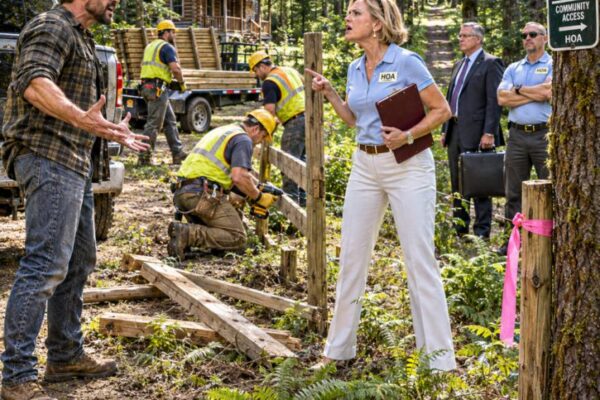
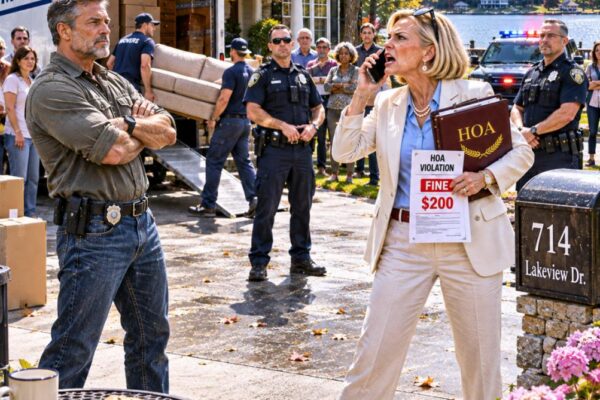
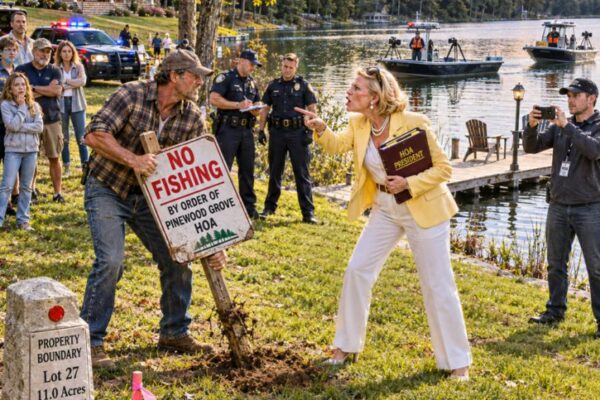
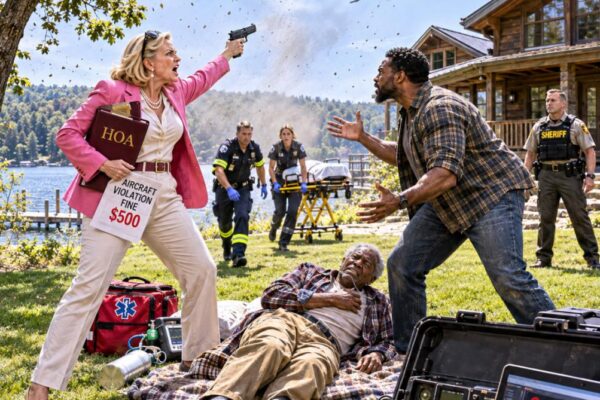
HOA Karen Tried to Steal My Family’s Shoreline and Evict Me—She Thought the Lake Would Obey Her Too.k
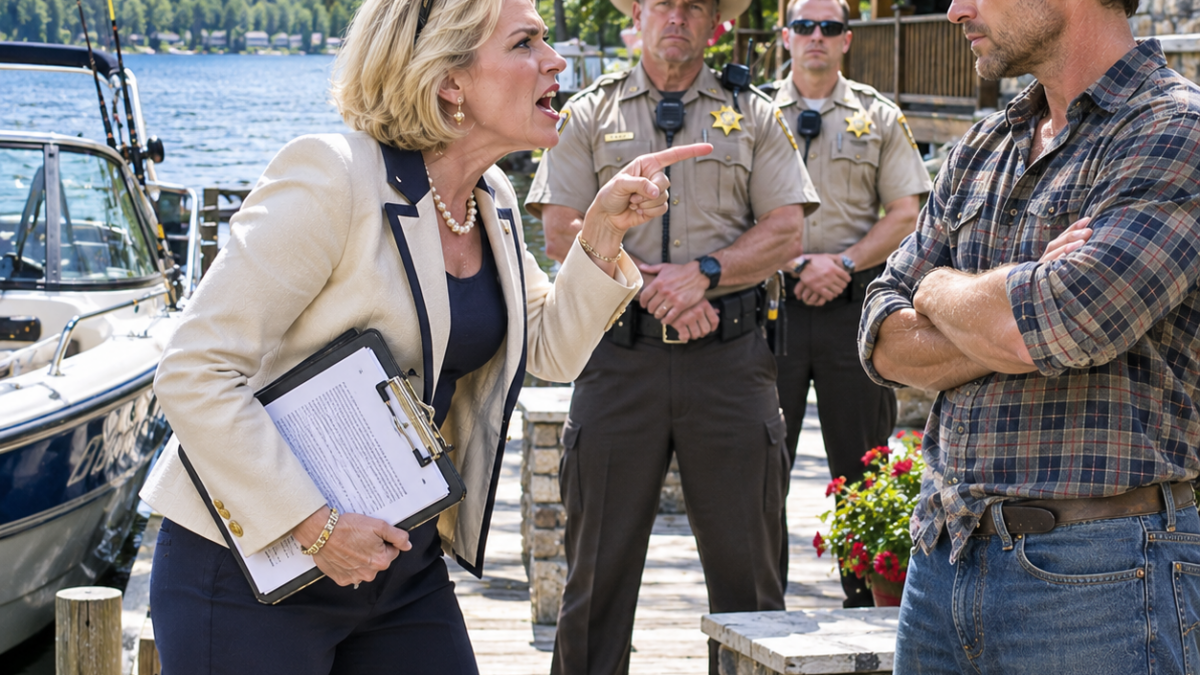
HOA Karen Tried to Steal My Family’s Shoreline and Evict Me—She Thought the Lake Would Obey Her Too
She fenced off the path my family had used for forty years, fined me $8,000, and claimed my home sat on HOA common land.
Then HOA Karen brought police to my driveway with paperwork she insisted gave her the right to force me out.
What she didn’t know was that the lake, the old surveys, and one forgotten engineering file were about to expose what had really been built beneath those eighty-six luxury homes.
“Mr. Harper, nobody is saying you’re under arrest.”
The officer kept his voice calm, which somehow made the three patrol cars behind him feel more serious.
Rain ticked against his uniform.
Behind him, Evelyn Shaw stood beneath a black umbrella in a cream trench coat and heels that kept sinking into the mud beside my driveway.
She was holding a red folder against her chest.
My house.
My driveway.
My rain.
And somehow she looked like I was the intruder.
“I understand that,” I said. “So why are you telling me to leave my own home?”
The younger officer glanced at Evelyn.
“She’s provided documents indicating the shoreline parcel may belong to the Willow Creek association.”
“May?”
Evelyn stepped forward.
“There’s no may about it. His family was allowed to occupy that structure under the old lake agreement. That permission has been revoked.”
I stared at her.
“My father bought this parcel in 1981.”
“Your father occupied it.”
“Bought it.”
She smiled.
Not warmly.
“We’ve been over this, Lucas.”
Rainwater ran from the hood of my jacket onto the gravel.
Two hundred yards behind us, excavators were sitting idle beside the first row of new luxury homes Evelyn’s development company had pushed up against the lake.
Eighty-six homes.
Concrete patios.
Retaining walls.
Fresh sod.
And drainage channels so narrow I had photographed them because I couldn’t believe anyone had approved them.
The lake had already turned brown from runoff.
Three dead fish had washed against my dock that morning.
Now Evelyn was trying to remove me before the storm arrived.
I held out my hand.
“Show me the recorded instrument.”
She didn’t move.
“The deed, Evelyn.”
“I don’t take legal instructions from a handyman.”
That one landed exactly where she intended.
For twenty years, I had repaired electrical systems, pumps, docks, irrigation lines, and half the old structures around Willow Creek.
That didn’t make me an attorney.
It also didn’t make my deed disappear.
The senior officer spoke.
“Mr. Harper, do you have proof of ownership?”
“Inside.”
Evelyn snapped, “He’s already had opportunities to provide it.”
I looked at him.
“Come with me.”
She stepped between us.
“No one enters. The structure is under association control pending removal.”
The officer’s expression changed.
Not dramatically.
Enough.
“Ma’am, you don’t control whether I look at his documents.”
Her jaw tightened.
Thunder rolled across the lake.
I went inside and returned with a fireproof envelope.
Deed.
Title policy.
Survey.
Tax records.
The officer studied the first page.
Then the second.
Evelyn’s confidence finally flickered.
But I wasn’t watching her anymore.
I was watching the lake.
The water had climbed another inch against the old stone marker near my dock.
That marker had been there since I was a kid.
My father used to check it every storm.
I suddenly remembered the metal box I had found beneath his workbench two nights earlier.
Old blueprints.
Handwritten elevations.
A flood-control map nobody in Evelyn’s project seemed to know existed.
And one line in my father’s handwriting:
IF THEY EVER BUILD PAST THIS LINE, THE LAKE WILL TAKE IT BACK.
I looked at the new homes.
Then at the storm.
Then at the officer.
“Before anybody makes me leave,” I said, “you need to call the county engineer.”
Evelyn laughed.
“Why?”
A deep mechanical groan came from somewhere beneath the lake.
Her smile vanished.
Because I knew that sound.
My father had taught me what it meant forty years ago.
And the water was still rising.
part 2
I did not build Willow Creek Lake.
That is the first thing people later got wrong.
My father did not build it either.
The lake existed long before the houses, before the HOA, before Evelyn Shaw ever saw it as a backdrop for luxury real estate.
What my father helped build was the infrastructure that kept the lake from becoming dangerous.
His name was Daniel Harper.
Civil engineer.
The kind who trusted concrete more than people and could look at a drainage ditch for thirty seconds before announcing who had designed it badly.
He worked for the county during the 1970s and early ’80s, when Willow Creek was still mostly farmland and woods.
The lake was natural in origin but had been modified decades earlier with a low control structure and drainage channels to stabilize seasonal water levels.
By the time my father joined the county, the system needed modernization.
He helped redesign the overflow route.
Emergency spillway.
Subsurface culverts.
Relief channels.
Monitoring points.
Not a magical secret valve capable of summoning an underground ocean.
That part of the story grew online later because people prefer revenge involving giant levers.
The real system was more interesting.
And more dangerous.
The lake had always had somewhere to go.
Until Evelyn started building houses on it.
My parents bought our parcel in 1981.
Fourteen acres then.
Over time, they sold off several upland pieces but kept the house, workshop, shoreline, and roughly six wooded acres.
The deed was clean.
Recorded.
Taxes paid every year.
No HOA membership.
No common-land designation.
Willow Creek Estates did not even exist when my parents purchased it.
The HOA subdivision came later, wrapping around our old parcel without absorbing it.
That fact would become very important.
My father died nine years before Evelyn’s project began.
Heart attack.
Quick.
Unfair.
My mother followed four years later after cancer.
I inherited the house.
By then I had spent most of my adult life teaching high-school engineering and doing repair work during summers because apparently standing in front of teenagers eight months a year had not given me enough exposure to chaos.
I loved that house.
Not because it was impressive.
It wasn’t.
One story.
Stone chimney.
Old pine floors.
A workshop that leaned slightly because my father insisted it did not.
The lake was the valuable part emotionally.
Mornings with him at the dock.
Learning to cast.
Learning to repair pumps.
Learning that water always follows physics, never promises.
He used to say:
“People negotiate. Water calculates.”
I thought it was one of those father sayings designed to sound profound.
Turns out he meant it literally.
For decades, nothing dramatic happened.
The lake rose in storms.
Overflowed into the wet meadow on the eastern side.
Relief culverts carried excess water under the old access road into a broad seasonal drainage basin.
Then levels fell.
That basin looked useless most of the year.
Dry grass.
Mud.
Frogs.
Nobody took photographs of it.
Developers hate land that appears to be doing nothing.
Evelyn Shaw saw eighty-six houses.
I first met her on a Tuesday morning at 6:40.
Bulldozers woke me.
I walked outside in pajama pants and boots to find three excavators, two dump trucks, and a survey crew working less than three hundred yards from my property line.
The wet meadow was being scraped.
Trees were down.
Orange stakes marked future streets.
A temporary sign read:
WILLOW CREEK RESERVE
LUXURY WATERFRONT LIVING
COMING SOON.
I stood there with coffee in one hand wondering when “coming soon” had become “already excavating.”
Then I saw Evelyn.
Perfect gray suit.
White hard hat.
Heels.
No joke.
Actual heels on an active construction site.
She stood beside a black SUV talking to the superintendent.
I walked over to the edge of my parcel.
“Excuse me.”
She looked at me.
“Can I help you?”
“I’m Lucas Harper. I live next door.”
Recognition.
Instantly.
“Of course.”
That bothered me.
“You know me?”
“I know the adjoining owners.”
“What are you building?”
She smiled toward the sign.
“Willow Creek Reserve.”
“On the flood meadow?”
Her smile changed.
“On our property.”
“That wasn’t my question.”
She came closer.
“We have approvals.”
“From who?”
“The appropriate authorities.”
Engineers learn to hate that phrase.
“Do you have floodplain approval?”
“Yes.”
“Wetlands?”
“Yes.”
“Stormwater?”
“Lucas.”
The use of my first name irritated me.
“We are fully permitted.”
Behind her, an excavator dragged a bucket through saturated soil.
Brown water poured into a temporary trench heading toward the lake.
“Your erosion controls are failing.”
“The contractor has it managed.”
“There’s sediment entering the water.”
She looked.
Barely.
Then back at me.
“This project is going to increase values for everyone around this lake.”
“I didn’t ask for my value increased.”
“You’ll appreciate it when you sell.”
“I’m not selling.”
That was the first moment her expression hardened.
Not much.
Enough.
“Everyone says that.”
“I’m not everyone.”
She smiled.
“Eventually people make practical decisions.”
I looked at the machines.
“Sometimes.”
Then I went home and called the county.
The county had permits.
That surprised me.
Preliminary grading.
Stormwater plan.
Road layout.
Development approval.
I requested records.
Not because I suspected conspiracy.
Because I teach engineering.
Large machines moving soil beside a lake automatically become my business if that lake is fifty yards from my kitchen.
The plans showed eighty-six homes.
High-end.
Small lots.
Private roads.
Retaining structures.
A stormwater pond near the southeastern boundary.
The old flood meadow had been reclassified in the submitted engineering report as low-risk seasonal saturation area.
That phrase bothered me.
I remembered standing there as a child during Hurricane Gloria’s remnants.
Water had covered half the meadow.
My father had taken me there afterward.
“That,” he said, pointing at flattened grass, “is why nobody builds there.”
I was eleven.
The submitted report said otherwise.
I told myself memory is not engineering evidence.
Then I found old photographs.
My father standing knee-deep beside a survey marker.
The wet meadow behind him full of water.
I sent a copy to county planning.
No response for nine days.
Then:
Thank you. Development plans have been reviewed by licensed professionals and approved under current requirements.
Fine.
Maybe the newer analysis was better.
Maybe drainage upgrades made construction feasible.
I was not automatically right because my father once disliked the idea.
Then the fish started dying.
Not hundreds.
Five one morning.
Three another.
Sediment clouded the cove.
I photographed everything.
Reported it.
The contractor installed better silt barriers.
Water improved.
That should have reassured me.
Instead, Evelyn visited.
She came carrying cookies.
That detail gets reversed when people tell the story.
I did not bring her cookies.
She brought me cookies.
A perfect white box tied with blue ribbon.
“I think we got off on the wrong foot.”
I looked at the box.
“Is this bribery?”
She laughed.
“Neighbor diplomacy.”
I let her onto the porch.
She looked around.
“Beautiful view.”
“Always has been.”
“This could be spectacular.”
“It already is.”
She ignored that.
“We’re designing a continuous shoreline experience.”
“What does that mean?”
“Walking paths. Landscaped transitions. Unified fencing.”
“On your land?”
“Primarily.”
That word.
“Primarily?”
She sat.
“Your parcel interrupts the shoreline.”
“I was here first.”
“I know.”
“We would consider purchasing.”
“No.”
“You haven’t heard a number.”
“No.”
“We can be generous.”
“Still no.”
Her smile remained.
“Lucas, maintaining an isolated older parcel inside a premium development can become difficult.”
“How?”
“Visual standards.”
“I’m not in your HOA.”
“Access.”
“My road is public.”
“Utilities.”
“Independent accounts.”
“Shoreline coordination.”
“What does that mean?”
Her smile disappeared.
“You really enjoy making things hard.”
“No. I enjoy nouns meaning something.”
She left the cookies.
They were excellent.
The threats started a month later.
First, a letter from Willow Creek Estates HOA.
UNAPPROVED SHORELINE FEATURE.
My dock.
Built in 1994.
Permitted.
Not in their HOA.
I responded:
Please provide evidence that my parcel is subject to your declaration.
No response.
Next:
UNAUTHORIZED LANDSCAPE WATER FEATURE.
My father’s koi pond.
Eight thousand dollars.
I laughed until I saw they had attached a “continuing penalty schedule.”
Then I called an attorney.
Melissa Grant.
Real-estate and land-use specialist.
She reviewed everything.
“Your property is not in this HOA.”
“I know.”
“I’m confirming.”
“Good.”
“Do not pay.”
“I wasn’t going to.”
“Do not attend their violation hearing as though you accept jurisdiction.”
“Okay.”
“Send a denial through me.”
She did.
The HOA’s regular counsel responded two weeks later.
His letter was cautious.
He had not issued the fine.
The board had.
He requested additional time to review historical annexation records.
Then the fine vanished.
I thought that would end it.
Instead, barriers appeared.
Eight-foot temporary fencing along the construction side.
Legal on their parcel.
Except it crossed the old footpath my family had used to reach the northern inlet.
That path was partly on my land.
Survey stakes proved it.
I sent photographs.
Melissa sent a demand.
Fence moved sixteen feet.
Then cameras appeared.
Construction security.
Again, legal if pointed at their site.
One was aimed directly toward my dock.
Melissa objected.
They re-angled it.
Every problem ended with Evelyn losing a few feet.
Every loss made her more determined.
Then power problems began.
My electricity flickered twice during utility relocation for the new development.
Could have been construction.
Could have been ordinary outages.
I reported them.
One afternoon, my water pressure dropped to nothing.
Utility company found a valve closed near the road after contractors had worked nearby.
No proof Evelyn ordered it.
I refused to claim she did.
But when she appeared the next day and said:
“These infrastructure conflicts are exactly what I warned you about,”
I started documenting more carefully.
Then came Frank Collins.
Frank served on the new HOA board.
Retired accountant.
One of Evelyn’s strongest public supporters.
I disliked him on principle until he appeared at my porch after dark.
No car.
Walked.
“Can we talk?”
“About?”
“The project.”
I let him in.
He sat at my kitchen table.
“My son is a drainage engineer.”
“Okay.”
“I showed him the plans.”
That got me.
“Why?”
“Because you keep complaining about flooding.”
“I keep asking questions.”
“He says you may be right.”
Frank opened a folded copy of an older survey.
Red lines.
Blue shading.
Original flood storage area.
The wet meadow.
Almost exactly where the first forty homes were being built.
“Where did this come from?”
“Old county archive copy. My son found reference to it in a prior drainage study.”
I looked at the date.
My father’s era.
“Has the county seen this?”
“Current county?”
“I assume not.”
“Why?”
“Because it isn’t cited in the developer’s flood analysis.”
My pulse changed.
“How is that possible?”
Frank looked sick.
“That is what I want to know.”
I called Melissa.
She called an environmental engineer.
We hired him privately.
Dr. Samuel Ortiz.
No mystery.
No secret conspiracy expert.
Just a licensed civil engineer who specialized in hydrology and stormwater.
He reviewed the old map, new plans, rainfall assumptions, detention pond design, and elevation data.
Then he drove the site.
Three days later, he sat at my table.
“This needs a closer look.”
“Meaning?”
“The new development appears to rely heavily on modeled drainage assumptions that do not match some of the historical flood-storage mapping.”
“Is it unsafe?”
“I did not say that.”
Lawyers and engineers should form a club devoted to disappointing dramatic people.
“What did you say?”
“I said a regulator needs to review the discrepancy.”
“Could eighty-six homes flood?”
“In a sufficiently severe event, almost any development can flood.”
“Sam.”
He pointed toward the map.
“I’m concerned the project reduced natural flood-storage capacity faster than the replacement detention infrastructure came online.”
That was bad enough.
We sent his report to county engineering.
And the state environmental agency.
Construction continued.
That infuriated me.
But regulators do not stop multimillion-dollar projects because one homeowner delivers a report on Tuesday.
They review.
They ask.
They compare.
Sometimes slowly.
Then Greg Nolan knocked on my door.
Greg had been assistant site superintendent.
Had.
He looked like he had not slept.
“I quit.”
“Congratulations?”
He handed me a folder.
“I think you need this.”
I did not take it.
“Why me?”
“Because nobody else is listening.”
That sentence makes every lawyer nervous.
I called Melissa before opening anything.
Greg met us at her office.
The records were copies he was lawfully entitled to retain or had received in his work, according to him. Melissa warned him not to provide stolen privileged material.
What remained was enough.
Internal construction emails.
Quality-control reports.
Drainage inspection photographs.
Requests for corrective work.
One memo from the project engineer warned that temporary grading had obstructed an existing relief swale before the permanent stormwater system was fully functional.
Another email showed Evelyn pushing to delay corrective excavation until after several model homes were completed.
Reason:
Marketing appearance.
That did not prove bribery.
It proved risk.
Then Greg produced inspection correspondence.
A consultant had flagged inadequate compaction near a retaining area.
Another noted sediment controls repeatedly failing.
Evelyn responded to one email:
We cannot keep stopping work every time someone finds theoretical water concerns.
Dr. Ortiz read that sentence.
He looked at me.
“Water concerns become less theoretical when it rains.”
Then I found my father’s metal box.
I had gone into the workshop looking for old property surveys.
Behind a cabinet sat a rusted document case with DANIEL HARPER written in marker.
Inside were drawings from the late 1970s.
County drainage study.
Overflow elevations.
Emergency spillway alignment.
Subsurface relief conduit.
Maintenance notes.
One blueprint showed a control structure beneath the eastern lake edge.
Not a secret weapon.
A safety feature.
Its purpose was to redirect extreme overflow toward the undeveloped flood basin during unusually high water.
The new luxury development now occupied much of that basin.
My stomach turned.
At the bottom of one page, Dad had written:
Never obstruct relief corridor.
Another:
Future development must preserve storage volume.
I called Sam Ortiz at midnight.
He came the next morning.
He spread the drawings across my kitchen table.
“Where did you get these?”
“My father.”
“This project predates current digital records.”
“Are they useful?”
“If authentic, very.”
“Can the old system still function?”
“Maybe.”
“Meaning?”
“It may still move water through alignments the new developer did not fully account for.”
That was the moment the whole story changed.
The lake did not have a revenge valve.
It had old infrastructure.
Infrastructure nobody should have forgotten.
We sent copies immediately to the county and state.
Construction slowed two days later.
Not stopped.
Slowed.
Inspectors arrived.
Survey crews rechecked elevations.
Evelyn became frantic.
That was when she tried to remove me.
The fake HOA claim that my parcel was common land came from an old plat notation she twisted beyond recognition.
The original subdivision documents showed a proposed shoreline easement that had never been granted across my parcel.
Evelyn presented the proposal as though it were effective.
She called police after I refused to leave during a supposed “site control transition.”
That was the confrontation from the beginning.
The officers did not evict me.
They could not adjudicate a complicated property dispute from a driveway.
Once they saw my recorded deed and title documentation, the senior officer told Evelyn:
“This appears civil.”
She said:
“He’s trespassing on association land.”
The officer looked around.
“He has tax records, a recorded deed, and a driver’s license showing he lives here.”
“My attorney says—”
“Then your attorney can take it to court.”
She went white.
No handcuffs.
No forced relocation.
No police conspiracy.
Just a line she could not cross by yelling harder.
Then thunder rolled.
And I heard the groan beneath the lake.
Sam Ortiz arrived twenty-eight minutes later.
County engineer ten minutes after him.
The storm had strengthened unexpectedly.
Rainfall rates exceeded the forecast.
The lake level rose.
Not because I opened anything.
I never touched the old control structure.
That matters.
Deliberately manipulating a flood-control system to destroy eighty-six homes would not have been justice.
It would have been a crime, and potentially something much worse.
What happened was frightening enough without sabotage.
The old relief system activated the way it had been designed to.
Water sought the lowest available routes.
Except several routes had been narrowed.
Filled.
Redirected.
One culvert remained partially obstructed by temporary construction material.
The new detention pond was incomplete.
Dr. Ortiz stood beside the county engineer watching the gauge.
“This is going over.”
“Where?”
Ortiz pointed toward Evelyn’s development.
“The historic basin.”
Evelyn heard him.
“No.”
He looked at her.
“That land was flood storage.”
“Our engineers approved the site.”
“I’m not debating approvals right now.”
She grabbed his arm.
“You stop it.”
He pulled free.
“Water does not take instructions.”
That sounded exactly like my father.
County emergency management began notifying residents.
Not all eighty-six homes were occupied yet.
Only thirty-two had closed.
Others were under construction or used as models.
Those residents were told to evacuate low-lying units as a precaution.
Fire department came.
Police blocked the construction road.
Utility crews shut off power to vulnerable sections.
Nobody waited for the lake to become dramatic.
That saved people.
The first overtopping happened near 11:20.
Water crossed a landscaped berm behind the eastern row.
Then entered two unfinished lots.
Then another.
By noon, three completed backyards were underwater.
By one, basement-level garages in several homes had taken water.
Construction equipment sat in brown water up to axles.
The sight made me sick.
Even knowing what Evelyn had done.
Families lived there.
People had bought those houses believing professionals had protected them.
I did not feel victorious.
I felt angry.
Evelyn arrived at my property soaked.
“This is because of your father’s system.”
“No.”
She stared.
“He built those channels.”
“To keep the lake from killing people.”
“They’re flooding my project.”
I looked at her.
“Your project is sitting where the water was designed to go.”
She shook her head.
“No.”
Frank Collins walked up behind her.
“I warned you.”
She turned.
“You approved this.”
“I approved what you told us was permitted and safe.”
“You were on the board.”
“And now I’m telling you we need evacuation, not arguments.”
Evelyn looked toward the new homes.
For the first time since I met her, she looked small.
The storm lasted until evening.
By then, eleven occupied homes had some water intrusion.
More unfinished structures were damaged.
Several garages flooded.
Landscaping was destroyed.
Retaining walls failed in two locations.
No one died.
No one was seriously injured.
That is the part I care about most.
The internet later turned it into:
EIGHTY-SIX LUXURY HOMES DESTROYED.
False.
Eighty-six homes were planned.
Many were affected by the investigation.
A smaller number actually flooded.
Still millions in damage.
Still devastating.
Still enough to trigger every question Evelyn had spent months trying to avoid.
The county issued a stop-work order the following morning.
State environmental regulators opened enforcement reviews.
The developer’s lenders demanded technical reports.
Insurers sent engineers.
Homeowners hired lawyers.
Nobody called it an act of God and walked away.
Modern insurers investigate.
So do banks.
So do regulators when historical infrastructure suddenly appears beneath a project that was supposed to be safe.
Dr. Ortiz’s report became central.
So did my father’s drawings.
The county archives eventually located matching microfilm records.
That authenticated them.
No miracle.
No family legend.
Records.
The historical floodplain analysis showed the eastern meadow had been treated as overflow storage.
The modern development’s engineering package referenced newer flood modeling but did not adequately reconcile several older drainage features.
Investigators then examined how the project received approval.
That is where Evelyn’s problems became more serious.
She had not secretly bought the entire lake.
Her development company had lawfully purchased several large parcels beside it.
What she had done was oversell the certainty of what those parcels could support.
Internal emails showed pressure on consultants.
Pressure to minimize delays.
Pressure to treat historic mapping as obsolete.
Pressure to keep construction moving while drainage questions remained.
One engineer had formally recommended additional hydrologic modeling before final buildout.
His recommendation was downgraded in later summaries.
Who changed the language became a major issue.
Then came the alleged bribes.
The source version turned every irregularity into bribery.
Reality was narrower.
One planning consultant had an undisclosed financial relationship with a subcontractor used by Evelyn’s development company.
A county employee accepted gifts from a firm connected to the project in violation of ethics rules.
Investigators found improper conduct.
They did not uncover an entire city government on Evelyn’s payroll.
That would have made a better movie.
It would have made a worse truth.
The environmental violations were easier.
Repeated sediment-control failures.
Work before certain inspections were complete.
Unauthorized fill within areas later determined subject to additional review.
Penalties followed.
Then the HOA finances.
Willow Creek Reserve had already created its homeowners association while construction was ongoing.
Evelyn controlled the developer-appointed board.
That is common in new developments until turnover thresholds are met.
What was not common was using that position to pressure me, a nonmember, through fines she had no authority to issue.
The $8,000 koi-pond penalty had no legal foundation against my parcel.
The shoreline notices were void.
The common-land claim was unsupported.
Her attorney eventually admitted as much in writing.
Melissa framed the letter.
Not literally.
I considered it.
Then homeowners inside the new development started comparing documents.
What they found caused another wave.
Marketing materials described robust flood protection.
Purchase packets contained generalized disclosures about waterfront conditions but not the specific historic overflow corridor that had become central to the investigation.
Whether those omissions legally constituted fraud depended on each transaction and what the seller knew when.
The homeowners sued.
Class certification became a fight.
Some claims settled.
Others continued individually.
I was not part of that litigation.
My case was simpler.
Trespass.
Interference with property rights.
Invalid HOA enforcement.
Damage from fencing and construction encroachment.
Utility interference where documented.
Melissa negotiated.
I received compensation.
Legal costs.
Survey costs.
Property repair.
No giant revenge jackpot.
The important part was a recorded boundary and easement agreement confirming that my parcel remained separate from both HOAs and the new development.
No future president could resurrect Evelyn’s fiction.
The old access route was restored within its lawful alignment.
The cameras were moved.
The eight-foot fence came down along my side.
Then Evelyn lost control of the development.
Not overnight.
Banks do not repossess an empire because Twitter gets angry.
Her development company entered a restructuring after construction stopped and lawsuits multiplied.
Investors replaced management.
Evelyn was removed from operational authority.
Several parcels were sold.
The unfinished project was redesigned.
A large portion of the eastern basin could no longer support the original density once regulators required updated flood modeling.
The revised plan removed twenty-four proposed homes.
Several damaged structures were demolished rather than repaired.
Others were elevated or redesigned with additional flood protection.
New drainage corridors were created.
The detention system expanded.
It cost everyone.
Developers.
Insurers.
Buyers.
Banks.
The county.
That is why I never called the flood a victory.
Bad development decisions do not punish only the person who made them.
They punish families who trusted the brochure.
Workers who lose jobs.
Taxpayers who fund emergency response.
Neighbors who live beside mud for two years.
Nature does not perform targeted revenge.
Water does not know who deserves what.
My father understood that.
That is why his old notes bothered me after the story became public.
People loved one line:
THE LAKE WILL TAKE IT BACK.
They put it on social media.
Made graphics.
Turned Dad into some prophet of natural vengeance.
That was not who he was.
I found the rest of the page later.
The complete note said:
If they ever build past this line without preserving equivalent storage, the lake will take it back during a severe event. Water volume must go somewhere. Do the math before politics.
Much more like Dad.
No poetry without an engineering lecture.
I gave the original to the county archive after scanning it.
The restoration took years.
Not because I became some secret Lake Guardian.
Because dozens of professionals worked.
Hydrologists.
Civil engineers.
Environmental scientists.
Construction crews.
Wetland specialists.
Surveyors.
County staff.
State regulators.
Homeowners.
Attorneys.
Banks.
Even developers.
The eastern edge became a permanent open-space flood corridor again.
Native grasses returned.
Additional wetland buffers were planted.
New culverts were built.
The old relief channel was inspected and rehabilitated where necessary.
The obsolete portions were replaced with modern structures.
No hidden valve remained waiting for me to unleash justice.
I was relieved.
Systems nobody remembers are dangerous systems.
The old infrastructure was mapped.
Documented.
Inspected.
Assigned to an actual maintenance authority.
That may be the best outcome of the entire story.
Frank Collins became one of the loudest voices for transparency.
He resigned from the development HOA board during the investigation.
Later, after homeowners gained control, they elected him again.
I teased him.
“You enjoy suffering.”
“I enjoy finishing what I helped mess up.”
Fair.
The new board published engineering reports.
Reserve studies.
Inspection schedules.
Flood maps.
People complained the website had too many documents.
I told Frank that was beautiful.
The HOA eventually changed its name.
Willow Creek Reserve had become too associated with Evelyn.
Residents chose Lakeview Commons.
I thought the new name sounded like an apartment complex.
They did not ask me.
Good.
I was not a member.
Old Ben remained my neighbor through all of it.
He was the one person who remembered my father’s drainage work firsthand.
The night before the big storm, he had brought soup and an old lantern when my power was intermittent.
The source version turned that into him encouraging me to open a secret flood valve.
He would have hit me with the lantern if I suggested such a thing.
Ben understood water.
He had worked excavation with Dad.
When I showed him the blueprint, he said:
“Don’t touch a damn thing.”
That was his exact advice.
“Call the county.”
“I already did.”
“Call again.”
“I did.”
“Then call somebody who scares the county.”
“That is not a job title.”
“Lawyer.”
Fair.
Ben became useful during the investigation because he remembered where old drainage markers had been.
Memory alone was not evidence.
But it helped engineers locate buried structures and compare maps.
One afternoon, he stood beside the restored flood meadow watching crews plant native willow.
“Dan would like this.”
“You think?”
“He’d complain first.”
“Definitely.”
“Then like it.”
I smiled.
That sounded right.
Evelyn did eventually face criminal charges.
Not for causing the flood.
Not for attempted eviction.
Those remained mostly civil and regulatory matters.
The criminal case involved falsified records submitted in connection with certain project certifications and financial representations investigators concluded she knowingly approved.
One county employee faced separate ethics and false-record charges.
A consultant surrendered a professional license after disciplinary proceedings.
Again, narrower than rumor.
Evelyn negotiated a plea.
Financial penalties.
Restitution tied to specific offenses.
Probation with a period of confinement under the sentence.
Professional restrictions.
She lost control of the development company long before the criminal case ended.
By the time sentencing arrived, she looked nothing like the woman who stood beside the bulldozers telling me:
This is our land now.
She spoke.
I did not expect her to.
“I thought opposition meant ignorance.”
That caught my attention.
She continued.
“Every time somebody questioned the project, I assumed they didn’t understand development.”
Then she looked toward the judge.
“When engineers raised concerns, I treated them like obstacles.”
My father would have hated her for that sentence alone.
“When Mr. Harper raised history, I treated it like nostalgia.”
She paused.
“I believed modern money and modern engineering had made old warnings irrelevant.”
That was probably the closest she ever came to understanding the whole failure.
The judge did not sentence her for arrogance.
Courts sentence offenses.
Still, the statement mattered to me.
Years later, she wrote me.
Not from prison.
After completing the custodial portion of her sentence and while under supervision.
The letter was short.
Lucas,
I owe you an apology for trying to use the HOA and police to pressure you off your property.
There is no explanation that makes it acceptable.
I also owe your father one, though I know that sounds ridiculous.
I spent years thinking old maps were obstacles to progress. I understand now that they were records of consequences.
I hope the lake is healthy.
Evelyn.
I read it twice.
Then put it in my father’s metal box.
I did not answer immediately.
Months later, I sent one line.
The lake is healthy.
That was enough.
I never wanted her destroyed.
I wanted her stopped.
Those are different desires.
Anger can blur them.
For a while after the flood, I enjoyed watching her lose control.
I would be lying if I denied it.
She had bullied me.
Threatened my home.
Tried to misuse police.
Dismissed my father’s work.
Seeing regulators walk past her while she demanded answers felt satisfying.
Then I met the Garcias.
They had bought house number fourteen.
Young couple.
Two children.
First expensive home they had ever owned.
Their finished basement took twenty inches of water.
Insurance covered part.
Not all.
They lived in a hotel for seven weeks.
Mrs. Garcia cried when she told me:
“We asked about flooding.”
That stripped the revenge out of the story.
Evelyn’s downfall did not make their losses disappear.
Justice had to mean more than watching the person at the top suffer.
It had to mean making the system less likely to fail again.
That became my role.
Not Lake Guardian.
I hate that nickname.
A reporter used it once.
Students at school found the clip.
For six months, whenever I entered class, somebody hummed superhero music.
Teenagers are cruel.
I did help with the restoration advisory group.
Voluntary.
No special title.
I brought historical records.
Helped engineers interpret my father’s notes.
Explained basic hydrology at public meetings in language homeowners could understand.
Frank handled finances.
Ben complained.
Melissa kept everyone from accidentally signing away something important.
Dr. Ortiz became the technical lead.
My students even got involved through school.
Not at the active construction site.
We created a watershed-monitoring project.
Rain gauges.
Water-level sensors.
Turbidity measurements.
Students collected data under supervision and compared storm response before and after restoration.
That became the legacy I actually liked.
My father’s old lesson became a lab.
Water calculates.
The kids learned why.
Rain falls.
Some infiltrates.
Some runs off.
Impervious surfaces increase runoff.
Storage areas matter.
Drainage capacity matters.
Elevation matters.
No villain required.
Physics is enough.
One student asked:
“So if they had listened to your dad, none of this happens?”
“No.”
He looked confused.
“No?”
“Because we don’t know what else might have happened.”
“But the flood?”
“The development could have been engineered safely in a different configuration.”
“So your dad wasn’t against houses?”
“Dad was against pretending water disappeared.”
That distinction matters.
The revised development proved it.
Homes remained.
People returned.
The neighborhood did not have to be erased to save the lake.
It had to be redesigned around reality.
That is better than revenge.
Five years after the storm, the eastern flood corridor is green again.
Wildflowers.
Willow.
Cattails.
Birds.
Frogs loud enough to destroy the concept of peace every spring.
The repaired subdivision sits farther back.
Stormwater ponds are larger.
Homes closest to the water have stricter elevation requirements.
Emergency routes are marked.
Flood information is included prominently in resale disclosures.
No one has to discover a 1978 blueprint in a rusty box to understand the system.
That is progress.
The lake itself recovered.
Fish populations returned.
Water clarity improved after sediment controls and shoreline restoration.
I restocked my father’s koi pond too.
That was personal.
The HOA never apologized for the eight-thousand-dollar fine because technically the development-era HOA was replaced during restructuring.
Frank apologized anyway.
He came over carrying a document.
“What?”
“Formal acknowledgment.”
“From who?”
“New board.”
“I’m not in your HOA.”
“We know.”
The letter said exactly that.
Lucas Harper’s parcel is not subject to Lakeview Commons HOA jurisdiction.
Recorded survey attached.
I laughed.
“You spent board money to tell me something my deed already says?”
“Twenty-eight dollars in postage and recording copies.”
“Wasteful.”
“Frame it.”
I did.
It hangs inside my workshop.
Beside Dad’s old level.
My relationship with the police changed too.
The senior officer from the driveway confrontation was named Carl Mendoza.
He stopped by months later.
Off duty.
No patrol car.
“I wanted to apologize.”
“For what?”
“We almost told you to leave.”
“You didn’t.”
“We suggested temporary relocation while things were clarified.”
“I remember.”
“We shouldn’t have.”
I appreciated that.
“You had a woman waving official-looking paperwork.”
“We still should’ve slowed down.”
“You did eventually.”
He nodded.
Then looked toward the lake.
“You know she called dispatch claiming there might be violence if you refused?”
“No.”
“She said you were unstable.”
I laughed.
“Based on?”
“She said you’d been obsessively documenting the project.”
“That part is true.”
Carl smiled.
“Documentation isn’t a threat.”
“No.”
The department later used the incident in civil-dispute training.
Not because it was scandalous.
Because property claims can look official while remaining civil.
Officers were reminded not to enforce an HOA’s ownership assertion as though it were a court order.
That reform mattered.
Evelyn had believed a folder and confidence could make the police do the legal work for her.
It nearly worked.
Authority should have a source.
That became the theme of my life whether I wanted one or not.
HOA authority.
Development authority.
Permit authority.
Police authority.
Engineering certification.
Every one of them needs an actual source and an actual limit.
My father understood that physically.
You do not tell water where it belongs because a map looks expensive.
You give it a safe path consistent with elevation, volume, and gravity.
Human systems need the same humility.
That is what Willow Creek lacked.
Everyone kept assuming the next person had checked.
Planning assumed engineering addressed old flood records.
Engineering assumed mapping had captured relevant historical structures.
Contractors assumed approvals meant site conditions were resolved.
Buyers assumed permits meant zero meaningful flood risk.
Police assumed HOA paperwork might reflect legitimate authority.
Board members assumed Evelyn’s lawyers had reviewed her actions.
Each assumption transferred responsibility forward.
Until the lake ran out of places to transfer water.
That is how disasters happen.
Not one villain pulling a lever.
A chain of people who stop checking.
I know that ending frustrates people.
They want the valve.
They want me in scuba gear under lightning.
They want Evelyn screaming while I turn a rusted wheel and unleash nature on eighty-six mansions.
That version would make me a criminal.
It would also destroy the most important lesson.
I did not need to flood her project.
She had already built the project where flooding could occur.
All I had to do was find the records, preserve the evidence, and force professionals to look again.
The storm did the rest.
Nature was not on my side.
Nature does not take sides.
It follows conditions.
That is more frightening.
And more useful.
My students eventually stopped calling me Lake Guardian.
Mostly.
One graduation class gave me a plaque.
MR. HARPER
GUARDIAN OF TORQUE AND QUESTIONABLE DRAINAGE DECISIONS
I keep that one too.
A few years after restoration finished, I took the original blueprint to the lake.
Not underwater.
I am not insane.
I stood at the dock with a laminated copy.
The old control structure had been replaced.
Modernized.
Sensors.
Inspection access.
Remote monitoring.
No mystery.
The county engineer showed me the new system.
“You want to see the control interface?”
I laughed.
“What?”
“Nothing.”
He opened the cabinet.
Water-level telemetry.
Gate status.
Alarm thresholds.
Everything labeled.
Everything documented.
My father would have loved it.
Probably would have complained about the panel layout.
I stood there longer than necessary.
Then I walked home.
At sunset, light crossed the lake exactly as it had when I was a child.
Some of the new homes were visible through trees.
Families on decks.
Children near the trail.
People who had nothing to do with Evelyn’s arrogance.
I was glad they were there.
That surprised me.
For a long time, I treated every new roof as an insult to my father.
Eventually I understood that preservation does not mean freezing a place in the year you loved it most.
It means change that respects limits.
The repaired development does.
The flood corridor does.
My old house does.
Even I do.
Ben died two winters ago.
Eighty-eight.
He left me his lantern.
Of course.
Inside the box was a note.
Dan would say quit staring at the water and fix something.
So I did.
The dock needed two boards.
I replaced them.
No symbolism.
Just maintenance.
That is what life became after Evelyn.
Maintenance.
Good kind.
Checking drainage after storms.
Cleaning the koi pond.
Teaching students.
Repairing old wiring.
Attending one restoration meeting each quarter and regretting it by minute twelve.
Ordinary.
Exactly what I wanted.
Sometimes reporters still call near the anniversary of the flood.
I usually decline.
One asked:
“Do you believe the lake took revenge?”
“No.”
“Then how would you describe what happened?”
I thought about Dad.
“Gravity won an argument.”
The reporter laughed.
I wasn’t joking.
Evelyn thought money could negotiate with a watershed.
The HOA thought paperwork could negotiate with a deed.
The police almost thought confidence could negotiate with ownership.
I spent months believing I had to defeat all of them.
In reality, I only had to keep dragging each dispute back to what was verifiable.
Where is the boundary?
Where is the recorded easement?
Where is the permit?
Where is the flood study?
Where is the board authority?
Where is the engineer’s warning?
Where does the water go?
Those questions did more than anger ever could.
They also saved me from becoming the kind of man revenge stories celebrate too easily.
When I found Dad’s drawings, I felt powerful.
For one ugly moment, I imagined there might actually be a way to make Evelyn’s development suffer.
That fantasy lasted maybe thirty seconds.
Then I heard Dad’s voice.
Do the math before politics.
He would never have turned flood infrastructure into a weapon.
Neither would I.
Engineering is supposed to protect people from forces they cannot negotiate with.
Not weaponize those forces against people you dislike.
That line matters to me.
Evelyn crossed boundaries because she convinced herself her goal justified it.
I refused to become her mirror.
The next major storm came three years after restoration.
Meteorologists warned us days ahead.
I barely slept the night it arrived.
Rain hammered the roof.
Lake climbed.
Old memories came back.
I walked to the stone marker with a flashlight.
Water rose.
Then slowed.
The new overflow corridor filled exactly as designed.
Detention ponds held.
Sensors triggered.
Controlled discharge moved through the restored channel.
No homes flooded.
Not one.
At 2:13 a.m., Frank texted:
YOU WATCHING?
I replied:
OF COURSE.
Then:
SYSTEM WORKS.
Three dots appeared.
His answer:
DAN WOULD APPROVE.
I stood in the rain reading that message.
Maybe.
Dad hated approving anything without inspecting it himself.
But I think he would have smiled.
The next morning, the lake was high but calm.
Children eventually came outside.
People walked dogs.
Crews inspected drainage structures.
No television helicopters.
No emergency lights.
No lawsuits.
Just infrastructure doing what it was designed to do.
That was the real ending.
Not Evelyn in court.
Not the flood.
Not the apology.
A storm came.
And nothing terrible happened.
Good engineering rarely gets applause because success looks like nothing.
No collapsed wall.
No flooded basement.
No panicked evacuation.
Nothing.
That morning, nothing felt glorious.
I walked back to my house.
Past the koi pond Evelyn once fined me eight thousand dollars for.
Past the property marker she tried to erase.
Past Dad’s workshop.
Inside, his rusty metal box sat on the shelf.
I opened it.
The original drawing remained there.
Emergency overflow corridor.
Storage basin.
Relief structure.
Everything Evelyn had once treated as outdated inconvenience.
I ran my finger across Dad’s handwriting.
Water volume must go somewhere.
That was the sentence I remembered.
Not the dramatic one.
Not the lake taking anything back.
The simple engineering truth.
Water must go somewhere.
So must power.
If you concentrate it in one person, it finds weak places.
If nobody builds relief into the system, pressure grows.
Evelyn had controlled the development company, the developer-appointed HOA, the narrative, the violations, and nearly the police response.
Too much authority.
Not enough relief.
Eventually the pressure found every weakness.
Documents.
Engineers.
Homeowners.
Regulators.
Courts.
The system finally opened.
And just like the restored lake, once power had somewhere safe to go, Willow Creek stopped drowning in it.
I still live in my father’s house.
Still beside the lake.
Still outside the HOA.
No luxury gate.
No title.
No nickname I accept.
Just Lucas Harper.
Teacher.
Handyman.
Son of an engineer who left behind better notes than anyone realized.
Sometimes at sunset I stand on the dock and look across at the homes Evelyn built.
Some survived the flood.
Some were rebuilt.
Some lots became permanent open space.
Lights come on in windows.
People cook dinner.
Kids argue.
Dogs bark.
Ordinary life.
I do not look at them and see greed anymore.
I see people.
That may be the greatest thing I recovered.
Evelyn tried to make the lake a battlefield.
For a while, I let her.
Now it is water again.
And when the level rises, nobody waits for the lake to “fight back.”
We check the gauges.
We inspect the channels.
We trust the maps because we know who verified them.
Then we let the system do what my father intended from the beginning.
Protect everyone.
Even the people who once thought they were too powerful to need protecting.
THE STORY ENDS HERE
HOA Karen Tried to Steal My Family’s Shoreline and Evict Me—She Thought the Lake Would Obey Her Too
She fenced off the path my family had used for forty years, fined me $8,000, and claimed my home sat on HOA common land.
Then HOA Karen brought police to my driveway with paperwork she insisted gave her the right to force me out.
What she didn’t know was that the lake, the old surveys, and one forgotten engineering file were about to expose what had really been built beneath those eighty-six luxury homes.
“Mr. Harper, nobody is saying you’re under arrest.”
The officer kept his voice calm, which somehow made the three patrol cars behind him feel more serious.
Rain ticked against his uniform.
Behind him, Evelyn Shaw stood beneath a black umbrella in a cream trench coat and heels that kept sinking into the mud beside my driveway.
She was holding a red folder against her chest.
My house.
My driveway.
My rain.
And somehow she looked like I was the intruder.
“I understand that,” I said. “So why are you telling me to leave my own home?”
The younger officer glanced at Evelyn.
“She’s provided documents indicating the shoreline parcel may belong to the Willow Creek association.”
“May?”
Evelyn stepped forward.
“There’s no may about it. His family was allowed to occupy that structure under the old lake agreement. That permission has been revoked.”
I stared at her.
“My father bought this parcel in 1981.”
“Your father occupied it.”
“Bought it.”
She smiled.
Not warmly.
“We’ve been over this, Lucas.”
Rainwater ran from the hood of my jacket onto the gravel.
Two hundred yards behind us, excavators were sitting idle beside the first row of new luxury homes Evelyn’s development company had pushed up against the lake.
Eighty-six homes.
Concrete patios.
Retaining walls.
Fresh sod.
And drainage channels so narrow I had photographed them because I couldn’t believe anyone had approved them.
The lake had already turned brown from runoff.
Three dead fish had washed against my dock that morning.
Now Evelyn was trying to remove me before the storm arrived.
I held out my hand.
“Show me the recorded instrument.”
She didn’t move.
“The deed, Evelyn.”
“I don’t take legal instructions from a handyman.”
That one landed exactly where she intended.
For twenty years, I had repaired electrical systems, pumps, docks, irrigation lines, and half the old structures around Willow Creek.
That didn’t make me an attorney.
It also didn’t make my deed disappear.
The senior officer spoke.
“Mr. Harper, do you have proof of ownership?”
“Inside.”
Evelyn snapped, “He’s already had opportunities to provide it.”
I looked at him.
“Come with me.”
She stepped between us.
“No one enters. The structure is under association control pending removal.”
The officer’s expression changed.
Not dramatically.
Enough.
“Ma’am, you don’t control whether I look at his documents.”
Her jaw tightened.
Thunder rolled across the lake.
I went inside and returned with a fireproof envelope.
Deed.
Title policy.
Survey.
Tax records.
The officer studied the first page.
Then the second.
Evelyn’s confidence finally flickered.
But I wasn’t watching her anymore.
I was watching the lake.
The water had climbed another inch against the old stone marker near my dock.
That marker had been there since I was a kid.
My father used to check it every storm.
I suddenly remembered the metal box I had found beneath his workbench two nights earlier.
Old blueprints.
Handwritten elevations.
A flood-control map nobody in Evelyn’s project seemed to know existed.
And one line in my father’s handwriting:
IF THEY EVER BUILD PAST THIS LINE, THE LAKE WILL TAKE IT BACK.
I looked at the new homes.
Then at the storm.
Then at the officer.
“Before anybody makes me leave,” I said, “you need to call the county engineer.”
Evelyn laughed.
“Why?”
A deep mechanical groan came from somewhere beneath the lake.
Her smile vanished.
Because I knew that sound.
My father had taught me what it meant forty years ago.
And the water was still rising.
part 2
I did not build Willow Creek Lake.
That is the first thing people later got wrong.
My father did not build it either.
The lake existed long before the houses, before the HOA, before Evelyn Shaw ever saw it as a backdrop for luxury real estate.
What my father helped build was the infrastructure that kept the lake from becoming dangerous.
His name was Daniel Harper.
Civil engineer.
The kind who trusted concrete more than people and could look at a drainage ditch for thirty seconds before announcing who had designed it badly.
He worked for the county during the 1970s and early ’80s, when Willow Creek was still mostly farmland and woods.
The lake was natural in origin but had been modified decades earlier with a low control structure and drainage channels to stabilize seasonal water levels.
By the time my father joined the county, the system needed modernization.
He helped redesign the overflow route.
Emergency spillway.
Subsurface culverts.
Relief channels.
Monitoring points.
Not a magical secret valve capable of summoning an underground ocean.
That part of the story grew online later because people prefer revenge involving giant levers.
The real system was more interesting.
And more dangerous.
The lake had always had somewhere to go.
Until Evelyn started building houses on it.
My parents bought our parcel in 1981.
Fourteen acres then.
Over time, they sold off several upland pieces but kept the house, workshop, shoreline, and roughly six wooded acres.
The deed was clean.
Recorded.
Taxes paid every year.
No HOA membership.
No common-land designation.
Willow Creek Estates did not even exist when my parents purchased it.
The HOA subdivision came later, wrapping around our old parcel without absorbing it.
That fact would become very important.
My father died nine years before Evelyn’s project began.
Heart attack.
Quick.
Unfair.
My mother followed four years later after cancer.
I inherited the house.
By then I had spent most of my adult life teaching high-school engineering and doing repair work during summers because apparently standing in front of teenagers eight months a year had not given me enough exposure to chaos.
I loved that house.
Not because it was impressive.
It wasn’t.
One story.
Stone chimney.
Old pine floors.
A workshop that leaned slightly because my father insisted it did not.
The lake was the valuable part emotionally.
Mornings with him at the dock.
Learning to cast.
Learning to repair pumps.
Learning that water always follows physics, never promises.
He used to say:
“People negotiate. Water calculates.”
I thought it was one of those father sayings designed to sound profound.
Turns out he meant it literally.
For decades, nothing dramatic happened.
The lake rose in storms.
Overflowed into the wet meadow on the eastern side.
Relief culverts carried excess water under the old access road into a broad seasonal drainage basin.
Then levels fell.
That basin looked useless most of the year.
Dry grass.
Mud.
Frogs.
Nobody took photographs of it.
Developers hate land that appears to be doing nothing.
Evelyn Shaw saw eighty-six houses.
I first met her on a Tuesday morning at 6:40.
Bulldozers woke me.
I walked outside in pajama pants and boots to find three excavators, two dump trucks, and a survey crew working less than three hundred yards from my property line.
The wet meadow was being scraped.
Trees were down.
Orange stakes marked future streets.
A temporary sign read:
WILLOW CREEK RESERVE
LUXURY WATERFRONT LIVING
COMING SOON.
I stood there with coffee in one hand wondering when “coming soon” had become “already excavating.”
Then I saw Evelyn.
Perfect gray suit.
White hard hat.
Heels.
No joke.
Actual heels on an active construction site.
She stood beside a black SUV talking to the superintendent.
I walked over to the edge of my parcel.
“Excuse me.”
She looked at me.
“Can I help you?”
“I’m Lucas Harper. I live next door.”
Recognition.
Instantly.
“Of course.”
That bothered me.
“You know me?”
“I know the adjoining owners.”
“What are you building?”
She smiled toward the sign.
“Willow Creek Reserve.”
“On the flood meadow?”
Her smile changed.
“On our property.”
“That wasn’t my question.”
She came closer.
“We have approvals.”
“From who?”
“The appropriate authorities.”
Engineers learn to hate that phrase.
“Do you have floodplain approval?”
“Yes.”
“Wetlands?”
“Yes.”
“Stormwater?”
“Lucas.”
The use of my first name irritated me.
“We are fully permitted.”
Behind her, an excavator dragged a bucket through saturated soil.
Brown water poured into a temporary trench heading toward the lake.
“Your erosion controls are failing.”
“The contractor has it managed.”
“There’s sediment entering the water.”
She looked.
Barely.
Then back at me.
“This project is going to increase values for everyone around this lake.”
“I didn’t ask for my value increased.”
“You’ll appreciate it when you sell.”
“I’m not selling.”
That was the first moment her expression hardened.
Not much.
Enough.
“Everyone says that.”
“I’m not everyone.”
She smiled.
“Eventually people make practical decisions.”
I looked at the machines.
“Sometimes.”
Then I went home and called the county.
The county had permits.
That surprised me.
Preliminary grading.
Stormwater plan.
Road layout.
Development approval.
I requested records.
Not because I suspected conspiracy.
Because I teach engineering.
Large machines moving soil beside a lake automatically become my business if that lake is fifty yards from my kitchen.
The plans showed eighty-six homes.
High-end.
Small lots.
Private roads.
Retaining structures.
A stormwater pond near the southeastern boundary.
The old flood meadow had been reclassified in the submitted engineering report as low-risk seasonal saturation area.
That phrase bothered me.
I remembered standing there as a child during Hurricane Gloria’s remnants.
Water had covered half the meadow.
My father had taken me there afterward.
“That,” he said, pointing at flattened grass, “is why nobody builds there.”
I was eleven.
The submitted report said otherwise.
I told myself memory is not engineering evidence.
Then I found old photographs.
My father standing knee-deep beside a survey marker.
The wet meadow behind him full of water.
I sent a copy to county planning.
No response for nine days.
Then:
Thank you. Development plans have been reviewed by licensed professionals and approved under current requirements.
Fine.
Maybe the newer analysis was better.
Maybe drainage upgrades made construction feasible.
I was not automatically right because my father once disliked the idea.
Then the fish started dying.
Not hundreds.
Five one morning.
Three another.
Sediment clouded the cove.
I photographed everything.
Reported it.
The contractor installed better silt barriers.
Water improved.
That should have reassured me.
Instead, Evelyn visited.
She came carrying cookies.
That detail gets reversed when people tell the story.
I did not bring her cookies.
She brought me cookies.
A perfect white box tied with blue ribbon.
“I think we got off on the wrong foot.”
I looked at the box.
“Is this bribery?”
She laughed.
“Neighbor diplomacy.”
I let her onto the porch.
She looked around.
“Beautiful view.”
“Always has been.”
“This could be spectacular.”
“It already is.”
She ignored that.
“We’re designing a continuous shoreline experience.”
“What does that mean?”
“Walking paths. Landscaped transitions. Unified fencing.”
“On your land?”
“Primarily.”
That word.
“Primarily?”
She sat.
“Your parcel interrupts the shoreline.”
“I was here first.”
“I know.”
“We would consider purchasing.”
“No.”
“You haven’t heard a number.”
“No.”
“We can be generous.”
“Still no.”
Her smile remained.
“Lucas, maintaining an isolated older parcel inside a premium development can become difficult.”
“How?”
“Visual standards.”
“I’m not in your HOA.”
“Access.”
“My road is public.”
“Utilities.”
“Independent accounts.”
“Shoreline coordination.”
“What does that mean?”
Her smile disappeared.
“You really enjoy making things hard.”
“No. I enjoy nouns meaning something.”
She left the cookies.
They were excellent.
The threats started a month later.
First, a letter from Willow Creek Estates HOA.
UNAPPROVED SHORELINE FEATURE.
My dock.
Built in 1994.
Permitted.
Not in their HOA.
I responded:
Please provide evidence that my parcel is subject to your declaration.
No response.
Next:
UNAUTHORIZED LANDSCAPE WATER FEATURE.
My father’s koi pond.
Eight thousand dollars.
I laughed until I saw they had attached a “continuing penalty schedule.”
Then I called an attorney.
Melissa Grant.
Real-estate and land-use specialist.
She reviewed everything.
“Your property is not in this HOA.”
“I know.”
“I’m confirming.”
“Good.”
“Do not pay.”
“I wasn’t going to.”
“Do not attend their violation hearing as though you accept jurisdiction.”
“Okay.”
“Send a denial through me.”
She did.
The HOA’s regular counsel responded two weeks later.
His letter was cautious.
He had not issued the fine.
The board had.
He requested additional time to review historical annexation records.
Then the fine vanished.
I thought that would end it.
Instead, barriers appeared.
Eight-foot temporary fencing along the construction side.
Legal on their parcel.
Except it crossed the old footpath my family had used to reach the northern inlet.
That path was partly on my land.
Survey stakes proved it.
I sent photographs.
Melissa sent a demand.
Fence moved sixteen feet.
Then cameras appeared.
Construction security.
Again, legal if pointed at their site.
One was aimed directly toward my dock.
Melissa objected.
They re-angled it.
Every problem ended with Evelyn losing a few feet.
Every loss made her more determined.
Then power problems began.
My electricity flickered twice during utility relocation for the new development.
Could have been construction.
Could have been ordinary outages.
I reported them.
One afternoon, my water pressure dropped to nothing.
Utility company found a valve closed near the road after contractors had worked nearby.
No proof Evelyn ordered it.
I refused to claim she did.
But when she appeared the next day and said:
“These infrastructure conflicts are exactly what I warned you about,”
I started documenting more carefully.
Then came Frank Collins.
Frank served on the new HOA board.
Retired accountant.
One of Evelyn’s strongest public supporters.
I disliked him on principle until he appeared at my porch after dark.
No car.
Walked.
“Can we talk?”
“About?”
“The project.”
I let him in.
He sat at my kitchen table.
“My son is a drainage engineer.”
“Okay.”
“I showed him the plans.”
That got me.
“Why?”
“Because you keep complaining about flooding.”
“I keep asking questions.”
“He says you may be right.”
Frank opened a folded copy of an older survey.
Red lines.
Blue shading.
Original flood storage area.
The wet meadow.
Almost exactly where the first forty homes were being built.
“Where did this come from?”
“Old county archive copy. My son found reference to it in a prior drainage study.”
I looked at the date.
My father’s era.
“Has the county seen this?”
“Current county?”
“I assume not.”
“Why?”
“Because it isn’t cited in the developer’s flood analysis.”
My pulse changed.
“How is that possible?”
Frank looked sick.
“That is what I want to know.”
I called Melissa.
She called an environmental engineer.
We hired him privately.
Dr. Samuel Ortiz.
No mystery.
No secret conspiracy expert.
Just a licensed civil engineer who specialized in hydrology and stormwater.
He reviewed the old map, new plans, rainfall assumptions, detention pond design, and elevation data.
Then he drove the site.
Three days later, he sat at my table.
“This needs a closer look.”
“Meaning?”
“The new development appears to rely heavily on modeled drainage assumptions that do not match some of the historical flood-storage mapping.”
“Is it unsafe?”
“I did not say that.”
Lawyers and engineers should form a club devoted to disappointing dramatic people.
“What did you say?”
“I said a regulator needs to review the discrepancy.”
“Could eighty-six homes flood?”
“In a sufficiently severe event, almost any development can flood.”
“Sam.”
He pointed toward the map.
“I’m concerned the project reduced natural flood-storage capacity faster than the replacement detention infrastructure came online.”
That was bad enough.
We sent his report to county engineering.
And the state environmental agency.
Construction continued.
That infuriated me.
But regulators do not stop multimillion-dollar projects because one homeowner delivers a report on Tuesday.
They review.
They ask.
They compare.
Sometimes slowly.
Then Greg Nolan knocked on my door.
Greg had been assistant site superintendent.
Had.
He looked like he had not slept.
“I quit.”
“Congratulations?”
He handed me a folder.
“I think you need this.”
I did not take it.
“Why me?”
“Because nobody else is listening.”
That sentence makes every lawyer nervous.
I called Melissa before opening anything.
Greg met us at her office.
The records were copies he was lawfully entitled to retain or had received in his work, according to him. Melissa warned him not to provide stolen privileged material.
What remained was enough.
Internal construction emails.
Quality-control reports.
Drainage inspection photographs.
Requests for corrective work.
One memo from the project engineer warned that temporary grading had obstructed an existing relief swale before the permanent stormwater system was fully functional.
Another email showed Evelyn pushing to delay corrective excavation until after several model homes were completed.
Reason:
Marketing appearance.
That did not prove bribery.
It proved risk.
Then Greg produced inspection correspondence.
A consultant had flagged inadequate compaction near a retaining area.
Another noted sediment controls repeatedly failing.
Evelyn responded to one email:
We cannot keep stopping work every time someone finds theoretical water concerns.
Dr. Ortiz read that sentence.
He looked at me.
“Water concerns become less theoretical when it rains.”
Then I found my father’s metal box.
I had gone into the workshop looking for old property surveys.
Behind a cabinet sat a rusted document case with DANIEL HARPER written in marker.
Inside were drawings from the late 1970s.
County drainage study.
Overflow elevations.
Emergency spillway alignment.
Subsurface relief conduit.
Maintenance notes.
One blueprint showed a control structure beneath the eastern lake edge.
Not a secret weapon.
A safety feature.
Its purpose was to redirect extreme overflow toward the undeveloped flood basin during unusually high water.
The new luxury development now occupied much of that basin.
My stomach turned.
At the bottom of one page, Dad had written:
Never obstruct relief corridor.
Another:
Future development must preserve storage volume.
I called Sam Ortiz at midnight.
He came the next morning.
He spread the drawings across my kitchen table.
“Where did you get these?”
“My father.”
“This project predates current digital records.”
“Are they useful?”
“If authentic, very.”
“Can the old system still function?”
“Maybe.”
“Meaning?”
“It may still move water through alignments the new developer did not fully account for.”
That was the moment the whole story changed.
The lake did not have a revenge valve.
It had old infrastructure.
Infrastructure nobody should have forgotten.
We sent copies immediately to the county and state.
Construction slowed two days later.
Not stopped.
Slowed.
Inspectors arrived.
Survey crews rechecked elevations.
Evelyn became frantic.
That was when she tried to remove me.
The fake HOA claim that my parcel was common land came from an old plat notation she twisted beyond recognition.
The original subdivision documents showed a proposed shoreline easement that had never been granted across my parcel.
Evelyn presented the proposal as though it were effective.
She called police after I refused to leave during a supposed “site control transition.”
That was the confrontation from the beginning.
The officers did not evict me.
They could not adjudicate a complicated property dispute from a driveway.
Once they saw my recorded deed and title documentation, the senior officer told Evelyn:
“This appears civil.”
She said:
“He’s trespassing on association land.”
The officer looked around.
“He has tax records, a recorded deed, and a driver’s license showing he lives here.”
“My attorney says—”
“Then your attorney can take it to court.”
She went white.
No handcuffs.
No forced relocation.
No police conspiracy.
Just a line she could not cross by yelling harder.
Then thunder rolled.
And I heard the groan beneath the lake.
Sam Ortiz arrived twenty-eight minutes later.
County engineer ten minutes after him.
The storm had strengthened unexpectedly.
Rainfall rates exceeded the forecast.
The lake level rose.
Not because I opened anything.
I never touched the old control structure.
That matters.
Deliberately manipulating a flood-control system to destroy eighty-six homes would not have been justice.
It would have been a crime, and potentially something much worse.
What happened was frightening enough without sabotage.
The old relief system activated the way it had been designed to.
Water sought the lowest available routes.
Except several routes had been narrowed.
Filled.
Redirected.
One culvert remained partially obstructed by temporary construction material.
The new detention pond was incomplete.
Dr. Ortiz stood beside the county engineer watching the gauge.
“This is going over.”
“Where?”
Ortiz pointed toward Evelyn’s development.
“The historic basin.”
Evelyn heard him.
“No.”
He looked at her.
“That land was flood storage.”
“Our engineers approved the site.”
“I’m not debating approvals right now.”
She grabbed his arm.
“You stop it.”
He pulled free.
“Water does not take instructions.”
That sounded exactly like my father.
County emergency management began notifying residents.
Not all eighty-six homes were occupied yet.
Only thirty-two had closed.
Others were under construction or used as models.
Those residents were told to evacuate low-lying units as a precaution.
Fire department came.
Police blocked the construction road.
Utility crews shut off power to vulnerable sections.
Nobody waited for the lake to become dramatic.
That saved people.
The first overtopping happened near 11:20.
Water crossed a landscaped berm behind the eastern row.
Then entered two unfinished lots.
Then another.
By noon, three completed backyards were underwater.
By one, basement-level garages in several homes had taken water.
Construction equipment sat in brown water up to axles.
The sight made me sick.
Even knowing what Evelyn had done.
Families lived there.
People had bought those houses believing professionals had protected them.
I did not feel victorious.
I felt angry.
Evelyn arrived at my property soaked.
“This is because of your father’s system.”
“No.”
She stared.
“He built those channels.”
“To keep the lake from killing people.”
“They’re flooding my project.”
I looked at her.
“Your project is sitting where the water was designed to go.”
She shook her head.
“No.”
Frank Collins walked up behind her.
“I warned you.”
She turned.
“You approved this.”
“I approved what you told us was permitted and safe.”
“You were on the board.”
“And now I’m telling you we need evacuation, not arguments.”
Evelyn looked toward the new homes.
For the first time since I met her, she looked small.
The storm lasted until evening.
By then, eleven occupied homes had some water intrusion.
More unfinished structures were damaged.
Several garages flooded.
Landscaping was destroyed.
Retaining walls failed in two locations.
No one died.
No one was seriously injured.
That is the part I care about most.
The internet later turned it into:
EIGHTY-SIX LUXURY HOMES DESTROYED.
False.
Eighty-six homes were planned.
Many were affected by the investigation.
A smaller number actually flooded.
Still millions in damage.
Still devastating.
Still enough to trigger every question Evelyn had spent months trying to avoid.
The county issued a stop-work order the following morning.
State environmental regulators opened enforcement reviews.
The developer’s lenders demanded technical reports.
Insurers sent engineers.
Homeowners hired lawyers.
Nobody called it an act of God and walked away.
Modern insurers investigate.
So do banks.
So do regulators when historical infrastructure suddenly appears beneath a project that was supposed to be safe.
Dr. Ortiz’s report became central.
So did my father’s drawings.
The county archives eventually located matching microfilm records.
That authenticated them.
No miracle.
No family legend.
Records.
The historical floodplain analysis showed the eastern meadow had been treated as overflow storage.
The modern development’s engineering package referenced newer flood modeling but did not adequately reconcile several older drainage features.
Investigators then examined how the project received approval.
That is where Evelyn’s problems became more serious.
She had not secretly bought the entire lake.
Her development company had lawfully purchased several large parcels beside it.
What she had done was oversell the certainty of what those parcels could support.
Internal emails showed pressure on consultants.
Pressure to minimize delays.
Pressure to treat historic mapping as obsolete.
Pressure to keep construction moving while drainage questions remained.
One engineer had formally recommended additional hydrologic modeling before final buildout.
His recommendation was downgraded in later summaries.
Who changed the language became a major issue.
Then came the alleged bribes.
The source version turned every irregularity into bribery.
Reality was narrower.
One planning consultant had an undisclosed financial relationship with a subcontractor used by Evelyn’s development company.
A county employee accepted gifts from a firm connected to the project in violation of ethics rules.
Investigators found improper conduct.
They did not uncover an entire city government on Evelyn’s payroll.
That would have made a better movie.
It would have made a worse truth.
The environmental violations were easier.
Repeated sediment-control failures.
Work before certain inspections were complete.
Unauthorized fill within areas later determined subject to additional review.
Penalties followed.
Then the HOA finances.
Willow Creek Reserve had already created its homeowners association while construction was ongoing.
Evelyn controlled the developer-appointed board.
That is common in new developments until turnover thresholds are met.
What was not common was using that position to pressure me, a nonmember, through fines she had no authority to issue.
The $8,000 koi-pond penalty had no legal foundation against my parcel.
The shoreline notices were void.
The common-land claim was unsupported.
Her attorney eventually admitted as much in writing.
Melissa framed the letter.
Not literally.
I considered it.
Then homeowners inside the new development started comparing documents.
What they found caused another wave.
Marketing materials described robust flood protection.
Purchase packets contained generalized disclosures about waterfront conditions but not the specific historic overflow corridor that had become central to the investigation.
Whether those omissions legally constituted fraud depended on each transaction and what the seller knew when.
The homeowners sued.
Class certification became a fight.
Some claims settled.
Others continued individually.
I was not part of that litigation.
My case was simpler.
Trespass.
Interference with property rights.
Invalid HOA enforcement.
Damage from fencing and construction encroachment.
Utility interference where documented.
Melissa negotiated.
I received compensation.
Legal costs.
Survey costs.
Property repair.
No giant revenge jackpot.
The important part was a recorded boundary and easement agreement confirming that my parcel remained separate from both HOAs and the new development.
No future president could resurrect Evelyn’s fiction.
The old access route was restored within its lawful alignment.
The cameras were moved.
The eight-foot fence came down along my side.
Then Evelyn lost control of the development.
Not overnight.
Banks do not repossess an empire because Twitter gets angry.
Her development company entered a restructuring after construction stopped and lawsuits multiplied.
Investors replaced management.
Evelyn was removed from operational authority.
Several parcels were sold.
The unfinished project was redesigned.
A large portion of the eastern basin could no longer support the original density once regulators required updated flood modeling.
The revised plan removed twenty-four proposed homes.
Several damaged structures were demolished rather than repaired.
Others were elevated or redesigned with additional flood protection.
New drainage corridors were created.
The detention system expanded.
It cost everyone.
Developers.
Insurers.
Buyers.
Banks.
The county.
That is why I never called the flood a victory.
Bad development decisions do not punish only the person who made them.
They punish families who trusted the brochure.
Workers who lose jobs.
Taxpayers who fund emergency response.
Neighbors who live beside mud for two years.
Nature does not perform targeted revenge.
Water does not know who deserves what.
My father understood that.
That is why his old notes bothered me after the story became public.
People loved one line:
THE LAKE WILL TAKE IT BACK.
They put it on social media.
Made graphics.
Turned Dad into some prophet of natural vengeance.
That was not who he was.
I found the rest of the page later.
The complete note said:
If they ever build past this line without preserving equivalent storage, the lake will take it back during a severe event. Water volume must go somewhere. Do the math before politics.
Much more like Dad.
No poetry without an engineering lecture.
I gave the original to the county archive after scanning it.
The restoration took years.
Not because I became some secret Lake Guardian.
Because dozens of professionals worked.
Hydrologists.
Civil engineers.
Environmental scientists.
Construction crews.
Wetland specialists.
Surveyors.
County staff.
State regulators.
Homeowners.
Attorneys.
Banks.
Even developers.
The eastern edge became a permanent open-space flood corridor again.
Native grasses returned.
Additional wetland buffers were planted.
New culverts were built.
The old relief channel was inspected and rehabilitated where necessary.
The obsolete portions were replaced with modern structures.
No hidden valve remained waiting for me to unleash justice.
I was relieved.
Systems nobody remembers are dangerous systems.
The old infrastructure was mapped.
Documented.
Inspected.
Assigned to an actual maintenance authority.
That may be the best outcome of the entire story.
Frank Collins became one of the loudest voices for transparency.
He resigned from the development HOA board during the investigation.
Later, after homeowners gained control, they elected him again.
I teased him.
“You enjoy suffering.”
“I enjoy finishing what I helped mess up.”
Fair.
The new board published engineering reports.
Reserve studies.
Inspection schedules.
Flood maps.
People complained the website had too many documents.
I told Frank that was beautiful.
The HOA eventually changed its name.
Willow Creek Reserve had become too associated with Evelyn.
Residents chose Lakeview Commons.
I thought the new name sounded like an apartment complex.
They did not ask me.
Good.
I was not a member.
Old Ben remained my neighbor through all of it.
He was the one person who remembered my father’s drainage work firsthand.
The night before the big storm, he had brought soup and an old lantern when my power was intermittent.
The source version turned that into him encouraging me to open a secret flood valve.
He would have hit me with the lantern if I suggested such a thing.
Ben understood water.
He had worked excavation with Dad.
When I showed him the blueprint, he said:
“Don’t touch a damn thing.”
That was his exact advice.
“Call the county.”
“I already did.”
“Call again.”
“I did.”
“Then call somebody who scares the county.”
“That is not a job title.”
“Lawyer.”
Fair.
Ben became useful during the investigation because he remembered where old drainage markers had been.
Memory alone was not evidence.
But it helped engineers locate buried structures and compare maps.
One afternoon, he stood beside the restored flood meadow watching crews plant native willow.
“Dan would like this.”
“You think?”
“He’d complain first.”
“Definitely.”
“Then like it.”
I smiled.
That sounded right.
Evelyn did eventually face criminal charges.
Not for causing the flood.
Not for attempted eviction.
Those remained mostly civil and regulatory matters.
The criminal case involved falsified records submitted in connection with certain project certifications and financial representations investigators concluded she knowingly approved.
One county employee faced separate ethics and false-record charges.
A consultant surrendered a professional license after disciplinary proceedings.
Again, narrower than rumor.
Evelyn negotiated a plea.
Financial penalties.
Restitution tied to specific offenses.
Probation with a period of confinement under the sentence.
Professional restrictions.
She lost control of the development company long before the criminal case ended.
By the time sentencing arrived, she looked nothing like the woman who stood beside the bulldozers telling me:
This is our land now.
She spoke.
I did not expect her to.
“I thought opposition meant ignorance.”
That caught my attention.
She continued.
“Every time somebody questioned the project, I assumed they didn’t understand development.”
Then she looked toward the judge.
“When engineers raised concerns, I treated them like obstacles.”
My father would have hated her for that sentence alone.
“When Mr. Harper raised history, I treated it like nostalgia.”
She paused.
“I believed modern money and modern engineering had made old warnings irrelevant.”
That was probably the closest she ever came to understanding the whole failure.
The judge did not sentence her for arrogance.
Courts sentence offenses.
Still, the statement mattered to me.
Years later, she wrote me.
Not from prison.
After completing the custodial portion of her sentence and while under supervision.
The letter was short.
Lucas,
I owe you an apology for trying to use the HOA and police to pressure you off your property.
There is no explanation that makes it acceptable.
I also owe your father one, though I know that sounds ridiculous.
I spent years thinking old maps were obstacles to progress. I understand now that they were records of consequences.
I hope the lake is healthy.
Evelyn.
I read it twice.
Then put it in my father’s metal box.
I did not answer immediately.
Months later, I sent one line.
The lake is healthy.
That was enough.
I never wanted her destroyed.
I wanted her stopped.
Those are different desires.
Anger can blur them.
For a while after the flood, I enjoyed watching her lose control.
I would be lying if I denied it.
She had bullied me.
Threatened my home.
Tried to misuse police.
Dismissed my father’s work.
Seeing regulators walk past her while she demanded answers felt satisfying.
Then I met the Garcias.
They had bought house number fourteen.
Young couple.
Two children.
First expensive home they had ever owned.
Their finished basement took twenty inches of water.
Insurance covered part.
Not all.
They lived in a hotel for seven weeks.
Mrs. Garcia cried when she told me:
“We asked about flooding.”
That stripped the revenge out of the story.
Evelyn’s downfall did not make their losses disappear.
Justice had to mean more than watching the person at the top suffer.
It had to mean making the system less likely to fail again.
That became my role.
Not Lake Guardian.
I hate that nickname.
A reporter used it once.
Students at school found the clip.
For six months, whenever I entered class, somebody hummed superhero music.
Teenagers are cruel.
I did help with the restoration advisory group.
Voluntary.
No special title.
I brought historical records.
Helped engineers interpret my father’s notes.
Explained basic hydrology at public meetings in language homeowners could understand.
Frank handled finances.
Ben complained.
Melissa kept everyone from accidentally signing away something important.
Dr. Ortiz became the technical lead.
My students even got involved through school.
Not at the active construction site.
We created a watershed-monitoring project.
Rain gauges.
Water-level sensors.
Turbidity measurements.
Students collected data under supervision and compared storm response before and after restoration.
That became the legacy I actually liked.
My father’s old lesson became a lab.
Water calculates.
The kids learned why.
Rain falls.
Some infiltrates.
Some runs off.
Impervious surfaces increase runoff.
Storage areas matter.
Drainage capacity matters.
Elevation matters.
No villain required.
Physics is enough.
One student asked:
“So if they had listened to your dad, none of this happens?”
“No.”
He looked confused.
“No?”
“Because we don’t know what else might have happened.”
“But the flood?”
“The development could have been engineered safely in a different configuration.”
“So your dad wasn’t against houses?”
“Dad was against pretending water disappeared.”
That distinction matters.
The revised development proved it.
Homes remained.
People returned.
The neighborhood did not have to be erased to save the lake.
It had to be redesigned around reality.
That is better than revenge.
Five years after the storm, the eastern flood corridor is green again.
Wildflowers.
Willow.
Cattails.
Birds.
Frogs loud enough to destroy the concept of peace every spring.
The repaired subdivision sits farther back.
Stormwater ponds are larger.
Homes closest to the water have stricter elevation requirements.
Emergency routes are marked.
Flood information is included prominently in resale disclosures.
No one has to discover a 1978 blueprint in a rusty box to understand the system.
That is progress.
The lake itself recovered.
Fish populations returned.
Water clarity improved after sediment controls and shoreline restoration.
I restocked my father’s koi pond too.
That was personal.
The HOA never apologized for the eight-thousand-dollar fine because technically the development-era HOA was replaced during restructuring.
Frank apologized anyway.
He came over carrying a document.
“What?”
“Formal acknowledgment.”
“From who?”
“New board.”
“I’m not in your HOA.”
“We know.”
The letter said exactly that.
Lucas Harper’s parcel is not subject to Lakeview Commons HOA jurisdiction.
Recorded survey attached.
I laughed.
“You spent board money to tell me something my deed already says?”
“Twenty-eight dollars in postage and recording copies.”
“Wasteful.”
“Frame it.”
I did.
It hangs inside my workshop.
Beside Dad’s old level.
My relationship with the police changed too.
The senior officer from the driveway confrontation was named Carl Mendoza.
He stopped by months later.
Off duty.
No patrol car.
“I wanted to apologize.”
“For what?”
“We almost told you to leave.”
“You didn’t.”
“We suggested temporary relocation while things were clarified.”
“I remember.”
“We shouldn’t have.”
I appreciated that.
“You had a woman waving official-looking paperwork.”
“We still should’ve slowed down.”
“You did eventually.”
He nodded.
Then looked toward the lake.
“You know she called dispatch claiming there might be violence if you refused?”
“No.”
“She said you were unstable.”
I laughed.
“Based on?”
“She said you’d been obsessively documenting the project.”
“That part is true.”
Carl smiled.
“Documentation isn’t a threat.”
“No.”
The department later used the incident in civil-dispute training.
Not because it was scandalous.
Because property claims can look official while remaining civil.
Officers were reminded not to enforce an HOA’s ownership assertion as though it were a court order.
That reform mattered.
Evelyn had believed a folder and confidence could make the police do the legal work for her.
It nearly worked.
Authority should have a source.
That became the theme of my life whether I wanted one or not.
HOA authority.
Development authority.
Permit authority.
Police authority.
Engineering certification.
Every one of them needs an actual source and an actual limit.
My father understood that physically.
You do not tell water where it belongs because a map looks expensive.
You give it a safe path consistent with elevation, volume, and gravity.
Human systems need the same humility.
That is what Willow Creek lacked.
Everyone kept assuming the next person had checked.
Planning assumed engineering addressed old flood records.
Engineering assumed mapping had captured relevant historical structures.
Contractors assumed approvals meant site conditions were resolved.
Buyers assumed permits meant zero meaningful flood risk.
Police assumed HOA paperwork might reflect legitimate authority.
Board members assumed Evelyn’s lawyers had reviewed her actions.
Each assumption transferred responsibility forward.
Until the lake ran out of places to transfer water.
That is how disasters happen.
Not one villain pulling a lever.
A chain of people who stop checking.
I know that ending frustrates people.
They want the valve.
They want me in scuba gear under lightning.
They want Evelyn screaming while I turn a rusted wheel and unleash nature on eighty-six mansions.
That version would make me a criminal.
It would also destroy the most important lesson.
I did not need to flood her project.
She had already built the project where flooding could occur.
All I had to do was find the records, preserve the evidence, and force professionals to look again.
The storm did the rest.
Nature was not on my side.
Nature does not take sides.
It follows conditions.
That is more frightening.
And more useful.
My students eventually stopped calling me Lake Guardian.
Mostly.
One graduation class gave me a plaque.
MR. HARPER
GUARDIAN OF TORQUE AND QUESTIONABLE DRAINAGE DECISIONS
I keep that one too.
A few years after restoration finished, I took the original blueprint to the lake.
Not underwater.
I am not insane.
I stood at the dock with a laminated copy.
The old control structure had been replaced.
Modernized.
Sensors.
Inspection access.
Remote monitoring.
No mystery.
The county engineer showed me the new system.
“You want to see the control interface?”
I laughed.
“What?”
“Nothing.”
He opened the cabinet.
Water-level telemetry.
Gate status.
Alarm thresholds.
Everything labeled.
Everything documented.
My father would have loved it.
Probably would have complained about the panel layout.
I stood there longer than necessary.
Then I walked home.
At sunset, light crossed the lake exactly as it had when I was a child.
Some of the new homes were visible through trees.
Families on decks.
Children near the trail.
People who had nothing to do with Evelyn’s arrogance.
I was glad they were there.
That surprised me.
For a long time, I treated every new roof as an insult to my father.
Eventually I understood that preservation does not mean freezing a place in the year you loved it most.
It means change that respects limits.
The repaired development does.
The flood corridor does.
My old house does.
Even I do.
Ben died two winters ago.
Eighty-eight.
He left me his lantern.
Of course.
Inside the box was a note.
Dan would say quit staring at the water and fix something.
So I did.
The dock needed two boards.
I replaced them.
No symbolism.
Just maintenance.
That is what life became after Evelyn.
Maintenance.
Good kind.
Checking drainage after storms.
Cleaning the koi pond.
Teaching students.
Repairing old wiring.
Attending one restoration meeting each quarter and regretting it by minute twelve.
Ordinary.
Exactly what I wanted.
Sometimes reporters still call near the anniversary of the flood.
I usually decline.
One asked:
“Do you believe the lake took revenge?”
“No.”
“Then how would you describe what happened?”
I thought about Dad.
“Gravity won an argument.”
The reporter laughed.
I wasn’t joking.
Evelyn thought money could negotiate with a watershed.
The HOA thought paperwork could negotiate with a deed.
The police almost thought confidence could negotiate with ownership.
I spent months believing I had to defeat all of them.
In reality, I only had to keep dragging each dispute back to what was verifiable.
Where is the boundary?
Where is the recorded easement?
Where is the permit?
Where is the flood study?
Where is the board authority?
Where is the engineer’s warning?
Where does the water go?
Those questions did more than anger ever could.
They also saved me from becoming the kind of man revenge stories celebrate too easily.
When I found Dad’s drawings, I felt powerful.
For one ugly moment, I imagined there might actually be a way to make Evelyn’s development suffer.
That fantasy lasted maybe thirty seconds.
Then I heard Dad’s voice.
Do the math before politics.
He would never have turned flood infrastructure into a weapon.
Neither would I.
Engineering is supposed to protect people from forces they cannot negotiate with.
Not weaponize those forces against people you dislike.
That line matters to me.
Evelyn crossed boundaries because she convinced herself her goal justified it.
I refused to become her mirror.
The next major storm came three years after restoration.
Meteorologists warned us days ahead.
I barely slept the night it arrived.
Rain hammered the roof.
Lake climbed.
Old memories came back.
I walked to the stone marker with a flashlight.
Water rose.
Then slowed.
The new overflow corridor filled exactly as designed.
Detention ponds held.
Sensors triggered.
Controlled discharge moved through the restored channel.
No homes flooded.
Not one.
At 2:13 a.m., Frank texted:
YOU WATCHING?
I replied:
OF COURSE.
Then:
SYSTEM WORKS.
Three dots appeared.
His answer:
DAN WOULD APPROVE.
I stood in the rain reading that message.
Maybe.
Dad hated approving anything without inspecting it himself.
But I think he would have smiled.
The next morning, the lake was high but calm.
Children eventually came outside.
People walked dogs.
Crews inspected drainage structures.
No television helicopters.
No emergency lights.
No lawsuits.
Just infrastructure doing what it was designed to do.
That was the real ending.
Not Evelyn in court.
Not the flood.
Not the apology.
A storm came.
And nothing terrible happened.
Good engineering rarely gets applause because success looks like nothing.
No collapsed wall.
No flooded basement.
No panicked evacuation.
Nothing.
That morning, nothing felt glorious.
I walked back to my house.
Past the koi pond Evelyn once fined me eight thousand dollars for.
Past the property marker she tried to erase.
Past Dad’s workshop.
Inside, his rusty metal box sat on the shelf.
I opened it.
The original drawing remained there.
Emergency overflow corridor.
Storage basin.
Relief structure.
Everything Evelyn had once treated as outdated inconvenience.
I ran my finger across Dad’s handwriting.
Water volume must go somewhere.
That was the sentence I remembered.
Not the dramatic one.
Not the lake taking anything back.
The simple engineering truth.
Water must go somewhere.
So must power.
If you concentrate it in one person, it finds weak places.
If nobody builds relief into the system, pressure grows.
Evelyn had controlled the development company, the developer-appointed HOA, the narrative, the violations, and nearly the police response.
Too much authority.
Not enough relief.
Eventually the pressure found every weakness.
Documents.
Engineers.
Homeowners.
Regulators.
Courts.
The system finally opened.
And just like the restored lake, once power had somewhere safe to go, Willow Creek stopped drowning in it.
I still live in my father’s house.
Still beside the lake.
Still outside the HOA.
No luxury gate.
No title.
No nickname I accept.
Just Lucas Harper.
Teacher.
Handyman.
Son of an engineer who left behind better notes than anyone realized.
Sometimes at sunset I stand on the dock and look across at the homes Evelyn built.
Some survived the flood.
Some were rebuilt.
Some lots became permanent open space.
Lights come on in windows.
People cook dinner.
Kids argue.
Dogs bark.
Ordinary life.
I do not look at them and see greed anymore.
I see people.
That may be the greatest thing I recovered.
Evelyn tried to make the lake a battlefield.
For a while, I let her.
Now it is water again.
And when the level rises, nobody waits for the lake to “fight back.”
We check the gauges.
We inspect the channels.
We trust the maps because we know who verified them.
Then we let the system do what my father intended from the beginning.
Protect everyone.
Even the people who once thought they were too powerful to need protecting.