HOA Karen Pointed a Gun at a Medical Helicopter and Tried to Block My Grandfather’s Rescue—She Has Vastly Underestimated My Intelligence.k
HOA Karen Pointed a Gun at a Medical Helicopter and Tried to Block My Grandfather’s Rescue—She Has Vastly Underestimated My Intelligence
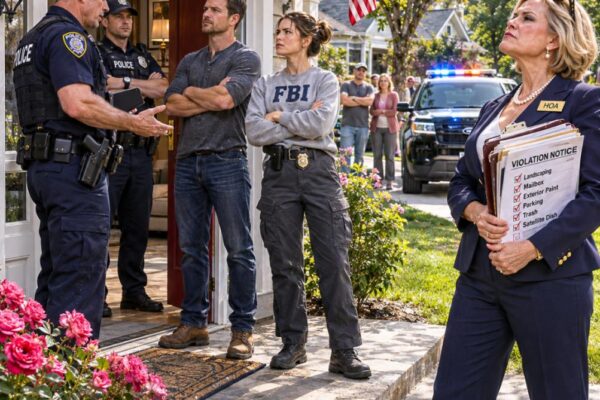
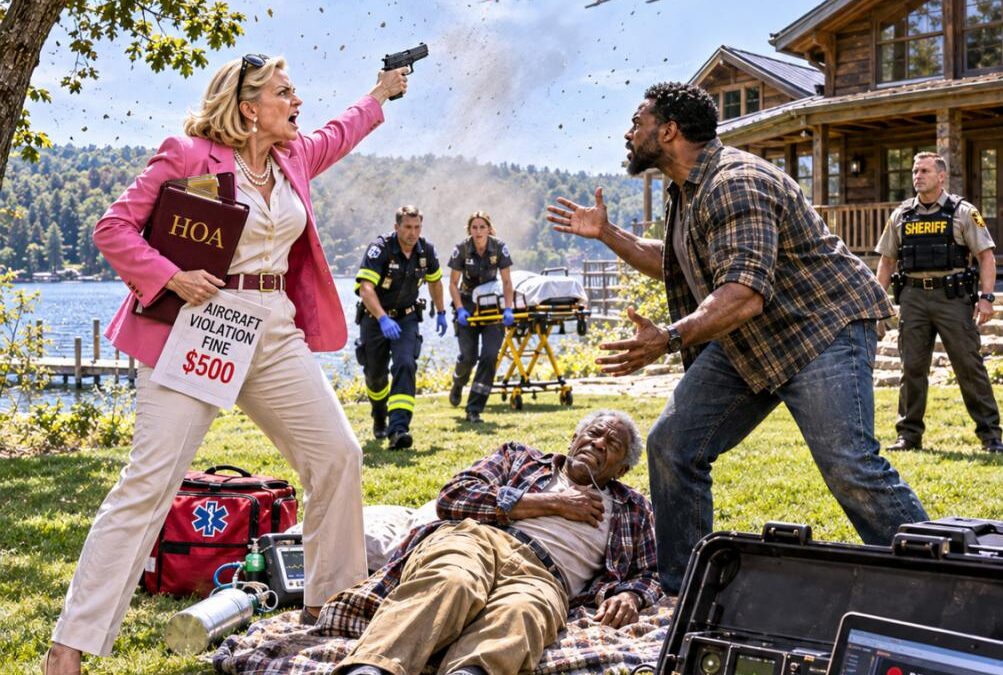
She stormed into my backyard during a medical emergency, claimed the HOA controlled the air above my home, and ordered a rescue helicopter to leave while my grandfather struggled to breathe.
When the pilot aborted the landing and my grandfather’s condition worsened, HOA Karen handed me a $500 “aircraft violation” as though she had just enforced a parking rule.
What she did not know was that my grandfather had spent forty years around aerospace systems—and the radio on his workbench had already recorded far more than she intended anyone to hear.
The helicopter was less than a hundred feet above my backyard when Sylvia Grant raised the pistol.
For half a second, my brain refused to understand what I was seeing.
Rotor wash flattened the grass around us. Dust and oak leaves spun in violent circles. The medical helicopter hovered over the clearing beyond the garage, its landing light washing the yard in hard white glare.
My grandfather Henry lay on a blanket beside the patio.
Seventy-eight years old.
Gray-faced.
One hand clamped against his chest.
Barely breathing.
I had spent seven minutes on the phone with 911 while the dispatcher coordinated the nearest available air-medical crew because ground transport was delayed by a wreck on the highway.
Seven minutes holding Henry’s wrist.
Seven minutes watching his pulse weaken beneath my fingertips.
Then Sylvia Grant came through my side gate carrying a handgun.
“Get that aircraft out of here!” she screamed.
The pilot’s voice came over the helicopter loudspeaker.
“Ma’am, move away from the landing zone.”
Sylvia pointed upward.
“This is private residential airspace! The HOA requires seventy-two-hour approval!”
I stared at her.
“Sylvia, put the gun down.”
She ignored me.
The helicopter shifted slightly against the wind.
Its landing skids lowered.
Henry whispered my name.
“Nathan…”
“I’m here.”
Sylvia stepped farther into the yard.
“Do not land!”
The flight medic leaned toward the open side door.
“Medical emergency! Clear the area!”
Sylvia lifted the pistol higher.
I moved toward her.
“Put it down!”
Then the gun fired.
The crack disappeared beneath the rotor noise, but I saw the muzzle jump.
The helicopter climbed instantly.
No hesitation.
No second attempt.
Up.
Away.
The medic disappeared behind the closing door.
The aircraft banked over the trees.
I felt something inside me turn cold.
Sylvia stared after it.
Then looked at me with almost offended disbelief.
“They were violating community restrictions.”
I took one step toward her.
“You fired at a medical helicopter.”
“I fired into the ground.”
“I watched you raise the gun.”
“You were panicking.”
Henry made a choking sound behind me.
Everything else stopped mattering.
I dropped beside him.
His eyes fluttered.
“Hospital,” he whispered.
I reached for my keys.
Something small slid from the pocket of his work shirt and landed in the grass.
A black USB drive.
Henry’s fingers closed around my wrist.
His voice was barely audible.
“The radio.”
“What?”
“Don’t trust… the notices.”
His eyes found mine.
Then he forced out four more words.
“They want the patent.”
I looked toward the garage.
On his workbench, the old shortwave receiver was still humming.
And Sylvia was already standing at my gate, writing me an HOA fine.
part 2
My name is Nathan Reed.
At thirty-two, I was one of those people everybody described as “still figuring things out,” which is a polite way of saying my life had not followed the plan I used to brag about.
I went to law school.
Made it through two years.
Then my mother got sick.
I left to help.
She died the following spring.
I told myself I would go back.
I never did.
Debt remained.
The degree did not.
I ended up working as a mechanic because engines had always made more sense to me than institutions.
A failed alternator does not lie.
A bad bearing does not hide behind procedural language.
Metal tells you what happened if you listen carefully enough.
That was something my grandfather Henry understood.
He raised me for long stretches when my mother worked nights.
Henry Mason was the most intelligent man I knew and the least interested in proving it.
He had spent decades as an aerospace engineer for a major defense contractor.
He worked on navigation systems, flight-control hardware, and classified projects he almost never discussed.
Whenever I asked what he had actually done, he usually said:
“Made expensive boxes behave.”
That was Henry.
The garage at our Willow Grove house looked like a collision between a machine shop and a museum.
Vacuum tubes.
Oscilloscopes.
Old avionics manuals.
Ham-radio gear.
Circuit boards.
Shelves of components in labeled drawers.
A lathe older than I was.
And, at the center of one workbench, an old military-surplus radio Henry had rebuilt so many times that almost nothing inside it was original.
Sunday mornings were ours.
Coffee.
Radio humming.
Henry tinkering.
Me pretending I understood half of what he said.
I had moved into his house after my mother died.
Originally temporary.
Then Henry’s health began slipping.
Not dramatically.
High blood pressure.
Arrhythmia.
A previous heart procedure.
The ordinary slow accumulation of age.
I stayed.
That morning had begun exactly like dozens before it.
Henry was adjusting something inside the receiver.
I was rebuilding a carburetor on an old Triumph motorcycle.
A baseball game played quietly on another radio.
Then I heard metal crash.
I looked up.
Henry hit the shelving on his way down.
I was across the garage before the tools stopped rattling.
“Grandpa.”
His hand was against his chest.
His breathing came in shallow pulls.
I had done a short volunteer-fire program years earlier.
Enough to know what I was looking at was bad.
Not enough to pretend I could fix it.
I called 911.
The dispatcher stayed with me.
Ground ambulance resources were tied up because of a multivehicle crash on the main highway.
An air-medical unit was already nearby after transferring a patient.
The dispatcher coordinated it.
I dragged patio furniture away from the open rear lawn as instructed.
No wires.
No trees directly overhead.
Enough clearance for the crew to assess.
Then Sylvia Grant appeared.
Sylvia had moved to Willow Grove fourteen months earlier.
She was fifty-four.
Silver hair cut into a perfectly symmetrical bob.
Always tailored.
Always composed.
She introduced herself to the neighborhood as president of the Willow Grove Homeowners Association.
Nobody remembered an election.
That should have mattered.
At the time, it didn’t.
Willow Grove had once had an active HOA.
That much was true.
The development was built in the late 1980s.
Common landscaping near the entrance.
A small retention pond.
Covenants.
Annual meetings.
Then residents stopped caring.
Boards changed.
Records disappeared.
Management companies came and went.
By the time Sylvia arrived, the association existed more as habit than institution.
She stepped into that vacuum confidently.
That confidence became authority because nobody bothered checking whether it had a legal foundation.
I certainly didn’t.
My first Sylvia violation was for a trash can visible from the street six hours after pickup.
Then porch lighting.
Then an oil stain on my driveway that was actually rainwater.
Then “excessive garage activity” because I worked on customer vehicles occasionally.
I was a mechanic.
Henry owned the house.
Our garage had existed before Willow Grove’s HOA was even incorporated.
Still, Sylvia issued notices.
Most were for fifty dollars.
Some one hundred.
I ignored the first few.
Then she threatened collections.
Henry wanted to fight.
I didn’t.
“I’ve already spent enough of my life arguing about rules.”
“You went to law school.”
“Exactly.”
He laughed.
Two years before Sylvia arrived, I had lost a stupid HOA dispute at an apartment-style condo property where I briefly owned a unit.
Not because I was completely wrong.
Because I represented myself badly, missed a deadline, and turned a manageable dispute into fifteen thousand dollars of legal debt.
That experience changed me.
Whenever somebody used the words covenant, lien, board, or hearing, I felt exhausted before the conversation started.
Sylvia exploited that.
Not just with me.
With everyone.
She carried papers with official-looking seals.
Quoted “association policy.”
Set deadlines.
Invoked penalties.
Most neighbors complied.
A widow named Mrs. Ellis paid two thousand dollars for “drainage remediation” that never appeared in any public board budget.
A family two streets over paid a “security compliance assessment.”
Henry noticed before I did.
“Something’s wrong with her.”
“She’s an HOA Karen.”
Henry hated that phrase.
“Don’t reduce people to internet cartoons.”
“She fined my trash can.”
“That does not make her a criminal.”
“Thank you, counsel.”
He looked at me.
“I mean it.”
Henry had a habit of protecting even people he disliked from sloppy conclusions.
It was one reason I trusted him.
Then the 911 calls started.
Sylvia reported my customers’ cars.
Our garage noise.
Henry’s radio antenna.
A propane grill.
A garden hose attachment.
At first, the responding officers were polite.
Then embarrassed.
One officer looked at the hose and said:
“That’s fertilizer.”
“Apparently it’s a tactical chemical-delivery system.”
He laughed.
Sylvia did not.
I began keeping records.
Dates.
Notices.
Police incident numbers.
Photographs.
Henry watched me create a folder.
“Look who rediscovered paperwork.”
“Don’t get emotional.”
Then, one Sunday, I noticed Henry watching Sylvia’s house through binoculars.
“Grandpa.”
He lowered them.
“What?”
“You told me not to turn her into a conspiracy.”
“I didn’t say she wasn’t part of one.”
That was Henry.
He could contradict himself with the confidence of a tenured professor.
“What do you mean?”
“Nothing yet.”
The phrase bothered me.
Nothing yet.
After the helicopter incident, it stopped being nothing.
I drove Henry to the hospital myself.
That decision felt insane.
But the helicopter had aborted.
The dispatcher rerouted ground EMS, yet with Henry deteriorating and the nearest ambulance still delayed, the dispatcher told me help was en route and to follow emergency instructions.
Henry’s condition worsened.
I made the choice to meet the ground crew at an agreed location several minutes away rather than sit still watching him fade.
The paramedics took over from there.
That part matters because I do not want to romanticize driving a cardiac patient like an action hero.
Emergency medicine belongs to professionals.
Henry was transferred to the hospital under medical care.
By the time I reached the emergency department, police had already been called about Sylvia’s gunshot.
Officers came to interview me.
I gave a statement.
I gave them the backyard camera footage.
The helicopter crew submitted its own report.
Whether Sylvia intentionally fired toward the aircraft became a major investigative question.
The footage showed her raising the weapon.
The audio captured the shot.
The projectile was later recovered from a wooden privacy fence at a trajectory inconsistent with her claim that she fired directly into the ground.
That did not automatically prove she intended to strike the helicopter.
Intent would matter enormously.
But it established something simpler.
Her conduct created a serious danger around an emergency aircraft.
The police took her firearm that evening pursuant to the investigation and state procedures.
She was not marched away in front of cheering neighbors.
She was interviewed.
Released pending further investigation.
And told not to come onto our property.
By then, I was at the hospital.
The cardiologist explained Henry had suffered a major cardiac event.
He stabilized enough for intervention, but there were complications.
I sat beside him late that night.
He looked tiny under the hospital blanket.
Nothing like the man who had built guidance hardware that once crossed continents.
His eyes opened.
“Nathan.”
“I’m here.”
“USB?”
I reached into my pocket.
I had found it in the backyard before leaving.
Black casing.
No label except a small white strip.
VDS-47.
“I have it.”
His face tightened.
“Don’t plug it in.”
I stared at him.
“You could have mentioned that before.”
He almost smiled.
“Encrypted.”
“What is it?”
“Evidence.”
“Of what?”
He closed his eyes.
“Vertex.”
I knew the name.
Vertex Defense Systems.
Henry’s former employer.
Large aerospace contractor.
Decades of government work.
“What about them?”
He opened his eyes again.
“Not now.”
“Grandpa, Sylvia just fired a gun during your rescue.”
“I know.”
“You whispered something about a patent.”
His breathing changed.
I stopped.
Nurse entered.
Conversation over.
The next morning, I went home.
Yellow paper covered the garage door.
EMERGENCY HOA SAFETY NOTICE.
Unauthorized radio equipment.
Exterior antenna.
Hazardous electrical installation.
Penalty: $1,200.
The paper carried a city-style seal.
Not an actual city seal.
Something designed to look enough like one that most people would not notice the difference.
I photographed it.
Then called the city.
No inspection.
No notice.
No partnership with Willow Grove.
That was the first provable fraud-like document I had seen from Sylvia.
I called attorney Rachel Kim.
Rachel had been a year ahead of me in law school.
Unlike me, she finished.
She now handled property litigation and white-collar defense.
I sent her the notice.
Her first response:
“Do not accuse her publicly.”
“I know.”
“You say that because you attended two years of law school.”
“I attended enough to become dangerous.”
“Exactly.”
She reviewed Willow Grove records.
The association corporation had become administratively inactive years earlier.
That did not necessarily eliminate recorded covenants.
But no valid election installing Sylvia as president appeared.
No board minutes authorizing her enforcement program.
No adopted rules covering most of her notices.
Payments were being directed to a private entity called Willow Grove Community Compliance LLC.
Owner:
Sylvia Grant.
Rachel stopped me before I got excited.
“This establishes serious questions.”
“She’s fake.”
“Questions.”
“She fined a helicopter.”
“That notice is absurd.”
“Thank you.”
“Still questions.”
I hated practicing law.
Even from the passenger seat.
Then I called Nate Cole.
My best friend since college.
Nate was a financial analyst.
Not a hacker.
Not a magician.
Not someone who could legally “dig into Sylvia’s bank records.”
What he could do was examine public entities, corporate registrations, court records, property filings, and documents neighbors voluntarily shared.
Within three days, he found patterns.
Willow Grove Community Compliance had no visible contractual appointment by the dormant HOA.
Several vendors receiving “inspection fees” shared mailing addresses or officers with Sylvia-associated entities.
One contractor listed on Mrs. Ellis’s invoice had dissolved four years earlier.
Another business existed, but its owner told us he had never performed work in Willow Grove.
That became useful.
Neighbors started sharing documents.
One invoice at a time.
Then Henry called from the hospital.
“Bring the radio.”
I stared at the phone.
“The whole radio?”
“Yes.”
“It weighs forty pounds.”
“Bring the small receiver underneath.”
I went to the garage.
Behind the old shortwave unit was a compact software-defined receiver I had never noticed.
Cables ran through the bench into a small computer.
On the screen, archived recordings filled a directory.
Dates.
Frequencies.
Signal captures.
Henry had been monitoring something.
I did not start decoding military communications.
I am a mechanic who left law school.
Reality has limits.
Instead, I brought the device to the hospital as instructed.
Henry explained.
For nearly eighteen months, he had been documenting suspicious low-power radio transmissions and encrypted digital bursts coming from equipment near our street.
Not classified military channels.
Commercial and experimental spectrum.
Some transmissions contained identifiers he recognized from old Vertex testing architecture.
Henry had reported the interference informally to a former colleague.
The colleague told him to stop looking.
Henry did not.
Of course he didn’t.
“What does Vertex want?”
He stared toward the window.
“A design package.”
“What design?”
“Precision timing.”
“GPS?”
“Partly.”
Henry had worked decades earlier on high-accuracy timing and navigation systems.
Not some magical secret GPS Generation Three capable of changing the world overnight.
Real technology is incremental.
Henry’s contribution involved methods for improving timing synchronization and signal correction in contested environments.
Useful to civilian navigation.
Aerospace.
Autonomous systems.
Defense.
The work had been covered by employment agreements and patents involving multiple inventors and corporate ownership claims.
Years later, Henry and several colleagues disputed whether Vertex had improperly buried inventor rights and reused portions of later independent work.
Messy.
Technical.
Legally unresolved.
Not worth killing anyone over.
At least that was what I thought.
Henry did not claim Vertex executives had ordered murders.
He told me something more believable.
Three former colleagues who challenged the company had experienced unusual pressure.
One died in a car accident.
One died in a house fire.
Another died by suicide.
There was no proof those deaths were connected.
Henry knew that.
“I’m not saying they killed anyone.”
“Then what are you saying?”
“I’m saying people were threatened.”
“By Vertex?”
“By somebody with access to internal material.”
He looked at me.
“And Sylvia’s notices started after I contacted counsel about reopening the patent dispute.”
That connected two worlds I wanted badly to keep separate.
HOA nuisance.
Corporate pressure.
Still not proof.
The USB held documents Henry had received from an anonymous source.
Internal Vertex communications.
Contract summaries.
Payment records.
Some referenced outside “property pressure consultants.”
One project label appeared repeatedly:
WG-17.
Willow Grove?
Maybe.
Maybe not.
Rachel insisted we stop.
“Do not go through the rest yourselves.”
“Why?”
“Because if these documents are stolen, privileged, classified, proprietary, or altered, you can create ten new problems.”
“So what do we do?”
“Counsel.”
Henry already had one.
A patent attorney named Miriam Cho.
Miriam came to the hospital the next afternoon.
She knew about the disputed technology.
She knew about Henry’s archive.
She did not know about Sylvia.
When she saw the files, her expression changed.
“These need forensic handling.”
That began the real investigation.
Not me decoding secret messages at midnight.
Not viral TikTok videos.
Lawyers.
Forensic specialists.
Chain of custody.
Then law enforcement.
Because Sylvia’s firearm incident had already attracted scrutiny, investigators were willing to examine whether the HOA harassment and other conduct intersected with anything larger.
The local police financial-crimes unit took the neighborhood-fraud material.
Federal investigators became involved later because some documents suggested interstate wire fraud and potential obstruction tied to contracting disputes.
The FBI did not announce that Vertex was a global patent-theft ring.
They did what investigators do.
They asked questions.
Issued subpoenas where authorized.
Interviewed witnesses.
Verified records.
And told me almost nothing.
Meanwhile, Sylvia kept escalating.
She could no longer enter our property.
So the notices multiplied.
Garage.
Antenna.
Vehicle repair.
Exterior wiring.
Trash.
Visitor parking.
Rachel sent a cease-and-desist letter disputing every unsupported charge.
Then Sylvia posted edited video of me online.
The clip made it look like I had threatened her with a wrench during an earlier argument.
The original footage came from her phone.
The edit removed the beginning where she entered my driveway and the end where I put the wrench on a workbench.
I did not make a viral TikTok exposing metadata to two hundred thousand people.
I did something less satisfying.
I preserved the post.
Downloaded the original publicly accessible version.
Sent it to counsel.
Then released a short statement through Rachel:
“The circulated clip is materially incomplete. The complete security-camera footage has been preserved and provided to investigators.”
Boring.
Effective.
The full footage eventually surfaced in court filings.
Sylvia’s narrative collapsed without me becoming an influencer.
Then Clara Bennett knocked on my door.
Clara was seventy.
Retired investigative reporter.
Lived three streets over.
I knew her as the woman who complained about recycling pickup.
She carried a recorder.
“I owe you something.”
“What?”
“An apology.”
She had believed Sylvia.
Paid fees.
Defended her.
Then, after the helicopter incident, she started doing what reporters do.
Records.
She pulled historical Willow Grove corporation filings.
Election notices.
Board records from former residents.
Old newsletters.
The HOA had effectively stopped operating in any organized way years before Sylvia arrived.
Sylvia had revived the name without properly reviving the structure.
Clara also had audio.
Not a secret recording from inside Sylvia’s house.
A homeowners meeting Clara attended and recorded openly.
Sylvia discussing how to “isolate noncompliant owners from community resources.”
Another voice asked about Henry.
Sylvia answered:
“He’ll cooperate once the house becomes too expensive to maintain.”
That was bad.
Then:
“His grandson can’t afford another legal fight.”
That was worse.
She knew about my prior HOA debt.
“How?”
Clara shook her head.
“I don’t know.”
Someone had researched us.
The old SWAT story from the prior user’s other tale is irrelevant here; I was not law enforcement. In this story, I was just Nathan Reed, ex-law student and mechanic.
That made the next part more frightening.
I had no special title.
No badge.
No government position.
I was simply a person with an elderly relative somebody wanted pressured.
The first break in the corporate side came from money.
Investigators linked Willow Grove Community Compliance to a consulting vendor that had received payments from a Vertex subcontractor.
The amounts were not enormous.
Consulting retainers.
Administrative services.
Neighborhood risk assessment.
The descriptions looked normal.
But dates overlapped with Sylvia’s escalating notices against us.
Then another subcontractor appeared.
Paul Kendrick.
He lived two streets away.
Quiet man.
Mid-fifties.
Always said he worked in “technology consulting.”
Public records showed a company receiving Vertex payments.
Paul also appeared as an unpaid adviser in Sylvia’s Willow Grove compliance files.
That was the connection.
Not proof of murder.
Not proof of espionage.
A financial and organizational link.
Paul had access to our neighborhood.
Sylvia had access to homeowners.
Vertex-connected money flowed near both.
Investigators took it from there.
Henry eventually underwent cardiac surgery.
Successful.
The morning of the procedure, hospital security notified us that two men had tried to enter a restricted family waiting area claiming to be federal investigators.
Staff asked for identification.
Something looked wrong.
Security refused access.
Hospital police became involved.
The men left.
One was later identified as a private investigator connected to a law firm representing a Vertex subcontractor.
The other worked for a corporate risk-consulting company.
Not fake FBI assassins.
Still unacceptable.
Their purpose became contested.
They claimed they wanted to serve documents and request an interview.
Miriam called it intimidation.
A judge later agreed that certain contacts crossed discovery and witness-contact boundaries once litigation began.
That resulted in sanctions and protective orders.
No murder plot needed.
The pressure was real enough.
Henry came home ten days later.
Weak.
Angry.
Alive.
I installed a chairlift temporarily.
He hated it.
“I can walk.”
“You can also fall.”
“I built flight systems.”
“You fell into a shelf.”
“That was cardiac.”
“That sentence does not help.”
He glared at me.
Then used the chairlift.
We moved most sensitive records out of the house and into counsel-controlled storage.
The old radio remained.
Not because it was the key to a conspiracy.
Because Henry loved it.
Then Sylvia violated the no-trespass order.
It happened at 6:12 one evening.
She came to our gate with two contractors and an “emergency inspection notice.”
Rachel had warned us not to engage.
I called police.
Sylvia refused to leave.
Officers arrived.
She showed them the HOA paper.
They showed her the court order.
She argued.
Then one contractor quietly said:
“Ma’am, you told us this was authorized.”
That line changed the atmosphere.
Officers separated everyone.
Sylvia was arrested for violating the court order and trespass-related conduct.
Not because I knew someone.
Not because federal helicopters descended.
Because she crossed a documented legal boundary after being told not to.
Her arrest opened another wave of homeowner complaints.
People brought receipts.
Forged notices.
Fake city seals.
Invoices.
Threatened liens.
The local fraud case became substantial.
Then federal agents executed search warrants as part of the broader financial investigation involving Sylvia, Paul, several consulting entities, and Vertex-related subcontracting relationships.
The search of Sylvia’s house recovered computers, homeowner files, false HOA documents, and payment records.
No secret command center.
No wall of photographs with red string.
Reality is usually uglier because it looks ordinary.
Filing cabinets.
QuickBooks records.
Contract folders.
Email accounts.
Spreadsheets.
Investigators later alleged Sylvia had participated in a pressure scheme that targeted several property owners connected to technical or intellectual-property disputes.
Not forty-seven families being hunted for assassination.
A smaller number.
Still serious.
The theory was that aggressive neighborhood enforcement, nuisance complaints, inspection pressure, and financial threats could make vulnerable owners more willing to sell, settle, relocate, or abandon disputes.
In some places, real HOAs had been manipulated.
In others, fake compliance entities were created.
Sylvia’s role was not global mastermind.
She was an operator.
A facilitator.
Someone good at turning bureaucratic pressure into personal exhaustion.
Paul Kendrick’s role was more technical.
Investigators alleged he gathered information on targeted households and coordinated with outside consultants.
Vertex itself became a complicated question.
Large companies are not single minds.
Some executives denied knowledge.
Some internal compliance staff apparently raised concerns.
Investigators focused on individuals and specific contracting channels rather than declaring an entire corporation criminal.
That distinction mattered.
The case split.
Sylvia’s neighborhood fraud.
Paul’s conspiracy and wire-related conduct.
Contractor misconduct.
Potential obstruction.
The patent dispute.
Corporate civil liability.
Government-contract compliance review.
Each had different standards.
Different lawyers.
Different courts.
Henry hated how slow it was.
“I could have built a navigation system faster.”
“Navigation systems don’t file motions.”
“They should.”
He recovered enough to work in the garage again.
That became our victory long before trial.
Sunday radio.
Coffee.
Tools.
He moved slower.
I carried more.
But the ritual returned.
One morning he handed me a folder.
Patent records.
Original notebooks.
Correspondence from the 1980s and 1990s.
“What is this?”
“My backup.”
“I thought everything was with Miriam.”
“Copies.”
“Why give it to me?”
“Because you keep asking what the invention was.”
I opened the first notebook.
Hand-drawn timing diagrams.
Error models.
Signal-processing equations beyond me.
Henry explained patiently.
He had not invented GPS.
He hated when reporters said that later.
He contributed to specialized correction methods and timing architecture used in high-precision navigation research.
Important.
Not magical.
The dispute was over subsequent improvements he believed were independently developed after leaving one program but later absorbed into corporate work without proper inventor credit or compensation.
“Why fight now?”
“Because I’m old.”
“That’s a reason to stop fighting.”
“No.”
He looked at me.
“It’s a reason to stop being afraid of the cost.”
That was Henry.
He had spent decades obeying security restrictions.
Contracts.
Classifications.
Corporate lawyers.
He did not want to expose legitimate defense secrets.
He wanted ownership and attribution issues reviewed through lawful channels.
Miriam had already arranged for protected filing procedures where sensitive information could be handled appropriately.
No public data dump.
No uploading weapons technology.
No dramatic release to universities.
If some information genuinely carried national-security restrictions, neither Henry nor I was going to make ourselves criminals to prove someone else behaved badly.
The patent case moved into confidential proceedings for certain technical materials.
Eventually, several claims were settled.
Henry received formal inventor recognition on portions of later work.
Financial terms stayed confidential.
A separate corporate compliance investigation resulted in penalties and restructuring involving certain subcontractors.
Again, no revelation that Vertex secretly worked for a foreign missile program.
There were export-control and contracting questions, but I never learned enough verified information to repeat neighborhood rumors.
What I knew was sufficient.
People associated with corporate interests had used Sylvia’s fake HOA machinery as pressure.
That was outrageous without adding international espionage.
Sylvia’s criminal case went to trial first.
The courtroom was packed.
Not with millions of livestream viewers.
With homeowners.
Some from Willow Grove.
Some from two other communities investigators had connected to similar schemes.
Mrs. Ellis sat two rows behind me.
Clara had a notebook even though she was officially retired.
Nate wore a suit he claimed made him look trustworthy.
“It makes you look like a banker.”
“I am finance-adjacent.”
“That is worse.”
Sylvia entered with counsel.
Silver hair shorter now.
No clipboard.
That detail affected me more than I expected.
The prosecution built the case methodically.
Willow Grove’s dormant governance.
Sylvia’s false representations.
Payments directed to her company.
Fake seals.
Unsupported fines.
Lien threats.
Her communications with outside consultants.
The helicopter incident came in carefully because it was emotionally explosive.
The pilot testified.
Captain Luke Carter.
He described approaching the landing zone under emergency coordination.
Seeing a person enter with a firearm.
Hearing a shot.
Executing an immediate abort because the crew could not safely determine where the weapon was directed.
He did not claim the bullet struck the rotor.
It hadn’t.
That detail from the exaggerated retelling was false.
The danger was enough.
A firearm discharged near an operating emergency helicopter created obvious risk.
The recovered projectile and video contradicted Sylvia’s claim that she fired straight into the ground.
The exact criminal counts depended on state and federal law and prosecutorial decisions, but the act supported serious weapons and interference-related charges.
When I testified, the defense focused on my hostility.
“You disliked Ms. Grant.”
“Eventually.”
“You called her an HOA Karen.”
“Privately.”
“You believed she was harassing you.”
“Yes.”
“You wanted her removed from the neighborhood.”
“I wanted her to stop pretending she had authority she couldn’t document.”
“Isn’t that the same thing?”
“No.”
He showed me one of my texts to Nate.
WE’RE DONE PLAYING DEFENSE.
“Those are your words?”
“Yes.”
“You considered yourself at war with her?”
“No.”
“What did you mean?”
“We were going to verify the authority behind the notices instead of simply responding to each one.”
He paused.
The answer was boring.
That helped.
Nate testified about public financial records and homeowner-provided documents.
Forensic accountants handled subpoenaed records.
Clara authenticated meeting recordings.
Mrs. Ellis testified about paying fees.
Paul Kendrick eventually entered a cooperation agreement in exchange for consideration at sentencing.
That changed the case.
He described how Sylvia’s neighborhood compliance operation attracted outside clients.
Companies and consultants paid her for “resident pressure support.”
Sometimes legitimate code enforcement concerns.
Sometimes exaggerated.
Sometimes fabricated.
In Henry’s case, Paul said the objective was not murder.
It was leverage.
Make the house expensive.
Make Nathan desperate.
Force Henry to negotiate.
Encourage relocation.
Keep him distracted.
The medical crisis was not staged.
That mattered enormously.
Henry’s heart attack was real.
There was no Plan B to kill him through surgery.
Sylvia’s interference made a genuine emergency more dangerous, but investigators found no proof the cardiac event had been caused intentionally.
I remember closing my eyes when Paul said that.
Not relief exactly.
The truth was terrible enough.
I did not need a conspiracy capable of controlling Henry’s heartbeat.
Sylvia’s defense was that she believed she was providing community management and lawful consulting services.
Some homeowners had benefited.
Some funds had been used legitimately.
True.
Her lawyers argued the HOA’s dormant status was confusing.
Also true.
They argued nobody had forced homeowners to accept her leadership initially.
True again.
Then prosecutors returned to the documents.
Fake city seals.
False claims of elected authority.
Threats of liens she could not lawfully impose.
Payments.
Instructions to pressure specific homeowners.
Her messages with Paul.
And the gunshot.
The case did not require Sylvia to be evil.
It required specific conduct.
The jury convicted her on multiple counts.
Not every count.
That mattered too.
Paul was sentenced separately.
Sylvia received a lengthy prison term, restitution obligations, and supervised-release conditions.
Not a magical lifetime ban from leadership.
The court had no reason to invent one.
Her sentence reflected the fraud, obstruction-related conduct, weapons incident, victim impact, and her role in the broader scheme.
The number was severe enough that she would be an old woman before fully free of the case.
I felt nothing when the judge announced it.
That surprised me.
I had imagined satisfaction.
Instead, I thought of Henry lying in the grass.
Of the helicopter climbing away.
Of Mrs. Ellis writing checks because she trusted the wrong person.
Of how much damage can come from somebody wanting to feel important.
Henry did not attend sentencing.
His doctor would not approve the travel.
When I told him the result, he adjusted a capacitor inside the radio and said:
“Good.”
“That’s it?”
“What do you want me to do?”
“I don’t know.”
“Dance?”
“You could pretend to care.”
He looked at me.
“I care that it’s over.”
That was enough.
Vertex’s civil and regulatory problems took longer.
Some employees were cleared.
Some contractors were terminated.
Several executives left.
Government agencies reviewed contracting controls.
Henry’s patent dispute resolved through settlement and corrected attribution.
The corporation did not collapse.
No criminal empire toppled because of one bullet.
Real institutions are rarely that fragile.
But the network that had been pressuring Henry did break.
The contractors connected to Sylvia lost access.
Paul went to prison.
Several consulting entities dissolved.
Victims recovered some money through restitution and civil settlements.
Not all.
Never all.
Willow Grove had to rebuild governance from scratch.
That became almost funny.
Nobody wanted the job.
At the first legitimate organizational meeting, forty homeowners attended.
When nominations for president opened, everyone looked at the floor.
Mrs. Ellis finally said:
“You all complained about Sylvia for two years. Somebody raise a hand.”
A CPA named Susan Park became president.
Real election.
Recorded minutes.
Published budget.
Actual bylaws.
Professional management company.
No secret rules.
No personal LLC collecting penalties.
Susan’s first neighborhood-wide message contained one sentence I saved:
“No resident should ever rely on the appearance of authority when the documents can establish the real thing.”
Henry approved.
“Competent woman.”
“She’s an accountant.”
“Same thing.”
The bogus $1,200 garage fine disappeared.
So did the other unsupported violations.
Then the new board reviewed actual issues.
Our garage did have one legitimate electrical problem.
A circuit Henry added years earlier lacked a proper modern enclosure.
The inspector flagged it.
I fixed it.
Henry complained.
“You let them bully you.”
“No.”
I held up the code section.
“This one is real.”
He squinted at it.
“Still unnecessary.”
“It keeps the house from burning down.”
“Overrated.”
That distinction became important to Willow Grove.
Not every rule was corruption.
Not every inspection was harassment.
A functioning community still needed drainage maintenance.
Insurance.
Common-area care.
Safety compliance.
The problem was never rules.
The problem was unaccountable power disguised as rules.
Clara eventually wrote a book.
Not about “HOA scams” broadly.
About trust fraud in small communities.
She interviewed residents, investigators, property lawyers, fraud experts, and governance specialists.
Henry refused to be photographed.
“People will think I invented GPS.”
“You did not.”
“I know. They don’t.”
She gave him a chapter anyway.
Nate built a financial-review service for small associations.
He helped boards reconcile vendor records and flag conflicts.
Nothing magical.
Mostly accounting controls.
Two signatures.
Vendor verification.
Annual statements.
Transparent invoices.
Boring things that stop interesting crimes.
I returned to full-time mechanic work.
For a while, I considered finishing law school.
Then I remembered law school.
No.
I did begin helping Rachel with community presentations.
Not as legal counsel.
As the person who had lived through it.
My section was simple.
When someone claims authority, ask for the source.
Not aggressively.
Not theatrically.
Just ask.
Who elected you?
Where are the minutes?
Where is the recorded covenant?
Where is the amendment?
What authorizes the fine?
Who controls the account?
Who audits it?
What happens if you appeal?
A legitimate board might be annoyed.
It should still have answers.
The helicopter incident changed local emergency procedures too.
The air-medical service reviewed residential landing-zone coordination.
Police and fire agencies updated protocols for rapidly securing emergency landing areas when bystanders interfered.
Sylvia’s gunshot became a training example.
Not because it was common.
Because it was absurd enough to expose a gap.
The pilot, Luke Carter, visited Henry six months later.
Henry had recovered enough to sit on the porch.
Luke brought a challenge coin from the air-medical unit.
Henry turned it over in his hand.
“You’re the pilot who left me lying in the yard.”
Luke froze.
I said:
“Grandpa.”
Then Henry smiled.
Luke exhaled.
“I was about to feel terrible.”
“You made the right call.”
Luke nodded.
“If there’s a firearm near an aircraft, we’re leaving until the scene is secure.”
“I know.”
Henry held out the coin.
“You saved your crew.”
Luke looked toward him.
“We came back for you.”
“The ambulance did.”
“Still counts.”
Henry handed the coin back.
“No.”
Luke frowned.
“Keep it.”
Henry shook his head.
“Put it in your aircraft.”
“Why?”
“Machines deserve reminders too.”
That was Henry.
Luke eventually accepted.
A year after the trial, Henry and I were back in the garage on a Sunday morning.
Same radio.
Same old baseball broadcast.
Different world.
I was rebuilding a motorcycle starter.
Henry adjusted the tuning knob.
“You know what people get wrong?”
“About what?”
“The story.”
“I’m afraid to ask.”
“They think the gunshot exposed everything.”
“It did start the investigation.”
“No.”
He tapped the radio.
“This was already happening.”
“Okay.”
“They think bad people become obvious when they do one dramatic thing.”
“Sometimes they do.”
“Usually they don’t.”
He looked at me.
“Sylvia’s power came from boring things.”
Paper.
Invoices.
Meetings.
People being too tired to check.
I nodded.
“She got away with the small things because everyone was waiting for something dramatic enough to object to.”
That was true.
The helicopter was dramatic.
But the conditions that allowed Sylvia to reach that point had been built quietly.
A fake title.
A community that stopped holding elections.
Neighbors grateful someone else handled problems.
A mechanic too tired to fight another HOA.
An old engineer keeping secrets because he thought he could manage them alone.
A contractor willing to pay someone who understood how to pressure people without leaving obvious fingerprints.
None of it looked like a conspiracy while it was happening.
It looked like paperwork.
Henry lived another five years.
Long enough to see Jasmine—my sister Claire’s daughter—graduate high school.
Long enough to complain about three different Willow Grove boards.
Long enough to rebuild that radio twice.
He died at eighty-three.
At home.
Quietly.
No helicopter.
No police.
No Sylvia.
Just me beside him.
His final coherent sentence was:
“Don’t let Nate sell my test equipment.”
Nate was offended.
“I wasn’t going to.”
“You absolutely were.”
“Some of that gear is valuable.”
“Exactly why he warned me.”
We laughed even though we were grieving.
Henry left his technical archives to a university engineering collection after lawyers reviewed the material for proprietary and security restrictions.
Not unrestricted weapon designs.
Not secret missile guidance data.
Not some cinematic data dump.
Engineering notebooks.
Published work.
Cleared correspondence.
Personal history.
His recognized inventions.
Materials future researchers could lawfully study.
The old radio came to me.
It still sits in the garage.
Most Sundays I turn it on.
Sometimes I hear distant amateur operators.
Weather broadcasts.
Static.
Ordinary signals.
I like ordinary now.
Willow Grove changed too.
The community garden sits near the retention pond.
Mrs. Ellis insisted on tomatoes.
Susan insisted on a proper budget.
Nate insisted on a plaque.
The final wording was simple:
TRUST REQUIRES QUESTIONS.
COMMUNITY REQUIRES ANSWERS.
Henry hated it.
“Sounds like corporate training.”
“You have a better one?”
“Yes.”
“What?”
“Read the paperwork.”
I wanted that instead.
I lost.
The first plaque stayed.
Years after Sylvia’s conviction, people still occasionally send me stories about fake HOAs.
Most are not fake.
Usually they are real associations with terrible communication.
Sometimes real boards overreach.
Sometimes homeowners misunderstand recorded covenants.
Sometimes there is genuine fraud.
The lesson is not paranoia.
It is verification.
I learned that the hard way.
For fifteen years, I had imagined danger as something obvious.
A gun.
A violent person.
A crisis.
Henry taught me another kind.
Danger can look polished.
Helpful.
Organized.
It can bring your elderly neighbor groceries.
Then charge her a fee nobody authorized.
It can print a seal.
Quote rules.
Speak calmly.
Call itself president.
And because everyone wants peace, people may cooperate long after the questions should have started.
The last Sunday Henry and I spent in the garage together, rain fell outside.
No baseball.
Just the radio.
He had one hand resting on the tuning dial.
I asked him:
“Why didn’t you tell me sooner?”
“About Vertex?”
“About everything.”
He thought for a while.
“Because I thought knowing more made me safer.”
“Did it?”
“No.”
“What did?”
He looked toward me.
“Other people knowing too.”
That may have been the most important thing he ever taught me.
Not secrecy.
Not technology.
Not law.
Accountability.
The bad version of authority wants everything isolated.
Private conversations.
Private payments.
Private threats.
One frightened homeowner at a time.
The good version survives daylight.
Documents.
Witnesses.
Review.
Appeal.
Questions.
After Henry died, I cleaned the garage.
I found one of Sylvia’s old notices under a stack of manuals.
UNAUTHORIZED COMMUNICATION EQUIPMENT.
Penalty: $1,200.
I stared at it.
Years earlier, that piece of paper had made me angry enough to consider another legal fight I could not afford.
Now it looked ridiculous.
Cheap printer.
Fake seal.
Invented authority.
I tore it in half.
Then stopped.
Old habits.
I taped it back together and placed it in Henry’s records box.
Proof matters.
Even after the danger is gone.
I turned on the radio.
Static filled the garage.
Then a distant voice emerged through it.
Some amateur operator hundreds of miles away talking about weather.
Nothing secret.
Nothing encrypted.
No conspiracy.
I sat in Henry’s chair.
Outside, Willow Grove was quiet.
Not the dangerous quiet where everybody assumed someone else was watching.
The good kind.
The kind built after people finally understood who actually had authority, where it came from, and how easily it could be abused when nobody asked.
Sylvia once walked through our neighborhood with a clipboard and convinced almost everyone that confidence was the same thing as power.
Henry spent his life building systems where one wrong signal could send a machine miles off course.
Maybe that was why he understood the problem before I did.
A false signal does not have to be strong.
It only has to be trusted.
Once we stopped trusting it automatically, Sylvia’s entire world began to collapse.
And in the end, that was all the defense we ever really needed.
THE STORY ENDS HERE
HOA Karen Pointed a Gun at a Medical Helicopter and Tried to Block My Grandfather’s Rescue—She Has Vastly Underestimated My Intelligence
She stormed into my backyard during a medical emergency, claimed the HOA controlled the air above my home, and ordered a rescue helicopter to leave while my grandfather struggled to breathe.
When the pilot aborted the landing and my grandfather’s condition worsened, HOA Karen handed me a $500 “aircraft violation” as though she had just enforced a parking rule.
What she did not know was that my grandfather had spent forty years around aerospace systems—and the radio on his workbench had already recorded far more than she intended anyone to hear.
The helicopter was less than a hundred feet above my backyard when Sylvia Grant raised the pistol.
For half a second, my brain refused to understand what I was seeing.
Rotor wash flattened the grass around us. Dust and oak leaves spun in violent circles. The medical helicopter hovered over the clearing beyond the garage, its landing light washing the yard in hard white glare.
My grandfather Henry lay on a blanket beside the patio.
Seventy-eight years old.
Gray-faced.
One hand clamped against his chest.
Barely breathing.
I had spent seven minutes on the phone with 911 while the dispatcher coordinated the nearest available air-medical crew because ground transport was delayed by a wreck on the highway.
Seven minutes holding Henry’s wrist.
Seven minutes watching his pulse weaken beneath my fingertips.
Then Sylvia Grant came through my side gate carrying a handgun.
“Get that aircraft out of here!” she screamed.
The pilot’s voice came over the helicopter loudspeaker.
“Ma’am, move away from the landing zone.”
Sylvia pointed upward.
“This is private residential airspace! The HOA requires seventy-two-hour approval!”
I stared at her.
“Sylvia, put the gun down.”
She ignored me.
The helicopter shifted slightly against the wind.
Its landing skids lowered.
Henry whispered my name.
“Nathan…”
“I’m here.”
Sylvia stepped farther into the yard.
“Do not land!”
The flight medic leaned toward the open side door.
“Medical emergency! Clear the area!”
Sylvia lifted the pistol higher.
I moved toward her.
“Put it down!”
Then the gun fired.
The crack disappeared beneath the rotor noise, but I saw the muzzle jump.
The helicopter climbed instantly.
No hesitation.
No second attempt.
Up.
Away.
The medic disappeared behind the closing door.
The aircraft banked over the trees.
I felt something inside me turn cold.
Sylvia stared after it.
Then looked at me with almost offended disbelief.
“They were violating community restrictions.”
I took one step toward her.
“You fired at a medical helicopter.”
“I fired into the ground.”
“I watched you raise the gun.”
“You were panicking.”
Henry made a choking sound behind me.
Everything else stopped mattering.
I dropped beside him.
His eyes fluttered.
“Hospital,” he whispered.
I reached for my keys.
Something small slid from the pocket of his work shirt and landed in the grass.
A black USB drive.
Henry’s fingers closed around my wrist.
His voice was barely audible.
“The radio.”
“What?”
“Don’t trust… the notices.”
His eyes found mine.
Then he forced out four more words.
“They want the patent.”
I looked toward the garage.
On his workbench, the old shortwave receiver was still humming.
And Sylvia was already standing at my gate, writing me an HOA fine.
part 2
My name is Nathan Reed.
At thirty-two, I was one of those people everybody described as “still figuring things out,” which is a polite way of saying my life had not followed the plan I used to brag about.
I went to law school.
Made it through two years.
Then my mother got sick.
I left to help.
She died the following spring.
I told myself I would go back.
I never did.
Debt remained.
The degree did not.
I ended up working as a mechanic because engines had always made more sense to me than institutions.
A failed alternator does not lie.
A bad bearing does not hide behind procedural language.
Metal tells you what happened if you listen carefully enough.
That was something my grandfather Henry understood.
He raised me for long stretches when my mother worked nights.
Henry Mason was the most intelligent man I knew and the least interested in proving it.
He had spent decades as an aerospace engineer for a major defense contractor.
He worked on navigation systems, flight-control hardware, and classified projects he almost never discussed.
Whenever I asked what he had actually done, he usually said:
“Made expensive boxes behave.”
That was Henry.
The garage at our Willow Grove house looked like a collision between a machine shop and a museum.
Vacuum tubes.
Oscilloscopes.
Old avionics manuals.
Ham-radio gear.
Circuit boards.
Shelves of components in labeled drawers.
A lathe older than I was.
And, at the center of one workbench, an old military-surplus radio Henry had rebuilt so many times that almost nothing inside it was original.
Sunday mornings were ours.
Coffee.
Radio humming.
Henry tinkering.
Me pretending I understood half of what he said.
I had moved into his house after my mother died.
Originally temporary.
Then Henry’s health began slipping.
Not dramatically.
High blood pressure.
Arrhythmia.
A previous heart procedure.
The ordinary slow accumulation of age.
I stayed.
That morning had begun exactly like dozens before it.
Henry was adjusting something inside the receiver.
I was rebuilding a carburetor on an old Triumph motorcycle.
A baseball game played quietly on another radio.
Then I heard metal crash.
I looked up.
Henry hit the shelving on his way down.
I was across the garage before the tools stopped rattling.
“Grandpa.”
His hand was against his chest.
His breathing came in shallow pulls.
I had done a short volunteer-fire program years earlier.
Enough to know what I was looking at was bad.
Not enough to pretend I could fix it.
I called 911.
The dispatcher stayed with me.
Ground ambulance resources were tied up because of a multivehicle crash on the main highway.
An air-medical unit was already nearby after transferring a patient.
The dispatcher coordinated it.
I dragged patio furniture away from the open rear lawn as instructed.
No wires.
No trees directly overhead.
Enough clearance for the crew to assess.
Then Sylvia Grant appeared.
Sylvia had moved to Willow Grove fourteen months earlier.
She was fifty-four.
Silver hair cut into a perfectly symmetrical bob.
Always tailored.
Always composed.
She introduced herself to the neighborhood as president of the Willow Grove Homeowners Association.
Nobody remembered an election.
That should have mattered.
At the time, it didn’t.
Willow Grove had once had an active HOA.
That much was true.
The development was built in the late 1980s.
Common landscaping near the entrance.
A small retention pond.
Covenants.
Annual meetings.
Then residents stopped caring.
Boards changed.
Records disappeared.
Management companies came and went.
By the time Sylvia arrived, the association existed more as habit than institution.
She stepped into that vacuum confidently.
That confidence became authority because nobody bothered checking whether it had a legal foundation.
I certainly didn’t.
My first Sylvia violation was for a trash can visible from the street six hours after pickup.
Then porch lighting.
Then an oil stain on my driveway that was actually rainwater.
Then “excessive garage activity” because I worked on customer vehicles occasionally.
I was a mechanic.
Henry owned the house.
Our garage had existed before Willow Grove’s HOA was even incorporated.
Still, Sylvia issued notices.
Most were for fifty dollars.
Some one hundred.
I ignored the first few.
Then she threatened collections.
Henry wanted to fight.
I didn’t.
“I’ve already spent enough of my life arguing about rules.”
“You went to law school.”
“Exactly.”
He laughed.
Two years before Sylvia arrived, I had lost a stupid HOA dispute at an apartment-style condo property where I briefly owned a unit.
Not because I was completely wrong.
Because I represented myself badly, missed a deadline, and turned a manageable dispute into fifteen thousand dollars of legal debt.
That experience changed me.
Whenever somebody used the words covenant, lien, board, or hearing, I felt exhausted before the conversation started.
Sylvia exploited that.
Not just with me.
With everyone.
She carried papers with official-looking seals.
Quoted “association policy.”
Set deadlines.
Invoked penalties.
Most neighbors complied.
A widow named Mrs. Ellis paid two thousand dollars for “drainage remediation” that never appeared in any public board budget.
A family two streets over paid a “security compliance assessment.”
Henry noticed before I did.
“Something’s wrong with her.”
“She’s an HOA Karen.”
Henry hated that phrase.
“Don’t reduce people to internet cartoons.”
“She fined my trash can.”
“That does not make her a criminal.”
“Thank you, counsel.”
He looked at me.
“I mean it.”
Henry had a habit of protecting even people he disliked from sloppy conclusions.
It was one reason I trusted him.
Then the 911 calls started.
Sylvia reported my customers’ cars.
Our garage noise.
Henry’s radio antenna.
A propane grill.
A garden hose attachment.
At first, the responding officers were polite.
Then embarrassed.
One officer looked at the hose and said:
“That’s fertilizer.”
“Apparently it’s a tactical chemical-delivery system.”
He laughed.
Sylvia did not.
I began keeping records.
Dates.
Notices.
Police incident numbers.
Photographs.
Henry watched me create a folder.
“Look who rediscovered paperwork.”
“Don’t get emotional.”
Then, one Sunday, I noticed Henry watching Sylvia’s house through binoculars.
“Grandpa.”
He lowered them.
“What?”
“You told me not to turn her into a conspiracy.”
“I didn’t say she wasn’t part of one.”
That was Henry.
He could contradict himself with the confidence of a tenured professor.
“What do you mean?”
“Nothing yet.”
The phrase bothered me.
Nothing yet.
After the helicopter incident, it stopped being nothing.
I drove Henry to the hospital myself.
That decision felt insane.
But the helicopter had aborted.
The dispatcher rerouted ground EMS, yet with Henry deteriorating and the nearest ambulance still delayed, the dispatcher told me help was en route and to follow emergency instructions.
Henry’s condition worsened.
I made the choice to meet the ground crew at an agreed location several minutes away rather than sit still watching him fade.
The paramedics took over from there.
That part matters because I do not want to romanticize driving a cardiac patient like an action hero.
Emergency medicine belongs to professionals.
Henry was transferred to the hospital under medical care.
By the time I reached the emergency department, police had already been called about Sylvia’s gunshot.
Officers came to interview me.
I gave a statement.
I gave them the backyard camera footage.
The helicopter crew submitted its own report.
Whether Sylvia intentionally fired toward the aircraft became a major investigative question.
The footage showed her raising the weapon.
The audio captured the shot.
The projectile was later recovered from a wooden privacy fence at a trajectory inconsistent with her claim that she fired directly into the ground.
That did not automatically prove she intended to strike the helicopter.
Intent would matter enormously.
But it established something simpler.
Her conduct created a serious danger around an emergency aircraft.
The police took her firearm that evening pursuant to the investigation and state procedures.
She was not marched away in front of cheering neighbors.
She was interviewed.
Released pending further investigation.
And told not to come onto our property.
By then, I was at the hospital.
The cardiologist explained Henry had suffered a major cardiac event.
He stabilized enough for intervention, but there were complications.
I sat beside him late that night.
He looked tiny under the hospital blanket.
Nothing like the man who had built guidance hardware that once crossed continents.
His eyes opened.
“Nathan.”
“I’m here.”
“USB?”
I reached into my pocket.
I had found it in the backyard before leaving.
Black casing.
No label except a small white strip.
VDS-47.
“I have it.”
His face tightened.
“Don’t plug it in.”
I stared at him.
“You could have mentioned that before.”
He almost smiled.
“Encrypted.”
“What is it?”
“Evidence.”
“Of what?”
He closed his eyes.
“Vertex.”
I knew the name.
Vertex Defense Systems.
Henry’s former employer.
Large aerospace contractor.
Decades of government work.
“What about them?”
He opened his eyes again.
“Not now.”
“Grandpa, Sylvia just fired a gun during your rescue.”
“I know.”
“You whispered something about a patent.”
His breathing changed.
I stopped.
Nurse entered.
Conversation over.
The next morning, I went home.
Yellow paper covered the garage door.
EMERGENCY HOA SAFETY NOTICE.
Unauthorized radio equipment.
Exterior antenna.
Hazardous electrical installation.
Penalty: $1,200.
The paper carried a city-style seal.
Not an actual city seal.
Something designed to look enough like one that most people would not notice the difference.
I photographed it.
Then called the city.
No inspection.
No notice.
No partnership with Willow Grove.
That was the first provable fraud-like document I had seen from Sylvia.
I called attorney Rachel Kim.
Rachel had been a year ahead of me in law school.
Unlike me, she finished.
She now handled property litigation and white-collar defense.
I sent her the notice.
Her first response:
“Do not accuse her publicly.”
“I know.”
“You say that because you attended two years of law school.”
“I attended enough to become dangerous.”
“Exactly.”
She reviewed Willow Grove records.
The association corporation had become administratively inactive years earlier.
That did not necessarily eliminate recorded covenants.
But no valid election installing Sylvia as president appeared.
No board minutes authorizing her enforcement program.
No adopted rules covering most of her notices.
Payments were being directed to a private entity called Willow Grove Community Compliance LLC.
Owner:
Sylvia Grant.
Rachel stopped me before I got excited.
“This establishes serious questions.”
“She’s fake.”
“Questions.”
“She fined a helicopter.”
“That notice is absurd.”
“Thank you.”
“Still questions.”
I hated practicing law.
Even from the passenger seat.
Then I called Nate Cole.
My best friend since college.
Nate was a financial analyst.
Not a hacker.
Not a magician.
Not someone who could legally “dig into Sylvia’s bank records.”
What he could do was examine public entities, corporate registrations, court records, property filings, and documents neighbors voluntarily shared.
Within three days, he found patterns.
Willow Grove Community Compliance had no visible contractual appointment by the dormant HOA.
Several vendors receiving “inspection fees” shared mailing addresses or officers with Sylvia-associated entities.
One contractor listed on Mrs. Ellis’s invoice had dissolved four years earlier.
Another business existed, but its owner told us he had never performed work in Willow Grove.
That became useful.
Neighbors started sharing documents.
One invoice at a time.
Then Henry called from the hospital.
“Bring the radio.”
I stared at the phone.
“The whole radio?”
“Yes.”
“It weighs forty pounds.”
“Bring the small receiver underneath.”
I went to the garage.
Behind the old shortwave unit was a compact software-defined receiver I had never noticed.
Cables ran through the bench into a small computer.
On the screen, archived recordings filled a directory.
Dates.
Frequencies.
Signal captures.
Henry had been monitoring something.
I did not start decoding military communications.
I am a mechanic who left law school.
Reality has limits.
Instead, I brought the device to the hospital as instructed.
Henry explained.
For nearly eighteen months, he had been documenting suspicious low-power radio transmissions and encrypted digital bursts coming from equipment near our street.
Not classified military channels.
Commercial and experimental spectrum.
Some transmissions contained identifiers he recognized from old Vertex testing architecture.
Henry had reported the interference informally to a former colleague.
The colleague told him to stop looking.
Henry did not.
Of course he didn’t.
“What does Vertex want?”
He stared toward the window.
“A design package.”
“What design?”
“Precision timing.”
“GPS?”
“Partly.”
Henry had worked decades earlier on high-accuracy timing and navigation systems.
Not some magical secret GPS Generation Three capable of changing the world overnight.
Real technology is incremental.
Henry’s contribution involved methods for improving timing synchronization and signal correction in contested environments.
Useful to civilian navigation.
Aerospace.
Autonomous systems.
Defense.
The work had been covered by employment agreements and patents involving multiple inventors and corporate ownership claims.
Years later, Henry and several colleagues disputed whether Vertex had improperly buried inventor rights and reused portions of later independent work.
Messy.
Technical.
Legally unresolved.
Not worth killing anyone over.
At least that was what I thought.
Henry did not claim Vertex executives had ordered murders.
He told me something more believable.
Three former colleagues who challenged the company had experienced unusual pressure.
One died in a car accident.
One died in a house fire.
Another died by suicide.
There was no proof those deaths were connected.
Henry knew that.
“I’m not saying they killed anyone.”
“Then what are you saying?”
“I’m saying people were threatened.”
“By Vertex?”
“By somebody with access to internal material.”
He looked at me.
“And Sylvia’s notices started after I contacted counsel about reopening the patent dispute.”
That connected two worlds I wanted badly to keep separate.
HOA nuisance.
Corporate pressure.
Still not proof.
The USB held documents Henry had received from an anonymous source.
Internal Vertex communications.
Contract summaries.
Payment records.
Some referenced outside “property pressure consultants.”
One project label appeared repeatedly:
WG-17.
Willow Grove?
Maybe.
Maybe not.
Rachel insisted we stop.
“Do not go through the rest yourselves.”
“Why?”
“Because if these documents are stolen, privileged, classified, proprietary, or altered, you can create ten new problems.”
“So what do we do?”
“Counsel.”
Henry already had one.
A patent attorney named Miriam Cho.
Miriam came to the hospital the next afternoon.
She knew about the disputed technology.
She knew about Henry’s archive.
She did not know about Sylvia.
When she saw the files, her expression changed.
“These need forensic handling.”
That began the real investigation.
Not me decoding secret messages at midnight.
Not viral TikTok videos.
Lawyers.
Forensic specialists.
Chain of custody.
Then law enforcement.
Because Sylvia’s firearm incident had already attracted scrutiny, investigators were willing to examine whether the HOA harassment and other conduct intersected with anything larger.
The local police financial-crimes unit took the neighborhood-fraud material.
Federal investigators became involved later because some documents suggested interstate wire fraud and potential obstruction tied to contracting disputes.
The FBI did not announce that Vertex was a global patent-theft ring.
They did what investigators do.
They asked questions.
Issued subpoenas where authorized.
Interviewed witnesses.
Verified records.
And told me almost nothing.
Meanwhile, Sylvia kept escalating.
She could no longer enter our property.
So the notices multiplied.
Garage.
Antenna.
Vehicle repair.
Exterior wiring.
Trash.
Visitor parking.
Rachel sent a cease-and-desist letter disputing every unsupported charge.
Then Sylvia posted edited video of me online.
The clip made it look like I had threatened her with a wrench during an earlier argument.
The original footage came from her phone.
The edit removed the beginning where she entered my driveway and the end where I put the wrench on a workbench.
I did not make a viral TikTok exposing metadata to two hundred thousand people.
I did something less satisfying.
I preserved the post.
Downloaded the original publicly accessible version.
Sent it to counsel.
Then released a short statement through Rachel:
“The circulated clip is materially incomplete. The complete security-camera footage has been preserved and provided to investigators.”
Boring.
Effective.
The full footage eventually surfaced in court filings.
Sylvia’s narrative collapsed without me becoming an influencer.
Then Clara Bennett knocked on my door.
Clara was seventy.
Retired investigative reporter.
Lived three streets over.
I knew her as the woman who complained about recycling pickup.
She carried a recorder.
“I owe you something.”
“What?”
“An apology.”
She had believed Sylvia.
Paid fees.
Defended her.
Then, after the helicopter incident, she started doing what reporters do.
Records.
She pulled historical Willow Grove corporation filings.
Election notices.
Board records from former residents.
Old newsletters.
The HOA had effectively stopped operating in any organized way years before Sylvia arrived.
Sylvia had revived the name without properly reviving the structure.
Clara also had audio.
Not a secret recording from inside Sylvia’s house.
A homeowners meeting Clara attended and recorded openly.
Sylvia discussing how to “isolate noncompliant owners from community resources.”
Another voice asked about Henry.
Sylvia answered:
“He’ll cooperate once the house becomes too expensive to maintain.”
That was bad.
Then:
“His grandson can’t afford another legal fight.”
That was worse.
She knew about my prior HOA debt.
“How?”
Clara shook her head.
“I don’t know.”
Someone had researched us.
The old SWAT story from the prior user’s other tale is irrelevant here; I was not law enforcement. In this story, I was just Nathan Reed, ex-law student and mechanic.
That made the next part more frightening.
I had no special title.
No badge.
No government position.
I was simply a person with an elderly relative somebody wanted pressured.
The first break in the corporate side came from money.
Investigators linked Willow Grove Community Compliance to a consulting vendor that had received payments from a Vertex subcontractor.
The amounts were not enormous.
Consulting retainers.
Administrative services.
Neighborhood risk assessment.
The descriptions looked normal.
But dates overlapped with Sylvia’s escalating notices against us.
Then another subcontractor appeared.
Paul Kendrick.
He lived two streets away.
Quiet man.
Mid-fifties.
Always said he worked in “technology consulting.”
Public records showed a company receiving Vertex payments.
Paul also appeared as an unpaid adviser in Sylvia’s Willow Grove compliance files.
That was the connection.
Not proof of murder.
Not proof of espionage.
A financial and organizational link.
Paul had access to our neighborhood.
Sylvia had access to homeowners.
Vertex-connected money flowed near both.
Investigators took it from there.
Henry eventually underwent cardiac surgery.
Successful.
The morning of the procedure, hospital security notified us that two men had tried to enter a restricted family waiting area claiming to be federal investigators.
Staff asked for identification.
Something looked wrong.
Security refused access.
Hospital police became involved.
The men left.
One was later identified as a private investigator connected to a law firm representing a Vertex subcontractor.
The other worked for a corporate risk-consulting company.
Not fake FBI assassins.
Still unacceptable.
Their purpose became contested.
They claimed they wanted to serve documents and request an interview.
Miriam called it intimidation.
A judge later agreed that certain contacts crossed discovery and witness-contact boundaries once litigation began.
That resulted in sanctions and protective orders.
No murder plot needed.
The pressure was real enough.
Henry came home ten days later.
Weak.
Angry.
Alive.
I installed a chairlift temporarily.
He hated it.
“I can walk.”
“You can also fall.”
“I built flight systems.”
“You fell into a shelf.”
“That was cardiac.”
“That sentence does not help.”
He glared at me.
Then used the chairlift.
We moved most sensitive records out of the house and into counsel-controlled storage.
The old radio remained.
Not because it was the key to a conspiracy.
Because Henry loved it.
Then Sylvia violated the no-trespass order.
It happened at 6:12 one evening.
She came to our gate with two contractors and an “emergency inspection notice.”
Rachel had warned us not to engage.
I called police.
Sylvia refused to leave.
Officers arrived.
She showed them the HOA paper.
They showed her the court order.
She argued.
Then one contractor quietly said:
“Ma’am, you told us this was authorized.”
That line changed the atmosphere.
Officers separated everyone.
Sylvia was arrested for violating the court order and trespass-related conduct.
Not because I knew someone.
Not because federal helicopters descended.
Because she crossed a documented legal boundary after being told not to.
Her arrest opened another wave of homeowner complaints.
People brought receipts.
Forged notices.
Fake city seals.
Invoices.
Threatened liens.
The local fraud case became substantial.
Then federal agents executed search warrants as part of the broader financial investigation involving Sylvia, Paul, several consulting entities, and Vertex-related subcontracting relationships.
The search of Sylvia’s house recovered computers, homeowner files, false HOA documents, and payment records.
No secret command center.
No wall of photographs with red string.
Reality is usually uglier because it looks ordinary.
Filing cabinets.
QuickBooks records.
Contract folders.
Email accounts.
Spreadsheets.
Investigators later alleged Sylvia had participated in a pressure scheme that targeted several property owners connected to technical or intellectual-property disputes.
Not forty-seven families being hunted for assassination.
A smaller number.
Still serious.
The theory was that aggressive neighborhood enforcement, nuisance complaints, inspection pressure, and financial threats could make vulnerable owners more willing to sell, settle, relocate, or abandon disputes.
In some places, real HOAs had been manipulated.
In others, fake compliance entities were created.
Sylvia’s role was not global mastermind.
She was an operator.
A facilitator.
Someone good at turning bureaucratic pressure into personal exhaustion.
Paul Kendrick’s role was more technical.
Investigators alleged he gathered information on targeted households and coordinated with outside consultants.
Vertex itself became a complicated question.
Large companies are not single minds.
Some executives denied knowledge.
Some internal compliance staff apparently raised concerns.
Investigators focused on individuals and specific contracting channels rather than declaring an entire corporation criminal.
That distinction mattered.
The case split.
Sylvia’s neighborhood fraud.
Paul’s conspiracy and wire-related conduct.
Contractor misconduct.
Potential obstruction.
The patent dispute.
Corporate civil liability.
Government-contract compliance review.
Each had different standards.
Different lawyers.
Different courts.
Henry hated how slow it was.
“I could have built a navigation system faster.”
“Navigation systems don’t file motions.”
“They should.”
He recovered enough to work in the garage again.
That became our victory long before trial.
Sunday radio.
Coffee.
Tools.
He moved slower.
I carried more.
But the ritual returned.
One morning he handed me a folder.
Patent records.
Original notebooks.
Correspondence from the 1980s and 1990s.
“What is this?”
“My backup.”
“I thought everything was with Miriam.”
“Copies.”
“Why give it to me?”
“Because you keep asking what the invention was.”
I opened the first notebook.
Hand-drawn timing diagrams.
Error models.
Signal-processing equations beyond me.
Henry explained patiently.
He had not invented GPS.
He hated when reporters said that later.
He contributed to specialized correction methods and timing architecture used in high-precision navigation research.
Important.
Not magical.
The dispute was over subsequent improvements he believed were independently developed after leaving one program but later absorbed into corporate work without proper inventor credit or compensation.
“Why fight now?”
“Because I’m old.”
“That’s a reason to stop fighting.”
“No.”
He looked at me.
“It’s a reason to stop being afraid of the cost.”
That was Henry.
He had spent decades obeying security restrictions.
Contracts.
Classifications.
Corporate lawyers.
He did not want to expose legitimate defense secrets.
He wanted ownership and attribution issues reviewed through lawful channels.
Miriam had already arranged for protected filing procedures where sensitive information could be handled appropriately.
No public data dump.
No uploading weapons technology.
No dramatic release to universities.
If some information genuinely carried national-security restrictions, neither Henry nor I was going to make ourselves criminals to prove someone else behaved badly.
The patent case moved into confidential proceedings for certain technical materials.
Eventually, several claims were settled.
Henry received formal inventor recognition on portions of later work.
Financial terms stayed confidential.
A separate corporate compliance investigation resulted in penalties and restructuring involving certain subcontractors.
Again, no revelation that Vertex secretly worked for a foreign missile program.
There were export-control and contracting questions, but I never learned enough verified information to repeat neighborhood rumors.
What I knew was sufficient.
People associated with corporate interests had used Sylvia’s fake HOA machinery as pressure.
That was outrageous without adding international espionage.
Sylvia’s criminal case went to trial first.
The courtroom was packed.
Not with millions of livestream viewers.
With homeowners.
Some from Willow Grove.
Some from two other communities investigators had connected to similar schemes.
Mrs. Ellis sat two rows behind me.
Clara had a notebook even though she was officially retired.
Nate wore a suit he claimed made him look trustworthy.
“It makes you look like a banker.”
“I am finance-adjacent.”
“That is worse.”
Sylvia entered with counsel.
Silver hair shorter now.
No clipboard.
That detail affected me more than I expected.
The prosecution built the case methodically.
Willow Grove’s dormant governance.
Sylvia’s false representations.
Payments directed to her company.
Fake seals.
Unsupported fines.
Lien threats.
Her communications with outside consultants.
The helicopter incident came in carefully because it was emotionally explosive.
The pilot testified.
Captain Luke Carter.
He described approaching the landing zone under emergency coordination.
Seeing a person enter with a firearm.
Hearing a shot.
Executing an immediate abort because the crew could not safely determine where the weapon was directed.
He did not claim the bullet struck the rotor.
It hadn’t.
That detail from the exaggerated retelling was false.
The danger was enough.
A firearm discharged near an operating emergency helicopter created obvious risk.
The recovered projectile and video contradicted Sylvia’s claim that she fired straight into the ground.
The exact criminal counts depended on state and federal law and prosecutorial decisions, but the act supported serious weapons and interference-related charges.
When I testified, the defense focused on my hostility.
“You disliked Ms. Grant.”
“Eventually.”
“You called her an HOA Karen.”
“Privately.”
“You believed she was harassing you.”
“Yes.”
“You wanted her removed from the neighborhood.”
“I wanted her to stop pretending she had authority she couldn’t document.”
“Isn’t that the same thing?”
“No.”
He showed me one of my texts to Nate.
WE’RE DONE PLAYING DEFENSE.
“Those are your words?”
“Yes.”
“You considered yourself at war with her?”
“No.”
“What did you mean?”
“We were going to verify the authority behind the notices instead of simply responding to each one.”
He paused.
The answer was boring.
That helped.
Nate testified about public financial records and homeowner-provided documents.
Forensic accountants handled subpoenaed records.
Clara authenticated meeting recordings.
Mrs. Ellis testified about paying fees.
Paul Kendrick eventually entered a cooperation agreement in exchange for consideration at sentencing.
That changed the case.
He described how Sylvia’s neighborhood compliance operation attracted outside clients.
Companies and consultants paid her for “resident pressure support.”
Sometimes legitimate code enforcement concerns.
Sometimes exaggerated.
Sometimes fabricated.
In Henry’s case, Paul said the objective was not murder.
It was leverage.
Make the house expensive.
Make Nathan desperate.
Force Henry to negotiate.
Encourage relocation.
Keep him distracted.
The medical crisis was not staged.
That mattered enormously.
Henry’s heart attack was real.
There was no Plan B to kill him through surgery.
Sylvia’s interference made a genuine emergency more dangerous, but investigators found no proof the cardiac event had been caused intentionally.
I remember closing my eyes when Paul said that.
Not relief exactly.
The truth was terrible enough.
I did not need a conspiracy capable of controlling Henry’s heartbeat.
Sylvia’s defense was that she believed she was providing community management and lawful consulting services.
Some homeowners had benefited.
Some funds had been used legitimately.
True.
Her lawyers argued the HOA’s dormant status was confusing.
Also true.
They argued nobody had forced homeowners to accept her leadership initially.
True again.
Then prosecutors returned to the documents.
Fake city seals.
False claims of elected authority.
Threats of liens she could not lawfully impose.
Payments.
Instructions to pressure specific homeowners.
Her messages with Paul.
And the gunshot.
The case did not require Sylvia to be evil.
It required specific conduct.
The jury convicted her on multiple counts.
Not every count.
That mattered too.
Paul was sentenced separately.
Sylvia received a lengthy prison term, restitution obligations, and supervised-release conditions.
Not a magical lifetime ban from leadership.
The court had no reason to invent one.
Her sentence reflected the fraud, obstruction-related conduct, weapons incident, victim impact, and her role in the broader scheme.
The number was severe enough that she would be an old woman before fully free of the case.
I felt nothing when the judge announced it.
That surprised me.
I had imagined satisfaction.
Instead, I thought of Henry lying in the grass.
Of the helicopter climbing away.
Of Mrs. Ellis writing checks because she trusted the wrong person.
Of how much damage can come from somebody wanting to feel important.
Henry did not attend sentencing.
His doctor would not approve the travel.
When I told him the result, he adjusted a capacitor inside the radio and said:
“Good.”
“That’s it?”
“What do you want me to do?”
“I don’t know.”
“Dance?”
“You could pretend to care.”
He looked at me.
“I care that it’s over.”
That was enough.
Vertex’s civil and regulatory problems took longer.
Some employees were cleared.
Some contractors were terminated.
Several executives left.
Government agencies reviewed contracting controls.
Henry’s patent dispute resolved through settlement and corrected attribution.
The corporation did not collapse.
No criminal empire toppled because of one bullet.
Real institutions are rarely that fragile.
But the network that had been pressuring Henry did break.
The contractors connected to Sylvia lost access.
Paul went to prison.
Several consulting entities dissolved.
Victims recovered some money through restitution and civil settlements.
Not all.
Never all.
Willow Grove had to rebuild governance from scratch.
That became almost funny.
Nobody wanted the job.
At the first legitimate organizational meeting, forty homeowners attended.
When nominations for president opened, everyone looked at the floor.
Mrs. Ellis finally said:
“You all complained about Sylvia for two years. Somebody raise a hand.”
A CPA named Susan Park became president.
Real election.
Recorded minutes.
Published budget.
Actual bylaws.
Professional management company.
No secret rules.
No personal LLC collecting penalties.
Susan’s first neighborhood-wide message contained one sentence I saved:
“No resident should ever rely on the appearance of authority when the documents can establish the real thing.”
Henry approved.
“Competent woman.”
“She’s an accountant.”
“Same thing.”
The bogus $1,200 garage fine disappeared.
So did the other unsupported violations.
Then the new board reviewed actual issues.
Our garage did have one legitimate electrical problem.
A circuit Henry added years earlier lacked a proper modern enclosure.
The inspector flagged it.
I fixed it.
Henry complained.
“You let them bully you.”
“No.”
I held up the code section.
“This one is real.”
He squinted at it.
“Still unnecessary.”
“It keeps the house from burning down.”
“Overrated.”
That distinction became important to Willow Grove.
Not every rule was corruption.
Not every inspection was harassment.
A functioning community still needed drainage maintenance.
Insurance.
Common-area care.
Safety compliance.
The problem was never rules.
The problem was unaccountable power disguised as rules.
Clara eventually wrote a book.
Not about “HOA scams” broadly.
About trust fraud in small communities.
She interviewed residents, investigators, property lawyers, fraud experts, and governance specialists.
Henry refused to be photographed.
“People will think I invented GPS.”
“You did not.”
“I know. They don’t.”
She gave him a chapter anyway.
Nate built a financial-review service for small associations.
He helped boards reconcile vendor records and flag conflicts.
Nothing magical.
Mostly accounting controls.
Two signatures.
Vendor verification.
Annual statements.
Transparent invoices.
Boring things that stop interesting crimes.
I returned to full-time mechanic work.
For a while, I considered finishing law school.
Then I remembered law school.
No.
I did begin helping Rachel with community presentations.
Not as legal counsel.
As the person who had lived through it.
My section was simple.
When someone claims authority, ask for the source.
Not aggressively.
Not theatrically.
Just ask.
Who elected you?
Where are the minutes?
Where is the recorded covenant?
Where is the amendment?
What authorizes the fine?
Who controls the account?
Who audits it?
What happens if you appeal?
A legitimate board might be annoyed.
It should still have answers.
The helicopter incident changed local emergency procedures too.
The air-medical service reviewed residential landing-zone coordination.
Police and fire agencies updated protocols for rapidly securing emergency landing areas when bystanders interfered.
Sylvia’s gunshot became a training example.
Not because it was common.
Because it was absurd enough to expose a gap.
The pilot, Luke Carter, visited Henry six months later.
Henry had recovered enough to sit on the porch.
Luke brought a challenge coin from the air-medical unit.
Henry turned it over in his hand.
“You’re the pilot who left me lying in the yard.”
Luke froze.
I said:
“Grandpa.”
Then Henry smiled.
Luke exhaled.
“I was about to feel terrible.”
“You made the right call.”
Luke nodded.
“If there’s a firearm near an aircraft, we’re leaving until the scene is secure.”
“I know.”
Henry held out the coin.
“You saved your crew.”
Luke looked toward him.
“We came back for you.”
“The ambulance did.”
“Still counts.”
Henry handed the coin back.
“No.”
Luke frowned.
“Keep it.”
Henry shook his head.
“Put it in your aircraft.”
“Why?”
“Machines deserve reminders too.”
That was Henry.
Luke eventually accepted.
A year after the trial, Henry and I were back in the garage on a Sunday morning.
Same radio.
Same old baseball broadcast.
Different world.
I was rebuilding a motorcycle starter.
Henry adjusted the tuning knob.
“You know what people get wrong?”
“About what?”
“The story.”
“I’m afraid to ask.”
“They think the gunshot exposed everything.”
“It did start the investigation.”
“No.”
He tapped the radio.
“This was already happening.”
“Okay.”
“They think bad people become obvious when they do one dramatic thing.”
“Sometimes they do.”
“Usually they don’t.”
He looked at me.
“Sylvia’s power came from boring things.”
Paper.
Invoices.
Meetings.
People being too tired to check.
I nodded.
“She got away with the small things because everyone was waiting for something dramatic enough to object to.”
That was true.
The helicopter was dramatic.
But the conditions that allowed Sylvia to reach that point had been built quietly.
A fake title.
A community that stopped holding elections.
Neighbors grateful someone else handled problems.
A mechanic too tired to fight another HOA.
An old engineer keeping secrets because he thought he could manage them alone.
A contractor willing to pay someone who understood how to pressure people without leaving obvious fingerprints.
None of it looked like a conspiracy while it was happening.
It looked like paperwork.
Henry lived another five years.
Long enough to see Jasmine—my sister Claire’s daughter—graduate high school.
Long enough to complain about three different Willow Grove boards.
Long enough to rebuild that radio twice.
He died at eighty-three.
At home.
Quietly.
No helicopter.
No police.
No Sylvia.
Just me beside him.
His final coherent sentence was:
“Don’t let Nate sell my test equipment.”
Nate was offended.
“I wasn’t going to.”
“You absolutely were.”
“Some of that gear is valuable.”
“Exactly why he warned me.”
We laughed even though we were grieving.
Henry left his technical archives to a university engineering collection after lawyers reviewed the material for proprietary and security restrictions.
Not unrestricted weapon designs.
Not secret missile guidance data.
Not some cinematic data dump.
Engineering notebooks.
Published work.
Cleared correspondence.
Personal history.
His recognized inventions.
Materials future researchers could lawfully study.
The old radio came to me.
It still sits in the garage.
Most Sundays I turn it on.
Sometimes I hear distant amateur operators.
Weather broadcasts.
Static.
Ordinary signals.
I like ordinary now.
Willow Grove changed too.
The community garden sits near the retention pond.
Mrs. Ellis insisted on tomatoes.
Susan insisted on a proper budget.
Nate insisted on a plaque.
The final wording was simple:
TRUST REQUIRES QUESTIONS.
COMMUNITY REQUIRES ANSWERS.
Henry hated it.
“Sounds like corporate training.”
“You have a better one?”
“Yes.”
“What?”
“Read the paperwork.”
I wanted that instead.
I lost.
The first plaque stayed.
Years after Sylvia’s conviction, people still occasionally send me stories about fake HOAs.
Most are not fake.
Usually they are real associations with terrible communication.
Sometimes real boards overreach.
Sometimes homeowners misunderstand recorded covenants.
Sometimes there is genuine fraud.
The lesson is not paranoia.
It is verification.
I learned that the hard way.
For fifteen years, I had imagined danger as something obvious.
A gun.
A violent person.
A crisis.
Henry taught me another kind.
Danger can look polished.
Helpful.
Organized.
It can bring your elderly neighbor groceries.
Then charge her a fee nobody authorized.
It can print a seal.
Quote rules.
Speak calmly.
Call itself president.
And because everyone wants peace, people may cooperate long after the questions should have started.
The last Sunday Henry and I spent in the garage together, rain fell outside.
No baseball.
Just the radio.
He had one hand resting on the tuning dial.
I asked him:
“Why didn’t you tell me sooner?”
“About Vertex?”
“About everything.”
He thought for a while.
“Because I thought knowing more made me safer.”
“Did it?”
“No.”
“What did?”
He looked toward me.
“Other people knowing too.”
That may have been the most important thing he ever taught me.
Not secrecy.
Not technology.
Not law.
Accountability.
The bad version of authority wants everything isolated.
Private conversations.
Private payments.
Private threats.
One frightened homeowner at a time.
The good version survives daylight.
Documents.
Witnesses.
Review.
Appeal.
Questions.
After Henry died, I cleaned the garage.
I found one of Sylvia’s old notices under a stack of manuals.
UNAUTHORIZED COMMUNICATION EQUIPMENT.
Penalty: $1,200.
I stared at it.
Years earlier, that piece of paper had made me angry enough to consider another legal fight I could not afford.
Now it looked ridiculous.
Cheap printer.
Fake seal.
Invented authority.
I tore it in half.
Then stopped.
Old habits.
I taped it back together and placed it in Henry’s records box.
Proof matters.
Even after the danger is gone.
I turned on the radio.
Static filled the garage.
Then a distant voice emerged through it.
Some amateur operator hundreds of miles away talking about weather.
Nothing secret.
Nothing encrypted.
No conspiracy.
I sat in Henry’s chair.
Outside, Willow Grove was quiet.
Not the dangerous quiet where everybody assumed someone else was watching.
The good kind.
The kind built after people finally understood who actually had authority, where it came from, and how easily it could be abused when nobody asked.
Sylvia once walked through our neighborhood with a clipboard and convinced almost everyone that confidence was the same thing as power.
Henry spent his life building systems where one wrong signal could send a machine miles off course.
Maybe that was why he understood the problem before I did.
A false signal does not have to be strong.
It only has to be trusted.
Once we stopped trusting it automatically, Sylvia’s entire world began to collapse.
And in the end, that was all the defense we ever really needed.