HOA Karen Chained Off My Private Dock and Cut My Marina Power—She Thought I’d Hand Over the Waterfront Without a Fight.k
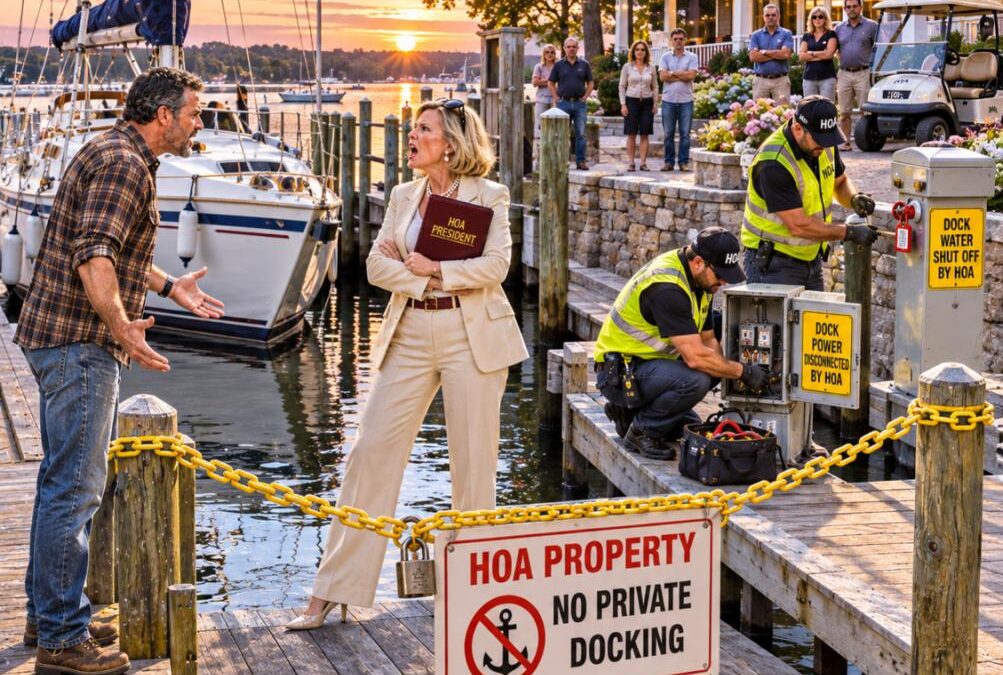
HOA Karen Chained Off My Private Dock and Cut My Marina Power—She Thought I’d Hand Over the Waterfront Without a Fight
She bolted an HOA sign to my private dock, chained off my slip, and told me I no longer had the right to berth my own sailboat there.
When I refused, HOA Karen shut off the dock’s electricity and water and began charging me $100 a day for violating a rule I could not find anywhere.
By the time she threatened to tow my thirty-four-foot sailboat, I had stopped asking whether she was bluffing and started asking what she planned to do with my waterfront after I surrendered it.
The neon-green sign looked radioactive in the sunset.
HOA PROPERTY — NO PRIVATE DOCKING.
I read it once from the cockpit of my sailboat.
Then again.
Five days earlier, I had left Sunset Bay under a clear morning sky with two coolers, a stack of engineering papers I intended not to grade, and the optimistic belief that forty-eight hours offshore would somehow become five peaceful days.
Now I was twenty yards from my own dock with nowhere to tie up.
A yellow-and-black plastic chain had been stretched across the slip entrance. Someone had drilled two new brackets into the cedar posts I replaced the previous spring.
Fresh metal shavings still glittered on the decking.
I eased the throttle into neutral.
Twenty feet uphill, Margaret Voss was trimming roses.
At least, she was pretending to.
Her white tennis skirt had no dirt on it. Neither did the gloves. Her platinum-blond hair sat beneath a visor, and a burgundy HOA folder rested on the garden wall beside her.
She looked up.
“Oh, Ethan. You’re back.”
I stared at her.
“Apparently.”
She smiled.
“Good trip?”
“Who chained my dock?”
She removed one glove finger by finger.
“The association.”
“My dock.”
“The waterfront committee has temporarily assumed control of individual slips.”
“There is no waterfront committee.”
“There is now.”
I pulled out my phone and opened the Sunset Bay HOA portal.
No notice.
No board minutes.
No waterfront resolution.
No marina policy.
Nothing.
“Show me the rule.”
Margaret sighed.
“You’ve always been very literal.”
“I teach engineering.”
“I know.”
“So show me the rule.”
She gestured toward the sign.
“It’s right there.”
“That’s a sign, Margaret. Not authority.”
Her smile disappeared.
“Your deed does not exempt you from community obligations.”
“My deed grants exclusive docking rights to this parcel.”
“We interpret that differently.”
“You don’t get to interpret recorded property rights into disappearing.”
A neighbor had stopped walking his dog across the road.
Margaret noticed.
Her voice became smoother.
“This is exactly why the board has had concerns about you, Ethan. Every reasonable community improvement becomes a confrontation.”
I looked at the fake sign.
The font was wrong.
The Sunset Bay logo was distorted.
The chain wasn’t even locked.
It had been looped through plastic clips designed to look stronger than they were.
I could have removed it with one hand.
Instead, I took photographs.
The sign.
The new screw holes.
The chain.
My GPS position.
The dock number.
Margaret standing behind it.
She laughed softly.
“Documenting your rebellion?”
“Documenting my property.”
“You should read your closing documents more carefully.”
“I did.”
“Then you know the board has broad marina authority.”
“No.”
I looked directly at her.
“I know exactly what the board has.”
Something flickered across her face.
Not anger.
Uncertainty.
Then she recovered.
“You have until tomorrow morning to move your boat to the transient basin.”
“My boat is coming into my slip tonight.”
“If you break an HOA safety closure, the fine is one hundred dollars per day.”
“What section?”
She put her glove back on.
“Read your documents.”
I looked past her toward the utility pedestal beside my dock.
A bright red tamper seal had been wrapped around the breaker cabinet.
Another around the water valve.
Margaret followed my eyes.
Her smile returned.
And that was when I realized the chain was only the beginning.
part 2
Eight months earlier, I had bought the house because of the dock.
The house itself was fine.
Two bedrooms, a loft, cedar siding, and windows large enough to make heating bills personally insulting. It sat on a narrow waterfront parcel at Sunset Bay, a planned community built around a protected inlet where sailboats, fishing boats, and retirees with aggressively polished pontoon boats shared the same calm water.
But the dock was why I signed.
Thirty-eight feet of private slip.
Deep enough for Seafarer, my thirty-four-foot cutter-rigged sailboat.
Dedicated shore power.
Freshwater connection.
A small storage box for lines and maintenance gear.
And most importantly, a deed provision that my attorney pointed to during closing.
Exclusive dock and berthing rights appurtenant to Parcel 17-B.
The wording mattered.
The dock structure itself sat partly within a recorded waterfront easement, and the HOA maintained portions of the common seawall and utility distribution system serving the slips. But each waterfront parcel had a designated exclusive-use slip.
Not public.
Not first-come.
Not HOA rental inventory.
Mine.
I knew because I asked.
Twice.
My closing attorney, Rebecca Lin, had answered the second time by sliding the recorded declaration across her desk.
“Ethan, if you ask me again whether someone can randomly park in your slip, I’m charging you for emotional damages.”
“I’m a teacher. I can’t afford emotional damages.”
“Then stop.”
I teach engineering at Riverview High School.
Mostly seniors.
Statics.
Basic electronics.
Computer-aided design.
A robotics elective that somehow consumes twice the budget allocated to it and three times my patience.
I am forty-one years old, divorced, no children, and own more tools than furniture.
Seafarer is the irresponsible financial decision I defend most passionately.
I bought her seven years before the house.
Old fiberglass hull.
Teak that demands constant attention.
Diesel engine with the emotional stability of a theater student.
I spent years renting slips and driving forty minutes every time I wanted to sail.
Sunset Bay changed that.
My boat would sit behind my house.
I could walk outside after work, check the bilge, drink coffee in the cockpit, and convince myself adulthood had eventually worked out.
For the first three months, it did.
Then Margaret Voss introduced herself.
She lived four houses down in the largest waterfront home on our side of the inlet.
Sixty.
Widowed.
Former luxury-property broker.
White tennis clothes on weekends whether she had played tennis or not.
She had been HOA president for five years.
Our first conversation happened beside my dock.
She stood on the common path looking at Seafarer.
“That’s older.”
I looked at the boat.
“Than what?”
“Most vessels here.”
“She’s 1989.”
Margaret smiled.
“Vintage.”
“That’s a diplomatic word.”
“We generally encourage owners to maintain a certain waterfront appearance.”
“I generally encourage the engine to start.”
She did not laugh.
That should have warned me.
A week later, I received an email.
Dear Mr. Dawson,
Please ensure all visible dock lines are marine-grade and uniform in color. Mixed rope colors can create a visually disorganized marina appearance.
I looked outside.
Two blue dock lines.
Two white.
All proper marine rope.
I checked the covenants.
No color rule.
I ignored the email.
Margaret sent another.
Then another.
Eventually I replied.
Please identify the adopted standard requiring uniform dock-line color.
No response.
Two days later, she appeared while I was washing the boat.
“I got your email.”
“Good.”
“You don’t need to turn every courtesy reminder into litigation.”
“I asked what rule you were referring to.”
“Not every standard is written as a separate regulation.”
“Then it’s a preference.”
She looked at the hose in my hand.
“You’ll find community life easier if you stop looking for technicalities.”
I almost smiled.
“I teach engineering. Technicalities are where bridges stay up.”
Margaret stared at me for several seconds.
Then walked away.
The first actual fine came a month later.
UNAPPROVED DOCK STORAGE.
Fifty dollars.
My offense was a blue plastic box containing a scrub brush, biodegradable soap, gloves, and spare shackles.
The dock rules allowed one weatherproof storage container below a specified height.
Mine complied.
I appealed.
Fine withdrawn.
Then came an “excessive nighttime illumination” warning.
My dock lights were low-voltage fixtures installed before I bought the property.
I measured their output because, again, I teach engineering and have access to students who think light meters are exciting.
Well below the association’s written limit.
Warning withdrawn.
Then Margaret complained that Seafarer’s mast obstructed neighbors’ views.
Every sailboat has a mast.
The slip next to mine held a forty-two-foot sloop.
Its mast was taller.
No complaint.
That was when Clare Bennett first spoke to me.
She lived two streets inland and worked as a landscape architect.
Golden retriever named Baxter.
Constantly dirty sneakers.
Zero tolerance for HOA theater.
She stopped while I was repairing a cleat.
“Margaret likes you.”
“I can tell.”
“She did this to me.”
“What did you do?”
“Asked why a garden renovation cost twelve thousand dollars.”
I looked up.
“What garden?”
She pointed toward the entrance monument.
Three beds of roses and ornamental grass.
“That?”
“That.”
“Twelve thousand?”
“The contractor I use professionally priced comparable work around thirty-five hundred.”
“What happened?”
“I asked to see bids.”
“And?”
“She removed me from the landscape committee for being disruptive.”
I laughed.
Clare did not.
“She isolates people who question money.”
That sentence stayed with me.
I had assumed Margaret was merely obsessive about aesthetics.
Clare was suggesting something else.
“Did you ever get the invoices?”
“Some.”
“And?”
“Nothing criminal on its face. Inflated, maybe. Related vendors, maybe. I couldn’t prove enough.”
“Related how?”
“Same mailing addresses. Family names.”
“Did the board know?”
“Margaret controlled what they saw.”
I leaned against the dock post.
“Why didn’t you push harder?”
Clare looked embarrassed.
“Because everyone stopped talking to me.”
That answer surprised me.
She continued.
“It sounds stupid until it happens. You ask one question. Suddenly your fence needs review. Your dog gets complaints. People tell you maybe you should calm down. You realize every social interaction in your neighborhood now comes through the person you challenged.”
Baxter pulled toward the water.
Clare tightened the leash.
“I got tired.”
I understood more three months later.
Margaret began turning residents against me after I successfully appealed the dock-light warning.
A post appeared in the community portal.
WATERFRONT OWNERS REMINDED THAT INDIVIDUAL PREFERENCES MUST NOT OVERRIDE COLLECTIVE MARINA STANDARDS.
No name.
Everyone knew.
Then:
Certain owners have taken an adversarial approach to safety guidance.
Then:
Private vessels generating maintenance concerns may be subject to additional review.
I started getting strange looks.
Nothing dramatic.
Neighbors who had chatted beside the mailboxes suddenly became busy.
One man who usually asked about sailing weather stopped making eye contact.
At school, I would laugh if a teenager told me a neighborhood email made him uncomfortable.
Living inside it felt different.
People are social animals.
Being quietly recategorized as difficult changes a place.
My home started feeling like territory.
So I did what I tell students to do when a design fails.
Separate observation from assumption.
I created a folder.
Covenants.
Rules.
Board minutes.
Notices.
Appeals.
Photos.
Utility agreements.
My deed.
I named it MARGARET because sometimes engineering professionalism has limits.
The utility documents became important.
Sunset Bay owned the common marina electrical distribution infrastructure.
Individual waterfront owners paid a quarterly marina utility assessment.
Each private slip had its own breaker pedestal and water connection.
The HOA maintained upstream equipment.
Owners maintained fixtures from the pedestal outward.
The governing documents allowed temporary shutoff for emergencies, repairs, safety hazards, or delinquent utility assessments after required notice.
Nothing gave the president unilateral power to disconnect a compliant slip because she disliked a sailboat.
I paid every bill.
No electrical violations.
No water violations.
That was why the red seals after my five-day trip frightened me more than the chain.
The fake sign was absurd.
Cut utilities could damage property.
My refrigerator was running from shore power.
Battery charger too.
Bilge pump had battery backup, but the charger maintained the bank.
Leaving a boat without reliable power during summer heat was not automatically catastrophic, but it was not something I accepted casually.
I tied Seafarer temporarily to the outside face of my own dock.
The chain blocked the inner slip, not the entire structure.
Margaret watched from the roses.
“You’re violating the closure.”
“I’m securing my boat while I figure out who tampered with my utilities.”
“The HOA disconnected them.”
“Under whose authority?”
“The waterfront rule.”
“Show me the vote.”
“You are becoming repetitive.”
“Because you keep avoiding the question.”
She walked inside.
I photographed every seal before touching anything.
Then I called the HOA management company.
Generic voicemail.
I called the emergency maintenance number.
A contractor named Ben answered.
“Sunset Bay marina.”
“Slip seventeen. Power and water have red HOA seals.”
Pause.
“Seventeen?”
“Yes.”
“You delinquent?”
“No.”
“Electrical problem?”
“Not that I know.”
Another pause.
“I didn’t shut you off.”
“Who can?”
“Management or board-authorized maintenance.”
“Was there a work order?”
“I’m checking.”
Keyboard sounds.
“No.”
That was useful.
“Can you restore it?”
“I’m not touching a board seal without written authorization.”
Also understandable.
I disconnected the boat from shore service properly and switched critical loads to the battery bank.
Then I drove to a marine supply store and bought ice.
The bait cooler in the dock box contained about fifty dollars of fishing supplies and frozen packs.
Annoying.
Not life-changing.
The bigger problem was that Margaret had demonstrated she could interfere with infrastructure while management hid behind procedure.
That night, my dining room became exactly what Clare later called my war room.
Deed.
Plat.
Declaration.
Marina utility policy.
Rules.
Minutes.
I searched the HOA portal.
Three days earlier, Margaret had uploaded a document titled:
INTERIM WATERFRONT PRESERVATION DIRECTIVE.
One page.
Signed:
Margaret Voss, President.
It claimed the board had authority to restrict private docking while conducting “marina standardization.”
No board resolution attached.
No minutes.
No effective date approved by the directors.
No legal review.
The document cited Section 12(b).
I checked.
Section 12(b) concerned landscaping changes visible from common streets.
Nothing about docks.
I laughed alone in the dining room.
The next morning, a certified letter arrived.
NOTICE OF WATERFRONT NONCOMPLIANCE.
One hundred dollars per day.
Section 12(b).
My laughter disappeared.
I called my closing attorney.
Rebecca Lin remembered me.
“Please tell me nobody parked in your slip.”
“Worse.”
I explained.
She asked me to email everything.
Two hours later:
“You are not removing anything.”
“I wasn’t planning to.”
“You are also not ripping down their sign in anger.”
“That was less certain.”
“Ethan.”
“Fine.”
“Do not break their seals.”
“I won’t.”
“And stop making signs.”
I had already ordered one.
There was silence.
“What sign?”
“Marine-grade reflective aluminum.”
“Ethan.”
“It says NOT HOA PROPERTY.”
She sighed.
“Where are you putting it?”
“On my dock.”
“Entirely within your exclusive-use area?”
“Yes.”
“Not obscuring required marina identification or safety information?”
“No.”
“Fine.”
“You approve?”
“I did not say that.”
The sign arrived the next day.
White letters on dark blue.
PRIVATE SLIP — SEE RECORDED DEED AND MARINA PLAN.
Rebecca had vetoed NOT YOUR HOA after reading my draft email.
Apparently lawyers hate joy.
I mounted the sign to an existing bracket so I drilled no additional holes.
At 7:04 the following morning, Lady arrived.
Lady was Margaret’s Chihuahua.
Six pounds of white fur and unresolved rage.
She barked at me from the path.
Margaret followed.
“What is that?”
“My sign.”
“You cannot install unauthorized marina signage.”
“Neither can you.”
She looked at her neon-green sign beneath mine.
“That is association signage.”
“Where was it approved?”
“This is childish.”
“I agree.”
“Take yours down.”
“Take yours down.”
“I will call security.”
“Please do.”
She stared at me.
Then said, “You think being technically right makes you untouchable.”
“No.”
I tightened the final bolt.
“I think property rights require documentation.”
Her face changed.
That same uncertainty.
Again.
I started wondering what she was afraid I would find.
Clare answered part of that question.
She caught me walking back from the marina that evening.
Baxter beside her.
“You’ve made her crazy.”
“That seems unfair. I’ve known her eight months.”
“She called an emergency board session.”
“When?”
“Tomorrow.”
“No notice.”
“Not for homeowners.”
“Board only?”
“At her house.”
“How do you know?”
“She wants me there as a landscape consultant.”
I stared.
“Why?”
“She says marina redevelopment may require shoreline planting changes.”
There it was.
Redevelopment.
“What marina redevelopment?”
Clare looked toward Margaret’s house.
“Exactly.”
We met at a coffee shop outside Sunset Bay.
I brought copies of the deed and the interim directive.
Clare brought old budgets.
The marina line items had changed.
Previous year:
MARINA MAINTENANCE — $42,000.
Current budget:
MARINA ENHANCEMENT PLANNING — $68,000.
No project had been announced.
Then we found a consulting payment.
Voss Waterfront Management LLC.
Clare stared at the name.
“Her?”
I searched the state business registry.
Margaret Voss, registered agent.
Company formed seven months earlier.
That was not automatically theft.
HOAs can hire companies associated with board members in some circumstances if conflicts are disclosed and procedures followed.
The question was whether the board had done that.
I searched meeting minutes.
No disclosure.
No approval.
No contract vote.
Rebecca Lin told me to stop making conclusions.
“Related-party payment without proper approval is concerning.”
“Concerning?”
“That is lawyer language for stop calling it embezzlement until an accountant sees it.”
Fine.
I bought a portable solar system for Seafarer.
Six hundred thirty-two dollars.
Panels.
Charge controller.
Cables.
Enough to keep the house batteries maintained independently while the shore-power dispute continued.
I had it shipped to Riverview High because I did not trust packages sitting near Margaret’s patrol route.
My students thought I was starting another robotics project.
One asked:
“Mr. Dawson, why do you need marine solar panels?”
“Because adults make poor design decisions.”
They accepted that immediately.
The emergency board meeting took place at Margaret’s house.
Clare attended.
What happened there later became one of the most important parts of the case, but not because she secretly recorded everyone illegally.
Before going, Clare checked the law with Rebecca.
Our state permitted recording by a participant to a conversation under circumstances applicable to that meeting, but Rebecca still advised caution because privacy expectations and context can complicate admissibility and civil claims.
More importantly, Clare did not need to rely solely on audio.
She was a participant.
She took contemporaneous notes.
And afterward, two board members independently confirmed what had been discussed.
Margaret opened the meeting with a proposal called:
SUNSET BAY MARINA OPTIMIZATION PROGRAM.
The plan was breathtaking.
Private waterfront slips would be redesignated as “managed marina assets.”
Existing deeded owners would retain priority access but pay annual management fees.
Unused periods could be rented to third parties through the HOA.
Revenue projections:
More than $50,000 annually in the first phase.
Phase two:
$110,000.
Margaret’s company would receive a ten-percent management fee for coordinating slip rentals, utility billing, maintenance, and “waterfront presentation.”
Clare asked the obvious question.
“How can the HOA rent slips it doesn’t own?”
Margaret reportedly said:
“The declaration gives us broad marina authority.”
Board member Thomas Reed disagreed.
“We need counsel.”
Margaret replied:
“If we bring counsel in before we establish operational control, owners will lawyer up.”
Clare wrote that sentence down.
Then Margaret used my name.
“Ethan is the test case.”
Clare froze.
According to her notes, Margaret said:
“If we establish that the board can restrict his docking privileges for noncompliance, the remaining owners will understand this is an association asset, not sixteen private kingdoms.”
Thomas asked:
“What noncompliance?”
Margaret mentioned the sign.
My boat’s appearance.
My refusal to cooperate.
Then utility shutoff.
Another director, Susan Hale, asked:
“Did the board authorize shutting off his power?”
Margaret said it was an emergency enforcement measure.
Susan asked:
“What emergency?”
Margaret changed subjects.
That night, Clare called me.
I put her on speaker with Rebecca Lin.
Clare read her notes.
Rebecca stayed quiet.
Then asked:
“Did anyone else object?”
“Thomas and Susan.”
“Will they confirm?”
“I think Susan will.”
“What about Thomas?”
“He’s afraid.”
Rebecca exhaled.
“Good.”
I laughed.
“How is fear good?”
“Because fear means this isn’t Margaret’s board unanimously doing something stupid. It means she may be acting beyond actual board authorization.”
That distinction mattered.
We sent a formal demand the next morning.
Not from me.
From counsel.
Restore utilities.
Remove the unauthorized sign.
Suspend fines.
Identify the board resolution authorizing the interim waterfront directive.
Preserve all marina records, financial records, communications with Voss Waterfront Management, utility-shutoff instructions, and correspondence concerning my slip.
No threats.
No accusations of theft.
Just documents.
Margaret responded personally.
The association will not be intimidated by aggressive legal posturing.
Rebecca forwarded it to me with:
She should stop emailing.
Margaret did not stop.
Instead she hired private security.
Two men appeared near my dock Saturday afternoon.
Black polo shirts.
SECURITY.
Legitimate company.
No fake badges.
They remained on the common path.
One told me they had been instructed to “monitor unauthorized marina activity.”
I asked:
“Did anyone tell you this dock belongs to me?”
He looked uncomfortable.
“We were told the HOA controls marina operations.”
“Would you like my attorney’s letter?”
“No, sir.”
Smart man.
They never crossed my property.
That evening, Margaret posted another community message.
Certain waterfront owners are escalating a routine standards issue by involving outside attorneys and provocative signage.
People began avoiding me more openly.
A couple who usually waved while kayaking paddled past without looking up.
At school, I caught myself thinking about HOA emails while students asked about torque calculations.
That bothered me.
Home was leaking into work.
I stayed late one afternoon building the solar mount for Seafarer.
One student, Maya Chen, lingered after robotics club.
“Mr. Dawson?”
“Yeah?”
“Why are you making the brackets yourself?”
“Because the kit bracket is garbage.”
“That’s not the real reason.”
Teenagers are terrifying.
“What’s the real reason?”
“You’re mad.”
I looked at her.
“Go home, Maya.”
She smiled.
“See you tomorrow.”
Teaching teenagers had trained me for Margaret better than any legal seminar.
Students challenge everything.
Rules.
Deadlines.
Definitions.
If you cannot explain why something is required, eventually a sixteen-year-old will expose you.
Margaret had built an entire leadership style around nobody asking why.
That was ending.
Susan Hale contacted Rebecca two days later.
She had been on the board four years.
Retired nurse.
Not interested in scandals.
She confirmed the meeting.
She also confirmed something else.
The board had never voted on the interim waterfront directive.
Margaret drafted it.
Margaret uploaded it.
Margaret ordered management to treat it as active policy.
The utility shutoff?
No vote.
No documented emergency.
Margaret sent an email directly to a maintenance subcontractor instructing him to seal my dock pedestal.
The contractor assumed she had authority because she was president.
That was exactly how small abuses become operational.
Nobody asks the next question.
Management assumes the president has board approval.
The contractor assumes management knows.
Neighbors assume a sign means policy.
Policy starts existing because everyone behaves as if it does.
Rebecca sent the confirmation to the HOA’s regular outside counsel.
That finally changed the atmosphere.
Until then, Margaret had kept our attorney-to-attorney communications away from the association’s usual firm by claiming she was “handling the matter internally.”
When regular counsel saw the deed, declaration, unsigned waterfront directive, utility records, and related-party company, he called an emergency board meeting through management.
Proper notice this time.
Margaret tried to cancel it.
The other directors refused.
The meeting was packed.
Not because I rallied anyone.
Margaret had done that herself.
Rumors about private dock fees had spread.
Every waterfront owner came.
Half the inland owners came because they wanted to know why HOA money was paying Voss Waterfront Management.
Margaret sat at the center table.
Same white outfit.
Same burgundy folder.
Less confidence.
The association attorney spoke first.
“The purpose tonight is to address board authority, marina governance, utility interruption, and financial disclosures.”
Margaret interrupted.
“We also need to address Ethan Dawson’s continuing noncompliance.”
The attorney looked at her.
“That is not the first item.”
She stopped.
Small moment.
Huge room.
He explained that his preliminary review found no board-approved rule converting exclusive-use private slips into general HOA-controlled rental assets.
No authority had been identified allowing the association to extinguish recorded exclusive docking rights by unilateral presidential directive.
Common utility infrastructure remained subject to HOA maintenance rights.
That did not mean the president could use those utilities as coercion outside adopted procedures.
A murmur moved through the room.
Margaret lifted her microphone.
“This legal interpretation ignores decades of marina governance.”
A waterfront owner named Jack Moreno called out:
“Then show us the documents.”
The attorney answered before Margaret.
“That is what we are reviewing.”
Then Susan spoke.
“I want the minutes to reflect that the board never voted on Ethan’s dock closure.”
Margaret turned.
“Susan.”
“No.”
Susan’s voice shook.
That made it stronger.
“We did not vote on it.”
Thomas Reed spoke next.
“Correct.”
Margaret looked from one to the other.
The structure around her was cracking.
Then Clare stood.
“I attended the marina planning meeting at Margaret’s request.”
Margaret’s face changed.
Clare continued.
“She proposed converting private slips into managed rental assets.”
Residents began talking at once.
The chair called for order.
Clare read from her notes.
Projected revenue.
Management fee.
Voss Waterfront Management.
Margaret interrupted.
“That was exploratory.”
Clare nodded.
“Then why was Ethan’s dock already closed?”
Silence.
I had waited weeks for that question.
I did not need to ask it.
That felt better.
Margaret looked at me.
“You deliberately escalated this.”
I stood only when the chair recognized me.
I carried a small portable speaker.
Not for secret audio.
For something simpler.
Voicemail.
Margaret had left me one two nights earlier after apparently forgetting she was recording herself.
The message began:
Ethan, this can still be resolved if you stop treating your slip like sovereign territory.
Then:
Once the board completes the marina transition, owners who cooperate will receive preferred fee treatment. People who force us to spend money on lawyers should not expect the same consideration.
Rebecca had told me the voicemail was mine to preserve and use in the board process.
I played it.
No accusations.
Just Margaret’s voice.
Preferred fees for cooperation.
Different financial treatment for owners who challenged the plan.
Jack Moreno stood.
“That sounds like retaliation.”
The association lawyer said:
“It raises concerns.”
Margaret slammed her hand on the table.
“This entire meeting is being manipulated by one disgruntled teacher and a former committee member with a vendetta.”
Clare laughed.
“Former because you removed me.”
“You were disruptive.”
“I asked why roses cost twelve thousand dollars.”
There it was.
The financial question.
Margaret’s expression changed.
The association attorney closed his folder.
“I believe the board needs to move into executive session with independent counsel and the association’s insurer.”
Margaret stood.
“No.”
Everyone stopped.
“You do not get to turn this into an investigation of me because Ethan refuses to follow rules.”
Thomas Reed looked at her.
“What rules, Margaret?”
She stared.
He continued.
“The rule you wrote yourself?”
That ended the public portion.
The board entered closed session for legal advice.
Residents stayed.
Nobody went home.
I sat beside Clare.
“You okay?”
“No.”
“Good.”
She looked at me.
“Why good?”
“Rebecca says fear means the board isn’t unanimous.”
Clare laughed despite herself.
Forty-five minutes later, the directors returned.
Thomas read the motions.
First:
The interim waterfront directive was suspended immediately.
Passed four to one.
Margaret voted no.
Second:
All fines issued under it were rescinded pending legal review.
Four to one.
Third:
Utilities to my slip were to be restored immediately.
Unanimous.
Margaret did not vote no on that one.
Fourth:
No private dock could be restricted except under properly adopted rules consistent with recorded property rights and legal counsel review.
Passed.
Fifth:
Payments to Voss Waterfront Management were suspended pending independent audit.
Margaret stood.
“This is outrageous.”
Thomas continued.
Sixth:
Margaret Voss was removed as HOA president effective immediately, pursuant to the board’s authority to replace officers.
She remained a director until the membership could vote under the bylaws.
Three to two.
Margaret stared at Susan.
“You voted for this?”
Susan looked miserable.
“Yes.”
Margaret gathered her folder.
“You have no idea what you’re doing.”
Thomas replied:
“That’s why we hired an auditor.”
She left.
Nobody applauded.
I appreciated that.
My power and water came back at 9:18 the next morning.
Ben, the maintenance contractor, removed the red seals himself.
“I’m sorry.”
“You thought she had authority.”
“I should’ve checked.”
“Yes.”
He nodded.
“I know.”
I watched the dock pedestal come alive.
Green indicator.
Voltage stable.
Water valve opened.
Simple systems.
Clear states.
On.
Off.
Human systems were harder.
The fake neon sign came down too.
I kept it.
Rebecca advised preserving it until every dispute resolved.
It spent eighteen months behind my garage workbench.
The two extra drill holes in the dock post remained.
I never filled them.
Not because I wanted a monument.
Because every time I saw them, I remembered how easy it had been for Margaret to make fiction look official with four screws and a logo.
The audit took three months.
It did not reveal a glamorous criminal empire.
Reality disappointed neighborhood gossip.
The twelve-thousand-dollar garden project included some legitimate irrigation work Clare had not known about.
Actual reasonable value was closer to seven thousand than three.
Still overpriced.
Still poorly bid.
But not the eight-thousand-dollar theft people had begun claiming.
Voss Waterfront Management was more serious.
The company had received $21,600 in planning and administrative payments over seven months.
Some work had been performed.
Site surveys.
Vendor calls.
Marina spreadsheets.
Meeting preparation.
But Margaret had not properly disclosed the related-party arrangement in several votes, and the board minutes did not show disinterested approval of the compensation structure.
Then auditors found duplicate reimbursement.
Two marina consulting expenses had been paid both through the company and directly to Margaret.
Roughly $6,800.
Another $9,400 in landscaping coordination payments went to a firm owned by Margaret’s cousin.
Again, some work was real.
Some invoices could not be substantiated.
The evidence went to the association’s attorney and insurer.
Then to the county district attorney when counsel concluded potential criminal conduct required review.
I did not make the criminal referral.
That mattered.
I had a property dispute.
The board had a financial-governance problem.
The prosecutor decided whether crimes existed.
Margaret’s management-fee proposal created another issue.
She stood to profit from a marina program she was aggressively trying to impose while using HOA authority against the first resisting owner.
That conflict alone destroyed most remaining support.
The membership petition to remove her as director collected signatures quickly.
The special meeting happened in November.
Margaret attended.
She had hired counsel by then.
Her attorney did something I respected.
He did not pretend the fake dock rule was legitimate.
He argued that Margaret believed the declaration gave the association broader authority and that board practices had historically been informal.
He disputed criminal intent regarding financial transactions.
Fair.
Belief matters.
Intent matters.
Evidence decides.
Then Margaret spoke.
She called the marina plan visionary.
She said Sunset Bay needed new revenue.
She said older infrastructure was failing.
That part was true.
The seawall reserve was underfunded.
Several electrical pedestals needed replacement.
The HOA had budget problems.
Her underlying concern was not imaginary.
Her solution was the problem.
She had decided the ends justified inventing authority.
Then she said:
“Ethan Dawson turned a community planning issue into a personal attack because he believes individual rights always outrank collective responsibility.”
My turn came later.
I stood.
“No.”
Margaret looked at me.
“I teach engineering.”
A few residents smiled.
“That means I spend all day telling teenagers there are constraints.”
“Materials have constraints.”
“Budgets have constraints.”
“Designs have constraints.”
“Authority does too.”
The room quieted.
“I am not arguing that the HOA has no rights around the marina.”
“It maintains common infrastructure.”
“It can adopt lawful safety standards.”
“It can assess owners according to recorded obligations.”
“It can repair shared facilities.”
I held up my deed.
“What it cannot do is make an exclusive property right disappear because the president wants a revenue stream.”
Then the utility invoice.
“It cannot shut off paid utility service to punish someone for challenging a rule the board never adopted.”
Then the marina directive.
“And it cannot turn one person’s signature into a board vote.”
I set the documents down.
“This could have been a legitimate conversation.”
“The seawall needs money.”
“Let’s talk about it.”
“The electrical system needs investment.”
“Let’s budget it.”
“If owners want to create a voluntary slip-rental program, propose it.”
“But you do not solve a funding problem by pretending the documents say something they do not.”
I sat.
No speech about tyranny.
No revenge.
The numbers did enough.
Margaret was removed from the board by seventy-four percent of votes cast.
Twenty-six percent supported her.
Some residents believed she had been unfairly demonized.
Some appreciated her years of service.
Some thought the marina proposal, though badly handled, was financially smart.
They were allowed to think that.
The vote still removed her.
Clare did not become president that night.
The original story made that too easy.
Instead, Thomas Reed became interim president under the bylaws until a proper election could be held.
Clare joined the finance committee later.
She almost refused.
I told her:
“You started this.”
She pointed at me.
“No. Your ugly boat started this.”
“Seafarer has character.”
“Seafarer has mildew.”
Cruel.
Accurate.
The criminal investigation into Margaret’s finances continued quietly.
No raid.
No handcuffs at an HOA meeting.
No dramatic prosecutor speech.
The district attorney eventually filed charges related to fraudulent reimbursement submissions and misappropriation of association funds.
Not every suspicious payment became a charge.
The landscaping contracts were messy but partly legitimate.
The Voss Waterfront payments involved disclosed work mixed with undisclosed conflicts.
The clearest evidence involved duplicate reimbursements and falsified supporting documents totaling a much smaller amount than rumor claimed.
Margaret eventually entered a negotiated plea to one felony theft-related count and a misdemeanor records offense.
She paid restitution.
Financial penalties.
Probation.
No long prison sentence.
No house seized by the government.
She sold her Sunset Bay home the following year.
People claimed it was twenty percent below market.
It was not.
Public records showed the sale was within a normal range for comparable waterfront homes.
I mention that because revenge stories attract fictional numbers like docks attract algae.
The truth was enough.
My civil dispute settled separately.
The HOA acknowledged my exclusive docking rights as described in the recorded documents.
The fake fines were rescinded.
My legal expenses were substantially reimbursed through the association’s insurer.
The board agreed to cover the cost of repairing the drill holes and any damage from the unauthorized signage.
I declined the post repair.
I asked for a recorded marina clarification instead.
Rebecca approved.
The HOA’s attorney agreed.
A document was recorded identifying the exclusive-use slips, common utility infrastructure, maintenance responsibilities, and limits of association authority.
That was worth more than cosmetic cedar.
Boards change.
Recorded instruments remain.
Sunset Bay rewrote marina procedures after that.
Not the deed rights.
Procedures.
No individual officer could order utility termination except a genuine emergency.
Nonemergency shutoffs required documented grounds, notice where required, and management verification.
Fines had to cite actual adopted provisions.
Every new marina rule required board approval in properly noticed meetings and review for consistency with existing recorded property rights.
Related-party contracts had to be disclosed.
Directors with financial interests recused themselves.
Projects above a threshold required multiple bids.
Simple.
Boring.
Effective.
The seawall problem remained.
Margaret had been right about that.
The community needed money.
So we did something radical.
We discussed it.
An engineer assessed the seawall.
A marine electrician reviewed the pedestals.
A reserve specialist updated the funding plan.
Waterfront owners paid a properly calculated special assessment because our documents assigned us a larger portion of marina-related costs.
Nobody enjoyed it.
I paid mine.
Jack Moreno complained for six straight weeks.
Then voted yes.
That was governance.
Not getting what you want.
Getting a process you can verify.
I installed my solar kit anyway.
By then the shore power was restored.
I no longer needed it.
I kept it because the design was good.
Two flexible panels mounted on a frame above the aft rail.
Charge controller.
Separate battery protection.
My robotics students helped me redesign the bracket after the commercial version flexed too much.
One student calculated wind loading.
Another improved the cable routing.
Maya Chen looked at my first prototype.
“This is terrible.”
“Thank you.”
“You always say criticism has to be specific.”
“Fine. The lateral brace is terrible.”
She was right.
We fixed it.
The following spring I used Seafarer as the basis for an engineering elective project.
Not sailing class.
Too much liability.
Students designed small marine systems.
Solar charging.
Bilge alarms.
Water-level sensors.
Corrosion-resistant brackets.
It became one of the most popular units I taught.
I never told them the entire Margaret story.
They knew there had been an HOA dispute because teenagers can find anything online.
One asked:
“Did you really fight your HOA with a boat battery?”
“No.”
“Internet says yes.”
“Internet also says Margaret stole a hundred thousand dollars.”
“Did she?”
“No.”
“That’s disappointing.”
“Reality usually is.”
Five years later, I still teach them that.
Evidence before excitement.
Clare eventually became HOA president.
Not immediately.
Two years after Margaret left.
She ran reluctantly.
Won easily.
Her first board meeting lasted four hours because she insisted every resident question receive an answer.
By meeting three, even I wanted her to become slightly less democratic.
She refused.
The financial portal became searchable.
Contracts posted.
Conflict disclosures posted.
Budgets explained with actual notes instead of unexplained categories.
Residents complained there was too much information.
Clare considered that success.
I somehow became ombudsman.
Volunteer.
Unpaid.
My responsibility was narrow.
If an owner believed management had misapplied a rule, I helped identify the correct appeal path before the disagreement became warfare.
I accepted because I had lived the alternative.
My first case involved wind chimes.
Of course.
A woman named Denise received a noise warning.
She believed the HOA was persecuting her.
The neighbor had submitted three recordings after midnight.
The chimes really were loud.
I told Denise.
She stared at me.
“I thought you fought unreasonable HOA rules.”
“I fought an invented rule.”
“So?”
“This one exists.”
“You’re siding with them?”
“I’m reading the rule.”
She removed the chimes at night.
Problem solved.
That case pleased me more than defeating Margaret.
Fairness does not mean homeowners always win.
It means authority can explain why.
Another case involved a fence.
Management had denied the color.
The written palette actually allowed it.
Denial reversed.
A third involved an elderly couple’s dock ladder.
Safety concern legitimate.
Deadline unreasonable.
Extension granted.
No war.
No neon-green signs.
No utility shutoff.
People talked.
Sometimes Margaret’s name came up.
Usually as a warning.
“Don’t pull a Margaret.”
I hated that phrase.
Not because I wanted to protect her.
Because reducing governance failure to one person makes the next failure easier.
Margaret exploited weak systems.
But the systems were weak before she exploited them.
Presidents could order maintenance directly.
Financial conflicts were poorly documented.
Meeting minutes lacked detail.
Management deferred too often to officers.
Homeowners rarely attended.
Those weaknesses created room.
Margaret filled it.
Replacing her without changing them would have solved nothing.
That lesson became part of my classroom too.
Not the HOA details.
System design.
I give students a fictional scenario:
One administrator can approve purchases, choose vendors, confirm delivery, and authorize payment.
“What’s wrong?”
At first they say:
“Nothing if she’s trustworthy.”
Then I smile.
By the end of the unit, they hate that answer.
Security does not begin by assuming everyone is evil.
It begins by accepting that nobody should need to be perfect.
Controls protect honest people too.
Margaret never understood that.
To her, oversight was insult.
Questions were disrespect.
Documentation was opposition.
If you asked for a bid, you doubted her.
If you asked for authority, you attacked her.
If you asked for a vote, you obstructed progress.
That mentality turned a marina funding problem into a property war.
I saw Margaret one final time before she moved.
I had just come back from sailing.
No chain.
No green sign.
I tied Seafarer to the dock.
She stood on the common path.
For a moment, the scene felt almost exactly like the day I returned from my five-day trip.
Except she had no folder.
No tennis whites.
Just jeans and a navy sweater.
“Ethan.”
“Margaret.”
She looked at Seafarer.
“You put solar on it.”
“Six hundred-dollar act of defiance.”
She smiled faintly.
“I deserved that.”
I finished the bow line.
She remained.
“I wanted to apologize.”
I looked up.
“For?”
“That’s a longer list than I expected.”
Good start.
She came closer but stopped at the property marker.
I noticed.
“So start somewhere.”
“The dock.”
“Okay.”
“I had no right to close it the way I did.”
“No.”
“The utilities.”
“No.”
“I convinced myself the association’s control of the infrastructure gave me more authority than it actually did.”
“That’s generous wording.”
She nodded.
“I was angry.”
“At me?”
“At everyone.”
“Why?”
She looked toward the marina.
“Money.”
That surprised me only because she admitted it immediately.
“The reserves were bad.”
“I know.”
“The seawall estimates scared me.”
“Same.”
“I thought the board would never approve enough assessments.”
“Probably.”
“And I thought if we could monetize the slips, I could solve it without asking homeowners for more money.”
“That part almost sounds responsible.”
She laughed once.
“Until I decided the documents should mean what I needed them to mean.”
“Yes.”
Her face tightened.
“I also thought I deserved compensation for managing it.”
“That was the conflict.”
“I know.”
“What about the duplicate reimbursement?”
She looked away.
“No excuse.”
I waited.
She did not offer one.
That mattered.
Then she looked at the dock.
“When you challenged me, I panicked.”
“Why?”
“Because I knew if one waterfront owner went to a lawyer before I established the program, it would collapse.”
I leaned against the piling.
“So you tried to make me the example.”
“Yes.”
There it was.
No secret recording needed.
“You told Clare that.”
“I said worse things than I should have.”
“You isolated her too.”
“I know.”
“You did it to everyone who questioned you.”
She closed her eyes briefly.
“Yes.”
I thought I would enjoy hearing that.
I didn’t.
By then, it was history.
“Why apologize now?”
“I’m moving.”
“That explains timing. Not motive.”
She looked at me.
“I don’t want to take the version of myself that lived here with me.”
That sentence was good enough that I suspected she had rehearsed it.
Maybe she had.
Still true.
“You can’t leave it here.”
“I know.”
“No community can absorb it for you.”
“I know.”
I nodded.
“Then figure out what you do with it.”
She looked disappointed.
“You don’t forgive me?”
“I didn’t say that.”
“Do you?”
I considered.
“I’m not angry every morning.”
“That’s something.”
“Yes.”
“I don’t want anything bad to happen to you.”
She nodded.
“And I believe you’re sorry.”
Her eyes lifted.
“But?”
“But forgiveness isn’t a management fee.”
She stared.
Then laughed.
Actually laughed.
“I walked into that.”
“Yes.”
She wiped one eye.
“I’m sorry, Ethan.”
“Thank you.”
Margaret moved to Florida.
Not into some ironic tyrannical HOA prison, despite neighborhood jokes.
She bought a condo in a coastal development with strict rules because, according to Clare, she genuinely liked structured communities.
People are complicated.
She sent me a card about a year later.
No request.
Just:
I joined the finance committee. I disclose everything now.
I laughed for ten minutes.
Then wrote back:
Ask for three bids.
That was the extent of our relationship.
The fake green HOA sign hangs in my garage now.
Not the sign Rebecca let me make.
Margaret’s original.
HOA PROPERTY — NO PRIVATE DOCKING.
The logo still looks terrible.
One afternoon, a robotics student named Leo spotted it while our team was helping me load equipment.
“What’s that?”
“Engineering lesson.”
“That doesn’t look like engineering.”
“It is.”
“How?”
I pointed to the sign.
“What makes something official?”
He shrugged.
“Government?”
“Not enough.”
“Logo?”
“No.”
“Someone in charge?”
“Still no.”
He stared at it.
“Rules?”
“Closer.”
Then Maya, now a teaching assistant in college, said:
“Authority.”
I smiled.
“Exactly.”
Authority has to come from somewhere.
A contract.
A deed.
A statute.
A properly adopted rule.
A vote.
A permit.
An easement.
A court order.
A person cannot manufacture authority by printing a sign with a logo.
That may be the most useful thing Margaret ever taught me.
The new sign on the dock is simpler.
PRIVATE SLIP 17-B.
GUESTS BY INVITATION.
Clare wanted me to put something funny beneath it.
NOT YOUR HOA.
Rebecca Lin still vetoed that.
“Why are you still asking your closing attorney about signs?”
“Tradition.”
“You need hobbies.”
“I own a sailboat.”
“An even worse hobby.”
Seafarer is still afloat.
Mostly.
She developed a fuel leak three summers ago that cost more than I want recorded in any permanent medium.
The teak still demands attention.
The diesel still starts according to an emotional schedule rather than mechanical logic.
I love her.
The marina looks better too.
Ironically, some of Margaret’s underlying ideas eventually happened.
Sunset Bay created a voluntary slip-sharing program.
Waterfront owners can opt in when traveling.
The HOA manages reservations for a modest administrative fee approved transparently by members.
I joined.
When I sail for several days, visiting boats sometimes use my slip.
I receive part of the rental income.
The association receives a small portion for administration and marina reserves.
The difference?
Consent.
That one word changed everything.
Margaret wanted the revenue badly enough to treat consent as an obstacle.
The new board treated it as the foundation.
Participation reached sixty percent within two years.
Owners who declined kept exclusive use.
Nobody punished them.
Nobody shut off utilities.
Nobody drilled signs into their docks.
The program now brings in enough to cover a meaningful part of annual marina maintenance.
Margaret’s financial instinct was not entirely wrong.
Her governance was.
That may be the hardest lesson to explain in a revenge story.
Sometimes the antagonist has identified a real problem.
That does not justify an unlawful solution.
Sunset Bay needed revenue.
Our marina infrastructure was aging.
Margaret saw both.
She also believed urgency made procedure optional.
It did not.
A good goal does not legalize bad authority.
I tell students the same thing about engineering shortcuts.
The bridge needs to open on time.
The budget is limited.
The client is angry.
The weather delayed construction.
None of those facts change the load.
Physics does not care why you skipped the calculation.
Property rights are similar.
Recorded documents do not become flexible because the HOA reserve account is uncomfortable.
One evening, five years after the dock fight, Clare sat with me on Seafarer’s stern while the sun dropped behind the inlet.
Baxter was gone by then.
Old age.
She had a younger dog that was somehow worse behaved.
“You ever think about moving?” she asked.
“No.”
“Not once?”
“During Margaret?”
I thought about it.
“Yes.”
“How close?”
“Very.”
“What stopped you?”
“Spite.”
Clare laughed.
Then I shook my head.
“No. Not really.”
“What, then?”
“I liked it here.”
She nodded.
That was the simplest answer.
Abusive leadership tries to convince people the only options are surrender or escape.
Sometimes leaving is absolutely the right choice.
I would never judge anyone for protecting their peace.
But I did not want to abandon a home I liked simply because one person discovered how uncomfortable she could make it.
So I stayed.
Not to defeat Margaret.
To keep the thing I had already chosen.
My dock.
My boat.
My classroom ten minutes away.
The morning coffee.
The inlet after rain.
Neighbors who eventually became actual neighbors.
That was enough.
Sunset Bay never became famous nationally.
The original version of the story wanted that.
National reform.
Viral headlines.
A movement.
None of that happened.
Our dispute appeared briefly in regional news after the criminal case became public.
A boating association newsletter wrote about deeded slip rights and HOA governance.
One state legislator mentioned the case during a hearing on common-interest-community transparency, but no sweeping national law came from my dock.
Real change is usually more local.
Sunset Bay fixed Sunset Bay.
That mattered.
Other homeowners contacted Rebecca after reading about the case.
She referred some to attorneys in their own states because HOA law varies dramatically.
I answered emails when I could.
My advice was always boring.
Read your deed.
Read the declaration.
Separate common property from exclusive-use areas.
Check recorded easements.
Check who actually adopted the rule.
Do not destroy signs or break seals in anger.
Photograph everything.
Pay undisputed amounts.
Appeal properly.
Get a local attorney when property rights or liens become serious.
Do not assume the HOA is right because the letterhead looks official.
Also do not assume the HOA is wrong because you dislike the rule.
That last part disappoints people.
Truth often does.
My students still hear versions of the story.
Not Margaret’s name.
Not the criminal case.
I use the dock as a design ethics exercise.
I give them a scenario:
A system operator controls a resource that users depend on.
The operator has authority to shut it down during emergencies.
Then the operator shuts down one user to force agreement in an unrelated dispute.
“What failed?”
At first they say:
“The operator.”
I say:
“Too easy.”
Then they eventually reach:
“The system allowed emergency authority to be used without verification.”
Exactly.
Bad systems depend on good people.
Good systems expect people to sometimes be wrong, angry, biased, rushed, frightened, or selfish.
That is why there are checks.
Margaret was the failure everyone could see.
The real reform was making sure the next Margaret would need other people to agree before touching the switch.
My solar panels remain on Seafarer.
Completely unnecessary most days.
I keep them anyway.
On long trips they maintain the batteries beautifully.
No shore connection.
No HOA breaker.
Just sunlight.
The first morning after installation, I stood on the dock watching the charge controller climb.
Clare walked by.
“You know your power is back on.”
“I know.”
“You’re doing this out of spite.”
“Redundancy.”
“Spite redundancy.”
I considered it.
“Fair.”
The phrase stuck.
Spite redundancy.
Maybe that is what resilience sometimes is.
You learn where a system can hurt you.
Then you design another path.
Not because you expect the same attack forever.
Because independence feels different after somebody misuses dependence.
Still, I never disconnected from shore power permanently.
That would have meant Margaret still controlled the design of my life.
The HOA utility works.
I use it.
The solar works.
I use that too.
No fear.
Just options.
Last month, Sunset Bay replaced the entire dock electrical system.
New pedestals.
Ground-fault protection.
LED lights.
Individual metering.
The project was expensive.
Properly bid.
Approved in an open meeting.
I voted yes.
Jack Moreno voted no and then spent twenty minutes explaining why.
Nobody punished him.
That may be my favorite feature of the new Sunset Bay.
People can say no.
Sometimes they lose the vote.
Then everyone moves on.
No retaliatory utility seal appears the next morning.
No surprise fine.
No fake rule.
No social exile campaign.
Just disagreement.
Healthy communities are noisier than controlled ones.
I wish Margaret had understood that sooner.
Maybe she does now.
I rarely think about her.
That is how I measure the ending.
Not the guilty plea.
Not the recall.
Not the settlement.
The number of ordinary mornings when her name never enters my mind.
I wake.
Make coffee.
Walk outside.
Check weather.
Look at Seafarer.
Sometimes I sail.
Sometimes I grade papers in the cockpit and pretend the lake makes student lab reports better.
Sometimes a neighbor stops to talk.
Sometimes nobody does.
The dock is simply a dock again.
The two drill holes from Margaret’s sign are still visible on the old cedar post.
I could fill them in five minutes.
I never have.
A student once asked why.
I told him:
“Every structure should show some of its load history.”
He stared.
“That sounds made up.”
“It is.”
“Then why really?”
I looked at the holes.
“Because I like remembering that something can look permanent while being held up by two cheap screws.”
He understood that one.
Margaret’s rule looked official.
Neon sign.
HOA logo.
Fine notice.
Utility seal.
Security guards.
Board title.
All of it designed to create one reaction:
Obey first.
Ask later.
I did the opposite.
Not because I was fearless.
I wasn’t.
There were nights I wondered whether I had misunderstood the deed.
Whether litigation would eat my savings.
Whether the HOA could lien the house.
Whether neighbors would hate me permanently.
Whether moving would be easier.
Fear and documentation can coexist.
So can anger and restraint.
I wanted to rip the sign down.
I photographed it instead.
I wanted to reopen the utility pedestal.
I called the contractor instead.
I wanted to accuse Margaret of stealing.
I waited for the audit.
I wanted the board to throw her out immediately.
We followed the bylaws.
Every boring choice made the next step stronger.
That is what eventually defeated her control.
Not clever revenge.
Not my homemade sign.
Not Clare’s notes.
Not one dramatic meeting.
A chain of verified things.
The deed said one thing.
The declaration said another.
The board minutes showed no vote.
The utility contractor showed no work order.
The financial records showed conflicts.
The audit showed unsupported payments.
The members voted.
The prosecutor charged what could actually be proved.
Piece by piece, Margaret’s version of reality became too expensive to maintain.
That is the ending I trust.
Not that she became a monster and I became a hero.
Margaret had done useful work for Sunset Bay before she crossed the line.
She negotiated insurance renewals.
Organized storm cleanup.
Helped older residents during evacuations.
She also became convinced that being useful entitled her to stop being accountable.
That combination is dangerous precisely because communities hesitate to challenge it.
People kept saying:
“But Margaret has done so much.”
True.
Then she still needed to follow the documents.
Contribution is not immunity.
Neither is experience.
Neither is urgency.
Neither is good intention.
No one receives permanent ownership of community authority.
That belongs to the process.
Five years after the green sign appeared, I took Seafarer out for another five-day trip.
Same coastline.
Same bad coffee.
Same ridiculous confidence that I would grade papers offshore.
I returned just before sunset.
As Sunset Bay came into view, I remembered the first return.
The chain.
The sign.
Margaret in white.
For a second, my chest tightened from muscle memory.
Then I laughed at myself.
My dock was clear.
Power pedestal glowing green.
Water line coiled neatly.
My little sign caught the last orange light.
PRIVATE SLIP 17-B.
GUESTS BY INVITATION.
Clare was sitting on the seawall with her dog.
She waved.
“About time.”
I brought Seafarer in slowly.
Bow toward the slip.
Reverse.
Small correction.
The hull settled exactly where it belonged.
Clare caught my stern line.
“You know technically I’m HOA president and you just allowed me on your dock.”
“Temporary authorization.”
“Can I charge a management fee?”
“Get off my property.”
She laughed.
I shut down the engine.
Silence rolled back across the water.
The same silence I had bought the house for.
Only now I understood what protected it.
Not Margaret’s standards.
Not HOA control.
Not my refusal to compromise.
Boundaries.
Clear ones.
Property boundaries.
Financial boundaries.
Board-authority boundaries.
The boundary between an emergency power and a punishment.
The boundary between leadership and ownership.
Margaret crossed all of them because for years nobody made her show where one ended and the next began.
I did.
Others joined me.
Then Sunset Bay drew the lines correctly.
My dock never needed to become everyone’s dock for the community to survive.
The community never needed to become my enemy for me to protect my rights.
We simply had to stop confusing cooperation with surrender.
That is what Margaret never understood when she bolted that neon-green sign into my cedar post.
She thought the HOA logo made the claim true.
She thought the chain made the decision final.
She thought shutting off my power would make resistance inconvenient enough that I would give up.
Instead, every step forced me to read one more document, preserve one more record, ask one more question.
And underneath all the noise, the answer never changed.
The dock was mine.
The rules had limits.
And no one—not even HOA Karen with a folder full of invented authority—could erase a recorded right just because she had found a profitable use for it.