HOA Karen Tried to Detain My Best Friend With Fake Violation Papers and Threatened to Put a Lien on My Home—but I’m Not Someone You Can Easily Mess With.k
HOA Karen Tried to Detain My Best Friend With Fake Violation Papers and Threatened to Put a Lien on My Home—but I’m Not Someone You Can Easily Mess With
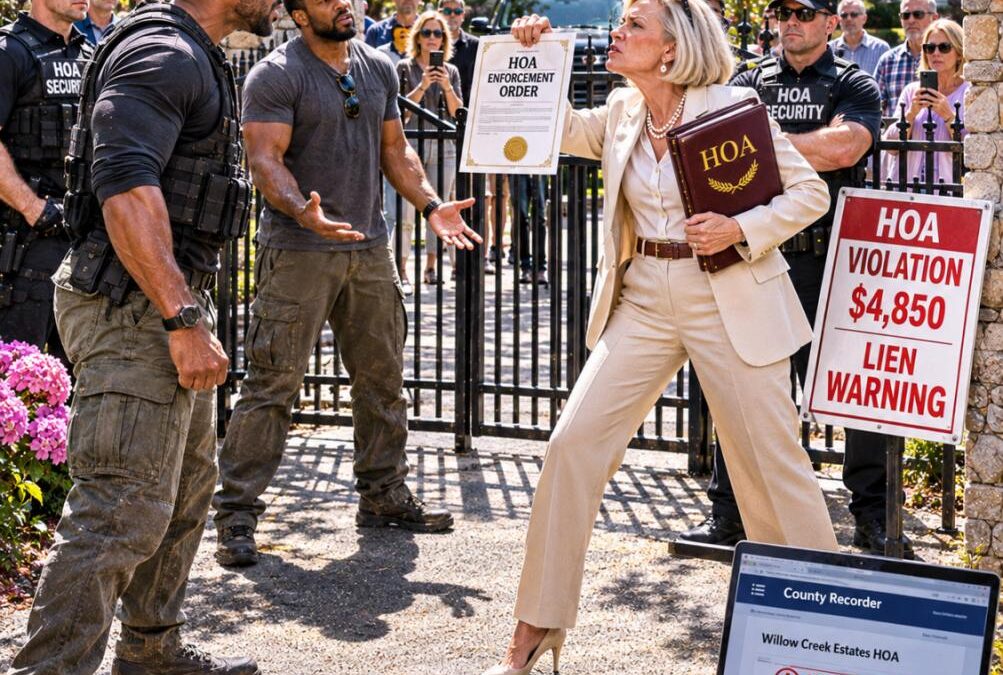
She stood inside my gate waving an embossed “HOA enforcement order,” told my best friend he was not allowed to leave, and threatened to put a lien on my house if I interfered.
For three months, HOA Karen had fined neighbors, summoned police, photographed our homes, and behaved like Willow Creek belonged to her.
Then I asked one question nobody else had bothered to ask: who exactly elected her?
“Your friend stays right there until authorities arrive.”
Sylvia Grant said it from the middle of my front walkway as if she had just executed a lawful arrest.
My best friend Nate looked at me.
I looked at the papers scattered across my porch.
Then we both looked at Sylvia.
She was fifty-four, silver hair cut into a perfect chin-length bob, ivory blazer buttoned despite the August heat, burgundy clipboard tucked beneath one arm.
In her other hand was a document with a gold embossed seal.
Across the top:
WILLOW CREEK ESTATES HOMEOWNERS ASSOCIATION
PROPERTY COMPLIANCE & SECURITY DIVISION
There was no security division.
I was beginning to suspect there was no association either.
Nate raised both hands theatrically.
“Am I being detained?”
Sylvia’s jaw tightened.
“You were observed photographing restricted HOA property.”
“I looked at your mailbox.”
“You photographed an address marker.”
“I’m a financial analyst. I was verifying an address from a public property record.”
“That is unauthorized surveillance.”
I almost laughed.
Then Sylvia stepped in front of my gate.
Actually blocked it.
“You are not leaving.”
That ended the humor.
I spent fifteen years on a metropolitan SWAT team.
I had entered buildings where armed men were waiting on the other side of doors.
I had negotiated stairwells with people high enough to forget gravity.
I had been shot at twice, stabbed once, and spent enough nights wearing body armor to know the difference between danger and theater.
Sylvia was theater.
But theater becomes dangerous the moment somebody believes the costume gives them authority.
I stepped off the porch.
“Sylvia.”
She lifted her clipboard.
“John, stay back.”
“You’re on my property.”
“I’m conducting official HOA business.”
“You need to leave.”
“I have full authority to investigate interference with community records.”
“No, you don’t.”
Her face changed.
Just slightly.
Behind me, Nate said, “That sounded definitive.”
I kept my eyes on Sylvia.
“For the last two weeks, I’ve checked the county recorder, the secretary of state’s corporate filings, our title documents, the developer records, and every Willow Creek election notice I can find.”
Sylvia’s fingers tightened around the clipboard.
I continued.
“There hasn’t been an HOA election in this neighborhood in years.”
“You don’t understand association continuity.”
“Then show me the board minutes naming you president.”
“Confidential.”
“Show me the governing declaration authorizing these fines.”
“Confidential.”
“Show me the association’s current corporate registration.”
“That information is not available to ordinary residents.”
Nate laughed once.
Sylvia turned on him.
“This is not funny.”
“No,” I said.
“It isn’t.”
I pointed toward the gate.
“Move.”
She didn’t.
Instead, she held up another document.
“Mr. Reed, your account is now delinquent by $4,850. If you continue obstructing compliance, the association will pursue lien remedies.”
I looked at the fake seal.
Then at her.
“You just made my next phone call very easy.”
Her expression flickered.
“To whom?”
I took my phone out.
“Actual law enforcement.”
For the first time since Sylvia Grant arrived in Willow Creek, she looked afraid.
part 2
My name is John Reed, and the reason I initially tolerated Sylvia Grant was simple.
After fifteen years on a SWAT team, an argument about trash cans felt too stupid to deserve adrenaline.
I retired at forty-seven.
Not because I had stopped loving police work.
Because eventually you start counting what the job takes.
Birthdays.
Sleep.
Hearing.
Knees.
Marriage, if you are not careful.
Pieces of your personality you do not realize have hardened until somebody you love points them out.
My marriage had ended amicably three years before retirement.
No scandal.
No betrayal.
Just two people discovering that living around a police schedule had become the center of their relationship instead of one part of it.
My daughter Rachel was in college by then.
My sister Claire worked as an emergency communications supervisor for Metro Police.
I wanted somewhere quiet enough that when Rachel visited, we could sit outside without me automatically tracking every unfamiliar vehicle passing the house.
Willow Creek Estates looked ideal.
Thirty-six homes.
Mature trees.
Wide sidewalks.
A small pond near the entrance.
No clubhouse.
No pool.
No gates.
Just a development built in the late 1990s that had apparently once maintained a traditional homeowners association for common landscaping and stormwater responsibilities.
When I bought my house, my title package contained old covenants and references to Willow Creek Estates Association, Inc.
My closing attorney told me the association appeared to be minimally active.
There were common-area maintenance charges handled through a neighborhood management arrangement.
Nothing unusual.
Then Sylvia appeared.
She knocked on my door four days after I moved in.
I opened it to find a woman dressed like she was attending a board meeting even though it was Saturday morning.
“John Reed?”
“Yes.”
“I’m Sylvia Grant, president of the Willow Creek Estates HOA.”
She handed me a packet.
“Welcome.”
I took it.
“Thank you.”
She looked past me into the hallway.
Then toward my driveway.
“You’ll want to review the updated standards carefully.”
“Updated when?”
“Continuously.”
That was a strange answer.
Inside the packet were pages of rules.
Trash cans.
Parking.
Exterior lighting.
Mailboxes.
Landscaping.
Holiday decorations.
Vehicle appearance.
Visitor registration.
Some sounded normal.
Some sounded invented.
One section claimed porch lights facing the street had to be switched off by 10:00 p.m. unless motion activated.
Another prohibited “visible vehicular deterioration.”
Another required advance notification for overnight guests staying more than seventy-two hours.
I asked Sylvia where these amendments had been recorded.
She smiled.
“Our board keeps the operative policies internally.”
“Are they available online?”
“We’re updating the portal.”
“What management company?”
“We moved away from third-party management.”
“Who’s on the board?”
Her smile changed.
“You’ll meet everyone.”
Then she noticed my old SWAT unit decal inside the garage.
Not official.
Just a retirement sticker one of the guys had given me.
“You were police?”
“Retired.”
“What kind?”
“Metro.”
She looked impressed.
That bothered me more than if she had looked suspicious.
“Good,” she said. “Then you understand the importance of rules.”
I should have asked more questions that morning.
Instead, I put the packet in a kitchen drawer.
That was my first mistake.
The first violation arrived nine days later.
Trash can placement.
I had left my container beside the garage after pickup.
According to Sylvia, it extended “approximately one inch beyond the approved screening plane.”
I stood outside looking at it.
One inch.
Maybe.
I moved it.
The warning disappeared.
Easy.
Next came my porch light.
I leave it on at night.
Not a floodlight.
A warm forty-watt fixture beside the front door.
Sylvia taped a notice to my door.
“Exterior illumination beyond 10:00 p.m.”
Fine: $75.
I emailed her.
“Please identify the recorded rule.”
She replied:
“Updated Community Standard 14-B.”
I searched my closing documents.
No 14-B.
I asked for a copy of the board resolution adopting it.
No response.
Then came the truck.
I owned a six-year-old Ford F-150.
Clean.
Minor scratch on the rear bumper from a parking garage.
Sylvia photographed it from the street.
The next day I received:
“Visible body damage potentially affecting neighborhood aesthetics.”
I laughed.
Then I saw the fine.
$125.
That was when I called Claire.
My sister answered:
“If this is about your HOA woman, I’m hanging up.”
“I’ve called twice.”
“You’ve called seven times.”
“That sounds fabricated.”
“I supervise dispatch records. Numbers are my thing.”
“She fined my bumper.”
“Pay it or fight it. Stop telling me.”
“She keeps calling 911 too.”
That made Claire quiet.
“How do you know?”
“Patrol has been here three times.”
“About you?”
“Once because I was using a pressure washer.”
Claire sighed.
“I can’t discuss calls just because you’re my brother.”
“I know.”
“And I am definitely not pulling dispatch records for you.”
“I know.”
“Good.”
Pause.
“But twenty-one calls from one address in three months would trigger quality review if they’re abusing emergency services.”
I sat up.
“Twenty-one?”
Silence.
“Claire.”
“I said if.”
“You said twenty-one.”
“I hate you.”
“You’re my sister.”
“That has never improved you.”
She hung up.
I did not call back.
I knew enough about public safety systems to understand the line.
My sister was not going to feed me privileged information.
And I was not going to turn family access into private intelligence.
So I started obtaining what I could lawfully obtain myself.
Police incident numbers involving my address.
Public call summaries where available.
My own body-camera request from an officer who responded after Sylvia accused my garden hose of being a “chemical irrigation device.”
That one became a neighborhood joke.
I was watering tomatoes.
Sylvia told the dispatcher the hose attachment looked “industrial.”
The responding officer stared at it.
Then at me.
Then said:
“That’s Miracle-Gro.”
“Apparently military grade.”
He laughed.
Sylvia did not.
The officer documented no issue and left.
That should have embarrassed her.
Instead, two days later she fined me for unauthorized fertilizer application.
The amount was $200.
That was when an old case came back to me.
Not a case I had personally investigated.
A regional fraud bulletin our department had circulated years earlier described a scheme involving fake property-management notices and fraudulent lien threats targeting homeowners in several cities.
The criminals relied on something painfully simple.
Most people do not know exactly what powers their HOA possesses.
They see official-looking paper.
A seal.
A deadline.
A lien threat.
They pay.
The cases varied.
Some involved legitimate associations whose funds had been diverted.
Others involved scammers impersonating management companies.
One case out west had included elderly homeowners paying thousands for nonexistent compliance inspections.
I had skimmed that bulletin and moved on.
Robbery and barricaded suspects had seemed more urgent at the time.
Now I opened my kitchen drawer and took out Sylvia’s welcome packet.
Something about it felt wrong.
No law firm.
No management company.
No tax identification number.
No board contact list.
No election schedule.
No annual budget.
Just rules and a payment address.
The payment address belonged to a post-office box.
That night, I called Nate Caldwell.
Nate and I met freshman year of college before I left to join the police academy.
He became the respectable one.
Economics degree.
MBA.
Financial analyst.
He could stare at three pages of numbers and detect a lie the way I could once detect somebody hiding behind a closed bedroom door.
He came over the following Saturday.
I spread the documents across my dining table.
Nate read silently.
Then asked:
“How much have you paid?”
“Nothing.”
“Good.”
“Why?”
“Because this payment instruction is strange.”
“How?”
“The checks are made payable to Willow Creek Community Services.”
“That sounds legitimate.”
“That is why names work.”
He pointed.
“Your original deed references Willow Creek Estates Association, Inc.”
I looked at the packet.
“Different entity.”
“Maybe legitimately different.”
“Can you check?”
“Public corporate registrations, yes.”
He opened his laptop.
“Bank records, no.”
That mattered later because people liked to retell this story as though Nate somehow hacked into Sylvia’s finances.
He did not.
We used public records.
County recorder.
Secretary of state.
State corporate registry.
Property tax files.
Court dockets.
Charity registrations.
Anything a citizen could access.
Willow Creek Estates Association, Inc. had existed.
The developer created it in 1997.
It filed annual reports for years.
Then activity became sporadic.
The corporation eventually fell into administrative dissolution after repeated filing failures.
That alone did not necessarily erase every covenant or property obligation.
HOA law can be more complicated than corporate status.
But it raised a larger question.
Who had elected Sylvia?
We searched Willow Creek Community Services.
A limited liability company.
Created eleven months earlier.
Organizer:
Sylvia Grant.
Mailing address:
Her post-office box.
No indication it was an HOA.
No recorded declaration assigning it association authority.
Nate leaned back.
“Well.”
“That’s not good.”
“No.”
“Could she be acting as manager?”
“Possibly.”
“Appointed by whom?”
“Excellent question.”
I emailed Sylvia.
“Please provide the current board roster, election date, minutes appointing Willow Creek Community Services as manager, and governing authority for assessments being collected through that entity.”
Her reply arrived seventeen minutes later.
“Internal association documents are available only to members in good standing.”
I stared at the screen.
I was allegedly a member.
But because I disputed her fines, I was not in good standing.
Convenient.
That afternoon, Nate and I knocked on doors.
Not accusing.
Asking.
Mrs. Ellis lived four houses down.
Eighty-one.
Widowed.
Sweet enough to make cookies for delivery drivers.
She invited us in.
When I asked about HOA elections, she frowned.
“Sylvia handles all that.”
“When was the last vote?”
“Oh, honey, I don’t know.”
“Did you vote for her?”
“She sort of took over after Mr. Patterson got sick.”
Mr. Patterson had been president years earlier.
“When?”
“Maybe two years.”
“Was there a meeting?”
“I don’t remember.”
Nate asked:
“Do you pay dues?”
“Yes.”
“How?”
She brought out a checkbook register.
Quarterly payments to Willow Creek Community Services.
Then additional charges.
Security review.
Storm inspection.
Fence assessment.
Community emergency reserve.
The amounts totaled more than $3,000 over eighteen months.
My stomach tightened.
“What was the storm inspection?”
“Sylvia had someone check my roof after that hailstorm.”
“Did you ask for it?”
“She said it was required.”
“Who did the inspection?”
“A nice man named Darren.”
“Company?”
Mrs. Ellis looked worried.
“I don’t know.”
Then she said something that complicated everything.
“Sylvia helped me after the storm.”
“How?”
“My back fence fell.”
“She arranged repairs.”
“Did she charge you?”
“Only materials.”
“She drove me to the doctor twice too.”
I looked at Nate.
This was not a simple villain.
Mrs. Ellis loved her.
And maybe had good reason.
That was part of how Sylvia built authority.
She was useful.
She organized food drives.
Helped older residents.
Called contractors.
Coordinated tree removal.
She solved real problems.
Then somewhere along the way, people stopped asking whether she had legal authority to impose anything.
Kindness became trust.
Trust became compliance.
Compliance became power.
The next neighbor, Mr. Gomez, had paid $1,200 in “parking penalties.”
A young couple across the street had paid $600 for an architectural review they later learned had never been filed with any government body.
Not every fee was necessarily fraudulent.
An informal neighborhood group can collect voluntary funds.
A contractor can legitimately charge for services.
The problem was Sylvia described everything as mandatory HOA authority.
Nate created a spreadsheet.
Homeowner.
Date.
Charge.
Payee.
Description.
Supporting document.
Threat used?
Lien mentioned?
By Monday, we had nine households.
More than $18,000 in questionable payments.
That was not enough for me.
I wanted the original association records.
I called the attorney who had handled my closing.
He connected me with a property lawyer named Angela Price.
Angela had the kind of voice that could make a grocery list sound like cross-examination.
I brought her everything.
She spent an hour reviewing the title package.
Then said:
“First, do not tell your neighbors there is no HOA.”
“But—”
“No.”
“The corporation is dissolved.”
“Corporate dissolution and covenant enforceability are different legal questions.”
“Okay.”
“Second, do not tell anyone Sylvia committed fraud.”
“We have fake fees.”
“You have suspicious fees.”
I sighed.
“You lawyers are exhausting.”
“We keep clients from turning evidence into defamation suits.”
“Fine.”
“Third, we determine what authority actually survived.”
Angela ordered certified copies of the recorded declaration, amendments, common-property deeds, and old association filings.
She tracked down the last known legitimate board member.
His name was William Patterson.
Seventy-six.
Recovering from a stroke.
He lived with his daughter two counties away.
Angela interviewed him with permission.
Mr. Patterson confirmed the association had essentially stopped functioning after several directors moved or became ill.
No proper election installed Sylvia.
No board vote appointed Willow Creek Community Services.
No board authorized her fines.
No updated rules had been adopted.
Then Angela found something even more important.
The old declaration allowed assessments for common expenses, but required budgets, owner notices, and board action.
Formal enforcement had procedures.
Hearings.
Notice.
Board votes.
Lien rights, where available, depended on compliance with the governing documents and state law.
Sylvia had followed none of it.
Instead, she had created her own company, printed documents using the old association name, and directed money to the company’s post-office box.
Angela looked at me.
“Now you have a real problem.”
“For Sylvia?”
“For everybody.”
The old HOA still had responsibilities attached to two small common parcels and drainage infrastructure.
Nobody had been governing them properly.
“So what do we do?”
“Two separate tracks.”
She held up one finger.
“Restore legitimate governance.”
Second.
“Preserve evidence of potentially fraudulent collections.”
Nate smiled.
“I like her.”
“I’m billing both of you.”
We began notifying neighbors.
Not with a fake meeting notice like the dramatic version people later told.
Angela drafted a lawful homeowner petition seeking a special organizational meeting under the governing documents and applicable state law.
Before that happened, Sylvia escalated.
She came to my house carrying the lien threat.
Forty-eight hours.
$4,850.
The gold embossed seal.
I asked for the charter.
She called it confidential.
That moment was caught by my doorbell camera.
It became Exhibit A for a lot of conversations later.
After Sylvia left, Nate examined the seal.
“She upgraded.”
“What?”
“The earlier notices use a printed logo.”
“So?”
“This has an embossing stamp.”
I stared at him.
“You sound jealous.”
“Fraud should at least respect graphic design.”
Then he became serious.
“John, lien threats scare people.”
“I know.”
“Mrs. Ellis would pay this.”
I knew that too.
So we stopped waiting.
Angela sent Sylvia a formal demand that she cease representing herself as HOA president unless she could produce lawful authority.
Copies went to homeowners.
The old association’s registered agent.
The county recorder.
And, because of the suspected financial misconduct, the state consumer-protection division.
Separately, several neighbors filed police reports concerning allegedly fraudulent fees.
I filed mine regarding the lien threat and document.
Then Sylvia tried to regain the narrative.
She called Mrs. Ellis.
Told her Nate and I were trying to destroy Willow Creek.
Said “outsiders” wanted control of neighborhood assets.
Mrs. Ellis called me crying.
“John, what is happening?”
“Nothing is happening to your house.”
“Sylvia said the HOA could collapse.”
“It already isn’t functioning properly.”
“She says you want to eliminate it.”
“No.”
That was important.
I did not want no HOA.
Willow Creek had drainage ponds and common landscaping that required legal management.
I wanted a real association.
Mrs. Ellis whispered:
“She helped us.”
“I know.”
“She’s done good things.”
“I know.”
“Then how can she also be doing this?”
That question stayed with me.
People like clean categories.
Good person.
Bad person.
Helper.
Fraudster.
Real life resists that.
Sylvia could drive an elderly widow to the doctor and still lie to her about mandatory fees.
Both things could be true.
The legal issue was not whether she had ever been kind.
It was whether she had authority to collect money through false representations.
The special meeting was scheduled for three weeks later.
Before it happened, Nate came over to help organize documents.
That was the afternoon Sylvia confronted him.
He had walked past her house on the public sidewalk because a county property record contained an address discrepancy.
He stopped at the curb.
Looked at the mailbox number.
Took one photograph from the sidewalk.
Then walked back.
Sylvia came after him.
By the time they reached my house, she was shouting.
“Your friend was photographing restricted HOA records.”
Nate looked exhausted.
“I photographed the number on your mailbox.”
“You were conducting surveillance.”
“It’s visible from space.”
She followed him through my open front gate.
That was her next mistake.
Then she ordered him not to leave.
I told her to go.
She refused.
I took out my phone.
But I did not call my former SWAT team.
I did not call the FBI and ask old friends to descend on my cul-de-sac like a hostage rescue.
That is not how legitimate policing works.
I called 911 as a resident.
“911, what is your emergency?”
“My name is John Reed. A woman is on my property refusing to leave and is physically blocking my guest from exiting through the gate while claiming authority to detain him.”
“Any weapons?”
“No.”
“Any physical violence?”
“No.”
“Do you know her?”
“Yes. Neighbor.”
“Are you in immediate danger?”
“Not currently.”
The dispatcher told me officers were coming.
I stayed on the line.
Sylvia heard.
Her expression changed.
“You’re wasting police resources.”
“You’ve called them twenty-one times in three months.”
Her eyes widened.
That told me the number was close enough.
“How do you know that?”
“I know enough.”
She stepped toward the gate.
Then Mrs. Ellis appeared on the sidewalk.
“Sylvia.”
Sylvia froze.
Mrs. Ellis looked furious.
“What are you doing?”
“This man is interfering with an HOA investigation.”
“What investigation?”
“They are trying to seize community control.”
Mrs. Ellis looked at Nate.
“Did you do something?”
“I photographed her mailbox.”
Mrs. Ellis stared at Sylvia.
“Why can’t he leave?”
Sylvia’s voice rose.
“Because documentation may have been compromised.”
“Move.”
“Susan—”
“Move.”
Mrs. Ellis’s first name was Susan.
I had never heard her use that tone.
Sylvia backed away from the gate.
Two patrol cruisers arrived six minutes later.
Officers separated us.
Took statements.
Reviewed my doorbell footage.
Confirmed Nate had not been physically restrained beyond Sylvia’s blocking conduct and verbal claims.
They did not handcuff her immediately.
That disappointed some neighbors later.
But good policing is not theater.
They documented the trespass complaint and the attempted assertion of detention authority.
They reviewed the alleged HOA papers.
One officer asked Sylvia:
“Are you a law-enforcement officer?”
“No.”
“Licensed security?”
“No.”
“Do you believe you have legal authority to detain people?”
“I have authority to preserve association evidence.”
“That wasn’t my question.”
She stopped answering.
The fraud investigation grew from there.
Not because I was former SWAT.
Because homeowners came forward with evidence.
Receipts.
Cancelled checks.
Notices.
Threat letters.
Emails.
Fake inspection invoices.
Lien warnings.
One family had paid $7,400 over two years.
Another nearly refinanced their mortgage because Sylvia told them an HOA lien was imminent.
Mrs. Ellis brought in a box containing everything Sylvia had ever given her.
That box mattered.
At the bottom was a “community security invoice” for $2,200.
Paid to Willow Creek Community Services.
The purported contractor:
Southeastern Residential Security Consultants.
Nate searched the public corporate registry.
The company existed.
Its organizer shared an address with a man named Darren Cole.
Same first name as the “roof inspector.”
We did not investigate him ourselves.
We gave the information to detectives.
The case moved from patrol to the department’s financial-crimes unit.
Then to the state consumer-protection office.
The local prosecutor became involved.
Only later, when investigators found evidence that money, communications, or conduct crossed state lines, did federal agencies become relevant.
No black FBI SUV raced into Willow Creek twenty minutes after my call.
Real investigations are slower.
Much slower.
That was frustrating.
For almost three months, Sylvia still lived five houses away.
She was ordered not to enter my property after the trespass incident.
She complied.
Mostly.
But she continued telling residents she was president.
So Angela moved faster on the governance side.
At the special homeowners meeting, twenty-nine of thirty-six lots were represented in person or by valid proxy.
William Patterson participated remotely with his daughter’s help.
The first order of business was simple.
Did Sylvia have evidence she had ever been elected president?
She attended with an attorney.
Her attorney objected to the framing.
Angela answered:
“Then provide the election record.”
None came.
Board appointment?
None.
Minutes?
None.
Valid written succession?
None.
Authority appointing Willow Creek Community Services?
None.
Sylvia argued that homeowners had accepted her leadership through years of conduct.
Angela explained that informal acquiescence did not automatically satisfy the association’s governing requirements for elections, assessments, enforcement, or lien authority.
Then came the vote.
A temporary board was elected properly.
Mrs. Ellis was nominated.
She immediately refused.
“I’m eighty-one.”
Everyone laughed.
Susan Park, a CPA who lived near the pond, became interim president.
Not Mrs. Ellis.
That would have made a nice story.
Susan was better.
She understood budgets.
The new board hired independent HOA counsel and a licensed management company.
First instruction:
Freeze all Sylvia-issued fines.
Second:
Audit every payment associated with Willow Creek Community Services.
Third:
Determine what dues had legitimately been required for common expenses and what had not.
That last part became messy.
Because not every dollar Sylvia collected had been stolen.
Some money really had paid landscapers.
Some repaired the pond aerator.
Some paid insurance premiums.
Some bought storm debris removal.
The problem was that Sylvia had controlled it without lawful governance or transparent accounting.
Investigators and forensic accountants had to separate legitimate expenditures from fraudulent ones.
Nate helped the neighborhood understand the audit.
He did not obtain Sylvia’s private bank records.
Police eventually did through proper legal process.
What Nate did was analyze the documents residents already owned.
Dates.
Amounts.
Payees.
Duplicates.
Impossible invoices.
Charges that did not correspond to known work.
Then detectives obtained bank and business records under lawful process.
That was where the picture sharpened.
Willow Creek Community Services had received substantial homeowner payments.
Some went to community expenses.
Others went to companies connected to Sylvia’s associates.
Investigators identified personal expenditures inconsistent with legitimate HOA purposes.
The amount attributed to potential fraud grew.
Then another city appeared.
Not Portland first.
Savannah.
A similar company name.
Similar violation language.
Same formatting.
Different woman listed as neighborhood coordinator.
Investigators compared records.
Then came Jacksonville.
Then a suburb outside Dallas.
That was when federal interest increased.
The pattern appeared larger than Willow Creek.
But I was not allowed inside that part of the investigation.
Nor should I have been.
I was a witness.
Retired police officers are particularly dangerous when they forget retirement removes investigative authority.
So I stayed home.
Documented my own evidence.
Testified when asked.
And tried not to make Nate insane.
One evening, he was sitting at my dining table surrounded by homeowner spreadsheets.
“You know what bothers me?”
“What?”
“You keep pacing behind me like a supervisor.”
“I was a supervisor.”
“You are now a man with a vegetable garden.”
“That garden is flourishing.”
“You killed basil.”
“Hostile plant.”
Nate looked at the spreadsheet.
“John.”
His tone changed.
“What?”
“There’s another recurring contractor.”
He pointed.
Northbridge Community Compliance.
Payments from five homeowners.
“Who are they?”
“No idea.”
We sent it to the detective.
Two weeks later, Detective Elena Harper asked whether I knew a woman named Sylvia Thornton.
“No.”
“Ever heard the name?”
“No.”
She showed me an old booking photograph.
The woman was younger.
Dark hair.
But the eyes were unmistakable.
Sylvia.
“What is this?”
“Prior fraud case.”
My stomach tightened.
“Grant isn’t her name?”
“Grant may be a name she lawfully used at some point. We’re verifying identity history. Do not discuss this with neighbors.”
I did not.
Later, court records established that Sylvia had previously been convicted under another surname in a property-services fraud case.
The dramatic neighborhood rumor said she had stolen the identity of a dead woman.
The truth was less cinematic.
She had used multiple names and business identities over the years, some connected to marriages, some aliases used in transactions, and at least one identity investigators alleged was supported by fraudulent documentation.
What mattered was not the mystery of her name.
It was the continuity of behavior.
She learned what people trusted.
A seal.
A title.
A uniform-looking form.
A contractor’s vest.
An elderly neighbor’s gratitude.
A frightened homeowner’s belief that liens happen instantly.
Then she monetized that trust.
Investigators eventually searched her home under a warrant.
I was not present.
No old SWAT buddies invited me.
I learned the broad outline later through public court filings and discovery associated with my victim status.
They seized computers.
Financial records.
Blank certificates.
Embossing tools.
Historical Willow Creek documents.
Contractor files.
Boxes containing homeowner payment records.
Records tied to other communities.
That was the day Sylvia was arrested.
Not on my lawn.
Not in front of a cheering crowd.
At another location after prosecutors approved charges supported by the investigation.
She initially faced state charges involving fraud, forgery-related conduct, theft, and false representations.
Federal charges followed later based on interstate transactions, electronic communications, and the broader scheme investigators alleged.
The amount was not instantly $850,000.
It grew as victims and records were identified.
Willow Creek represented only part of it.
Mrs. Ellis cried when she heard.
Not from relief.
From grief.
“She drove me to chemotherapy.”
I sat beside her in her kitchen.
“I know.”
“How can somebody do that and steal from me?”
I had no satisfying answer.
“She knew I was alone.”
“Yes.”
“That’s why she helped me?”
“I don’t know.”
Mrs. Ellis wiped her eyes.
“I hate that I don’t know.”
That became the emotional center of Willow Creek.
Not rage.
Betrayal.
People had trusted Sylvia because she had done genuinely useful things.
She remembered birthdays.
Delivered groceries.
Organized storm cleanup.
Found contractors.
Sat with sick neighbors.
Then she used the same relationships to make people afraid of questioning invoices.
That was not fake kindness in every moment.
Human beings are more complicated than that.
Maybe Sylvia liked being needed.
Maybe she believed providing value entitled her to money.
Maybe the power became addictive.
Those questions belonged to psychologists and philosophers.
The case needed documents.
Willow Creek’s audit took six months.
The legitimate HOA was formally restored.
Corporate filings corrected.
Insurance renewed.
Common-property accounts separated from everything Sylvia had controlled.
A professional management company established a proper budget.
Real dues turned out to be lower than the average amount Sylvia had been collecting.
Much lower.
The board held quarterly open meetings.
Financial statements went online.
Contracts over a certain amount required competitive bids.
Two signatures were required for large disbursements.
Lien-related notices went through legal review.
Every enforcement letter identified the actual covenant.
No invented “military-grade hose” rule.
Nate attended the first budget meeting.
He looked miserable.
“You wanted transparency,” I whispered.
“I didn’t say I wanted to hear forty-five minutes about pond algae.”
“That is democracy.”
“This is punishment.”
Susan Park heard us.
“You two can leave.”
“No,” Nate said. “Now I’m invested in the algae.”
Willow Creek slowly became boring.
That was the best thing that ever happened to it.
The criminal case took much longer.
Nearly two years from the first local arrest to final federal resolution.
Victims from several jurisdictions were identified.
Some losses were modest.
Hundreds.
Some thousands.
A few much larger.
One elderly couple had paid for nonexistent structural remediation.
Another community had paid consulting fees tied to a fake safety program.
Investigators alleged that Sylvia and others used a network of small businesses and misleading community-service entities to collect or route funds.
Not every city involved the exact same HOA trick.
The method adapted.
That made sense.
Fraud evolves around whatever people trust.
At trial—or, more accurately, through the combination of hearings, plea negotiations, and proceedings that eventually resolved the case—the prosecution focused on documents.
Emails.
Bank transfers.
Business registrations.
Forged or altered notices.
Victim testimony.
Financial analysis.
Sylvia’s previous conviction.
Representations she made about authority she did not possess.
Mrs. Ellis testified.
I sat behind her.
Her hands shook when she began.
Then steadied.
“She was my friend.”
The prosecutor asked:
“Why did you pay the assessments?”
“Because Sylvia told me I had to.”
“Did you believe she was HOA president?”
“Yes.”
“Why?”
“She said she was.”
“Anything else?”
Mrs. Ellis looked toward Sylvia.
“Because she acted like somebody who would know.”
That sentence hit harder than any legal argument.
The prosecutor showed her an invoice.
Community emergency reserve.
$950.
“Did you understand this payment to be optional?”
“No.”
“What did Ms. Grant tell you?”
“That if I didn’t pay, it would become a lien.”
“Did you know there had been no board vote authorizing the charge?”
Mrs. Ellis shook her head.
“No.”
Then she looked at Sylvia.
“I would’ve given you money if you asked.”
The courtroom went still.
“You didn’t have to lie.”
Sylvia looked down.
Nate testified about the homeowner records he analyzed.
He was careful to distinguish his work from law-enforcement financial evidence.
He had reviewed documents voluntarily supplied by residents.
The government’s forensic accountants handled subpoenaed records.
My testimony came later.
The prosecutor asked about the attempted detention.
The fake lien notice.
The pattern of escalating violations.
My request for proof of authority.
The doorbell video played.
Sylvia on my walkway.
“Your friend stays right there until authorities arrive.”
Hearing it again made me angrier than I expected.
The defense attorney asked:
“You were a SWAT commander?”
“Team sergeant.”
“You were physically capable of removing Ms. Grant from your property.”
“Probably.”
“But you didn’t.”
“No.”
“Why?”
“Because being capable of using force doesn’t mean you should.”
That answer ended that line of questioning quickly.
The most revealing evidence did not come from Sylvia screaming on the stand.
She never delivered the cinematic confession neighbors later invented.
There was no:
I made these communities better.
No dramatic declaration that she deserved the money.
Real defendants with competent lawyers rarely hand prosecutors gifts like that.
Instead, prosecutors introduced emails.
In one, Sylvia wrote to an associate:
“People pay faster when enforcement looks centralized.”
Another:
“Older owners rarely challenge lien language.”
Another:
“Do not call it voluntary in the notice.”
That last sentence made Mrs. Ellis gasp behind me.
The defense argued some payments funded actual neighborhood services.
True.
They argued Sylvia believed residents had implicitly authorized her role.
Maybe partly true.
They argued association governance had fallen into chaos before she stepped in.
Also true.
But those facts did not explain forged approvals, false claims of election, deceptive lien threats, personal transfers, or fabricated charges.
The case did not require Sylvia to have done nothing good.
It required proof of specific criminal acts.
Eventually, Sylvia entered a plea resolving substantial charges rather than continue through every count.
Other defendants reached separate outcomes.
The final loss amount recognized by the court was hundreds of thousands of dollars across multiple victims and jurisdictions, though not every claimed dollar was recoverable.
The sentence was severe.
Not the theatrical lifetime ban from leadership people repeated online.
Courts impose legal conditions, not magical prohibitions against being annoying.
She received a lengthy federal prison term based on the offenses, prior history, loss calculations, victim impact, and other sentencing factors.
Restitution was ordered.
Whether victims would ever recover every dollar was another matter.
Restitution orders are not money printers.
Assets had to exist.
Some funds were recovered from accounts and property.
Some were not.
Willow Creek received money through a combination of recovered funds, insurance claims where coverage applied, and civil settlements.
We did not build a community garden with some giant pile of “Sylvia’s seized money.”
Again, reality was less neat.
The board used part of recovered and budgeted funds to repair common landscaping and improve the pond.
The community garden happened because Mrs. Ellis proposed it.
She stood at a meeting and said:
“We spent two years talking about fraud. Can we grow tomatoes now?”
The motion passed unanimously.
We built twelve raised beds beside the pond.
I supplied irrigation tubing.
Actual civilian-grade tubing.
Nate made a sign for my bed:
CHEMICAL IRRIGATION UNIT 1
Susan made him remove it.
He moved it to my garage.
Mrs. Ellis planted tomatoes, basil, and cucumbers.
I killed basil again.
Nobody understood how.
Two years after the arrest, Willow Creek felt like another neighborhood.
Not perfect.
A real HOA replaced Sylvia’s fantasy government, which meant residents still complained.
One man accused the board of tyranny because his fence stain was the wrong shade.
A woman demanded the association ban a neighbor’s wind chimes.
Susan threatened to resign every three months.
Normal.
Healthy, irritating governance.
My sister Claire came over one Sunday.
We sat on the porch drinking coffee.
“You look bored.”
“I’m retired.”
“You used to hate boredom.”
“People mature.”
“You’ve spent twenty minutes watching that sprinkler.”
“It’s peaceful.”
She looked toward Sylvia’s old house.
A young family lived there now.
Two children.
Dog.
Bicycles in the driveway.
“You ever think about the calls?”
“Sometimes.”
Claire nodded.
“The department changed how repeat neighborhood complaints are flagged.”
I looked at her.
“Because of Sylvia?”
“Partly. Not your business.”
“You brought it up.”
“I regret that already.”
She smiled.
Then became serious.
“You know you couldn’t have stopped her in that old case.”
I knew what she meant.
The regional bulletin I remembered.
The earlier fraud scheme.
For months, I had carried irrational guilt.
What if I had paid more attention back then?
What if Sylvia had been connected?
What if eight families somewhere had suffered because cops like me considered financial fraud somebody else’s problem?
The later investigation never established that I had personally encountered Sylvia during that old case.
Maybe her network overlapped.
Maybe the similarity simply triggered my suspicion.
Either way, I had never possessed evidence that could have stopped her years earlier.
I knew that intellectually.
Guilt does not care much about intellect.
“I should’ve taken those cases more seriously.”
Claire said nothing.
“I used to think property fraud was paperwork.”
“It is paperwork.”
“You know what I mean.”
“Yes.”
I looked toward the street.
“When somebody points a gun, everybody understands the threat.”
Claire nodded.
“When someone sends an eighty-year-old woman a fake lien notice, it looks civilized.”
“That doesn’t make it harmless.”
“No.”
Mrs. Ellis could have lost savings.
Other families did.
That changed my understanding of violence.
Not every life-destroying act arrives loudly.
Some arrive in envelopes.
Clean font.
Gold seal.
Payment deadline.
Nate took the lesson in a different direction.
He built a small compliance-analysis product through his consulting firm.
Not some magical national scam detector.
Software cannot decide whether an HOA is legitimate from vibes.
But it helped property managers and neighborhood boards reconcile assessments, detect duplicate vendors, flag unusual payments, and maintain transparent approval trails.
He named the prototype CLIPBOARD.
I told him that was terrible branding.
He disagreed.
A few community associations adopted it.
Then a management company licensed it.
Nate became unbearably proud.
He came to my house with a bottle of whiskey.
“You realize Sylvia improved my career.”
“Never say that near Mrs. Ellis.”
“Fair.”
We drank on the porch.
No one watched us from across the street.
Eventually, people started inviting me to speak about HOA fraud.
At first, I refused.
I was not a lawyer.
Not an accountant.
Not a regulator.
I was a retired cop who had nearly paid a woman $75 because my porch light stayed on.
Then Angela persuaded me.
“You don’t have to teach law.”
“What do I teach?”
“The question you finally asked.”
So I started with that.
Who elected you?
Then:
Where is the declaration?
Where is the amendment?
Who approved this assessment?
Where is the budget?
What entity receives the payment?
What is the appeal process?
Is the lien authority actually in the governing documents and permitted by state law?
Can owners inspect records?
Simple questions.
Not accusations.
That distinction became my entire message.
Do not assume every aggressive HOA letter is fraud.
Do not assume every unpopular president is illegitimate.
Do not stop paying real assessments because a story online made you suspicious.
Verify.
Read.
Request.
Document.
Use counsel when necessary.
Report suspected fraud through proper channels.
Authority should survive questions.
If someone becomes furious because you asked for the document creating their authority, that does not prove fraud.
But it is a good reason to keep reading.
Willow Creek eventually installed a small plaque near the community garden.
Mrs. Ellis wrote the wording.
Not me.
It said:
BUILT BY NEIGHBORS
IN MEMORY OF BROKEN TRUST
AND IN HOPE OF REAL COMMUNITY
I thought it was too dramatic.
Nobody cared what I thought.
At the dedication, Susan gave Mrs. Ellis the scissors.
She cut the ribbon.
Then announced that everyone needed to stop calling her “Mrs. Ellis.”
“My name is Ruth.”
Nate whispered:
“I’ve known her three years. This feels illegal.”
I laughed.
Ruth heard.
“I can still report you.”
“To whom?”
She pointed toward Susan.
“Real HOA.”
Everybody laughed.
That was the difference.
The words were harmless now because the authority was visible.
Elected board.
Published budget.
Recorded rules.
Meeting minutes.
Bank statements reviewed by people other than one self-appointed president.
Checks and balances at the smallest possible level.
People imagine democracy as presidents, Congress, governors, elections broadcast on television.
Sometimes democracy is seven tired homeowners sitting on folding chairs arguing about pond maintenance while somebody records minutes.
It is boring.
That is why bad actors sometimes beat it.
They are willing to do the boring work while everybody else stays home.
Sylvia showed up.
Sylvia organized.
Sylvia carried folders.
Sylvia remembered deadlines.
Nobody wanted to spend Tuesday nights reading covenants.
So she became indispensable.
Then unquestioned.
That progression frightened me more than the fraud itself.
Because it did not require everyone to be stupid.
It required them to be busy.
Ruth had chemotherapy.
Mr. Gomez worked two jobs.
The young couple across the street had twins.
I was tired of authority after a career filled with it.
Everyone had a reason not to ask.
Sylvia filled the vacuum.
One afternoon, years later, Rachel came home from college for the weekend.
She sat on the porch beside me.
“Is this where the fake HOA lady arrested Uncle Nate?”
“She didn’t arrest him.”
“That’s how he tells it.”
“Nate also says he once advised the Treasury Department.”
“Did he?”
“He filled out a survey.”
Rachel laughed.
Then she looked at the garden across the street.
“You seem happier here.”
“I am.”
“Even after everything?”
“Because of everything might be overstating it.”
“You thought about moving.”
I had.
For a few weeks after Sylvia’s arrest, Willow Creek felt contaminated.
Every mailbox reminded me.
Every HOA email irritated me.
I imagined selling and buying acreage where nobody could issue a landscaping notice.
Then Ruth brought me tomatoes.
Susan asked me to help review security-camera policy.
The Gomez family invited me to dinner.
Nate kept appearing without warning.
Slowly, Sylvia stopped owning the meaning of the neighborhood.
That mattered.
“I realized leaving would give one person too much influence over what this place meant to me.”
Rachel nodded.
“You always make things sound philosophical.”
“I’m retired. It’s all I have left.”
She leaned against the porch post.
“Do you hate her?”
Sylvia.
I thought for a while.
“No.”
“You’re lying.”
“Maybe a little.”
She smiled.
“Fair.”
“I hate what she did.”
“Difference?”
“Yes.”
“How?”
“Hating a person makes everything about what they are.”
I looked toward the street.
“Evidence taught me to focus on what they did.”
That discipline had saved me more than once.
As a cop.
As a homeowner.
As a witness.
Sylvia was probably not pure evil.
She had helped people.
Maybe cared about some of them genuinely.
Maybe convinced herself she deserved compensation.
Maybe eventually believed her own authority.
None of that erased forged documents or stolen money.
But I did not need a theory of her soul to understand the case.
She represented herself as something she was not.
She used that false authority to obtain money.
She threatened property consequences she lacked authority to impose.
She exploited trust.
Those were actions.
Prove the actions.
Let everyone else debate the soul.
Years after her conviction, a letter arrived at my house.
Federal prison return address.
I almost threw it away.
Then I opened it.
Three pages.
Sylvia’s handwriting was precise.
She said the government had exaggerated.
She said some homeowners lied.
She said Willow Creek had been falling apart before she stepped in.
She listed things she had done.
Storm cleanup.
Food drives.
Fence repairs.
Medical rides.
Vendor negotiations.
Then one sentence:
“No one wanted responsibility until they decided they hated the person who took it.”
That line bothered me because part of it was true.
Nobody wanted responsibility.
Including me.
Then she wrote:
“I know now that I crossed lines, but I still believe Willow Creek was better because someone cared enough to keep order.”
No apology to Ruth.
No mention of fake lien threats.
No mention of money.
At the end:
“There are people doing worse things in communities all over the country. Ask who benefits from the paperwork.”
That was almost good advice.
I hated that.
I showed the letter to Angela.
She read it.
“You answering?”
“No.”
“Good.”
“What do you think?”
“I think incarcerated fraud defendants are not my preferred source of governance philosophy.”
I laughed.
Then she handed it back.
“But the last line isn’t wrong.”
I put the letter in my records box.
Not because I forgave her.
Because records matter.
Even records written by people whose version you distrust.
Especially those.
Willow Creek changed presidents three more times after Susan.
No one served more than two terms.
Not because state law required it.
Because homeowners amended the bylaws after everything happened.
Ruth voted against term limits.
Her explanation:
“If somebody is competent, let them work.”
Nate said:
“That is exactly how this started.”
Ruth told him to mind his business.
The amendment passed anyway.
Annual audits became routine.
Real audits.
Not performative reviews.
Vendor conflicts had to be disclosed.
Board member names and election dates were posted.
Homeowners could attend meetings and inspect specified records under the governing documents and applicable law.
Nothing revolutionary.
Just transparency.
The number of 911 calls from Willow Creek dropped too.
Not to zero.
Mrs. Pearson called once because she believed a coyote was trapped beneath her deck.
It was a plastic grocery bag.
Nobody let her forget it.
A resident called during an actual burglary attempt.
Good call.
Another called because teenagers were setting fireworks near dry grass.
Also reasonable.
What disappeared were “community violation emergencies.”
Nobody summoned police over porch lights.
Or trash cans.
Or hoses.
That was progress.
I kept the porch light on.
Every night.
Not as a protest.
Because I like coming home to light.
For months after Sylvia, I secretly enjoyed it as defiance.
Eventually that faded.
That was how I knew the house had become mine again.
Defiance still lets the person you oppose control your behavior.
Peace is when you stop thinking about them.
On the fifth anniversary of the special meeting, Nate came over carrying an unopened Amazon box.
He placed it in the center of my porch.
“What are you doing?”
“Experiment.”
“What experiment?”
“We leave this here for three hours and see if the police come.”
I stared at him.
“That was never a good trap.”
“I still think it had potential.”
“It was an Amazon package.”
“Exactly. High-value target.”
“You are a financial analyst.”
“Senior financial analyst.”
“That makes this worse.”
Ruth walked up the sidewalk carrying cucumbers.
She saw the package.
“You two planning something stupid?”
“Yes,” Nate said.
“No,” I said.
She handed me the cucumbers.
“Take those.”
Then she pointed at Nate.
“And you stop investigating cardboard.”
“Yes, ma’am.”
Ruth went home.
Nate watched her.
“She’s terrifying.”
“You should’ve elected her president.”
“We tried.”
We sat down.
The evening was warm.
Kids rode bicycles near the pond.
A lawn mower ran somewhere in the distance.
My porch light came on automatically as the sun dropped.
Nate noticed.
“Violation.”
“Get off my property.”
“Do I get to leave this time?”
“Unfortunately.”
We laughed.
That was what the story eventually became for us.
Not a prison sentence.
Not FBI files.
Not a headline about hundreds of thousands of dollars.
A joke we could finally make because the danger had passed.
But I never forgot the deeper lesson.
Fifteen years on SWAT taught me to respect obvious threats.
Weapons.
Barricades.
Hostages.
Violence.
Willow Creek taught me to respect quiet ones.
A false title.
An invoice.
A fabricated seal.
A frightened homeowner.
An organization everybody assumes someone else is supervising.
Sylvia did not kick down doors.
She knocked politely.
She helped carry groceries.
She remembered which widow had a doctor appointment.
Then she sent paperwork that looked official enough for people to obey.
The mask worked because parts of it were real.
She really did care about order.
She really did solve problems.
She really did know the neighborhood.
What she did not have was the authority she claimed.
And nobody asked until she had been using it for years.
That is why, when people ask me what finally brought her down, I never say my SWAT background.
It didn’t.
Nate did not bring her down with some secret financial database.
The FBI did not arrive because I knew somebody.
No single dramatic trap solved it.
Questions did.
Documents did.
Mrs. Ellis saving receipts did.
Mr. Gomez keeping notices did.
William Patterson remembering he had never appointed her did.
Neighbors attending a meeting did.
Detectives following money through lawful warrants did.
Accountants separating real expenses from fake ones did.
Prosecutors proving specific acts instead of telling a satisfying story.
And eventually, a courtroom looked at the evidence and did what evidence is supposed to make possible.
Accountability.
I spent half my adult life entering dangerous places with armor on.
The fight that changed Willow Creek began with me sitting at a kitchen table holding a piece of paper and wondering whether anyone had ever bothered to check the name printed at the top.
That question was quieter than any flash-bang I ever heard.
It did more damage to Sylvia’s fake authority than force ever could.
Years later, I still tell homeowners the same thing when they ask how to protect themselves.
Do not start with accusations.
Start with paper.
Who elected you?
Where is the rule?
Who approved the money?
Where does it go?
What process created this authority?
A legitimate institution may be inconvenient.
It may be strict.
It may even be badly run.
But legitimate authority should have a trail.
Minutes.
Votes.
Deeds.
Budgets.
Filings.
Contracts.
Records.
Sylvia had spent years creating the appearance of that trail.
Eventually we followed it backward.
It led to her.
And once everybody could see that clearly, the burgundy clipboard stopped looking like a badge.
It was just a clipboard.
That was all it had ever been.