HOA Karen Called 911 Because I Refused Her Private Meeting Over My Driveway Gate—She Thought Fear Would Make Me Obey.k
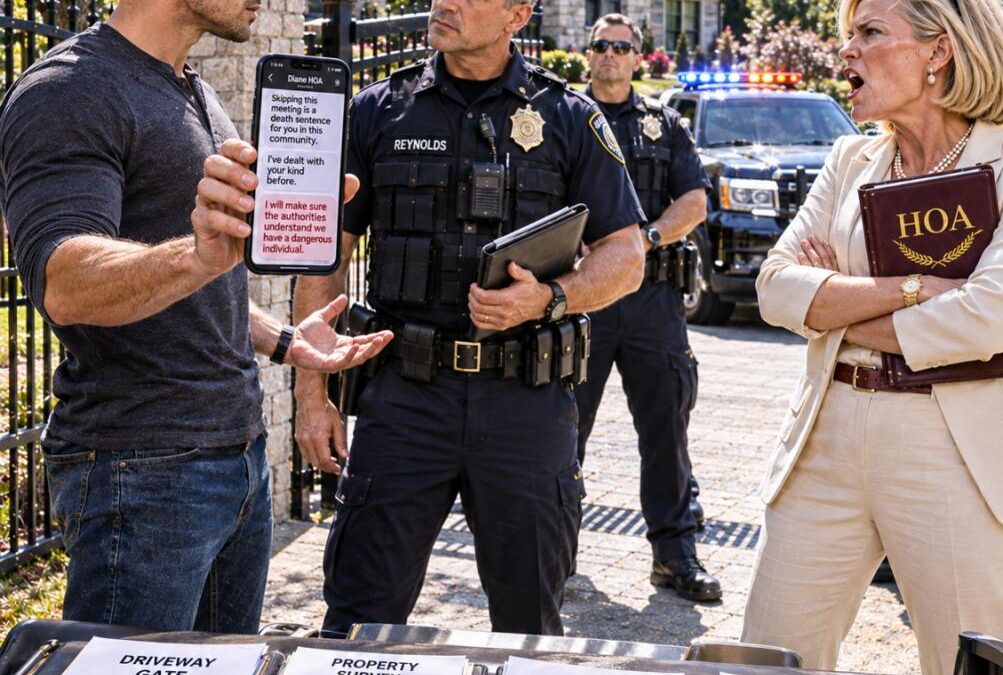
HOA Karen Called 911 Because I Refused Her Private Meeting Over My Driveway Gate—She Thought Fear Would Make Me Obey
She told me skipping her private HOA meeting would be a “death sentence” for my life in Oakwood, then called 911 when I refused to rearrange my job around her schedule.
HOA Karen told police I was a dangerous resident over a driveway gate that already had permits, surveys, and written approval under the neighborhood rules.
When the officer at my door recognized my last name and asked one quiet question about my father, I realized Diane Marshall had no idea whose family she had just dragged into her little system of intimidation.
My phone buzzed at 1:14 on a Thursday afternoon.
Skipping this meeting is a death sentence for you in this community.
I read the message twice.
Then a third time.
The sender was Diane Marshall, president of Oakwood Homeowners Association, a woman I’d met exactly four times since moving back to town.
I was twenty-eight, sitting at my kitchen island with three monitors open, forty-two minutes from a software deployment for a client whose contract covered almost half my mortgage for the year.
Diane wanted me at the clubhouse Friday at two.
No alternative.
No video call.
No email discussion.
No rescheduling.
The emergency?
My driveway gate.
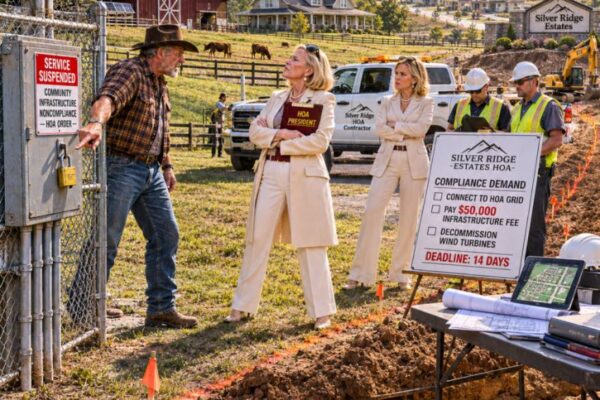
I had installed a black wrought-iron security gate two weeks earlier after a contractor confirmed the setback, the county approved the permit, and a surveyor marked both property lines.
Oakwood’s own architectural rules allowed security gates provided they stayed within the lot, did not obstruct sidewalks or utilities, and met height requirements.
Mine did.
I texted back:
I can’t make 2:00 tomorrow. I can meet after 5:30, Monday morning, or we can handle the issue by email. I’ve attached the permit, survey, and Section 12.
Her reply came almost immediately.
You don’t dictate terms to the HOA.
Then:
I’ve dealt with your kind before.
Then the one that made me stop typing.
If you continue refusing lawful HOA direction, I will make sure the authorities understand we have a dangerous individual refusing compliance.
I stared at the word dangerous.
Not difficult.
Not noncompliant.
Dangerous.
I saved screenshots.
Old habit.
Not because I was law enforcement.
I wasn’t.
I’m a software engineer.
But my father had spent thirty-one years in county law enforcement, the last nine as sheriff, and he had drilled one lesson into me since childhood:
When somebody starts changing the story, preserve the first version.
Twenty-two minutes later, sirens came down Oakwood Drive.
Two cruisers stopped outside my house.
My neighbor across the street opened her blinds.
Another man stepped onto his porch.
I walked outside with empty hands.
Officer Tom Reynolds climbed from the first cruiser.
I knew the face before I knew why.
He looked at me, then my house, then the gate.
“Lucas Bennett?”
“Yes.”
He studied me.
“How old are you now?”
I frowned.
“Twenty-eight.”
His expression shifted.
“Birthday in March?”
I stared at him.
Then memory clicked.
Backyard barbecues.
My father’s old patrol buddies.
A younger Tom Reynolds teaching me how to throw a football when I was maybe eight.
“You know my dad.”
Tom almost laughed.
“Know him?”
His partner looked confused.
Tom shook his head.
“Your father nearly fired me twice.”
“Only twice?”
“Three times if we’re counting unofficially.”
Then his face became serious.
“We got a call saying an aggressive resident was threatening an HOA officer over a security violation.”
I took out my phone.
“Would you like to see the messages?”
Tom read them.
His jaw tightened.
Then he looked toward the corner, where Diane Marshall stood beside her silver SUV with her arms folded.
He read the last message again.
I will make sure the authorities understand we have a dangerous individual.
Tom handed me the phone.
“Don’t delete these.”
“I wasn’t planning to.”
Then he said something that made Diane’s expression change before he even walked toward her.
“Lucas, I think your father is going to want to hear about this one.”
part 2
I hated that sentence.
Not because Tom meant anything wrong by it.
Because I had spent years trying to avoid exactly what happened next.
People discovering who my father was and changing the way they treated me.
Sheriff James Bennett had been elected three times.
Before that, chief deputy.
Before that, detective.
Before that, patrol.
In Oakwood County, his name opened doors I had never earned.
That was one reason I moved to California after college.
Silicon Valley didn’t care that my dad had once commanded a sheriff’s office.
They cared whether my code worked.
I built a career there, got tired of twelve-hour days and overpriced apartments, then came home after selling my small interest in a software startup.
Oakwood was supposed to be simple.
Small town.
Remote work.
Quiet house.
No family reputation following me through every room.
I bought a two-story place on Maple Court and deliberately didn’t tell people that Sheriff Bennett was my father.
Not secret.
Just irrelevant.
At least I thought it was.
Tom walked toward Diane.
I stayed by my porch.
His partner remained near the cruiser.
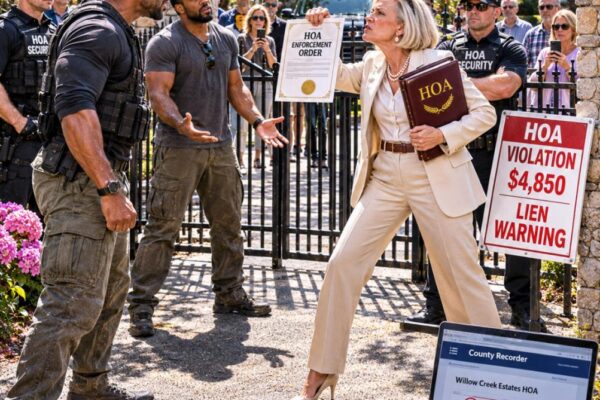
Diane had dressed for an HOA confrontation like she was appearing before Congress.
Cream blazer.
Black trousers.
Pearl earrings.
Leather binder pressed against one side.
Tom asked:
“Ms. Marshall?”
“Yes.”
“Tell me exactly what Mr. Bennett did that made you believe police were necessary.”
She glanced toward me.
“He has repeatedly refused community directives.”
“That isn’t criminal.”
“He’s become increasingly aggressive.”
“How?”
“He challenges every instruction.”
Tom waited.
Diane seemed to realize that wasn’t enough.
“He installed an unauthorized security structure.”
I almost interrupted.
Didn’t.
Tom looked at the gate.
“Is this what you’re talking about?”
“Yes.”
“Did he threaten you physically?”
“He used intimidating language.”
“What language?”
“He told me I had no right to dictate his schedule.”
I actually looked at my screenshots to make sure I hadn’t forgotten something.
Tom asked again.
“Did he threaten to hurt you?”
“No.”
“Touch you?”
“No.”
“Approach you?”
“No.”
“Damage HOA property?”
“No.”
“Block a road?”
“No.”
Diane’s face reddened.
“He has made it clear he doesn’t respect our authority.”
Tom nodded.
“That sounds like an association dispute.”
Diane leaned closer.
“Officer, you don’t understand the history here.”
“Then explain the part involving criminal conduct.”
Silence.
Tom glanced toward me.
Then back at her.
“Because that’s what police handle.”
She lowered her voice.
“He’s unstable.”
My stomach tightened.
Tom’s expression changed.
“Based on what?”
“He’s secretive. Nobody knows much about him. He refuses meetings. He works odd hours. He installed a fortified gate.”
Fortified.
It was six feet tall.
Decorative steel.
Same style as three other houses.
I stepped forward.
“Tom.”
He looked at me.
I held out the permit packet.
“County permit. Survey. Architectural section.”
Diane snapped:
“Do not interfere with my statement.”
Tom turned toward her.
“He is allowed to provide documents about his own property.”
She looked furious.
I gave Tom the paperwork.
He read the county permit.
Then Section 12.
Security measures permitted subject to specified conditions.
Nothing unusual.
Nothing dangerous.
The second officer inspected the gate from the sidewalk.
“No obstruction,” he said.
Tom handed everything back.
“Ms. Marshall, if you believe this violates HOA rules, follow your enforcement procedure. If you believe there’s a crime, call us and report the crime you actually observed.”
Diane’s eyes narrowed.
“I did.”
“No.”
Tom shook his head.
“You reported a dangerous resident refusing compliance.”
“That is accurate.”
“That is a conclusion.”
He pointed toward my phone.
“And these messages suggest you described him as dangerous before you called.”
Her face froze.
“You’ve seen private HOA communications?”
“I’ve seen messages sent to the homeowner standing right there.”
She looked at me.
That’s when I saw it.
Not embarrassment.
Calculation.
Diane Marshall was already thinking about the next move.
Tom gave me an incident number.
No arrest.
No lecture.
No dramatic warning to Diane about “abusing 911.”
People retell police encounters too theatrically.
What he did was document.
Then, before leaving, he pulled me aside.
“Your dad doesn’t know?”
“Not yet.”
“Keep him out of it if you can.”
I almost smiled.
“That was the plan.”
Tom’s voice lowered.
“I mean officially. This is his county. You don’t want anybody claiming you’re using his office to settle an HOA dispute.”
That was exactly right.
“Agreed.”
“If things escalate, call through normal channels.”
“I will.”
Then he added:
“And Lucas?”
“Yeah?”
“That text is weird.”
“Death sentence?”
“All of it.”
I looked toward Diane.
“So is she.”
Tom didn’t smile.
“Don’t underestimate weird.”
That turned out to be the best advice anyone gave me.
The following morning, Diane posted a message on Oakwood’s community portal.
SAFETY INCIDENT RESOLVED
The board has addressed a recent situation involving a resident who resisted lawful security compliance. Residents are reminded that hostile conduct toward volunteer HOA officers will not be tolerated.
No name.
Didn’t need one.
Half the neighborhood had seen police outside my house.
I took screenshots.
Then I emailed Oakwood’s management company.
Subject:
REQUEST FOR BASIS OF GATE VIOLATION AND RECORDS RELATING TO POLICE REFERRAL
I attached my permit.
Survey.
Section 12.
Diane’s messages.
Then asked for:
Any formal violation notice.
Architectural committee decision.
Board minutes concerning my gate.
Any board authorization for Diane’s demanded private meeting.
Any board authorization for a police referral.
I copied nobody from my father’s office.
That mattered to me.
The property manager, Carol Spencer, replied three hours later.
Mr. Bennett,
We have no violation notice currently entered against your account. I am reviewing the matter with the board.
Interesting.
No violation.
Yet Diane had demanded an emergency meeting and threatened consequences.
I forwarded Carol’s response to my attorney.
I didn’t have one at the time.
So I called my college roommate, Nathan Cole.
Nathan practiced property and civil litigation two counties over.
His first response was:
“Your HOA president said skipping a meeting is a death sentence?”
“Yes.”
“Literal message?”
“Yes.”
“Send it.”
I did.
Thirty seconds later:
“Oh.”
“Good oh?”
“No.”
He read the gate documents.
Then Oakwood’s declaration.
Then bylaws.
He called that evening.
“Gate appears compliant based on what you sent.”
“That’s what I thought.”
“Diane can’t unilaterally require private interrogations.”
“Good.”
“She can request meetings, issue notices within whatever authority she has, bring matters to committees.”
“But?”
“She can’t turn refusal to accommodate her schedule into a safety threat.”
“That part I knew.”
Nathan went quiet.
“Why does she care about this gate?”
“I don’t know.”
“Find out.”
I laughed.
“You’re the lawyer.”
“And you’re the software guy. Query the database.”
“That is not how neighborhoods work.”
“Apparently yours might.”
The next morning, Tom Reynolds called off duty.
I almost didn’t answer.
“Lucas.”
“What’s wrong?”
“Nothing immediately.”
His voice was heavier than before.
“I pulled the call history because the report bothered me.”
“Should you be telling me this?”
“I’m not giving you protected details. I’m telling you something you can request through public-record channels.”
That distinction was important.
“What?”
“Diane has called our dispatch line a lot.”
“How much is a lot?”
“I want you to request it formally.”
“Why?”
“Because then nobody can accuse me of feeding you internal information.”
My father trained good cops.
I appreciated that.
I filed the records request.
The answer arrived days later.
Not thirteen 911 calls in one year exactly, as neighborhood gossip later claimed.
But enough to make a pattern visible.
Over roughly eighteen months, Diane had contacted law enforcement repeatedly about HOA-related conflicts.
Noise.
Parking.
A solar installation.
A door color dispute that somehow became a “hostile resident” concern.
Several calls were legitimate welfare or safety matters.
Others seemed to begin as covenant disputes and acquire words like threatening, unstable, suspicious, or aggressive when police were contacted.
One name kept appearing.
John Harper.
Retired electrical engineer.
His offense?
Solar panels installed after a permitting dispute.
Another:
Rachel Evans.
Single mother.
Teal front door.
Diane called after Rachel allegedly “became verbally aggressive” during a compliance discussion.
No charges.
No arrests.
No criminal findings.
Just police contact.
I met John first.
He was sixty-four and suspicious of everyone.
That included me.
“Why are you asking?”
“Diane called police on me over my gate.”
His face changed.
“Of course she did.”
“What happened with your panels?”
He told me.
The panels were ultimately approved.
But after he challenged Diane’s interpretation of the architectural rules, she began documenting unrelated issues.
Trash bins.
Driveway staining.
Visitors.
One evening, they argued.
She called police saying he was threatening.
“What did you say?”
“I told her if she kept lying about the rules, I’d hire a lawyer and embarrass the board.”
“That’s not a threat of violence.”
“Exactly.”
“Did you save records?”
He looked offended.
“I’m an engineer.”
Of course he did.
Rachel was more hesitant.
She had a ten-year-old son.
No desire to relive anything.
Diane’s fight with her began over a teal front door that the architectural committee had actually approved under a broad “muted color” provision.
Diane apparently hated teal.
When Rachel refused to repaint, complaints multiplied.
Visitor parking.
Basketball hoop.
Holiday decorations.
Then one heated driveway argument.
Police.
Again.
No charges.
No violence.
No crime.
I asked Rachel:
“Do you think she’s just controlling?”
She laughed bitterly.
“Just?”
Fair.
Then she said something else.
“She always knows things.”
“What things?”
“When my ex was behind on child support.”
My expression changed.
“How?”
“I don’t know.”
“She said that?”
“Not directly. She said, ‘You have enough financial uncertainty without creating expensive compliance problems.’”
That bothered me.
HOA files can contain sensitive information.
Payment status.
Addresses.
Contact details.
Sometimes records related to accommodations or disputes.
They should not be a private intelligence system.
I asked Carol, the management company representative, what board members could access.
She was cautious.
Correctly.
Directors had access to owner-account information necessary for governance.
Not Social Security numbers.
Not private credit reports.
Not broad financial databases.
So the later neighborhood rumor that Diane maintained a giant HOA database containing everyone’s Social Security numbers was wrong.
What she did appear to have was something subtler.
Fragments.
Public records.
HOA delinquency information.
Personal details residents had disclosed.
Court cases.
Social media.
And perhaps outside data obtained through her consulting work.
Diane ran Marshall Community Solutions LLC.
Her website offered:
HOA governance consulting.
Resident risk evaluation.
Property compliance analytics.
Vendor screening.
Conflict-management strategy.
One blog post was titled:
LEVERAGING AUTHORITY TO RESTORE COMMUNITY ORDER
I read it twice.
Not illegal.
Disturbing.
Another:
WHEN SOFT ENFORCEMENT FAILS: ESCALATION AS A GOVERNANCE TOOL
Again, legal.
Still disturbing.
I sent the links to Nathan.
His response:
She monetizes being Karen.
I laughed.
Then he wrote:
Don’t confuse bad philosophy with crime.
That became our rule.
Bad behavior first.
Crime only when evidence supported it.
The gate issue should have ended once management confirmed there was no violation.
Instead, Diane escalated.
She circulated a proposed security amendment requiring “enhanced identity verification” for homes with gates, cameras, or “access-control structures.”
Guess whose house was used as the example.
Mine.
At the next HOA meeting, she displayed photographs of my gate.
I sat in the back.
Forty homeowners attended.
Diane opened:
“Recent resistance to reasonable safety oversight demonstrates the need for stronger controls.”
She never said my name.
Then:
“Certain residents believe county permits override private community standards.”
I raised my hand.
She ignored me until homeowner comment.
When my turn came, I asked:
“Has the architectural committee denied my gate?”
“No formal determination has been made.”
“Then why is my gate in your presentation?”
“It illustrates emerging risk.”
“What risk?”
“Restricted visibility.”
“My gate is see-through.”
“Emergency access.”
“Fire department approved clearance.”
“Potential concealment.”
“From wrought iron?”
A few people laughed.
Diane’s face hardened.
“Mr. Bennett, your sarcasm demonstrates why this matter requires structured discussion.”
I looked at the board.
“Has anyone here voted that my gate violates anything?”
Silence.
The vice president, Linda Hayes, looked toward Diane.
“No vote.”
“Thank you.”
I sat down.
That should have embarrassed Diane.
Instead it made her more dangerous.
The anonymous message arrived that night.
Stop digging into things that aren’t your business.
Unknown number.
No proof it came from Diane.
I saved it.
Then received another:
You don’t know what you’re stepping into.
Nathan told me to report it.
I did.
No threats of specific violence.
No trace immediately available.
Just another record.
Then Sophie Tran contacted me.
She had been Oakwood’s bookkeeper for three years before being fired six months earlier.
Her email was simple.
If you’re asking questions about Diane Marshall, we should talk somewhere that isn’t Oakwood.
We met at Riverside Park at noon.
Sophie was thirty-three, Vietnamese American, small, precise, and nervous enough to scan the parking lot twice before sitting down.
“I don’t want my name online.”
“You have my word.”
“What I show you goes to an attorney first.”
“Agreed.”
She carried printed bank statements.
Not HOA statements.
Records from Marshall Community Solutions that she’d lawfully retained copies of from work she’d performed for the company.
Nathan later verified what she could properly provide before we used anything.
Sophie pointed at recurring deposits.
Several came from property-management consulting contracts.
Legitimate.
Others came from companies with generic names.
Prime Domestic Solutions.
HomeBridge Placement.
Meridian Lifestyle Services.
“What are these?”
“I don’t know.”
“Then why do they matter?”
“Because Diane told me to code them as community consulting.”
“For what services?”
“She never gave invoices.”
That was irregular.
Not proof of trafficking.
Not yet.
Sophie continued.
“I questioned it.”
“What happened?”
“She fired me.”
“Could be retaliation. Could be unrelated.”
“I know.”
She looked frustrated.
“That’s why I brought this.”
She produced emails.
Diane had asked Sophie to classify travel expenses from several out-of-state trips as “client development.”
Again, maybe legitimate.
Then one email referenced:
housing units for placement arrivals
Another:
temporary accommodation before transfer
I felt my stomach tighten.
“What does placement mean?”
“I don’t know.”
Sophie leaned forward.
“But I saw women.”
“What women?”
“Different houses in Oakwood.”
Now we were entering dangerous territory.
“Be exact.”
She nodded.
“Three times, I delivered bookkeeping documents to Diane at night because she demanded them urgently. Once at her house. Twice at vacant properties owned by investors she knew.”
“Okay.”
“There were young women there. Asian. They seemed scared.”
“Did they say they were being held?”
“No.”
“Ask for help?”
“No.”
“Were doors locked?”
“I don’t know.”
“Could they have been tenants or employees?”
“Yes.”
She looked at me.
“But something was wrong.”
Instinct.
Useful.
Not evidence.
I told her exactly that.
She appreciated it.
Then John Harper brought vehicle logs he’d made after repeated late-night traffic near two vacant homes.
Again:
Interesting.
Not proof.
Rachel, who worked as a nurse, said one young woman she encountered near a mailbox appeared distressed and had limited English.
Again:
Concerning.
Not proof.
I refused to let our group start calling it trafficking.
Not yet.
That word changes everything.
It makes people stop evaluating details because the moral horror is so overwhelming.
Nathan was even stricter.
“No amateur rescue operation.”
“We weren’t planning one.”
“No following vehicles.”
“Agreed.”
“No confrontation.”
“Agreed.”
“No hacking.”
I stared at him.
“Why does everyone keep saying that to the software engineer?”
“Because television has poisoned society.”
He was right about one thing.
If a crime network existed, hacking Diane’s accounts would not make me a hero.
It would contaminate evidence and potentially make me a criminal.
So I didn’t.
We collected only what people lawfully possessed.
Public corporate filings.
Property ownership.
Resident records.
Sophie’s legitimate work copies.
My own HOA communications.
Then Nathan made a referral.
Not to my father.
Not initially.
To a federal trafficking hotline and a trusted former prosecutor who could route credible information appropriately.
Weeks passed.
Nothing happened publicly.
That frustrated John.
“Maybe nobody cares.”
Nathan shook his head.
“You have no idea what they’re doing.”
“Neither do you.”
“Correct.”
Then Diane’s husband called me.
Michael Marshall.
I had seen him twice.
Quiet man in his early forties.
Worked in commercial real estate.
He asked to meet away from Oakwood.
Coffee shop near the interstate.
Nathan came.
Michael looked exhausted.
“I know you’ve been asking questions.”
My back tightened.
Nathan said:
“Then you should assume this conversation may eventually be documented.”
Michael nodded.
“Good.”
He placed a folder on the table.
“I hired a private investigator six months ago.”
“On your wife?”
“Yes.”
“Why?”
“Because she was disappearing overnight.”
He had suspected an affair.
What he found was different.
Travel receipts.
Properties tied to companies Diane consulted for.
Cash withdrawals.
Communications with a man named Victor Chen.
Not Chun, as gossip later distorted it.
Chen had connections to labor-recruitment businesses under investigation in multiple states.
Michael’s investigator had not proven Diane ran a national trafficking empire.
He had documented enough to scare him.
Recorded calls made legally under the rules applicable to him and his investigator.
Bank transfers.
Property visits.
One call included Chen telling Diane:
“You wanted the HOA houses because nobody asks questions in neighborhoods that look respectable.”
That sentence changed the room.
Another:
“Keep them quiet until transport.”
Nathan immediately stopped Michael.
“Do not play any more for us.”
Michael looked confused.
“Why?”
“Because if this is what it sounds like, law enforcement needs originals, chain of custody, and context.”
That afternoon, Michael spoke directly with federal investigators.
Then everything went silent.
For almost a month.
Diane continued being HOA president.
Continued fighting my gate.
Continued posting about community harmony.
I started wondering whether we’d misunderstood everything.
Then a federal agent named Karen Walsh contacted me.
She did not confirm an investigation.
She interviewed me about Diane’s communications, the 911 incident, HOA practices, Sophie’s role, and what I had personally observed.
Personal observation.
That phrase repeated constantly.
Not what John believed.
Not what Sophie feared.
Not neighborhood theories.
What did I personally see?
What did I receive?
What records were mine?
I respected that.
She also asked about my father.
“Sheriff Bennett?”
“Yes.”
“Has he participated in your information gathering?”
“No.”
“Has he directed deputies to assist you?”
“No.”
“Do you want him involved?”
“No.”
That surprised her.
“Why?”
“Because I want this case clean.”
She nodded.
“Good.”
My father learned the broad situation from Tom and from me, but he stayed out of operational decisions involving any federal investigation.
He hated it.
Sheriffs are fathers too.
But he understood.
Then Diane summoned me to another “mandatory private conference.”
I declined again.
This time her response was shorter.
You’ll regret making this public.
I sent it to Nathan and Agent Walsh.
No reply.
The HOA meeting that changed everything happened Monday night.
Diane scheduled it herself.
Her agenda:
SECURITY GOVERNANCE.
BOARD AUTHORITY.
MEMBER CONDUCT.
My gate appeared under item six.
Sixty-three residents showed up.
Diane had invited a local reporter, apparently hoping to frame the meeting around harassment of volunteer HOA leadership.
That was her right.
She also brought an attorney.
Smart.
I sat beside Nathan.
Michael Marshall sat in the back.
Diane did not acknowledge him.
That told me their marriage was already collapsing.
She began with the gate.
Then police calls.
Then “outside agitators.”
Then an extraordinary accusation.
“A small group of residents has been conducting unauthorized investigations, intimidating board members, and undermining legitimate neighborhood safety.”
She displayed my photograph.
Then John’s.
Then Rachel’s.
Then Sophie Tran’s.
Sophie whispered:
“She has my picture?”
Nathan said:
“Stay calm.”
Diane continued.
“These individuals have spread reckless accusations involving my private business activities.”
Interesting.
We had not publicly accused her of trafficking.
Someone had told her questions were being asked.
She was scared.
Then Michael stood.
The room changed instantly.
Diane froze.
“Michael, sit down.”
“No.”
She stared at him.
“This is association business.”
“I know.”
His voice shook.
“I’ve spent six months telling myself your business had nothing to do with Oakwood.”
Diane’s attorney stood.
“I advise you not to make allegations concerning private marital matters in this forum.”
Michael looked at him.
“Good advice.”
Then at the room.
“So I’ll only say this.”
He held up the folder.
“I have turned financial and communications records over to federal investigators because I believe my wife used relationships connected to this association to facilitate activities that may be criminal.”
Gasps.
Diane went white.
“You lying bastard.”
Her attorney touched her arm.
She jerked away.
Michael continued.
“I am not asking anyone here to decide guilt.”
Good.
Nathan and I exchanged a glance.
Michael had listened.
“I am asking this board to immediately suspend Diane’s access to resident records until independent counsel determines whether HOA information was used for private business.”
That was a governance motion.
Not a criminal verdict.
Linda Hayes, the vice president, looked stunned.
Then Greg Turner, another director, said:
“I second that.”
Diane slammed the gavel.
“No.”
Linda looked at her.
“You don’t control whether a motion is made.”
“I control this meeting.”
“Not like that.”
The room started murmuring.
Diane pointed toward me.
“This is Lucas Bennett’s revenge campaign.”
I stayed seated.
She raised her voice.
“Because I challenged his illegal gate.”
I finally stood.
“Show me the denial.”
She froze.
“The what?”
“The architectural denial.”
Silence.
“Show me the rule violation.”
Nothing.
“Show me the board vote.”
Still nothing.
“The management company told me no formal gate violation exists.”
People turned toward Diane.
That gate had been her excuse for months.
I continued.
“You threatened me with a ‘death sentence’ in the community because I couldn’t attend your private meeting.”
Her attorney looked at her.
That was apparently new information to him.
I displayed the screenshot.
No theatrics.
Just the original message.
Then another.
I’ve dealt with your kind before.
Then:
I’ll make sure the authorities know we’ve got a dangerous individual here.
I looked around.
“She called police twenty minutes later.”
Diane shouted:
“Because you were hostile.”
Officer Tom Reynolds wasn’t there.
Neither was my father.
Good.
This wasn’t a police show.
It was an HOA meeting.
I said:
“The responding report found no threat.”
Diane pointed toward Michael.
“This entire conspiracy is because my husband is angry about our marriage.”
Michael looked shattered.
“Diane, stop.”
“Shut up!”
That was the first time her polished mask truly cracked.
Then the door opened.
Agent Walsh entered with two federal investigators and several local officers.
No raid team.
No dramatic rifles.
No rushing.
They walked toward Diane.
Her attorney immediately turned to her.
“Do not say anything.”
Agent Walsh identified herself.
Then asked Diane to step away from the podium.
Diane looked toward me.
Then Michael.
Then the room.
“Is this some kind of performance?”
“No, ma’am.”
Walsh’s voice was calm.
“We have a federal warrant.”
Nobody cheered.
Nobody should.
Diane’s face seemed to collapse inward.
She looked at her attorney.
He nodded once.
She complied.
That was all.
No running.
No screaming confession.
No handcuffs above her head while cameras flashed.
Just a woman who had spent years projecting certainty realizing there were now questions she did not control.
The investigation took much longer than the arrest.
That’s where the exaggerated neighborhood version lost interest.
Seven women were indeed removed from properties connected to the broader investigation over the following days.
Not all from Oakwood.
Not all under Diane’s direct control.
Several were foreign nationals recruited through fraudulent domestic-work or hospitality promises.
Federal agents and victim-service organizations handled their cases.
I never met most of them.
That was appropriate.
They weren’t props in my HOA story.
They were people.
The wider network stretched across multiple states.
Victor Chen became a major target.
Several recruiters, property intermediaries, and business operators were charged.
Diane’s role was serious but more specific than the rumors suggested.
She had used her consulting relationships and access to housing opportunities to help arrange temporary accommodations, conceal movement, and facilitate payments tied to the network.
Investigators also examined whether HOA information helped identify vacant or lightly occupied homes and vulnerable residents.
Some allegations held up.
Others didn’t.
The horrifying truth was enough without embellishment.
She had not personally kidnapped women from airports.
She was not the supreme leader of a six-state empire.
She was a willing facilitator who kept participating after she understood what was happening.
That distinction mattered at trial.
Her defense argued that Victor Chen had coerced her.
There was evidence supporting pressure.
Threats.
Blackmail involving her early participation.
But prosecutors also had later emails showing that after she understood the nature of the scheme, she continued negotiating payments and expanding contacts.
Coercion explained part of her involvement.
It didn’t erase choices she later made.
The HOA side collapsed almost immediately.
The board suspended Diane as president.
Then removed her officer privileges under the bylaws.
Her elected director seat required a membership vote.
The recall passed overwhelmingly.
Sophie Tran was rehired temporarily—not as some triumphant bookkeeper returning to expose villains, but because the new board needed someone who understood the financial system and had documentation.
Independent accountants took over the audit.
Oakwood’s own finances turned out to be less dramatic than everyone feared.
Diane had abused access.
Used HOA resources for some private consulting activity.
Failed to disclose conflicts.
But she had not stolen millions from the association.
Again, reality was narrower.
Enough.
The gate?
Approved.
Technically, it had never been denied.
At the first meeting after Diane’s suspension, Linda Hayes looked at my file.
“Lucas.”
“Yes?”
“Your gate complies.”
“I know.”
She almost smiled.
“We should’ve told you that months ago.”
“Yes.”
“You’re going to make me apologize in the minutes, aren’t you?”
“Yes.”
She sighed.
“Motion to acknowledge that Mr. Bennett’s driveway gate complies with Section 12.”
Seconded.
Passed.
I framed the minutes.
Nathan called that unhealthy.
My father called it genetic.
Then came the thing I cared about most.
The police calls.
Tom Reynolds had been right.
Diane had used law enforcement as an escalation tool in several disputes.
Not every call was malicious.
One involved an actual threat from a drunk resident.
Another involved property damage.
Those were legitimate.
But enough followed a pattern that the sheriff’s office reviewed how HOA-related calls were described at dispatch.
My father recused himself from direct review because I was involved.
The undersheriff handled it.
New guidance emphasized separating observed conduct from caller conclusions.
“Resident refuses HOA rule” is not “dangerous individual.”
“Homeowner argues” is not automatically “threatening.”
The department didn’t issue a grand apology.
It improved a process.
That meant more to me.
Tom came to my house after the review.
Off duty.
He looked at the gate.
“So this is the structure that nearly destroyed civilization.”
“Apparently.”
He shook it.
“Pretty solid.”
“Licensed contractor.”
“Show-off.”
Then he became serious.
“You were smart keeping your dad out.”
“I know.”
“People are still going to say you won because you’re the sheriff’s kid.”
“That bothers me.”
“It shouldn’t.”
“It does.”
He leaned against the fence.
“You know what actually happened?”
“What?”
“Diane called police expecting your identity to matter one way.”
I looked at him.
“Dangerous resident.”
“Exactly.”
“Then my identity mattered the other way.”
“Sheriff’s son.”
“Yes.”
He nodded.
“Neither should have mattered as much as the facts.”
That was exactly it.
The case against Diane moved through federal court over more than a year.
Some charges were dismissed or merged.
Others survived.
She ultimately faced trafficking-related conspiracy and financial offenses supported by evidence showing knowing participation after the point she claimed she had been forced.
The potential sentence was severe.
The final sentence came from federal guidelines, statutory limits, victim impact, cooperation issues, and the judge’s findings—not from neighbors demanding twenty-five years to life.
I testified only about what I personally knew.
The texts.
The 911 incident.
Her attempts to use HOA authority against me.
Her access to resident information.
Nothing more.
I did not testify about women I’d never met.
I did not pretend to be an investigator.
I did not stand in court and announce that I had exposed a monster.
Federal agents had built the case.
Victims had survived it.
Michael had provided crucial evidence.
Sophie had preserved records.
John and Rachel had documented patterns.
I had asked questions.
That was my role.
At sentencing, several survivors spoke through statements.
I won’t recreate their words.
They weren’t mine to turn into drama.
Sophie spoke about how fear inside an ordinary neighborhood allowed secrecy to look normal.
Michael spoke about watching his marriage become a structure for crimes he had been afraid to understand.
John spoke about the way Diane trained residents to equate disagreement with danger.
Rachel spoke about her son watching police arrive over a door-color fight.
When my turn came, I kept it short.
“I don’t think this began with my gate.”
I looked toward Diane.
“I think the gate was just the first time I asked a question she couldn’t answer by saying, ‘Because I’m the president.’”
I paused.
“Oakwood’s biggest failure wasn’t that one person had bad intentions.”
“It was that everyone else got used to not asking where authority ended.”
I sat down.
My father was in the courtroom.
Not in uniform.
Not introduced.
Just Dad.
Afterward, he hugged me.
No speech about pride.
He said:
“You need lunch.”
That’s fathers.
Oakwood changed.
Slowly.
Painfully.
The board hired independent management.
Resident information access became limited and logged.
No director could download broad owner lists without a documented purpose.
Police referrals made in the HOA’s name required either an emergency or factual documentation of suspected criminal conduct.
No president could invent mandatory meetings outside the process.
Architectural decisions had deadlines.
Appeals went to a committee that did not include the person who initiated the dispute.
Sophie helped rebuild accounting procedures, then left voluntarily for a better job.
Good for her.
John joined the architectural committee.
That terrified everyone.
He read every rule literally.
Rachel joined the board.
Her teal door stayed teal.
Michael Marshall sold his house after the criminal case.
Not because neighbors expelled him.
He needed a different life.
Before leaving, he came to my place.
We stood beside the gate.
“She hated that thing.”
“I noticed.”
He smiled weakly.
“You know why?”
“Control?”
“Partly.”
He touched one of the iron bars.
“She said gates make neighborhoods look divided.”
“That sounds almost reasonable.”
“She hated anything she couldn’t enter without asking.”
That sentence stayed with me.
Permission.
Again.
The real fight had never been about iron.
It was about the existence of a boundary Diane did not control.
My property.
My time.
My schedule.
My information.
My right to ask:
What rule?
What vote?
What authority?
Fear-based power hates those questions.
Because fear wants speed.
Obey now.
Verify later.
Diane’s original text worked the same way.
A death sentence if I skipped one meeting.
Forty-eight-hour deadlines.
Emergency safety concerns.
Dangerous resident.
All urgency.
No room to think.
The people she helped exploit were controlled through urgency too.
Move tonight.
Don’t call anyone.
Your documents aren’t valid.
You owe money.
Your family is at risk.
Different scale.
Same psychological tool.
Comply before you verify.
That realization changed how I saw Oakwood.
Diane’s HOA behavior had not caused the trafficking network.
But the habits overlapped.
Secrecy.
Authority.
Information asymmetry.
Isolation.
And people taught not to ask too many questions.
That was why the neighborhood had been useful to her.
Not because everybody was evil.
Because everybody was polite.
Polite enough to let Diane handle things.
Polite enough not to ask why cars arrived late at vacant houses.
Polite enough not to challenge strange fees.
Polite enough to accept that the president “knew more.”
Community harmony became silence.
Silence became cover.
We changed that.
Not into paranoia.
That’s important.
Oakwood did not become a neighborhood where everyone filmed everyone.
We did not start interrogating unfamiliar visitors.
We did not turn residents into amateur police.
That would have repeated Diane’s logic in reverse.
We made systems transparent.
That’s different.
A stranger is not a threat because you don’t know them.
A board president is not trustworthy because you do.
Evidence has to travel both directions.
My relationship with my father changed too.
For most of my twenties, I had been determined not to become “Sheriff Bennett’s kid.”
After Diane, I realized running from the connection gave it too much power too.
Dad had served honestly for decades.
I didn’t need to hide him to prove I had my own identity.
I just needed not to misuse his.
One evening we sat on my porch.
He looked at the gate.
“You spent too much.”
“It adds value.”
“It looks like a cemetery entrance.”
“You have no taste.”
“Your mother picked every piece of furniture we ever owned.”
“Exactly.”
He laughed.
Then said:
“You know Tom called me that day.”
“I assumed.”
“I didn’t go.”
“Thank you.”
He nodded.
“Hardest thing I’ve done in years.”
“Really?”
“No.”
He smiled.
“But I wanted to.”
I looked toward the street.
“Did you think she was dangerous?”
“Who?”
“Diane.”
Dad thought for a while.
“People with authority become dangerous when nobody around them can tell them no.”
I looked at him.
“That sounds rehearsed.”
“I’ve been sheriff a long time.”
“Fair.”
Then he added:
“Including sheriffs.”
That was why he had earned my respect.
Not the badge.
The awareness that the badge needed limits.
Two years after Diane’s arrest, I attended Oakwood’s annual meeting.
Not as a board member.
I had refused every nomination.
Nathan said I was constitutionally incapable of enjoying victory.
Maybe.
Rachel was president.
John chaired architecture.
A newer resident raised his hand.
“Why do we require preapproval for driveway gates?”
People laughed.
I did too.
Rachel looked toward me.
“Lucas?”
“No.”
I held up both hands.
“I am not participating.”
The resident looked confused.
Rachel smiled.
“Long story.”
Then she answered properly.
She cited Section 12.
Explained the approval standard.
Showed the submission process.
No intimidation.
No private emergency meeting.
No police.
Just governance.
Afterward, the new guy found me in the parking lot.
“You’re the gate guy?”
“Unfortunately.”
“What happened?”
“Ask for the minutes.”
He laughed.
I didn’t.
“Seriously.”
Then he understood.
Records are boring until you need them.
Sophie visited Oakwood occasionally.
She no longer lived nearby but had friends in the community.
One summer, we held a lake picnic.
No “truth day.”
No celebration of Diane’s downfall.
Just families.
Sophie sat beside Rachel.
John argued with someone about dock permits.
My father grilled burgers despite everyone agreeing he was terrible at it.
Tom Reynolds came with his kids.
Nobody talked about federal court until late evening.
Then Sophie looked toward the lake.
“I used to think Oakwood was the safest place I’d ever worked.”
“What changed?”
She smiled sadly.
“Nothing.”
I waited.
“I learned safe-looking and safe aren’t the same thing.”
That was the most accurate summary of the whole story.
Oakwood had manicured lawns.
A lake.
Architectural guidelines.
Holiday lights.
Families walking dogs.
Behind some of those walls, people were frightened.
Behind others, residents were being manipulated.
The danger didn’t announce itself with broken windows.
It wore blazers and sent calendar invitations.
People ask me now whether I knew from the first text that Diane was hiding something enormous.
Absolutely not.
That would make me sound smarter than I was.
I thought she was an HOA bully.
Then I thought she was misusing police.
Then I thought she was gathering too much personal information.
Then Sophie raised financial questions.
Then Michael produced evidence.
Then trained investigators figured out the rest.
That’s how real discovery works.
You update the theory when evidence changes.
You don’t start with the ending and force everything backward.
The trafficking case was not hidden inside my gate.
The gate simply created friction.
Friction caused Diane to reveal how she used power.
That made people compare experiences.
Comparisons created questions.
Questions reached people already carrying pieces of the larger truth.
The rest belonged to law enforcement.
Diane’s fatal mistake wasn’t calling 911 on the sheriff’s son.
People love that version because irony fits on a thumbnail.
HOA PRESIDENT CALLS COPS ON SHERIFF’S SON—INSTANT REGRET.
That’s not what happened.
She did not lose because my father was sheriff.
If anything, I worked harder to keep him out because I didn’t want the outcome contaminated by nepotism.
Diane lost because she built systems that depended on everyone being isolated.
John thought he was alone.
Rachel thought she was alone.
Sophie thought she was alone.
Michael thought he was alone.
I thought I had a gate dispute.
Then we talked.
That was the collapse.
The sheriff’s son detail made her uncomfortable.
The documents made her vulnerable.
The witnesses made her accountable.
The victims and investigators made the criminal case.
Different things.
That distinction matters.
My gate is still there.
Black wrought iron.
Six feet.
County-approved.
HOA-approved.
Almost offensively ordinary.
Every now and then somebody asks why I never replaced it after everything happened.
Why would I?
It was never the problem.
One Saturday morning I was oiling the hinges when Rachel walked past.
“Compliance inspection.”
I looked up.
“Get off my property.”
She pointed at the gate.
“Looks three millimeters too tall.”
“Death sentence?”
“Obviously.”
I laughed.
Then she became serious.
“Do you ever think about selling?”
“No.”
“Even after everything?”
“No.”
“Why?”
I looked down Oakwood Drive.
Kids on bikes.
John washing his car.
A delivery van at the corner.
Sophie visiting Rachel.
My father sitting on my porch drinking coffee he had not been invited to drink.
“Because Diane doesn’t get to define the place forever.”
Rachel nodded.
That is the strange thing about surviving somebody else’s misuse of power.
If you’re not careful, they stay in charge after they’re gone.
You keep checking the window.
Keep avoiding meetings.
Keep assuming every question is manipulation.
Keep telling the story with them at the center.
Eventually, you have to move them out of that position too.
Oakwood is not Diane’s neighborhood anymore.
It isn’t mine.
That’s the point.
It belongs to all of us according to the same recorded rules.
Not according to whoever can speak loudest.
I still have the first text.
Printed.
Not framed.
I’m not that dramatic.
It sits in a file with the gate permit.
Skipping this meeting is a death sentence for you in this community.
Sometimes I read it and think about how small the original conflict was.
A Friday meeting.
A gate.
A reschedule.
She could have replied:
Monday works.
That would have been the end.
But people addicted to control experience boundaries as attacks.
I said:
I can’t meet Friday.
She heard:
You cannot command me.
And she was right about one thing.
She couldn’t.
That didn’t make me dangerous.
It made me an owner with a calendar.
Everything else came from her need to punish that distinction.
The phrase my father uses is simple.
“Authority isn’t ownership.”
Police authority isn’t ownership of citizens.
Board authority isn’t ownership of homeowners.
Management authority isn’t ownership of employees.
Being responsible for a system does not mean the people inside it belong to you.
Diane never learned that until people stopped obeying the assumption.
Her greatest weapon was not the HOA.
Not police calls.
Not her consulting company.
Not even the criminal network she became part of.
It was the belief that questioning her carried consequences too severe to risk.
Once that belief disappeared, her power collapsed fast.
Today, when a new Oakwood homeowner receives an HOA notice, the letter ends with four lines.
Rule cited:
Date of board or committee authority:
Evidence relied upon:
Appeal process:
Rachel says it’s ugly formatting.
John says it is beautiful.
I’m with John.
Because no homeowner should receive a threat first and an explanation later.
And nobody should ever have to discover they’re the sheriff’s son before someone decides their questions deserve an answer.
The gate opens every morning when I drive out.
It closes behind me.
Not as a symbol of defiance.
As a boundary.
A simple reminder that good communities understand the difference between access and entitlement.
Diane thought the gate meant I was keeping Oakwood out.
What I was really doing was defining where my property began.
It took the whole neighborhood far too long to learn that power needs the same kind of line.
THE STORY ENDS HERE
HOA Karen Called 911 Because I Refused Her Private Meeting Over My Driveway Gate—She Thought Fear Would Make Me Obey
She told me skipping her private HOA meeting would be a “death sentence” for my life in Oakwood, then called 911 when I refused to rearrange my job around her schedule.
HOA Karen told police I was a dangerous resident over a driveway gate that already had permits, surveys, and written approval under the neighborhood rules.
When the officer at my door recognized my last name and asked one quiet question about my father, I realized Diane Marshall had no idea whose family she had just dragged into her little system of intimidation.
My phone buzzed at 1:14 on a Thursday afternoon.
Skipping this meeting is a death sentence for you in this community.
I read the message twice.
Then a third time.
The sender was Diane Marshall, president of Oakwood Homeowners Association, a woman I’d met exactly four times since moving back to town.
I was twenty-eight, sitting at my kitchen island with three monitors open, forty-two minutes from a software deployment for a client whose contract covered almost half my mortgage for the year.
Diane wanted me at the clubhouse Friday at two.
No alternative.
No video call.
No email discussion.
No rescheduling.
The emergency?
My driveway gate.
I had installed a black wrought-iron security gate two weeks earlier after a contractor confirmed the setback, the county approved the permit, and a surveyor marked both property lines.
Oakwood’s own architectural rules allowed security gates provided they stayed within the lot, did not obstruct sidewalks or utilities, and met height requirements.
Mine did.
I texted back:
I can’t make 2:00 tomorrow. I can meet after 5:30, Monday morning, or we can handle the issue by email. I’ve attached the permit, survey, and Section 12.
Her reply came almost immediately.
You don’t dictate terms to the HOA.
Then:
I’ve dealt with your kind before.
Then the one that made me stop typing.
If you continue refusing lawful HOA direction, I will make sure the authorities understand we have a dangerous individual refusing compliance.
I stared at the word dangerous.
Not difficult.
Not noncompliant.
Dangerous.
I saved screenshots.
Old habit.
Not because I was law enforcement.
I wasn’t.
I’m a software engineer.
But my father had spent thirty-one years in county law enforcement, the last nine as sheriff, and he had drilled one lesson into me since childhood:
When somebody starts changing the story, preserve the first version.
Twenty-two minutes later, sirens came down Oakwood Drive.
Two cruisers stopped outside my house.
My neighbor across the street opened her blinds.
Another man stepped onto his porch.
I walked outside with empty hands.
Officer Tom Reynolds climbed from the first cruiser.
I knew the face before I knew why.
He looked at me, then my house, then the gate.
“Lucas Bennett?”
“Yes.”
He studied me.
“How old are you now?”
I frowned.
“Twenty-eight.”
His expression shifted.
“Birthday in March?”
I stared at him.
Then memory clicked.
Backyard barbecues.
My father’s old patrol buddies.
A younger Tom Reynolds teaching me how to throw a football when I was maybe eight.
“You know my dad.”
Tom almost laughed.
“Know him?”
His partner looked confused.
Tom shook his head.
“Your father nearly fired me twice.”
“Only twice?”
“Three times if we’re counting unofficially.”
Then his face became serious.
“We got a call saying an aggressive resident was threatening an HOA officer over a security violation.”
I took out my phone.
“Would you like to see the messages?”
Tom read them.
His jaw tightened.
Then he looked toward the corner, where Diane Marshall stood beside her silver SUV with her arms folded.
He read the last message again.
I will make sure the authorities understand we have a dangerous individual.
Tom handed me the phone.
“Don’t delete these.”
“I wasn’t planning to.”
Then he said something that made Diane’s expression change before he even walked toward her.
“Lucas, I think your father is going to want to hear about this one.”
part 2
I hated that sentence.
Not because Tom meant anything wrong by it.
Because I had spent years trying to avoid exactly what happened next.
People discovering who my father was and changing the way they treated me.
Sheriff James Bennett had been elected three times.
Before that, chief deputy.
Before that, detective.
Before that, patrol.
In Oakwood County, his name opened doors I had never earned.
That was one reason I moved to California after college.
Silicon Valley didn’t care that my dad had once commanded a sheriff’s office.
They cared whether my code worked.
I built a career there, got tired of twelve-hour days and overpriced apartments, then came home after selling my small interest in a software startup.
Oakwood was supposed to be simple.
Small town.
Remote work.
Quiet house.
No family reputation following me through every room.
I bought a two-story place on Maple Court and deliberately didn’t tell people that Sheriff Bennett was my father.
Not secret.
Just irrelevant.
At least I thought it was.
Tom walked toward Diane.
I stayed by my porch.
His partner remained near the cruiser.
Diane had dressed for an HOA confrontation like she was appearing before Congress.
Cream blazer.
Black trousers.
Pearl earrings.
Leather binder pressed against one side.
Tom asked:
“Ms. Marshall?”
“Yes.”
“Tell me exactly what Mr. Bennett did that made you believe police were necessary.”
She glanced toward me.
“He has repeatedly refused community directives.”
“That isn’t criminal.”
“He’s become increasingly aggressive.”
“How?”
“He challenges every instruction.”
Tom waited.
Diane seemed to realize that wasn’t enough.
“He installed an unauthorized security structure.”
I almost interrupted.
Didn’t.
Tom looked at the gate.
“Is this what you’re talking about?”
“Yes.”
“Did he threaten you physically?”
“He used intimidating language.”
“What language?”
“He told me I had no right to dictate his schedule.”
I actually looked at my screenshots to make sure I hadn’t forgotten something.
Tom asked again.
“Did he threaten to hurt you?”
“No.”
“Touch you?”
“No.”
“Approach you?”
“No.”
“Damage HOA property?”
“No.”
“Block a road?”
“No.”
Diane’s face reddened.
“He has made it clear he doesn’t respect our authority.”
Tom nodded.
“That sounds like an association dispute.”
Diane leaned closer.
“Officer, you don’t understand the history here.”
“Then explain the part involving criminal conduct.”
Silence.
Tom glanced toward me.
Then back at her.
“Because that’s what police handle.”
She lowered her voice.
“He’s unstable.”
My stomach tightened.
Tom’s expression changed.
“Based on what?”
“He’s secretive. Nobody knows much about him. He refuses meetings. He works odd hours. He installed a fortified gate.”
Fortified.
It was six feet tall.
Decorative steel.
Same style as three other houses.
I stepped forward.
“Tom.”
He looked at me.
I held out the permit packet.
“County permit. Survey. Architectural section.”
Diane snapped:
“Do not interfere with my statement.”
Tom turned toward her.
“He is allowed to provide documents about his own property.”
She looked furious.
I gave Tom the paperwork.
He read the county permit.
Then Section 12.
Security measures permitted subject to specified conditions.
Nothing unusual.
Nothing dangerous.
The second officer inspected the gate from the sidewalk.
“No obstruction,” he said.
Tom handed everything back.
“Ms. Marshall, if you believe this violates HOA rules, follow your enforcement procedure. If you believe there’s a crime, call us and report the crime you actually observed.”
Diane’s eyes narrowed.
“I did.”
“No.”
Tom shook his head.
“You reported a dangerous resident refusing compliance.”
“That is accurate.”
“That is a conclusion.”
He pointed toward my phone.
“And these messages suggest you described him as dangerous before you called.”
Her face froze.
“You’ve seen private HOA communications?”
“I’ve seen messages sent to the homeowner standing right there.”
She looked at me.
That’s when I saw it.
Not embarrassment.
Calculation.
Diane Marshall was already thinking about the next move.
Tom gave me an incident number.
No arrest.
No lecture.
No dramatic warning to Diane about “abusing 911.”
People retell police encounters too theatrically.
What he did was document.
Then, before leaving, he pulled me aside.
“Your dad doesn’t know?”
“Not yet.”
“Keep him out of it if you can.”
I almost smiled.
“That was the plan.”
Tom’s voice lowered.
“I mean officially. This is his county. You don’t want anybody claiming you’re using his office to settle an HOA dispute.”
That was exactly right.
“Agreed.”
“If things escalate, call through normal channels.”
“I will.”
Then he added:
“And Lucas?”
“Yeah?”
“That text is weird.”
“Death sentence?”
“All of it.”
I looked toward Diane.
“So is she.”
Tom didn’t smile.
“Don’t underestimate weird.”
That turned out to be the best advice anyone gave me.
The following morning, Diane posted a message on Oakwood’s community portal.
SAFETY INCIDENT RESOLVED
The board has addressed a recent situation involving a resident who resisted lawful security compliance. Residents are reminded that hostile conduct toward volunteer HOA officers will not be tolerated.
No name.
Didn’t need one.
Half the neighborhood had seen police outside my house.
I took screenshots.
Then I emailed Oakwood’s management company.
Subject:
REQUEST FOR BASIS OF GATE VIOLATION AND RECORDS RELATING TO POLICE REFERRAL
I attached my permit.
Survey.
Section 12.
Diane’s messages.
Then asked for:
Any formal violation notice.
Architectural committee decision.
Board minutes concerning my gate.
Any board authorization for Diane’s demanded private meeting.
Any board authorization for a police referral.
I copied nobody from my father’s office.
That mattered to me.
The property manager, Carol Spencer, replied three hours later.
Mr. Bennett,
We have no violation notice currently entered against your account. I am reviewing the matter with the board.
Interesting.
No violation.
Yet Diane had demanded an emergency meeting and threatened consequences.
I forwarded Carol’s response to my attorney.
I didn’t have one at the time.
So I called my college roommate, Nathan Cole.
Nathan practiced property and civil litigation two counties over.
His first response was:
“Your HOA president said skipping a meeting is a death sentence?”
“Yes.”
“Literal message?”
“Yes.”
“Send it.”
I did.
Thirty seconds later:
“Oh.”
“Good oh?”
“No.”
He read the gate documents.
Then Oakwood’s declaration.
Then bylaws.
He called that evening.
“Gate appears compliant based on what you sent.”
“That’s what I thought.”
“Diane can’t unilaterally require private interrogations.”
“Good.”
“She can request meetings, issue notices within whatever authority she has, bring matters to committees.”
“But?”
“She can’t turn refusal to accommodate her schedule into a safety threat.”
“That part I knew.”
Nathan went quiet.
“Why does she care about this gate?”
“I don’t know.”
“Find out.”
I laughed.
“You’re the lawyer.”
“And you’re the software guy. Query the database.”
“That is not how neighborhoods work.”
“Apparently yours might.”
The next morning, Tom Reynolds called off duty.
I almost didn’t answer.
“Lucas.”
“What’s wrong?”
“Nothing immediately.”
His voice was heavier than before.
“I pulled the call history because the report bothered me.”
“Should you be telling me this?”
“I’m not giving you protected details. I’m telling you something you can request through public-record channels.”
That distinction was important.
“What?”
“Diane has called our dispatch line a lot.”
“How much is a lot?”
“I want you to request it formally.”
“Why?”
“Because then nobody can accuse me of feeding you internal information.”
My father trained good cops.
I appreciated that.
I filed the records request.
The answer arrived days later.
Not thirteen 911 calls in one year exactly, as neighborhood gossip later claimed.
But enough to make a pattern visible.
Over roughly eighteen months, Diane had contacted law enforcement repeatedly about HOA-related conflicts.
Noise.
Parking.
A solar installation.
A door color dispute that somehow became a “hostile resident” concern.
Several calls were legitimate welfare or safety matters.
Others seemed to begin as covenant disputes and acquire words like threatening, unstable, suspicious, or aggressive when police were contacted.
One name kept appearing.
John Harper.
Retired electrical engineer.
His offense?
Solar panels installed after a permitting dispute.
Another:
Rachel Evans.
Single mother.
Teal front door.
Diane called after Rachel allegedly “became verbally aggressive” during a compliance discussion.
No charges.
No arrests.
No criminal findings.
Just police contact.
I met John first.
He was sixty-four and suspicious of everyone.
That included me.
“Why are you asking?”
“Diane called police on me over my gate.”
His face changed.
“Of course she did.”
“What happened with your panels?”
He told me.
The panels were ultimately approved.
But after he challenged Diane’s interpretation of the architectural rules, she began documenting unrelated issues.
Trash bins.
Driveway staining.
Visitors.
One evening, they argued.
She called police saying he was threatening.
“What did you say?”
“I told her if she kept lying about the rules, I’d hire a lawyer and embarrass the board.”
“That’s not a threat of violence.”
“Exactly.”
“Did you save records?”
He looked offended.
“I’m an engineer.”
Of course he did.
Rachel was more hesitant.
She had a ten-year-old son.
No desire to relive anything.
Diane’s fight with her began over a teal front door that the architectural committee had actually approved under a broad “muted color” provision.
Diane apparently hated teal.
When Rachel refused to repaint, complaints multiplied.
Visitor parking.
Basketball hoop.
Holiday decorations.
Then one heated driveway argument.
Police.
Again.
No charges.
No violence.
No crime.
I asked Rachel:
“Do you think she’s just controlling?”
She laughed bitterly.
“Just?”
Fair.
Then she said something else.
“She always knows things.”
“What things?”
“When my ex was behind on child support.”
My expression changed.
“How?”
“I don’t know.”
“She said that?”
“Not directly. She said, ‘You have enough financial uncertainty without creating expensive compliance problems.’”
That bothered me.
HOA files can contain sensitive information.
Payment status.
Addresses.
Contact details.
Sometimes records related to accommodations or disputes.
They should not be a private intelligence system.
I asked Carol, the management company representative, what board members could access.
She was cautious.
Correctly.
Directors had access to owner-account information necessary for governance.
Not Social Security numbers.
Not private credit reports.
Not broad financial databases.
So the later neighborhood rumor that Diane maintained a giant HOA database containing everyone’s Social Security numbers was wrong.
What she did appear to have was something subtler.
Fragments.
Public records.
HOA delinquency information.
Personal details residents had disclosed.
Court cases.
Social media.
And perhaps outside data obtained through her consulting work.
Diane ran Marshall Community Solutions LLC.
Her website offered:
HOA governance consulting.
Resident risk evaluation.
Property compliance analytics.
Vendor screening.
Conflict-management strategy.
One blog post was titled:
LEVERAGING AUTHORITY TO RESTORE COMMUNITY ORDER
I read it twice.
Not illegal.
Disturbing.
Another:
WHEN SOFT ENFORCEMENT FAILS: ESCALATION AS A GOVERNANCE TOOL
Again, legal.
Still disturbing.
I sent the links to Nathan.
His response:
She monetizes being Karen.
I laughed.
Then he wrote:
Don’t confuse bad philosophy with crime.
That became our rule.
Bad behavior first.
Crime only when evidence supported it.
The gate issue should have ended once management confirmed there was no violation.
Instead, Diane escalated.
She circulated a proposed security amendment requiring “enhanced identity verification” for homes with gates, cameras, or “access-control structures.”
Guess whose house was used as the example.
Mine.
At the next HOA meeting, she displayed photographs of my gate.
I sat in the back.
Forty homeowners attended.
Diane opened:
“Recent resistance to reasonable safety oversight demonstrates the need for stronger controls.”
She never said my name.
Then:
“Certain residents believe county permits override private community standards.”
I raised my hand.
She ignored me until homeowner comment.
When my turn came, I asked:
“Has the architectural committee denied my gate?”
“No formal determination has been made.”
“Then why is my gate in your presentation?”
“It illustrates emerging risk.”
“What risk?”
“Restricted visibility.”
“My gate is see-through.”
“Emergency access.”
“Fire department approved clearance.”
“Potential concealment.”
“From wrought iron?”
A few people laughed.
Diane’s face hardened.
“Mr. Bennett, your sarcasm demonstrates why this matter requires structured discussion.”
I looked at the board.
“Has anyone here voted that my gate violates anything?”
Silence.
The vice president, Linda Hayes, looked toward Diane.
“No vote.”
“Thank you.”
I sat down.
That should have embarrassed Diane.
Instead it made her more dangerous.
The anonymous message arrived that night.
Stop digging into things that aren’t your business.
Unknown number.
No proof it came from Diane.
I saved it.
Then received another:
You don’t know what you’re stepping into.
Nathan told me to report it.
I did.
No threats of specific violence.
No trace immediately available.
Just another record.
Then Sophie Tran contacted me.
She had been Oakwood’s bookkeeper for three years before being fired six months earlier.
Her email was simple.
If you’re asking questions about Diane Marshall, we should talk somewhere that isn’t Oakwood.
We met at Riverside Park at noon.
Sophie was thirty-three, Vietnamese American, small, precise, and nervous enough to scan the parking lot twice before sitting down.
“I don’t want my name online.”
“You have my word.”
“What I show you goes to an attorney first.”
“Agreed.”
She carried printed bank statements.
Not HOA statements.
Records from Marshall Community Solutions that she’d lawfully retained copies of from work she’d performed for the company.
Nathan later verified what she could properly provide before we used anything.
Sophie pointed at recurring deposits.
Several came from property-management consulting contracts.
Legitimate.
Others came from companies with generic names.
Prime Domestic Solutions.
HomeBridge Placement.
Meridian Lifestyle Services.
“What are these?”
“I don’t know.”
“Then why do they matter?”
“Because Diane told me to code them as community consulting.”
“For what services?”
“She never gave invoices.”
That was irregular.
Not proof of trafficking.
Not yet.
Sophie continued.
“I questioned it.”
“What happened?”
“She fired me.”
“Could be retaliation. Could be unrelated.”
“I know.”
She looked frustrated.
“That’s why I brought this.”
She produced emails.
Diane had asked Sophie to classify travel expenses from several out-of-state trips as “client development.”
Again, maybe legitimate.
Then one email referenced:
housing units for placement arrivals
Another:
temporary accommodation before transfer
I felt my stomach tighten.
“What does placement mean?”
“I don’t know.”
Sophie leaned forward.
“But I saw women.”
“What women?”
“Different houses in Oakwood.”
Now we were entering dangerous territory.
“Be exact.”
She nodded.
“Three times, I delivered bookkeeping documents to Diane at night because she demanded them urgently. Once at her house. Twice at vacant properties owned by investors she knew.”
“Okay.”
“There were young women there. Asian. They seemed scared.”
“Did they say they were being held?”
“No.”
“Ask for help?”
“No.”
“Were doors locked?”
“I don’t know.”
“Could they have been tenants or employees?”
“Yes.”
She looked at me.
“But something was wrong.”
Instinct.
Useful.
Not evidence.
I told her exactly that.
She appreciated it.
Then John Harper brought vehicle logs he’d made after repeated late-night traffic near two vacant homes.
Again:
Interesting.
Not proof.
Rachel, who worked as a nurse, said one young woman she encountered near a mailbox appeared distressed and had limited English.
Again:
Concerning.
Not proof.
I refused to let our group start calling it trafficking.
Not yet.
That word changes everything.
It makes people stop evaluating details because the moral horror is so overwhelming.
Nathan was even stricter.
“No amateur rescue operation.”
“We weren’t planning one.”
“No following vehicles.”
“Agreed.”
“No confrontation.”
“Agreed.”
“No hacking.”
I stared at him.
“Why does everyone keep saying that to the software engineer?”
“Because television has poisoned society.”
He was right about one thing.
If a crime network existed, hacking Diane’s accounts would not make me a hero.
It would contaminate evidence and potentially make me a criminal.
So I didn’t.
We collected only what people lawfully possessed.
Public corporate filings.
Property ownership.
Resident records.
Sophie’s legitimate work copies.
My own HOA communications.
Then Nathan made a referral.
Not to my father.
Not initially.
To a federal trafficking hotline and a trusted former prosecutor who could route credible information appropriately.
Weeks passed.
Nothing happened publicly.
That frustrated John.
“Maybe nobody cares.”
Nathan shook his head.
“You have no idea what they’re doing.”
“Neither do you.”
“Correct.”
Then Diane’s husband called me.
Michael Marshall.
I had seen him twice.
Quiet man in his early forties.
Worked in commercial real estate.
He asked to meet away from Oakwood.
Coffee shop near the interstate.
Nathan came.
Michael looked exhausted.
“I know you’ve been asking questions.”
My back tightened.
Nathan said:
“Then you should assume this conversation may eventually be documented.”
Michael nodded.
“Good.”
He placed a folder on the table.
“I hired a private investigator six months ago.”
“On your wife?”
“Yes.”
“Why?”
“Because she was disappearing overnight.”
He had suspected an affair.
What he found was different.
Travel receipts.
Properties tied to companies Diane consulted for.
Cash withdrawals.
Communications with a man named Victor Chen.
Not Chun, as gossip later distorted it.
Chen had connections to labor-recruitment businesses under investigation in multiple states.
Michael’s investigator had not proven Diane ran a national trafficking empire.
He had documented enough to scare him.
Recorded calls made legally under the rules applicable to him and his investigator.
Bank transfers.
Property visits.
One call included Chen telling Diane:
“You wanted the HOA houses because nobody asks questions in neighborhoods that look respectable.”
That sentence changed the room.
Another:
“Keep them quiet until transport.”
Nathan immediately stopped Michael.
“Do not play any more for us.”
Michael looked confused.
“Why?”
“Because if this is what it sounds like, law enforcement needs originals, chain of custody, and context.”
That afternoon, Michael spoke directly with federal investigators.
Then everything went silent.
For almost a month.
Diane continued being HOA president.
Continued fighting my gate.
Continued posting about community harmony.
I started wondering whether we’d misunderstood everything.
Then a federal agent named Karen Walsh contacted me.
She did not confirm an investigation.
She interviewed me about Diane’s communications, the 911 incident, HOA practices, Sophie’s role, and what I had personally observed.
Personal observation.
That phrase repeated constantly.
Not what John believed.
Not what Sophie feared.
Not neighborhood theories.
What did I personally see?
What did I receive?
What records were mine?
I respected that.
She also asked about my father.
“Sheriff Bennett?”
“Yes.”
“Has he participated in your information gathering?”
“No.”
“Has he directed deputies to assist you?”
“No.”
“Do you want him involved?”
“No.”
That surprised her.
“Why?”
“Because I want this case clean.”
She nodded.
“Good.”
My father learned the broad situation from Tom and from me, but he stayed out of operational decisions involving any federal investigation.
He hated it.
Sheriffs are fathers too.
But he understood.
Then Diane summoned me to another “mandatory private conference.”
I declined again.
This time her response was shorter.
You’ll regret making this public.
I sent it to Nathan and Agent Walsh.
No reply.
The HOA meeting that changed everything happened Monday night.
Diane scheduled it herself.
Her agenda:
SECURITY GOVERNANCE.
BOARD AUTHORITY.
MEMBER CONDUCT.
My gate appeared under item six.
Sixty-three residents showed up.
Diane had invited a local reporter, apparently hoping to frame the meeting around harassment of volunteer HOA leadership.
That was her right.
She also brought an attorney.
Smart.
I sat beside Nathan.
Michael Marshall sat in the back.
Diane did not acknowledge him.
That told me their marriage was already collapsing.
She began with the gate.
Then police calls.
Then “outside agitators.”
Then an extraordinary accusation.
“A small group of residents has been conducting unauthorized investigations, intimidating board members, and undermining legitimate neighborhood safety.”
She displayed my photograph.
Then John’s.
Then Rachel’s.
Then Sophie Tran’s.
Sophie whispered:
“She has my picture?”
Nathan said:
“Stay calm.”
Diane continued.
“These individuals have spread reckless accusations involving my private business activities.”
Interesting.
We had not publicly accused her of trafficking.
Someone had told her questions were being asked.
She was scared.
Then Michael stood.
The room changed instantly.
Diane froze.
“Michael, sit down.”
“No.”
She stared at him.
“This is association business.”
“I know.”
His voice shook.
“I’ve spent six months telling myself your business had nothing to do with Oakwood.”
Diane’s attorney stood.
“I advise you not to make allegations concerning private marital matters in this forum.”
Michael looked at him.
“Good advice.”
Then at the room.
“So I’ll only say this.”
He held up the folder.
“I have turned financial and communications records over to federal investigators because I believe my wife used relationships connected to this association to facilitate activities that may be criminal.”
Gasps.
Diane went white.
“You lying bastard.”
Her attorney touched her arm.
She jerked away.
Michael continued.
“I am not asking anyone here to decide guilt.”
Good.
Nathan and I exchanged a glance.
Michael had listened.
“I am asking this board to immediately suspend Diane’s access to resident records until independent counsel determines whether HOA information was used for private business.”
That was a governance motion.
Not a criminal verdict.
Linda Hayes, the vice president, looked stunned.
Then Greg Turner, another director, said:
“I second that.”
Diane slammed the gavel.
“No.”
Linda looked at her.
“You don’t control whether a motion is made.”
“I control this meeting.”
“Not like that.”
The room started murmuring.
Diane pointed toward me.
“This is Lucas Bennett’s revenge campaign.”
I stayed seated.
She raised her voice.
“Because I challenged his illegal gate.”
I finally stood.
“Show me the denial.”
She froze.
“The what?”
“The architectural denial.”
Silence.
“Show me the rule violation.”
Nothing.
“Show me the board vote.”
Still nothing.
“The management company told me no formal gate violation exists.”
People turned toward Diane.
That gate had been her excuse for months.
I continued.
“You threatened me with a ‘death sentence’ in the community because I couldn’t attend your private meeting.”
Her attorney looked at her.
That was apparently new information to him.
I displayed the screenshot.
No theatrics.
Just the original message.
Then another.
I’ve dealt with your kind before.
Then:
I’ll make sure the authorities know we’ve got a dangerous individual here.
I looked around.
“She called police twenty minutes later.”
Diane shouted:
“Because you were hostile.”
Officer Tom Reynolds wasn’t there.
Neither was my father.
Good.
This wasn’t a police show.
It was an HOA meeting.
I said:
“The responding report found no threat.”
Diane pointed toward Michael.
“This entire conspiracy is because my husband is angry about our marriage.”
Michael looked shattered.
“Diane, stop.”
“Shut up!”
That was the first time her polished mask truly cracked.
Then the door opened.
Agent Walsh entered with two federal investigators and several local officers.
No raid team.
No dramatic rifles.
No rushing.
They walked toward Diane.
Her attorney immediately turned to her.
“Do not say anything.”
Agent Walsh identified herself.
Then asked Diane to step away from the podium.
Diane looked toward me.
Then Michael.
Then the room.
“Is this some kind of performance?”
“No, ma’am.”
Walsh’s voice was calm.
“We have a federal warrant.”
Nobody cheered.
Nobody should.
Diane’s face seemed to collapse inward.
She looked at her attorney.
He nodded once.
She complied.
That was all.
No running.
No screaming confession.
No handcuffs above her head while cameras flashed.
Just a woman who had spent years projecting certainty realizing there were now questions she did not control.
The investigation took much longer than the arrest.
That’s where the exaggerated neighborhood version lost interest.
Seven women were indeed removed from properties connected to the broader investigation over the following days.
Not all from Oakwood.
Not all under Diane’s direct control.
Several were foreign nationals recruited through fraudulent domestic-work or hospitality promises.
Federal agents and victim-service organizations handled their cases.
I never met most of them.
That was appropriate.
They weren’t props in my HOA story.
They were people.
The wider network stretched across multiple states.
Victor Chen became a major target.
Several recruiters, property intermediaries, and business operators were charged.
Diane’s role was serious but more specific than the rumors suggested.
She had used her consulting relationships and access to housing opportunities to help arrange temporary accommodations, conceal movement, and facilitate payments tied to the network.
Investigators also examined whether HOA information helped identify vacant or lightly occupied homes and vulnerable residents.
Some allegations held up.
Others didn’t.
The horrifying truth was enough without embellishment.
She had not personally kidnapped women from airports.
She was not the supreme leader of a six-state empire.
She was a willing facilitator who kept participating after she understood what was happening.
That distinction mattered at trial.
Her defense argued that Victor Chen had coerced her.
There was evidence supporting pressure.
Threats.
Blackmail involving her early participation.
But prosecutors also had later emails showing that after she understood the nature of the scheme, she continued negotiating payments and expanding contacts.
Coercion explained part of her involvement.
It didn’t erase choices she later made.
The HOA side collapsed almost immediately.
The board suspended Diane as president.
Then removed her officer privileges under the bylaws.
Her elected director seat required a membership vote.
The recall passed overwhelmingly.
Sophie Tran was rehired temporarily—not as some triumphant bookkeeper returning to expose villains, but because the new board needed someone who understood the financial system and had documentation.
Independent accountants took over the audit.
Oakwood’s own finances turned out to be less dramatic than everyone feared.
Diane had abused access.
Used HOA resources for some private consulting activity.
Failed to disclose conflicts.
But she had not stolen millions from the association.
Again, reality was narrower.
Enough.
The gate?
Approved.
Technically, it had never been denied.
At the first meeting after Diane’s suspension, Linda Hayes looked at my file.
“Lucas.”
“Yes?”
“Your gate complies.”
“I know.”
She almost smiled.
“We should’ve told you that months ago.”
“Yes.”
“You’re going to make me apologize in the minutes, aren’t you?”
“Yes.”
She sighed.
“Motion to acknowledge that Mr. Bennett’s driveway gate complies with Section 12.”
Seconded.
Passed.
I framed the minutes.
Nathan called that unhealthy.
My father called it genetic.
Then came the thing I cared about most.
The police calls.
Tom Reynolds had been right.
Diane had used law enforcement as an escalation tool in several disputes.
Not every call was malicious.
One involved an actual threat from a drunk resident.
Another involved property damage.
Those were legitimate.
But enough followed a pattern that the sheriff’s office reviewed how HOA-related calls were described at dispatch.
My father recused himself from direct review because I was involved.
The undersheriff handled it.
New guidance emphasized separating observed conduct from caller conclusions.
“Resident refuses HOA rule” is not “dangerous individual.”
“Homeowner argues” is not automatically “threatening.”
The department didn’t issue a grand apology.
It improved a process.
That meant more to me.
Tom came to my house after the review.
Off duty.
He looked at the gate.
“So this is the structure that nearly destroyed civilization.”
“Apparently.”
He shook it.
“Pretty solid.”
“Licensed contractor.”
“Show-off.”
Then he became serious.
“You were smart keeping your dad out.”
“I know.”
“People are still going to say you won because you’re the sheriff’s kid.”
“That bothers me.”
“It shouldn’t.”
“It does.”
He leaned against the fence.
“You know what actually happened?”
“What?”
“Diane called police expecting your identity to matter one way.”
I looked at him.
“Dangerous resident.”
“Exactly.”
“Then my identity mattered the other way.”
“Sheriff’s son.”
“Yes.”
He nodded.
“Neither should have mattered as much as the facts.”
That was exactly it.
The case against Diane moved through federal court over more than a year.
Some charges were dismissed or merged.
Others survived.
She ultimately faced trafficking-related conspiracy and financial offenses supported by evidence showing knowing participation after the point she claimed she had been forced.
The potential sentence was severe.
The final sentence came from federal guidelines, statutory limits, victim impact, cooperation issues, and the judge’s findings—not from neighbors demanding twenty-five years to life.
I testified only about what I personally knew.
The texts.
The 911 incident.
Her attempts to use HOA authority against me.
Her access to resident information.
Nothing more.
I did not testify about women I’d never met.
I did not pretend to be an investigator.
I did not stand in court and announce that I had exposed a monster.
Federal agents had built the case.
Victims had survived it.
Michael had provided crucial evidence.
Sophie had preserved records.
John and Rachel had documented patterns.
I had asked questions.
That was my role.
At sentencing, several survivors spoke through statements.
I won’t recreate their words.
They weren’t mine to turn into drama.
Sophie spoke about how fear inside an ordinary neighborhood allowed secrecy to look normal.
Michael spoke about watching his marriage become a structure for crimes he had been afraid to understand.
John spoke about the way Diane trained residents to equate disagreement with danger.
Rachel spoke about her son watching police arrive over a door-color fight.
When my turn came, I kept it short.
“I don’t think this began with my gate.”
I looked toward Diane.
“I think the gate was just the first time I asked a question she couldn’t answer by saying, ‘Because I’m the president.’”
I paused.
“Oakwood’s biggest failure wasn’t that one person had bad intentions.”
“It was that everyone else got used to not asking where authority ended.”
I sat down.
My father was in the courtroom.
Not in uniform.
Not introduced.
Just Dad.
Afterward, he hugged me.
No speech about pride.
He said:
“You need lunch.”
That’s fathers.
Oakwood changed.
Slowly.
Painfully.
The board hired independent management.
Resident information access became limited and logged.
No director could download broad owner lists without a documented purpose.
Police referrals made in the HOA’s name required either an emergency or factual documentation of suspected criminal conduct.
No president could invent mandatory meetings outside the process.
Architectural decisions had deadlines.
Appeals went to a committee that did not include the person who initiated the dispute.
Sophie helped rebuild accounting procedures, then left voluntarily for a better job.
Good for her.
John joined the architectural committee.
That terrified everyone.
He read every rule literally.
Rachel joined the board.
Her teal door stayed teal.
Michael Marshall sold his house after the criminal case.
Not because neighbors expelled him.
He needed a different life.
Before leaving, he came to my place.
We stood beside the gate.
“She hated that thing.”
“I noticed.”
He smiled weakly.
“You know why?”
“Control?”
“Partly.”
He touched one of the iron bars.
“She said gates make neighborhoods look divided.”
“That sounds almost reasonable.”
“She hated anything she couldn’t enter without asking.”
That sentence stayed with me.
Permission.
Again.
The real fight had never been about iron.
It was about the existence of a boundary Diane did not control.
My property.
My time.
My schedule.
My information.
My right to ask:
What rule?
What vote?
What authority?
Fear-based power hates those questions.
Because fear wants speed.
Obey now.
Verify later.
Diane’s original text worked the same way.
A death sentence if I skipped one meeting.
Forty-eight-hour deadlines.
Emergency safety concerns.
Dangerous resident.
All urgency.
No room to think.
The people she helped exploit were controlled through urgency too.
Move tonight.
Don’t call anyone.
Your documents aren’t valid.
You owe money.
Your family is at risk.
Different scale.
Same psychological tool.
Comply before you verify.
That realization changed how I saw Oakwood.
Diane’s HOA behavior had not caused the trafficking network.
But the habits overlapped.
Secrecy.
Authority.
Information asymmetry.
Isolation.
And people taught not to ask too many questions.
That was why the neighborhood had been useful to her.
Not because everybody was evil.
Because everybody was polite.
Polite enough to let Diane handle things.
Polite enough not to ask why cars arrived late at vacant houses.
Polite enough not to challenge strange fees.
Polite enough to accept that the president “knew more.”
Community harmony became silence.
Silence became cover.
We changed that.
Not into paranoia.
That’s important.
Oakwood did not become a neighborhood where everyone filmed everyone.
We did not start interrogating unfamiliar visitors.
We did not turn residents into amateur police.
That would have repeated Diane’s logic in reverse.
We made systems transparent.
That’s different.
A stranger is not a threat because you don’t know them.
A board president is not trustworthy because you do.
Evidence has to travel both directions.
My relationship with my father changed too.
For most of my twenties, I had been determined not to become “Sheriff Bennett’s kid.”
After Diane, I realized running from the connection gave it too much power too.
Dad had served honestly for decades.
I didn’t need to hide him to prove I had my own identity.
I just needed not to misuse his.
One evening we sat on my porch.
He looked at the gate.
“You spent too much.”
“It adds value.”
“It looks like a cemetery entrance.”
“You have no taste.”
“Your mother picked every piece of furniture we ever owned.”
“Exactly.”
He laughed.
Then said:
“You know Tom called me that day.”
“I assumed.”
“I didn’t go.”
“Thank you.”
He nodded.
“Hardest thing I’ve done in years.”
“Really?”
“No.”
He smiled.
“But I wanted to.”
I looked toward the street.
“Did you think she was dangerous?”
“Who?”
“Diane.”
Dad thought for a while.
“People with authority become dangerous when nobody around them can tell them no.”
I looked at him.
“That sounds rehearsed.”
“I’ve been sheriff a long time.”
“Fair.”
Then he added:
“Including sheriffs.”
That was why he had earned my respect.
Not the badge.
The awareness that the badge needed limits.
Two years after Diane’s arrest, I attended Oakwood’s annual meeting.
Not as a board member.
I had refused every nomination.
Nathan said I was constitutionally incapable of enjoying victory.
Maybe.
Rachel was president.
John chaired architecture.
A newer resident raised his hand.
“Why do we require preapproval for driveway gates?”
People laughed.
I did too.
Rachel looked toward me.
“Lucas?”
“No.”
I held up both hands.
“I am not participating.”
The resident looked confused.
Rachel smiled.
“Long story.”
Then she answered properly.
She cited Section 12.
Explained the approval standard.
Showed the submission process.
No intimidation.
No private emergency meeting.
No police.
Just governance.
Afterward, the new guy found me in the parking lot.
“You’re the gate guy?”
“Unfortunately.”
“What happened?”
“Ask for the minutes.”
He laughed.
I didn’t.
“Seriously.”
Then he understood.
Records are boring until you need them.
Sophie visited Oakwood occasionally.
She no longer lived nearby but had friends in the community.
One summer, we held a lake picnic.
No “truth day.”
No celebration of Diane’s downfall.
Just families.
Sophie sat beside Rachel.
John argued with someone about dock permits.
My father grilled burgers despite everyone agreeing he was terrible at it.
Tom Reynolds came with his kids.
Nobody talked about federal court until late evening.
Then Sophie looked toward the lake.
“I used to think Oakwood was the safest place I’d ever worked.”
“What changed?”
She smiled sadly.
“Nothing.”
I waited.
“I learned safe-looking and safe aren’t the same thing.”
That was the most accurate summary of the whole story.
Oakwood had manicured lawns.
A lake.
Architectural guidelines.
Holiday lights.
Families walking dogs.
Behind some of those walls, people were frightened.
Behind others, residents were being manipulated.
The danger didn’t announce itself with broken windows.
It wore blazers and sent calendar invitations.
People ask me now whether I knew from the first text that Diane was hiding something enormous.
Absolutely not.
That would make me sound smarter than I was.
I thought she was an HOA bully.
Then I thought she was misusing police.
Then I thought she was gathering too much personal information.
Then Sophie raised financial questions.
Then Michael produced evidence.
Then trained investigators figured out the rest.
That’s how real discovery works.
You update the theory when evidence changes.
You don’t start with the ending and force everything backward.
The trafficking case was not hidden inside my gate.
The gate simply created friction.
Friction caused Diane to reveal how she used power.
That made people compare experiences.
Comparisons created questions.
Questions reached people already carrying pieces of the larger truth.
The rest belonged to law enforcement.
Diane’s fatal mistake wasn’t calling 911 on the sheriff’s son.
People love that version because irony fits on a thumbnail.
HOA PRESIDENT CALLS COPS ON SHERIFF’S SON—INSTANT REGRET.
That’s not what happened.
She did not lose because my father was sheriff.
If anything, I worked harder to keep him out because I didn’t want the outcome contaminated by nepotism.
Diane lost because she built systems that depended on everyone being isolated.
John thought he was alone.
Rachel thought she was alone.
Sophie thought she was alone.
Michael thought he was alone.
I thought I had a gate dispute.
Then we talked.
That was the collapse.
The sheriff’s son detail made her uncomfortable.
The documents made her vulnerable.
The witnesses made her accountable.
The victims and investigators made the criminal case.
Different things.
That distinction matters.
My gate is still there.
Black wrought iron.
Six feet.
County-approved.
HOA-approved.
Almost offensively ordinary.
Every now and then somebody asks why I never replaced it after everything happened.
Why would I?
It was never the problem.
One Saturday morning I was oiling the hinges when Rachel walked past.
“Compliance inspection.”
I looked up.
“Get off my property.”
She pointed at the gate.
“Looks three millimeters too tall.”
“Death sentence?”
“Obviously.”
I laughed.
Then she became serious.
“Do you ever think about selling?”
“No.”
“Even after everything?”
“No.”
“Why?”
I looked down Oakwood Drive.
Kids on bikes.
John washing his car.
A delivery van at the corner.
Sophie visiting Rachel.
My father sitting on my porch drinking coffee he had not been invited to drink.
“Because Diane doesn’t get to define the place forever.”
Rachel nodded.
That is the strange thing about surviving somebody else’s misuse of power.
If you’re not careful, they stay in charge after they’re gone.
You keep checking the window.
Keep avoiding meetings.
Keep assuming every question is manipulation.
Keep telling the story with them at the center.
Eventually, you have to move them out of that position too.
Oakwood is not Diane’s neighborhood anymore.
It isn’t mine.
That’s the point.
It belongs to all of us according to the same recorded rules.
Not according to whoever can speak loudest.
I still have the first text.
Printed.
Not framed.
I’m not that dramatic.
It sits in a file with the gate permit.
Skipping this meeting is a death sentence for you in this community.
Sometimes I read it and think about how small the original conflict was.
A Friday meeting.
A gate.
A reschedule.
She could have replied:
Monday works.
That would have been the end.
But people addicted to control experience boundaries as attacks.
I said:
I can’t meet Friday.
She heard:
You cannot command me.
And she was right about one thing.
She couldn’t.
That didn’t make me dangerous.
It made me an owner with a calendar.
Everything else came from her need to punish that distinction.
The phrase my father uses is simple.
“Authority isn’t ownership.”
Police authority isn’t ownership of citizens.
Board authority isn’t ownership of homeowners.
Management authority isn’t ownership of employees.
Being responsible for a system does not mean the people inside it belong to you.
Diane never learned that until people stopped obeying the assumption.
Her greatest weapon was not the HOA.
Not police calls.
Not her consulting company.
Not even the criminal network she became part of.
It was the belief that questioning her carried consequences too severe to risk.
Once that belief disappeared, her power collapsed fast.
Today, when a new Oakwood homeowner receives an HOA notice, the letter ends with four lines.
Rule cited:
Date of board or committee authority:
Evidence relied upon:
Appeal process:
Rachel says it’s ugly formatting.
John says it is beautiful.
I’m with John.
Because no homeowner should receive a threat first and an explanation later.
And nobody should ever have to discover they’re the sheriff’s son before someone decides their questions deserve an answer.
The gate opens every morning when I drive out.
It closes behind me.
Not as a symbol of defiance.
As a boundary.
A simple reminder that good communities understand the difference between access and entitlement.
Diane thought the gate meant I was keeping Oakwood out.
What I was really doing was defining where my property began.
It took the whole neighborhood far too long to learn that power needs the same kind of line.