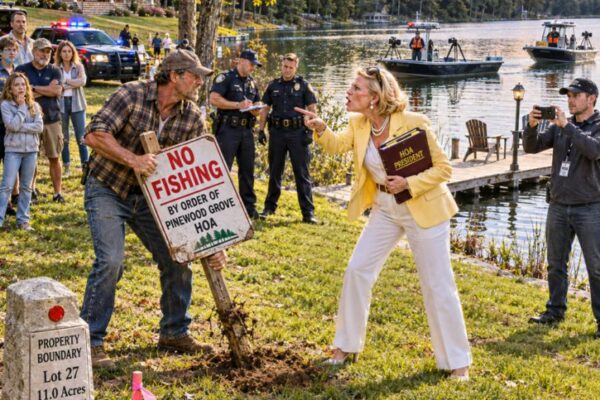
HOA Karen Called Police on Me at 3 A.M. Over a Desk Lamp—Then Tried to Fine Me Under Rules She Invented.k
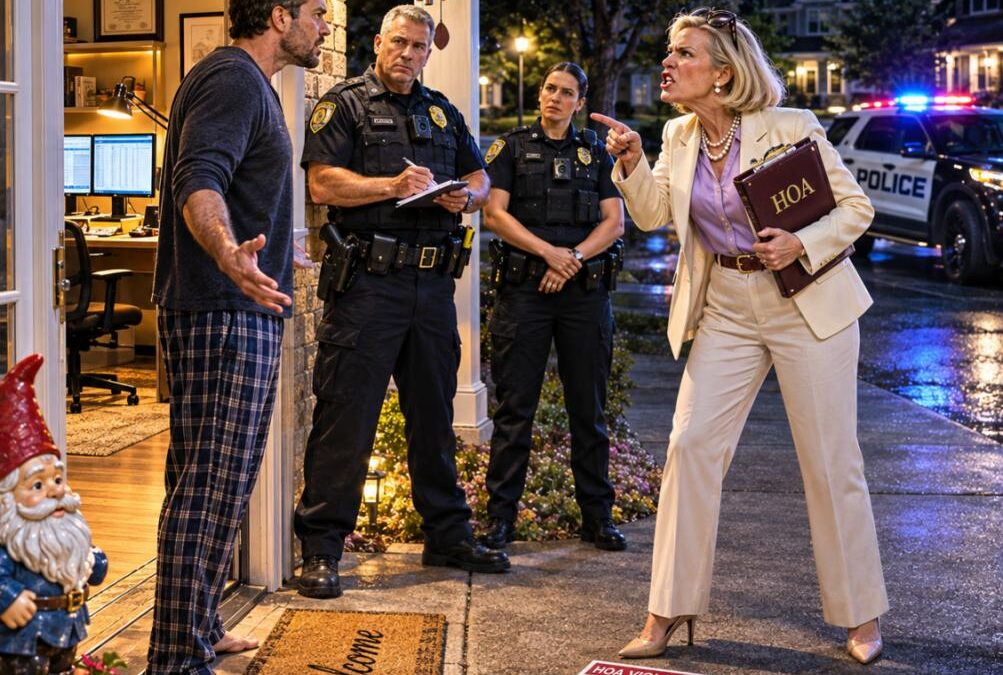
HOA Karen Called Police on Me at 3 A.M. Over a Desk Lamp—Then Tried to Fine Me Under Rules She Invented
She sent police to my door at 3:07 in the morning because the light in my home office was still on.
Then HOA Karen fined my welcome mat, my sister’s wind chime, and a ceramic garden gnome under “rules” nobody could show me in the bylaws.
By the time she threatened a $1,000 penalty and a lien against my house, I had stopped asking why she hated being challenged and started checking where every dollar of our HOA dues was going.
The pounding on my front door came at 3:07 a.m.
Not a knock.
Three hard strikes that snapped me out of a spreadsheet and sent my hand instinctively toward the desk drawer where I kept nothing more dangerous than spare charging cables.
I froze.
Through the closed blinds, my office lamp cast a narrow yellow strip across the front lawn.
Another knock.
“Police.”
I stood slowly.
At that hour, after nearly a decade investigating financial crimes for the federal government, unexpected law enforcement at my own house did not feel routine.
I checked the doorbell camera.
Two uniformed officers stood beneath my porch light.
And across the street, wearing a robe over pajamas and slippers that probably cost more than my laptop bag, Karen Walsh stood on her lawn with her arms folded.
Watching.
I opened the door.
The older officer looked tired rather than aggressive.
“Mr. Carter?”
“Yes.”
“We got a report of unusual activity. Lights on at odd hours. Possible intruder or unauthorized business operation.”
I stared at him.
Then at Karen.
Then back.
“The unusual activity is me working.”
The younger officer glanced past me.
My living room was dark.
The office behind it contained one computer, two monitors, a legal pad, and a mug of coffee I had reheated so many times it had become a threat to public health.
Karen called from across the street.
“He’s always up at strange hours.”
The senior officer turned.
“Ma’am, please let us speak with him.”
Karen ignored that.
“There are strange people coming and going too. Deliveries. Electronics. Lights. It violates our quiet-enjoyment standards.”
I almost laughed.
“Officer, I work in forensic accounting. I’m on deadline.”
Karen stepped off her curb.
“You told me you were an accountant.”
“I am.”
“That doesn’t explain why your house is lit up at three in the morning.”
“It explains it perfectly.”
The senior officer sighed.
“Ma’am, somebody working inside his own home isn’t a police matter.”
Karen’s face tightened.
“He could be running an illegal operation.”
I looked directly at her.
“What illegal operation uses Excel?”
The younger officer bit the inside of his cheek.
Karen did not appreciate it.
“This neighborhood has rules.”
The older officer looked at me.
“Sir, everything appears fine. Sorry for waking you.”
“I was already awake.”
He nodded.
Then lowered his voice.
“If this keeps happening, document it.”
That sentence stayed with me.
The officers walked back to their cruiser.
Karen stood beneath the streetlight, furious that reality had refused to cooperate with her.
“You embarrassed yourself,” she snapped.
I rested one hand on the door.
“You called 911 over a desk lamp.”
“This was a warning, Ethan.”
There it was.
Not concern.
Not safety.
A warning.
She turned and walked home.
I closed the door.
Then I looked at the stack of HOA fines on my dining table.
Welcome mat.
Wind chime.
Trash cans.
Sidewalk chalk left by my niece.
Rules I had assumed were real because the letters had official logos and numbered sections.
At 3:19 that morning, I opened the Willow Creek bylaws.
And before sunrise, I found the first problem.
Several of Karen’s favorite rules did not exist at all.
part 2
My name is Ethan Carter.
I was thirty-nine when the police showed up over my office lamp, and until that night, I had spent six months trying very hard not to become emotionally invested in Willow Creek politics.
That was harder than it sounds.
For nearly ten years, I worked as a federal financial investigator specializing in complex fraud, money laundering, procurement schemes, shell companies, and the type of accounting designed specifically so ordinary people would stop reading before they reached the interesting part.
I am not a street cop.
I do not carry a badge around the neighborhood like a personality.
Most of my work involves bank records, subpoenas, spreadsheets, interviews, corporate filings, and long stretches of sitting beneath fluorescent lights while someone insists the forty-seven transfers between six companies were completely normal.
My job taught me two things.
First, paperwork is rarely boring when somebody desperately wants you to think it is.
Second, power loves complexity because complexity makes people surrender.
That was why I wanted Willow Creek.
Simple house.
Small backyard.
Quiet street.
No downtown traffic.
No condo elevators.
No neighbor above me wearing shoes made of concrete.
The neighborhood looked almost aggressively peaceful.
Maples along the sidewalks.
Matching mailboxes.
Small community pool.
Clubhouse.
Lawns neat but not ridiculous.
I bought a two-story brick house near the middle of the subdivision and told myself that, after years of tracking people who stole millions through accounting tricks, I could survive an HOA.
Karen Walsh introduced herself four days after closing.
She stood at my door wearing cream slacks, a pale green blouse, pearl studs, and the expression of a woman disappointed by something I had not yet done.
She pointed toward my porch.
“Your mat.”
I looked down.
Black rubber.
WELCOME printed in gray.
“What about it?”
“Willow Creek requires natural fiber.”
I stared.
“Excuse me?”
“Coir or comparable earth-toned natural material. Rubber mats are not consistent with the entrance aesthetic.”
I thought she was joking.
She was not.
“I haven’t received the full architectural handbook yet.”
“You should have.”
“I didn’t.”
Karen opened the burgundy folder tucked beneath her arm.
“I’m Karen Walsh. HOA president.”
“Ethan Carter.”
“I know.”
That should have been my first warning.
She had already looked me up.
“Replace it within seven days and there won’t be a formal violation.”
I looked at the mat.
Then at her.
“Is there a safety issue?”
“It’s aesthetics.”
“Okay.”
I could have argued.
I didn’t.
I had spent that day reviewing a financial case involving three countries, seven corporations, and a CFO who believed deleting emails meant deleting evidence.
I was not going to spend my evening fighting over a welcome mat.
I ordered a brown coir one online.
Peace, I told myself, was worth thirty-two dollars.
A month later, my sister gave me a wind chime.
Nothing enormous.
Metal tubes, maybe eighteen inches long.
I hung it beneath the back porch.
Karen issued a notice.
NOISE POLLUTION.
Twenty-five dollars.
I paid it.
That was mistake number one.
Not because the money mattered.
Because every unquestioned fine trained Karen to believe I would choose convenience over scrutiny.
Then came trash cans.
The rule required bins behind the side fence by eight p.m. on collection day.
I rolled mine in at 7:42.
The next morning:
Fifty-dollar violation.
PHOTO EVIDENCE: CONTAINER VISIBLE FROM ROADWAY.
The photograph had no timestamp.
I paid.
My job trained me to investigate fraud.
My personality apparently allowed a suburban woman with a clipboard to charge me fifty dollars because I did not want to attend an HOA hearing.
There is a lesson in that.
People tolerate small abuse precisely because it is small.
The cost of resisting feels larger than the harm.
Then the harm grows.
My niece visited one Saturday.
She was eight.
She drew a sun, a robot, and what I think was supposed to be me on the sidewalk in washable chalk.
Monday morning:
UNAUTHORIZED PAVEMENT MARKINGS.
Fifty dollars.
I did not pay that one.
I emailed Karen.
Please identify the provision prohibiting temporary sidewalk chalk.
She replied within eight minutes.
Section 9.4 — Exterior Appearance.
I looked it up.
Section 9.4 required residents to keep lots “clean and visually harmonious with surrounding properties.”
Nothing about chalk.
I wrote back.
Section 9.4 does not prohibit washable chalk.
Her answer:
The board retains discretion to interpret aesthetic standards.
I almost respected the confidence.
Almost.
I requested a hearing.
At the hearing, Karen sat at the center of a folding table with two directors beside her.
Tom Brennan.
Retired civil engineer.
Quiet.
Gray beard.
And Susan Pike, a real-estate appraiser who looked exhausted before the meeting started.
I explained the issue.
Karen said, “The drawings remained visible for more than twenty-four hours.”
“They washed off in the rain.”
“After the violation occurred.”
“What exactly was the violation?”
“Visual inconsistency.”
“Where is visual inconsistency defined?”
Karen looked at me as though I had asked where gravity was defined.
“The board has interpretive authority.”
Tom finally spoke.
“Karen, do we actually have a chalk rule?”
“No specific chalk language is necessary.”
“That’s not what I asked.”
Her eyes narrowed.
Susan looked down at her papers.
The fine was withdrawn.
Karen never forgave me.
Not because she lost fifty dollars.
Because Tom had questioned her in front of me.
A week later, my mailbox post supposedly needed repainting.
I checked.
It matched every post on the street.
Then my driveway edging was “inconsistent.”
Then a small planter exceeded approved dimensions.
Then my porch light was “too bright.”
Every time I asked for the provision.
Every time, the answer became vaguer.
Standards.
Interpretation.
Community character.
Board discretion.
By then, I had stopped paying disputed fines automatically.
I appealed.
Some disappeared.
Some were reduced.
Some Karen tried to keep alive through sheer persistence.
I still did not investigate her.
That distinction matters.
My badge did not give me permission to turn a private neighborhood dispute into a federal case.
I could not search restricted databases because Karen annoyed me.
Could not subpoena her bank records because she hated wind chimes.
Could not use government systems to examine HOA vendors.
That would have been abuse of power too.
So when the police arrived at 3:07 because my office light was on, something changed—but not the way Karen later imagined.
I did not “open a federal case.”
I became an HOA member who finally decided to read everything.
By five that morning, I had coffee, three binders, a laptop, and the Willow Creek governing documents spread across my dining table.
Declaration.
Bylaws.
Architectural guidelines.
Fine schedule.
Board resolutions available through the community portal.
Meeting minutes.
I started with the mat.
No natural-fiber requirement.
The architectural standard required “neutral color and reasonable condition.”
My black mat had arguably complied.
Wind chime?
No prohibition.
Noise provision applied to amplified sound and recurring disturbances exceeding specified quiet-hour standards.
No blanket chime ban.
Sidewalk chalk?
Nothing.
Mailbox paint?
The actual approved color matched mine.
Then I found something more important.
Rule adoption.
The bylaws required new rules affecting owners’ property use to be adopted by the board at a properly noticed meeting and entered into the association’s records.
Some categories also required written notice to the membership before enforcement.
I searched minutes.
No welcome-mat rule.
No wind-chime rule.
No chalk rule.
No planter-dimension rule.
Several “section numbers” Karen cited did not correspond to the subjects on the notices.
One did not exist.
That was when I created a spreadsheet.
Not PROJECT SPARROW.
I am an accountant, not a twelve-year-old naming a spy mission.
I called it:
Willow Creek Enforcement Review.
Extremely intimidating.
I entered every violation.
Date.
Alleged rule.
Actual rule.
Board adoption.
Fine.
Appeal result.
Evidence.
Within two hours, I had a pattern.
Karen was not merely interpreting rules aggressively.
She appeared to be inventing enforcement standards and presenting them as if the board had formally adopted them.
That was not automatically criminal fraud.
Important distinction.
HOA governance can be sloppy without becoming a felony.
But owners were paying money based on notices that overstated or misstated governing authority.
That needed examination.
At nine, I called a community-association attorney.
Rachel Kim.
I knew her through a colleague but had never hired her.
I sent the documents.
She called around eleven.
“You have an unusually organized HOA complaint.”
“Occupational damage.”
“What do you want?”
“First, I want the rules.”
“You have them.”
“I want to know whether there are others I haven’t been given.”
“Good question.”
“Second, I want my invalid fines reviewed.”
“Reasonable.”
“Third, I want Karen to stop calling police because I work late.”
Rachel paused.
“That part may be harder.”
“Why?”
“Because citizens can call police when they genuinely believe something is wrong.”
“She reported a desk lamp as suspicious activity.”
“I didn’t say it was intelligent.”
I laughed.
She continued.
“Do we know exactly what she told dispatch?”
“No.”
“Then don’t call it a false report yet.”
That sentence became our operating rule.
Do not outrun the evidence.
Rachel sent a formal records request under our governing documents and applicable state law.
Board minutes.
Rule-adoption records.
Fine schedules.
Financial statements.
Budgets.
Vendor contracts.
Certain invoices and accounting records members were entitled to inspect.
Conflict disclosures.
No federal letterhead.
No badge.
No threats.
Just a homeowner’s attorney asking an HOA for its books.
Karen responded by emailing the entire neighborhood.
Certain residents have recently begun burdening volunteer leadership with excessive document demands and adversarial legal tactics.
No name.
Everyone knew.
Then she mailed me another fine.
UNAPPROVED DECORATIVE OBJECT.
My sister’s ceramic planter.
One hundred dollars.
I showed Rachel.
She called.
“Do not do anything stupid.”
“I wasn’t planning to.”
“That sentence always precedes something stupid.”
“I have an idea.”
“No.”
“You haven’t heard it.”
“I don’t need to.”
I bought a garden gnome.
Twelve inches tall.
Ceramic.
Red hat.
White beard.
Ridiculous grin.
I named him Winston because if you are going to become absurd, commit fully.
Before placing him outside, I checked every rule.
No prohibition on small decorative lawn objects.
No size problem.
No setback problem.
No obstruction.
No safety issue.
Rachel reluctantly agreed that nothing she reviewed prohibited him.
“You are baiting her.”
“I am placing a decorative object in my own flower bed.”
“Ethan.”
“If she ignores it, excellent.”
“And if she doesn’t?”
“We learn whether she issues another invented violation.”
Rachel sighed.
“You work for the government, which somehow makes this worse.”
“I’m acting privately.”
“Then act like a normal private citizen.”
“Normal citizens own gnomes.”
She hung up.
Winston went into the flower bed Saturday morning.
Karen saw him at 9:14.
My doorbell camera captured her stopping on the public sidewalk.
Hands on hips.
She photographed him.
She left.
At 10:02, email.
FINAL WARNING — FLAGRANT EXTERIOR VIOLATION.
One thousand dollars if not removed within twenty-four hours.
I stared at the number.
Then laughed so loudly my neighbor Tom heard me from his driveway.
“What?”
I walked over with my phone.
He read the email.
“One thousand dollars?”
“For Winston.”
He looked toward the gnome.
“Winston?”
“It seemed appropriate.”
Tom studied the notice.
“What section?”
“Karen cites 11.7.”
He pulled out his phone.
We checked.
Section 11.7 concerned drainage modifications.
Tom looked at me.
“She made this up.”
“That is my working hypothesis.”
“You have a lawyer?”
“Yes.”
“Good.”
He handed back the phone.
Then something shifted in his expression.
“You looking at the financials too?”
“Why?”
“Our dues went up thirty percent in two years.”
“I saw.”
“Landscape quality got worse.”
“I noticed.”
He looked toward the entrance.
“Meadow View.”
“What about them?”
“Used to be GreenStar Landscaping. Board changed contractors.”
“When?”
“Two years ago.”
“Why?”
“Karen said Meadow View was more responsive.”
“Competitive bid?”
Tom laughed bitterly.
“I asked once.”
“And?”
“She told me procurement details were confidential.”
That phrase was nonsense.
Not all vendor information had to be public to every passerby, but members often had rights to inspect significant association records subject to legitimate limitations.
I added Meadow View to the list.
Again:
Public sources only.
State corporate registry.
Business website.
Licensing information where applicable.
County records.
The company owner was Mark Walsh.
Karen’s brother-in-law.
That was not proof of theft.
It was a conflict that should have been disclosed and properly handled.
I checked the meeting minutes available online.
The contract change appeared in one sentence:
Motion to approve new landscape vendor based on president’s recommendation.
Passed 3–2.
No relationship disclosed in the minutes.
Maybe disclosed elsewhere.
I waited for records.
While I waited, Karen escalated Winston.
Second email.
Then third.
She accused me of deliberately degrading community aesthetics.
She threatened legal referral.
Then she posted an emergency meeting notice.
Purpose:
ENFORCEMENT ACTION REGARDING REPEATED FLAGRANT NONCOMPLIANCE.
I forwarded it to Rachel.
She called.
“She’s actually making the gnome an agenda item.”
“Yes.”
“I hate that I’m enjoying this.”
“Welcome.”
“Do not bring your badge.”
“I wasn’t going to.”
“Do not tell anyone you investigate fraud for the government as intimidation.”
“I won’t.”
“Do not accuse her of embezzlement.”
“I don’t have evidence of that.”
“Good.”
Then the association records arrived.
Three boxes digitally.
Minutes.
Budgets.
Bank summaries.
Invoices.
Vendor contracts.
Fine logs.
Rachel reviewed the legal parts.
I reviewed the arithmetic.
Again, as an owner using records lawfully produced to me.
No secret federal databases.
No government subpoenas.
The landscaping contract had increased from roughly $62,000 per year under GreenStar to nearly $87,000 under Meadow View.
Forty percent.
Some increase could be inflation.
Scope could differ.
Fuel.
Labor.
I compared contracts.
The service scope was almost identical.
Actually, Meadow View performed fewer seasonal color rotations.
I checked invoices.
Tree service billed separately.
Irrigation repairs billed separately.
Then a line appeared repeatedly:
MANAGEMENT COORDINATION FEE.
Five percent.
To whom?
The contract identified:
Walsh Community Consulting.
Different entity.
Registered agent:
Karen Walsh.
I stopped.
Read again.
Meadow View’s contract required the HOA to pay a five-percent coordination fee to the president’s consulting company?
That seemed impossible.
Then I checked the board approval packet.
No mention of Karen’s company.
Rachel read it next.
“This is a problem.”
“Criminal?”
“I did not say that.”
“It looks like undisclosed self-dealing.”
“It looks like a transaction involving an officer-related company that requires explanation.”
“Lawyers have ruined adjectives.”
“You pay me for verbs.”
We checked payments.
The HOA had paid approximately $11,000 to Walsh Community Consulting over two years.
Invoices described:
Vendor oversight.
Quality assurance.
Landscape coordination.
Neighborhood compliance integration.
Could legitimate work have been done?
Maybe.
Was Karen allowed to be compensated separately?
Depends on the documents, board approval, disclosure, state law, and facts.
The bylaws prohibited director compensation for board service but allowed reimbursement and separate contracted services if properly authorized.
The authorization trail was weak.
Then Tom told me something important.
“I never knew she was being paid.”
He had served on the board during the first year of the Meadow View contract.
“You voted on the contract?”
“Yes.”
“You knew Mark was her brother-in-law?”
“No.”
“You knew about Walsh Community Consulting?”
“No.”
“Did the board approve that fee separately?”
“Not while I was there.”
That mattered.
I asked him to write down what he remembered.
He did.
Another former director, Susan Marks, confirmed the same.
Not proof of theft.
Evidence of governance failure and possible undisclosed financial interest.
Then I reviewed the fine ledger.
Karen’s invented rules had generated thousands.
Not hundreds of thousands.
Just under nine thousand dollars in two years.
Chalk.
Mats.
Decorative items.
Planters.
Wind chimes.
Mailbox details.
Most owners paid because individual fines were too small to justify lawyers.
Fifty dollars.
Seventy-five.
One hundred.
Small enough to surrender.
Large enough to accumulate.
Lisa Morgan, a young mother two streets over, had paid fifty dollars because her son drew chalk dinosaurs on their own driveway.
I showed her the bylaws.
“There’s no chalk rule?”
“Not that I can find.”
“She told me there was.”
“I know.”
“Can I get the money back?”
“Probably needs board review.”
Her eyes filled.
Not because of fifty dollars.
“She made me feel like I was trashy.”
I did not expect that.
Lisa continued.
“She said children’s drawings made Willow Creek look like a rental neighborhood.”
There it was.
Another word with too much meaning packed inside.
Rental.
Not illegal.
Not automatically discriminatory.
But class-coded.
Status-coded.
Karen used aesthetics as morality.
Clean meant respectable.
Uniform meant safe.
Different meant decline.
Once I saw that, many of her emails made more sense.
Not better.
More coherent.
The night before the emergency meeting, my dining table disappeared under paper.
Rachel hated my plan to use slides.
“You are not conducting a prosecution.”
“I’m explaining records.”
“You’re enjoying this.”
“A little.”
“Dangerous.”
She helped anyway.
We built the presentation around questions.
No accusations beyond evidence.
Question one:
Where was the garden-ornament rule adopted?
Question two:
Where was the wind-chime rule adopted?
Question three:
Why did fines cite unrelated sections?
Question four:
Was Karen’s relationship to Meadow View disclosed before the contract vote?
Question five:
Who approved payments to Walsh Community Consulting?
Question six:
Why did association expenses increase despite reduced landscaping scope?
Simple.
I also called the police department’s nonemergency line.
Not to summon officers for intimidation.
To document the prior 3 a.m. incident and ask what procedure to follow if Karen attempted to use police for a civil HOA disagreement during a heated meeting.
The desk sergeant said patrol would respond only if needed.
Good.
No staged showdown.
The clubhouse was packed anyway.
Karen had done my advertising for me.
She sat center table with two directors beside her.
Tom sat in the audience now.
Susan Pike remained on the board.
The third director, Paul Jenkins, was one of Karen’s strongest supporters.
Karen opened with Winston.
I wish that were exaggeration.
A photograph of my gnome appeared on the projector.
Twelve inches of ceramic rebellion.
Karen said:
“This is not about one lawn ornament.”
Correct for once.
“It is about whether individual residents can openly mock community standards and undermine volunteer governance.”
I whispered to Rachel:
“She’s making him sound revolutionary.”
Rachel whispered back:
“Stop.”
Karen continued.
“Mr. Carter has repeatedly challenged routine enforcement, refused corrective guidance, involved attorneys unnecessarily, and created an atmosphere of hostility.”
Then she proposed a one-thousand-dollar fine.
Plus continuing penalties.
Plus legal costs.
Plus possible collection action if unpaid.
I raised my hand.
Karen said, “You’ll have your opportunity.”
Fine.
Eventually she called me.
“Mr. Carter, do you have anything to say?”
“Yes.”
I walked to the lectern.
Winston remained on the screen behind me.
A terrible visual.
“Good evening.”
I clicked to my first slide.
HOA Rule Adoption Procedure.
Not dramatic.
Karen visibly relaxed.
She thought I was going to bore everyone.
Good.
“Tonight isn’t about whether you like my garden gnome.”
A few people laughed.
“It isn’t even about whether I like my garden gnome.”
More laughter.
“It’s about how rules become enforceable.”
I highlighted the bylaw section.
“New property-use rules require board adoption in a noticed meeting and entry into association records.”
Next slide.
WELCOME MAT NOTICE.
“Please show me where this rule was adopted.”
Silence.
Next.
WIND CHIME.
“Same question.”
Next.
SIDEWALK CHALK.
Lisa stood.
“That was mine.”
People turned.
She continued.
“I paid fifty dollars.”
Karen said, “Lisa, public comment—”
Lisa sat down.
But everyone had heard.
Next slide.
GNOME — SECTION 11.7.
Then the actual Section 11.7.
DRAINAGE ALTERATIONS.
The room began murmuring.
I looked at Karen.
“Unless Winston has started redirecting stormwater, this citation appears incorrect.”
That got a real laugh.
Karen slammed her hand on the table.
“This is exactly the disrespect I’m talking about.”
I did not answer.
Next slide.
Fine revenue.
Approximately nine thousand dollars from disputed categories.
Not all necessarily invalid.
I made that explicit.
“I’m not claiming every fine was improper.”
Karen’s expression shifted.
She had expected accusation.
“I am asking the board to review every fine based on standards it cannot prove were adopted.”
Then the landscaping contract.
Annual cost.
Old vendor.
New vendor.
Forty-percent increase.
Scope comparison.
Then Meadow View ownership.
MARK WALSH.
Brother-in-law.
The room went silent.
Karen stood.
“This is character assassination.”
I clicked again.
Walsh Community Consulting.
Karen Walsh.
Approximately $11,000.
“Then answer the records.”
Her face reddened.
“These were legitimate coordination services.”
“Were they disclosed?”
“Yes.”
“Where?”
“In board discussions.”
Tom stood.
“I was on the board.”
Karen froze.
Tom continued.
“I never knew.”
Paul Jenkins turned toward him.
“You approved the vendor.”
“I approved Meadow View. I did not approve paying Karen separately.”
Susan Pike looked at Karen.
“Neither did I.”
Karen’s face lost color.
“You knew I coordinated landscaping.”
Susan replied:
“We knew you volunteered on landscaping.”
That word landed hard.
Volunteered.
Karen gripped the table.
“You have no idea how much work I do for this community.”
Nobody disputed that.
That was part of the problem.
She had done so much that everyone had stopped asking which hat she was wearing when she did it.
President.
Volunteer.
Consultant.
Vendor coordinator.
Rule interpreter.
Complaint investigator.
Fine issuer.
The same person in every role.
I clicked to the final slide.
No badge.
No government seal.
Just a sentence.
QUESTIONS REQUIRE AN INDEPENDENT AUDIT.
Karen laughed sharply.
“Of course.”
I looked at her.
“What does that mean?”
“It means you think because of what you do for a living, you can come in here and run an investigation.”
The room turned toward me.
There it was.
She was about to expose my job as though it were my secret weapon.
I kept my voice level.
“My employment is irrelevant.”
Karen smiled coldly.
“Tell them.”
“No.”
“Why not?”
“Because I am here as a homeowner.”
She looked almost disappointed.
Rachel had been right.
Using my badge would have made the story about me.
The records were stronger.
Karen said:
“Mr. Carter is a federal investigator.”
Gasps.
Of course.
People love titles.
I raised one hand.
“That does not give me authority over Willow Creek.”
The room quieted.
“I did not use federal databases.”
“I did not subpoena these records.”
“I did not open a federal investigation.”
“I requested association documents I am entitled to inspect as an owner.”
I pointed toward Tom.
“These questions belong to everyone in this room.”
That changed something.
Not because I was powerful.
Because I refused to make myself the center.
Lisa stood.
“I want my chalk fine reviewed.”
A man near the back said:
“My wind chime fine too.”
Another homeowner:
“She fined us for a welcome mat.”
Then Helen Price, seventy-eight, held up a photograph.
A ceramic bird.
“She charged me one hundred dollars for this after my husband died.”
Karen snapped:
“Those are separate enforcement matters.”
Tom said:
“No, Karen. They’re not.”
The room erupted.
Questions.
Not shouting at first.
Questions.
Where are the bids?
Who authorized your company?
How many fines used rules that were never adopted?
Why did dues increase?
Why were meeting records incomplete?
Karen tried to regain control.
She banged the gavel.
Nobody stopped.
Then she made the mistake that ended the evening.
She picked up her phone.
“I’m calling the police.”
The room went quiet again.
“For what?” Tom asked.
“Disorderly conduct.”
“We’re sitting in chairs.”
“This meeting is out of control.”
Rachel leaned toward me.
“Say nothing.”
Karen called.
Not 911 this time.
The nonemergency number.
Credit for learning.
Two officers arrived twenty minutes later.
The same senior officer from my 3 a.m. visit was one of them.
He entered.
Looked at me.
Looked at Karen.
Then at roughly sixty homeowners sitting in folding chairs.
“What’s the problem?”
Karen said:
“Certain residents are refusing to leave after disrupting association business.”
Tom stood.
“I’m an owner.”
Lisa raised her hand.
“Me too.”
Half the room followed.
The officer closed his eyes briefly.
“Ma’am, is anybody threatening you?”
“No.”
“Any violence?”
“No.”
“Property damage?”
“No.”
“Then this sounds civil.”
Karen pointed at me.
“He’s using his federal position to intimidate people.”
The officer looked at me.
I said:
“I have not displayed credentials or invoked federal authority.”
Rachel added:
“I’m his private attorney. This is an HOA records dispute.”
The officer nodded.
“Then unless somebody commits a crime, we’re leaving.”
Karen stared.
“You’re refusing to protect me?”
“No, ma’am. We’re refusing to turn a board disagreement into a police matter.”
They left.
Exactly as police should have.
That moment mattered more than any badge reveal could have.
Karen’s favorite tool had stopped validating her.
The board did not vote to remove her that night.
The source version made that too easy.
Instead, Susan Pike moved for an independent audit.
Tom was no longer a director, so he could not vote.
Paul objected.
The fifth director, Marianne Cole, joined Susan.
Two to two.
Karen, as president, claimed authority to break the tie.
Rachel immediately objected from the audience.
Conflict of interest.
The board attorney, participating remotely after being called during recess, agreed Margaret should not vote on a matter directly involving her own compensation.
The motion remained tied.
Then Paul changed his vote.
He looked at Karen.
“I want to know where the money went.”
Three to one.
Audit approved.
That was the real turning point.
Not public humiliation.
Independent review.
The board also suspended collection of all fines based on disputed rules pending legal review.
Karen remained president.
For another six weeks.
Those six weeks were ugly.
She emailed residents accusing “a small faction” of trying to seize control.
She posted photographs of Winston.
Winston became locally famous.
Someone placed a tiny cardboard sign beside him one night:
AUDIT ME.
I removed it because I was trying to appear mature.
Lisa denied involvement.
Poorly.
The audit firm requested records.
Bank statements.
Invoices.
Contracts.
Check images.
Electronic accounting exports.
Board authorizations.
Vendor ownership information.
Karen resisted some requests.
The board’s attorney compelled cooperation through corporate procedure.
No search warrant.
No federal agents.
Just governance.
Then the first preliminary finding appeared.
Walsh Community Consulting had received $11,240.
Some invoices described services that Karen could document.
Site inspections.
Vendor meetings.
Plant replacement coordination.
The auditor estimated a portion could represent genuine work.
But payment approval was defective.
Conflict disclosure inadequate.
Several invoices lacked board authorization.
Then Meadow View.
Mark Walsh’s company had performed real landscaping.
This was not a fake vendor.
Workers existed.
Grass had been cut.
Trees trimmed.
But the pricing was materially above competing bids the auditor later obtained for comparable scope.
That alone was not embezzlement.
Poor contracting can be expensive without being criminal.
Then auditors found duplicate billing.
Certain seasonal plantings were charged through Meadow View and again through Karen’s consulting invoices as reimbursable material coordination.
Approximately $4,700.
Another $6,300 in reimbursements lacked receipts matching the accounting descriptions.
Then one invoice changed everything.
Clubhouse irrigation repair.
$8,400.
The actual subcontractor charged Meadow View $3,600.
Markup by itself could be legitimate.
But an additional $2,500 “project facilitation” payment went to Walsh Community Consulting.
And internal email showed Karen personally instructed accounting to code the payment as “emergency infrastructure” so the normal bid threshold would not trigger.
That was not conclusive proof of theft.
It was evidence a prosecutor might care about.
The board attorney referred the audit to the association’s insurer.
Then, after independent counsel reviewed the suspected falsified reimbursement records, the board voted to send the relevant materials to the county district attorney.
Not me.
The board.
I stayed out of the criminal referral.
That was essential.
The membership petition began the next day.
Tom collected signatures.
Lisa helped.
Helen Price sat at a folding table near the pool with her ceramic bird beside her.
Someone placed Winston next to it without asking me.
By sunset, the petition had enough owners to require a special recall meeting.
Karen challenged signatures.
Some were invalid.
Two renters had signed when only owners could.
One property had joint ownership requiring a different form.
Those signatures were removed.
The petition still qualified.
Rachel smiled when I told her.
“Procedure.”
“I hate how much you enjoy that word.”
“It keeps revenge stories from becoming lawsuits.”
The recall meeting was packed.
Karen hired her own lawyer.
Good.
She deserved representation.
Her attorney spoke first.
He argued the HOA had historically used informal aesthetic standards.
That many homeowners had accepted them.
That some rules may have been improperly documented rather than invented maliciously.
Fair argument.
He also argued Karen’s consulting work had real value and that poor documentation did not prove theft.
Also fair.
Then Karen spoke.
She looked different.
Not weaker.
Angrier.
She told the room she had spent seven years protecting Willow Creek.
Property values.
Landscaping.
Pool maintenance.
Storm cleanup.
Architectural consistency.
Volunteer events.
She had done those things.
That mattered.
Then she said:
“Every strong community eventually faces people who confuse personal preference with freedom.”
Her eyes found me.
“Mr. Carter moved here and immediately began challenging standards other residents had accepted for years.”
I almost laughed at “immediately.”
I had paid ridiculous fines for months.
Karen continued.
“He used his professional expertise to dig through records in an attempt to criminalize ordinary volunteer mistakes.”
That was clever.
Some residents nodded.
Then came my turn.
No PowerPoint.
No badge.
I carried Winston.
Rachel had told me not to.
I ignored her.
I placed him on the table.
The room laughed.
Even Karen’s attorney smiled.
“This little guy cost me a thousand dollars.”
More laughter.
“Or he would have, if I paid the fine.”
Then I became serious.
“But this isn’t about a gnome.”
I looked around.
“It’s about whether the person enforcing a rule can show you the rule.”
“Whether the person spending your money can show you the authorization.”
“Whether the person hiring a relative disclosed the relationship.”
“Whether the person receiving compensation told the board she was being compensated.”
I paused.
“Karen says I turned volunteer mistakes into accusations.”
“I agree that mistakes happen.”
“I make them professionally.”
“That is why systems require records.”
I looked at Karen.
“I don’t know whether every unsupported invoice was dishonest.”
“That is for the audit and appropriate authorities to determine.”
“I do know we were fined under standards that were never properly adopted.”
“I know police were called to my house at three in the morning because I was working under a desk lamp.”
The senior officer from that night was not present.
Good.
This was not his fight.
“I know a young mother paid money because her child drew chalk dinosaurs.”
Lisa stared at the floor.
“I know Helen paid one hundred dollars for a ceramic bird after her husband died because fighting the HOA felt harder than paying.”
Helen began crying quietly.
“And I know Willow Creek kept allowing this because each amount was small enough that resistance seemed irrational.”
The room was completely silent.
“That is how small power becomes large.”
I pointed toward Winston.
“Not because the gnome matters.”
“Because nobody asks where the authority came from.”
Then I sat.
The vote was conducted by secret ballot through an independent election inspector.
Karen was removed from the board with sixty-nine percent of valid votes.
Thirty-one percent wanted her to remain.
That surprised people.
It did not surprise me.
Karen had supporters.
She had helped residents.
Organized storm cleanup.
Negotiated pool repairs.
Visited sick neighbors.
She was not evil every minute of every day.
Human beings are inconvenient that way.
When the result was announced, Karen did not flee sobbing.
She sat still.
Then asked whether she could make one statement.
The inspector allowed it.
Karen stood.
“I hope you all understand what you have done.”
No one answered.
“This neighborhood will become impossible to govern.”
Tom said quietly:
“Then we’ll govern it together.”
Karen looked at him.
Then at me.
Then she picked up her handbag.
She left the clubhouse without another word.
No applause.
I was glad.
The district attorney’s investigation took months.
Not a week.
No agents raided her house because of garden-gnome fraud.
Investigators reviewed the audit, reimbursement records, contracts, emails, and payment authorizations.
Some questionable transactions were explained.
Some were not.
The final criminal case was narrower than neighborhood rumor.
Margaret—Karen, as everyone called her—was ultimately charged under state law with theft-related offenses and falsifying business records connected to several unsupported reimbursements.
The landscaping contract itself was not declared a giant criminal conspiracy.
Mark Walsh’s company had done real work.
But the undisclosed relationship and inflated costs became part of civil recovery and governance reform.
Karen eventually entered a negotiated plea on a reduced set of charges.
Restitution.
Probation.
Financial penalties.
A short custodial component under state sentencing rules.
No decade in prison.
No federal takedown.
No dramatic seizure of her house.
The federal government never prosecuted her because my day job did not magically transform HOA accounting into federal jurisdiction.
That distinction mattered to me more than anyone else.
I had spent my career watching authority expand whenever people stopped asking why it applied.
I was not going to do the same thing just because Karen had targeted me.
Our civil settlement was separate.
Invalid fines were refunded.
Mine.
Lisa’s.
Helen’s.
Dozens more after individual review.
Not every fine disappeared.
Some owners had actually violated valid rules.
That mattered too.
Tom had a fence penalty that remained because his fence really was six inches over the approved height.
He complained for two weeks.
I told him:
“Facts trump fear.”
He hated hearing his own phrase returned to him.
The HOA hired a professional management company.
No president could issue violations personally.
Complaints went through management.
Objective evidence required.
Rule citations had to match actual provisions.
Owners received an appeal process.
New rules required documented adoption.
Board minutes improved.
Financial controls changed.
Related-party contracts required disclosure and recusal.
Projects above a defined amount required multiple bids unless a genuine emergency made that impossible, and emergency exceptions had to be documented afterward.
Two signatures for major expenditures.
Monthly financial reports.
Annual independent review.
Nobody cheered for internal controls.
I did.
The landscaping contract was rebid.
The winning price came in roughly thirty percent below what Willow Creek had been paying while maintaining comparable scope.
Not thirty-eight exactly.
Real numbers rarely cooperate with dramatic storytelling.
Dues did not immediately drop because the HOA had deferred repairs.
Instead, the board stopped raising them for two years and rebuilt reserves properly.
Property values did not magically jump because Karen left.
The market moved according to interest rates, inventory, schools, and dozens of variables larger than our little civil war.
But something did change.
People came to meetings.
That sounds miserable.
It was healthy.
The first meeting under the new board lasted three hours and forty-two minutes.
I aged visibly.
Residents asked about every expense.
Some questions were intelligent.
Some were about why pool umbrellas cost so much.
One man spent nine minutes arguing that beige umbrellas were psychologically depressing.
Democracy is not glamorous.
Still better than dictatorship by clipboard.
Tom became president.
Reluctantly.
His first act was to say:
“I don’t want this job.”
Excellent qualification.
Lisa joined the rules committee.
Helen refused every committee and said she had already served her country by surviving Karen.
Winston became a problem.
People wanted him displayed at the clubhouse.
I refused.
“He lives with me.”
Tom said:
“He’s a symbol.”
“He’s twelve inches of ceramic.”
“Same thing.”
Eventually, during the annual picnic, someone placed Winston beside the sign-in table.
Within an hour he was surrounded by pink flamingos, pinwheels, ceramic frogs, and one horrifying lawn goose dressed like a firefighter.
The new board had to issue a reminder that common-area decorations still required permission.
Everyone laughed.
Then they removed them.
That moment mattered.
Freedom was not the absence of rules.
It was the difference between real rules and one person’s preferences pretending to be law.
My relationship with Karen did not end at the recall.
She still lived across the street.
For nine months.
At first, we ignored each other.
She stopped walking past my house.
I stopped checking her curtains at night.
The police were never called about my office light again.
I kept working late.
One evening, around eleven, I noticed my lamp glowing against the closed blinds.
I stood there looking at it.
Months earlier, that light had brought two officers to my door.
Now it was just light.
That was how I knew the neighborhood was becoming home again.
Then Karen came over.
Saturday afternoon.
No clipboard.
No pearls.
Jeans.
Blue sweater.
I opened the door but stayed behind the threshold.
“Ethan.”
“Karen.”
“I’m selling.”
“I heard.”
“Of course you did.”
Silence.
Then she looked at the doormat.
Brown coir.
The one I bought after our first meeting.
“You could have kept the black mat.”
I stared.
“That’s your opening?”
She almost smiled.
“I was wrong about that.”
“And several other things.”
“Yes.”
I waited.
Karen looked toward the street.
“I wanted to explain something.”
“You don’t owe me an explanation.”
“No.”
She looked back.
“I owe myself one.”
That was unexpected.
I stepped onto the porch.
She stayed on the walkway.
“When my husband died, everything became paperwork.”
I knew he had died six years earlier.
Insurance.
Estate.
House.
Accounts.
Repairs.
Karen continued.
“People kept telling me what I didn’t understand.”
She folded her arms.
“So I learned.”
“HOA rules?”
“Everything.”
“Then you became president.”
“Yes.”
She looked embarrassed.
“At first, it felt useful.”
“I believe that.”
“I fixed things.”
“You did.”
“People called me when something went wrong.”
“Yes.”
“Then they started calling before anything went wrong.”
I understood.
“You became the answer.”
She nodded.
“I liked it.”
There it was.
Simple.
“I liked being the person who knew.”
Her eyes went toward Winston in the flower bed.
“When someone questioned me, it felt like they were saying I had become useless again.”
“That doesn’t explain the money.”
“No.”
Good.
She did not hide behind grief.
“I told myself the consulting fee was fair because I did the work.”
“Why not ask the board to approve it openly?”
“Because they might say no.”
There it was.
The entire case in one sentence.
“Did you know the gnome rule wasn’t real?”
She looked down.
“At first I thought we had adopted something years ago.”
“And after I challenged it?”
“I knew I couldn’t find it.”
“So why issue a thousand-dollar fine?”
Her face tightened.
“Because I wanted you to stop.”
“Stop what?”
“Making me prove everything.”
That answer hit harder than any confession about money.
“Karen, that was literally your job.”
“I know.”
We stood in silence.
Then she said:
“I thought if I admitted one rule was wrong, everyone would challenge everything.”
“They did anyway.”
“Yes.”
“And the neighborhood survived.”
“Yes.”
That small word carried more defeat than any courtroom sentence.
She looked at me.
“I’m sorry I called the police.”
“Why did you?”
“I saw your light.”
“That’s not a reason.”
“I was angry.”
“Still not a reason.”
She took a breath.
“I wanted somebody with authority to come tell you I was right.”
There it was.
Again.
Authority as validation.
Not safety.
“You told them there might be an intruder.”
“I said activity looked suspicious.”
“At my own house.”
“I know.”
“You could have gotten someone hurt.”
Her eyes filled.
“I know.”
I believed that she knew now.
Maybe not then.
“Do you forgive me?” she asked.
I laughed softly.
Everyone eventually asks that.
“I don’t know.”
She looked disappointed.
“That’s honest.”
“It’s what I have.”
She nodded.
“I can live with it.”
I looked at her.
“That may be the first healthy thing you’ve said to me.”
This time, she actually laughed.
Karen sold her house two months later.
The buyers were a couple with three children.
Within a week, chalk covered their driveway.
Bright suns.
Dinosaurs.
A badly drawn dragon.
Lisa sent me a photograph.
No violation.
I saved it.
Willow Creek did not become some utopia.
People still argued.
One resident believed every dog should be under twenty-five pounds.
Another wanted solar streetlights.
Someone proposed banning basketball after seven p.m.
That meeting almost killed me.
But people argued in the open.
Rules required votes.
Money required records.
The president could be questioned without becoming your enemy.
That was enough.
I never joined the board.
Tom asked repeatedly.
“No.”
“We need someone with your financial background.”
“No.”
“You’d be good.”
“That is exactly how Karen started.”
He stopped asking.
I did agree to serve on a temporary finance-review committee for one year.
One.
We created a vendor disclosure form.
Conflict policy.
Invoice checklist.
Simple stuff.
The committee dissolved after completing its work.
No throne.
That was intentional.
At my federal job, colleagues eventually heard about the HOA mess.
Of course.
One investigator placed a small ceramic gnome on my desk.
Someone taped a label beneath it:
SPECIAL AGENT WINSTON.
I removed the label.
Kept the gnome.
The experience changed how I thought about my work.
For years, I had investigated executives who stole millions.
Huge cases.
Shell companies.
Wire transfers.
Offshore accounts.
Willow Creek involved tiny amounts by comparison.
Fifty-dollar fines.
Hundred-dollar reimbursements.
A few thousand in unsupported fees.
Yet the emotional effect on residents was enormous.
Why?
Because the money came with authority.
Lisa did not cry because she lost fifty dollars.
She cried because someone in power told her that her child’s harmless drawing made her family less suitable for the neighborhood.
Helen did not resent one hundred dollars.
She resented being threatened with escalating penalties during the worst year of her life.
I did not care about a thousand-dollar gnome fine nearly as much as I cared that Karen believed she could invent the rule after the fact.
Financial abuse is rarely only financial.
Money is often the delivery mechanism.
Control is the product.
That lesson made me better at my actual job.
When interviewing fraud victims, I stopped treating small-dollar humiliation as background.
People remember the moment they were made to feel stupid.
Powerless.
Ashamed.
Those details explain why they stayed silent.
Silence is useful to fraud.
Whether the fraud is a ten-million-dollar corporate scheme or a fifty-dollar chalk fine.
The person abusing the system depends on everyone deciding resistance costs too much.
Karen depended on that.
Until Winston.
That ridiculous ceramic face forced the question into daylight.
Is this really a rule?
Once one person asked, everybody started asking.
Then the money questions followed.
That is why I never threw him away.
He still stands in my flower bed.
Weather faded his hat.
One eye has a small crack.
The HOA has never complained.
Tom once suggested I repaint him.
“Historic preservation.”
“I thought you hated aesthetics enforcement.”
“This is different.”
“Why?”
“Because I’m president.”
I stared at him.
He stared back.
Then we both laughed.
That is the safest kind of authority.
The kind that can laugh at itself.
Five years later, I still live in Willow Creek.
My black rubber welcome mat came back.
I found the original in a box while cleaning the garage.
I stood on the porch holding it.
The brown coir mat Karen approved was worn out.
I could have bought another.
Instead, I put the black one down.
WELCOME.
Nothing revolutionary.
No camera crew.
No symbolic speech.
Just rubber.
A week passed.
Then a month.
Nobody cared.
My sister’s wind chime hangs from the back porch again too.
The chalk rules are simple now.
Temporary washable chalk on private driveways and sidewalks associated with a home is allowed unless it creates offensive content or actual safety problems.
That rule was adopted properly.
Notice.
Board vote.
Minutes.
I voted for it.
My niece, now thirteen, visited last summer.
She drew another robot.
Better this time.
Underneath it she wrote:
Winston for President.
I told her we had suffered enough.
She laughed.
At night, I still sometimes work until three.
Financial crime does not respect HOA quiet hours.
The light glows behind my blinds.
Nobody calls police.
The officers who came that first night were never villains.
They responded to a call.
They looked.
They asked questions.
They left.
The senior officer later attended one HOA meeting to explain the difference between emergencies, nonemergency complaints, and civil disputes.
His message was simple.
“Do not use 911 to win arguments.”
I wish every community had that sentence framed.
Karen’s misuse of police never became some giant criminal charge.
There was not enough evidence that the first call alone met the required standard for a knowingly false emergency report beyond a reasonable doubt.
That disappointed residents who wanted every wrong converted into a conviction.
Law does not work that way.
Nor should it.
The department documented the incident.
Later calls from Willow Creek received appropriate screening.
The board adopted a policy that HOA officers could not purport to request law enforcement on behalf of the association without an actual public-safety basis.
Again:
Boring reform.
Useful reform.
Karen eventually completed her criminal sentence and probation related to the financial case.
I heard through Tom that she moved to another county.
No dramatic ruin.
No homelessness.
No exile.
She started doing bookkeeping work for a small business after restrictions allowed.
The irony was obvious.
I did not celebrate it.
People need lives after accountability.
Otherwise we are not correcting behavior.
We are worshipping punishment.
She sent Willow Creek one restitution payment every month until the obligation was complete.
Nina—our management representative—recorded every one.
When the final payment arrived, Tom emailed the board:
Matter closed.
Three words.
No victory lap.
That felt right.
The most important thing Karen lost was not money.
It was unquestioned authority.
And the most important thing Willow Creek gained was not lower landscaping costs.
It was the habit of asking:
Where is that written?
Who approved it?
Was the conflict disclosed?
Does this apply equally?
Can I appeal?
Those questions are not disrespect.
They are maintenance.
Every system needs maintenance.
I teach that now when younger investigators join our unit.
They arrive excited about tracing millions.
I tell them to start smaller.
Read the footnote.
Check the vendor address.
Ask who approved the exception.
Verify the authority.
Do not let an impressive title substitute for documentation.
One trainee asked where I learned that.
I said:
“A garden gnome.”
He thought I was joking.
Mostly.
I sometimes think about my first weeks in Willow Creek.
How easy I made Karen’s job.
She told me the mat was wrong.
I replaced it.
She fined the wind chime.
I paid.
She fined the trash cans.
I paid.
Each time, I told myself I was buying peace.
I was really renting silence.
And rent always goes up.
That does not mean every petty HOA dispute deserves war.
Most do not.
If the rule exists and the violation is real, fix it.
If you disagree, appeal.
If the board votes against you lawfully, sometimes you lose.
Community living requires compromise.
What it should not require is obedience to rules nobody adopted.
Or payments nobody authorized.
Or police calls because someone powerful is angry that you asked for proof.
That is the line Karen crossed.
And once I finally stopped looking at each incident separately, the pattern became obvious.
Welcome mat.
Wind chime.
Chalk.
Gnome.
Landscaping.
Consulting payments.
Police.
Different forms.
Same assumption.
I decide.
You comply.
Everything changed when the neighborhood replaced that assumption with another.
Show us.
Show us the rule.
Show us the vote.
Show us the invoice.
Show us the conflict disclosure.
Show us why this person received a fine when that person received a warning.
Show us why a police response is necessary.
Show us.
Power hates that word when it has gotten comfortable.
Willow Creek learned to use it.
My house is still quiet most nights.
Exactly what I wanted when I moved in.
There is a comfortable chair by the front window.
The black welcome mat sits outside.
My sister’s wind chime moves when the evening breeze comes through.
Winston watches the flower bed with the same stupid smile.
Sometimes I catch myself looking across the street toward Karen’s old house.
A family lives there now.
Two kids.
Their bikes are frequently on the lawn.
Once, one bike remained out overnight.
Management sent a courtesy reminder.
The father brought it in the next morning.
That was the entire crisis.
No fine.
No police.
No emergency meeting.
No ruler measuring the angle of the handlebars.
One small problem.
One proportionate response.
Then everybody moved on.
That is what Karen never understood while she sat at the center of Willow Creek convincing herself control was the same thing as leadership.
Good governance is often invisible.
It works precisely because nobody has to fear it.
A rule appears in writing.
A resident understands it.
A fair process exists if there is disagreement.
Money can be traced.
Authority can be explained.
Questions are allowed.
No one needs to rule.
The night Karen called police at three in the morning, she thought she was proving something about me.
That I was suspicious.
Difficult.
Disruptive.
The kind of homeowner who needed to be reminded who was in charge.
Instead, she accidentally forced me to do the one thing she had spent years teaching everyone else not to do.
Check her work.
Once I did, the whole system changed.
Not because I carried a federal badge.
Not because I knew how to investigate executives.
Not because I was smarter than Karen.
Because her power depended on people assuming the paperwork was correct.
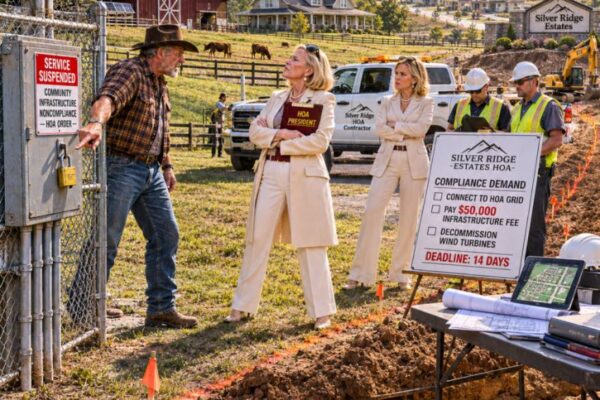
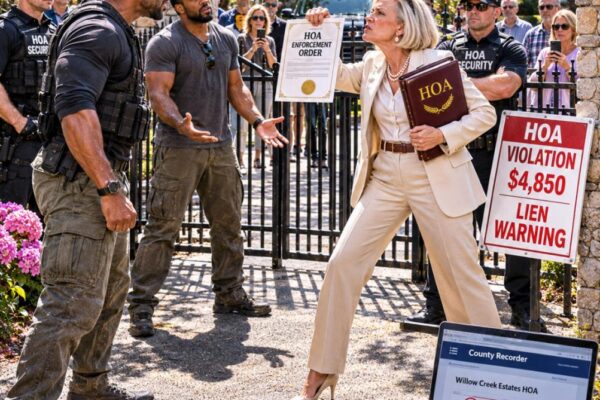
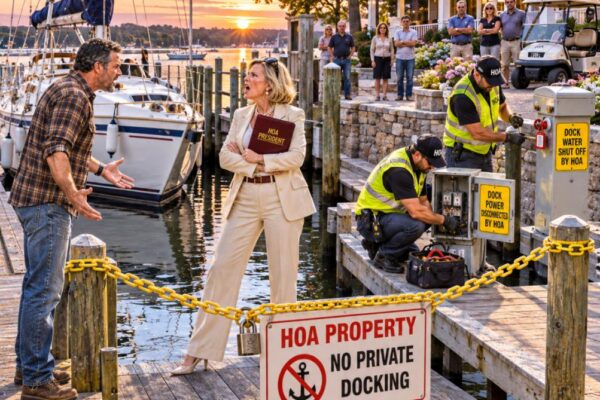
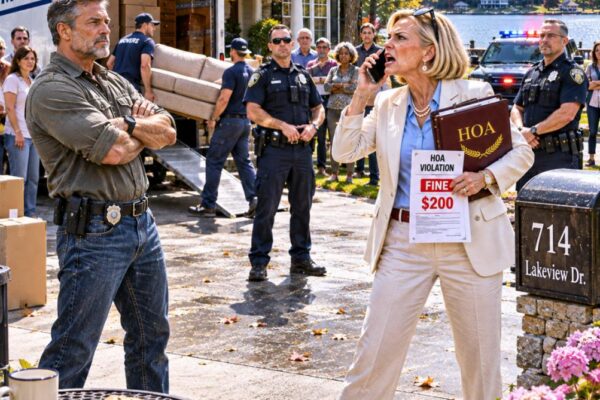
And all I had to do was read it.