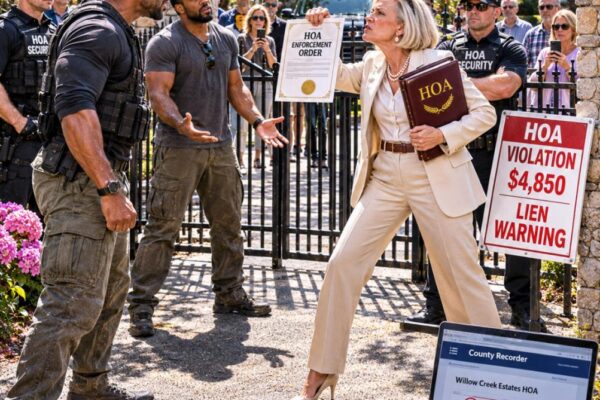
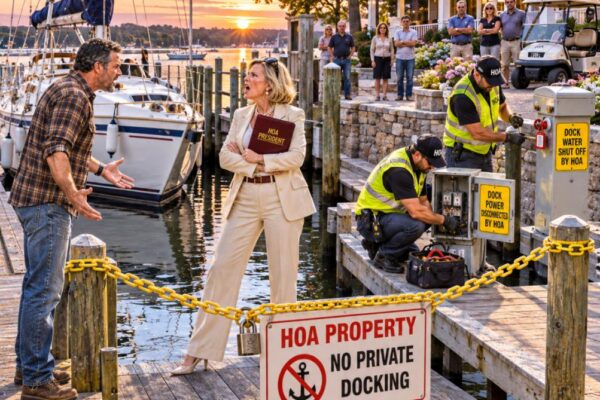
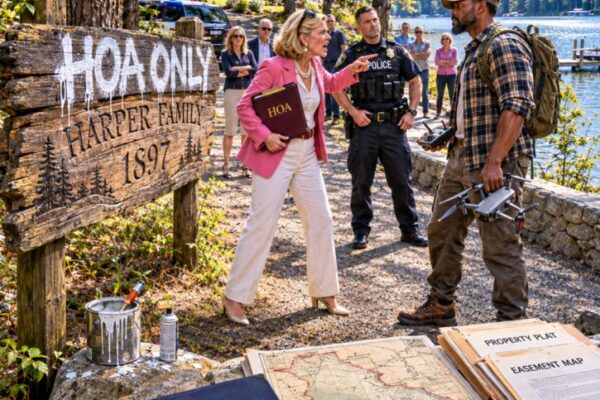
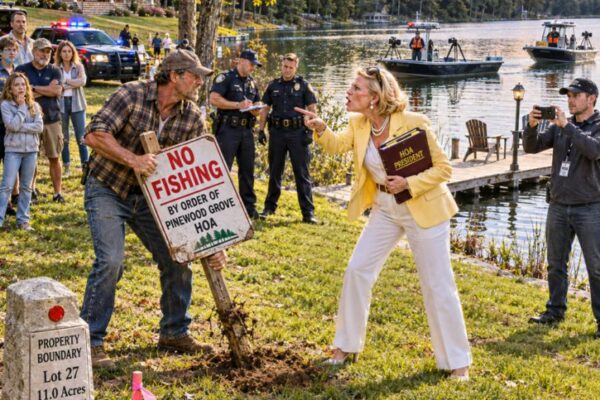
HOA Karen Called 911 From the HOA Office and Lied That I Was Threatening Her—Then She Tried to Put a Lien on My Home.k
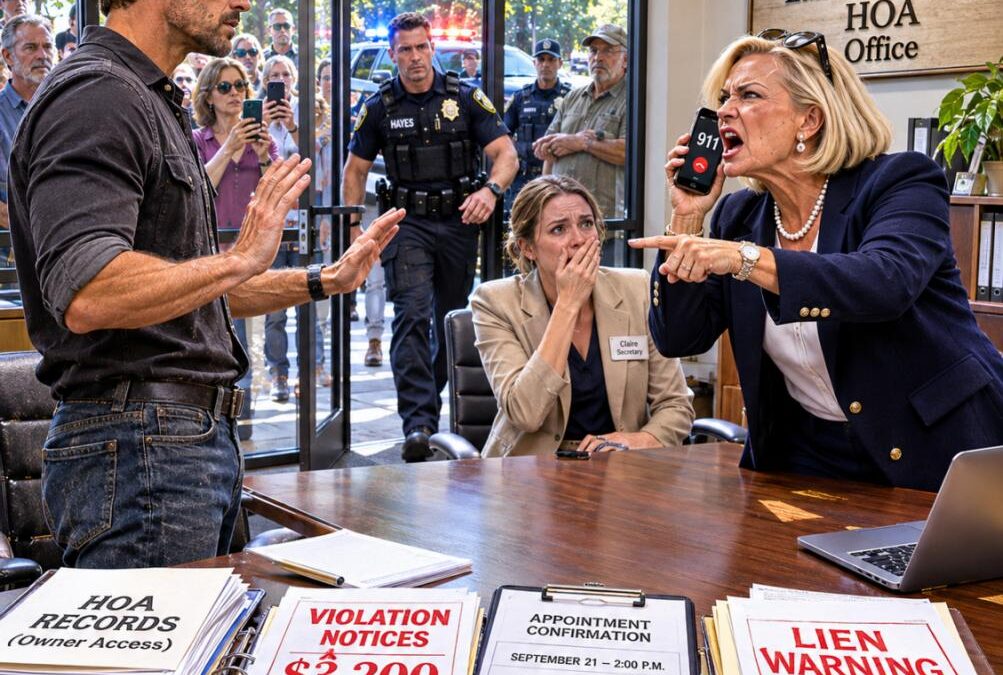
HOA Karen Called 911 From the HOA Office and Lied That I Was Threatening Her—Then She Tried to Put a Lien on My Home
She invited me into the HOA office, canceled the appointment after I arrived, then called 911 and told police I had trapped her inside.
By then she had already buried me under $3,200 in fake violations and threatened to put a lien on the house I had just bought.
HOA Karen thought one frightened phone call would turn me into the neighborhood villain, but she had forgotten that every system leaves a record.
“You don’t belong here.”
Evelyn Warner shouted it from six feet away while holding her phone against her chest.
I stood beside the conference table inside the Lake View Pines HOA office with both hands visible.
“Evelyn, I have an appointment.”
“No, you don’t.”
I slid the printed confirmation across the table.
SEPTEMBER 21 — 2:00 P.M.
RECORDS REVIEW WITH HOA SECRETARY CLAIRE MORGAN.
Evelyn didn’t look at it.
She was sixty-two, silver hair cut into a sharp bob, navy blazer buttoned to the throat, reading glasses hanging from a gold chain. For eight years she had been president of Lake View Pines, and from the way she carried herself, you would have thought the county had deeded her the lake.
Behind her, Claire Morgan looked terrified.
“I scheduled him,” Claire said quietly.
Evelyn turned.
“You did not have authority.”
“I’m the secretary.”
“You are subordinate to the board.”
Claire’s face went pale.
Outside the glass office doors, half a dozen homeowners had gathered.
Evelyn had started livestreaming before I arrived.
According to her post, I was “attempting unauthorized access to confidential association files.”
That was convenient.
Three weeks earlier, Claire had privately shown me copies of expense ledgers containing charges that made no sense.
Fifteen thousand dollars to GreenStone Landscape Management.
No landscaping work anyone could identify.
Eight thousand to something called Community Equipment Services.
No equipment.
And a series of smaller payments approved with Evelyn’s initials.
I hadn’t accused anyone of stealing.
I had asked to inspect records.
Now Evelyn was giving the neighborhood a show.
“Leave,” she said.
“Give me the records I’m entitled to review and I will.”
Her expression hardened.
“You’re trespassing.”
“This office is open for homeowner appointments.”
“Your appointment is revoked.”
“After I arrived?”
She raised the phone.
“I’m calling 911.”
I almost told her not to be ridiculous.
Then I remembered something my company teaches dispatch agencies every day.
Do not argue with the story.
Preserve it.
Calls are logged.
Times are recorded.
Statements matter.
So I stopped talking.
Evelyn dialed.
The dispatcher answered.
Her entire body changed.
Her voice cracked.
“Please send police. There’s a man in our office. He won’t leave.”
I stared at her.
She looked directly at me and kept going.
“He’s threatening me.”
Claire gasped.
“I’m trapped in here with him.”
“You’re standing beside the exit,” I said.
Evelyn lifted one finger like a prosecutor catching a confession.
“He’s getting aggressive now.”
I smiled.
Not because it was funny.
Because outside the window, I saw Officer Daniel Hayes stepping out of the first patrol car.
He had responded to two of Evelyn’s previous complaints about me.
And both times, he had written the same thing in his report.
No violation observed.
Evelyn lowered her phone and whispered:
“Now we’ll see who this neighborhood believes.”
I looked at the security camera above the conference-room door.
Then at Claire.
Then at the stack of original financial ledgers she had brought for our appointment.
“Yes,” I said.
“We will.”
part 2
My name is Nathan Brooks.
I was thirty-five when I moved into Lake View Pines, and if you had asked me then what success looked like, I would have answered with an address.
Not a valuation.
Not a company headline.
An address.
I had spent most of my adult life building Brooks Tech Systems, a mid-sized software company that designed call-routing, incident-management, and emergency-response technology for municipal agencies.
We did not “control 911.”
We built tools that helped dispatch centers receive, route, prioritize, and audit emergency communications.
That distinction mattered.
People hear technology company and imagine access to everything.
I had access to nothing I wasn’t authorized to access.
Customer data belonged to customers.
Police records belonged to agencies.
Emergency calls were governed by law, policy, and public-records rules depending on jurisdiction.
My job was to design systems.
Not spy on them.
Brooks Tech had started in a rented office above a print shop.
Four employees.
Two desks we bought used.
One coffee machine that leaked directly onto the floor.
By thirty-five, we employed almost two hundred people.
Most worked remotely.
Our headquarters was downtown.
I wanted my home office for quiet strategic work, not to turn my house into a commercial campus.
Lake View Pines seemed perfect.
Tree-lined streets.
A lake large enough for kayaks but too small for obnoxious powerboats.
Mature homes.
Walking trails.
A clubhouse.
An HOA that, according to the documents provided at closing, permitted ordinary home-office use as long as there was no regular customer traffic, exterior signage, or commercial nuisance.
I filed the required notice.
No clients visiting.
No employees reporting to my house.
No sign.
No deliveries beyond normal residential packages.
Simple.
Then I met Evelyn Warner.
Three days after closing, I was drinking coffee on my porch when she marched across my lawn.
Not walkway.
Lawn.
She wore beige slacks, a white blouse, and carried a leather clipboard.
“You’re Nathan Brooks.”
Not a question.
“I am.”
“I’m Evelyn Warner, president of Lake View Pines.”
“Nice to meet you.”
She looked at the birch tree beside my driveway.
“That may have to go.”
I lowered my coffee.
“Why?”
“Doesn’t fit the approved streetscape.”
“The tree is probably twenty years old.”
“Then prior boards were lax.”
She took a picture.
Then my shutters.
Another picture.
“Those are slightly blue.”
“They’re gray.”
“Blue-gray.”
“Okay.”
“Our approved palette is warmer.”
“They were here when I bought the house.”
“That doesn’t guarantee continuing compliance.”
I stared at her.
She photographed my mailbox.
Then my porch light.
Then, incredibly, me.
“Did you just take my picture?”
“For documentation.”
“Documentation of what?”
“Current property condition.”
I was still wearing a bathrobe.
“Does my robe violate the architectural guidelines?”
She didn’t laugh.
That told me everything I needed to know about Evelyn.
Neighbors watched from windows.
I saw curtains move.
The embarrassment was strangely effective.
I was a CEO.
I negotiated contracts worth millions.
I presented to city councils.
I testified before procurement committees.
None of that prepared me for standing barefoot on my own porch while a retired school principal photographed my shutters like evidence from a burglary.
Before leaving, Evelyn handed me a packet.
“Read this carefully.”
“I read the covenants before closing.”
“These are updated board standards.”
“Recorded amendments?”
“Board policies.”
“Can I get the adoption dates?”
Her smile tightened.
“You’re going to be difficult.”
“I asked for dates.”
She turned away.
That was our first conversation.
The violations started four days later.
Leaf clutter.
There were twelve leaves under one hydrangea.
I counted because pettiness is contagious.
Next:
Improper vehicle alignment.
My car was supposedly parked 2.3 degrees off perpendicular to the garage.
I wish I were exaggerating.
Someone had apparently measured the photograph.
Then pet noise.
I did not own a pet.
I appealed that one.
Evelyn wrote:
“Complaint may relate to guest animal activity.”
No animal had visited either.
Then porch-light nuisance.
Then trash-container positioning.
Then “excessive commercial delivery frequency.”
That was Amazon.
By the end of the first month, the fines totaled $1,150.
I wrote the board.
No answer except Evelyn.
I requested a hearing.
Postponed.
Requested records.
Delayed.
Requested the names of current board members.
That finally produced an email from Claire Morgan, the HOA secretary.
Claire listed five directors.
Evelyn Warner, president.
Gerald Henderson, vice president.
Claire Morgan, secretary.
Susan Lee, treasurer.
Martin Cole, director.
At the next meeting, I attended.
Maybe twenty homeowners sat in folding chairs.
Evelyn ran the room like an administrator addressing unruly seventh graders.
No discussion unless recognized.
Three-minute comment limit.
No interruptions.
No challenges to staff.
She reviewed landscaping.
Pool maintenance.
Lake treatment.
Then violations.
Mine.
“Lot 44 continues to demonstrate disregard for neighborhood standards.”
I raised my hand.
Evelyn ignored it.
Gerald Henderson’s wife, Margaret, sat near the front.
She wasn’t a director, but she had lived in Lake View Pines almost twenty years.
She said:
“Evelyn, why are we discussing his shutters when three houses have the same color?”
Evelyn’s eyes hardened.
“This isn’t about one color.”
“What is it about?”
“Pattern behavior.”
I raised my hand again.
She finally called on me.
“What pattern?”
“Constant challenges.”
“To what?”
“Association authority.”
“That’s not a property violation.”
Several homeowners shifted.
Evelyn leaned toward her microphone.
“You filed for a home business.”
“I filed a home-office notice permitted by Section 8.4.”
“You’re running a national company from a residential property.”
“No. I occasionally work at a desk.”
“You’ve received equipment.”
“A laptop.”
“Commercial deliveries.”
“UPS.”
A few people laughed.
Evelyn’s face reddened.
Then Mrs. Henderson said:
“Isn’t this aggressive enforcement connected to the election?”
Silence.
I looked at her.
Evelyn went still.
“What election?”
“The board election next month.”
Mrs. Henderson looked around the room.
“You’ve been telling people Nathan is trying to destabilize the association.”
I had not even known there was an election.
Evelyn snapped:
“That is inappropriate.”
“Is it false?”
“Margaret.”
“You’ve also told people Claire is becoming disloyal.”
Claire stared at the table.
The room had changed.
It was subtle.
But suddenly I was no longer the only person asking questions.
Evelyn closed homeowner comments early.
That was the first moment I understood the conflict was not about my shutters.
It was about authority.
I still did not understand how much money was attached to it.
The next month became ridiculous.
Yellow notices appeared on my door.
Grass height.
Car positioning.
Leaf accumulation.
Home-office activity.
Noise.
Pet noise again.
The running total eventually hit $3,200.
I disputed every charge in writing.
I paid regular HOA dues separately so nobody could claim I had stopped meeting legitimate obligations.
That distinction was important.
Never mix a dispute over fines with undisputed assessments unless counsel tells you otherwise.
Then my trash pickup stopped.
The HOA had a neighborhood contract.
My bins remained at the curb while every other house was serviced.
I called the waste company.
“Your address is marked suspended by the association.”
“Why?”
“You’d have to ask them.”
I did.
Evelyn wrote:
“Certain community services may be restricted while accounts are delinquent.”
My attorney later had opinions about that.
Strong ones.
Then my lawn service canceled.
Not the HOA service.
My private company.
The owner apologized.
“Someone from the neighborhood association said there was a property-access dispute and we could be trespassing.”
“Who?”
“Evelyn Warner.”
I began documenting everything.
Every email.
Every notice.
Every phone call.
Security cameras already covered my doors.
I added one overlooking the driveway.
Not aimed into anyone else’s windows.
Just my property.
The police calls became more frequent.
Music complaint.
I had soft jazz playing from a speaker in my office.
Officer Hayes arrived.
I invited him inside.
He stood in my living room listening.
“Is that it?”
“Yes.”
He looked embarrassed.
“Dispatch said amplified music disturbing multiple residences.”
“Which residences?”
“I can’t provide caller information from here.”
“I understand.”
He walked outside.
At the property line, the music was barely audible.
No violation.
Report.
Done.
A week later, another call.
Suspicious commercial activity.
A courier had delivered prototype tablets.
Another:
Possible altercation.
I had been on a video conference.
Another:
Vehicle obstruction.
My car was in my driveway.
Officer Hayes responded to two of those.
The second time he looked toward Evelyn’s house and sighed.
“I can’t tell you who keeps calling.”
“I’m not asking.”
“Good.”
“But you sound like you want to.”
He almost smiled.
“We document what we find.”
That phrase stuck with me.
Document what we find.
Not what we suspect.
Not what we feel.
What we find.
Then Claire contacted me.
Not through the HOA email.
A handwritten note under my door.
I can’t discuss this openly. Evelyn monitors association email. There are records you need to see. HOA office. Thursday. 8:15 p.m.
I almost ignored it.
Secret meetings are rarely the beginning of anything healthy.
Still, I went.
Claire was waiting inside.
She locked the door behind me.
“You didn’t get this from me.”
“I’m already uncomfortable.”
“You should be.”
She opened a file cabinet.
Ledgers.
Invoices.
Bank summaries.
Board packets.
The first thing she showed me was GreenStone Landscape Management.
$15,000 paid over twelve months.
“What did they do?”
“That’s the problem.”
Claire pulled the landscaping contract.
Lake View Pines already had a legitimate landscaping vendor under another name.
GreenStone was listed as “special restoration.”
No projects.
No detailed invoices.
Just monthly amounts.
Then Community Equipment Services.
Eight thousand dollars.
Equipment rentals.
No inventory.
No project logs.
Another vendor:
Pine Lake Consulting.
Repeated $1,250 payments.
I asked:
“Who approves these?”
Claire pointed at initials.
EW.
“Does the board vote?”
“Sometimes.”
“Sometimes?”
“Evelyn says routine expenses don’t require full board approval.”
“What does the bylaws threshold say?”
“Five thousand dollars.”
I looked at the ledger.
The $15,000 had been broken into smaller installments.
That did not prove theft.
Could be legitimate recurring work.
Could also be structured to avoid review.
We needed more.
Claire looked toward the door.
“She changes minutes.”
I stared at her.
“What?”
“Not everything.”
“Claire.”
“She edits wording after meetings.”
“Do directors approve?”
“She circulates them late. Nobody reads closely.”
“Can you prove changes?”
Claire opened her laptop.
Original drafts.
Final versions.
In one, Susan Lee had raised concerns about landscaping expenses.
The final minutes said:
“Treasurer reviewed vendor expenses.”
Different meaning.
In another, Gerald Henderson moved to obtain competitive bids.
The final version omitted the motion entirely.
“Why haven’t you said anything?”
Claire looked ashamed.
“I did.”
“To whom?”
“Evelyn.”
I almost laughed.
“What happened?”
“She told everyone I was overwhelmed and confused.”
Claire’s eyes filled.
“My husband died last year.”
I understood.
Evelyn had turned grief into credibility damage.
“Does Susan know?”
“Some.”
“Gerald?”
“He suspects.”
“What do you want me to do?”
Claire looked at me.
“Make her show you the records officially.”
Not steal them.
Not leak them.
Not post them online.
Force process.
That was smart.
I requested records formally through counsel.
My attorney was Melissa Chen.
She handled corporate governance, but she knew enough property law to bring in association counsel when necessary.
Melissa’s first instruction:
“Stop baiting Evelyn.”
“I’m not baiting her.”
“You smiled in the last video.”
“That isn’t illegal.”
“It’s annoying.”
“She deserves it.”
“That sentence is why lawyers exist.”
Our formal request cited the governing documents and applicable records-inspection rights.
Meeting minutes.
Budgets.
Bank statements.
Vendor contracts.
Invoices.
Election materials.
Violation procedures.
Evelyn denied most of it.
“Confidential.”
Melissa responded:
“No.”
More professionally.
Then we scheduled the September 21 appointment with Claire to inspect records the HOA had finally agreed to produce.
At 1:37 p.m. that day, Evelyn posted on the neighborhood group.
Residents are advised that an individual has threatened unauthorized access to confidential association materials today. Security concerns have been reported.
No name.
Everyone knew.
By 1:58, three residents were outside the HOA office with phones.
At 2:00, I entered.
At 2:04, Evelyn appeared.
At 2:07, she declared the appointment void.
At 2:11, she called 911.
By 2:18, Officer Hayes was inside the office.
He looked at me.
Then Evelyn.
Then Claire.
“Everybody stay where you are.”
Evelyn immediately said:
“Thank God. He refuses to leave.”
I pointed toward the table.
“My appointment confirmation is there.”
Hayes picked it up.
Evelyn spoke over him.
“It was revoked.”
“When?”
“This morning.”
Claire said:
“No, it wasn’t.”
Evelyn spun.
“You are not helping.”
Hayes looked at Claire.
“Did you schedule him?”
“Yes.”
“To inspect HOA records?”
“Yes.”
“Was he threatening anyone?”
“No.”
Evelyn shouted:
“She’s compromised!”
Hayes held up one hand.
“Ma’am.”
She stopped.
He looked at me.
“Mr. Brooks, did you threaten Ms. Warner?”
“No.”
“Prevent her from leaving?”
“No.”
Claire said:
“She was standing by the exit the entire time.”
Evelyn’s face flushed.
Then Joan Miller entered.
Joan was one of Evelyn’s most loyal supporters.
“He has been harassing her for months.”
Officer Hayes turned.
“Were you here?”
“No, but—”
“Then please wait outside.”
A man behind Joan introduced himself as Victor Klein, attorney for the association.
He claimed my recording devices violated privacy law.
Melissa, who had been waiting in her car because she expected trouble, walked in thirty seconds later.
I wish I could describe Evelyn’s face.
I won’t.
Melissa looked at Victor.
“My client is recording openly on his phone in a room where half the neighborhood is currently recording through glass.”
Victor did not answer.
Then Detective Laura Harper arrived.
Not because my company called anyone.
Officer Hayes had requested a supervisor after dispatch notes and the conflicting accounts suggested the call might involve more than ordinary trespass.
Detective Harper reviewed the appointment.
Asked Claire questions.
Asked me questions.
Then asked Evelyn to describe exactly what threat I made.
Evelyn said:
“He intimidated me.”
“With what words?”
“He refused to recognize my authority.”
“That isn’t a threat.”
“He was aggressive.”
“What did he do?”
“He challenged me.”
Detective Harper’s expression did not change.
Then Claire did something none of us expected.
She placed the original ledger on the table.
“I need to report something.”
Evelyn went white.
“Claire.”
Claire looked at the detective.
“I believe association records have been altered.”
That stopped the room.
Melissa touched my arm.
Quiet.
Detective Harper asked:
“What kind of alterations?”
Claire showed the draft and final minutes.
The unexplained vendor payments.
The initials.
The missing motion.
No one announced a crime.
No one handcuffed Evelyn.
No forensic accountants rushed in “within hours.”
Harper took a report.
Requested preservation of records.
Asked Claire not to remove originals from association custody except through lawful process.
Recommended the board secure financial files.
Then she looked at Evelyn.
“Do not destroy or alter anything.”
Evelyn laughed nervously.
“This is absurd. He came here with a plan.”
Harper looked at me.
“Did you?”
“I came to inspect records.”
That was it.
The police left.
But Evelyn’s 911 call had created the one thing she could no longer control.
An outside record.
The board called an emergency meeting that evening.
Gerald Henderson chaired it after Evelyn refused to recuse.
Susan Lee presented the bank balance.
Then the expenses.
The board voted three to two to hire independent forensic accountants and place financial-control restrictions on the president pending review.
Evelyn screamed.
Actually screamed.
“You’re letting him take over!”
I sat in the back.
I had no vote on the board.
Gerald said:
“Nathan didn’t make the motion.”
“You’re doing this because of him.”
“No.”
He held up the ledger.
“We’re doing it because of this.”
The review took nearly four months.
Lake View Pines became unbearable during that period.
Rumors.
Factions.
Facebook posts.
People I barely knew accused me of trying to privatize the HOA.
Others treated me like some anti-HOA hero.
I wanted neither.
My company became part of the gossip.
Someone posted:
“Brooks runs emergency-response technology and is using police connections against Evelyn.”
That was false.
I wrote one public statement.
“My company has no role in this dispute, has accessed no police information, and will not do so. All records I use will be obtained through ordinary legal channels available to any homeowner.”
Then I stopped posting.
Melissa approved.
Barely.
The forensic report arrived in January.
The total questionable spending was larger than Claire initially knew.
Approximately $47,000 over several years.
But “questionable” did not mean $47,000 stolen.
That distinction mattered.
Some expenses were legitimate but poorly documented.
Some vendors had performed work.
Some invoices were inflated.
Some had no supporting work at all.
GreenStone Landscape Management turned out to be linked to Evelyn’s nephew.
That relationship had never been disclosed to the board.
Community Equipment Services was registered to an address associated with a longtime friend.
Investigators found payments where no equipment could be identified.
Pine Lake Consulting had performed limited administrative work worth far less than what had been paid.
The forensic accountants referred several matters to counsel.
The board referred the report to law enforcement.
Only then did the financial-crimes investigation expand.
Subpoenas.
Bank records.
Interviews.
Vendor records.
No instant revelation.
Months.
Evelyn stepped down temporarily.
Then tried to rescind her resignation.
The board rejected that.
Homeowners petitioned for a recall vote.
She fought that too.
Meanwhile, my violations were independently reviewed.
Pet noise.
Withdrawn.
I had no pet.
Vehicle angle.
Withdrawn.
There was no adopted rule.
Leaves.
Withdrawn.
Unsupported.
Porch light.
Withdrawn.
No enforceable standard matching the notice.
Home-office notice.
Confirmed compliant.
One violation survived.
Trash bin visible for more than the allowed period after collection.
I had actually left it out.
Twenty-five-dollar warning.
I paid it.
Some neighbors thought that was hilarious.
I framed the receipt.
Not because I enjoyed losing.
Because fair systems have to be allowed to tell you when you are wrong too.
The police investigation eventually concluded that a portion of the $47,000 represented criminal misappropriation and false billing.
Not all of it.
Evelyn was charged under state law with offenses related to theft, false statements or records, and misuse of association funds based on the prosecutor’s final charging theory.
Her nephew faced separate charges involving invoices.
Another vendor cooperated.
The dead former treasurer Evelyn tried to blame was cleared after archived signatures and bank records contradicted her claim.
That part enraged the neighborhood.
The man had been dead two years.
His widow attended the next HOA meeting.
She stood in front of everyone and said:
“My husband spent thirty years volunteering here, and she used his grave as an alibi.”
Evelyn was not present.
Good.
I do not know what would have happened if she had been.
The trial came nearly a year later.
By then, the neighborhood had changed leadership.
Samuel Reed, a retired educator, had been elected president.
Not appointed.
Elected.
Recorded vote.
Published minutes.
Samuel was sixty-nine and had spent forty years teaching middle-school science.
He had exactly zero patience for drama.
At his first meeting, someone began complaining about “the old regime.”
Samuel interrupted.
“We will discuss budgets, not regimes.”
I liked him instantly.
The criminal case against Evelyn did not include every story residents told about her.
Some families claimed she had forced them to sell.
The evidence was more complicated.
Some moved for unrelated reasons.
Others did pay disputed fines before moving.
One elderly resident had been harassed over garden decorations.
Another family had fought over a shed.
Those stories mattered socially.
The criminal case remained narrower.
Money.
Records.
Representations.
Intent.
Claire testified.
She described altered minutes.
Susan testified about unexplained payments.
Gerald described being told competitive-bid motions had failed when the drafts showed otherwise.
Forensic accountants traced funds.
Vendor witnesses testified.
I testified about the September 21 incident only where relevant.
The prosecutor played the 911 recording.
Evelyn’s voice:
“He’s threatening me.”
Then the office security video.
Me standing twelve feet away.
Hands visible.
Claire beside the exit.
Evelyn moving freely around the room.
The prosecutor asked:
“Did you prevent Ms. Warner from leaving?”
“No.”
“Threaten her?”
“No.”
“Touch her?”
“No.”
“Raise your voice?”
“Not before she called.”
A few jurors smiled.
The defense focused on my company.
“You design 911 technology?”
“Yes.”
“So you understand emergency systems better than ordinary citizens.”
“I understand software.”
“You know how calls are recorded.”
“Yes.”
“You knew Ms. Warner’s call could later be obtained.”
“Yes.”
“So when she called 911, you deliberately stayed calm because you wanted evidence.”
I thought about the question.
“Yes.”
The lawyer looked pleased.
As if I had admitted something sinister.
Then he asked:
“You were trapping her?”
“No.”
“You allowed her to make a mistake.”
“I allowed an adult woman to speak for herself.”
That ended that.
Evelyn testified in her own defense.
Not dramatically.
Not screaming.
Her lawyers were better than that.
She claimed she had made accounting mistakes under pressure.
Relied on volunteers.
Approved vendors she believed were legitimate.
Failed to disclose relationships because she did not think them material.
Edited minutes for clarity, not deception.
She defended the 911 call by saying she genuinely felt threatened.
That was harder to disprove because fear is subjective.
The jury did not need to decide whether her fear was sincere in order to decide the financial counts.
The records were enough.
She was convicted on several charges and acquitted on others.
That mattered.
Justice was not a sweep.
At sentencing, Judge Laura Benton spoke carefully.
She did not declare Evelyn a monster.
She said something better.
“You were entrusted with authority that existed for the benefit of the community. The evidence showed that you treated that authority as personal property.”
I remembered that.
Evelyn was ordered to pay restitution based on established losses.
She received a sentence involving a combination of confinement, probation or supervised conditions depending on the counts, financial penalties, and community-service obligations after release where legally appropriate.
No magical nationwide lifetime ban from every HOA in America.
What Lake View Pines did separately was amend its bylaws to prohibit anyone convicted of financial crimes involving an association from serving in elected board office for a substantial period consistent with counsel’s advice.
Other associations could govern themselves.
The court did not turn Evelyn into a professional flyer distributor at the same office she once controlled.
That would have been poetic.
Courts are not in the poetry business.
But she did see something perhaps worse.
Lake View Pines became functional without her.
Samuel Reed published budgets online.
Meeting recordings were posted.
Vendor contracts above a threshold required multiple bids unless emergency circumstances were documented.
Directors had conflict-of-interest disclosure requirements.
Minutes were circulated promptly.
Homeowners received plain-English appeal instructions.
Violation notices cited specific provisions.
Financial statements were independently reviewed.
Board emails used association accounts.
No one person controlled the keys, bank access, enforcement, and records.
I helped with the digital transparency portal.
Not because I wanted control.
Because that was something I actually knew how to build.
We created a simple system.
Budget.
Minutes.
Contracts.
Policies.
Election dates.
Notices.
No secret dashboard.
No homeowner surveillance.
No ranking people by compliance.
Samuel looked at the first prototype.
“Too complicated.”
“It has six buttons.”
“Five too many.”
“You taught science?”
“For forty years.”
“That explains nothing.”
“It explains that adults won’t read.”
He was right.
We reduced it to four.
Claire remained secretary for one more term.
Then stepped down.
At her final meeting, she handed Samuel the official minute book.
He looked at her.
“You okay?”
Claire nodded.
“I think so.”
She had carried guilt for years.
“I should have spoken sooner.”
Samuel said:
“Probably.”
Everybody looked at him.
He shrugged.
“What? She knows.”
Claire laughed.
Then Samuel added:
“But speaking late is still speaking.”
That was the kind of president Lake View Pines needed.
Mrs. Henderson became chair of the election committee.
Her husband refused to serve on anything.
He said marriage had already exposed him to enough governance.
Neighbors started talking again.
That sounds trivial.
It wasn’t.
During Evelyn’s final year, people had stopped interacting naturally because everything might become evidence.
Trash cans.
Cars.
Guests.
Landscaping.
Complaints.
Evelyn’s real power had not come from the money.
It came from uncertainty.
You never knew what she might turn into a violation.
After she was gone, life became boring again.
Kids left bicycles near lawns.
Neighbors argued over boats.
Someone painted a front door bright teal without approval and got a legitimate notice.
The homeowner appealed.
Lost.
Repainted it.
Nobody called it tyranny.
Mrs. Henderson’s grandson played drums.
Too loudly.
A neighbor complained.
Samuel checked the noise policy.
Talked to both sides.
The kid moved practice earlier.
Problem solved without police.
That was progress.
The letter from Elena Torres arrived six months after the trial.
I did not know her.
She had moved out of Lake View Pines before I arrived.
Her family had owned a house near the lake.
According to Elena, they had accumulated thousands in fines over a shed dispute, landscaping issues, and attorney fees.
They eventually sold.
She had read about Evelyn’s case.
Her letter said:
“Thank you for making people look at the records. I spent years thinking maybe we were the problem.”
That sentence hurt.
I sent the letter to Melissa.
“Can she recover anything?”
“Maybe.”
“Can we help?”
“We can connect her with counsel.”
Lake View Pines established a review process for prior enforcement during Evelyn’s tenure.
Not every old fine disappeared.
Some violations had been legitimate.
Some records were incomplete.
Some claims were too old.
But where evidence showed unsupported penalties or improper process, the association issued refunds or settlements where warranted.
Elena’s family recovered part of what they had paid.
Not their house.
That was already gone.
You cannot repair every consequence.
That was another lesson I hated.
People started crediting me with “saving” Lake View Pines.
I rejected that every time.
Claire saved records.
Susan questioned payments.
Gerald voted for the audit.
Mrs. Henderson challenged Evelyn publicly before I knew what was happening.
Police documented false or unsupported calls.
Forensic accountants followed money.
Detectives obtained legal process.
Prosecutors built a case.
Homeowners voted.
Samuel rebuilt governance.
I was simply the person Evelyn overreached against at the wrong moment.
My company became involved only once, years later, in a way I was proud of.
We added a training case to our dispatch-software demonstration environment.
Fictional.
No names.
A caller falsely describing a civil HOA dispute as an immediate threat.
The training emphasized clarifying questions.
What exactly is happening?
What behavior did you observe?
Are weapons present?
Has anyone made a threat?
Are you free to leave?
Is this a civil property disagreement?
Not to discourage emergency calls.
To improve information quality.
Fear can be genuine and still produce inaccurate descriptions.
Dispatchers need facts.
Officers need context.
That lesson came directly from Lake View Pines.
One afternoon, Officer Hayes came to a community safety forum at the clubhouse.
Someone asked him:
“Did you know Evelyn was making false calls?”
Hayes answered carefully.
“We knew several calls resulted in no violations.”
“That didn’t answer the question.”
“It’s the answer I can give.”
Then he said:
“Police don’t get to decide a caller is lying just because previous calls were unfounded. We still evaluate safety.”
I appreciated that.
“What changed?” someone asked.
“We became more deliberate about documenting the pattern and clarifying what conduct was actually being reported.”
That was the right answer.
Afterward, Hayes approached me.
“You know your company’s software is in our regional dispatch center now.”
“I know.”
“Don’t get excited.”
“I’m very excited.”
“I complain about it regularly.”
“That’s customer engagement.”
He laughed.
Then looked toward the old HOA office.
“Strange day.”
“September twenty-first?”
“Yeah.”
“You thought I was trespassing?”
“I thought somebody was going to make my afternoon terrible.”
“Accurate.”
He smiled.
“You were almost too calm.”
“I knew the camera was running.”
“I figured.”
“That bother you?”
“No.”
Hayes looked at me.
“Wish more people got calmer when they knew cameras were running.”
Fair.
I eventually stopped working from the home office as often.
Not because Evelyn won.
Because Brooks Tech grew and I realized I missed people.
I spent three days a week downtown.
Two at home.
The back office still overlooked the lake.
No clients.
No commercial sign.
No violation.
My porch shutters remained blue-gray.
The birch tree remained.
One afternoon Samuel stopped by while I was pruning it.
“Still illegal?”
I asked.
He looked at the tree.
“Deeply.”
“I knew it.”
“Cut it down immediately.”
“Get off my lawn.”
He laughed.
That was the kind of authority I could tolerate.
Years later, Evelyn wrote to the association.
Not me.
She had completed the custodial portion of her sentence and was under court supervision.
Her letter requested copies of old financial records for her own legal matters.
Samuel called.
“What do we do?”
“Ask counsel.”
“I thought you were useful.”
“I build software.”
“Coward.”
Association counsel advised which records she remained entitled to receive and which contained protected homeowner information.
They complied.
That mattered.
Even Evelyn received process.
You do not prove a system is fair by denying rights to the person who abused it.
That is revenge.
Not governance.
I never spoke to her again.
I saw her once from a distance at a courthouse during a restitution hearing.
Silver hair.
Dark coat.
Smaller somehow without the blazer and clipboard.
For years I had imagined that confronting Evelyn would feel triumphant.
It didn’t.
She looked human.
That did not reduce what she had done.
If anything, it made the whole thing more disturbing.
Ordinary people can cause extraordinary damage when institutions stop checking them.
You do not need a cartoon villain.
You need concentrated authority, weak oversight, compliant neighbors, and enough confidence to make questions feel rude.
Evelyn had all four.
Lake View Pines had supplied three of them.
The fourth was hers.
That was why I stopped calling the story “what Evelyn did.”
Part of it was what we allowed.
I had dismissed HOA governance as petty.
Claire stayed quiet.
Gerald trusted the president.
Susan signed checks without demanding enough backup.
Homeowners skipped elections.
Residents assumed somebody else was reading minutes.
Everyone had a reason.
Work.
Kids.
Illness.
Grief.
Fatigue.
I understood every excuse.
Together, they created space for one person to become indispensable.
That was the real warning.
Power does not always seize institutions dramatically.
Sometimes everybody hands it over because the meeting starts at seven and there is traffic.
Samuel said something at an annual meeting that I wrote down.
“Transparency is mostly inconvenience distributed fairly.”
I told him that sounded terrible.
He said:
“Still true.”
He was right.
Multiple signatures slow payments.
Competitive bids take time.
Meeting notices are tedious.
Record requests create work.
Elections are annoying.
Conflict disclosures feel unnecessary when everyone trusts each other.
Until they aren’t.
Good governance is friction.
Evelyn had removed friction by concentrating everything in herself.
That made Lake View Pines efficient.
Until we discovered where the efficiency led.
Three years after the trial, the HOA office looked completely different.
Glass walls still there.
Same conference table.
But no private locked cabinets belonging to one president.
Records were professionally stored.
Board meeting agendas appeared online.
A small sign at the entrance said:
HOMEOWNER RECORD REVIEW — APPOINTMENT RECOMMENDED, NOT REQUIRED DURING POSTED ACCESS HOURS
Claire had insisted on that language.
One September afternoon, I stood in the same room where Evelyn had called 911.
Samuel was arguing with Susan over a landscaping contract.
Mrs. Henderson had brought cookies.
Three homeowners were complaining about dock rules.
Nobody was afraid.
I looked toward the security camera.
Same angle.
I remembered Evelyn’s voice.
He’s threatening me.
I’m trapped.
At the time, I thought her mistake was calling 911.
It wasn’t.
Her mistake came earlier.
She believed the system belonged to her because she had controlled it for so long that everybody else had forgotten it belonged to them too.
The phone call simply created a record she could not rewrite.
That was why it mattered.
Systems remember.
Bank accounts remember.
Cameras remember.
Minutes remember when originals survive.
Dispatch logs remember.
Neighbors remember.
And sometimes the person everyone calls difficult is simply the first one who asks those memories to agree with each other.
I had built my career designing systems that move emergency information quickly.
Lake View Pines taught me something our engineers already knew but I had never applied to my own life.
Bad input creates bad outcomes.
Evelyn fed the neighborhood bad information for years.
Nathan is running an illegal business.
The Torres family refuses compliance.
Claire is confused.
The treasurer approved it.
The vendor did the work.
I’m trapped.
He’s threatening me.
Each claim entered the system.
People reacted.
Police came.
Fines issued.
Checks cleared.
Neighbors withdrew.
Then we started validating the input.
Where is the rule?
Where is the invoice?
Where is the vote?
Where is the work?
Who was present?
What did the camera show?
What did the dispatcher hear?
That is how her power disappeared.
Not because I was CEO of a 911 technology company.
Not because the police recognized me.
Not because I had some secret connection.
Because evidence is a terrible environment for authority built on ambiguity.
One Sunday morning, I sat on my porch with coffee.
The same porch where Evelyn had photographed me years earlier.
The birch tree cast moving shadows across the lawn.
A family kayaked across the lake.
Someone’s dog barked.
A trash container sat two inches beyond somebody’s hedge.
Civilization survived.
Samuel walked past.
He looked at the trash can.
Then at me.
“You seeing this?”
“Emergency.”
“Should I call 911?”
“Immediately.”
He shook his head.
We both laughed.
Then he kept walking.
I stayed there with my coffee.
No yellow notices.
No camera flash from across the street.
No fear that ordinary life would become evidence in someone else’s private campaign.
For a long time, I had thought winning meant watching Evelyn fall.
It didn’t.
Her conviction did not restore every family.
Restitution did not erase fear.
New bylaws did not make people wise.
The real victory was smaller.
Lake View Pines learned how to ask questions before obedience.
And I learned that you do not have to know somebody’s secret to defeat abusive authority.
Sometimes the most dangerous question is the most ordinary one.
Show me the record.
THE STORY ENDS HERE
HOA Karen Called 911 From the HOA Office and Lied That I Was Threatening Her—Then She Tried to Put a Lien on My Home
She invited me into the HOA office, canceled the appointment after I arrived, then called 911 and told police I had trapped her inside.
By then she had already buried me under $3,200 in fake violations and threatened to put a lien on the house I had just bought.
HOA Karen thought one frightened phone call would turn me into the neighborhood villain, but she had forgotten that every system leaves a record.
“You don’t belong here.”
Evelyn Warner shouted it from six feet away while holding her phone against her chest.
I stood beside the conference table inside the Lake View Pines HOA office with both hands visible.
“Evelyn, I have an appointment.”
“No, you don’t.”
I slid the printed confirmation across the table.
SEPTEMBER 21 — 2:00 P.M.
RECORDS REVIEW WITH HOA SECRETARY CLAIRE MORGAN.
Evelyn didn’t look at it.
She was sixty-two, silver hair cut into a sharp bob, navy blazer buttoned to the throat, reading glasses hanging from a gold chain. For eight years she had been president of Lake View Pines, and from the way she carried herself, you would have thought the county had deeded her the lake.
Behind her, Claire Morgan looked terrified.
“I scheduled him,” Claire said quietly.
Evelyn turned.
“You did not have authority.”
“I’m the secretary.”
“You are subordinate to the board.”
Claire’s face went pale.
Outside the glass office doors, half a dozen homeowners had gathered.
Evelyn had started livestreaming before I arrived.
According to her post, I was “attempting unauthorized access to confidential association files.”
That was convenient.
Three weeks earlier, Claire had privately shown me copies of expense ledgers containing charges that made no sense.
Fifteen thousand dollars to GreenStone Landscape Management.
No landscaping work anyone could identify.
Eight thousand to something called Community Equipment Services.
No equipment.
And a series of smaller payments approved with Evelyn’s initials.
I hadn’t accused anyone of stealing.
I had asked to inspect records.
Now Evelyn was giving the neighborhood a show.
“Leave,” she said.
“Give me the records I’m entitled to review and I will.”
Her expression hardened.
“You’re trespassing.”
“This office is open for homeowner appointments.”
“Your appointment is revoked.”
“After I arrived?”
She raised the phone.
“I’m calling 911.”
I almost told her not to be ridiculous.
Then I remembered something my company teaches dispatch agencies every day.
Do not argue with the story.
Preserve it.
Calls are logged.
Times are recorded.
Statements matter.
So I stopped talking.
Evelyn dialed.
The dispatcher answered.
Her entire body changed.
Her voice cracked.
“Please send police. There’s a man in our office. He won’t leave.”
I stared at her.
She looked directly at me and kept going.
“He’s threatening me.”
Claire gasped.
“I’m trapped in here with him.”
“You’re standing beside the exit,” I said.
Evelyn lifted one finger like a prosecutor catching a confession.
“He’s getting aggressive now.”
I smiled.
Not because it was funny.
Because outside the window, I saw Officer Daniel Hayes stepping out of the first patrol car.
He had responded to two of Evelyn’s previous complaints about me.
And both times, he had written the same thing in his report.
No violation observed.
Evelyn lowered her phone and whispered:
“Now we’ll see who this neighborhood believes.”
I looked at the security camera above the conference-room door.
Then at Claire.
Then at the stack of original financial ledgers she had brought for our appointment.
“Yes,” I said.
“We will.”
part 2
My name is Nathan Brooks.
I was thirty-five when I moved into Lake View Pines, and if you had asked me then what success looked like, I would have answered with an address.
Not a valuation.
Not a company headline.
An address.
I had spent most of my adult life building Brooks Tech Systems, a mid-sized software company that designed call-routing, incident-management, and emergency-response technology for municipal agencies.
We did not “control 911.”
We built tools that helped dispatch centers receive, route, prioritize, and audit emergency communications.
That distinction mattered.
People hear technology company and imagine access to everything.
I had access to nothing I wasn’t authorized to access.
Customer data belonged to customers.
Police records belonged to agencies.
Emergency calls were governed by law, policy, and public-records rules depending on jurisdiction.
My job was to design systems.
Not spy on them.
Brooks Tech had started in a rented office above a print shop.
Four employees.
Two desks we bought used.
One coffee machine that leaked directly onto the floor.
By thirty-five, we employed almost two hundred people.
Most worked remotely.
Our headquarters was downtown.
I wanted my home office for quiet strategic work, not to turn my house into a commercial campus.
Lake View Pines seemed perfect.
Tree-lined streets.
A lake large enough for kayaks but too small for obnoxious powerboats.
Mature homes.
Walking trails.
A clubhouse.
An HOA that, according to the documents provided at closing, permitted ordinary home-office use as long as there was no regular customer traffic, exterior signage, or commercial nuisance.
I filed the required notice.
No clients visiting.
No employees reporting to my house.
No sign.
No deliveries beyond normal residential packages.
Simple.
Then I met Evelyn Warner.
Three days after closing, I was drinking coffee on my porch when she marched across my lawn.
Not walkway.
Lawn.
She wore beige slacks, a white blouse, and carried a leather clipboard.
“You’re Nathan Brooks.”
Not a question.
“I am.”
“I’m Evelyn Warner, president of Lake View Pines.”
“Nice to meet you.”
She looked at the birch tree beside my driveway.
“That may have to go.”
I lowered my coffee.
“Why?”
“Doesn’t fit the approved streetscape.”
“The tree is probably twenty years old.”
“Then prior boards were lax.”
She took a picture.
Then my shutters.
Another picture.
“Those are slightly blue.”
“They’re gray.”
“Blue-gray.”
“Okay.”
“Our approved palette is warmer.”
“They were here when I bought the house.”
“That doesn’t guarantee continuing compliance.”
I stared at her.
She photographed my mailbox.
Then my porch light.
Then, incredibly, me.
“Did you just take my picture?”
“For documentation.”
“Documentation of what?”
“Current property condition.”
I was still wearing a bathrobe.
“Does my robe violate the architectural guidelines?”
She didn’t laugh.
That told me everything I needed to know about Evelyn.
Neighbors watched from windows.
I saw curtains move.
The embarrassment was strangely effective.
I was a CEO.
I negotiated contracts worth millions.
I presented to city councils.
I testified before procurement committees.
None of that prepared me for standing barefoot on my own porch while a retired school principal photographed my shutters like evidence from a burglary.
Before leaving, Evelyn handed me a packet.
“Read this carefully.”
“I read the covenants before closing.”
“These are updated board standards.”
“Recorded amendments?”
“Board policies.”
“Can I get the adoption dates?”
Her smile tightened.
“You’re going to be difficult.”
“I asked for dates.”
She turned away.
That was our first conversation.
The violations started four days later.
Leaf clutter.
There were twelve leaves under one hydrangea.
I counted because pettiness is contagious.
Next:
Improper vehicle alignment.
My car was supposedly parked 2.3 degrees off perpendicular to the garage.
I wish I were exaggerating.
Someone had apparently measured the photograph.
Then pet noise.
I did not own a pet.
I appealed that one.
Evelyn wrote:
“Complaint may relate to guest animal activity.”
No animal had visited either.
Then porch-light nuisance.
Then trash-container positioning.
Then “excessive commercial delivery frequency.”
That was Amazon.
By the end of the first month, the fines totaled $1,150.
I wrote the board.
No answer except Evelyn.
I requested a hearing.
Postponed.
Requested records.
Delayed.
Requested the names of current board members.
That finally produced an email from Claire Morgan, the HOA secretary.
Claire listed five directors.
Evelyn Warner, president.
Gerald Henderson, vice president.
Claire Morgan, secretary.
Susan Lee, treasurer.
Martin Cole, director.
At the next meeting, I attended.
Maybe twenty homeowners sat in folding chairs.
Evelyn ran the room like an administrator addressing unruly seventh graders.
No discussion unless recognized.
Three-minute comment limit.
No interruptions.
No challenges to staff.
She reviewed landscaping.
Pool maintenance.
Lake treatment.
Then violations.
Mine.
“Lot 44 continues to demonstrate disregard for neighborhood standards.”
I raised my hand.
Evelyn ignored it.
Gerald Henderson’s wife, Margaret, sat near the front.
She wasn’t a director, but she had lived in Lake View Pines almost twenty years.
She said:
“Evelyn, why are we discussing his shutters when three houses have the same color?”
Evelyn’s eyes hardened.
“This isn’t about one color.”
“What is it about?”
“Pattern behavior.”
I raised my hand again.
She finally called on me.
“What pattern?”
“Constant challenges.”
“To what?”
“Association authority.”
“That’s not a property violation.”
Several homeowners shifted.
Evelyn leaned toward her microphone.
“You filed for a home business.”
“I filed a home-office notice permitted by Section 8.4.”
“You’re running a national company from a residential property.”
“No. I occasionally work at a desk.”
“You’ve received equipment.”
“A laptop.”
“Commercial deliveries.”
“UPS.”
A few people laughed.
Evelyn’s face reddened.
Then Mrs. Henderson said:
“Isn’t this aggressive enforcement connected to the election?”
Silence.
I looked at her.
Evelyn went still.
“What election?”
“The board election next month.”
Mrs. Henderson looked around the room.
“You’ve been telling people Nathan is trying to destabilize the association.”
I had not even known there was an election.
Evelyn snapped:
“That is inappropriate.”
“Is it false?”
“Margaret.”
“You’ve also told people Claire is becoming disloyal.”
Claire stared at the table.
The room had changed.
It was subtle.
But suddenly I was no longer the only person asking questions.
Evelyn closed homeowner comments early.
That was the first moment I understood the conflict was not about my shutters.
It was about authority.
I still did not understand how much money was attached to it.
The next month became ridiculous.
Yellow notices appeared on my door.
Grass height.
Car positioning.
Leaf accumulation.
Home-office activity.
Noise.
Pet noise again.
The running total eventually hit $3,200.
I disputed every charge in writing.
I paid regular HOA dues separately so nobody could claim I had stopped meeting legitimate obligations.
That distinction was important.
Never mix a dispute over fines with undisputed assessments unless counsel tells you otherwise.
Then my trash pickup stopped.
The HOA had a neighborhood contract.
My bins remained at the curb while every other house was serviced.
I called the waste company.
“Your address is marked suspended by the association.”
“Why?”
“You’d have to ask them.”
I did.
Evelyn wrote:
“Certain community services may be restricted while accounts are delinquent.”
My attorney later had opinions about that.
Strong ones.
Then my lawn service canceled.
Not the HOA service.
My private company.
The owner apologized.
“Someone from the neighborhood association said there was a property-access dispute and we could be trespassing.”
“Who?”
“Evelyn Warner.”
I began documenting everything.
Every email.
Every notice.
Every phone call.
Security cameras already covered my doors.
I added one overlooking the driveway.
Not aimed into anyone else’s windows.
Just my property.
The police calls became more frequent.
Music complaint.
I had soft jazz playing from a speaker in my office.
Officer Hayes arrived.
I invited him inside.
He stood in my living room listening.
“Is that it?”
“Yes.”
He looked embarrassed.
“Dispatch said amplified music disturbing multiple residences.”
“Which residences?”
“I can’t provide caller information from here.”
“I understand.”
He walked outside.
At the property line, the music was barely audible.
No violation.
Report.
Done.
A week later, another call.
Suspicious commercial activity.
A courier had delivered prototype tablets.
Another:
Possible altercation.
I had been on a video conference.
Another:
Vehicle obstruction.
My car was in my driveway.
Officer Hayes responded to two of those.
The second time he looked toward Evelyn’s house and sighed.
“I can’t tell you who keeps calling.”
“I’m not asking.”
“Good.”
“But you sound like you want to.”
He almost smiled.
“We document what we find.”
That phrase stuck with me.
Document what we find.
Not what we suspect.
Not what we feel.
What we find.
Then Claire contacted me.
Not through the HOA email.
A handwritten note under my door.
I can’t discuss this openly. Evelyn monitors association email. There are records you need to see. HOA office. Thursday. 8:15 p.m.
I almost ignored it.
Secret meetings are rarely the beginning of anything healthy.
Still, I went.
Claire was waiting inside.
She locked the door behind me.
“You didn’t get this from me.”
“I’m already uncomfortable.”
“You should be.”
She opened a file cabinet.
Ledgers.
Invoices.
Bank summaries.
Board packets.
The first thing she showed me was GreenStone Landscape Management.
$15,000 paid over twelve months.
“What did they do?”
“That’s the problem.”
Claire pulled the landscaping contract.
Lake View Pines already had a legitimate landscaping vendor under another name.
GreenStone was listed as “special restoration.”
No projects.
No detailed invoices.
Just monthly amounts.
Then Community Equipment Services.
Eight thousand dollars.
Equipment rentals.
No inventory.
No project logs.
Another vendor:
Pine Lake Consulting.
Repeated $1,250 payments.
I asked:
“Who approves these?”
Claire pointed at initials.
EW.
“Does the board vote?”
“Sometimes.”
“Sometimes?”
“Evelyn says routine expenses don’t require full board approval.”
“What does the bylaws threshold say?”
“Five thousand dollars.”
I looked at the ledger.
The $15,000 had been broken into smaller installments.
That did not prove theft.
Could be legitimate recurring work.
Could also be structured to avoid review.
We needed more.
Claire looked toward the door.
“She changes minutes.”
I stared at her.
“What?”
“Not everything.”
“Claire.”
“She edits wording after meetings.”
“Do directors approve?”
“She circulates them late. Nobody reads closely.”
“Can you prove changes?”
Claire opened her laptop.
Original drafts.
Final versions.
In one, Susan Lee had raised concerns about landscaping expenses.
The final minutes said:
“Treasurer reviewed vendor expenses.”
Different meaning.
In another, Gerald Henderson moved to obtain competitive bids.
The final version omitted the motion entirely.
“Why haven’t you said anything?”
Claire looked ashamed.
“I did.”
“To whom?”
“Evelyn.”
I almost laughed.
“What happened?”
“She told everyone I was overwhelmed and confused.”
Claire’s eyes filled.
“My husband died last year.”
I understood.
Evelyn had turned grief into credibility damage.
“Does Susan know?”
“Some.”
“Gerald?”
“He suspects.”
“What do you want me to do?”
Claire looked at me.
“Make her show you the records officially.”
Not steal them.
Not leak them.
Not post them online.
Force process.
That was smart.
I requested records formally through counsel.
My attorney was Melissa Chen.
She handled corporate governance, but she knew enough property law to bring in association counsel when necessary.
Melissa’s first instruction:
“Stop baiting Evelyn.”
“I’m not baiting her.”
“You smiled in the last video.”
“That isn’t illegal.”
“It’s annoying.”
“She deserves it.”
“That sentence is why lawyers exist.”
Our formal request cited the governing documents and applicable records-inspection rights.
Meeting minutes.
Budgets.
Bank statements.
Vendor contracts.
Invoices.
Election materials.
Violation procedures.
Evelyn denied most of it.
“Confidential.”
Melissa responded:
“No.”
More professionally.
Then we scheduled the September 21 appointment with Claire to inspect records the HOA had finally agreed to produce.
At 1:37 p.m. that day, Evelyn posted on the neighborhood group.
Residents are advised that an individual has threatened unauthorized access to confidential association materials today. Security concerns have been reported.
No name.
Everyone knew.
By 1:58, three residents were outside the HOA office with phones.
At 2:00, I entered.
At 2:04, Evelyn appeared.
At 2:07, she declared the appointment void.
At 2:11, she called 911.
By 2:18, Officer Hayes was inside the office.
He looked at me.
Then Evelyn.
Then Claire.
“Everybody stay where you are.”
Evelyn immediately said:
“Thank God. He refuses to leave.”
I pointed toward the table.
“My appointment confirmation is there.”
Hayes picked it up.
Evelyn spoke over him.
“It was revoked.”
“When?”
“This morning.”
Claire said:
“No, it wasn’t.”
Evelyn spun.
“You are not helping.”
Hayes looked at Claire.
“Did you schedule him?”
“Yes.”
“To inspect HOA records?”
“Yes.”
“Was he threatening anyone?”
“No.”
Evelyn shouted:
“She’s compromised!”
Hayes held up one hand.
“Ma’am.”
She stopped.
He looked at me.
“Mr. Brooks, did you threaten Ms. Warner?”
“No.”
“Prevent her from leaving?”
“No.”
Claire said:
“She was standing by the exit the entire time.”
Evelyn’s face flushed.
Then Joan Miller entered.
Joan was one of Evelyn’s most loyal supporters.
“He has been harassing her for months.”
Officer Hayes turned.
“Were you here?”
“No, but—”
“Then please wait outside.”
A man behind Joan introduced himself as Victor Klein, attorney for the association.
He claimed my recording devices violated privacy law.
Melissa, who had been waiting in her car because she expected trouble, walked in thirty seconds later.
I wish I could describe Evelyn’s face.
I won’t.
Melissa looked at Victor.
“My client is recording openly on his phone in a room where half the neighborhood is currently recording through glass.”
Victor did not answer.
Then Detective Laura Harper arrived.
Not because my company called anyone.
Officer Hayes had requested a supervisor after dispatch notes and the conflicting accounts suggested the call might involve more than ordinary trespass.
Detective Harper reviewed the appointment.
Asked Claire questions.
Asked me questions.
Then asked Evelyn to describe exactly what threat I made.
Evelyn said:
“He intimidated me.”
“With what words?”
“He refused to recognize my authority.”
“That isn’t a threat.”
“He was aggressive.”
“What did he do?”
“He challenged me.”
Detective Harper’s expression did not change.
Then Claire did something none of us expected.
She placed the original ledger on the table.
“I need to report something.”
Evelyn went white.
“Claire.”
Claire looked at the detective.
“I believe association records have been altered.”
That stopped the room.
Melissa touched my arm.
Quiet.
Detective Harper asked:
“What kind of alterations?”
Claire showed the draft and final minutes.
The unexplained vendor payments.
The initials.
The missing motion.
No one announced a crime.
No one handcuffed Evelyn.
No forensic accountants rushed in “within hours.”
Harper took a report.
Requested preservation of records.
Asked Claire not to remove originals from association custody except through lawful process.
Recommended the board secure financial files.
Then she looked at Evelyn.
“Do not destroy or alter anything.”
Evelyn laughed nervously.
“This is absurd. He came here with a plan.”
Harper looked at me.
“Did you?”
“I came to inspect records.”
That was it.
The police left.
But Evelyn’s 911 call had created the one thing she could no longer control.
An outside record.
The board called an emergency meeting that evening.
Gerald Henderson chaired it after Evelyn refused to recuse.
Susan Lee presented the bank balance.
Then the expenses.
The board voted three to two to hire independent forensic accountants and place financial-control restrictions on the president pending review.
Evelyn screamed.
Actually screamed.
“You’re letting him take over!”
I sat in the back.
I had no vote on the board.
Gerald said:
“Nathan didn’t make the motion.”
“You’re doing this because of him.”
“No.”
He held up the ledger.
“We’re doing it because of this.”
The review took nearly four months.
Lake View Pines became unbearable during that period.
Rumors.
Factions.
Facebook posts.
People I barely knew accused me of trying to privatize the HOA.
Others treated me like some anti-HOA hero.
I wanted neither.
My company became part of the gossip.
Someone posted:
“Brooks runs emergency-response technology and is using police connections against Evelyn.”
That was false.
I wrote one public statement.
“My company has no role in this dispute, has accessed no police information, and will not do so. All records I use will be obtained through ordinary legal channels available to any homeowner.”
Then I stopped posting.
Melissa approved.
Barely.
The forensic report arrived in January.
The total questionable spending was larger than Claire initially knew.
Approximately $47,000 over several years.
But “questionable” did not mean $47,000 stolen.
That distinction mattered.
Some expenses were legitimate but poorly documented.
Some vendors had performed work.
Some invoices were inflated.
Some had no supporting work at all.
GreenStone Landscape Management turned out to be linked to Evelyn’s nephew.
That relationship had never been disclosed to the board.
Community Equipment Services was registered to an address associated with a longtime friend.
Investigators found payments where no equipment could be identified.
Pine Lake Consulting had performed limited administrative work worth far less than what had been paid.
The forensic accountants referred several matters to counsel.
The board referred the report to law enforcement.
Only then did the financial-crimes investigation expand.
Subpoenas.
Bank records.
Interviews.
Vendor records.
No instant revelation.
Months.
Evelyn stepped down temporarily.
Then tried to rescind her resignation.
The board rejected that.
Homeowners petitioned for a recall vote.
She fought that too.
Meanwhile, my violations were independently reviewed.
Pet noise.
Withdrawn.
I had no pet.
Vehicle angle.
Withdrawn.
There was no adopted rule.
Leaves.
Withdrawn.
Unsupported.
Porch light.
Withdrawn.
No enforceable standard matching the notice.
Home-office notice.
Confirmed compliant.
One violation survived.
Trash bin visible for more than the allowed period after collection.
I had actually left it out.
Twenty-five-dollar warning.
I paid it.
Some neighbors thought that was hilarious.
I framed the receipt.
Not because I enjoyed losing.
Because fair systems have to be allowed to tell you when you are wrong too.
The police investigation eventually concluded that a portion of the $47,000 represented criminal misappropriation and false billing.
Not all of it.
Evelyn was charged under state law with offenses related to theft, false statements or records, and misuse of association funds based on the prosecutor’s final charging theory.
Her nephew faced separate charges involving invoices.
Another vendor cooperated.
The dead former treasurer Evelyn tried to blame was cleared after archived signatures and bank records contradicted her claim.
That part enraged the neighborhood.
The man had been dead two years.
His widow attended the next HOA meeting.
She stood in front of everyone and said:
“My husband spent thirty years volunteering here, and she used his grave as an alibi.”
Evelyn was not present.
Good.
I do not know what would have happened if she had been.
The trial came nearly a year later.
By then, the neighborhood had changed leadership.
Samuel Reed, a retired educator, had been elected president.
Not appointed.
Elected.
Recorded vote.
Published minutes.
Samuel was sixty-nine and had spent forty years teaching middle-school science.
He had exactly zero patience for drama.
At his first meeting, someone began complaining about “the old regime.”
Samuel interrupted.
“We will discuss budgets, not regimes.”
I liked him instantly.
The criminal case against Evelyn did not include every story residents told about her.
Some families claimed she had forced them to sell.
The evidence was more complicated.
Some moved for unrelated reasons.
Others did pay disputed fines before moving.
One elderly resident had been harassed over garden decorations.
Another family had fought over a shed.
Those stories mattered socially.
The criminal case remained narrower.
Money.
Records.
Representations.
Intent.
Claire testified.
She described altered minutes.
Susan testified about unexplained payments.
Gerald described being told competitive-bid motions had failed when the drafts showed otherwise.
Forensic accountants traced funds.
Vendor witnesses testified.
I testified about the September 21 incident only where relevant.
The prosecutor played the 911 recording.
Evelyn’s voice:
“He’s threatening me.”
Then the office security video.
Me standing twelve feet away.
Hands visible.
Claire beside the exit.
Evelyn moving freely around the room.
The prosecutor asked:
“Did you prevent Ms. Warner from leaving?”
“No.”
“Threaten her?”
“No.”
“Touch her?”
“No.”
“Raise your voice?”
“Not before she called.”
A few jurors smiled.
The defense focused on my company.
“You design 911 technology?”
“Yes.”
“So you understand emergency systems better than ordinary citizens.”
“I understand software.”
“You know how calls are recorded.”
“Yes.”
“You knew Ms. Warner’s call could later be obtained.”
“Yes.”
“So when she called 911, you deliberately stayed calm because you wanted evidence.”
I thought about the question.
“Yes.”
The lawyer looked pleased.
As if I had admitted something sinister.
Then he asked:
“You were trapping her?”
“No.”
“You allowed her to make a mistake.”
“I allowed an adult woman to speak for herself.”
That ended that.
Evelyn testified in her own defense.
Not dramatically.
Not screaming.
Her lawyers were better than that.
She claimed she had made accounting mistakes under pressure.
Relied on volunteers.
Approved vendors she believed were legitimate.
Failed to disclose relationships because she did not think them material.
Edited minutes for clarity, not deception.
She defended the 911 call by saying she genuinely felt threatened.
That was harder to disprove because fear is subjective.
The jury did not need to decide whether her fear was sincere in order to decide the financial counts.
The records were enough.
She was convicted on several charges and acquitted on others.
That mattered.
Justice was not a sweep.
At sentencing, Judge Laura Benton spoke carefully.
She did not declare Evelyn a monster.
She said something better.
“You were entrusted with authority that existed for the benefit of the community. The evidence showed that you treated that authority as personal property.”
I remembered that.
Evelyn was ordered to pay restitution based on established losses.
She received a sentence involving a combination of confinement, probation or supervised conditions depending on the counts, financial penalties, and community-service obligations after release where legally appropriate.
No magical nationwide lifetime ban from every HOA in America.
What Lake View Pines did separately was amend its bylaws to prohibit anyone convicted of financial crimes involving an association from serving in elected board office for a substantial period consistent with counsel’s advice.
Other associations could govern themselves.
The court did not turn Evelyn into a professional flyer distributor at the same office she once controlled.
That would have been poetic.
Courts are not in the poetry business.
But she did see something perhaps worse.
Lake View Pines became functional without her.
Samuel Reed published budgets online.
Meeting recordings were posted.
Vendor contracts above a threshold required multiple bids unless emergency circumstances were documented.
Directors had conflict-of-interest disclosure requirements.
Minutes were circulated promptly.
Homeowners received plain-English appeal instructions.
Violation notices cited specific provisions.
Financial statements were independently reviewed.
Board emails used association accounts.
No one person controlled the keys, bank access, enforcement, and records.
I helped with the digital transparency portal.
Not because I wanted control.
Because that was something I actually knew how to build.
We created a simple system.
Budget.
Minutes.
Contracts.
Policies.
Election dates.
Notices.
No secret dashboard.
No homeowner surveillance.
No ranking people by compliance.
Samuel looked at the first prototype.
“Too complicated.”
“It has six buttons.”
“Five too many.”
“You taught science?”
“For forty years.”
“That explains nothing.”
“It explains that adults won’t read.”
He was right.
We reduced it to four.
Claire remained secretary for one more term.
Then stepped down.
At her final meeting, she handed Samuel the official minute book.
He looked at her.
“You okay?”
Claire nodded.
“I think so.”
She had carried guilt for years.
“I should have spoken sooner.”
Samuel said:
“Probably.”
Everybody looked at him.
He shrugged.
“What? She knows.”
Claire laughed.
Then Samuel added:
“But speaking late is still speaking.”
That was the kind of president Lake View Pines needed.
Mrs. Henderson became chair of the election committee.
Her husband refused to serve on anything.
He said marriage had already exposed him to enough governance.
Neighbors started talking again.
That sounds trivial.
It wasn’t.
During Evelyn’s final year, people had stopped interacting naturally because everything might become evidence.
Trash cans.
Cars.
Guests.
Landscaping.
Complaints.
Evelyn’s real power had not come from the money.
It came from uncertainty.
You never knew what she might turn into a violation.
After she was gone, life became boring again.
Kids left bicycles near lawns.
Neighbors argued over boats.
Someone painted a front door bright teal without approval and got a legitimate notice.
The homeowner appealed.
Lost.
Repainted it.
Nobody called it tyranny.
Mrs. Henderson’s grandson played drums.
Too loudly.
A neighbor complained.
Samuel checked the noise policy.
Talked to both sides.
The kid moved practice earlier.
Problem solved without police.
That was progress.
The letter from Elena Torres arrived six months after the trial.
I did not know her.
She had moved out of Lake View Pines before I arrived.
Her family had owned a house near the lake.
According to Elena, they had accumulated thousands in fines over a shed dispute, landscaping issues, and attorney fees.
They eventually sold.
She had read about Evelyn’s case.
Her letter said:
“Thank you for making people look at the records. I spent years thinking maybe we were the problem.”
That sentence hurt.
I sent the letter to Melissa.
“Can she recover anything?”
“Maybe.”
“Can we help?”
“We can connect her with counsel.”
Lake View Pines established a review process for prior enforcement during Evelyn’s tenure.
Not every old fine disappeared.
Some violations had been legitimate.
Some records were incomplete.
Some claims were too old.
But where evidence showed unsupported penalties or improper process, the association issued refunds or settlements where warranted.
Elena’s family recovered part of what they had paid.
Not their house.
That was already gone.
You cannot repair every consequence.
That was another lesson I hated.
People started crediting me with “saving” Lake View Pines.
I rejected that every time.
Claire saved records.
Susan questioned payments.
Gerald voted for the audit.
Mrs. Henderson challenged Evelyn publicly before I knew what was happening.
Police documented false or unsupported calls.
Forensic accountants followed money.
Detectives obtained legal process.
Prosecutors built a case.
Homeowners voted.
Samuel rebuilt governance.
I was simply the person Evelyn overreached against at the wrong moment.
My company became involved only once, years later, in a way I was proud of.
We added a training case to our dispatch-software demonstration environment.
Fictional.
No names.
A caller falsely describing a civil HOA dispute as an immediate threat.
The training emphasized clarifying questions.
What exactly is happening?
What behavior did you observe?
Are weapons present?
Has anyone made a threat?
Are you free to leave?
Is this a civil property disagreement?
Not to discourage emergency calls.
To improve information quality.
Fear can be genuine and still produce inaccurate descriptions.
Dispatchers need facts.
Officers need context.
That lesson came directly from Lake View Pines.
One afternoon, Officer Hayes came to a community safety forum at the clubhouse.
Someone asked him:
“Did you know Evelyn was making false calls?”
Hayes answered carefully.
“We knew several calls resulted in no violations.”
“That didn’t answer the question.”
“It’s the answer I can give.”
Then he said:
“Police don’t get to decide a caller is lying just because previous calls were unfounded. We still evaluate safety.”
I appreciated that.
“What changed?” someone asked.
“We became more deliberate about documenting the pattern and clarifying what conduct was actually being reported.”
That was the right answer.
Afterward, Hayes approached me.
“You know your company’s software is in our regional dispatch center now.”
“I know.”
“Don’t get excited.”
“I’m very excited.”
“I complain about it regularly.”
“That’s customer engagement.”
He laughed.
Then looked toward the old HOA office.
“Strange day.”
“September twenty-first?”
“Yeah.”
“You thought I was trespassing?”
“I thought somebody was going to make my afternoon terrible.”
“Accurate.”
He smiled.
“You were almost too calm.”
“I knew the camera was running.”
“I figured.”
“That bother you?”
“No.”
Hayes looked at me.
“Wish more people got calmer when they knew cameras were running.”
Fair.
I eventually stopped working from the home office as often.
Not because Evelyn won.
Because Brooks Tech grew and I realized I missed people.
I spent three days a week downtown.
Two at home.
The back office still overlooked the lake.
No clients.
No commercial sign.
No violation.
My porch shutters remained blue-gray.
The birch tree remained.
One afternoon Samuel stopped by while I was pruning it.
“Still illegal?”
I asked.
He looked at the tree.
“Deeply.”
“I knew it.”
“Cut it down immediately.”
“Get off my lawn.”
He laughed.
That was the kind of authority I could tolerate.
Years later, Evelyn wrote to the association.
Not me.
She had completed the custodial portion of her sentence and was under court supervision.
Her letter requested copies of old financial records for her own legal matters.
Samuel called.
“What do we do?”
“Ask counsel.”
“I thought you were useful.”
“I build software.”
“Coward.”
Association counsel advised which records she remained entitled to receive and which contained protected homeowner information.
They complied.
That mattered.
Even Evelyn received process.
You do not prove a system is fair by denying rights to the person who abused it.
That is revenge.
Not governance.
I never spoke to her again.
I saw her once from a distance at a courthouse during a restitution hearing.
Silver hair.
Dark coat.
Smaller somehow without the blazer and clipboard.
For years I had imagined that confronting Evelyn would feel triumphant.
It didn’t.
She looked human.
That did not reduce what she had done.
If anything, it made the whole thing more disturbing.
Ordinary people can cause extraordinary damage when institutions stop checking them.
You do not need a cartoon villain.
You need concentrated authority, weak oversight, compliant neighbors, and enough confidence to make questions feel rude.
Evelyn had all four.
Lake View Pines had supplied three of them.
The fourth was hers.
That was why I stopped calling the story “what Evelyn did.”
Part of it was what we allowed.
I had dismissed HOA governance as petty.
Claire stayed quiet.
Gerald trusted the president.
Susan signed checks without demanding enough backup.
Homeowners skipped elections.
Residents assumed somebody else was reading minutes.
Everyone had a reason.
Work.
Kids.
Illness.
Grief.
Fatigue.
I understood every excuse.
Together, they created space for one person to become indispensable.
That was the real warning.
Power does not always seize institutions dramatically.
Sometimes everybody hands it over because the meeting starts at seven and there is traffic.
Samuel said something at an annual meeting that I wrote down.
“Transparency is mostly inconvenience distributed fairly.”
I told him that sounded terrible.
He said:
“Still true.”
He was right.
Multiple signatures slow payments.
Competitive bids take time.
Meeting notices are tedious.
Record requests create work.
Elections are annoying.
Conflict disclosures feel unnecessary when everyone trusts each other.
Until they aren’t.
Good governance is friction.
Evelyn had removed friction by concentrating everything in herself.
That made Lake View Pines efficient.
Until we discovered where the efficiency led.
Three years after the trial, the HOA office looked completely different.
Glass walls still there.
Same conference table.
But no private locked cabinets belonging to one president.
Records were professionally stored.
Board meeting agendas appeared online.
A small sign at the entrance said:
HOMEOWNER RECORD REVIEW — APPOINTMENT RECOMMENDED, NOT REQUIRED DURING POSTED ACCESS HOURS
Claire had insisted on that language.
One September afternoon, I stood in the same room where Evelyn had called 911.
Samuel was arguing with Susan over a landscaping contract.
Mrs. Henderson had brought cookies.
Three homeowners were complaining about dock rules.
Nobody was afraid.
I looked toward the security camera.
Same angle.
I remembered Evelyn’s voice.
He’s threatening me.
I’m trapped.
At the time, I thought her mistake was calling 911.
It wasn’t.
Her mistake came earlier.
She believed the system belonged to her because she had controlled it for so long that everybody else had forgotten it belonged to them too.
The phone call simply created a record she could not rewrite.
That was why it mattered.
Systems remember.
Bank accounts remember.
Cameras remember.
Minutes remember when originals survive.
Dispatch logs remember.
Neighbors remember.
And sometimes the person everyone calls difficult is simply the first one who asks those memories to agree with each other.
I had built my career designing systems that move emergency information quickly.
Lake View Pines taught me something our engineers already knew but I had never applied to my own life.
Bad input creates bad outcomes.
Evelyn fed the neighborhood bad information for years.
Nathan is running an illegal business.
The Torres family refuses compliance.
Claire is confused.
The treasurer approved it.
The vendor did the work.
I’m trapped.
He’s threatening me.
Each claim entered the system.
People reacted.
Police came.
Fines issued.
Checks cleared.
Neighbors withdrew.
Then we started validating the input.
Where is the rule?
Where is the invoice?
Where is the vote?
Where is the work?
Who was present?
What did the camera show?
What did the dispatcher hear?
That is how her power disappeared.
Not because I was CEO of a 911 technology company.
Not because the police recognized me.
Not because I had some secret connection.
Because evidence is a terrible environment for authority built on ambiguity.
One Sunday morning, I sat on my porch with coffee.
The same porch where Evelyn had photographed me years earlier.
The birch tree cast moving shadows across the lawn.
A family kayaked across the lake.
Someone’s dog barked.
A trash container sat two inches beyond somebody’s hedge.
Civilization survived.
Samuel walked past.
He looked at the trash can.
Then at me.
“You seeing this?”
“Emergency.”
“Should I call 911?”
“Immediately.”
He shook his head.
We both laughed.
Then he kept walking.
I stayed there with my coffee.
No yellow notices.
No camera flash from across the street.
No fear that ordinary life would become evidence in someone else’s private campaign.
For a long time, I had thought winning meant watching Evelyn fall.
It didn’t.
Her conviction did not restore every family.
Restitution did not erase fear.
New bylaws did not make people wise.
The real victory was smaller.
Lake View Pines learned how to ask questions before obedience.
And I learned that you do not have to know somebody’s secret to defeat abusive authority.
Sometimes the most dangerous question is the most ordinary one.
Show me the record.