HOA Karen Invented a $200 Safety Fee, Called the Cops on Me Twice, and Tried to Frame Me for Sabotage—She Has Vastly Underestimated My Intelligence.k
HOA Karen Invented a $200 Safety Fee, Called the Cops on Me Twice, and Tried to Frame Me for Sabotage—She Has Vastly Underestimated My Intelligence
She demanded a fake $200 “community safety fee,” then called police when I asked to see the vote that authorized it.
The next day, HOA Karen told parents I was photographing their children and started building a file to make me look dangerous.
When her SUV nearly hit my eight-year-old daughter and she immediately blamed me for tampering with it, I realized the fee had never been about money.
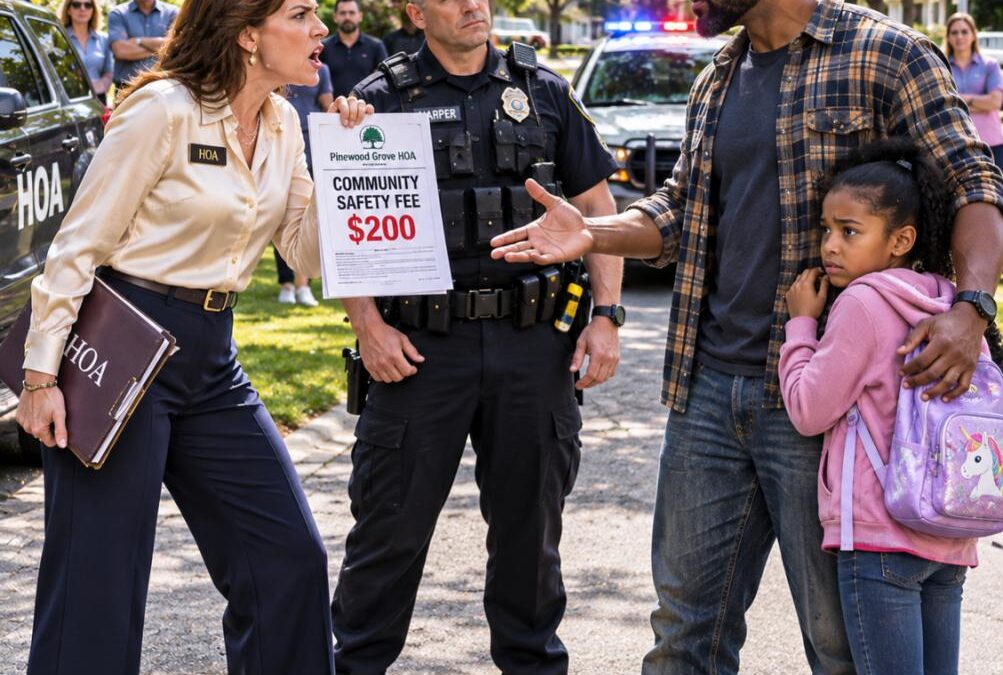
Vanessa Reed was pointing at me when Officer Harper stepped out of his cruiser.
Not gesturing.
Pointing.
One arm extended like she was identifying a suspect in a lineup.
“He’s the one.”
My daughter Emma was tucked against my side, one arm around my waist, her school backpack still hanging from one shoulder.
I looked down at her.
“It’s okay.”
It wasn’t.
Vanessa stood at the end of my driveway holding a white invoice inside a clear plastic sleeve. She was thirty-seven, polished in the way people are when appearance itself is part of the argument—cream blouse, tailored navy pants, straight brown hair tucked behind one ear, HOA badge pinned near her collar.
Her voice shook perfectly.
“Officer, I came here to collect a mandatory community safety assessment. Mr. Brooks became hostile and refused to comply.”
Harper looked at me.
“Sir?”
“My name is Nathan Brooks. This is my property.”
“I know.”
He kept his hands relaxed near his belt.
“Did you threaten Ms. Reed?”
“No.”
Vanessa cut in.
“He said I had no authority and accused me of running a scam.”
“I asked for meeting minutes.”
Her expression sharpened.
Harper glanced between us.
“Meeting minutes?”
I held out the invoice.
“Two hundred dollars. ‘Pinewood Grove Community Safety Enhancement Fee.’ It says it was approved by the board last Thursday.”
Harper took it.
“I asked Vanessa for the minutes showing the vote.”
“And then?”
“She called 911.”
Vanessa stepped forward.
“He was aggressive.”
I looked at Harper.
“I work from home as an insurance investigator. I spend all day looking at documents people want me to accept without checking. The invoice has no management-company contact, no vote reference, no payment portal used by the HOA, and no account number.”
Vanessa’s eyes changed.
Just for a second.
That was my mistake.
I saw it immediately.
Until that moment, I was only a stubborn homeowner.
Now she knew what I did for a living.
Emma squeezed my hand.
Harper asked Vanessa, “Did he threaten physical harm?”
“He intimidated me.”
“How?”
“He kept challenging me.”
“That isn’t what I asked.”
Vanessa’s lips tightened.
A man stood across the street near his mailbox.
Greg Dawson.
He lived two houses down.
Vanessa looked toward him.
“Greg heard it.”
Harper called him over.
Greg walked slowly.
Too slowly.
He wouldn’t look at me.
“I heard voices,” he said.
“Did Nathan threaten her?”
Greg swallowed.
“He was… angry.”
“Did you hear a threat?”
Long pause.
Vanessa stared at him.
Greg finally said, “Not exactly.”
Harper handed the invoice back to me.
“This sounds like an HOA dispute.”
“It is,” I said.
Vanessa snapped, “It’s a safety matter.”
Harper started toward his cruiser.
Then Emma spoke.
“Daddy?”
I crouched.
“What, sweetheart?”
She looked past me.
Toward Vanessa.
“Why does that lady keep taking pictures of our house?”
Everything inside me stopped.
I turned.
Vanessa’s phone was already lowered.
But not quickly enough.
Officer Harper had seen it too.
And the expression on Vanessa’s face told me the $200 invoice was only the first page of whatever she had planned.
part 2
Harper didn’t seize her phone.
He didn’t accuse her of stalking us.
He didn’t turn a neighborhood dispute into a criminal investigation because an eight-year-old said a woman had taken photographs from a public sidewalk.
What he did was ask a better question.
“Ms. Reed, why are you photographing the property?”
Vanessa lifted her chin.
“Compliance documentation.”
“For this fee?”
“For broader safety concerns.”
“What concerns?”
She looked directly at me.
“Mr. Brooks has had unusual activity around his residence.”
I almost laughed.
“What activity?”
“Professional camera equipment. Unknown visitors. Vehicles at irregular hours.”
I stared at her.
“My sister picked Emma up Tuesday.”
“That isn’t the only vehicle.”
“A plumber was here Thursday.”
“You see?”
“No.”
I shook my head.
“That is what houses do. People come to them.”
Emma looked confused.
Harper rubbed his forehead.
“Unless somebody has committed a crime, this needs to go through whatever association process exists.”
Vanessa said, “Officer, if something happens later, I want it documented that I tried to warn you.”
There it was.
Not a complaint.
A foundation.
She was creating a narrative in advance.
I knew the technique because I saw versions of it in insurance fraud constantly.
A driver complains about mysterious steering problems before a suspicious crash.
A claimant reports a leak before a conveniently timed water loss.
A business documents imaginary equipment failures before a fire.
None of those things prove fraud.
But people laying groundwork often think evidence works backward.
Say something first.
Then later events look like confirmation.
Harper gave us an incident number and left.
Vanessa stayed.
She held the invoice toward me again.
“Forty-eight hours.”
I didn’t take it.
“You still haven’t shown me the vote.”
“All owners were notified.”
“I wasn’t.”
“Your email preferences are your responsibility.”
“Send me the minutes.”
“You’ll receive whatever records you’re entitled to.”
“Good.”
I started toward the house.
Her voice followed.
“You shouldn’t make enemies when you’re new here, Nathan.”
I stopped.
Six months earlier, that sentence might have sounded like advice.
Now it sounded like information.
I turned.
“Was that a threat?”
She smiled.
“See? This is exactly the hostility I reported.”
Then she walked away.
Pinewood Grove had been my attempt at starting over.
Not reinventing myself.
I was forty-one.
Too old for dramatic reinvention.
I wanted stability.
My divorce from Emma’s mother had lasted fourteen months and cost me sleep, money, and whatever illusions I still had about two adults being able to separate cleanly because both claimed they wanted what was best for their child.
We eventually did manage something close to civil.
Shared custody.
School schedule.
Holidays split.
Emma spent most weekdays with me because her mother had moved forty minutes away for work.
I bought the house in Pinewood because the elementary school was good, the streets were quiet, and I could afford a small backyard without moving so far outside Atlanta that every grocery trip became an expedition.
My job helped.
I worked for a national insurance carrier in its special investigations unit.
Not law enforcement.
Not some private spy.
I investigated suspicious claims referred internally by adjusters and fraud models.
Staged crashes.
Inflated repairs.
False injury claims.
Identity misuse.
Sometimes organized rings.
Most of the job was boring.
Interviews.
Metadata.
Invoices.
Photographs.
Timelines.
The boring part is where fraud usually dies.
Vanessa had no idea how much I liked boring.
At least she hadn’t until I told Officer Harper.
That night, after Emma went to bed, I examined the $200 invoice.
The HOA itself was real.
Pinewood Grove Homeowners Association.
Recorded declaration.
Management company.
Board.
Annual assessments.
I’d paid everything due.
The safety fee looked plausible because Vanessa understood the association’s forms.
Same logo.
Same typeface.
Same legal footer.
But there were differences.
Actual HOA notices came from Oak Residential Management.
This one came directly from:
SAFETY COMPLIANCE COMMITTEE
PINEWOOD GROVE HOA
I searched the owner portal.
No Safety Compliance Committee.
No board notice.
No minutes from Thursday.
I emailed the property manager.
Subject:
REQUEST FOR AUTHORIZATION RECORD — SAFETY ENHANCEMENT FEE.
I attached the invoice.
Then I texted my friend Laura Bennett.
Laura was an attorney I’d worked with on insurance litigation.
Can you look at something tomorrow?
Her response:
If it’s your divorce again, increase my rate.
Not divorce.
HOA.
Even worse. Send it.
The property manager replied at 8:12 the next morning.
Mr. Brooks,
Thank you for forwarding this. We are reviewing. Please do not remit payment outside the association’s normal portal.
That was enough to keep me interested.
At 8:26, Vanessa emailed me.
Your refusal has been noted. Continued noncompliance will trigger escalating enforcement.
I forwarded it to management.
No response.
Then the second police call happened.
I was in my driveway helping Emma photograph leaves for a school science project.
She had a borrowed DSLR from my sister.
Nothing exotic.
Emma wanted pictures showing color differences.
Red maple.
Yellow hickory.
Brown oak.
She took the pictures.
I helped with focus.
Around four-thirty, Officer Harper returned.
This time he looked uncomfortable before he reached me.
“Nathan.”
“Officer.”
“We got another call.”
I already knew.
Vanessa stood across the street with three parents.
“What now?”
Harper lowered his voice.
“Concern about photography involving children.”
I felt my stomach drop.
Not fear.
Rage.
That accusation was different.
Designed differently.
The three parents looked uncertain.
One woman folded her arms tightly.
Vanessa approached.
“He’s been using professional camera equipment near homes where children play.”
I stared at her.
“My daughter is holding the camera.”
Emma clutched it against her chest.
Harper looked at the memory card.
“You willing to show me what you’ve been taking?”
“Yes.”
Then I corrected myself.
“Emma’s been taking them.”
We scrolled through the images.
Leaf.
Leaf.
Blurry shoe.
Leaf.
My thumb accidentally covering half the frame.
Emma laughed nervously.
“I took that one.”
Harper smiled.
“Pretty terrible.”
“Daddy said composition is important.”
“Daddy’s right.”
I saw Vanessa watching.
Her plan was slipping.
So she produced documents.
A printed page titled:
PARENT SAFETY CONCERNS.
Five names.
Three signatures.
Two blank lines.
One of the mothers standing behind Vanessa suddenly said:
“I didn’t sign that.”
Vanessa turned.
“Yes, you did.”
“No. I signed the email list for the safety meeting.”
Silence.
Harper looked at the paper.
Then at Vanessa.
“Did these people sign this statement?”
Vanessa’s face tightened.
“The names reflect concerns expressed to me.”
“That isn’t the same thing.”
“I summarized.”
The mother walked over.
“Take my name off.”
Another parent said, “Mine too.”
Vanessa’s cheeks reddened.
I wanted to speak.
I didn’t.
Harper had enough.
He told Vanessa that if she had a legitimate complaint about conduct, she could report specific facts.
But unsupported accusations involving children could cause serious harm.
He did not threaten her.
He documented.
Then left.
Emma stood beside me after the cruiser disappeared.
“Daddy?”
“Yes?”
“Why does she keep saying we’re bad?”
I crouched in front of her.
“She doesn’t get to decide that.”
“But the police keep coming.”
I hated that sentence.
I looked toward Vanessa’s house.
Lights on.
Curtains closed.
The anger inside me changed shape.
I no longer wanted to win an argument.
I wanted to know what she was protecting.
Laura came over that evening.
She read the fake invoice.
The emails.
The police incident numbers.
Then she asked:
“What do you know about Vanessa?”
“HOA president. Thirty-seven. Runs some kind of risk-consulting business.”
“Insurance?”
“Maybe.”
That caught her attention.
“Don’t search company systems.”
“I know.”
She looked at me.
“I mean it.”
“I investigate insurance fraud for a living. I know what unauthorized access is.”
“Good. Because the fastest way to turn yourself from victim into defendant is to use protected work data for personal curiosity.”
That was exactly why I had called her.
I could recognize patterns.
I could not use private carrier databases just because my neighbor scared my child.
So I stayed legal.
Public court records.
County property records.
State corporate filings.
HOA records I was entitled to inspect.
Neighbors who voluntarily shared their own documents.
Nothing else.
Vanessa owned Reed Claims Consulting LLC.
Registered four years earlier.
Business purpose vague.
Claims assistance.
Risk services.
Loss documentation.
That wasn’t inherently suspicious.
Plenty of legitimate businesses did exactly that.
Then Greg Dawson approached me.
Not voluntarily, exactly.
I saw him leaving for work and asked:
“Can we talk?”
He looked terrified.
“I don’t want problems.”
“Neither do I.”
He looked toward Vanessa’s house.
“You should just pay the fee.”
“Why?”
“Two hundred dollars isn’t worth this.”
“Is it real?”
He didn’t answer.
“Greg.”
“I don’t know.”
“You told Officer Harper I sounded angry.”
“You did.”
“Did I threaten her?”
“No.”
“Why didn’t you say that immediately?”
His hands moved nervously.
“I don’t want to be in the middle.”
“You already are.”
That hurt him.
Good.
Sometimes honesty should sting.
He walked away.
Two days later, the property manager sent a formal association-wide notice.
Pinewood Grove HOA had not approved any $200 community safety enhancement fee.
Owners should disregard direct payment requests unless issued through the management portal.
I read it twice.
Then looked across the street.
Vanessa’s SUV was gone.
The fake fee was confirmed.
But the management company called it:
An unauthorized communication currently under board review.
Careful.
No fraud accusation yet.
I respected that.
The board scheduled an emergency meeting for Thursday.
Vanessa canceled it twelve hours later, citing a family matter.
That was when neighbors started talking.
Mrs. Patel from the corner came over with a folder.
“Did you get one too?”
“Safety fee?”
“Yes.”
“How much?”
“Four hundred.”
“Why double?”
She shrugged.
“Our house has a pool.”
Mr. Hanley had received $150.
Greg wouldn’t say.
Six households I spoke with had different amounts.
No clear formula.
Laura’s interest sharpened.
“Did anyone pay?”
“Mrs. Patel did.”
“How?”
“Check.”
“Payee?”
She showed me the carbon copy.
REED COMMUNITY SAFETY SERVICES.
Not the HOA.
Laura looked at me.
“Well.”
“Still not enough?”
“Enough for questions.”
That was when a different kind of pattern emerged.
Not from insurance databases.
From neighbors.
Mr. Hanley had filed an insurance claim after falling on a cracked sidewalk two years earlier.
Mrs. Patel’s husband had been in a minor vehicle accident near the neighborhood entrance.
Another homeowner, Denise Morgan, had filed a water-damage claim.
In each story, Vanessa appeared somehow.
Witness.
Helpful document preparer.
Person who “knew who to call.”
Still not criminal.
People help neighbors.
Then Denise said something odd.
“Vanessa told me how much to claim.”
“What do you mean?”
“She said the insurer would lowball me unless I included temporary housing and lost property.”
“Did you actually lose those items?”
Denise looked uncomfortable.
“Some.”
“Some?”
“She told me everybody pads claims.”
My investigator brain woke up fully.
I did not interrogate her.
Not my case.
Not yet.
I asked whether she still had documents.
She did.
And whether she would speak with her insurer if contacted.
She hesitated.
Then nodded.
I told Laura.
Laura gave me the same warning.
“You are not conducting a private fraud investigation using employer resources.”
“I know.”
“If residents want to report suspicious claims, use the insurer’s fraud hotline or state fraud bureau.”
“I know.”
“You’re smiling.”
“I have a lead.”
“You have a neighbor telling you something concerning.”
“Lawyers ruin language.”
“That’s why you call me.”
So we did it correctly.
Denise reported her own concerns to the carrier.
Mrs. Patel’s husband agreed to review his old claim.
I reported Vanessa’s fake safety-fee demand to the HOA and local consumer-protection office.
Separately.
No grand theory.
No accusation of a criminal enterprise.
Not yet.
Vanessa, meanwhile, increased pressure.
She posted on the neighborhood forum that an unnamed resident was “conducting unauthorized investigations into families.”
People knew she meant me.
Then:
Residents should be cautious about providing financial or personal information to private individuals claiming investigative authority.
That one was clever.
Technically, good advice.
Weaponized through context.
Suddenly, I was the suspicious one.
Parents stopped waving.
One woman pulled her child closer when I walked past.
Emma noticed.
Children always notice.
“Why doesn’t Lily come over anymore?”
I had no answer.
Then Greg came to my door after dark.
His face looked gray.
“I can’t do this.”
“Do what?”
He stepped inside.
“Vanessa wants me to say you were near her SUV.”
“When?”
“Tomorrow.”
I stared at him.
“What happens tomorrow?”
He shook his head.
“I don’t know exactly.”
“Greg.”
“She said there may be an incident.”
Every alarm in my head went off.
“What kind?”
“She wouldn’t say.”
“Why would you agree?”
His eyes filled.
“I owe money.”
“To her?”
“No.”
“Then what does she have on you?”
“Gambling.”
He sat at my table.
Twenty thousand dollars in debt.
Some of it from legal online betting.
Some from offshore sites.
He had borrowed money through a private lender connected to someone Vanessa knew.
She had helped “restructure” the debt.
Now she had copies of bank statements, messages, and enough information to blow up his marriage.
“Is she blackmailing you?”
“I don’t know.”
“Don’t use legal words if you’re unsure.”
He nodded.
“She said if I don’t cooperate, my wife learns everything.”
“Did you record that?”
“No.”
“Texts?”
He handed me his phone.
One message from Vanessa:
Tomorrow needs to be consistent. You saw Nathan near my vehicle in the afternoon. If you get nervous, remember what’s at stake for your family.
I took a photograph with his permission.
Then looked at him.
“Do not lie to police.”
“I know.”
“No.”
I leaned forward.
“You don’t know, because you’ve already lied once.”
His face collapsed.
“If something happens tomorrow, you tell the truth immediately.”
He nodded.
Laura told me to send the message to police.
We did.
Officer Harper took the report.
That changed what came next.
Not enough to stop it.
Enough to keep suspicion from landing where Vanessa expected.
The next afternoon, Vanessa’s SUV was parked outside Greg’s house.
I noticed because I was waiting for Emma’s school bus.
At 3:58, Greg walked outside.
He saw the SUV.
Then saw me.
His face went pale.
Something was wrong.
“Greg?”
He started toward the vehicle.
Then stopped.
The SUV began moving.
Driverless.
Slowly at first.
Then faster down the slight grade.
Someone screamed.
The school bus had just stopped at the corner.
Children were stepping onto the sidewalk.
Emma was among them.
I ran.
No thought.
Just movement.
“EMMA!”
She froze.
Worst possible thing.
I reached her as the SUV crossed the curb line.
I grabbed the back of her backpack and pulled her toward me.
The vehicle missed us by several feet, tore through the edge of my fence, crossed a patch of grass, and slammed into a fire hydrant hard enough to burst the cap.
Water exploded upward.
Kids screamed.
Parents ran.
Emma clung to me so tightly I could barely breathe.
Then Vanessa came running from Greg’s house.
Her reaction was immediate.
Too immediate.
She didn’t ask whether the children were hurt.
She looked at the SUV.
Then at me.
“What did you do?”
I stared at her.
“What?”
She turned toward Greg.
“You saw him near my car.”
Greg went white.
Vanessa shouted:
“You saw him tampering with it!”
“No,” Greg said.
She froze.
He shook his head.
“No.”
Vanessa’s expression changed.
“You told me—”
“No.”
Greg stepped backward.
“I didn’t see Nathan touch your car.”
Neighbors were filming now.
Vanessa pointed at me.
“He threatened me. He investigates people. He has cameras. He did this.”
I was still holding Emma.
Officer Harper arrived within minutes.
Then another unit.
Because we’d already reported Vanessa’s message to Greg the previous night, Harper did not approach me as a blank suspect.
That mattered.
So did the cameras.
Mine covered my front yard and driveway.
Greg had a doorbell camera.
Mrs. Patel had a camera facing part of the street.
None showed me touching Vanessa’s SUV.
Greg’s footage showed Vanessa near the vehicle earlier.
It did not clearly show what she did.
Not enough to make dramatic conclusions at the curb.
Harper separated everyone.
Emma sat with Mrs. Patel.
I gave my statement.
Greg gave his.
Then he handed over his phone.
Vanessa denied everything.
She claimed Greg had misunderstood.
Claimed I had manipulated him.
Claimed the prior messages involved “community documentation.”
Her vehicle was impounded for mechanical examination.
Not because police instantly knew sabotage occurred.
Because a driverless SUV had rolled into a hydrant near children and ownership of the cause mattered.
That evening, a detective called me.
They had obtained additional residential video after canvassing.
A camera from a house across from Greg captured Vanessa working near her SUV before the incident.
The angle was imperfect.
But combined with forensic examination of the vehicle, investigators developed enough evidence to suspect intentional tampering.
I asked:
“Am I a suspect?”
“Everyone connected stays part of the fact pattern until we’re done.”
Fair.
“But the evidence does not currently support the allegation that you caused it.”
That was all I needed.
Emma slept beside me that night.
She hadn’t done that since she was five.
At 2:00 a.m., she whispered:
“Was the car trying to hit me?”
I felt something break inside.
“No.”
“Did Ms. Reed do it?”
“I don’t know yet.”
That was the honest answer.
“Why does she hate us?”
“I don’t know that either.”
She rolled closer.
I stared at the ceiling until morning.
The next day, Vanessa called an emergency HOA meeting.
That decision remains one of the strangest things she ever did.
Maybe she believed momentum was everything.
Maybe she thought publicly defining the story before investigators completed theirs would protect her.
Maybe she simply couldn’t imagine losing control of the room.
The notice said:
URGENT COMMUNITY SAFETY MEETING — ESCALATING THREAT TO RESIDENTS.
She intended to discuss me.
Laura told me not to attend alone.
Officer Harper advised me that there was no restriction preventing me from going to an HOA meeting.
The detective asked us not to reveal details of their vehicle examination.
So I didn’t.
No heroic laptop reveal.
No movie-style ambush.
Just documents we were legally free to discuss.
The community center was packed.
Thirty-eight homeowners.
Vanessa stood at the front.
Pale.
Perfectly dressed.
Her voice remained smooth.
“The last forty-eight hours demonstrate why we must take resident safety concerns seriously.”
She displayed my photograph.
Then the police incidents.
First call:
Aggressive fee refusal.
Second:
Suspicious photography.
Third:
Vehicle incident.
She arranged them as escalation.
Exactly as I suspected she would.
Then she said:
“Mr. Brooks has repeatedly attempted to undermine community authority while using his professional investigative background to intimidate residents.”
Laura whispered:
“Let her finish.”
I did.
Vanessa continued for nearly fifteen minutes.
Then homeowner comment opened.
I stood.
The room went quiet.
Some people looked afraid of me.
That hurt more than anger would have.
“My name is Nathan Brooks.”
Vanessa said, “Everyone knows.”
I looked at her.
“I’d like that in the minutes too.”
A few people shifted.
“I was asked to pay a two-hundred-dollar safety fee.”
I held up the invoice.
“The management company has confirmed the board did not approve it.”
Vanessa interrupted.
“It was a committee assessment.”
The property manager, attending by video, spoke through the speaker.
“There is no authorized Safety Compliance Committee with assessment authority.”
The room changed.
Vanessa turned toward the screen.
“We discussed creating one.”
“Discussed is not adopted.”
Laura looked at me.
Same pattern every time.
I continued.
“Several homeowners received different amounts.”
Mrs. Patel stood.
“Four hundred.”
Mr. Hanley:
“One-fifty.”
Another owner:
“Three hundred.”
Vanessa’s face tightened.
“It was risk-based.”
I asked:
“Where is the formula?”
No answer.
Then Greg stood.
His hands trembled.
“I lied.”
Vanessa turned.
“Greg.”
“At the first police call.”
He swallowed.
“I said Nathan sounded threatening because Vanessa wanted me to support her.”
People murmured.
Vanessa snapped:
“That is false.”
Greg held up his phone.
“She threatened to expose my gambling debt if I didn’t help.”
Vanessa’s face went pale.
“I never threatened you.”
He read her message.
Tomorrow needs to be consistent. You saw Nathan near my vehicle in the afternoon. If you get nervous, remember what’s at stake for your family.
Nobody spoke.
Vanessa recovered quickly.
“That message is being deliberately mischaracterized.”
Laura stood.
“Then this is probably a good time for the board to suspend any discussion of sanctions against Mr. Brooks until police complete their investigation.”
The vice president, Robert Miles, nodded.
“I agree.”
Vanessa looked at him.
“You cannot undermine emergency authority.”
Robert frowned.
“What emergency authority?”
“You know exactly what I mean.”
“No.”
He shook his head.
“I don’t.”
That was the first crack in her board.
Then Mrs. Patel spoke.
She described the fake assessment.
Another homeowner described a claim Vanessa had helped prepare.
Denise described her water-loss claim.
The stories began connecting in public.
Not into a proven criminal conspiracy.
Into enough questions that nobody wanted Vanessa touching another dollar.
Robert made a motion.
Immediate suspension of all special safety-fee collection pending independent review.
Seconded.
Passed four to one.
Vanessa voted against.
Then:
Independent financial audit.
Passed.
Then:
Preservation of HOA emails, security footage, payment records, and vendor files.
Unanimous.
Even Vanessa voted yes after realizing how refusing would look.
I expected her to adjourn.
Instead, she pointed at me.
“This is exactly what you wanted.”
“No.”
“You came here looking for fraud.”
“No.”
“I know what you do.”
“I know what I do too.”
“You manipulate data until innocent people look guilty.”
That one angered me.
I took a breath.
Then said:
“My job is the opposite.”
Silence.
“I look for what would prove the suspicion wrong.”
She laughed.
“Convenient.”
“No.”
I shook my head.
“Necessary.”
Then I looked around the room.
“Some of what people are saying tonight may have innocent explanations.”
Vanessa blinked.
I continued.
“Maybe some insurance claims were legitimate.”
“Maybe some payments were voluntary.”
“Maybe some residents misunderstood.”
Laura smiled slightly.
“That’s why we investigate.”
I looked at Vanessa.
“You’ve spent weeks telling everyone what I am.”
Then the homeowners.
“I’m asking you not to do the same thing to her.”
That surprised the room.
Especially Vanessa.
“If she’s done something wrong, records will show it.”
I sat down.
The meeting ended without police.
No federal agents stormed through the doors.
No dramatic arrest.
That came later, after evidence moved through the boring machinery Vanessa seemed to think she could outrun.
The vehicle investigation established intentional tampering.
Combined with Greg’s messages, camera footage, and other evidence, detectives obtained warrants.
Vanessa was arrested two days later.
Not for attempted murder.
The facts didn’t support a theatrical charge based on what investigators could prove about her intent.
The actual charges involved vehicle tampering, reckless endangerment-related conduct, false reporting, coercive conduct connected to Greg, and financial offenses that developed later.
Laura explained it to me:
“Prosecutors charge what they can prove.”
“I know.”
“You sound disappointed.”
“I want what happened to Emma to have a bigger name.”
“That is emotional truth.”
She looked at me.
“Criminal statutes have elements.”
I hated that.
I respected it.
The insurance investigation expanded because multiple residents independently contacted their carriers and the state insurance-fraud bureau.
Only then did my employer become involved.
And even then, I was removed from any formal investigation involving Pinewood.
Conflict of interest.
Correct decision.
My manager called.
“You’re a witness, not an investigator.”
“I know.”
“I mean stay out.”
“I know.”
“You sound offended.”
“I am.”
“Good. Stay offended at home.”
Professional boundaries saved the case.
Other investigators handled it.
They obtained records through proper channels.
What they found was significant.
Not every suspicious neighborhood claim was fraudulent.
Of course not.
But several showed coordination.
Inflated property-loss amounts.
Questionable witness statements.
Repeated referrals through Vanessa’s consulting company.
Payments routed as “claim preparation” fees.
A small group of staged or exaggerated incidents.
The total suspected exposure across multiple carriers approached the six-figure range.
The famous $180,000 number neighborhood gossip later repeated represented combined suspicious claim values, not money personally pocketed by Vanessa.
Actual proven loss was lower.
Still serious.
Then investigators found something worse.
Payments continuing after an elderly resident’s death.
Not a simple $1,200 monthly disability check mailed directly to Vanessa, as people later claimed.
Reality was more complicated.
A benefit arrangement connected to Mrs. Thompson had continued because false certifications were submitted after her death, with funds diverted through an account investigators connected to a participant in Vanessa’s network.
Evidence showed Vanessa had helped create or transmit some of the documentation.
That was federal territory once interstate communications and insurer payments entered the picture.
The state fraud bureau coordinated with federal investigators.
No dramatic FBI raid at the HOA meeting.
That version sounded better online.
The real version looked like subpoenas.
Search warrants.
Account analysis.
Interviews.
Data preservation.
Then more arrests.
Greg cooperated.
Not because he became heroic overnight.
Because he had lied, panicked, and finally decided the only way out was through the truth.
His gambling debt turned out to be real.
Vanessa had connected him with a private lender tied to another participant.
She didn’t literally own his debt.
She had access to enough information about it to frighten him.
Investigators treated his role carefully.
Cooperation did not erase his false statement.
He accepted consequences.
That mattered to me.
People kept asking whether I forgave him.
I gave the same answer.
“I trust him more now than when he lied. Less than before he lied.”
Human beings prefer clean categories.
Friend.
Enemy.
Victim.
Accomplice.
Greg managed to be several things at once.
Months passed.
Emma slowly stopped asking whether police were coming back.
That was my measure of healing.
Not court dates.
Not arrests.
Her.
The first week after Vanessa’s arrest, Emma would look toward the street whenever a vehicle slowed.
Then she started playing outside again.
Her friend Lily came over.
The parents who had avoided me began returning.
One mother apologized.
“I believed the photography thing.”
“I understand.”
“I shouldn’t have.”
“No.”
She looked embarrassed.
I softened.
“Vanessa gave you a document with your child’s name on it.”
“I got scared.”
“That’s what it was designed to do.”
Fear had been Vanessa’s most useful currency.
Not insurance money.
Not HOA authority.
Fear.
Parents fear for children.
Homeowners fear liens.
People with debt fear exposure.
Divorced fathers fear custody complications.
Once you identify what someone is afraid to lose, you don’t need much power.
You only need to convince them you can reach it.
Vanessa had done exactly that.
The HOA audit found another layer.
The fake $200 fee wasn’t technically an HOA transaction at all.
Vanessa had created the invoices using association branding but directed payments toward Reed Community Risk Services, an entity connected to her business.
Some residents paid.
Some thought they were paying the HOA.
Some believed the fee funded private patrols.
The board had discussed enhanced safety generally but never approved Vanessa’s assessment program.
That distinction became central.
Misuse of association identity.
Unauthorized collection.
Potential self-dealing.
The board removed her as president immediately after the audit’s preliminary findings.
Her elected director seat required a separate membership process.
The recall passed overwhelmingly.
I did not become president.
Not immediately.
I had learned enough from watching Vanessa to distrust anyone who emerged from a crisis already reaching for the gavel.
Instead, Robert Miles became interim president.
Quiet accountant.
Terrible public speaker.
Excellent with records.
Perfect.
His first announcement was:
“No special assessments unless you can find them in the minutes.”
People laughed.
Then he added:
“I am serious.”
Better.
The federal case took almost a year.
By the time plea negotiations began, the charging documents painted a much broader picture than my original $200 invoice.
False insurance submissions.
Improper claim assistance.
Wire communications supporting fraudulent transactions.
Coercive conduct.
Misuse of HOA information in ways prosecutors could connect to specific schemes.
Vehicle tampering.
False statements.
Not every rumor survived.
Vanessa did not have a secret dossier containing everyone’s entire financial life.
She had pieces.
HOA records.
Things neighbors told her.
Public records.
Information from her consulting work.
Enough to create leverage when combined with bluffing.
She did not personally engineer eight perfect staged accidents.
Some claims involved other participants.
Some were inflated rather than entirely fabricated.
She did not steal millions.
She did not try to assassinate me in some professionally planned crash.
The evidence supported something both smaller and more frightening.
She was willing to create danger to manufacture a story.
Her SUV was supposed to become proof that I was escalating.
Instead, the uncontrolled vehicle almost hit children.
That was the part I could not forgive quickly.
Maybe ever.
Vanessa eventually pleaded guilty to a combination of fraud-related and vehicle-tampering offenses under an agreement resolving several counts.
Her sentence included years in federal custody, supervised release, restitution tied to proven losses, and financial restrictions.
People kept repeating “eight years.”
The final sentence was in that general range once the various components were resolved, though good-time rules and supervised release made the practical timeline more complicated than neighborhood gossip understood.
She was barred from certain insurance-industry activities by regulators.
Her consulting business collapsed.
Her marriage ended during the case.
Her house was eventually sold.
Not seized in some dramatic punishment.
Sold.
I refused to celebrate that part.
Her husband had not created the fake fee.
Her family had its own damage.
Justice becomes ugly when people start enjoying collateral suffering.
The HOA adopted new rules.
Not more restrictions on lawns.
Restrictions on power.
No president could independently create assessments.
All financial obligations required a citation to board minutes and governing authority.
Payment instructions had to route through the management system.
No use of HOA branding by outside vendors without written authorization.
Resident information access logged.
Board members prohibited from using association files for private business.
Security complaints documented factually.
No parent-safety list without actual parent statements.
No unofficial “risk files.”
Then Laura proposed something simple.
A homeowner verification notice at the bottom of every assessment:
Questions about this charge? Verify it independently through the management portal.
Vanessa’s entire $200 scheme would have died at that sentence.
That thought haunted me.
The best fraud prevention is often embarrassingly simple.
Make verification easy.
The board created a fraud-reporting channel too.
Not because Pinewood was uniquely criminal.
Because people had learned how much silence costs.
Mrs. Patel joined the finance committee.
Denise testified in the insurance case.
Greg attended meetings but never ran for office.
Smart.
I joined the board a year later.
Not as president.
At-large director.
Enough power to contribute.
Not enough to become the next person everyone automatically deferred to.
Emma hated the meetings.
“Why do you go?”
“Because rules get weird when normal people stop showing up.”
“That sounds boring.”
“It is.”
“Can I stay home?”
“Absolutely.”
Her childhood had already been used enough in adult conflict.
Then, eighteen months later, Robert resigned because his job transferred him to Charlotte.
The board needed a president.
Laura called me.
“No.”
“I didn’t ask yet.”
“You’re going to.”
“You should run.”
“No.”
“You spend your career finding weak controls.”
“I do.”
“This organization needs controls.”
“That does not mean it needs me.”
“You’re terrified of becoming Vanessa.”
“Yes.”
“Good.”
I hated that answer.
The members elected me president by seven votes.
The first thing I did was remove authority from the presidency.
Every assessment over a defined threshold required board approval.
All violation appeals handled by a committee containing no original complainant.
Records access audited.
Financial reports public to owners.
Outside annual review.
I told the board:
“If a system only works when the good person is in charge, it’s a bad system.”
Mrs. Patel wrote that down.
Then used it against me six months later when I wanted emergency authority to hire a contractor after a storm.
“Bad system, Nathan.”
“I hate all of you.”
The board approved the contractor properly fifteen minutes later.
Progress.
Emma turned ten.
Then eleven.
She stopped remembering the details of Vanessa’s accusations.
That was a gift.
One afternoon, she found the old school leaf photographs on my computer.
“Why do we have fifty pictures of trees?”
I stared at her.
“You don’t remember?”
“No.”
I almost told her.
Then didn’t.
“Science project.”
She looked horrified.
“I was bad at photography.”
“Terrible.”
She laughed.
That was enough.
Greg and I never became close friends again.
But one night, two years after the SUV incident, he knocked on my door.
“My son got accepted to Georgia Tech.”
“That’s great.”
He smiled.
Then became serious.
“I’m in recovery.”
“For gambling?”
“Fourteen months.”
I held out my hand.
He shook it.
“I’ve wanted to tell you something.”
“Okay.”
“The day Vanessa’s SUV rolled, I almost repeated the lie.”
My chest tightened.
“What stopped you?”
“Emma.”
He looked toward the stairs.
“She was standing there.”
His voice broke.
“I realized if I lied again, you might lose your daughter because I was afraid of losing my marriage.”
I didn’t know what to say.
He continued.
“I’m sorry.”
“I know.”
“No. I need to say it.”
So I let him.
Some apologies are not for the person receiving them.
They’re the speaker rebuilding themselves out loud.
After he left, I checked on Emma.
She was asleep.
I sat beside her bed longer than necessary.
People called me brave during the case.
I wasn’t.
I was scared constantly.
Not for myself.
For her.
Vanessa understood that before I did.
She learned my weak point was not my job.
Not my reputation.
Not the HOA fine.
Emma.
That’s why the photography accusation worked.
That’s why the police calls mattered.
That’s why the SUV incident broke something inside me.
The mistake Vanessa made was assuming fear would make me reckless.
My profession had trained me in the opposite direction.
When fear goes up, documentation gets cleaner.
That principle saved me.
I did not break into Vanessa’s accounts.
I did not misuse insurance databases.
I did not plant a tracker.
I did not confront her alone at night.
I did not threaten Greg.
I did not publish accusations online.
I wrote dates down.
Saved original files.
Called an attorney.
Reported conflicts.
Let independent investigators take over when my personal involvement became too great.
Boring.
Again.
Always boring.
That became the story I eventually told when insurance associations invited me to speak about community-based fraud.
People wanted the flashy version.
“Did you know immediately she was running a ring?”
No.
“Did you use your insurance access to expose her?”
Absolutely not.
“Did the FBI storm the HOA meeting?”
No.
“Did your camera catch everything?”
No.
We got lucky with multiple cameras and Greg’s messages, but the vehicle case still required forensic examination and warrants.
“Did Vanessa confess in front of everybody?”
No.
Most sophisticated fraudsters do not end their careers with a villain speech.
They deny.
Reframe.
Minimize.
Blame.
Then documents remove options one at a time.
That is what happened to her.
Her downfall was administrative before it was criminal.
The fake fee.
The missing vote.
The wrong payment recipient.
The parent list.
The messages to Greg.
The claim documents.
The financial trails.
One inconsistency connected to another until investigators could test the larger theory.
Truth rarely kicks down a door.
It accumulates.
Pinewood Grove changed after Vanessa.
Not magically.
We still had arguments.
Fence colors.
Pool hours.
Parking.
One homeowner once sent me a seven-page complaint about a neighbor’s wind chimes.
Seven pages.
I wanted Vanessa back for three minutes just to punish him.
Instead, we followed procedure.
The wind chimes stayed.
So did democracy.
The most important change happened in meetings.
A homeowner would ask:
“Where was this approved?”
Nobody treated the question as hostile.
Someone opened the minutes.
Another asked:
“Is this an HOA fee or a vendor fee?”
Answer.
Another:
“Who has access to this information?”
Answer.
Questions stopped being rebellion.
That was the cultural shift Vanessa could never survive.
Her system depended on people feeling rude for asking.
I taught Emma the same thing.
Not suspicion.
Verification.
When she got her first phone at twelve, I explained scams.
Messages claiming urgency.
Authority.
Consequences.
“Your account will close.”
“Your parent owes money.”
“Your school needs this password.”
She rolled her eyes.
“Dad.”
“I’m serious.”
“I know.”
“If somebody pressures you not to verify—”
“Verify harder.”
I smiled.
“Exactly.”
Then she asked:
“Is that because of Ms. Reed?”
Kids remember more than they admit.
“Yes.”
Emma looked down.
“Do you hate her?”
I thought carefully.
“No.”
She looked skeptical.
“I hated what she did.”
“What’s the difference?”
“One can change.”
“And the other?”
I didn’t answer immediately.
“Sometimes people can too.”
I had no evidence Vanessa changed.
I wasn’t going to invent redemption because it made a better ending.
She wrote one letter from prison as part of a restitution process.
No request for forgiveness.
Mostly explanations.
She said she had convinced herself that insurance companies were rich enough to absorb losses.
That residents who cooperated benefited.
That HOA control protected property values.
That fear was necessary because people ignored polite requests.
Every fraudster eventually creates a philosophy.
Then, near the end, one paragraph changed tone.
I used your daughter as leverage without admitting to myself that was what I was doing. I told myself I was documenting risk. I understand now that I made a child afraid in her own home because I was afraid you would expose me.
I read that paragraph twice.
Then put the letter away.
I never showed Emma.
That burden belonged to adults.
Vanessa’s punishment was enough because punishment is not supposed to satisfy my imagination.
It was supposed to follow law.
Custody.
Restitution.
Supervision.
Professional consequences.
Loss of office.
Those were connected to proven conduct.
Anything beyond that was not mine to demand for entertainment.
The older I get, the less interested I am in suffering that doesn’t repair anything.
People online asked:
“Should she have gotten more?”
I don’t know.
I am not the sentencing judge.
I know what I wanted.
Emma safe.
False accusations corrected.
Money returned to victims where possible.
A system less vulnerable to another Vanessa.
We got most of that.
Not perfectly.
Enough.
Three years after the school-bus incident, Pinewood held a fall picnic.
Emma was eleven.
She and Lily were throwing a football near the clubhouse.
Mrs. Patel ran the food table.
Greg helped set up chairs.
Robert, the former interim president, drove down from Charlotte.
Laura arrived late and complained that nobody had saved her peach cobbler.
I stood near the playground with a paper plate.
One of the newer homeowners approached.
“Are you Nathan?”
“Depends.”
He laughed nervously.
“I got an invoice.”
My stomach tightened reflexively.
Then he showed me.
Pool-key replacement.
Twenty-five dollars.
Real.
Approved fee schedule.
Management portal.
Everything correct.
I handed it back.
“It’s legitimate.”
He looked disappointed.
“You’re supposed to be the fraud guy.”
“I can’t make every bill exciting.”
“So I have to pay?”
“Yes.”
“This HOA sucks.”
“Welcome to Pinewood.”
We both laughed.
That might have been my favorite moment as president.
Not catching fraud.
Confirming a boring fee.
Because fairness isn’t refusing every authority.
It’s knowing the authority can answer when challenged.
Emma ran over.
“Dad!”
“What?”
She pointed toward the football.
It had landed in a flower bed.
“Am I in trouble?”
I looked at the crushed flowers.
“Probably.”
She groaned.
Mrs. Patel shouted from twenty feet away:
“COMMUNITY SAFETY FEE! TWO HUNDRED DOLLARS!”
Everybody laughed.
Emma didn’t understand why at first.
Then she did.
She smiled.
That was healing.
Not forgetting.
Reclaiming the memory enough to joke about what once scared us.
Sometimes I still think about the first day Vanessa stood in my driveway.
White invoice.
Perfect smile.
Two hundred dollars.
Such a small amount.
If she had asked for two thousand, I would have checked immediately.
Two hundred was clever.
Small enough to pay.
Large enough to profit if enough households complied.
Then the deadline.
Forty-eight hours.
Then community safety.
Who wants to argue against safety?
Then the HOA logo.
People trust formatting.
Vanessa understood human behavior.
That made her dangerous.
Her biggest mistake was assuming my job made me dangerous in the same way.
It didn’t.
I didn’t beat her because I knew secret investigative tricks.
I beat her because I asked a boring question.
“Where are the meeting minutes?”
Everything began there.
No minutes.
No vote.
No authorized committee.
Wrong payment recipient.
Then police calls.
Then false parent concerns.
Then Greg.
Then the vehicle.
Then claims.
Then accounts.
One question opened another.
Vanessa tried to isolate me by making neighbors afraid.
The investigation succeeded because people eventually compared what she had told each of us.
Mrs. Patel thought the fee was mandatory.
Mr. Hanley thought it funded patrols.
Denise thought claim padding was normal.
Greg thought his family would collapse if he disobeyed.
Parents thought I was photographing children.
Everyone had a different piece.
Vanessa’s power lived in the spaces between those pieces.
Once people talked, the spaces disappeared.
That is the lesson I kept.
Fraud loves isolation.
Abuse of authority loves isolation too.
One person gets a letter and assumes everybody else paid.
One parent hears a warning and assumes others complained.
One neighbor gets threatened and believes resistance is uniquely dangerous.
Then somebody compares notes.
Not rumors.
Documents.
That’s when manufactured authority becomes fragile.
Today, Pinewood Grove is still just a suburb.
No documentaries.
No national movement.
No permanent FBI office in the clubhouse.
Children ride bikes.
People complain about dues.
A dog named Baxter escapes twice a week.
Greg’s marriage survived.
Denise repaid money connected to the inflated part of her old claim under an agreement with her insurer.
Mrs. Patel now questions every expenditure over fifty dollars and has become the board’s financial nightmare.
I consider that a public service.
Emma is older.
She barely fits under my arm anymore.
Vanessa’s old house belongs to a nurse named Kelly and her husband.
They have twins.
I watched them move in.
A rental truck stayed in the driveway almost nine hours.
No one fined them.
Good.
At the first board meeting Kelly attended, she raised her hand.
“I have a question about the reserve study.”
I almost laughed.
Not at her.
At the beauty of it.
“Go ahead.”
She asked.
We answered.
No one photographed her.
No police.
No file.
No accusation that questions meant aggression.
That is what victory looks like to me now.
Not Vanessa behind bars.
Not headlines.
Not revenge.
A new homeowner asks for proof and nobody gets offended.
My daughter plays outside without checking the street for police cruisers.
Greg tells the truth even when the truth embarrasses him.
Board members know passwords are not personal power.
Fees trace back to votes.
People verify.
That’s enough.
Vanessa believed fear would beat truth because fear moves faster.
She was right about that.
Fear is incredibly fast.
One accusation and parents pull children inside.
One police call and neighbors start whispering.
One photograph and people imagine context.
One fake invoice and someone writes a check.
Truth is slower.
It asks for records.
Waits for metadata.
Checks timestamps.
Finds witnesses.
Compares statements.
Lets investigators do their jobs.
Fear wins the first hour.
Sometimes the first week.
Truth only wins if someone has the patience to keep going.
That was my advantage.
Not my insurance databases.
Not secret access.
Not some genius trap.
Patience.
Vanessa thought I was building a case against her from the moment I questioned the $200 fee.
At first, I wasn’t.
I was asking for minutes.
She built the case herself trying to make sure I never got them.
And whenever Emma asks what I actually did to stop her, I give her the same answer.
“I kept asking for the paperwork.”
She always rolls her eyes.
Because she’s a kid.
And because paperwork makes a terrible hero.
But in Pinewood Grove, it saved us.
THE STORY ENDS HERE
HOA Karen Invented a $200 Safety Fee, Called the Cops on Me Twice, and Tried to Frame Me for Sabotage—She Has Vastly Underestimated My Intelligence
She demanded a fake $200 “community safety fee,” then called police when I asked to see the vote that authorized it.
The next day, HOA Karen told parents I was photographing their children and started building a file to make me look dangerous.
When her SUV nearly hit my eight-year-old daughter and she immediately blamed me for tampering with it, I realized the fee had never been about money.
Vanessa Reed was pointing at me when Officer Harper stepped out of his cruiser.
Not gesturing.
Pointing.
One arm extended like she was identifying a suspect in a lineup.
“He’s the one.”
My daughter Emma was tucked against my side, one arm around my waist, her school backpack still hanging from one shoulder.
I looked down at her.
“It’s okay.”
It wasn’t.
Vanessa stood at the end of my driveway holding a white invoice inside a clear plastic sleeve. She was thirty-seven, polished in the way people are when appearance itself is part of the argument—cream blouse, tailored navy pants, straight brown hair tucked behind one ear, HOA badge pinned near her collar.
Her voice shook perfectly.
“Officer, I came here to collect a mandatory community safety assessment. Mr. Brooks became hostile and refused to comply.”
Harper looked at me.
“Sir?”
“My name is Nathan Brooks. This is my property.”
“I know.”
He kept his hands relaxed near his belt.
“Did you threaten Ms. Reed?”
“No.”
Vanessa cut in.
“He said I had no authority and accused me of running a scam.”
“I asked for meeting minutes.”
Her expression sharpened.
Harper glanced between us.
“Meeting minutes?”
I held out the invoice.
“Two hundred dollars. ‘Pinewood Grove Community Safety Enhancement Fee.’ It says it was approved by the board last Thursday.”
Harper took it.
“I asked Vanessa for the minutes showing the vote.”
“And then?”
“She called 911.”
Vanessa stepped forward.
“He was aggressive.”
I looked at Harper.
“I work from home as an insurance investigator. I spend all day looking at documents people want me to accept without checking. The invoice has no management-company contact, no vote reference, no payment portal used by the HOA, and no account number.”
Vanessa’s eyes changed.
Just for a second.
That was my mistake.
I saw it immediately.
Until that moment, I was only a stubborn homeowner.
Now she knew what I did for a living.
Emma squeezed my hand.
Harper asked Vanessa, “Did he threaten physical harm?”
“He intimidated me.”
“How?”
“He kept challenging me.”
“That isn’t what I asked.”
Vanessa’s lips tightened.
A man stood across the street near his mailbox.
Greg Dawson.
He lived two houses down.
Vanessa looked toward him.
“Greg heard it.”
Harper called him over.
Greg walked slowly.
Too slowly.
He wouldn’t look at me.
“I heard voices,” he said.
“Did Nathan threaten her?”
Greg swallowed.
“He was… angry.”
“Did you hear a threat?”
Long pause.
Vanessa stared at him.
Greg finally said, “Not exactly.”
Harper handed the invoice back to me.
“This sounds like an HOA dispute.”
“It is,” I said.
Vanessa snapped, “It’s a safety matter.”
Harper started toward his cruiser.
Then Emma spoke.
“Daddy?”
I crouched.
“What, sweetheart?”
She looked past me.
Toward Vanessa.
“Why does that lady keep taking pictures of our house?”
Everything inside me stopped.
I turned.
Vanessa’s phone was already lowered.
But not quickly enough.
Officer Harper had seen it too.
And the expression on Vanessa’s face told me the $200 invoice was only the first page of whatever she had planned.
part 2
Harper didn’t seize her phone.
He didn’t accuse her of stalking us.
He didn’t turn a neighborhood dispute into a criminal investigation because an eight-year-old said a woman had taken photographs from a public sidewalk.
What he did was ask a better question.
“Ms. Reed, why are you photographing the property?”
Vanessa lifted her chin.
“Compliance documentation.”
“For this fee?”
“For broader safety concerns.”
“What concerns?”
She looked directly at me.
“Mr. Brooks has had unusual activity around his residence.”
I almost laughed.
“What activity?”
“Professional camera equipment. Unknown visitors. Vehicles at irregular hours.”
I stared at her.
“My sister picked Emma up Tuesday.”
“That isn’t the only vehicle.”
“A plumber was here Thursday.”
“You see?”
“No.”
I shook my head.
“That is what houses do. People come to them.”
Emma looked confused.
Harper rubbed his forehead.
“Unless somebody has committed a crime, this needs to go through whatever association process exists.”
Vanessa said, “Officer, if something happens later, I want it documented that I tried to warn you.”
There it was.
Not a complaint.
A foundation.
She was creating a narrative in advance.
I knew the technique because I saw versions of it in insurance fraud constantly.
A driver complains about mysterious steering problems before a suspicious crash.
A claimant reports a leak before a conveniently timed water loss.
A business documents imaginary equipment failures before a fire.
None of those things prove fraud.
But people laying groundwork often think evidence works backward.
Say something first.
Then later events look like confirmation.
Harper gave us an incident number and left.
Vanessa stayed.
She held the invoice toward me again.
“Forty-eight hours.”
I didn’t take it.
“You still haven’t shown me the vote.”
“All owners were notified.”
“I wasn’t.”
“Your email preferences are your responsibility.”
“Send me the minutes.”
“You’ll receive whatever records you’re entitled to.”
“Good.”
I started toward the house.
Her voice followed.
“You shouldn’t make enemies when you’re new here, Nathan.”
I stopped.
Six months earlier, that sentence might have sounded like advice.
Now it sounded like information.
I turned.
“Was that a threat?”
She smiled.
“See? This is exactly the hostility I reported.”
Then she walked away.
Pinewood Grove had been my attempt at starting over.
Not reinventing myself.
I was forty-one.
Too old for dramatic reinvention.
I wanted stability.
My divorce from Emma’s mother had lasted fourteen months and cost me sleep, money, and whatever illusions I still had about two adults being able to separate cleanly because both claimed they wanted what was best for their child.
We eventually did manage something close to civil.
Shared custody.
School schedule.
Holidays split.
Emma spent most weekdays with me because her mother had moved forty minutes away for work.
I bought the house in Pinewood because the elementary school was good, the streets were quiet, and I could afford a small backyard without moving so far outside Atlanta that every grocery trip became an expedition.
My job helped.
I worked for a national insurance carrier in its special investigations unit.
Not law enforcement.
Not some private spy.
I investigated suspicious claims referred internally by adjusters and fraud models.
Staged crashes.
Inflated repairs.
False injury claims.
Identity misuse.
Sometimes organized rings.
Most of the job was boring.
Interviews.
Metadata.
Invoices.
Photographs.
Timelines.
The boring part is where fraud usually dies.
Vanessa had no idea how much I liked boring.
At least she hadn’t until I told Officer Harper.
That night, after Emma went to bed, I examined the $200 invoice.
The HOA itself was real.
Pinewood Grove Homeowners Association.
Recorded declaration.
Management company.
Board.
Annual assessments.
I’d paid everything due.
The safety fee looked plausible because Vanessa understood the association’s forms.
Same logo.
Same typeface.
Same legal footer.
But there were differences.
Actual HOA notices came from Oak Residential Management.
This one came directly from:
SAFETY COMPLIANCE COMMITTEE
PINEWOOD GROVE HOA
I searched the owner portal.
No Safety Compliance Committee.
No board notice.
No minutes from Thursday.
I emailed the property manager.
Subject:
REQUEST FOR AUTHORIZATION RECORD — SAFETY ENHANCEMENT FEE.
I attached the invoice.
Then I texted my friend Laura Bennett.
Laura was an attorney I’d worked with on insurance litigation.
Can you look at something tomorrow?
Her response:
If it’s your divorce again, increase my rate.
Not divorce.
HOA.
Even worse. Send it.
The property manager replied at 8:12 the next morning.
Mr. Brooks,
Thank you for forwarding this. We are reviewing. Please do not remit payment outside the association’s normal portal.
That was enough to keep me interested.
At 8:26, Vanessa emailed me.
Your refusal has been noted. Continued noncompliance will trigger escalating enforcement.
I forwarded it to management.
No response.
Then the second police call happened.
I was in my driveway helping Emma photograph leaves for a school science project.
She had a borrowed DSLR from my sister.
Nothing exotic.
Emma wanted pictures showing color differences.
Red maple.
Yellow hickory.
Brown oak.
She took the pictures.
I helped with focus.
Around four-thirty, Officer Harper returned.
This time he looked uncomfortable before he reached me.
“Nathan.”
“Officer.”
“We got another call.”
I already knew.
Vanessa stood across the street with three parents.
“What now?”
Harper lowered his voice.
“Concern about photography involving children.”
I felt my stomach drop.
Not fear.
Rage.
That accusation was different.
Designed differently.
The three parents looked uncertain.
One woman folded her arms tightly.
Vanessa approached.
“He’s been using professional camera equipment near homes where children play.”
I stared at her.
“My daughter is holding the camera.”
Emma clutched it against her chest.
Harper looked at the memory card.
“You willing to show me what you’ve been taking?”
“Yes.”
Then I corrected myself.
“Emma’s been taking them.”
We scrolled through the images.
Leaf.
Leaf.
Blurry shoe.
Leaf.
My thumb accidentally covering half the frame.
Emma laughed nervously.
“I took that one.”
Harper smiled.
“Pretty terrible.”
“Daddy said composition is important.”
“Daddy’s right.”
I saw Vanessa watching.
Her plan was slipping.
So she produced documents.
A printed page titled:
PARENT SAFETY CONCERNS.
Five names.
Three signatures.
Two blank lines.
One of the mothers standing behind Vanessa suddenly said:
“I didn’t sign that.”
Vanessa turned.
“Yes, you did.”
“No. I signed the email list for the safety meeting.”
Silence.
Harper looked at the paper.
Then at Vanessa.
“Did these people sign this statement?”
Vanessa’s face tightened.
“The names reflect concerns expressed to me.”
“That isn’t the same thing.”
“I summarized.”
The mother walked over.
“Take my name off.”
Another parent said, “Mine too.”
Vanessa’s cheeks reddened.
I wanted to speak.
I didn’t.
Harper had enough.
He told Vanessa that if she had a legitimate complaint about conduct, she could report specific facts.
But unsupported accusations involving children could cause serious harm.
He did not threaten her.
He documented.
Then left.
Emma stood beside me after the cruiser disappeared.
“Daddy?”
“Yes?”
“Why does she keep saying we’re bad?”
I crouched in front of her.
“She doesn’t get to decide that.”
“But the police keep coming.”
I hated that sentence.
I looked toward Vanessa’s house.
Lights on.
Curtains closed.
The anger inside me changed shape.
I no longer wanted to win an argument.
I wanted to know what she was protecting.
Laura came over that evening.
She read the fake invoice.
The emails.
The police incident numbers.
Then she asked:
“What do you know about Vanessa?”
“HOA president. Thirty-seven. Runs some kind of risk-consulting business.”
“Insurance?”
“Maybe.”
That caught her attention.
“Don’t search company systems.”
“I know.”
She looked at me.
“I mean it.”
“I investigate insurance fraud for a living. I know what unauthorized access is.”
“Good. Because the fastest way to turn yourself from victim into defendant is to use protected work data for personal curiosity.”
That was exactly why I had called her.
I could recognize patterns.
I could not use private carrier databases just because my neighbor scared my child.
So I stayed legal.
Public court records.
County property records.
State corporate filings.
HOA records I was entitled to inspect.
Neighbors who voluntarily shared their own documents.
Nothing else.
Vanessa owned Reed Claims Consulting LLC.
Registered four years earlier.
Business purpose vague.
Claims assistance.
Risk services.
Loss documentation.
That wasn’t inherently suspicious.
Plenty of legitimate businesses did exactly that.
Then Greg Dawson approached me.
Not voluntarily, exactly.
I saw him leaving for work and asked:
“Can we talk?”
He looked terrified.
“I don’t want problems.”
“Neither do I.”
He looked toward Vanessa’s house.
“You should just pay the fee.”
“Why?”
“Two hundred dollars isn’t worth this.”
“Is it real?”
He didn’t answer.
“Greg.”
“I don’t know.”
“You told Officer Harper I sounded angry.”
“You did.”
“Did I threaten her?”
“No.”
“Why didn’t you say that immediately?”
His hands moved nervously.
“I don’t want to be in the middle.”
“You already are.”
That hurt him.
Good.
Sometimes honesty should sting.
He walked away.
Two days later, the property manager sent a formal association-wide notice.
Pinewood Grove HOA had not approved any $200 community safety enhancement fee.
Owners should disregard direct payment requests unless issued through the management portal.
I read it twice.
Then looked across the street.
Vanessa’s SUV was gone.
The fake fee was confirmed.
But the management company called it:
An unauthorized communication currently under board review.
Careful.
No fraud accusation yet.
I respected that.
The board scheduled an emergency meeting for Thursday.
Vanessa canceled it twelve hours later, citing a family matter.
That was when neighbors started talking.
Mrs. Patel from the corner came over with a folder.
“Did you get one too?”
“Safety fee?”
“Yes.”
“How much?”
“Four hundred.”
“Why double?”
She shrugged.
“Our house has a pool.”
Mr. Hanley had received $150.
Greg wouldn’t say.
Six households I spoke with had different amounts.
No clear formula.
Laura’s interest sharpened.
“Did anyone pay?”
“Mrs. Patel did.”
“How?”
“Check.”
“Payee?”
She showed me the carbon copy.
REED COMMUNITY SAFETY SERVICES.
Not the HOA.
Laura looked at me.
“Well.”
“Still not enough?”
“Enough for questions.”
That was when a different kind of pattern emerged.
Not from insurance databases.
From neighbors.
Mr. Hanley had filed an insurance claim after falling on a cracked sidewalk two years earlier.
Mrs. Patel’s husband had been in a minor vehicle accident near the neighborhood entrance.
Another homeowner, Denise Morgan, had filed a water-damage claim.
In each story, Vanessa appeared somehow.
Witness.
Helpful document preparer.
Person who “knew who to call.”
Still not criminal.
People help neighbors.
Then Denise said something odd.
“Vanessa told me how much to claim.”
“What do you mean?”
“She said the insurer would lowball me unless I included temporary housing and lost property.”
“Did you actually lose those items?”
Denise looked uncomfortable.
“Some.”
“Some?”
“She told me everybody pads claims.”
My investigator brain woke up fully.
I did not interrogate her.
Not my case.
Not yet.
I asked whether she still had documents.
She did.
And whether she would speak with her insurer if contacted.
She hesitated.
Then nodded.
I told Laura.
Laura gave me the same warning.
“You are not conducting a private fraud investigation using employer resources.”
“I know.”
“If residents want to report suspicious claims, use the insurer’s fraud hotline or state fraud bureau.”
“I know.”
“You’re smiling.”
“I have a lead.”
“You have a neighbor telling you something concerning.”
“Lawyers ruin language.”
“That’s why you call me.”
So we did it correctly.
Denise reported her own concerns to the carrier.
Mrs. Patel’s husband agreed to review his old claim.
I reported Vanessa’s fake safety-fee demand to the HOA and local consumer-protection office.
Separately.
No grand theory.
No accusation of a criminal enterprise.
Not yet.
Vanessa, meanwhile, increased pressure.
She posted on the neighborhood forum that an unnamed resident was “conducting unauthorized investigations into families.”
People knew she meant me.
Then:
Residents should be cautious about providing financial or personal information to private individuals claiming investigative authority.
That one was clever.
Technically, good advice.
Weaponized through context.
Suddenly, I was the suspicious one.
Parents stopped waving.
One woman pulled her child closer when I walked past.
Emma noticed.
Children always notice.
“Why doesn’t Lily come over anymore?”
I had no answer.
Then Greg came to my door after dark.
His face looked gray.
“I can’t do this.”
“Do what?”
He stepped inside.
“Vanessa wants me to say you were near her SUV.”
“When?”
“Tomorrow.”
I stared at him.
“What happens tomorrow?”
He shook his head.
“I don’t know exactly.”
“Greg.”
“She said there may be an incident.”
Every alarm in my head went off.
“What kind?”
“She wouldn’t say.”
“Why would you agree?”
His eyes filled.
“I owe money.”
“To her?”
“No.”
“Then what does she have on you?”
“Gambling.”
He sat at my table.
Twenty thousand dollars in debt.
Some of it from legal online betting.
Some from offshore sites.
He had borrowed money through a private lender connected to someone Vanessa knew.
She had helped “restructure” the debt.
Now she had copies of bank statements, messages, and enough information to blow up his marriage.
“Is she blackmailing you?”
“I don’t know.”
“Don’t use legal words if you’re unsure.”
He nodded.
“She said if I don’t cooperate, my wife learns everything.”
“Did you record that?”
“No.”
“Texts?”
He handed me his phone.
One message from Vanessa:
Tomorrow needs to be consistent. You saw Nathan near my vehicle in the afternoon. If you get nervous, remember what’s at stake for your family.
I took a photograph with his permission.
Then looked at him.
“Do not lie to police.”
“I know.”
“No.”
I leaned forward.
“You don’t know, because you’ve already lied once.”
His face collapsed.
“If something happens tomorrow, you tell the truth immediately.”
He nodded.
Laura told me to send the message to police.
We did.
Officer Harper took the report.
That changed what came next.
Not enough to stop it.
Enough to keep suspicion from landing where Vanessa expected.
The next afternoon, Vanessa’s SUV was parked outside Greg’s house.
I noticed because I was waiting for Emma’s school bus.
At 3:58, Greg walked outside.
He saw the SUV.
Then saw me.
His face went pale.
Something was wrong.
“Greg?”
He started toward the vehicle.
Then stopped.
The SUV began moving.
Driverless.
Slowly at first.
Then faster down the slight grade.
Someone screamed.
The school bus had just stopped at the corner.
Children were stepping onto the sidewalk.
Emma was among them.
I ran.
No thought.
Just movement.
“EMMA!”
She froze.
Worst possible thing.
I reached her as the SUV crossed the curb line.
I grabbed the back of her backpack and pulled her toward me.
The vehicle missed us by several feet, tore through the edge of my fence, crossed a patch of grass, and slammed into a fire hydrant hard enough to burst the cap.
Water exploded upward.
Kids screamed.
Parents ran.
Emma clung to me so tightly I could barely breathe.
Then Vanessa came running from Greg’s house.
Her reaction was immediate.
Too immediate.
She didn’t ask whether the children were hurt.
She looked at the SUV.
Then at me.
“What did you do?”
I stared at her.
“What?”
She turned toward Greg.
“You saw him near my car.”
Greg went white.
Vanessa shouted:
“You saw him tampering with it!”
“No,” Greg said.
She froze.
He shook his head.
“No.”
Vanessa’s expression changed.
“You told me—”
“No.”
Greg stepped backward.
“I didn’t see Nathan touch your car.”
Neighbors were filming now.
Vanessa pointed at me.
“He threatened me. He investigates people. He has cameras. He did this.”
I was still holding Emma.
Officer Harper arrived within minutes.
Then another unit.
Because we’d already reported Vanessa’s message to Greg the previous night, Harper did not approach me as a blank suspect.
That mattered.
So did the cameras.
Mine covered my front yard and driveway.
Greg had a doorbell camera.
Mrs. Patel had a camera facing part of the street.
None showed me touching Vanessa’s SUV.
Greg’s footage showed Vanessa near the vehicle earlier.
It did not clearly show what she did.
Not enough to make dramatic conclusions at the curb.
Harper separated everyone.
Emma sat with Mrs. Patel.
I gave my statement.
Greg gave his.
Then he handed over his phone.
Vanessa denied everything.
She claimed Greg had misunderstood.
Claimed I had manipulated him.
Claimed the prior messages involved “community documentation.”
Her vehicle was impounded for mechanical examination.
Not because police instantly knew sabotage occurred.
Because a driverless SUV had rolled into a hydrant near children and ownership of the cause mattered.
That evening, a detective called me.
They had obtained additional residential video after canvassing.
A camera from a house across from Greg captured Vanessa working near her SUV before the incident.
The angle was imperfect.
But combined with forensic examination of the vehicle, investigators developed enough evidence to suspect intentional tampering.
I asked:
“Am I a suspect?”
“Everyone connected stays part of the fact pattern until we’re done.”
Fair.
“But the evidence does not currently support the allegation that you caused it.”
That was all I needed.
Emma slept beside me that night.
She hadn’t done that since she was five.
At 2:00 a.m., she whispered:
“Was the car trying to hit me?”
I felt something break inside.
“No.”
“Did Ms. Reed do it?”
“I don’t know yet.”
That was the honest answer.
“Why does she hate us?”
“I don’t know that either.”
She rolled closer.
I stared at the ceiling until morning.
The next day, Vanessa called an emergency HOA meeting.
That decision remains one of the strangest things she ever did.
Maybe she believed momentum was everything.
Maybe she thought publicly defining the story before investigators completed theirs would protect her.
Maybe she simply couldn’t imagine losing control of the room.
The notice said:
URGENT COMMUNITY SAFETY MEETING — ESCALATING THREAT TO RESIDENTS.
She intended to discuss me.
Laura told me not to attend alone.
Officer Harper advised me that there was no restriction preventing me from going to an HOA meeting.
The detective asked us not to reveal details of their vehicle examination.
So I didn’t.
No heroic laptop reveal.
No movie-style ambush.
Just documents we were legally free to discuss.
The community center was packed.
Thirty-eight homeowners.
Vanessa stood at the front.
Pale.
Perfectly dressed.
Her voice remained smooth.
“The last forty-eight hours demonstrate why we must take resident safety concerns seriously.”
She displayed my photograph.
Then the police incidents.
First call:
Aggressive fee refusal.
Second:
Suspicious photography.
Third:
Vehicle incident.
She arranged them as escalation.
Exactly as I suspected she would.
Then she said:
“Mr. Brooks has repeatedly attempted to undermine community authority while using his professional investigative background to intimidate residents.”
Laura whispered:
“Let her finish.”
I did.
Vanessa continued for nearly fifteen minutes.
Then homeowner comment opened.
I stood.
The room went quiet.
Some people looked afraid of me.
That hurt more than anger would have.
“My name is Nathan Brooks.”
Vanessa said, “Everyone knows.”
I looked at her.
“I’d like that in the minutes too.”
A few people shifted.
“I was asked to pay a two-hundred-dollar safety fee.”
I held up the invoice.
“The management company has confirmed the board did not approve it.”
Vanessa interrupted.
“It was a committee assessment.”
The property manager, attending by video, spoke through the speaker.
“There is no authorized Safety Compliance Committee with assessment authority.”
The room changed.
Vanessa turned toward the screen.
“We discussed creating one.”
“Discussed is not adopted.”
Laura looked at me.
Same pattern every time.
I continued.
“Several homeowners received different amounts.”
Mrs. Patel stood.
“Four hundred.”
Mr. Hanley:
“One-fifty.”
Another owner:
“Three hundred.”
Vanessa’s face tightened.
“It was risk-based.”
I asked:
“Where is the formula?”
No answer.
Then Greg stood.
His hands trembled.
“I lied.”
Vanessa turned.
“Greg.”
“At the first police call.”
He swallowed.
“I said Nathan sounded threatening because Vanessa wanted me to support her.”
People murmured.
Vanessa snapped:
“That is false.”
Greg held up his phone.
“She threatened to expose my gambling debt if I didn’t help.”
Vanessa’s face went pale.
“I never threatened you.”
He read her message.
Tomorrow needs to be consistent. You saw Nathan near my vehicle in the afternoon. If you get nervous, remember what’s at stake for your family.
Nobody spoke.
Vanessa recovered quickly.
“That message is being deliberately mischaracterized.”
Laura stood.
“Then this is probably a good time for the board to suspend any discussion of sanctions against Mr. Brooks until police complete their investigation.”
The vice president, Robert Miles, nodded.
“I agree.”
Vanessa looked at him.
“You cannot undermine emergency authority.”
Robert frowned.
“What emergency authority?”
“You know exactly what I mean.”
“No.”
He shook his head.
“I don’t.”
That was the first crack in her board.
Then Mrs. Patel spoke.
She described the fake assessment.
Another homeowner described a claim Vanessa had helped prepare.
Denise described her water-loss claim.
The stories began connecting in public.
Not into a proven criminal conspiracy.
Into enough questions that nobody wanted Vanessa touching another dollar.
Robert made a motion.
Immediate suspension of all special safety-fee collection pending independent review.
Seconded.
Passed four to one.
Vanessa voted against.
Then:
Independent financial audit.
Passed.
Then:
Preservation of HOA emails, security footage, payment records, and vendor files.
Unanimous.
Even Vanessa voted yes after realizing how refusing would look.
I expected her to adjourn.
Instead, she pointed at me.
“This is exactly what you wanted.”
“No.”
“You came here looking for fraud.”
“No.”
“I know what you do.”
“I know what I do too.”
“You manipulate data until innocent people look guilty.”
That one angered me.
I took a breath.
Then said:
“My job is the opposite.”
Silence.
“I look for what would prove the suspicion wrong.”
She laughed.
“Convenient.”
“No.”
I shook my head.
“Necessary.”
Then I looked around the room.
“Some of what people are saying tonight may have innocent explanations.”
Vanessa blinked.
I continued.
“Maybe some insurance claims were legitimate.”
“Maybe some payments were voluntary.”
“Maybe some residents misunderstood.”
Laura smiled slightly.
“That’s why we investigate.”
I looked at Vanessa.
“You’ve spent weeks telling everyone what I am.”
Then the homeowners.
“I’m asking you not to do the same thing to her.”
That surprised the room.
Especially Vanessa.
“If she’s done something wrong, records will show it.”
I sat down.
The meeting ended without police.
No federal agents stormed through the doors.
No dramatic arrest.
That came later, after evidence moved through the boring machinery Vanessa seemed to think she could outrun.
The vehicle investigation established intentional tampering.
Combined with Greg’s messages, camera footage, and other evidence, detectives obtained warrants.
Vanessa was arrested two days later.
Not for attempted murder.
The facts didn’t support a theatrical charge based on what investigators could prove about her intent.
The actual charges involved vehicle tampering, reckless endangerment-related conduct, false reporting, coercive conduct connected to Greg, and financial offenses that developed later.
Laura explained it to me:
“Prosecutors charge what they can prove.”
“I know.”
“You sound disappointed.”
“I want what happened to Emma to have a bigger name.”
“That is emotional truth.”
She looked at me.
“Criminal statutes have elements.”
I hated that.
I respected it.
The insurance investigation expanded because multiple residents independently contacted their carriers and the state insurance-fraud bureau.
Only then did my employer become involved.
And even then, I was removed from any formal investigation involving Pinewood.
Conflict of interest.
Correct decision.
My manager called.
“You’re a witness, not an investigator.”
“I know.”
“I mean stay out.”
“I know.”
“You sound offended.”
“I am.”
“Good. Stay offended at home.”
Professional boundaries saved the case.
Other investigators handled it.
They obtained records through proper channels.
What they found was significant.
Not every suspicious neighborhood claim was fraudulent.
Of course not.
But several showed coordination.
Inflated property-loss amounts.
Questionable witness statements.
Repeated referrals through Vanessa’s consulting company.
Payments routed as “claim preparation” fees.
A small group of staged or exaggerated incidents.
The total suspected exposure across multiple carriers approached the six-figure range.
The famous $180,000 number neighborhood gossip later repeated represented combined suspicious claim values, not money personally pocketed by Vanessa.
Actual proven loss was lower.
Still serious.
Then investigators found something worse.
Payments continuing after an elderly resident’s death.
Not a simple $1,200 monthly disability check mailed directly to Vanessa, as people later claimed.
Reality was more complicated.
A benefit arrangement connected to Mrs. Thompson had continued because false certifications were submitted after her death, with funds diverted through an account investigators connected to a participant in Vanessa’s network.
Evidence showed Vanessa had helped create or transmit some of the documentation.
That was federal territory once interstate communications and insurer payments entered the picture.
The state fraud bureau coordinated with federal investigators.
No dramatic FBI raid at the HOA meeting.
That version sounded better online.
The real version looked like subpoenas.
Search warrants.
Account analysis.
Interviews.
Data preservation.
Then more arrests.
Greg cooperated.
Not because he became heroic overnight.
Because he had lied, panicked, and finally decided the only way out was through the truth.
His gambling debt turned out to be real.
Vanessa had connected him with a private lender tied to another participant.
She didn’t literally own his debt.
She had access to enough information about it to frighten him.
Investigators treated his role carefully.
Cooperation did not erase his false statement.
He accepted consequences.
That mattered to me.
People kept asking whether I forgave him.
I gave the same answer.
“I trust him more now than when he lied. Less than before he lied.”
Human beings prefer clean categories.
Friend.
Enemy.
Victim.
Accomplice.
Greg managed to be several things at once.
Months passed.
Emma slowly stopped asking whether police were coming back.
That was my measure of healing.
Not court dates.
Not arrests.
Her.
The first week after Vanessa’s arrest, Emma would look toward the street whenever a vehicle slowed.
Then she started playing outside again.
Her friend Lily came over.
The parents who had avoided me began returning.
One mother apologized.
“I believed the photography thing.”
“I understand.”
“I shouldn’t have.”
“No.”
She looked embarrassed.
I softened.
“Vanessa gave you a document with your child’s name on it.”
“I got scared.”
“That’s what it was designed to do.”
Fear had been Vanessa’s most useful currency.
Not insurance money.
Not HOA authority.
Fear.
Parents fear for children.
Homeowners fear liens.
People with debt fear exposure.
Divorced fathers fear custody complications.
Once you identify what someone is afraid to lose, you don’t need much power.
You only need to convince them you can reach it.
Vanessa had done exactly that.
The HOA audit found another layer.
The fake $200 fee wasn’t technically an HOA transaction at all.
Vanessa had created the invoices using association branding but directed payments toward Reed Community Risk Services, an entity connected to her business.
Some residents paid.
Some thought they were paying the HOA.
Some believed the fee funded private patrols.
The board had discussed enhanced safety generally but never approved Vanessa’s assessment program.
That distinction became central.
Misuse of association identity.
Unauthorized collection.
Potential self-dealing.
The board removed her as president immediately after the audit’s preliminary findings.
Her elected director seat required a separate membership process.
The recall passed overwhelmingly.
I did not become president.
Not immediately.
I had learned enough from watching Vanessa to distrust anyone who emerged from a crisis already reaching for the gavel.
Instead, Robert Miles became interim president.
Quiet accountant.
Terrible public speaker.
Excellent with records.
Perfect.
His first announcement was:
“No special assessments unless you can find them in the minutes.”
People laughed.
Then he added:
“I am serious.”
Better.
The federal case took almost a year.
By the time plea negotiations began, the charging documents painted a much broader picture than my original $200 invoice.
False insurance submissions.
Improper claim assistance.
Wire communications supporting fraudulent transactions.
Coercive conduct.
Misuse of HOA information in ways prosecutors could connect to specific schemes.
Vehicle tampering.
False statements.
Not every rumor survived.
Vanessa did not have a secret dossier containing everyone’s entire financial life.
She had pieces.
HOA records.
Things neighbors told her.
Public records.
Information from her consulting work.
Enough to create leverage when combined with bluffing.
She did not personally engineer eight perfect staged accidents.
Some claims involved other participants.
Some were inflated rather than entirely fabricated.
She did not steal millions.
She did not try to assassinate me in some professionally planned crash.
The evidence supported something both smaller and more frightening.
She was willing to create danger to manufacture a story.
Her SUV was supposed to become proof that I was escalating.
Instead, the uncontrolled vehicle almost hit children.
That was the part I could not forgive quickly.
Maybe ever.
Vanessa eventually pleaded guilty to a combination of fraud-related and vehicle-tampering offenses under an agreement resolving several counts.
Her sentence included years in federal custody, supervised release, restitution tied to proven losses, and financial restrictions.
People kept repeating “eight years.”
The final sentence was in that general range once the various components were resolved, though good-time rules and supervised release made the practical timeline more complicated than neighborhood gossip understood.
She was barred from certain insurance-industry activities by regulators.
Her consulting business collapsed.
Her marriage ended during the case.
Her house was eventually sold.
Not seized in some dramatic punishment.
Sold.
I refused to celebrate that part.
Her husband had not created the fake fee.
Her family had its own damage.
Justice becomes ugly when people start enjoying collateral suffering.
The HOA adopted new rules.
Not more restrictions on lawns.
Restrictions on power.
No president could independently create assessments.
All financial obligations required a citation to board minutes and governing authority.
Payment instructions had to route through the management system.
No use of HOA branding by outside vendors without written authorization.
Resident information access logged.
Board members prohibited from using association files for private business.
Security complaints documented factually.
No parent-safety list without actual parent statements.
No unofficial “risk files.”
Then Laura proposed something simple.
A homeowner verification notice at the bottom of every assessment:
Questions about this charge? Verify it independently through the management portal.
Vanessa’s entire $200 scheme would have died at that sentence.
That thought haunted me.
The best fraud prevention is often embarrassingly simple.
Make verification easy.
The board created a fraud-reporting channel too.
Not because Pinewood was uniquely criminal.
Because people had learned how much silence costs.
Mrs. Patel joined the finance committee.
Denise testified in the insurance case.
Greg attended meetings but never ran for office.
Smart.
I joined the board a year later.
Not as president.
At-large director.
Enough power to contribute.
Not enough to become the next person everyone automatically deferred to.
Emma hated the meetings.
“Why do you go?”
“Because rules get weird when normal people stop showing up.”
“That sounds boring.”
“It is.”
“Can I stay home?”
“Absolutely.”
Her childhood had already been used enough in adult conflict.
Then, eighteen months later, Robert resigned because his job transferred him to Charlotte.
The board needed a president.
Laura called me.
“No.”
“I didn’t ask yet.”
“You’re going to.”
“You should run.”
“No.”
“You spend your career finding weak controls.”
“I do.”
“This organization needs controls.”
“That does not mean it needs me.”
“You’re terrified of becoming Vanessa.”
“Yes.”
“Good.”
I hated that answer.
The members elected me president by seven votes.
The first thing I did was remove authority from the presidency.
Every assessment over a defined threshold required board approval.
All violation appeals handled by a committee containing no original complainant.
Records access audited.
Financial reports public to owners.
Outside annual review.
I told the board:
“If a system only works when the good person is in charge, it’s a bad system.”
Mrs. Patel wrote that down.
Then used it against me six months later when I wanted emergency authority to hire a contractor after a storm.
“Bad system, Nathan.”
“I hate all of you.”
The board approved the contractor properly fifteen minutes later.
Progress.
Emma turned ten.
Then eleven.
She stopped remembering the details of Vanessa’s accusations.
That was a gift.
One afternoon, she found the old school leaf photographs on my computer.
“Why do we have fifty pictures of trees?”
I stared at her.
“You don’t remember?”
“No.”
I almost told her.
Then didn’t.
“Science project.”
She looked horrified.
“I was bad at photography.”
“Terrible.”
She laughed.
That was enough.
Greg and I never became close friends again.
But one night, two years after the SUV incident, he knocked on my door.
“My son got accepted to Georgia Tech.”
“That’s great.”
He smiled.
Then became serious.
“I’m in recovery.”
“For gambling?”
“Fourteen months.”
I held out my hand.
He shook it.
“I’ve wanted to tell you something.”
“Okay.”
“The day Vanessa’s SUV rolled, I almost repeated the lie.”
My chest tightened.
“What stopped you?”
“Emma.”
He looked toward the stairs.
“She was standing there.”
His voice broke.
“I realized if I lied again, you might lose your daughter because I was afraid of losing my marriage.”
I didn’t know what to say.
He continued.
“I’m sorry.”
“I know.”
“No. I need to say it.”
So I let him.
Some apologies are not for the person receiving them.
They’re the speaker rebuilding themselves out loud.
After he left, I checked on Emma.
She was asleep.
I sat beside her bed longer than necessary.
People called me brave during the case.
I wasn’t.
I was scared constantly.
Not for myself.
For her.
Vanessa understood that before I did.
She learned my weak point was not my job.
Not my reputation.
Not the HOA fine.
Emma.
That’s why the photography accusation worked.
That’s why the police calls mattered.
That’s why the SUV incident broke something inside me.
The mistake Vanessa made was assuming fear would make me reckless.
My profession had trained me in the opposite direction.
When fear goes up, documentation gets cleaner.
That principle saved me.
I did not break into Vanessa’s accounts.
I did not misuse insurance databases.
I did not plant a tracker.
I did not confront her alone at night.
I did not threaten Greg.
I did not publish accusations online.
I wrote dates down.
Saved original files.
Called an attorney.
Reported conflicts.
Let independent investigators take over when my personal involvement became too great.
Boring.
Again.
Always boring.
That became the story I eventually told when insurance associations invited me to speak about community-based fraud.
People wanted the flashy version.
“Did you know immediately she was running a ring?”
No.
“Did you use your insurance access to expose her?”
Absolutely not.
“Did the FBI storm the HOA meeting?”
No.
“Did your camera catch everything?”
No.
We got lucky with multiple cameras and Greg’s messages, but the vehicle case still required forensic examination and warrants.
“Did Vanessa confess in front of everybody?”
No.
Most sophisticated fraudsters do not end their careers with a villain speech.
They deny.
Reframe.
Minimize.
Blame.
Then documents remove options one at a time.
That is what happened to her.
Her downfall was administrative before it was criminal.
The fake fee.
The missing vote.
The wrong payment recipient.
The parent list.
The messages to Greg.
The claim documents.
The financial trails.
One inconsistency connected to another until investigators could test the larger theory.
Truth rarely kicks down a door.
It accumulates.
Pinewood Grove changed after Vanessa.
Not magically.
We still had arguments.
Fence colors.
Pool hours.
Parking.
One homeowner once sent me a seven-page complaint about a neighbor’s wind chimes.
Seven pages.
I wanted Vanessa back for three minutes just to punish him.
Instead, we followed procedure.
The wind chimes stayed.
So did democracy.
The most important change happened in meetings.
A homeowner would ask:
“Where was this approved?”
Nobody treated the question as hostile.
Someone opened the minutes.
Another asked:
“Is this an HOA fee or a vendor fee?”
Answer.
Another:
“Who has access to this information?”
Answer.
Questions stopped being rebellion.
That was the cultural shift Vanessa could never survive.
Her system depended on people feeling rude for asking.
I taught Emma the same thing.
Not suspicion.
Verification.
When she got her first phone at twelve, I explained scams.
Messages claiming urgency.
Authority.
Consequences.
“Your account will close.”
“Your parent owes money.”
“Your school needs this password.”
She rolled her eyes.
“Dad.”
“I’m serious.”
“I know.”
“If somebody pressures you not to verify—”
“Verify harder.”
I smiled.
“Exactly.”
Then she asked:
“Is that because of Ms. Reed?”
Kids remember more than they admit.
“Yes.”
Emma looked down.
“Do you hate her?”
I thought carefully.
“No.”
She looked skeptical.
“I hated what she did.”
“What’s the difference?”
“One can change.”
“And the other?”
I didn’t answer immediately.
“Sometimes people can too.”
I had no evidence Vanessa changed.
I wasn’t going to invent redemption because it made a better ending.
She wrote one letter from prison as part of a restitution process.
No request for forgiveness.
Mostly explanations.
She said she had convinced herself that insurance companies were rich enough to absorb losses.
That residents who cooperated benefited.
That HOA control protected property values.
That fear was necessary because people ignored polite requests.
Every fraudster eventually creates a philosophy.
Then, near the end, one paragraph changed tone.
I used your daughter as leverage without admitting to myself that was what I was doing. I told myself I was documenting risk. I understand now that I made a child afraid in her own home because I was afraid you would expose me.
I read that paragraph twice.
Then put the letter away.
I never showed Emma.
That burden belonged to adults.
Vanessa’s punishment was enough because punishment is not supposed to satisfy my imagination.
It was supposed to follow law.
Custody.
Restitution.
Supervision.
Professional consequences.
Loss of office.
Those were connected to proven conduct.
Anything beyond that was not mine to demand for entertainment.
The older I get, the less interested I am in suffering that doesn’t repair anything.
People online asked:
“Should she have gotten more?”
I don’t know.
I am not the sentencing judge.
I know what I wanted.
Emma safe.
False accusations corrected.
Money returned to victims where possible.
A system less vulnerable to another Vanessa.
We got most of that.
Not perfectly.
Enough.
Three years after the school-bus incident, Pinewood held a fall picnic.
Emma was eleven.
She and Lily were throwing a football near the clubhouse.
Mrs. Patel ran the food table.
Greg helped set up chairs.
Robert, the former interim president, drove down from Charlotte.
Laura arrived late and complained that nobody had saved her peach cobbler.
I stood near the playground with a paper plate.
One of the newer homeowners approached.
“Are you Nathan?”
“Depends.”
He laughed nervously.
“I got an invoice.”
My stomach tightened reflexively.
Then he showed me.
Pool-key replacement.
Twenty-five dollars.
Real.
Approved fee schedule.
Management portal.
Everything correct.
I handed it back.
“It’s legitimate.”
He looked disappointed.
“You’re supposed to be the fraud guy.”
“I can’t make every bill exciting.”
“So I have to pay?”
“Yes.”
“This HOA sucks.”
“Welcome to Pinewood.”
We both laughed.
That might have been my favorite moment as president.
Not catching fraud.
Confirming a boring fee.
Because fairness isn’t refusing every authority.
It’s knowing the authority can answer when challenged.
Emma ran over.
“Dad!”
“What?”
She pointed toward the football.
It had landed in a flower bed.
“Am I in trouble?”
I looked at the crushed flowers.
“Probably.”
She groaned.
Mrs. Patel shouted from twenty feet away:
“COMMUNITY SAFETY FEE! TWO HUNDRED DOLLARS!”
Everybody laughed.
Emma didn’t understand why at first.
Then she did.
She smiled.
That was healing.
Not forgetting.
Reclaiming the memory enough to joke about what once scared us.
Sometimes I still think about the first day Vanessa stood in my driveway.
White invoice.
Perfect smile.
Two hundred dollars.
Such a small amount.
If she had asked for two thousand, I would have checked immediately.
Two hundred was clever.
Small enough to pay.
Large enough to profit if enough households complied.
Then the deadline.
Forty-eight hours.
Then community safety.
Who wants to argue against safety?
Then the HOA logo.
People trust formatting.
Vanessa understood human behavior.
That made her dangerous.
Her biggest mistake was assuming my job made me dangerous in the same way.
It didn’t.
I didn’t beat her because I knew secret investigative tricks.
I beat her because I asked a boring question.
“Where are the meeting minutes?”
Everything began there.
No minutes.
No vote.
No authorized committee.
Wrong payment recipient.
Then police calls.
Then false parent concerns.
Then Greg.
Then the vehicle.
Then claims.
Then accounts.
One question opened another.
Vanessa tried to isolate me by making neighbors afraid.
The investigation succeeded because people eventually compared what she had told each of us.
Mrs. Patel thought the fee was mandatory.
Mr. Hanley thought it funded patrols.
Denise thought claim padding was normal.
Greg thought his family would collapse if he disobeyed.
Parents thought I was photographing children.
Everyone had a different piece.
Vanessa’s power lived in the spaces between those pieces.
Once people talked, the spaces disappeared.
That is the lesson I kept.
Fraud loves isolation.
Abuse of authority loves isolation too.
One person gets a letter and assumes everybody else paid.
One parent hears a warning and assumes others complained.
One neighbor gets threatened and believes resistance is uniquely dangerous.
Then somebody compares notes.
Not rumors.
Documents.
That’s when manufactured authority becomes fragile.
Today, Pinewood Grove is still just a suburb.
No documentaries.
No national movement.
No permanent FBI office in the clubhouse.
Children ride bikes.
People complain about dues.
A dog named Baxter escapes twice a week.
Greg’s marriage survived.
Denise repaid money connected to the inflated part of her old claim under an agreement with her insurer.
Mrs. Patel now questions every expenditure over fifty dollars and has become the board’s financial nightmare.
I consider that a public service.
Emma is older.
She barely fits under my arm anymore.
Vanessa’s old house belongs to a nurse named Kelly and her husband.
They have twins.
I watched them move in.
A rental truck stayed in the driveway almost nine hours.
No one fined them.
Good.
At the first board meeting Kelly attended, she raised her hand.
“I have a question about the reserve study.”
I almost laughed.
Not at her.
At the beauty of it.
“Go ahead.”
She asked.
We answered.
No one photographed her.
No police.
No file.
No accusation that questions meant aggression.
That is what victory looks like to me now.
Not Vanessa behind bars.
Not headlines.
Not revenge.
A new homeowner asks for proof and nobody gets offended.
My daughter plays outside without checking the street for police cruisers.
Greg tells the truth even when the truth embarrasses him.
Board members know passwords are not personal power.
Fees trace back to votes.
People verify.
That’s enough.
Vanessa believed fear would beat truth because fear moves faster.
She was right about that.
Fear is incredibly fast.
One accusation and parents pull children inside.
One police call and neighbors start whispering.
One photograph and people imagine context.
One fake invoice and someone writes a check.
Truth is slower.
It asks for records.
Waits for metadata.
Checks timestamps.
Finds witnesses.
Compares statements.
Lets investigators do their jobs.
Fear wins the first hour.
Sometimes the first week.
Truth only wins if someone has the patience to keep going.
That was my advantage.
Not my insurance databases.
Not secret access.
Not some genius trap.
Patience.
Vanessa thought I was building a case against her from the moment I questioned the $200 fee.
At first, I wasn’t.
I was asking for minutes.
She built the case herself trying to make sure I never got them.
And whenever Emma asks what I actually did to stop her, I give her the same answer.
“I kept asking for the paperwork.”
She always rolls her eyes.
Because she’s a kid.
And because paperwork makes a terrible hero.
But in Pinewood Grove, it saved us.