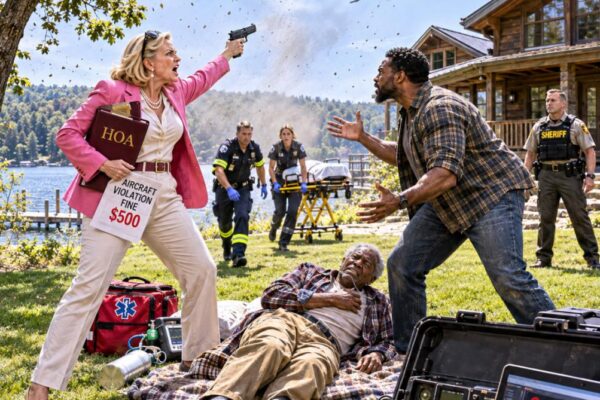
HOA Karen Called Animal Control Three Times to Take My Guide Dog and Claimed He Was Dangerous—but She Vastly Underestimated What Her Own Records Would Prove.k
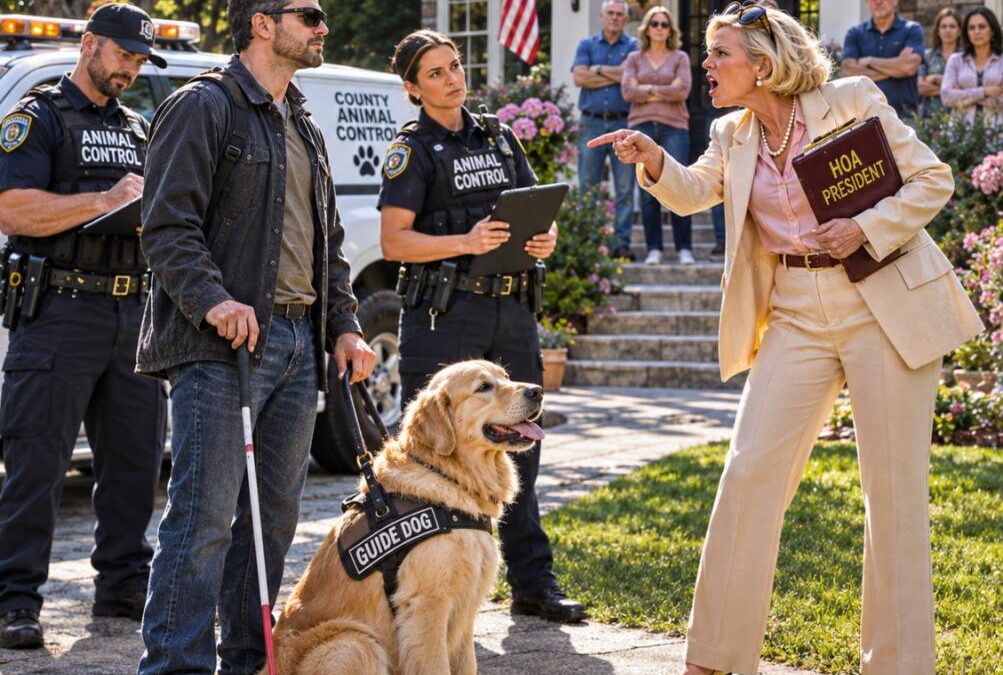
HOA Karen Called Animal Control Three Times to Take My Guide Dog and Claimed He Was Dangerous—but She Vastly Underestimated What Her Own Records Would Prove
She told animal control my guide dog was an unregistered attack animal and tried to use HOA rules to make me choose between my home and the dog who lets me move through the world safely.
Every complaint collapsed the moment officials met Riley, yet HOA Karen kept escalating while secretly building a file meant to make her lies look official.
By the third early-morning visit, I stopped asking why she hated my dog and started asking who had authorized her to use the HOA against my disability.
The knock came at 6:45 on a Tuesday morning.
Three hard strikes.
Official strikes.
Not the hesitant tap of a neighbor or the frantic pounding of somebody with an emergency.
Riley was already awake.
My seventy-pound golden retriever lifted his head from beside the bed, crossed the wooden floor, and pressed his nose against my hand.
That was his way of saying:
Person at the door.
I reached for the guide harness hanging from the chair.
“Forward.”
Riley led me through the cabin.
My vision isn’t complete darkness.
That’s what people often assume when I say I’m legally blind.
After the accident, I kept a narrow field of usable sight in my left eye and vague light perception in the right. Faces blur. Depth is unreliable. Objects outside my central field can disappear completely.
Riley makes the missing pieces navigable.
At the door, I could make out two dark uniforms.
Long shapes hanging from their shoulders.
Clipboards.
County animal control.
My stomach dropped.
Not again.
I opened the door.
The taller officer said, “Nathan Brooks?”
“Yes.”
“We received a dangerous-animal complaint.”
Riley stepped forward.
The officer stiffened.
Then Riley dropped the tennis ball he’d been carrying directly onto the man’s boot.
The second officer laughed before she could stop herself.
Riley wagged hard enough to slap his tail against the doorframe.
The first officer looked down.
Then at me.
Then back at the golden retriever sitting politely in a guide harness.
“The report describes a large German shepherd-type dog that has charged residents and stalked children near the playground.”
I stared at him.
“This is Riley.”
Riley leaned against the second officer’s leg.
She scratched his ear.
“Clearly terrifying.”
I exhaled.
“He’s my guide dog.”
The taller officer’s tone changed.
“Sir, I’m sorry. We still need to document the complaint.”
“I understand.”
“This says three children were chased yesterday afternoon.”
“Yesterday afternoon?”
“Yes.”
I reached for my phone.
“At two o’clock yesterday, Riley and I were seventy miles away at my ophthalmologist’s office.”
The officer paused.
“I can show you the appointment records.”
Behind them, across Pine Ridge Lane, a curtain moved in the upstairs window of Evelyn Warwick’s house.
Four houses down.
Platinum-blond hair.
Pale pink robe.
Watching.
I felt something inside me settle.
Not anger.
Anger had been there for months.
This was different.
Clarity.
The officer asked, “Do you know who might have made the complaint?”
I looked toward Evelyn’s window.
“I have a strong suspicion.”
Riley nudged my knee.
I rested one hand on his head.
Then I said, “Before you leave, I want the complaint number.”
The taller officer nodded.
“Of course.”
“And I want it noted that this is the third dangerous-dog report made about a trained guide dog in three months.”
The second officer stopped scratching Riley.
“Third?”
“Yes.”
Across the street, Evelyn’s curtain snapped shut.
That was when I knew I was done treating this like an eccentric HOA president misunderstanding a dog.
part 2
My name is Nathan Brooks.
I’m forty-three years old.
Five years ago, I could drive at night.
I could read street signs from half a block away.
I could walk into an unfamiliar building without counting doors, memorizing corners, or listening for acoustic changes that told me a hallway had opened into a larger room.
Then a delivery truck ran a red light.
I remember the impact.
Glass.
Metal.
The steering wheel coming toward my face.
Then light.
Then nothing for a while.
When I woke in the hospital, the world had been reduced to shapes.
Doctors were careful.
Careful doctors scare you more than pessimistic ones.
They said optic nerve damage.
Retinal trauma.
Multiple surgeries.
Possible improvement.
No promises.
There was some improvement.
Enough that I can tell whether the sky is bright.
Enough that large objects have edges if the contrast is good.
Enough that people sometimes assume I see far more than I actually do because I look directly toward their voices.
But not enough to drive.
Not enough to safely cross unfamiliar streets.
Not enough to trust a staircase without help.
The first year after the accident was ugly.
I hated needing people.
Hated mobility training.
Hated the white cane at first because I believed everyone saw it before they saw me.
That wasn’t true.
But grief doesn’t require accurate beliefs.
Riley changed things.
He came from an accredited guide-dog program after months of training and matching.
No magical certificate made him legitimate.
No online registration database.
No laminated card that transformed an ordinary pet into a service animal.
He was trained to perform work directly related to my disability.
Find doors.
Avoid obstacles.
Stop at curbs.
Ignore distractions.
Refuse a command if following it would put me in danger.
The first time Riley deliberately disobeyed me was at an intersection.
I told him forward.
He refused.
I told him again.
He planted all four paws.
Three seconds later, a delivery van rolled through the crosswalk.
I stood there shaking.
Riley looked up at me.
Then sneezed.
As if saving my life was mildly inconvenient.
From then on, we were a team.
Four years later, when my grandmother died and left me her cabin at Pine Ridge Lake, I thought I had finally found the right place to rebuild the quieter version of my life.
The cabin was small.
Two bedrooms.
Stone fireplace.
Wraparound porch.
Cedar siding weathered gray.
Grandma June had owned it since the late eighties.
Pine Ridge Lake had grown around her.
What began as seasonal cabins became expensive second homes, then full-time residences, then an HOA with a clubhouse and a small private marina.
Grandma joined a limited road-and-lake maintenance agreement when the association formed.
Her deed had several older exemptions.
Nothing exotic.
Just grandfathered features like the cabin’s cedar siding, the gravel parking pad, and a slightly oversized porch.
I inherited those property rights with the house where applicable.
I did not inherit immunity from every HOA rule.
That distinction became important.
I paid assessments.
Followed parking rules.
Kept the trash bins where they belonged.
Used the marina like everyone else.
I moved in during April.
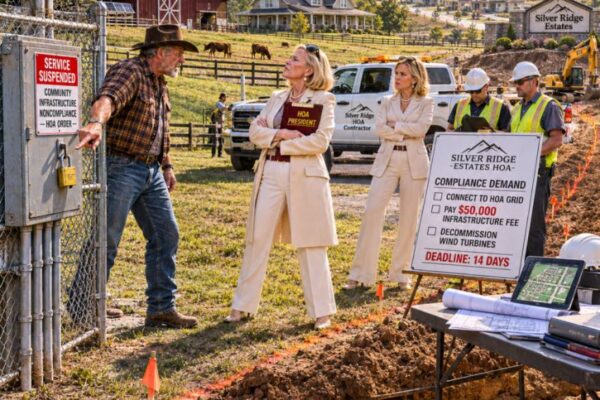
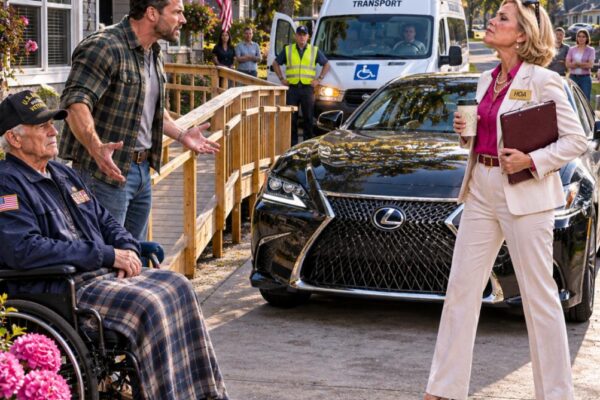
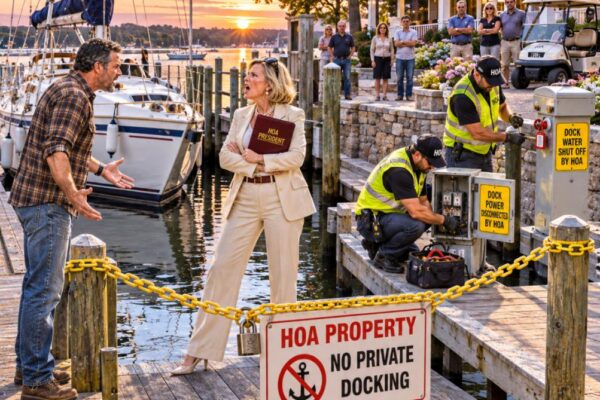
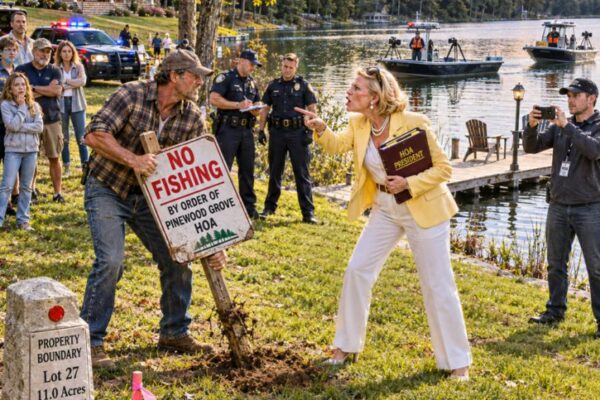
Evelyn Warwick arrived before the moving truck finished unloading.
She wore a coral blazer, white pants, jeweled sandals, and oversized sunglasses resting on platinum hair.
Burgundy clipboard.
Of course.
She stood beside my driveway while two movers carried boxes into the house.
“Mr. Brooks?”
“Yes.”
“I’m Evelyn Warwick. HOA president.”
“Nice to meet you.”
“I understand you’re June’s grandson.”
“I am.”
“She was very independent.”
The word sounded like a criticism.
“She was.”
Evelyn glanced toward the porch.
Then at the cedar siding.
Then the gravel.
Then Riley.
Her attention stopped there.
“What breed?”
“Golden retriever.”
“He’s large.”
“About seventy pounds.”
“We have animal restrictions.”
“He’s my guide dog.”
Her expression barely changed.
“All animals still need to be registered with the association.”
“Send me whatever form you use for accommodation records and emergency contacts.”
“I said animal registration.”
I understood what she was asking.
The HOA maintained a voluntary pet information sheet for dogs.
Vaccination status.
Breed.
Emergency contact.
Useful enough.
But service animals are not simply pets subject to every ordinary pet restriction.
I wasn’t going to start a legal seminar in my driveway.
“Email me the policy.”
Evelyn looked at Riley.
“He needs to be leashed at all times.”
“When he’s working, he’s in a guide harness.”
“Same difference.”
“Not exactly.”
She frowned.
“Is he mixed with German shepherd?”
“No.”
“He has a very large head.”
I laughed.
Riley looked personally offended.
“He’s a golden retriever.”
“We’ve had issues with aggressive dogs near children.”
“Riley isn’t aggressive.”
“Every owner says that.”
That was the first moment I felt the edge beneath her tone.
Then Riley did something devastating to her theory.
He picked up his tennis ball and pushed it against her shin.
Evelyn jumped backward.
“Control him.”
“He’s offering you a ball.”
“I don’t want him touching me.”
“Riley, leave it.”
He immediately returned to my side.
Evelyn wrote something on her clipboard.
I heard the pen.
“What are you writing?”
“Observations.”
“About what?”
“Behavior.”
I should have understood then.
Evelyn did not need Riley to be dangerous.
She needed a file that said he was.
The first notice arrived five days later.
UNREGISTERED ANIMAL — $75.
I emailed management.
Riley was a service animal required because of a disability.
I asked that the association treat the communication as a request for reasonable accommodation from any ordinary pet-registration provision that conflicted with my disability-related use, while offering vaccination and emergency information if legitimately needed.
The management company responded professionally.
Fine withdrawn.
They asked for limited information concerning the accommodation.
I provided what my attorney later described as more than enough.
That should have ended it.
Instead, Evelyn appeared at the next board meeting with a new issue.
“Excessive barking.”
I attended remotely because navigating the clubhouse at night wasn’t worth the trouble.
Evelyn said Riley had “repeatedly vocalized aggressively at passing residents.”
I raised my hand in the video meeting.
Susan Harper, one of the board members, recognized me.
“Mr. Brooks?”
“Can I ask when?”
Evelyn said, “Multiple incidents.”
“Dates?”
“I don’t have the log in front of me.”
“Times?”
“Various.”
“Any recordings?”
Her voice sharpened.
“Must every resident become a videographer to raise a concern?”
“No. But I work from home. Riley rarely barks.”
That was true.
He had one low alert bark when someone approached the porch unexpectedly.
Not trained attack behavior.
Not lunging.
Not sustained noise.
Susan asked management whether there were independent complaints.
There weren’t.
Only Evelyn.
Issue closed.
Then came the leash accusation.
Evelyn photographed Riley guiding me along Pine Ridge Lane.
Harness attached.
My hand on the rigid handle.
She filed a violation claiming he was “not controlled by a standard six-foot leash.”
At the board meeting, I explained:
“He’s controlling my route through the harness.”
Evelyn replied, “Rules should be uniform.”
That sentence became her favorite weapon.
Uniformity.
It sounds fair until you use it to erase disability.
A wheelchair ramp is not unfair because everybody else uses stairs.
Braille signs are not special treatment because sighted people don’t need them.
A guide dog working in harness is not an ordinary pet being casually walked.
The board dismissed that notice too.
Evelyn did not.
She began appearing near my property more often.
At the mailbox.
Near the walking path.
Outside the small general store.
Once, while Riley guided me from the parking area toward the marina, she said:
“People are uncomfortable.”
I stopped.
“With what?”
“The dog.”
“Who?”
“Residents.”
“Names?”
“They have privacy rights.”
“Complaints?”
“They speak to me.”
“Has Riley threatened anyone?”
“Threat can be subjective.”
I stared toward her voice.
“No. Fear can be subjective. Behavior isn’t.”
She went quiet.
Then said:
“You have an answer for everything.”
“No. I have a dog standing still beside me.”
She walked away.
That evening I received a warning for “hostile interaction with board representative.”
I saved it.
I had learned to save everything.
That instinct came from my job.
Before the accident, I worked in audio post-production for documentary television.
Afterward, I transitioned into freelance audio editing.
Vision loss changed my workflow, but audio was still my strongest sense.
I edited podcasts.
Narration.
Interviews.
Cleanup.
Mixing.
Sound design.
My workstation used screen-reader software, tactile markers, keyboard commands, and absurdly expensive headphones.
People assume blindness killed my career.
It mostly changed my monitor.
What I kept from documentary work was the belief that timelines matter.
Exact words matter.
Original files matter.
So I created a folder.
HOA.
Inside:
Notices.
Emails.
Meeting recordings.
Animal-control reports.
Dates.
Names.
The first animal-control visit happened in June.
Complaint:
Unregistered aggressive dog roaming near lake.
The officer arrived at noon.
Riley was asleep under my desk.
I showed his vaccination record.
Explained his work.
The officer watched him guide me down the porch steps.
Case closed.
Two weeks later:
Second complaint.
Dog allegedly lunged at jogger.
No named victim.
No injury.
No witness willing to provide a statement.
Animal control visited again.
Different officer.
Same result.
That afternoon I called management.
“Is Evelyn making these reports?”
The manager said:
“We don’t control outside complaints.”
“I know. I’m asking whether the HOA submitted anything.”
Silence.
Then:
“There was correspondence from the president concerning animal safety.”
“Can I obtain it?”
“Submit a records request.”
I did.
The response arrived partially redacted.
Evelyn had emailed county animal control from her HOA account.
Subject:
URGENT COMMUNITY SAFETY ISSUE — LOT 47.
She called Riley “a large shepherd-type animal.”
That was objectively bizarre.
His veterinary records said golden retriever.
Anyone with working eyes would know.
She wrote that he “frequently moves through common areas under loose control due to the owner’s physical limitations.”
I stopped reading.
Then started again.
Owner’s physical limitations.
There it was.
Not just Riley.
Me.
She argued that because of my blindness, I could not adequately restrain him.
That sentence hurt more than I expected.
Not because it was legally useful.
Because somewhere in Evelyn’s mind, my disability had become evidence that I was less capable of controlling the animal specifically trained to compensate for that disability.
I called my friend Marcus Levin.
Marcus and I had known each other since college.
He was a civil-rights attorney.
Not my attorney then.
Just the friend who tells you when you’re being dramatic and charges other people three hundred dollars an hour for the same service.
I read him the email.
He was silent.
Then:
“Okay.”
“What?”
“This is no longer funny.”
“You laughed at the waste-disposal notice.”
“Because accusing a guide dog of commercial-animal waste operation was objectively hilarious.”
“Fair.”
“This email is different.”
“How?”
“She tied enforcement directly to your disability.”
“ADA?”
“Maybe in some contexts, but don’t get hung up on the ADA because that’s the acronym everybody knows.”
I listened.
“In housing, the Fair Housing Act is likely the cleaner federal framework for what you’re describing. Depending on the facts and facilities, other disability laws or state laws may apply too. The point is housing providers and associations can’t simply deny disability-related accommodations or interfere with your housing rights because they don’t like a service animal.”
“Can I sue?”
“You can always sue.”
“Helpful.”
“Should you sue today? I don’t know.”
“What should I do?”
“Give the board a formal chance to correct it. And preserve everything.”
I laughed.
“What?”
“Every lawyer says preserve everything.”
“Because clients lose everything.”
He had a point.
Marcus helped me draft a formal reasonable-accommodation and anti-harassment letter.
It stated that Riley was a trained guide dog performing disability-related work.
It asked the HOA to confirm he would not be subjected to ordinary pet restrictions that interfered with that work.
It requested cessation of unsupported dangerous-animal accusations.
It asked that any future safety complaint identify actual observed conduct rather than stereotypes about my disability.
The board’s attorney responded.
Professionally.
Riley could continue working throughout the community.
No breed or weight restriction would apply to him merely because of his status as an assistance animal.
The association acknowledged the accommodation.
I thought that would end it.
Evelyn treated the letter like a declaration of war.
At the next HOA meeting, she devoted twelve minutes to “service animal loopholes.”
She never said Riley’s name at first.
She talked about “residents using disability laws to circumvent safety standards.”
Susan interrupted.
“Evelyn, is this about Nathan?”
“I’m discussing policy.”
“We have one guide-dog accommodation.”
“Then the policy affects one person.”
I was listening remotely.
Marcus had told me not to interrupt unless directly addressed.
Then Evelyn projected a photograph.
Riley lying on my porch.
“The community is being asked to accept an animal of this size without ordinary controls.”
Susan said:
“He’s asleep.”
“That’s not the point.”
Another director, Greg Thompson, spoke.
“What has Riley actually done?”
“He charged me last Thursday.”
I sat upright.
Greg asked:
“Where?”
“Near your hedge.”
“My hedge?”
“Yes.”
Greg sounded confused.
“My front hedge is behind a fence.”
Evelyn paused.
“I may mean the Harper property.”
Susan said:
“My kids were playing with Riley Thursday.”
Silence.
“When?”
Evelyn asked.
“Most of the afternoon.”
I checked my calendar.
Then remembered.
Nia—Susan’s daughter, not mine—had indeed been playing fetch with Riley after school while Susan sat on my porch drinking iced tea.
I unmuted.
“Evelyn, what time did Riley charge you?”
She ignored me.
Susan said:
“Answer him.”
“Around four.”
Susan laughed once.
Not kindly.
“At four o’clock Riley was in Nathan’s backyard with my two children.”
The meeting became uncomfortable.
Evelyn recovered quickly.
“I may be thinking of Wednesday.”
I checked the audio file from Wednesday.
Why did I have one?
Because I had been editing a three-hour podcast session at home while Riley slept under my desk. A smart collar log also showed he barely moved.
Not definitive proof he never stepped outside.
Enough to make Evelyn’s certainty look reckless.
Still, the board did not discipline her.
They called it confusion.
That emboldened her.
The cameras came next.
Pine Ridge had security cameras near the clubhouse, marina, and entry road.
Normal.
Then two new cameras appeared on common-property poles near my cabin.
One faced down the lane.
The other was angled directly toward my front porch and part of the side yard.
I could not see the angle well enough myself.
Greg noticed it.
“Nathan, why is that camera pointing at your house?”
“What camera?”
That question told him everything.
He described it.
I called management.
They said Evelyn had authorized “enhanced violation documentation.”
I asked the board for the policy authorizing targeted surveillance of one residence.
No answer.
Then weekly HOA emails began including still photographs.
Riley on the porch.
Riley standing beside me at the mailbox.
Riley carrying a soft mail pouch from the porch to my office.
Riley playing with Susan’s kids.
One image was captioned:
CONTINUED LARGE-ANIMAL PRESENCE IN HIGH-TRAFFIC AREAS.
High-traffic area.
My porch.
Another:
UNRESTRAINED ACTIVITY.
Riley was lying down.
Then somebody added dramatic music to a compilation played at a board meeting.
Low bass.
Tense percussion.
Over footage of Riley yawning.
I wish I were making that up.
Susan stopped the video.
“Who edited this?”
Evelyn said:
“Communications committee.”
Greg asked:
“Why is there horror-movie music?”
“It illustrates concern.”
“It illustrates a dog scratching his ear.”
That was the first time I heard open laughter at Evelyn’s expense.
She hated it.
The health-department complaint came next.
Then code enforcement.
Then the petition.
BAN DANGEROUS DOGS OVER 30 POUNDS.
The proposed rule did not name Riley.
It didn’t need to.
Marcus called me.
“They cannot use a facially neutral rule to deny an accommodation if disability law requires an exception.”
“I know.”
“I’m reminding you.”
“You enjoy this.”
“I enjoy being correct.”
The petition failed.
Even residents who disliked dogs thought thirty pounds was absurd.
Then Evelyn proposed muzzles for dogs over forty pounds in common areas.
That went nowhere too.
By August, Susan was openly challenging her at meetings.
Greg had stopped voting with her.
Another director, Margaret Lowe, rarely spoke but began asking management to verify every violation before mailing it.
Evelyn was losing institutional control.
So she went outside the HOA.
Third animal-control report.
The Tuesday-morning knock.
The false claim about children being stalked.
I gave officers Riley’s records.
Then my medical appointment confirmation.
My rideshare receipts.
A timestamped photograph from the clinic.
Riley had been with me all day.
The officer wrote everything down.
Then he said:
“Mr. Brooks, we’re going to flag this history for supervisor review.”
“Thank you.”
“We can’t prevent people from reporting genuine concerns.”
“I don’t want you to.”
“But knowingly false reports are another issue.”
He looked toward Riley.
Riley had finally convinced the second officer to throw his tennis ball once down the hallway.
I smiled.
“That sounds reasonable.”
After they left, I called Marcus.
“I’m done.”
“Good.”
“That sounds aggressive for a lawyer.”
“I mean you’re done handling this informally.”
He drove up that afternoon.
We sat at my kitchen table.
Riley lay across his shoes.
Marcus reviewed the third report.
Then the prior two.
Then Evelyn’s email referring to my “physical limitations.”
Then the surveillance stills.
The dangerous-dog proposal.
The accommodation approval.
The meeting recordings.
He stopped at one email I had almost forgotten.
Evelyn to management:
“His guide-dog claim is being used to override ordinary rules. We need enough documented incidents to reconsider the accommodation.”
Marcus read it again.
“She wrote this after the board approved your accommodation?”
“Yes.”
“Any actual incident between approval and this email?”
“No.”
He leaned back.
“There it is.”
“What?”
“Motive isn’t always this clean.”
He pointed at the email.
“She was trying to manufacture a record to undermine an approved disability accommodation.”
“Can you prove manufacture?”
“We can prove she wanted enough incidents.”
He corrected himself.
“We investigate who generated them.”
That distinction mattered.
We sent a formal demand to the board.
Not to Evelyn personally.
To the association.
Preserve:
All communications about me.
All communications about Riley.
Animal-control reports.
Camera installation records.
Video files.
Violation logs.
Complaint histories.
Board messages.
Evelyn’s correspondence.
Any discussions of revoking or restricting my accommodation.
We also filed a fair housing complaint with the appropriate housing civil-rights agency.
Marcus explained the process carefully.
“Filing doesn’t mean the government has found discrimination.”
“I know.”
“They investigate.”
“I know.”
“And there isn’t an automatic twenty-five-thousand-dollar fine because somebody filed a complaint.”
“I know.”
He smiled.
“You’ve been reading.”
“I’ve been listening to you repeat yourself.”
“Excellent.”
The board called an emergency meeting before the agency even contacted them.
Their insurer had received our demand.
Insurance companies have a remarkable ability to accelerate moral reflection.
The clubhouse filled.
I attended in person.
Riley guided me down the center aisle.
People moved chairs without being asked.
Susan helped me locate the front table.
Marcus joined by video because he had a hearing in the city.
Evelyn sat at the board table.
Pink blazer.
Pearls.
Clipboard.
The usual armor.
The acting board counsel opened.
“This meeting concerns enforcement practices involving Lot Forty-Seven and the association’s approved disability accommodation.”
Evelyn immediately interrupted.
“This is a safety matter.”
Susan said:
“No. Tonight it’s a governance matter.”
That was new.
The attorney asked management to summarize the file.
Fourteen HOA notices concerning Riley in six months.
Nine closed without violation.
Three withdrawn after accommodation review.
Two labeled informational only.
Three outside animal-control complaints.
No citations.
No bite.
No injury.
No verified charging incident.
No documented aggressive contact.
Then the cameras.
Installed at Evelyn’s direction.
No full board vote.
No written surveillance policy.
One camera captured portions of my private porch and side yard.
Association counsel had never reviewed the placement.
Susan stared at Evelyn.
“You told us these were general security cameras.”
“They were.”
“Why were the clips labeled Brooks Animal File?”
Silence.
I could hear papers moving.
Evelyn said:
“Management labels files.”
Management responded immediately.
“We did not create that folder.”
The room changed.
Marcus appeared on the video monitor.
He said:
“May I ask a question?”
The attorney nodded.
“Who created Brooks Animal File?”
Management checked the metadata.
“User account EW-Admin.”
Evelyn Warwick.
Nobody spoke.
Marcus continued.
“Who edited the compilation video?”
Another pause.
“Same account.”
Susan turned toward Evelyn.
“You added the music?”
Evelyn looked furious.
“That is irrelevant.”
Greg laughed.
“It’s a dog yawning, Evelyn.”
She snapped:
“This community was being manipulated into complacency.”
I felt Riley shift beside me.
I rested my hand on his harness.
Then Susan read Evelyn’s email aloud.
We need enough documented incidents to reconsider the accommodation.
The room went quiet.
She asked:
“What incidents?”
Evelyn said:
“Safety concerns.”
“Which verified incidents?”
“I have personally experienced aggression.”
“Dates?”
“We’ve discussed them.”
“None were verified.”
“You don’t believe me?”
Susan answered carefully.
“I believe we have an obligation to distinguish your fear from documented conduct.”
That sentence mattered.
Evelyn stood.
“You’re all going to wait until a child gets mauled.”
A woman in the audience gasped.
Not because Riley moved.
He was asleep.
Marcus said through the screen:
“Ms. Warwick, has Riley ever bitten anyone?”
“No.”
“Attempted to?”
“He has lunged.”
“Any video from your targeted surveillance system showing a lunge?”
She hesitated.
“No.”
“Any animal-control finding?”
“They’re afraid of disability lawsuits.”
One of the animal-control supervisors was sitting in the audience.
Susan had invited him.
He stood.
“No, ma’am.”
Evelyn froze.
He continued.
“Our officers evaluated three complaints. None produced evidence supporting a dangerous-dog designation.”
Then he held up a file.
“The third alleged incident occurred while Mr. Brooks and Riley were documented outside the county.”
A murmur moved through the room.
Evelyn looked at me.
For the first time in months, she seemed to understand that every report had created evidence in both directions.
She had been trying to build a dangerous-dog file.
Instead, she built a false-complaint timeline.
Then Mrs. Harper stood.
Susan was on the board, but her mother-in-law, Martha Harper, lived two houses away and had babysat Susan’s children many afternoons.
“My grandchildren play with Riley.”
Evelyn snapped:
“That is your choice.”
Martha continued.
“I have watched you photograph that dog while children were hugging him.”
“You don’t know what you’re talking about.”
“I know what I saw.”
Greg spoke next.
“My hedge has never been involved in one of your alleged attacks.”
That got laughter.
Even I laughed.
Evelyn did not.
Then the board attorney asked me to speak.
Riley guided me to the small lectern.
I placed both hands on it.
For months, people had been arguing about Riley as if he were the complicated part.
He wasn’t.
“He’s a dog.”
That wasn’t what anyone expected.
I continued.
“A very well-trained dog.”
A few people smiled.
“He does not understand HOA politics. He doesn’t know what an accommodation request is. He doesn’t know the difference between federal law and a neighborhood rule.”
Riley sneezed behind me.
More laughter.
“What he knows is that when I say forward, he finds a safe route.”
My throat tightened.
“When I misjudge a curb, he stops me.”
The room became still.
“When something blocks the path that I cannot see, he moves me around it.”
I paused.
“Five years ago, I lost enough vision that I had to learn how to move through the world again.”
I turned toward Evelyn’s voice.
“Evelyn looked at that and decided the thing helping me move safely was the threat.”
Nobody spoke.
“I don’t know why.”
I meant that.
“Maybe she is genuinely terrified of large dogs.”
Evelyn shifted.
“Maybe she doesn’t understand disability.”
I continued.
“Maybe she resented being told an HOA rule sometimes has to yield to a lawful accommodation.”
Then I said:
“But after the board approved that accommodation, she wrote that she needed enough incidents to reconsider it.”
I let the words sit.
“That isn’t safety.”
I placed a folder on the lectern.
“This is six months of my life.”
Notices.
Reports.
Emails.
Camera stills.
“I moved here because my doctor told me lower stress might help with post-accident migraines.”
A quiet laugh came from somewhere.
“That plan has not gone especially well.”
Even Susan laughed at that.
I continued.
“I am not asking this board to treat Riley as harmless because he’s cute.”
I could hear his tail hit the floor.
“I’m asking you to use evidence.”
“No bite.”
“No injury.”
“No verified charge.”
“No aggressive incident.”
“Three animal-control complaints that produced nothing.”
“And one complaint describing an event Riley could not physically have committed.”
I stepped back.
“If real safety evidence ever exists, investigate it.”
Then:
“But stop treating my disability as evidence against me.”
I sat down.
The board went into executive session with counsel.
Forty minutes.
Longest forty minutes of my year.
When they returned, Susan read the motion.
Effective immediately, Evelyn’s unilateral enforcement privileges were suspended.
All future complaints concerning my accommodation would be reviewed through management and association counsel rather than through Evelyn.
The targeted camera would be removed or reoriented within seventy-two hours.
An independent review of prior enforcement involving disability accommodations would begin.
Because Evelyn had been elected as a director, the board could not simply erase her board seat with one vote unless the governing documents allowed it.
They did, however, remove her as president under the internal officer provisions.
Three directors voted yes.
Evelyn voted no.
One abstained.
Susan became acting president.
Evelyn sat motionless.
Then she said:
“You’ll regret this.”
The board attorney immediately said:
“Evelyn.”
She stopped.
I heard Riley’s harness tags jingle.
That was it.
No handcuffs.
No gavel flying across the room.
No federal agents.
Just authority removed through the same boring rules she had used against everybody else.
The fair housing investigation continued.
The agency requested records.
The HOA’s insurer hired outside counsel.
Evelyn retained her own attorney.
Other residents came forward.
Not all involved disability.
Some involved selective enforcement.
A veteran with PTSD had been warned about a support-related accommodation request without proper review.
An older resident using a mobility scooter had received repeated complaints about where the scooter was parked near her porch.
A family with a child who had a disability described being pressured over temporary medical equipment visible from the street.
Not every complaint became a legal violation.
Some were misunderstandings.
Some were corrected quickly.
But Evelyn’s pattern around accommodations was concerning.
Then discovery produced more emails.
One to a friend on the architectural committee:
“Nathan expects the whole neighborhood to reorganize around one dog.”
Friend:
“He’s blind, Evelyn.”
Evelyn:
“I know. That can’t mean every normal rule disappears.”
Another:
“If we let this continue, everybody will claim medical exemptions.”
Another:
“People pay good money to feel safe here. They shouldn’t have to wonder whether a large animal is really under control just because the owner has special circumstances.”
Special circumstances.
I listened to Marcus read that one aloud.
Then asked:
“Is that enough?”
“For what?”
“To prove discrimination.”
He sighed.
“You still want the magic sentence.”
“I want certainty.”
“Law gives you evidence and standards. Not mind-reading.”
He explained again.
The fair housing issue was not whether Evelyn privately disliked blind people.
The stronger question was what she did with housing authority after knowing I had a disability-related need.
Did she interfere with an approved accommodation?
Did she subject me to unequal conditions because of disability?
Did she retaliate after I asserted protected rights?
Did the association act reasonably once notified?
Those questions were answerable.
That was enough.
The association wanted mediation.
So did I.
Not immediately.
At first, I wanted court.
I wanted Evelyn answering questions under oath.
I wanted every email read publicly.
Then Marcus asked:
“What outcome helps you live there?”
I hated good questions.
“Peace.”
“Can a trial guarantee it?”
“No.”
“What else?”
“Remove the surveillance.”
“Already done.”
“No unsupported animal complaints.”
“Policy can address that.”
“Training.”
“Good.”
“Correct the record.”
“Good.”
“Legal fees.”
“Obviously.”
“Compensation.”
“Also reasonable if supported.”
Then I said:
“I want the board to stop calling service animals pets in the enforcement manual.”
Marcus smiled.
“That may be the most Nathan demand you’ve made.”
We mediated.
The association did not admit every allegation.
Evelyn did not confess to discrimination.
Real settlements rarely provide cinematic surrender.
But the resulting conciliation agreement was meaningful.
The HOA formally confirmed Riley’s accommodation.
All invalid Riley-related fines and warnings were removed from my account.
The association adopted a written disability-accommodation policy.
Requests would be handled confidentially through management.
No board member could unilaterally deny an accommodation.
No breed, size, or weight restriction would be applied to an assistance animal solely because it conflicted with ordinary pet rules.
Actual dangerous behavior could still be addressed based on objective evidence.
That last part mattered.
Disability rights do not require ignoring genuine danger.
They require individualized, evidence-based decisions rather than stereotypes.
The association adopted anti-retaliation language.
Board members received fair housing training.
Targeted surveillance required documented authority and privacy review.
The HOA agreed to cover negotiated legal fees and compensation.
The administrative complaint resolved through conciliation subject to the agency’s process.
No Department of Justice agents came to Evelyn’s door.
No automatic $25,000 penalty appeared because somebody had used the letters ADA in a meeting.
That part of neighborhood rumor became ridiculous.
Martha told me someone on Facebook claimed Evelyn owed the federal government half a million dollars.
“She doesn’t.”
“I know.”
“Should we correct them?”
“Yes.”
Martha sounded disappointed.
“Fine.”
The animal-control situation changed too.
The county supervisor sent me a letter confirming Riley had no dangerous-animal designation.
They created an internal note on my address indicating prior unsupported complaints involving a working guide dog.
That did not prevent legitimate future reporting.
It prevented officers from arriving blind to context.
Evelyn faced separate review over the knowingly false third report.
The outcome was modest.
A citation related to false reporting under local rules and an agreement that future animal-control complaints from her concerning Riley had to be based on actual observed conduct she could describe truthfully.
No jail.
No dramatic criminal record destroying her life.
Consequences proportionate to what could be established.
She remained an HOA director until the next special membership vote.
That meeting was worse for her.
Not because I spoke.
I didn’t.
I stayed home.
I’d spent enough nights in the clubhouse.
Residents voted overwhelmingly to remove her from the board under the association’s procedures.
Susan Harper became president in the next election.
Greg Thompson became vice president.
The first thing Susan did was make the newsletter painfully boring.
I loved it.
Roof repairs.
Marina schedule.
Budget.
Snow-removal contracts.
No photos of Riley.
No “dog crisis.”
No ominous music.
Evelyn’s real-estate business did take a hit, but not in the fairy-tale way people later described.
No entire industry blacklisted her overnight.
She was a local agent who had built much of her brand around being a Pine Ridge community expert.
Once the board dispute became public through meeting records and neighbors began talking, some clients stopped using her.
A brokerage removed her from a neighborhood marketing campaign.
Two billboards disappeared when their contracts expired.
Her business survived.
Smaller.
That felt more believable than instant ruin.
For several months after losing the presidency, Evelyn avoided me.
If Riley and I approached on Pine Ridge Lane, she crossed the street.
At first, I enjoyed that.
Then I realized something uncomfortable.
I had spent half a year asking her not to treat Riley like danger.
I didn’t want to spend the next half enjoying the fact that she still did.
One afternoon in March, I heard her voice near the mailbox.
“Nathan?”
I stopped.
Riley stopped.
“Yes?”
“I need to ask you something.”
Her tone was different.
Less metallic.
“What?”
“Is he working right now?”
I almost laughed.
“His harness is on.”
“So I shouldn’t pet him.”
“That would be best.”
Silence.
Then:
“Okay.”
She walked away.
That was our first normal conversation.
Twenty seconds.
It shouldn’t have felt significant.
It did.
Spring changed the lake.
Ice disappeared.
Fishing boats returned.
Riley discovered geese and developed a professional hatred of their refusal to respect pedestrian lanes.
My migraines improved.
Not vanished.
Improved.
Stress did too.
The first morning we walked to the lake without me thinking about Evelyn until after we returned home, I realized something inside me had shifted.
For months, I had scanned every sound for threat.
A car stopping.
A knock.
A notification.
Riley would alert me to visitors and my body would tighten before I knew who they were.
Home had become a place where I waited for the next accusation.
No settlement agreement fixes that instantly.
I started therapy again.
I had gone after the accident.
Stopped when life stabilized.
Went back after the HOA fight.
The counselor asked:
“What are you afraid will happen?”
“Someone will take Riley.”
“Is that likely?”
“No.”
“Does your nervous system know that?”
Apparently not.
That took longer.
Riley helped.
Of course.
He didn’t understand legal trauma.
He understood routine.
Breakfast.
Harness.
Walk.
Work.
Nap.
Ball.
Dinner.
Sleep.
Dogs are excellent at reminding humans that most of life is not happening in the room where lawyers are talking.
By summer, Susan’s children were back playing fetch with him.
Greg’s azaleas—actual azaleas, not the imaginary bushes Evelyn claimed she had dived into—flowered along his fence.
The animal-control supervisor attended the HOA’s disability training session and explained how dangerous-dog investigations actually work.
Marcus spoke about fair housing obligations.
He was insufferably pleased with himself.
Afterward, I said:
“You enjoyed that.”
“Deeply.”
“You said housing law for forty-five minutes.”
“To a captive audience.”
“Disgusting.”
We went for lunch.
The new accommodation policy produced its first real test later that year.
A woman named Denise moved into Pine Ridge with a small assistance dog related to a psychiatric disability.
She did not want to explain her diagnosis to the entire board.
She shouldn’t have to.
Management processed the accommodation through the new system.
Limited information.
Confidential file.
No public debate.
No newsletter.
No photos.
Approval completed.
I only learned because Denise told me months later.
“You’re the reason this was easy.”
I shook my head.
“No.”
“Everyone says you changed the rule.”
“The law already existed.”
“Then why wasn’t it easy for you?”
Good question.
“Because systems depend on whether people follow the law before somebody forces them to.”
That answer stayed with me.
The goal was not to make me heroic.
It was to make the next person ordinary.
If Denise needed fourteen notices, three animal-control visits, a lawyer, cameras, a fair housing complaint, and a packed emergency meeting just to keep an assistance animal in her home, then we had not fixed much.
Her boring approval was the victory.
Riley became something of a neighborhood celebrity anyway.
Against my wishes.
The newsletter once ran a short piece explaining guide-dog etiquette.
Susan asked first.
I agreed on one condition.
“No picture of me.”
She laughed.
“Why?”
“Riley photographs better.”
True.
The article showed him sitting beside the lake in harness.
It explained:
Don’t pet a working guide dog without permission.
Don’t feed him.
Don’t distract him.
Don’t grab the harness.
Ask the handler if help is needed rather than assuming.
Simple.
Useful.
Evelyn complained that the newsletter had become “activist.”
Susan forwarded me the email.
I told her not to.
“I don’t want her living in my inbox anymore.”
Susan apologized.
That was another boundary.
Once accountability happened, I didn’t need a subscription to Evelyn’s unhappiness.
A year after the animal-control visit, I received a certified envelope.
Return address:
Evelyn Warwick.
I almost gave it to Marcus unopened.
Then curiosity won.
Inside was a single page.
Nathan,
I have spent a long time thinking about what happened.
I believed I was protecting Pine Ridge and allowed that belief to justify things I should not have done.
I treated Riley as a danger without evidence.
I also treated your blindness as a reason to doubt your ability to control him, when the truth was that I did not understand how a guide-dog team works.
The repeated complaints were wrong.
The cameras were wrong.
I am sorry.
Evelyn.
I read it three times.
Not because it healed everything.
Because it was specific.
No “if you felt.”
No “misunderstanding.”
No accusation hidden inside the apology.
I called Marcus.
“Evelyn apologized.”
“Properly?”
“I think so.”
“Are you checking with counsel to determine whether you’re emotionally permitted to accept?”
“That’s why I pay you.”
“You don’t pay me for friendship.”
“Excellent arrangement.”
“Are you going to answer?”
“I don’t know.”
I didn’t for two weeks.
Then I wrote:
Thank you for acknowledging it. I hope what happened changes how you treat the next person whose needs are different from yours.
Nathan.
Nothing else.
No invitation for coffee.
No friendship.
No revenge.
She sent no response.
That was fine.
The following fall, Riley turned seven.
Guide dogs don’t work forever.
I knew that intellectually.
Emotionally, I refused the information.
His program conducted regular evaluations.
Healthy.
Strong.
Still excellent.
But I started thinking about retirement.
His.
Not mine.
The idea terrified me more than I expected.
Would he stay with me?
Probably, if practical.
Would I train with another guide dog while he slept on the couch judging both of us?
Hopefully.
That fear made the HOA conflict feel smaller.
Evelyn had once occupied an enormous amount of mental space because I believed she could take him.
Now time itself would eventually change our partnership.
That is different.
Natural losses are painful enough.
Nobody needs manufactured ones.
One October morning, Riley and I walked toward the lake.
Cold air.
Dry leaves.
The path curved near Evelyn’s house.
I heard a door open.
Then her voice.
“Good morning, Nathan.”
“Morning.”
We kept walking.
She didn’t cross the street.
Didn’t approach Riley.
Didn’t say anything else.
That was progress.
At the lake, I unclipped the rigid harness but kept his regular lead attached.
“Free.”
Riley shook himself.
Working posture disappeared instantly.
He became a golden retriever again.
He grabbed a stick.
Dropped it at my feet.
I threw.
Badly.
He found it anyway.
Again.
Again.
The sun reflected across water I could mostly perceive as light.
Riley ran through that brightness.
For a few minutes, nothing in my life needed to become evidence.
That is a luxury people don’t understand until it’s gone.
During the worst months, every walk became documentation.
Was Riley leashed?
Was the harness visible?
Who passed us?
Was a camera watching?
Did someone complain?
Should I record?
Should I save?
Should I prove?
Living defensively turns ordinary life into litigation before a lawsuit ever exists.
The legal case mattered because it stopped that.
Not because Evelyn lost.
Because I could stop proving Riley was allowed to exist beside me.
The new board later removed the targeted camera pole entirely.
Susan called before the work happened.
“You want it?”
“What?”
“The old camera.”
“Why would I want that?”
“Trophy?”
“No.”
“Art?”
“No.”
“Dog toy?”
“Absolutely not.”
They recycled it.
Good.
Not every symbol needs preservation.
I kept some things.
The three animal-control reports.
Evelyn’s email.
The conciliation agreement.
The apology letter.
Not because I wanted to relive them.
Because records matter.
The same lesson I had learned in audio editing applied everywhere.
The original source matters.
People revise stories unconsciously.
Months later, someone would say Evelyn had tried to have Riley euthanized.
She had not.
Someone else claimed federal agents arrested her.
They did not.
Someone claimed I received a million-dollar settlement.
I wish.
Someone claimed Riley bit Evelyn and the whole case turned on whether it was justified.
Absolutely false.
The real story needed no exaggeration.
A powerful HOA officer repeatedly targeted a disabled homeowner’s guide dog.
She used unsupported complaints.
She sought to build a record against an accommodation that had already been approved.
She tied her suspicion to my disability.
She authorized targeted surveillance.
She kept escalating when evidence contradicted her.
The board eventually acted.
A fair housing process followed.
Policies changed.
That was serious enough.
Truth doesn’t become stronger when you add explosions.
Marcus taught me that.
So did Riley, in a way.
A guide dog works from reality.
There’s a curb or there isn’t.
A car is coming or it isn’t.
A path is blocked or it isn’t.
He does not need the obstacle to be evil.
He simply responds to what is there.
I became better at that.
One winter evening, Pine Ridge lost power during an ice storm.
The clubhouse opened as a warming center.
Susan called.
“Can you make it over safely?”
“With Riley.”
“Right. Stupid question.”
“Not stupid. Good question.”
We walked there.
Riley guided around fallen branches.
At the clubhouse, maybe forty residents sat with blankets, coffee, chargers, and children.
Denise was there with her assistance dog.
Greg.
Martha.
Animal-control Officer Carter, who lived nearby, happened to be there too.
Then Evelyn entered.
Everyone noticed.
I could feel the room shift.
She chose a chair across the room.
Nothing happened.
Hours passed.
At one point, a little boy approached Riley while he was working beside my chair.
Evelyn saw him.
Before I could say anything, she spoke.
“Ask first. He’s working.”
The boy stopped.
“Can I pet him?”
I smiled.
“Not while the harness is on. Later maybe.”
“Okay.”
He walked away.
I turned my head toward Evelyn.
She said nothing.
Neither did I.
But that moment meant more than the letter.
Knowledge had changed behavior.
That is what training is supposed to do.
Not humiliate.
Teach.
The lights came back shortly after midnight.
Riley and I walked home beneath frozen branches.
At my porch, I removed his harness.
He immediately shoved a tennis ball against my ankle.
I laughed.
“You have been working for six hours.”
Tail wag.
“You’re unionizing tomorrow.”
More wagging.
I threw the ball down the hallway.
He chased it.
I stood in the doorway listening.
There was a time when I thought justice would feel like Evelyn suffering enough to understand what she’d done.
I was wrong.
Suffering doesn’t reliably teach anything.
Sometimes it just creates another angry person.
Accountability gave her consequences.
Training gave her information.
Losing authority forced a boundary.
Whether she changed inside was not my responsibility.
What mattered was that the system changed outside.
That was enough.
Two years after the third animal-control complaint, I attended one HOA meeting voluntarily.
Terrible decision.
Susan had promised it would be twenty minutes.
It lasted ninety.
Somebody wanted to regulate inflatable pool animals because a giant pink flamingo had blown into the lake during a storm.
I sat beside Greg.
He whispered:
“Think of the children.”
I nearly laughed out loud.
The discussion became absurdly serious.
Maximum float dimensions.
Anchoring rules.
Wind advisories.
Finally I raised my hand.
Susan sighed.
“Yes, Nathan?”
“I would like the minutes to reflect that Riley has no position on inflatable flamingos.”
The room laughed.
Even Susan.
That was when I knew Pine Ridge had become ordinary again.
Ridiculous HOA politics.
The kind I had wanted all along.
No one debating whether my guide dog made the neighborhood unsafe.
No one treating disability accommodation like a loophole.
Just adults arguing about pool toys.
Beautiful.
Riley eventually retired at nine.
He stayed with me.
Obviously.
The guide-dog program matched me with a younger dog named Atlas.
Black Labrador.
More serious than Riley.
Less interested in tennis balls.
Riley hated him for approximately three days.
Then decided retirement meant stealing Atlas’s bed.
My first walk through Pine Ridge with both dogs created confusion.
Atlas in harness.
Riley on a regular leash with Susan helping me manage him for the short introduction.
Evelyn happened to be outside.
She called:
“New guide?”
“Yes.”
“What’s his name?”
“Atlas.”
“And Riley retired?”
“He’s management now.”
Riley barked once.
Perfect timing.
Evelyn laughed.
I did too.
Then Atlas guided me toward the lake.
That should probably be the ending.
Not a courtroom.
Not a fine.
Not a board vote.
Me walking.
One dog working.
One dog retired behind me.
The neighborhood finally understanding the difference.
The morning Evelyn sent animal control to my door, she thought authority meant she could turn fear into evidence.
Enough reports.
Enough notices.
Enough photos.
Eventually, somebody would believe her.
She forgot that records work both directions.
Every closed complaint became evidence too.
Every withdrawn fine.
Every photo of Riley doing nothing dangerous.
Every email admitting she wanted enough incidents to challenge my accommodation.
Every board meeting where her story shifted.
She tried to build a case.
She built mine.
I did not defeat her because Riley was adorable.
He is.
That wasn’t the point.
I didn’t defeat her because blindness automatically made me morally right.
It doesn’t.
Disabled people can violate rules too.
Service animals can create legitimate problems too.
Real dangerous behavior can be addressed.
What mattered was evidence.
Riley wasn’t dangerous.
The HOA knew he was disability-related.
Evelyn knew an accommodation existed.
And she kept using official power to target the very thing that allowed me to live independently.
The law drew a line.
The board eventually enforced it.
That line gave me my home back.
On quiet mornings, Atlas guides me toward the lake while Riley sleeps late on the porch like a retired executive.
Sometimes Evelyn passes us.
She says hello.
Nothing more.
I prefer it that way.
Pine Ridge does not need a dramatic ending.
Neither do I.
I wanted quiet.
At last, I got it.
And when Atlas stops at the curb, waits for a car I cannot see, then leads me safely forward after it passes, I sometimes think about Evelyn’s old accusation.
That my physical limitations meant I could not control my dog.
She had misunderstood the partnership completely.
I wasn’t controlling Riley.
Riley wasn’t controlling me.
We were working together.
That was the thing she never understood about accommodations either.
They are not privileges handed down by people with clipboards.
They are tools that allow someone to participate on equal terms.
Once Pine Ridge understood that, the whole so-called dog crisis disappeared.
The lake stayed quiet.
The neighborhood survived.
Children continued playing.
Property values did not collapse.
And Riley spent his retirement committing his only verified offense—
stealing Atlas’s bed whenever nobody was looking.