“Give Us $10 Million—or We’ll Have You Declared Incompetent!” My Son’s New Wife Threatened Six Days After Their $68,400 Wedding. Her Lawyer Claimed My Late Husband Had Left Me $53.24 Million and Demanded Another $30,000 Every Month. I’d Never Told My Son About That Fortune. When I Asked Him to Come Home Alone, He Brought Something That Changed Everything…k
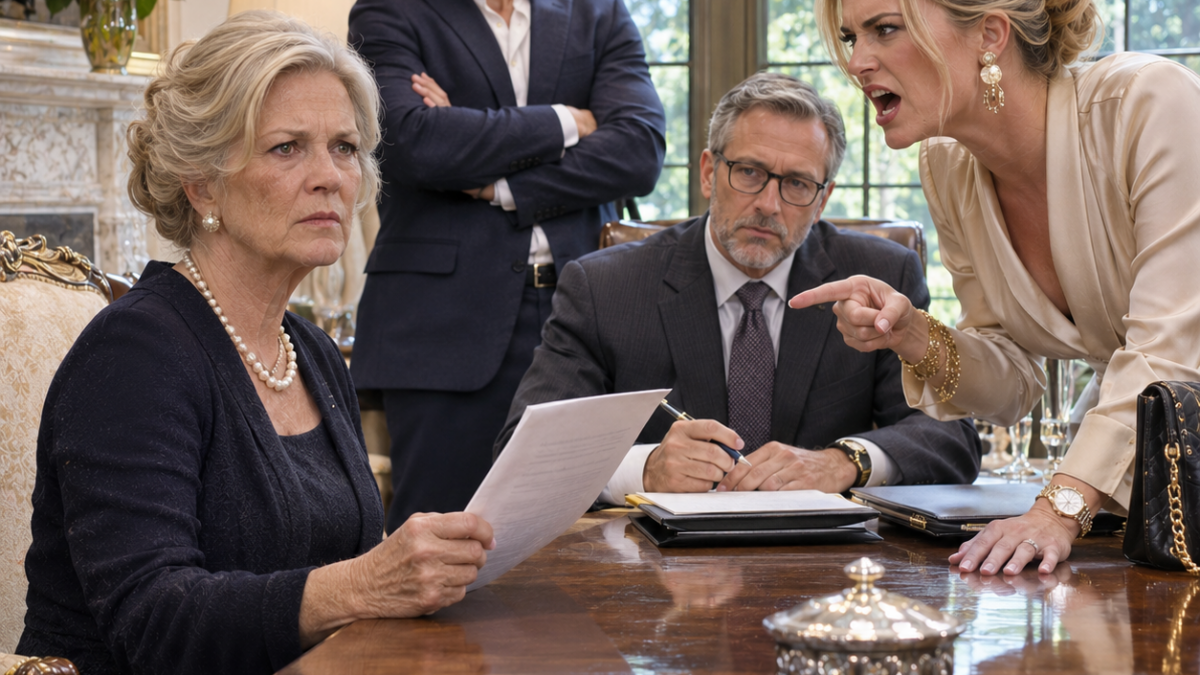
“Give Us $10 Million—or We’ll Have You Declared Incompetent!” My Son’s New Wife Threatened Six Days After Their $68,400 Wedding. Her Lawyer Claimed My Late Husband Had Left Me $53.24 Million and Demanded Another $30,000 Every Month. I’d Never Told My Son About That Fortune. When I Asked Him to Come Home Alone, He Brought Something That Changed Everything…
The woman standing in my living room had been my daughter-in-law for six days when she threatened to have me declared mentally incompetent.
She wore a cream-colored coat, diamond earrings, and the same satisfied smile she’d worn at her wedding reception.
Beside her stood a man in a charcoal suit carrying a leather briefcase.
My son was nowhere in sight.
“Mrs. Donnelly,” the man said, “my name is Raymond Keel. I represent your son’s interests concerning your late husband’s estate.”
I looked from him to Sienna.
“Daniel has an attorney?”
Sienna smiled.
“Patricia, let’s not make this unpleasant.”
I’d been making tea when they arrived. Now I stood beside the fireplace, wondering why my son’s new wife had brought a stranger into the house where I’d lived for thirty-eight years.
Raymond opened his briefcase.
“Following Leonard Donnelly’s death, you became the principal beneficiary of assets valued at approximately fifty-three million, two hundred forty thousand dollars.”
The teacup nearly slipped from my hand.
Not because the amount was wrong.
Because my son didn’t know it.
And I’d gone to considerable trouble to keep it that way.
I set the cup down carefully.
“Where did you get that number?”
Raymond slid two documents across my coffee table.
“The first concerns the validity of your husband’s trust. The second seeks appointment of a guardian to oversee your financial affairs.”
I stared at him.
“You’re threatening to put me under guardianship?”
“We prefer to avoid litigation,” he answered smoothly.
Sienna settled into Leonard’s old armchair.
“Daniel and I are only asking for what’s fair.”
I looked at her.
“Which is?”
“Ten million dollars immediately. Then thirty thousand a month.”
For a moment, I could hear nothing except the old grandfather clock in the hallway.
Leonard had bought it at an estate sale the summer before Daniel was born.
He’d repaired the movement himself.
Now it seemed to be ticking louder than ever.
“Ten million,” I repeated.
Sienna crossed her legs.
“You can afford it, Patricia. Sitting on that kind of fortune while your only son struggles is selfish.”
My son was a university literature professor with a steady salary, an eight-year-old Honda, and a mortgage he could manage.
He wasn’t starving.
He wasn’t homeless.
And until he met Sienna Marsh, he’d never considered his life a failure because he couldn’t afford a luxury watch.
“Where is Daniel?” I asked.
Sienna glanced at Raymond.
“He’s at work.”
“Does he know you’re here?”
“Of course.”
“Then why isn’t he sitting beside you?”
Raymond cleared his throat.
“Your son prefers not to participate in a potentially emotional discussion.”
I looked at the documents.
His name appeared near the top.
DANIEL L. DONNELLY.
My hands went cold.
The boy I’d raised, the boy Leonard had loved more than anything in this world, was apparently threatening to accuse me of manipulating his dying father.
I looked at Sienna.
“Six days ago, I watched you promise to love my son for the rest of your life.”
She shrugged.
“I do love him. That’s why I’m protecting our future.”
Then she leaned forward.
“Sign the agreement, Patricia, and we keep this private. Refuse, and by Friday everyone in Columbus will know exactly how much money you’re hiding.”
I watched her for a long moment.
Then I took the documents and placed them back on the coffee table.
“File whatever you believe you have grounds to file.”
Raymond’s expression changed.
Sienna sat straighter.
“Excuse me?”
“If my son wants to sue me, he can look me in the eye and tell me himself.”
I walked to the front door and opened it.
“Now I’d like you both to leave.”
Sienna didn’t move immediately.
Then she stood.
“You’re making a terrible mistake.”
I looked at her.
“No, Sienna. I made my mistake when I ignored what I saw the first night you came to dinner.”
Her smile disappeared.
She walked past me without another word.
Raymond collected his papers and followed.
After their car disappeared down the street, I closed the door, leaned against it, and began shaking.
My name is Patricia Donnelly.
I’m sixty-eight years old, a retired literature professor, a widow, and the mother of one son.
For most of my life, I believed the worst thing money could do to a family was make people argue over who deserved more of it.
That afternoon, I learned there was something worse.
Money could make you wonder whether the child you’d raised still loved you.
Or whether someone had taught him to see you as an obstacle standing between himself and a fortune.
And as I stood in the quiet house my husband had built for us, I remembered something Leonard told me shortly before he died.
“Patty, don’t count your money where people can see you counting.”
I hadn’t understood how much that warning would matter.
Not until Sienna Marsh walked through my front door.
Six months earlier, I’d been perfectly happy with my life.
Leonard had been gone for three years.
I missed him every day, but I’d learned to live with the quiet.
On Wednesday mornings, I taught a small literature seminar for older adults at a community education center.
We read novels, argued over characters, and pretended the eleven students had completed their assignments.
Most of them hadn’t.
I drove an aging Honda, shopped with coupons when I remembered to clip them, and kept wearing the same wool coat I’d owned for fifteen winters.
People often asked why I hadn’t bought a newer car.
I always gave the same answer.
“Because this one starts.”
Leonard would’ve laughed at that.
He’d started working behind the counter of a small hardware store when he was nineteen.
By the time he retired, he’d built a chain of thirty-one stores across Ohio and neighboring states.
He understood inventory, customers, and employees in a way that impressed people who’d earned business degrees from places he’d never visited.
But he never forgot what it felt like to count change for groceries.
He wore the same winter jacket for years.
Repaired things instead of replacing them.
And insisted our son learn to work before expecting to inherit anything.
When Leonard sold the business, the transaction was far more substantial than most people knew.
He arranged the proceeds through a carefully structured family trust, established years before his final illness.
By the time he died, the assets in the trust were valued at $53.24 million.
I didn’t keep that amount in a checking account.
Much of it was invested and professionally managed.
The trust provided for me during my lifetime and established a separate protected inheritance for Daniel.
Leonard had been particular about that.
“Daniel should have a good life,” he’d said. “But I don’t want him to spend his youth waiting for mine to end.”
I’d agreed.
After Leonard’s funeral, Daniel received the required notice concerning the trust.
He signed for it.
Apparently, he never read much beyond the first page.
He knew his father had sold the hardware stores.
He knew I was comfortable.
But he had no idea how much money Leonard had left.
And I saw no reason to make the number part of our everyday conversations.
Daniel was thirty-five, taught American literature at a university in Columbus, and lived in a modest apartment near campus.
He enjoyed his work.
He drove an old Honda.
He sometimes complained about faculty meetings and students who thought reading the opening paragraph of a novel counted as finishing it.
He was a good man.
At least, I had always believed he was.
Then one Sunday in November, he brought Sienna home for dinner.
And for the first time since Leonard died, I wished my husband were sitting at the head of the table.
Daniel had told me he was bringing someone special.
He didn’t tell me she was a real estate agent.
That became obvious within ten minutes of her arrival.
Sienna was thirty-one, with long dark hair, expensive shoes, and a smile that seemed to adjust itself depending on whom she was speaking to.
She carried a bottle of wine and a bouquet of white roses.
“Mrs. Donnelly,” she said, “I’ve heard so much about you.”
“Please. Patricia.”
She looked around our entryway.
“What a charming house. Are these the original hardwood floors?”
I glanced down.
“Leonard installed them the summer we moved in.”
“Really? They’re beautiful.”
She stepped into the living room.
“And that fireplace? Original too?”
“Yes.”
“Such craftsmanship. Homes like this are getting harder to find.”
Daniel laughed.
“Mom, she’s a realtor. Everything’s a potential listing.”
Sienna playfully struck his arm.
“I can’t help appreciating good property.”
I smiled.
I wanted to like her.
That mattered.
My son had never been lucky in love, and I’d worried that he was spending too much of his life alone with his books.
He was kind, intelligent, and loyal.
He also had a habit of overlooking things about people because he wanted to believe the best of them.
Leonard used to say Daniel inherited my optimism and his father’s terrible sense of direction.
Sienna seemed to make him happy.
He couldn’t stop looking at her.
When I asked how they’d met, he laughed.
“She was standing beside the fountain outside the art museum. I was looking at her instead of where I was walking.”
Sienna grinned.
“He put one whole foot into the fountain.”
“It was a small fountain,” Daniel protested.
I laughed.
For the first time in months, the dining room felt lively.
Over dinner, Sienna asked about Leonard.
Daniel told her the story of how his father had once sold a snowblower to the mayor in July, then arranged to have it delivered with a red ribbon during the first snowfall.
Sienna laughed politely.
“Daniel says his father owned a few hardware stores.”
“A few more than that,” I answered.
“Did he sell them before he died?”
“Yes.”
“That must’ve been quite a transaction.”
I lifted my water glass.
“It allowed him to retire comfortably.”
She waited, perhaps expecting more.
I offered none.
Later, Sienna asked where the powder room was.
I directed her down the hallway.
She was gone a surprisingly long time.
When she returned, she said a client had called.
“Even on Sundays,” she added with a little laugh. “Real estate never sleeps.”
After dinner, Daniel helped me carry dishes into the kitchen.
“Well?” he asked.
“Well what?”
“What do you think?”
I rinsed a plate.
“She’s certainly interested.”
“In me?”
I hesitated.
“In a great many things.”
He frowned.
“Mom.”
I dried my hands.
“She’s charming, sweetheart. Just take your time getting to know her.”
He smiled.
“I will.”
I believed him.
That was my first mistake.
Two months later, Sienna moved into his apartment.
Daniel told me over coffee.
“She’s been spending almost every night there anyway.”
“That’s quite a change.”
“When you know, you know.”
I looked at him.
“Your father asked me to marry him after eight months.”
“Exactly.”
“Eight months, Daniel. Not eight weeks.”
He laughed.
“Mom, times have changed.”
I didn’t argue.
But I noticed other changes.
Daniel began dressing differently.
The old brown leather satchel he carried to campus disappeared.
He replaced it with an expensive briefcase.
His favorite watch, a gift from Leonard, went into a drawer because Sienna said it looked outdated.
Then he bought a new one that cost more than some of my students earned in a month.
He showed it to me proudly.
“Sienna picked it out.”
“It’s handsome.”
“She says I’ve been living like a graduate student.”
I looked at him.
“And did that bother you before?”
He hesitated.
“Not really.”
“Then why does it bother you now?”
He smiled awkwardly.
“Mom, there’s nothing wrong with wanting something nicer.”
“No, honey. There isn’t.”
But I wondered whether he’d started wanting those things himself.
Or whether somebody was teaching him that the life he’d built wasn’t good enough.
One afternoon, he showed me the new tablet Sienna had bought him.
“She linked my old iPad to her account so we can browse property listings together. Our phones and tablets share things automatically.”
“Property listings?”
“We might buy a house.”
“You’ve only been living together a few weeks.”
He rolled his eyes.
“Here we go.”
I touched his arm.
“I’m not criticizing you. I’m asking whether you’re comfortable with how quickly everything is moving.”
He kissed my cheek.
“Very.”
Then came Leonard’s birthday.
Every year, Daniel and I visited the cemetery together.
It wasn’t a solemn ceremony.
We usually brought flowers, stood beside the stone, and told Leonard what had happened since our last visit.
Daniel complained about his students.
I complained about my knees.
Then we went somewhere for lunch.
It was our little tradition.
That year, Daniel promised he’d meet me at eleven.
At ten-thirty, he hadn’t called.
At eleven, I waited by the cemetery gate.
At eleven-fifteen, I tried his phone.
Sienna answered.
“Oh, Patricia. Daniel’s busy.”
“Busy?”
“He came to my brokerage’s new-year kickoff. It’s an important networking event.”
I stared at Leonard’s flowers on the passenger seat.
“He promised to visit his father’s grave with me.”
“I’m sure Leonard would want Daniel to get ahead.”
I closed my eyes.
“You never met Leonard.”
There was silence.
Then she said, “I’ll tell him you called.”
Daniel didn’t come.
I visited Leonard alone.
I laid the flowers beside the stone.
Then I sat on the nearby bench until my hands grew cold.
“Well, Len,” I whispered, “I think our boy is in love.”
The wind moved through the bare trees.
“And I think I’m beginning to understand why you worried about money.”
I didn’t tell Daniel how badly the missed visit hurt.
When he called that evening, he apologized.
Sienna had apparently said the cemetery visit was next weekend.
I believed he was telling the truth about what she’d told him.
But I also knew he’d forgotten something that had mattered to him for years.
In March, he proposed.
Sienna accepted.
Then they announced the wedding would be on May second.
Seven weeks away.
I nearly dropped my coffee.
“Seven weeks?”
“The Marlowe had a cancellation,” Daniel explained. “It’s an incredible venue.”
Sienna appeared beside him on the video call.
“We’ve done all the planning already.”
She began listing the arrangements.
A designer gown.
Custom suits.
A live band.
Five courses.
An open bar.
Orchids flown from Colombia.
A photographer whose work appeared in Columbus Monthly.
Then she mentioned the total.
Sixty-eight thousand, four hundred dollars.
I stared at the screen.
“For a wedding?”
Sienna smiled.
“Well, we only do this once.”
I looked at Daniel.
“Can you afford it?”
He glanced toward her.
“We’ve got a plan.”
Sienna leaned closer.
“Traditionally, the bride’s family contributes, but my parents are having a difficult year. Daniel said Leonard left you quite comfortable.”
I felt something tighten in my chest.
“Leonard provided for his family.”
“Of course.”
I offered a substantial contribution toward the celebration, an amount I’d discussed with my financial adviser.
Sienna looked disappointed.
“That’s generous,” she said carefully.
Daniel thanked me.
But several days later, he called alone.
“Sienna’s upset.”
I sighed.
“About what?”
“She thinks most widows in your position would help their only son a little more.”
I sat down.
“Daniel, you don’t have to spend nearly seventy thousand dollars to prove you love somebody.”
“We’re not trying to prove anything.”
“Then why not have a smaller wedding?”
He didn’t answer.
Finally, he said, “It’s handled, Mom. The loan went through.”
My stomach dropped.
“You borrowed money for the reception?”
“It’s manageable.”
I wanted to argue.
Instead, I reminded myself that he was an adult.
He had the right to make financial decisions I wouldn’t have made.
I couldn’t protect him from every mistake.
But I also didn’t have to finance every choice.
I told him I loved him.
Then I ended the call.
That was the evening I overheard Sienna say the words that should have stopped the wedding.
And when I told Daniel, he chose not to believe me.
Sienna was visiting one Sunday afternoon to discuss the wedding flowers.
She’d brought three sample arrangements and enough photographs to fill a small magazine.
I made tea.
Daniel went upstairs to look for an old family photograph she wanted to include in the reception display.
Sienna stepped into the hallway to take a phone call.
I was carrying the empty teapot toward the kitchen when I heard her voice.
“She has absolutely no idea.”
I stopped.
There was a pause.
Then Sienna laughed.
“His mother’s sitting on a fortune and dressing like a librarian.”
I felt my face grow hot.
She lowered her voice.
“Once the ring’s on, we get our share. One way or another.”
I stood motionless.
Then she ended the call and turned.
Our eyes met.
For half a second, she looked startled.
Then her smile returned.
“Patricia. I was just talking to a client.”
I didn’t answer.
Daniel came downstairs carrying the photograph.
“Found it!”
I looked at him.
“Honey, could we speak privately?”
Sienna tilted her head.
“Is something wrong?”
“I’d like a moment with my son.”
She smiled tightly.
“Of course.”
Daniel followed me into the kitchen.
I told him what I’d heard.
He stared at me.
“Mom, you misunderstood.”
“I know what she said.”
“She was discussing a real estate client.”
“She said your mother.”
He frowned.
“Are you sure?”
“I was standing ten feet away.”
Sienna appeared in the doorway.
“What’s going on?”
Daniel looked at her.
“Mom says you were talking about her money.”
Sienna laughed.
“Oh, Patricia. You heard me talking about the Hendricks family.”
“The Hendricks family?”
“One of my clients. The son is getting married, and his mother owns a lake house worth a fortune. She won’t list it until after the wedding.”
She smiled.
“When I said we’d get our share, I meant the sales commission.”
I stared at her.
“And the librarian comment?”
She shrugged.
“I was talking about the client’s mother. It’s a private joke.”
Daniel looked toward me.
“See?”
I wanted to tell him how convenient the explanation sounded.
How quickly she’d supplied details.
How she’d used his affection for her as a shield.
Instead, I asked one question.
“What’s the property address?”
Sienna’s smile weakened.
“Patricia, I’m not sharing confidential client information just to satisfy your curiosity.”
Daniel sighed.
“Mom, please.”
I looked at him.
He wasn’t angry exactly.
He looked disappointed.
As though I were the person hurting someone he loved.
That was worse.
“I’m asking you to be careful,” I said.
He took Sienna’s hand.
“And I’m asking you to come to my wedding and be happy for me.”
I wanted to reach across the room and hold the little boy he’d once been.
Instead, I nodded.
“I’ll be there.”
They left half an hour later.
I waited until their car disappeared before calling Ellen Navarro.
Ellen had been Leonard’s attorney and my friend for more than twenty years.
She knew the trust better than anyone except the people who’d built it.
I met her the following morning.
She listened while I described the conversation.
Then she opened a file.
“First, Patricia, let’s be clear about the legal position.”
I nodded.
“Leonard created the trust twelve years before his illness. It was properly executed, funded, and administered. His medical records from that period present no indication that he lacked capacity.”
She turned another page.
“Daniel received the required trust notice after the funeral. Any ordinary challenge based on those circumstances would face major procedural and evidentiary obstacles.”
I let out a breath.
“Could Sienna get access through marriage?”
“Not simply by marrying Daniel. The inheritance intended for him is held under separate trust provisions. She doesn’t become an owner or beneficiary merely because she’s his wife.”
Ellen studied me.
“Does Daniel know the total value?”
“No.”
“Do you intend to tell him?”
“I don’t know.”
She nodded.
Then suggested an independent professional co-trustee.
Not because I couldn’t manage my affairs.
Because a second fiduciary would make the records more transparent and reduce the opportunity for anyone to claim that I was secretly acting alone or mishandling the trust.
We also discussed preserving evidence of my financial decision-making and updating safeguards against unauthorized access.
I agreed.
“And Sienna?” Ellen asked.
I looked down.
“I could hire somebody to investigate her.”
“You could ask for lawful background research. But you don’t have to.”
I shook my head.
“If she’s innocent, Daniel might never forgive me for treating her like a criminal.”
“And if she isn’t?”
I looked toward the window.
“Then I want him to see it for himself.”
Ellen closed the folder.
“That may take time.”
“I know.”
She leaned forward.
“One more thing. Do not respond to threats about your money without speaking to me first.”
I smiled faintly.
“That’s why you’re here.”
The wedding went ahead on May second.
The ceremony was beautiful.
I won’t pretend otherwise.
Daniel looked handsome in his suit.
Sienna wore a white gown with a long lace train.
The flowers were extraordinary.
The music was lovely.
And when my son stood before her and promised to love her, I believed every word he said.
That was what made the day painful.
I wasn’t watching a villain marry my son.
I was watching a man I loved promise himself to someone I no longer trusted.
During the reception, Sienna raised a glass.
“To my wonderful new mother-in-law, Patricia. Thank you for welcoming me into a family with so much security.”
The word lingered.
Security.
Not kindness.
Not love.
Not history.
Security.
Daniel smiled at her.
I lifted my glass.
Later, Sienna’s mother approached me near the terrace.
She looked exhausted.
“I wanted to tell you something,” she said.
I turned.
She glanced toward the reception hall.
“We couldn’t help with the wedding. Sienna put her share on three credit cards. They’re nearly maxed out.”
I frowned.
“Why?”
“She said it was an investment.”
“An investment in what?”
Her mother looked ashamed.
“When she first told us about Daniel, she talked about Leonard’s stores more than she talked about your son.”
Before I could respond, she shook her head.
“I’m sorry. I shouldn’t have said that.”
Then she walked away.
At the end of the evening, Daniel came to say goodbye.
He and Sienna were flying to Maui for their honeymoon.
I hugged him.
“Call me when you get there.”
“I will.”
He looked at me for a moment.
“Mom, about that phone call you overheard…”
My heart lifted.
Maybe he was ready to talk.
Then Sienna appeared.
“Babe, the photographer wants us by the river before the light disappears.”
Daniel glanced at her.
Then back at me.
“We’ll talk later.”
I nodded.
“Have a wonderful trip.”
I stood on the terrace and watched them walk away.
Six days later, Sienna returned with Raymond Keel.
She claimed Daniel wanted $10 million immediately and $30,000 every month afterward.
When I refused, she threatened to make our family’s finances a public spectacle.
And for the first time since Leonard died, I wondered whether the trust he’d built so carefully would protect our money but fail to protect our son.
That night, I called Daniel.
He didn’t answer.
I left a voicemail.
“Honey, it’s Mom. Please call me. Not about money. About you.”
Then I sat beside Leonard’s old desk and waited.
The following evening, there was a knock at the front door.
When I opened it, Daniel stood on the porch.
Alone.
He looked as though he hadn’t slept.
“Mom,” he said. “Can I come in?”
I stepped aside.
He walked into the living room, looked toward his father’s chair, and began crying.
I hadn’t seen Daniel cry like that since Leonard’s funeral.
He sat on the edge of the couch, elbows on his knees, looking at the floor.
I brought him a glass of water.
For several minutes, he didn’t speak.
Then he looked up.
“I think I made a terrible mistake.”
I sat beside him.
“Tell me.”
He took a breath.
“Sienna and I came back from Maui on Tuesday. She told me there was an emergency at the brokerage and went straight into the office.”
I nodded.
“Yesterday she came home furious. Said she’d visited you and that you were cruel to her.”
I remained silent.
“She said you threw her out and refused to discuss Dad’s estate.”
I waited.
Then Daniel looked at me.
“Did she come here?”
“Yes.”
“With a lawyer?”
“Raymond Keel.”
He closed his eyes.
I continued.
“They demanded ten million dollars and thirty thousand a month.”
His head snapped up.
“What?”
“They brought proposed court documents bearing your name.”
I watched his face drain of color.
“They said you wanted to challenge your father’s trust. They also threatened to ask a court to appoint a guardian over my finances.”
Daniel stared.
“I never asked for that.”
“Then I need you to tell me what happened.”
He reached into his bag and took out a tablet.
“First, I owe you an apology.”
I waited.
“When you told me about Sienna’s phone call, I didn’t believe you.”
“I know.”
“I searched her brokerage website afterward. I looked for a Hendricks listing. I couldn’t find one.”
“That doesn’t necessarily mean it never existed.”
“I told myself that.”
He swallowed.
“Then on Maui, she kept taking calls outside on the balcony. Every time I walked toward her, she ended the conversation.”
He opened a photograph on the tablet.
It showed a sheet from a hotel notepad.
Across the top were the initials P.D.
Beneath them:
53.24
And farther down:
10M + 30K/month
I stared at the photograph.
“Where did you find this?”
“Beside the bed. She’d left it under a room-service menu.”
He looked ashamed.
“I asked what it meant. She said it was a client investment calculation.”
I didn’t answer.
Daniel continued.
“When we got home, I remembered my old iPad.”
“The one you said she linked to her account?”
He nodded.
“She gave me a new one when we got engaged. I hadn’t used the old one in months.”
He explained that he’d charged it and discovered her account was still signed in, as she’d arranged when they began sharing property listings.
Messages and attachments from her account were appearing on the device.
He had photographed what was visible and taken the tablet to Ellen’s office rather than forwarding everything to his friends or trying to break into additional accounts.
Ellen had advised him to preserve the device and have the legal implications of using those communications evaluated.
But he’d seen enough.
He showed me a message from November.
It was addressed to a woman named Tasha.
His mother plays poor. Found a paper in the dad’s desk. 53.24.
I felt cold.
November.
The first evening Sienna came to dinner.
The twenty minutes she’d spent supposedly answering a client’s call near the powder room.
Leonard’s desk stood just beyond that hallway.
Inside it was the one folder Ellen and I hadn’t moved to the trust office because it contained a personal letter Leonard had written shortly before he died.
The folder also included an old financial summary.
Leonard had tied it with a ribbon.
He’d always tied everything with a double knot.
Daniel looked at me.
“She went through Dad’s desk that first night.”
I nodded slowly.
“That’s what it appears.”
Another message was dated March.
He proposed. Five months. Told you.
The next came after my confrontation with Sienna over the overheard call.
Old lady heard me on the phone. Danny bought the Hendricks thing. Need to move fast before she gets him alone.
I closed my eyes.
There had never been a Hendricks client.
Sienna had invented the explanation while standing in my kitchen.
Then Daniel showed me the latest message.
Raymond says if Danny signs, she’ll pay to keep it quiet. Danny will sign. He always does what I tell him.
Daniel looked at me.
“Mom, I never retained Raymond Keel.”
I took his hand.
“Then we need to make that clear.”
He nodded.
Then he asked the question I’d been dreading.
“What is fifty-three point two four?”
I looked at him.
For years, I’d avoided saying the number.
I’d told myself I was protecting his independence.
That Leonard wanted him to have a life outside the family fortune.
That a young professor with a steady salary didn’t need to know the exact size of his future inheritance.
All of that was true.
But I could see the hurt in his face.
“It’s the value of what your father left in trust,” I said.
“Fifty-three million?”
“Fifty-three million, two hundred forty thousand dollars at the valuation Sienna found.”
Daniel stared at me.
“Dad owned thirty-one hardware stores.”
“Yes.”
“And he never told me?”
“He taught you how to earn a living.”
My son looked toward Leonard’s empty chair.
“You let me borrow money for my own wedding.”
I felt the accusation.
“I offered to help. I also told you the wedding was more expensive than you could reasonably afford.”
He looked away.
“That’s not what I mean.”
“I know.”
His voice broke.
“You didn’t trust me.”
I sat quietly for a moment.
Then I said, “Your father and I trusted you to build a life of your own. But perhaps we should’ve been more open about what he arranged.”
Daniel wiped his eyes.
“If I’d known about the money, Sienna would’ve found out.”
“Possibly.”
He gave a bitter laugh.
“She found out before I did.”
I squeezed his hand.
“That’s why we’re going to stop keeping secrets from each other.”
He nodded.
“No more secrets.”
We called Ellen that evening.
She arrived carrying the trust documents and enough patience to explain what Leonard had built.
She confirmed the trust’s history and structure.
Leonard had established it twelve years before his illness.
A professional fiduciary affiliated with Ellen’s firm had become co-trustee alongside me that spring.
Daniel’s future inheritance was held under separate provisions designed to protect it from ordinary claims arising solely through marriage.
Sienna had no automatic right to the trust.
As for the threatened guardianship, Ellen explained that a substantial estate and an older beneficiary weren’t evidence of incapacity.
I still taught classes, managed my household, reviewed financial statements, and participated in investment decisions with the trustees.
There was no legitimate medical basis identified for stripping me of those rights.
“And the petition?” Daniel asked.
Ellen looked at him.
“Without your authorization, Mr. Keel cannot properly represent that he acts for you. We will require clarification immediately.”
Daniel leaned forward.
“I want Sienna to hear me tell him that.”
Ellen considered the request.
“Then we should arrange a meeting with counsel present.”
I looked at my son.
He seemed older than he had when he arrived.
More tired.
But also more determined.
“What are you going to do about the marriage?” I asked gently.
He stared at his hands.
“I don’t know whether anything she told me was real.”
Ellen spoke carefully.
“We can review whether the circumstances support an annulment based on fraud or whether divorce is the appropriate remedy. That’s a legal question, not a punishment we can promise.”
Daniel nodded.
“Sienna’s wedding expenses were on her credit cards. The loan I took out is in my name.”
“You’ll need to address your own debt obligations,” Ellen said. “But a six-day marriage doesn’t entitle her to your mother’s trust.”
Daniel looked at me.
Then he did something that made me cry.
He stood, crossed the room, and hugged me.
“I’m sorry I didn’t believe you.”
I held him tightly.
“I’m sorry I didn’t tell you more.”
For a long moment, we stood beside his father’s old chair.
Then Daniel stepped back.
“I know how we settle this.”
I looked at him.
“How?”
“We invite Sienna here.”
Ellen raised an eyebrow.
Daniel continued.
“Tell her you’re ready to discuss the family money.”
I understood immediately.
“She’ll come.”
He nodded.
“And this time, I want her to explain everything while I’m sitting across from her.”
We arranged the meeting for seven that evening.
I called Sienna.
She answered on the second ring.
“Patricia?”
“I’ve been thinking about what you said.”
A pause.
Then her voice softened.
“I’m glad.”
“I think we should discuss the family money in person.”
“Of course.”
“Seven o’clock. Bring the paperwork.”
She sounded almost cheerful.
“That’s wonderful, Patricia. I knew you’d come around.”
After I hung up, Daniel looked at me.
“She’ll bring Raymond.”
“Probably.”
He glanced toward Ellen.
“Then let’s make sure we’re ready.”
At seven, Sienna arrived in the same cream-colored coat she’d worn when she threatened me.
She walked through my front door smiling.
She had no idea Daniel was sitting in the dining room.
And for the first time since meeting her, I was certain she was about to hear the word no from the one person she believed would always say yes.
Sienna stopped smiling when she saw Daniel.
He stood beside the dining room table, holding a folder.
Ellen Navarro sat near the fireplace.
I remained by the door.
For a moment, Sienna looked from one face to another.
Then she laughed nervously.
“Well. A family meeting.”
Daniel didn’t smile.
“Sit down, Sienna.”
She looked at me.
“Patricia, I thought we were discussing your contribution to our future.”
“We are,” I said. “But first, I want to know why you’ve been threatening me in my son’s name.”
Her expression hardened.
“That’s a very unfair way to describe what happened.”
Daniel placed the tablet on the table.
“Then explain these.”
He opened the first message.
November.
His mother plays poor. Found a paper in the dad’s desk. 53.24.
Sienna stared.
“Where did you get that?”
“My old iPad.”
Her face changed.
“You went through my private messages?”
Daniel looked at her.
“You linked your account to my tablet. You told me we had nothing to hide from each other.”
“Those were jokes. With Tasha. That’s how we talk.”
He opened the next message.
He proposed. Five months. Told you.
Then another.
Danny bought the Hendricks thing.
I spoke quietly.
“There never was a Hendricks family, was there?”
Sienna folded her arms.
“I work with hundreds of clients. You can’t expect me to remember every conversation.”
“Then perhaps you’ll remember going through Leonard’s desk.”
Her eyes shifted toward the hallway.
I continued.
“The first night you came here, that folder was tied with a ribbon. Leonard always made double knots. When I found it afterward, it had been tied with a single one.”
Sienna said nothing.
Daniel looked at her.
“You found the number before we were engaged.”
She lifted her chin.
“I was curious about your family. What woman wouldn’t be?”
“A woman who loved me wouldn’t have needed to search my father’s private papers.”
Her mouth tightened.
“I did love you.”
“Then why did you arrange for a lawyer to threaten my mother?”
She turned toward me.
“Because your mother has fifty-three million dollars while you drive around in a car that’s falling apart!”
Daniel stared.
“That car gets me to work.”
“You teach literature, Daniel. You live like a graduate student!”
“I like teaching.”
She laughed bitterly.
“Fine. Keep teaching. But why should we struggle when that kind of money is sitting there?”
I looked at her.
“Because the money isn’t yours.”
Sienna’s eyes flashed.
“I’m his wife.”
“For six days,” Daniel replied.
She turned toward him.
“Daniel, don’t let her turn you against me.”
He opened the last message.
Danny will sign. He always does what I tell him.
Then he looked up.
“Not this time.”
Sienna’s expression changed.
She glanced toward the front window.
“Raymond’s waiting outside.”
Daniel nodded.
“Then let’s invite him in.”
She hesitated.
“Daniel—”
“Please.”
I opened the door a few minutes later.
Raymond Keel entered carrying the same briefcase.
He seemed surprised to find Ellen sitting with us.
“Ms. Navarro.”
“Mr. Keel.”
He looked at Daniel.
“Mr. Donnelly. I understand we’re ready to proceed.”
Daniel stood.
“Proceed with what?”
Raymond opened his folder.
“The proposed settlement. The documents are marked for your signature.”
He placed them on the table.
Ten million dollars.
Thirty thousand a month.
Threatened trust litigation.
Threatened guardianship proceedings.
My son’s name on papers he’d never authorized.
Daniel didn’t touch the pen.
“Mr. Keel, I’ve never met you before tonight.”
Raymond went still.
“I beg your pardon?”
“I didn’t hire you. I didn’t authorize a claim against my mother. And I’m not signing these documents.”
Raymond looked toward Sienna.
She began speaking rapidly.
“I explained everything to him. He agreed we needed to protect our interests.”
Daniel shook his head.
“No. You told me Mom was being unfair about Dad’s estate. You never told me you’d threatened to have her declared incompetent.”
Ellen leaned forward.
“Mr. Keel, you approached a widow claiming to represent her son and demanded substantial payments under threat of court proceedings. I strongly suggest you verify the identity and instructions of any client before taking further action.”
Raymond closed his briefcase.
His face had gone pale.
“Ms. Marsh, I was given to understand your husband had authorized this.”
“He would have signed!”
Daniel’s voice was quiet.
“But I didn’t.”
Raymond stood.
“I cannot proceed on the representations I’ve been given.”
Sienna stared at him.
“You can’t just leave!”
He looked at Ellen.
“I’ll communicate through appropriate counsel after reviewing the circumstances.”
Then he walked out.
Sienna remained standing beside the table.
For the first time since I’d met her, she seemed to have run out of explanations.
Daniel took another folder from his bag.
“My attorney is reviewing whether this marriage can be annulled for fraud. If annulment isn’t available, I’ll file for divorce.”
Sienna stared.
“You can’t be serious.”
“I am.”
She turned toward me.
“This is what you wanted.”
I shook my head.
“I wanted my son to be happy.”
“You wanted to keep your money!”
I looked at her.
“Leonard built thirty-one hardware stores. He worked for decades. He paid his employees before he paid himself. He drove the same truck for fifteen years because he didn’t believe looking wealthy was the same thing as living well.”
Sienna rolled her eyes.
“Fifty-three million dollars, and you people clip coupons.”
Daniel stood straighter.
“My father wasn’t pretending to be poor. He was careful about what money could do to people.”
Sienna laughed.
“Do you know what I could have done with that fortune?”
I looked toward Leonard’s photograph on the mantel.
“Yes,” I said. “I think you’ve made that very clear.”
She grabbed her handbag.
“I’m his wife. I have rights.”
Daniel nodded.
“You have whatever rights the law gives you. But you don’t have the right to threaten my mother with accusations you know aren’t true.”
He handed her a notice directing future legal communications through counsel.
Ellen explained that Sienna wasn’t to come to my home or contact me to demand money.
Sienna looked around the living room one last time.
The hardwood floors.
The old paintings.
Leonard’s repaired clock.
The furniture we’d collected over nearly four decades.
Then she looked at Daniel.
“You’ll regret this.”
His expression was sad.
“Maybe I’ll regret not seeing the truth sooner.”
I opened the door.
Sienna walked outside.
No Raymond beside her.
No signed settlement.
No ten million dollars.
Just her expensive handbag and the sound of her heels against the front steps.
After her car left, Daniel sat on the couch and covered his face.
“I can’t believe I didn’t see it.”
I sat beside him.
“You did see some of it, honey.”
He looked up.
“You warned me.”
“Yes.”
“And I didn’t listen.”
I took his hand.
“You saw what you were ready to see. Then you found the courage to look closer.”
He stared toward the door.
“I loved her.”
“I know.”
“Maybe that’s what hurts most.”
I put my arm around his shoulders.
We stayed there until Leonard’s clock struck nine.
Then I made tea.
Not because tea could solve anything.
Because it was what I’d always done when someone in my family was hurting.
The legal consequences took time.
Ellen made sure the threatened papers and the circumstances surrounding Raymond’s involvement were preserved and reviewed through the appropriate channels.
Daniel obtained separate legal counsel for the marriage.
After examining the evidence concerning Sienna’s representations and intentions before the wedding, his attorney pursued an annulment based on fraud.
It wasn’t automatic simply because the marriage had been brief.
The court had to determine whether the legal grounds existed.
That June, the annulment was granted.
The marriage was declared void under the applicable ruling.
Sienna remained responsible for the credit-card obligations she’d incurred in her own name, subject to the ordinary rules governing those accounts.
Daniel still owed the money he’d borrowed for the wedding.
He refused my offer to help.
“Mom, it’s my loan.”
“You know I could pay it.”
“I know.”
He smiled faintly.
“Dad wouldn’t have.”
I didn’t argue.
I knew what he meant.
It wasn’t about whether he could accept help.
It was about making his own decisions again.
There were two years left on the loan.
He made the payments.
He returned the expensive watch.
Kept his old Honda.
And went back to teaching literature.
For several months, he visited every Sunday.
Sometimes we cooked dinner.
Sometimes we worked in the garden.
Sometimes we talked about what happened.
Other times we didn’t.
Gradually, we learned how to be mother and son again without making every conversation about Sienna.
One afternoon, Daniel asked to see the trust documents.
I gave them to him.
This time, he read them.
Every page.
He asked questions.
Ellen answered.
We discussed what Leonard had intended and how Daniel’s eventual inheritance would be managed.
There were no more whispered numbers or sealed conversations.
I didn’t surrender control of my life.
And Daniel didn’t ask me to.
He simply wanted to understand what his father had left and why.
One Sunday the following autumn, Daniel came to dinner looking unusually cheerful.
“There’s someone I’ve been seeing,” he announced.
I smiled.
“Oh?”
“Her name’s Molly.”
“What does she do?”
“Works at the public library.”
“That’s lovely.”
He laughed.
“She drives a Corolla older than my Honda.”
I raised an eyebrow.
“Does she?”
“And brings her lunch to work in a mason jar.”
I laughed.
“Your father would’ve liked that.”
Daniel looked toward the photograph on the mantel.
Then back at me.
“She doesn’t know about the trust.”
I considered my answer carefully.
“Daniel, privacy is reasonable. Just don’t turn it into a test.”
He nodded.
“I won’t.”
“People deserve to get to know each other without money becoming the first thing they see. But they also deserve honesty as a relationship becomes serious.”
He smiled.
“That’s the plan.”
I reached across the table.
“Then I’d love to meet her.”
He squeezed my hand.
“I think you’d like her, Mom.”
After he left, I carried our dishes into the kitchen.
The house was quiet again.
But it was a different kind of quiet from the afternoon Sienna and Raymond had threatened me.
I no longer wondered whether I’d lost my son.
I knew where he stood.
And he knew where I stood.
I walked into Leonard’s old study.
His desk was still beside the window.
The drawer where Sienna had found the financial summary was closed.
I had moved the important documents to secure storage months earlier, but I kept the ribbon she’d untied.
It seemed a strange thing to save.
Yet I wanted to remember how quickly one careless moment could allow somebody into the private parts of a family’s life.
I touched Leonard’s photograph.
“Well, Len,” I whispered, “our boy finally understands.”
Then I thought about Molly.
A librarian with an old Corolla.
A woman who apparently packed her lunch in a jar.
A woman Daniel liked because she made him laugh when he talked about difficult students.
I smiled.
Leonard used to tell me that you could learn a great deal about a person by watching what they did when there was nothing to gain.
Sienna had looked at our family and seen a fortune waiting to be divided.
Daniel had looked at her and seen a future.
The two things were never the same.
I switched off the study lamp.
Then, before going upstairs, I stopped beside the grandfather clock.
It was ticking steadily, just as it had through birthdays, funerals, arguments, weddings, and thirty-eight years of ordinary family life.
Leonard had repaired it with his own hands.
He’d never cared whether anyone knew what it was worth.
He only cared that it kept good time.
And I finally understood the difference between having wealth and being rich in the ways that mattered.
My husband had left me $53.24 million. But the most important thing he left our son was a lesson money could never buy: anyone who loves you only after discovering what you own never loved you enough in the first place.