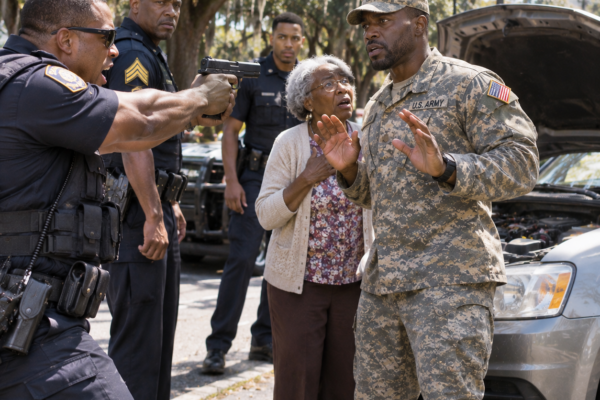
“Get Up, Old Man,” the Officer Snapped Before Kicking My Injured Leg in City Hall. My Cane Crashed to the Floor While a Ten-Year-Old Boy Watched in Terror. The Officer Laughed When I Wrote Down His Badge Number—But Two Floors Above Us, City Officials Were Preparing to Meet the Retired Federal Judge Hired to Investigate His Department.K
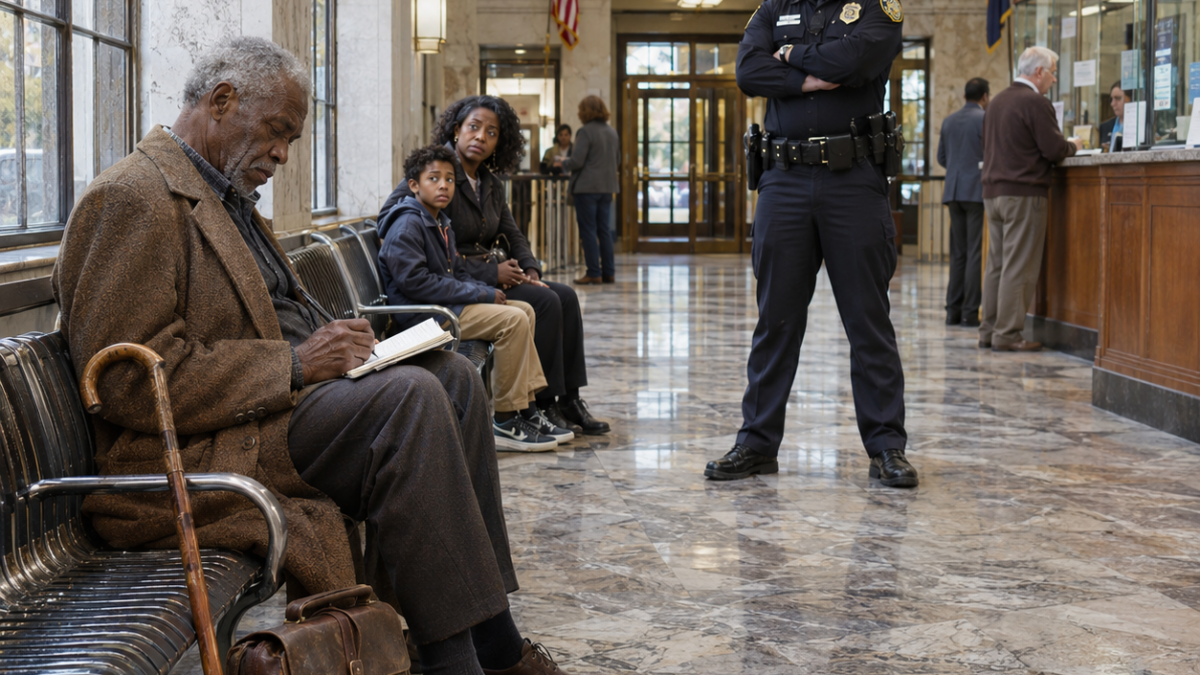
“Get Up, Old Man,” the Officer Snapped Before Kicking My Injured Leg in City Hall. My Cane Crashed to the Floor While a Ten-Year-Old Boy Watched in Terror. The Officer Laughed When I Wrote Down His Badge Number—But Two Floors Above Us, City Officials Were Preparing to Meet the Retired Federal Judge Hired to Investigate His Department.
“Move your briefcase, old man.”
I looked up from my notebook at the police officer standing over me.
The hallway was nearly eight feet wide. My leather briefcase rested beneath the metal bench, and there was enough room for three people to walk past without touching either of us.
“Is it blocking your way, Officer?”
His jaw tightened.
“I didn’t ask you a question. I told you to move it.”
I picked up the briefcase and placed it between my shoes.
“There you go.”
He didn’t leave.
Instead, he looked at my right leg, which was stretched a little farther forward than my left.
“Move your foot.”
I pulled it back beneath the bench.
“Anything else?”
That was apparently the wrong question.
“Yeah,” he said. “Get up. Find somewhere else to sit.”
I studied his face.
He was somewhere in his thirties, broad-shouldered, with close-cropped brown hair and the polished black boots of a man who took considerable pride in his uniform.
His nameplate read COLLINS.
“I’m waiting for an appointment,” I explained. “And I have a bad knee. I’d prefer to remain seated.”
He gave a short, unpleasant laugh.
“I don’t care about your knee.”
It was 9:48 on a cold Tuesday morning at the Belmont Civic Administration Center in Virginia.
I had arrived forty minutes earlier wearing a faded wool coat, an old charcoal sweater, and the same repaired leather shoes I’d owned for nearly a decade.
My name is Walter Bennett. I’m seventy-two years old, and I spent thirty-one years as a judge, including seventeen on the federal bench.
But Officer Derek Collins didn’t know any of that.
Neither did most of the people waiting in the hallway.
I’d deliberately arrived without an escort, without announcing my position, and without wearing anything that might suggest why I was there.
At eleven o’clock, I was supposed to meet the city manager, police chief, legal counsel, and members of Belmont’s newly established Public Safety Review Commission.
The city had hired me as an independent monitor after years of complaints about police misconduct, questionable internal investigations, and expensive lawsuits.
I wanted to understand how ordinary residents were treated when nobody important appeared to be watching.
I’d already seen enough to fill several pages.
Near the public services counter, a young mother named Rachel Moore had been sent back to complete the same government form three times while holding her sleeping daughter.
A seventy-six-year-old veteran had waited almost an hour for assistance with a disability parking permit.
And just minutes earlier, I’d overheard something far more troubling.
A woman named Denise Harper had asked a records clerk about a complaint involving her twenty-two-year-old son.
Six months earlier, a police officer had allegedly shoved the young man against his car during a traffic stop, leaving him with a split lip and bruises.
Denise had submitted photographs, medical records, and a written statement.
Now the clerk’s computer showed something extraordinary.
Complaint 4471 — Withdrawn by Complainant.
“I never withdrew anything,” Denise insisted.
The clerk, Maya Torres, checked the screen again.
“There’s no withdrawal document attached.”
“Because I never signed one.”
Maya’s expression changed.
I wrote down the complaint number.
Then Collins approached my bench.
Now he stood inches from me, his hand resting near his duty belt.
“When an officer tells you to get up, you get up.”
I glanced toward a little boy sitting beside his mother across the hallway. He had stopped drawing and was watching us.
“Officer,” I said, “I have complied with every reasonable request you’ve made. I’m not obstructing anyone.”
Collins leaned closer.
“Are you refusing an order?”
“I’m asking what lawful reason you have to remove me from a public waiting area.”
His face reddened.
“Stand up!”
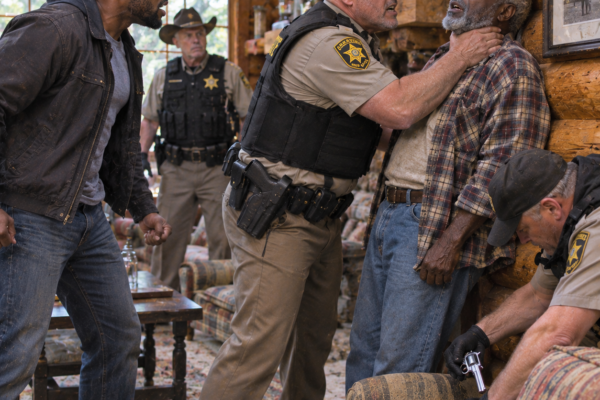
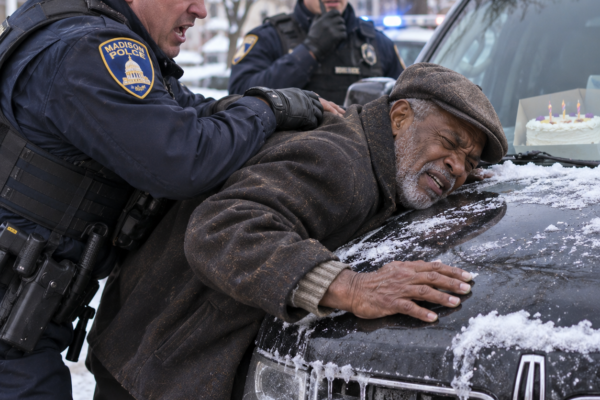
Before I could answer, he drove the front of his heavy boot into my injured right shin.
Pain shot up my leg.
My cane struck the marble floor with a sharp crack.
My briefcase toppled sideways, scattering documents across the hallway.
The little boy screamed.
For several seconds, I couldn’t draw a proper breath.
Then I looked up.
Collins was standing over me.
“Maybe now you’ll learn some respect.”
I reached slowly for my cane.
Across the hallway, Maya had risen from her chair. Denise was staring at the officer in disbelief.
Above us, a black security camera remained pointed directly at the bench.
I looked back at Collins.
“Your name and badge number, Officer.”
He smiled.
“Derek Collins. Badge 3174.”
I opened my notebook and wrote it beneath the number of Denise’s missing complaint.
Collins tapped his badge.
“Write it down, old man. See how much good it does you.”
I closed the notebook.
For the first time that morning, I looked at the camera rather than the officer.
Then I reached for my phone.
Part 2:
“Move your briefcase, old man.”
I looked up from my notebook at the police officer standing over me.
The hallway was nearly eight feet wide. My leather briefcase rested beneath the metal bench, and there was enough room for three people to walk past without touching either of us.
“Is it blocking your way, Officer?”
His jaw tightened.
“I didn’t ask you a question. I told you to move it.”
I picked up the briefcase and placed it between my shoes.
“There you go.”
He didn’t leave.
Instead, he looked at my right leg, which was stretched a little farther forward than my left.
“Move your foot.”
I pulled it back beneath the bench.
“Anything else?”
That was apparently the wrong question.
“Yeah,” he said. “Get up. Find somewhere else to sit.”
I studied his face.
He was somewhere in his thirties, broad-shouldered, with close-cropped brown hair and the polished black boots of a man who took considerable pride in his uniform.
His nameplate read COLLINS.
“I’m waiting for an appointment,” I explained. “And I have a bad knee. I’d prefer to remain seated.”
He gave a short, unpleasant laugh.
“I don’t care about your knee.”
It was 9:48 on a cold Tuesday morning at the Belmont Civic Administration Center in Virginia.
I had arrived forty minutes earlier wearing a faded wool coat, an old charcoal sweater, and the same repaired leather shoes I’d owned for nearly a decade.
My name is Walter Bennett. I’m seventy-two years old, and I spent thirty-one years as a judge, including seventeen on the federal bench.
But Officer Derek Collins didn’t know any of that.
Neither did most of the people waiting in the hallway.
I’d deliberately arrived without an escort, without announcing my position, and without wearing anything that might suggest why I was there.
At eleven o’clock, I was supposed to meet the city manager, police chief, legal counsel, and members of Belmont’s newly established Public Safety Review Commission.
The city had hired me as an independent monitor after years of complaints about police misconduct, questionable internal investigations, and expensive lawsuits.
I wanted to understand how ordinary residents were treated when nobody important appeared to be watching.
I’d already seen enough to fill several pages.
Near the public services counter, a young mother named Rachel Moore had been sent back to complete the same government form three times while holding her sleeping daughter.
A seventy-six-year-old veteran had waited almost an hour for assistance with a disability parking permit.
And just minutes earlier, I’d overheard something far more troubling.
A woman named Denise Harper had asked a records clerk about a complaint involving her twenty-two-year-old son.
Six months earlier, a police officer had allegedly shoved the young man against his car during a traffic stop, leaving him with a split lip and bruises.
Denise had submitted photographs, medical records, and a written statement.
Now the clerk’s computer showed something extraordinary.
Complaint 4471 — Withdrawn by Complainant.
“I never withdrew anything,” Denise insisted.
The clerk, Maya Torres, checked the screen again.
“There’s no withdrawal document attached.”
“Because I never signed one.”
Maya’s expression changed.
I wrote down the complaint number.
Then Collins approached my bench.
Now he stood inches from me, his hand resting near his duty belt.
“When an officer tells you to get up, you get up.”
I glanced toward a little boy sitting beside his mother across the hallway. He had stopped drawing and was watching us.
“Officer,” I said, “I have complied with every reasonable request you’ve made. I’m not obstructing anyone.”
Collins leaned closer.
“Are you refusing an order?”
“I’m asking what lawful reason you have to remove me from a public waiting area.”
His face reddened.
“Stand up!”
Before I could answer, he drove the front of his heavy boot into my injured right shin.
Pain shot up my leg.
My cane struck the marble floor with a sharp crack.
My briefcase toppled sideways, scattering documents across the hallway.
The little boy screamed.
For several seconds, I couldn’t draw a proper breath.
Then I looked up.
Collins was standing over me.
“Maybe now you’ll learn some respect.”
I reached slowly for my cane.
Across the hallway, Maya had risen from her chair. Denise was staring at the officer in disbelief.
Above us, a black security camera remained pointed directly at the bench.
I looked back at Collins.
“Your name and badge number, Officer.”
He smiled.
“Derek Collins. Badge 3174.”
I opened my notebook and wrote it beneath the number of Denise’s missing complaint.
Collins tapped his badge.
“Write it down, old man. See how much good it does you.”
I closed the notebook.
For the first time that morning, I looked at the camera rather than the officer.
Then I reached for my phone.
Collins stepped toward me again.
“Who are you calling?”
“Someone who needs to know what happened.”
“You can file a complaint like everybody else.”
“That’s exactly what I intend to do.”
He gave a dismissive snort and walked toward the elevators.
I watched until the doors closed behind him.
Only then did I allow myself to lean back against the bench.
The pain was sharper than I’d expected. I had injured that knee playing college football more than fifty years earlier, and two operations had left it less forgiving than the rest of me. Collins’s boot had struck below the joint, but the force had driven my leg sideways against the bench support.
Maya hurried toward me.
“Sir, are you all right?”
“I’d appreciate some help getting up.”
She retrieved my cane while a security officer named Aaron Blake gathered the documents that had spilled from my briefcase.
“I saw the whole thing,” Denise said from behind him. “That officer kicked you. You weren’t doing anything.”
Aaron looked uneasy.
“I’m going to document the incident.”
“Please do,” I said. “And call for medical assistance.”
His eyebrows rose, as though he’d expected me to brush it aside.
“I’ll get someone immediately.”
The little boy was still crying softly. His mother, a woman in dental scrubs, had knelt beside him and was speaking close to his ear.
I wanted to tell him he was safe.
But after what he’d just witnessed, I wasn’t sure he’d believe me.
An emergency medical technician arrived from a nearby office and examined my leg. She recommended an urgent-care evaluation to rule out more significant injury.
I thanked her and asked Aaron for a private room while I arranged transportation.
Inside a small conference room beside the security office, I called Rachel Morgan, the attorney coordinating the independent review.
She answered immediately.
“Walter? We aren’t expecting you upstairs for another hour.”
“I’ve been assaulted.”
The silence at the other end was absolute.
“By whom?”
“A Belmont police officer. Derek Collins, badge 3174.”
“Are you injured?”
“Yes. I’ve requested medical attention.”
“Where are you?”
“Inside the civic center.”
Rachel took a breath.
“I’m coming downstairs.”
“Before you do, ask the building’s security supervisor to preserve the recordings from the lobby and second-floor hallway. The incident occurred around 9:48.”
“I’ll make that request immediately.”
“And Rachel?”
“Yes?”
“Complaint 4471. Denise Harper. Her son’s police complaint was marked withdrawn, but she says she never withdrew it.”
I heard her writing.
“Why are you telling me this now?”
“Because I want to know whether the same department that produced Derek Collins has been making complaints disappear.”
I hung up and studied the notebook resting on my lap.
Two numbers sat next to one another.
4471.
3174.
I had no proof that they were connected beyond the fact that both had come to my attention within minutes.
But I knew what my work was supposed to be.
I wasn’t there to punish somebody who had insulted me.
I was there to determine whether Belmont had a system capable of investigating its own officers honestly.
And the events of the morning suggested a very uncomfortable answer.
Rachel arrived with the building’s security supervisor, Calvin Price, a former sheriff’s deputy who had been responsible for municipal security for twelve years.
Calvin confirmed that two cameras covered the waiting area.
Both were operating.
He had already requested an export of the recordings and instructed the contractor not to overwrite the originals.
“Does either camera record audio?” I asked.
“No, Judge. Video only.”
“That’s fine. The witnesses can tell us what was said.”
Rachel looked at Calvin.
“Please document everyone who witnessed the incident and ask them for contact information voluntarily. We don’t want anybody pressured into providing a statement.”
Calvin nodded.
“I’ve already spoken to the mother with the little boy. She’s willing to describe what she saw.”
Rachel turned back to me.
“We need to get you examined.”
“I agree.”
She looked surprised.
“Good. Because I was prepared to argue.”
I almost smiled.
“After seventy-two years, Rachel, I’ve learned when not to argue with a woman holding my medical records.”
At urgent care, X-rays showed no new fracture. The physician documented bruising and soft-tissue injury and advised me to limit weight-bearing for several days.
She asked how it happened.
I told her.
She paused with her pen above the examination form.
“An officer kicked you while you were sitting?”
“Yes.”
“Was there any physical confrontation?”
“No.”
She studied me for a moment, then continued documenting the injury.
I appreciated that she recorded what I said without trying to decide whether I deserved to be believed.
By early afternoon, I was back at the civic center.
Rachel had urged me to go home, but the commission’s first meeting had already been postponed once.
I wanted to attend.
More importantly, I wanted to know how Belmont’s senior officials would react when they discovered what had happened downstairs.
The elevator opened on the fifth floor.
At the end of the hallway, a long conference room overlooked downtown Belmont.
Inside sat City Manager Thomas Avery, Police Chief Harold Benton, municipal counsel, two civilian commission members, and several senior department representatives.
Derek Collins was among them.
He sat beside Lieutenant Raymond Shaw, a silver-haired supervisor whose name appeared in the personnel information I’d reviewed before accepting the assignment.
Neither man looked toward the door until my cane struck the floor.
Tap.
Tap.
Rachel entered ahead of me.
“Before we begin,” she announced, “I’d like to introduce the independent monitor appointed under the city’s public safety review agreement.”
Collins raised his head.
His expression changed.
Rachel stepped aside.
“Judge Walter Bennett. Retired United States district judge.”
For several seconds, nobody spoke.
Then Collins stood halfway from his chair.
“Wait.”
His eyes traveled from my face to the cane supporting my right leg.
“You’re the man from downstairs.”
I met his gaze.
“Yes, Officer Collins.”
He looked toward Shaw.
Then toward the police chief.
“I didn’t know who he was.”
I placed my briefcase on the conference table.
“That is not the defense you think it is.”
Chief Benton rose.
“Judge Bennett, something happened downstairs?”
I took my seat.
“Officer Collins kicked me while I was seated on a public bench. There are witnesses, and the security system recorded the physical encounter.”
Collins shook his head.
“That’s not what happened. He refused to move and became aggressive.”
I looked directly at him.
“Did I threaten you?”
“You were being confrontational.”
“Did I touch you?”
“No, but—”
“Did I prevent you from passing through the hallway?”
He hesitated.
“You were obstructing the area.”
I opened my notebook.
“The hallway was approximately eight feet wide. I moved my briefcase and my foot when you asked. Then you ordered me to stand despite knowing I had an injured knee.”
“That’s your version.”
“Yes. And I expect every relevant witness and recording to be examined before anyone reaches a conclusion.”
I turned toward Avery.
“Mr. City Manager, I have two concerns. The first is the assault allegation. The second is whether this officer’s conduct reflects a wider failure of supervision and complaint handling.”
Avery looked shaken.
“Of course. We can begin an internal investigation immediately.”
“An investigation conducted by whom?”
“Internal Affairs.”
I glanced toward Collins and Shaw.
“Under the same supervisory structure that has been accused of mishandling complaints?”
Shaw leaned forward.
“Judge Bennett, with respect, we haven’t established any wrongdoing.”
“Correct,” I said. “That’s why an independent review matters.”
Rachel slid a written preservation request across the table.
“It covers the incident footage, the officer’s duty records, relevant body-camera data, complaint histories, audit logs, and associated correspondence.”
Avery read it.
“Can the city comply?”
Municipal counsel nodded.
“We can issue an immediate litigation hold and coordinate access through authorized personnel. Some records may require additional legal process or privacy protections.”
“Then do it,” Avery said.
Chief Benton looked toward Collins.
“Officer, pending review, you’ll be relieved of field duty. Human Resources and the department will handle the administrative process.”
Collins stood.
“This is ridiculous.”
Shaw placed a hand on his arm.
“Sit down, Derek.”
Collins remained standing.
“You can’t just believe him because he’s a judge.”
I looked at him.
“I don’t expect anyone to believe me because I’m a judge.”
He stared at me.
“I expect them to believe the evidence.”
That was the last thing I said directly to Derek Collins that afternoon.
He left the conference room under the supervision of a police captain.
Shaw stayed.
I noticed that he spent the next fifteen minutes watching Rachel’s preservation request rather than looking at me.
He had the posture of a man trying to calculate how much information could be recovered from a system he thought he understood.
I didn’t know then what his name would come to mean.
But by the end of that week, I would hear it many times.
When I returned to my house that evening, my daughter, Angela, was waiting on the porch.
She lived in Fredericksburg with her husband and two teenage children. She’d driven down after Rachel called her about my injury.
Angela took one look at my cane and frowned.
“Please tell me you didn’t go back to that meeting after the doctor examined you.”
“I went back to the meeting.”
“Dad.”
“Before you start, the X-rays were clear.”
“That wasn’t my question.”
I unlocked the door.
Angela followed me into the kitchen and placed a container of homemade soup on the counter.
She had inherited her mother’s talent for making people feel loved while simultaneously giving them orders.
“Sit down.”
I raised an eyebrow.
“That’s the second person today who’s ordered me to stand up or sit down.”
She looked at me sharply.
Then she understood what she’d said.
“Oh, Dad.”
She put her arms around me.
For a moment, I let myself lean into the embrace.
My wife, Margaret, had died five years earlier. During the last years of her life, she’d been the person who reminded me that being a judge didn’t mean I had to carry every problem alone.
Without her, I sometimes forgot.
Angela pulled away.
“You’re shaking.”
“Just tired.”
“No. You’re upset.”
I sat at the kitchen table while she warmed the soup.
Then I told her about Collins’s boot striking my leg.
About the boy who had screamed.
About the police officer who’d smiled when I wrote down his badge number.
Angela listened without interrupting.
Finally, she asked, “Why didn’t you tell him who you were?”
I considered the question.
“Because the problem wasn’t that he didn’t recognize me.”
“Then what was it?”
“He believed he could treat somebody that way without consequences.”
Angela placed a bowl in front of me.
“That’s what scares me, Dad. What if he’d done more than kick you?”
I looked at her.
“I’ve been asking myself the same thing.”
She sat across from me.
“Promise me something.”
“What?”
“Don’t turn your injury into another professional obligation. You’re allowed to be the person who was hurt.”
I stared at the soup.
For thirty-one years, I’d listened to people describe violence committed against them. I’d watched some struggle to remain composed because they feared emotion would make them appear unreliable.
Now I understood how difficult it was to separate the pain from the need to tell the truth about it.
“I’ll try,” I said.
Angela nodded.
“That’s all I’m asking.”
The next morning, Maya Torres arrived at the civic center earlier than usual.
I learned about her work later, through interviews and the audit reports she helped prepare.
Maya was twenty-seven and had been a municipal records specialist for four years.
Three years earlier, a database error had incorrectly listed her father as deceased. His disability benefits had been interrupted for months while her family tried to persuade several offices that a living man was, in fact, alive.
Since then, Maya had taken records seriously.
When Denise Harper’s complaint appeared as withdrawn without supporting authorization, Maya knew the discrepancy couldn’t simply be ignored.
Following the preservation order, the city’s information technology director placed the complaint archive under a restricted audit process.
Maya was assigned to assist the external records examiner because she understood how the database had been configured.
They began with complaint 4471.
The original report had been submitted six months earlier.
Denise had complained that Officer Collins used unnecessary force against her son, Jamal Harper, during a traffic stop.
The file contained photographs of Jamal’s injuries, a medical examination report, and a written account describing the stop.
Eighteen days after the complaint was submitted, its status changed to “Withdrawn by Complainant.”
There was no signed withdrawal request.
No recorded telephone confirmation.
No email from Denise.
The system’s ordinary user interface showed only the final status.
The audit trail showed something else.
The change had been approved using the supervisory credentials of Lieutenant Raymond Shaw.
That was concerning, but it wasn’t conclusive. Supervisors sometimes corrected records for legitimate reasons, and an account name alone didn’t establish who had been sitting at a computer.
The investigators needed to determine whether Shaw had authorized the change, what documentation he relied on, and whether the same thing had happened elsewhere.
Maya and the examiner expanded their search.
They identified seventeen complaints connected to Derek Collins that required further review.
Some had been filed under his badge number.
Others appeared under different incident classifications.
Six involved allegations of excessive force.
Four involved threats or intimidation.
Three concerned disputed detentions.
Four had been marked withdrawn by their complainants.
The categories overlapped in several cases, but one pattern was unmistakable: fifteen of the seventeen records had been closed, redirected, or altered in ways that required explanations.
It didn’t mean all seventeen allegations were true.
It meant the department’s official summary of two complaints could not be trusted as a complete account of what had been reported.
The external examiner reviewed the audit histories.
Shaw’s supervisory credentials appeared repeatedly.
He had approved closures without documented interviews, transferred certain misconduct allegations into routine supervisory reviews, and authorized withdrawal statuses without the required supporting forms.
On Friday afternoon, Rachel brought the preliminary findings to my office.
She placed two binders on the table.
“The official personnel summary lists two civilian complaints against Collins,” she said.
“And the archive?”
“Seventeen complaints that warrant examination. Fifteen have significant processing irregularities.”
I opened the first binder.
Inside were the complaint numbers, dates, and current statuses.
The second binder contained summaries of the relevant audit activity.
I turned several pages.
“Has Shaw been interviewed?”
“Not yet. The independent investigators are preserving the evidence before notifying him of the full scope.”
“Good.”
Rachel watched me carefully.
“Walter, I know you’re wondering whether we should have suspended him immediately.”
“I’m wondering how many people came through those doors trying to report something and were told the problem had been resolved when it hadn’t even been investigated.”
She nodded.
“That’s what we’re trying to establish.”
I closed the binder.
“Then let’s find out.”
The evidence relating to Denise’s son was especially troubling.
Jamal had been stopped one evening while driving home from an evening class at a technical college.
Collins’s report said Jamal had failed to signal a turn, became verbally aggressive, and physically resisted when officers attempted to detain him.
Jamal’s account was different.
He said he’d asked why he was being ordered out of his vehicle. When he reached for his insurance card after being told to produce identification and vehicle documents, Collins grabbed his arm and forced him against the hood.
He was arrested on a misdemeanor resisting charge.
The charge was still pending when Denise filed the complaint.
She had spent six months trying to get somebody to examine the encounter properly.
The independent investigators obtained the available body-camera footage through the department’s evidence custodian.
A recording had been retained on an older evidence server because it was associated with the pending criminal case, even though the internal complaint file no longer referenced it.
The video showed Jamal standing beside his car.
His hands were visible.
He asked why he was being detained.
Collins stepped toward him and shoved him against the hood.
The recording didn’t support the report’s description of Jamal attempting to strike or flee from the officer.
The investigators preserved the file and referred the discrepancy to the prosecutor handling Jamal’s charge.
Denise wasn’t permitted to watch restricted evidence simply because she asked for it. But Jamal’s defense attorney was entitled to seek disclosure through the criminal case, and the newly identified video became part of that process.
I met Denise and Jamal several days later, with their attorney’s knowledge, at a community room in Belmont.
Jamal was tall and lean, with a faint scar beneath his lower lip.
He shook my hand politely but didn’t sit until his mother did.
“I heard what happened to you,” he said.
“Thank you.”
He looked at my cane.
“Collins always liked making people feel small.”
Denise placed a hand on her son’s arm.
I leaned forward.
“Jamal, I know your case is being reviewed, and I don’t want to interfere with it. But I would like to hear what the last six months have been like for your family.”
He stared at the floor.
“Everybody kept telling me to move on.”
“Who?”
“People at work. Some of my friends. Even my uncle.”
He looked up.
“They said fighting the police would only make it worse.”
Denise’s expression tightened.
“I told him we weren’t fighting the police. We were asking somebody to tell the truth.”
Jamal gave a bitter smile.
“Didn’t feel like anybody was listening.”
I thought about his complaint number.
4471.
A few keystrokes had made it appear that his family no longer wanted answers.
“Your mother didn’t give up,” I said.
“No.”
He looked toward her.
“She never does.”
Denise wiped at the corner of her eye.
“My son came home looking like somebody had beaten him. Then I was told he must have done something to deserve it.”
Her voice shook.
“I wasn’t asking them to make him perfect. I know my son can be stubborn. I was asking why a police officer had to put his hands on him that way.”
I nodded.
“That’s a question the department should have examined honestly.”
She leaned forward.
“And when they didn’t?”
“Then the system failed you.”
For several seconds, she didn’t speak.
Then she said, “Nobody from the city has ever said that to me before.”
I wished it hadn’t taken so long.
The following Monday, a young patrol officer named Emily Carter requested an interview with the independent investigative team.
Emily had been with Belmont Police for fourteen months.
She hadn’t witnessed my encounter with Collins, but she’d worked in his precinct and heard officers discuss complaints.
According to her signed statement, Collins had returned from the civic center joking about an elderly man who thought he knew the Constitution.
One officer laughed.
Another asked whether the man would file a complaint.
Collins answered, “If he does, it’ll disappear like the others.”
Emily had remembered the sentence because several senior officers had warned her never to contradict another officer’s report.
During her interview, Rachel asked whether that was an official department policy.
“No,” Emily replied.
“Then why did officers follow it?”
“Because the people who made trouble for other officers didn’t get the same opportunities.”
She explained how younger officers learned to soften reports.
If a senior officer described someone as aggressive, a rookie was expected to avoid writing that the person had appeared calm.
If a supervisor said an incident was resolved, asking for another review could be interpreted as disloyalty.
“Did anyone explicitly tell you to falsify a report?” Rachel asked.
Emily considered the question.
“Not in those words.”
“What words did they use?”
“‘Don’t hang your partner out to dry.’ ‘Remember who has your back.’ Things like that.”
“Did you ever see a report changed?”
“I saw officers asked to rewrite sections. I can’t say every change was dishonest.”
Rachel nodded.
“That’s an important distinction.”
Emily looked down at her hands.
“I joined because I wanted to help people. My dad was a paramedic for almost thirty years. He used to tell me that somebody calling for help shouldn’t have to wonder whether the person coming would make things worse.”
She swallowed.
“I don’t want to spend the rest of my career pretending I don’t hear things.”
Her statement didn’t prove that every supervisor had participated in misconduct.
But it explained how a culture of silence could allow misconduct to continue.
It also gave investigators leads they could verify against reports, messages, and witness accounts.
When I later met Emily, I thanked her for cooperating.
She shook her head.
“I should’ve spoken sooner.”
“Perhaps.”
She looked surprised by my answer.
I continued.
“But the important question now is whether you’re prepared to keep reporting accurately, even when it’s difficult.”
She nodded.
“I am.”
“Then make sure your actions match that answer.”
She accepted the criticism without protest.
I respected her for it.
By the end of the second week, the independent review had reached Lieutenant Shaw.
The investigation found that his account had authorized numerous complaint status changes without the documentation required by departmental policy.
Some complaints had been converted into lower-level service inquiries.
Others had been closed after minimal attempts to contact witnesses.
Several had been routed away from Internal Affairs entirely.
When confronted with the records, Shaw argued that he was managing an overwhelming backlog.
He claimed that the system was outdated and that clerks frequently failed to attach supporting documents.
There was some truth to the administrative problems. Belmont’s complaint database was old, poorly designed, and inconsistently maintained.
But the explanation didn’t account for why force complaints involving particular officers were repeatedly downgraded.
It didn’t explain the missing withdrawal authorizations.
And it didn’t explain why some original narratives differed from the summaries sent to personnel reviewers.
The investigators recommended that Shaw be removed from complaint-handling responsibilities while the disciplinary inquiry continued.
Chief Benton approved the suspension of his supervisory access, and Human Resources began the formal administrative process.
Shaw retained counsel.
He was entitled to respond to the allegations before any final employment decision.
I supported that process.
It would have been easy to declare him guilty based on the records alone.
But a fair investigation couldn’t become unfair simply because the evidence appeared strong.
I had spent too many years reminding lawyers that procedure mattered most when emotions were running high.
I wasn’t about to abandon that principle because my own leg still hurt.
The administrative hearing concerning Derek Collins took place seventeen days after he kicked me.
I wasn’t a member of the hearing panel.
I appeared as a witness.
That distinction mattered to me.
Collins sat beside his attorney, wearing a dark suit instead of his police uniform.
He looked uncomfortable without the badge and duty belt that had given him such confidence in the hallway.
The panel reviewed the security footage from two cameras.
The first showed Collins approaching the bench.
It showed me moving my briefcase.
Then my foot.
It showed him remaining directly in front of me even after the walkway was clear.
The second camera captured the kick from a different angle.
My leg jerked sideways.
My cane fell.
The briefcase struck the floor.
There was no physical attack against Collins.
No threatening movement.
No attempt to prevent him from leaving.
He had simply decided that my continued presence on the bench was an insult to his authority.
When it was his turn to speak, Collins insisted that he had used reasonable force to obtain compliance.
His attorney argued that the encounter had escalated quickly and that Collins had perceived resistance.
The panel questioned him about the alleged obstruction.
“Once Mr. Bennett moved the briefcase and his leg, what prevented you from passing?”
Collins looked toward the screen.
“He was still being argumentative.”
“Was he physically blocking your path?”
“Not at that exact moment.”
“Did he threaten you?”
“No.”
“Did he attempt to strike you?”
“No.”
“Then what specific conduct required physical force?”
Collins hesitated.
“He refused my direction to stand.”
The panel chair looked down at the documents.
“Officer, that answers what happened before the force. It doesn’t explain why the force was necessary.”
I watched Collins’s expression.
For the first time since our encounter, he was being required to explain his conduct to people who weren’t willing to accept his authority as an answer.
The panel found that he had violated department policies governing use of force, professional conduct, and truthful reporting.
After the required employment procedures were completed, the department terminated him.
The matter was also referred to an independent prosecutor for consideration of criminal charges.
The referral didn’t mean a conviction was guaranteed.
It meant his actions would be examined under the same laws that applied to the people he’d spent his career policing.
I received the decision in writing.
Rachel was sitting across from me when I finished reading it.
“How do you feel?” she asked.
I placed the document on my desk.
“Relieved.”
“That’s understandable.”
“But not finished.”
She smiled faintly.
“I didn’t think you would be.”
The investigation of Shaw continued separately.
His case was more complicated because much of the evidence involved administrative decisions made over several years.
The external investigators examined whether the improper changes were deliberate, whether other supervisors had participated, and whether any records had been falsified to conceal misconduct.
Shaw denied intending to protect officers from legitimate complaints.
He acknowledged that some files lacked required documentation but maintained that staffing shortages and poor systems had contributed to the failures.
Ultimately, the administrative review sustained multiple findings involving improper complaint handling and failures to preserve required records.
His employment ended following the city’s disciplinary process.
Additional evidence was referred for independent legal review, but I made no public claims about criminal guilt where no court had reached a judgment.
Chief Benton faced uncomfortable questions of his own.
He hadn’t personally changed the complaint statuses.
But the review found that senior leadership had ignored repeated warnings about the department’s complaint-handling process.
Benton acknowledged those failures at a public commission meeting.
“I relied too heavily on summaries prepared by the same supervisors responsible for reviewing complaints,” he said. “That was a mistake.”
A city council member asked whether he believed the department could restore public trust.
Benton looked toward the residents seated behind us.
“Not by asking people to trust us,” he answered. “Only by giving them reasons to.”
I respected that answer.
But I also knew the city needed more than an apology.
Over the following months, the commission developed a series of reforms with input from residents, attorneys, police employees, and independent auditors.
Every civilian complaint would receive a permanent tracking number.
Complainants would be given a receipt and a way to check their case status.
A supervisor could no longer mark a complaint withdrawn without documented confirmation from the person who submitted it.
Changes to complaint records would be preserved in an audit history rather than replacing the original entry.
Serious allegations involving force or unlawful detention would receive review outside the accused officer’s immediate chain of command.
Relevant recordings would be preserved according to an updated retention schedule, including automatic holds when a complaint or legal proceeding required them.
The city also revised training on de-escalation, intervention, and accurate reporting.
None of those changes guaranteed that every officer would behave properly.
No policy could do that.
But they made it harder for misconduct to disappear because a supervisor changed a field on a computer.
Maya helped design the new records procedures.
Her work impressed the independent audit team enough that the city promoted her into a civilian records integrity position.
When she told me, she sounded embarrassed.
“I’m only twenty-seven.”
I smiled.
“Does that prevent you from understanding a database?”
“No.”
“Then I wouldn’t worry too much about the number.”
She laughed.
“I suppose you’re right.”
I became serious.
“Maya, don’t let this promotion convince you that you’re responsible for protecting the city from embarrassment.”
She was quiet.
“Your job is to protect the accuracy of the records. Sometimes those records will embarrass people.”
“I understand.”
“I think you do.”
Emily Carter remained with the police department.
Her statement had made her unpopular with some officers, and she faced uncomfortable weeks at work. But the independent review documented her cooperation, and the city reinforced its prohibition against retaliation.
She later volunteered to help revise training for younger officers.
During one session, she told them about the pressure to make reports agree with a senior officer’s account.
An older officer asked whether she thought every disagreement between partners needed to become a disciplinary investigation.
“No,” Emily replied. “I think every report needs to be truthful. If two officers saw something differently, that’s what the reports should say.”
I heard about the exchange from Rachel.
It pleased me more than any speech delivered at a press conference.
Denise Harper’s family also began receiving answers.
After reviewing the recovered body-camera footage and other evidence, the prosecutor dismissed the resisting charge against Jamal.
His attorney then began the appropriate process to address the remaining record of the case.
The city acknowledged that Denise’s complaint had been mishandled and reopened the underlying allegation for independent review.
A separate civil claim concerning Jamal’s injuries remained unresolved.
Denise understood that the legal process would take time.
But the official record no longer claimed she’d withdrawn her complaint.
One afternoon, she visited my office carrying a small bakery box.
“Jamal wanted me to bring these,” she said.
Inside were cinnamon rolls.
“He’s back in his technical program,” she told me. “He missed some classes because of everything that happened. His instructor helped him catch up.”
“How is he doing?”
“Better.”
She looked toward the window.
“He still gets nervous when he sees a police car behind him.”
I nodded.
“That may take time.”
“I know.”
She turned back toward me.
“But he said something yesterday that I never thought I’d hear again.”
“What?”
“He said maybe he wants to finish school and apply for a job with the city.”
I smiled.
“That sounds promising.”
Denise laughed softly.
“I told him to make sure he reads the employee handbook first.”
We shared a laugh.
Then her expression grew serious.
“Judge Bennett, I spent six months feeling like the only person who believed my son.”
“You weren’t.”
“I know that now.”
She reached for her handbag.
“Thank you for looking deeper.”
I thought about the morning at the public services counter.
Maya leaning toward the computer.
Denise insisting she’d never signed a withdrawal.
A complaint number that should never have disappeared.
“Your persistence made that possible,” I told her.
She shook her head.
“Maybe. But somebody finally listened.”
Three months after my first visit, I returned to the Belmont Civic Administration Center for the final meeting of my initial monitoring term.
The building looked almost exactly the same.
The same marble floors.
The same metal benches.
The same directory beside the elevators.
But at the public services counter, residents were receiving printed receipts when they submitted complaints.
A woman holding a completed form asked the clerk how she could check its status.
The clerk pointed to the tracking number and explained the telephone and online options.
Nearby, Frank Delaney, the elderly veteran I’d seen waiting for help on my first morning, was speaking to a staff member about his parking permit.
This time, someone had brought him a chair and helped him complete the paperwork.
I stopped to greet him.
“Getting everything sorted out?”
He smiled.
“Finally. Took long enough.”
I laughed.
“Sometimes it does.”
On the fifth floor, Maya presented the first performance report under the new procedures.
Complaint submissions had increased.
Some council members had expressed concern about that.
But the report also showed shorter average review times and more complaints receiving documented responses.
Preliminary figures suggested fewer reported force incidents during the monitoring period, although I cautioned against drawing broad conclusions from only three months of data.
One commissioner looked troubled.
“Judge Bennett, the public might interpret a higher number of complaints as evidence that policing is getting worse.”
“That’s possible,” I said.
“How do we explain it?”
“By explaining what the numbers actually measure.”
I looked around the table.
“When people believe submitting a complaint is pointless, many stop reporting. An increase in complaints can mean more misconduct. It can also mean people have begun trusting the process enough to use it.”
I tapped the report.
“We need to investigate the complaints, examine their outcomes, and look for patterns over time. Our goal cannot be to make the number smaller simply because a smaller number looks better.”
Maya nodded.
I continued.
“The goal is to reduce the conduct that gives people legitimate reasons to complain.”
The commission accepted the report and approved continued independent monitoring.
My initial assignment was complete, but the work would continue under the city’s oversight agreement.
After the meeting, I returned alone to the second-floor hallway.
The same bench stood beneath the security camera.
I sat down carefully.
My shin had healed, although cold weather still aggravated the old knee injury.
For a moment, I remembered Collins standing over me.
The sound of his boot striking my leg.
My cane hitting the floor.
The frightened little boy.
I looked down at the place where my briefcase had fallen.
Then I heard a small clattering sound.
A red toy fire truck rolled across the marble and stopped near my shoe.
A little boy in a green jacket hurried after it.
I bent carefully and picked it up.
“Looking for this?”
He grinned.
“Thank you, sir.”
“You’re welcome.”
His mother called him back toward the bench.
As I handed him the truck, a young uniformed officer approached from the hallway.
For an instant, I felt my shoulders tighten.
The officer noticed us and stopped a few feet away.
“Take your time, sir,” he said. “No hurry.”
I looked up.
He appeared to be in his twenties.
His uniform was neat, his hands relaxed at his sides.
He waited until the boy had returned to his mother.
Then he smiled politely and continued down the hallway.
It was a small moment.
Almost nothing.
But I sat there thinking about the difference between the two officers.
One had treated an elderly man sitting on a bench as an insult to his authority.
The other had simply allowed a person enough time to move safely.
Neither needed to know I had once been a federal judge.
When I reached the front entrance, Angela was waiting beside her car.
“Ready, Dad?”
I smiled.
“Ready.”
She glanced at my cane.
“How’s the knee?”
“Complaining.”
“Then you’re letting me drive.”
I handed her the keys without arguing.
As we pulled away from the civic center, I looked back at the building.
I knew Belmont wasn’t fixed.
There would be new complaints, difficult investigations, and officials tempted to protect their reputations instead of confronting failures.
The reforms would need to be watched and maintained long after my name disappeared from the commission’s paperwork.
But Denise could now see the status of her son’s complaint.
Maya had a way to preserve the records she was responsible for.
Emily could write an accurate report without being expected to protect someone else’s lie.
And the next elderly man waiting in that hallway had a better chance of being treated with the respect he’d deserved all along.
Angela turned toward me at a red light.
“What are you thinking about?”
I looked at her.
“Your mother.”
She smiled.
“What would she have said about all this?”
I considered Margaret’s patience, her stubbornness, and her ability to make me laugh when I took myself too seriously.
“She would’ve told me to stop working long enough to eat lunch.”
Angela laughed.
“Then we should probably listen to her.”
We stopped at a little diner on the way home.
The waitress brought us coffee, offered to hang up my coat, and asked whether I wanted a chair with more room for my leg.
I thanked her.
She had no idea who I was.
And she didn’t need to know.